Mark 14:10

Greek (Tischendorf 8th ed.) Mark 14:10 appears in the Greek New Testament. The text above is from the Tischendorf 8th edition. Each word links to its Strong’s number and a concise gloss. Click any word for its full Thayer’s Greek Lexicon entry.
Download image
Cite this verse

Mark 14:10 (World English Bible). Public Domain. Lemma interlinear Bible study tool, https://lemma.gebible.app/v/mark/14/10.

Show BibTeX & RIS
BibTeX
RIS
English Translation
Judas Iscariot, who was one of the twelve, went away to the chief priests, that he might deliver him to them.
World English Bible · Public Domain
Download a study sheet

One document with this verse’s original text, its word-by-word gloss line, the meaning frame, cross-references with their text, attributed commentary, and full source and license credits — printable, and it pastes into notes with its structure intact.

This verse Autodidact and up

Study sheet (.html) Plain text (.txt)

A passage Seminary Student

Up to 50 verses in one chapter. A passage sheet keeps up to 6 commentary sources and 12 cross-references per verse, in the order this page ranks them, and says so on the sheet whenever that leaves anything out. Ask for a single verse and you get the Autodidact verse sheet above.

Everything on this page stays free to read, with no account — the sheet is a download of what is already on screen, not access to it.

Want to remove ads? Support Godless Engineer
Compare translations 3

The same verse in 3 English versions, stacked beneath the original-language interlinear above. Click any original word for its lexicon entry.

Each is an independent rendering of the whole verse — the interlinear is not word-aligned to these translations.

Highlighted words mark where these versions differ — a whole-verse word diff, not a word-by-word alignment.

  • World English Bible Public Domain
    Judas Iscariot, who was one of the twelve, went away to the chief priests, that he might deliver him to them.
  • King James Version Public Domain
    And Judas Iscariot, one of the twelve, went unto the chief priests, to betray him unto them.
  • unfoldingWord Literal Text CC BY-SA 4.0
    And Judas Iscariot, one of the Twelve, went away to the chief priests so that he might hand him over to them.

unfoldingWord Literal Text — © unfoldingWord, licensed CC BY-SA 4.0. Word-aligned USFM3 via Door43 (git.door43.org/unfoldingWord/en_ult).

Versions to compare (up to 4)

3 of 4 selected

Show all 19 translations

Every available English version of this verse, each an independent rendering of the whole verse.

  • World English Bible Public Domain
    Judas Iscariot, who was one of the twelve, went away to the chief priests, that he might deliver him to them.
  • Berean Standard Bible Public Domain
    Then Judas Iscariot, one of the Twelve, went to the chief priests to betray Jesus to them.
  • Majority Standard Bible Public Domain
    Then Judas Iscariot, one of the Twelve, went to the chief priests to betray Jesus to them.
  • King James Version Public Domain
    And Judas Iscariot, one of the twelve, went unto the chief priests, to betray him unto them.
  • American Standard Version (1901) Public Domain
    And Judas Iscariot, he that was one of the twelve, went away unto the chief priests, that he might deliver him unto them.
  • Revised Version (1885) Public Domain
    And Judas Iscariot, he that was one of the twelve, went away unto the chief priests, that he might deliver him unto them.
  • Geneva Bible (1599) Public Domain
    Then Iudas Iscariot, one of the twelue, went away vnto the hie Priestes, to betray him vnto them.
  • Douay-Rheims (1899) Public Domain
    And Judas Iscariot, one of the twelve, went to the chief priests, to betray him to them.
  • Young's Literal Translation Public Domain
    And Judas the Iscariot, one of the twelve, went away unto the chief priests that he might deliver him up to them,
  • Literal Standard Version CC BY-SA 4.0
    And Judas the Iscariot, one of the Twelve, went away to the chief priests that he might deliver Him up to them,
  • Unlocked Literal Bible CC BY-SA 4.0
    Then Judas Iscariot, one of the twelve, went away to the chief priests so that he might deliver him over to them.
  • unfoldingWord Literal Text CC BY-SA 4.0
    And Judas Iscariot, one of the Twelve, went away to the chief priests so that he might hand him over to them.
  • Darby Bible Public Domain
    And Judas Iscariote, one of the twelve, went away to the chief priests that he might deliver him up to them;
  • World Messianic Bible Public Domain
    Judah Iscariot, who was one of the twelve, went away to the chief priests, that he might deliver him to them.
  • Webster's Bible Public Domain
    And Judas Iscariot, one of the twelve, went to the chief priests, to betray him to them.
  • Free Bible Version CC BY-SA 4.0
    Then Judas Iscariot, one of the twelve disciples, went to the chief priests and arranged to betray Jesus to them.
  • Bible in Basic English Public Domain
    And Judas Iscariot, who was one of the twelve, went away to the chief priests, so that he might give him up to them.
  • Text-Critical English NT CC BY 4.0
    Then Judas Iscariot, one of the twelve, went to the chief priests to deliver Jesus up to them.
  • Tyndale New Testament (1534) Public Domain
    And Iudas Iscarioth one of the twelve went awaye vnto the hye prestes to betraye hym vnto them.

Literal Standard Version (2020), Covenant Press — licensed CC BY-SA 4.0. Text via the HelloAO Bible API (eBible.org). Unlocked Literal Bible (unfoldingWord) — licensed CC BY-SA 4.0. Text via the HelloAO Bible API (eBible.org). unfoldingWord Literal Text — © unfoldingWord, licensed CC BY-SA 4.0. Word-aligned USFM3 via Door43 (git.door43.org/unfoldingWord/en_ult). Free Bible Version, Dr. Jonathan Gallagher — licensed CC BY-SA 4.0. Text via the HelloAO Bible API (eBible.org).

Word by word

More ways to search: Search by grammar → Find every occurrence → Compare this word →

Practice this passage: Drill this verse → Learn its vocabulary →

Ἰσκαριώθ
Iskariṓtēs
G2469
“Judas”
Noun, Proper, indeclinable
Part of Speech
Noun · Proper, indeclinable
Full Thayer's Definition

Origin: of hebrew origin probably G377 and G7149

TDNT: None

Iscariot = "men of Kerioth" 1. the apostle who betrayed Jesus
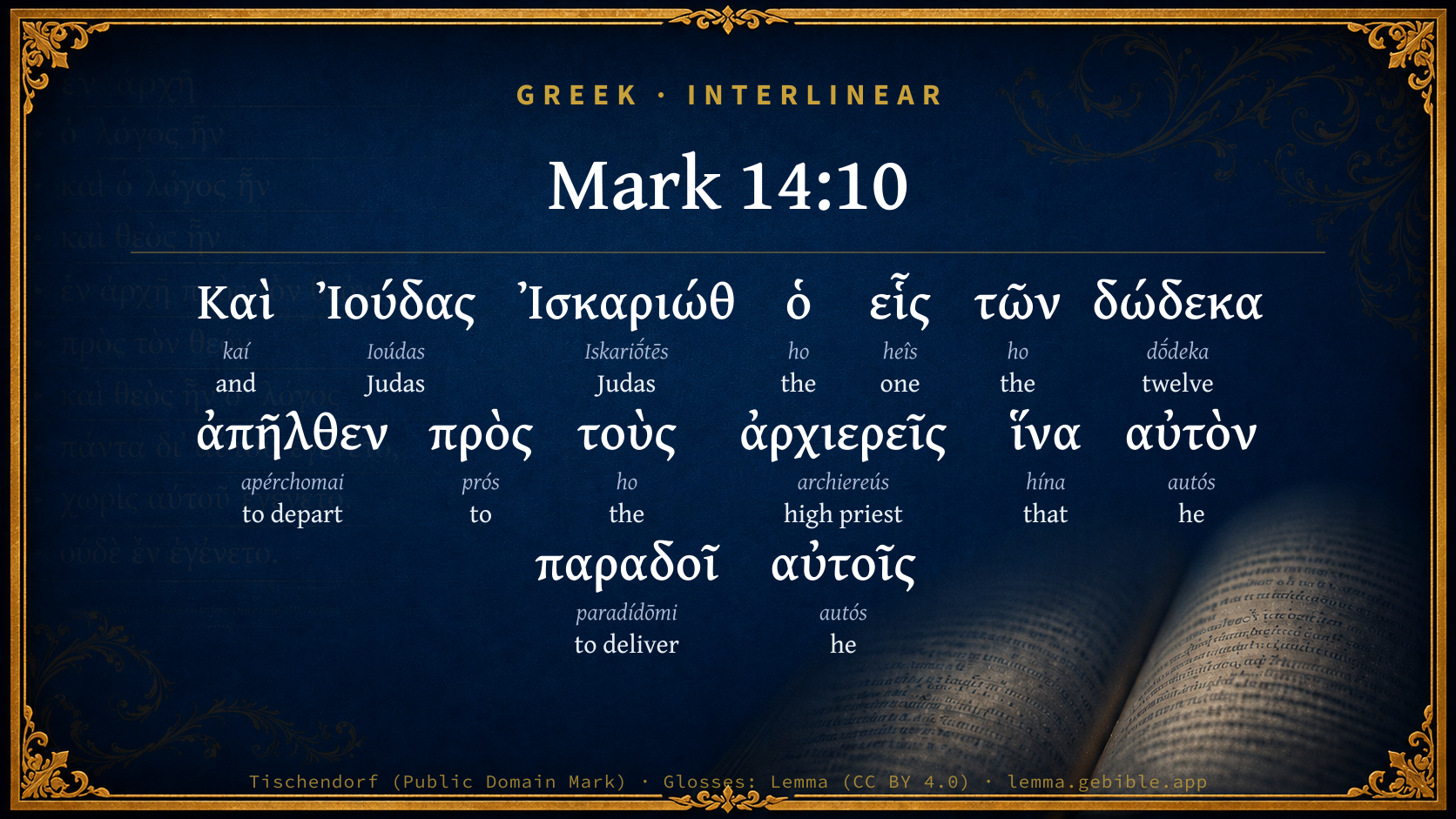
  1. Καὶ kaí G2532 “and” Conjunction
  2. Ἰούδας Ioúdas G2455 “Judas” Noun, Nominative, Singular, Masculine
  3. ὁ ho G3588 “the” Article, Nominative, Singular, Masculine
  4. εἷς heîs G1520 “one” Adjective, Nominative, Singular, Masculine
  5. τῶν ho G3588 “the” Article, Genitive, Plural, Masculine
  6. δώδεκα dṓdeka G1427 “twelve” Adjective, Numeral (indeclinable)
  7. ἀπῆλθεν apérchomai G565 “to depart” Verb, Aorist, Active, Indicative, 3rd person, Singular
  8. πρὸς prós G4314 “to” Preposition
  9. τοὺς ho G3588 “the” Article, Accusative, Plural, Masculine
  10. ἀρχιερεῖς archiereús G749 “high priest” Noun, Accusative, Plural, Masculine
  11. ἵνα hína G2443 “that” Conjunction
  12. αὐτὸν autós G846 “he” Personal pronoun, Accusative, Singular, Masculine
  13. παραδοῖ paradídōmi G3860 “to deliver” Verb, Aorist, Active, Subjunctive, 3rd person, Singular
  14. αὐτοῖς autós G846 “he” Personal pronoun, Dative, Plural, Masculine

About this verse

These counts appear in no published source. They are computed here, from the morphology-tagged text and Lemma’s own curated glosses. What Lemma adds →

15
words
12
distinct lemmas
Gospels
section

Notable vocabulary

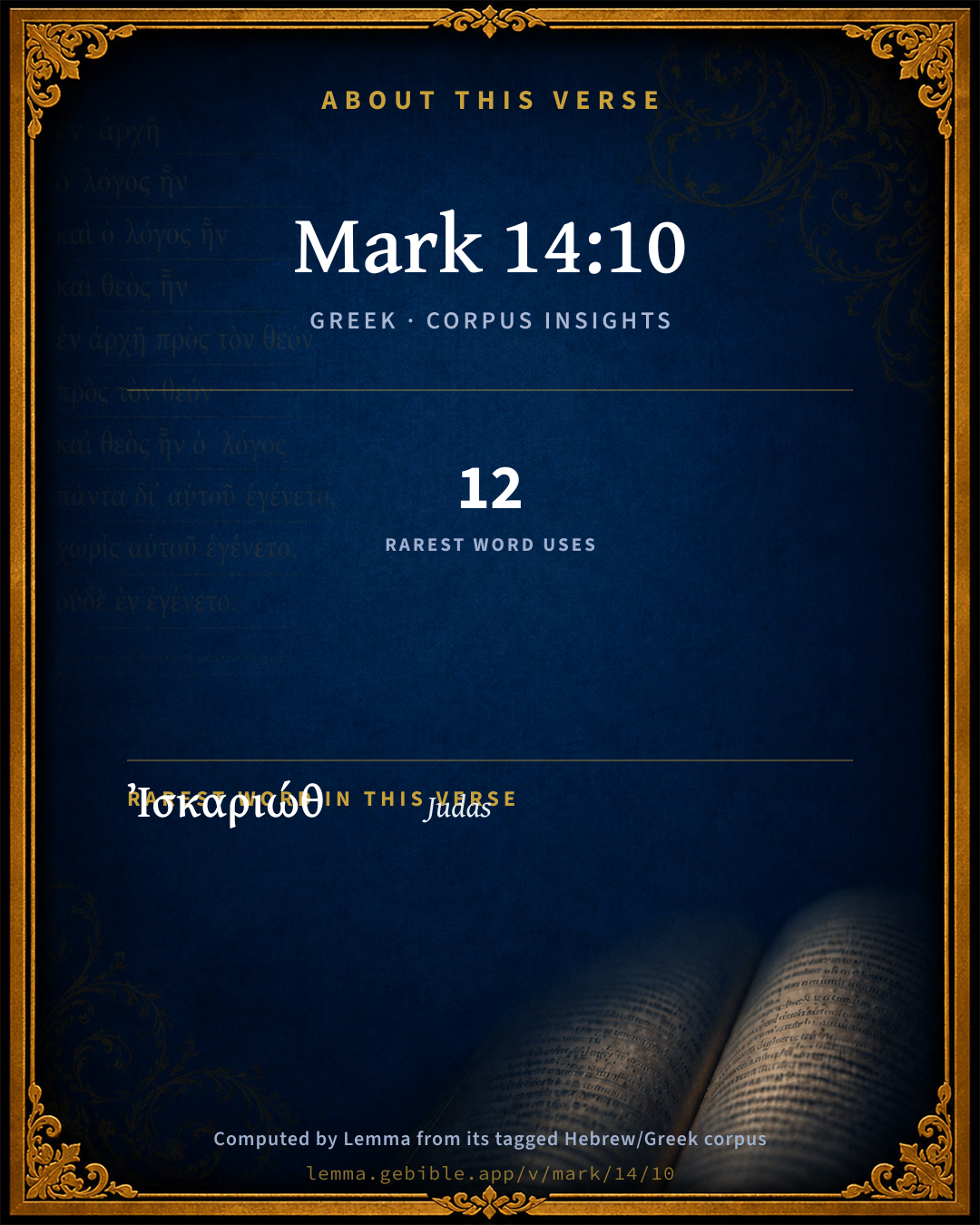
The rarest word here is Ἰσκαριώθ Judas G2469 — appearing just 12 times in the whole Greek New Testament.

Shared distinctive vocabulary

Ἰσκαριώθ Judas G2469 occurs in 12 verses of the Greek New Testament. Also found in:

Repetition

Words recur within this verse:

Cross-references

9

Topical passages linked to Mark 14:10 in the Treasury of Scripture Knowledge — connected by theme and wording, ordered by reader-vote popularity; previews shown in the World English Bible.

  • Luke 22:3–6 Satan entered into Judas, who was surnamed Iscariot, who was numbered with the twelve.
  • Matthew 26:14–16 Then one of the twelve, who was called Judas Iscariot, went to the chief priests,
  • John 13:2 After supper, the devil having already put into the heart of Judas Iscariot, Simon's son, to betray him,
  • Psalms 41:9 Yes, my own familiar friend, in whom I trusted, Who ate bread with me, Has lifted up his heel against me.
  • Psalms 55:12–14 For it was not an enemy who insulted me, Then I could have endured it. Neither was it he who hated me who raised himself up against me, Then I would have hid myself from him.
  • Matthew 10:4 Simon the Canaanite; and Judas Iscariot, who also betrayed him.
  • John 6:70–71 Jesus answered them, "Didn't I choose you, the twelve, and one of you is a devil?"
  • John 13:30 Therefore, having received that morsel, he went out immediately. It was night.
  • Mark 3:19 and Judas Iscariot, who also betrayed him. He came into a house.

Cross-references courtesy of OpenBible.info (CC BY 4.0).

Commentary

Notes on Mark 14:10 from classic Christian and Jewish commentators (each source and its license shown beneath its notes). The classic Christian expositions comment on the surrounding passage and are grouped to its opening verse, so a note may address several verses; the Jewish commentaries on the Tanakh (Rashi and others) are per-verse, so they appear only where the commentator wrote on this verse.

Lemma curates 59 commentaries, every one of them public domain or Creative Commons licensed, each selected and text-cleaned for this edition rather than reprinted as found. About our sources →

Joseph Benson's Commentary

Mar 14:10-16. Judas went unto the chief priests, &c. — Immediately after this reproof, having anger now added to his covetousness. See these verses explained in the notes on Mat 26:14-19. There shall meet you a man bearing a pitcher of water — It was highly seasonable for our Lord to give them this additional proof, both of his knowing all things, and of his influence over the minds of men; follow him — If our Lord meant that the man would be coming out of the city as the disciples were going in, his order implied, that they were to turn back with him, the house whither he was carrying the water being somewhere in the suburbs; but if he meant that the man would meet them at the crossing of a street, or the turning of a corner, they were to go with him perhaps farther into the city. The expression used by Luke, συναντησει υμιν, seems to favour this supposition. Say ye to the good man of the house — To the master of the family; The Master saith, Where is the guest-chamber, &c. — Commentators on this passage tell us, from the Talmudists, that in Jerusalem, at the passover, the houses were not to be let, but were of common right for any one to eat the passover in them. He will show you a large upper room furnished — Greek, εστρομενον, stratum, spread, namely, with a carpet; and prepared — Having beds or couches placed to recline on. “The English word,” says Dr. Campbell, “which comes nearest the import of the Greek, is carpeted. But when this term is used, as here, of a dining-room, it is not meant only of the floor, but of the couches, on which the guests reclined at meals. On these they were wont, for the sake both of neatness and of conveniency, to spread a coverlet or carpet. As this was commonly the last thing they did in dressing the room, it may not improperly be employed to denote the whole.” There make ready for us — There provide the unleavened bread, the lamb, and the bitter herbs, and make all things ready against the time of our coming. Christ does not order one or both of these disciples to return and inform him and the others where they had made this preparation, and to direct them to the house. This was unnecessary; for the same prophetic gift which enabled Jesus to predict these circumstances, would easily guide him to the house; and it is a beautiful modesty in the sacred historian not to notice it. His disciples went forth — After our Lord had given these particular instructions, the two disciples whom he sent went out from thence, came into the city, and found all the circumstances as Jesus had predicted. It is justly observed by Mr. Scott here, that “nothing could be less the object of natural sagacity and foresight than the events here mentioned. Had the two disciples come to the place specified rather sooner or later than they did, the man bearing the pitcher of water would either not have arrived, or would have been gone. But our Lord knew that the owner of a certain commodious house in Jerusalem favoured him; he foresaw that at a precise time of the day he would send his servant for a pitcher of water; that the disciples would meet him just when they entered the city; that by following him they would find out the person whom he intended; and that by mentioning him as the master, or the teacher, the owner of the house would readily consent to accommodate them in an upper chamber. When the disciples found all these circumstances so exactly accord to the prediction, they could not but be deeply impressed with a conviction of their Lord’s knowledge of every event, and of his influence over every heart.”

Joseph Benson's Commentary on the Old and New Testaments (1811–1818) — public domain. Text from a community e-Sword module.

Godbey's Commentary on the New Testament

William B. Godbey

TREASON OF JUDAS

Mat 26:14-16; Mar 14:10-11; Luk 22:3-6. “But Satan entered into Judas, called Iscariot, being of the number of the twelve.” There is not an intimation against Judas till about the close of the second year of our Lord’s ministry. (Joh 6:64-71) Judas had faithfully preached these two years with the other eleven, his financial office infelicitously conducing to that fatal development of money-love. This whole year he has been gradually wrought upon more and more by Demon Avarice. Now, he even has the impudence to speak out overtly at the supper condemnatory of Mary for her lavish prodigality in pouring forty-five dollars’ worth of Oriental myrrh on the head of the Savior. Of course, this bold step encouraged Satan, who had long been tinkering with him and pulling on him, so that he proceeded at once to enter into him, thus gaining a decisive victory, and taking possession of him.

“And having gone away, he spoke with the high priests and captains as to how he might deliver Him to them.” These captains were the officers of the temple guards. The holy Temple Campus is said to contain thirty-five acres. Most of it is open pavement, where the Moslem millions now assemble on their great religious anniversaries; but where the children of Abraham, in the good olden time, used to gather, not only from all parts of Canaan, but from their Gentile dispersions in all the ends of the earth. As Jesus was a native Jew, He was never prohibited from coming into this holy area. At present, any Jew entering that holy place would be instantly killed. I have entered it twice, and both times guarded by Turkish soldiers, with loaded guns, so long as I remained in the sacred inclosure. Hence that holy place, from the days of David and Solomon, has been constantly guarded by soldiers. Of course, these temple guards were subject to the ipse dixit of the hierarchy.

“And they rejoiced, and contracted with him to give money [i. e., thirty pieces of silver, as Matthew says]. And he promised them, and continued to seek opportunity to deliver Him to them without a mob.” Such was the popularity of Jesus with the common people, that they constantly anticipated and feared that, in case of an attempt to arrest Him, a mob would rise, take Him out of their hands, and do them violence.

William B. Godbey, Commentary on the New Testament (1896–1900) — public domain. Text from a community e-Sword module.

The Expositor's Bible

CHAPTER 14:10-16 (Mar_14:10-16)

THE TRAITOR

"And Judas Iscariot, he that was one of the twelve, went away unto the chief priests, that he might deliver Him unto them. And they, when they heard it, were glad, and promised to give him money. And he sought how he might conveniently deliver Him unto them. And on the first day of unleavened bread, when they sacrificed the passover, His disciples say unto Him, Where wilt Thou that we go and make ready that Thou mayest eat the passover? And He sendeth two of His disciples, and saith unto them, Go into the city, and there shall meet you a man bearing a pitcher of water: follow him; and wheresoever he shall enter in, say to the goodman of the house, the Master saith, Where is My guest-chamber, where I shall eat the passover with My disciples? And he will himself shew you a large upper room furnished and ready: and there make ready for us. And the disciples went forth, and came into the city, and found as He had said unto them: and they made ready the passover." Mar_14:10-16 (R.V.)

IT was when Jesus rebuked the Twelve for censuring Mary, that the patience of Judas, chafing in a service which had grown hateful, finally gave way. He offered a treacherous and odious help to the chiefs of his religion, and these pious men, too scrupulous to cast blood-money into the treasure or to defile themselves by entering a pagan judgment hall, shuddered not at the contact of such infamy, warned him not that perfidy will pollute the holiest cause, care as little then for his ruin as when they asked what to them was his remorseful agony; but were glad, and promised to give him money. By so doing, they became accomplices in the only crime by which it is quite certain that a soul was lost. The supreme "offense" was planned and perpetrated by no desperate criminal. It was the work of an apostle, and his accomplices were the heads of a divinely given religion. What an awful example of the deadening power, palsying the conscience, petrifying the heart, of religious observances devoid of real trust and love.

The narrative, as we saw, somewhat displaced the story of Simon's feast, to connect this incident more closely with the betrayal. And it now proceeds at once to the Passover, and the final crisis. In so doing, it pauses at a curious example of circumspection, intimately linked also with the treason of Judas. The disciples, unconscious of treachery, asked where they should prepare the paschal supper. And Jesus gave them a sign by which to recognize one who had a large upper room prepared for that purpose, to which he would make them welcome. It is not quite impossible that the pitcher of water was a signal preconcerted with some disciple in Jerusalem, although secret understandings are not found elsewhere in the life of Jesus. What concerns us to observe is that the owner of the house which the bearer entered was a believer. To him Jesus is "the Master," and can say "Where is My guest-chamber?"

[NOTE: Carrying water was women's work; a man carrying a pitcher of water would be unusual.]

So obscure a disciple was he, that Peter and John require a sign to guide them to his house. Yet his upper room would now receive such a consecration as the Temple never knew. With strange feelings would he henceforth enter the scene of the last supper of his Lord. But now, what if he had only admitted Jesus with hesitation and after long delay? We should wonder; yet there are lowlier doors at which the same Jesus stands and knocks, and would fain come in and sup. And cold is His welcome to many a chamber which is neither furnished nor made ready.

The mysterious and reticent indication of the place is easily understood. Jesus would not enable His enemies to lay hands upon Him before the time. His nights had hitherto been spent at Bethany; now first it was possible to arrest Him in the darkness, and hurry on the trial before the Galileans at the feast, strangers and comparatively isolated, could learn the danger of their "prophet of Galilee." It was only too certain that when the blow was struck, the light and fickle adhesion of the populace would transfer itself to the successful party. Meanwhile, the prudence of Jesus gave Him time for the Last Supper, and the wonderful discourse recorded by St. John, and the conflict and victory in the Garden. When the priests learned, at a late hour, that Jesus might yet be arrested before morning, but that Judas could never watch Him any more, the necessity for prompt action came with such surprise upon them, that the arrest was accomplished while they still had to seek false witnesses, and to consult how a sentence might best be extorted from the Governor. It is right to observe at every point, the mastery of Jesus, the perplexity and confusion of His foes.

And it is also right that we should learn to include, among the woes endured for us by the Man of Sorrows, this haunting consciousness that a base vigilance was to be watched against, that He breathed the air of treachery and vileness.

Here then, in view of the precautions thus forced upon our Lord, we pause to reflect upon the awful fall of Judas, the degradation of an apostle into a hireling, a traitor, and a spy. Men have failed to believe that one whom Jesus called to His side should sink so low.

They have not observed how inevitably great goodness rejected brings out special turpitude, and dark shadows go with powerful lights; how, in this supreme tragedy, all the motives, passions, moral and immoral impulses are on the tragic scale; what gigantic forms of baseness, hypocrisy, cruelty, and injustice stalk across the awful platform, and how the forces of hell strip themselves, and string their muscles for a last desperate wrestle against the powers of heaven, so that here is the very place to expect the extreme apostasy. And so they have conjectured that Iscariot was only half a traitor. Some project had misled him of forcing his Master to turn to bay.

Then the powers which wasted themselves in scattering unthanked and unprofitable blessings would exert themselves to crush the foe. Then he could claim for himself the credit deserved by much astuteness, the consideration due to the only man of political resource among the Twelve. But this well-intending Judas is equally unknown to the narratives and the prophecies, and this theory does not harmonize with any of the facts. Profound reprobation and even contempt are audible in all the narratives; they are quite as audible in the reiterated phrase, "which was one of the Twelve," and in almost every mention of his name, as in the round assertion of St. John, that he was a thief and stole from the common purse. Only the lowest motive is discernible in the fact that his project ripened just when the waste of the ointment spoiled his last hope from apostleship, -- the hope of unjust gain, and in his bargaining for the miserable price which he still carried with him when the veil dropped from his inner eyes, when he awoke to the sorrow of the world which worketh death, to the remorse which was not penitence.

One who desired that Jesus should be driven to counter-measures and yet free to take them, would probably have favored His escape when once the attempt to arrest Him inflicted the necessary spur, and certainly he would have anxiously avoided any appearance of insult. But it will be seen that Judas carefully closed every door against his Lord's escape, and seized Him with something very like a jibe on his recreant lips.

No, his infamy cannot be palliated, but it can be understood. For it is a solemn and awful truth, that in every defeat of grace the reaction is equal to the action; they who have been exalted unto heaven are brought down far below the level of the world; and the principle is universal that Israel cannot, by willing it, be as the nations that are round about, to serve other gods. God Himself gives him statutes that are not good. He makes fat the heart and blinds the eyes of the apostate. Therefore it comes that religion without devotion is the mockery of honest worldlings; that hypocrisy goes so constantly with the meanest and most sordid lust of gain, and selfish cruelty; that publicans and harlots enter heaven before scribes and Pharisees; that salt which has lost its savor is fit neither for the land nor for the dung-hill. Oh, then, to what place of shame shall a recreant apostle be thrust down?

Moreover it must be observed that the guilt of Judas, however awful, is but a shade more dark than that of his sanctimonious employers, who sought false witnesses against Christ, extorted by menace and intrigue a sentence which Pilate openly pronounced to be unjust, mocked His agony on the cross, and on the resurrection morning bribed a pagan soldiery to lie for the Hebrew faith. It is plain enough that Jesus could not and did not choose the apostle through foreknowledge of what they would hereafter prove, but by His perception of what they then were, and what they were capable of becoming, if faithful to the light they should receive.

Not one, when chosen first, was ready to welcome the purely spiritual kingdom, the despised Messiah, the life of poverty and scorn. They had to learn, and it was open to them to refuse the discipline. Once at least they were asked, Will ye also go away? How severe was the trial may be seen by the rebuke of Peter, and the petition of "Zebedee's children" and their mother. They conquered the same reluctance of the flesh which overcame the better part in Judas. But he clung desperately to secular hope, until the last vestige of such hope was over. Listening to the warnings of Christ against the cares of this world, the lust of other things, love of high places and contempt of lowly service, and watching bright offers rejected and influential classes estranged, it was inevitable that a sense of personal wrong, and a vindictive resentment, should spring up in his gloomy heart. The thorns choked the good seed. Then came a deeper fall. As he rejected the pure light of self-sacrifice, and the false light of his romantic daydreams faded, no curb was left on the baser instincts which are latent in the human heart. Self-respect being already lost, and conscience beaten down, he was allured by low compensations, and the apostle became a thief. What better than gain, however sordid, was left to a life so plainly frustrated and spoiled? That is the temptation of disillusion, as fatal to middle life as the passions are to early manhood. And this fall reacted again upon his attitude towards Jesus. Like all who will not walk in the light, he hated the light; like all hirelings of two masters, he hated the one he left. Men ask how Judas could have consented to accept for Jesus the blood-money of a slave. The truth is that his treason itself yielded him a dreadful satisfaction, and the insulting kiss, and the sneering "Rabbi," expressed the malice of his heart. Well for him if he had never been born. For when his conscience awoke with a start and told him what thing he had become, only self-loathing remained to him. Peter denying Jesus was nevertheless at heart His own; a look sufficed to melt him. For Judas, Christ was become infinitely remote and strange, an abstraction, "the innocent blood," no more than that. And so, when Jesus was passing into the holiest through the rent veil which was His flesh, this first Antichrist had already torn with his own hands the tissue of the curtain which hides eternity.

Now let us observe that all this ruin was the result of forces continually at work upon human hearts. Aspiration, vocation, failure, degradation -- it is the summary of a thousand lives. Only it is here exhibited on a vast and dreadful scale (magnified by the light which was behind, as images thrown by a lantern upon a screen) for the instruction and warning of the world.

William Robertson Nicoll, ed., The Expositor's Bible (London: Hodder & Stoughton, 1887–1910) — public domain. 65 of 66 books (1 Corinthians is not separately keyed, as that volume carries no machine-parseable verse references); section-level commentary keyed to the opening verse. Introductory and overview sections not keyed to a specific passage are excluded.

Tyndale Open Study Notes

Tyndale Open Resources

14:10-11 In sharp contrast to the woman, Judas Iscariot, one of the twelve disciples, offered to betray Jesus for money (Matt 26:15; 27:3, 9).

Tyndale Open Study Notes — © Tyndale Open Resources, licensed CC BY-SA 4.0. Text via the HelloAO Bible API.

Meyer's Critical & Exegetical Commentary

Heinrich August Wilhelm Meyer

Mar_14:10-11. See on Mat_26:14-16. Comp. Luk_22:3-6.

εἶς τῶν δώδεκα] has a tragic stress.

Meyer — Critical and Exegetical Commentary on the New Testament — English translation by Peter Christie, edited by Frederick Crombie (T&T Clark, 1880) — public domain. Text from a community e-Sword module.

Expositor's Greek Testament

ed. W. Robertson Nicoll

Mar 14:10-11 . Judas offers to betray his Master (Mat 26:14-16 , Luk 22:3-6 ).

The Expositor's Greek Testament, edited by W. Robertson Nicoll (1897–1910) — public domain. Text from a community e-Sword module.

Geneva Bible (1599)

Geneva Bible translators

Covetousness cloaked with a zeal of charity, is an occasion to betray and crucify Christ.

Geneva Bible (1599) marginal notes — public domain. Text via Bolls.life.

Ellicott's Commentary for English Readers

(10, 11) And Judas Iscariot.—See Notes on Mat_26:14-15.

A Bible Commentary for English Readers, edited by Charles John Ellicott (1878–1897) — public domain. Text from a community e-Sword module.

The Cambridge Bible for Schools and Colleges

gen. ed. J. J. S. Perowne

10, 11. The Compact of Judas with the Chief Priests

10. And Judas Iscariot] The words “to the burying” must have fallen like the death knell of all his Messianic hopes on the ears of Judas Iscariot, “the only southern Jew among the Twelve,” and this, added to the consciousness that his Master had read the secret of his life (Joh_12:6), filled his soul with feelings of bitterest mortification and hostility. Three causes, if we may conjecture anything on a subject so full of mystery, would seem to have brought about his present state of mind, and precipitated the course which he now took: (1) avarice; (2) disappointment of his carnal hopes; (3) a withering of internal religion.

(i) Avarice. We may believe that his practical and administrative talents caused him to be made the almoner of the Apostles. This constituted at once his opportunity and his trial. He proved unfaithful to his trust, and used the common purse of the brotherhood for his own ends (Joh_12:6). The germs of avarice probably unfolded themselves very gradually, and in spite of many warnings from his Lord (Mat_6:19-34; Mat_13:22-23; Mar_10:25; Luk_16:11; Joh_6:70), but they gathered strength, and as he became entrusted with larger sums, he fell more deeply.

(ii) Disappointment of his carnal hopes] Like all his brother Apostles, he had cherished gross and carnal views of the Messianic glory, his heart was set on the realization of a visible kingdom, with high places, pomp, and power. If some of the brotherhood were to sit on thrones (Mat_19:28), might he not obtain some post, profitable if not splendid? But the issue of the Triumphal Entry, and the repeated allusions of his Master to His death and His burying, sounded the knell of all these temporal and earthly aspirations.

(iii) A withering of internal religion] He had been for three years close to Goodness Incarnate, but the good seed within him had become choked with the thorns of greed and carnal longings. “The mildew of his soul had spread apace,” and the discovery of his secret sin, and its rebuke by our Lord at Bethany, turned his attachment to his Master more and more into aversion. The presence of Goodness so close to him ceasing to attract had begun to repel, and now in his hour of temptation, while he was angry at being suspected and rebuked, and possibly jealous of the favour shewn to others of the brotherhood, arose the question, prompted by none other than the Evil One (Luk_22:3), Why should he lose everything? Might he not see what was to be gained by taking the other side? (Mat_26:15).

went unto the chief priests] Full of such thoughts, in the darkness of the night he repaired from Bethany to Jerusalem, and being admitted into the council of the chief priests asked what they would give him for betraying his Master into their hands.

The Cambridge Bible for Schools and Colleges (gen. ed. J. J. S. Perowne; Cambridge University Press, 1878–1918) — public domain. Text from a community e-Sword module.

John Gill's Exposition

And Judas Iscariot, one of the twelve,.... Apostles of Christ; who was the principal person that had indignation at the woman, and murmured against her, for the profusion of the ointment:

went unto the chief priests; as soon as this affair was over, and Christ had defended the woman's conduct to his shame and silence: he immediately went out of the house, where they were, and set out from Bethany to Jerusalem; and understanding the chief priests were in consultation together at Caiaphas's house, how to apprehend Jesus, and put him to death, went directly to them, unsent for, and unthought of by them:

to betray him unto them; which Satan had put into his heart, and what his avarice and revenge for the late action of the woman, and Christ's defence of it, prompted him to; See Gill on Mat 26:14.

John Gill's Exposition of the Whole Bible (1746–1763) — public domain (CC PDM 1.0). Text via the HelloAO Bible API.

Trapp's Complete Commentary

John Trapp

10 And Judas Iscariot, one of the twelve, went unto the chief priests, to betray him unto them.

Ver. 10. {See Trapp on "Mat 26:14"}

John Trapp, A Commentary or Exposition upon All the Books of the Old and New Testament (1647–1656) — public domain. Text from a community e-Sword module.

Haydock's Catholic Bible Commentary

Many of the present day shudder at the thought of the horrid and inexpressible crime of Judas, in betraying his Master, his Lord, and his God, and yet do not take care to avoid the like wickedness themselves; for, as often as for a little gain they neglect the duties of faith and charity, they become traitors to God, who is charity and faith. (Ven. Bede)

George Leo Haydock (1774–1849), Haydock's Catholic Family Bible and Commentary, 1859 edition — public domain. Excludes Psalms (Douay-Rheims chapter numbering differs from Protestant) and Deuterocanonical books (Catholic canon only).

Matthew Poole's English Annotations

See Poole on "Mat 26:17", and following verses to Mat 26:19.

Matthew Poole's English Annotations on the Holy Bible (1683–1685) — public domain. Text from a community e-Sword/MySword module.

The Pulpit Commentary

And Judas Iscariot, he that was one of the twelve (o eiv twn dwdeka), went away unto the chief priests, that he might deliver him unto them. The betrayal follows immediately after the anointing by Mary. We may suppose that the other disciples who had murmured on account of this waste of the ointment, were brought to their senses by our Lord"s rebuke, and felt its force. But with Judas the case was very different. The rebuke, which had a salutary effect on them, only served to harden him. He had lost one opportunity of gain; he would seek another. In his cupidity and wickedness he resolves to betray his Master, and sell him to the Jews. So while the chief priests were plotting how they might destroy him, they found an apt and unexpected instrument for their purpose in one of his own disciples. Judas came to them, and the vile and hateful bargain was concluded. It marks the tremendous iniquity of the transaction that it was "one of the twelve" who betrayed him not one of the seventy, but one of those who were in the closest intimacy and nearness to him.

Vers. 10, 11. The traitor.

That there should be a traitor in the camp of our Lord"s followers and professed friends, may be regarded as an instance of the Divine

forbearance, which tolerated one so unworthy, and also as a fulfillment of the predictions of Scripture. The fact is, however, one which is fraught with instruction and warning to every disciple of the Lord.

I THE AGGRAVATIONS OF THE TRAITOR"S GUILT. These are to be recognized in two circumstances which have been recorded regarding Judas Iscariot.

1. He was not only a disciple and follower of Jesus; he was actually one of the twelve. These were admitted to an especial intimacy with Jesus; they knew his movements, they shared his privacy, they heard his language of friendship and partook his counsels. All this made the treachery of one of this select band the more guilty and reprehensible.

2. He was entrusted with office in the little society to which he belonged. The treasurer of the twelve although, doubtless, their means were always small Judas bare the bag, and made the purchases necessary for the wants of the companions, and even gave from the general poverty for the relief of those poorer than they. He was accordingly a trusted official, who abused the confidence reposed in him.

II THE MOTIVES TO THE TRAITOR"S GUILT. These were probably two.

1. Judas was dissatisfied with his Master"s methods. Doubtless his expectations were of a carnal character; he wished Jesus to declare himself a King, and to assign to his twelve friends posts honorable and lucrative in this new kingdom. It may have been to hasten on this catastrophe that the Iscariot acted as he did.

2. Judas was covetous, and was prompted in his treason by the love of money. He secured from the chief priests the thirty shekels which formed the customary price of a slave price of him that was valued!" Surely it is a warning against avarice and covetousness, to find a professed friend of Jesus misled by these degrading vices!

III THE OUTCOME OF THE TRAITOR"S GUILT.

1. It might have been difficult for our Lord"s enemies to have seized him had they not been in the confidence of one of his companions. There were obvious reasons why the arrest could not have taken place at Bethany or in Jerusalem. It was the duplicity and treachery of Judas that suggested the garden of prayer as the scene of this disgraceful apprehension.

2. To Judas the consequences were terrific. In remorse and despair he afterwards took his life.

3. Yet how was all this overruled for wise and gracious ends! The treachery of the Iscariot was the occasion of the crucifixion of Jesus, and this was the means of the salvation of the world!

Vers. 10, 11. Volunteering to betray.

The "and" connects this with the preceding paragraph, not only historically but psychologically. His present action was (immediately) determined by the gift of Mary and the mild rebuke of the Master.

I THE CRIME CONTEMPLATED. To deliver up Christ to his enemies. Whether he fully realized how much was involved as a result of this step is uncertain. He might imagine that not death, but the checking of his Master upon the career he had marked out, would ensue. But there is recklessness as to any consequences, provided he himself should be no loser. In robbing the alms from the bag, he was guilty of a breach of trust; in this new development of his master passion the unfaithfulness culminated. It is manifest that the spiritual side of Christ"s ministry had for him no value. It was only the earthly rewards that might attend on discipleship that made it attractive to him. Was it to force the hand of the ideal, unpractical Christ that he sought to deliver him up? A miracle of deliverance might then result in a realization greater than his most brilliant hopes could depict, and thus his (passing) act of villainy be condoned. Or was it in sheer disgust and desperation respecting the course affairs seemed to be taking that he conceived of his deed? We cannot tell. In a mind like that of Judas there are depths beyond depths.

II THE MOTIVE. That selfishness was at the root we may be sure. Avarice is the direction it took. He proposed money, and asked how much. (Mat_26:15) Thirty pieces of silver a small sum? Yes, but he might be at that moment in real or fancied need, or the amount might be looked upon as a mere installment of further reward, when he might have made himself useful, perhaps necessary, to the rulers. Fear of consequences, if he followed Christ further in the direction in which he was moving, may also have influenced his mind. And there can be no question as to the immediate impulse of wounded feeling, through baffled dishonesty and the sense that Christ saw through him. Falling short of the higher illumination and power of the Spirit, he was at the mercy of his own base, earthly nature.

III CONSPIRING CIRCUMSTANCES. The background to all this mental and spiritual movement on the part of Judas is the attitude of the chief priests and scribes, "seeking how they might take" Christ. But for opportunity afforded the treachery of Judas might have remained an aimless mood or a latent disposition, instead of becoming a definite purpose. In this consists the danger of unspiritual states of mind: they subject those in whom they are indulged to the tyranny of passing influences and circumstances. M.

Vers. 10, 11, 17-21, 43-52. Betrayal.

We now approach the darkest of all the dark hours through which our Redeemer passed in this world, so overcast with clouds. "The Son of man is betrayed into the hands of men." It was by "one of the twelve," and "unto the chief priests," and for "money

I What lessons on THE FRAILTY OF THE POOR HUMAN HEART! The hand that received "the sop," that dipped into the same dish with Jesus, received into its hardened palm the miserable pittance a slave"s price. Ah! even in the presence of the holy One could he plot and scheme for his delivery. Let us, when we decry the deed, bow our heads lowly, remembering that we share the same frail nature. How barefaced the lie walking, reclining, talking with the little band, carrying their common purse, and so trusted by them all, yet stealing away in the darkness to meet his enemies and plot with them how, "in the absence of the multitude," he could deliver him unto them! And going so far as to choose the symbol of brotherly affection a kiss to be the sign by which in the darkness they should distinguish him! "Woe unto that man through whom the Son of man is betrayed! good were it for that man if he had not been born." Truly so; for what theory or process of restoration could prevent the name Judas from being for ever the symbol of treachery and base desertion and sordid misery. "Woe," indeed! "And he went away and hanged himself." It is impossible to contemplate the heights from which men have fallen into deep abysses, without a feeling of shame and humiliation. But it would be wrong to think of them without being warned by them of the sad possibilities to which we are all exposed.

II THE INSUFFICIENCY OF OFFICE TO SECURE ITS RIGHTFUL SPIRIT. The parallel of Judas"s infamy is found in the men who stood as the head and representatives of the very religion it was Jesus" high mission to fulfill and perfect. How deplorable is the contrast between the sanctity of the position held by these officials and the spirit in which they held it! It was theirs to be the leaders of religious thought, and the embodiment of the religious spirit. But the sad testimony is borne to the insufficiency of official relationship to secure the true spirit of office. Truly may the Shepherd say, "I was wounded in the house of my friends;" and the poor one, "yea, mine own familiar friend, in whom I trusted, which did eat of my bread, hath lifted up his heel against me.

III THE POWER OF COVETOUSNESS. And this was all for money! Well might it be written, "For the love of money is a root of all kinds of evil." But it is needful to return to the preceding incident to find the hidden clue to such a deed of darkness. St. John has left the sad record, "He was a thief, and having the bag took away what was put therein." So, yielding little by little to the love of pelf, this chosen one, who harbored the demon of covetousness within the folds of his dress, had lost all strength of virtue, and being overcome of evil, and under the influence of a master-passion, sold his Master for thirty pieces of silver price of him that was priced, whom certain of the children of Israel did price." But our thoughts should rest less upon the faithless disciple or the more faithless priests than upon the patient, submissive One who drank so deeply of our cup. He who descended to that lowest condition of human shame was found, like the slaves in the market, "priced" and sold. Revolting from that unfaithfulness which could sell a friend for gain, from that love of pelf which could crush all the fine and noble and generous feelings of the heart, even closing it to the sweet, winning voice of him who spake as never man spake revolting equally from that deceitfulness which could occupy holy ofice without the slightest apprehension of the sanctity of demeanor, or the slightest possession of the purity of spirit due to such a position let us mark and imitate the lowly, patient, self-possessed, forgiving, trustful spirit of him who endured all that the Scriptures of the prophets might be fulfilled, that the will of the Father might be done, that the redemption of the lost might be effected. G.

Vers. 10, 11. Black conspiracy.

I "THE BEST INFLUENCES FOR GOOD MAY RE RESISTED AND BECOME VAIN.

II "HYPOCRISY PREPARES FOR DISHONESTY AND ALL WICKEDNESS" (Godwin). J.

The Pulpit Commentary (1880–1919), ed. H.D.M. Spence-Jones & Joseph S. Exell — public domain. Text from a community e-Sword module.

John Wesley's Explanatory Notes

Judas went to the chief priests - Immediately after this reproof, having anger now added to his covetousness. Matt. xxvi, 14; Luke xxii, 3.

John Wesley, Explanatory Notes Upon the Whole Bible (1754–1765) — public domain. Text via the GEBible commentary corpus.

Kretzmann's Popular Commentary

Paul E. Kretzmann

The Preparation for, and the Celebration of, the Passover.

Judas offers to betray Jesus:

v. 10. And Judas Iscariot, one of the Twelve, went unto the chief priests to betray Him unto them.

v. 11. And when they heard it, they were glad, and promised to give him money. And he sought how he might conveniently betray Him.

The public reprimand which Judas had received in the house of Simon in Bethany, when he voiced his displeasure over the woman’s deed of kindness, seems to have been the direct motive for his betrayal. His downward road was similar to that of many that do not cling to the Savior with all simplicity of heart. The fact that he was treasurer of the disciples taught him to crave money and nourished his pride. Soon he loved money, he worshiped gold, he was most anxious to possess all that he could. Ordinary, honest methods of obtaining it did not appeal to him anymore, they were too slow; so he became a thief. And now Christ’s defense of the woman had roused his anger. One of the Twelve he had been chosen, one of the Twelve he still was, in appearance, but he now went to the chief priests in order to betray his Lord and Master to them. And they? On this matter, where it concerned the murder of an innocent person, they were only too glad to give him audience; they were filled with hellish glee as they contemplated the destruction of the hated Nazarene. They gave him the assurance that they would give him silver, that they would pay him well for his nefarious deed. And Judas, hardened against all the warnings of his conscience, against all appeals of his better nature, from that hour deliberately sought opportunity, how he might betray Jesus at a most convenient time. Judas is a terrible example of the power of Satan over the heart that deliberately leaves and rejects the Lord.

Paul E. Kretzmann, Popular Commentary of the Bible (1921–1924) — public domain. Text from a community e-Sword module.

Burkitt's Expository Notes on the New Testament

William Burkitt

Observe here, 1. The person betraying our blessed Redeemer: Judas, Judas a professor; Judas, a preacher; Judas, an apostle; and one of the twelve whom Christ had chosen out of all the world to be his dearest friends, his family and household; shall we wonder to find friends unfriendly or unfaithful to us, when our Saviour had a traitor in his own family!

Observe, 2. The heinous nature of Judas’s sin, he betrayed Jesus; Jesus his Maker, Jesus his Master. It is no strange or uncommon thing for the vilest of sins, and most horrid impieties, to be acted by such persons, as make the most eminent profession of holiness and religion.

Observe, 3. What was the occasion that led Judas to the commission of this sin: It was his inordinate love of money. I do not find that Judas had any particular malice, spite, or ill will, against our Saviour, but a base and unworthy spirit of covetousness possessed him, and this made him sell his Master. Covetousness is the root-sin. An eager and insatiable thirst after the world, is a parent of the most monstrous and unnatural sins; for which reason our Saviour doubles his caution, Take heed, and beware of covetousness Luk 12:15. It shews us both the danger of the sin, and great care we ought to take to preserve ourselves from it.

William Burkitt's Expository Notes on the New Testament (1700–1703) — public domain. Text from a community e-Sword module.

The People's New Testament

B. W. Johnson

10, 11. Judas Iscariot. See notes on Matt. 26:14–16.

B. W. Johnson's The People's New Testament with Notes (1889–1891) — public domain. Electronic text from the Christian Classics Ethereal Library (CCEL) ThML edition.

unfoldingWord translationNotes

Door43 World Missions Community

Connecting Statement:

After the woman anoints Jesus with perfume, Judas promises to deliver Jesus to the chief priests.

so that he might deliver him over to them

Judas did not deliver Jesus over to them yet, rather he went to make arrangements with them. AT: "in order to arrange with them that he would deliver Jesus over to them" (See: Assumed Knowledge and Implicit Information)

deliver him over

"bring Jesus to them so they could capture him"

When the chief priests heard it

It may be helpful to state clearly what the chief priests heard. AT: "When the chief priests heard what he was willing to do for them" (See: Assumed Knowledge and Implicit Information)

translationWords

Judas Iscariot

the twelve

chief priests

promise

unfoldingWord translationNotes — © Distant Shores Media and the Door43 World Missions Community, licensed CC BY-SA 4.0. Source: git.door43.org/Door43/en_tn.

Cambridge Greek Testament for Schools and Colleges

10, 11. THE COMPACT OF JUDAS WITH THE HIERARCHY

Mat 26:14-16. Luk 22:3-6

10. Ἰούδας Ἰσκαριώθ. In mentioning the traitor here each Evangelist has something characteristic. Mk has Ἰσκαριώθ: he never has Ἰσκαριώτης. Mt. has ὁ λεγόμενος Ἰσκαριώτης, Lk. has τὸν καλούμενον Ἰσκαριώτην. All three give without comment the mournful fact that the traitor was “one of the Twelve.” The art. here, ὁ εἷς τ. δώδεκα, looks as if “one-of-the-Twelve” had become a sort of sobriquet for Judas.

παραδοῖ. See on Mar 4:29. Although Judas is called προδότης, yet προδίδωμι is not used of his crime. It is a rare verb in Bibl. Grk, but here [3320] has προδοῖ and Vulg. has proderet. Cf. 2Ki 6:11; 4Ma 4:1. It is not probable that the Sanhedrin had publicly offered a reward, and that “Judas called in answer to an advertisement.”

[3320] Codex Bezae. 6th cent. Has a Latin translation (d) side by side with the Greek text, and the two do not quite always agree. Presented by Beza to the University Library of Cambridge in 1581. Remarkable for its frequent divergences from other texts. Contains Mark, except Mar 16:15-20, which has been added by a later hand. Photographic facsimile, 1899.

Cambridge Greek Testament for Schools and Colleges (Cambridge University Press, 1896; 21 vols, various authors incl. Carr, Maclear, Plummer, Farrar, Lumby, Moule, M. R. James, Simcox) — public domain. Text from a community e-Sword module.

International Critical Commentary

10. Καὶ Ἰούδας Ἰσκαριώθ6 … ἀπῆλθε πρὸς τοὺς ἀρχιερεῖς, ἵνα αὐτὸν παραδοῖ αὐτοῖς—And Judas Iscariot … went away to the chief priests, to deliver him up to them. εἷς τῶν δώδεκα—one of the twelve. This is simply a necessary part of the story, and this accounts sufficiently for its insertion, without supposing any rhetorical purpose in the writer. But its effect is tremendous.

It does not appear from Mk.’s account that there was any connection between this and the preceding event, as if Judas was led by it to what he did, though J. does tell us that Judas was specially aggrieved by the waste of the ointment. But the council of the Sanhedrim, the feast and the anointing, and the conspiracy of Judas, are simply put together as the events of this day. It has been assumed that we must find a logical connection of these events, and considerable ingenuity has been expended in accounting for the anointing on this ground. But the chronological connection explains everything. Notice that the chief priests become the leading actors in the proceedings against Jesus after his entry into Jerusalem, instead of the Scribes.

Omit ὁ before Ἰούδας, Tisch. Treg. WH. RV. א ABCDELM ΓΔΠ. Omit ὁ before Ἰσκαριώθ, Tisch. Treg. WH. RV. א* BC* D. Ἰσκαριώθ, instead of -ώτης, Tisch. WH. א BC* L mss. Lat. Vet. παραδοῖ, instead of παραδῷ, Tisch. Treg. WH. BD.

International Critical Commentary — older volumes (1896–1929), various authors — public domain. Text from a community e-Sword module.

Lesson kit

Teaching starters — assembled from the data on this page, not authored interpretation. Every prompt links to the verse data it draws on. Edit before teaching.

Mark, in the Gospels, opens this verse with 15 words (12 distinct Greek lemmas). Its most distinctive word is Iskariṓtēs (“Judas”). A historical commentator’s framing appears above. Read the whole chapter for the surrounding context.

Discussion questions

  1. The word Iskariṓtēs carries the sense “Judas.” How does it shape the verse?
  2. How does Matthew 10:4, which shares the word «Judas», read alongside this verse?
  3. What does the repetition of “the” (3× in this one verse) do in this verse?
  4. These translations render this verse differently; the difference is in the English rendering, not the original. What questions does that raise?
  5. Compare how Joseph Benson's Commentary and Godbey's Commentary on the New Testament read this verse. Where do they agree or differ?

Things to notice

Reading settings

Reading text

Shown beneath each verse's original-language words.

Old Testament
Old Testament edition

Read the OT as the Masoretic Hebrew (MT) or the Greek Septuagint (LXX).

English shown for the Greek Septuagint (in the Hebrew ↔ Greek comparison).

Comparing translations? Open the Compare panel on any verse page to stack up to four side by side.