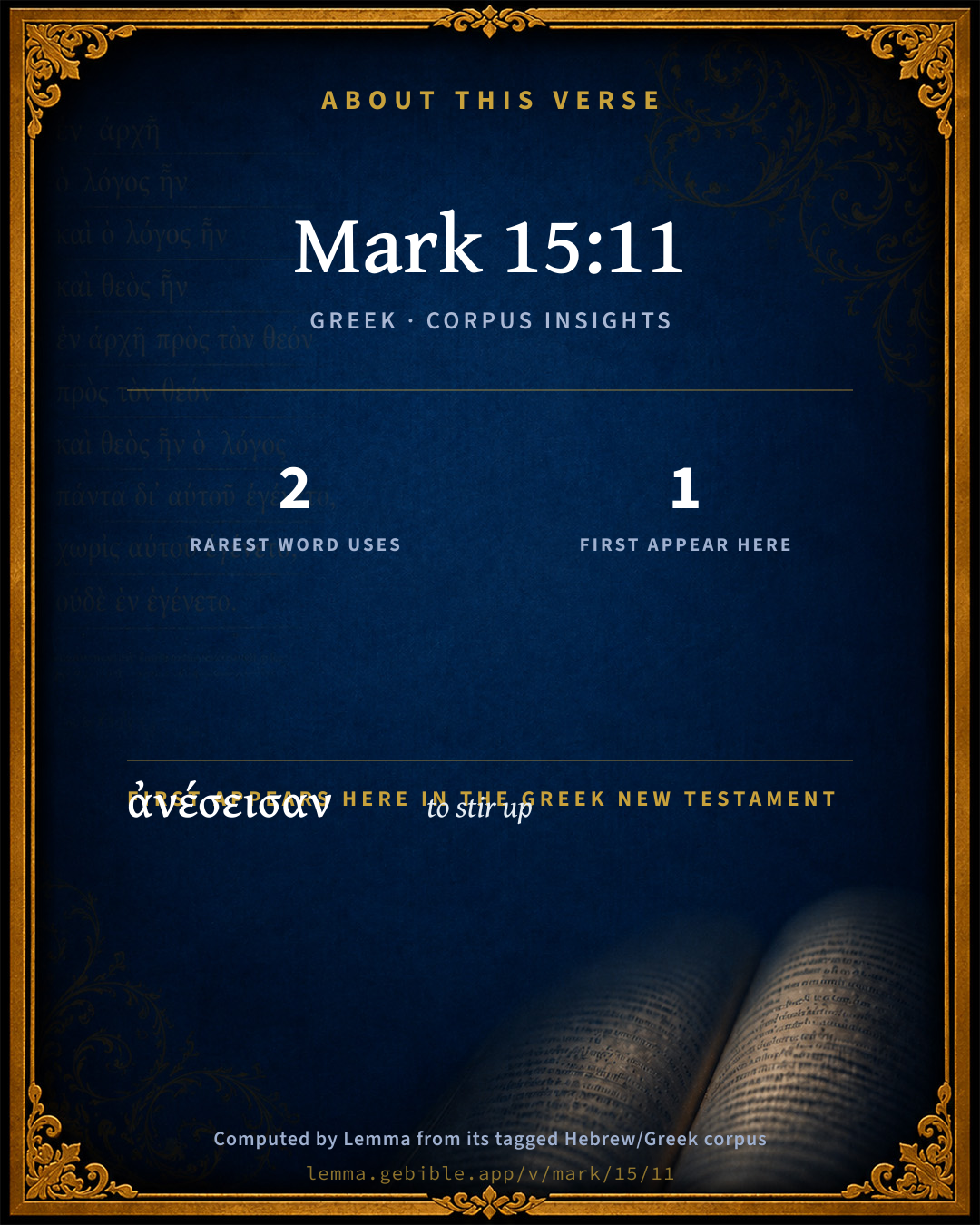
Mark 15:11

Greek (Tischendorf 8th ed.) Mark 15:11 appears in the Greek New Testament. The text above is from the Tischendorf 8th edition. Each word links to its Strong’s number and a concise gloss. Click any word for its full Thayer’s Greek Lexicon entry.
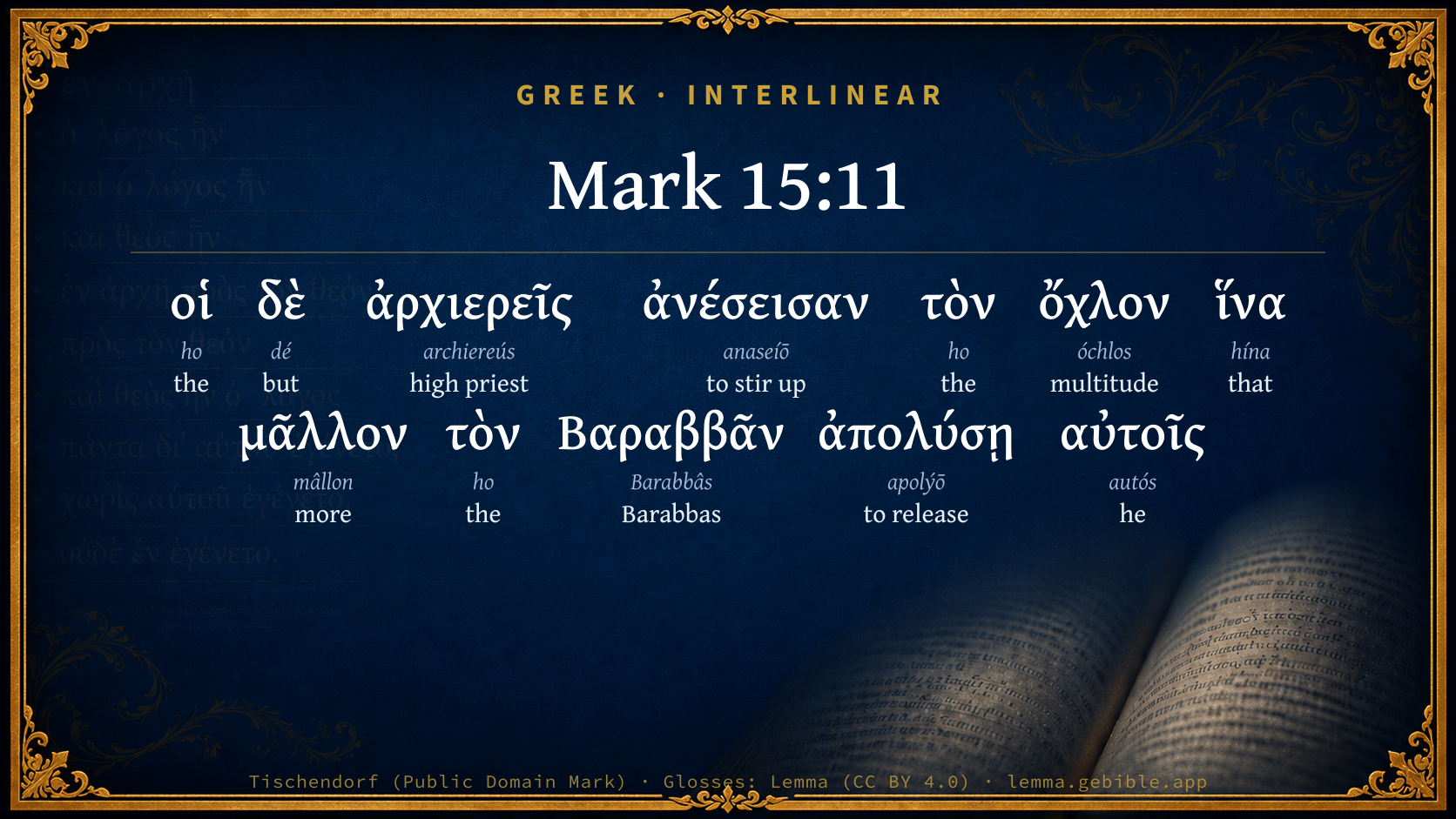
Download image
Cite this verse

Mark 15:11 (World English Bible). Public Domain. Lemma interlinear Bible study tool, https://lemma.gebible.app/v/mark/15/11.

Show BibTeX & RIS
BibTeX
RIS
English Translation
But the chief priests stirred up the multitude, that he should release Barabbas to them instead.
World English Bible · Public Domain
Highlights
  • 1 first appearance in the Greek New Testament
Full analysis ↓
Download a study sheet

One document with this verse’s original text, its word-by-word gloss line, the meaning frame, cross-references with their text, attributed commentary, and full source and license credits — printable, and it pastes into notes with its structure intact.

This verse Autodidact and up

Study sheet (.html) Plain text (.txt)

A passage Seminary Student

Up to 50 verses in one chapter. A passage sheet keeps up to 6 commentary sources and 12 cross-references per verse, in the order this page ranks them, and says so on the sheet whenever that leaves anything out. Ask for a single verse and you get the Autodidact verse sheet above.

Everything on this page stays free to read, with no account — the sheet is a download of what is already on screen, not access to it.

Want to remove ads? Support Godless Engineer
Compare translations 3

The same verse in 3 English versions, stacked beneath the original-language interlinear above. Click any original word for its lexicon entry.

Each is an independent rendering of the whole verse — the interlinear is not word-aligned to these translations.

Highlighted words mark where these versions differ — a whole-verse word diff, not a word-by-word alignment.

  • World English Bible Public Domain
    But the chief priests stirred up the multitude, that he should release Barabbas to them instead.
  • King James Version Public Domain
    But the chief priests moved the people, that he should rather release Barabbas unto them.
  • unfoldingWord Literal Text CC BY-SA 4.0
    But the chief priests stirred up the crowd so that he would release Barabbas to them instead.

unfoldingWord Literal Text — © unfoldingWord, licensed CC BY-SA 4.0. Word-aligned USFM3 via Door43 (git.door43.org/unfoldingWord/en_ult).

Versions to compare (up to 4)

3 of 4 selected

Show all 19 translations

Every available English version of this verse, each an independent rendering of the whole verse.

  • World English Bible Public Domain
    But the chief priests stirred up the multitude, that he should release Barabbas to them instead.
  • Berean Standard Bible Public Domain
    But the chief priests stirred up the crowd to have him release Barabbas to them instead.
  • Majority Standard Bible Public Domain
    But the chief priests stirred up the crowd to have him release Barabbas to them instead.
  • King James Version Public Domain
    But the chief priests moved the people, that he should rather release Barabbas unto them.
  • American Standard Version (1901) Public Domain
    But the chief priests stirred up the multitude, that he should rather release Barabbas unto them.
  • Revised Version (1885) Public Domain
    But the chief priests stirred up the multitude, that he should rather release Barabbas unto them.
  • Geneva Bible (1599) Public Domain
    But the high Priestes had moued the people to desire that he would rather deliuer Barabbas vnto them.
  • Douay-Rheims (1899) Public Domain
    But the chief priests moved the people, that he should rather release Barabbas to them.
  • Young's Literal Translation Public Domain
    and the chief priests did move the multitude, that he might rather release Barabbas to them.
  • Literal Standard Version CC BY-SA 4.0
    and the chief priests moved the multitude that he might rather release Barabbas to them.
  • Unlocked Literal Bible CC BY-SA 4.0
    But the chief priests stirred up the crowd to cry out that Barabbas should be released instead.
  • unfoldingWord Literal Text CC BY-SA 4.0
    But the chief priests stirred up the crowd so that he would release Barabbas to them instead.
  • Darby Bible Public Domain
    But the chief priests stirred up the crowd that he might rather release Barabbas to them.
  • World Messianic Bible Public Domain
    But the chief priests stirred up the multitude, that he should release Barabbas to them instead.
  • Webster's Bible Public Domain
    But the chief priests moved the people that he should rather release Barabbas to them.
  • Free Bible Version CC BY-SA 4.0
    But the chief priests stirred up the crowd to have him release Barabbas to them instead.
  • Bible in Basic English Public Domain
    But the people were moved by the chief priests to make him let Barabbas go free.
  • Text-Critical English NT CC BY 4.0
    But the chief priests stirred up the crowd to have Pilate release for them Barabbas instead.
  • Tyndale New Testament (1534) Public Domain
    But the hye prestes had moved the people that he shuld rather delyvre Barrabas vnto them.

Literal Standard Version (2020), Covenant Press — licensed CC BY-SA 4.0. Text via the HelloAO Bible API (eBible.org). Unlocked Literal Bible (unfoldingWord) — licensed CC BY-SA 4.0. Text via the HelloAO Bible API (eBible.org). unfoldingWord Literal Text — © unfoldingWord, licensed CC BY-SA 4.0. Word-aligned USFM3 via Door43 (git.door43.org/unfoldingWord/en_ult). Free Bible Version, Dr. Jonathan Gallagher — licensed CC BY-SA 4.0. Text via the HelloAO Bible API (eBible.org).

Word by word

More ways to search: Search by grammar → Find every occurrence → Compare this word →

Practice this passage: Drill this verse → Learn its vocabulary →

About this verse

These counts appear in no published source. They are computed here, from the morphology-tagged text and Lemma’s own curated glosses. What Lemma adds →

12
words
10
distinct lemmas
Gospels
section

Notable vocabulary

The rarest word here is ἀνέσεισαν to stir up G383 — appearing just 2 times in the whole Greek New Testament.

First appearance in Scripture

This word makes its first canonical appearance in the Greek New Testament here:

  • ἀνέσεισαν to stir up G383

Shared distinctive vocabulary

ἀνέσεισαν to stir up G383 occurs in 2 verses of the Greek New Testament. Also found in:

Repetition

A word recurs within this verse:

Cross-references

4

Topical passages linked to Mark 15:11 in the Treasury of Scripture Knowledge — connected by theme and wording, ordered by reader-vote popularity; previews shown in the World English Bible.

  • Acts 3:14 But you denied the Holy and Righteous One, and asked for a murderer to be granted to you,
  • Matthew 27:20 Now the chief priests and the elders persuaded the multitudes to ask for Barabbas, and destroy Jesus.
  • Hosea 5:1 "Listen to this, you priests! Listen, house of Israel, And give ear, house of the king! For the judgment is against you; For you have been a snare at Mizpah, And a net spread on Tabor.
  • John 18:40 Then they all shouted again, saying, "Not this man, but Barabbas!" Now Barabbas was a robber.

Cross-references courtesy of OpenBible.info (CC BY 4.0).

Commentary

Notes on Mark 15:11 from classic Christian and Jewish commentators (each source and its license shown beneath its notes). The classic Christian expositions comment on the surrounding passage and are grouped to its opening verse, so a note may address several verses; the Jewish commentaries on the Tanakh (Rashi and others) are per-verse, so they appear only where the commentator wrote on this verse.

Lemma curates 59 commentaries, every one of them public domain or Creative Commons licensed, each selected and text-cleaned for this edition rather than reprinted as found. About our sources →

Joseph Benson's Commentary

Mar 15:11-15. But the chief priests — Being very solicitous to carry the plan they had formed for his destruction into execution; moved the people — To desire the release of Barabbas, though he was a scandalous and outrageous criminal. Pilate said again — Being willing, Luke says, to release Jesus; What will ye then that I shall do unto him whom ye call King of the Jews — It seems strange that Pilate should so often repeat this title, King of the Jews; but perhaps he might do it partly to ridicule it, and bring contempt on the scheme of a Messiah; and partly to procure from the Jews, in their zeal against Jesus, the strongest and most public professions of their subjection to Cesar. And they cried out again, Crucify him — By this cry, they declared the greatest degree of rage that can be imagined; for it was as if they had said, Let him whom you call our king be treated like one of the vilest of your slaves, who has committed the most enormous crime. To have inflicted such a punishment as this on any free Jew, would probably have been sufficient to have thrown the whole city and nation into an uproar; but now they were deaf to every thing but the clamour of passion, and in their madness did not consider with how dangerous a precedent they might furnish the Roman governor. And indeed it turned dreadfully on themselves, when such vast numbers of them were crucified for their opposition to the Romans during the time of their last war. See Doddridge, and note on Mat 27:25. Pilate said, Why, what evil hath he done? — What crime do you accuse him of? But instead of showing that he had done any evil, or specifying any one crime of which he had been guilty; they only cried out the more exceedingly, Crucify him — See note on Mat 27:23. Pilate, therefore, willing to content the people — To whom, as appears from Josephus, he had given much cause of disgust before; being perhaps afraid of an insurrection if he should continue to withstand them, though at the head of an armed force sufficient to have quelled any mob, weakly suffered himself to be borne down by their violence; and released unto them him that for sedition and murder had been cast into prison, whom they desired; but delivered Jesus to their will, Luk 23:25, namely, delivered him to be crucified, when he had scourged him! “Whipping, or scourging, was a punishment frequently used by the Jews and Romans. The Jews commonly inflicted it by a whip of three cords, and limited the number of stripes to thirty-nine, that they might not exceed the number limited. Deu 25:3. But the usual way of scourging among the Romans was with such rods or wands as the lictors carried in a bundle before the magistrates; and they were exceeding cruel in this kind of punishment, tearing with their scourges even the veins and arteries, and laying the very bowels of the malefactors bare; and as our Saviour was scourged at Pilate’s order, it was done most probably by his officers, after the Roman manner, and was therefore no less severe than disgraceful.” See Calmet, and note on Mat 27:26.

Joseph Benson's Commentary on the Old and New Testaments (1811–1818) — public domain. Text from a community e-Sword module.

Expositor's Greek Testament

ed. W. Robertson Nicoll

Mar 15:11 . ἀνέσεισαν , the aorist implies that the priests stirred up the people with success , to the effect that their request to Pilate was in favour of Barabbas. One may wonder how they so easily gained their purpose. But Barabbas, as described by Mk., represented a popular passion, which was stronger than any sympathy they might have for so unworldly a character as Jesus the passion for political liberty . The priests would know how to play on that feeling. What unprincipled characters they were! They accuse Jesus to Pilate of political ambition, and they recommend Barabbas to the people for the same reason. But a “holy” end sanctifies the means! On the contrast between Jesus and Barabbas vide Klostermann.

The Expositor's Greek Testament, edited by W. Robertson Nicoll (1897–1910) — public domain. Text from a community e-Sword module.

The Cambridge Bible for Schools and Colleges

gen. ed. J. J. S. Perowne

11. But the chief priests] It was probably at this juncture that he received the message from his wife imploring him to have nothing to do with “that just person” (Mat_27:19) standing before him. His feelings, therefore, of awe were intensified, and his resolve to effect the release increased. But the chief priests stirred up the people, and urged them to choose Barabbas, the patriot leader, the zealot for their country, the champion against oppression. The word translated “moved” only occurs here and in the parallel, Luk_23:5. It denotes (i) to shake to and fro, to brandish; (ii) to make threatening gestures; (iii) to stir up, or instigate. Their efforts were successful, and when Pilate formally put the question, the cry went up, “Not this Man,” the Holy and Undefiled, Whom they had lately welcomed with Hosannas into their city, but the hero of the insurrection, Barabbas (Joh_18:39-40).

The Cambridge Bible for Schools and Colleges (gen. ed. J. J. S. Perowne; Cambridge University Press, 1878–1918) — public domain. Text from a community e-Sword module.

John Gill's Exposition

But the chief priests moved the people,.... Greatly solicited and persuaded them, both in person, and by their officers they employed, and dispersed among them, to make use of arguments with them to prevail upon them:

that he should rather release Barabbas unto them; than Jesus of Nazareth; choosing rather to have a murderer granted unto them, than the holy and just one. The Persic version, as before, reads, "the chief of the priests"; but they were all concerned, and were the most active men in bringing about the death of Christ; though Caiaphas was behind none of them in envy, rage, and malice; See Gill on Mat 27:20.

John Gill's Exposition of the Whole Bible (1746–1763) — public domain (CC PDM 1.0). Text via the HelloAO Bible API.

The Pulpit Commentary

But the chief priests stirred up the multitude (aneseisan to), that he should rather release Barabbas unto them. St. Matthew (Mat_27:20) says, "They persuaded the multitudes" ( epeisan tou). St. Mark"s word (aneseisan) implies a rousing of their bad passions; agitating them to a blind zeal for his crucifixion.

HOMILIES BY A. ROWLAND Vers. 11, 12. The foes of Jesus.

It is remarkable that the evangelists speak of their Lord"s enemies with such unruffled calmness. If our dearest friend had been subjected to inhuman treatment, ending in his death, we should have held up the names of his oppressors to the execration of the world. But in the Gospels we look in vain for a strong epithet, or a burst of indignant declamation. This was not because the evangelists were deficient in love to their Lord, but because they had caught something of the spirit of him "who, when he was reviled, reviled not again," and because they had learnt that amid these strange, sad scenes the Divine purpose was being fulfilled, and that he who was the Victim of sinners was the Sacrifice for sin. Hostility to the Lord Jesus Christ is the irrefragable proof of man"s antagonism to goodness and truth. The cross of Calvary, stained by his blood, is a witness at once to the depravity of man and the infinite love of God. Hatred to goodness was never more pronounced and desperate, for goodness was now both incarnate and aggressive. It was no longer an abstraction, but a Person; no longer inert, but active. The Jews were generally left unmolested, because they were content to dwell as a peculiar and separate people, without assailing idolatry in others. But our Lord and his disciples endeavored to make the truth known and felt. Moses said in effect, "Keep yourselves from surrounding peoples, lest ye be defiled." Christ said, "Go ye into all the world, and preach the gospel to every creature." The old economy was represented by the temple, which was compact, perfect, kept free from the defiling tread of the heathen; the new was represented by the mustard seed, which would grow under the open sky till it became a tree, and many nations found rest under its shadow. It was partly because Jesus Christ was aggressive in his work that the world rose in arms against him. Let us study the characteristics of some of his foes, and discover their motives, that we may be on our guard against becoming their modern representatives. In the two verses we have chosen we have glimpses of the priests, of the people, and of Pontius Pilate.

I THE PRIESTS WERE HOSTILE TO OUR LORD FROM PRIDE. They should have been the first to welcome him. As Jews they were familiar with the utterances of the prophets, and as priests they should have known the meaning of the sacrifices they offered. They had heard the preaching of John when he announced Messiah, and they had again and again had evidence respecting the work and teaching of Jesus. But pride summoned prejudice to build up an obstacle impervious to all assaults. Their social dignity refused to recognize this peasant Teacher; their intellectual culture spurned the utterances of the Prophet of Nazareth; and their ecclesiastical prestige held it to be incredible that a carpenter"s Son should be "the Light of the world." In our day, too, pride has such disastrous influence. Many admit that Jesus Christ was a pattern of benevolence and of moral purity; but when he declares himself to be an infallible Teacher of Divine truth, when he claims superhuman power, when he demands submission to his will, they rise against him, as those did who once exclaimed, "For good works we stone thee not, but for blasphemy; because thou, being a man, makest thyself God.

II PILATE WAS HOSTILE TO OUR LORD FROM POLICY. He saw at a glance the vindictiveness of the priests, and the innocence of him they accused; and, after a few minutes" conversation, frankly said, "I find in him no fault at all." But this was followed by a pitiful struggle and fall. He tried to rid himself of responsibility by sending the Galilean to Herod; he offered to release him, not on the ground of innocence, but as an act of grace, usual at the Passover; he cruelly scourged him, in the hope that this would satisfy the bloodthirsty mob. But when these devices failed, and the people threatened Pilate himself, as a traitor to the emperor, he delivered Jesus to be crucified. He fell through moral cowardice, brought about by former crimes, fearing lest he should lose office and honor unless he fell in with the demands of this brutal crowd. Things seen rule the man who has no faith in things unseen. Personal interests seemed more to him than the life or death of one poor Prisoner. He yielded to clamor; and though at the time he knew it not, he crucified the Christ.

III THE PEOPLE WERE HOSTILE TO OUR LORD FROM PASSION. "The chief priests moved the people." They would urge that Jesus had been condemned by their own orthodox court, and that it was the duty of every patriot to induce the Romans to support its decisions; and they would further urge that Barabbas, the leader of an insurrection, was a friend of the people and a champion of their liberties, so that he was to be preferred to Jesus of Nazareth. The mass of the people were not intelligently hostile to our Lord. Some knew little of him, and thought that the Sanhedrim was best able to judge of such questions; and others went with the popular current, whether it led them to shout "Hosanna!" or "Crucify him!" Hence they were included with the soldiers in the prayer of our Lord, "Father, forgive them; for they know not what they do. A.R.

The Pulpit Commentary (1880–1919), ed. H.D.M. Spence-Jones & Joseph S. Exell — public domain. Text from a community e-Sword module.

Cambridge Greek Testament for Schools and Colleges

11. οἱ δὲ ἀρχιερεῖς. It was the hierarchy, and neither Pilate nor the people, who first suggested Barabbas. We are not told what means they used to change the attitude of the people towards Jesus. But the citizens far outnumbered the Galilean pilgrims, and with the city mob Barabbas may have been a sort of hero, like Dick Turpin, or, if he was a revolutionist rather than a highwayman, he may have been like Wat Tyler. The fickleness of the multitude in this case seems extraordinary, even beyond that which is often found in mobile vulgus. But it was a fatal shock to sentiment to see the supposed Messiah standing bound and helpless before the heathen Procurator. No true Messiah would endure such an indignity. The change of feeling was catastrophic and complete. They had been deceived and made fools of, and they were quickly made ready by the priests to propose the cruelest of punishments for the impostor. Judas had betrayed Him, the Eleven had deserted Him, and we need not be astonished at the fickleness of the populace. Loisy’s incredulity is quite out of place. Lagrange compares the sudden collapse of Boulanger’s popularity in April 1889. For ἀνασείω cf. Luk 23:5.

Cambridge Greek Testament for Schools and Colleges (Cambridge University Press, 1896; 21 vols, various authors incl. Carr, Maclear, Plummer, Farrar, Lumby, Moule, M. R. James, Simcox) — public domain. Text from a community e-Sword module.

International Critical Commentary

11. οἱ δὲ ἀρχιερεῖς ἀνέσεισαν τὸν ὄχλον, ἵνα μᾶλλον τὸν Βαραββᾶν ἀπολύσῃ αὐτοῖς—but the chief priests stirred up the multitude, that he should rather release Barabbas to them. This was the first time in the life of Jesus that the people had turned against him. And while, of course, the fickleness of the crowd is always to be taken into account, there were other elements at work here, which made the people especially pliable. It was a case of regulars against an irregular, of priests against prophet, and popular preference is always evenly balanced between these. But the great thing was the cruel disappointment of the people after the triumphal entry of Jesus into Jerusalem. He had raised their hopes to the highest pitch then, only to dash them to the ground again by his subsequent inaction and powerlessness. It was no use for them to ask for the release of a king who had just abdicated.

International Critical Commentary — older volumes (1896–1929), various authors — public domain. Text from a community e-Sword module.

Vincent's Word Studies in the New Testament

Marvin R. Vincent

Moved [ανεσεισαν] . A feeble translation. Seiw is to shake. Hence seismov, an earthquake. See on Mt 13:8. Better as Rev., stirred up. Wyc., The bishops stirred the company of people.

Marvin R. Vincent, Word Studies in the New Testament (1887–1900) — public domain. Text from a community e-Sword/MySword module.

Lesson kit

Teaching starters — assembled from the data on this page, not authored interpretation. Every prompt links to the verse data it draws on. Edit before teaching.

Mark, in the Gospels, opens this verse with 12 words (10 distinct Greek lemmas). Its most distinctive word is anaseíō (“to stir up”). A historical commentator’s framing appears above. Read the whole chapter for the surrounding context.

Discussion questions

  1. What does “to stir up” (anaseíō) contribute to the verse as a whole?
  2. This is the first place “to stir up” appears in Scripture (first appears here). What does its debut here establish?
  3. How does Luke 23:5, which shares the word «to stir up», read alongside this verse?
  4. What does the repetition of “the” (3× in this one verse) do in this verse?
  5. The translations on this page render this verse differently — a whole-verse word diff, not a word-by-word alignment. What might account for the different wordings?
  6. Compare how Joseph Benson's Commentary and Expositor's Greek Testament read this verse. Where do they agree or differ?

Things to notice

  • 1 word makes its first canonical appearance in Scripture here.
  • These translations choose different wording for 10 words in this verse.
  • “the” occurs 3× in this single verse.
  • 10 distinct Greek lemmas span 12 words in this verse.

Reading settings

Reading text

Shown beneath each verse's original-language words.

Old Testament
Old Testament edition

Read the OT as the Masoretic Hebrew (MT) or the Greek Septuagint (LXX).

English shown for the Greek Septuagint (in the Hebrew ↔ Greek comparison).

Comparing translations? Open the Compare panel on any verse page to stack up to four side by side.