Ephesians 6:21

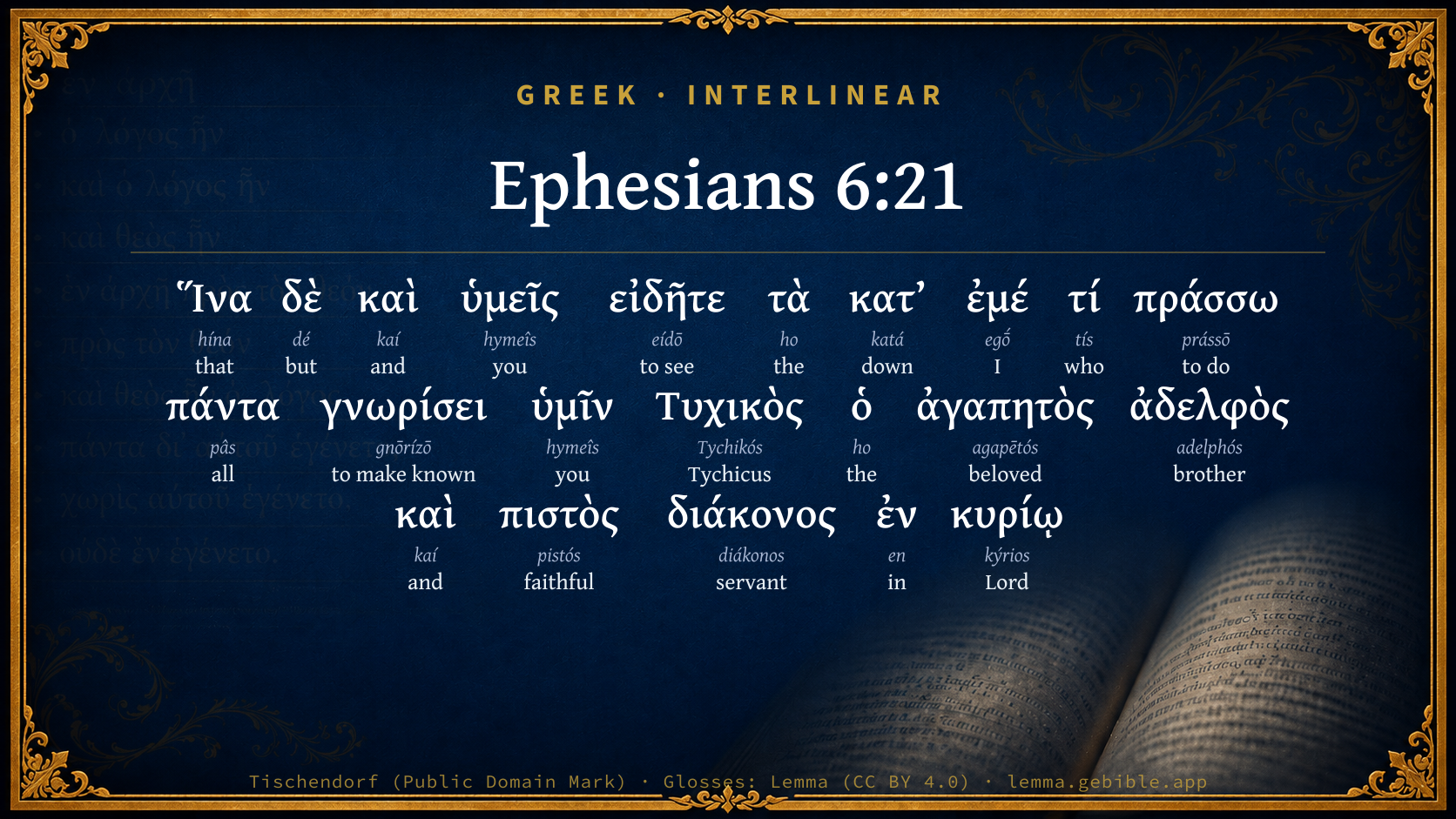
Greek (Tischendorf 8th ed.) Ephesians 6:21 appears in the Greek New Testament. The text above is from the Tischendorf 8th edition. Each word links to its Strong’s number and a concise gloss. Click any word for its full Thayer’s Greek Lexicon entry.
Download image
Cite this verse

Ephesians 6:21 (World English Bible). Public Domain. Lemma interlinear Bible study tool, https://lemma.gebible.app/v/ephesians/6/21.

Show BibTeX & RIS
BibTeX
RIS
English Translation
But that you also may know my affairs, how I am doing, Tychicus, the beloved brother and faithful servant in the Lord, will make known to you all things;
World English Bible · Public Domain
Download a study sheet

One document with this verse’s original text, its word-by-word gloss line, the meaning frame, cross-references with their text, attributed commentary, and full source and license credits — printable, and it pastes into notes with its structure intact.

This verse Autodidact and up

Study sheet (.html) Plain text (.txt)

A passage Seminary Student

Up to 50 verses in one chapter. A passage sheet keeps up to 6 commentary sources and 12 cross-references per verse, in the order this page ranks them, and says so on the sheet whenever that leaves anything out. Ask for a single verse and you get the Autodidact verse sheet above.

Everything on this page stays free to read, with no account — the sheet is a download of what is already on screen, not access to it.

Want to remove ads? Support Godless Engineer
Compare translations 3

The same verse in 3 English versions, stacked beneath the original-language interlinear above. Click any original word for its lexicon entry.

Each is an independent rendering of the whole verse — the interlinear is not word-aligned to these translations.

Highlighted words mark where these versions differ — a whole-verse word diff, not a word-by-word alignment.

  • World English Bible Public Domain
    But that you also may know my affairs, how I am doing, Tychicus, the beloved brother and faithful servant in the Lord, will make known to you all things;
  • King James Version Public Domain
    But that ye also may know my affairs, and how I do, Tychicus, a beloved brother and faithful minister in the Lord, shall make known to you all things:
  • unfoldingWord Literal Text CC BY-SA 4.0
    But so that you also may know the things concerning me, how I am doing, Tychicus, the beloved brother and faithful servant in the Lord, will make known to you everything,

unfoldingWord Literal Text — © unfoldingWord, licensed CC BY-SA 4.0. Word-aligned USFM3 via Door43 (git.door43.org/unfoldingWord/en_ult).

Versions to compare (up to 4)

3 of 4 selected

Show all 19 translations

Every available English version of this verse, each an independent rendering of the whole verse.

  • World English Bible Public Domain
    But that you also may know my affairs, how I am doing, Tychicus, the beloved brother and faithful servant in the Lord, will make known to you all things;
  • Berean Standard Bible Public Domain
    Tychicus, the beloved brother and faithful servant in the Lord, will tell you everything, so that you also may know about me and what I am doing.
  • Majority Standard Bible Public Domain
    Tychicus, the beloved brother and faithful servant in the Lord, will tell you everything, so that you also may know about me and what I am doing.
  • King James Version Public Domain
    But that ye also may know my affairs, and how I do, Tychicus, a beloved brother and faithful minister in the Lord, shall make known to you all things:
  • American Standard Version (1901) Public Domain
    But that ye also may know my affairs, how I do, Tychicus, the beloved brother and faithful minister in the Lord, shall make known to you all things:
  • Revised Version (1885) Public Domain
    But that ye also may know my affairs, how I do, Tychicus, the beloved brother and faithful minister in the Lord, shall make known to you all things:
  • Geneva Bible (1599) Public Domain
    But that ye may also know mine affaires, and what I doe, Tychicus my deare brother and faithfull minister in the Lord, shall shewe you of all things,
  • Douay-Rheims (1899) Public Domain
    But that you also may know the things that concern me, and what I am doing, Tychicus, my dearest brother and faithful minister in the Lord, will make known to you all things:
  • Young's Literal Translation Public Domain
    And that ye may know -- ye also -- the things concerning me -- what I do, all things make known to you shall Tychicus, the beloved brother and faithful ministrant in the Lord,
  • Literal Standard Version CC BY-SA 4.0
    And that you may know—you also—the things concerning me—what I do, Tychicus will make all things known to you, the beloved brother and faithful servant in the LORD,
  • Unlocked Literal Bible CC BY-SA 4.0
    Tychicus, the beloved brother and faithful servant in the Lord, will tell you everything, so that you may know how I am doing.
  • unfoldingWord Literal Text CC BY-SA 4.0
    But so that you also may know the things concerning me, how I am doing, Tychicus, the beloved brother and faithful servant in the Lord, will make known to you everything,
  • Darby Bible Public Domain
    But in order that *ye* also may know what concerns me, how I am getting on, Tychicus, the beloved brother and faithful minister in [the] Lord, shall make all things known to you;
  • World Messianic Bible Public Domain
    But that you also may know my affairs, how I am doing, Tychicus, the beloved brother and faithful servant in the Lord, will make known to you all things.
  • Webster's Bible Public Domain
    But that ye also may know my affairs, and how I do, Tychicus, a beloved brother and faithful minister in the Lord, will make known to you all things:
  • Free Bible Version CC BY-SA 4.0
    Tychicus, our good friend and faithful minister, will give you all my news and explain everything so you'll know how I'm doing.
  • Bible in Basic English Public Domain
    But so that you may have knowledge of my business, and how I am, Tychicus, the well-loved brother and tested servant in the Lord, will give you news of all things:
  • Text-Critical English NT CC BY 4.0
    Tychicus, the beloved brother and faithful servant in the Lord, will give you a full report about how I am doing so that you may be informed.
  • Tyndale New Testament (1534) Public Domain
    But that ye maye also knowe what condicion I am in and what I do Tichicus my deare brother and faythfull minister in the Lorde shall shewe you of all thinges

Literal Standard Version (2020), Covenant Press — licensed CC BY-SA 4.0. Text via the HelloAO Bible API (eBible.org). Unlocked Literal Bible (unfoldingWord) — licensed CC BY-SA 4.0. Text via the HelloAO Bible API (eBible.org). unfoldingWord Literal Text — © unfoldingWord, licensed CC BY-SA 4.0. Word-aligned USFM3 via Door43 (git.door43.org/unfoldingWord/en_ult). Free Bible Version, Dr. Jonathan Gallagher — licensed CC BY-SA 4.0. Text via the HelloAO Bible API (eBible.org).

Word by word

More ways to search: Search by grammar → Find every occurrence → Compare this word →

Practice this passage: Drill this verse → Learn its vocabulary →

Τυχικὸς
Tychikós
G5190
“Tychicus”
Noun, Nominative, Singular, Masculine
Part of Speech
Noun
Case
Nominative
Number
Singular
Gender
Masculine
Full Thayer's Definition

Origin: from a derivative of G5177

TDNT: None

Tychicus = "fateful" 1. an Asiatic Christian, friend and companion of the apostle Paul
  1. Ἵνα hína G2443 “that” Conjunction
  2. δὲ dé G1161 “but” Conjunction
  3. καὶ kaí G2532 “and” Conjunction
  4. ὑμεῖς hymeîs G5210 “you” Personal pronoun, 2nd person, Nominative, Plural
  5. εἰδῆτε eídō G1492 “to see” Verb, Perfect, Active, Subjunctive, 2nd person, Plural
  6. τὰ ho G3588 “the” Article, Accusative, Plural, Neuter
  7. κατ’ katá G2596 “down” Preposition
  8. ἐμέ egṓ G1473 “I” Personal pronoun, 1st person, Accusative, Singular
  9. τί tís G5101 “who” Interrogative pronoun, Accusative, Singular, Neuter
  10. πράσσω prássō G4238 “to do” Verb, Present, Active, Indicative, 1st person, Singular
  11. πάντα pâs G3956 “all” Adjective, Accusative, Plural, Neuter
  12. γνωρίσει gnōrízō G1107 “to make known” Verb, Future, Active, Indicative, 3rd person, Singular
  13. ὑμῖν hymeîs G5210 “you” Personal pronoun, 2nd person, Dative, Plural
  14. ὁ ho G3588 “the” Article, Nominative, Singular, Masculine
  15. ἀγαπητὸς agapētós G27 “beloved” Adjective, Nominative, Singular, Masculine
  16. ἀδελφὸς adelphós G80 “brother” Noun, Nominative, Singular, Masculine
  17. καὶ kaí G2532 “and” Conjunction
  18. πιστὸς pistós G4103 “faithful” Adjective, Nominative, Singular, Masculine
  19. διάκονος diákonos G1249 “servant” Noun, Nominative, Singular, Masculine
  20. ἐν en G1722 “in” Preposition
  21. κυρίῳ kýrios G2962 “Lord” Noun, Dative, Singular, Masculine

About this verse

These counts appear in no published source. They are computed here, from the morphology-tagged text and Lemma’s own curated glosses. What Lemma adds →

22
words
19
distinct lemmas
Pauline Epistles
section

Notable vocabulary

The rarest word here is Τυχικὸς Tychicus G5190 — appearing just 5 times in the whole Greek New Testament.

Shared distinctive vocabulary

Τυχικὸς Tychicus G5190 occurs in 5 verses of the Greek New Testament. Also found in:

Repetition

Words recur within this verse:

Cross-references

11

Topical passages linked to Ephesians 6:21 in the Treasury of Scripture Knowledge — connected by theme and wording, ordered by reader-vote popularity; previews shown in the World English Bible.

  • Acts 20:4 These accompanied him as far as Asia: Sopater of Beroea; Aristarchus and Secundus of the Thessalonians; Gaius of Derbe; Timothy; and Tychicus and Trophimus of Asia.
  • 2 Timothy 4:12 But I sent Tychicus to Ephesus.
  • Titus 3:12 When I send Artemas to you, or Tychicus, be diligent to come to me to Nicopolis, for I have determined to winter there.
  • Colossians 4:7–9 All my affairs will be made known to you by Tychicus, the beloved brother, faithful servant, and fellow bondservant in the Lord.
  • 1 Corinthians 4:17 Because of this I have sent Timothy to you, who is my beloved and faithful child in the Lord, who will remind you of my ways which are in Christ, even as I teach everywhere in every assembly.
  • Colossians 1:7 even as you learned of Epaphras our beloved fellow servant, who is a faithful minister of Christ on our behalf,
  • 1 Timothy 4:6 If you instruct the brothers of these things, you will be a good servant of Christ Jesus, nourished in the words of the faith, and of the good doctrine which you have followed.
  • Philemon 1:16 no longer as a slave, but more than a slave, a beloved brother, especially to me, but how much rather to you, both in the flesh and in the Lord.
  • 1 Peter 5:12 Through Silvanus, our faithful brother, as I consider him, I have written to you briefly, exhorting, and testifying that this is the true grace of God in which you stand.
  • 2 Peter 3:15 Regard the patience of our Lord as salvation; even as our beloved brother Paul also, according to the wisdom given to him, wrote to you;
  • Philippians 1:12 Now I desire to have you know, brothers, that the things which happened to me have turned out rather to the progress of the Gospel;

Cross-references courtesy of OpenBible.info (CC BY 4.0).

Commentary

Notes on Ephesians 6:21 from classic Christian and Jewish commentators (each source and its license shown beneath its notes). The classic Christian expositions comment on the surrounding passage and are grouped to its opening verse, so a note may address several verses; the Jewish commentaries on the Tanakh (Rashi and others) are per-verse, so they appear only where the commentator wrote on this verse.

Lemma curates 59 commentaries, every one of them public domain or Creative Commons licensed, each selected and text-cleaned for this edition rather than reprinted as found. About our sources →

Joseph Benson's Commentary

Eph 6:21-22. That ye also — As well as others; may know my affairs — The things which have happened to me, and what I am doing at present: or, the things which relate to me, as the expression, τα κατ’ εμε, which occurs likewise Php 1:12, signifies. The apostle means that he wished the Ephesians, as well as the Philippians and Colossians, to know what success he had had in preaching at Rome, what opposition he had met with, what comfort he had enjoyed under his sufferings, what converts he had made to Christ, and in what manner the evidences of the gospel affected the minds of the inhabitants of Rome. These, and such like things, he sent Tychicus to make known to them.

Joseph Benson's Commentary on the Old and New Testaments (1811–1818) — public domain. Text from a community e-Sword module.

The Preacher's Complete Homiletical Commentary

Joseph S. Exell (gen. ed.)

CRITICAL AND EXPLANATORY NOTES

Eph_6:21. Tychicus, a beloved brother and faithful minister.—If all servants were “brethren” first, the troubles of our modern commercial life would be few.

MAIN HOMILETICS OF THE PARAGRAPH.—Eph_6:21-22

A Trusted Messenger—

I. Commended for his acknowledged Christian character.—“Tychicus, a beloved brother and faithful minister in the Lord” (Eph_6:21). These are high and honourable designations, and indicate the genuine esteem in which he was held by the apostle. He had become endeared to Paul by the many valuable services he had rendered to him, and by the marked fidelity of his ministerial work. He appears to have joined St. Paul’s staff, and remained with him from the time he accompanied him to Jerusalem in the year 59. He was sent to Ephesus to relieve Timothy when Paul desired the presence of the latter at Rome. He was well known to the Asian Church, and every way qualified to discharge the mission with which he was entrusted. He was “the beloved brother” in his relation to the Church in general, and the “faithful minister in the Lord” in his special relation to the apostle. It is better to be loved than to be simply popular. Genuine piety forms character, and commands the confidence and respect of all lovers of the truth.

II. Entrusted with personal details of special interest.—“Whom I have sent unto you for the same purpose, that ye might know our affairs” (Eph_6:22). There were probably some details about St. Paul’s imprisonment that could be communicated better in person than by letter, and certain allusions in the letter that could be more fully explained in a personal interview. Every item about Paul was of intense interest to the Asian Churches. Many of the members had been brought to Christ through his instrumentality. They were alarmed as to his fate and as to the future of the gospel. They were anxious to know if there was any prospect of his release and of his return to his missionary labours. Tychicus, enjoying the full confidence of the apostle and the affection of the people, was just the man to give them the information they so eagerly desired, and would be cordially welcomed everywhere. The trusted messenger of a great and good man is regarded for the time being with the reverence and respect cherished towards the man he represents and of whose affairs he is empowered to speak.

III. Competent to minister encouragement.—“That he might comfort your hearts” (Eph_6:22). Tychicus was not only a newsman and letter-carrier, but also a minister of Christ. He knew how to present his message so as to allay the fears of his hearers, to comfort their hearts, and to encourage their faith in the power and triumph of the gospel, notwithstanding the sufferings of its preachers. The gospel is full of consolation, and it should be the constant aim of the minister to make it known and apply it to the circumstances of his people. A diligent pastor in his visitations comes in contact with much suffering and sorrow, and has many opportunities of administering the balm of gospel comfort. Great tact and sympathy are necessary, especially in visiting the sick. Referring to this, a godly and experienced minister said, “Tenderness is essential. Enter the chamber gently. Tread noiselessly. Get near to the sufferer. Speak as softly as may be. Remember his nerves; noise is often torture. Sympathise with his weakness, restlessness, and pain. True you are not come to minister to his body; but enter into his sufferings and symptoms. Ask what his doctor has said. Avoid a professional, official, conventional air. The case may be too grave for cheerful words; but if otherwise, let your face carry a little sunshine into the sick-room. Avoid fussiness. Go with a brother’s heart. Be brief—brief in your talk, brief in your readings, brief in your prayers—your whole visit brief. Take up one point. A sick man’s brain is soon overtasked, his nerves soon jar, his strength soon fails. Let your good-bye be ‘God bless you.’ Let your last look be one of tenderness and love. Whatever you are in the pulpit, Barnabas, not Boanerges, is your pattern by the sick-bed.” It is the privilege and mission of every minister and believer to be a messenger of comfort and strength to those in trouble. We shall be remembered for our kindness when many of our sermons are forgotten.

Lessons.—

1. The character of the good is self-evident.

2. A good man should be trusted and honoured.

3. The value of a good man is recognised in times of stress and difficulty.

GERM NOTES ON THE VERSES

Eph_6:21-22. Apostolical Care for the Church.

I. Paul was careful to keep up an intercourse and communion with the Churches of Christ.—There ought to be fellowship and correspondence among the Churches. They should all unite their endeavours for the common edification and comfort. The Church of Christ is one. We should seek the counsel of sister Churches under our difficulties, and be ready when requested to afford them our counsel under theirs.

II. Paul was solicitous that the Christians among whom he had preached should know of his condition and doings.—He was a prisoner, but suffered not his time to pass in restless impatience or useless indolence. He received all who came to him and preached to them the kingdom of God. He instructed his fellow-prisoners. He spent much of his time in prayer. Several of his epistles were written when he was in bonds. Paul’s example teaches us that we should do good in every condition.

III. When Paul sends Tychicus he gives him written testimonials that he might be received in the character of a minister.—This precaution was taken that the Churches might not be imposed upon by ignorant pretenders or artful deceivers. The Church is a regular, organised community. We are to receive none as ambassadors of Christ but those who come to us according to the order He has settled. Ministers ought to act in concert and unite their labours in building up the kingdom of Christ. Tychicus co-operated with Paul.

IV. Fidelity is an essential part of the ministerial character.—Paul calls Tychicus “a faithful minister.” Such a minister undertakes his work with pure intentions and abides in it with constancy, even though he may meet with worldly discouragements. Tychicus was sent to comfort the Ephesians under their grief for Paul’s imprisonment, and to guard them against any discouraging apprehensions. Ministers are to strengthen new converts and young professors to constancy and perseverance in religion by laying before them the comforting and animating motives of the gospel.—Lathrop.

A Faithful Minister.—

1. It concerns Christians to inform themselves of the life and way of eminent men in the Church, and chiefly of those who have been sufferers for truth, that they may be incited to sympathise with them, to follow their example, and bless the Lord on their behalf.

2. It is in a singular manner required of a minister that he be faithful—diligent in his work, sincere in his aims and endeavours, neither adding nor paring what God has committed unto him to speak.

3. We should labour so to inform ourselves of the case and carriage of others and how it goes with the affairs of Christ’s kingdom elsewhere as to draw spiritual edification thence.

4. To know God’s gracious providence towards His suffering servants, together with their undaunted courage under sufferings and the use God makes of their sufferings to advance His truth, is sufficient ground of comfort and encouragement to God’s people.—Fergusson.

The Preacher's Complete Homiletical Commentary (gen. ed. Joseph S. Exell; Funk & Wagnalls, c. 1892) — public domain (pre-1929). A full-Bible homiletical/sermon-outline anthology covering 65 of 66 books (2 John is absent from the source module). Text from a community e-Sword module.

Lange's Commentary on the Holy Scriptures

IV. CLOSE OF THE EPISTLE

Eph_6:21-24

1. Personal intelligence is brought by the bearer of the letter

Eph_6:21-22

21But that ye also may know57 my affairs, and how I do [the things concerning me, how I fare]58, Tychicus, a [the] beloved brother and faithful minister in the Lord, shall make known to you all things [shall make all known59 to you]: 22Whom I have sent unto you for the same [this very] purpose, that ye might [may]60 know our affairs, and that he might [may] comfort your hearts.

EXEGETICAL AND CRITICAL

Eph_6:21. But that ye also may know, ἵνα δὲεἰδῆτε καὶ ὑμεῖς.—Passing over to another subject (δέ) the Apostle hastens from the intercession for himself to a conclusion. He wishes that in order to make proper intercession for him, they might also know his condition more exactly, referring them, however, to oral communications. The καί before ὑμεῖς points to others (Bengel; perinde ut alii). The immediate antithesis is Tychicus and those who are near Paul in his imprisonment. Not merely those about him (Eph_6:22 : τὰ περὶ ἠμῶν), even those more remote should know respecting him. It cannot be in antithesis to the Apostle himself (Rueckert and others); this gives no meaning. Even Stier’s view: You also on your part should know what I on my part experience and suffer, does not correctly explain the καί before ὑμεῖς. To think of the Colossians (Harless, Meyer, Bleek) or of Timothy (comp. 2Ti_4:12) is not warranted by anything in the passage.61

The things concerning me, how I fare, set forth a double object of the communication: τὰ κατ̓ ἐμέ (Php_1:12; Col_4:7) denotes the external circumstances, τί πράσσω the personal demeanor and state in the same.62—Tychicus—shall make all known to you.—Πάντα comprises what has already been referred to, pointing to the full and detailed deportment (γνώρίσει) of Tychicus, who is mentioned in Act_20:4; Col_4:7-8; 2Ti_4:12; Tit_3:12, without imparting any further information than that he was a native of Asia and a serviceable companion of Paul, who here characterizes him as:

The beloved brother and faithful minister in the Lord.—Ὁ ἀγαπητὸς ἀδελφός designates him as a stout-hearted Christian, καὶ πιστὸς διάκονος as a reliable servant, a servant of the gospel, in accordance with the context, which indicates that Tychicus would come not for personal reasons, but in the interest of the Church (παρακαλέση τὰς καρδίας ὑμῶν), and in agreement with Col_4:7 (where “minister and fellow-servant in the Lord “marks him as a servant who with Paul is a δοῦλος of Christ). We should not then think (of the ecclesiastical office of the diaconate (Estius), nor yet of a personal servant to Paul himself (Meyer).63 The added phrase ἐν κυρίῳ, “in the Lord,” is to be joined with both ἁδελφός and διάκονος since they are connected without the article, thus confirming the reference to the ministry of the Gospel, through which he is a brother; his Christian character he manifests in the service of Christianity. Christ is the sphere of life and effort for Tychicus; hence ἐν κυρίῳ which refers back to ἀδελφός also.

Eph_6:22. Whom I have sent unto you for this very purpose, ὅν ἕπεμψα πρὸς ὑμᾶς εἰς αὑτὸ τοῦτο, for the very purpose, which has been already mentioned [“I have sent” is on the whole preferable to “I send” (Wordsworth) or “I sent” (Alford).—E.]—That ye may know our affairs.64—Ἵ να must be parallel to the first one, as γνῶτε to εἰδῆτε, Τὰ περὶ ἡμῶν merely extends the circle: the situation, not merely of the Apostle, but of his companions also (Col_4:10-14; Phm_1:10; Phm_1:23-24). Paul does not send there merely in his own interest.

And that he may comfort your hearts, καὶ παρακαλέσῃ τὰς καρδίας ὑμῶν.—This denotes the consequence of communication, or the impression which accompanies it. Accordingly it is not necessary to give prominence to ministerial address as the signification here (Stier), Bengel: Ne offenderetis in vinculismeis. [“It is better, however, owing to our ignorance of the exact state of the church, to leave the precise reference undefined, and to extend it generally to all particulars in which they needed it” (Ellicott).—R.]

DOCTRINAL AND ETHICAL

1. Personal and Congregational interests stand in close connection. Still the latter are the preponderating ones; the former must fall into the back-ground. 2. Independency. The proposition of Robinson in the beginning of the 17th century: cœtum quemlibet particularem esse totam, integram et perfectam ecclesiam ex suis partibus constantem immediate et independentem [quoad alias ecclesias sub ipso Christo), cannot be justified from the Apostolic age, in which the local churches stood in active intercourse and received suggestions from various quarters. [Every attempt to carry into practice this extreme view of Robinson has resulted either in ecclesiastical anarchy or a quasi-independency, such as exists in Congregational churches.—R.]

3. Our times are successful in spreading intelligence in many ways from one parish to another. This is well both for those who desire such personally imparted communications, and for those who make a sacrifice in this service, in order to receive as well as give refreshing, revival, consolation and strength. It always happens so, where the inner life is in action, even though the organization and polity are still incomplete, as in the early churches. Care however should be taken, that there be not mixed with this a dissipation of the strength required for the immediate task, or the merest of curiosity. It is precisely the fresh, glad taking root in the local churches which bears flower and fruit to be imparted for the edification of other churches. [These remarks, so pertinent to such an event as the sending of Tychicus, have a bearing on the influence of ecclesiastical bodies on the congregations within whose bounds they assemble, but more especially on the labors of I those ministers who travel from place to place as! “evangelists,” “revival preachers.” The good and the evil attendant on their labors are clearly indicated above. Such journeyings find their parallel not in the travel of the Apostles, but in those of Tychicus.—R.]

HOMILETICAL AND PRACTICAL

Comp. Doctr. Notes.—Starke:—Preachers should behave to each in a friendly, peaceable, affectionate, brotherly manner.—It pleases God very much, when preachers are concerned for their hearers, and hearers for their preachers.—Rieger:—More particular intelligence respecting each other awakens also the more fitting intercession for each other.—[It ought to be the aim of the “religious newspaper,” to do for churches and families what Tychicus was to do for Paul: Communicate such personal intelligence as would comfort the hearts of those who read. Those editors who do this rather than to minister to pride or to provoke angry discussion, well deserve the title “beloved brother and faithful minister in the Lord.”—R.]

Footnotes:

[57] Eph_6:21—[The order in B. K. L., great majority of cursives, fathers, is: εἰδῆτε καὶ ὑμεῖς (so Tischendorf, Meyer, Alford); א. A. D. E. F., Latin fathers:καὶ ὑμεῖς εἰδῆτε (so Lachmann, Ellicott). The former admits of the best explanation of the variation (see Meyer).—R.]

[58]Eph_6:21.—[ How I fare is less ambiguous than How I do, while the things concerning me is literal and avoids the somewhat uneuphonic juxtaposition: my affairs, how I fare.—R.]

[59]Eph_6:21—(“The order: ὑμῖν γνωρίδει is accepted by Tischendorf, Meyer, Alford, Wordsworth, Ellicott on the authority of A. K. L. nearly all cursives, good versions, fathers, although א. B. D. E. F. (Lachmann) sustain γνωρίσει ὑμῖν. The probability of a conformation to Col_4:7 leads to this view.—The E. V. deviates from the order of the Greek, which would be best brought out by a change to the passive form: “all shall be made known to you by Tychicus, the beloved brother and faithful minister in the Lord, whom I have sent,” etc. Alford: “Tychicus shall make known all to you, the beloved brother and faithful minister in the Lord, whom,” etc.—R.]

[60]Eph_6:22.—[ May instead of “might,” “in accordance with the law of the succession of the tenses” (Ellicott).—R.]

[61][Alford: “As I have been going at length into the matters concerning you, so if you also on your part, wish to know,” etc. But this is scarcely an obvious antithesis. Hodge explains indefinitely: “You as well as other Christian friends who have manifested solicitude about me in my bonds.” The presence of καί here has been used as an argument in favor of the priority of the Epistle to the Colossians, who are supposed to be referred to (antithetically) in καί, but though its presence would be naturally explained were the priority of that Epistle fully established, it scarcely amounts to an argument in favor of that hypothesis.—R.]

[62][Not “what I do,” for Paul always did one thing (Meyer).—]

[63][Alford and Ellicott follow Meyer, in taking διάκονος in the sense of “servant,” Paul’s servant, not the servant of the Gospel; they also join ἐν κυρίῳ with this term alone, as indicating that his service for Paul was yet in Christ. But Braune’s view is the more natural one—The adjective πιστός here means “trusty,” “trustworthy,” but with no reference to the trustworthiness of his message, as Chrysostom and Bengel imply, since he was probably known to the Ephesians, though not to the Colossians (Meyer).—R.]

[64][Alford, referring to the fact that this verse occurs word for word in Col_4:8, except that γνῷ τὰ περὶ ὑμῶν is substituted there, asks; “Does not this variation bear the mark of genuineness with it?” Braune (Colossians, p. 82) accepts the reading which conforms exactly to this verse, but the other is defended in the additional notes.—R.]

Lange's Commentary on the Holy Scriptures (Critical, Doctrinal, and Homiletical), ed. John Peter Lange, English translation edited by Philip Schaff (1864–1880) — public domain. Text from a community e-Sword module.

The Annotated Bible

Arno C. Gaebelein

7. The Conclusion

CHAPTER 6:21-24

In the preceding verses the great apostle asked the prayers of the saints for himself Thereby he testified in a practical way to the great truth of the body of Christ, the church. The conclusions are brief. Tychicus, a beloved brother and faithful minister in Christ, would make known to them all things, and he was sent also by the loving apostle to comfort their hearts. What a marvelous document this epistle is! What a solid rock to stand upon! What revelations concerning God, and ourselves as redeemed by the blood of His Son! God grant that all His people may increasingly enjoy the riches of this richest portion of His Holy Word.

Arno C. Gaebelein, The Annotated Bible (1913–1922) — public domain. Text from a community e-Sword module.

Tyndale Open Study Notes

Tyndale Open Resources

6:21-24 Paul closes with some personal words and a benediction that repeats the desires expressed at the beginning of the letter.

Tyndale Open Study Notes — © Tyndale Open Resources, licensed CC BY-SA 4.0. Text via the HelloAO Bible API.

Bengel's Gnomon

Johann Albrecht Bengel

Eph 6:21. Καὶ ὑμεῖς) ye also, as well as others.—πάντα, all things) A salutary relation.—πιστὸς, faithful) who will declare to you the truth.

Bengel's Gnomon of the New Testament — English translation (T&T Clark, Edinburgh, 1860) — public domain. Text from a community e-Sword module.

Meyer's Critical & Exegetical Commentary

Heinrich August Wilhelm Meyer

Eph_6:21. Δέ] Serving to make the transition to another subject.

καὶ ὑμεῖς] ye also, not merely the Colossians, Col_4:8-9. See Introd. § 2. While most of the older expositors pass over this καί in silence (rightly, however, explained in a general sense by Bengel: perinde ut alii), Rückert and Matthies strangely enough think that it stands in contradistinction to the apostle himself. From this there would in fact result the absurd thought: in order that not only I, but also ye may know how it fares with me.

τὰ κατʼ ἐμέ] my circumstances, my position, Php_1:22; Col_4:7. See Kühner, II. p. 119.

τί πράσσω] more precise definition of τὰ κατʼ ἐμέ: what I experience. i.e. how it fares with me, how I find myself.[317] So often also in classical writers, de statu et rebus, in quibus quis constitutus est et versatur, Ellendt, Lex. Soph. II. 629. Comp. Ael. V. H. ii. 35, where the sick Gorgias is asked τί πράττοι, Plato, Theaet. p. 174 B; Soph. Oed. R. 74; and see Wetstein and Kypke.

Τύχικος] See Act_20:4; Col_4:7; 2Ti_4:12. Beyond these passages unknown.

Ὁ ἈΓΑΠΗΤῸς ἈΔΕΛΦῸς ΚΑῚ ΠΙΣΤ. ΔΙΆΚ. ἘΝ ΚΥΡ.] So Paul characterizes Tychicus by way of commendation,[318] and that (a) as his beloved fellow-Christian, and (b) as his faithful official servant. As the latter, he was employed by Paul for just such journeys as the present. Comp. 2Ti_4:12. Mark likewise, according to 2Ti_4:11, receives from the apostle the testimony that he is for him εὔχρηστος εἰς διακονίαν. Others, like Grotius (comp. Calvin), do not refer διάκονος to the relation to the apostle, but explain it: servant of the gospel [minister evangelii], while Estius and many understand specially the ecclesiastical office of the deacon. But Col_4:7, where διάκονος καὶ σύνδουλος are united (the latter word softening the relation of service towards the apostle expressed by διάκονος), speaks in favour of our view.

ἐν κυρίῳ] belongs only to διάκονος, not to ἀδελφός as well (in opposition to Meier and Harless), since only the former had need of a specific definition (comp. on Php_1:14), in order to be brought out in its true relation (and not to bear the semblance of harshness). Not beyond the pale of Christian relations was Tychicus servant of the apostle, but in Christ his service was carried on, Christ was the sphere of the same, inasmuch as Tychicus was official διάκονος of the apostle. ἐν κυρίῳ is attached without an article, because combined with διάκονος so as to form one idea.

[317] Others, like Wolf: what I am doing. But that the reader knew. He was doing the one thing, which always occupied him. See vv. 19, 20.

[318] The assumption of a more special design as regards πιστός, namely, that it is meant to represent Tychicus as a trustworthy reporter (Grotius), is inadmissible, because Tychicus without doubt was known to the readers (Act_20:4). It was otherwise in relation to the Colossians. See on Col_4:7.

Meyer — Critical and Exegetical Commentary on the New Testament — English translation by Peter Christie, edited by Frederick Crombie (T&T Clark, 1880) — public domain. Text from a community e-Sword module.

Expositor's Greek Testament

ed. W. Robertson Nicoll

Eph 6:21-22 . Statement regarding Tychicus and his mission.

Eph 6:21 . ἵνα δὲ εἰδῆτε καὶ ὑμεῖς [ καὶ ὑμεῖς εἰδῆτε ] τὰ κατʼ ἐμέ , τί πράσσω : but that ye also may know my affairs, how I do . The metabatic δέ , passing on to a different subject. The order καὶ ὑμεῖς εἰδῆτε is given in [876] [877] [878] [879] , etc.; εἰδῆτε καὶ ὑμεῖς in [880] [881] [882] , Syr., etc. The evidence is almost equally balanced. LTTr prefer the former order; WH give it in the margin. The καί has its proper force of “also,” and points, therefore, to others as well as the Ephesians as possessing or being interested in the knowledge of Paul’s affairs. Those who take the Epistle to the Colossians to be prior to this one, naturally think of the Colossians as in view. But in the Epistle itself there is nothing to indicate who these others were. For τὰ κατʼ ἐμέ = “my circumstances,” cf. Phi 1:22 ; Col 4:7 ; also Tob 10:8 ; Est 1:22Est 1:22 . τί πράσσω , not = “what I do,” but “how I fare,” in the reflexive sense (Lat., me habeo ) common from Æschylus downwards. Here it is explanatory of τὰ κατʼ ἐμέ . πάντα ὑμῖν γνωρίσει [ γνωρίσει ὑμῖν ] Τυχικός : Tychicus shall make known to you . πάντα is omitted in [883] 1 [884] , Syr., etc. ὑμῖν is placed by the TR before γνωρίσει (as in [885] [886] [887] , Syr.-P., Chr., Theod., etc.; after it by LTTr WRV (as in [888] [889] [890] [891] [892] [893] [894] , 17, 37, 116, 120, Syr.-Sch., Copt., etc.). Τυχικός , usually so accented, but Τύχικος in WH, is mentioned again in Act 20:4 ; Col 4:7 ; 2Ti 4:12 ; Tit 3:12 . We gather from these passages that he was a native of proconsular Asia (Act 20:4 ), possibly of Ephesus itself (see Light., Philip. , p. 11); that he was with Paul towards the close of his third missionary journey (Act 20:4 ); and again at the time when the Epistle to the Colossians was written; and yet again at the end of the Apostle’s career (Tit 3:12 ; 2Ti 4:12 ). It is probable that he went to Jerusalem, as Trophimus did (Act 21:29 ), in all likelihood as a delegate of his Church, the words ἄχρις τῆς Ἀσίας not belonging to the true text of Act 20:4 . We find him here charged with the delivery of the circular letter known as the Epistle to the Ephesians, probably at the chief centres, Laodicea, Colossæ, etc., where Christian communities had been formed in Asia. He is mentioned also in connection with missions to Crete and to Ephesus (Tit 3:12 ; 2Ti 4:12 ). ὁ ἀγαπητὸς ἀδελφὸς καὶ πιστὸς διάκονος ἐν Κυρίῳ : the beloved brother and faithful minister in the Lord . In the sister Epistle he is described in the same terms, but with the addition of καὶ σύνδουλος . πιστός = faithful , in the sense of trusty , as in Mat 24:45 and often elsewhere. The ἐν Κυρίῳ defines the διάκονος , and does not refer to the whole clause. The service to Paul was service rendered in the Lord , in Christ’s fellowship and Spirit. The term διάκονος does not carry here the idea of ecclesiastical office, such as the deaconship proper, but refers to ministrations rendered to Paul himself, and so is “servant” or “minister” in the general sense. So in Col 4:7 he is called not only πιστὸς διάκονος , but Paul’s fellow-servant ( σύνδουλος ) in the Lord. This is Paul’s commendation of him to the Churches which he was to visit.

[876] Codex Sinaiticus (sæc. iv.), now at St. Petersburg, published in facsimile type by its discoverer, Tischendorf, in 1862.

[877] Codex Alexandrinus (sæc. v.), at the British Museum, published in photographic facsimile by Sir E. M. Thompson (1879).

[878] Codex Claromontanus (sæc. vi.), a Græco-Latin MS. at Paris, edited by Tischendorf in 1852.

[879] Codex Augiensis (sæc. ix.), a Græco-Latin MS., at Trinity College, Cambridge, edited by Scrivener in 1859. Its Greek text is almost identical with that of G, and it is therefore not cited save where it differs from that MS. Its Latin version, f, presents the Vulgate text with some modifications.

[880] Codex Vaticanus (sæc. iv.), published in photographic facsimile in 1889 under the care of the Abbate Cozza-Luzi.

[881] Codex Mosquensis (sæc. ix.), edited by Matthæi in 1782.

[882] Codex Angelicus (sæc. ix.), at Rome, collated by Tischendorf and others.

[883] Codex Claromontanus (sæc. vi.), a Græco-Latin MS. at Paris, edited by Tischendorf in 1852.

[884] Codex Augiensis (sæc. ix.), a Græco-Latin MS., at Trinity College, Cambridge, edited by Scrivener in 1859. Its Greek text is almost identical with that of G, and it is therefore not cited save where it differs from that MS. Its Latin version, f, presents the Vulgate text with some modifications.

[885] Codex Alexandrinus (sæc. v.), at the British Museum, published in photographic facsimile by Sir E. M. Thompson (1879).

[886] Codex Mosquensis (sæc. ix.), edited by Matthæi in 1782.

[887] Codex Angelicus (sæc. ix.), at Rome, collated by Tischendorf and others.

[888] Codex Vaticanus (sæc. iv.), published in photographic facsimile in 1889 under the care of the Abbate Cozza-Luzi.

[889] Codex Sinaiticus (sæc. iv.), now at St. Petersburg, published in facsimile type by its discoverer, Tischendorf, in 1862.

[890] Codex Claromontanus (sæc. vi.), a Græco-Latin MS. at Paris, edited by Tischendorf in 1852.

[891] Codex Sangermanensis (sæc. ix.), a Græco-Latin MS., now at St. Petersburg, formerly belonging to the Abbey of Saint-Germain-des-Prés. Its text is largely dependent upon that of D. The Latin version, e (a corrected copy of d), has been printed, but with incomplete accuracy, by Belsheim (18 5).

[892] Codex Augiensis (sæc. ix.), a Græco-Latin MS., at Trinity College, Cambridge, edited by Scrivener in 1859. Its Greek text is almost identical with that of G, and it is therefore not cited save where it differs from that MS. Its Latin version, f, presents the Vulgate text with some modifications.

[893] Codex Boernerianus (sæc. ix.), a Græco-Latin MS., at Dresden, edited by Matthæi in 1791. Written by an Irish scribe, it once formed part of the same volume as Codex Sangallensis ( δ ) of the Gospels. The Latin text, g, is based on the O.L. translation.

[894] Codex Porphyrianus (sæc. ix.), at St. Petersburg, collated by Tischendorf. Its text is deficient for chap. Eph 2:13-16 .

The Expositor's Greek Testament, edited by W. Robertson Nicoll (1897–1910) — public domain. Text from a community e-Sword module.

Hodge's Commentary on Romans, Ephesians & First Corinthians

Charles Hodge

Eph_6:21

In conclusion the apostle informs the Ephesians that he had sent Tychicus to them to relieve their anxiety concerning him; ἵνα δὲ εἰδῆτε καὶ ὑμεῖς, but that ye also may know, i.e. you as well as other Christian friends who had manifested solicitude about me in my bonds; τὰ κατ ̓ ἑμέ, the things which concern me, i.e. my circumstances; τί πράσσω, not what I do, for that they knew already; but how I do. His health as well as his situation was a matter of anxiety to his friends. Tychicus shall make all known to you; ὁ ἀγαπητὸς ἀδελφὸς καὶ πιστὸς διάκονος ἐν κυρίῳ; this admits of a twofold interpretation. It may mean that Tychicus was Pauls διάκονος, servant, as well as his brother. This view is commended, though not adopted by Calvin, and is advocated by many of the best commentators, on the ground that it is most natural that the two words ἀδελφὸς and διάκονος should have the same reference, my beloved brother and faithful servant; and that in so many other places Paul speaks of those who attended him and in various forms served him. The words ἐν κυρίῳ, according to this view, belong equally to both words. He was a brother as well as a servant in the Lord, i.e. a Christian brother and servant. It is more common, however, to understand the apostle as commending Tychicus as a faithful minister of the Gospel. In Col_4:7, he is called a fellow servant which favors the assumption that he was a fellow laborer in the ministry. He is mentioned in Act_20:4; 2Ti_4:12; Tit_3:12. None of these passages, however, throws any light on his relation to the apostle further than that he was one of his attendants. As, however, in the next verse Paul says he had sent him not only that they might know his affairs, but also παρακαλέσῃ τὰς καρδίας ὑμῶν, that he might comfort your hearts; the probability is altogether in favor of his being a minister of Christ, who could communicate to the Ephesians not only the consolation of favorable intelligence concerning Paul. but the higher consolations of the Gospel.

Charles Hodge — Commentary on Romans (1835), First Corinthians (1857), and Ephesians (1856) — public domain. Text from a community e-Sword module.

Geneva Bible (1599)

Geneva Bible translators

A familiar and very amiable declaration of his state, together with a solemn prayer, wherewith Paul is wont to end his Epistles.

Geneva Bible (1599) marginal notes — public domain. Text via Bolls.life.

Jamieson, Fausset & Brown

Robert Jamieson, A. R. Fausset & David Brown

that ye also--as I have been discussing things relating to you, so that ye also may know about me (compare Col 4:7-8). NEANDER takes it, "Ye also," as well as the Colossians (Col 4:6).

my affairs--Greek, "the things concerning me."

how I do--how I fare.

Tychicus--an Asiatic, and so a fit messenger bearing the respective Epistles to Ephesus and Colosse (Act 20:4; Ti2 4:12).

a beloved brother--Greek, "the beloved brother"; the same epithet as in Col 4:7.

minister--that is, servant.

in the Lord--in the Lord's work.

Jamieson, Fausset & Brown — Commentary Critical and Explanatory on the Whole Bible (1871) — public domain (CC PDM 1.0). Text via the HelloAO Bible API.

Adam Clarke's Commentary

Verse 21. That ye also] As well as other Churches to whom I have communicated the dealings both of God and man to me.

May know my affairs] May be acquainted with my situation and circumstances.

And how I do] How I employ my time, and what fruit there is of my apostolical labours.

Tychicus, a beloved brother] We learn, from Ac 20:4, that Tychicus was of Asia, and that he was a useful companion of St. Paul. See the note on the above place.

This same person, and with the same character and commendation, is mentioned in the Epistle to the Colossians, Col 4:7. He is mentioned also in Tit 3:12, and in 2Ti 4:12; from all these places it is evident that he was a person in whom the apostle had the highest confidence, and that he was a very eminent minister of Christ.

Adam Clarke's Commentary on the Bible (1810–1826) — public domain. Text from a community e-Sword/MySword module.

John Calvin's Commentaries

21. But that, ye also may know. Uncertain or false reports frequently produce uneasiness, chiefly, no doubt, in weak minds, but sometimes also in thoughtful and steady persons. To prevent this danger, Paul sends Tychicus, from whom the Ephesians would receive full information. The holy solicitude which Paul felt about the interests of religion, or, to use his own language, “the care of all the churches,” (2 Corinthians 11:28,) was thus strikingly evinced. When death stood constantly before his eyes, neither the dread of death, nor anxiety about himself, prevented him from making provision for the most distant churches. Another man would have said, “My own affairs require all the attention I can give. It would be more reasonable that all should run to my assistance, than that they should expect from me the smallest relief.” But Paul acts a different part, and sends in every direction to strengthen the churches which he had founded.

Tychicus is commended, that his statements may be more fully believed. A faithful minister in the Lord. It is not easy to say, whether this refers to the public ministry of the church, or to the private attentions which Paul had received from Tychicus. This uncertainty arises from these two expressions being connected, a beloved brother and faithful minister in the Lord. The former refers to Paul, to whom the second may be supposed also to apply. I am more inclined, however, to understand it as denoting the public ministry; for I do not think it probable that Paul would have sent any man who did not hold such a rank in the church, as would secure the respectful attention of the Ephesians.

John Calvin's Commentaries (1540-1563) — public domain. Text from the Calvin Translation Society English edition (1840s-50s) via the Christian Classics Ethereal Library (ccel.org). Calvin's coverage is partial (roughly two-thirds of the Bible); uncommented books and verses are honest gaps, never fabricated. The 19th-century editor's footnotes and remarks are omitted so the notes are faithfully Calvin's own voice.

Ellicott's Commentary for English Readers

(21) That ye also—i.e., ye as well as others. There is evidently an allusion to Tychicus’ similar mission to Colossæ; and we may, perhaps, also trace some indication of a generality of scope in this Epistle.

Tychicus is first mentioned with Trophimus in Act_20:4, as being “of Asia,” and accompanying St. Paul on his last journey from Corinth to Asia, although he is not, like Trophimus, actually named as with the Apostle at Jerusalem. It is highly probable that he was one of the “messengers of the churches” spoken of in 2Co_8:18-23, as sent to bear the alms to Jerusalem. We now find him again with St. Paul, and made by him the bearer of this Epistle and the Epistle to the Colossians. Lastly, he is alluded to as still his companion in the interval between the first and second captivity (Tit_3:2), and in the second captivity is despatched once more to Ephesus (2Ti_4:12). It is evident that he well deserved the title of a “faithful minister” to the Apostle; and we note (in 2Ti_4:11-12) that the command to bring Mark, as being “profitable for ministration” is immediately connected with the remark, “Tychicus have I sent to Ephesus.”

A faithful minister.—The word “minister” is diaconus; but there is no reason to think that it is used technically to describe Tychicus as a deacon. In the Colossian Epistle the words “and fellowservant” are added, showing clearly that the word “minister” refers only to ministration to St. Paul.

A Bible Commentary for English Readers, edited by Charles John Ellicott (1878–1897) — public domain. Text from a community e-Sword module.

The Cambridge Bible for Schools and Colleges

gen. ed. J. J. S. Perowne

21–22. The mission of Tychicus

21. ye also] as well as my other friends, near or distant. Perhaps the emphasis has to do with Col_4:7, words written so nearly at the same time: Ephesus as well as Colossæ should be kept informed. This, however, opens the question (not to be discussed here) which Epistle was first written, this or the Colossian.

my affairs] Lit., the things concerning me. So Php_1:12; Col_4:7. The phrase is common in later classical Greek.—Omit “and,” supplied by A.V. after these words.

how I do] Lit., “what I do.” But Gr. usage confirms the rendering of A.V. and R.V. The “doing” is faring; exactly as in the English phrase.

Tychicus] Named elsewhere, Act_20:4; Col_4:7; 2Ti_4:12; Tit_3:12. An examination of these passages and their surroundings shews that Tychicus belonged to the province of Asia, and makes it likely that he was an Ephesian. His character is drawn in noble outlines here and in Col. We see in him one who attracted the Apostle’s love and reliance, in the fellowship of Christ, in a high degree; and the words in 2 Tim. shew that his faithful readiness for service was maintained into the last trying days of St Paul’s life.—It is suggested that Tychicus, and his brother Asian, Trophimus, were the two “brethren” associated with Titus in the management of the collection (2Co_8:16-24) for the poor Christians in Judea.—Tradition makes Tychicus afterwards bishop of Chalcedon in Bithynia, or of Colophon, or of Neapolis in Cyprus.

See the art. Tychicus in Smith’s Dict. of the Bible; Ellicott here; and Lightfoot on Col_4:7, and p. 11 of his Philippians. Lightfoot shews that the name Tychicus, though not common, occurs in inscriptions and on coins belonging to Asia Minor.

This is the one individual personal allusion in the Epistle.

a beloved brother] Lit., and better, the, &c. The allusion is to a person well-defined by acquaintance. On the word “brother” see below, on Eph_6:23.

minister] Gr. diaconos: so in Col_4:7. See on Eph_3:7 above for the essential meaning of the word. In this passage, as in Col., the probable reference is to the activities of Tychicus as St Paul’s helper. Cp. Col_1:7 for the word in a similar connexion. In Php_1:1; 1Ti_3:8; 1Ti_3:12; 1Ti_4:6; the word is used to denote holders of a subordinate office in the Christian ministry. And cp. Rom_16:1, where it is used of a Christian woman holding a recognized position in the work of the Church. Here, however, such a meaning is unlikely, the person being of a calibre, and in a connexion with the Apostle, which do not suggest an inferior grade of work. In no passages of the N.T. save Rom., Phil., and 1 Tim., quoted above, has the word diaconos any necessary connexion at all with organized ministry as such. E.g. in Joh_2:5; Joh_2:9, it denotes a “servant” in the commonest sense; in Rom_13:4, a “servant” of God in civil magistracy; in 2Co_3:6, a “servant” of the New Covenant, as an active agent in its promulgation. In Rom_15:8; Gal_2:17; it is used of the Lord Himself.

in the Lord] The last occurrence in the Epistle of this sacred and pregnant phrase. The life, and the life-work, of Tychicus were altogether conditioned, characterized, and animated, by his union with Christ, and the people of Christ.

The Cambridge Bible for Schools and Colleges (gen. ed. J. J. S. Perowne; Cambridge University Press, 1878–1918) — public domain. Text from a community e-Sword module.

John Gill's Exposition

But that ye also may know my affairs, and how I do,.... Both his temporal and spiritual affairs; as that he was in bonds, and how he was supported under them, and of what use they were to others; how that he preached in his own hired house, and with what success; and what ministering brethren he had with him to assist him; and in what condition was the church at Rome where he now was: the apostle's life and actions would bear the light, and what he did was worthy of imitation, and must be both delightful and useful to know; and the account he sends, by a messenger hereafter named, of whom he gives the following character, that credit might be the more readily given to his relation:

Tychicus, a beloved brother, and faithful minister in the Lord,

shall make known to you all things. This Tychicus was of Asia, who accompanied the apostle in his travels, and went with him to Rome, from whence he sent him to several places to relate his case, and to know the state of the churches, Col 4:7. He calls him "a beloved brother": he was a "brother", because he was a partaker of the same grace, was of the same family and household of God, and was of the same function, being a minister of the Gospel, and was a "beloved" one: he was beloved of God and Christ, and of all the saints that knew him, and especially a brother beloved of the Apostle Paul; and where there is brotherhood, there should be love: he also styles him a "faithful minister in the Lord"; he was a "minister" in the work and service of the Lord, in things pertaining to him; he was one of his appointing, qualifying, and sending; and he preached Christ, and him crucified; and was a "faithful" one, to his Lord or master, in whose name he ministered, to the Gospel which he ministered, and to the souls of men to whom he ministered; and a greater character he could not well have; and therefore it need not be doubted but that he would faithfully relate all things concerning the apostle, and what he said might be depended on as truth.

John Gill's Exposition of the Whole Bible (1746–1763) — public domain (CC PDM 1.0). Text via the HelloAO Bible API.

Trapp's Complete Commentary

John Trapp

21 But that ye also may know my affairs, and how I do, Tychicus, a beloved brother and faithful minister in the Lord, shall make known to you all things:

Ver. 21. But that ye may know] It is of good use to the Church to know the lives and affairs of men eminent in goodness and of exemplary holiness, that others may express them; as Polycarp did John the Evangelist, as Irenaeus did Polycarp, as Cyprian did Tertullian, Paraeus did Ursin, &c.

John Trapp, A Commentary or Exposition upon All the Books of the Old and New Testament (1647–1656) — public domain. Text from a community e-Sword module.

Albert Barnes' Notes on the Bible

But that ye also may know my affairs - May understand my condition, my feelings, and in what I am engaged. To them it could not but be a subject of deep interest.

And how I do - Greek, “What I do; that is how I am employed.

Tychicus - Tychicus was of the province of Asia, in Asia Minor, of which Ephesus was the capital; see Act 20:4. It is not improbable that he was of Ephesus, and that he was well known to the church there. He also carried the letter to the Colossians Col 4:7, and probably the Second Epistle to Timothy; 2Ti 4:12. Paul also proposed to send him to Crete to succeed Titus; Tit 3:12. He was high in the confidence of: Paul, but it is not known when he was converted, or why he was now at Rome. The Greeks speak of him as one of the seventy disciples, and make him bishop of Colophon, in the province of Asia.

Albert Barnes' Notes on the Bible (1834–1885) — public domain. Text from a community e-Sword/MySword module.

Matthew Poole's English Annotations

But that ye also, as well as other churches,

may know my affairs, how I am used by the Romans in my bonds.

How I do, or rather, what I do, i.e. how I behave myself: see Act 28:30,31.

Faithful minister: minister is here taken in a large sense, for any that labour in the gospel, such as were not only ordinary pastors, but evangelists and apostles themselves.

Matthew Poole's English Annotations on the Holy Bible (1683–1685) — public domain. Text from a community e-Sword/MySword module.

Whedon's Commentary on the Bible

Daniel D. Whedon

21. From the ambassador he now passes to the man. But of his personalities no record is made; no mention more lasting than the breath of his messenger.

Tychicus—One of the group of subordinates around Paul, made a group by the attractions of his character. See Col_4:7-8.

Daniel D. Whedon (gen. ed.), Commentary on the Old and New Testaments (1874–1909) — public domain. Text from a community e-Sword module.

The Pulpit Commentary

Vers. 21, 22. MISSION OF TYCHICUS.

But that ye also may know my affairs, how I do. Having referred to his captivity, he thought it natural for the Ephesians to desire more information about him, how he did or fared in his captivity.

Tychicus, the beloved brother and faithful minister in the Lord.

Nothing more is known of him than that (with Trophimus) he was a man of, (Act_20:4) who accompanied Paul when traveling from Macedonia to Asia, and was sent by him to various Churches (Col_4:7; 2Ti_4:12; Tit_3:12) The two qualities by which he is noted, lovableness and fidelity, have not only served to embalm his name, but show that he had much of Paul"s own character.

Shall make known to you all things.

Vers. 21, 22.

Tychicus.

Many honorable men in the Bible have short biographies, but they are very expressive, Nothing else is known of Tychicus except that he was a man of Asia. But we see here that:

1. He devoted himself to the service of Christ (ver. 21).

2. He was faithful in that service.

3. He was the fellow-laborer of other devoted men.

4. By his loving spirit he secured their love.

5. He was sympathetic, friendly, tender-hearted, suitable to be employed on a mission of comfort (ver. 22).

6. His memory continues embalmed and fragrant for these two qualities fidelity to his master, and kindly sympathy for his brother men. His short biography is full of instruction for the servants of Christ. He was unselfish, unworldly, unambitious; it were a blessing for the Church if the rank-and-file of its undistinguished ministers and other workers were like him. After all, few inscriptions on a tombstone would be more to be desired by the minister of Christ than this: "He served his Master and he loved his brethren.

Vers. 21, 22.

The errand of Tychicus to Ephesus.

The apostle showed his affectionate concern for the Church at Ephesus, not only by writing them an Epistle, but in dispatching a minister to inform them concerning his condition and labors as a prisoner, and to comfort their hearts under their various trials. It was a great mark of love and confidence to send a messenger so far, for Ephesus was many hundred miles distant from Rome.

I THE MESSENGER WAS TYCHICUS. We know little of him except what is told in several passages of Scripture. "Tychicus have I sent to Ephesus", (2Ti_4:12) probably in reference to this very mission. He was an Asiatic, who remained faithful to the apostle amidst many desertions; (Act_20:4) "a faithful minister in the Lord;" as well as "a beloved brother" of the apostle one thoroughly acquainted with all his affairs, and quite in harmony with all his aims. How powerfully the apostle influenced all the Churches by his chosen messengers! They reflected his feelings, they intensified the impression made by his direct labors, they perpetuated the cordial relationship which bound him to all the Churches.

II THE DESIGN OF HIS JOURNEY. It was twofold.

1. To acquaint the Ephesians with his circumstances as a prisoner at Rome. There were many things in that imprisonment that the Ephesians would be anxious to know, besides the state of his health and spirits. They would like to know what facilities he still enjoyed for pro-securing his labors, even as a prisoner; how the gospel was spreading in the great capital of the world; how the Judaic party was affecting his legitimate influence as an apostle; and what were the prospects of his release from imprisonment.

2. To comfort the Ephesians, not merely by minute oral information respecting these matters, but by the higher lessons of the gospel. As a faithful minister in the Lord, Tychicus was capable of doing great service in explaining and enforcing the lessons of affliction. It is the business of ministers to comfort the hearts of believers, who, whether at Ephesus or elsewhere, may suffer from persecution, from Satan"s temptations, from spiritual deadness. It is a poor state of the Church when she is without such comforters. T.C.

Vers. 21-24.

Affairs of the apostle.

1. Why he does not enter on them. "But that ye also may know my affairs, how I do, Tychicus... shall make known to you all things." He knew that they would be anxious to have some account of his affairs. He would have given them a written account but for the fact that Tychicus, the bearer of his letter to them, would be able to give them (and others too, it is implied) a more detailed account by word of mouth. We have already remarked on the absence of the personal in this catholic Epistle. The one exception is the introduction of the name of Tychicus, and it is introduced to account for the absence of details about himself. In the Epistle to the Colossians, along with the same reference to Tychicus, there are numerous salutations.

2. It favors the hypothesis of this being a circular letter (intended for a circle of which Ephesus was the center), that none are conjoined with the apostle in sending salutations (the apostle alone may have been known to all the Churches), and none are singled out as special objects for salutation (as in the one Church of Colossae).

3. Qualifications of Tychicus. "The beloved brother and faithful minister in the Lord." In Act_20:4, he is classed as an Asiatic. If he did not, then, belong to the same city (Trophimus associated with him was an Ephesian) he belonged to the same province, as those to whom he conveyed the letter. Of more importance than his country was his Christian character, for which the apostle vouches. He limits his consideration to the Christian sphere (where Christ appoints and animates), and, within that sphere, Tychicus was both a beloved brother and faithful minister. He had those qualities of heart which attached men to him, an important element in a mission, he had also those qualities of conscience which, as they made him fit to be entrusted with the gospel, also made him fit for the special service required of him.

4. Definite statement of the object of his mission. "Whom I have sent unto you for this very purpose, that ye may know our state, and that he may comfort your hearts." A servant of the Church, he was, in the first instance; but he was sent by Paul on this special errand. He was not only to communicate information to them regarding Paul, but also regarding Paul"s companions in Rome. Through what he communicated, he would comfort their hearts. For the precise bearing of this we are left to conjecture. He might be able to tell them that the health of Paul and of such a fellow-prisoner as Aristarchus was not suffering from their confinement. He might be able to report that not only Paul, but all of them, were remaining steadfast in the faith of Christ. He might be able to announce some increased liberty in the preaching of the gospel. He might especially be able (with communicated apostolic fervor) to report the preaching of Paul, and himself to present the gospel as the means of comfort.

DOUBLE BENEDICTION.

1. First benediction. "Peace be to the brethren, and love with faith, from God the Father and the Lord Jesus Christ." The source from which blessing is invoked is (as at the beginning of the Epistle) God the Father and the Lord Jesus Christ. There is given both the First Cause and the Second Cause. It belongs to God the Father (to whom can it more belong than to him?) to bless his children. Christ is the Second Cause, by whom God made the worlds, by whom also he redeemed and blesses his people. He is, therefore, also invoked as the Source of blessing.

(1) First blessing. "Peace be to the brethren." We are to understand "peace" here, as at the beginning of the Epistle, in the sense of freedom from unrest, as being under the loving care of God. It may mean freedom from persecution, if that is lovingly arranged by God. It may also mean freedom from internal dissensions, if God sees fit to grant that. There is a limitation in the scope of the blessing compared with the language of the following benediction. We are not to understand it as peace to the whole Church of Christ, but rather peace to the brethren to whom, in turn, the Epistle was to be sent round.

(2) Second blessing. "And love with faith." The apostle (as he has done throughout) presupposes faith, but not as a fixed quantity. Rather does he invoke it in its higher degrees, and, at the same time, invoke love as its concomitant. Let love not lag behind, but let it keep pace with faith. If we turn believingly to God as our Father and Christ as our Savior, we should also turn affectionately to the brethren. Let there be love (in all its beauty) to manifest the reality and activity of our faith.

2. Second benediction. "Grace be with all them that love our Lord Jesus Christ in uncorruptness." The blessing. "Grace." This is to be understood as in other places. Let there be the outflowing of the Divine compassion. Let there be every fitting manifestation of the Divine favor. The scope of the blessing. As to its form, it is catholic. It excludes selfishness and denominational jealousies, and takes in the whole circle which Christ acknowledges. As to matter, there are two things pointed to.

(1) The grand characteristic of the Christian is love to the Lord Jesus Christ. The Christian is one who (appealed to by the Savior) can say with Peter, Lord, thou knowest all things; thou knowest that I love thee." Such an affection as God has put into the nature of the child, of the parent, such (in its personal character, in its tenderness, in its strength) is to be our affection to Christ. Such a virtuous affection (as distinguished from natural affection) as we have toward the brethren, such, purified and heightened, is to be our affection toward the Master. The ground of virtuous affection is moral goodness, and especially one form of it, viz. holy benevolence. We love a man who, besides being conscientious, is filled with universal good will. So we love Christ because (with all dutifulness) he is the perfection of all unselfishness and benevolence toward men. In estimating his character (as an object for our love) we must take into account his rank in the universe, viz. that he was the Son of God. If a king and one of his subjects were both voluntarily to go into slavery for the purpose of redeeming their country, the sacrifice would be regarded as greater on the part of the king than on the part of his subject. There may be the same patriotism; but there is something to be put down to the rank. So all that Christ was and did is enhanced in proportion to the height from which he descended. It was not simply love to man in a human position, but love that made infinite descent to burn in the human soul of Christ. We must also take into account the public capacity in which he acted. He was not rendering such help as we personally may render to one another. But he was the Christ, the appointed Representative of all mankind. He had all our interests on his hands. His character comes out in the whole of his life. He evinced a universal benevolence: "Him that cometh unto me I will in no wise cast out." He was called the Friend of sinners. He loved men apart from their outward surroundings and natural capacities; he loved them as sinners in need of salvation. Especially does his character come out at the last. He went (in suffering the desert of sin) under that which is called the hiding of the Father"s countenance. And it was not only dauntless trust in God, but unquenchable love to men, that maintained him there. He went down to the lowest depths for us (in experience the most terrible), that he might carry us with him to the heights.

(2) An indispensable element is pointed to in our love to Christ. "In uncorruptness." There is a spurious love to Christ, which is founded on his sufferings without reference to their spiritual meaning. "I wept when the waters went over his soul." Such love, as it is not well founded, so also is it transient. The closing climactic thought in this great catholic Epistle is that our love to Christ is to have an immortality, an incorruptibility. As there was a deathless principle in his love to us, so there is to be a deathless principle in our love to him. It will have of this, according as it is founded on the real excellence of Christ. The purer and clearer our conception of his transcendent benevolence and beneficence, the more will our love have of undying and ever-unfolding beauty. R.F.

Vers. 21-24.

Types of transcendent virtues.

that ye also may know," etc. In these verses we have three types of transcendent virtues a type of elevated friendship, a type of spiritual benevolence, and a type of Christian catholicity.

I A TYPE OF ELEVATED FRIENDSHIP. Paul here does two things which show the purity and the worth of his friendship.

1. Introduces a noble man to his friends. Some are very anxious to keep their friends to themselves, and, if possible, to monopolize their thoughts and their hearts; and some, if they introduce a friend at all, only those of an inferior type. Paul introduces Tychicus, "a beloved brother and faithful minister." You cannot confer a greater benefit on your friends than to commend to their confidence a noble man; the gift of such a man to them is more valuable than lordly estates or mighty kingdoms.

2. He introduces a noble man to their friendship entirely for their own advantage. There are those who introduce men to their friends for the sake of getting something for them; but not so in this case. Paul does not ask them to do anything for Tychicus; nor does he ask them to send back through Tychicus any favor to him. He sends Tychicus in order to serve them in two ways.

(1) To satisfy their anxieties as friends. They would naturally be anxious to know something concerning the affairs" of the man who lived and labored in their city for three years, and around whose neck their fathers fell in tears when he bade them adieu. They would like to know how this their father in Christ fared now a prisoner in Rome. To satisfy the natural craving of their hearts, he now sends Tychicus; he would tell them all. I should like to have seen Tychicus deliver this letter, and to have heard the thousand eager questions.

(2) To promote their happiness as Christians. "And that he might comfort your hearts" Paul knew well the trials to which the Church at Ephesus was exposed, both from Jews and pagans. He knew they wanted comfort. The letter he sent abounded with comforting thoughts, and he knew that a loving brother like Tychicus would skillfully and efficaciously apply the healing balm. Here is

II A TYPE OF SPIRITUAL BENEVOLENCE. Paul"s heart goes out in well-wishing. And what did he wish for his brethren at Ephesus? No secondary favors, but the highest blessings from God the Father and his blessed Son.

1. Divine peace. "Peace be to the brethren." Mark where the peace comes from God the Father and the Lord Jesus Christ." There is a peace that does not come from that source a peace that comes from the devil, a moral stagnation of soul, something like the stillness of that murky atmosphere that nurses and forebodes the thunder, the lightning, and the hurricane which spread devastation over sea and land. The peace of God is:

1. Peace of an approving conscience.

2. Peace of conscious security.

3. Peace of accordant affections.

4. Peace of harmonious activities.

5. A conjunction of love and faith. "Love with faith." There is a love and also a faith that are not of Heaven. Divine love and faith are always united in a good man. Divine faith "works by love," works by love as the laborer works by the sun. These are the blessings spiritual benevolence desires for men, and they are in truth the germs of all good. Give me these, and I want no more. Out of them my Paradise will bloom; they are the nebulae which will one day encircle me with the brightest of heavens. Give the race these, and soon all crimes, sufferings, discords, miseries, will cease.

III A TYPE OF CHRISTIAN CATHOLICITY. Grace be with all them that love our Lord Jesus love him purely, love him in reality, love him as he ought to be loved. Wherever they are, in whatever land, of whatever tribe or kingdom, happiness to them. The language of modern sects is Grace be to all them that are Baptists, Methodists, Independents, Episcopalians, etc. The language of the true Christian catholicity is be to all them that love our Lord Jesus Christ," of all creeds or no creed, Churches or no Church.

CONCLUSION. Here end our reflections on this wonderful Epistle. Our walk through this section of the great garden of truth, whose aromas have refreshed, whose beauty has charmed, and whose objects have challenged our thoughts and excited our devout admiration, is now ended. Should others follow our footsteps with keener eyes and finer senses, more apt to discover the beautiful and the good, they will be able to discover for themselves, and reveal to others, much more than we have done. When we began our walk we were afraid that we should meet some of those grim Calvinian dogmas which certain theologians assured us were there, but we never met their shadow. There are no theological weeds and thistles here. All is free and fresh as nature, as fitted to the human soul as light to the eye and breath to the lungs. D.T.

HOMILIES BY W.F. ADENEY Vers. 1-4.

Children and parents.

Christianity purifies and elevates family life. It is supremely natural, orderly, and reasonable in the treatment of domestic affairs. We meet with frequent allusions to families and households in the New Testament. The order and health of the home are clearly recognized as of primary importance. This is seen in the treatment of parental relations.

I THE DUTIES OF CHILDREN TO THEIR PARENTS.

1. The duties.

(1) Obedience. A condition of subjection is necessary and right for childhood. Children must be taught to reverence an authority above them and to yield their will to a higher will. Thus the first principle of what, in after life, must be the fundamental relation to God, is instilled. Children should obey, for the very sake of obedience, orders for which at present they see no reason, and from which they can foresee no good results. But there is a limit to obedience. "Obey your parents in the Lord." When parents command what is plainly contrary to the will of Christ, disobedience becomes a duty.

(2) Honor. It is not enough to obey in act. Love and reverence should be found in the heart of children. It is most injurious for children to lose reverence for their parents. They are themselves degraded when this is the case.

2. The grounds on which these duties to parents are enforced.

(1) It is right. This comes first. It is an appeal to conscience. No obedience or honor can be of worth when only low, selfish motives prompt the performance of filial duty.

(2) It is profitable. In the long run the principle that underlies the ancient promise of the fifth commandment is abundantly exemplified. Family life is the root of social order. When this is corrupt that will be upset. Good domestic habits are the safeguards of the best kind of conservatism. The most frightful revolutions are those that begin at the family hearth.

II THE DUTIES OF PARENTS TO CHILDREN. The family relation is reciprocal, and so are the duties of parents and children. It is most unreasonable to expect the children to discharge their share of domestic duty if parents, who have so much larger knowledge and experience and whose example is the most powerful instructor of their children, fail in theirs. To stern Roman fathers the Christian view of parental duty was novel Even now it is too little regarded.

1. The negative duty. "Provoke not your children to wrath." While strictly enforcing necessary commands, parents should be most careful not to lay on the shoulders of their children unnecessary burdens. Obedience is hard enough under the best of circumstances. Especially is it desirable not to provoke childish irritation by hasty, harsh manners when a wiser, kinder method might be more efficacious in securing obedience and respect.

2. The positive duty. "Nurture them in the chastening and admonition of the Lord." The parent is the spiritual guardian of his children. He cannot delegate to another the responsibility that God will some day call him to account for. In caring for their children"s health, happiness, and worldly prospects, etc., parents are often least anxious about the most essential point, the spiritual welfare of their family. Let it be remembered that the first requisite in training children for Christ is that the parents should be themselves his disciples. W.F.A.

The Pulpit Commentary (1880–1919), ed. H.D.M. Spence-Jones & Joseph S. Exell — public domain. Text from a community e-Sword module.

John Wesley's Explanatory Notes

Ye also - As well as others.

John Wesley, Explanatory Notes Upon the Whole Bible (1754–1765) — public domain. Text via the GEBible commentary corpus.

Kretzmann's Popular Commentary

Paul E. Kretzmann

Concluding Remarks and Greeting.

v. 21. But that ye also may know my affairs, and how I do, Tychicus, a beloved brother and faithful minister in the Lord, shall make known to you all things,

v. 22. whom I have sent unto you for the same purpose, that ye might know our affairs, and that he might comfort your hearts.

v. 23. Peace be to the brethren and love with faith, from God the father and the Lord Jesus Christ.

v. 24. Grace be with all them that love our Lord Jesus Christ in sincerity. Amen.

The epistle to the Ephesians is notable for the fact that it contains no personal discussions. That fact is here explained: But that you also may know my affairs and how I fare, all will Tychicus make known to you, the beloved brother and faithful minister in the Lord. The first Roman imprisonment of Paul was not so severe but that he could freely communicate with his friends and receive their ministrations, Act 28:30-31. And so Tychicus, one of Paul’s younger helpers and valued very highly by him, had spent some time in Rome. This man, undoubtedly also the bearer of the letter, was to give the Ephesian Christians such information of a personal nature as they might be anxious to get. For, as Paul writes, he sent him for that very purpose that they might know all about the affairs of the apostle and his companions. The result of such information would naturally be that the hearts of the Christians in Ephesus might be comforted. They would see that the case of their beloved teacher was not so hopeless as might have seemed to them from reports received before, and thus they would be cheered and encouraged.

The closing benediction differs somewhat from that usually employed by the apostle, but its contents are the same. He wishes peace to the brethren, that peace of God which is in Christ Jesus and which passes all understanding; and love with faith, faith making the Christian, but love being the inevitable companion of faith. Both faith and love are also here represented as having their source in God the Father and in the Lord Jesus Christ. See 2Ti 1:2; Tit 1:4. Both of them together, equal in divine essence, bestow all spiritual blessings. And so the apostle concludes: Grace with all them that love our Lord Jesus Christ, with incorruption. The highest gift is the grace of God in Christ Jesus, and that grace is found in the possession of all those that love the Lord Jesus, and will bring with it eternal, immutable, incorruptible love. Up in heaven, in eternal glory, the love which knows neither change, diminution, nor decay will find its full and glorious expression.

Summary

The apostle states the duties of children and parents, of servants and masters; he describes the Christian’s spiritual enemies, his armor, and its use; he adds an admonition to prayer and intercession, and closes with a recommendation of Tychicus and with an apostolic blessing.

Paul E. Kretzmann, Popular Commentary of the Bible (1921–1924) — public domain. Text from a community e-Sword module.

Burkitt's Expository Notes on the New Testament

William Burkitt

Observe here, 1. The tender love and affectionate regard which St. Paul bore to these Ephesians in the midst of his sufferings, and during his imprisonment: he not only wrote, but sent to them. No doubt, the apostle had but few, very few, fast friends with him at Rome, whom he could repose entire confidence in, and receive great consolation from; however, he will deny himself to serve them.

A faithful minister of Jesus Christ is so tenderly affectionate towards his flock, that he prefers their spiritual edification before his own private and particular advantage; though St. Paul was now a prisoner, and under a daily expectation of death, and had few to attend him, yet he sends one of his most beloved friends away to them, choosing rather himself to want an attender, than that they should want a comforter: nothing better becomes a minister of Christ than a public spirit.

Observe, 2. The character of the person whom St. Paul sent unto them; he is described,

1. By his name, Tychicus.

2. By his state: he was a brother, that is, a christian, a beloved brother, a brother in Christ.

3. By his office: he was a minister, yea, a faithful minister in the Lord, that is, in the work of the Lord; between whom and St. Paul there was a sweet harmony, an happy union of hearts, a joint care and endeavour in carrying on the interest of Christ amongst the churches.

Behold, how good and pleasant a thing it is, when ministers of Christ are dear to each other; when instead of divisions, emulations, and strife, amongst them, they can give testimonials of each other, as well-deserving; without endeavouring to conceal and obscure the gifts and graces of God, which are eminent in any of their fellow-labourers, on purpose only to set off themselves, that their own performances may be the more taken notice of. St. Paul was far from this spirit, as appears by the character which, upon a fit occasion, he gave of Tychicus.

Observe, 3. The design and end which St. Paul had in sending Tychicus unto them: and that was two-fold;

1. That he might acquaint them with St. Paul’s condition and state: That ye might know my affairs, how I do, and what I do, I have sent Tychicus to declare unto you all things.

What! all things without exception?

Yes, both doings and sufferings; the apostle was ashamed of neither.

Learn thence, That the life and conversation of ministers, both public and private, must and ought to be such that they need not be ashamed to have it known, or concerned that the church should know, what they do, how they manage; to the intent that their people may be deified by their conversation, as well as instructed by their preaching; Tychicus shall declare unto you all things.

The second end St. Paul had in sending Tychicus from himself to the Ephesians was, that he might comfort their hearts. But how could Tychicus do this? These ways:

1. By making known to them the true cause of his sufferings. St. Paul’s enemies had laid heavy things to his charge, these might perhaps fly as far as Ephesus: now, though the apostle regarded little what the wicked world said of him, yet he desired to be set right in the thoughts of the churches, and accordingly sends Tychicus to acquaint them with the cause of his imprisonment.

2. To keep them from discouragement, and being inordinately cast down at the report of his sufferings. No doubt, St. Paul’s chain entered into their souls, and his sufferings were their sorrow; he therefore sends Tychicus, to prevent their immoderate sorrow and mourning upon this account.

3. To comfort their hearts with the report of that holy joy and cheerfulness of spirit which was found with him in and under all his sufferings.

O! it is an excellent sight to behold the saints at liberty mourning over their afflicted brethern; and they that are sufferers become comforters of them that are at liberty.

Lord! never doth thy holy religion appear more glorious, than when thy ministers commend it by their sufferings for it; and no way can they commend it higher, than by an holy, humble cheerfulness of spirit in their sufferings for it; thy ministers preach with for greater advantage from a prison, than they can from a pulpit.

4. Might not St. Paul send Tychicus now to the church at Ephesus, to engage the churches to pray with earnestness for himself, as well as to comfort them?

O! none so covetous of prayers as the ministers of Christ, and no ministers like suffering ministers.

St. Paul sets all the churches at work to pray for him in prison; and great reason for it; a prison has its temptations as well as a palace; when men play the persecutors, the devil forgets not to be a tempter; sometimes he will attempt to soften them with impressions of fear; at another time he hopes to overcome them, and weaken their courage, by their friends’ tears and entreaties; sometimes the devil hopes to embitter a suffering saint’s spirit against his persecutors, and to sour him with the leaven of malice and wrath.

O! it is no easy matter to receive evil, and yet wish none to him from whose hands we have received it; to reserve love for him that shows wrath and hatred to us, is a glorious but a difficult work. But if all this fails, yet the devil hopes to blow him up with pride, and a high conceit of himself, who dares suffer, when others shrink, and is ready to lay down their head, when others pull in their heads, and seek to save themselves in a whole skin. Pride is a salamander, that can live in the very flames of martyrdom; if any saint need the humility of many saints, it is he that is called to suffer for Christ. St. Paul was very sensible of this: he well knew that a suffering condition is full of temptation, that a christian’s strength to carry him through it is not in his own keeping, God must help, or the stoutest champion will quail.

He also knows that prayer is the best means to fetch in that help; and accordingly St. Paul here sends Tychicus to Ephesus, to engage the auxiliary forces of the saints’ prayers on earth, and the posse caeli from heaven, that he might glorify God in a suffering hour.

William Burkitt's Expository Notes on the New Testament (1700–1703) — public domain. Text from a community e-Sword module.

The People's New Testament

B. W. Johnson

21, 22. Tychicus. He is named in Acts 20:4. See also Col. 4:7; Titus 3:12; 2 Tim. 4:12. He probably carried this letter, and could tell the brethren at Ephesus and Asia Minor about Paul's present condition. He was “a faithful minister,” and could not only satisfy their longing to know of Paul's state, but could comfort them.

B. W. Johnson's The People's New Testament with Notes (1889–1891) — public domain. Electronic text from the Christian Classics Ethereal Library (CCEL) ThML edition.

unfoldingWord translationNotes

Door43 World Missions Community

Tychicus

Tychicus was one of several men who served with Paul. (See: How to Translate Names)

so that he may encourage your hearts

Here "hearts" is a metonym for people's inner beings. AT: "so that he may encourage you" (See: Metonymy)

translationWords

beloved

brother

faithful

servant

lord

heart

unfoldingWord translationNotes — © Distant Shores Media and the Door43 World Missions Community, licensed CC BY-SA 4.0. Source: git.door43.org/Door43/en_tn.

Cambridge Greek Testament for Schools and Colleges

21, 22. COMMENDATION OF TYCHICUS

21. Ἴνα δὲ εἰδῆτε καὶ ὑμεῖς τὰ κατʼ ἐμέ. These two verses recur verbatim in Col 4:7-8 with the omission of ἵνα δὲ εἰδῆτε καὶ ὑμεῖς and τί πράσσω; and the addition of καὶ σύνδουλος between διάκονος and ἐν κυρίῳ.

εἰδῆτε. The change to γνῶτε in Eph 6:22 is curious. Is it due to the question τί πράσσω; that follows? That construction is not found with γινώσκω in St Paul. He uses it freely with οἶδα.

καὶ ὑμεῖς. You as well as the others to whom T. must come in his tour.

Τύχικος. See Lightfoot on Col 4:7.

ὁ ἀγαπητὸς ἀδελφὸς. A title given to Tychicus and Onesimus in Col. and Philem. It is applied to the Corinthians as a whole (1Co 15:58), and to the Philippians (Php 4:1).

πιστὸς διάκονος. Col 1:7; 1Th 3:2.

Cambridge Greek Testament for Schools and Colleges (Cambridge University Press, 1896; 21 vols, various authors incl. Carr, Maclear, Plummer, Farrar, Lumby, Moule, M. R. James, Simcox) — public domain. Text from a community e-Sword module.

Alford’s Greek Testament

Henry Alford

21-24.] Conclusion of the Epistle.

21.] But (transition to another subject: the contrast being between his more solemn occupations just spoken of, and his personal welfare) that ye also (the καί may have two meanings: 1) as I have been going at length into the matters concerning you, so if you also on your part, wish to know my matters, &c.: 2) it may relate to some others whom the same messenger was to inform, and to whom he had previously written. If so, it would be an argument for the priority of the Epistle to the Colossians (so Harl. p. lx, Mey., Wieseler, and Wigger’s Stud. u. Krit. 1841, p. 432): for that was sent by Tychicus, and a similar sentiment occurs there, 4:7. But I prefer the former meaning) may know the matters concerning me, how I fare (not, ‘what I am doing,’ as Wolf: Meyer answers well, that he was always doing one thing: but as in Ælian, V. H. ii. 35, where Gorgias being sick is asked τί πράττοι; or as in Plut. inst. Lac. p. 241 (Kypke), where when a Spartan mother asks her son τί πράσσει πατρίς; he answers, ‘all have perished’) Tychicus (Act 20:4.Col 4:7Col 4:7. 2Ti 3:122Ti_3:122Ti 3:12. He appears in the first-cited place amongst Paul’s companions to Asia from Corinth, classed with Τρόφιμος as Ἀσιανοί. Nothing more is known of him) shall make known all to you, the beloved brother (reff.) and faithful (trustworthy) servant (‘minister’ is ambiguous, and might lead to the idea of Estius, who says on ‘in Domino,’—‘non male hinc colligitur Tychicum sacra ordinatione diaconum fuisse:’ see Col 4:7, where he is πιστὸς διάκονος καὶ σύνδουλος, and note there) in the Lord (belongs to διάκονος, not to both ἀδ. and διάκ. He διηκόνει ἐν κυρίῳ, Christ’s work being the field on which his labour was bestowed); whom I sent to you for this very purpose (not ‘for the same purpose,’ as E. V.) that ye may know the matters respecting us (see Col 4:8, where this verse occurs word for word, but with ίνα γνῷ τὰ περὶ ὑμῶν for these words. Does not this variation bear the mark of genuineness with it? The ἡμῶν are those mentioned Col 4:10) and that he may comfort (we need not assign a reason why they wanted comfort:—there would probably be many in those times of peril) your hearts.

23,

Henry Alford, The Greek Testament (1849–1861) — public domain. Text from a community e-Sword module.

International Critical Commentary

21-24. Personal commendation of Tychicus, who carries the letter, and final benediction

21. ἵνα δὲ εἰδῆτε καὶ ὑμεις. καί is probably simply “ye as well as others.” Meyer and others suppose a reference to the Epistle to the Colossians, “ye as well as the Colossians”; cf. Col 4:7. But this seems forced, for this significance of καί could hardly occur to the readers. But it may mean, “although there are no personal relations between us.” Alford understands: “as I have been going at length into the matters concerning you, so if you also, on your part, wish,” etc.

τὰ κατʼ ἐμέ = Col 4:7.

τὶ πράσσω, nearer definition of τὰ κατʼ ἐμέ, “how I do,” not “what I am doing,” which they knew was the one thing that always engaged his thoughts.

Τύχικος ὁ ἀγαπητὸς ἀδελφὸς καὶ πιστὸς διάκονος. Tychicus is mentioned, Act 20:4, as accompanying St. Paul from Macedonia to Asia. His services as διάκονος are alluded to 2Ti 4:12; Tit 3:12. It was only ἐν κυρίῳ that he was Paul’s διάκονος. In Col 4:7 σύνδουλος is added.

International Critical Commentary — older volumes (1896–1929), various authors — public domain. Text from a community e-Sword module.

Vincent's Word Studies in the New Testament

Marvin R. Vincent

That ye also may know, etc. Compare Cicero to Atticus : "Send us some letter - carrier, that both you may know how it goes with us, and that we may know how you fare and what you are going to do" (v. 18).

Tychicus. See on Col 4:7.

A beloved brother. Rev., correctly, the beloved brother. Tychicus is referred to as well known.

Marvin R. Vincent, Word Studies in the New Testament (1887–1900) — public domain. Text from a community e-Sword/MySword module.

Lesson kit

Teaching starters — assembled from the data on this page, not authored interpretation. Every prompt links to the verse data it draws on. Edit before teaching.

Ephesians, in the Pauline Epistles, opens this verse with 22 words (19 distinct Greek lemmas). Its most distinctive word is Tychikós (“Tychicus”). A historical commentator’s framing appears above. Read the whole chapter for the surrounding context.

Discussion questions

  1. What does “Tychicus” (Tychikós) contribute to the verse as a whole?
  2. How does Acts 20:4, which shares the word «Tychicus», read alongside this verse?
  3. What does the repetition of “and” (2× in this one verse) do in this verse?
  4. The translations on this page render this verse differently — a whole-verse word diff, not a word-by-word alignment. What might account for the different wordings?
  5. Compare how Joseph Benson's Commentary and The Preacher's Complete Homiletical Commentary read this verse. Where do they agree or differ?

Things to notice

Reading settings

Reading text

Shown beneath each verse's original-language words.

Old Testament
Old Testament edition

Read the OT as the Masoretic Hebrew (MT) or the Greek Septuagint (LXX).

English shown for the Greek Septuagint (in the Hebrew ↔ Greek comparison).

Comparing translations? Open the Compare panel on any verse page to stack up to four side by side.