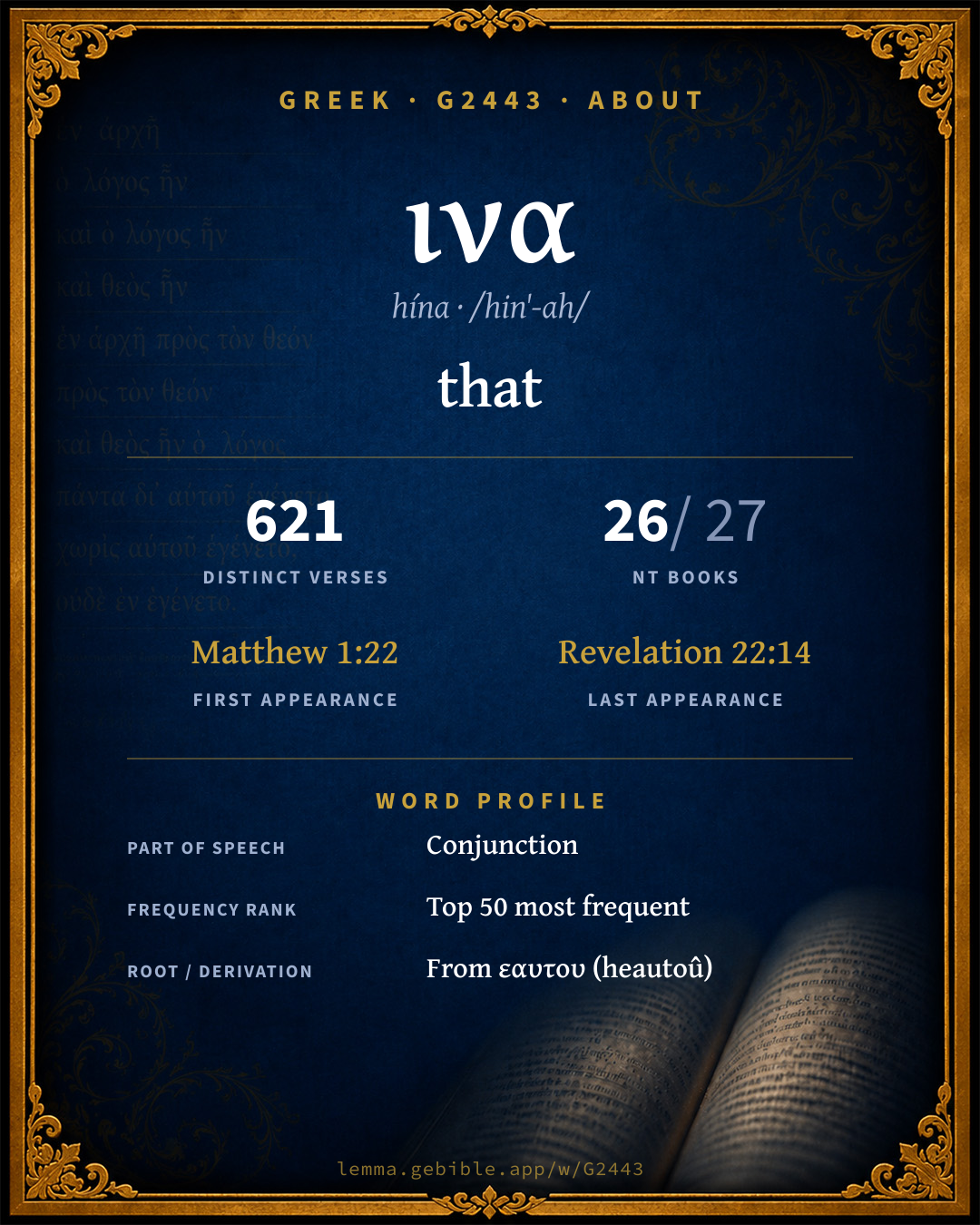
ἵνα
that
Full lexicon entry — Thayer's Greek Lexicon
From Thayer's Greek Lexicon
Where this word appears
Grammar key — what these labels mean
Part of speech
- Conjunction
- A joining word linking words or clauses.
Every verse where G2443 appears in the Book of Hebrews — 20 distinct verses. Click any verse to open its interlinear word-by-word view. Verse text shown in the World English Bible for context — . Each verse’s Greek form is shown with its reference; the English is not keyword-highlighted, since the data carries no word-level English alignment. Use “Compare translations” on any verse to read it across multiple English versions. This concordance covers the Greek New Testament; Septuagint (Greek Old Testament) occurrences of this word are not indexed here.
Hebrews
- Hebrews 2:14 ἵνα conj Since then the children have shared in flesh and blood, he also himself in like manner partook of the same, that through death he might bring to nothing him who had the power of death, that is, the devil,
- Hebrews 2:17 ἵνα conj Therefore he was obligated in all things to be made like his brothers, that he might become a merciful and faithful high priest in things pertaining to God, to make atonement for the sins of the people.
- Hebrews 3:13 ἵνα conj but exhort one another day by day, so long as it is called "today;" lest any one of you be hardened by the deceitfulness of sin.
- Hebrews 4:11 ἵνα conj Let us therefore give diligence to enter into that rest, lest anyone fall after the same example of disobedience.
- Hebrews 4:16 ἵνα conj Let us therefore draw near with boldness to the throne of grace, that we may receive mercy, and may find grace for help in time of need.
- Hebrews 5:1 ἵνα conj For every high priest, being taken from among men, is appointed for men in things pertaining to God, that he may offer both gifts and sacrifices for sins.
- Hebrews 6:12 ἵνα conj that you won't be sluggish, but imitators of those who through faith and patience inherited the promises.
- Hebrews 6:18 ἵνα conj that by two immutable things, in which it is impossible for God to lie, we may have a strong encouragement, who have fled for refuge to take hold of the hope set before us.
- Hebrews 9:25 ἵνα conj nor yet that he should offer himself often, as the high priest enters into the holy place year by year with blood not his own,
- Hebrews 10:9 ἵνα conj then he has said, "Behold, I have come to do your will." He takes away the first, that he may establish the second,
- Hebrews 10:36 ἵνα conj For you need endurance so that, having done the will of God, you may receive the promise.
- Hebrews 11:28 ἵνα conj By faith, he kept the Passover, and the sprinkling of the blood, that the destroyer of the firstborn should not touch them.
- Hebrews 11:35 ἵνα conj Women received their dead by resurrection. Others were tortured, not accepting their deliverance, that they might obtain a better resurrection.
- Hebrews 11:40 ἵνα conj God having provided some better thing concerning us, so that apart from us they should not be made perfect.
- Hebrews 12:3 ἵνα conj For consider him who has endured such contradiction of sinners against himself, that you don't grow weary, fainting in your souls.
- Hebrews 12:13 ἵνα conj and make straight paths for your feet, so that which is lame may not be dislocated, but rather be healed.
- Hebrews 12:27 ἵνα conj This phrase, "Yet once more," signifies the removing of those things that are shaken, as of things that have been made, that those things which are not shaken may remain.
- Hebrews 13:12 ἵνα conj Therefore Jesus also, that he might sanctify the people through his own blood, suffered outside of the gate.
- Hebrews 13:17 ἵνα conj Obey your leaders and submit to them, for they watch on behalf of your souls, as those who will give account, that they may do this with joy, and not with groaning, for that would be unprofitable for you.
- Hebrews 13:19 ἵνα conj I strongly urge you to do this, that I may be restored to you sooner.
About this entry
At a glance — auto-summarized from this page’s data, not written by a person. Every figure links to its source below. This summary describes the numbers; it doesn’t interpret them.
At its core, ινα (hína) means “that.” It first appears in Matthew 1:22. Spanning 621 verses in 26 books, it ranks among the most common words of the Greek New Testament. Sharing its root, it stands alongside εαυτου, αυτου and ινατι. Each statement above links to its evidence; the full detail follows below.
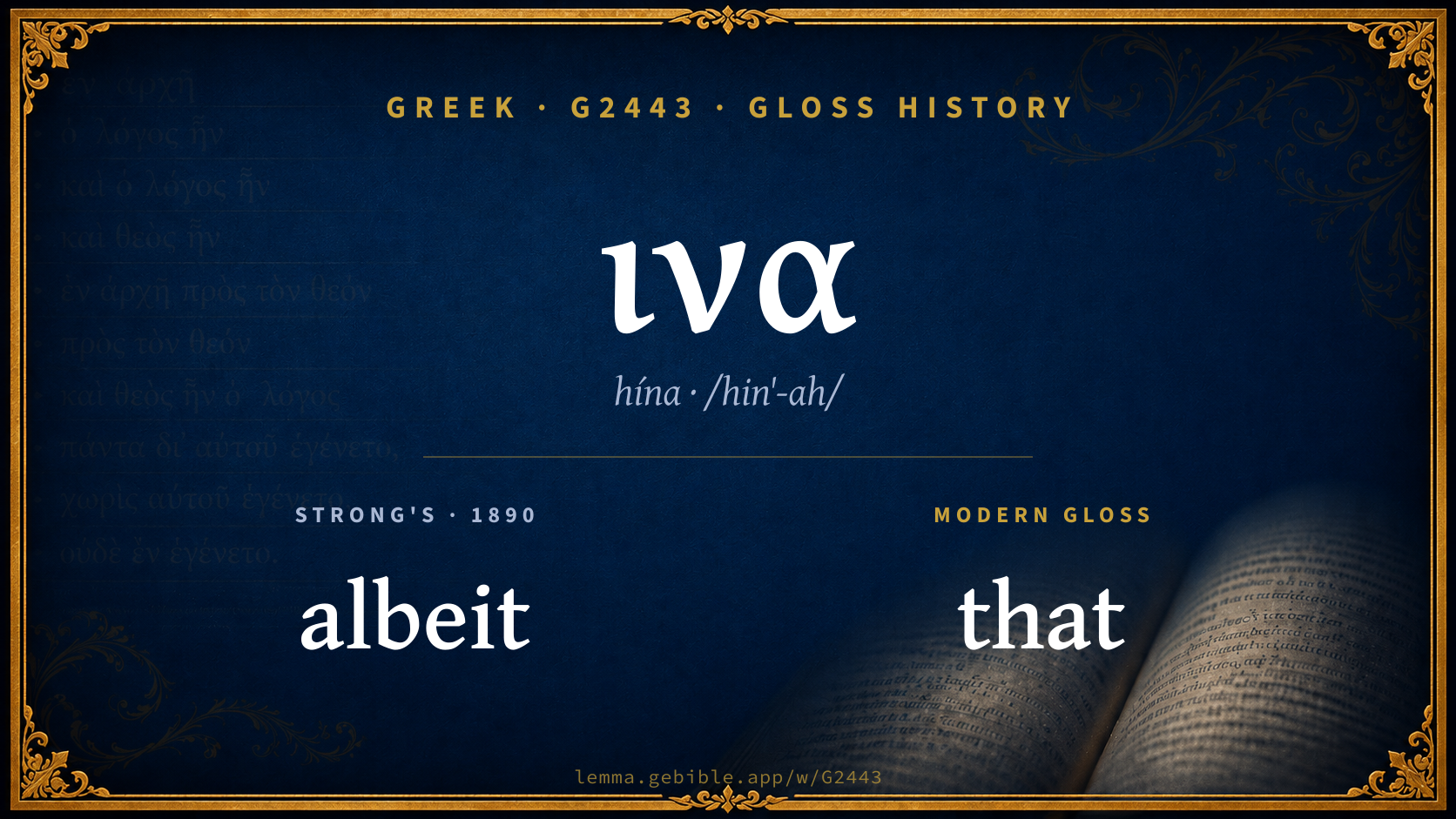
Gloss history
Strong's 1890 vs modern scholarship
About this word
Strong's G2443 catalogs a Greek word from the Greek New Testament.
These counts are not copied from any lexicon or concordance. They are computed here, from the morphology-tagged Greek New Testament. What Lemma adds →
- 621
- distinct verses
- The word appears in 621 distinct verses.
- 26 / 27
- NT books
- The word appears in 26 of 27 New Testament books.
- #29
- by frequency
- Top 50 most frequent Greek words (rank 29 of 5,347 Greek words by occurrence).
View all 621 occurrences in the concordance →
Most concentrated in
- John 132 verses 21%
- Mark 59 verses 10%
- 1 Corinthians 50 verses 8%
By section of the New Testament
By traditional corpus
Conventional, traditional groupings — biblical authorship is debated, so this is a traditional corpus grouping, not an authorship claim. Some books belong to more than one corpus (Luke is in both the Gospels and the Lukan corpus, and so on), so these shares overlap and need not total 100%. Each figure is a share of the word’s 621 distinct verses.
- Gospels 276 verses · 44%
- Pauline corpus 228 verses · 37%
- Johannine 194 verses · 31%
- Lukan (Luke–Acts) 62 verses · 10%
- General (Catholic) Epistles 44 verses · 7%
- Revelation 37 verses · 6%
- Hebrews 20 verses · 3%
How translations render this word
Counts come from each version’s own published word-to-Strong’s tagging or interlinear alignment — an approximate guide to how each version renders this word, not a word-level alignment the data otherwise carries. Because each total is that version’s own tagged count, the per-version totals vary from one another and need not match the appearance or distinct-verse counts above. These counts may also differ from a printed concordance because Lemma counts each distinctly tagged rendering and does not collapse phrase taggings into a single head-word total. This is a fixed set of word-tagged versions (KJV, ASV, BSB, ULT) and does not change with the reading translation you choose elsewhere. Each version’s license is shown beside its name below (and on Sources).
- King James Version: That 478×, To 72×, See that 2×
- American Standard Version: That 510×, To 54×, Him 3×
- Berean Standard Bible: That 321×, To 163×, So 16×
- unfoldingWord Literal Text: That 597×, Order that 35×, Order 7×
King James Version Public Domain
Renders G2443 across 570 tagged occurrences — most commonly:
Plus 18 renderings that appear only once — usually multi-word phrases or single function words the recovered tagging swept in, not distinct renderings.
American Standard Version Public Domain
Renders G2443 across 641 tagged occurrences — most commonly:
Plus 55 renderings that appear only once — usually multi-word phrases or single function words the recovered tagging swept in, not distinct renderings. Not rendered by a distinct English word in 2 further occurrences.
Berean Standard Bible Public Domain
Renders G2443 across 585 tagged occurrences — most commonly:
Plus other, less common renderings. Plus 21 renderings that appear only once — usually multi-word phrases or single function words the recovered tagging swept in, not distinct renderings. Not rendered by a distinct English word in 74 further occurrences.
unfoldingWord Literal Text CC BY-SA 4.0
Renders G2443 across 670 tagged occurrences — most commonly:
Plus 10 renderings that appear only once — usually multi-word phrases or single function words the recovered tagging swept in, not distinct renderings.
Senses in Thayer's
The 1 sense Thayer's distinguishes for this word, in lexicon order (not ranked by frequency or importance). The full entry — with sub-senses — is in the Lexicon Entry tab.
- that…
Word origin
Derived from εαυτου (heautoû) (G1438) — himself.
Forms in the corpus
The 2 distinct written forms G2443 takes in the Greek New Testament, most frequent first — each parse links to that case’s occurrences in the concordance.
| Form | Parsing | Example | Uses |
|---|---|---|---|
| ἵνα hína | Conjunction | Matthew 1:22 | 663 |
| Ἵνα Hína | Conjunction | Ephesians 6:21 | 1 |
Same root — word family
Other Thayer's entries built from the same root as G2443, grouped by Strong’s listed origin. These share a root / origin per the lexicon — not necessarily a shared meaning. Each links to that word’s own entry.
Derives from
Shares the same root
Derived from this word
Compare all same-root words → Showing 4 of 5 — not the complete family. They share a root, not necessarily a meaning.
Septuagint usage
The same Greek word ινα appears 451 times in the Greek Old Testament (Septuagint), across 422 verses in 29 books.
- 451
- LXX occurrences
- Tagged occurrences of this Greek word in the Septuagint.
- 422
- verses
- Distinct Septuagint verses containing this word.
- 29 / 39
- OT books
- The word appears in 29 of the 39 Old Testament books.
Sample Septuagint occurrences
- Genesis 3:3 ἵνα
- Exodus 1:11 ἵνα
- Leviticus 8:35 ἵνα
- Numbers 4:15 ἵνα
- Deuteronomy 2:30 ἵνα
- Joshua 1:7 ἵνα
- Judges 19:22 ἵνα
- Ruth 1:11 ἵνα
- 1 Samuel 1:8 ἵνα
- 2 Samuel 2:22 ἵνα
- 1 Kings 2:3 ἵνα
- 2 Kings 5:8 ἵνα
Septuagint occurrences (same lexeme)
Every verse where the same Strong’s number (G2443) appears in the Greek Septuagint — showing the first 50 of 422. Verse text shown in the World English Bible for context; the Greek form is the matched word — the English is not keyword-highlighted.
- Genesis 3:3 ἵνα but of the fruit of the tree which is in the midst of the garden, God has said, 'You shall not eat of it, neither shall you touch it, lest you die.'"
- Genesis 4:6 ἵνα Yahweh said to Cain, "Why are you angry? Why has the expression of your face fallen?
- Genesis 6:19 ἵνα Of every living thing of all flesh, you shall bring two of every sort into the ark, to keep them alive with you. They shall be male and female.
- Genesis 11:7 ἵνα Come, let's go down, and there confuse their language, that they may not understand one another's speech."
- Genesis 12:19 ἵνα Why did you say, 'She is my sister,' so that I took her to be my wife? Now therefore, see your wife, take her, and go your way."
- Genesis 14:23 ἵνα that I will not take a thread nor a shoe-latchet nor anything that is yours, lest you should say, 'I have made Abram rich.'
- Genesis 16:2 ἵνα Sarai said to Abram," See now, Yahweh has restrained me from bearing. Please go in to my handmaid. It may be that I will obtain children by her." Abram listened to the voice of Sarai.
- Genesis 18:21 ἵνα I will go down now, and see whether they have done altogether according to the cry of it, which is come to me. If not, I will know."
- Genesis 19:5 ἵνα They called to Lot, and said to him, "Where are the men who came in to you this night? Bring them out to us, that we may have sex with them."
- Genesis 19:15 ἵνα When the morning arose, then the angels hurried Lot, saying, "Arise, take your wife, and your two daughters who are here, lest you be consumed in the iniquity of the city."
- Genesis 21:30 ἵνα He said, "You shall take these seven ewe lambs from my hand, that it may be a witness to me, that I have dug this well."
- Genesis 22:14 ἵνα Abraham called the name of that place Yahweh-Jireh. As it is said to this day, "In Yahweh's mountain it will be provided.
- Genesis 24:3 ἵνα I will make you swear by Yahweh, the God of heaven and the God of the earth, that you shall not take a wife for my son of the daughters of the Canaanites, among whom I live.
- Genesis 24:14 ἵνα Let it happen, that the young lady to whom I will say, 'Please let down your pitcher, that I may drink.' She will say, 'Drink, and I will also give your camels a drink.' Let the same be she who you have appointed for your servant Isaac. Thereby will I know that you have shown kindness to my master."
- Genesis 24:31 ἵνα He said, "Come in, you blessed of Yahweh. Why do you stand outside? For I have prepared the house, and room for the camels."
- Genesis 24:49 ἵνα Now if you will deal kindly and truly with my master, tell me. If not, tell me. That I may turn to the right hand, or to the left."
- Genesis 24:54 ἵνα They ate and drank, he and the men who were with him, and stayed all night. They rose up in the morning, and he said, "Send me away to my master."
- Genesis 24:56 ἵνα He said to them, "Don't hinder me, seeing Yahweh has prospered my way. Send me away that I may go to my master."
- Genesis 25:22 ἵνα The children struggled together within her. She said, "If it be so, why do I live?" She went to inquire of Yahweh.
- Genesis 25:32 ἵνα Esau said, "Behold, I am about to die. What good is the birthright to me?"
- Genesis 26:27 ἵνα Isaac said to them, "Why have you come to me, since you hate me, and have sent me away from you?"
- Genesis 27:4 ἵνα Make me savory food, such as I love, and bring it to me, that I may eat, and that my soul may bless you before I die."
- Genesis 27:25 ἵνα He said, "Bring it near to me, and I will eat of my son's venison, that my soul may bless you." He brought it near to him, and he ate. He brought him wine, and he drank.
- Genesis 27:41 ἵνα Esau hated Jacob because of the blessing with which his father blessed him. Esau said in his heart, "The days of mourning for my father are at hand. Then I will kill my brother Jacob."
- Genesis 27:46 ἵνα Rebekah said to Isaac, "I am weary of my life because of the daughters of Heth. If Jacob takes a wife of the daughters of Heth, such as these, of the daughters of the land, what good will my life do me?"
- Genesis 29:25 ἵνα It happened in the morning that, behold, it was Leah. He said to Laban, "What is this you have done to me? Didn't I serve with you for Rachel? Why then have you deceived me?"
- Genesis 30:25 ἵνα It happened, when Rachel had borne Joseph, that Jacob said to Laban, "Send me away, that I may go to my own place, and to my country.
- Genesis 30:26 ἵνα Give me my wives and my children for whom I have served you, and let me go: for you know my service with which I have served you."
- Genesis 30:38 ἵνα He set the rods which he had peeled opposite the flocks in the gutters in the watering-troughs where the flocks came to drink. They conceived when they came to drink.
- Genesis 31:26 ἵνα Laban said to Jacob, "What have you done, that you have deceived me, and carried away my daughters like captives of the sword?
- Genesis 31:30 ἵνα Now, you want to be gone, because you sore longed after your father's house, but why have you stolen my gods?"
- Genesis 32:6 ἵνα The messengers returned to Jacob, saying, "We came to your brother Esau. Not only that, but he comes to meet you, and four hundred men with him."
- Genesis 32:30 ἵνα Jacob called the name of the place Peniel: for, he said, "I have seen God face to face, and my life is preserved."
- Genesis 33:8 ἵνα Esau said, "What do you mean by all this company which I met?" Jacob said, "To find favor in the sight of my lord."
- Genesis 33:15 ἵνα Esau said, "Let me now leave with you some of the folk who are with me." He said, "Why? Let me find favor in the sight of my lord."
- Genesis 42:1 ἵνα Now Jacob saw that there was grain in Egypt, and Jacob said to his sons, "Why do you look at one another?"
- Genesis 42:2 ἵνα He said, "Behold, I have heard that there is grain in Egypt. Go down there, and buy for us from there, so that we may live, and not die."
- Genesis 43:8 ἵνα Judah said to Israel, his father, "Send the boy with me, and we will arise and go, so that we may live, and not die, both we, and you, and also our little ones.
- Genesis 44:5 ἵνα Isn't this that from which my lord drinks, and by which he indeed divines? You have done evil in so doing.'"
- Genesis 44:7 ἵνα They said to him, "Why does my lord speak such words as these? Far be it from your servants that they should do such a thing!
- Genesis 44:34 ἵνα For how will I go up to my father, if the boy isn't with me? Lest I see the evil that will come on my father."
- Genesis 45:11 ἵνα There I will nourish you; for there are yet five years of famine; lest you come to poverty, you, and your household, and all that you have."'
- Genesis 46:34 ἵνα that you shall say, 'Your servants have been keepers of cattle from our youth even until now, both we, and our fathers:' that you may dwell in the land of Goshen; for every shepherd is an abomination to the Egyptians."
- Genesis 47:15 ἵνα When the money was all spent in the land of Egypt, and in the land of Canaan, all the Egyptians came to Joseph, and said, "Give us bread, for why should we die in your presence? For our money fails."
- Genesis 47:19 ἵνα Why should we die before your eyes, both we and our land? Buy us and our land for bread, and we and our land will be servants to Pharaoh. Give us seed, that we may live, and not die, and that the land won't be desolate."
- Genesis 48:9 ἵνα Joseph said to his father, "They are my sons, whom God has given me here." He said, "Please bring them to me, and I will bless them."
- Genesis 49:1 ἵνα Jacob called to his sons, and said: "Gather yourselves together, that I may tell you that which will happen to you in the days to come.
- Genesis 50:20 ἵνα As for you, you meant evil against me, but God meant it for good, to bring to pass, as it is this day, to save many people alive.
- Exodus 1:11 ἵνα Therefore they set taskmasters over them to afflict them with their burdens. They built storage cities for Pharaoh: Pithom and Raamses.
- Exodus 2:20 ἵνα He said to his daughters, "Where is he? Why is it that you have left the man? Call him, that he may eat bread."
These are occurrences of the same Greek lexeme (G2443) in the Septuagint — not a translation of any one Hebrew word. The store carries no word-level Hebrew↔Greek alignment, so no Hebrew original is asserted here. Counts come from the recovered LXX Strong's tagging — high-frequency vocabulary is well covered, while rare or late forms may be untagged — so they reflect tagged occurrences and may slightly undercount.