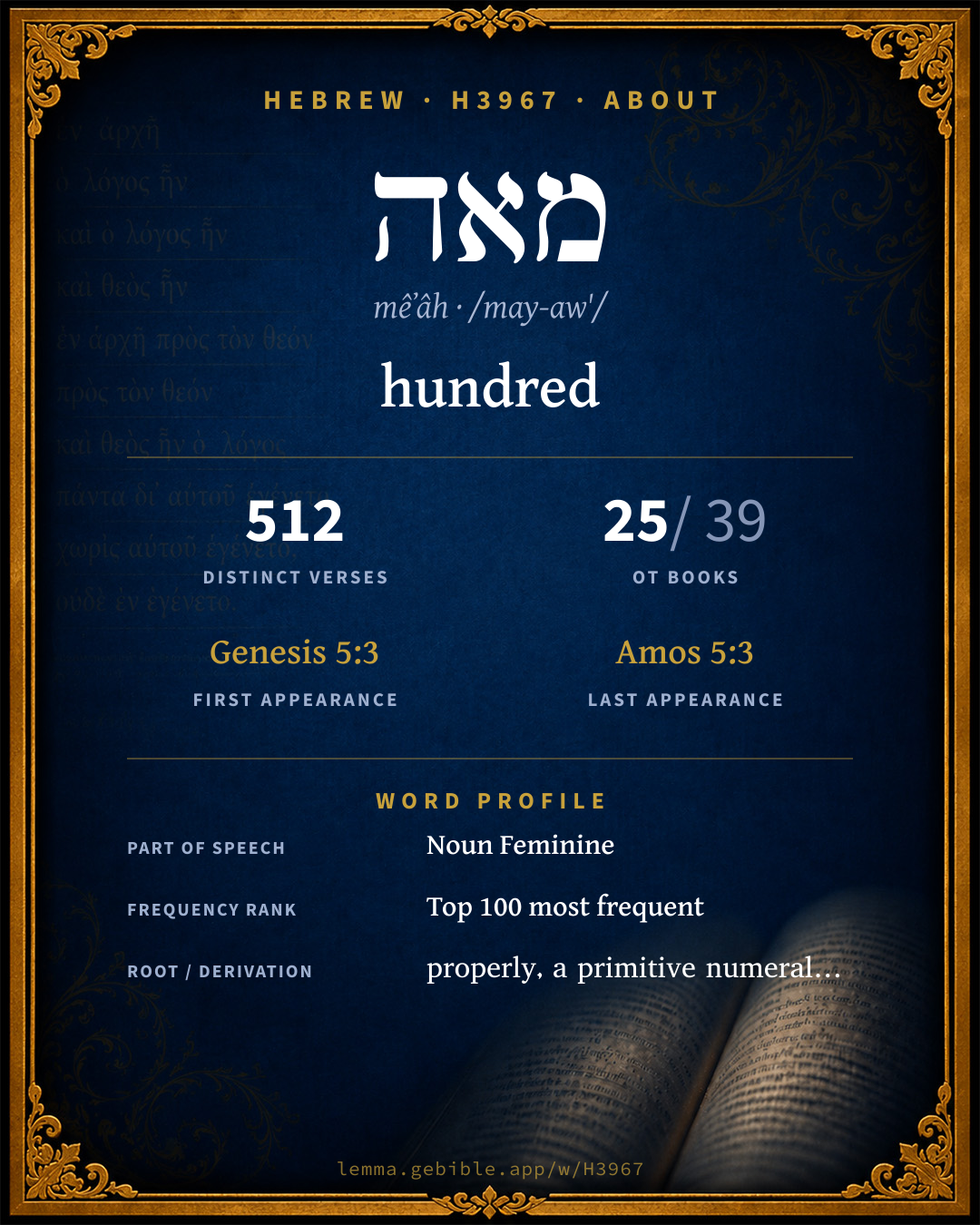
מֵאָה
hundred
‘hundred’ is one of 4 main senses fuller range ↓
Full lexicon entry — Brown-Driver-Briggs (BDB)
From Brown-Driver-Briggs (BDB)
Where this word appears
Grammar key — what these labels mean
Part of speech
- Adjective
- A word that describes or qualifies a noun.
State
- Absolute
- The independent form of a noun, not bound to a following word.
- Construct
- A noun bound to a following noun in a possessive / “of” relationship (the construct chain).
Gender
- Both
- Attested as both masculine and feminine.
- Feminine
- Grammatically feminine.
Number
- Plural
- More than one (in Hebrew, generally three or more).
- Singular
- One.
- Dual
- Exactly two — for natural pairs and some measures of time.
Every verse where H3967 appears in the Book of Judges — 30 distinct verses. Click any verse to open its interlinear word-by-word view. Verse text shown in the World English Bible for context — . Each verse’s Hebrew form is shown with its reference; the English is not keyword-highlighted, since the data carries no word-level English alignment. Use “Compare translations” on any verse to read it across multiple English versions. This concordance covers the Hebrew Bible; Septuagint (Greek Old Testament) occurrences are not indexed here.
Judges
- Judges 2:8 מֵאָ֥ה adj Cardinal number bs Joshua the son of Nun, the servant of Yahweh, died, being one hundred ten years old.
- Judges 3:31 מֵא֣וֹת adj Cardinal number bp After him was Shamgar the son of Anath, who struck of the Philistines six hundred men with an ox-goad: and he also saved Israel.
- Judges 4:3 מֵא֤וֹת adj Cardinal number bp The children of Israel cried to Yahweh: for he had nine hundred chariots of iron; and twenty years he mightily oppressed the children of Israel.
- Judges 4:13 מֵאוֹת֙ adj Cardinal number bp Sisera gathered together all his chariots, even nine hundred chariots of iron, and all the people who were with him, from Harosheth of the Gentiles, to the river Kishon.
- Judges 7:6 מֵא֖וֹת adj Cardinal number bp The number of those who lapped, putting their hand to their mouth, was three hundred men: but all the rest of the people bowed down on their knees to drink water.
- Judges 7:7 מֵא֨וֹת adj Cardinal number bp Yahweh said to Gideon, By the three hundred men who lapped will I save you, and deliver the Midianites into your hand; and let all the people go every man to his place.
- Judges 7:8 מֵא֥וֹת adj Cardinal number bp So the people took food in their hand, and their trumpets; and he sent all the men of Israel every man to his tent, but retained the three hundred men: and the camp of Midian was beneath him in the valley.
- Judges 7:16 מֵא֥וֹת adj Cardinal number bp He divided the three hundred men into three companies, and he put into the hands of all of them trumpets, and empty pitchers, with torches within the pitchers.
- Judges 7:19 וּ/מֵאָה conj + Adjective Cardinal number bs So Gideon, and the hundred men who were with him, came to the outermost part of the camp in the beginning of the middle watch, when they had but newly set the watch: and they blew the trumpets, and broke in pieces the pitchers that were in their hands.
- Judges 7:22 מֵא֣וֹת adj Cardinal number bp They blew the three hundred trumpets, and Yahweh set every man's sword against his fellow, and against all the host; and the host fled as far as Beth-shittah toward Zererah, as far as the border of Abel Meholah, by Tabbath.
- Judges 8:4 מֵא֤וֹת adj Cardinal number bp Gideon came to the Jordan, [and] passed over, he, and the three hundred men who were with him, faint, yet pursuing.
- Judges 8:10 מֵאָ֨ה adj Cardinal number bs Now Zebah and Zalmunna were in Karkor, and their hosts with them, about fifteen thousand men, all who were left of all the host of the children of the east; for there fell one hundred twenty thousand men who drew sword.
- Judges 8:26 מֵא֖וֹת adj Cardinal number bp The weight of the golden ear-rings that he requested was one thousand and seven hundred [shekels] of gold, besides the crescents, and the pendants, and the purple clothing that was on the kings of Midian, and besides the chains that were about their camels' necks.
- Judges 11:26 מֵא֖וֹת adj Cardinal number bp While Israel lived in Heshbon and its towns, and in Aroer and its towns, and in all the cities that are along by the side of the Arnon, three hundred years; why didn't you recover them within that time?
- Judges 15:4 מֵא֣וֹת adj Cardinal number bp Samson went and caught three hundred foxes, and took firebrands, and turned tail to tail, and put a firebrand in the midst between every two tails.
- Judges 16:5 וּ/מֵאָ֖ה conj + Adjective Cardinal number bs The lords of the Philistines came up to her, and said to her, Entice him, and see in which his great strength lies, and by what means we may prevail against him, that we may bind him to afflict him: and we will each give you of us eleven hundred [pieces] of silver.
- Judges 17:2 וּ/מֵאָ֨ה conj + Adjective Cardinal number bs He said to his mother, The eleven hundred [pieces] of silver that were taken from you, about which you did utter a curse, and did also speak it in my ears, behold, the silver is with me; I took it. His mother said, Blessed be my son of Yahweh.
- Judges 17:3 וּ/מֵאָ֥ה conj + Adjective Cardinal number bs He restored the eleven hundred [pieces] of silver to his mother; and his mother said, I most assuredly dedicate the silver to Yahweh from my hand for my son, to make an engraved image and a molten image: now therefore I will restore it to you.
- Judges 17:4 מָאתַ֨יִם adj Cardinal number bd When he restored the money to his mother, his mother took two hundred [pieces] of silver, and gave them to the founder, who made of it an engraved image and a molten image: and it was in the house of Micah.
- Judges 18:11 מֵא֣וֹת adj Cardinal number bp There set forth from there of the family of the Danites, out of Zorah and out of Eshtaol, six hundred men girt with weapons of war.
- Judges 18:16 מֵא֣וֹת adj Cardinal number bp The six hundred men girt with their weapons of war, who were of the children of Dan, stood by the entrance of the gate.
- Judges 18:17 מֵא֣וֹת adj Cardinal number bp The five men who went to spy out the land went up, and came in there, and took the engraved image, and the ephod, and the teraphim, and the molten image: and the priest stood by the entrance of the gate with the six hundred men girt with weapons of war.
- Judges 20:2 מֵא֥וֹת adj Cardinal number bp The chiefs of all the people, even of all the tribes of Israel, presented themselves in the assembly of the people of God, four hundred thousand footmen who drew sword.
- Judges 20:10 לַ/מֵּאָ֜ה וּ/מֵאָ֤ה prep det + Adjective Cardinal number bs conj + Adjective Cardinal number bs and we will take ten men of one hundred throughout all the tribes of Israel, and one hundred of one thousand, and a thousand out of ten thousand, to get food for the people, that they may do, when they come to Gibeah of Benjamin, according to all the folly that they have worked in Israel.
- Judges 20:15 מֵא֖וֹת adj Cardinal number bp The children of Benjamin were numbered on that day out of the cities twenty-six thousand men who drew the sword, besides the inhabitants of Gibeah, who were numbered seven hundred chosen men.
- Judges 20:16 מֵאוֹת֙ adj Cardinal number bp Among all this people there were seven hundred chosen men left-handed; everyone could sling stones at a hair-breadth, and not miss.
- Judges 20:17 מֵא֥וֹת adj Cardinal number bp The men of Israel, besides Benjamin, were numbered four hundred thousand men who drew sword: all these were men of war.
- Judges 20:35 וּ/מֵאָ֖ה conj + Adjective Cardinal number bs Yahweh struck Benjamin before Israel; and the children of Israel destroyed of Benjamin that day twenty-five thousand one hundred men: all these drew the sword.
- Judges 20:47 מֵא֖וֹת adj Cardinal number bp But six hundred men turned and fled toward the wilderness to the rock of Rimmon, and abode in the rock of Rimmon four months.
- Judges 21:12 מֵאוֹת֙ adj Cardinal number bp They found among the inhabitants of Jabesh Gilead four hundred young virgins, who had not known man by lying with him; and they brought them to the camp to Shiloh, which is in the land of Canaan.
About this entry
At a glance — auto-summarized from this page’s data, not written by a person. Every figure links to its source below. This summary describes the numbers; it doesn’t interpret them.
מאה — transliterated mêʼâh — is a Hebrew noun carrying the sense “hundred.” Translators differ — “hundred” in the King James Version, then “were” (unfoldingWord Literal Text), as the renderings breakdown shows. With 512 verses in 25 books, it is one of the most common word in the Hebrew Bible. It first appears in Genesis 5:3. It is not a single-sense word — see its full sense range. See the sense tree, 512-verse concordance, and the renderings breakdown below.
Gloss history
Strong's 1890 vs modern scholarship
About this word
Strong's H3967 catalogs a Hebrew word from the Hebrew Old Testament.
These counts are not copied from any lexicon or concordance. They are computed here, from the morphology-tagged Hebrew Old Testament. What Lemma adds →
- 512
- distinct verses
- The word appears in 512 distinct verses.
- 25 / 39
- OT books
- The word appears in 25 of 39 Old Testament books.
- #84
- by frequency
- Top 100 most frequent Hebrew words (rank 84 of 8,640 Hebrew words by occurrence).
View all 512 occurrences in the concordance →
Most concentrated in
- Numbers 85 verses 17%
- Genesis 63 verses 12%
- 2 Chronicles 52 verses 10%
By section of the Old Testament
By traditional corpus
Conventional, traditional groupings — biblical authorship is debated, so this is a traditional corpus grouping, not an authorship claim. Each share is this word’s portion of its verses in that division of the Hebrew canon. Each figure is a share of the word’s 512 distinct verses.
- Writings (Ketuvim) 204 verses · 40%
- Torah (Pentateuch) 175 verses · 34%
- Prophets (Nevi'im) 133 verses · 26%
How translations render this word
Counts come from each version’s own published word-to-Strong’s tagging or interlinear alignment — an approximate guide to how each version renders this word, not a word-level alignment the data otherwise carries. Because each total is that version’s own tagged count, the per-version totals vary from one another and need not match the appearance or distinct-verse counts above. These counts may also differ from a printed concordance because Lemma counts each distinctly tagged rendering and does not collapse phrase taggings into a single head-word total. This is a fixed set of word-tagged versions (KJV, ASV, BSB, ULT) and does not change with the reading translation you choose elsewhere. Each version’s license is shown beside its name below (and on Sources).
BDB lists this Strong’s number as 2 distinct words (homographs). Each count above pools all of them and is not split by sense — see the Senses section below. A low-frequency rendering may belong to a different one of those words, not the primary meaning.
- King James Version†: Hundred 418×, Two hundred 64×, Hundreds 19×
- American Standard Version†: Hundred 409×, Two hundred 66×, Hundreds 22×
- Berean Standard Bible†: Hundred 132×, Hundreds 26×, Two hundred 17×
- unfoldingWord Literal Text†: Were 105×, Years 35×, Hundreds 26×
King James Version Public Domain
Renders H3967 across 578† tagged occurrences — most commonly:
Plus other, less common renderings. Plus 22 renderings that appear only once — usually multi-word phrases or single function words the recovered tagging swept in, not distinct renderings. Not rendered by a distinct English word in 3 further occurrences.
American Standard Version Public Domain
Renders H3967 across 577† tagged occurrences — most commonly:
Plus other, less common renderings. Plus 31 renderings that appear only once — usually multi-word phrases or single function words the recovered tagging swept in, not distinct renderings.
Berean Standard Bible Public Domain
Renders H3967 across 226† tagged occurrences — most commonly:
Plus 16 renderings that appear only once — usually multi-word phrases or single function words the recovered tagging swept in, not distinct renderings. Not rendered by a distinct English word in 352 further occurrences.
unfoldingWord Literal Text CC BY-SA 4.0
Renders H3967 across 313† tagged occurrences — most commonly:
Plus other, less common renderings. Plus 24 renderings that appear only once — usually multi-word phrases or single function words the recovered tagging swept in, not distinct renderings. Not rendered by a distinct English word in 283 further occurrences.
9 senses and sub-senses in the full BDB
What do BDB’s symbols mean?
BDB uses these scholarly abbreviations:
| Symbol | Meaning |
|---|---|
| 𝔊 | the Septuagint (the ancient Greek translation, LXX) |
| 𝔙 | the Vulgate (the Latin translation) |
| 𝔖 | the Syriac version (the Peshitta) |
| 𝔗 | the Targum (the Aramaic translation) |
| ψ | the Psalms |
| √ | root (the underlying root or stem) |
| ‖ | parallel passage (a synonymous or contrasted parallel) |
| † | the dagger: every passage where the word occurs is cited |
The 9 senses and sub-senses the full Brown-Driver-Briggs lexicon distinguishes for this word, in lexicon order (not ranked by frequency), with BDB’s own verbatim wording and sub-sense lettering. Shown in Hebrew script with BDB’s own scholarly abbreviations. The condensed entry is in the Lexicon Entry tab. See also the Forms in the corpus table below.
מאה I hundred (NH id.
- 1. as simple number:
- a. abs. sg., (1) foll. by sg. of noun enumerated: מֵאָה קְשִׂיטָה Gn 33:19; Jos 24:32 (both E); מ׳ אִישׁ Ju 7:19; 1 K 18:13; 2 K 4:43; מ׳ אַמָּה 1 K 7:2; Ez 40:19 +; מ׳ כִּכָּר 2 K 23:33; 2 Ch 25:6; 27:5; 36:3; Ezr 8:26; מ׳ אֶלֶף = 100,000 1 K 20:29 + 6 times K Ch; cf. also Gn 17:17 (P), 2 S 8:4; Is 65:20;(×2), and sq. n. coll. רֶכֶב 2 S 8:4 = 1 Ch 18:4, צֹאן 1 K 5:3; (2) less often sq. pl. מֵאָה שְׁעָרִים Gn 26:12 (J), מ׳ פְּעָמִים 2 S 24:3 = 1 Ch 21:3, מ׳ נְבִיאִים 1 K 18:4, etc.; (3) seldom, and late, preceded by n.pl.: הָרִמֹּנִים מֵאָה Je 52:23, אַמּוֹת הַמֵּאָה Ez 42:2, cf. Ezr 2:69; 2 Ch 3:16; 4:8; 29:32; (4) exceptional is כְּלֵי כֶסֶף מֵאָה לְכִכָּרִים Ezr 8:26; also, with ellipsis, מֵאָה כֶסֶף Dt 22:19 (i.e. shekels); מֵאָה קַיִץ 2 S 16:1 (i.e. cakes); (5) מֵאָה without noun enumerated, especially = a hundred (men, persons) Ju 20:10(×2) Am 5:3(×2) Lv 26:8(×2) (H), 1 Ch 12:14; מ׳ Pr 17:10 = 100 (blows), Ec 6:3 = 100 (children), 8:12 = 100 (times).—On Ne 3:1; 12:39 v. infr. e.g. Genesis 33:19
- b. abs. du., (1) foll. by sg., מָאתַיִם אִישׁ 1 S 18:27; 30:10; 2 S 15:11, מ׳ לֶחֶם 1 S 25:18; 2 S 16:1, מ׳ צִנָּה 1 K 10:16 = 2 Ch 9:15, מ׳ אֶלֶף 1 S 15:4 +, מ׳ שָׁנָה Gn 11:23 (P); (2) less often sq. pl. מ׳ שְׁקָלִים Jos 7:21 (JE), 2 S 14:26, מ׳ דְּבֵלִים 1 S 25:18, מ׳ אֲנָשִׁים 1 S 30:21, cf. Ezr 8:4; (3) also preceded by n.pl.: עִזִּים מ׳ Gn 32:15, רְחֵלִים מ׳ v 15 (E), הָרִמּוֹנִים מ׳ 1 K 7:20, cf. 1 Ch 15:8; 2 Ch 29:32; Ezr 2:65; (4) c. ellipsis מ׳ כֶּסֶף Ju 17:4; (5) as pred., רָאשֵׁיהֶם מ׳ 1 Ch 12:32 (v 33 Van d. H.). e.g. 1 Samuel 18:27
- c. abs. pl. מֵא(וֹ)ת:—(1) alone, = hundreds, לְמֵאוֹת 1 S 29:2 by hundreds, so 2 S 18:4 (both + thousands); especially (הַ)מּ׳ שָׂרֵי captains of (the) hundreds Ex 18:21, 25 (E), 2 K 11:4, 9, 10, 15 +; (2) multiplied, sq. noun enumerated, in sg.: שְׁלשׁ מ׳ אִישׁ Ju 7:6 300 men, cf. v 7, 8, 16; 8:4 Ex 12:27 (E), etc.; אַרְבַּע מ׳ שָׁנָה Gn 15:13 (JE) 400 years; חֲמֵשׁ מ׳ אֶלֶף 2 S 24:9 500,000, cf. 2 Ch 13:17; שֵׁשׁ מ׳ רֶכֶב Ex 14:7 (J) 600 chariots; שְׁבַע מ׳ אִישׁ Ju 20:15, 16 700 men; שְׁמֹנֶה מ׳ חָלָל 2 S 23:8 800 slain; תְּשַׁע מ׳ רֶכֶב Ju 4:3, 13 900 chariots; (3) less often sq. n.pl.: שְׁלשׁ מ׳ שׁוּעָלִים Ju 15:4 300 foxes; חֲמֵשׁ מ׳ מֲתוֹנוֹת Jb 1:3 500 she-asses, etc.; (4) rare, and chiefly late, after n.pl. פִּלַגְשִׁים שְׁלשׁ מ׳ 1 K 11:3 300 concubines, cf. 7:42 = 2 Ch 4:13, 1 Ch 4:42; 2 Ch 14:8 etc.; after n.coll. בָּקָר חֲמֵשׁ מ׳ 2 Ch 35:9; (5) rare is חֲמֵשׁ מ׳ בַּשֶּׁקֶל Ex 30:24 (P); (6) ellipsis of n., שְׁלשׁ מ׳ כֶּסֶף Gn 45:22 (E), etc. e.g. 1 Samuel 29:2
- d. cstr. sg., only sq. sg., and late: מְאַת־שָׁנָה Gn 11:10; 21:5; 25:7 (all P) + 25 times P, 2 Ch 25:9; Est 1:4 (DrIntr. 124) (also c. other numerals, v. 2 infr.); מְאַ֖ת Ec 8:12 = 100 times (מֵאָה פְּעָמִים), sc. פַּעַם, or perhaps only appar. cstr. (Köii. 228 cf. Ew§ 269 b. 279 e).—Ne 5:11 v. 3 infr. e.g. Genesis 11:10
- 2. as part of larger number:
- a. usually preceding tens and units, (1) with noun expressed once, or not at all, earlier usage, usually c. וְ before ten if no unit follows, otherwise without וְ before ten (see Köii. 218 ff.); מֵאָה וְעֶשֶׂר שָׂרִים Ju 2:8; שֵׁשׁ מֵאוֹת שִׁשִּׁים וָשֵׁשׁ כִּכָּר 1 K 10:14 666 talents, etc. (exceptions are Ne 7:24 and v 31); (2) chiefly late, with noun and וְ repeated: מֵאָה שָׁנָה וְעֶשְׂרִים שָׁנָה וְשֶׁבַע שָׁנִים Gn 23:1 (P) (cf. ואלף אמה ומאת אמה SI 5, 6 DaExpos. Times, May, 1898). e.g. Judges 2:8
- b. less often, foll. tens and units, chiefly late, c. וְ repeated:—עֶשְׂרִים וּמֵאָה Nu 7:86 (P); שֶׁבַע וּשְׁלשִׁים וּמְאַת שָׁנָה Ex 6:16 (P), etc.; c. noun after ten and after hundred, חָמֵשׁ וְשִׁשִּׁים שָׁנָה וּשְׁלשׁ מֵאוֹת שָׁנָה Gn 5:23 (P), etc.—On these usages v., further, Köii. 217 ff. DaSynt. §§ 36 R. 3, 37 (d) Ges§§ 97, 134 and especially Herner Synt. d. Zahlwörter im AT (1893). e.g. Numbers 7:86
- 3. מְאַת הַכֶּסֶף Ne 5:11 = a hundredth part of the money; but read quite poss. מַשַּׁאת the debt (GeiJüd. Zeitschr. viii. 1870, 227 Gr.) e.g. Nehemiah 5:11
מאה II used as n.pr. of tower on northern wall of Jerus., מִגְדַּל הַמֵּאָה Ne 3
Senses from the full Brown-Driver-Briggs lexicon (Brown, Driver, Briggs; Oxford 1906 — public domain), digitized via Sefaria, supplemented by the OpenScriptures HebrewLexicon (CC BY 4.0). Full attribution on Sources.
Word origin
I. n.f. hundred (NH id.; MI 20 מאתן (du.); SI5 מאת, מאתים (du.); Ph. מאת, מאתם (du.); Assyrian mê (prob., Dl§ 75), TelAm. me-at WklTelAm. 20; Arabic مِاىَٔةٌ; Sab. מאת, מאתם OsZMG x. 1856, 49; CIS iv. i. 6, 4; 46, 6; מאה EutSin. 457; Ethiopic ምእት:; Aramaic מְאָה, ܡܳܐܐ; Palm. תלת מאה 300 VogPalm. 6, 4; Nab. מאה EutNab 8, 9);—מ׳ Gn 6:3 + 144 times; cstr. מְאַת 5:3 + 30 times (on מְאַת Ec 8:12 v. 1 d infr.); pl. abs. מֵאוֹת Gn 5:9 + 324 times (מֵאֹת only 5:4, 30); המאיות Kt 2 K 11:4 + 3 times 2 K 11; du. מָאתַיִם (-תָ֑יִם) Gn 11:19 + 76 times (but 1 S 18:27 read מֵאָה (מְאַת) 𝔊𝔊 We Dr Kit Bu HPS);—hundred:—
II. n.f. used as n.pr. of tower on northern wall of Jerus., מִגְדַּל הַמֵּאָה Ne 3:1; 12:39.
— Brown-Driver-Briggs (Oxford 1906, public domain), digitized via Sefaria, supplemented by the OpenScriptures HebrewLexicon (CC BY 4.0). See Sources.
Origin: properly, a primitive numeral; a hundred
Jastrow Dictionary
A second Hebrew/Aramaic lexicon for comparison, covering Aramaic and post-biblical (Talmudic, Targumic, Midrashic) usage that the biblical-Hebrew BDB does not. Matched by lemma rather than by Strong’s number, so a lemma may carry more than one Jastrow headword (shown separately below), and the entries cover usage well beyond the Bible.
מֵאָה
- (b. h.) one hundred. Tosef. Ber. VII (VI), 24 מ׳ מצות one hundred religious acts. Ib. 8; a. v. fr.—Pesik. Vattom., p. 131ᵇ מ׳ חסר שתים ninety-eight; a. fr.—Du. מָאתַיִם. Ex. R. s. 23; Mekh. B’shall., s. 6. Macc. I, 2. Keth. I, 2, v. כְּתוּבָּה; a. fr.—Pl. מֵאוֹת. Macc. 23ᵇ; a. fr.
מְאָה
- Targ. Gen. V, 3, sq.; a. fr.—Du. מָאתַיִן, מָאתָן. Ezra VI, 17.—Targ. Gen. XXXII, 15; a. fr.—Pl. מַאֲוָון. מָאוָן, מְאַוָותָא. Targ. II Sam. XVIII, 4 ed. Lag. (ed. מאתן; corr. acc.). Targ. I Sam. XXIX, 2.—Targ. O. Ex. XVIII, 21 מְאַוָתָא ed. Berl. (oth. ed. מַאֲוָ׳; Y. מַאֲוָו׳); a. fr.—Y. Kil. IX, 32ᵇ bot. תלת מ׳ צומין three hundred fasts; Y. Keth. XII, 35ᵃ bot. מאתן (corr. acc.). Y. Naz. V, end, 54ᵇ תלת מ׳ נזירין three hundred Nazarites; תשע מ׳ קרבנין nine hundred sacrifices; (Y. Ber. VII, 11ᵇ bot.; Gen. R. s. 91 תלת מאה, תשע מאה); a. fr. e.g. Ezra 6:17
A Dictionary of the Targumim, the Talmud Babli and Yerushalmi, and the Midrashic Literature (Marcus Jastrow; London, Luzac, 1903) — Public Domain. Digitized via Sefaria. Digitized via Sefaria. Full attribution on Sources.
Forms in the corpus
The 101 distinct written forms H3967 takes in the Hebrew Bible, most frequent first — each parse links to that state’s occurrences in the concordance. Hebrew forms include their vowel points and cantillation, so a single lemma takes many written forms.
The 60 most common forms are shown; 41 rarer forms follow in the full concordance.
Same root — word family
Other BDB entries built from the same root as H3967, grouped by Strong’s listed origin. These share a root / origin per the lexicon — not necessarily a shared meaning. Each links to that word’s own entry.
Derived from this word
Proper names from this root
People and places named from this root — a name, not an additional meaning of the word.
Compare all same-root words → 1 of the same-root words is a proper name (a person or place). They share a root, not necessarily a meaning.
Septuagint verse parallels
This word appears in 452 verses that also exist in the Greek Old Testament (Septuagint), out of the 512 Hebrew verses it occurs in. You can read those verses in Greek by switching the Old Testament edition to the Septuagint.
Read these verses in the Septuagint
- Genesis 5:3
- Exodus 6:16
- Leviticus 26:8
- Numbers 1:21
- Deuteronomy 1:15
- Joshua 7:21
- Judges 2:8
- 1 Samuel 11:8
- 2 Samuel 2:31
- 1 Kings 5:16
- 2 Kings 3:4
- 1 Chronicles 4:42
This is a verse-level parallel only — the same verses exist in both the Hebrew and Greek Old Testaments. No word-level Hebrew↔Greek correspondence is claimed: the data carries no such alignment, so no Greek word is shown as this Hebrew word’s translation. Coverage is not total — the Septuagint omits the deuterocanon and renumbers the Psalms, so some Hebrew verses have no direct Greek parallel.