
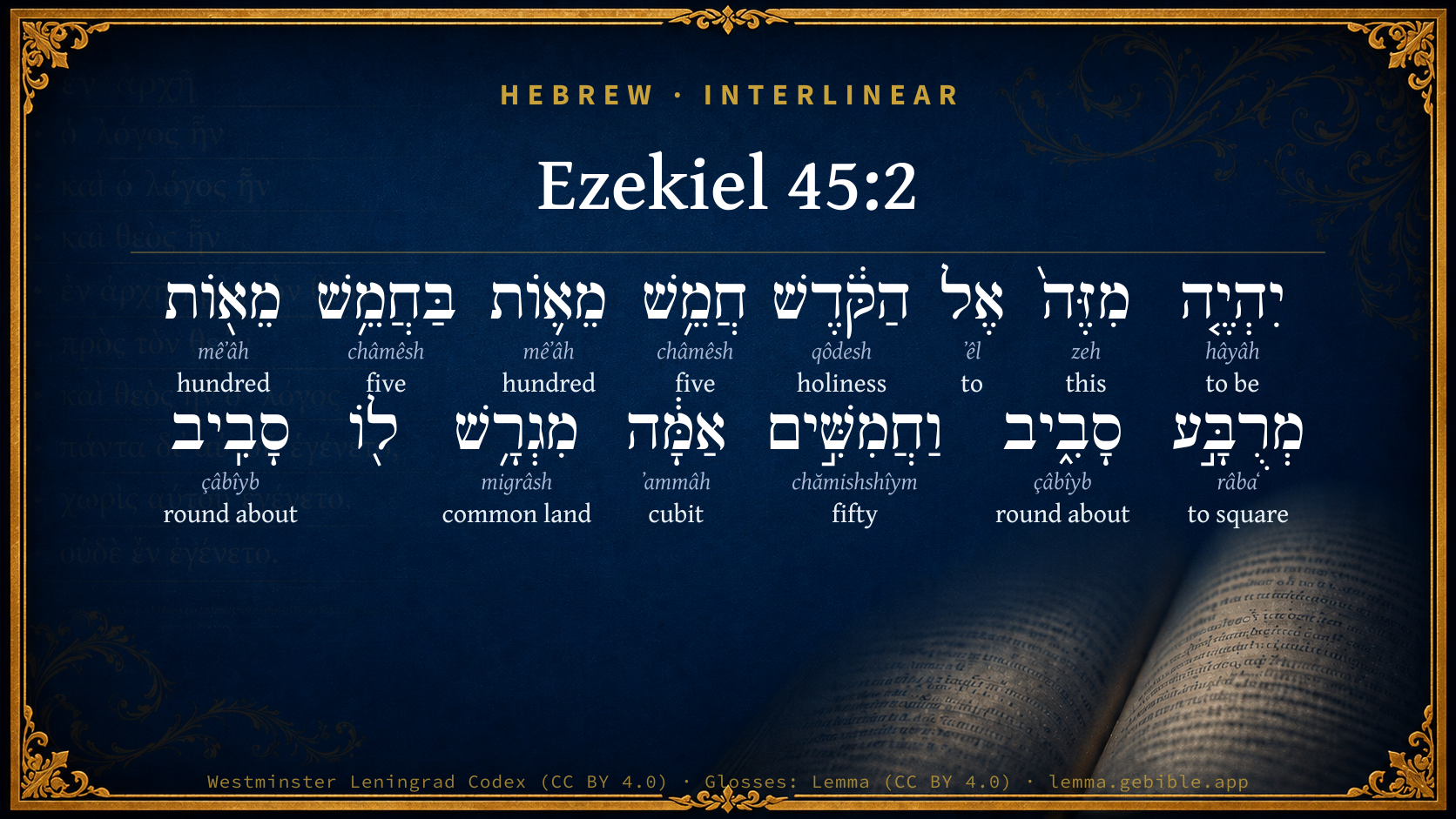
Ezekiel 45:2

Hebrew (Westminster Leningrad Codex) Ezekiel 45:2 appears in the Hebrew Old Testament. The text above is from the Westminster Leningrad Codex. Each word links to its Strong’s number, a concise gloss, and parsing drawn from the Open Scriptures Hebrew Bible morphology. Click any word for its full Brown-Driver-Briggs (BDB) entry.
Download image
Cite this verse

Ezekiel 45:2 (World English Bible). Public Domain. Lemma interlinear Bible study tool, https://lemma.gebible.app/v/ezekiel/45/2.

Show BibTeX & RIS
BibTeX
RIS
English Translation
Of this there shall be for the holy place five hundred [in length] by five hundred [in breadth], square round about; and fifty cubits for the suburbs of it round about.
World English Bible · Public Domain
Download a study sheet

One document with this verse’s original text, its word-by-word gloss line, the meaning frame, cross-references with their text, attributed commentary, and full source and license credits — printable, and it pastes into notes with its structure intact.

This verse Autodidact and up

Study sheet (.html) Plain text (.txt)

A passage Seminary Student

Up to 50 verses in one chapter. A passage sheet keeps up to 6 commentary sources and 12 cross-references per verse, in the order this page ranks them, and says so on the sheet whenever that leaves anything out. Ask for a single verse and you get the Autodidact verse sheet above.

Everything on this page stays free to read, with no account — the sheet is a download of what is already on screen, not access to it.

Want to remove ads? Support Godless Engineer
Compare translations 3

The same verse in 3 English versions, stacked beneath the original-language interlinear above. Click any original word for its lexicon entry.

Each is an independent rendering of the whole verse — the interlinear is not word-aligned to these translations.

Highlighted words mark where these versions differ — a whole-verse word diff, not a word-by-word alignment.

  • World English Bible Public Domain
    Of this there shall be for the holy place five hundred [in length] by five hundred [in breadth], square round about; and fifty cubits for the suburbs of it round about.
  • King James Version Public Domain
    Of this there shall be for the sanctuary five hundred in length, with five hundred in breadth, square round about; and fifty cubits round about for the suburbs thereof.
  • unfoldingWord Literal Text CC BY-SA 4.0
    From this there will be a five hundred cubits by five hundred cubits square surrounding the holy place, with a surrounding border fifty cubits in width.

unfoldingWord Literal Text — © unfoldingWord, licensed CC BY-SA 4.0. Word-aligned USFM3 via Door43 (git.door43.org/unfoldingWord/en_ult).

Versions to compare (up to 4)

3 of 4 selected

Show all 18 translations

Every available English version of this verse, each an independent rendering of the whole verse.

  • World English Bible Public Domain
    Of this there shall be for the holy place five hundred [in length] by five hundred [in breadth], square round about; and fifty cubits for the suburbs of it round about.
  • Berean Standard Bible Public Domain
    Within this area there is to be a section for the sanctuary 500 cubits square, with 50 cubits around it for open land.
  • Majority Standard Bible Public Domain
    Within this area there is to be a section for the sanctuary 500 cubits square, with 50 cubits around it for open land.
  • King James Version Public Domain
    Of this there shall be for the sanctuary five hundred in length, with five hundred in breadth, square round about; and fifty cubits round about for the suburbs thereof.
  • American Standard Version (1901) Public Domain
    Of this there shall be for the holy place five hundred `in length' by five hundred `in breadth', square round about; and fifty cubits for the suburbs thereof round about.
  • Revised Version (1885) Public Domain
    Of this there shall be for the holy place five hundred in length by five hundred in breadth, square round about; and fifty cubits for the suburbs thereof round about.
  • Geneva Bible (1599) Public Domain
    Of this there shalbe for the Sanctuarie fiue hundreth in length with fiue hundreth in breadth, all square round about, and fiftie cubites rounde about for the suburbes thereof.
  • Douay-Rheims (1899) Public Domain
    And there shall be for the sanctuary on every side five hundred by five hundred, foursquare round about: and fifty cubits for the suburbs thereof round about.
  • Young's Literal Translation Public Domain
    There is of this for the sanctuary five hundred by five hundred, square, round about; and fifty cubits of suburb `is' to it round about.
  • Literal Standard Version CC BY-SA 4.0
    There is of this for the sanctuary five hundred by five hundred, square, around; and fifty cubits of outskirt [is] around it.
  • Unlocked Literal Bible CC BY-SA 4.0
    From this there will be a five hundred cubits by five hundred cubits square surrounding the holy place, with a surrounding border fifty cubits in width.
  • unfoldingWord Literal Text CC BY-SA 4.0
    From this there will be a five hundred cubits by five hundred cubits square surrounding the holy place, with a surrounding border fifty cubits in width.
  • Darby Bible Public Domain
    Of this there shall be for the sanctuary five hundred [reeds] by five hundred, square round about; and fifty cubits round about for the suburbs thereof.
  • World Messianic Bible Public Domain
    Of this there shall be a five hundred by five hundred square for the holy place, and fifty cubits for its pasture lands all around.
  • Webster's Bible Public Domain
    Of this there shall be for the sanctuary five hundred in length, with five hundred in breadth, square around; and fifty cubits around for the suburbs of it.
  • Free Bible Version CC BY-SA 4.0
    Inside this there is the section for the sanctuary that measures 500 cubits square, with an open area around it 50 cubits wide.
  • Bible in Basic English Public Domain
    Of this, a square five hundred long and five hundred wide is to be for the holy place, with a space of fifty cubits all round it.
  • JPS Tanakh (1917) Public Domain
    Of this there shall be for the holy place five hundred in length by five hundred in breadth, square round about; and fifty cubits for the open land round about it.

Literal Standard Version (2020), Covenant Press — licensed CC BY-SA 4.0. Text via the HelloAO Bible API (eBible.org). Unlocked Literal Bible (unfoldingWord) — licensed CC BY-SA 4.0. Text via the HelloAO Bible API (eBible.org). unfoldingWord Literal Text — © unfoldingWord, licensed CC BY-SA 4.0. Word-aligned USFM3 via Door43 (git.door43.org/unfoldingWord/en_ult). Free Bible Version, Dr. Jonathan Gallagher — licensed CC BY-SA 4.0. Text via the HelloAO Bible API (eBible.org).

Word by word

More ways to search: Search by grammar → Find every occurrence → Compare this word →

Practice this passage: Drill this verse → Learn its vocabulary →

מְרֻבָּ֣ע
râbaʻ
H7251
“squared”
Verb, Pual, Participle Passive, Masculine, Singular, Absolute
Part of Speech
Verb
Stem
Pual
Form
Participle Passive
Gender
Masculine
Number
Singular
State
Absolute
Full BDB Definition

Origin: a primitive root [rather identical with H7250 through the idea of sprawling "at all fours" (or possibly the reverse is the order of deriv)

TWOT: 2107

to square, be squared - (Qal) square (participle) - (Pual) square (participle)
  1. יִהְיֶ֤ה hâyâh H1961 “to be” Verb, Qal, Imperfect, 3rd Person, Masculine, Singular
  2. מִזֶּה֙ zeh H2088 “from · this” Preposition + Pronoun, Demonstrative, Masculine, Singular
  3. אֶל ʼêl H413 “to” Preposition
  4. הַקֹּ֔דֶשׁ qôdesh H6944 “the · holiness” Particle, Definite Article + Noun, Common, Masculine, Singular, Absolute
  5. חֲמֵ֥שׁ châmêsh H2568 “five” Adjective, Cardinal number, Feminine, Singular, Absolute
  6. מֵא֛וֹת mêʼâh H3967 “hundred” Adjective, Cardinal number, Both, Plural, Absolute
  7. בַּחֲמֵ֥שׁ châmêsh H2568 “in/at the · five” Preposition, Determined + Adjective, Cardinal number, Feminine, Singular, Absolute
  8. מֵא֖וֹת mêʼâh H3967 “hundred” Adjective, Cardinal number, Both, Plural, Absolute
  9. סָבִ֑יב çâbîyb H5439 “round about” Noun, Common, Both, Singular, Absolute
  10. וַחֲמִשִּׁ֣ים chămishshîym H2572 “and · fifty” Conjunction + Adjective, Cardinal number, Both, Plural, Absolute
  11. אַמָּ֔ה ʼammâh H520 “cubit” Noun, Common, Feminine, Singular, Absolute
  12. מִגְרָ֥שׁ migrâsh H4054 “common land” Noun, Common, Masculine, Singular, Absolute
  13. סָבִֽיב çâbîyb H5439 “round about” Noun, Common, Both, Singular, Absolute

About this verse

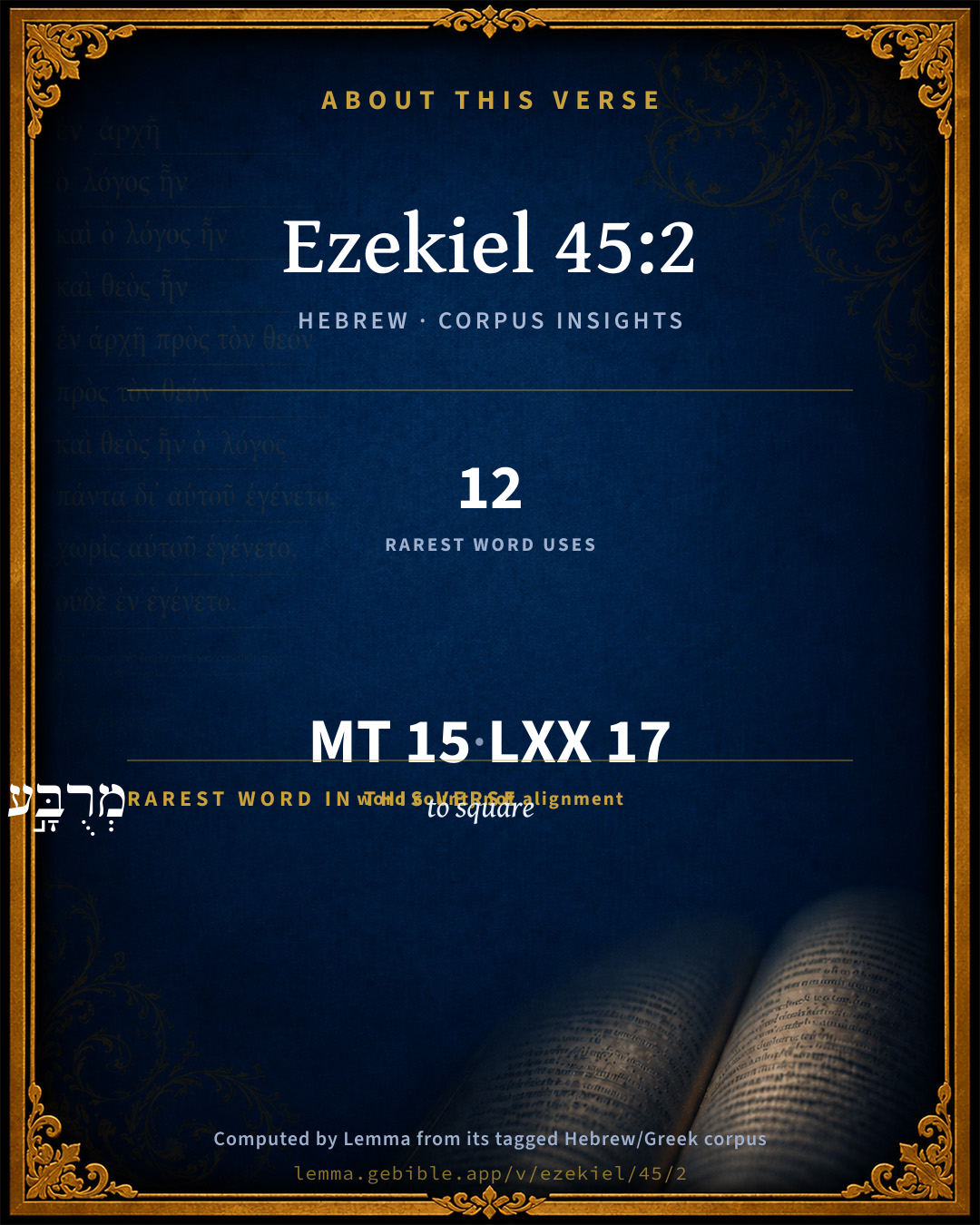
These counts appear in no published source. They are computed here, from the morphology-tagged text and Lemma’s own curated glosses. What Lemma adds →

15
words
11
distinct lemmas
Prophets
section

Notable vocabulary

The rarest word here is מְרֻבָּ֣ע to square H7251 — appearing just 12 times in the whole Hebrew Bible.

Shared distinctive vocabulary

מְרֻבָּ֣ע to square H7251 occurs in 12 verses of the Hebrew Bible. Also found in:

Grammatical profile

  • 2 verbs
  • 5 nouns
  • 5 adjectives
  • 1 pronoun
  • 2 prepositions

Verb forms

  • יִהְיֶ֤ה Qal · Imperfect
  • מְרֻבָּ֣ע Pual · Participle Passive

Repetition

Words recur within this verse — often emphatic in Hebrew:

  • חֲמֵ֥שׁ five H2568 ×2
  • מֵא֛וֹת hundred H3967 ×2
  • סָבִ֑יב round about H5439 ×2

Hebrew & Septuagint length

In English translation the verse runs 31 words from the Hebrew and 37 from the Septuagint (LXX English) — closely comparable.

A rough comparison of the two English renderings, which tokenize alike — not a word-level alignment.

Word counts can differ between the Hebrew and the Greek without any difference in meaning — e.g. the Hebrew direct-object marker אֵת has no separate Greek word, and Greek often adds the article ὁ.

In the original languages it is 15 Hebrew tokens and 17 Greek tokens — but the two are counted differently (Hebrew bundles its prefixes and suffixes into one token; the Greek is in lemma form), so that isn’t a like-for-like length.

Cross-references

2

Topical passages linked to Ezekiel 45:2 in the Treasury of Scripture Knowledge — connected by theme and wording, ordered by reader-vote popularity; previews shown in the World English Bible.

  • Ezekiel 42:16–20 He measured on the east side with the measuring reed five hundred reeds, with the measuring reed round about.
  • Ezekiel 27:28 At the sound of the cry of your pilots the suburbs shall shake.

Cross-references courtesy of OpenBible.info (CC BY 4.0).

Hebrew and Greek witnesses Masoretic Hebrew ↔ Greek Septuagint

The same verse in the two great witnesses to the Old Testament, shown verse-for-verse.

These are two independent witnesses, not word-aligned to each other, and the Septuagint is shown in lemma (dictionary) form.

Hebrew Ezekiel 45:2 Masoretic · Westminster Leningrad Codex

יִהְיֶ֤ה מִזֶּה֙ אֶל הַקֹּ֔דֶשׁ חֲמֵ֥שׁ מֵא֛וֹת בַּחֲמֵ֥שׁ מֵא֖וֹת מְרֻבָּ֣ע סָבִ֑יב וַחֲמִשִּׁ֣ים אַמָּ֔ה מִגְרָ֥שׁ ל֖וֹ סָבִֽיב

Of this there shall be for the holy place five hundred [in length] by five hundred [in breadth], square round about; and fifty cubits for the suburbs of it round about.

World English Bible · Public Domain

Greek LXX Ezekiel 45:2 Septuagint · lemma form

καί εἰμί ἐκ οὗτος εἰς ἁγίασμα πεντακόσιοι ἐπί πεντακόσιοι τετράγωνος κυκλόθεν καί πῆχυς πεντήκοντα διάστημα αὐτός κυκλόθεν

And there shall be a sanctuary out of this, five hundred reeds in length by five hundred in breadth, a square round about; and there shall be a vacant space beyond this of fifty cubits round about.

LXX2012 (modern English Septuagint) · Public Domain

On this verse, Joseph Benson's Commentary discusses the Septuagint’s reading. Read the note in Commentary ↓

Hebrew: Westminster Leningrad Codex (CC BY 4.0). Greek: Septuagint (public domain); English from LXX2012 (modern English Septuagint) (Public Domain). How the Septuagint differs from the Hebrew →

Targum (Aramaic paraphrase)

1

The Targum is the ancient Jewish Aramaic paraphrase of the Hebrew Scriptures — an interpretive translation, not the Hebrew text itself. Onkelos (literal) and Pseudo-Jonathan (expansive) render the Torah, and Jonathan the Prophets. Coverage is partial: where no permissively-licensed English translation exists for a verse, only the Aramaic is shown. This is verse-level text, not a word-by-word alignment to the Hebrew.

  1. Targum Jonathan Prophets (Joshua–Malachi)
    יְהֵי מִדֵין לְקוּדְשָׁא חֲמֵשׁ מְאָה בַּחֲמֵשׁ מְאָה מְרֻבַּע סְחוֹר סְחוֹר וְחַמְשִׁין אַמִין רוּחָא לֵיהּ סְחוֹר סְחוֹר:

    (no public-domain English translation for this verse)

    Targum Jonathan — Aramaic: “Mikraot Gedolot” (public domain). English: “Sefaria Community Translation” (CC0 1.0 (public-domain dedication)); “London "Chaldee Paraphrase," 1871” (public domain). Text via Sefaria.

Commentary

Notes on Ezekiel 45:2 from classic Christian and Jewish commentators (each source and its license shown beneath its notes). The classic Christian expositions comment on the surrounding passage and are grouped to its opening verse, so a note may address several verses; the Jewish commentaries on the Tanakh (Rashi and others) are per-verse, so they appear only where the commentator wrote on this verse.

Lemma curates 59 commentaries, every one of them public domain or Creative Commons licensed, each selected and text-cleaned for this edition rather than reprinted as found. About our sources →

Trapp's Complete Commentary

John Trapp

Eze 45:2 Of this there shall be for the sanctuary five hundred [in length], with five hundred [in breadth], square round about; and fifty cubits round about for the suburbs thereof.

Ver. 2. For the suburbs.] Which hath its name in Hebrew from its being severed from the city, and, as it were, cast out of it. It is better rendered, as in the margin, void places.

John Trapp, A Commentary or Exposition upon All the Books of the Old and New Testament (1647–1656) — public domain. Text from a community e-Sword module.

Joseph Benson's Commentary

Eze 45:2-5. Of this there shall be for the sanctuary five hundred in length, &c. — If we understand these dimensions of cubits, it exactly agrees with the opinion of the Jews, that the temple stood in an area of five hundred cubits square. And fifty cubits for the suburbs — This likewise bears a suitable proportion to the contents of a square of five hundred cubits. And in it shall be the sanctuary and the most holy place — Both the outward sanctuary and the inward oracle, or holy of holies, together with the courts adjoining, shall be placed in the centre or middle of it: see Eze 48:10. And it shall be a place for their houses — The priests were divided into twenty-four courses, (1 Chronicles 24.,) who performed the public worship by turns: so the houses were for them to live in who were not in their course of waiting. And the five and twenty thousand of length, &c. — The French translation renders the sense plainer, thus: There shall be other five and twenty thousand, &c: see Eze 48:13. This appears to be the true sense of the place, because otherwise there will be wanting ten thousand in breadth to make an exact square of twenty-five thousand: see the following verse. The Levites, being very numerous, (they were reckoned at thirty-eight thousand in David’s time, 1Ch 23:3,) had as large a piece of ground allotted to them as belonged to the temple and the whole priestly order. For twenty chambers — Most commentators understand this of several rows of chambers, or ranges of building. The LXX. read, πολεις του κατοικειν, cities to inhabit: such cities as were allotted to them by Moses, Num 35:2.

Joseph Benson's Commentary on the Old and New Testaments (1811–1818) — public domain. Text from a community e-Sword module.

Adam Clarke's Commentary

Verse 2. Of this there shall be for the sanctuary] See the plan, A. See Clarke on Eze 48:35.

Adam Clarke's Commentary on the Bible (1810–1826) — public domain. Text from a community e-Sword/MySword module.

Ellicott's Commentary for English Readers

(2) Fifty cubits round about.—In Eze_42:16-20 the space of 500 reeds square is described, which was “for,” or belonged to, the sanctuary, to guard it from any profanation; but here we have, still farther, a narrow strip of 50 cubits wide (about 83 feet) of open space outside the wall to prevent the priests’ houses being built too close to the sacred precincts. The word suburbs is better rendered in the margin, void or open place. The situation of the sanctuary and its surroundings within the priests’ portion is more definitely fixed in Eze_48:10 as “in the midst thereof.”

A Bible Commentary for English Readers, edited by Charles John Ellicott (1878–1897) — public domain. Text from a community e-Sword module.

The Cambridge Bible for Schools and Colleges

gen. ed. J. J. S. Perowne

2. In this sacred territory, more particularly, in the half of it assigned to the priests (Eze_45:3-4), shall the sanctuary be situated, a square of 500, surrounded by a free space of 50 cubits on all sides. The 500 are certainly cubits, cf. Eze_42:20.

the suburbs thereof] What the “suburbs” are appears from Num_35:4; it is an open space around the walls of an enclosure, a city or building, held to belong to the building or city, but not occupied by it. It is the liberties of a city or the precincts of an edifice, Eze_48:15; Eze_48:17.

The Cambridge Bible for Schools and Colleges (gen. ed. J. J. S. Perowne; Cambridge University Press, 1878–1918) — public domain. Text from a community e-Sword module.

John Gill's Exposition

Of this there shall be for the sanctuary,.... Or temple, the house before described in the preceding chapters:

five hundred in length, and five hundred in breadth, square round about: that is, five hundred reeds square, as is manifest from Eze 42:16, and this denotes the largeness, perfection, and stability of the church of Christ, which the sanctuary was a type of:

and fifty cubits round about for the suburbs thereof; which were a void place of fifty cubits round about the sanctuary, measuring from the wall to that; this was done in reverence to the holy place, and to show that we should not rush hastily into the house of God, and church of Christ, but first pass through the suburbs or open place. Cubits being here mentioned, show that reeds are to be understood where the kind of measure is not expressed.

John Gill's Exposition of the Whole Bible (1746–1763) — public domain (CC PDM 1.0). Text via the HelloAO Bible API.

Albert Barnes' Notes on the Bible

The “sanctuary” here probably means the whole temple precincts.

Suburbs - literally, as margin. To mark out more distinctly the sacred precincts, a vacant space of fifty cubits was left on all sides.

Albert Barnes' Notes on the Bible (1834–1885) — public domain. Text from a community e-Sword/MySword module.

Haydock's Catholic Bible Commentary

Suburbs. Hebrew also, "vacant spaces."

George Leo Haydock (1774–1849), Haydock's Catholic Family Bible and Commentary, 1859 edition — public domain. Excludes Psalms (Douay-Rheims chapter numbering differs from Protestant) and Deuterocanonical books (Catholic canon only).

Matthew Poole's English Annotations

Of this whole consecrate portion of twenty-five thousand cubits long, or twelve miles and half, and ten thousand broad, or five miles and little more.

For the sanctuary; for a platform for the sanctuary, both house and courts.

Five hundred in length, with five hundred in breadth; five hundred cubits square, which is about one-fourth of a mile square.

Fifty cubits; which amount to twenty-nine yards and half a foot. This bears some proportion to the contents of that square, which is one quarter of a mile in each side; but fifty cubits suburb to that square, that should be supposed to have sides each a mile, a half, and half quarter long.

The suburbs thereof: place round about this the five hundred cubits square mountain of the house.

Matthew Poole's English Annotations on the Holy Bible (1683–1685) — public domain. Text from a community e-Sword/MySword module.

The Pulpit Commentary

Of this district, either of 25, 000 10, 000, or 25, 000 20, 000 reeds, according to the view taken of ver. 1, there should be measured off for the sanctuary five hundred in length, with five hundred in breadth. The supplement here also, Keil, Kliefoth, Plumptre, and others consider to be "reeds," since obviously the whole temple with its precincts is intended, (Eze_42:16-20) though Hengstenberg and Schroder prefer "cubits," holding the sanctuary to be the temple buildings enclosed within the outer court well. (Eze 40) The free space of fifty cubits round about for the suburbs (or, open places) thereof seems to indicate that the larger area was that alluded to by the prophet. That the term vdgmi occurs more frequently in the so-called priest-code (Lev_25:34; Num_35:2, Num_35:3, Num_35:4, Num_35:5, Num_35:7; Jos_14:4 Jos_21:2, Jos_21:3, Jos_21:8, Jos_21:11, Jos_21:13, etc.) and in the Chronicles. (1Ch_5:16 1Ch_6:35, 37 13:2; 2Ch_11:14 2Ch_31:19) than in Ezekiel. (see Eze_27:28 Eze_48:15, Eze_48:17) is a fact; but on this fact cannot be founded an argument for the priority of Ezekiel, since it rather points to Ezekiel"s acquaintance with such "suburbs" in connection with priestly and Levitical cities.

The Pulpit Commentary (1880–1919), ed. H.D.M. Spence-Jones & Joseph S. Exell — public domain. Text from a community e-Sword module.

John Wesley's Explanatory Notes

Of this - Whole portion of twenty five thousand cubits long, or twelve miles and half, and ten thousand broad, or five miles and a little more. For the sanctuary - For a platform for the sanctuary, both house and court.

John Wesley, Explanatory Notes Upon the Whole Bible (1754–1765) — public domain. Text via the GEBible commentary corpus.

Rashi

Rabbi Shlomo Yitzchaki (Rashi)

From this shall be From this offering, there shall be for the needs of the Sanctuary: five hundred rods for the Temple Mount and the rest shall be for houses for the priests, as is delineated at the end of the Book.

Rashi on the Tanakh — English translations: “The Judaica Press complete Tanach with Rashi, translated by A. J. Rosenberg” (CC BY 4.0); “Pentateuch with Rashi's commentary by M. Rosenbaum and A.M. Silbermann, 1929-1934” (public domain); “The Metsudah Tanach series, Lakewood, N.J” (CC BY 4.0); and “The Book of Joshua, Metsudah Publications, 1997” (CC BY 4.0). Text via Sefaria.

Lesson kit

Teaching starters — assembled from the data on this page, not authored interpretation. Every prompt links to the verse data it draws on. Edit before teaching.

Ezekiel, in the Prophets, opens this verse with 15 words (11 distinct Hebrew lemmas). Its most distinctive word is râbaʻ (“to square”). A historical commentator’s framing appears above. Read the whole chapter for the surrounding context.

Discussion questions

  1. How does “to square” (râbaʻ) shape what this verse is saying?
  2. Exodus 27:1 shares the word «to square» with this verse. How do the two illuminate each other?
  3. “five” occurs 2× in this one verse. What is the effect of the repetition?
  4. These translations render this verse differently. What is at stake in choosing one wording over another?
  5. The verb «יִהְיֶ֤ה» is Qal Imperfect. How does its form color the action?
  6. Reading how Trapp's Complete Commentary and Joseph Benson's Commentary read this verse, where do the two commentators agree and where do they part?

Things to notice

Reading settings

Reading text

Shown beneath each verse's original-language words.

Old Testament
Old Testament edition

Read the OT as the Masoretic Hebrew (MT) or the Greek Septuagint (LXX).

English shown for the Greek Septuagint (in the Hebrew ↔ Greek comparison).

Comparing translations? Open the Compare panel on any verse page to stack up to four side by side.