
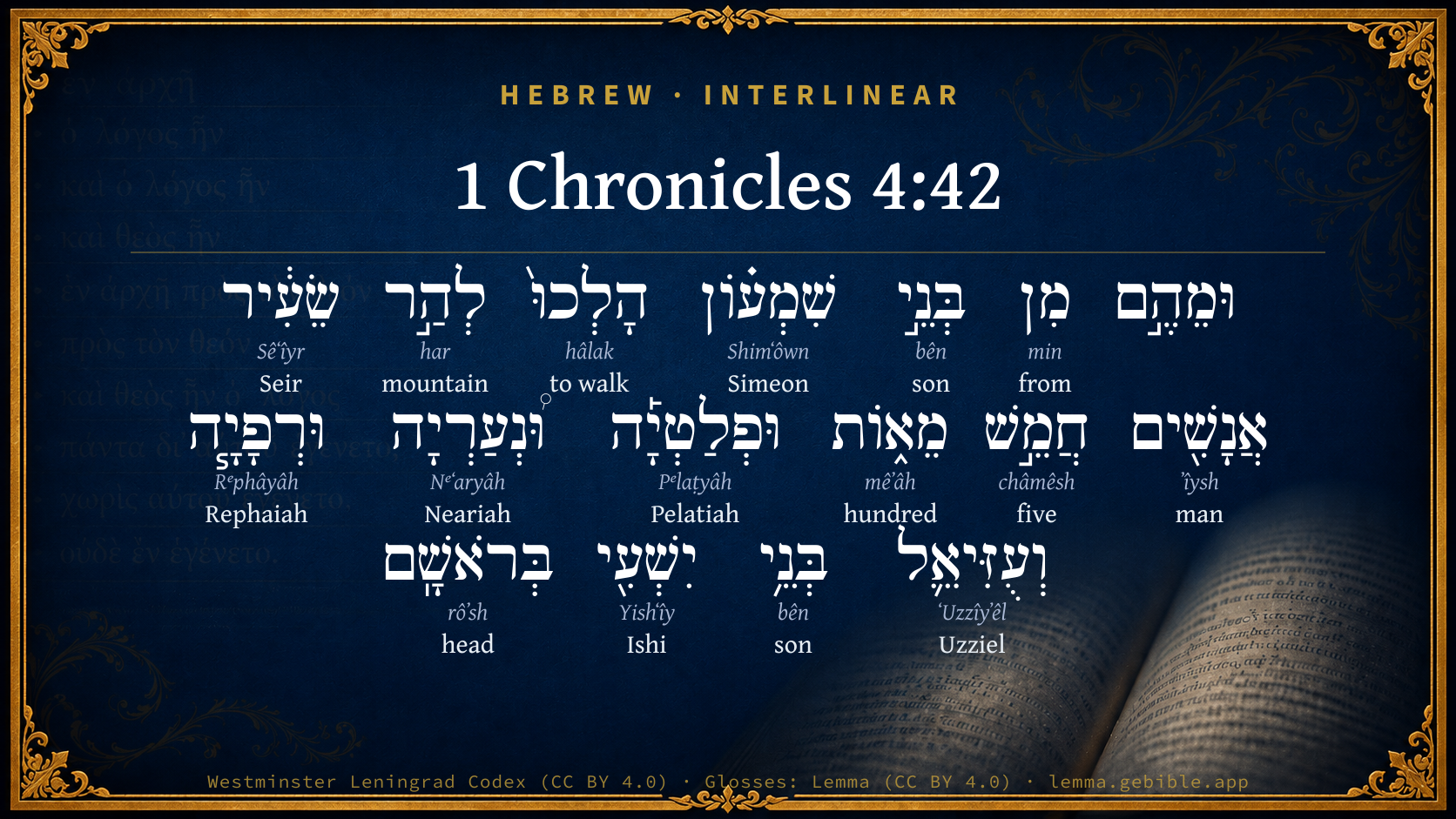
1 Chronicles 4:42

Hebrew (Westminster Leningrad Codex) 1 Chronicles 4:42 appears in the Hebrew Old Testament. The text above is from the Westminster Leningrad Codex. Each word links to its Strong’s number, a concise gloss, and parsing drawn from the Open Scriptures Hebrew Bible morphology. Click any word for its full Brown-Driver-Briggs (BDB) entry.
Download image
Cite this verse

1 Chronicles 4:42 (World English Bible). Public Domain. Lemma interlinear Bible study tool, https://lemma.gebible.app/v/1-chronicles/4/42.

Show BibTeX & RIS
BibTeX
RIS
English Translation
Some of them, even of the sons of Simeon, five hundred men, went to Mount Seir, having for their captains Pelatiah, and Neariah, and Rephaiah, and Uzziel, the sons of Ishi.
World English Bible · Public Domain
Download a study sheet

One document with this verse’s original text, its word-by-word gloss line, the meaning frame, cross-references with their text, attributed commentary, and full source and license credits — printable, and it pastes into notes with its structure intact.

This verse Autodidact and up

Study sheet (.html) Plain text (.txt)

A passage Seminary Student

Up to 50 verses in one chapter. A passage sheet keeps up to 6 commentary sources and 12 cross-references per verse, in the order this page ranks them, and says so on the sheet whenever that leaves anything out. Ask for a single verse and you get the Autodidact verse sheet above.

Everything on this page stays free to read, with no account — the sheet is a download of what is already on screen, not access to it.

Want to remove ads? Support Godless Engineer
Compare translations 3

The same verse in 3 English versions, stacked beneath the original-language interlinear above. Click any original word for its lexicon entry.

Each is an independent rendering of the whole verse — the interlinear is not word-aligned to these translations.

Highlighted words mark where these versions differ — a whole-verse word diff, not a word-by-word alignment.

  • World English Bible Public Domain
    Some of them, even of the sons of Simeon, five hundred men, went to Mount Seir, having for their captains Pelatiah, and Neariah, and Rephaiah, and Uzziel, the sons of Ishi.
  • King James Version Public Domain
    And some of them, even of the sons of Simeon, five hundred men, went to mount Seir, having for their captains Pelatiah, and Neariah, and Rephaiah, and Uzziel, the sons of Ishi.
  • unfoldingWord Literal Text CC BY-SA 4.0
    And 500 men from them, from the sons of Simeon, went to Mount Seir, and Pelatiah and Neariah and Rephaiah and Uzziel, the sons of Ishi, their heads,

unfoldingWord Literal Text — © unfoldingWord, licensed CC BY-SA 4.0. Word-aligned USFM3 via Door43 (git.door43.org/unfoldingWord/en_ult).

Versions to compare (up to 4)

3 of 4 selected

Show all 18 translations

Every available English version of this verse, each an independent rendering of the whole verse.

  • World English Bible Public Domain
    Some of them, even of the sons of Simeon, five hundred men, went to Mount Seir, having for their captains Pelatiah, and Neariah, and Rephaiah, and Uzziel, the sons of Ishi.
  • Berean Standard Bible Public Domain
    And five hundred of these Simeonites led by Pelatiah, Neariah, Rephaiah, and Uzziel, the sons of Ishi, went to Mount Seir
  • Majority Standard Bible Public Domain
    And five hundred of these Simeonites led by Pelatiah, Neariah, Rephaiah, and Uzziel, the sons of Ishi, went to Mount Seir
  • King James Version Public Domain
    And some of them, even of the sons of Simeon, five hundred men, went to mount Seir, having for their captains Pelatiah, and Neariah, and Rephaiah, and Uzziel, the sons of Ishi.
  • American Standard Version (1901) Public Domain
    And some of them, even of the sons of Simeon, five hundred men, went to mount Seir, having for their captains Pelatiah, and Neariah, and Rephaiah, and Uzziel, the sons of Ishi.
  • Revised Version (1885) Public Domain
    And some of them, even of the sons of Simeon, five hundred men, went to mount Seir; having for their captains Pelatiah, and Neariah, and Rephaiah, and Uzziel, the sons of Ishi.
  • Geneva Bible (1599) Public Domain
    And besides these, fiue hundreth men of the sonnes of Simeon went to mount Seir, and Pelatiah, and Neariah, and Rophaiah, and Vzziel the sonnes of Ishi were their captaines,
  • Douay-Rheims (1899) Public Domain
    Some also of the children of Simeon, five hundred men, went into mount Seir, having for their captains Phaltias and Naaria and Raphaia and Oziel the sons of Jesi:
  • Young's Literal Translation Public Domain
    And of them, of the sons of Simeon, there have gone to mount Seir, five hundred men, and Pelatiah, and Neariah, and Rephaiah, and Uzziel, sons of Ishi, at their head,
  • Literal Standard Version CC BY-SA 4.0
    And of them, of the sons of Simeon, five hundred men have gone to Mount Seir, and Pelatiah, and Neariah, and Rephaiah, and Uzziel, sons of Ishi, at their head,
  • Unlocked Literal Bible CC BY-SA 4.0
    From them, from the sons of Simeon, five hundred men went to Mount Seir with Pelatiah, Neariah, Rephaiah, and Uzziel, the sons of Ishi, as their leader.
  • unfoldingWord Literal Text CC BY-SA 4.0
    And 500 men from them, from the sons of Simeon, went to Mount Seir, and Pelatiah and Neariah and Rephaiah and Uzziel, the sons of Ishi, their heads,
  • Darby Bible Public Domain
    And five hundred men of them, of the sons of Simeon, went to mount Seir, having at their head Pelatiah, and Neariah, and Rephaiah, and Uzziel, the sons of Jishi,
  • World Messianic Bible Public Domain
    Some of them, even of the sons of Simeon, five hundred men, went to Mount Seir, having for their captains Pelatiah, Neariah, Rephaiah, and Uzziel, the sons of Ishi.
  • Webster's Bible Public Domain
    And some of them, even of the sons of Simeon, five hundred men, went to mount Seir, having for their captains Pelatiah, and Neariah, and Rephaiah, and Uzziel, the sons of Ishi.
  • Free Bible Version CC BY-SA 4.0
    Some of these Simeonites invaded Mount Seir—five hundred men led by Pelatiah, Neariah, Rephaiah, and Uzziel, the sons of Ishi.
  • Bible in Basic English Public Domain
    And some of them, five hundred of the sons of Simeon, went to the hill-country of Seir, with Pelatiah and Neariah and Rephaiah and Uzziel, the sons of Ishi, at their head.
  • JPS Tanakh (1917) Public Domain
    And some of them, even of the sons of Simeon, five hundred men, went to mount Seir, having for their captains Pelatiah, and Neariah, and Rephaiah, and Uzziel, the sons of Ishi.

Literal Standard Version (2020), Covenant Press — licensed CC BY-SA 4.0. Text via the HelloAO Bible API (eBible.org). Unlocked Literal Bible (unfoldingWord) — licensed CC BY-SA 4.0. Text via the HelloAO Bible API (eBible.org). unfoldingWord Literal Text — © unfoldingWord, licensed CC BY-SA 4.0. Word-aligned USFM3 via Door43 (git.door43.org/unfoldingWord/en_ult). Free Bible Version, Dr. Jonathan Gallagher — licensed CC BY-SA 4.0. Text via the HelloAO Bible API (eBible.org).

Word by word

More ways to search: Search by grammar → Find every occurrence → Compare this word →

Practice this passage: Drill this verse → Learn its vocabulary →

וּ֠נְעַרְיָה
Nᵉʻaryâh
H5294
“and · Neariah”
Conjunction + Noun, Proper
Part of Speech
Conjunction + Noun
Type
Proper
Full BDB Definition

Origin: from H5288 and H3050

TWOT: None

Neariah = "servant of Jehovah" - one of the 6 sons of Shemaiah in the line of the royal family of David of the tribe of Judah in the time after the captivity - son of Ishi and one of the captains of the 500 Simeonites who, in the days of king Hezekiah of Judah, drove out the Amalekites from Mount Seir
  1. מִן min H4480 “from” Preposition
  2. בְּנֵ֣י bên H1121 “sons of” Noun, Common, Masculine, Plural, Construct
  3. שִׁמְע֗וֹן Shimʻôwn H8095 “Simeon” Noun, Proper
  4. הָלְכוּ֙ hâlak H1980 “to walk” Verb, Qal, Perfect, 3rd Person, Common, Plural
  5. לְהַ֣ר har H2022 “to/for · mountain of” Preposition + Noun, Common, Masculine, Singular, Construct
  6. שֵׂעִ֔יר Sêʻîyr H8165 “Seir” Noun, Proper
  7. אֲנָשִׁ֖ים ʼîysh H376 “men” Noun, Common, Masculine, Plural, Absolute
  8. חֲמֵ֣שׁ châmêsh H2568 “five” Adjective, Cardinal number, Feminine, Singular, Absolute
  9. מֵא֑וֹת mêʼâh H3967 “hundred” Adjective, Cardinal number, Both, Plural, Absolute
  10. וּפְלַטְיָ֡ה Pᵉlaṭyâh H6410 “and · Pelatiah” Conjunction + Noun, Proper
  11. וּרְפָיָ֧ה Rᵉphâyâh H7509 “and · Rephaiah” Conjunction + Noun, Proper
  12. וְעֻזִּיאֵ֛ל ʻUzzîyʼêl H5816 “and · Uzziel” Conjunction + Noun, Proper
  13. בְּנֵ֥י bên H1121 “sons of” Noun, Common, Masculine, Plural, Construct
  14. יִשְׁעִ֖י Yishʻîy H3469 “Ishi” Noun, Proper
  15. בְּרֹאשָֽׁם rôʼsh H7218 “in/at · head · their” Preposition + Noun, Common, Masculine, Singular, Construct + Suffix, Personal, 3rd Person, Masculine, Plural

About this verse

These counts appear in no published source. They are computed here, from the morphology-tagged text and Lemma’s own curated glosses. What Lemma adds →

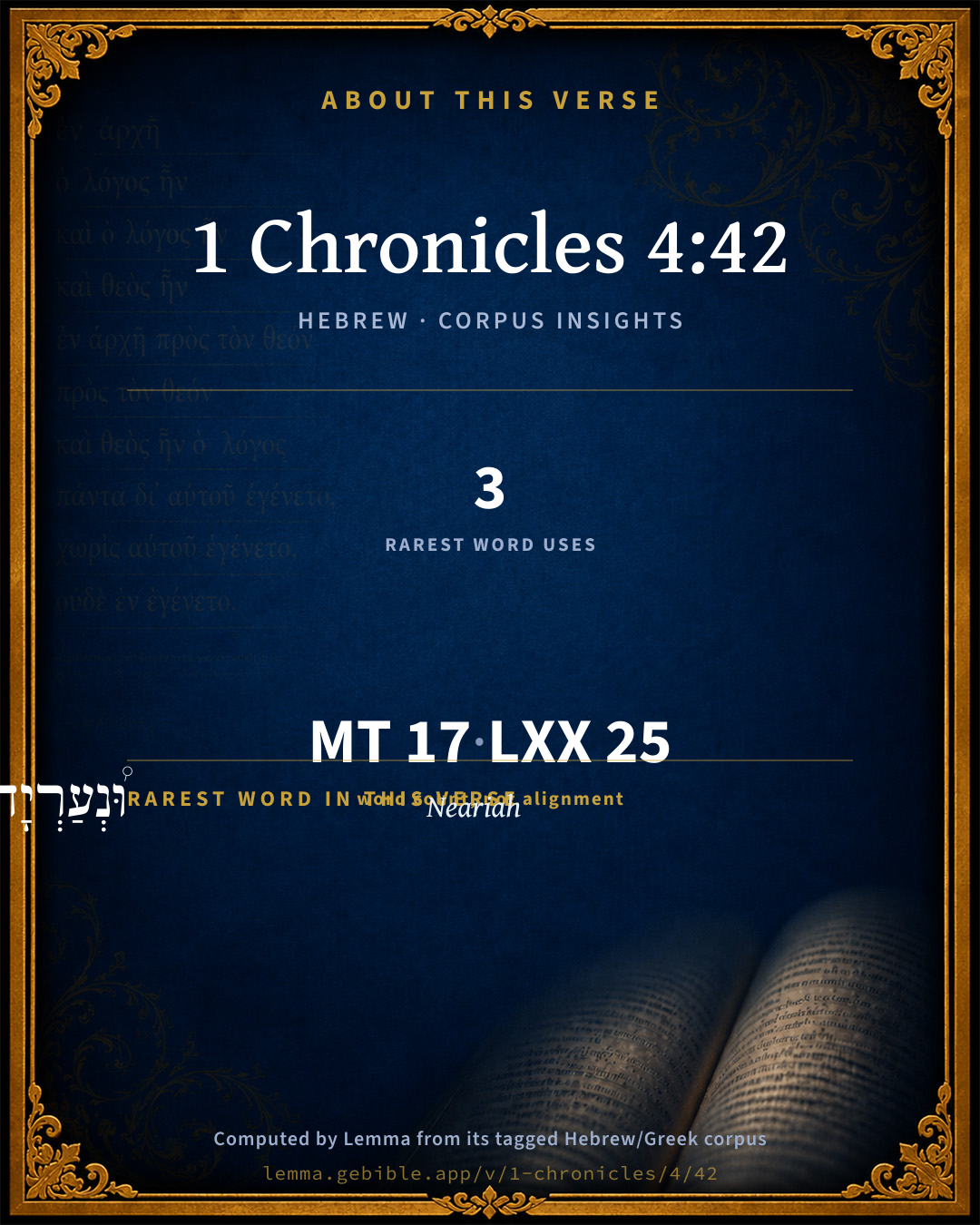
17
words
15
distinct lemmas
Historical
section

Notable vocabulary

The rarest word here is וּ֠נְעַרְיָה Neariah H5294 — appearing just 3 times in the whole Hebrew Bible.

Shared distinctive vocabulary

וּ֠נְעַרְיָה Neariah H5294 occurs in 3 verses of the Hebrew Bible. Also found in:

Grammatical profile

  • 1 verb
  • 12 nouns
  • 2 adjectives
  • 2 prepositions

Verb forms

  • הָלְכוּ֙ Qal · Perfect

Repetition

A word recurs within this verse — often emphatic in Hebrew:

  • בְּנֵ֣י son H1121 ×2

Hebrew & Septuagint length

In English translation the verse runs 31 words from the Hebrew and 32 from the Septuagint (LXX English) — closely comparable.

A rough comparison of the two English renderings, which tokenize alike — not a word-level alignment.

Word counts can differ between the Hebrew and the Greek without any difference in meaning — e.g. the Hebrew direct-object marker אֵת has no separate Greek word, and Greek often adds the article ὁ.

In the original languages it is 17 Hebrew tokens and 25 Greek tokens — but the two are counted differently (Hebrew bundles its prefixes and suffixes into one token; the Greek is in lemma form), so that isn’t a like-for-like length.

Cross-references

2

Topical passages linked to 1 Chronicles 4:42 in the Treasury of Scripture Knowledge — connected by theme and wording, ordered by reader-vote popularity; previews shown in the World English Bible.

  • Genesis 36:8–9 Esau lived in the hill country of Seir. Esau is Edom.
  • Deuteronomy 1:2 It is eleven days' [journey] from Horeb by the way of Mount Seir to Kadesh-barnea.

Cross-references courtesy of OpenBible.info (CC BY 4.0).

Hebrew and Greek witnesses Masoretic Hebrew ↔ Greek Septuagint

The same verse in the two great witnesses to the Old Testament, shown verse-for-verse.

These are two independent witnesses, not word-aligned to each other, and the Septuagint is shown in lemma (dictionary) form.

Hebrew 1 Chronicles 4:42 Masoretic · Westminster Leningrad Codex

וּמֵהֶ֣ם מִן בְּנֵ֣י שִׁמְע֗וֹן הָלְכוּ֙ לְהַ֣ר שֵׂעִ֔יר אֲנָשִׁ֖ים חֲמֵ֣שׁ מֵא֑וֹת וּפְלַטְיָ֡ה וּ֠נְעַרְיָה וּרְפָיָ֧ה וְעֻזִּיאֵ֛ל בְּנֵ֥י יִשְׁעִ֖י בְּרֹאשָֽׁם

Some of them, even of the sons of Simeon, five hundred men, went to Mount Seir, having for their captains Pelatiah, and Neariah, and Rephaiah, and Uzziel, the sons of Ishi.

World English Bible · Public Domain

Greek LXX 1 Chronicles 4:42 Septuagint · lemma form

καί ἐκ αὐτός ἀπό ὁ υἱός συμεων πορεύομαι εἰς ὄρος σηιρ ἀνήρ πεντακόσιοι καί φαλεττια καί νωαδια καί ραφαια καί οζιηλ υἱός ιεσι ἄρχων αὐτός

And some of them, even of the sons of Symeon, went to mount Seir, even five hundred men; and Phalaettia, and Noadia, and Raphaia, and Oziel, sons of Jesi, were their rulers.

LXX2012 (modern English Septuagint) · Public Domain

Hebrew: Westminster Leningrad Codex (CC BY 4.0). Greek: Septuagint (public domain); English from LXX2012 (modern English Septuagint) (Public Domain). How the Septuagint differs from the Hebrew →

Commentary

Notes on 1 Chronicles 4:42 from classic Christian and Jewish commentators (each source and its license shown beneath its notes). The classic Christian expositions comment on the surrounding passage and are grouped to its opening verse, so a note may address several verses; the Jewish commentaries on the Tanakh (Rashi and others) are per-verse, so they appear only where the commentator wrote on this verse.

Lemma curates 59 commentaries, every one of them public domain or Creative Commons licensed, each selected and text-cleaned for this edition rather than reprinted as found. About our sources →

Trapp's Complete Commentary

John Trapp

1Ch 4:42 And [some] of them, [even] of the sons of Simeon, five hundred men, went to mount Seir, having for their captains Pelatiah, and Neariah, and Rephaiah, and Uzziel, the sons of Ishi.

Ver. 42. And some of them, even of the sons of Simeon.] As Simeon himself was a rough-spirited venturous man; so were his posterity.

John Trapp, A Commentary or Exposition upon All the Books of the Old and New Testament (1647–1656) — public domain. Text from a community e-Sword module.

Ellicott's Commentary for English Readers

(42) Went.—Or, had gone (marched). The time of this expedition to mount Seir is not expressed; but for that very reason it is likely to have been nearly contemporaneous with the events just described. The band of five hundred would seem to have belonged to the clans which had already smitten the Hamites. Neither Ishi (Yish’i) nor his sons are otherwise known. If a totally different expedition were intended, the expression, “and of them—of the sons of Simeon—five hundred men,” would be a needlessly misleading periphrasis for, “And some of the sons of Simeon.” “Of them” can only refer to the clans whose emigration in the days of Hezekiah has been the subject of this section.

A Bible Commentary for English Readers, edited by Charles John Ellicott (1878–1897) — public domain. Text from a community e-Sword module.

Haydock's Catholic Bible Commentary

Jesi; perhaps Asaia, by the transposition of one letter; (ver. 36.; Calmet) or these chiefs were remote descendants of Jesi, ver. 20. (Haydock) --- The expedition probably took place about the same time as the preceding, to avoid the attack of the Assyrians, or of Juda, by retiring farther into Arabia. (Calmet)

George Leo Haydock (1774–1849), Haydock's Catholic Family Bible and Commentary, 1859 edition — public domain. Excludes Psalms (Douay-Rheims chapter numbering differs from Protestant) and Deuterocanonical books (Catholic canon only).

Matthew Poole's English Annotations

Some went to Mount Seir; probably about the same time.

Matthew Poole's English Annotations on the Holy Bible (1683–1685) — public domain. Text from a community e-Sword/MySword module.

The Pulpit Commentary

Vers. 42, 43. These verses give the further exploits, with a view of settlement, of certain of the tribe of Simeon. And of them we should prefer to apply to those already mentioned (vers. 34-41), did the expression stand alone. But the following clause in apposition, of the sons of Simeon, seems intended to prevent the supposition that they are the Simeonites to whom alone allusion is made. Keil again ("Comm.," in loc.) refers those intended to ver. 27, because he reads, for Ishi, the Shimei of ver. 27, on very insufficient grounds. It is a question whether the movement of ver. 42 is to be understood as arising out of that other the account of which closes in ver. 41, or whether it were not a co-ordinate movement. It still would probably enough spring from the same intrinsic causes. The allotment of the tribe of Simeon carved out of that of Judah was found too small for their growing numbers, though Simeon was not of the most numerous. Nor is it necessary to suppose perhaps it is rather necessary to correct the impression that this expedition, issuing in a permanent settlement, lay at all near the conquests of the "thirteen princes." It is, on the whole, most natural to consider that one event concludes with ver. 41, and that the following events (vers. 42, 43) are distinct and independent. All requisite light as to who these "smitten Amalekites" were, is for them too significantly furnished by comparison of 1Sa_27:8 1Sa_30:1; 2Sa_8:12; with 1Sa_14:48 1Sa_15:7. Of the names, five in number, found in this verse, just so much and no more is known.

The Pulpit Commentary (1880–1919), ed. H.D.M. Spence-Jones & Joseph S. Exell — public domain. Text from a community e-Sword module.

unfoldingWord translationNotes

Door43 World Missions Community

five hundred men

"500 men" (See: Numbers)

Pelatiah ... Neariah ... Rephaiah ... Uzziel ... Ishi

These are names of men. (See: How to Translate Names)

the rest of the Amalekite refugees

"the remaining Amalekite refugees"

refugees

people who are forced to leave their home country

to this day

"from then until now." This refers to the day when the author was writing this account.

translationWords

tribe

Simeon

Amalek

unfoldingWord translationNotes — © Distant Shores Media and the Door43 World Missions Community, licensed CC BY-SA 4.0. Source: git.door43.org/Door43/en_tn.

Lesson kit

Teaching starters — assembled from the data on this page, not authored interpretation. Every prompt links to the verse data it draws on. Edit before teaching.

1 Chronicles, in the Historical, opens this verse with 17 words (15 distinct Hebrew lemmas). Its most distinctive word is Nᵉʻaryâh (“Neariah”). A historical commentator’s framing appears above. Read the whole chapter for the surrounding context.

Discussion questions

  1. What does “Neariah” (Nᵉʻaryâh) contribute to the verse as a whole?
  2. How does 1 Chronicles 3:22, which shares the word «Neariah», read alongside this verse?
  3. What does the repetition of “son” (2× in this one verse) do in this verse?
  4. The translations on this page render this verse differently — a whole-verse word diff, not a word-by-word alignment. What might account for the different wordings?
  5. «הָלְכוּ֙» is a Qal Perfect verb. How does that grammatical form shape the action described?
  6. Compare how Trapp's Complete Commentary and Ellicott's Commentary for English Readers read this verse. Where do they agree or differ?

Things to notice

Reading settings

Reading text

Shown beneath each verse's original-language words.

Old Testament
Old Testament edition

Read the OT as the Masoretic Hebrew (MT) or the Greek Septuagint (LXX).

English shown for the Greek Septuagint (in the Hebrew ↔ Greek comparison).

Comparing translations? Open the Compare panel on any verse page to stack up to four side by side.