
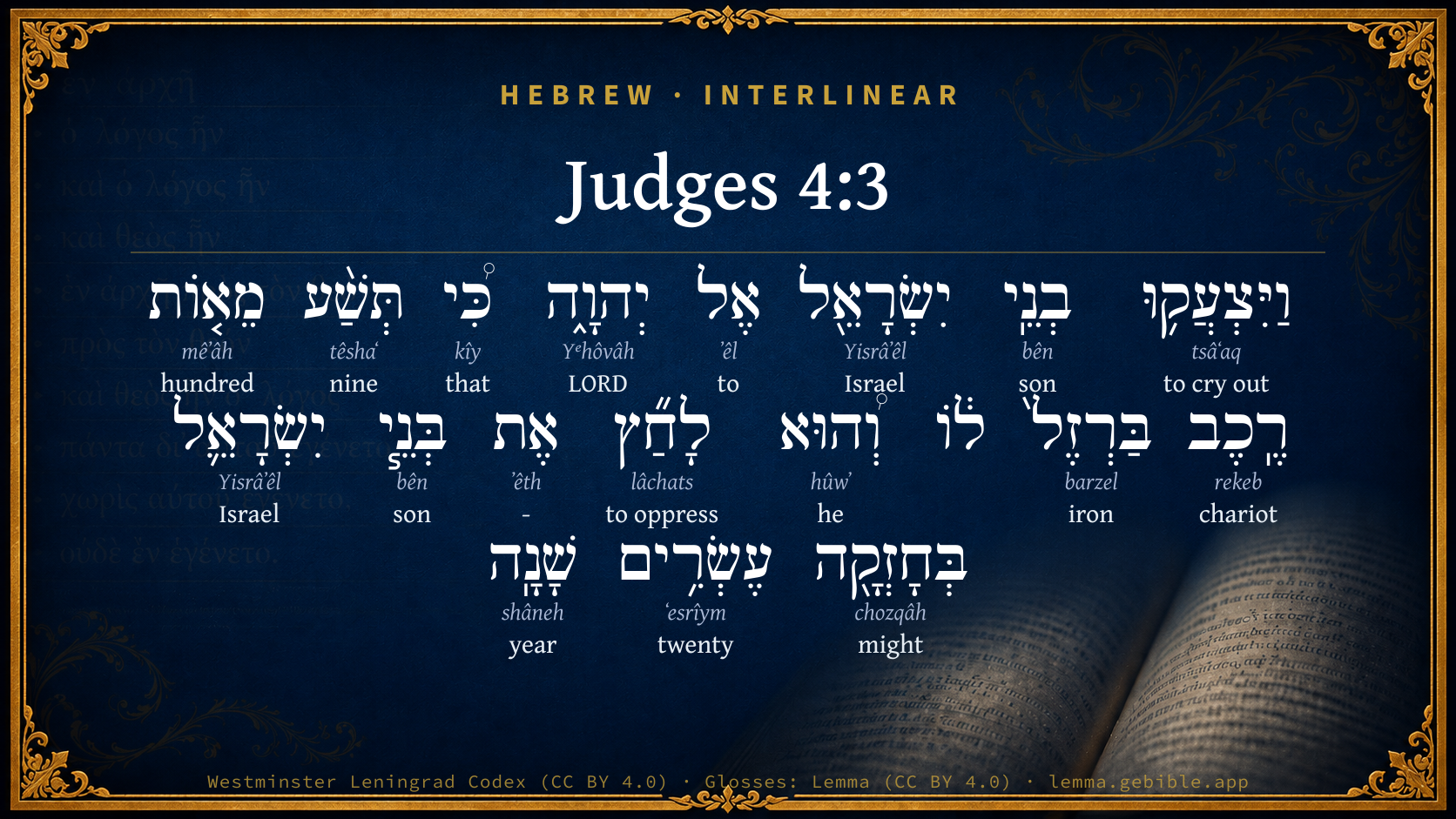
Judges 4:3

Hebrew (Westminster Leningrad Codex) Judges 4:3 appears in the Hebrew Old Testament. The text above is from the Westminster Leningrad Codex. Each word links to its Strong’s number, a concise gloss, and parsing drawn from the Open Scriptures Hebrew Bible morphology. Click any word for its full Brown-Driver-Briggs (BDB) entry.
Download image
Cite this verse

Judges 4:3 (World English Bible). Public Domain. Lemma interlinear Bible study tool, https://lemma.gebible.app/v/judges/4/3.

Show BibTeX & RIS
BibTeX
RIS
English Translation
The children of Israel cried to Yahweh: for he had nine hundred chariots of iron; and twenty years he mightily oppressed the children of Israel.
World English Bible · Public Domain
Highlights
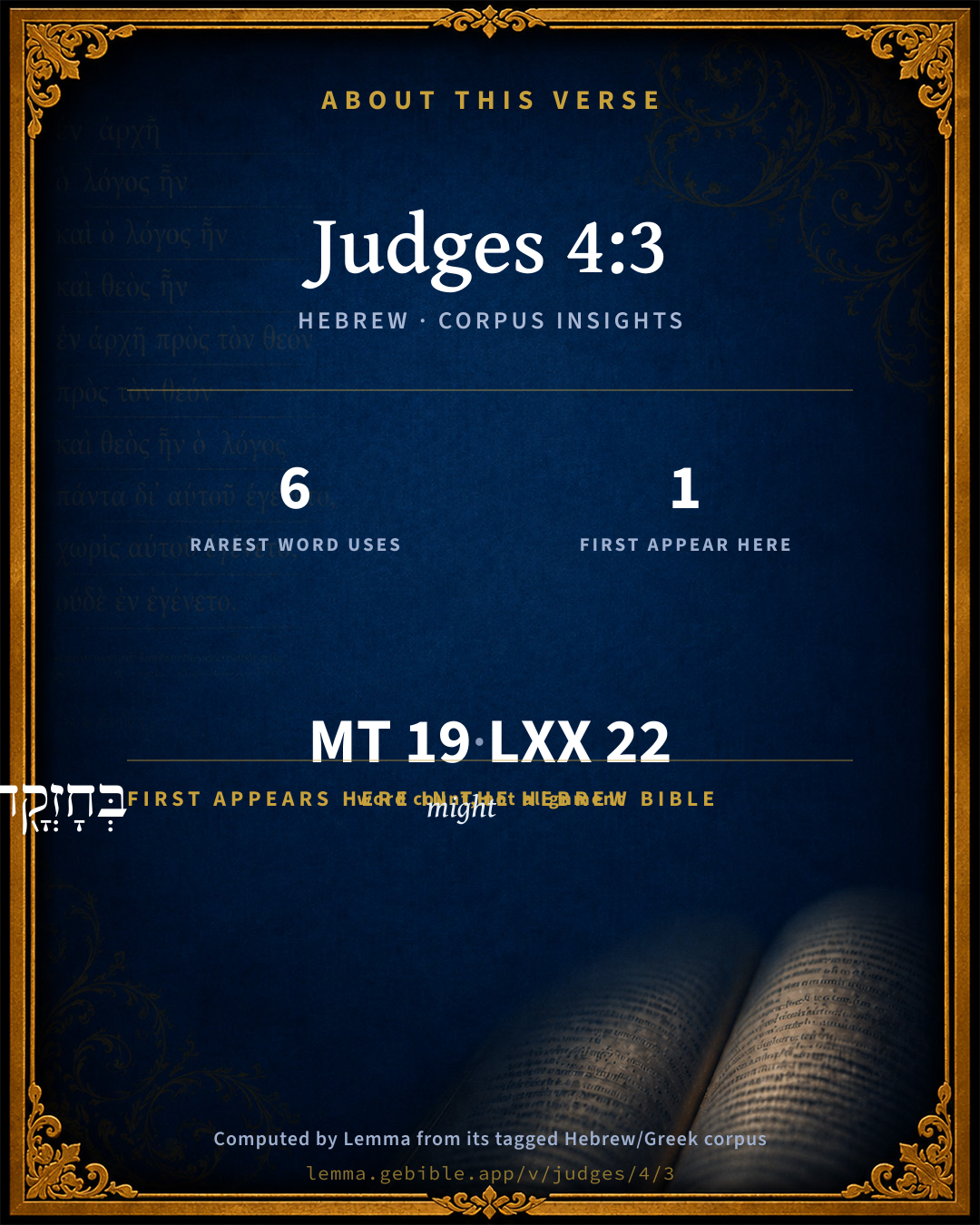
  • 1 first appearance in the Hebrew Bible
Full analysis ↓
Download a study sheet

One document with this verse’s original text, its word-by-word gloss line, the meaning frame, cross-references with their text, attributed commentary, and full source and license credits — printable, and it pastes into notes with its structure intact.

This verse Autodidact and up

Study sheet (.html) Plain text (.txt)

A passage Seminary Student

Up to 50 verses in one chapter. A passage sheet keeps up to 6 commentary sources and 12 cross-references per verse, in the order this page ranks them, and says so on the sheet whenever that leaves anything out. Ask for a single verse and you get the Autodidact verse sheet above.

Everything on this page stays free to read, with no account — the sheet is a download of what is already on screen, not access to it.

Want to remove ads? Support Godless Engineer
Compare translations 3

The same verse in 3 English versions, stacked beneath the original-language interlinear above. Click any original word for its lexicon entry.

Each is an independent rendering of the whole verse — the interlinear is not word-aligned to these translations.

Highlighted words mark where these versions differ — a whole-verse word diff, not a word-by-word alignment.

  • World English Bible Public Domain
    The children of Israel cried to Yahweh: for he had nine hundred chariots of iron; and twenty years he mightily oppressed the children of Israel.
  • King James Version Public Domain
    And the children of Israel cried unto the LORD: for he had nine hundred chariots of iron; and twenty years he mightily oppressed the children of Israel.
  • unfoldingWord Literal Text CC BY-SA 4.0
    Then the sons of Israel cried out to Yahweh, for 900 chariots of iron to him, and he oppressed the sons of Israel with might 20 years.

unfoldingWord Literal Text — © unfoldingWord, licensed CC BY-SA 4.0. Word-aligned USFM3 via Door43 (git.door43.org/unfoldingWord/en_ult).

Versions to compare (up to 4)

3 of 4 selected

Show all 18 translations

Every available English version of this verse, each an independent rendering of the whole verse.

  • World English Bible Public Domain
    The children of Israel cried to Yahweh: for he had nine hundred chariots of iron; and twenty years he mightily oppressed the children of Israel.
  • Berean Standard Bible Public Domain
    Then the Israelites cried out to the LORD, because Jabin had nine hundred chariots of iron, and he had harshly oppressed the Israelites for twenty years.
  • Majority Standard Bible Public Domain
    Then the Israelites cried out to the LORD, because Jabin had nine hundred chariots of iron, and he had harshly oppressed the Israelites for twenty years.
  • King James Version Public Domain
    And the children of Israel cried unto the LORD: for he had nine hundred chariots of iron; and twenty years he mightily oppressed the children of Israel.
  • American Standard Version (1901) Public Domain
    And the children of Israel cried unto Jehovah: for he had nine hundred chariots of iron; and twenty years he mightily oppressed the children of Israel.
  • Revised Version (1885) Public Domain
    And the children of Israel cried unto the LORD: for he had nine hundred chariots of iron; and twenty years he mightily oppressed the children of Israel.
  • Geneva Bible (1599) Public Domain
    Then the children of Israel cryed vnto the Lord: (for he had nine hundreth charets of yron, and twentie yeeres he had vexed the children of Israel very sore)
  • Douay-Rheims (1899) Public Domain
    And the children of Israel cried to the Lord: for he had nine hundred chariots set with scythes, and for twenty years had grievously oppressed them.
  • Young's Literal Translation Public Domain
    and the sons of Israel cry unto Jehovah, for he hath nine hundred chariots of iron, and he hath oppressed the sons of Israel mightily twenty years.
  • Literal Standard Version CC BY-SA 4.0
    and the sons of Israel cry to YHWH, for he has nine hundred chariots of iron, and he has oppressed the sons of Israel mightily [for] twenty years.
  • Unlocked Literal Bible CC BY-SA 4.0
    The people of Israel called out to Yahweh for help, because Sisera had nine hundred iron chariots and he oppressed the people of Israel with force for twenty years.
  • unfoldingWord Literal Text CC BY-SA 4.0
    Then the sons of Israel cried out to Yahweh, for 900 chariots of iron to him, and he oppressed the sons of Israel with might 20 years.
  • Darby Bible Public Domain
    Then the people of Israel cried to the LORD for help; for he had nine hundred chariots of iron, and oppressed the people of Israel cruelly for twenty years.
  • World Messianic Bible Public Domain
    The children of Israel cried to the LORD, for he had nine hundred chariots of iron; and he mightily oppressed the children of Israel for twenty years.
  • Webster's Bible Public Domain
    And the children of Israel cried to the LORD; for he had nine hundred chariots of iron; and twenty years he mightily oppressed the children of Israel.
  • Free Bible Version CC BY-SA 4.0
    The Israelites cried out to the Lord to help them, for Sisera had nine hundred iron chariots and he cruelly mistreated them for twenty years.
  • Bible in Basic English Public Domain
    Then the children of Israel made prayer to the Lord; for he had nine hundred iron war-carriages, and for twenty years he was very cruel to the children of Israel.
  • JPS Tanakh (1917) Public Domain
    And the children of Israel cried unto the LORD; for he had nine hundred chariots of iron; and twenty years he mightily oppressed the children of Israel.

Literal Standard Version (2020), Covenant Press — licensed CC BY-SA 4.0. Text via the HelloAO Bible API (eBible.org). Unlocked Literal Bible (unfoldingWord) — licensed CC BY-SA 4.0. Text via the HelloAO Bible API (eBible.org). unfoldingWord Literal Text — © unfoldingWord, licensed CC BY-SA 4.0. Word-aligned USFM3 via Door43 (git.door43.org/unfoldingWord/en_ult). Free Bible Version, Dr. Jonathan Gallagher — licensed CC BY-SA 4.0. Text via the HelloAO Bible API (eBible.org).

Word by word

More ways to search: Search by grammar → Find every occurrence → Compare this word →

Practice this passage: Drill this verse → Learn its vocabulary →

בְּחָזְקָ֖ה
chozqâh
H2394
“in/at · might”
Preposition + Noun, Common, Feminine, Singular, Absolute
Part of Speech
Preposition + Noun
Type
Common
Gender
Feminine
Number
Singular
State
Absolute
Full BDB Definition

Origin: from H2392

TWOT: 636d

force, might, strength, violence
  1. וַיִּצְעֲק֥וּ tsâʻaq H6817 “and · to cry out” Conjunction + Verb, Qal, Sequential Imperfect, 3rd Person, Masculine, Plural
  2. בְנֵֽי bên H1121 “sons of” Noun, Common, Masculine, Plural, Construct
  3. יִשְׂרָאֵ֖ל Yisrâʼêl H3478 “Israel” Noun, Proper
  4. אֶל ʼêl H413 “to” Preposition
  5. יְהוָ֑ה Yᵉhôvâh H3068 “LORD” Noun, Proper
  6. כִּ֠י kîy H3588 “that” Conjunction
  7. תְּשַׁ֨ע têshaʻ H8672 “nine” Adjective, Cardinal number, Feminine, Singular, Absolute
  8. מֵא֤וֹת mêʼâh H3967 “hundred” Adjective, Cardinal number, Both, Plural, Absolute
  9. רֶֽכֶב rekeb H7393 “chariot of” Noun, Common, Masculine, Singular, Construct
  10. בַּרְזֶל֙ barzel H1270 “iron” Noun, Common, Masculine, Singular, Absolute
  11. וְ֠הוּא hûwʼ H1931 “and · he” Conjunction + Pronoun, Personal, 3rd Person, Masculine, Singular
  12. לָחַ֞ץ lâchats H3905 “to oppress” Verb, Qal, Perfect, 3rd Person, Masculine, Singular
  13. אֶת ʼêth H853 “-” Particle, Direct Object
  14. בְּנֵ֧י bên H1121 “sons of” Noun, Common, Masculine, Plural, Construct
  15. יִשְׂרָאֵ֛ל Yisrâʼêl H3478 “Israel” Noun, Proper
  16. עֶשְׂרִ֥ים ʻesrîym H6242 “twenty” Adjective, Cardinal number, Both, Plural, Absolute
  17. שָׁנָֽה shâneh H8141 “year” Noun, Common, Feminine, Singular, Absolute

About this verse

These counts appear in no published source. They are computed here, from the morphology-tagged text and Lemma’s own curated glosses. What Lemma adds →

19
words
16
distinct lemmas
Historical
section

Notable vocabulary

The rarest word here is בְּחָזְקָ֖ה might H2394 — appearing just 6 times in the whole Hebrew Bible.

First appearance in Scripture

This word makes its first canonical appearance in the Hebrew Bible here:

  • בְּחָזְקָ֖ה might H2394

Shared distinctive vocabulary

בְּחָזְקָ֖ה might H2394 occurs in 6 verses of the Hebrew Bible. Also found in:

Grammatical profile

  • 2 verbs
  • 9 nouns
  • 3 adjectives
  • 1 pronoun
  • 2 prepositions
  • 1 conjunction
  • 1 particle

Verb forms

  • וַיִּצְעֲק֥וּ Qal · Sequential Imperfect
  • לָחַ֞ץ Qal · Perfect

Repetition

Words recur within this verse — often emphatic in Hebrew:

  • בְנֵֽי son H1121 ×2
  • יִשְׂרָאֵ֖ל Israel H3478 ×2

Hebrew & Septuagint length

In English translation the verse runs 25 words from the Hebrew and 24 from the Septuagint (LXX English) — closely comparable.

A rough comparison of the two English renderings, which tokenize alike — not a word-level alignment.

Word counts can differ between the Hebrew and the Greek without any difference in meaning — e.g. the Hebrew direct-object marker אֵת has no separate Greek word, and Greek often adds the article ὁ.

In the original languages it is 19 Hebrew tokens and 22 Greek tokens — but the two are counted differently (Hebrew bundles its prefixes and suffixes into one token; the Greek is in lemma form), so that isn’t a like-for-like length.

Cross-references

14

Topical passages linked to Judges 4:3 in the Treasury of Scripture Knowledge — connected by theme and wording, ordered by reader-vote popularity; previews shown in the World English Bible.

  • Judges 1:19 Yahweh was with Judah; and drove out [the inhabitants of] the hill-country; for he could not drive out the inhabitants of the valley, because they had chariots of iron.
  • Psalms 106:42 Their enemies also oppressed them. They were brought into subjection under their hand.
  • Judges 3:9 When the children of Israel cried to Yahweh, Yahweh raised up a savior to the children of Israel, who saved them, even Othniel the son of Kenaz, Caleb's younger brother.
  • Deuteronomy 28:29 and you shall grope at noonday, as the blind gropes in darkness, and you shall not prosper in your ways: and you shall be only oppressed and robbed always, and there shall be none to save you.
  • Deuteronomy 28:33 The fruit of your ground, and all your labors, shall a nation which you don't know eat up; and you shall be only oppressed and crushed always;
  • Deuteronomy 28:47–48 Because you didn't serve Yahweh your God with joyfulness, and with gladness of heart, by reason of the abundance of all things;
  • Joshua 17:16 The children of Joseph said, The hill-country is not enough for us: and all the Canaanites who dwell in the land of the valley have chariots of iron, both they who are in Beth-shean and its towns, and they who are in the valley of Jezreel.
  • Judges 3:15 But when the children of Israel cried to Yahweh, Yahweh raised them up a savior, Ehud the son of Gera, the Benjamite, a man left-handed. The children of Israel sent tribute by him to Eglon the king of Moab.
  • Judges 5:8 They chose new gods; Then was war in the gates: Was there a shield or spear seen Among forty thousand in Israel?
  • Judges 10:16 They put away the foreign gods from among them, and served Yahweh; and his soul was grieved for the misery of Israel.
  • 1 Samuel 7:8 The children of Israel said to Samuel, "Don't cease to cry to Yahweh our God for us, that he will save us out of the hand of the Philistines."
  • Psalms 50:15 Call on me in the day of trouble. I will deliver you, and you will honor me."
  • Psalms 78:34 When he killed them, then they inquired after him. They returned and sought God earnestly.
  • Jeremiah 2:27–28 who tell a stock, You are my father; and to a stone, You have brought me forth: for they have turned their back to me, and not their face; but in the time of their trouble they will say, Arise, and save us.

Cross-references courtesy of OpenBible.info (CC BY 4.0).

Hebrew and Greek witnesses Masoretic Hebrew ↔ Greek Septuagint

The same verse in the two great witnesses to the Old Testament, shown verse-for-verse.

These are two independent witnesses, not word-aligned to each other, and the Septuagint is shown in lemma (dictionary) form.

Hebrew Judges 4:3 Masoretic · Westminster Leningrad Codex

וַיִּצְעֲק֥וּ בְנֵֽי יִשְׂרָאֵ֖ל אֶל יְהוָ֑ה כִּ֠י תְּשַׁ֨ע מֵא֤וֹת רֶֽכֶב בַּרְזֶל֙ ל֔וֹ וְ֠הוּא לָחַ֞ץ אֶת בְּנֵ֧י יִשְׂרָאֵ֛ל בְּחָזְקָ֖ה עֶשְׂרִ֥ים שָׁנָֽה

The children of Israel cried to Yahweh: for he had nine hundred chariots of iron; and twenty years he mightily oppressed the children of Israel.

World English Bible · Public Domain

Greek LXX Judges 4:3 Septuagint · lemma form

καί κράζω ὁ υἱός ἰσραήλ πρός κύριος ὅτι ἐννακόσιοι ἅρμα σιδηροῦς εἰμί αὐτός καί αὐτός θλίβω ὁ ἰσραήλ κατά κράτος εἴκοσι ἔτος

And the children of Israel cried to the Lord, because he had nine hundred chariots of iron; and he mightily oppressed Israel twenty years.

LXX2012 (modern English Septuagint) · Public Domain

Hebrew: Westminster Leningrad Codex (CC BY 4.0). Greek: Septuagint (public domain); English from LXX2012 (modern English Septuagint) (Public Domain). How the Septuagint differs from the Hebrew →

Targum (Aramaic paraphrase)

1

The Targum is the ancient Jewish Aramaic paraphrase of the Hebrew Scriptures — an interpretive translation, not the Hebrew text itself. Onkelos (literal) and Pseudo-Jonathan (expansive) render the Torah, and Jonathan the Prophets. Coverage is partial: where no permissively-licensed English translation exists for a verse, only the Aramaic is shown. This is verse-level text, not a word-by-word alignment to the Hebrew.

  1. Targum Jonathan Prophets (Joshua–Malachi)
    וּצְעָקוּ בְנֵי יִשְׂרָאֵל קֳדָם יְיָ אֲרֵי תְשַׁע מֵאָה רְתִיכִין דְבַרְזְלָא לֵיהּ וְהוּא דְחַק יַת בְּנֵי יִשְׂרָאֵל בְּתוּקְפָא עַסְרִין שְׁנִין:

    (no public-domain English translation for this verse)

    Targum Jonathan — Aramaic: “Mikraot Gedolot” (public domain). English: “Sefaria Community Translation” (CC0 1.0 (public-domain dedication)); “London "Chaldee Paraphrase," 1871” (public domain). Text via Sefaria.

Commentary

Notes on Judges 4:3 from classic Christian and Jewish commentators (each source and its license shown beneath its notes). The classic Christian expositions comment on the surrounding passage and are grouped to its opening verse, so a note may address several verses; the Jewish commentaries on the Tanakh (Rashi and others) are per-verse, so they appear only where the commentator wrote on this verse.

Lemma curates 59 commentaries, every one of them public domain or Creative Commons licensed, each selected and text-cleaned for this edition rather than reprinted as found. About our sources →

Trapp's Complete Commentary

John Trapp

Jdg 4:3 And the children of Israel cried unto the LORD: for he had nine hundred chariots of iron; and twenty years he mightily oppressed the children of Israel.

Ver. 3. He mightily oppressed the children of Israel.] See Jdg 4:2. In the Canaanites the same wickedness prospereth that is punished in Israel. Our very profession hurteth us, if we be not innocent.

John Trapp, A Commentary or Exposition upon All the Books of the Old and New Testament (1647–1656) — public domain. Text from a community e-Sword module.

Joseph Benson's Commentary

Jdg 4:3. Mightily oppressed — More than former tyrants, from his malice and hatred against the Israelites, and from God’s just judgment, the growing punishment being suitable to their aggravated wickedness.

Joseph Benson's Commentary on the Old and New Testaments (1811–1818) — public domain. Text from a community e-Sword module.

Adam Clarke's Commentary

Verse 3. Nine hundred chariots of iron] Chariots armed with iron scythes, as is generally supposed; they could not have been made all of iron, but they might have been shod with iron, or had iron scythes projecting from the axle on each side, by which infantry might be easily cut down or thrown into confusion. The ancient Britons are said to have had such chariots.

Adam Clarke's Commentary on the Bible (1810–1826) — public domain. Text from a community e-Sword/MySword module.

Ellicott's Commentary for English Readers

(3) Cried unto the Lord.—Jdg_3:9; Jdg_3:15; Psa_107:13.

Nine hundred.—Josephus magnifies the number to 3,000.

Chariots of iron.—Jdg_1:19; Jos_17:10. We may notice that as the children of Israel burnt these chariots at Misrephoth-maim (Joshua 11), they could not have been of solid iron throughout.

Mightily oppressed.—The word “mightily” is rendered “sharply” in Jdg_8:1; “by force” in 1Sa_2:16.

A Bible Commentary for English Readers, edited by Charles John Ellicott (1878–1897) — public domain. Text from a community e-Sword module.

John Gill's Exposition

And the children of Israel cried unto the Lord,.... Because of their hard bondage, and begged deliverance from it, being brought to a sense of their sins, and humbled for them:

for he had nine hundred chariots of iron; the same with the , chariots which carried scythes at the side of them, fastened to the orbs of the wheels (x), and were on both sides; and in some stood out ten cubits (y) which running furiously among the infantry, cut them to pieces in a terrible manner; of which Cyrus had in his army at first but an hundred, afterwards increased to three hundred (z); and yet here a petty prince of Canaan had nine hundred of them; and which Josephus (a) has increased, beyond all belief, to the number of three thousand; which struck great terror into the Israelites, and who therefore durst not attempt to shake off his yoke, but cried to the Lord for help:

and twenty years he mightily oppressed the children of Israel; as they increased their sins, and repeated their revolts, the Lord increased their oppressions, and continued them the longer; the first was only eight years, the next eighteen, and this twenty, and which was a very heavy one; the other being foreign princes that oppressed them, but this a Canaanitish king, an implacable enemy, and who doubtless used them the more severely for what they had done to his ancestors, killed his father or grandfather, burnt the city of Hazor, and destroyed the inhabitants of it in Joshua's time; and the servitude was the harder, and the more intolerable to the Israelites, that they were under a people whose land had been given them to possess, and whom they had expelled, and now were become subject to them.

(x) Vid. Suidam in voce (y) Curtius, l. 4. c. 9, 12, 15. Liv. Hist. l. 37. c. 41. (z) Xenophon. Cyropaedia, l. 6. c. 13. (a) Antiqu. l. 5. c. 5. sect. 1.

John Gill's Exposition of the Whole Bible (1746–1763) — public domain (CC PDM 1.0). Text via the HelloAO Bible API.

Albert Barnes' Notes on the Bible

Oppressed - The same word is used Exo 3:9 of the oppression of Israel by the Egyptians. If they were put to task-work in hewing timber, their condition was very like that of their ancestors making bricks.

Albert Barnes' Notes on the Bible (1834–1885) — public domain. Text from a community e-Sword/MySword module.

Haydock's Catholic Bible Commentary

Scythes. Hebrew, "chariots of iron." (Calmet)

George Leo Haydock (1774–1849), Haydock's Catholic Family Bible and Commentary, 1859 edition — public domain. Excludes Psalms (Douay-Rheims chapter numbering differs from Protestant) and Deuterocanonical books (Catholic canon only).

Matthew Poole's English Annotations

More than the former tyrants; partly from his malice and hatred against the Israelites; and principally from God’s just judgement, the growing punishment being most suitable to their aggravated wickedness.

Matthew Poole's English Annotations on the Holy Bible (1683–1685) — public domain. Text from a community e-Sword/MySword module.

Whedon's Commentary on the Bible

Daniel D. Whedon

3. Israel cried — Compare Jdg_3:9; Jdg_3:15, note.

Nine hundred chariots — The Jabin with whom Joshua fought had also many chariots. For cut of ancient war chariot, see at Jos_11:4.

Daniel D. Whedon (gen. ed.), Commentary on the Old and New Testaments (1874–1909) — public domain. Text from a community e-Sword module.

John Wesley's Explanatory Notes

Mightily oppressed - More than former tyrants; from his malice and hatred against the Israelites; and from God's just judgment, the growing punishment being suitable to their aggravated wickedness.

John Wesley, Explanatory Notes Upon the Whole Bible (1754–1765) — public domain. Text via the GEBible commentary corpus.

Rashi

Rabbi Shlomo Yitzchaki (Rashi)

Oppressed the Bnei Yisroel intensely. R' Tanchuma expounded, through ridicule. Similarly, it is said, "Your remarks offend me intensely."

Rashi on the Tanakh — English translations: “The Judaica Press complete Tanach with Rashi, translated by A. J. Rosenberg” (CC BY 4.0); “Pentateuch with Rashi's commentary by M. Rosenbaum and A.M. Silbermann, 1929-1934” (public domain); “The Metsudah Tanach series, Lakewood, N.J” (CC BY 4.0); and “The Book of Joshua, Metsudah Publications, 1997” (CC BY 4.0). Text via Sefaria.

Lesson kit

Teaching starters — assembled from the data on this page, not authored interpretation. Every prompt links to the verse data it draws on. Edit before teaching.

Judges, in the Historical, opens this verse with 19 words (16 distinct Hebrew lemmas). Its most distinctive word is chozqâh (“might”). A historical commentator’s framing appears above. Read the whole chapter for the surrounding context.

Discussion questions

  1. How does “might” (chozqâh) shape what this verse is saying?
  2. This is the first place “might” appears in Scripture (first appears here). What does its debut here establish?
  3. How does Judges 8:1, which shares the word «might», read alongside this verse?
  4. What does the repetition of “son” (2× in this one verse) do in this verse?
  5. These translations render this verse differently. What is at stake in choosing one wording over another?
  6. «וַיִּצְעֲק֥וּ» is a Qal Sequential Imperfect verb. How does that grammatical form shape the action described?
  7. Compare how Trapp's Complete Commentary and Joseph Benson's Commentary read this verse. Where do they agree or differ?

Things to notice

Reading settings

Reading text

Shown beneath each verse's original-language words.

Old Testament
Old Testament edition

Read the OT as the Masoretic Hebrew (MT) or the Greek Septuagint (LXX).

English shown for the Greek Septuagint (in the Hebrew ↔ Greek comparison).

Comparing translations? Open the Compare panel on any verse page to stack up to four side by side.