
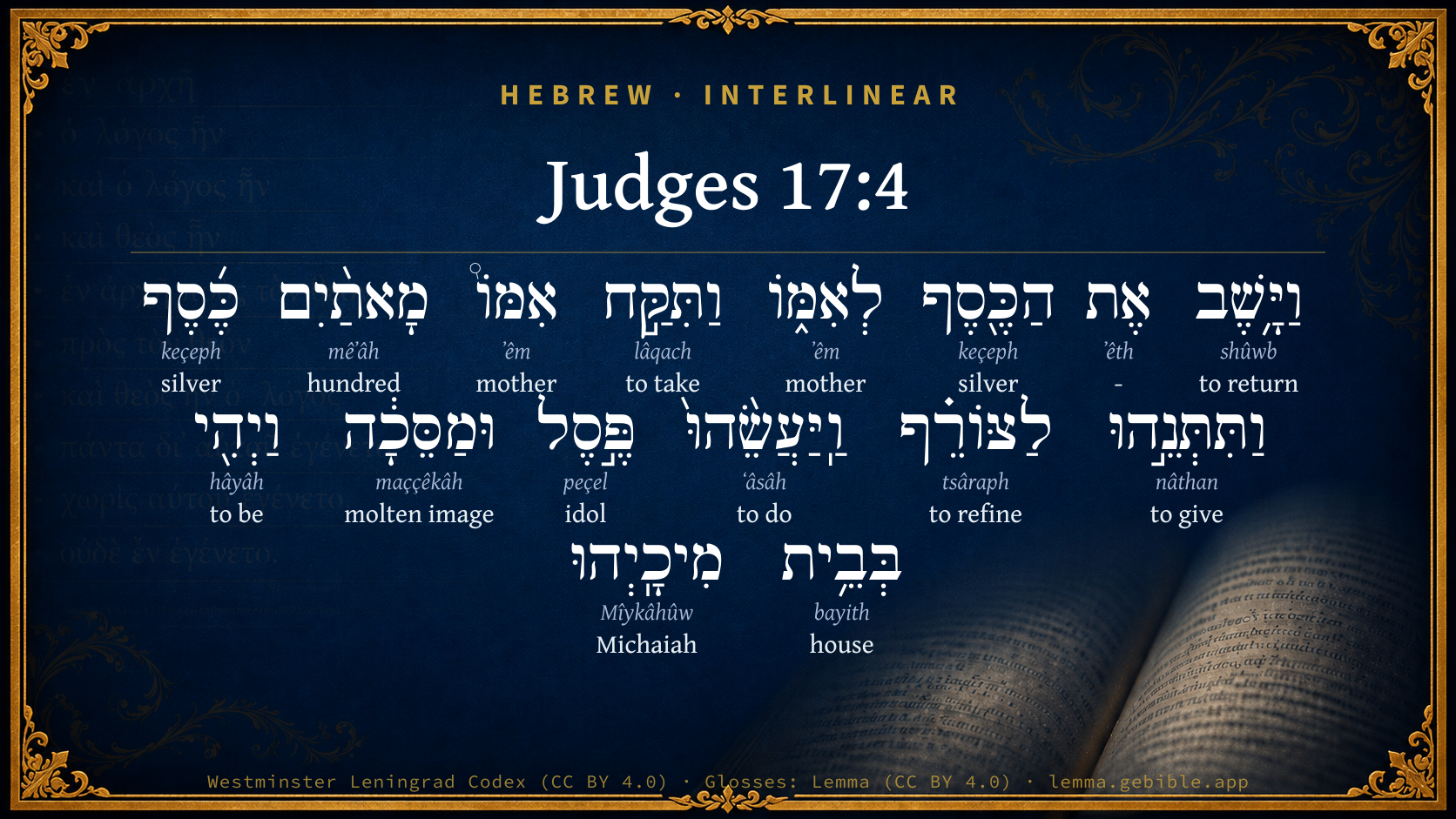
Judges 17:4

Hebrew (Westminster Leningrad Codex) Judges 17:4 appears in the Hebrew Old Testament. The text above is from the Westminster Leningrad Codex. Each word links to its Strong’s number, a concise gloss, and parsing drawn from the Open Scriptures Hebrew Bible morphology. Click any word for its full Brown-Driver-Briggs (BDB) entry.
Download image
Cite this verse

Judges 17:4 (World English Bible). Public Domain. Lemma interlinear Bible study tool, https://lemma.gebible.app/v/judges/17/4.

Show BibTeX & RIS
BibTeX
RIS
English Translation
When he restored the money to his mother, his mother took two hundred [pieces] of silver, and gave them to the founder, who made of it an engraved image and a molten image: and it was in the house of Micah.
World English Bible · Public Domain
Download a study sheet

One document with this verse’s original text, its word-by-word gloss line, the meaning frame, cross-references with their text, attributed commentary, and full source and license credits — printable, and it pastes into notes with its structure intact.

This verse Autodidact and up

Study sheet (.html) Plain text (.txt)

A passage Seminary Student

Up to 50 verses in one chapter. A passage sheet keeps up to 6 commentary sources and 12 cross-references per verse, in the order this page ranks them, and says so on the sheet whenever that leaves anything out. Ask for a single verse and you get the Autodidact verse sheet above.

Everything on this page stays free to read, with no account — the sheet is a download of what is already on screen, not access to it.

Want to remove ads? Support Godless Engineer
Compare translations 3

The same verse in 3 English versions, stacked beneath the original-language interlinear above. Click any original word for its lexicon entry.

Each is an independent rendering of the whole verse — the interlinear is not word-aligned to these translations.

Highlighted words mark where these versions differ — a whole-verse word diff, not a word-by-word alignment.

  • World English Bible Public Domain
    When he restored the money to his mother, his mother took two hundred [pieces] of silver, and gave them to the founder, who made of it an engraved image and a molten image: and it was in the house of Micah.
  • King James Version Public Domain
    Yet he restored the money unto his mother; and his mother took two hundred shekels of silver, and gave them to the founder, who made thereof a graven image and a molten image: and they were in the house of Micah.
  • unfoldingWord Literal Text CC BY-SA 4.0
    And he returned the silver to his mother, and his mother took 200 silver and she gave it to a refiner. And he made it an idol and a molded image, and it was in the house of Micah.

unfoldingWord Literal Text — © unfoldingWord, licensed CC BY-SA 4.0. Word-aligned USFM3 via Door43 (git.door43.org/unfoldingWord/en_ult).

Versions to compare (up to 4)

3 of 4 selected

Show all 18 translations

Every available English version of this verse, each an independent rendering of the whole verse.

  • World English Bible Public Domain
    When he restored the money to his mother, his mother took two hundred [pieces] of silver, and gave them to the founder, who made of it an engraved image and a molten image: and it was in the house of Micah.
  • Berean Standard Bible Public Domain
    So he returned the silver to his mother, and she took two hundred shekels of silver and gave them to a silversmith, who made them into a graven image and a molten idol. And they were placed in the house of Micah.
  • Majority Standard Bible Public Domain
    So he returned the silver to his mother, and she took two hundred shekels of silver and gave them to a silversmith, who made them into a graven image and a molten idol. And they were placed in the house of Micah.
  • King James Version Public Domain
    Yet he restored the money unto his mother; and his mother took two hundred shekels of silver, and gave them to the founder, who made thereof a graven image and a molten image: and they were in the house of Micah.
  • American Standard Version (1901) Public Domain
    And when he restored the money unto his mother, his mother took two hundred `pieces' of silver, and gave them to the founder, who made thereof a graven image and a molten image: and it was in the house of Micah.
  • Revised Version (1885) Public Domain
    And when he restored the money unto his mother, his mother took two hundred pieces of silver, and gave them to the founder, who made thereof a graven image and a molten image: and it was in the house of Micah.
  • Geneva Bible (1599) Public Domain
    And when he had restored the money vnto his mother, his mother tooke two hundreth shekels of siluer, and gaue them to the founder, which made thereof a grauen and molten image, and it was in the house of Michah.
  • Douay-Rheims (1899) Public Domain
    And he restored them to his mother: and she took two hundred pieces of silver and gave them to the silversmith, to make of them a graven and a molten god, which was in the house of Michas.
  • Young's Literal Translation Public Domain
    And he giveth back the money to his mother, and his mother taketh two hundred silverlings, and giveth them to a refiner, and he maketh them a graven image, and a molten image, and it is in the house of Micah.
  • Literal Standard Version CC BY-SA 4.0
    And he gives back the money to his mother, and his mother takes two hundred pieces of silver, and gives them to a refiner, and he makes them a carved image, and a molten image, and it is in the house of Micah.
  • Unlocked Literal Bible CC BY-SA 4.0
    When he restored the money to his mother, his mother took two hundred pieces of silver and gave them to a metal worker who made them into carved and cast metal figures, and they were placed in the house of Micah.
  • unfoldingWord Literal Text CC BY-SA 4.0
    And he returned the silver to his mother, and his mother took 200 silver and she gave it to a refiner. And he made it an idol and a molded image, and it was in the house of Micah.
  • Darby Bible Public Domain
    So when he restored the money to his mother, his mother took two hundred pieces of silver, and gave it to the silversmith, who made it into a graven image and a molten image; and it was in the house of Micah.
  • World Messianic Bible Public Domain
    When he restored the money to his mother, his mother took two hundred pieces of silver, and gave them to a silversmith, who made a carved image and a molten image out of it. It was in the house of Micah.
  • Webster's Bible Public Domain
    Yet he restored the money to his mother; and his mother took two hundred shekels of silver, and gave them to the founder, who made of it a graven image and a molten image: and they were in the house of Micah.
  • Free Bible Version CC BY-SA 4.0
    After he'd returned the silver to his mother she gave two hundred shekels to a silversmith who made it into a carved idol, an image made with molten silver. They were kept in Micah's house.
  • Bible in Basic English Public Domain
    So he gave the silver back to his mother. Then his mother took two hundred shekels of silver and gave them to a metal-worker who made a pictured image and a metal image from them: and it was in the house of Micah.
  • JPS Tanakh (1917) Public Domain
    And when he restored the money unto his mother, his mother took two hundred pieces of silver, and gave them to the founder, who made thereof a graven image and a molten image; and it was in the house of Micah.

Literal Standard Version (2020), Covenant Press — licensed CC BY-SA 4.0. Text via the HelloAO Bible API (eBible.org). Unlocked Literal Bible (unfoldingWord) — licensed CC BY-SA 4.0. Text via the HelloAO Bible API (eBible.org). unfoldingWord Literal Text — © unfoldingWord, licensed CC BY-SA 4.0. Word-aligned USFM3 via Door43 (git.door43.org/unfoldingWord/en_ult). Free Bible Version, Dr. Jonathan Gallagher — licensed CC BY-SA 4.0. Text via the HelloAO Bible API (eBible.org).

Word by word

More ways to search: Search by grammar → Find every occurrence → Compare this word →

Practice this passage: Drill this verse → Learn its vocabulary →

מִיכָֽיְהוּ
Mîykâhûw
H4319
“Michaiah”
Noun, Proper
Part of Speech
Noun
Type
Proper
Full BDB Definition

Origin: a contr. for H4321

TWOT: None

Michaiah = "who is like God" - son of Imlah and a prophet of Samaria who predicted the defeat and death of king Ahab of Israel
  1. וַיָּ֥שֶׁב shûwb H7725 “and · to return” Conjunction + Verb, Hiphil, Sequential Imperfect, 3rd Person, Masculine, Singular
  2. אֶת ʼêth H853 “-” Particle, Direct Object
  3. הַכֶּ֖סֶף keçeph H3701 “the · silver” Particle, Definite Article + Noun, Common, Masculine, Singular, Absolute
  4. לְאִמּ֑וֹ ʼêm H517 “to/for · mother · his” Preposition + Noun, Common, Feminine, Singular, Construct + Suffix, Personal, 3rd Person, Masculine, Singular
  5. וַתִּקַּ֣ח lâqach H3947 “and · to take” Conjunction + Verb, Qal, Sequential Imperfect, 3rd Person, Feminine, Singular
  6. אִמּוֹ֩ ʼêm H517 “mother · his” Noun, Common, Feminine, Singular, Construct + Suffix, Personal, 3rd Person, Masculine, Singular
  7. מָאתַ֨יִם mêʼâh H3967 “hundred” Adjective, Cardinal number, Both, Dual, Absolute
  8. כֶּ֜סֶף keçeph H3701 “silver” Noun, Common, Masculine, Singular, Absolute
  9. וַתִּתְּנֵ֣הוּ nâthan H5414 “and · to give · him” Conjunction + Verb, Qal, Sequential Imperfect, 3rd Person, Feminine, Singular + Suffix, Personal, 3rd Person, Masculine, Singular
  10. לַצּוֹרֵ֗ף tsâraph H6884 “to/for the · refining” Preposition, Determined + Verb, Qal, Participle Active, Masculine, Singular, Absolute
  11. וַֽיַּעֲשֵׂ֨הוּ֙ ʻâsâh H6213 “and · to do · him” Conjunction + Verb, Qal, Sequential Imperfect, 3rd Person, Masculine, Singular + Suffix, Personal, 3rd Person, Masculine, Singular
  12. פֶּ֣סֶל peçel H6459 “idol” Noun, Common, Masculine, Singular, Absolute
  13. וּמַסֵּכָ֔ה maççêkâh H4541 “and · molten image” Conjunction + Noun, Common, Feminine, Singular, Absolute
  14. וַיְהִ֖י hâyâh H1961 “and · to be” Conjunction + Verb, Qal, Sequential Imperfect, 3rd Person, Masculine, Singular
  15. בְּבֵ֥ית bayith H1004 “in/at · house of” Preposition + Noun, Common, Masculine, Singular, Construct

About this verse

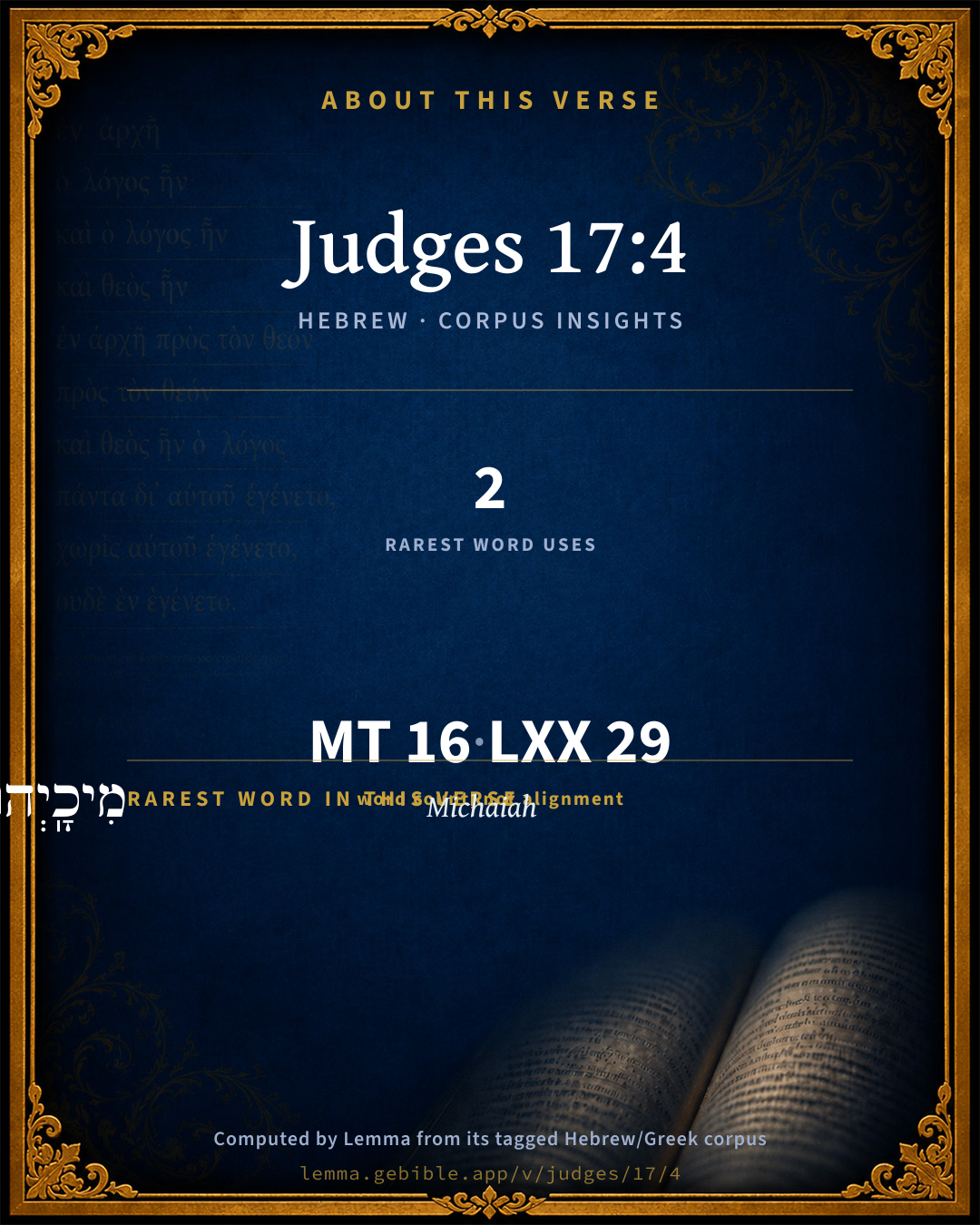
These counts appear in no published source. They are computed here, from the morphology-tagged text and Lemma’s own curated glosses. What Lemma adds →

16
words
14
distinct lemmas
Historical
section

Notable vocabulary

The rarest word here is מִיכָֽיְהוּ Michaiah H4319 — appearing just 2 times in the whole Hebrew Bible.

Shared distinctive vocabulary

מִיכָֽיְהוּ Michaiah H4319 occurs in 2 verses of the Hebrew Bible. Also found in:

Grammatical profile

  • 6 verbs
  • 8 nouns
  • 1 adjective
  • 1 particle

Verb forms

  • וַיָּ֥שֶׁב Hiphil · Sequential Imperfect
  • וַתִּקַּ֣ח Qal · Sequential Imperfect
  • וַתִּתְּנֵ֣הוּ Qal · Sequential Imperfect
  • לַצּוֹרֵ֗ף Qal · Participle Active
  • וַֽיַּעֲשֵׂ֨הוּ֙ Qal · Sequential Imperfect
  • וַיְהִ֖י Qal · Sequential Imperfect

Repetition

Words recur within this verse — often emphatic in Hebrew:

  • הַכֶּ֖סֶף silver H3701 ×2
  • לְאִמּ֑וֹ mother H517 ×2

Hebrew & Septuagint length

In English translation the verse runs 41 words from the Hebrew and 41 from the Septuagint (LXX English) — the same length.

A rough comparison of the two English renderings, which tokenize alike — not a word-level alignment.

Word counts can differ between the Hebrew and the Greek without any difference in meaning — e.g. the Hebrew direct-object marker אֵת has no separate Greek word, and Greek often adds the article ὁ.

In the original languages it is 16 Hebrew tokens and 29 Greek tokens — but the two are counted differently (Hebrew bundles its prefixes and suffixes into one token; the Greek is in lemma form), so that isn’t a like-for-like length.

Cross-references

2

Topical passages linked to Judges 17:4 in the Treasury of Scripture Knowledge — connected by theme and wording, ordered by reader-vote popularity; previews shown in the World English Bible.

  • Isaiah 46:6–7 Some pour out gold from the bag, and weigh silver in the balance. They hire a goldsmith, and he makes it a god. They fall down--yes, they worship.
  • Jeremiah 10:9–10 There is silver beaten into plates, which is brought from Tarshish, and gold from Uphaz, the work of the artificer and of the hands of the goldsmith; blue and purple for their clothing; they are all the work of skillful men.

Cross-references courtesy of OpenBible.info (CC BY 4.0).

Hebrew and Greek witnesses Masoretic Hebrew ↔ Greek Septuagint

The same verse in the two great witnesses to the Old Testament, shown verse-for-verse.

These are two independent witnesses, not word-aligned to each other, and the Septuagint is shown in lemma (dictionary) form.

Hebrew Judges 17:4 Masoretic · Westminster Leningrad Codex

וַיָּ֥שֶׁב אֶת הַכֶּ֖סֶף לְאִמּ֑וֹ וַתִּקַּ֣ח אִמּוֹ֩ מָאתַ֨יִם כֶּ֜סֶף וַתִּתְּנֵ֣הוּ לַצּוֹרֵ֗ף וַֽיַּעֲשֵׂ֨הוּ֙ פֶּ֣סֶל וּמַסֵּכָ֔ה וַיְהִ֖י בְּבֵ֥ית מִיכָֽיְהוּ

When he restored the money to his mother, his mother took two hundred [pieces] of silver, and gave them to the founder, who made of it an engraved image and a molten image: and it was in the house of Micah.

World English Bible · Public Domain

Greek LXX Judges 17:4 Septuagint · lemma form

καί ἀποδίδωμι ὁ ἀργύριον ὁ μήτηρ αὐτός καί λαμβάνω ὁ μήτηρ αὐτός διακόσιοι ἀργύριον καί δίδωμι αὐτός ἀργυροκόπος καί ποιέω αὐτός γλυπτός καί χωνευτός καί γίγνομαι ἐν οἶκος μιχαιας

But he returned the silver to his mother, and his mother took two hundred pieces of silver, and gave them to a silversmith, and he made it a graven and a molten image; and it was in the house of Michaias.

LXX2012 (modern English Septuagint) · Public Domain

Hebrew: Westminster Leningrad Codex (CC BY 4.0). Greek: Septuagint (public domain); English from LXX2012 (modern English Septuagint) (Public Domain). How the Septuagint differs from the Hebrew →

Targum (Aramaic paraphrase)

1

The Targum is the ancient Jewish Aramaic paraphrase of the Hebrew Scriptures — an interpretive translation, not the Hebrew text itself. Onkelos (literal) and Pseudo-Jonathan (expansive) render the Torah, and Jonathan the Prophets. Coverage is partial: where no permissively-licensed English translation exists for a verse, only the Aramaic is shown. This is verse-level text, not a word-by-word alignment to the Hebrew.

  1. Targum Jonathan Prophets (Joshua–Malachi)
    וַאֲתֵיב יַת כַּסְפָּא לְאִמֵיהּ וּנְסִיבַת אִמֵיהּ מָאתָן סַלְעִין דִכְסַף וִיהַבְתֵּיהּ לְקִינָאָה וְעַבְדֵיהּ צְלַם וּמַתְּכָא וַהֲוָה בְּבֵית מִיכָיְהוּ:

    (no public-domain English translation for this verse)

    Targum Jonathan — Aramaic: “Mikraot Gedolot” (public domain). English: “Sefaria Community Translation” (CC0 1.0 (public-domain dedication)); “London "Chaldee Paraphrase," 1871” (public domain). Text via Sefaria.

Commentary

Notes on Judges 17:4 from classic Christian and Jewish commentators (each source and its license shown beneath its notes). The classic Christian expositions comment on the surrounding passage and are grouped to its opening verse, so a note may address several verses; the Jewish commentaries on the Tanakh (Rashi and others) are per-verse, so they appear only where the commentator wrote on this verse.

Lemma curates 59 commentaries, every one of them public domain or Creative Commons licensed, each selected and text-cleaned for this edition rather than reprinted as found. About our sources →

Ellicott's Commentary for English Readers

(4) Yet.—Rather, And.

Two hundred shekels of silver.—Bertheau supposes that these two hundred shekels were not apart of the eleven hundred, but the trespass-money of one-fifth, which by the law Micah had to pay for his theft (Lev. 5:24). But apart from the sum not being exact, no such impression is given by the narrative. It is left to be understood that the remaining nine hundred shekels were spent in other parts of the idolatrous worship. (It may be mentioned, by way of passing illustration, that when Sir John Hawle was murdered in Westminster Abbey, the £200 paid in penance by his murderers seem to have been expended upon the purchase of a costly image, which was placed in the Chapel of St. Erasmus.)

Gave them to the founder.—An illustration of the folly which Isaiah pursues with such a storm of irony and contempt (Isa_46:6-13). These pesîlîm were originally of all sorts of materials (e.g., wood, brass, stone, and clay, Dan_2:33; Dan_5:23; Deu_7:5; Deu_12:3, &c.), but usually of metal (Isa_40:19; Isa_44:10, &c.), adorned with plates and chains of precious metal, and embroidered robes (Jer_10:9; Eze_16:18, &c.). (See Excursus I.: Calf-Worship. )

EXCURSUS ON NOTES TO JUDGES.

EXCURSUS I.—ON Jdg_17:4. (CALF-WORSHIP.)

IT may be regarded as certain, from the testimony of Scripture itself, that the calf of Aaron and those by which the rebel king

“Doubled that sin in Bethel and in Dan,

Likening his Maker to the grazed ox,”

were not idols in the ordinary sense of the word, but were intended as symbols of the one God. The calf-worship was a violation not of the first, but of the second commandment. The main element of the fourfold cherub was certainly an ox, as is clear from the comparison of Eze_10:14 with Jdg_1:7-8; and the knowledge of this cherubic emblem was not confined to the Jews, but was spread at least through all Semitic races. That the calf was intended to be an emblem of God seems to be the opinion of Josephus, who in such a matter would represent creditable Jewish traditions (Antt. viii. 8, § 4). Aaron in proclaiming the feast at the inauguration of his golden calf distinctly calls it a feast to Jehovah (Exo_32:5). It was the well-understood purpose of Jeroboam not to introduce a new worship, but to provide a convenient modification of the old; and it appears from 1Ki_22:16 that the prophets of the calf-worship still regarded themselves, and were regarded, as the prophets of Jehovah; but the fate of Amos is sufficient to show that they must have sanctioned, or at least tolerated, the use of these unauthorised symbols, against which, so far as we are informed, not even Elijah or Elisha ever raised their voices, though the former was so implacable a foe to all idolatry, and the latter lived on terms of close friendship with at least one of the northern kings. (See the article “Calf,” by the present writer, in Smith’s Dictionary of the Bible.)

A Bible Commentary for English Readers, edited by Charles John Ellicott (1878–1897) — public domain. Text from a community e-Sword module.

Trapp's Complete Commentary

John Trapp

Jdg 17:4 Yet he restored the money unto his mother; and his mother took two hundred [shekels] of silver, and gave them to the founder, who made thereof a graven image and a molten image: and they were in the house of Micah.

Ver. 4. Yet he restored the money unto his mother.] And so disburdened his conscience, which was grated upon by this guilt, worse than the kidneys are by gravel. I myself, saith a reverend divine, {a} knew one man that had wronged another but of five shillings, and fifty years after could not rest till he had restored it.

And gave them to the founder.] For his pains, haply, in making her gods of the other nine hundred: or, two hundred she laid out upon the images, and nine hundred upon the other trinkets. Idolaters "lavish money out of the bag." {Isa 46:6} Canutus bestowed as much upon a crucifix as a year’s revenue of his kingdom came to. He gave a hundred talents of silver and one of gold for St Augustine’s arm, which he bestowed on Coventry. Our Edward I prepared thirty-two thousand pounds to have his heart carried to Jerusalem, which he charged his son upon his deathbed to see done.

{a} Mr Burroughs.

John Trapp, A Commentary or Exposition upon All the Books of the Old and New Testament (1647–1656) — public domain. Text from a community e-Sword module.

Joseph Benson's Commentary

Jdg 17:4. Yet he restored the money to his mother — Though she allowed him to keep it, he persisted in his resolution to restore it, that she might dispose of it as she pleased. His mother took two hundred shekels — Reserving nine hundred either for the ephod, or teraphim, or other things relating to this worship.

Joseph Benson's Commentary on the Old and New Testaments (1811–1818) — public domain. Text from a community e-Sword module.

Adam Clarke's Commentary

Verse 4. A graven image and a molten image] What these images were, we cannot positively say; they were most probably some resemblance of matters belonging to the tabernacle. See below.

Adam Clarke's Commentary on the Bible (1810–1826) — public domain. Text from a community e-Sword/MySword module.

The Cambridge Bible for Schools and Colleges

gen. ed. J. J. S. Perowne

4. two hundred pieces of silver] Because the whole sum was given to Jehovah it does not follow that the whole was wanted for the image. Elsewhere the founder is a maker of idols, Isa_40:19; Isa_41:7.

The Cambridge Bible for Schools and Colleges (gen. ed. J. J. S. Perowne; Cambridge University Press, 1878–1918) — public domain. Text from a community e-Sword module.

John Gill's Exposition

Yet he restored the money unto his mother,.... Gave it to her a second tithe, not as disapproving her idolatrous intention, as the sequel shows, but being desirous to be entirely free of it, and not have his mind disturbed with it as it had been, and that she might do with it as she thought fit:

and his mother took two hundred shekels of silver, and gave them to the founder, who made thereof a graven image, and a molten image; the other nine hundred pieces she kept to herself, repenting of her vow, and being unwilling to part with so much money for such an use; or else they were laid out in an ephod, and teraphim, and what else were thought necessary for the idolatrous worship they were about to set up; though Kimchi is of opinion, that the two hundred shekels were what she gave the founder for making the images, and of the nine hundred the images were made; and indeed the images must be very small ones, if made out of two hundred shekels of silver only; some have thought there was but one image, called both molten and graven; because after the silver was melted, and cast into a mould, it was fashioned with a graving tool, as the golden calf was by Aaron; but they are manifestly distinguished and represented as two, Jdg 18:17 and they were in the house of Micah; in an apartment in his house, peculiar for them, as appears by the next verse; here they were put and continued.

John Gill's Exposition of the Whole Bible (1746–1763) — public domain (CC PDM 1.0). Text via the HelloAO Bible API.

Albert Barnes' Notes on the Bible

See Jdg 8:27, note; Gen 31:19, note.

Albert Barnes' Notes on the Bible (1834–1885) — public domain. Text from a community e-Sword/MySword module.

Matthew Poole's English Annotations

Yet he restored the money unto his mother; though his mother allowed him to keep it, yet he persisted in his resolution to restore it, that she might dispose of it as she pleased; and did actually restore it, as was said before; and now confirms the former restitution, and therefore is twice said to restore it.

His mother took two hundred shekels of silver; reserving nine hundred shekels, either for the ephod and teraphim, or for other things relating to this worship, or for her own private use; being, it seems, cooled in her first zeal, and willing to have as cheap a religion as she could, as also her son Micah was, Jdg 17:10.

Who made thereof; made them, either first, of that matter; or secondly, for that money.

Matthew Poole's English Annotations on the Holy Bible (1683–1685) — public domain. Text from a community e-Sword/MySword module.

Whedon's Commentary on the Bible

Daniel D. Whedon

4. Two hundred shekels — Less than one fifth of the eleven hundred shekels. What was done with the remaining nine hundred? They were probably used for making the ephod and teraphim mentioned in Jdg_17:5, and paying the founder who made all the images; for, according to Jdg_17:3, the silver was to be in some way wholly dedicated to the Lord. This mention of the founder, or smelter, indicates the knowledge at this time in Israel of the art of metallurgy.

Daniel D. Whedon (gen. ed.), Commentary on the Old and New Testaments (1874–1909) — public domain. Text from a community e-Sword module.

The Pulpit Commentary

Yet he restored. Rather, so he restored, repeating what was said in ver. 3, and adding the consequence, that his mother took two hundred shekels and gave them to the founder. It is a great puzzle to explain why two hundred shekels only are here spoken of, and what became of the other nine hundred. Bertheau thinks the two hundred were different from the eleven hundred, and were the fifth part of the whole value stolen, which the thief, according to Lev_6:5, was bound to give in addition to the principal. He therefore translates ver. 4 thus: "So he restored the money to his mother (and his mother took two hundred shekels), and she gave it (the money 1100 shekels) to the founder," etc. Others understand that two hundred only were actually made into the graven and molten image, and the other nine hundred were devoted to other expenses of the worship. In the house of Micah. This explains, Now I will restore it unto thee, and, for my son to make, etc., in ver. 3.

The Pulpit Commentary (1880–1919), ed. H.D.M. Spence-Jones & Joseph S. Exell — public domain. Text from a community e-Sword module.

John Wesley's Explanatory Notes

Restored - Though his mother allowed him to keep it, yet he persisted in his resolution to restore it, that she might dispose of it as she pleased. Two hundred - Reserving nine hundred shekels, either for the ephod or teraphim, or for other things relating to this worship.

John Wesley, Explanatory Notes Upon the Whole Bible (1754–1765) — public domain. Text via the GEBible commentary corpus.

Lesson kit

Teaching starters — assembled from the data on this page, not authored interpretation. Every prompt links to the verse data it draws on. Edit before teaching.

Judges, in the Historical, opens this verse with 16 words (14 distinct Hebrew lemmas). Its most distinctive word is Mîykâhûw (“Michaiah”). A historical commentator’s framing appears above. Read the whole chapter for the surrounding context.

Discussion questions

  1. What does “Michaiah” (Mîykâhûw) contribute to the verse as a whole?
  2. Judges 17:1 shares the word «Michaiah» with this verse. How do the two illuminate each other?
  3. “silver” occurs 2× in this one verse. What is the effect of the repetition?
  4. These translations render this verse differently. What is at stake in choosing one wording over another?
  5. The verb «וַיָּ֥שֶׁב» is Hiphil Sequential Imperfect. How does its form color the action?
  6. Reading how Ellicott's Commentary for English Readers and Trapp's Complete Commentary read this verse, where do the two commentators agree and where do they part?

Things to notice

Reading settings

Reading text

Shown beneath each verse's original-language words.

Old Testament
Old Testament edition

Read the OT as the Masoretic Hebrew (MT) or the Greek Septuagint (LXX).

English shown for the Greek Septuagint (in the Hebrew ↔ Greek comparison).

Comparing translations? Open the Compare panel on any verse page to stack up to four side by side.