
Exodus 27:9

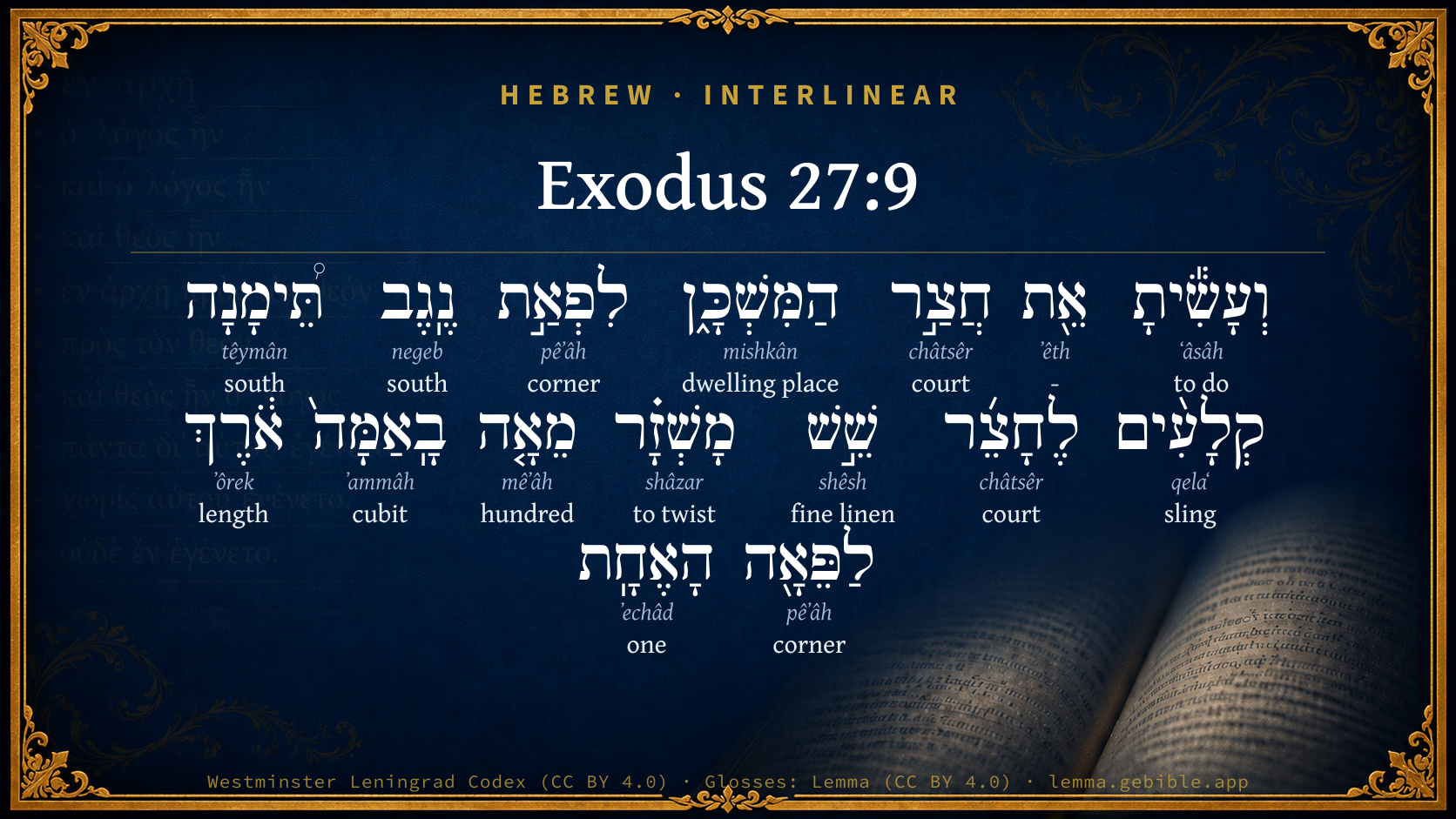
Hebrew (Westminster Leningrad Codex) Exodus 27:9 appears in the Hebrew Old Testament. The text above is from the Westminster Leningrad Codex. Each word links to its Strong’s number, a concise gloss, and parsing drawn from the Open Scriptures Hebrew Bible morphology. Click any word for its full Brown-Driver-Briggs (BDB) entry.
Download image
Cite this verse

Exodus 27:9 (World English Bible). Public Domain. Lemma interlinear Bible study tool, https://lemma.gebible.app/v/exodus/27/9.

Show BibTeX & RIS
BibTeX
RIS
English Translation
"You shall make the court of the tent: for the south side southward there shall be hangings for the court of fine twined linen one hundred cubits long for one side:
World English Bible · Public Domain
Highlights
  • 1 first appearance in the Hebrew Bible
Full analysis ↓
Download a study sheet

One document with this verse’s original text, its word-by-word gloss line, the meaning frame, cross-references with their text, attributed commentary, and full source and license credits — printable, and it pastes into notes with its structure intact.

This verse Autodidact and up

Study sheet (.html) Plain text (.txt)

A passage Seminary Student

Up to 50 verses in one chapter. A passage sheet keeps up to 6 commentary sources and 12 cross-references per verse, in the order this page ranks them, and says so on the sheet whenever that leaves anything out. Ask for a single verse and you get the Autodidact verse sheet above.

Everything on this page stays free to read, with no account — the sheet is a download of what is already on screen, not access to it.

Want to remove ads? Support Godless Engineer
Compare translations 3

The same verse in 3 English versions, stacked beneath the original-language interlinear above. Click any original word for its lexicon entry.

Each is an independent rendering of the whole verse — the interlinear is not word-aligned to these translations.

Highlighted words mark where these versions differ — a whole-verse word diff, not a word-by-word alignment.

  • World English Bible Public Domain
    "You shall make the court of the tent: for the south side southward there shall be hangings for the court of fine twined linen one hundred cubits long for one side:
  • King James Version Public Domain
    And thou shalt make the court of the tabernacle: for the south side southward there shall be hangings for the court of fine twined linen of an hundred cubits long for one side:
  • unfoldingWord Literal Text CC BY-SA 4.0
    And you shall make the courtyard of the Dwelling. There shall be curtains of fine twisted linen on the south side of the courtyard; one side shall be 100 cubits long,

unfoldingWord Literal Text — © unfoldingWord, licensed CC BY-SA 4.0. Word-aligned USFM3 via Door43 (git.door43.org/unfoldingWord/en_ult).

Versions to compare (up to 4)

3 of 4 selected

Show all 18 translations

Every available English version of this verse, each an independent rendering of the whole verse.

  • World English Bible Public Domain
    "You shall make the court of the tent: for the south side southward there shall be hangings for the court of fine twined linen one hundred cubits long for one side:
  • Berean Standard Bible Public Domain
    You are also to make a courtyard for the tabernacle. On the south side of the courtyard make curtains of finely spun linen, a hundred cubits long on one side,
  • Majority Standard Bible Public Domain
    You are also to make a courtyard for the tabernacle. On the south side of the courtyard make curtains of finely spun linen, a hundred cubits long on one side,
  • King James Version Public Domain
    And thou shalt make the court of the tabernacle: for the south side southward there shall be hangings for the court of fine twined linen of an hundred cubits long for one side:
  • American Standard Version (1901) Public Domain
    And thou shalt make the court of the tabernacle: for the south side southward there shall be hangings for the court of fine twined linen a hundred cubits long for one side:
  • Revised Version (1885) Public Domain
    And thou shalt make the court of the tabernacle: for the south side southward there shall be hangings for the court of fine twined linen an hundred cubits long for one side:
  • Geneva Bible (1599) Public Domain
    Also thou shalt make the court of the Tabernacle in the Southside, euen full South: the court shall haue curtaines of fine twined linnen, of an hundreth cubites long, for one side,
  • Douay-Rheims (1899) Public Domain
    Thou shalt make also the court of the tabernacle, in the south side whereof southward there shall be hangings of fine twisted linen of a hundred cubits long for one side.
  • Young's Literal Translation Public Domain
    `And thou hast made the court of the tabernacle: for the south side southward, hangings for the court of twined linen, a hundred by the cubit `is' the length for the one side,
  • Literal Standard Version CC BY-SA 4.0
    And you have made the court of the Dwelling Place: for the south side southward, hangings for the court of twined linen, the length of the first side [is] one hundred by the cubit,
  • Unlocked Literal Bible CC BY-SA 4.0
    You must make a courtyard for the tabernacle. There must be hangings on the south side of the courtyard, hangings of fine twined linen one hundred cubits long.
  • unfoldingWord Literal Text CC BY-SA 4.0
    And you shall make the courtyard of the Dwelling. There shall be curtains of fine twisted linen on the south side of the courtyard; one side shall be 100 cubits long,
  • Darby Bible Public Domain
    And thou shalt make the court of the tabernacle. On the south side, southward, hangings for the court of twined byssus; a hundred cubits the length for the one side,
  • World Messianic Bible Public Domain
    “You shall make the court of the tabernacle: for the south side southward there shall be hangings for the court of fine twined linen one hundred cubits long for one side.
  • Webster's Bible Public Domain
    And thou shalt make the court of the tabernacle: for the south side southward there shall be hangings for the court of fine twined linen of a hundred cubits long for one side:
  • Free Bible Version CC BY-SA 4.0
    Make a courtyard for the Tabernacle. For the south side of the courtyard make curtains of finely-spun linen, a hundred cubits long on one side,
  • Bible in Basic English Public Domain
    And let there be an open space round the House, with hangings for its south side of the best linen, a hundred cubits long.
  • JPS Tanakh (1917) Public Domain
    And thou shalt make the court of the tabernacle: for the south side southward there shall be hangings for the court of fine twined linen a hundred cubits long for one side.

Literal Standard Version (2020), Covenant Press — licensed CC BY-SA 4.0. Text via the HelloAO Bible API (eBible.org). Unlocked Literal Bible (unfoldingWord) — licensed CC BY-SA 4.0. Text via the HelloAO Bible API (eBible.org). unfoldingWord Literal Text — © unfoldingWord, licensed CC BY-SA 4.0. Word-aligned USFM3 via Door43 (git.door43.org/unfoldingWord/en_ult). Free Bible Version, Dr. Jonathan Gallagher — licensed CC BY-SA 4.0. Text via the HelloAO Bible API (eBible.org).

Word by word

More ways to search: Search by grammar → Find every occurrence → Compare this word →

Practice this passage: Drill this verse → Learn its vocabulary →

מָשְׁזָ֗ר
shâzar
H7806
“twisted”
Verb, Hophal, Participle Passive, Masculine, Singular, Absolute
Part of Speech
Verb
Stem
Hophal
Form
Participle Passive
Gender
Masculine
Number
Singular
State
Absolute
Full BDB Definition

Origin: a primitive root

TWOT: 2358

to twist, be twisted - (Hophal) - to be twisted - twisted (participle)
  1. וְעָשִׂ֕יתָ ʻâsâh H6213 “and · to do” Conjunction + Verb, Qal, Sequential Perfect, 2nd Person, Masculine, Singular
  2. אֵ֖ת ʼêth H853 “-” Particle, Direct Object
  3. חֲצַ֣ר châtsêr H2691 “court of” Noun, Common, Both, Singular, Construct
  4. הַמִּשְׁכָּ֑ן mishkân H4908 “the · dwelling place” Particle, Definite Article + Noun, Common, Masculine, Singular, Absolute
  5. לִפְאַ֣ת pêʼâh H6285 “to/for · corner of” Preposition + Noun, Common, Feminine, Singular, Construct
  6. נֶֽגֶב negeb H5045 “south” Noun, Common, Masculine, Singular, Absolute
  7. תֵּ֠ימָנָה têymân H8486 “south · toward” Noun, Common, Feminine, Singular, Absolute + Suffix, Demonstrative
  8. קְלָעִ֨ים qelaʻ H7050 “slings” Noun, Common, Masculine, Plural, Absolute
  9. לֶחָצֵ֜ר châtsêr H2691 “to/for the · court” Preposition, Determined + Noun, Common, Both, Singular, Absolute
  10. שֵׁ֣שׁ shêsh H8336 “fine linen” Adjective, Cardinal number, Feminine, Singular, Absolute
  11. מֵאָ֤ה mêʼâh H3967 “hundred” Adjective, Cardinal number, Both, Singular, Absolute
  12. בָֽאַמָּה֙ ʼammâh H520 “in/at the · cubit” Preposition, Determined + Noun, Common, Feminine, Singular, Absolute
  13. אֹ֔רֶךְ ʼôrek H753 “length” Noun, Common, Masculine, Singular, Absolute
  14. לַפֵּאָ֖ה pêʼâh H6285 “to/for the · corner” Preposition, Determined + Noun, Common, Feminine, Singular, Absolute
  15. הָאֶחָֽת ʼechâd H259 “the · one” Particle, Definite Article + Adjective, Cardinal number, Feminine, Singular, Absolute

About this verse

These counts appear in no published source. They are computed here, from the morphology-tagged text and Lemma’s own curated glosses. What Lemma adds →

16
words
14
distinct lemmas
Pentateuch
section

Notable vocabulary

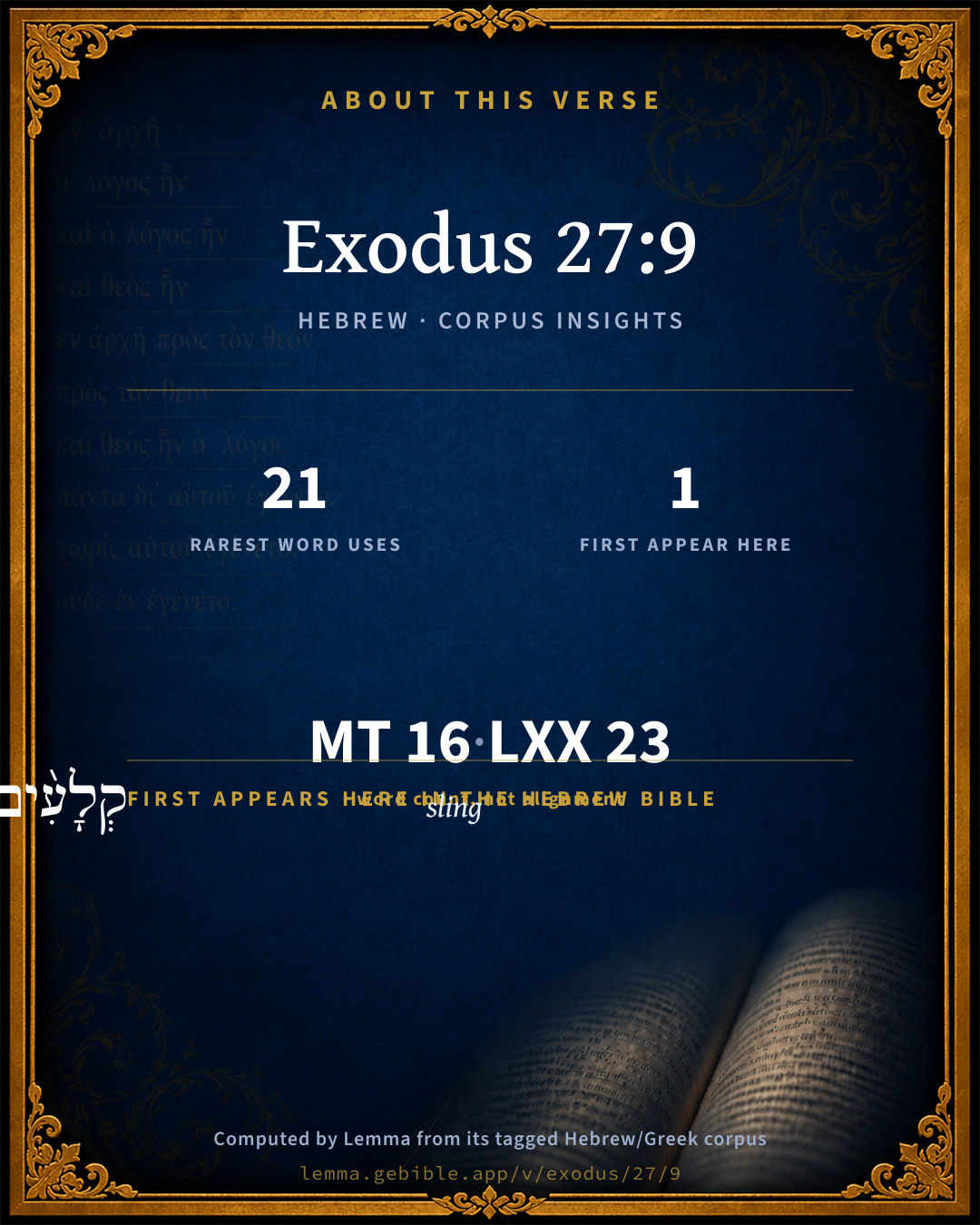
The rarest word here is מָשְׁזָ֗ר to twist H7806 — appearing just 21 times in the whole Hebrew Bible.

First appearance in Scripture

This word makes its first canonical appearance in the Hebrew Bible here:

  • קְלָעִ֨ים sling H7050

Shared distinctive vocabulary

מָשְׁזָ֗ר to twist H7806 occurs in 21 verses of the Hebrew Bible. Also found in:

Grammatical profile

  • 2 verbs
  • 10 nouns
  • 3 adjectives
  • 1 particle

Verb forms

  • וְעָשִׂ֕יתָ Qal · Sequential Perfect
  • מָשְׁזָ֗ר Hophal · Participle Passive

Repetition

Words recur within this verse — often emphatic in Hebrew:

  • חֲצַ֣ר court H2691 ×2
  • לִפְאַ֣ת corner H6285 ×2

Hebrew & Septuagint length

In English translation the verse runs 31 words from the Hebrew and 30 from the Septuagint (LXX English) — closely comparable.

A rough comparison of the two English renderings, which tokenize alike — not a word-level alignment.

Word counts can differ between the Hebrew and the Greek without any difference in meaning — e.g. the Hebrew direct-object marker אֵת has no separate Greek word, and Greek often adds the article ὁ.

In the original languages it is 16 Hebrew tokens and 23 Greek tokens — but the two are counted differently (Hebrew bundles its prefixes and suffixes into one token; the Greek is in lemma form), so that isn’t a like-for-like length.

Cross-references

21

Topical passages linked to Exodus 27:9 in the Treasury of Scripture Knowledge — connected by theme and wording, ordered by reader-vote popularity; previews shown in the World English Bible.

  • Exodus 38:9–20 He made the court: for the south side southward the hangings of the court were of fine twined linen, one hundred cubits;
  • Exodus 26:31–37 "You shall make a veil of blue, and purple, and scarlet, and fine twined linen, with cherubim. The work of the skillful workman shall it be made.
  • Exodus 36:17 He made fifty loops on the edge of the curtain that was outmost in the coupling, and he made fifty loops on the edge of the curtain which was outmost in the second coupling.
  • Exodus 39:40 the hangings of the court, its pillars, its sockets, the screen for the gate of the court, its cords, its pins, all the instruments of the service of the tent, for the tent of meeting,
  • Exodus 40:8 You shall set up the court around it, and hang up the screen of the gate of the court.
  • 1 Kings 6:36 He built the inner court with three courses of hewn stone, and a course of cedar beams.
  • 1 Kings 8:64 The same day did the king make the middle of the court holy that was before the house of Yahweh; for there he offered the burnt offering, and the meal-offering, and the fat of the peace-offerings, because the brazen altar that was before Yahweh was too little to receive the burnt offering, and the meal-offering, and the fat of the peace-offerings.
  • 2 Chronicles 33:5 He built altars for all the host of the sky in the two courts of the house of Yahweh.
  • Psalms 84:10 For a day in your courts is better than a thousand. I would rather be a doorkeeper in the house of my God, Than to dwell in the tents of wickedness.
  • Psalms 92:13 They are planted in Yahweh's house. They will flourish in our God's courts.
  • Psalms 100:4 Enter into his gates with thanksgiving, Into his courts with praise. Give thanks to him, and bless his name.
  • Psalms 116:19 In the courts of Yahweh's house, In the midst of you, Jerusalem. Praise Yah!
  • Ezekiel 40:14 He made also posts, sixty cubits; and the court [reached] to the posts, round about the gate.
  • Ezekiel 40:20 The gate of the outer court whose prospect is toward the north, he measured the length of it and the breadth of it.
  • Ezekiel 40:23 There was a gate to the inner court over against the [other] gate, [both] on the north and on the east; and he measured from gate to gate one hundred cubits.
  • Ezekiel 40:28 Then he brought me to the inner court by the south gate: and he measured the south gate according to these measures;
  • Ezekiel 40:32 He brought me into the inner court toward the east: and he measured the gate according to these measures;
  • Ezekiel 40:44 Outside of the inner gate were chambers for the singers in the inner court, which was at the side of the north gate; and their prospect was toward the south; one at the side of the east gate having the prospect toward the north.
  • Ezekiel 42:3 Over against the twenty [cubits] which belonged to the inner court, and over against the pavement which belonged to the outer court, was gallery against gallery in the third story.
  • Ezekiel 42:19–20 He turned about to the west side, and measured five hundred reeds with the measuring reed.
  • Ezekiel 46:20–24 He said to me, This is the place where the priests shall boil the trespass-offering and the sin-offering, [and] where they shall bake the meal-offering; that they not bring them forth into the outer court, to sanctify the people.

Cross-references courtesy of OpenBible.info (CC BY 4.0).

Hebrew and Greek witnesses Masoretic Hebrew ↔ Greek Septuagint

The same verse in the two great witnesses to the Old Testament, shown verse-for-verse.

These are two independent witnesses, not word-aligned to each other, and the Septuagint is shown in lemma (dictionary) form.

Hebrew Exodus 27:9 Masoretic · Westminster Leningrad Codex

וְעָשִׂ֕יתָ אֵ֖ת חֲצַ֣ר הַמִּשְׁכָּ֑ן לִפְאַ֣ת נֶֽגֶב תֵּ֠ימָנָה קְלָעִ֨ים לֶחָצֵ֜ר שֵׁ֣שׁ מָשְׁזָ֗ר מֵאָ֤ה בָֽאַמָּה֙ אֹ֔רֶךְ לַפֵּאָ֖ה הָאֶחָֽת

"You shall make the court of the tent: for the south side southward there shall be hangings for the court of fine twined linen one hundred cubits long for one side:

World English Bible · Public Domain

Greek LXX Exodus 27:9 Septuagint · lemma form

καί ποιέω αὐλή ὁ σκηνή εἰς ὁ κλίτος ὁ πρός λίψ ἱστίον ὁ αὐλή ἐκ βύσσος κλώθω μῆκος ἑκατόν πῆχυς ὁ εἷς κλίτος

And you shall make a court for the tabernacle, curtains of the court of fine linen spun on the south side, the length of one hundred cubits for one side.

LXX2012 (modern English Septuagint) · Public Domain

On this verse, Ellicott's Commentary for English Readers discusses the Septuagint’s reading. Read the note in Commentary ↓

Hebrew: Westminster Leningrad Codex (CC BY 4.0). Greek: Septuagint (public domain); English from LXX2012 (modern English Septuagint) (Public Domain). How the Septuagint differs from the Hebrew →

Targum (Aramaic paraphrase)

2

The Targum is the ancient Jewish Aramaic paraphrase of the Hebrew Scriptures — an interpretive translation, not the Hebrew text itself. Onkelos (literal) and Pseudo-Jonathan (expansive) render the Torah, and Jonathan the Prophets. Coverage is partial: where no permissively-licensed English translation exists for a verse, only the Aramaic is shown. This is verse-level text, not a word-by-word alignment to the Hebrew.

  1. Targum Onkelos Torah (Genesis–Deuteronomy)
    וְתַעְבֵּד יָת דָרַת מַשְׁכְּנָא לְרוּחַ עֵבַר דָרוֹמָא סְרָדִין לְדָרְתָּא דְבוּץ שְׁזִיר מְאָה בְאַמִין אֻרְכָּא לְעֵבֶר חָד:

    (no public-domain English translation for this verse)

    Targum Onkelos — Aramaic: “Onkelos Genesis” (public domain); “Onkelos Exodus” (public domain); “Onkelos Leviticus” (public domain); “Onkelos Numbers” (public domain); “Onkelos Deuteronomy” (public domain). English: “Sefaria Community Translation” (CC0 1.0 (public-domain dedication)); “J.W. Etheridge. The Targums of Onkelos and Jonathan Ben Uzziel on the Pentateuch. London: Longmans, Green, 1862” (public domain). Text via Sefaria.

  2. Targum Pseudo-Jonathan Torah (Genesis–Deuteronomy)
    וְתַעֲבֵיד יַת דָּרַת מַשְׁכְּנָא לְרוּחַ עִיבַר דָּרוֹמָא וִילַוָון לְדַרְתָּא דְּבוּץ שְׁזִיר מְאָה אַמִּין אוּרְכָּא לְרוּחַ חֲדָא

    And thou shalt make the court of the tabernacle. For the southern side shall be hangings of fine linen twined; a hundred cubits the length for one side.

    Targum Pseudo-Jonathan — Aramaic: “Targum Jonathan on Genesis” (public domain); “Targum Jonathan on Exodus” (public domain); “Targum Jonathan on Leviticus” (public domain); “Targum Jonathan on Numbers” (public domain); “Targum Jonathan on Deuteronomy” (public domain). English: “The Targum of Jonathan ben Uzziel, trans. J. W. Etheridge, London, 1862” (public domain). Text via Sefaria.

Commentary

Notes on Exodus 27:9 from classic Christian and Jewish commentators (each source and its license shown beneath its notes). The classic Christian expositions comment on the surrounding passage and are grouped to its opening verse, so a note may address several verses; the Jewish commentaries on the Tanakh (Rashi and others) are per-verse, so they appear only where the commentator wrote on this verse.

Lemma curates 59 commentaries, every one of them public domain or Creative Commons licensed, each selected and text-cleaned for this edition rather than reprinted as found. About our sources →

Trapp's Complete Commentary

John Trapp

Exo 27:9 And thou shalt make the court of the tabernacle: for the south side southward [there shall be] hangings for the court [of] fine twined linen of an hundred cubits long for one side:

Ver. 9. The court of the tabernacle.] This outer court signified the visible Church, where hypocrites also come to the external worships. Doeg may set his foot as far as David.

John Trapp, A Commentary or Exposition upon All the Books of the Old and New Testament (1647–1656) — public domain. Text from a community e-Sword module.

Albert Barnes' Notes on the Bible

The court of the tabernacle - (Compare Exo 38:9-20)

Exo 27:9

The south side southward - The south side on the right. See Exo 26:18.

Exo 27:10

Sockets - Bases. See Exo 26:19.

Fillets - Rather, Connecting rods; curtain-rods of silver connecting the heads of the pillars. The hangings were attached to the pillars by the silver hooks; but the length of the space between the pillars would render it most probable that they were also in some way fastened to these rods.

Exo 27:13

The east side eastward - On the front side eastward.

Exo 27:16

An hanging - An entrance curtain, which, unlike the hangings at the sides and back of the court, could be drawn up, or aside, at pleasure. The words are rightly distinguished in our Bible in Num 3:26.

Wrought with nedlework - The work of the embroiderer. See Exo 26:36; Exo 35:35. On the materials, see Exo 25:4.

Exo 27:17

Filleted with silver - Connected with silver rods. See Exo 27:10,

Exo 27:19

All the vessels ... - All the tools of the tabernacle used in all its workmanship, and all its tent-pins, and all the tent-pins of the court, shall be of bronze. The working tools of the sanctuary were most probably such things as axes, knives, hammers, etc. that were employed in making, repairing, setting up and taking down the structure. Compare Num 3:36.

The tabernacle - The word is here to be taken as including both the משׁכן mı̂shkân and the tent, as in Num 1:51, Num 1:53, etc. (see Exo 26:1 note).

The pins - tent-pins.

Albert Barnes' Notes on the Bible (1834–1885) — public domain. Text from a community e-Sword/MySword module.

The Biblical Illustrator

Joseph S. Exell

Exo_27:9-19

The court of the Tabernacle.

The court of the Tabernacle

I. This court may be an emblem of that sacred enclosure which always surrounds the Church. A garden enclosed is my sister, my spouse. God Himself, with all His infinite perfections and attributes, is round about His people. Every attribute of God is a pillar in our protecting wall, power, sovereignty, justice, righteousness, truth and faithfulness, appear in perfect harmony with love, benevolence, mercy, tenderness, compassion and goodness. All unite to uphold the separating wall between the Church and the world.

II. We may look upon this court as emblematical of the life and ministry of Christ. Only the true Christian can enter into Christ, but a sinner may read His life. As the court led to the Tabernacle, so the reading of the life of Christ has often been the means of the soul believing in Jesus. In the life of Christ we have a perfect model for the Christians imitation. Christ has left us an example that we should follow His steps.

III. We may view the court of the Tabernacle as an emblem of the Holy Scriptures. We cannot come to God without entering the court of revelation. He that loves the Bible has entered the outer court of the Tabernacle. Reverence for the Word of God is a good sign.

IV. The court of the Tabernacle was a place of worship. Here the Israelites came with their various sacrifices; and here God accepted them. If we would be accepted by God, we must observe Gods order, and come to the place He has appointed. We must also come in a right spirit.

V. In the court of the Tabernacle we have a figure of the professing Church.

1. Not all who entered the court entered the Tabernacle. Not all who make a profession of religion possess it. The heart, as well as the lip, must be right. The court was the way to the Tabernacle. There is no evidence that a man possesses grace while he neglects the means of grace. If a man has no love to Gods house, he can have no love to God. If we have no desire to be numbered with Gods people, there cannot be much desire after God Himself. (R. E. Sears.)

Hangings of the court

It is likely that those hangings would be of open work, and that the people would be able to look through this linen fence, and see what was being done inside. This would set forth the guilelessness of Christs character. He was no deceiver; there was no guile in His lips. He lived in a very hollow age, when deceit was the order of the day; but He was a transparent Man, an unselfish Man, a perfect Man. At the east end was a hanging called the gate. The basis of this gate would be the same as the fine linen in other parts of the court, and the meshes would be nearly filled up with blue, purple, and scarlet wools. This gate is Christ, the one gate, the one only door to God and to happiness in this life, or in the life which is to come. Those white hangings were suspended from upright pillars, standing in blocks of brass. The pillars were strong enough to sustain the weight of the hangings, and they were high enough to keep the fine linen from touching the ground, or contracting defilement in any part. So our Lord Jesus was sustained in His holy conduct in every part of His life by those upright principles which He had in His holy nature. (G. Rodgers.)

Fine linen

The fine linen was a thing of the earth. It had grown from seed which had been cast into the ground, and had died there, after which life came up out of death; there was death and resurrection. After this it went through many processes before it was seen about the dwelling-place of God. So the Christian has to learn death and resurrection. We have to die, and to be quickened to life, and we have to pass through some painful processes. Satan himself is sometimes permitted to sift us and to twist us, and he handles the soul roughly; but it is all needed to make us the fine-twined linen such as God would have us be. All things do indeed work together for our good, if they help to conform us to the image of Christ (Rom_8:28-29). (G. Rodgers.)

The gate of the court

The word hanging is in the Hebrew exclusively used for the vail the door of the Tabernacle, and the gate of the court; and serves, therefore, to connect together these three in type. Each of these hangings covered or hid the interior from the eyes of one approaching from the outside. Each had the character of a door. All three were made of the same materials arranged in precisely the same order; and all three were of the same dimensions as regards their area. The same truth seems, therefore, to be embodied in each of these typical curtains. The same Jesus, God manifest in the flesh, is pourtrayed in each. There could be no access to God of any kind, whether of comparatively distant worship or of closest intimacy, but through the one door, the Lord Jesus (Joh_10:7). Cain was the first who tried another path; and instead of being able to draw near, his very attempt ended in his going out from the presence of God into the land of banishment. Thousands follow in his footsteps, and think to worship and to offer without passing through the door. (H. W. Soltau.)

The hanging of fine linen

The court itself, with the exception of the gate, was closed by a hanging of fine-twined linen, five cubits high. Fine linen seems to be used in Scripture as a type of righteousness--a righteousness equal to all the demands of God--enabling him who possesses it to stand in Gods glory; in contrast with sin, by reason of which, all come short of the glory of God. The Israelite, who entered through the gate of the court, would be encompassed, shut in, and protected by this hanging of fine-twined linen. Though in a wilderness, he stood on holy ground; and the fine linen by which he was surrounded shut out from his eye the dreary barren prospect, through which he was wending his way. The lovely Tabernacle of God stood partially revealed to his gaze. The courts of the Lords house, overshadowed by the cloud of glory, were before him. The altar, with its lamb for the burnt-offering, sent up an odour of a sweet savour on his behalf. The laver, filled with water, told him of a fountain filled with life and purity, which would cleanse away even the ordinary defilement contracted whilst passing through a wilderness of death. He had entered through the gate of the court, the appointed doorway; within, every object proclaimed life, peace, righteousness, acceptance, and nearness to God. Moreover, no deadly foe could enter these precincts. Thus the court presented a place of security, of holiness, and of intercourse with God. Jerusalem on earth will hereafter afford some such place of refuge for the nations of the earth. (H. W. Soltau.)

The pins

By means of these pins of brass, the Tabernacle and the court were securely fastened to the desert ground, so that no storm or flood of waters could sweep away this structure, although many of the materials were such as to be easily affected by the wind or rain. May we not be reminded by this type, of the stedfast purpose of Christ, to pursue the path marked out for Him by the counsels of God, even though that path ended in the storm of judgment and in the billows of wrath. What a wondrous object of contemplation is the blessed Lord, as revealed to us in the Scriptures of truth. Weak, yet immovably firm. Himself the mighty God, yet dependent for everything on God His Father. Oh! the wondrous power of that weakness. Oh! the marvellous victory of that death. Oh! the eternal stability of Him laid low in the depths of the grave. (H. W. Soltau.)

The Biblical Illustrator, edited by Joseph S. Exell (c. 1880s–1900s) — public domain. Text from a community e-Sword module.

Joseph Benson's Commentary

Exo 27:9. Thou shalt make the court — Such a place as we call a court- yard, uncovered above, but enclosed with pillars and hangings of fine linen. This court, according to common computation, was fifty yards long and twenty-five broad. In it stood the tabernacle toward the upper west end; between the tabernacle and the lower end stood the altar, with the laver on one side of it, Exo 30:18. The pillars were set up at convenient distances, in sockets of brass, the pillars filleted with silver, and silver tenterhooks in them, on which the linen hangings were fastened: the hanging which served for the gate was finer than the rest. This court was a type of the church, enclosed and distinguished from the rest of the world; the enclosure supported by pillars, denoting the stability of the church; hung with the clean linen, which is said to be the “righteousness of saints,”

Rev 19:8. Yet this court would contain but a few worshippers; thanks be to God, now the enclosure is taken down; and there is room for all that in every place call on the name of Christ.

Joseph Benson's Commentary on the Old and New Testaments (1811–1818) — public domain. Text from a community e-Sword module.

Whedon's Commentary on the Bible

Daniel D. Whedon

COURT OF THE TABERNACLE, Exo_27:9-19.

9. South side southward — See note on Exo_26:18.

Hangings — These, which were to serve for a fence about the sanctuary, were of the same material as the tabernacle-cloth, (Exo_26:1,) and the inner vail, (Exo_26:31,) and the front curtain, (Exo_26:36,) but without the cunning work and colours inwrought on them.

Daniel D. Whedon (gen. ed.), Commentary on the Old and New Testaments (1874–1909) — public domain. Text from a community e-Sword module.

The Preacher's Complete Homiletical Commentary

Joseph S. Exell (gen. ed.)

MAIN HOMILETICS OF THE PARAGRAPH.—Exo_27:9-20

THE COURT OF THE TABERNACLE

This scene, into which all the members of the house of Israel might enter, reminds us—

I. Of the common need. It was the court of the congregation. Every member of the house of Israel needed to come here—that is, every member needed forgiveness and purification. No matter that they were an elected and peculiar people. Whilst nationally they were elected to play a great part in the government of God, their moral weaknesses remained, and they needed forgiveness and cleansing. No election ignores moral considerations. No matter what their age. The youth, the patriarch. No matter what their rank. Princes, elders, common people, all needed alike to present themselves here. No matter what their office. The Priest, the people—the sacred and secular orders. The men of all Israel came here to be reminded of their imperfection, sin and stain. We are all guilty before God. All have sinned and come short of the glory of God; there is no difference. “If any man say that he hath no sin,” &c.

II. Of the common privilege. It was the court of the congregation. All needed to come, all were privileged to come. The hanging at the entrance was full of promise. If the radiant vail encouraged the high priest to enter the holiest, if the similar vail gave assurance to the priest to pass into the holy place, the similar vail, at the entrance to the court of the congregation, spoke hope into the breast of all Israel, Exo_27:16. The embroidered, richly dyed hangings on the very threshold of the sacred tent, inspired all guilty and sorrowful souls, who turned their faces thitherward, with most consolatory expectations. Whatever might be the sin, the altar in that enclosure might be approached. Whatever might be the uncleannesses of the people, there it might be atoned for and purged. (Notice the sins and stains to be removed as given in Leviticus.) So forgiveness and purity in Christ is a common privilege. “The common salvation.” There are special gifts and appointments in the natural sphere; special gifts and callings in the Church; but grace, pardon, purity are in Christ for the whole world. “There is no difference.”

III. Of the common hope. The Tabernacle of the congregation was far inferior to the holy place and the most holy—in the one brass and silver, in the other fine gold—but the places were connected together, and the priest passing into the interior of the holy habitation represented the whole nation. So now in Christ have we forgiveness and righteousness; our high priest represents us in the heavenly place; and soon shall we pass from the more imperfect services of earth to the highest vision, and glory, and joy of the celestial world.

ILLUSTRATIONS

BY

REV. WILLIAM ADAMSON

Mosaic-Ritual! Exo_27:1-21.

(1.) Beautiful and rich as were the materials employed, there was a remarkable simplicity about the tabernacle and its adjuncts. And why? Glance at the books designed for the instruction of children. They may be rich in design and ornate in execution, but how mono-syllabic they are! What pictures of simplicity they contain! When the child develops in body and mind, the thoughts and words are also proportionately developed. We do not dream of instructing the babe-mind in the mysteries of algebra, or the intricacies of science.

(2.) God speaks, by the mouth of a later prophet, as of Israel as His child at this time. As a child, Israel’s host could but receive milk of truth—the elementary truths of Divine wisdom. Pictures interleave the Divine manual of saving instruction—pictures such as the tabernacle, the altar of burnt-offering, the outer court with its brazen laver, and encircling curtains, and solitary gateway.

(3.) And as Israel grew, so the instruction was raised. The theocratic nation was schooled in the deep things of God, while its saints and seers were permitted to drink deeply at the Fount of Divine Wisdom, searching diligently into the mystery of redemption, until the Teacher Himself became Incarnate. Thus the Law was alike the pedagogue leading to, and the schoolmaster instructing as to, Christ—the End of the law for righteousness to every one that believeth.

“And when the last trumpet shall sound through the skies,

When the dead from the dust of the earth shall arise,

With bright millions I’ll rise far above yonder sky,

To wear Christ’s Righteousness for ever on high.”

Divine-Design! Exo_27:9-19.

(1.) If on shaking a quantity of printer’s type in a basket, it should appear that some of the pieces stuck together, when they fell, in such order as to compose the narrative of these Mosaic ordinances, could we resist the conclusion that these particular types were loaded with the design of composing that story? We read the design in the complicated and intelligible adaptation of the final result. So, when we find these various and varied ordinances, altars, lamps, courts, and curtains thus arranged by Moses, we cannot but believe that He who gave them to him loaded them with the designed method and arrangement in which we find them.

(2.) There are few subjects that confuse the mind more thoroughly than the numerous and diverse mineral substances which form the great mass of the earth’s crust; and it was not till Abbé Haüy dropped his beautiful specimen of calcareous spar, and noted that all the shivered fragments of the original prism had the same rhomboidal form, that men dreamt of any regularity among inorganic objects. God formed His manual of religious instruction after this analogy of nature. Its unity does not stand out upon the surface, neither does its unity of design. We have to make due, devout, and diligent search to find the Divine design in these Exodus unveilings.

“Thy Word is like a deep, deep mine,

And jewels rich and rare

Are hidden in its mighty depths,

For every searcher there.”

—Hodder.

Court-Order! Exo_27:12-15.

(1.) Johnson says, Order is a lovely nymph—the child of Beauty and Wisdom. Her attendants are Comfort, Neatness, and Activity. Her abode is the Valley of Happiness She is always to be found when sought for; and she never appears so lovely as when contrasted with her opponent, Disorder.

(2.) Southey says, as the beams to a house, as the bones to the microcosm of man, so is order to all things. Not only is order beautiful; its existence is a necessity. Addison says wrongly that its non-existence is excusable in men of great learning, who are often too full to be exact, and who may therefore throw down their pearls in heaps instead of stringing them,

(3.) Shaftesbury says, In nature is no confusion, but all is managed for the best with perfect frugality and just reserve. Bigg says that nature is still, as ever, the thin veil which half conceals and half reveals the design of God in grace. The order which we perceive in nature, from the setting and sweeping of star-worlds in space to the forming and flitting of fire-flies amid the palm fronds, is designed to instruct us in the order of Revelation.

“So work the honey-bees,

Creatures that by a rule in nature teach

The act of order to a peopled kingdom.”

—Shakespeare.

Linen! Exo_27:16.

(1.) Weaving was extensively carried on in ancient Egypt. On the tombs are found various representations of the mode of carrying on this art. Pharaoh arrayed Joseph in vestures of fine linen. There can be no doubt that during the captivity in Egypt the Israelitish women were thus employed. It was as bond-slaves in the houses of the princes of Egypt that they acquired the arts which were afterwards used in the service of the Lord. Thus the disciplines of life are often enlisted by God to enable His chosen ones to render to Him agreeable service.

(2.) The fine twined linen probably alludes to the great pains taken in the bleaching of linen in ancient Egypt. Osburn says that, after being marked, the piece of wet linen was probably wrapped in strong sacking made for the purpose, one end of which was fastened to a post, and a staff was inserted in a loop in the other. It was then wrung by the united strength of two men, so as to force out as much of the water as possible, and thus prevent any impurity that might be in the water or in the cloth from drying in. It may, therefore, be called fine twined, or twisted, or wrong linen.

(3.) Such was the righteousness of God, wrought out by the Lord Jesus on the plains of earth; that fine linen, clean and white, which is the righteousness of the saints. Through the ordeal of trial the Lord Jesus wrought it; and through much tribulation the saints enter the kingdom to wear it.

“Lo! his clothing is the sun,

The bright Sun of Righteousness;

He hath put salvation on,

Jesus is his beauteous dress.”

—Wesley.

Court-Entrance! Exo_27:16. There was admittance by one only gate. All worshippers must pass the door. In a town in the north of Scotland some boys were in the habit of meeting together for prayer. A little girl was passing, and heard them sing. She stopped to listen, and thinking that it was just an ordinary prayer-meeting, she felt anxious to get in. Putting up her hand, she pulled the latch, but it would not open. It was fastened inside. She became very uneasy, and the thought arose in her mind: “What if this were the door of heaven, and me outside? “She went home, but could not sleep. Day after day, she became more troubled at the thought of being shut out of heaven. She went from one prayer-meeting to another, still finding no rest. At length, one day reading the tenth chapter of John, she came to the words, “I am the Door.” She paused! Here was the very door she was seeking; it was wide open. She entered.

“ ‘I am the door,’ those words begin;

I press towards that Voice,

And, ere I know it, am within,

And all within rejoice.”

Thoroughness! Exo_27:17. In all these minute arrangements God teaches the art and duty of thoroughness. A friend called on Michael Angelo, who was finishing a statue. Some time afterwards he called again; the sculptor was still at his work. His friend, looking at the figure, exclaimed, “You have been idle since I saw you last!” “By no means,” replied the sculptor, “I hare retouched this part, and polished that; I have softened this feature, and brought out this muscle; I have given more expression to this lip, and more energy to this limb.” To this his friend replied that all these were “trifles.” “It may be so,” replied Angelo, “but recollect that trifles make perfection, and what perfection is no trifle.” But Angelo’s perfect works, when viewed through the microscope, disclosed rough outlines. Not so God’s. His works are thoroughly perfect—even to the “filleting” and “sockets.” And so are His words.

“How longed the holy men and prophets old God’s

Truth to see! How blessed, whom He hath willed

To see His Truth in His own book enrolled.”

—Mant.

Little Things! Exo_27:19. It is but the littleness of man that sees no greatness in a trifle. And indeed there is nothing little in truth which can be connected with eternity and God. Little pins held together that tabernacle, which was the glory of God. As Dryden says, God never made His work for man to mend.

(1.) This is true of nature, which Goethe calls the living visible garment of God, and which Carlyle terms the lime vesture of God that reveals Him to the wise, and hides Him from the foolish. A microscopic examination of the smallest flower or animalcule shows that He has cared for the little things—that every part is perfect of its kind—and that with Him nothing is too insignificant to be done thoroughly.

(2.) This is true of the Mosaic law, which has been rightly called the gospel in bud. How careful God was that the little things of the tabernacle should all be wrought out after His plan. Even the pins were to be made perfectly, and after the fashion shown to Moses in the Mount.

“Naught that is right think little; well aware

What reason bids, God bids; by His command

How aggrandised the smallest thing we do!”

—Young.

The Preacher's Complete Homiletical Commentary (gen. ed. Joseph S. Exell; Funk & Wagnalls, c. 1892) — public domain (pre-1929). A full-Bible homiletical/sermon-outline anthology covering 65 of 66 books (2 John is absent from the source module). Text from a community e-Sword module.

Tyndale Open Study Notes

Tyndale Open Resources

27:9-19 The plans for the courtyard called for walls of curtains made of finely woven linen hanging on posts with bronze bases. The posts seem to have been 7½ feet apart and 7½ feet high. The curtains formed a rectangle 150 feet long and 75 feet wide, with a 30-foot opening centered in the east

Tyndale Open Study Notes — © Tyndale Open Resources, licensed CC BY-SA 4.0. Text via the HelloAO Bible API.

Geneva Bible (1599)

Geneva Bible translators

This was the first entry into the Tabernacle, where the people abode.

Geneva Bible (1599) marginal notes — public domain. Text via Bolls.life.

Matthew Henry's Commentary

Before the tabernacle there was to be a court or yard, enclosed with hangings of the finest linen that was used for tents. This court, according to the common computation of cubits, was fifty yards long, and twenty-five broad. Pillars were set up at convenient distances, in sockets of brass, the pillars filleted with silver, and silver tenter-hooks in them, on which the linen hangings were fastened: the hanging which served for the gate was finer than the rest, Exo 27:16. This court was a type of the church, enclosed and distinguished from the rest of the world, the enclosure supported by pillars, denoting the stability of the church, hung with the clean linen, which is said to be the righteousness of saints, Rev 19:8. These were the courts David longed for and coveted to reside in (Psa 84:2, Psa 84:10), and into which the people of God entered with praise and thanksgiving (Psa 100:4); yet this court would contain but a few worshippers. Thanks be to God, now, under the gospel, the enclosure is taken down. God's will is that men pray every where; and there is room for all that in every place call on the name of Jesus Christ.

Matthew Henry's Commentary on the Whole Bible (1708–1710) — public domain (CC PDM 1.0). Text via the HelloAO Bible API.

Jamieson, Fausset & Brown

Robert Jamieson, A. R. Fausset & David Brown

the court of the tabernacle--The enclosure in which the edifice stood was a rectangular court, extending rather more than fifty yards in length and half that space in breadth, and the enclosing parapet was about three yards or half the height of the tabernacle. That parapet consisted of a connected series of curtains, made of fine twined linen yarn, woven into a kind of network, so that the people could see through; but that large curtain which overhung the entrance was of a different texture, being embroidered and dyed with variegated colors, and it was furnished with cords for pulling it up or drawing it aside when the priests had occasion to enter. The curtains of this enclosure were supported on sixty brazen pillars which stood on pedestals of the same metal, but their capitals and fillets were of silver, and the hooks on which they were suspended were of silver also.

Jamieson, Fausset & Brown — Commentary Critical and Explanatory on the Whole Bible (1871) — public domain (CC PDM 1.0). Text via the HelloAO Bible API.

Adam Clarke's Commentary

Verse 9. The court of the tabernacle] The tabernacle stood in an enclosure or court, open at the top. This court was made with pillars or posts, and hangings. It was one hundred cubits, or about fifty-eight yards and a half, in length; the breadth we learn from Ex 27:12; Ex 27:18; and five cubits, or nearly three yards, high, Ex 27:18. And as this was but half the height of the tabernacle, Ex 26:16, that sacred building might easily be seen by the people from without.

Adam Clarke's Commentary on the Bible (1810–1826) — public domain. Text from a community e-Sword/MySword module.

Ellicott's Commentary for English Readers

(9) For the south side southward.—Rather, for the south side upon the right. (See Note on Exo_26:18.)

Hangings.—The word used is new and rare. It is rendered ίστία, “sails,” by the LXX., and seems to designate a coarse sail-cloth, woven with interstices, through which what went on inside the court might be seen. The court, it must be remembered, was open to all Israelites (Lev_1:3, &c.).

Of fine twined linen.—Made of linen thread, i.e., each thread having several strands; not “fine linen” in the modern sense.

THE COURT OF THE TABERNACLE.

(9-18) Almost every ancient temple stood within a sacred enclosure, which isolated it from the common working world, and rendered its religious character more distinctly apparent. Such enclosures were particularly affected by the Egyptians, and were usually oblong squares, surrounded by walls, with, for the most part, a single entrance. An open space of this kind, always desirable, was absolutely necessary where the sanctuary itself was covered in, since it would have been intolerable to kill and burn victims in a confined and covered space. The altar which has been described (Exo_27:1-8) was necessarily placed outside the tabernacle, and formed the chief furniture of the court, for which directions are now given.

A Bible Commentary for English Readers, edited by Charles John Ellicott (1878–1897) — public domain. Text from a community e-Sword module.

The Cambridge Bible for Schools and Colleges

gen. ed. J. J. S. Perowne

9. the south side southward] see on Exo_26:18.

fine twined linen] see on Exo_25:4.

The Cambridge Bible for Schools and Colleges (gen. ed. J. J. S. Perowne; Cambridge University Press, 1878–1918) — public domain. Text from a community e-Sword module.

John Gill's Exposition

And thou shall make the court of the tabernacle: for the south side southward,.... This was a large court yard to the house of God, or tabernacle, which stood in it at the upper end of it; it was enclosed, but open to the air; and in it, between the entrance into it and the holy place, stood the altar of burnt offering before described, and on one side of that the laver for the priests to wash in; into this the people of Israel were admitted, and where they brought their sacrifices and worshipped: it was typical of the visible church of God on earth, which, though an enclosure, and is separated from the world, yet consists of professors, good and bad, of real saints and hypocrites; as into this court Israelites of every character, sex, and state entered. In David's time it was divided into various courts, and what answered to it when the temple was built were the several apartments called the courts of the priests, where they sacrificed, and the court of Israel, where the men Israelites worshipped, and the court of the women, where they were by themselves; and in later times there was another court separate from these, called the court of the Gentiles, into which they might enter; and the description of this court begins with that side of it which lay full south: there shall be

hangings for the court of fine twined linen of one hundred cubits long for one side; for the south side; and these hangings, with the rest all around, made the court, and were the walls of it; and from hence we learn, that it was one hundred cubits or fifty yards long, according to the common computation of a cubit; though it was three hundred inches more, this cubit being three inches more than is commonly supposed. These hangings, vails, or curtains, for so in the versions they are differently called, were the enclosure of the court; they were made of fine linen, six times twisted, but not of various colours, and curiously wrought with cunning work, as the curtains of the tabernacle were; and according to the signification of the word, they were wrought full of holes, like eyelet holes, or in the manner of network; so that though they kept persons from entering in, they might be seen through, and through them might be seen what was doing in the court: and all this may signify that the visible church of God on earth is separated from the world, and should consist of men called out of it, and of such who are clothed with that fine linen, clean and white, the righteousness of the saints, and which is the righteousness of Christ, and who have both inward and outward holiness; and though none but those who are admitted members of it may partake of its ordinances, yet others may be spectators of what is done in it.

John Gill's Exposition of the Whole Bible (1746–1763) — public domain (CC PDM 1.0). Text via the HelloAO Bible API.

Haydock's Catholic Bible Commentary

Court. This inclosed the tabernacle, and the altar of holocausts, being 50 yards long and 25 broad. At the bottom, or western end, there were ten pillars, and on the north and south 20, ornamented in the same manner, and supporting curtains of cotton. But on the eastern side, 10 yards were left, with four pillars in the middle, for an entrance, supporting a richer veil, and on either side three pillars of brass, adorned with circles of silver, as all the rest were. (Haydock)

George Leo Haydock (1774–1849), Haydock's Catholic Family Bible and Commentary, 1859 edition — public domain. Excludes Psalms (Douay-Rheims chapter numbering differs from Protestant) and Deuterocanonical books (Catholic canon only).

Matthew Poole's English Annotations

A court encompassing the tabernacle, Exo 40:33, in the midst whereof the altar of sacrifices was placed, upon which the offerings were burnt in the open air, which was most convenient. By the

hangings the court was distinguished and enclosed.

Matthew Poole's English Annotations on the Holy Bible (1683–1685) — public domain. Text from a community e-Sword/MySword module.

The Pulpit Commentary

Vers. 9-18. THE COURT BEFORE THE TABERNACLE. The description of the altar is (as already observed) naturally followed by that of the court which was to contain it, and in which it was to be the most conspicuous object. This is given with great clearness in ten verses, and presents scarcely any problem for solution. The court was an oblong square, three hundred feet in length and seventy-five in breadth. It was enclosed by curtains, hung on sixty pillars, placed at intervals of seven feet and a half apart. The pillars were connected by rods, and each of them fitted into a socket. There was but one entrance, which was at the eastern side, midway in it. It was thirty feet wide, and had its own curtains and its own pillars. These curtains were of similar material with those at the entrance to the tabernacle, but the hangings round the rest of the court were merely of fine white linen.

Thou shalt make the court. Rather, a court." For the south side southward. Rather," For the south side, upon the right." Compare the comment on Exo_26:18. Hangings. The word used is a rare one in this sense, quite different from those which have been employed for "curtains" or "hangings "previously. (Exo_26:1, Exo_26:7, Exo_26:36) The LXX translate by iJstia "sails;" and the Jewish commentators believe a loosely woven sail-cloth to be intended. Fine twined linen. See the comment on Exo_26:1.

Vers. 9-18. The Court of the Tabernacle.

I THE USE OF THE COURT. The court was primarily a precinct inclosing the sacred structure, and preserving it from contact with the roughnesses of the rude world without. It formed a sort of vestibule to the tent-temple, which awoke solemn thoughts, and gave men time to put away secular considerations, and attune their minds to the Divine harmonies, before entering the house itself, which contained the manifestation of the Divine presence. God must be approached with preparation, humbly, reverently, tremblingly. The court at once preserved the sacred structure from accidental or intentional profanation, and helped to prepare the priests for the duties of their office. Secondly, the court was the place of sacrifice. It contained the brazen altar, whither all Israel was to bring their gifts. Here were offered, at once all the stated sacrifices, daily, or weekly, or monthly, or yearly, and all the irregular and voluntary offerings which the piety of the Israelites induced them to bring in. The smoke of victims continually ascended from it to heaven. Here was the place for expiation for thankfulness for self-dedication to the service of God.

II THE PERSONS ENTITLED TO HAVE THE USE OF IT. These were all Israel young and old, rich and poor, great and small, priests and laymen. Into the holy of holies none but the high priest, into the holy place none but the priests might enter. But the court was common to the priesthood with the laity. Hither came, to "the door of the tabernacle of the congregation," every pious Israelite who was minded to offer a sacrifice of any kind whose heart swelled with gratitude for mercies received, and who therefore brought a "thank-offering whose soul was weighed down with the sense of sin, and who sought relief by the sacrifice of a "sinoffering whose awakened spirit told him that unless the soul wholly rests on God there is no peace for it, and who, as a sign of absolute self-dedication, came to offer a "burnt-offering." Hither came many a man, anti many a woman, like Hannah, (1Sa_1:7-11) in sore trouble, and offered to the Lord Almighty their vows. Whatever may have been the practice with respect to the temple, while the tabernacle endured, the whole congregation had free access to it. Here they felt themselves to be that "kingdom of priests that "holy nation " & Ntilde; which God had declared that they should be. (Exo_19:6) Here they realised, at any rate to some extent, that blessing which is among the greatest of the Christian"s privileges-the right to "come boldly to the throne of grace" (Heb_4:16) to "draw near to God," without an earthly mediator, "in full assurance of faith" (Heb_10:22) to "cast all our care upon him to have direct communion with him to speak with him, "as a manspeaks with his friend.

III THE POSITION OF THE COURT WITH RESPECT TO THE REST OF THE TABERNACLE. There was clearly a gradation in holiness. The inner shrine had a sanctity peculiar to itself, expressed by the very name, "holy of holies." Here was the greatest beauty and the greatest magnificence. Walls entirely of gold, curtains of cunning work, interwoven with the graceful forms of cherubim, furniture all covered with gold, golden cherubs of beaten work upon the mercy-seat above all, the glory of God showing in the space between these figures. A lesser degree of sanctity belonged to the outer chamber holy place;" and this was indicated by inferior richness and magnificence. Though gold was still the metal chiefly used, silver, and even bronze, (Exo_26:37) were introduced. The outer curtain was not wrought with cherubim (ver. 36). The change was even greater between the "holy place" and the court. In the court was no gold, but only silver and bronze. The "hangings" were for the most part plain. Only at the entrance did the eye rest upon the mingled glory of blue and purple and scarlet, and upon the cunning work of embroidery. The furniture and utensils were of bronze only. Again, the gradation was marked by the law of admission: into the court, all the congregation; into the "holy place," the priests only; into the "holy of holies," none but the high priest. And thus it will be always, as we are nearer to God or further from him. If we dwell only in his courts, on the outer verge of his kingdom, we must be content with the bronze and plain linen of bare acceptance; we must not expect favour, glory, beauty. If, on the other hand, we press forward from his courts into his sanctuary; if we strive ever to advance in holiness, then he has better things in store for us. "For brass he will give gold", (Isa_60:17) for acceptance, approval for mere pardon, communion and fellowship; and to such as press intothe inner shrine, with the "boldness" that is now legitimate, (Heb_10:19) he will reveal himself in the full splendour of his majesty, and in the perfect glow of his love.

The Pulpit Commentary (1880–1919), ed. H.D.M. Spence-Jones & Joseph S. Exell — public domain. Text from a community e-Sword module.

John Wesley's Explanatory Notes

Before the tabernacle there was to be a court, enclosed with hangings of fine linen. This court, according to the common computation, was 50 yards long, and 25 broad. Pillars were set up at convenient distances, in sockets of brass, the pillars filleted with silver, and silver tenterhooks in them, on which the linen hangings were fastened: the hanging which served for the gate was finer than the rest. This court was a type of the church, enclosed, and distinguished from the rest of the world; the inclosure supported by pillars, noting the stability of the church hung with the clean linen, which is said to be the righteousness of saints, Rev. xix, 8. Yet this court would contain but a few worshippers; thanks be to God, now the inclosure is taken down; and there is room for all that in every place call on the name of Christ.

John Wesley, Explanatory Notes Upon the Whole Bible (1754–1765) — public domain. Text via the GEBible commentary corpus.

Keil & Delitzsch

C. F. Keil & F. Delitzsch

(cf. Exo 38:9-20). The Court of the dwelling was to consist of קלעים "hangings" of spun byssus, and pillars with brass (copper) sockets, and hooks and fastenings for the pillars of silver. The pillars were of course made of acacia-wood; they were five cubits high, with silvered capitals (Exo 38:17, Exo 38:19), and carried the hangings, which were fastened to them by means of the hooks and fastenings. There were twenty of them on both the southern and northern sides, and the length of the drapery on each of these sides was 100 cubits (באמּה מאה, 100 sc., measured by the cubit), so that the court was a hundred cubits long (Exo 27:18).

Keil & Delitzsch — Biblical Commentary on the Old Testament (1861–1891) — public domain (CC PDM 1.0). Text via the HelloAO Bible API. (Old Testament only.)

Scofield Reference Notes

C. I. Scofield

fine twined linen

The fine linen commonly typifies personal righteousness Exo 26:1 ref. (d), and in the hangings of the court stands for that measure of righteousness which God demands of any who would, in his own righteousness, approach. Christ, figuratively speaking, put up the hangings of the court in Luk 10:25-28. The only way of approach was the "gate"; Exo 27:16; Joh 10:9. The hangings of the court bar out equally the self-righteous man and the open sinner, for the height was above seven feet. Exo 27:18.

The Scofield Reference Bible (1917 edition), notes by C. I. Scofield — public domain. Text from a community e-Sword module.

Kretzmann's Popular Commentary

Paul E. Kretzmann

The Court of the Tabernacle

v. 9. And thou shalt make the court of the Tabernacle, an enclosed yard to mark the space set aside for formal worship; for the south side southward there shall be hangings for the court of fine twined linen, curtains made of byssus, of an hundred cubits long for one side;

v. 10. and the twenty pillars thereof, the posts between which the curtains were suspended, and their twenty sockets shall be of brass; the hooks of the pillars and their fillets, the rods connecting the several posts, shall be of silver.

v. 11. And likewise for the north side in length there shall be hangings of an hundred cubits long, and his twenty pillars and their twenty sockets of brass; the hooks of the pillars and their fillets of silver, corresponding exactly to the enclosure on the south side of the court.

v. 12. And for the breadth of the court on the west side shall be hangings of fifty cubits; their pillars ten and their sockets ten. This was on the side of the court in the rear of the Tabernacle, behind the Most Holy Place.

v. 13. And the breadth of the court on the east side eastward, where the entrance was, shall be fifty cubits.

v. 14. The hangings of one side of the gate shall be fifteen cubits; their pillars three and their sockets three.

v. 15. And on the other side shall be hangings fifteen cubits; their pillars three and their sockets three. The entire length of the byssus curtains, which formed the enclosure of the court, thus amounted to one hundred and eighty cubits.

v. 16. And for the gate of the court, the great and only entrance, toward the east, shall be an hanging of twenty cubits, of blue, and purple, and scarlet, and fine twined linen, wrought with needlework, the same material and workmanship as that used for the door-curtain of the Holy Place; and their pillars shall be four and their sockets four.

v. 17. All the pillars round about the court shall be filleted with silver, the connecting rods were to be of this precious metal; their hooks shall be of silver and their sockets of brass, of copper or one of its common alloys, brass or bronze.

v. 18. The length of the court shall be an hundred cubits and the breadth fifty everywhere, wherever one chose to measure, and the height five cubits of fine twined linen, and their sockets of brass.

v. 19. All the vessels of the Tabernacle in all the service thereof, as they were employed in sacrificial worship, and all the pins thereof, the pegs to which the ropes of the Tabernacle were fastened, and all the pins of the court, the pegs which held the guy ropes of the posts, shall be of brass.

v. 20. And thou shalt command the children of Israel that they bring thee pure oil olive beaten for the light to cause the lamp to burn always. The oil used in the Tabernacle was not that pressed out of olives by stamping with the feet or by means of an oil-press, but that which flowed from the ripe olives after they were cut or bruised. This oil was pure and clear, and therefore served well for burning in the Holy Place.

v. 21. In the Tabernacle of the Congregation without the veil, which is before the testimony, before the Ark of the Covenant, Aaron and his sons shall order it from evening to morning before the Lord, the lamps burned from the time of the evening sacrifice till the next morning. The Tabernacle is here for the first time called the "tent of meeting," because the Lord met with the representatives of the people when He communicated with them from the mercy-seat. It shall be a statute forever unto their generations on the behalf of the children of Israel. This refers both to the furnishing of the oil on the part of the people and to the lighting of the lamps on the part of the priests. Just as the children of Israel were to be reminded that their light was not to be quenched as long as they remained in the covenant of the Lord, so we Christians should remember that the light of our faith should ever be visible in good works.

Paul E. Kretzmann, Popular Commentary of the Bible (1921–1924) — public domain. Text from a community e-Sword module.

unfoldingWord translationNotes

Door43 World Missions Community

There must be hangings ... courtyard

This can be stated in active form. AT: "You must place hangings ... courtyard" (See: Active or Passive)

hangings of fine twined linen

A "hanging" was a large curtain made of cloth. See how you translated this in Exodus 26:36

fine twined linen

"finely twisted linen." This was cloth made from fine linen threads that someone twisted together to make a stronger thread

one hundred cubits

A cubit is 46 centimeters. AT: "44 meters" (See: Biblical Distance)

There must also be hooks ... posts

This can be stated in active form. AT: "You must also attach hooks ... posts" (See: Active or Passive)

posts

a strong piece of wood set upright and used as a support

translationWords

court

tabernacle

bronze

silver

rod

unfoldingWord translationNotes — © Distant Shores Media and the Door43 World Missions Community, licensed CC BY-SA 4.0. Source: git.door43.org/Door43/en_tn.

Rashi

Rabbi Shlomo Yitzchaki (Rashi)

קלעים HANGINGS — made like the sails of ships, full of holes, of plaited work and not weaver’s work. The rendering in the Targum, סרדין, is the same as the rendering of מִכְבָּר, which it renders by the singular סרדא; this is because they, both the hangings and the grate, are riddled with holes like a sieve.

לפאה האחת FOR ONE SIDE — the entire side (not only the corner; cf. Rashi on Exodus 26:18) is called פאה.‎

Rashi on the Tanakh — English translations: “The Judaica Press complete Tanach with Rashi, translated by A. J. Rosenberg” (CC BY 4.0); “Pentateuch with Rashi's commentary by M. Rosenbaum and A.M. Silbermann, 1929-1934” (public domain); “The Metsudah Tanach series, Lakewood, N.J” (CC BY 4.0); and “The Book of Joshua, Metsudah Publications, 1997” (CC BY 4.0). Text via Sefaria.

Lesson kit

Teaching starters — assembled from the data on this page, not authored interpretation. Every prompt links to the verse data it draws on. Edit before teaching.

Exodus, in the Pentateuch, opens this verse with 16 words (14 distinct Hebrew lemmas). Its most distinctive word is shâzar (“to twist”). A historical commentator’s framing appears above. Read the whole chapter for the surrounding context.

Discussion questions

  1. How does “to twist” (shâzar) shape what this verse is saying?
  2. The word “sling” first appears here in Scripture. What is being introduced at this debut?
  3. Exodus 26:1 shares the word «to twist» with this verse. How do the two illuminate each other?
  4. “court” occurs 2× in this one verse. What is the effect of the repetition?
  5. These translations render this verse differently; the difference is in the English rendering, not the original. What questions does that raise?
  6. The verb «וְעָשִׂ֕יתָ» is Qal Sequential Perfect. How does its form color the action?
  7. Reading how Trapp's Complete Commentary and Albert Barnes' Notes on the Bible read this verse, where do the two commentators agree and where do they part?

Things to notice

Reading settings

Reading text

Shown beneath each verse's original-language words.

Old Testament
Old Testament edition

Read the OT as the Masoretic Hebrew (MT) or the Greek Septuagint (LXX).

English shown for the Greek Septuagint (in the Hebrew ↔ Greek comparison).

Comparing translations? Open the Compare panel on any verse page to stack up to four side by side.