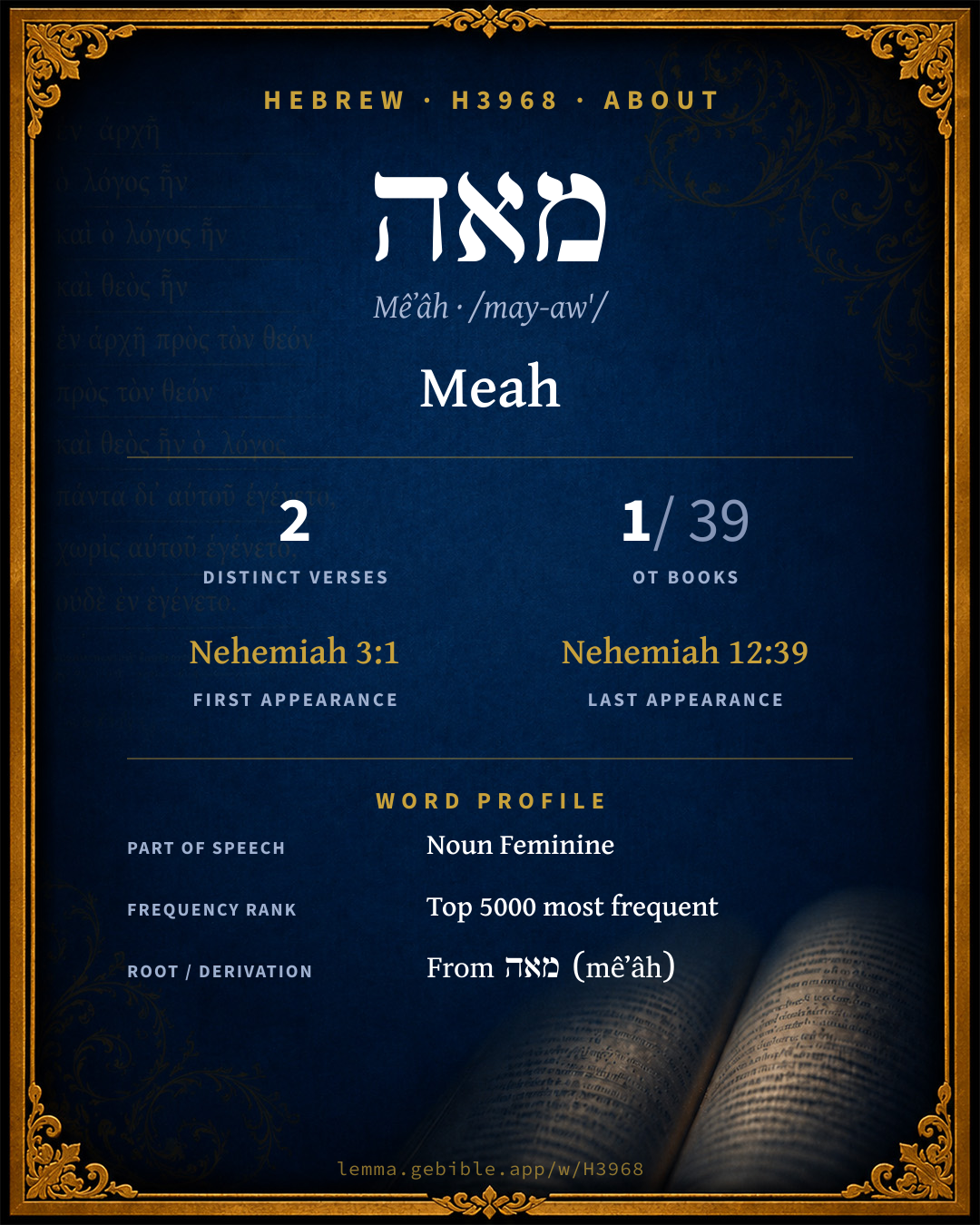
מֵאָה
Meah
BDB lists 2 entries for ‘Meah’ fuller range ↓
Full lexicon entry — Brown-Driver-Briggs (BDB)
From Brown-Driver-Briggs (BDB)
Where this word appears
Grammar key — what these labels mean
State
- Absolute
- The independent form of a noun, not bound to a following word.
Gender
- Both
- Attested as both masculine and feminine.
Number
- Singular
- One.
Every verse where H3968 appears — 2 distinct verses across 1 book. Click any verse to open its interlinear word-by-word view. Verse text shown in the World English Bible for context — . Each verse’s Hebrew form is shown with its reference; the English is not keyword-highlighted, since the data carries no word-level English alignment. Use “Compare translations” on any verse to read it across multiple English versions. This concordance covers the Hebrew Bible; Septuagint (Greek Old Testament) occurrences are not indexed here.
Nehemiah 2 verses
- Nehemiah 3:1 הַ/מֵּאָה֙ ptcl def.art + Adjective Cardinal number bs Then Eliashib the high priest rose up with his brothers the priests, and they built the sheep gate; they sanctified it, and set up the doors of it; even to the tower of Hammeah they sanctified it, to the tower of Hananel.
- Nehemiah 12:39 הַ/מֵּאָ֔ה ptcl def.art + Adjective Cardinal number bs and above the gate of Ephraim, and by the old gate, and by the fish gate, and the tower of Hananel, and the tower of Hammeah, even to the sheep gate: and they stood still in the gate of the guard.
About this entry
At a glance — auto-summarized from this page’s data, not written by a person. Every figure links to its source below. This summary describes the numbers; it doesn’t interpret them.
The Hebrew name מאה centers on the idea of “Meah.” The Hebrew Bible uses it only 2 verses. The word gravitates to Nehemiah (100%). Its earliest occurrence is Nehemiah 3:1. Dig into 2-verse concordance and the renderings breakdown below.
Gloss history
Strong's 1890 vs modern scholarship
About this word
Strong's H3968 catalogs a Hebrew word from the Hebrew Old Testament.
These counts are not copied from any lexicon or concordance. They are computed here, from the morphology-tagged Hebrew Old Testament. What Lemma adds →
- 2
- distinct verses
- The word appears in 2 distinct verses.
- 1 / 39
- OT books
- The word appears in 1 of 39 Old Testament books.
- #4,807
- by frequency
- Top 5000 most frequent Hebrew words (rank 4,807 of 8,640 Hebrew words by occurrence).
View all 2 occurrences in the concordance →
Most concentrated in
- Nehemiah 2 verses 100%
By section of the Old Testament
By traditional corpus
Conventional, traditional groupings — biblical authorship is debated, so this is a traditional corpus grouping, not an authorship claim. Each share is this word’s portion of its verses in that division of the Hebrew canon. Each figure is a share of the word’s 2 distinct verses.
- Writings (Ketuvim) 2 verses · 100%
How translations render this word
Counts come from each version’s own published word-to-Strong’s tagging or interlinear alignment — an approximate guide to how each version renders this word, not a word-level alignment the data otherwise carries. Because each total is that version’s own tagged count, the per-version totals vary from one another and need not match the appearance or distinct-verse counts above. These counts may also differ from a printed concordance because Lemma counts each distinctly tagged rendering and does not collapse phrase taggings into a single head-word total. This is a fixed set of word-tagged versions (KJV, ASV, BSB, ULT) and does not change with the reading translation you choose elsewhere. Each version’s license is shown beside its name below (and on Sources).
BDB lists this Strong’s number as 2 distinct words (homographs). Each count above pools all of them and is not split by sense — see the Senses section below. A low-frequency rendering may belong to a different one of those words, not the primary meaning.
- King James Version†: Meah 2×
- American Standard Version†: Hammeah 1×, Tower of hammeah 1×
- Berean Standard Bible†: Hundred 2×
- unfoldingWord Literal Text†: Hundred 2×
King James Version Public Domain
Renders H3968 across 2† tagged occurrences — most commonly:
American Standard Version Public Domain
Renders H3968 across 2† tagged occurrences — most commonly:
Berean Standard Bible Public Domain
Renders H3968 across 2† tagged occurrences — most commonly:
unfoldingWord Literal Text CC BY-SA 4.0
Renders H3968 across 2† tagged occurrences — most commonly:
9 senses and sub-senses in the full BDB
What do BDB’s symbols mean?
BDB uses these scholarly abbreviations:
| Symbol | Meaning |
|---|---|
| 𝔊 | the Septuagint (the ancient Greek translation, LXX) |
| 𝔙 | the Vulgate (the Latin translation) |
| 𝔖 | the Syriac version (the Peshitta) |
| 𝔗 | the Targum (the Aramaic translation) |
| ψ | the Psalms |
| √ | root (the underlying root or stem) |
| ‖ | parallel passage (a synonymous or contrasted parallel) |
| † | the dagger: every passage where the word occurs is cited |
The 9 senses and sub-senses the full Brown-Driver-Briggs lexicon distinguishes for this word, in lexicon order (not ranked by frequency), with BDB’s own verbatim wording and sub-sense lettering. Shown in Hebrew script with BDB’s own scholarly abbreviations. The condensed entry is in the Lexicon Entry tab. See also the Forms in the corpus table below.
מאה I hundred (NH id.
- 1. as simple number:
- a. abs. sg., (1) foll. by sg. of noun enumerated: מֵאָה קְשִׂיטָה Gn 33:19; Jos 24:32 (both E); מ׳ אִישׁ Ju 7:19; 1 K 18:13; 2 K 4:43; מ׳ אַמָּה 1 K 7:2; Ez 40:19 +; מ׳ כִּכָּר 2 K 23:33; 2 Ch 25:6; 27:5; 36:3; Ezr 8:26; מ׳ אֶלֶף = 100,000 1 K 20:29 + 6 times K Ch; cf. also Gn 17:17 (P), 2 S 8:4; Is 65:20;(×2), and sq. n. coll. רֶכֶב 2 S 8:4 = 1 Ch 18:4, צֹאן 1 K 5:3; (2) less often sq. pl. מֵאָה שְׁעָרִים Gn 26:12 (J), מ׳ פְּעָמִים 2 S 24:3 = 1 Ch 21:3, מ׳ נְבִיאִים 1 K 18:4, etc.; (3) seldom, and late, preceded by n.pl.: הָרִמֹּנִים מֵאָה Je 52:23, אַמּוֹת הַמֵּאָה Ez 42:2, cf. Ezr 2:69; 2 Ch 3:16; 4:8; 29:32; (4) exceptional is כְּלֵי כֶסֶף מֵאָה לְכִכָּרִים Ezr 8:26; also, with ellipsis, מֵאָה כֶסֶף Dt 22:19 (i.e. shekels); מֵאָה קַיִץ 2 S 16:1 (i.e. cakes); (5) מֵאָה without noun enumerated, especially = a hundred (men, persons) Ju 20:10(×2) Am 5:3(×2) Lv 26:8(×2) (H), 1 Ch 12:14; מ׳ Pr 17:10 = 100 (blows), Ec 6:3 = 100 (children), 8:12 = 100 (times).—On Ne 3:1; 12:39 v. infr. e.g. Genesis 33:19
- b. abs. du., (1) foll. by sg., מָאתַיִם אִישׁ 1 S 18:27; 30:10; 2 S 15:11, מ׳ לֶחֶם 1 S 25:18; 2 S 16:1, מ׳ צִנָּה 1 K 10:16 = 2 Ch 9:15, מ׳ אֶלֶף 1 S 15:4 +, מ׳ שָׁנָה Gn 11:23 (P); (2) less often sq. pl. מ׳ שְׁקָלִים Jos 7:21 (JE), 2 S 14:26, מ׳ דְּבֵלִים 1 S 25:18, מ׳ אֲנָשִׁים 1 S 30:21, cf. Ezr 8:4; (3) also preceded by n.pl.: עִזִּים מ׳ Gn 32:15, רְחֵלִים מ׳ v 15 (E), הָרִמּוֹנִים מ׳ 1 K 7:20, cf. 1 Ch 15:8; 2 Ch 29:32; Ezr 2:65; (4) c. ellipsis מ׳ כֶּסֶף Ju 17:4; (5) as pred., רָאשֵׁיהֶם מ׳ 1 Ch 12:32 (v 33 Van d. H.). e.g. 1 Samuel 18:27
- c. abs. pl. מֵא(וֹ)ת:—(1) alone, = hundreds, לְמֵאוֹת 1 S 29:2 by hundreds, so 2 S 18:4 (both + thousands); especially (הַ)מּ׳ שָׂרֵי captains of (the) hundreds Ex 18:21, 25 (E), 2 K 11:4, 9, 10, 15 +; (2) multiplied, sq. noun enumerated, in sg.: שְׁלשׁ מ׳ אִישׁ Ju 7:6 300 men, cf. v 7, 8, 16; 8:4 Ex 12:27 (E), etc.; אַרְבַּע מ׳ שָׁנָה Gn 15:13 (JE) 400 years; חֲמֵשׁ מ׳ אֶלֶף 2 S 24:9 500,000, cf. 2 Ch 13:17; שֵׁשׁ מ׳ רֶכֶב Ex 14:7 (J) 600 chariots; שְׁבַע מ׳ אִישׁ Ju 20:15, 16 700 men; שְׁמֹנֶה מ׳ חָלָל 2 S 23:8 800 slain; תְּשַׁע מ׳ רֶכֶב Ju 4:3, 13 900 chariots; (3) less often sq. n.pl.: שְׁלשׁ מ׳ שׁוּעָלִים Ju 15:4 300 foxes; חֲמֵשׁ מ׳ מֲתוֹנוֹת Jb 1:3 500 she-asses, etc.; (4) rare, and chiefly late, after n.pl. פִּלַגְשִׁים שְׁלשׁ מ׳ 1 K 11:3 300 concubines, cf. 7:42 = 2 Ch 4:13, 1 Ch 4:42; 2 Ch 14:8 etc.; after n.coll. בָּקָר חֲמֵשׁ מ׳ 2 Ch 35:9; (5) rare is חֲמֵשׁ מ׳ בַּשֶּׁקֶל Ex 30:24 (P); (6) ellipsis of n., שְׁלשׁ מ׳ כֶּסֶף Gn 45:22 (E), etc. e.g. 1 Samuel 29:2
- d. cstr. sg., only sq. sg., and late: מְאַת־שָׁנָה Gn 11:10; 21:5; 25:7 (all P) + 25 times P, 2 Ch 25:9; Est 1:4 (DrIntr. 124) (also c. other numerals, v. 2 infr.); מְאַ֖ת Ec 8:12 = 100 times (מֵאָה פְּעָמִים), sc. פַּעַם, or perhaps only appar. cstr. (Köii. 228 cf. Ew§ 269 b. 279 e).—Ne 5:11 v. 3 infr. e.g. Genesis 11:10
- 2. as part of larger number:
- a. usually preceding tens and units, (1) with noun expressed once, or not at all, earlier usage, usually c. וְ before ten if no unit follows, otherwise without וְ before ten (see Köii. 218 ff.); מֵאָה וְעֶשֶׂר שָׂרִים Ju 2:8; שֵׁשׁ מֵאוֹת שִׁשִּׁים וָשֵׁשׁ כִּכָּר 1 K 10:14 666 talents, etc. (exceptions are Ne 7:24 and v 31); (2) chiefly late, with noun and וְ repeated: מֵאָה שָׁנָה וְעֶשְׂרִים שָׁנָה וְשֶׁבַע שָׁנִים Gn 23:1 (P) (cf. ואלף אמה ומאת אמה SI 5, 6 DaExpos. Times, May, 1898). e.g. Judges 2:8
- b. less often, foll. tens and units, chiefly late, c. וְ repeated:—עֶשְׂרִים וּמֵאָה Nu 7:86 (P); שֶׁבַע וּשְׁלשִׁים וּמְאַת שָׁנָה Ex 6:16 (P), etc.; c. noun after ten and after hundred, חָמֵשׁ וְשִׁשִּׁים שָׁנָה וּשְׁלשׁ מֵאוֹת שָׁנָה Gn 5:23 (P), etc.—On these usages v., further, Köii. 217 ff. DaSynt. §§ 36 R. 3, 37 (d) Ges§§ 97, 134 and especially Herner Synt. d. Zahlwörter im AT (1893). e.g. Numbers 7:86
- 3. מְאַת הַכֶּסֶף Ne 5:11 = a hundredth part of the money; but read quite poss. מַשַּׁאת the debt (GeiJüd. Zeitschr. viii. 1870, 227 Gr.) e.g. Nehemiah 5:11
מאה II used as n.pr. of tower on northern wall of Jerus., מִגְדַּל הַמֵּאָה Ne 3
Senses from the full Brown-Driver-Briggs lexicon (Brown, Driver, Briggs; Oxford 1906 — public domain), digitized via Sefaria, supplemented by the OpenScriptures HebrewLexicon (CC BY 4.0). Full attribution on Sources.
Word origin
I. n.f. hundred (NH id.; MI 20 מאתן (du.); SI5 מאת, מאתים (du.); Ph. מאת, מאתם (du.); Assyrian mê (prob., Dl§ 75), TelAm. me-at WklTelAm. 20; Arabic مِاىَٔةٌ; Sab. מאת, מאתם OsZMG x. 1856, 49; CIS iv. i. 6, 4; 46, 6; מאה EutSin. 457; Ethiopic ምእት:; Aramaic מְאָה, ܡܳܐܐ; Palm. תלת מאה 300 VogPalm. 6, 4; Nab. מאה EutNab 8, 9);—מ׳ Gn 6:3 + 144 times; cstr. מְאַת 5:3 + 30 times (on מְאַת Ec 8:12 v. 1 d infr.); pl. abs. מֵאוֹת Gn 5:9 + 324 times (מֵאֹת only 5:4, 30); המאיות Kt 2 K 11:4 + 3 times 2 K 11; du. מָאתַיִם (-תָ֑יִם) Gn 11:19 + 76 times (but 1 S 18:27 read מֵאָה (מְאַת) 𝔊𝔊 We Dr Kit Bu HPS);—hundred:—
II. n.f. used as n.pr. of tower on northern wall of Jerus., מִגְדַּל הַמֵּאָה Ne 3:1; 12:39.
— Brown-Driver-Briggs (Oxford 1906, public domain), digitized via Sefaria, supplemented by the OpenScriptures HebrewLexicon (CC BY 4.0). See Sources.
Derived from מאה (mêʼâh) (H3967) — hundred.
Jastrow Dictionary
A second Hebrew/Aramaic lexicon for comparison, covering Aramaic and post-biblical (Talmudic, Targumic, Midrashic) usage that the biblical-Hebrew BDB does not. Matched by lemma rather than by Strong’s number, so a lemma may carry more than one Jastrow headword (shown separately below), and the entries cover usage well beyond the Bible.
מֵאָה
- (b. h.) one hundred. Tosef. Ber. VII (VI), 24 מ׳ מצות one hundred religious acts. Ib. 8; a. v. fr.—Pesik. Vattom., p. 131ᵇ מ׳ חסר שתים ninety-eight; a. fr.—Du. מָאתַיִם. Ex. R. s. 23; Mekh. B’shall., s. 6. Macc. I, 2. Keth. I, 2, v. כְּתוּבָּה; a. fr.—Pl. מֵאוֹת. Macc. 23ᵇ; a. fr.
מְאָה
- Targ. Gen. V, 3, sq.; a. fr.—Du. מָאתַיִן, מָאתָן. Ezra VI, 17.—Targ. Gen. XXXII, 15; a. fr.—Pl. מַאֲוָון. מָאוָן, מְאַוָותָא. Targ. II Sam. XVIII, 4 ed. Lag. (ed. מאתן; corr. acc.). Targ. I Sam. XXIX, 2.—Targ. O. Ex. XVIII, 21 מְאַוָתָא ed. Berl. (oth. ed. מַאֲוָ׳; Y. מַאֲוָו׳); a. fr.—Y. Kil. IX, 32ᵇ bot. תלת מ׳ צומין three hundred fasts; Y. Keth. XII, 35ᵃ bot. מאתן (corr. acc.). Y. Naz. V, end, 54ᵇ תלת מ׳ נזירין three hundred Nazarites; תשע מ׳ קרבנין nine hundred sacrifices; (Y. Ber. VII, 11ᵇ bot.; Gen. R. s. 91 תלת מאה, תשע מאה); a. fr. e.g. Ezra 6:17
A Dictionary of the Targumim, the Talmud Babli and Yerushalmi, and the Midrashic Literature (Marcus Jastrow; London, Luzac, 1903) — Public Domain. Digitized via Sefaria. Digitized via Sefaria. Full attribution on Sources.
Forms in the corpus
The 2 distinct written forms H3968 takes in the Hebrew Bible, most frequent first — each parse links to that state’s occurrences in the concordance. Hebrew forms include their vowel points and cantillation, so a single lemma takes many written forms.
| Form | Parsing | Example | Uses |
|---|---|---|---|
| הַ/מֵּאָ֔ה | Adjective, Cardinal number, Both, Singular, Absolute | Nehemiah 12:39 | 1 |
| הַ/מֵּאָה֙ | Adjective, Cardinal number, Both, Singular, Absolute | Nehemiah 3:1 | 1 |
Same root — word family
Other BDB entries built from the same root as H3968, grouped by Strong’s listed origin. These share a root / origin per the lexicon — not necessarily a shared meaning. Each links to that word’s own entry.
Derives from
Shares the same root
Compare all same-root words → They share a root, not necessarily a meaning.
Bible dictionary
Public-domain dictionary articles matched to this entry by name (Meah). A biblical name can be shared by more than one person or place, so an article may treat several.
Easton's Bible Dictionary · M. G. Easton, 1897
An hundred, a tower in Jersalem on the east wall (Neh. 3:1) in the time of Nehemiah.
Smith's Bible Dictionary · William Smith, 1863
(a hundred), The tower of, one of the towers of the wall of Jerusalem when rebuilt by Nehemiah, (Nehemiah 3:1; 12:39) appears to have been situated somewhere at the northeast part of the city, outside of the walls of Zion.
Hitchcock's Bible Names Dictionary · Roswell D. Hitchcock, 1869
a hundred cubits
Classic public-domain reference works; full attribution on Sources.