Exodus 38:9

Hebrew (Westminster Leningrad Codex) Exodus 38:9 appears in the Hebrew Old Testament. The text above is from the Westminster Leningrad Codex. Each word links to its Strong’s number, a concise gloss, and parsing drawn from the Open Scriptures Hebrew Bible morphology. Click any word for its full Brown-Driver-Briggs (BDB) entry.
Download image
Cite this verse

Exodus 38:9 (World English Bible). Public Domain. Lemma interlinear Bible study tool, https://lemma.gebible.app/v/exodus/38/9.

Show BibTeX & RIS
BibTeX
RIS
English Translation
He made the court: for the south side southward the hangings of the court were of fine twined linen, one hundred cubits;
World English Bible · Public Domain
Download a study sheet

One document with this verse’s original text, its word-by-word gloss line, the meaning frame, cross-references with their text, attributed commentary, and full source and license credits — printable, and it pastes into notes with its structure intact.

This verse Autodidact and up

Study sheet (.html) Plain text (.txt)

A passage Seminary Student

Up to 50 verses in one chapter. A passage sheet keeps up to 6 commentary sources and 12 cross-references per verse, in the order this page ranks them, and says so on the sheet whenever that leaves anything out. Ask for a single verse and you get the Autodidact verse sheet above.

Everything on this page stays free to read, with no account — the sheet is a download of what is already on screen, not access to it.

Want to remove ads? Support Godless Engineer
Compare translations 3

The same verse in 3 English versions, stacked beneath the original-language interlinear above. Click any original word for its lexicon entry.

Each is an independent rendering of the whole verse — the interlinear is not word-aligned to these translations.

Highlighted words mark where these versions differ — a whole-verse word diff, not a word-by-word alignment.

  • World English Bible Public Domain
    He made the court: for the south side southward the hangings of the court were of fine twined linen, one hundred cubits;
  • King James Version Public Domain
    And he made the court: on the south side southward the hangings of the court were of fine twined linen, an hundred cubits:
  • unfoldingWord Literal Text CC BY-SA 4.0
    And he made the courtyard. For the south side, the curtains of the courtyard 100 cubits of fine twisted linen,

unfoldingWord Literal Text — © unfoldingWord, licensed CC BY-SA 4.0. Word-aligned USFM3 via Door43 (git.door43.org/unfoldingWord/en_ult).

Versions to compare (up to 4)

3 of 4 selected

Show all 18 translations

Every available English version of this verse, each an independent rendering of the whole verse.

  • World English Bible Public Domain
    He made the court: for the south side southward the hangings of the court were of fine twined linen, one hundred cubits;
  • Berean Standard Bible Public Domain
    Then he constructed the courtyard. The south side of the courtyard was a hundred cubits long and had curtains of finely spun linen,
  • Majority Standard Bible Public Domain
    Then he constructed the courtyard. The south side of the courtyard was a hundred cubits long and had curtains of finely spun linen,
  • King James Version Public Domain
    And he made the court: on the south side southward the hangings of the court were of fine twined linen, an hundred cubits:
  • American Standard Version (1901) Public Domain
    And he made the court: for the south side southward the hangings of the court were of fine twined linen, a hundred cubits;
  • Revised Version (1885) Public Domain
    And he made the court: for the south side southward the hangings of the court were of fine twined linen, an hundred cubits:
  • Geneva Bible (1599) Public Domain
    Finally he made the court on the South side full South: the hangings of the court were of fine twined linnen, hauing an hundreth cubites.
  • Douay-Rheims (1899) Public Domain
    He made also the court, in the south side whereof were hangings of fine twisted linen, of a hundred cubits,
  • Young's Literal Translation Public Domain
    And he maketh the court; at the south side southward, the hangings of the court of twined linen, a hundred by the cubit,
  • Literal Standard Version CC BY-SA 4.0
    And he makes the court: at the south side southward, the hangings of the court of twined linen, one hundred by the cubit,
  • Unlocked Literal Bible CC BY-SA 4.0
    He also made the courtyard. The hangings on the south side of the courtyard were of fine linen, one hundred cubits long.
  • unfoldingWord Literal Text CC BY-SA 4.0
    And he made the courtyard. For the south side, the curtains of the courtyard 100 cubits of fine twisted linen,
  • Darby Bible Public Domain
    And he made the court. On the south side southward, the hangings of the court were of twined byssus, a hundred cubits;
  • World Messianic Bible Public Domain
    He made the court: for the south side southward the hangings of the court were of fine twined linen, one hundred cubits;
  • Webster's Bible Public Domain
    And he made the court: on the south side southward the hangings of the court were of fine twined linen, a hundred cubits:
  • Free Bible Version CC BY-SA 4.0
    Then he made a courtyard. For the south side of the courtyard he made curtains of finely-spun linen, a hundred cubits long on one side,
  • Bible in Basic English Public Domain
    To make the open space, he put hangings on the south side, of the best linen, a hundred cubits long:
  • JPS Tanakh (1917) Public Domain
    And he made the court; for the south side southward the hangings of the court were of fine twined linen, a hundred cubits.

Literal Standard Version (2020), Covenant Press — licensed CC BY-SA 4.0. Text via the HelloAO Bible API (eBible.org). Unlocked Literal Bible (unfoldingWord) — licensed CC BY-SA 4.0. Text via the HelloAO Bible API (eBible.org). unfoldingWord Literal Text — © unfoldingWord, licensed CC BY-SA 4.0. Word-aligned USFM3 via Door43 (git.door43.org/unfoldingWord/en_ult). Free Bible Version, Dr. Jonathan Gallagher — licensed CC BY-SA 4.0. Text via the HelloAO Bible API (eBible.org).

Word by word

More ways to search: Search by grammar → Find every occurrence → Compare this word →

Practice this passage: Drill this verse → Learn its vocabulary →

מָשְׁזָ֔ר
shâzar
H7806
“twisted”
Verb, Hophal, Participle Passive, Masculine, Singular, Absolute
Part of Speech
Verb
Stem
Hophal
Form
Participle Passive
Gender
Masculine
Number
Singular
State
Absolute
Full BDB Definition

Origin: a primitive root

TWOT: 2358

to twist, be twisted - (Hophal) - to be twisted - twisted (participle)
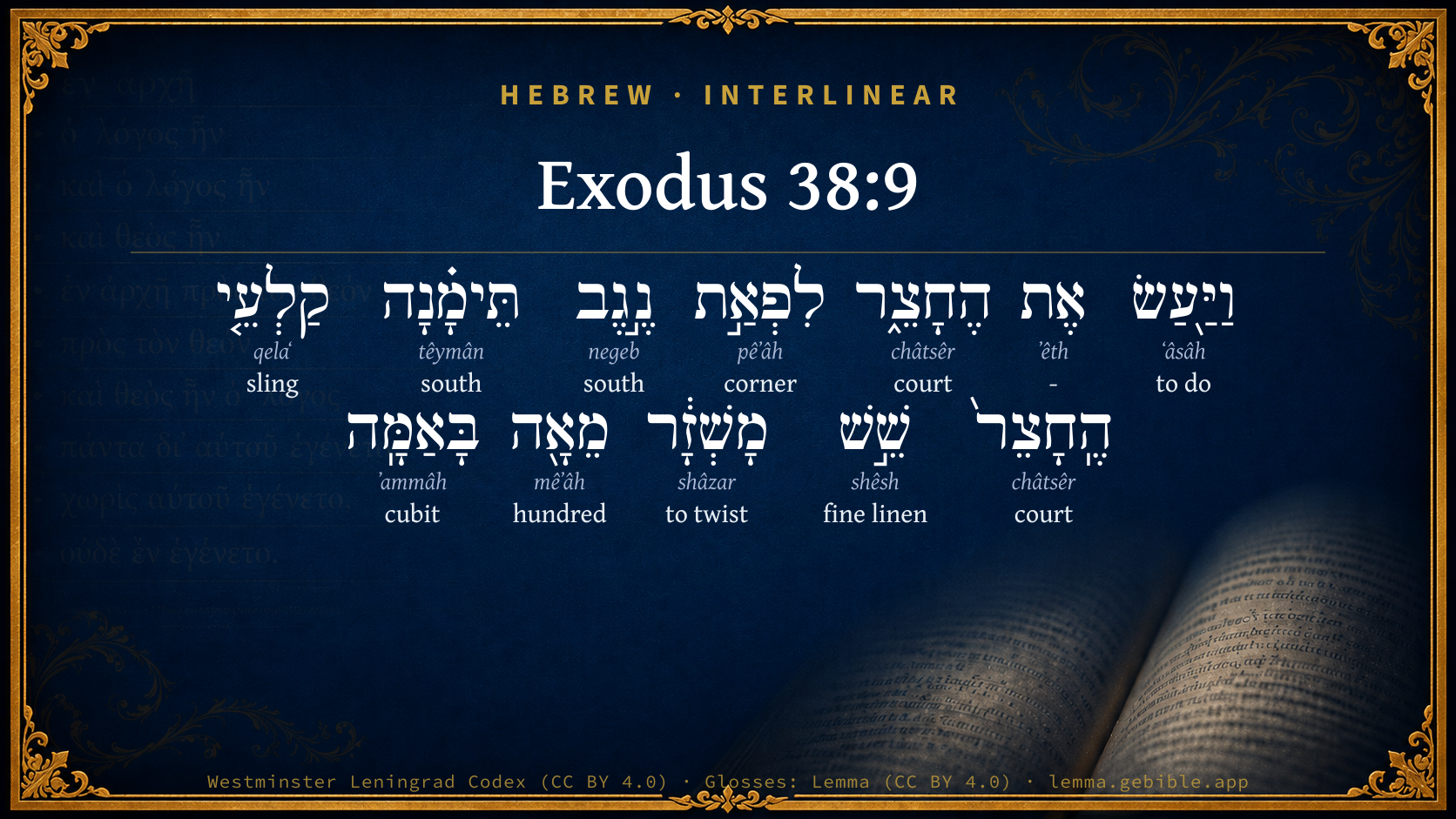
  1. וַיַּ֖עַשׂ ʻâsâh H6213 “and · to do” Conjunction + Verb, Qal, Sequential Imperfect, 3rd Person, Masculine, Singular
  2. אֶת ʼêth H853 “-” Particle, Direct Object
  3. הֶחָצֵ֑ר châtsêr H2691 “the · court” Particle, Definite Article + Noun, Common, Both, Singular, Absolute
  4. לִפְאַ֣ת pêʼâh H6285 “to/for · corner of” Preposition + Noun, Common, Feminine, Singular, Construct
  5. נֶ֣גֶב negeb H5045 “south” Noun, Common, Masculine, Singular, Absolute
  6. תֵּימָ֗נָה têymân H8486 “south · toward” Noun, Common, Feminine, Singular, Absolute + Suffix, Demonstrative
  7. קַלְעֵ֤י qelaʻ H7050 “slings of” Noun, Common, Masculine, Plural, Construct
  8. הֶֽחָצֵר֙ châtsêr H2691 “the · court” Particle, Definite Article + Noun, Common, Both, Singular, Absolute
  9. שֵׁ֣שׁ shêsh H8336 “fine linen” Adjective, Cardinal number, Feminine, Singular, Absolute
  10. מֵאָ֖ה mêʼâh H3967 “hundred” Adjective, Cardinal number, Both, Singular, Absolute
  11. בָּאַמָּֽה ʼammâh H520 “in/at the · cubit” Preposition, Determined + Noun, Common, Feminine, Singular, Absolute

About this verse

These counts appear in no published source. They are computed here, from the morphology-tagged text and Lemma’s own curated glosses. What Lemma adds →

12
words
11
distinct lemmas
Pentateuch
section

Notable vocabulary

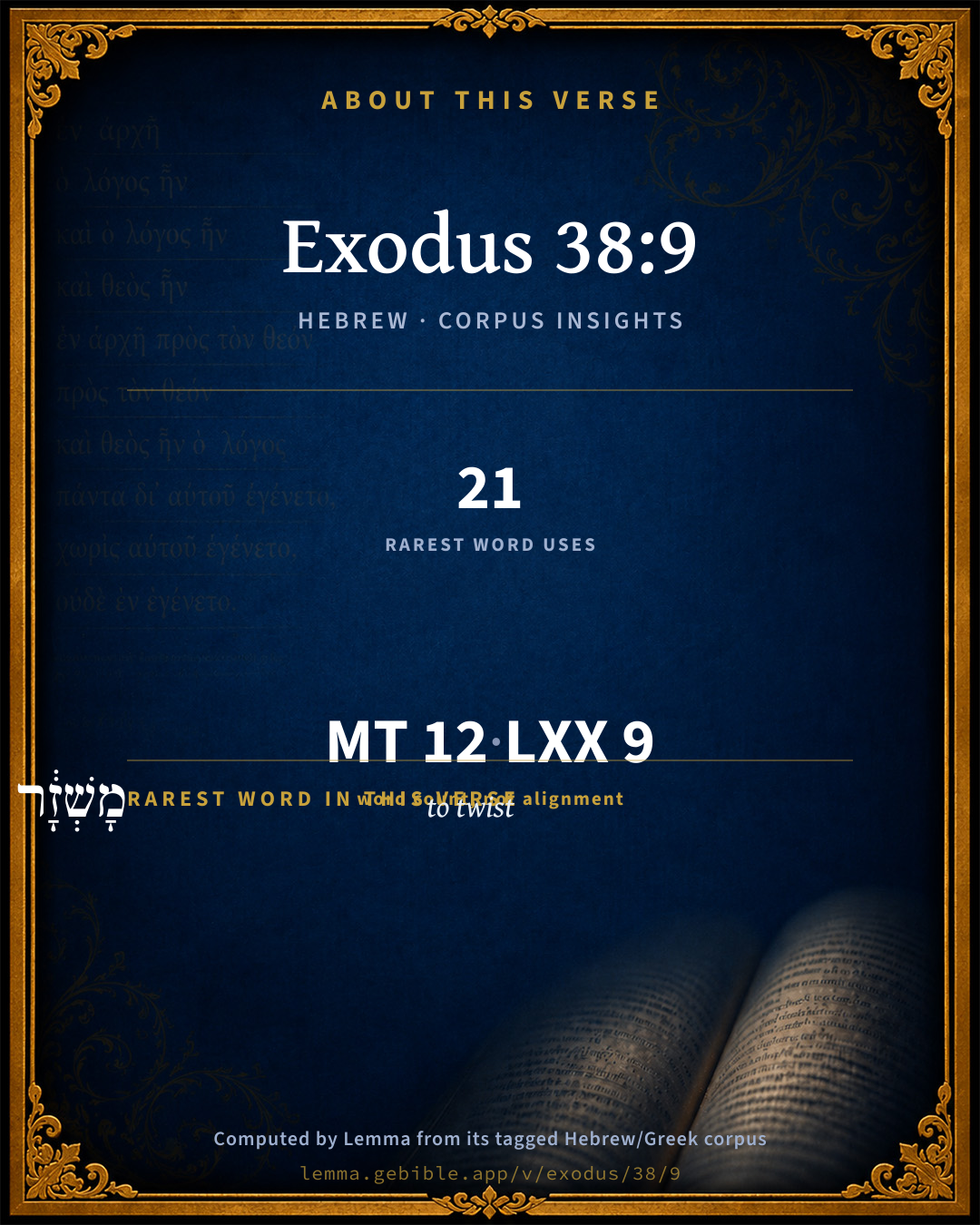
The rarest word here is מָשְׁזָ֔ר to twist H7806 — appearing just 21 times in the whole Hebrew Bible.

Shared distinctive vocabulary

מָשְׁזָ֔ר to twist H7806 occurs in 21 verses of the Hebrew Bible. Also found in:

Grammatical profile

  • 2 verbs
  • 7 nouns
  • 2 adjectives
  • 1 particle

Verb forms

  • וַיַּ֖עַשׂ Qal · Sequential Imperfect
  • מָשְׁזָ֔ר Hophal · Participle Passive

Repetition

A word recurs within this verse — often emphatic in Hebrew:

  • הֶחָצֵ֑ר court H2691 ×2

Hebrew & Septuagint length

In English translation the verse runs 22 words from the Hebrew and 9 from the Septuagint (LXX English) — the Septuagint runs noticeably shorter here. See the side-by-side →

A rough comparison of the two English renderings, which tokenize alike — not a word-level alignment.

Word counts can differ between the Hebrew and the Greek without any difference in meaning — e.g. the Hebrew direct-object marker אֵת has no separate Greek word, and Greek often adds the article ὁ.

In the original languages it is 12 Hebrew tokens and 9 Greek tokens — but the two are counted differently (Hebrew bundles its prefixes and suffixes into one token; the Greek is in lemma form), so that isn’t a like-for-like length.

Cross-references

9

Topical passages linked to Exodus 38:9 in the Treasury of Scripture Knowledge — connected by theme and wording, ordered by reader-vote popularity; previews shown in the World English Bible.

  • Exodus 27:9–19 "You shall make the court of the tent: for the south side southward there shall be hangings for the court of fine twined linen one hundred cubits long for one side:
  • Psalms 89:7 A very awesome God in the council of the holy ones, To be feared above all those who are around him?
  • Exodus 40:8 You shall set up the court around it, and hang up the screen of the gate of the court.
  • Exodus 40:33 He raised up the court around the tent and the altar, and set up the screen of the gate of the court. So Moses finished the work.
  • 1 Kings 6:36 He built the inner court with three courses of hewn stone, and a course of cedar beams.
  • Psalms 84:2 My soul longs, and even faints for the courts of Yahweh. My heart and my flesh cry out for the living God.
  • Psalms 84:10 For a day in your courts is better than a thousand. I would rather be a doorkeeper in the house of my God, Than to dwell in the tents of wickedness.
  • Psalms 92:13 They are planted in Yahweh's house. They will flourish in our God's courts.
  • Psalms 100:4 Enter into his gates with thanksgiving, Into his courts with praise. Give thanks to him, and bless his name.

Cross-references courtesy of OpenBible.info (CC BY 4.0).

Hebrew and Greek witnesses Masoretic Hebrew ↔ Greek Septuagint

The same verse in the two great witnesses to the Old Testament, shown verse-for-verse.

Here the Septuagint runs noticeably shorter than the Hebrew — LXX2012 (modern English Septuagint) 9 words vs World English Bible 22. A rough length comparison of the two English translations, not a word-level alignment — read both below.

These are two independent witnesses, not word-aligned to each other, and the Septuagint is shown in lemma (dictionary) form.

Hebrew Exodus 38:9 Masoretic · Westminster Leningrad Codex

וַיַּ֖עַשׂ אֶת הֶחָצֵ֑ר לִפְאַ֣ת נֶ֣גֶב תֵּימָ֗נָה קַלְעֵ֤י הֶֽחָצֵר֙ שֵׁ֣שׁ מָשְׁזָ֔ר מֵאָ֖ה בָּאַמָּֽה

He made the court: for the south side southward the hangings of the court were of fine twined linen, one hundred cubits;

World English Bible · Public Domain

Greek LXX Exodus 38:9 Septuagint · lemma form

καί ποιέω ὁ τράπεζα ὁ προκεῖμαι ἐκ χρυσίον καθαρός

And he made the set table of pure gold,

LXX2012 (modern English Septuagint) · Public Domain

Hebrew: Westminster Leningrad Codex (CC BY 4.0). Greek: Septuagint (public domain); English from LXX2012 (modern English Septuagint) (Public Domain). How the Septuagint differs from the Hebrew →

Targum (Aramaic paraphrase)

2

The Targum is the ancient Jewish Aramaic paraphrase of the Hebrew Scriptures — an interpretive translation, not the Hebrew text itself. Onkelos (literal) and Pseudo-Jonathan (expansive) render the Torah, and Jonathan the Prophets. Coverage is partial: where no permissively-licensed English translation exists for a verse, only the Aramaic is shown. This is verse-level text, not a word-by-word alignment to the Hebrew.

  1. Targum Onkelos Torah (Genesis–Deuteronomy)
    וַעֲבַד יָת דַרְתָּא לְרוּחַ עֵבַר דָרוֹמָא סְרָדֵי דַרְתָּא דְבוּץ שְׁזִיר מְאָה בְאַמִין:

    (no public-domain English translation for this verse)

    Targum Onkelos — Aramaic: “Onkelos Genesis” (public domain); “Onkelos Exodus” (public domain); “Onkelos Leviticus” (public domain); “Onkelos Numbers” (public domain); “Onkelos Deuteronomy” (public domain). English: “Sefaria Community Translation” (CC0 1.0 (public-domain dedication)); “J.W. Etheridge. The Targums of Onkelos and Jonathan Ben Uzziel on the Pentateuch. London: Longmans, Green, 1862” (public domain). Text via Sefaria.

  2. Targum Pseudo-Jonathan Torah (Genesis–Deuteronomy)
    וַעֲבַד יַת דָּרְתָא לְרוּחַ עִיבַר דָּרוֹמָא וִילַוֵי דָרְתָא דְבוּץ שְׁזִיר מְאָה אַמִּין

    And he made the court; on the southern side, the curtains of the court (made he) with fine linen, a hundred cubits,

    Targum Pseudo-Jonathan — Aramaic: “Targum Jonathan on Genesis” (public domain); “Targum Jonathan on Exodus” (public domain); “Targum Jonathan on Leviticus” (public domain); “Targum Jonathan on Numbers” (public domain); “Targum Jonathan on Deuteronomy” (public domain). English: “The Targum of Jonathan ben Uzziel, trans. J. W. Etheridge, London, 1862” (public domain). Text via Sefaria.

Commentary

Notes on Exodus 38:9 from classic Christian and Jewish commentators (each source and its license shown beneath its notes). The classic Christian expositions comment on the surrounding passage and are grouped to its opening verse, so a note may address several verses; the Jewish commentaries on the Tanakh (Rashi and others) are per-verse, so they appear only where the commentator wrote on this verse.

Lemma curates 59 commentaries, every one of them public domain or Creative Commons licensed, each selected and text-cleaned for this edition rather than reprinted as found. About our sources →

Joseph Benson's Commentary

Exo 38:9. He made the court — The inner utensils of the court being thus completed, they proceeded to make the court itself, which was a large oblong square, fenced in with thick, well-wrought hangings; the size, dimensions, and workmanship of each side whereof have been described in Exo 27:9-19. This court represented the state of the Old Testament church; it was a garden enclosed; the worshippers were then confined to a little compass. But the enclosure being of curtains only, intimated that that confinement of the church to one particular nation was not to be perpetual. The dispensation itself was a tabernacle dispensation, moveable and mutable, and in due time to be taken down and folded up, when the place of the tent should be enlarged, and its cords lengthened, to make room for the Gentile world.

Joseph Benson's Commentary on the Old and New Testaments (1811–1818) — public domain. Text from a community e-Sword module.

unfoldingWord translationNotes

Door43 World Missions Community

General Information:

Bezalel's work crew continues to build the tabernacle and furniture.

He also made ... as well as silver rods

For Exo 38:9-10 see how you translated many of these words in Exodus 27:9-10.

one hundred ... twenty

"100 ... 20" (See: Numbers)

cubits

A cubit is 46 centimeters. (See: Biblical Distance)

translationWords

court

bronze

silver

unfoldingWord translationNotes — © Distant Shores Media and the Door43 World Missions Community, licensed CC BY-SA 4.0. Source: git.door43.org/Door43/en_tn.

Matthew Henry's Commentary

The walls of the court, or church-yard, were like the rest curtains or hangings, made according to the appointment, Exo 27:9, etc. This represented the state of the Old Testament church: it was a garden enclosed; the worshippers were then confined to a little compass. But the enclosure being of curtains only intimated that the confinement of the church in one particular nation was not to be perpetual. The dispensation itself was a tabernacle-dispensation, movable and mutable, and in due time to be taken down and folded up, when the place of the tent should be enlarged and its cords lengthened, to make room for the Gentile world, as is foretold, Isa 54:2, Isa 54:3. The church here on earth is but the court of God's house, and happy they that tread these courts and flourish in them; but through these courts we are passing to the holy place above. Blessed are those that dwell in that house of God: they well be still praising him. The enclosing of a court before the tabernacle teaches us a gradual approach to God. The priests that ministered must pass through the holy court, before they entered the holy house. Thus before solemn ordinances there ought to be the separated and enclosed court of a solemn preparation, in which we must wash our hands, and so draw near with a true heart.

Matthew Henry's Commentary on the Whole Bible (1708–1710) — public domain (CC PDM 1.0). Text via the HelloAO Bible API.

Jamieson, Fausset & Brown

Robert Jamieson, A. R. Fausset & David Brown

the court--It occupied a space of one hundred and fifty feet by seventy-five, and it was enclosed by curtains of fine linen about eight feet high, suspended on brazen or copper pillars. Those curtains were secured by rods fastened to the top, and kept extended by being fastened to pins stuck in the ground.

Jamieson, Fausset & Brown — Commentary Critical and Explanatory on the Whole Bible (1871) — public domain (CC PDM 1.0). Text via the HelloAO Bible API.

Adam Clarke's Commentary

Verse 9. The court] See Clarke on Ex 27:9.

Adam Clarke's Commentary on the Bible (1810–1826) — public domain. Text from a community e-Sword/MySword module.

Ellicott's Commentary for English Readers

(9-20) The construction of the court follows upon that of the furniture which it contained. The passage runs parallel with Exo_27:9-19.

A Bible Commentary for English Readers, edited by Charles John Ellicott (1878–1897) — public domain. Text from a community e-Sword module.

The Cambridge Bible for Schools and Colleges

gen. ed. J. J. S. Perowne

9–20 (Exo_27:9-19). The Court of the Tent of Meeting. In vv. 16–19 the text (Exo_27:16-18) is reproduced with greater freedom than usual.

The Cambridge Bible for Schools and Colleges (gen. ed. J. J. S. Perowne; Cambridge University Press, 1878–1918) — public domain. Text from a community e-Sword module.

John Gill's Exposition

And Bezaleel the son of Uri, the son of Hur, of the tribe of Judah,.... Of whom and his descent see Exo 31:2.

made all that the Lord commanded Moses; gave directions about them, and took care that the tabernacle and all things belonging to it were made, which the Lord commanded Moses, and in the exact manner in which they were ordered to be made.

John Gill's Exposition of the Whole Bible (1746–1763) — public domain (CC PDM 1.0). Text via the HelloAO Bible API.

John Wesley's Explanatory Notes

And he made the court - The walls of the court, were like the rest, curtains, or hangings. This represented the state of the Old Testament church, it was a garden enclosed; the worshippers were then confined to a little compass. But the inclosure being of curtains only, intimated that that confinement of the church to one particular nation was not to be perpetual. The dispensation itself was a tabernacle-dispensation, moveable and mutable, and in due time to be taken down and folded up, when the place of the tent should be enlarged, and its cords lengthened, to make room for the Gentile world.

John Wesley, Explanatory Notes Upon the Whole Bible (1754–1765) — public domain. Text via the GEBible commentary corpus.

Kretzmann's Popular Commentary

Paul E. Kretzmann

The Great EnclosuRev. 9. And he made the court; on the south side southward the hangings of the court were of fine twined linen, curtains of byssus, an hundred cubits;

v. 10. their pillars were twenty, and their brazen sockets twenty; the hooks of the pillars and their fillets were of silver. While the posts themselves were of bronze, the hooks and the connecting rods from which the curtains were suspended were of silver.

v. 11. And for the north side the hangings were an hundred cubits, their pillars were twenty, and their sockets of brass twenty; the hooks of the pillars and their fillets of silver.

v. 12. And for the west side, in the rear of the Tabernacle, were hangings of fifty cubits, their pillars ten, and their sockets ten; the hooks of the pillars and their fillets of silver.

v. 13. And for the east side eastward fifty cubits.

v. 14. The hangings of the one side of the gate were fifteen cubits; their pillars three, and their sockets three.

v. 15. And for the other side of the court gate, the large entrance to the sacred enclosure, on this hand and that hand, were hangings of fifteen cubits; their pillars three and their sockets three. This section of the enclosure toward the east was just like the curtains on the north, south, and west sides.

v. 16. All the hangings of the court round about were of fine twined linen.

v. 17. And the sockets for the pillars, the bases, were of brass, the hooks of the pillars and their fillets of silver, and the overlaying of their chapiters, the capitals of the posts only, of silver; and all the pillars of the court were filleted with silver, their connecting rods were made of silver.

v. 18. And the hanging for the gate of the court was needlework, woven in geometrical figures like the screen before the Holy Place, of blue, and purple, and scarlet, and fine twined linen; and twenty cubits was the length of this curtain, for that was the width of the gate, and the height in the breadth was five cubits, answerable to, agreeing with, the hangings of the court.

v. 19. And their pillars were four and their sockets of brass four; their hooks of silver and the overlaying of their chapiters and their fillets of silver.

v. 20. And all the pins of the Tabernacle and of the court round about were of brass, the pegs for holding the guy-ropes. Cf Exo 27:9-19.

Paul E. Kretzmann, Popular Commentary of the Bible (1921–1924) — public domain. Text from a community e-Sword module.

Lesson kit

Teaching starters — assembled from the data on this page, not authored interpretation. Every prompt links to the verse data it draws on. Edit before teaching.

Exodus, in the Pentateuch, opens this verse with 12 words (11 distinct Hebrew lemmas). Its most distinctive word is shâzar (“to twist”). The Greek Septuagint runs shorter here. A historical commentator’s framing appears above. Read the whole chapter for the surrounding context.

Discussion questions

  1. What does “to twist” (shâzar) contribute to the verse as a whole?
  2. Exodus 26:1 shares the word «to twist» with this verse. How do the two illuminate each other?
  3. “court” occurs 2× in this one verse. What is the effect of the repetition?
  4. Compared with the Hebrew, the Septuagint runs shorter here. What questions does that raise?
  5. These translations render this verse differently; the difference is in the English rendering, not the original. What questions does that raise?
  6. The verb «וַיַּ֖עַשׂ» is Qal Sequential Imperfect. How does its form color the action?
  7. Reading how Joseph Benson's Commentary and unfoldingWord translationNotes read this verse, where do the two commentators agree and where do they part?

Things to notice

Reading settings

Reading text

Shown beneath each verse's original-language words.

Old Testament
Old Testament edition

Read the OT as the Masoretic Hebrew (MT) or the Greek Septuagint (LXX).

English shown for the Greek Septuagint (in the Hebrew ↔ Greek comparison).

Comparing translations? Open the Compare panel on any verse page to stack up to four side by side.