2 Chronicles 3:16

Hebrew (Westminster Leningrad Codex) 2 Chronicles 3:16 appears in the Hebrew Old Testament. The text above is from the Westminster Leningrad Codex. Each word links to its Strong’s number, a concise gloss, and parsing drawn from the Open Scriptures Hebrew Bible morphology. Click any word for its full Brown-Driver-Briggs (BDB) entry.
Download image
Cite this verse

2 Chronicles 3:16 (World English Bible). Public Domain. Lemma interlinear Bible study tool, https://lemma.gebible.app/v/2-chronicles/3/16.

Show BibTeX & RIS
BibTeX
RIS
English Translation
He made chains in the oracle, and put [them] on the tops of the pillars; and he made one hundred pomegranates, and put them on the chains.
World English Bible · Public Domain
Download a study sheet

One document with this verse’s original text, its word-by-word gloss line, the meaning frame, cross-references with their text, attributed commentary, and full source and license credits — printable, and it pastes into notes with its structure intact.

This verse Autodidact and up

Study sheet (.html) Plain text (.txt)

A passage Seminary Student

Up to 50 verses in one chapter. A passage sheet keeps up to 6 commentary sources and 12 cross-references per verse, in the order this page ranks them, and says so on the sheet whenever that leaves anything out. Ask for a single verse and you get the Autodidact verse sheet above.

Everything on this page stays free to read, with no account — the sheet is a download of what is already on screen, not access to it.

Want to remove ads? Support Godless Engineer
Compare translations 3

The same verse in 3 English versions, stacked beneath the original-language interlinear above. Click any original word for its lexicon entry.

Each is an independent rendering of the whole verse — the interlinear is not word-aligned to these translations.

Highlighted words mark where these versions differ — a whole-verse word diff, not a word-by-word alignment.

  • World English Bible Public Domain
    He made chains in the oracle, and put [them] on the tops of the pillars; and he made one hundred pomegranates, and put them on the chains.
  • King James Version Public Domain
    And he made chains, as in the oracle, and put them on the heads of the pillars; and made an hundred pomegranates, and put them on the chains.
  • unfoldingWord Literal Text CC BY-SA 4.0
    And he made chains in the inner sanctuary, and he placed on the head of the pillars; and he made 100 pomegranates and he placed on the chains.

unfoldingWord Literal Text — © unfoldingWord, licensed CC BY-SA 4.0. Word-aligned USFM3 via Door43 (git.door43.org/unfoldingWord/en_ult).

Versions to compare (up to 4)

3 of 4 selected

Show all 18 translations

Every available English version of this verse, each an independent rendering of the whole verse.

  • World English Bible Public Domain
    He made chains in the oracle, and put [them] on the tops of the pillars; and he made one hundred pomegranates, and put them on the chains.
  • Berean Standard Bible Public Domain
    He made interwoven chains and put them on top of the pillars. He made a hundred pomegranates and fastened them into the chainwork.
  • Majority Standard Bible Public Domain
    He made interwoven chains and put them on top of the pillars. He made a hundred pomegranates and fastened them into the chainwork.
  • King James Version Public Domain
    And he made chains, as in the oracle, and put them on the heads of the pillars; and made an hundred pomegranates, and put them on the chains.
  • American Standard Version (1901) Public Domain
    And he made chains in the oracle, and put `them' on the tops of the pillars; and he made a hundred pomegranates, and put them on the chains.
  • Revised Version (1885) Public Domain
    And he made chains in the oracle, and put them on the tops of the pillars; and he made an hundred pomegranates, and put them on the chains.
  • Geneva Bible (1599) Public Domain
    He made also chaines for the oracle, and put them on the heads of the pillars, and made an hundreth pomegranates, and put them among the chaines.
  • Douay-Rheims (1899) Public Domain
    He made also as it were little chains in the oracle, and he put them on the heads of the pillars: and a hundred pomegranates, which he put between the little chains.
  • Young's Literal Translation Public Domain
    And he maketh chains in the oracle, and putteth on the heads of the pillars, and maketh a hundred pomegranates, and putteth on the chains.
  • Literal Standard Version CC BY-SA 4.0
    And he makes chains in the oracle, and puts [them] on the heads of the pillars, and makes one hundred pomegranates, and puts [them] on the chains.
  • Unlocked Literal Bible CC BY-SA 4.0
    He made chains for the pillars and put them on top of them; he also made one hundred pomegranates and joined them to the chains.
  • unfoldingWord Literal Text CC BY-SA 4.0
    And he made chains in the inner sanctuary, and he placed on the head of the pillars; and he made 100 pomegranates and he placed on the chains.
  • Darby Bible Public Domain
    And he made chains [as] in the oracle, and he put them on the top of the pillars; and he made a hundred pomegranates, and put them on the chains.
  • World Messianic Bible Public Domain
    He made chains in the inner sanctuary, and put them on the tops of the pillars; and he made one hundred pomegranates, and put them on the chains.
  • Webster's Bible Public Domain
    And he made chains, as in the oracle, and put them on the heads of the pillars; and made a hundred pomegranates, and put them on the chains.
  • Free Bible Version CC BY-SA 4.0
    He made chains like in the Most Holy Place and he placed them on top of the columns. He also made one hundred ornamental pomegranates and attached them to each chain.
  • Bible in Basic English Public Domain
    And he made chains, like neck ornaments, and put them on the tops of the pillars, and a hundred apples on the chains.
  • JPS Tanakh (1917) Public Domain
    And he made chains in the Sanctuary, and put them on the tops of the pillars; and he made a hundred pomegranates, and put them on the chains.

Literal Standard Version (2020), Covenant Press — licensed CC BY-SA 4.0. Text via the HelloAO Bible API (eBible.org). Unlocked Literal Bible (unfoldingWord) — licensed CC BY-SA 4.0. Text via the HelloAO Bible API (eBible.org). unfoldingWord Literal Text — © unfoldingWord, licensed CC BY-SA 4.0. Word-aligned USFM3 via Door43 (git.door43.org/unfoldingWord/en_ult). Free Bible Version, Dr. Jonathan Gallagher — licensed CC BY-SA 4.0. Text via the HelloAO Bible API (eBible.org).

Word by word

More ways to search: Search by grammar → Find every occurrence → Compare this word →

Practice this passage: Drill this verse → Learn its vocabulary →

שַׁרְשְׁרוֹת֙
sharshᵉrâh
H8333
“chains”
Noun, Common, Feminine, Plural, Absolute
Part of Speech
Noun
Type
Common
Gender
Feminine
Number
Plural
State
Absolute
Full BDB Definition

Origin: from H8327 [compare H8331 ]

TWOT: 2470

chain
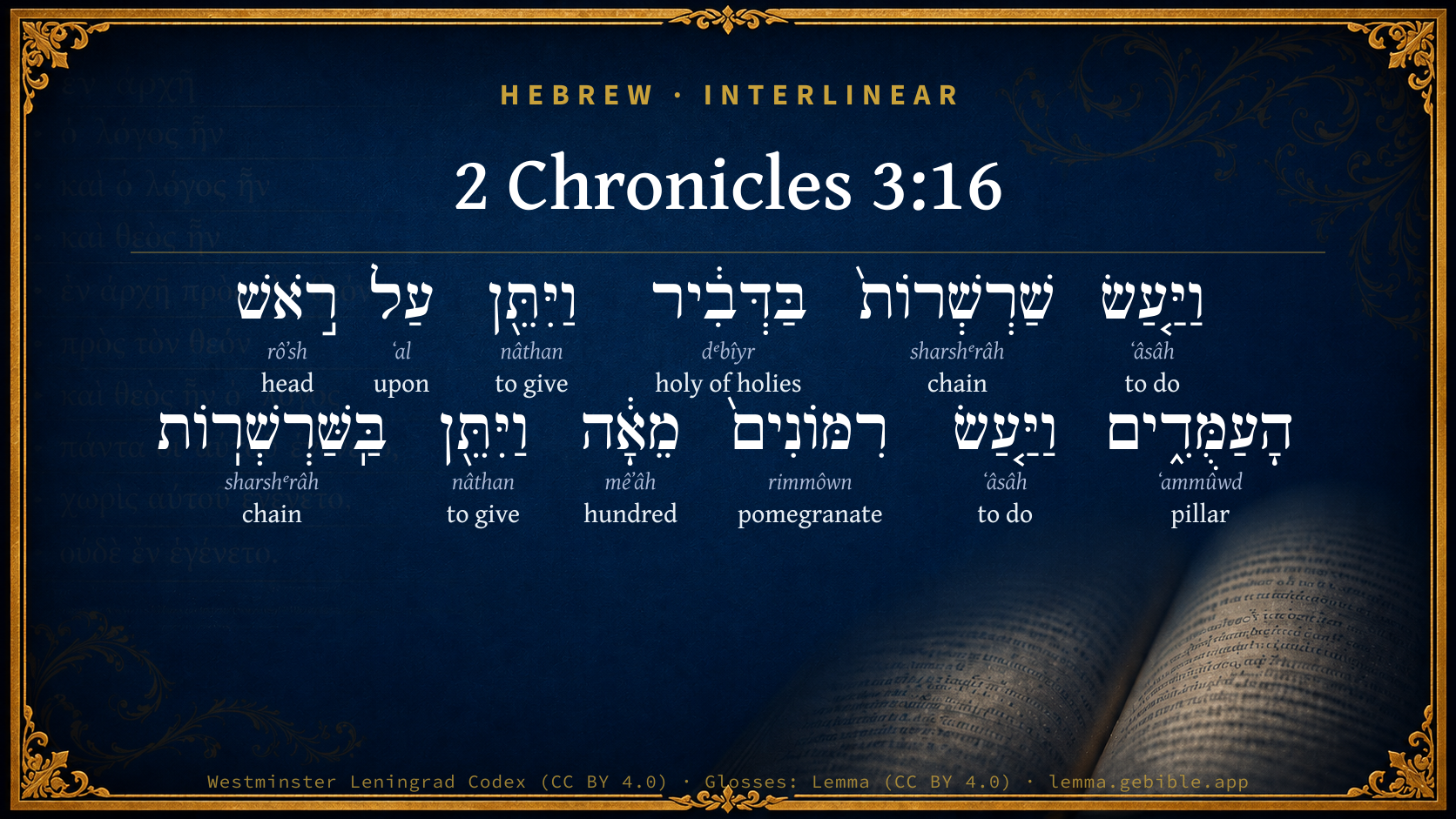
  1. וַיַּ֤עַשׂ ʻâsâh H6213 “and · to do” Conjunction + Verb, Qal, Sequential Imperfect, 3rd Person, Masculine, Singular
  2. בַּדְּבִ֔יר dᵉbîyr H1687 “in/at the · holy of holies” Preposition, Determined + Noun, Common, Masculine, Singular, Absolute
  3. וַיִּתֵּ֖ן nâthan H5414 “and · to give” Conjunction + Verb, Qal, Sequential Imperfect, 3rd Person, Masculine, Singular
  4. עַל ʻal H5921 “upon” Preposition
  5. רֹ֣אשׁ rôʼsh H7218 “head of” Noun, Common, Masculine, Singular, Construct
  6. הָעַמֻּדִ֑ים ʻammûwd H5982 “the · pillars” Particle, Definite Article + Noun, Common, Masculine, Plural, Absolute
  7. וַיַּ֤עַשׂ ʻâsâh H6213 “and · to do” Conjunction + Verb, Qal, Sequential Imperfect, 3rd Person, Masculine, Singular
  8. רִמּוֹנִים֙ rimmôwn H7416 “pomegranates” Noun, Common, Masculine, Plural, Absolute
  9. מֵאָ֔ה mêʼâh H3967 “hundred” Adjective, Cardinal number, Both, Singular, Absolute
  10. וַיִּתֵּ֖ן nâthan H5414 “and · to give” Conjunction + Verb, Qal, Sequential Imperfect, 3rd Person, Masculine, Singular
  11. בַּֽשַּׁרְשְׁרֽוֹת sharshᵉrâh H8333 “in/at the · chains” Preposition, Determined + Noun, Common, Feminine, Plural, Absolute

About this verse

These counts appear in no published source. They are computed here, from the morphology-tagged text and Lemma’s own curated glosses. What Lemma adds →

12
words
9
distinct lemmas
Historical
section

Notable vocabulary

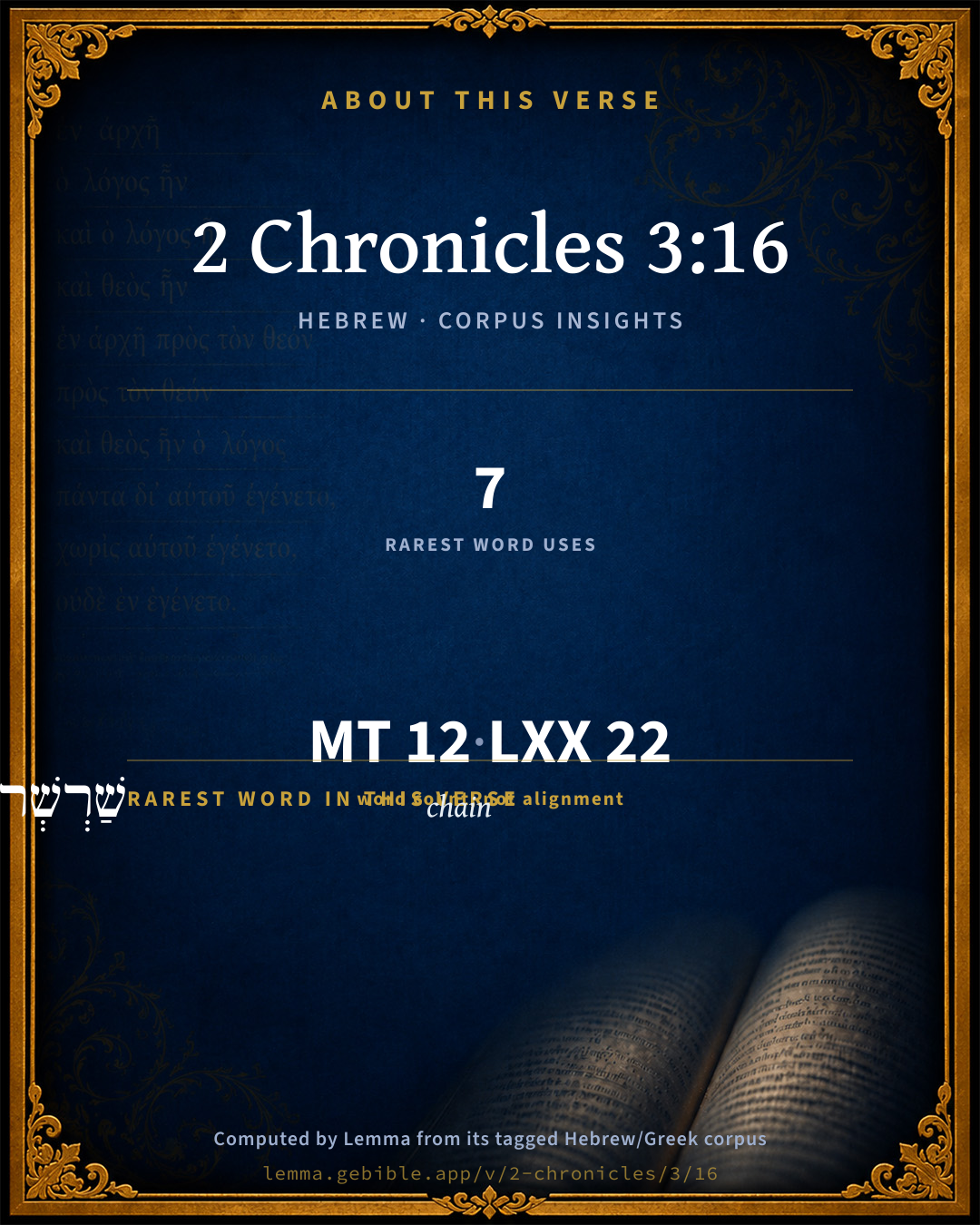
The rarest word here is שַׁרְשְׁרוֹת֙ chain H8333 — appearing just 7 times in the whole Hebrew Bible.

Shared distinctive vocabulary

שַׁרְשְׁרוֹת֙ chain H8333 occurs in 5 verses of the Hebrew Bible. Also found in:

Grammatical profile

  • 4 verbs
  • 6 nouns
  • 1 adjective
  • 1 preposition

Verb forms

  • וַיַּ֤עַשׂ Qal · Sequential Imperfect
  • וַיִּתֵּ֖ן Qal · Sequential Imperfect
  • וַיַּ֤עַשׂ Qal · Sequential Imperfect
  • וַיִּתֵּ֖ן Qal · Sequential Imperfect

Repetition

Words recur within this verse — often emphatic in Hebrew:

  • וַיַּ֤עַשׂ to do H6213 ×2
  • שַׁרְשְׁרוֹת֙ chain H8333 ×2
  • וַיִּתֵּ֖ן to give H5414 ×2

Hebrew & Septuagint length

In English translation the verse runs 27 words from the Hebrew and 29 from the Septuagint (LXX English) — closely comparable.

A rough comparison of the two English renderings, which tokenize alike — not a word-level alignment.

Word counts can differ between the Hebrew and the Greek without any difference in meaning — e.g. the Hebrew direct-object marker אֵת has no separate Greek word, and Greek often adds the article ὁ.

In the original languages it is 12 Hebrew tokens and 22 Greek tokens — but the two are counted differently (Hebrew bundles its prefixes and suffixes into one token; the Greek is in lemma form), so that isn’t a like-for-like length.

Cross-references

2

Topical passages linked to 2 Chronicles 3:16 in the Treasury of Scripture Knowledge — connected by theme and wording, ordered by reader-vote popularity; previews shown in the World English Bible.

  • 1 Kings 7:20 There were capitals above also on the two pillars, close by the belly which was beside the network: and the pomegranates were two hundred, in rows round about on the other capital.
  • 1 Kings 6:21 So Solomon overlaid the house within with pure gold: and he drew chains of gold across before the oracle; and he overlaid it with gold.

Cross-references courtesy of OpenBible.info (CC BY 4.0).

Hebrew and Greek witnesses Masoretic Hebrew ↔ Greek Septuagint

The same verse in the two great witnesses to the Old Testament, shown verse-for-verse.

These are two independent witnesses, not word-aligned to each other, and the Septuagint is shown in lemma (dictionary) form.

Hebrew 2 Chronicles 3:16 Masoretic · Westminster Leningrad Codex

וַיַּ֤עַשׂ שַׁרְשְׁרוֹת֙ בַּדְּבִ֔יר וַיִּתֵּ֖ן עַל רֹ֣אשׁ הָעַמֻּדִ֑ים וַיַּ֤עַשׂ רִמּוֹנִים֙ מֵאָ֔ה וַיִּתֵּ֖ן בַּֽשַּׁרְשְׁרֽוֹת

He made chains in the oracle, and put [them] on the tops of the pillars; and he made one hundred pomegranates, and put them on the chains.

World English Bible · Public Domain

Greek LXX 2 Chronicles 3:16 Septuagint · lemma form

καί ποιέω σερσερωθ ἐν ὁ δαβιρ καί δίδωμι ἐπί ὁ κεφαλή ὁ στῦλος καί ποιέω ῥοΐσκος ἑκατόν καί ἐπιτίθημι ἐπί ὁ χάλαστα

And he made chains, as in the oracle, and put them on the heads of the pillars; and he made one hundred pomegranates, and put them on the chains.

LXX2012 (modern English Septuagint) · Public Domain

On this verse, Ellicott's Commentary for English Readers discusses the Septuagint’s reading. Read the note in Commentary ↓

Hebrew: Westminster Leningrad Codex (CC BY 4.0). Greek: Septuagint (public domain); English from LXX2012 (modern English Septuagint) (Public Domain). How the Septuagint differs from the Hebrew →

Commentary

Notes on 2 Chronicles 3:16 from classic Christian and Jewish commentators (each source and its license shown beneath its notes). The classic Christian expositions comment on the surrounding passage and are grouped to its opening verse, so a note may address several verses; the Jewish commentaries on the Tanakh (Rashi and others) are per-verse, so they appear only where the commentator wrote on this verse.

Lemma curates 59 commentaries, every one of them public domain or Creative Commons licensed, each selected and text-cleaned for this edition rather than reprinted as found. About our sources →

Trapp's Complete Commentary

John Trapp

2Ch 3:16 And he made chains, [as] in the oracle, and put [them] on the heads of the pillars; and made an hundred pomegranates, and put [them] on the chains.

2Ch 3:17 And he reared up the pillars before the temple, one on the right hand, and the other on the left; and called the name of that on the right hand Jachin, and the name of that on the left Boaz.

Ver. 16,17. See 1Ki 7:17-18; 1Ki 7:21.

John Trapp, A Commentary or Exposition upon All the Books of the Old and New Testament (1647–1656) — public domain. Text from a community e-Sword module.

Geneva Bible (1599)

Geneva Bible translators

For every pillar an hundred, read 1 Kings 7:20.

Geneva Bible (1599) marginal notes — public domain. Text via Bolls.life.

Ellicott's Commentary for English Readers

(16) And he made chains, as in the oracle.—Heb., And he made chainwork in the oracle, or chancel, which is clearly corrupt. But if we read kad-debîr for bad-debîr, an infinitesimal change in Hebrew writing, we get the sense which our version suggests: And he made chainwork as in the chancel. It is true that the sacred writer has not told us that the walls of the Holy of Holies were so ornamented, but in 2Ch_3:5 he states it of the great hall or holy place, and 1Ki_6:29 declares that the whole house was adorned with mural carvings. It was quite natural to write, “and he made chainwork as in the oracle,” assuming that such decorations really existed in the inner chamber. There seems therefore to be no need to alter debîr into rabîd, (“collar”) as most commentators have done, although the change is very slight in Hebrew writing. The LXX. had the present Hebrew text, but, apparently, not understanding it transliterated the Hebrew words: “He made serserôth in the dabir.” So Vulg., “as it were chainlets in the oracle.” The Syriac and Arabic have “and he made chains of fifty cubits.”

An hundred pomegranates.—So Jer_52:23. (See 1Ki_7:20; 1Ki_7:42, from which it appears that there were altogether four hundred pomegranates, viz., an upper and lower row of one hundred each upon the chainwork of each pillar. So 2Ch_4:13.)

A Bible Commentary for English Readers, edited by Charles John Ellicott (1878–1897) — public domain. Text from a community e-Sword module.

The Cambridge Bible for Schools and Colleges

gen. ed. J. J. S. Perowne

16. he made chains, as in the oracle] R.V. he made chains in the oracle. The words, in the oracle, though found in LXX., are probably a gloss introduced from 1Ki_6:21 (chains … before the oracle). The Chronicler is here speaking of the outside of the Temple, having already described the “oracle,” i.e. the Holy of Holies, in 2Ch_3:8-14. The Heb. word dìbîr was translated “oracle” because it was supposed to be derived from a word meaning “to speak.” It means, however, simply “the hindmost part” of the house (cf. 2Ch_4:20, 2Ch_5:7; 2Ch_5:9).

The Cambridge Bible for Schools and Colleges (gen. ed. J. J. S. Perowne; Cambridge University Press, 1878–1918) — public domain. Text from a community e-Sword module.

Albert Barnes' Notes on the Bible

As in the oracle - This passage is probably corrupt. Our translators supposing that a single letter had fallen out at the beginning of the word translated “in the oracle,” supplied “as.” But we have no reason to suppose there were any “chains” or “festoons” in the “oracle” or most holy place.

Albert Barnes' Notes on the Bible (1834–1885) — public domain. Text from a community e-Sword/MySword module.

Haydock's Catholic Bible Commentary

In, or "as in." (Sa) (Menochius) --- Protestants supply as. (Haydock) --- Hundred, for one row, or 200 for both, 3 Kings. (Du Hamel)

George Leo Haydock (1774–1849), Haydock's Catholic Family Bible and Commentary, 1859 edition — public domain. Excludes Psalms (Douay-Rheims chapter numbering differs from Protestant) and Deuterocanonical books (Catholic canon only).

Matthew Poole's English Annotations

As in the oracle; as he had done, or like unto those which he made, in the oracle; of which see 1Ki 6:21. The particle as is oft understood, as Gen 49:9; Deu 33:22, &c.

An hundred pomegranates in each row, or two hundred in all, as it is said, 1Ki 7:20.

Matthew Poole's English Annotations on the Holy Bible (1683–1685) — public domain. Text from a community e-Sword/MySword module.

The Pulpit Commentary

Chains, as in the oracle. Though the writer of Chronicles has not in this description mentioned any chains as appertaining to the oracle, yet they are mentioned in the parallel. The selection of what is said has in our present text so much the appearance of haste, that this may account for the abrupt appearance of the allusion here. Otherwise the words, "in the oracle," tempt us to fear some corruptness of text, scarcely safely removed by Bertheau"s suggestion to substitute dybir ("ring") for rybid ("oracle").

A hundred pomegranates. (comp. 2Ch_4:13; 1Ki_7:15, 1Ki_7:18, 1Ki_7:20) These passages indicate that the total number of pomegranates was two hundred for each pillar.

The Pulpit Commentary (1880–1919), ed. H.D.M. Spence-Jones & Joseph S. Exell — public domain. Text from a community e-Sword module.

Rashi

Rabbi Shlomo Yitzchaki (Rashi)

and placed them in the chains He made chains at the top of the capital under it, and within the chains he set forms of pomegranates in order to cover the hollow of the capital, as it is written (ibid. verse 41): “to cover the two bowls (גֻלּוֹת) of the chapiters,” and because of its hollow, he calls them גֻלּוֹת. And concerning the net-work (שְׂבָכָה) written there, these are the chains, an expression of (Job 18:8): “and he shall walk on the nets (שְׂבָכָה),” an expression of branches, like (Gen. 22:13): “caught in the hedge (בַּסְּבַךְ) by its horns.” Some interpret it as coif, and Rabbi Eliezer interprets it as branches.

Rashi on the Tanakh — English translations: “The Judaica Press complete Tanach with Rashi, translated by A. J. Rosenberg” (CC BY 4.0); “Pentateuch with Rashi's commentary by M. Rosenbaum and A.M. Silbermann, 1929-1934” (public domain); “The Metsudah Tanach series, Lakewood, N.J” (CC BY 4.0); and “The Book of Joshua, Metsudah Publications, 1997” (CC BY 4.0). Text via Sefaria.

Lesson kit

Teaching starters — assembled from the data on this page, not authored interpretation. Every prompt links to the verse data it draws on. Edit before teaching.

2 Chronicles, in the Historical, opens this verse with 12 words (9 distinct Hebrew lemmas). Its most distinctive word is sharshᵉrâh (“chain”). A historical commentator’s framing appears above. Read the whole chapter for the surrounding context.

Discussion questions

  1. The word sharshᵉrâh carries the sense “chain.” How does it shape the verse?
  2. Exodus 28:14 shares the word «chain» with this verse. How do the two illuminate each other?
  3. “to do” occurs 2× in this one verse. What is the effect of the repetition?
  4. These translations render this verse differently; the difference is in the English rendering, not the original. What questions does that raise?
  5. The verb «וַיַּ֤עַשׂ» is Qal Sequential Imperfect. How does its form color the action?
  6. Reading how Trapp's Complete Commentary and Geneva Bible (1599) read this verse, where do the two commentators agree and where do they part?

Things to notice

Reading settings

Reading text

Shown beneath each verse's original-language words.

Old Testament
Old Testament edition

Read the OT as the Masoretic Hebrew (MT) or the Greek Septuagint (LXX).

English shown for the Greek Septuagint (in the Hebrew ↔ Greek comparison).

Comparing translations? Open the Compare panel on any verse page to stack up to four side by side.