
Ezekiel 48:17

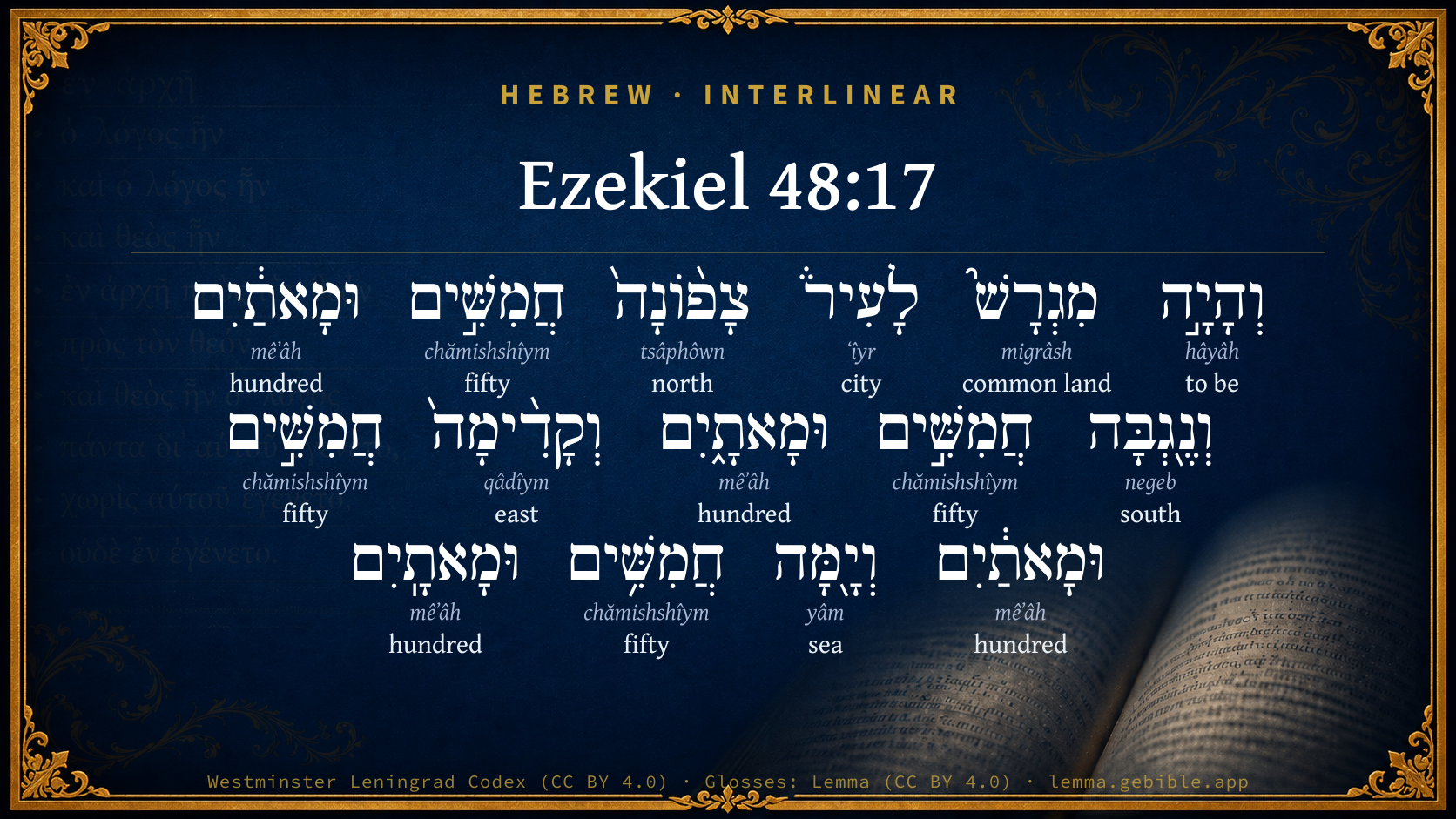
Hebrew (Westminster Leningrad Codex) Ezekiel 48:17 appears in the Hebrew Old Testament. The text above is from the Westminster Leningrad Codex. Each word links to its Strong’s number, a concise gloss, and parsing drawn from the Open Scriptures Hebrew Bible morphology. Click any word for its full Brown-Driver-Briggs (BDB) entry.
Download image
Cite this verse

Ezekiel 48:17 (World English Bible). Public Domain. Lemma interlinear Bible study tool, https://lemma.gebible.app/v/ezekiel/48/17.

Show BibTeX & RIS
BibTeX
RIS
English Translation
The city shall have suburbs: toward the north two hundred fifty, and toward the south two hundred fifty, and toward the east two hundred fifty, and toward the west two hundred fifty.
World English Bible · Public Domain
Download a study sheet

One document with this verse’s original text, its word-by-word gloss line, the meaning frame, cross-references with their text, attributed commentary, and full source and license credits — printable, and it pastes into notes with its structure intact.

This verse Autodidact and up

Study sheet (.html) Plain text (.txt)

A passage Seminary Student

Up to 50 verses in one chapter. A passage sheet keeps up to 6 commentary sources and 12 cross-references per verse, in the order this page ranks them, and says so on the sheet whenever that leaves anything out. Ask for a single verse and you get the Autodidact verse sheet above.

Everything on this page stays free to read, with no account — the sheet is a download of what is already on screen, not access to it.

Want to remove ads? Support Godless Engineer
Compare translations 3

The same verse in 3 English versions, stacked beneath the original-language interlinear above. Click any original word for its lexicon entry.

Each is an independent rendering of the whole verse — the interlinear is not word-aligned to these translations.

Highlighted words mark where these versions differ — a whole-verse word diff, not a word-by-word alignment.

  • World English Bible Public Domain
    The city shall have suburbs: toward the north two hundred fifty, and toward the south two hundred fifty, and toward the east two hundred fifty, and toward the west two hundred fifty.
  • King James Version Public Domain
    And the suburbs of the city shall be toward the north two hundred and fifty, and toward the south two hundred and fifty, and toward the east two hundred and fifty, and toward the west two hundred and fifty.
  • unfoldingWord Literal Text CC BY-SA 4.0
    There will be pasture for the city toward the north, 250 cubits deep; to the south, 250 cubits deep; to the east, 250 cubits deep, and to the west, 250 cubits deep.

unfoldingWord Literal Text — © unfoldingWord, licensed CC BY-SA 4.0. Word-aligned USFM3 via Door43 (git.door43.org/unfoldingWord/en_ult).

Versions to compare (up to 4)

3 of 4 selected

Show all 18 translations

Every available English version of this verse, each an independent rendering of the whole verse.

  • World English Bible Public Domain
    The city shall have suburbs: toward the north two hundred fifty, and toward the south two hundred fifty, and toward the east two hundred fifty, and toward the west two hundred fifty.
  • Berean Standard Bible Public Domain
    The pastureland of the city will extend 250 cubits to the north, 250 cubits to the south, 250 cubits to the east, and 250 cubits to the west.
  • Majority Standard Bible Public Domain
    The pastureland of the city will extend 250 cubits to the north, 250 cubits to the south, 250 cubits to the east, and 250 cubits to the west.
  • King James Version Public Domain
    And the suburbs of the city shall be toward the north two hundred and fifty, and toward the south two hundred and fifty, and toward the east two hundred and fifty, and toward the west two hundred and fifty.
  • American Standard Version (1901) Public Domain
    And the city shall have suburbs: toward the north two hundred and fifty, and toward the south two hundred and fifty, and toward the east two hundred and fifty, and toward the west two hundred and fifty.
  • Revised Version (1885) Public Domain
    And the city shall have suburbs; toward the north two hundred and fifty, and toward the south two hundred and fifty, and toward the east two hundred and fifty, and toward the west two hundred and fifty.
  • Geneva Bible (1599) Public Domain
    And the suburbes of the citie shall be toward the North two hundreth and fiftie, and towarde the South two hundreth and fiftie, and towarde the East two hundreth and fiftie, and towarde the West two hundreth and fiftie.
  • Douay-Rheims (1899) Public Domain
    And the suburbs of the city shall be to the north two hundred and fifty, and to the south two hundred and fifty, and to the east two hundred and fifty, and to the sea two hundred and fifty.
  • Young's Literal Translation Public Domain
    And the suburb to the city hath been northward, fifty and two hundred, and southward, fifty and two hundred, and eastward, fifty and two hundred, and westward, fifty and two hundred.
  • Literal Standard Version CC BY-SA 4.0
    And the outskirt of the city has been northward—two hundred and fifty, and southward—two hundred and fifty, and eastward—two hundred and fifty, and westward—two hundred and fifty.
  • Unlocked Literal Bible CC BY-SA 4.0
    There will be pasture for the city toward the north, 250 cubits deep; to the south, 250 cubits deep; to the east, 250 cubits deep, and to the west, 250 cubits deep.
  • unfoldingWord Literal Text CC BY-SA 4.0
    There will be pasture for the city toward the north, 250 cubits deep; to the south, 250 cubits deep; to the east, 250 cubits deep, and to the west, 250 cubits deep.
  • Darby Bible Public Domain
    And the suburbs of the city shall be toward the north two hundred and fifty [cubits], and toward the south two hundred and fifty, and toward the east two hundred and fifty, and toward the west two hundred and fifty.
  • World Messianic Bible Public Domain
    The city shall have pasture lands: toward the north two hundred fifty, and toward the south two hundred fifty, and toward the east two hundred fifty, and toward the west two hundred fifty.
  • Webster's Bible Public Domain
    And the suburbs of the city shall be towards the north two hundred and fifty, and towards the south two hundred and fifty, and towards the east two hundred and fifty, and towards the west two hundred and fifty.
  • Free Bible Version CC BY-SA 4.0
    The city's pastureland will surround it for 250 cubits on all sides, north, south, east, and west.
  • Bible in Basic English Public Domain
    And the town will have a free space on the north of two hundred and fifty, on the south of two hundred and fifty, on the east of two hundred and fifty, and on the west of two hundred and fifty.
  • JPS Tanakh (1917) Public Domain
    And the city shall have open land: toward the north two hundred and fifty, and toward the south two hundred and fifty, and toward the east two hundred and fifty, and toward the west two hundred and fifty.

Literal Standard Version (2020), Covenant Press — licensed CC BY-SA 4.0. Text via the HelloAO Bible API (eBible.org). Unlocked Literal Bible (unfoldingWord) — licensed CC BY-SA 4.0. Text via the HelloAO Bible API (eBible.org). unfoldingWord Literal Text — © unfoldingWord, licensed CC BY-SA 4.0. Word-aligned USFM3 via Door43 (git.door43.org/unfoldingWord/en_ult). Free Bible Version, Dr. Jonathan Gallagher — licensed CC BY-SA 4.0. Text via the HelloAO Bible API (eBible.org).

Word by word

More ways to search: Search by grammar → Find every occurrence → Compare this word →

Practice this passage: Drill this verse → Learn its vocabulary →

וְקָדִ֨ימָה֙
qâdîym
H6921
“and · east · toward”
Conjunction + Noun, Common, Masculine, Singular, Absolute + Suffix, Demonstrative
Part of Speech
Conjunction + Noun
Type
Common
Gender
Masculine
Number
Singular
State
Absolute
Full BDB Definition

Origin: from H6923

TWOT: 1988d

east, east wind - east (of direction) - east wind
  1. וְהָיָ֣ה hâyâh H1961 “and · to be” Conjunction + Verb, Qal, Sequential Perfect, 3rd Person, Masculine, Singular
  2. מִגְרָשׁ֮ migrâsh H4054 “common land” Noun, Common, Masculine, Singular, Absolute
  3. לָעִיר֒ ʻîyr H5892 “to/for the · city” Preposition, Determined + Noun, Common, Feminine, Singular, Absolute
  4. צָפ֨וֹנָה֙ tsâphôwn H6828 “north · toward” Noun, Common, Feminine, Singular, Absolute + Suffix, Demonstrative
  5. חֲמִשִּׁ֣ים chămishshîym H2572 “fifty” Adjective, Cardinal number, Both, Plural, Absolute
  6. וּמָאתַ֔יִם mêʼâh H3967 “and · hundred” Conjunction + Adjective, Cardinal number, Both, Dual, Absolute
  7. וְנֶ֖גְבָּה negeb H5045 “and · south · toward” Conjunction + Noun, Common, Masculine, Singular, Absolute + Suffix, Demonstrative
  8. חֲמִשִּׁ֣ים chămishshîym H2572 “fifty” Adjective, Cardinal number, Both, Plural, Absolute
  9. וּמָאתָ֑יִם mêʼâh H3967 “and · hundred” Conjunction + Adjective, Cardinal number, Both, Dual, Absolute
  10. חֲמִשִּׁ֣ים chămishshîym H2572 “fifty” Adjective, Cardinal number, Both, Plural, Absolute
  11. וּמָאתַ֔יִם mêʼâh H3967 “and · hundred” Conjunction + Adjective, Cardinal number, Both, Dual, Absolute
  12. וְיָ֖מָּה yâm H3220 “and · sea · toward” Conjunction + Noun, Common, Masculine, Singular, Absolute + Suffix, Demonstrative
  13. חֲמִשִּׁ֥ים chămishshîym H2572 “fifty” Adjective, Cardinal number, Both, Plural, Absolute
  14. וּמָאתָֽיִם mêʼâh H3967 “and · hundred” Conjunction + Adjective, Cardinal number, Both, Dual, Absolute

About this verse

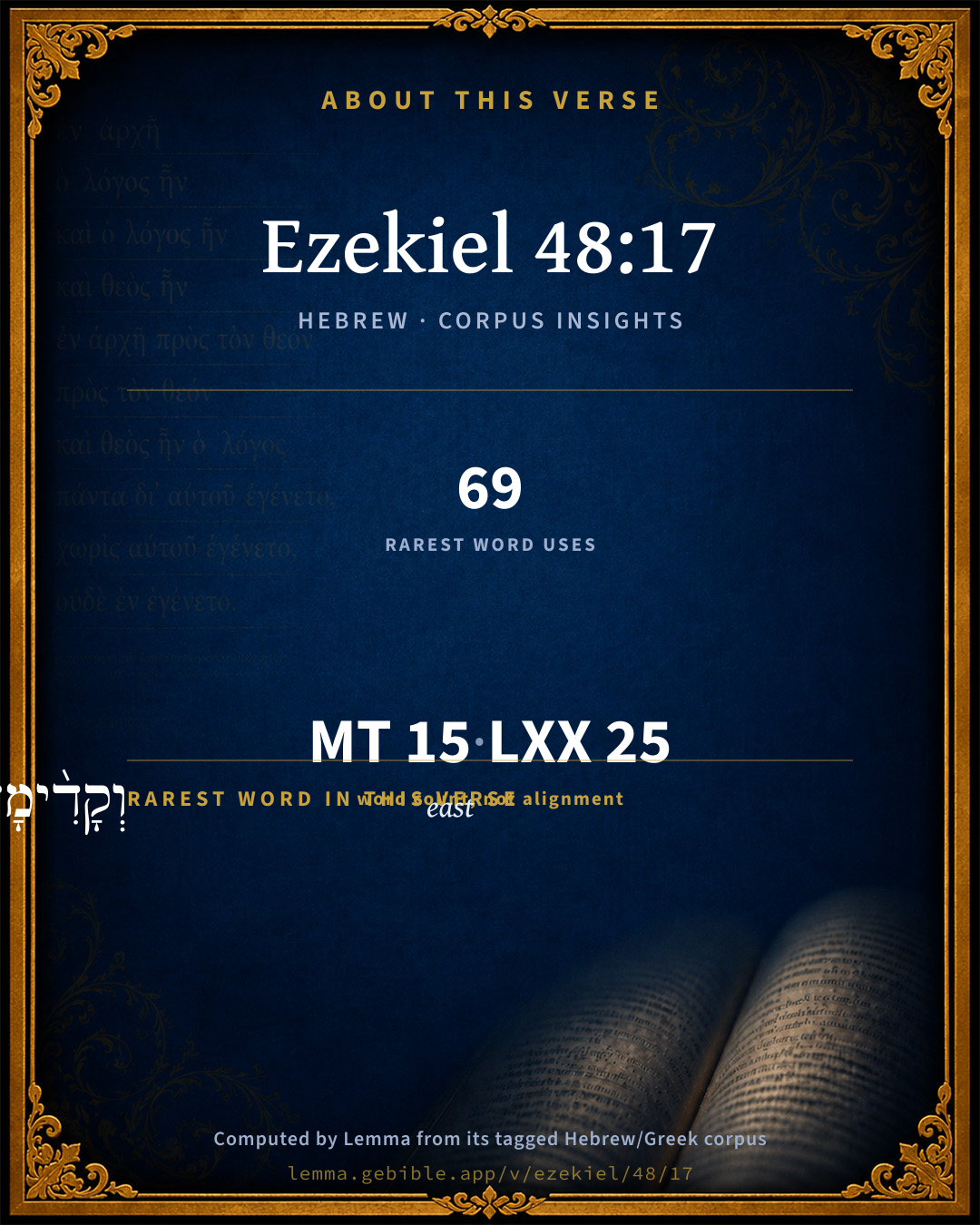
These counts appear in no published source. They are computed here, from the morphology-tagged text and Lemma’s own curated glosses. What Lemma adds →

15
words
9
distinct lemmas
Prophets
section

Grammatical profile

  • 1 verb
  • 6 nouns
  • 8 adjectives

Verb forms

  • וְהָיָ֣ה Qal · Sequential Perfect

Repetition

Words recur within this verse — often emphatic in Hebrew:

  • חֲמִשִּׁ֣ים fifty H2572 ×4
  • וּמָאתַ֔יִם hundred H3967 ×4

Hebrew & Septuagint length

In English translation the verse runs 32 words from the Hebrew and 32 from the Septuagint (LXX English) — the same length.

A rough comparison of the two English renderings, which tokenize alike — not a word-level alignment.

Word counts can differ between the Hebrew and the Greek without any difference in meaning — e.g. the Hebrew direct-object marker אֵת has no separate Greek word, and Greek often adds the article ὁ.

In the original languages it is 15 Hebrew tokens and 25 Greek tokens — but the two are counted differently (Hebrew bundles its prefixes and suffixes into one token; the Greek is in lemma form), so that isn’t a like-for-like length.

Hebrew and Greek witnesses Masoretic Hebrew ↔ Greek Septuagint

The same verse in the two great witnesses to the Old Testament, shown verse-for-verse.

These are two independent witnesses, not word-aligned to each other, and the Septuagint is shown in lemma (dictionary) form.

Hebrew Ezekiel 48:17 Masoretic · Westminster Leningrad Codex

וְהָיָ֣ה מִגְרָשׁ֮ לָעִיר֒ צָפ֨וֹנָה֙ חֲמִשִּׁ֣ים וּמָאתַ֔יִם וְנֶ֖גְבָּה חֲמִשִּׁ֣ים וּמָאתָ֑יִם וְקָדִ֨ימָה֙ חֲמִשִּׁ֣ים וּמָאתַ֔יִם וְיָ֖מָּה חֲמִשִּׁ֥ים וּמָאתָֽיִם

The city shall have suburbs: toward the north two hundred fifty, and toward the south two hundred fifty, and toward the east two hundred fifty, and toward the west two hundred fifty.

World English Bible · Public Domain

Greek LXX Ezekiel 48:17 Septuagint · lemma form

καί εἰμί διάστημα ὁ πόλις πρός βορέας διακόσιοι πεντήκοντα καί πρός νότος διακόσιοι καί πεντήκοντα καί πρός ἀνατολή διακόσιοι πεντήκοντα καί πρός θάλασσα διακόσιοι πεντήκοντα

And there shall be a space to the city northward two hundred and fifty, and southward two hundred and fifty, and eastward two hundred and fifty, and westward two hundred and fifty.

LXX2012 (modern English Septuagint) · Public Domain

Hebrew: Westminster Leningrad Codex (CC BY 4.0). Greek: Septuagint (public domain); English from LXX2012 (modern English Septuagint) (Public Domain). How the Septuagint differs from the Hebrew →

Targum (Aramaic paraphrase)

1

The Targum is the ancient Jewish Aramaic paraphrase of the Hebrew Scriptures — an interpretive translation, not the Hebrew text itself. Onkelos (literal) and Pseudo-Jonathan (expansive) render the Torah, and Jonathan the Prophets. Coverage is partial: where no permissively-licensed English translation exists for a verse, only the Aramaic is shown. This is verse-level text, not a word-by-word alignment to the Hebrew.

  1. Targum Jonathan Prophets (Joshua–Malachi)
    וִיהֵי רְוָחָא לְקַרְתָּא לְצִפּוּנָא מָאתָן וְחַמְשִׁין וְדָרוֹמָא מָאתָן וְחַמְשִׁין וּמַדִינְחָא מָאתָן וְחַמְשִׁין וּמַעֲרָבָא מָאתָן וְחַמְשִׁין:

    (no public-domain English translation for this verse)

    Targum Jonathan — Aramaic: “Mikraot Gedolot” (public domain). English: “Sefaria Community Translation” (CC0 1.0 (public-domain dedication)); “London "Chaldee Paraphrase," 1871” (public domain). Text via Sefaria.

Commentary

Notes on Ezekiel 48:17 from classic Christian and Jewish commentators (each source and its license shown beneath its notes). The classic Christian expositions comment on the surrounding passage and are grouped to its opening verse, so a note may address several verses; the Jewish commentaries on the Tanakh (Rashi and others) are per-verse, so they appear only where the commentator wrote on this verse.

Lemma curates 59 commentaries, every one of them public domain or Creative Commons licensed, each selected and text-cleaned for this edition rather than reprinted as found. About our sources →

Trapp's Complete Commentary

John Trapp

Eze 48:17 And the suburbs of the city shall be toward the north two hundred and fifty, and toward the south two hundred and fifty, and toward the east two hundred and fifty, and toward the west two hundred and fifty.

Ver. 17. And the suburbs of the city.] These were much larger than the suburbs of the temple, as may be observed by comparing Eze.

40. See Eze 45:2.

John Trapp, A Commentary or Exposition upon All the Books of the Old and New Testament (1647–1656) — public domain. Text from a community e-Sword module.

The Cambridge Bible for Schools and Colleges

gen. ed. J. J. S. Perowne

17. The “suburbs” or free space round the city shall be 250 cubits on all the four sides. Adding the 250 on the N. and on the S. of the city to the 4500 it appears that the whole breadth of the 5000 assigned to the city was occupied by it and its suburbs from N. to S.

The Cambridge Bible for Schools and Colleges (gen. ed. J. J. S. Perowne; Cambridge University Press, 1878–1918) — public domain. Text from a community e-Sword module.

John Gill's Exposition

Moreover, from the possession of the Levites, and from the possession of the city,.... Or, "beyond" these, as it may be rendered, on the other side of them; or, "except" (z) these:

being in the midst of that which is the prince's; between his two portions; or, as it is next explained,

between the border of Judah, and the border of Benjamin, shall be for the prince; that is, all beyond and excepting that which belonged to the priests and Levites, the sanctuary and the city, were the prince's, which lay between Judah and Benjamin: or thus it was; before the holy oblation one part of the prince's portion ran, parallel with the tribe of Judah, east and west; after the holy oblation on the other side, another part of his portion touched the tribe of Benjamin, and ran parallel with the east and west: and so were between them both, as well as on each side of the holy oblation: all this denotes the nearness of Christ to his church and people; his protection of them on all sides; and the largeness of his interest and kingdom; see Eze 45:7.

(z)

John Gill's Exposition of the Whole Bible (1746–1763) — public domain (CC PDM 1.0). Text via the HelloAO Bible API.

Albert Barnes' Notes on the Bible

The city being 4500 reeds square, 250 reeds are marked off north, south, east, west from the city land.

Albert Barnes' Notes on the Bible (1834–1885) — public domain. Text from a community e-Sword/MySword module.

Haydock's Catholic Bible Commentary

Suburbs, separating the Levites from laics, different from what is mentioned [in] ver. 15.

George Leo Haydock (1774–1849), Haydock's Catholic Family Bible and Commentary, 1859 edition — public domain. Excludes Psalms (Douay-Rheims chapter numbering differs from Protestant) and Deuterocanonical books (Catholic canon only).

Matthew Poole's English Annotations

Here are the dimensions of the suburbs, which added to those of the city thus, two hundred and fifty added to the four thousand five hundred on the north side, and two hundred and fifty added to the four thousand five hundred on the south side, make five thousand; so on the east add two hundred and fifty to four thousand five hundred, and then add two hundred and fifty to the four thousand five hundred on the west, it makes up an equilateral square five thousand on each side.

Matthew Poole's English Annotations on the Holy Bible (1683–1685) — public domain. Text from a community e-Sword/MySword module.

unfoldingWord translationNotes

Door43 World Missions Community

250 cubits ... ten thousand cubits

"two hundred and fifty cubits ... 10,000 cubits." A cubit was about 54 centimeters. See how you translated this in Ezekiel 40:5. AT: "about 135 meters ... about 5.4 kilometers" (See: Numbers and Biblical Distance)

its produce

"the food that grows there"

translationWords

holy

unfoldingWord translationNotes — © Distant Shores Media and the Door43 World Missions Community, licensed CC BY-SA 4.0. Source: git.door43.org/Door43/en_tn.

Rashi

Rabbi Shlomo Yitzchaki (Rashi)

The city shall have an open space All the ‘migrashim’ of the cities in Scripture are an open space with neither houses or fields.

Rashi on the Tanakh — English translations: “The Judaica Press complete Tanach with Rashi, translated by A. J. Rosenberg” (CC BY 4.0); “Pentateuch with Rashi's commentary by M. Rosenbaum and A.M. Silbermann, 1929-1934” (public domain); “The Metsudah Tanach series, Lakewood, N.J” (CC BY 4.0); and “The Book of Joshua, Metsudah Publications, 1997” (CC BY 4.0). Text via Sefaria.

Lesson kit

Teaching starters — assembled from the data on this page, not authored interpretation. Every prompt links to the verse data it draws on. Edit before teaching.

Ezekiel, in the Prophets, opens this verse with 15 words (9 distinct Hebrew lemmas). Its most distinctive word is qâdîym (“east”). A historical commentator’s framing appears above. Read the whole chapter for the surrounding context.

Discussion questions

  1. How does “east” (qâdîym) shape what this verse is saying?
  2. What does the repetition of “fifty” (4× in this one verse) do in this verse?
  3. The translations on this page render this verse differently — a whole-verse word diff, not a word-by-word alignment. What might account for the different wordings?
  4. «וְהָיָ֣ה» is a Qal Sequential Perfect verb. How does that grammatical form shape the action described?
  5. Compare how Trapp's Complete Commentary and The Cambridge Bible for Schools and Colleges read this verse. Where do they agree or differ?

Things to notice

Reading settings

Reading text

Shown beneath each verse's original-language words.

Old Testament
Old Testament edition

Read the OT as the Masoretic Hebrew (MT) or the Greek Septuagint (LXX).

English shown for the Greek Septuagint (in the Hebrew ↔ Greek comparison).

Comparing translations? Open the Compare panel on any verse page to stack up to four side by side.