Psalms 30:12

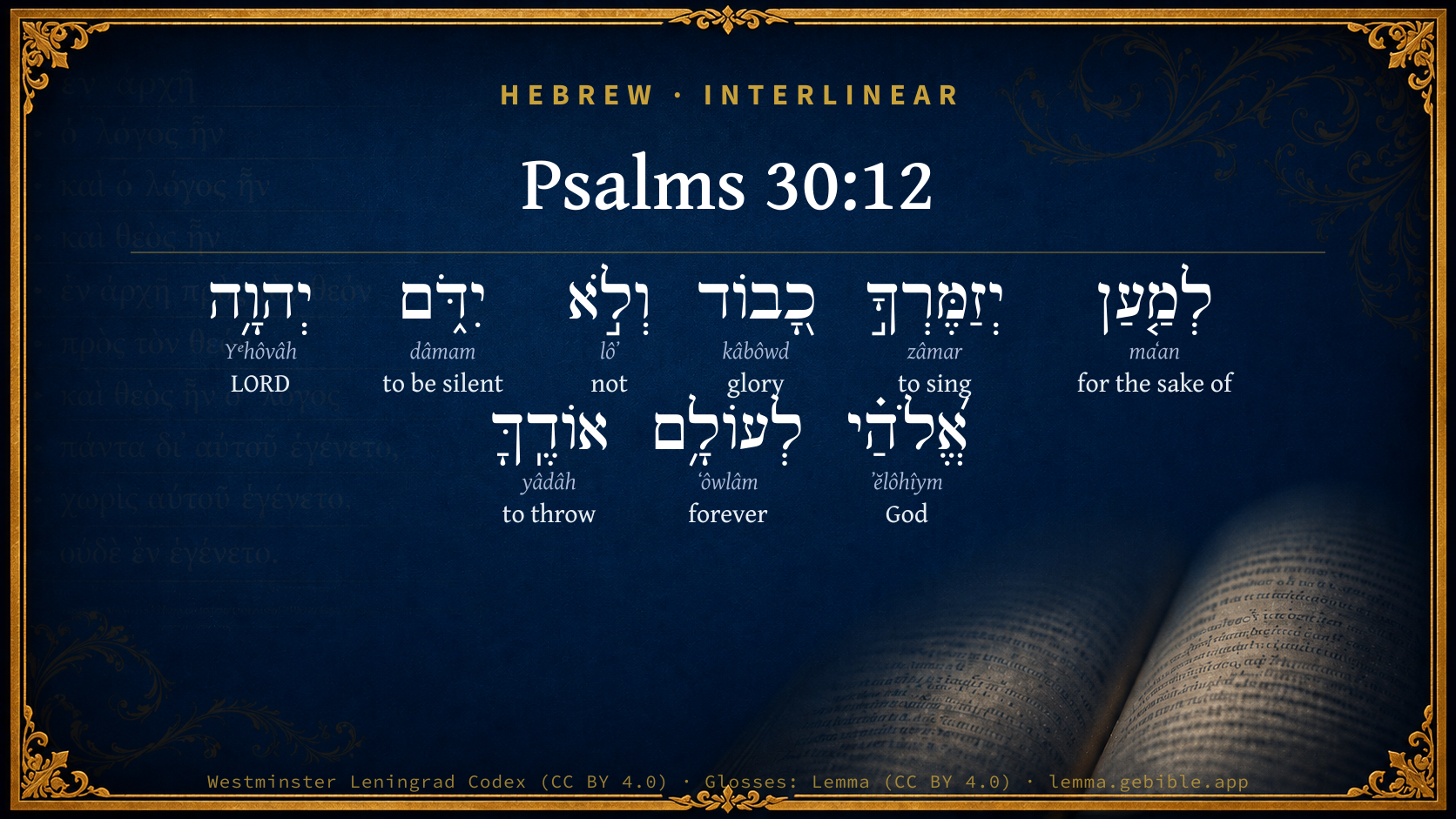
Hebrew (Westminster Leningrad Codex) Psalms 30:12 appears in the Hebrew Old Testament. The text above is from the Westminster Leningrad Codex. Each word links to its Strong’s number, a concise gloss, and parsing drawn from the Open Scriptures Hebrew Bible morphology. Click any word for its full Brown-Driver-Briggs (BDB) entry.
Download image
Cite this verse

Psalms 30:12 (World English Bible). Public Domain. Lemma interlinear Bible study tool, https://lemma.gebible.app/v/psalms/30/12.

Show BibTeX & RIS
BibTeX
RIS
English Translation
To the end that my heart may sing praise to you, and not be silent. Yahweh my God, I will give thanks to you forever!
World English Bible · Public Domain
Download a study sheet

One document with this verse’s original text, its word-by-word gloss line, the meaning frame, cross-references with their text, attributed commentary, and full source and license credits — printable, and it pastes into notes with its structure intact.

This verse Autodidact and up

Study sheet (.html) Plain text (.txt)

A passage Seminary Student

Up to 50 verses in one chapter. A passage sheet keeps up to 6 commentary sources and 12 cross-references per verse, in the order this page ranks them, and says so on the sheet whenever that leaves anything out. Ask for a single verse and you get the Autodidact verse sheet above.

Everything on this page stays free to read, with no account — the sheet is a download of what is already on screen, not access to it.

Want to remove ads? Support Godless Engineer
Compare translations 3

The same verse in 3 English versions, stacked beneath the original-language interlinear above. Click any original word for its lexicon entry.

Each is an independent rendering of the whole verse — the interlinear is not word-aligned to these translations.

Highlighted words mark where these versions differ — a whole-verse word diff, not a word-by-word alignment.

  • World English Bible Public Domain
    To the end that my heart may sing praise to you, and not be silent. Yahweh my God, I will give thanks to you forever!
  • King James Version Public Domain
    To the end that my glory may sing praise to thee, and not be silent. O LORD my God, I will give thanks unto thee for ever.
  • unfoldingWord Literal Text CC BY-SA 4.0
    in order that glory may sing praise to you and not be silent. Yahweh my God, I will give thanks to you forever.

unfoldingWord Literal Text — © unfoldingWord, licensed CC BY-SA 4.0. Word-aligned USFM3 via Door43 (git.door43.org/unfoldingWord/en_ult).

Versions to compare (up to 4)

3 of 4 selected

Show all 18 translations

Every available English version of this verse, each an independent rendering of the whole verse.

  • World English Bible Public Domain
    To the end that my heart may sing praise to you, and not be silent. Yahweh my God, I will give thanks to you forever!
  • Berean Standard Bible Public Domain
    that my heart may sing Your praises and not be silent. O LORD my God, I will give thanks forever.
  • Majority Standard Bible Public Domain
    that my heart may sing Your praises and not be silent. O LORD my God, I will give thanks forever.
  • King James Version Public Domain
    To the end that my glory may sing praise to thee, and not be silent. O LORD my God, I will give thanks unto thee for ever.
  • American Standard Version (1901) Public Domain
    To the end that `my' glory may sing praise to thee, and not be silent. O Jehovah my God, I will give thanks unto thee for ever. Psalm 31 For the Chief Musician. A Psalm of David.
  • Revised Version (1885) Public Domain
    To the end that my glory may sing praise to thee, and not be silent. O LORD my God, I will give thanks unto thee for ever.
  • Geneva Bible (1599) Public Domain
    Therefore shall my tongue praise thee and not cease: O Lord my God, I will giue thankes vnto thee for euer.
  • Douay-Rheims (1899) Public Domain
    Thou hast turned for me my mourning into joy: thou hast cut my sackcloth, and hast compassed me with gladness:
  • Young's Literal Translation Public Domain
    So that honour doth praise Thee, and is not silent, O Jehovah, my God, to the age I thank Thee!
  • Literal Standard Version CC BY-SA 4.0
    So that glory praises You, and is not silent, || O YHWH, my God, I thank You for all time!
  • Unlocked Literal Bible CC BY-SA 4.0
    So now my glory will sing praise to you and not be silent; Yahweh my God, I will give thanks to you forever!
  • unfoldingWord Literal Text CC BY-SA 4.0
    in order that glory may sing praise to you and not be silent. Yahweh my God, I will give thanks to you forever.
  • Darby Bible Public Domain
    That [my] glory may sing psalms of thee, and not be silent. Jehovah my God, I will praise thee for ever.
  • World Messianic Bible Public Domain
    to the end that my heart may sing praise to you, and not be silent. LORD my God, I will give thanks to you forever!
  • Webster's Bible Public Domain
    \\30:11\\Thou hast turned for me my mourning into dancing: thou hast put off my sackcloth, and girded me with gladness;
  • Free Bible Version CC BY-SA 4.0
    so I can sing praises to you and not keep quiet. Lord my God, I will thank you forever!
  • Bible in Basic English Public Domain
    So that my glory may make songs of praise to you and not be quiet. O Lord my God, I will give you praise for ever.
  • JPS Tanakh (1917) Public Domain
    (30-13) So that my glory may sing praise to Thee, and not be silent; O LORD my God, I will give thanks unto Thee for ever.

Literal Standard Version (2020), Covenant Press — licensed CC BY-SA 4.0. Text via the HelloAO Bible API (eBible.org). Unlocked Literal Bible (unfoldingWord) — licensed CC BY-SA 4.0. Text via the HelloAO Bible API (eBible.org). unfoldingWord Literal Text — © unfoldingWord, licensed CC BY-SA 4.0. Word-aligned USFM3 via Door43 (git.door43.org/unfoldingWord/en_ult). Free Bible Version, Dr. Jonathan Gallagher — licensed CC BY-SA 4.0. Text via the HelloAO Bible API (eBible.org).

Word by word

More ways to search: Search by grammar → Find every occurrence → Compare this word →

Practice this passage: Drill this verse → Learn its vocabulary →

יִדֹּ֑ם
dâmam
H1826
“to be silent”
Verb, Qal, Imperfect, 3rd Person, Masculine, Singular
Part of Speech
Verb
Stem
Qal
Form
Imperfect
Person
3rd Person
Gender
Masculine
Number
Singular
Full BDB Definition

Origin: a prim root [compare H1724 , H1820 ]

TWOT: 439

to be silent, be still, wait, be dumb, grow dumb - (Qal) - to be silent - to be still, die - to be struck dumb - (Niphal) to be silenced, be made silent, destroyed - (Poal) to make quiet - (Hiphil) to make silent (cause to die)
  1. לְמַ֤עַן maʻan H4616 “for the sake of” Preposition
  2. יְזַמֶּרְךָ֣ zâmar H2167 “to sing · you” Verb, Piel, Imperfect, 3rd Person, Masculine, Singular + Suffix, Personal, 2nd Person, Masculine, Singular
  3. כָ֭בוֹד kâbôwd H3519 “glory” Noun, Common, Both, Singular, Absolute
  4. וְלֹ֣א lôʼ H3808 “and · not” Conjunction + Particle, Negative
  5. יְהוָ֥ה Yᵉhôvâh H3068 “LORD” Noun, Proper
  6. אֱ֝לֹהַ֗י ʼĕlôhîym H430 “God(s) · my” Noun, Common, Masculine, Plural, Construct + Suffix, Personal, 1st Person, Common, Singular
  7. לְעוֹלָ֥ם ʻôwlâm H5769 “to/for · forever” Preposition + Noun, Common, Masculine, Singular, Absolute
  8. אוֹדֶֽךָּ yâdâh H3034 “to throw · you” Verb, Hiphil, Imperfect, 1st Person, Common, Singular + Suffix, Personal, 2nd Person, Masculine, Singular

About this verse

These counts appear in no published source. They are computed here, from the morphology-tagged text and Lemma’s own curated glosses. What Lemma adds →

9
words
9
distinct lemmas
Wisdom
section

Shared distinctive vocabulary

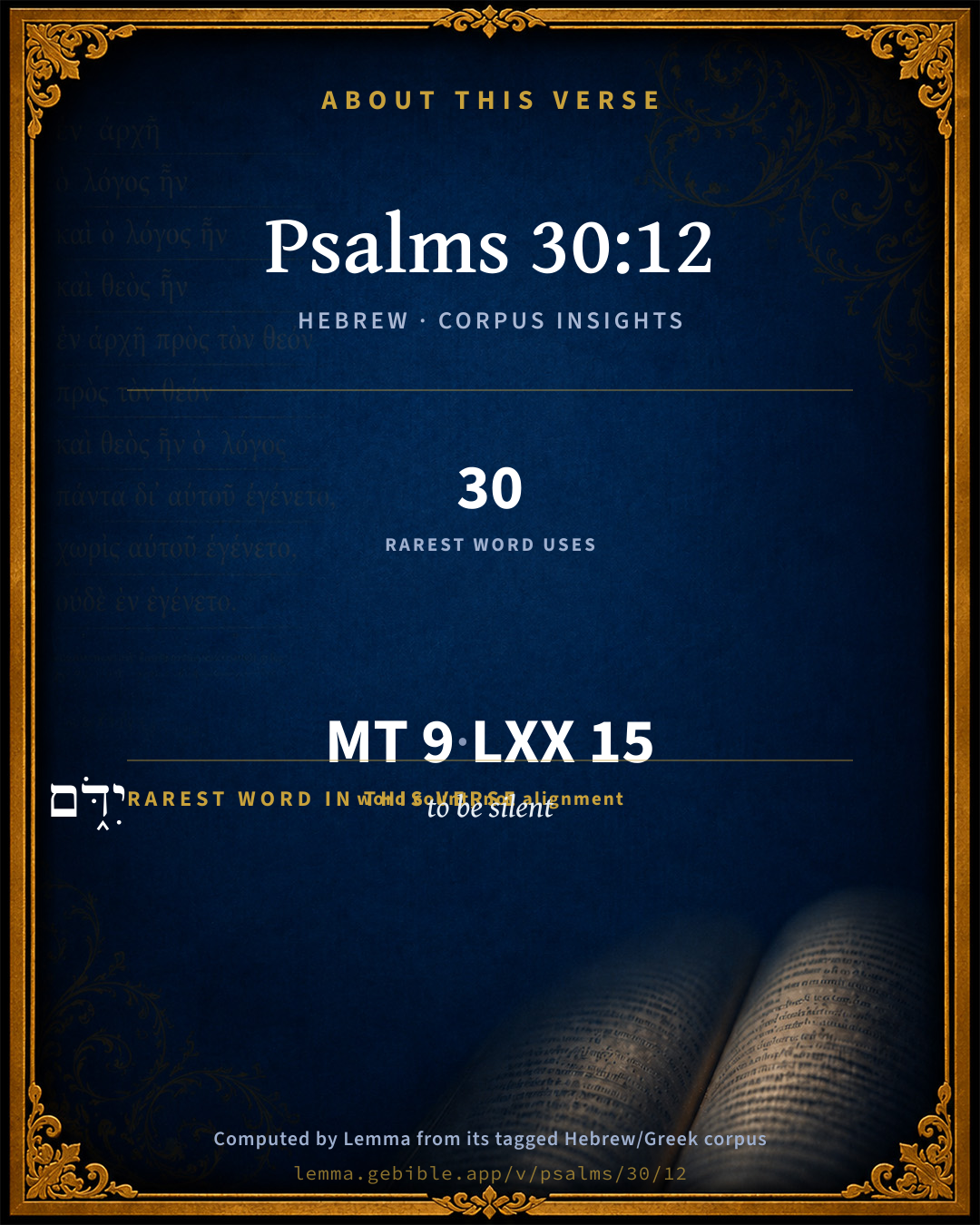
יִדֹּ֑ם to be silent H1826 occurs in 29 verses of the Hebrew Bible. Also found in:

Grammatical profile

  • 3 verbs
  • 4 nouns
  • 1 preposition
  • 1 particle

Verb forms

  • יְזַמֶּרְךָ֣ Piel · Imperfect
  • יִדֹּ֑ם Qal · Imperfect
  • אוֹדֶֽךָּ Hiphil · Imperfect

Hebrew & Septuagint length

In English translation the verse runs 25 words from the Hebrew and 28 from the Septuagint (LXX English) — closely comparable.

A rough comparison of the two English renderings, which tokenize alike — not a word-level alignment.

Word counts can differ between the Hebrew and the Greek without any difference in meaning — e.g. the Hebrew direct-object marker אֵת has no separate Greek word, and Greek often adds the article ὁ.

In the original languages it is 9 Hebrew tokens and 15 Greek tokens — but the two are counted differently (Hebrew bundles its prefixes and suffixes into one token; the Greek is in lemma form), so that isn’t a like-for-like length.

Cross-references

13

Topical passages linked to Psalms 30:12 in the Treasury of Scripture Knowledge — connected by theme and wording, ordered by reader-vote popularity; previews shown in the World English Bible.

  • Psalms 145:2 Every day I will praise you. I will extol your name forever and ever.
  • Psalms 16:9 Therefore my heart is glad, and my tongue rejoices. My body shall also dwell in safety.
  • Psalms 44:8 In God we have made our boast all day long, We will give thanks to your name forever. Selah.
  • Psalms 146:1–2 Praise Yah! Praise Yahweh, my soul.
  • Luke 19:40 He answered them, "I tell you that if these were silent, the stones would cry out."
  • Revelation 4:8–9 The four living creatures, each one of them having six wings, are full of eyes around about and within. They have no rest day and night, saying, "Holy, holy, holy, holy, holy, holy, holy, holy, holy is the Lord God, the Almighty, who was and who is and who is to come!"
  • Psalms 13:6 I will sing to Yahweh, Because he has been good to me.
  • Psalms 57:8 Wake up, my glory! Wake up, psaltery and harp! I will wake up the dawn.
  • Psalms 71:14 But I will always hope, And will add to all of your praise.
  • Psalms 71:23 My lips shall shout for joy! My soul, which you have redeemed, sings praises to you!
  • Acts 4:20 for we can't help telling the things which we saw and heard."
  • Genesis 49:6 My soul, don't come into their council; My glory, don't be united to their assembly; For in their anger they killed a man, In their self-will they hamstrung an ox.
  • Revelation 7:12 saying, "Amen! Blessing, glory, wisdom, thanksgiving, honor, power, and might, be to our God forever and ever! Amen."

Cross-references courtesy of OpenBible.info (CC BY 4.0).

Hebrew and Greek witnesses Masoretic Hebrew ↔ Greek Septuagint

The same verse in the two great witnesses to the Old Testament, shown verse-for-verse.

You’re reading Greek Psalm 29 (Hebrew Psalm 30). The Septuagint counts the superscription, so verse numbers can differ from the Hebrew — chapter-level alignment, not verse-by-verse. Numbering follows Rahlfs.

These are two independent witnesses, not word-aligned to each other, and the Septuagint is shown in lemma (dictionary) form.

Hebrew Psalms 30:12 Masoretic · Westminster Leningrad Codex

לְמַ֤עַן יְזַמֶּרְךָ֣ כָ֭בוֹד וְלֹ֣א יִדֹּ֑ם יְהוָ֥ה אֱ֝לֹהַ֗י לְעוֹלָ֥ם אוֹדֶֽךָּ

To the end that my heart may sing praise to you, and not be silent. Yahweh my God, I will give thanks to you forever!

World English Bible · Public Domain

Greek LXX Greek Psalm 29:12 Septuagint · lemma form

στρέφω ὁ κοπετός ἐγώ εἰς χορός ἐγώ διαῥήγνυμι ὁ σάκκος ἐγώ καί περιζώννυμι ἐγώ εὐφροσύνη

that my glory may sing praise to you, and I may not be pierced with sorrow. O Lord my God, I will give thanks to you for ever.

LXX2012 (modern English Septuagint) · Public Domain

On this verse, Ellicott's Commentary for English Readers discusses the Septuagint’s reading. Read the note in Commentary ↓

Hebrew: Westminster Leningrad Codex (CC BY 4.0). Greek: Septuagint (public domain); English from LXX2012 (modern English Septuagint) (Public Domain). How the Septuagint differs from the Hebrew →

Commentary

Notes on Psalms 30:12 from classic Christian and Jewish commentators (each source and its license shown beneath its notes). The classic Christian expositions comment on the surrounding passage and are grouped to its opening verse, so a note may address several verses; the Jewish commentaries on the Tanakh (Rashi and others) are per-verse, so they appear only where the commentator wrote on this verse.

Lemma curates 59 commentaries, every one of them public domain or Creative Commons licensed, each selected and text-cleaned for this edition rather than reprinted as found. About our sources →

Trapp's Complete Commentary

John Trapp

Psa 30:12 To the end that [my] glory may sing praise to thee, and not be silent. O LORD my God, I will give thanks unto thee for ever.

Ver. 12. To the end that my glory may sing praise to thee] i.e. That my tongue, oiled from a heart enlarged, may exalt thee, according to my bounden duty and thine abundant desert. A good tongue, that watcheth all opportunities to glorify God and edify others, is certainly a man’s great glory; but an evil tongue is his foul shame. Basil expoundeth glory by το πνευμα, the spirit or soul. The Chaldee Paraphrast, Laudabunt te honorabiles mundi, The glorious ones of the world shall praise thee.

O Lord my God, I will give thanks unto thee for ever] Epiphonematica et pathetica conclusio, Davidi ex summis calamitatibus erepto familiaris. He concludeth as he began, engaging his heart to everlasting thankfulness; and therein becoming a worthy pattern to all posterity.

John Trapp, A Commentary or Exposition upon All the Books of the Old and New Testament (1647–1656) — public domain. Text from a community e-Sword module.

Joseph Benson's Commentary

Psa 30:12. To the end that my glory — My soul, or rather, my tongue; for to the tongue both singing and silence most properly belong; may sing praise to thee — May bear testimony to thy truth and faithfulness, manifested in fulfilling thy promises, and may ascribe to thee the glory and praise due to thy infinite perfections.

Joseph Benson's Commentary on the Old and New Testaments (1811–1818) — public domain. Text from a community e-Sword module.

J. A. Alexander on Psalms

Joseph Addison Alexander

13. (Psa 30:12). In order that glory may make music to thee and not be dumb, Jehovah, my God, I will praise thee (or give thanks to thee) for ever. This verse describes not only the effect but the design of the deliverance asked for, and so furnishes a counterpart to the argument in Psa 30:10 (9). As the death of the Psalmist would deprive God of praise, so his deliverance is intended to ensure it.—The use of glory in the first clause is obscure. Some understand by it the tongue or voice, which is entirely arbitrary; others the soul, the nobler part of man, as in Psa 16:9; Psa 57:9; Psa 108:2 (1). But as the form in all these cases is my glory, it seems better to take glory here without the pronoun in the wide sense of every thing glorious, including the worshipper's highest powers, and perhaps his regal dignity, as in Psa 7:6 (5) As in God's temple every thing says "Glory!" (Psa 29:9), so everything glorious among his works is bound to praise him.—Not be dumb, a stronger phrase than not be silent.—With the last clause compare the words of Hezekiah, Isa 38:20.

Joseph Addison Alexander, The Psalms Translated and Explained (1850) — public domain. Text from a community e-Sword module.

Geneva Bible (1599)

Geneva Bible translators

Because thou hast preserved me that my tongue should praise thee, I will not be unmindful of my duty.

Geneva Bible (1599) marginal notes — public domain. Text via Bolls.life.

Jamieson, Fausset & Brown

Robert Jamieson, A. R. Fausset & David Brown

Though "my" is supplied before "glory" it is better as in Psa 16:9, to receive it as used for tongue, the organ of praise. The ultimate end of God's mercies to us is our praise to Him.

Next: Psalms Chapter 31

Jamieson, Fausset & Brown — Commentary Critical and Explanatory on the Whole Bible (1871) — public domain (CC PDM 1.0). Text via the HelloAO Bible API.

Adam Clarke's Commentary

Verse 12. To the end that my glory may sing] The word כבוד cabod, which we here translate glory, is sometimes taken to signify the liver. Here it is supposed to mean the tongue; why not the heart? But does not David mean, by his glory, the state of exaltation and honour to which God had raised him, and in which he had before too much trusted; forgetting that he held it in a state of dependence on God? Now he was disciplined into a better sentiment. My glory before had sung praise to myself; in it I had rested; on it I had presumed; and intoxicated with my success, I sent Joab to number the people. Now my glory shall be employed for another purpose; it shall give thanks to God, and never be silent. I shall confess to all the world that all the good, the greatness, the honour, the wealth, prosperity, and excellence I possess, came from God alone; and that I hold them on his mere good pleasure. It is so; therefore, "O Lord my God, I will give thanks unto thee for ever."

The old Psalter translates and paraphrases the last verse thus: - That my joy syng til the, and I be noght stanged: Lord my God withouten ende I sal schryf til the. The dede and the sorrow of oure syn God turnes in til joy of remission; and scheres oway oure sekk-(drives away our distress) and umgyfs (surrounds) qwen we dye, with gladness. That oure joy syng til hym, that has gyfen us that joy; for we be no more stanged (stung) with conscience of syn: na drede of dede or of dome; bot withouten ende we sal loue (praise) him. Na tunge may telle na herte may thynk the mykelnes of joy that es in louing (praising) of hym in gast, and in sothfastnes, i.e., spirit and truth.

ANALYSIS OF THE THIRTIETH PSALM

There are two parts in this Psalm: -

I. The giving of thanks for delivery from a great danger, Ps 30:1-3.

II. An exhortation to others to follow his example, and thus acknowledge God's merciful dealings with them, Ps 30:4-12.

I. He begins with thanksgiving: "I will extol thee, O Lord;" and adds the causes.

1. "Thou hast lifted me up," as one out of a deep dark pit.

2. "Thou hast not made my foes to triumph over me;" but rather turned their mirth into sadness.

3. "Thou hast healed me;" - both in body and mind.

4. "Thou hast brought up my soul from the grave;" restored me to life, when apparently condemned to death.

5. He earnestly sought these blessings: "O Lord my God, I cried unto thee," and thou didst for me all that I have mentioned.

II. After having given thanks, he calls on the saints to acknowledge and celebrate the goodness of God to him and to others: "Sing unto the Lord," c. And to induce them to do this, he gives the instance in himself, that God was angry with him, but soon appeased.

1. He was angry, but his anger endured but a moment but life, and a continuance of it, are from his favour.

2. And justly angry he was for his sin and carnal confidence: "In my prosperity I said, I shall never be moved."

3. The effect of his anger was: "He hid his face, and I was troubled."

This is the example that he sets before the saints, that they be not secure when the world goes well with them; lest they have experience of God's displeasure, as he had.

Next he shows the means he used to avert God's wrath; and this he proposes as a pattern for all to follow in like cases.

1. He betook himself to prayer. 2. He sets down the form he used.

1. He that is ill sends for the physician - so did I. This was the fruit of my chastisement; I cried unto thee, O Lord; and unto the Lord I made supplication.

2. And the form he used was this: - I earnestly pleaded with God thus: 1. "What profit is there in my blood when I go down to the pit?" 2. "Shall the dust praise thee? shall it declare thy truth?" 3. Can a dead man praise thee, or canst thou make good thy promises to the dead? 4. And he concluded with, "Hear, O Lord, and have mercy upon me; O Lord, be thou my helper."

3. He shows the effect of his prayer: "Thou hast turned my mourning into dancing, thou hast put off my sackcloth, and girded me with gladness."

4. For what end God did this: "That my glory may sing praise to thee, and not be silent. O Lord my God, I will give thanks to thee for ever."

Now, O ye saints, 1. You see my case; 2. You see what course I took; 3. You see the effect; 4. You see the end why God was so good to me, that I should praise him. To you, who are in my state, I propose my example. Betake yourselves to God in your necessities; and, having obtained deliverance by earnest prayer and faith, remember to return praise to God for his ineffable goodness.

Adam Clarke's Commentary on the Bible (1810–1826) — public domain. Text from a community e-Sword/MySword module.

John Calvin's Commentaries

12. That my glory may sing praise to thee. In this verse he more fully expresses his acknowledgement of the purpose for which God had preserved him from death, and that he would be careful to render him a proper return of gratitude. Some refer the word glory to the body, and some to the soul, or the higher powers of the mind. Others, as the pronoun my, which we have supplied, is not in the Hebrew text, prefer to translate it in the accusative case, supplying the word every man, in this way: That every man may celebrate thy glory; as if the prophet had said, This is a blessing worthy of being celebrated by the public praises of all men. But as all these interpretations are strained, I adhere to the sense which I have given. The Hebrew word כבוד, kebod, which signifies glory, it is well known, is sometimes employed metaphorically to signify the tongue, as we have seen in Psalm 16:9. And as David adds immediately after, I will celebrate thy praise for ever, the context demands that he should particularly speak of his own duty in this place. His meaning, therefore, is, O Lord, as I know that thou hast preserved me for this purpose, that thy praises may resound from my tongue, I will faithfully discharge this service to thee, and perform my part even unto death. To sing, and not be silent, is a Hebrew amplification; as if he had said, My tongue shall not be mute, or deprive God of his due praise; it shall, on the contrary, devote itself to the celebration of his glory.

John Calvin's Commentaries (1540-1563) — public domain. Text from the Calvin Translation Society English edition (1840s-50s) via the Christian Classics Ethereal Library (ccel.org). Calvin's coverage is partial (roughly two-thirds of the Bible); uncommented books and verses are honest gaps, never fabricated. The 19th-century editor's footnotes and remarks are omitted so the notes are faithfully Calvin's own voice.

Ellicott's Commentary for English Readers

(12) My glory.—The suffix is wanting in the Hebrew, and in all the older versions except LXX. and Vulg. The Chaldee versions make the word concrete and render “the nobles.” The Syriac, reading the verb in a different person, makes glory the object—“then will I sing to thee, Glory.” My glory would, as in Psa_108:1, mean my heart. (See Note, Psa_16:9.) Without the pronoun, we must (with Jerome) understand by “glory” renown or praise, which, as it were, itself raises songs; or it must be concrete, “everything glorious.”

A Bible Commentary for English Readers, edited by Charles John Ellicott (1878–1897) — public domain. Text from a community e-Sword module.

The Cambridge Bible for Schools and Colleges

gen. ed. J. J. S. Perowne

12. my glory] My soul, as in Psa_7:5 (note); Psa_57:8.

for ever] All the days of my life. See 1Sa_1:22 compared with 1Sa_1:28. But the Psalmist’s words had a larger meaning than he could as yet know (Rev_22:3 ff.).

The Cambridge Bible for Schools and Colleges (gen. ed. J. J. S. Perowne; Cambridge University Press, 1878–1918) — public domain. Text from a community e-Sword module.

John Gill's Exposition

To the end that my glory may sing praise to thee, and not be silent,.... Meaning either his soul, the more noble and glorious part of him; or the members of his body, his tongue, which is the glory of it, and with which he glorified God; see Psa 16:9; compared with Act 2:26, this was the end that was to be answered by changing the scene of things; and which was answered;

O Lord my God, I will give thanks unto thee for ever; to the end of life, as long as he had a being, and to all eternity, Psa 104:33. Jerom interprets the whole psalm of the resurrection of Christ.

Next: Psalms Chapter 31

John Gill's Exposition of the Whole Bible (1746–1763) — public domain (CC PDM 1.0). Text via the HelloAO Bible API.

Albert Barnes' Notes on the Bible

To the end that my glory may sing praise to thee - Margin, my “tongue,” or my “soul.” DeWette renders it, “my heart.” The Aramaic Paraphrase: “that the honorable of the world may praise thee.” The Septuagint and the Latin Vulgate: “my glory.” The reference is, undoubtedly, to what the psalmist regarded as most glorious, honorable, exalted, in himself. There is no evidence that he referred to his “tongue” or his “heart” particularly, but the expression seems to be equivalent to “my highest powers” - all the powers and faculties of my nature. The “tongue” would indeed be the instrument of uttering praise, but still the reference is rather to the exalted powers of the soul than to the instrument. Let all that is capable of praise within me, all my powers, be employed in celebrating the goodness of God.

And not be silent - Be employed in praise.

O Lord my God, I will give thanks unto thee for ever - Compare the notes at Isa 38:20. This verse states the purpose which the psalmist now saw that God intended to accomplish by his dealings with him in the varied scenes of his past life; and his own purpose now as he entered his new abode. “The purpose of God,” in all these various dealings - in the prosperity which had been bestowed on him Psa 30:6-7; in the reverses and trials by sickness or otherwise which had come upon him Psa 30:3, Psa 30:7; and in the deliverance which God had granted him in answer to his prayers Psa 30:2-3, Psa 30:10-11 - was, that he should learn to praise the Lord. “His own purpose” now, as he entered his new habitation and dedicated it to God, was, to praise God with his highest powers forever: to consecrate all that he had to his gracious preserver; to make his house, not a habitation of gaiety and sin, but an abode of serious piety - a home where the happiness sought would be that which is found in the influence of religion. It is scarcely necessary to add that every new dwelling should be entered by a family with feelings similar to these; that the first act of the head of a family on entering a new habitation - whether it be a palace or a cottage - should be solemnly to consecrate it to God, and to resolve that it shall be a house where His praises shall be celebrated, and where the influence of religion shall be invoked to guide and sanctify all the members of the household.

Albert Barnes' Notes on the Bible (1834–1885) — public domain. Text from a community e-Sword/MySword module.

Matthew Poole's English Annotations

My glory; my soul; or rather, my tongue, to which both singing and silence most properly belong. See Poole "Psa 7:5"; See Poole "Psa 16:9".

Matthew Poole's English Annotations on the Holy Bible (1683–1685) — public domain. Text from a community e-Sword/MySword module.

The Treasury of David

Charles H. Spurgeon

Ver. 12. To the end namely, with this view and intent that my glory that is, my tongue or my soulmay sing praise to thee, and not be silent. It would be a shameful crime, if, after receiving God's mercies, we should forget to praise him. God would not have our tongues lie idle while so many themes for gratitude are spread on every hand. He would have no dumb children in the house. They are all to sing in heaven, and therefore they should all sing on earth. Let us sing with the poet:

"I would begin the music here,

And so my soul should rise:

Oh for some heavenly notes to bear

My passions to the skies."

O Lord my God, I will give thanks unto thee for ever.

"I will praise him in life; I will praise him in death;

I will praise him as long as he lendeth me breath;

And say when the death dew lays cold on my brow,

If ever I loved thee, my Jesus, it is now."

Ver. 12. Even as the Chaldeans formerly measured their natural day differently from the Israelites; they put the day first and the night after; but the Israelites, on the contrary, according to the order that was observed in the creation; for in the beginning darkness was upon the face of the deep, and of every one of the six days it is said, "The evening and the morning were the first day, "etc. So the times of the world and of the church are differently disposed; for the world begins hers by the day of temporal prosperity, and finishes it by a night of darkness and anguish that is eternal; but the church, on the contrary, begins hers by the night of adversity, which she suffers for awhile, and ends them by a day of consolation which she shall have for ever. The prophet in this Psalm begins with the anger of God, but ends with his favour: as of old, when they entered into the tabernacle they did at first see unpleasant things, as the knives of the sacrifices, the blood of victims, the fire that burned upon the altar, which consumed the offerings; but when they passed a little further there was the holy place, the candlestick of gold, the shewbread, and the altar of gold on which they offered perfumes; and in fine, there was the holy of holies, and the ark of the covenant, and the mercyseat and the cherubims which was called the face of God. Timothy Rogers.

Ver. 12. I will give thanks. What is praise? The rent we owe to God; and the larger the farm the greater the rent should be. G. S. Bowes, 1863.

Ver. 12. Our glory, and its relation to God's glory.

Ver. 12. The end of gracious dispensations.

Ver. 12. Silencewhen sinful.

Ver. 12. (last clause). The believer's vow and the time for making it. See the whole Psalm.

Charles H. Spurgeon's The Treasury of David (1869–1885) — public domain. Psalms only. Text from a community e-Sword/MySword module.

Whedon's Commentary on the Bible

Daniel D. Whedon

12. My glory—Equal to my soul, as the most excellent part of man. See Gen_49:6, and note on Psa_16:9. The result of David’s prayer and of the divine dispensation to him is, that from his soul he may praise God, and “give thanks… for ever.”

Daniel D. Whedon (gen. ed.), Commentary on the Old and New Testaments (1874–1909) — public domain. Text from a community e-Sword module.

The Pulpit Commentary

To the end that my glory may sing praise to thee. If we allow the ellipse of the personal pronoun supposed by our translators and Revisers, we must regard David as calling his soul "his glory," as in Psa_16:9. But some commentators think that "glory" is here used as we use "royalty," and designates the royal person or the royal office (so Kay and Professor Alexander). And not be silent. O Lord my God, I will give thanks unto thee for ever. Great mercies deserve perpetual remembrance. David regarded the mercy at this time vouchsafed him as one which, like that vouchsafed Hezekiah, required to be commemorated "all the days of his life". (Isa_38:20)

The Pulpit Commentary (1880–1919), ed. H.D.M. Spence-Jones & Joseph S. Exell — public domain. Text from a community e-Sword module.

John Wesley's Explanatory Notes

My glory - My tongue.

John Wesley, Explanatory Notes Upon the Whole Bible (1754–1765) — public domain. Text via the GEBible commentary corpus.

Scofield Reference Notes

C. I. Scofield

my glory

i.e. my tongue, or my soul. Gen 49:6; Psa 16:9; Psa 57:8

The Scofield Reference Bible (1917 edition), notes by C. I. Scofield — public domain. Text from a community e-Sword module.

Rashi

Rabbi Shlomo Yitzchaki (Rashi)

You loosened Heb. פתחת, alachas in Old French, to release, like (Gen. 24:32): “and he untied (ויפתח) the camels.” Our Sages, however, explained the entire psalm as referring to Mordecai, Esther, and Haman, in Pesikta Zuta.

and I said in my tranquility Haman said this. To You, O Lord, I would call Esther said this etc. until “be my helper.” You turned my lament into dancing for me Mordecai and all Israel said this.

Rashi on the Tanakh — English translations: “The Judaica Press complete Tanach with Rashi, translated by A. J. Rosenberg” (CC BY 4.0); “Pentateuch with Rashi's commentary by M. Rosenbaum and A.M. Silbermann, 1929-1934” (public domain); “The Metsudah Tanach series, Lakewood, N.J” (CC BY 4.0); and “The Book of Joshua, Metsudah Publications, 1997” (CC BY 4.0). Text via Sefaria.

Lesson kit

Teaching starters — assembled from the data on this page, not authored interpretation. Every prompt links to the verse data it draws on. Edit before teaching.

Psalms, in the Wisdom, opens this verse with 9 words (9 distinct Hebrew lemmas). Its most distinctive word is dâmam (“to be silent”). A historical commentator’s framing appears above. Read the whole chapter for the surrounding context.

Discussion questions

  1. What does “to be silent” (dâmam) contribute to the verse as a whole?
  2. Exodus 15:16 shares the word «to be silent» with this verse. How do the two illuminate each other?
  3. These translations render this verse differently; the difference is in the English rendering, not the original. What questions does that raise?
  4. The verb «יְזַמֶּרְךָ֣» is Piel Imperfect. How does its form color the action?
  5. Reading how Trapp's Complete Commentary and Joseph Benson's Commentary read this verse, where do the two commentators agree and where do they part?

Things to notice

Reading settings

Reading text

Shown beneath each verse's original-language words.

Old Testament
Old Testament edition

Read the OT as the Masoretic Hebrew (MT) or the Greek Septuagint (LXX).

English shown for the Greek Septuagint (in the Hebrew ↔ Greek comparison).

Comparing translations? Open the Compare panel on any verse page to stack up to four side by side.