

2 Chronicles 20:21

Hebrew (Westminster Leningrad Codex) 2 Chronicles 20:21 appears in the Hebrew Old Testament. The text above is from the Westminster Leningrad Codex. Each word links to its Strong’s number, a concise gloss, and parsing drawn from the Open Scriptures Hebrew Bible morphology. Click any word for its full Brown-Driver-Briggs (BDB) entry.
Download image
Cite this verse

2 Chronicles 20:21 (World English Bible). Public Domain. Lemma interlinear Bible study tool, https://lemma.gebible.app/v/2-chronicles/20/21.

Show BibTeX & RIS
BibTeX
RIS
English Translation
When he had taken counsel with the people, he appointed those who should sing to Yahweh, and give praise in holy array, as they went out before the army, and say, Give thanks to Yahweh; for his loving kindness endures forever.
World English Bible · Public Domain
Download a study sheet

One document with this verse’s original text, its word-by-word gloss line, the meaning frame, cross-references with their text, attributed commentary, and full source and license credits — printable, and it pastes into notes with its structure intact.

This verse Autodidact and up

Study sheet (.html) Plain text (.txt)

A passage Seminary Student

Up to 50 verses in one chapter. A passage sheet keeps up to 6 commentary sources and 12 cross-references per verse, in the order this page ranks them, and says so on the sheet whenever that leaves anything out. Ask for a single verse and you get the Autodidact verse sheet above.

Everything on this page stays free to read, with no account — the sheet is a download of what is already on screen, not access to it.

Want to remove ads? Support Godless Engineer
Compare translations 3

The same verse in 3 English versions, stacked beneath the original-language interlinear above. Click any original word for its lexicon entry.

Each is an independent rendering of the whole verse — the interlinear is not word-aligned to these translations.

Highlighted words mark where these versions differ — a whole-verse word diff, not a word-by-word alignment.

  • World English Bible Public Domain
    When he had taken counsel with the people, he appointed those who should sing to Yahweh, and give praise in holy array, as they went out before the army, and say, Give thanks to Yahweh; for his loving kindness endures forever.
  • King James Version Public Domain
    And when he had consulted with the people, he appointed singers unto the LORD, and that should praise the beauty of holiness, as they went out before the army, and to say, Praise the LORD; for his mercy endureth for ever.
  • unfoldingWord Literal Text CC BY-SA 4.0
    And he consulted with the people, and he appointed ones who sing to Yahweh and ones who praise the holy majesty as they went out before the equipped. And they were saying, “Give thanks to Yahweh, for his covenant faithfulness is forever.”

unfoldingWord Literal Text — © unfoldingWord, licensed CC BY-SA 4.0. Word-aligned USFM3 via Door43 (git.door43.org/unfoldingWord/en_ult).

Versions to compare (up to 4)

3 of 4 selected

Show all 18 translations

Every available English version of this verse, each an independent rendering of the whole verse.

  • World English Bible Public Domain
    When he had taken counsel with the people, he appointed those who should sing to Yahweh, and give praise in holy array, as they went out before the army, and say, Give thanks to Yahweh; for his loving kindness endures forever.
  • Berean Standard Bible Public Domain
    Then Jehoshaphat consulted with the people and appointed those who would sing to the LORD and praise the splendor of His holiness. As they went out before the army, they were singing: “Give thanks to the LORD, for His loving devotion endures forever.”
  • Majority Standard Bible Public Domain
    Then Jehoshaphat consulted with the people and appointed those who would sing to the LORD and praise the splendor of His holiness. As they went out before the army, they were singing: “Give thanks to the LORD, for His loving devotion endures forever.”
  • King James Version Public Domain
    And when he had consulted with the people, he appointed singers unto the LORD, and that should praise the beauty of holiness, as they went out before the army, and to say, Praise the LORD; for his mercy endureth for ever.
  • American Standard Version (1901) Public Domain
    And when he had taken counsel with the people, he appointed them that should sing unto Jehovah, and give praise in holy array, as they went out before the army, and say, Give thanks unto Jehovah; for his lovingkindness `endureth' for ever.
  • Revised Version (1885) Public Domain
    And when he had taken counsel with the people, he appointed them that should sing unto the LORD, and praise the beauty of holiness, as they went out before the army, and say, Give thanks unto the LORD; for his mercy endureth for ever.
  • Geneva Bible (1599) Public Domain
    And when he had consulted with the people, and appoynted singers vnto the Lord, and them that should prayse him that is in the beautifull Sanctuarie, in going forth before the men of armes, and saying, Prayse ye the Lord, for his mercy lasteth for euer,
  • Douay-Rheims (1899) Public Domain
    And he gave counsel to the people, and appointed the singing men of the Lord, to praise him by their companies, and to go before the army, and with one voice to say: Give glory to the Lord, for his mercy endureth for ever.
  • Young's Literal Translation Public Domain
    And he taketh counsel with the people, and appointeth singers to Jehovah, and those giving praise to the honour of holiness, in the going out before the armed `men', and saying, `Give ye thanks to Jehovah, for to the age `is' His kindness.'
  • Literal Standard Version CC BY-SA 4.0
    And he takes counsel with the people, and appoints singers for YHWH, and those giving praise for the honor of holiness, in the going out before the armed [men], and saying, “Give thanks to YHWH, for His kindness [is] for all time.”
  • Unlocked Literal Bible CC BY-SA 4.0
    After he consulted with the people, he appointed those who sang to Yahweh and who praised him for his majestic splendor as they went out before the army, saying, “Give thanks to Yahweh, for his covenant faithfulness endures forever.”
  • unfoldingWord Literal Text CC BY-SA 4.0
    And he consulted with the people, and he appointed ones who sing to Yahweh and ones who praise the holy majesty as they went out before the equipped. And they were saying, “Give thanks to Yahweh, for his covenant faithfulness is forever.”
  • Darby Bible Public Domain
    And he consulted with the people, and appointed singers to Jehovah, and those that should praise in holy splendour, as they went forth before the armed men, and say, Give thanks to Jehovah; for his loving-kindness [endureth] for ever!
  • World Messianic Bible Public Domain
    When he had taken counsel with the people, he appointed those who were to sing to the LORD and give praise in holy array as they go out before the army, and say, “Give thanks to the LORD, for his loving kindness endures forever.”
  • Webster's Bible Public Domain
    And when he had consulted with the people, he appointed singers to the LORD, and that should praise the beauty of holiness, as they went out before the army, and to say, Praise the LORD; for his mercy endureth for ever.
  • Free Bible Version CC BY-SA 4.0
    After discussion with the people, he appointed singers to praise the Lord for his glorious, holy goodness. They led the way at the front of the army, singing, “Praise the Lord, for his trustworthy love lasts forever!”
  • Bible in Basic English Public Domain
    And after discussion with the people, he put in their places those who were to make melody to the Lord, praising him in holy robes, while they went at the head of the army, and saying, May the Lord be praised, for his mercy is unchanging for ever.
  • JPS Tanakh (1917) Public Domain
    And when he had taken counsel with the people, he appointed them that should sing unto the LORD, and praise in the beauty of holiness, as they went out before the army, and say: 'Give thanks unto the LORD, for His mercy endureth for ever.'

Literal Standard Version (2020), Covenant Press — licensed CC BY-SA 4.0. Text via the HelloAO Bible API (eBible.org). Unlocked Literal Bible (unfoldingWord) — licensed CC BY-SA 4.0. Text via the HelloAO Bible API (eBible.org). unfoldingWord Literal Text — © unfoldingWord, licensed CC BY-SA 4.0. Word-aligned USFM3 via Door43 (git.door43.org/unfoldingWord/en_ult). Free Bible Version, Dr. Jonathan Gallagher — licensed CC BY-SA 4.0. Text via the HelloAO Bible API (eBible.org).

Word by word

More ways to search: Search by grammar → Find every occurrence → Compare this word →

Practice this passage: Drill this verse → Learn its vocabulary →

לְהַדְרַת
hădârâh
H1927
“to/for · adornment of”
Preposition + Noun, Common, Feminine, Singular, Construct
Part of Speech
Preposition + Noun
Type
Common
Gender
Feminine
Number
Singular
State
Construct
Full BDB Definition

Origin: from H1926

TWOT: 477c

adornment, glory - holy adornment (of public worship) - glory (of the king)
  1. וַיִּוָּעַץ֙ yâʻats H3289 “and · to counsel” Conjunction + Verb, Niphal, Sequential Imperfect, 3rd Person, Masculine, Singular
  2. אֶל ʼêl H413 “to” Preposition
  3. הָעָ֔ם ʻam H5971 “the · people” Particle, Definite Article + Noun, Common, Masculine, Singular, Absolute
  4. וַיַּעֲמֵ֤ד ʻâmad H5975 “and · to stand” Conjunction + Verb, Hiphil, Sequential Imperfect, 3rd Person, Masculine, Singular
  5. מְשֹֽׁרֲרִים֙ shîyr H7891 “singing” Verb, Polel, Participle Active, Masculine, Plural, Absolute
  6. לַיהוָ֔ה Yᵉhôvâh H3068 “to/for · LORD” Preposition + Noun, Proper
  7. וּֽמְהַֽלְלִ֖ים hâlal H1984 “and · praising” Conjunction + Verb, Piel, Participle Active, Masculine, Plural, Absolute
  8. קֹ֑דֶשׁ qôdesh H6944 “holiness” Noun, Common, Masculine, Singular, Absolute
  9. בְּצֵאת֙ yâtsâʼ H3318 “in/at · to go out” Preposition + Verb, Qal, Infinitive Construct
  10. לִפְנֵ֣י pânîym H6440 “to/for · face(s) of” Preposition + Noun, Common, Both, Plural, Construct
  11. הֶֽחָל֔וּץ châlats H2502 “the · armed” Particle, Definite Article + Verb, Qal, Participle Passive, Masculine, Singular, Absolute
  12. וְאֹֽמְרִים֙ ʼâmar H559 “and · saying” Conjunction + Verb, Qal, Participle Active, Masculine, Plural, Absolute
  13. הוֹד֣וּ yâdâh H3034 “throw” Verb, Hiphil, Imperative, 2nd Person, Masculine, Plural
  14. לַיהוָ֔ה Yᵉhôvâh H3068 “to/for · LORD” Preposition + Noun, Proper
  15. כִּ֥י kîy H3588 “that” Conjunction
  16. לְעוֹלָ֖ם ʻôwlâm H5769 “to/for · forever” Preposition + Noun, Common, Masculine, Singular, Absolute
  17. חַסְדּֽוֹ chêçêd H2617 “kindness · his” Noun, Common, Masculine, Singular, Construct + Suffix, Personal, 3rd Person, Masculine, Singular

About this verse

These counts appear in no published source. They are computed here, from the morphology-tagged text and Lemma’s own curated glosses. What Lemma adds →

18
words
17
distinct lemmas
Historical
section

Notable vocabulary

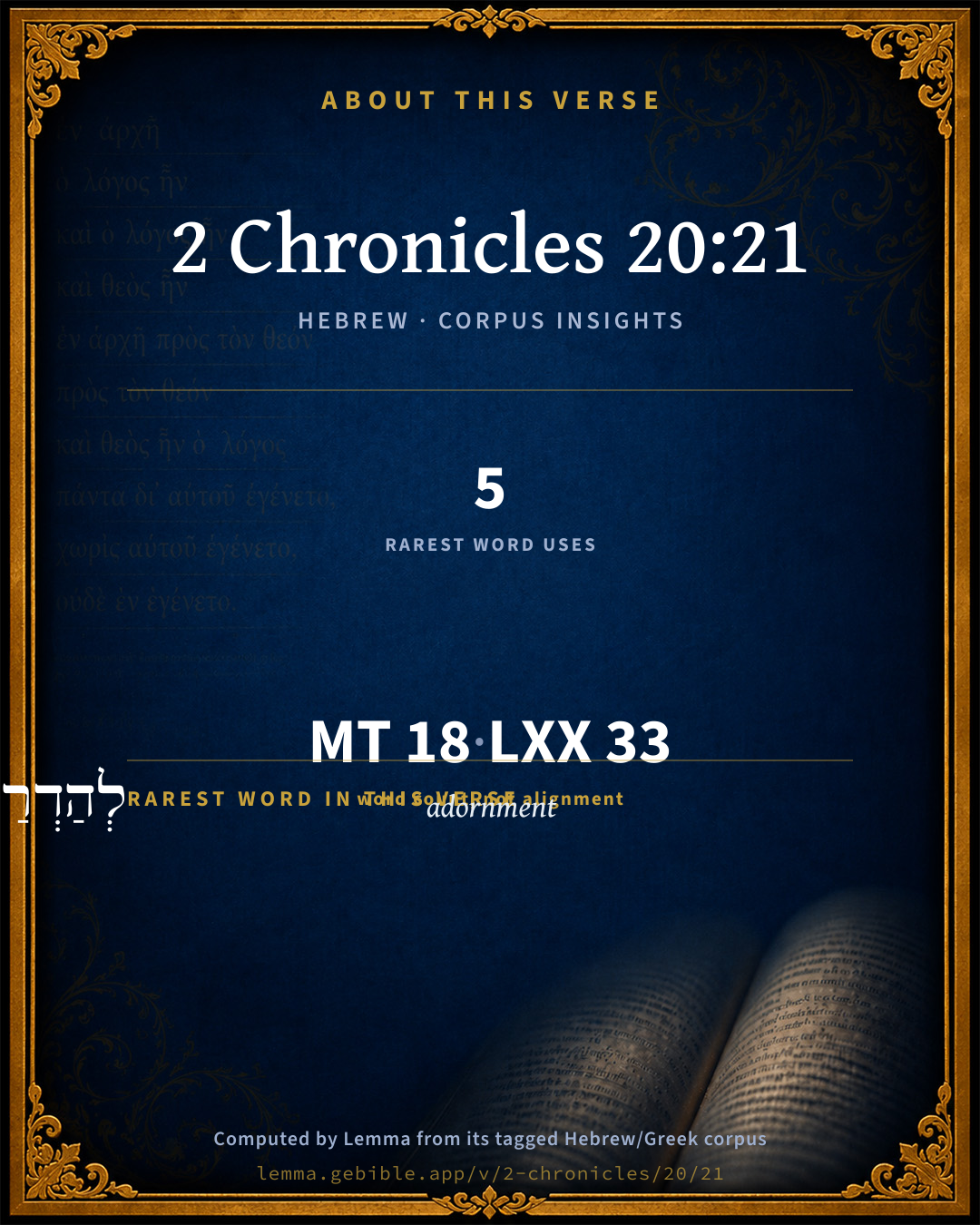
The rarest word here is לְהַדְרַת adornment H1927 — appearing just 5 times in the whole Hebrew Bible.

Shared distinctive vocabulary

לְהַדְרַת adornment H1927 occurs in 5 verses of the Hebrew Bible. Also found in:

Grammatical profile

  • 8 verbs
  • 8 nouns
  • 1 preposition
  • 1 conjunction

Verb forms

  • וַיִּוָּעַץ֙ Niphal · Sequential Imperfect
  • וַיַּעֲמֵ֤ד Hiphil · Sequential Imperfect
  • מְשֹֽׁרֲרִים֙ Polel · Participle Active
  • וּֽמְהַֽלְלִ֖ים Piel · Participle Active
  • בְּצֵאת֙ Qal · Infinitive Construct
  • הֶֽחָל֔וּץ Qal · Participle Passive
  • וְאֹֽמְרִים֙ Qal · Participle Active
  • הוֹד֣וּ Hiphil · Imperative

Repetition

A word recurs within this verse — often emphatic in Hebrew:

  • לַיהוָ֔ה LORD H3068 ×2

Hebrew & Septuagint length

In English translation the verse runs 41 words from the Hebrew and 46 from the Septuagint (LXX English) — closely comparable.

A rough comparison of the two English renderings, which tokenize alike — not a word-level alignment.

Word counts can differ between the Hebrew and the Greek without any difference in meaning — e.g. the Hebrew direct-object marker אֵת has no separate Greek word, and Greek often adds the article ὁ.

In the original languages it is 18 Hebrew tokens and 33 Greek tokens — but the two are counted differently (Hebrew bundles its prefixes and suffixes into one token; the Greek is in lemma form), so that isn’t a like-for-like length.

Cross-references

20

Topical passages linked to 2 Chronicles 20:21 in the Treasury of Scripture Knowledge — connected by theme and wording, ordered by reader-vote popularity; previews shown in the World English Bible.

  • Psalms 107:1 Give thanks to Yahweh, For he is good, For his loving kindness endures forever.
  • Psalms 106:1 Praise Yahweh! Give thanks to Yahweh, for he is good, For his loving kindness endures forever.
  • 2 Chronicles 5:13 it happened, when the trumpeters and singers were as one, to make one sound to be heard in praising and thanking Yahweh; and when they lifted up their voice with the trumpets and cymbals and instruments of music, and praised Yahweh, [saying], For he is good; for his loving kindness endures forever; that then the house was filled with a cloud, even the house of Yahweh,
  • 1 Chronicles 16:34 Oh give thanks to Yahweh; for he is good; For his loving kindness endures forever.
  • 1 Chronicles 16:29 Ascribe to Yahweh the glory due to his name: Bring an offering, and come before him: Worship Yahweh in holy array.
  • Ezra 3:10–11 When the builders laid the foundation of the temple of Yahweh, they set the priests in their clothing with trumpets, and the Levites the sons of Asaph with cymbals, to praise Yahweh, after the order of David king of Israel.
  • Psalms 29:2 Ascribe to Yahweh the glory due to his name. Worship Yahweh in holy array.
  • Jeremiah 33:11 the voice of joy and the voice of gladness, the voice of the bridegroom and the voice of the bride, the voice of those who say, Give thanks to Yahweh of Hosts, for Yahweh is good, for his loving kindness endures forever; [and of them] who bring [sacrifices of] thanksgiving into the house of Yahweh. For I will cause the captivity of the land to return as at the first, says Yahweh.
  • 2 Chronicles 7:3 All the children of Israel looked on, when the fire came down, and the glory of Yahweh was on the house; and they bowed themselves with their faces to the ground on the pavement, and worshiped, and gave thanks to Yahweh, [saying], For he is good; for his loving kindness endures for ever.
  • 2 Chronicles 7:6 The priests stood, according to their offices; the Levites also with instruments of music of Yahweh, which David the king had made to give thanks to Yahweh, (for his loving kindness endures for ever), when David praised by their ministry: and the priests sounded trumpets before them; and all Israel stood.
  • 1 Chronicles 13:1–2 David consulted with the captains of thousands and of hundreds, even with every leader.
  • 2 Chronicles 29:25–30 He set the Levites in the house of Yahweh with cymbals, with psalteries, and with harps, according to the commandment of David, and of Gad the king's seer, and Nathan the prophet; for the commandment was of Yahweh by his prophets.
  • Nehemiah 12:27 At the dedication of the wall of Jerusalem they sought the Levites out of all their places, to bring them to Jerusalem, to keep the dedication with gladness, both with giving thanks, and with singing, with cymbals, psalteries, and with harps.
  • Psalms 90:17 Let the favor of the Lord our God be on us; Establish the work of our hands for us; Yes, establish the work of our hands.
  • Psalms 96:9 Worship Yahweh in holy array. Tremble before him, all the earth.
  • Psalms 136:1–26 Give thanks to Yahweh, for he is good; For his loving kindness endures forever.
  • 1 Chronicles 16:41 and with them Heman and Jeduthun, and the rest who were chosen, who were mentioned by name, to give thanks to Yahweh, because his loving kindness endures forever;
  • 2 Chronicles 30:21 The children of Israel who were present at Jerusalem kept the feast of unleavened bread seven days with great gladness; and the Levites and the priests praised Yahweh day by day, [singing] with loud instruments to Yahweh.
  • Psalms 50:2 Out of Zion, the perfection of beauty, God shines forth.
  • Proverbs 11:14 Where there is no wise guidance, the nation falls, But in the multitude of counselors there is victory.

Cross-references courtesy of OpenBible.info (CC BY 4.0).

Hebrew and Greek witnesses Masoretic Hebrew ↔ Greek Septuagint

The same verse in the two great witnesses to the Old Testament, shown verse-for-verse.

These are two independent witnesses, not word-aligned to each other, and the Septuagint is shown in lemma (dictionary) form.

Hebrew 2 Chronicles 20:21 Masoretic · Westminster Leningrad Codex

וַיִּוָּעַץ֙ אֶל הָעָ֔ם וַיַּעֲמֵ֤ד מְשֹֽׁרֲרִים֙ לַיהוָ֔ה וּֽמְהַֽלְלִ֖ים לְהַדְרַת קֹ֑דֶשׁ בְּצֵאת֙ לִפְנֵ֣י הֶֽחָל֔וּץ וְאֹֽמְרִים֙ הוֹד֣וּ לַיהוָ֔ה כִּ֥י לְעוֹלָ֖ם חַסְדּֽוֹ

When he had taken counsel with the people, he appointed those who should sing to Yahweh, and give praise in holy array, as they went out before the army, and say, Give thanks to Yahweh; for his loving kindness endures forever.

World English Bible · Public Domain

Greek LXX 2 Chronicles 20:21 Septuagint · lemma form

καί βουλεύω μετά ὁ λαός καί ἵστημι ψαλτῳδός καί αἰνέω ἐκὁμολογέω καί αἰνέω ὁ ἅγιος ἐν ὁ ἐκἔρχομαι ἔμπροσθεν ὁ δύναμις καί λέγω ἐκὁμολογέω ὁ κύριος ὅτι εἰς ὁ αἰών ὁ ἔλεος αὐτός

And he took counsel with the people, and set appointed men to sing psalms and praises, to give thanks, and sing the holy songs of praise in going forth before the host: and they said, Give thanks to the Lord, for his mercy endures for ever.

LXX2012 (modern English Septuagint) · Public Domain

Hebrew: Westminster Leningrad Codex (CC BY 4.0). Greek: Septuagint (public domain); English from LXX2012 (modern English Septuagint) (Public Domain). How the Septuagint differs from the Hebrew →

Commentary

Notes on 2 Chronicles 20:21 from classic Christian and Jewish commentators (each source and its license shown beneath its notes). The classic Christian expositions comment on the surrounding passage and are grouped to its opening verse, so a note may address several verses; the Jewish commentaries on the Tanakh (Rashi and others) are per-verse, so they appear only where the commentator wrote on this verse.

Lemma curates 59 commentaries, every one of them public domain or Creative Commons licensed, each selected and text-cleaned for this edition rather than reprinted as found. About our sources →

Trapp's Complete Commentary

John Trapp

2Ch 20:21 And when he had consulted with the people, he appointed singers unto the LORD, and that should praise the beauty of holiness, as they went out before the army, and to say, Praise the LORD; for his mercy [endureth] for ever.

Ver. 21. And when he had consulted with the people.] This gained him much respect amongst them; for he knew that it was no hunting invitis canibus, unwilling dogs, unless the hounds were willing, as the proverb is.

He appointed singers unto the Lord.] See on 2Ch 20:19. Faith lodgeth a certainty in the soul, believing God upon his bare word; and that against sense in things invisible, and against mason in things incredible.

And that should praise the beauty of holiness.] This is a description of God, saith Junius; of heaven, saith Vatablus; of the ark, say others. {Psa 29:2; Psa 96:9}

John Trapp, A Commentary or Exposition upon All the Books of the Old and New Testament (1647–1656) — public domain. Text from a community e-Sword module.

The Biblical Illustrator

Joseph S. Exell

2Ch_20:21

And when he had consulted with the people.

Shouting before the victory

Anybody can sing the Te Deum after the battle is over. The German soldiers shouted when they had conquered their foe in the first battle in the war with France. It did not want much of a spirit to do that. The difference between an ordinary man of war and a Christian is this: a Christian shouts before the victory, because he knows it is sure to come. You remember how the people gave a shout of triumph before the wall of Jericho before it fell down.

I. We are here taught the great duty of patriotism. In a leading newspaper it was stated that if we were not so good we might do a great many things which would be to our worldly advantage, that we are cursed with a great amount of scrupulousness with respect to our conduct in Ireland, Egypt, and Burmah; that if we were a little more unscrupulous, and did not trouble ourselves about the rights and wrongs of men, we might seize Egypt and settle all our differences in India. Yet all history proves to us that this kind of foreign policy in the long run is an utter fallacy. Why is it that the great Empires of Egypt, Assyria, Babylon, Persia, and Rome have fallen? Why has Spain lost her position and France been humbled in our own day? Because they yielded to the foul ungodly spirit of national self-assertion and aggression; because they did not praise the beauty of holiness.

II. Our special object is to illustrate the history of the Christian Church. We are engaged in a holy war. The Bishop of Durham said the Churches of this country were indebted to the Salvation Army, because they had revived the consciousness of the fact that the Church of God was an army, and that our great business as a country is war--not with one another, but with all human misery. What must we do? Praise the beauty of holiness. If we go forth to war, we must do as Jehoshaphat--we must needs be clothed with the Spirit of holiness. The apostle John was not ready for the great work he was called to until he had put on the power from on high, which was the Spirit of holiness. What was the practical result of the Pentecostal blessing? They were filled with the Holy Ghost. What followed? They were delivered from--

1. Cowardice.

2. Selfishness.

3. Ignorance.

John Wesley and those with him at Oxford saw, after reading the Bible, that holiness comes by faith. Our great mission is to spread Scriptural holiness. If we march forth to war with confidence in the Spirit of holiness, we shall triumph even without fighting. (Hugh Price Hughes, M.A.)

Enthusiastic soldiers

When the Spartans marched into battle, they advanced with cheerful songs, willing to fight; but when the Persians entered the conflict, you could hear, as the regiments came on, the crack of the whip, by which the officers drove the cowards to the fray. What wonder that the Spartans were like lions in the midst of Sheep! Were we enthusiastic soldiers of the Cross, through Gods help, nothing would be able to stand against us. (C. H. Spurgeon.)

Praise

The biographer of Bishop Hannington says, How often had he encouraged his companions in times of doubt or difficulty with the words, Never be disappointed, only praise.

The Biblical Illustrator, edited by Joseph S. Exell (c. 1880s–1900s) — public domain. Text from a community e-Sword module.

Joseph Benson's Commentary

2Ch 20:21. When he had consulted with the people — That is, with the elders and heads of the tribes, who represented the rest. He called a council of war, and it was resolved to appoint singers to go out before the army, who had nothing to do but to praise God, to praise his holiness, which is his beauty, to praise him as they did in the temple, that beauty of holiness, “with that good old doxology, which eternity itself,” as Henry says, “will not wear threadbare, Praise the Lord, for his mercy endureth for ever.” By this strange advance to the field of battle, Jehoshaphat showed his firm reliance on the word of God, which enabled him to triumph before the battle, to animate his own men, and confound the enemy.

Joseph Benson's Commentary on the Old and New Testaments (1811–1818) — public domain. Text from a community e-Sword module.

Geneva Bible (1599)

Geneva Bible translators

This was a Psalm of thanksgiving which they used commonly to sing when they praised the Lord for his benefits, and was made by David, Ps. 136.

Geneva Bible (1599) marginal notes — public domain. Text via Bolls.life.

Jamieson, Fausset & Brown

Robert Jamieson, A. R. Fausset & David Brown

he appointed singers . . . that they should praise . . . as they went out before the army--Having arranged the line of procession, he gave the signal to move forwards. The Levites led the van with their musical instruments; and singing the 136th Psalm, the people went on, not as an army marching against an enemy, but returning in joyful triumph after a victory.

Jamieson, Fausset & Brown — Commentary Critical and Explanatory on the Whole Bible (1871) — public domain (CC PDM 1.0). Text via the HelloAO Bible API.

Ellicott's Commentary for English Readers

(21) And when he had consulted with.—Or, advised, given counsel to, warned. (Comp. 2Ki_6:8.) Vulg., “deditque consilium populo, et statuit cantores domini.”

And that should praise the beauty of holiness.—Rather, and men praising, in holy apparel. i.e., Levitical vestments (1Ch_16:29; Psa_29:2).

And to say.—And saying.

Praise the Lord.—Give thanks unto Jehovah The refrain of the singers. (See on 1Ch_16:34; 1Ch_16:41; 2Ch_5:13; 2Ch_7:3.) The band of Levitical minstrels were to march before the army (halûq, the armed host; Jos_6:7).

A Bible Commentary for English Readers, edited by Charles John Ellicott (1878–1897) — public domain. Text from a community e-Sword module.

The Cambridge Bible for Schools and Colleges

gen. ed. J. J. S. Perowne

21. consulted] R.V. taken counsel.

singers unto the Lord, and that should praise] R.V. them that should sing unto the LORD, and praise. Cp. the preliminaries of the Battle of the Standard fought between the Scots and English in 1138.

the beauty of holiness] Cp. 1Ch_16:29 (note).

before the army] Contrast Jos_6:7; Jos_6:9 (the armed men precede the ark).

Praise] R.V. Give thanks; cp. 1Ch_16:41.

The Cambridge Bible for Schools and Colleges (gen. ed. J. J. S. Perowne; Cambridge University Press, 1878–1918) — public domain. Text from a community e-Sword module.

John Gill's Exposition

And when he had consulted with the people,.... His principal officers, in what order they should march, and in what manner they should form themselves, when they met the enemy, and how they should conduct as if they were to engage:

he appointed singers unto the Lord; to sing his praise, and give him glory, as if the victory was already completed, it being so sure:

and that should praise the beauty of holiness, as they went out before the army; that is, praise God, who is glorious in holiness, whose beauty lies in his holiness, and who is holy in all his ways and works:

and to say, praise the Lord, for his mercy endureth for ever; with which they were to conclude their songs of praise, as David did, and whose songs they might sing; see Psa 136:1.

John Gill's Exposition of the Whole Bible (1746–1763) — public domain (CC PDM 1.0). Text via the HelloAO Bible API.

Albert Barnes' Notes on the Bible

Praise the beauty of holiness - Some render, “in the beauty of holiness” - i. e. in rich apparel and ornaments suitable to a holy occasion. Compare Psa 29:2.

Albert Barnes' Notes on the Bible (1834–1885) — public domain. Text from a community e-Sword/MySword module.

Haydock's Catholic Bible Commentary

Ever. This was usually sung in times of joy, C. v. 13. The army seemed thus to be returning victorious. C.

George Leo Haydock (1774–1849), Haydock's Catholic Family Bible and Commentary, 1859 edition — public domain. Excludes Psalms (Douay-Rheims chapter numbering differs from Protestant) and Deuterocanonical books (Catholic canon only).

Matthew Poole's English Annotations

With the people, i.e. with the elders or chief of the people; partly to take their advice about the expediency of the thing; and partly that they might excite and prepare themselves, and the people under them, to this great work of praising God.

He appointed singers unto the Lord; to the honour and service of God.

The beauty of holiness, or, the glory, or magnificence, or majesty of holiness, i.e. (by a vulgar Hebraism,) the Holy Majesty; a periphrasis of God. Or, according to the beauty or magnificence of the sanctuary, i.e. in the same comely order and magnificent manner as they used to do it in the temple; where the following song was usually sung, as 2Ch 5:13; 7:3,6.

Matthew Poole's English Annotations on the Holy Bible (1683–1685) — public domain. Text from a community e-Sword/MySword module.

Whedon's Commentary on the Bible

Daniel D. Whedon

21. And that should praise the beauty of holiness — Literally, and those singing praise according to the beauty of holiness. The versions and interpreters have expressed this passage variously. Bertheau, Keil, and Rawlinson understand a reference to the beautiful garments and holy attire of the singers. But it seems better to understand the beauty (or ornament) of holiness in the spiritual sense of the blessed and beautiful state of soul in which these singers praised Jehovah.

Daniel D. Whedon (gen. ed.), Commentary on the Old and New Testaments (1874–1909) — public domain. Text from a community e-Sword module.

The Pulpit Commentary

And when he had consulted with the people; i.e. possibly simply "conferred with" those who were over the singers, as to who should be the most prominent in leading the service of praise, or as to what should be the words sung and other like matters of detail; or more probably, considering the exact form of language used, the reference is to what we are told Jehoshaphat had just done, to wit, counselled well the people and given good advice to them. Praise the beauty of holiness. The rendering should no doubt be in the beauty of holiness, i.e. in garments of beauty (1Ch_16:29; Psa_29:2; Revised Version margin, in holy army) Praise the Lord; Revised Version, give thanks to the. (2Ch_5:13 2Ch_7:3, 6 Psa 106:136)

The Pulpit Commentary (1880–1919), ed. H.D.M. Spence-Jones & Joseph S. Exell — public domain. Text from a community e-Sword module.

John Wesley's Explanatory Notes

Consulted - Jehoshaphat called a counsel of war, and it was resolved, to appoint singers to go out before the army, who had nothing to do, but to praise God, to praise his holiness, which is his beauty, to praise him as they did in the temple, that beauty of holiness. By this strange advance to the field of battle, Jehoshaphat shewed his firm reliance on the word of God, which enabled him to triumph before the battle, to animate his own men and confound the enemy.

John Wesley, Explanatory Notes Upon the Whole Bible (1754–1765) — public domain. Text via the GEBible commentary corpus.

Lesson kit

Teaching starters — assembled from the data on this page, not authored interpretation. Every prompt links to the verse data it draws on. Edit before teaching.

2 Chronicles, in the Historical, opens this verse with 18 words (17 distinct Hebrew lemmas). Its most distinctive word is hădârâh (“adornment”). A historical commentator’s framing appears above. Read the whole chapter for the surrounding context.

Discussion questions

  1. How does “adornment” (hădârâh) shape what this verse is saying?
  2. How does 1 Chronicles 16:29, which shares the word «adornment», read alongside this verse?
  3. What does the repetition of “LORD” (2× in this one verse) do in this verse?
  4. These translations render this verse differently; the difference is in the English rendering, not the original. What questions does that raise?
  5. «וַיִּוָּעַץ֙» is a Niphal Sequential Imperfect verb. How does that grammatical form shape the action described?
  6. Compare how Trapp's Complete Commentary and The Biblical Illustrator read this verse. Where do they agree or differ?

Things to notice

Reading settings

Reading text

Shown beneath each verse's original-language words.

Old Testament
Old Testament edition

Read the OT as the Masoretic Hebrew (MT) or the Greek Septuagint (LXX).

English shown for the Greek Septuagint (in the Hebrew ↔ Greek comparison).

Comparing translations? Open the Compare panel on any verse page to stack up to four side by side.