
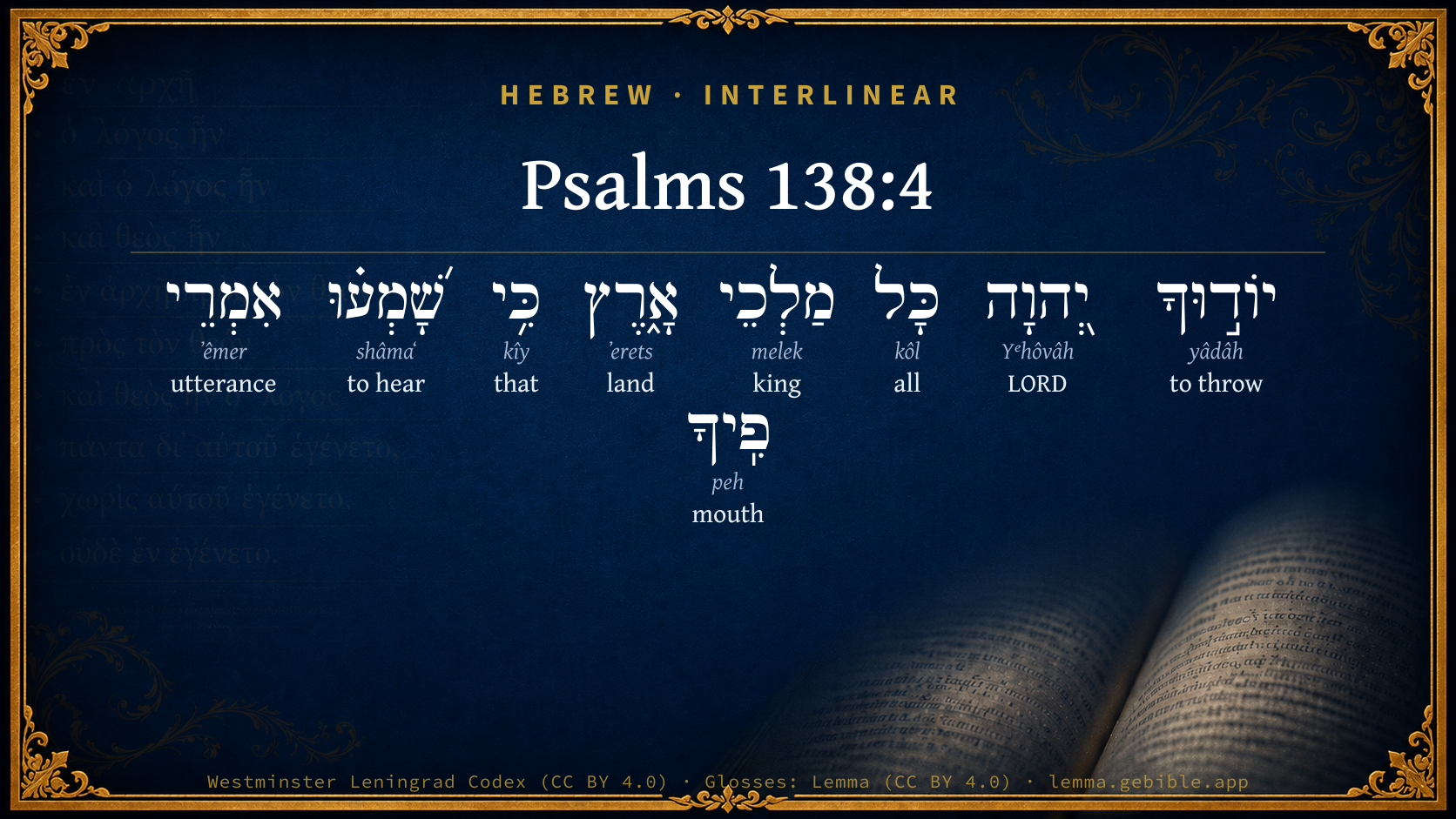
Psalms 138:4

Hebrew (Westminster Leningrad Codex) Psalms 138:4 appears in the Hebrew Old Testament. The text above is from the Westminster Leningrad Codex. Each word links to its Strong’s number, a concise gloss, and parsing drawn from the Open Scriptures Hebrew Bible morphology. Click any word for its full Brown-Driver-Briggs (BDB) entry.
Download image
Cite this verse

Psalms 138:4 (World English Bible). Public Domain. Lemma interlinear Bible study tool, https://lemma.gebible.app/v/psalms/138/4.

Show BibTeX & RIS
BibTeX
RIS
English Translation
All the kings of the earth will give you thanks, Yahweh, For they have heard the words of your mouth.
World English Bible · Public Domain
Download a study sheet

One document with this verse’s original text, its word-by-word gloss line, the meaning frame, cross-references with their text, attributed commentary, and full source and license credits — printable, and it pastes into notes with its structure intact.

This verse Autodidact and up

Study sheet (.html) Plain text (.txt)

A passage Seminary Student

Up to 50 verses in one chapter. A passage sheet keeps up to 6 commentary sources and 12 cross-references per verse, in the order this page ranks them, and says so on the sheet whenever that leaves anything out. Ask for a single verse and you get the Autodidact verse sheet above.

Everything on this page stays free to read, with no account — the sheet is a download of what is already on screen, not access to it.

Want to remove ads? Support Godless Engineer
Compare translations 3

The same verse in 3 English versions, stacked beneath the original-language interlinear above. Click any original word for its lexicon entry.

Each is an independent rendering of the whole verse — the interlinear is not word-aligned to these translations.

Highlighted words mark where these versions differ — a whole-verse word diff, not a word-by-word alignment.

  • World English Bible Public Domain
    All the kings of the earth will give you thanks, Yahweh, For they have heard the words of your mouth.
  • King James Version Public Domain
    All the kings of the earth shall praise thee, O LORD, when they hear the words of thy mouth.
  • unfoldingWord Literal Text CC BY-SA 4.0
    May all the kings of the earth thank you, Yahweh, because they heard the words from your mouth.

unfoldingWord Literal Text — © unfoldingWord, licensed CC BY-SA 4.0. Word-aligned USFM3 via Door43 (git.door43.org/unfoldingWord/en_ult).

Versions to compare (up to 4)

3 of 4 selected

Show all 18 translations

Every available English version of this verse, each an independent rendering of the whole verse.

  • World English Bible Public Domain
    All the kings of the earth will give you thanks, Yahweh, For they have heard the words of your mouth.
  • Berean Standard Bible Public Domain
    All the kings of the earth will give You thanks, O LORD, when they hear the words of Your mouth.
  • Majority Standard Bible Public Domain
    All the kings of the earth will give You thanks, O LORD, when they hear the words of Your mouth.
  • King James Version Public Domain
    All the kings of the earth shall praise thee, O LORD, when they hear the words of thy mouth.
  • American Standard Version (1901) Public Domain
    All the kings of the earth shall give thee thanks, O Jehovah, For they have heard the words of thy mouth.
  • Revised Version (1885) Public Domain
    All the kings of the earth shall give thee thanks, O LORD, for they have heard the words of thy mouth.
  • Geneva Bible (1599) Public Domain
    All the Kings of the earth shall praise thee, O Lord: for they haue heard the wordes of thy mouth.
  • Douay-Rheims (1899) Public Domain
    How shall we sing the song of the Lord in a strange land?
  • Young's Literal Translation Public Domain
    O Jehovah, all kings of earth confess Thee, When they have heard the sayings of Thy mouth.
  • Literal Standard Version CC BY-SA 4.0
    O YHWH, all kings of earth confess You, || When they have heard the sayings of Your mouth.
  • Unlocked Literal Bible CC BY-SA 4.0
    All the kings of the earth will give you thanks, Yahweh, for they will hear the words from your mouth.
  • unfoldingWord Literal Text CC BY-SA 4.0
    May all the kings of the earth thank you, Yahweh, because they heard the words from your mouth.
  • Darby Bible Public Domain
    All the kings of the earth shall celebrate thee, Jehovah, when they have heard the words of thy mouth;
  • World Messianic Bible Public Domain
    All the kings of the earth will give you thanks, LORD, for they have heard the words of your mouth.
  • Webster's Bible Public Domain
    All the kings of the earth shall praise thee, O LORD, when they hear the words of thy mouth.
  • Free Bible Version CC BY-SA 4.0
    All the kings of the earth will praise you, Lord, for they have heard what you have said.
  • Bible in Basic English Public Domain
    All the kings of the earth will give you praise, O Lord, when the words of your mouth come to their ears.
  • JPS Tanakh (1917) Public Domain
    All the kings of the earth shall give Thee thanks, O LORD, for they have heard the words of Thy mouth.

Literal Standard Version (2020), Covenant Press — licensed CC BY-SA 4.0. Text via the HelloAO Bible API (eBible.org). Unlocked Literal Bible (unfoldingWord) — licensed CC BY-SA 4.0. Text via the HelloAO Bible API (eBible.org). unfoldingWord Literal Text — © unfoldingWord, licensed CC BY-SA 4.0. Word-aligned USFM3 via Door43 (git.door43.org/unfoldingWord/en_ult). Free Bible Version, Dr. Jonathan Gallagher — licensed CC BY-SA 4.0. Text via the HelloAO Bible API (eBible.org).

Word by word

More ways to search: Search by grammar → Find every occurrence → Compare this word →

Practice this passage: Drill this verse → Learn its vocabulary →

About this verse

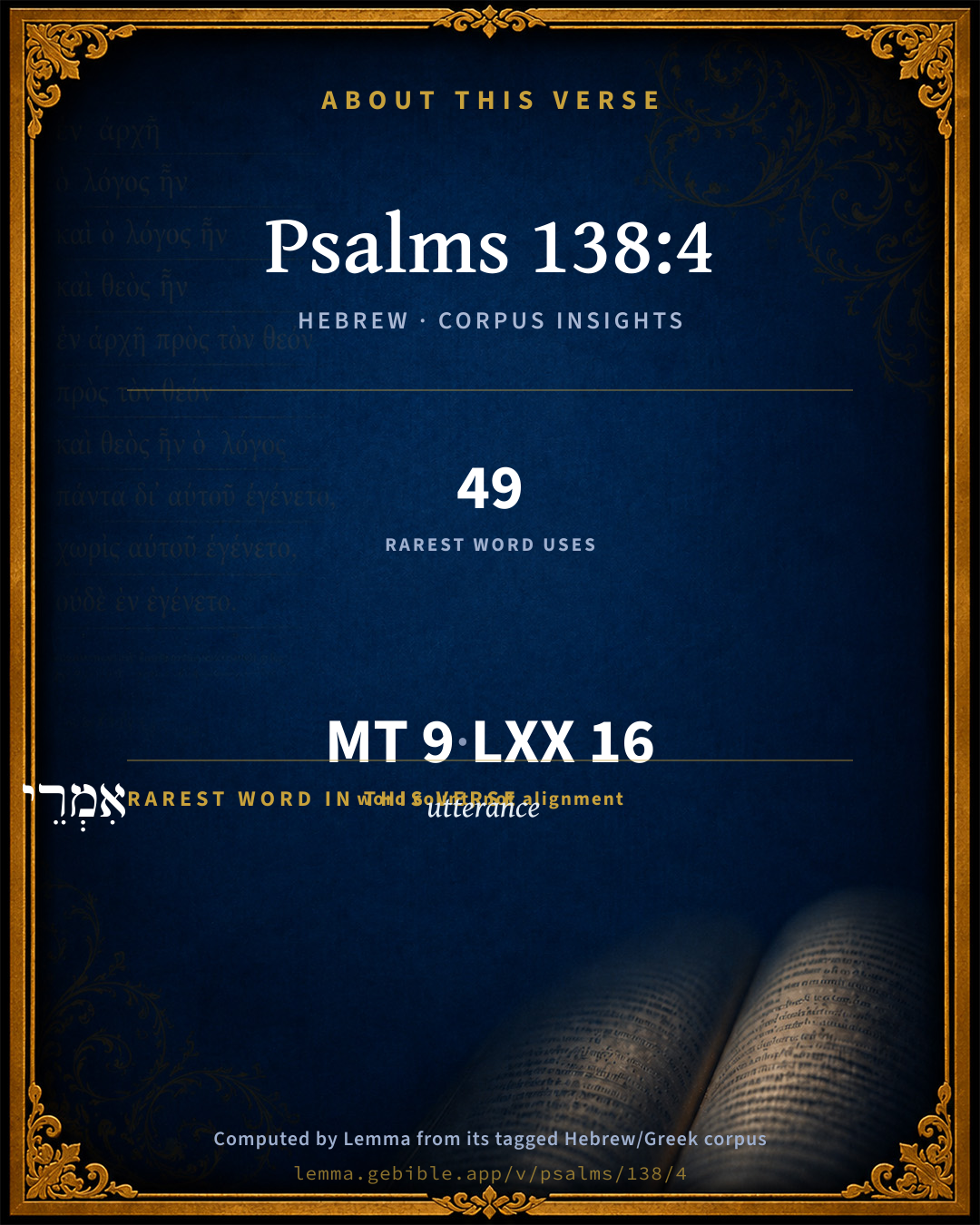
These counts appear in no published source. They are computed here, from the morphology-tagged text and Lemma’s own curated glosses. What Lemma adds →

9
words
9
distinct lemmas
Wisdom
section

Shared distinctive vocabulary

אִמְרֵי utterance H561 occurs in 47 verses of the Hebrew Bible. Also found in:

Grammatical profile

  • 2 verbs
  • 6 nouns
  • 1 conjunction

Verb forms

  • יוֹד֣וּךָ Hiphil · Imperfect
  • שָׁ֝מְע֗וּ Qal · Perfect

Hebrew & Septuagint length

In English translation the verse runs 20 words from the Hebrew and 23 from the Septuagint (LXX English) — closely comparable.

A rough comparison of the two English renderings, which tokenize alike — not a word-level alignment.

Word counts can differ between the Hebrew and the Greek without any difference in meaning — e.g. the Hebrew direct-object marker אֵת has no separate Greek word, and Greek often adds the article ὁ.

In the original languages it is 9 Hebrew tokens and 16 Greek tokens — but the two are counted differently (Hebrew bundles its prefixes and suffixes into one token; the Greek is in lemma form), so that isn’t a like-for-like length.

Cross-references

13

Topical passages linked to Psalms 138:4 in the Treasury of Scripture Knowledge — connected by theme and wording, ordered by reader-vote popularity; previews shown in the World English Bible.

  • Psalms 102:15 So the nations will fear the name of Yahweh; All the kings of the earth your glory.
  • Psalms 72:11 Yes, all kings shall fall down before him. All nations shall serve him.
  • Psalms 22:22 I will declare your name to my brothers. In the midst of the assembly, I will praise you.
  • Psalms 22:27 All the ends of the earth shall remember and turn to Yahweh. All the relatives of the nations shall worship before you.
  • Psalms 102:22 When the peoples are gathered together, The kingdoms, to serve Yahweh.
  • Isaiah 49:23 Kings shall be your nursing fathers, and their queens your nursing mothers: they shall bow down to you with their faces to the earth, and lick the dust of your feet; and you shall know that I am Yahweh; and those who wait for me shall not be disappointed.
  • Isaiah 60:3–5 Nations shall come to your light, and kings to the brightness of your rising.
  • Isaiah 60:16 You shall also suck the milk of the nations, and shall suck the breast of kings; and you shall know that I, Yahweh, am your Savior, and your Redeemer, the Mighty One of Jacob.
  • Revelation 11:15 The seventh angel sounded, and great voices in heaven followed, saying, "The kingdom of the world has become the Kingdom of our Lord, and of his Christ. He will reign forever and ever!"
  • Revelation 21:24 The nations will walk in its light. The kings of the earth bring the glory and honor of the nations into it.
  • Psalms 51:13 Then I will teach transgressors your ways. Sinners shall be converted to you.
  • Psalms 69:30–32 I will praise the name of God with a song, And will magnify him with thanksgiving.
  • Psalms 71:18 Yes, even when I am old and gray-haired, God, don't forsake me, Until I have declared your strength to the next generation, Your might to everyone who is to come.

Cross-references courtesy of OpenBible.info (CC BY 4.0).

Hebrew and Greek witnesses Masoretic Hebrew ↔ Greek Septuagint

The same verse in the two great witnesses to the Old Testament, shown verse-for-verse.

You’re reading Greek Psalm 137 (Hebrew Psalm 138). The Septuagint counts the superscription, so verse numbers can differ from the Hebrew — chapter-level alignment, not verse-by-verse. Numbering follows Rahlfs.

These are two independent witnesses, not word-aligned to each other, and the Septuagint is shown in lemma (dictionary) form.

Hebrew Psalms 138:4 Masoretic · Westminster Leningrad Codex

יוֹד֣וּךָ יְ֭הוָה כָּל מַלְכֵי אָ֑רֶץ כִּ֥י שָׁ֝מְע֗וּ אִמְרֵי פִֽיךָ

All the kings of the earth will give you thanks, Yahweh, For they have heard the words of your mouth.

World English Bible · Public Domain

Greek LXX Greek Psalm 137:4 Septuagint · lemma form

ἐκὁμολογέω σύ κύριος πᾶς ὁ βασιλεύς ὁ γῆ ὅτι ἀκούω πᾶς ὁ ῥῆμα ὁ στόμα σύ

Let all the kings of the earth, o Lord, give thanks to you; for they have heard all the words of your mouth.

LXX2012 (modern English Septuagint) · Public Domain

Hebrew: Westminster Leningrad Codex (CC BY 4.0). Greek: Septuagint (public domain); English from LXX2012 (modern English Septuagint) (Public Domain). How the Septuagint differs from the Hebrew →

Commentary

Notes on Psalms 138:4 from classic Christian and Jewish commentators (each source and its license shown beneath its notes). The classic Christian expositions comment on the surrounding passage and are grouped to its opening verse, so a note may address several verses; the Jewish commentaries on the Tanakh (Rashi and others) are per-verse, so they appear only where the commentator wrote on this verse.

Lemma curates 59 commentaries, every one of them public domain or Creative Commons licensed, each selected and text-cleaned for this edition rather than reprinted as found. About our sources →

Trapp's Complete Commentary

John Trapp

Psa 138:4 All the kings of the earth shall praise thee, O LORD, when they hear the words of thy mouth.

Ver. 4. All the kings of the earth shall praise thee] Such of them as shall read these psalms of my composing; or otherwise shall hear of thy gracious dealing with me, according to thy promise. Such also as shall hereafter be converted to the faith; for though "Not many mighty, not many noble, are called," 1Co 1:26, yet some are, and these shine in the Church like stars of the first magnitude.

John Trapp, A Commentary or Exposition upon All the Books of the Old and New Testament (1647–1656) — public domain. Text from a community e-Sword module.

Joseph Benson's Commentary

Psa 138:4-5. All the kings of the earth shall praise thee — All the neighbouring kings; or, rather, this is a prophecy of the calling of the Gentiles, and so the generality of the kings of the earth are intended, according to the prediction, Psa 72:11; All kings shall fall down before him, all nations shall serve him; when they shall hear the words of thy mouth — The gospel preached among them. Yea, they shall sing in the ways — Or, of, or, because of the ways, of the Lord; that is, his wonderful counsel and gracious providences toward themselves and others. For great is — Or, great shall be, the glory of the Lord — At that time the worship and glory of God shall not be confined to one small land, as now it is, but shall be extended to all parts of the world.

Joseph Benson's Commentary on the Old and New Testaments (1811–1818) — public domain. Text from a community e-Sword module.

J. A. Alexander on Psalms

Joseph Addison Alexander

4. (Psa 138:4) Jehovah, all kings of the earth shall acknowledge thee, when they have heard the sayings of thy mouth. Not merely one king, though that king be David, shall acknowledge, thank, and praise thee, but all others who receive the true religion, when they know what thou hast promised, and especially when they compare the promise and fulfilment, with particular reference to the promise of Messiah, which is described in Scripture as a grand means for the conversion of the nations and the chiefs which represent them. See above, on Psa 68:29; Psa 68:31; Psa 102:15.

Joseph Addison Alexander, The Psalms Translated and Explained (1850) — public domain. Text from a community e-Sword module.

Tyndale Open Study Notes

Tyndale Open Resources

138:4-5 As the Lord’s glory fills the earth, the world’s population must willingly submit to him. Every king (cp. Ps 2) will join the community of praise as they hear the Lord’s ways of truth and love.

Tyndale Open Study Notes — © Tyndale Open Resources, licensed CC BY-SA 4.0. Text via the HelloAO Bible API.

Geneva Bible (1599)

Geneva Bible translators

All the world shall confess that thou hast wonderfully preserved me, and performed thy promise.

Geneva Bible (1599) marginal notes — public domain. Text via Bolls.life.

Adam Clarke's Commentary

Verse 4. All the kings of the earth] Of the land: all the neighbouring nations, seeing what is done for us, and looking in vain to find that any human agency was employed in the work, will immediately see that it was thy hand; and consequently, by confessing that it was thou, will give praise to thy name.

Adam Clarke's Commentary on the Bible (1810–1826) — public domain. Text from a community e-Sword/MySword module.

John Calvin's Commentaries

4. Let all kings of the earth praise thee Here he declares that the goodness he had experienced would be extensively known, and the report of it spread over all the world. In saying that even kings had heard the words of God’s mouth, he does not mean to aver that they had been taught in the true religion so as to be prepared for becoming members of the Church, but only that it would be well known everywhere that the reason of his having been preserved in such a wonderful manner was God’s having anointed him king by his commandment. “Sed hoc ubique fore notum, non alia de causa mirabiliter servatum fuisse a Deo, nisi quod ejus mandate unctus fuerat in Regem.” — Lat.

John Calvin's Commentaries (1540-1563) — public domain. Text from the Calvin Translation Society English edition (1840s-50s) via the Christian Classics Ethereal Library (ccel.org). Calvin's coverage is partial (roughly two-thirds of the Bible); uncommented books and verses are honest gaps, never fabricated. The 19th-century editor's footnotes and remarks are omitted so the notes are faithfully Calvin's own voice.

Ellicott's Commentary for English Readers

(4, 5) The general sense of these verses is plain, though there are slightly different ways of understanding the expressions. The psalmist imagines that the word or promise, which has been so abundantly fulfilled, will, by its performance, convince all the kings of the earth, and bring them in confession and praise to Jehovah. For a Hebrew the expression “hear the words of Thy mouth,” referring in this instance immediately back to Psa_138:2, was synonymous with “see Thy wonders,” since for them “God spoke and it was done.”

A Bible Commentary for English Readers, edited by Charles John Ellicott (1878–1897) — public domain. Text from a community e-Sword module.

The Cambridge Bible for Schools and Colleges

gen. ed. J. J. S. Perowne

4. All the kings of the earth shall give thanks unto thee, Jehovah] When the kings of the nations hear of Jehovah’s promises to Israel and His fulfilment of them, they will join in the Psalmist’s thanksgiving. Cp. Psa_68:29 ff.; Psa_102:15-16.

4–6. Jehovah’s faithfulness to His promises will evoke the homage of the world.

The Cambridge Bible for Schools and Colleges (gen. ed. J. J. S. Perowne; Cambridge University Press, 1878–1918) — public domain. Text from a community e-Sword module.

John Gill's Exposition

All the kings of the earth shall praise thee, O Lord,.... Or "let them confess", or "praise thee" (s); a wish or prayer. Not only the kings known to David, as Kimchi limits it; or that lived in his days, as Hiram and others; but in the latter day, when they shall come to Zion, the church, and be nursing fathers to it, and shall serve and worship the King Messiah, Isa 49:23;

when they hear the words of thy mouth; either the promises of it fulfilled not only with respect to David; but the Messiah, and his church and people, in the latter day, even the glorious things spoken thereof: or the doctrines of the Gospel, which are the words of his mouth, and more desirable than thousands of gold and silver; and which, when kings shall hear so as to understand, they will praise the Lord for them; see Isa 52:15. The Targum is,

"the words of thy praise.''

(s) "confiteantur tibi", V. L. Pagninus, Montanus.

John Gill's Exposition of the Whole Bible (1746–1763) — public domain (CC PDM 1.0). Text via the HelloAO Bible API.

Albert Barnes' Notes on the Bible

All the kings of the earth shall praise thee ... - That is, kings, princes, and rulers shall learn the words of promise; shall be made acquainted with the words which thou hast graciously spoken, and with their fulfillment, and shall be led to praise thee. This refers to a time, of which frequent prophetic mention is made in the Scriptures, when kings and rulers shall be converted to the true religion, and when they shall act an important part, by their example and influence, in maintaining and diffusing it. Compare Psa 68:31-32; Isa 49:23.

Albert Barnes' Notes on the Bible (1834–1885) — public domain. Text from a community e-Sword/MySword module.

Matthew Poole's English Annotations

Either,

1. All neighbouring kings; or,

2. The generality of kings and princes upon earth. And so this is a prophecy of the calling of the Gentiles, which seems to be confirmed by the next verse, which expresseth their extraordinary joy; and an eminent advancement of God’s glory, which agrees much better to this great occasion, than to that of David’s exaltation to the throne, wherein the other kings of the earth were not much concerned.

The words of thy mouth; either,

1. Thy promises declared unto them by me; or,

2. The gospel preached among them.

Matthew Poole's English Annotations on the Holy Bible (1683–1685) — public domain. Text from a community e-Sword/MySword module.

The Treasury of David

Charles H. Spurgeon

Ver. 4. All the kings of the earth shall praise thee, O Lord, when they hear the words of thy mouth. Kings have usually small care to hear the word of the Lord; but King David feels assured that if they do hear it they will feel its power. A little piety goes a long way in courts; but brighter days are coming, in which rulers will become hearers and worshippers: may the advent of such happy times be hastened. What an assembly! "all the kings of the earth!" What a purpose! Gathered to hear the words of Jehovah's mouth. What a preacher! David himself rehearses the words of Jehovah. What praise! when they all in happy union lift up their songs unto the Lord. Kings are as gods below, and they do well when they worship the God above. The way of conversion for kings is the same as for ourselves: faith to them also cometh by hearing, and hearing by the word of God. Happy are those who can cause the word of the Lord to penetrate palaces; for the occupants of thrones are usually the last to know the joyful sounds of the gospel. David, the king, cared for kings' souls, and it will be wise for each man to look first after those who are of his own order. He went to his work of testimony with fall assurance of success: he meant to speak only the words of Jehovah's mouth, and he felt sure that the kings would hear and praise Jehovah.

Ver. 4. All the kings of the earth shall praise thee. In a sense sufficiently striking this promise was fulfilled to David, and to the nation of Israel, as surrounding monarchs beheld the wonderful dispensations of divine providence which attended their steps (2Sa 5:11 8:10); but in its completest sense, it shall realize its accomplishment in the future conquests of Messiah, when the princes and potentates of the earth receive his word, learn by divine grace to celebrate the glorious methods of his love, and see in the light of faith the greatness of Jehovah's glory as the God of salvation. "All the kings of the earth" shall yet praise the Lord, and shall hasten with their numerous subjects to hail the triumphs of his grace. John Morison.

Ver. 4.

1. A royal audience.

2. A royal orchestra.

Ver. 4-5.

1. They who hear the words of God will know God.

2. They who know God will praise him, however exalted they may be amongst men: "All the kings, "etc.

3. They who praise God will walk in his ways.

4. They who walk in the ways of the Lord will glorify him, and he will be glorified in them.

G.R.

Psalms 138:5*

Charles H. Spurgeon's The Treasury of David (1869–1885) — public domain. Psalms only. Text from a community e-Sword/MySword module.

Whedon's Commentary on the Bible

Daniel D. Whedon

4, 5. The kings of the earth shall praise thee—The words give the moral tendency and intent of this wonderful display of divine mercy, and, as a general thing, its ultimate effect—namely, to cause the nations to confess and praise Jehovah. A result to be fully realized only in gospel times through the unfoldings of the great gospel word.

Daniel D. Whedon (gen. ed.), Commentary on the Old and New Testaments (1874–1909) — public domain. Text from a community e-Sword module.

The Pulpit Commentary

All the kings of the earth shall praise thee, O Lord. The world shall be converted to thy worship when it is seen how promptly and fully thou answerest prayer. (comp. Psa_68:31, 32 102:15) When they hear the words of thy mouth. The promises that thou makest, and thy performance of them.

The Pulpit Commentary (1880–1919), ed. H.D.M. Spence-Jones & Joseph S. Exell — public domain. Text from a community e-Sword module.

John Wesley's Explanatory Notes

The kings - A prophecy of the calling of the Gentiles. Hear - The gospel preached among then.

John Wesley, Explanatory Notes Upon the Whole Bible (1754–1765) — public domain. Text via the GEBible commentary corpus.

Rashi

Rabbi Shlomo Yitzchaki (Rashi)

for they heard When they heard the words of Your mouth: “You shall not murder; You shall not commit adultery,” they acknowledged the words of Your mouth: “I am [the Lord your God]” and “You shall have no [other god].” It is proper to make them first accept the yoke of His kingdom, and then He should levy all His decrees.

Rashi on the Tanakh — English translations: “The Judaica Press complete Tanach with Rashi, translated by A. J. Rosenberg” (CC BY 4.0); “Pentateuch with Rashi's commentary by M. Rosenbaum and A.M. Silbermann, 1929-1934” (public domain); “The Metsudah Tanach series, Lakewood, N.J” (CC BY 4.0); and “The Book of Joshua, Metsudah Publications, 1997” (CC BY 4.0). Text via Sefaria.

Lesson kit

Teaching starters — assembled from the data on this page, not authored interpretation. Every prompt links to the verse data it draws on. Edit before teaching.

Psalms, in the Wisdom, opens this verse with 9 words (9 distinct Hebrew lemmas). Its most distinctive word is ʼêmer (“utterance”). A historical commentator’s framing appears above. Read the whole chapter for the surrounding context.

Discussion questions

  1. The word ʼêmer carries the sense “utterance.” How does it shape the verse?
  2. Genesis 49:21 shares the word «utterance» with this verse. How do the two illuminate each other?
  3. These translations render this verse differently; the difference is in the English rendering, not the original. What questions does that raise?
  4. The verb «יוֹד֣וּךָ» is Hiphil Imperfect. How does its form color the action?
  5. Reading how Trapp's Complete Commentary and Joseph Benson's Commentary read this verse, where do the two commentators agree and where do they part?

Things to notice

Reading settings

Reading text

Shown beneath each verse's original-language words.

Old Testament
Old Testament edition

Read the OT as the Masoretic Hebrew (MT) or the Greek Septuagint (LXX).

English shown for the Greek Septuagint (in the Hebrew ↔ Greek comparison).

Comparing translations? Open the Compare panel on any verse page to stack up to four side by side.