
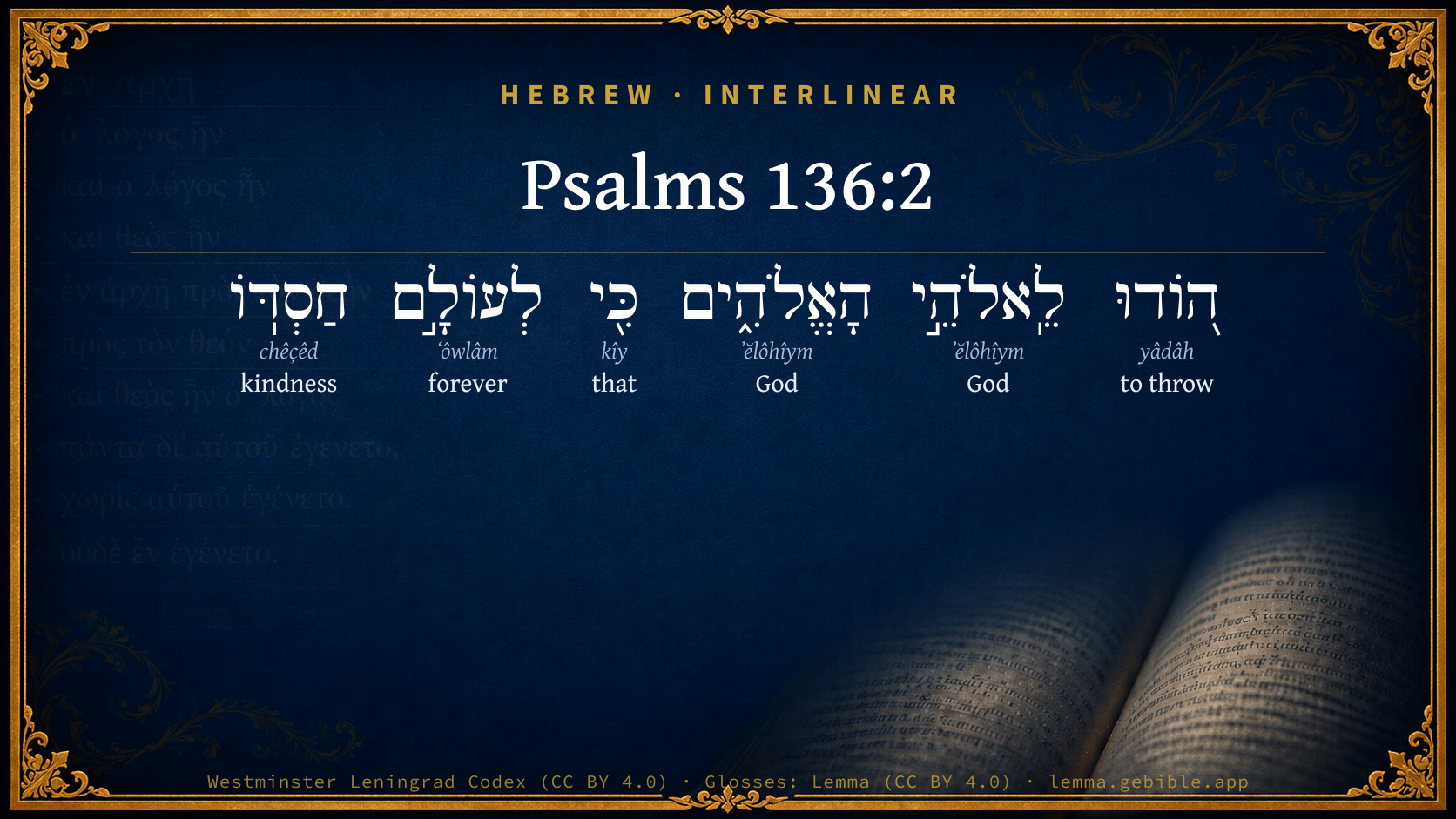
Psalms 136:2

Hebrew (Westminster Leningrad Codex) Psalms 136:2 appears in the Hebrew Old Testament. The text above is from the Westminster Leningrad Codex. Each word links to its Strong’s number, a concise gloss, and parsing drawn from the Open Scriptures Hebrew Bible morphology. Click any word for its full Brown-Driver-Briggs (BDB) entry.
Download image
Cite this verse

Psalms 136:2 (World English Bible). Public Domain. Lemma interlinear Bible study tool, https://lemma.gebible.app/v/psalms/136/2.

Show BibTeX & RIS
BibTeX
RIS
English Translation
Give thanks to the God of gods; For his loving kindness endures forever.
World English Bible · Public Domain
Download a study sheet

One document with this verse’s original text, its word-by-word gloss line, the meaning frame, cross-references with their text, attributed commentary, and full source and license credits — printable, and it pastes into notes with its structure intact.

This verse Autodidact and up

Study sheet (.html) Plain text (.txt)

A passage Seminary Student

Up to 50 verses in one chapter. A passage sheet keeps up to 6 commentary sources and 12 cross-references per verse, in the order this page ranks them, and says so on the sheet whenever that leaves anything out. Ask for a single verse and you get the Autodidact verse sheet above.

Everything on this page stays free to read, with no account — the sheet is a download of what is already on screen, not access to it.

Want to remove ads? Support Godless Engineer
Compare translations 3

The same verse in 3 English versions, stacked beneath the original-language interlinear above. Click any original word for its lexicon entry.

Each is an independent rendering of the whole verse — the interlinear is not word-aligned to these translations.

Highlighted words mark where these versions differ — a whole-verse word diff, not a word-by-word alignment.

  • World English Bible Public Domain
    Give thanks to the God of gods; For his loving kindness endures forever.
  • King James Version Public Domain
    O give thanks unto the God of gods: for his mercy endureth for ever.
  • unfoldingWord Literal Text CC BY-SA 4.0
    Give thanks to the God of the gods, for his covenant faithfulness to forever.

unfoldingWord Literal Text — © unfoldingWord, licensed CC BY-SA 4.0. Word-aligned USFM3 via Door43 (git.door43.org/unfoldingWord/en_ult).

Versions to compare (up to 4)

3 of 4 selected

Show all 18 translations

Every available English version of this verse, each an independent rendering of the whole verse.

  • World English Bible Public Domain
    Give thanks to the God of gods; For his loving kindness endures forever.
  • Berean Standard Bible Public Domain
    Give thanks to the God of gods. His loving devotion endures forever.
  • Majority Standard Bible Public Domain
    Give thanks to the God of gods. His loving devotion endures forever.
  • King James Version Public Domain
    O give thanks unto the God of gods: for his mercy endureth for ever.
  • American Standard Version (1901) Public Domain
    Oh give thanks unto the God of gods; For his lovingkindness `endureth' for ever.
  • Revised Version (1885) Public Domain
    O give thanks unto the God of gods: for his mercy endureth for ever.
  • Geneva Bible (1599) Public Domain
    Praise ye the God of gods: for his mercie endureth for euer.
  • Douay-Rheims (1899) Public Domain
    You that stand in the house of the Lord, in the courts of the house of our God.
  • Young's Literal Translation Public Domain
    Give ye thanks to the God of gods, For to the age `is' His kindness.
  • Literal Standard Version CC BY-SA 4.0
    Give thanks to the God of gods, || For His kindness [is] for all time.
  • Unlocked Literal Bible CC BY-SA 4.0
    Oh, give thanks to the God of gods, for his covenant faithfulness endures forever.
  • unfoldingWord Literal Text CC BY-SA 4.0
    Give thanks to the God of the gods, for his covenant faithfulness to forever.
  • Darby Bible Public Domain
    Give thanks unto the God of gods, for his loving-kindness [endureth] for ever;
  • World Messianic Bible Public Domain
    Give thanks to the God of gods, for his loving kindness endures forever.
  • Webster's Bible Public Domain
    O give thanks to the God of gods: for his mercy endureth for ever.
  • Free Bible Version CC BY-SA 4.0
    Thank the Lord, the God of gods! For his trustworthy love lasts forever.
  • Bible in Basic English Public Domain
    O give praise to the God of gods: for his mercy is unchanging for ever.
  • JPS Tanakh (1917) Public Domain
    O give thanks unto the God of gods, for His mercy endureth for ever.

Literal Standard Version (2020), Covenant Press — licensed CC BY-SA 4.0. Text via the HelloAO Bible API (eBible.org). Unlocked Literal Bible (unfoldingWord) — licensed CC BY-SA 4.0. Text via the HelloAO Bible API (eBible.org). unfoldingWord Literal Text — © unfoldingWord, licensed CC BY-SA 4.0. Word-aligned USFM3 via Door43 (git.door43.org/unfoldingWord/en_ult). Free Bible Version, Dr. Jonathan Gallagher — licensed CC BY-SA 4.0. Text via the HelloAO Bible API (eBible.org).

Word by word

More ways to search: Search by grammar → Find every occurrence → Compare this word →

Practice this passage: Drill this verse → Learn its vocabulary →

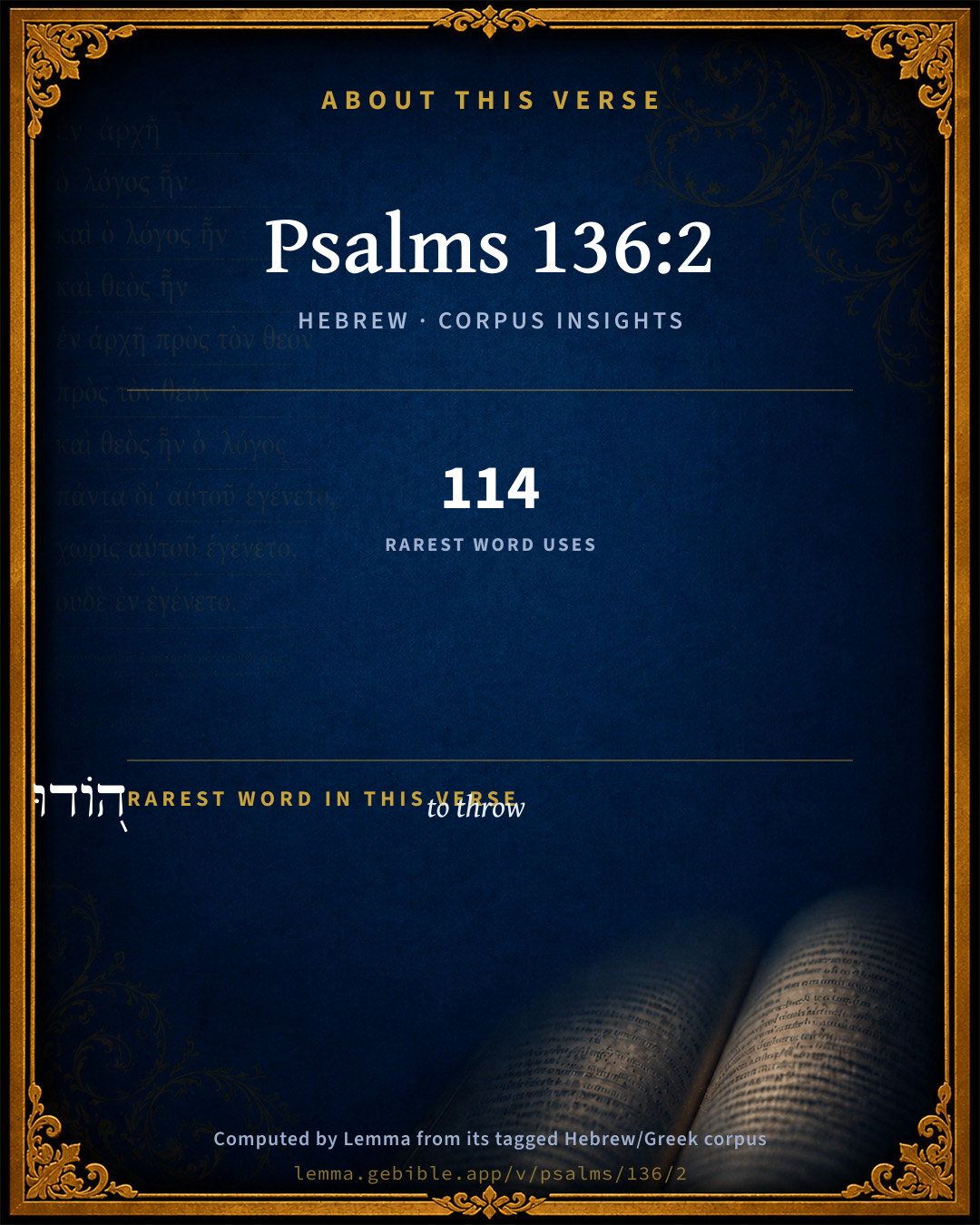
About this verse

These counts appear in no published source. They are computed here, from the morphology-tagged text and Lemma’s own curated glosses. What Lemma adds →

6
words
5
distinct lemmas
Wisdom
section

Grammatical profile

  • 1 verb
  • 4 nouns
  • 1 conjunction

Verb forms

  • ה֭וֹדוּ Hiphil · Imperative

Repetition

A word recurs within this verse — often emphatic in Hebrew:

  • לֵֽאלֹהֵ֣י God H430 ×2

Hebrew & Septuagint length

In English translation the verse runs 13 words from the Hebrew and 13 from the Septuagint (LXX English) — the same length.

A rough comparison of the two English renderings, which tokenize alike — not a word-level alignment.

Word counts can differ between the Hebrew and the Greek without any difference in meaning — e.g. the Hebrew direct-object marker אֵת has no separate Greek word, and Greek often adds the article ὁ.

Cross-references

8

Topical passages linked to Psalms 136:2 in the Treasury of Scripture Knowledge — connected by theme and wording, ordered by reader-vote popularity; previews shown in the World English Bible.

  • Deuteronomy 10:17 For Yahweh your God, he is God of gods, and Lord of lords, the great God, the mighty, and the awesome, who doesn't regard persons, nor takes reward.
  • Psalms 97:9 For you, Yahweh, are most high above all the earth. You are exalted far above all gods.
  • 2 Chronicles 2:5 The house which I build is great; for great is our God above all gods.
  • Daniel 2:47 The king answered to Daniel, and said, Of a truth your God is the God of gods, and the Lord of kings, and a revealer of secrets, seeing you have been able to reveal this secret.
  • Exodus 18:11 Now I know that Yahweh is greater than all gods because of the thing in which they dealt arrogantly against them."
  • Joshua 22:22 The Mighty One, God, Yahweh, the Mighty One, God, Yahweh, he knows; and Israel he shall know: if it be in rebellion, or if in trespass against Yahweh (don't save us this day),
  • Psalms 82:1 God presides in the great assembly. He judges among the gods.
  • Psalms 97:7 Let all them be shamed who serve engraved images, Who boast in their idols. Worship him, all you gods!

Cross-references courtesy of OpenBible.info (CC BY 4.0).

Hebrew and Greek witnesses Masoretic Hebrew ↔ Greek Septuagint

The same verse in the two great witnesses to the Old Testament, shown verse-for-verse.

You’re reading Greek Psalm 135 (Hebrew Psalm 136). The Septuagint counts the superscription, so verse numbers can differ from the Hebrew — chapter-level alignment, not verse-by-verse. Numbering follows Rahlfs.

These are two independent witnesses, not word-aligned to each other, and the Septuagint is shown in lemma (dictionary) form.

Hebrew Psalms 136:2 Masoretic · Westminster Leningrad Codex

ה֭וֹדוּ לֵֽאלֹהֵ֣י הָאֱלֹהִ֑ים כִּ֖י לְעוֹלָ֣ם חַסְדּֽוֹ

Give thanks to the God of gods; For his loving kindness endures forever.

World English Bible · Public Domain

Greek LXX Greek Psalm 135:2 Septuagint · lemma form

ἐκὁμολογέω ὁ θεός ὁ θεός ὅτι εἰς ὁ αἰών ὁ ἔλεος αὐτός

Give thanks to the God of gods; for his mercy endures for ever.

LXX2012 (modern English Septuagint) · Public Domain

Hebrew: Westminster Leningrad Codex (CC BY 4.0). Greek: Septuagint (public domain); English from LXX2012 (modern English Septuagint) (Public Domain). How the Septuagint differs from the Hebrew →

Commentary

Notes on Psalms 136:2 from classic Christian and Jewish commentators (each source and its license shown beneath its notes). The classic Christian expositions comment on the surrounding passage and are grouped to its opening verse, so a note may address several verses; the Jewish commentaries on the Tanakh (Rashi and others) are per-verse, so they appear only where the commentator wrote on this verse.

Lemma curates 59 commentaries, every one of them public domain or Creative Commons licensed, each selected and text-cleaned for this edition rather than reprinted as found. About our sources →

Trapp's Complete Commentary

John Trapp

Psa 136:2 O give thanks unto the God of gods: for his mercy [endureth] for ever.

Ver. 2. For his mercy endureth for ever] This is the foot or burden of the whole song; neither is it any idle repetition, but a notable expression of the saints’ unsatisfiableness in praising God for his never failing mercy. These heavenly birds, having got a note, record it over and over. In the last psalm there are but six verses, yet twelve Hallelujahs.

John Trapp, A Commentary or Exposition upon All the Books of the Old and New Testament (1647–1656) — public domain. Text from a community e-Sword module.

Joseph Benson's Commentary

Psa 136:2-3. O give thanks unto the God of gods — Who is infinitely superior to all that are called gods, whether angels, or princes, or idols: the God whom angels adore, from whom magistrates derive their power, and by whom all pretended deities are and shall be conquered; unto the Lord of lords — The Sovereign of all sovereigns; or. as the word אדני, adoni, imports, the supporter of all supports, the stay, basis, or foundation of all creatures.

Joseph Benson's Commentary on the Old and New Testaments (1811–1818) — public domain. Text from a community e-Sword module.

J. A. Alexander on Psalms

Joseph Addison Alexander

2. (Psa 136:2) Give thanks unto the God of gods—for unto eternity (is) his mercy. The divine title or description, both in this verse and the next, is borrowed from Deu 10:17. Gods does not here mean false gods, but is a superlative plural qualifying that before it. See above, on Psa 77:13; Psa 135:5.

Joseph Addison Alexander, The Psalms Translated and Explained (1850) — public domain. Text from a community e-Sword module.

Adam Clarke's Commentary

Verse 2. The God of gods] לאדני האדנים ladonai haadonim. As adonai signifies director, c., it may apply here, not to idols, for God is not their god but to the priests and spiritual rulers; as Lord of lords may apply to kings and magistrates, &c. He is God and ruler over all the rulers of the earth, whether in things sacred or civil.

Adam Clarke's Commentary on the Bible (1810–1826) — public domain. Text from a community e-Sword/MySword module.

Ellicott's Commentary for English Readers

(2, 3) God of gods . . . Lord of Lords.—From Deu_10:17.

A Bible Commentary for English Readers, edited by Charles John Ellicott (1878–1897) — public domain. Text from a community e-Sword module.

The Cambridge Bible for Schools and Colleges

gen. ed. J. J. S. Perowne

2. O give thanks unto the God of praises (Psa_22:3), for &c.

The Cambridge Bible for Schools and Colleges (gen. ed. J. J. S. Perowne; Cambridge University Press, 1878–1918) — public domain. Text from a community e-Sword module.

John Gill's Exposition

O give thanks unto the God of gods,.... Not only of the gods of the Gentiles, who are by name and not by nature gods; or of civil magistrates, who are so called, and seem to be designed in the next verse; but the angels, as Aben Ezra and Kimchi. Christ, our Immanuel, is the God of them, the object of their worship and adoration, being their Creator and Preserver, Psa 97:7. So the Heathens say (r) of the Maker of all things, him you may properly call the God of gods, the Supreme and Best; this title Janus has with them (s);

for his mercy endureth for ever; in the preservation of those excellent creatures from apostasy, when many of their species fell; and in the continuance and confirmation of them in the state in which they were created; and in making use of them as ministering spirits to the heirs of salvation; and as a guard about them while they live, and at death to convey their souls to heaven.

(r) Hierocles in Carm. Pythagor. p. 10. (s) Macrob. Saturnal. l. 1. c. 9.

John Gill's Exposition of the Whole Bible (1746–1763) — public domain (CC PDM 1.0). Text via the HelloAO Bible API.

Albert Barnes' Notes on the Bible

O give thanks unto the God of gods - See Deu 10:17. The supreme God; the God superior to all that is called God, or that is adored by the nations of the earth; above all to whom the name God is ever applied.

For his mercy... - The ground of praise here is, that it is a characteristic of the supreme God that he is a merciful Being; that there is blended in his character eternal mercy with infinite power. Mere power might fill us with dread; power mingled with mercy, and able to carry out the purposes of mercy, must lay the foundation for praise.

Albert Barnes' Notes on the Bible (1834–1885) — public domain. Text from a community e-Sword/MySword module.

Matthew Poole's English Annotations

The God of gods; who is infinitely superior to all that are called gods, whether angels, or princes, or idols.

Matthew Poole's English Annotations on the Holy Bible (1683–1685) — public domain. Text from a community e-Sword/MySword module.

The Treasury of David

Charles H. Spurgeon

Ver. 2. O give thanks unto the God of gods. If there be powers in heaven or on earth worthy of the name of gods he is the God of them; from him their dominion comes, their authority is derived from him, and their very existence is dependent upon his will. Moreover, for the moment assuming that the deities of the heathen were gods, yet none of them could be compared with our Elohim, who is infinitely beyond what they are fabled to be. Jehovah is our God, to be worshipped and adored, and he is worthy of our reverence to the highest degree. If the heathen cultivate the worship of their gods with zeal, how much more intently should we seek the glory of the God of godsthe only true and real God. Foolish persons have gathered from this verse that the Israelites believed in the existence of many gods, at the same time believing that their Jehovah was the chief among them; but this is an absurd inference, since gods who have a God over them cannot possibly be gods themselves. The words are to be understood after the usual manner of human speech, in which things are often spoken of not as they really are, but as they profess to be. God as God is worthy of our warmest thanks,

for his mercy endureth for ever. Imagine supreme Godhead without everlasting mercy! It would then have been as fruitful a source of terror as it is now a fountain of thanksgiving. Let the Highest be praised in the highest style, for right well do his nature and his acts deserve the gratitude of all his creatures.

Praise your God with right good will,

For his love endureth still.

Ver. 2. The God of gods. "God of gods" is an Hebrew superlative, because he is far above all gods, whether they be so reputed or deputed. Robert Harris.

Ver. 2. The God of gods. One, as being Creator, infinitely higher than all others, his creatures, who have at any time been regarded as gods. Freneh and Skinner, 1842.

Ver. 2-3. Before proceeding to recite God's works, the Psalmist declares his supreme Deity, and dominion: not that such comparative language implies that there is anything approaching Deity besides him, but there is a disposition in men, whenever they see any part of his glory displayed, to conceive of a God separate from him, thus impiously dividing the Godhead into parts, and even proceeding so far as to frame gods of wood and stone. There is a depraved tendency in all to take delight in a multiplicity of gods. For this reason, apparently, the Psalmist uses the plural number not only in the word Elohim but in the word Adonim, so that it reads literally, Praise ye the Lords of lords: he would intimate, that the fullest perfection of all dominion is to be found in the one God. John Calvin.

Psalms 136:3*

Charles H. Spurgeon's The Treasury of David (1869–1885) — public domain. Psalms only. Text from a community e-Sword/MySword module.

Whedon's Commentary on the Bible

Daniel D. Whedon

2, 3.

God of gods… Lord of lords—Quoted from Deu_10:17. Compare “King of kings and Lord of lords,” Rev_19:16. It is the highest ascription of absolute supremacy to the true God, the title “God” denoting his absolute power, and “Lord” his sovereign dominion. The plural form, “gods, lords,” (Hebrew, eloheem, adoneem,) whether applied to idols or human rulers, comprehends all that the nations conceived of power and government, in heaven and earth, over which is enthroned God the supreme. As his goodness is declared Psa_136:1, so here his majesty, following the order of Psa_135:3; Psa_135:5-6. In his government they harmonize. The call to give praise thrice, Psa_136:1-3, is emphatic, but not an occult intimation of the holy Trinity, as some have supposed.

Daniel D. Whedon (gen. ed.), Commentary on the Old and New Testaments (1874–1909) — public domain. Text from a community e-Sword module.

The Pulpit Commentary

Oh give thanks unto the God of gods: for his mercy, etc. The phrase, "God of gods," occurs first in Deu_10:17. It was one very familiar to the Assyrians and Babylonians ("Religions of the Ancient World," pp. 56, 60, 68, etc.). In the Bible it is used by Joshua, (Jos_22:22) Nebuchadnezzar, (Dan_2:47) Daniel, (Dan_11:36) and this psalmist. It sanctions a secondary use of the word "God," such as is found also in Psa_82:6 Psa_96:4 Psa_97:7, 9 138:1.

God and other gods.

"Oh give thanks unto the God of gods." This expression appears to recognize other gods in order to make comparison with them of the One only, living, and true God. It is necessary to keep in mind that there are gods for whom their worshippers claim that they are verily and indeed gods. True, "the gods of the nations are idols (helpless vanities), but the Lord (Jehovah) made the heavens;" but that is the view which the worshippers of Jehovah take, not the view which the nations that serve these gods take. For us there is no comparison between God and the gods. And yet Scripture invites us to make comparisons. Some freshness may be gained by taking one point of view; but it must be regarded as a point of view, and in no sense a complete setting of truth in relation to this subject. Gods, as distinct from God, are always wrongly treated when they are regarded as distinct and independent deities. It may be the fact of history that to the mass of the people they become such; but that is their delusion. They never really are such; they are always either incarnations of God, in order to bear direct relation to human and earthly things, or they are guardian angels or patron saints. This may be clearly illustrated from the Hindu religion. Brahma is the one living god; but there are five cults of Brahma, according as he is presented incarnate in Vishnoo, "Siva, "Sakti, Gane"sa, or Surya. It might be said that these are gods, but the deeper truth is that they are no more than sensible helps to the apprehension of Brahma, and to right relations with him. This suggests interesting points of reflection.

I THE SPIRITUALITY OF GOD IS OF SUPREME IMPORTANCE FOR MAN. Leave man alone, and anywhere and everywhere he will inevitably materialize God and give him some formal shape, either in act or thought. And then man deteriorates, because he puts the stamp of superiority on his bodily investiture instead of on his spiritual self. His god becomes a body, with passions to be indulged. Therefore God so jealously guards for the Israelites his unseen, spiritual Being, and forbids every attempt to make a likeness of him.

II THE SPIRITUALITY OF GOD IS PRESERVED IN THE ONE INCARNATION IN WHICH HE HAS SHOWN HIMSELF. The "Man Christ Jesus" is the One and only true incarnation of God. It was a simple and genuine man"s life, which soon gave place to a presence spiritually realized. The Christ we worship is no figure of a God. It is the God who was unseen passing by us and for a moment removing his hand and letting us see, and then passing into the unseen again. R.T.

The Pulpit Commentary (1880–1919), ed. H.D.M. Spence-Jones & Joseph S. Exell — public domain. Text from a community e-Sword module.

John Wesley's Explanatory Notes

The God of gods - Who is infinitely superior to all that are called gods, whether angels, or princes, or idols.

John Wesley, Explanatory Notes Upon the Whole Bible (1754–1765) — public domain. Text via the GEBible commentary corpus.

Ibn Ezra

Rabbi Abraham ibn Ezra

"Thank the God of gods" - the God of the high angels, who don't have bodies [and are therefore called gods].

Ibn Ezra on the Tanakh — English translations: “Sefaria Community Translation” (CC0 1.0 (public-domain dedication)); “Yalkut, Sifsei Chachomim Chumash, Metsudah Publications, 2009” (CC BY 4.0); and “Commentary of Ibn Ezra on Isaiah - trans. by M. Friedlander, 1873” (public domain). Text via Sefaria.

Lesson kit

Teaching starters — assembled from the data on this page, not authored interpretation. Every prompt links to the verse data it draws on. Edit before teaching.

Psalms, in the Wisdom, opens this verse with 6 words (5 distinct Hebrew lemmas). Its most distinctive word is yâdâh (“to throw”). A historical commentator’s framing appears above. Read the whole chapter for the surrounding context.

Discussion questions

  1. The word yâdâh carries the sense “to throw.” How does it shape the verse?
  2. Deuteronomy 10:17 shares this passage’s theme. How do the two illuminate each other?
  3. “God” occurs 2× in this one verse. What is the effect of the repetition?
  4. These translations render this verse differently; the difference is in the English rendering, not the original. What questions does that raise?
  5. The verb «ה֭וֹדוּ» is Hiphil Imperative. How does its form color the action?
  6. Reading how Trapp's Complete Commentary and Joseph Benson's Commentary read this verse, where do the two commentators agree and where do they part?

Things to notice

Reading settings

Reading text

Shown beneath each verse's original-language words.

Old Testament
Old Testament edition

Read the OT as the Masoretic Hebrew (MT) or the Greek Septuagint (LXX).

English shown for the Greek Septuagint (in the Hebrew ↔ Greek comparison).

Comparing translations? Open the Compare panel on any verse page to stack up to four side by side.