Psalms 142:7

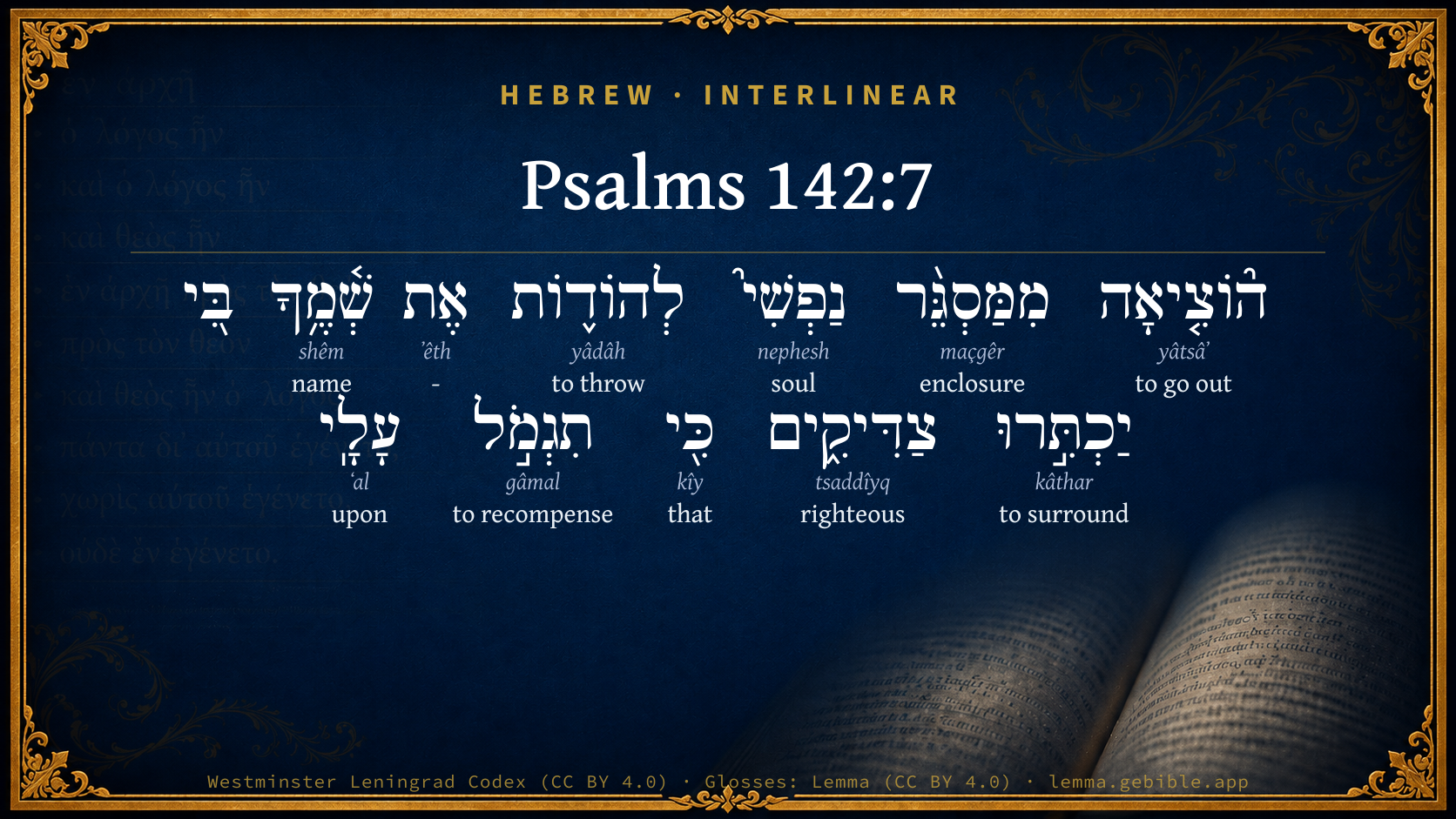
Hebrew (Westminster Leningrad Codex) Psalms 142:7 appears in the Hebrew Old Testament. The text above is from the Westminster Leningrad Codex. Each word links to its Strong’s number, a concise gloss, and parsing drawn from the Open Scriptures Hebrew Bible morphology. Click any word for its full Brown-Driver-Briggs (BDB) entry.
Download image
Cite this verse

Psalms 142:7 (World English Bible). Public Domain. Lemma interlinear Bible study tool, https://lemma.gebible.app/v/psalms/142/7.

Show BibTeX & RIS
BibTeX
RIS
English Translation
Bring my soul out of prison, That I may give thanks to your name. The righteous will surround me, For you will be good to me.
World English Bible · Public Domain
Download a study sheet

One document with this verse’s original text, its word-by-word gloss line, the meaning frame, cross-references with their text, attributed commentary, and full source and license credits — printable, and it pastes into notes with its structure intact.

This verse Autodidact and up

Study sheet (.html) Plain text (.txt)

A passage Seminary Student

Up to 50 verses in one chapter. A passage sheet keeps up to 6 commentary sources and 12 cross-references per verse, in the order this page ranks them, and says so on the sheet whenever that leaves anything out. Ask for a single verse and you get the Autodidact verse sheet above.

Everything on this page stays free to read, with no account — the sheet is a download of what is already on screen, not access to it.

Want to remove ads? Support Godless Engineer
Compare translations 3

The same verse in 3 English versions, stacked beneath the original-language interlinear above. Click any original word for its lexicon entry.

Each is an independent rendering of the whole verse — the interlinear is not word-aligned to these translations.

Highlighted words mark where these versions differ — a whole-verse word diff, not a word-by-word alignment.

  • World English Bible Public Domain
    Bring my soul out of prison, That I may give thanks to your name. The righteous will surround me, For you will be good to me.
  • King James Version Public Domain
    Bring my soul out of prison, that I may praise thy name: the righteous shall compass me about; for thou shalt deal bountifully with me.
  • unfoldingWord Literal Text CC BY-SA 4.0
    Bring out my soul from prison to praise your name. The righteous will gather around me because you will fulfill for me.

unfoldingWord Literal Text — © unfoldingWord, licensed CC BY-SA 4.0. Word-aligned USFM3 via Door43 (git.door43.org/unfoldingWord/en_ult).

Versions to compare (up to 4)

3 of 4 selected

Show all 18 translations

Every available English version of this verse, each an independent rendering of the whole verse.

  • World English Bible Public Domain
    Bring my soul out of prison, That I may give thanks to your name. The righteous will surround me, For you will be good to me.
  • Berean Standard Bible Public Domain
    Free my soul from prison, that I may praise Your name. The righteous will gather around me because of Your goodness to me.
  • Majority Standard Bible Public Domain
    Free my soul from prison, that I may praise Your name. The righteous will gather around me because of Your goodness to me.
  • King James Version Public Domain
    Bring my soul out of prison, that I may praise thy name: the righteous shall compass me about; for thou shalt deal bountifully with me.
  • American Standard Version (1901) Public Domain
    Bring my soul out of prison, That I may give thanks unto thy name: The righteous shall compass me about; For thou wilt deal bountifully with me. Psalm 143 A Psalm of David.
  • Revised Version (1885) Public Domain
    Bring my soul out of prison, that I may give thanks unto thy name: the righteous shall compass me about; for thou shalt deal bountifully with me.
  • Geneva Bible (1599) Public Domain
    Bring my soule out of prison, that I may prayse thy Name: then shall the righteous come about me, when thou art beneficiall vnto me.
  • Douay-Rheims (1899) Public Domain
    as when the thickness of the earth is broken up upon the ground: Our bones are scattered by the side of hell.
  • Young's Literal Translation Public Domain
    Bring forth from prison my soul to confess Thy name, The righteous do compass me about, When Thou conferrest benefits upon me!
  • Literal Standard Version CC BY-SA 4.0
    Bring forth my soul from prison to confess Your Name, || The righteous surround me about, || When You confer benefits on me!
  • Unlocked Literal Bible CC BY-SA 4.0
    Bring my soul out of prison so that I may give thanks to your name. The righteous will gather around me because you have been good to me.”
  • unfoldingWord Literal Text CC BY-SA 4.0
    Bring out my soul from prison to praise your name. The righteous will gather around me because you will fulfill for me.
  • Darby Bible Public Domain
    Bring my soul out of prison, that I may celebrate thy name. The righteous shall surround me, because thou dealest bountifully with me.
  • World Messianic Bible Public Domain
    Bring my soul out of prison, that I may give thanks to your name. The righteous will surround me, for you will be good to me.
  • Webster's Bible Public Domain
    \\142:6\\Attend to my cry; for I am brought very low: deliver me from my persecutors; for they are stronger than I.
  • Free Bible Version CC BY-SA 4.0
    Release me from my prison so I can praise you for the person you are! Those who live right will gather round me because you have treated me so well.”
  • Bible in Basic English Public Domain
    Take my soul out of prison, so that I may give praise to your name: the upright will give praise because of me; for you have given me a full reward.
  • JPS Tanakh (1917) Public Domain
    (142-8) Bring my soul out of prison, that I may give thanks unto Thy name; the righteous shall crown themselves because of me; for Thou wilt deal bountifully with me.

Literal Standard Version (2020), Covenant Press — licensed CC BY-SA 4.0. Text via the HelloAO Bible API (eBible.org). Unlocked Literal Bible (unfoldingWord) — licensed CC BY-SA 4.0. Text via the HelloAO Bible API (eBible.org). unfoldingWord Literal Text — © unfoldingWord, licensed CC BY-SA 4.0. Word-aligned USFM3 via Door43 (git.door43.org/unfoldingWord/en_ult). Free Bible Version, Dr. Jonathan Gallagher — licensed CC BY-SA 4.0. Text via the HelloAO Bible API (eBible.org).

Word by word

More ways to search: Search by grammar → Find every occurrence → Compare this word →

Practice this passage: Drill this verse → Learn its vocabulary →

יַכְתִּ֣רוּ
kâthar
H3803
“to surround”
Verb, Hiphil, Imperfect, 3rd Person, Masculine, Plural
Part of Speech
Verb
Stem
Hiphil
Form
Imperfect
Person
3rd Person
Gender
Masculine
Number
Plural
Full BDB Definition

Origin: a primitive root

TWOT: 1060

to surround - (Piel) to surround - (Hiphil) to surround, encircle
  1. ה֘וֹצִ֤יאָה yâtsâʼ H3318 “go out” Verb, Hiphil, Imperative, 2nd Person, Masculine, Singular + Suffix, h
  2. מִמַּסְגֵּ֨ר maçgêr H4525 “from · enclosure” Preposition + Noun, Common, Masculine, Singular, Absolute
  3. נַפְשִׁי֮ nephesh H5315 “soul · my” Noun, Common, Both, Singular, Construct + Suffix, Personal, 1st Person, Common, Singular
  4. לְהוֹד֪וֹת yâdâh H3034 “to throw” Preposition + Verb, Hiphil, Infinitive Construct
  5. אֶת ʼêth H853 “-” Particle, Direct Object
  6. שְׁ֫מֶ֥ךָ shêm H8034 “name · your” Noun, Common, Masculine, Singular, Construct + Suffix, Personal, 2nd Person, Masculine, Singular
  7. צַדִּיקִ֑ים tsaddîyq H6662 “righteous” Adjective, Adjective, Masculine, Plural, Absolute
  8. כִּ֖י kîy H3588 “that” Conjunction
  9. תִגְמֹ֣ל gâmal H1580 “to recompense” Verb, Qal, Imperfect, 2nd Person, Masculine, Singular
  10. עָלָֽי ʻal H5921 “upon · me” Preposition + Suffix, Personal, 1st Person, Common, Singular

About this verse

These counts appear in no published source. They are computed here, from the morphology-tagged text and Lemma’s own curated glosses. What Lemma adds →

12
words
11
distinct lemmas
Wisdom
section

Notable vocabulary

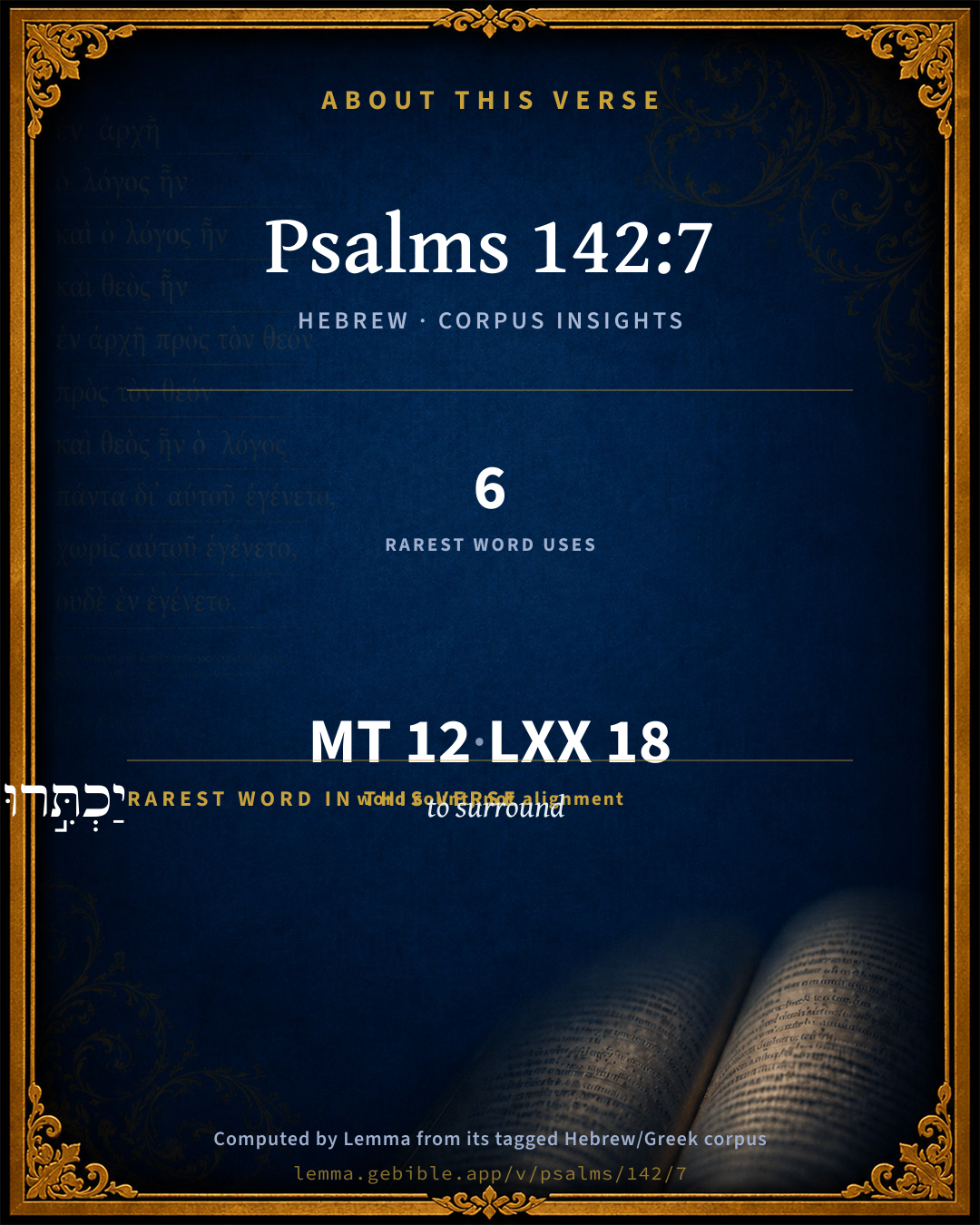
The rarest word here is יַכְתִּ֣רוּ to surround H3803 — appearing just 6 times in the whole Hebrew Bible.

Shared distinctive vocabulary

יַכְתִּ֣רוּ to surround H3803 occurs in 6 verses of the Hebrew Bible. Also found in:

Grammatical profile

  • 4 verbs
  • 3 nouns
  • 1 adjective
  • 2 prepositions
  • 1 conjunction
  • 1 particle

Verb forms

  • ה֘וֹצִ֤יאָה Hiphil · Imperative
  • לְהוֹד֪וֹת Hiphil · Infinitive Construct
  • יַכְתִּ֣רוּ Hiphil · Imperfect
  • תִגְמֹ֣ל Qal · Imperfect

Hebrew & Septuagint length

In English translation the verse runs 26 words from the Hebrew and 26 from the Septuagint (LXX English) — the same length.

A rough comparison of the two English renderings, which tokenize alike — not a word-level alignment.

Word counts can differ between the Hebrew and the Greek without any difference in meaning — e.g. the Hebrew direct-object marker אֵת has no separate Greek word, and Greek often adds the article ὁ.

In the original languages it is 12 Hebrew tokens and 18 Greek tokens — but the two are counted differently (Hebrew bundles its prefixes and suffixes into one token; the Greek is in lemma form), so that isn’t a like-for-like length.

Cross-references

18

Topical passages linked to Psalms 142:7 in the Treasury of Scripture Knowledge — connected by theme and wording, ordered by reader-vote popularity; previews shown in the World English Bible.

  • Psalms 143:11 Revive me, Yahweh, for your name's sake. In your righteousness, bring my soul out of trouble.
  • Psalms 146:7 Who executes justice for the oppressed; Who gives food to the hungry. Yahweh frees the prisoners.
  • Psalms 7:6–7 Arise, Yahweh, in your anger. Lift up yourself against the rage of my adversaries. Awake for me. You have commanded judgment.
  • Psalms 13:6 I will sing to Yahweh, Because he has been good to me.
  • Isaiah 61:1 The Spirit of the Lord Yahweh is on me; because Yahweh has anointed me to preach good news to the humble; he has sent me to bind up the broken-hearted, to proclaim liberty to the captives, and the opening [of the prison] to those who are bound;
  • Acts 2:24 whom God raised up, having freed him from the agony of death, because it was not possible that he should be held by it.
  • James 5:11 Behold, we call them blessed who endured. You have heard of the patience of Job, and have seen the Lord in the outcome, and how the Lord is full of compassion and mercy.
  • Psalms 9:14 That I may show forth all your praise. In the gates of the daughter of Zion, I will rejoice in your salvation.
  • Psalms 116:7 Return to your rest, my soul, For Yahweh has dealt bountifully with you.
  • Psalms 119:17 Do good to your servant. I will live and I will obey your word.
  • Psalms 142:1 I cry with my voice to Yahweh. With my voice, I ask Yahweh for mercy.
  • Psalms 9:3 When my enemies turn back, They stumble and perish in your presence.
  • Psalms 31:8 You have not shut me up into the hand of the enemy. You have set my feet in a large place.
  • Psalms 34:2 My soul shall boast in Yahweh. The humble shall hear of it, and be glad.
  • Psalms 22:21–27 Save me from the lion's mouth; Yes, from the horns of the wild oxen you have answered me.
  • Psalms 88:4–8 I am counted among those who go down into the pit. I am like a man who has no help,
  • Psalms 119:74 Those who fear you will see me and be glad, Because I have put my hope in your word.
  • Psalms 107:41–42 Yet he lifts the needy out of their affliction, And increases their families like a flock.

Cross-references courtesy of OpenBible.info (CC BY 4.0).

Hebrew and Greek witnesses Masoretic Hebrew ↔ Greek Septuagint

The same verse in the two great witnesses to the Old Testament, shown verse-for-verse.

You’re reading Greek Psalm 141 (Hebrew Psalm 142). The Septuagint counts the superscription, so verse numbers can differ from the Hebrew — chapter-level alignment, not verse-by-verse. Numbering follows Rahlfs.

These are two independent witnesses, not word-aligned to each other, and the Septuagint is shown in lemma (dictionary) form.

Hebrew Psalms 142:7 Masoretic · Westminster Leningrad Codex

ה֘וֹצִ֤יאָה מִמַּסְגֵּ֨ר נַפְשִׁי֮ לְהוֹד֪וֹת אֶת שְׁ֫מֶ֥ךָ בִּ֭י יַכְתִּ֣רוּ צַדִּיקִ֑ים כִּ֖י תִגְמֹ֣ל עָלָֽי

Bring my soul out of prison, That I may give thanks to your name. The righteous will surround me, For you will be good to me.

World English Bible · Public Domain

Greek LXX Greek Psalm 141:7 Septuagint · lemma form

προςἔχω πρός ὁ δέησις ἐγώ ὅτι ταπεινόω σφόδρα ῥύομαι ἐγώ ἐκ ὁ καταδιώκω ἐγώ ὅτι κραταιόω ὑπέρ ἐγώ

Bring my soul out of prison, that I may give thanks to your name, O Lord; the righteous shall wait for me, until you recompense me.

LXX2012 (modern English Septuagint) · Public Domain

On this verse, Ellicott's Commentary for English Readers discusses the Septuagint’s reading. Read the note in Commentary ↓

Hebrew: Westminster Leningrad Codex (CC BY 4.0). Greek: Septuagint (public domain); English from LXX2012 (modern English Septuagint) (Public Domain). How the Septuagint differs from the Hebrew →

Commentary

Notes on Psalms 142:7 from classic Christian and Jewish commentators (each source and its license shown beneath its notes). The classic Christian expositions comment on the surrounding passage and are grouped to its opening verse, so a note may address several verses; the Jewish commentaries on the Tanakh (Rashi and others) are per-verse, so they appear only where the commentator wrote on this verse.

Lemma curates 59 commentaries, every one of them public domain or Creative Commons licensed, each selected and text-cleaned for this edition rather than reprinted as found. About our sources →

Trapp's Complete Commentary

John Trapp

Psa 142:7 Bring my soul out of prison, that I may praise thy name: the righteous shall compass me about; for thou shalt deal bountifully with me.

Ver. 7. Bring my soul out of prison] i.e. Out of this distress, wherewith I am no less straitened than if in prison.

The righteous shall compass me about] Heb. shall crown me; that is, shall encircle me, as wondering at thy goodness in my deliverance; or they shall set the crown on mine head, as the saints do likewise upon Christ’s head, {Son 3:11} to whom this psalm may be fitly applied all along, as above said.

John Trapp, A Commentary or Exposition upon All the Books of the Old and New Testament (1647–1656) — public domain. Text from a community e-Sword module.

The Biblical Illustrator

Joseph S. Exell

Psa_142:7

Bring my soul out of prison.

The soul in prison

I. The prison into which so many souls are cast. David said, In the way wherein I walked, the hunters laid a snare for me. No one had better intentions than David; and I believe that nobody has better intentions than ourselves. But the best of wishes will do us little benefit unless we have brave resolves. To intend well is one thing; but if the intention stop short of action, it is worth nothing. When we intend well without practical resolution, it seems as if a trap were laid for us. We are oftenest caught in what seems our strongest point because we do not guard and watch ourselves where we are unconscious of weakness. Therefore, we all need to take heed lest we also be caught tripping. David further said, The hunters are stonger than I. What makes our enemies strong? It is ones own weakness, the result of sin. David again cries, Bring my soul out of prison! It is a blessed thing when a man feels that his inclination to sin is like having his soul in prison. What man who is worthy of the name would not prefer liberty to bondage?

II. The way to get ones soul out of prison. We read in Bunyans marvellous parable that when Christian had been beaten sore by a giant and thrust into Doubting Castle, he gave himself up to misery and despair. But one day he said, Why, what a fool am I to stay here in all this wretchedness, when I have in my breast a key to unlock the gates of Doubting Castle. And taking out the key he found it fitted the lock, and he escaped. It was, says Bunyan, a key called Promise. This should teach us that when we seek in Gods Word and find His promises, they are to us as a key to open the door of the prison into which our sins have thrust us. Would you have this priceless, this wonderful key always within your reach? Then hold on to Gods promises, which apply to every individual case. (W. Birch.)

Man, morally considered

I. Mans moral imprisonment. All sinners are in a state of bondage. They are spirits in prison. Like fallen angels they are in chains of darkness.

1. A state of darkness. Justice shuts out the light from the prisoner in the cell. How morally benighted is the unregenerate soul l Having the understanding darkened.

2. A state of confinement. Materialism--intemperance--avarice--prejudice--unholy associations and habits manacle his faculties.

3. A state of criminality. A prisoner is under sentence of condemnation. So every sinner is a moral criminal, condemned alike by God and by his own conscience.

II. Mans moral liberation. Bring my soul out of prison.

1. A consciousness of its wretched condition. O wretched man that I am, etc. How can I become free? Who can level those massive walls, who can break those fetters?

2. A consciousness that God alone can deliver. Bring my soul. He feels he cannot emancipate himself, nor can his fellow-men effect his deliverance. Hence to Him he looks who came to preach deliverance to the captive, etc.

III. Mans moral mission. That I may praise Thy name.

1. Deep in the heart of all men is the feeling of obligation to worship God.

2. Moral misery consists in this, the soul feeling its obligation to worship, and yet unable to do so through the enthralling influence of its corruptions. Hence the text may be regarded as the prayer of every sin-convicted soul.

(1) I must worship Thee; my conscience urges this as an essential condition of my peace.

(2) I cannot worship Thee in my state of moral captivity.

(3) Come Thou, therefore, to my deliverance and set me free. (Homilist.)

A cry from prison

I. A wretched condition. Some of the prisons in which we sometimes find ourselves confined. Fearfulness.

(1) Lest our conversion is only a sham.

(2) Lest we may not be finally saved.

(3) Dread of death.

2. Carelessness.

(1) About our souls prosperity.

(2) As to the use of our privileges.

3. Discontentedness.

4. Selfishness.

(1) In belief.

(2) In prayers.

(3) In efforts.

II. A suitable petition. It is expressive of--

1. Consciousness. The spiritual dead feel not their awful condition.

2. Helplessness. We can do nothing; but He is faithful who has promised.

3. Tenderness. Bring. The invalid cannot bear harsh treatment. And our compassionate Lord deals gently with us. Doubtless David had former proof of this, hence his present cry. Further, this would necessitate Gods coming Himself, not even trusting His loved ones to His ministering spirits. Come Lord Thyself, and bring my soul out of prison. Then it was a petition of--

4. Completeness. Bring my soul out. It is well for our souls, when we get so dissatisfied with our prisons as to want to leave them entirely.

III. A justifying reason. How could David praise Gods name?

1. By making known His wondrous power.

2. By living near to God.

3. By warning others of their danger. (A. H. Stote.)

Bring my soul out of prison

I. The mercy implored. Consider it as the language of

1. An awakened sinner.

2. A disconsolate Christian, when oppressed or persecuted, or under trouble.

II. The end for which this mercy was desired. Mercy wanted calls for prayer; and the earnestness of the prayer should correspond with the magnitude of the blessing we implore. Mercy received requires praise; and the more importunate the prayer, the more animated will be the praise in return.

1. Praise may be considered as mental.

2. Vocal.

3. Practical. (B. Beddome, M. A.)

.

Psa_143:1-12

The Biblical Illustrator, edited by Joseph S. Exell (c. 1880s–1900s) — public domain. Text from a community e-Sword module.

J. A. Alexander on Psalms

Joseph Addison Alexander

8. (Psa 142:7) Bring out from prison my soul, to thank thy name. Me shall the righteous surround when thou shalt bestow on me (favour). With the first clause compare Psa 25:17; Psa 107:10; Psa 143:11. Some suppose an allusion to Joseph's imprisonment and liberation. See above, on Psa 105:17-20. To thank (or praise) thy name, although an exact translation, is restricted by the English idiom to the person mentioned just before, and can only mean in accordance with our usage, that I may thank thy name; whereas the Hebrew infinitive knows no such limitation, and in this case simply means, that some one (without defining who) may praise thy name; or, exchanging the active for the passive form, that thy name may be praised; or, retaining the indefiniteness of the original expression, for the praising of thy name. The agents here intended are probably the righteous, who are mentioned in the next clause. The verb surround, which has a hostile sense in Psa 22:13, Hab 1:4, here means to gather round one with a friendly curiosity and eagerness, which some suppose to be suggested by the construction with the preposition, which cannot be expressed in English. This sympathy of the righteous in his joys and sorrows is a favourite idea with David. See above, on Psa 35:27; Psa 40:16. For the meaning and construction of the last verb see above, on Psa 13:6; Psa 103:10; Psa 116:7.

Joseph Addison Alexander, The Psalms Translated and Explained (1850) — public domain. Text from a community e-Sword module.

Tyndale Open Study Notes

Tyndale Open Resources

142:7 His experience of confinement and duress is like being in prison (see 107:10).

Tyndale Open Study Notes — © Tyndale Open Resources, licensed CC BY-SA 4.0. Text via the HelloAO Bible API.

Geneva Bible (1599)

Geneva Bible translators

For he was on all sides beset with his enemies, as though he had been in a most straight prison.

Either to rejoice at my wonderful deliverance, or to set a crown upon mine head.

Geneva Bible (1599) marginal notes — public domain. Text via Bolls.life.

Adam Clarke's Commentary

Verse 7. Bring my soul out of prison] Bring נפשי naphshi, my life, out of this cave in which it is now imprisoned; Saul and his men being in possession of the entrance.

The righteous shall compass me about] יכתרו yachtiru, they shall crown me; perhaps meaning that the pious Jews, on the death of Saul, would cheerfully join together to make him king, being convinced that God, by his bountiful dealings with him, intended that it should be so. The old Psalter, which is imperfect from the twenty-first verse of Psalm cxix. (Ps 119:21) to the end of Psalm cxli. (Ps 141:10), concludes this Psalm thus: "Lede my saule oute of corruption of my body; that corrupcion is bodely pyne, in whilk my saule is anguyst; after that in Godes house, sal al be louyng (praising) of the."

ANALYSIS OF THE HUNDRED AND FORTY-SECOND PSALM

The substance of this Psalm is the earnest prayer of the psalmist that he might be delivered from the danger he was in.

The parts are,

I. An exordium, in which he

1. Shows what he did in his trouble; took himself to prayer, Ps 142:1-2.

2. Then his consternation and anxiety of mind, which arose from the malice and craft of his enemies, and want of help from his friends, Ps 142:3-4.

II. His address and petition to God, Ps 142:5-7. 1. The two first verses show the psalmist's intention. "I cried unto the Lord," c. 2. "I poured out my supplication," &c.

This he amplifies, -

1. From his vehemence: "I cried, I supplicated."

2. From the object: "Unto the Lord." I invoked him, and no other.

3. From the instrument: "With my voice."

4. From his humility in prayer. It was a supplication.

5. From his free and full confession: "I poured out," &c.

6. From his sincerity and confidence in God.

The reason was: -

1. This I did "when my spirit was overwhelmed," &c. There being no sufficiency in me, I betook myself to the all-sufficient God.

2. "For thou knowest my path," &c. My actions and intentions.

The craft and subtlety of his enemies, especially Saul.

1. "In the way wherein I walked," &c. My vocation.

2. "Have they privily laid," &c. Saul gave him his daughter Michal to be a snare to him and a dowry he must have of a hundred foreskins of the Philistines, that David might fall by their hands.

His destitution in the time of trouble.

1. "I looked on my right hand," c. But no friend was near: "There was no man," &c. The miserable have few friends.

2. "Refuge failed me," &c. I had no place of safety.

3. "No man cared," &c. Regarded my life, or cared if I perished.

II. The psalmist, having no human help, calls upon God.

1. "Thou art my refuge," &c. My hiding-place.

2. "Thou art my portion," &c. While I live in this world.

Then he sends up his prayer, fortified by a double argument.

1. From the lamentable condition he was brought into: "I was brought low," &c.

2. From the malice and power of his enemies: "Deliver me," &c.

Again he renews his prayer, and presses it from the final cause: "Bring my soul," &c.

Upon which follow two effects: -

1. His gratitude: "That I may praise thy name."

2. That of others: "The righteous shall compass me," &c. Come unto me.

3. The reason for this: "For thou shalt deal bountifully with me." Bestow favours upon me, having delivered me from my former miseries which men seeing, who are commonly the friends of prosperity, will magnify and resort to me.

Adam Clarke's Commentary on the Bible (1810–1826) — public domain. Text from a community e-Sword/MySword module.

Ellicott's Commentary for English Readers

(7) Out of prison.—This expression, which must certainly be figurative of distress (comp. Psa_143:11), probably led to the inscription.

Compass me about.—The Hebrew word here employed is used in a hostile sense in Psa_22:12; Jdg_20:43; Hab_1:4. It is better, therefore, to follow the LXX. and render:

“In my case the righteous are waiting

Till,” &c

This sense “waiting for,” besides being favoured by the construction, suits well the passage, Pro_14:18.

“The simple inherit folly,

But the prudent wait for knowledge,

and is Aquila’s rendering there of the word as it is here.

A Bible Commentary for English Readers, edited by Charles John Ellicott (1878–1897) — public domain. Text from a community e-Sword module.

The Cambridge Bible for Schools and Colleges

gen. ed. J. J. S. Perowne

7. Bring my soul out of prison] Probably to be understood figuratively, ‘bring my soul out of distress’ (Psa_143:11). Cp. Isa_42:7, of the Exile; Psa_107:10. But it may mean that he was actually in prison. Cp. Psa_143:3.

praise thy name] Give thanks unto thy name, as in Psa_140:13.

the righteous shall compass me about] The loyal worshippers of Jehovah will gather round him to share in his thanksgivings. Cp. Psa_22:22 ff. The meaning of the verb however is not certain, and some authorities, both ancient and modern, render, as in R.V. marg., crown themselves because of me, i.e. rejoice in my deliverance; but this explanation is improbable, as is also the rendering of the LXX, “the righteous will wait for me, till thou hast recompensed me.” There were then some ‘righteous’ men left; the Psalmist was not so absolutely isolated as his complaint in Psa_142:4 seemed to shew; but probably friends and sympathisers were in no position to help him in his present distress, and practically he was alone, like Elijah in the wilderness.

because thou dealest bountifully with me] Cp. Psa_13:6.

The Cambridge Bible for Schools and Colleges (gen. ed. J. J. S. Perowne; Cambridge University Press, 1878–1918) — public domain. Text from a community e-Sword module.

John Gill's Exposition

Bring my soul out of prison,.... Not out of purgatory, to which some Popish writers wrest these words very absurdly; nor out of the prison of his body, as Joseph Ben Gorion (p); knowing that none but God had a power of removing it from thence; but out of the cave, where he was detained as in a prison, while Saul and his men were about the mouth of it; or rather out of all his straits, distresses, and difficulties, which surrounded and pressed him on all sides, as if he was in a prison;

that I may praise thy name; this release he desired not so much for his own sake, that he might be at ease and liberty, but that he might have fresh occasion to praise the Lord, and an opportunity of doing it publicly, in the assembly and congregation of the people;

the righteous shall compass me about; in a circle, like a crown, as the word (q) signifies; when delivered, they should flock to him and come about him, to see him and look at him, as a miracle of mercy, whose deliverance was marvellous; and to congratulate him upon it, and to join with him in praises unto God for it. The Targum is,

"for my sake the righteous will make to thee a crown of praise.''

And to the same purpose Jarchi,

"for my sake the righteous shall surround thee, and praise thy name.''

Aben Ezra interprets it,

"they shall glory as if the royal crown was on their heads;''

for thou shalt deal bountifully with me; in delivering him from his enemies, settling him on the throne, and bestowing upon him all the blessings of Providence and grace; see Psa 116:7; and thus the psalm is concluded with a strong expression of faith in the Lord, though in such a low estate.

(p) Hist. Heb. l. 6. c. 20. p. 610. (q) "coronabunt", Pagninus, Montanus; "vel in me tanquam eoronati triumphabunt", Cocceius.

Next: Psalms Chapter 143

John Gill's Exposition of the Whole Bible (1746–1763) — public domain (CC PDM 1.0). Text via the HelloAO Bible API.

Albert Barnes' Notes on the Bible

Bring my soul out of prison - Bring me out of my present condition which is like a prison. I am as it were shut up; I am encompassed with foes; I do not know how to escape. Compare Psa 25:17.

That I may praise thy name - Not merely for my own sake, but that I may have occasion more abundantly to praise thee; that thus “thou” mayest be honored; an object at all times much more important than our own welfare - even than our salvation.

The righteous shall compass me about - They shall come to me with congratulations and with expressions of rejoicing. They will desire my society, my friendship, my influence, and will regard it as a privilege and an honor to be associated with me. David looked to this as an object to be desired. He wished to be associated with the righteous; to enjoy their friendship; to have their good opinion; to be reckoned as one of them here and forever. Compare the notes at Psa 26:9. It “is” an honor - a felicity to be desired - to be associated with good people, to possess their esteem; to have their sympathy, their prayers, and their affections; to share their joys here, and their triumphs in the world to come.

For thou shalt deal bountifully with me - Or, when thou shalt deal bountifully with me. When thou dost show me this favor, then the righteous will come around me in this manner. They will see that I am a friend of God, and they will desire to be associated with me as his friend.

Albert Barnes' Notes on the Bible (1834–1885) — public domain. Text from a community e-Sword/MySword module.

Matthew Poole's English Annotations

Bring my soul out of prison; bring me safe out of this cave, wherein I am imprisoned, and set me at perfect liberty.

Shall compass me about; shall flock to me from all parts, partly out of curiosity to see such a spectacle and miracle of God’s power and mercy; and partly to rejoice and bless God with me and for me, and for all the benefits which they expect from my government.

Matthew Poole's English Annotations on the Holy Bible (1683–1685) — public domain. Text from a community e-Sword/MySword module.

The Treasury of David

Charles H. Spurgeon

Ver. 7. Bring my soul out of prison, that I may praise thy name. That God may be glorified is another notable plea for a suppliant. Escaped prisoners are sure to speak well of those who give them liberty; Soul emancipation is the noblest form of liberation, and calls for the loudest praise: he who is delivered from the dungeons of despair is sure to magnify the name of the Lord. We are in such a prison that only God himself can bring us out of it, and when he does so he will put a new song into our mouths. The cave was not half such a dungeon to David's body as persecution and temptation made for his soul. To be exiled from the godly is worse than imprisonment, hence David makes it one point of his release that he would be restored to church fellowship

The righteous shall compass me about. Saints gather around a child of God when his Father smiles upon him; they come to hear his joyful testimony, to rejoice with him, and to have their own faith encouraged. All the true believers in the twelve tribes were glad to rally to David's banner when the Lord enlarged his spirit; they glorified God for him and with him and through him. They congratulated him, consorted with him, crowned him, and championed him. This was a sweet experience for righteous David, who had for awhile come under the censure of the upright. He bore their smiting with patience, and now he welcomes their sanction with gratitude.

For thou shalt deal bountifully with me. God's bountiful dealing is sure to bring with it the sympathy and alliance of all the favourites of the Great King. What a change from looking for a friend and finding none to this enthusiastic concourse of allies around the man after God's own heart! When we can begin a psalm with crying, we may hope to close it with singing. The voice of prayer soon awakens the voice of praise.

Ver. 7. Bring my soul out of prison, etc. As if he should say, O Lord, I confess I am a poor prisoner to sin and Satan, I would fain be set at liberty to believe thy word, and to do thy will; but, alas, I cannot. I find many a door fast shut upon me in this prison, and many a lock upon the doors, many lets and impediments which I am never able to remove; and therefore, gracious Lord, do that for me, which neither I myself nor all the friends I can make are ever able to do for me; pay the debts of thy poor prisoner in my blessed Surety, and set open the prison doors: "Bring my soul out of prison, O Lord, that I may praise thy name!" Matthew Lawrence, in "The Use and Practice of Faith", 1657.

Ver. 7. The righteous shall compass me about. In a circle, like a crown, as the word signifies; when delivered they should flock to him and come about him to see him and look at him, as a miracle of mercy, whose deliverance was marvellous; and to congratulate him upon it, and to join with him in praise unto God for it. The Targum is, "For my sake the righteous will make to thee a crown of praise." John Gill.

Ver. 7. For thou shalt deal bountifully with me. Others' mercies ought to be the matter of our praises to God; and others' praises to God on our behalf ought to be both desired and rejoiced in by us. Matthew Henry.

Ver. 7. A prisoner. A freedman. A singer. A centre. A wonder.

Ver. 7. Prison Dreams.

1. What we image in our fetters.

a) Christ's brow girt about with rare praise.

b) Christ's people compassing and accompanying us in costliest service.

c) A new life of bounty and blessingwhen we get out.

2. How far do our dreamings come true? Before peril and after; under conviction, and after conversion; sick room, and active service.

3. The duty of fidelity to prison vows and lessons.

W.B.H.

Ver. 7. (middle clause). A Queen Bee. An under shepherd. A warm hearth. A Museum of wonders. Or, they shall surround me, interested in my story"out of prison"; drawn by my song"praise thy name"; attracted by likeness of character, and admiring the goodness of the Lord.

Ver. 7. (last clause). Take this with Ps 116:7. "The Lord hath dealt bountifully with thee." Infer the future from the past.

In Chandler's "Life of David", vol. 1, pp. 157-160, there is an Exposition of this Psalm.

Charles H. Spurgeon's The Treasury of David (1869–1885) — public domain. Psalms only. Text from a community e-Sword/MySword module.

Whedon's Commentary on the Bible

Daniel D. Whedon

7. Bring my soul out of prison—There is no necessity for understanding מסגר, (masger,) prison, in a figurative sense for affliction, distress, and making Psa_25:17; Psa_143:11, parallels. The word never takes that sense, but either signifies prison, jail, place of confinement, (as Isa_24:22; Isa_42:7,) or a smith, one that works in iron. We have already seen that the Philistines had seized, arrested David, (see note on title of Psalms 56,) and the history shows that he was detained by force when he would have escaped. 1Sa_21:10-15. Indeed, his escape was due solely to the providence of God, as Psalms 34, 56 fully declare.

The righteous shall compass me about—David is not alone. He belongs to the spiritual “commonwealth of Israel,” the universal Church. The divine treatment of him will set forth a principle which shall affect all who trust in God. With him, therefore, the true-hearted Church will sympathize, and upon his deliverance they will surround him with joyful gratulations; or, giving the word the sense of crowning, triumph, as in Pro_14:18, they shall deck themselves as with crowns—they shall triumph.

Daniel D. Whedon (gen. ed.), Commentary on the Old and New Testaments (1874–1909) — public domain. Text from a community e-Sword module.

The Pulpit Commentary

Bring my soul out of prison. The word "prison" is used symbolically, as a metaphor for trouble and distress. (comp. Psa_88:8 Psa_107:10-14) That I may praise thy Name; or, "that men may praise thy Name." David"s deliverance from his enemies would cause the godly generally to "praise the Lord." The righteous shall compass me about; rather, in me shall the righteous triumph (Kay, Cheyne). Viewing my cause as their own, they will glory in my deliverance. (comp. Psa_35:27 Psa_40:16) For thou shalt deal bountifully with me; i.e. thou writ assuredly "hear my cry" and "deliver me" (see the preceding verse).

God"s bountifulness.

"Thou shalt deal bountifully with me." The point here seems to be that an unusual experience of the Divine goodness, in one particular case, excites the attention of others who trust in God, and becomes, for them, an inspiration to increased confidence in God.

I GOD"S BOUNTIFULNESS AS OUR IMPRESSION OF GOD"S DEALINGS WITH US. It is not the constant impression. Sometimes we have to say, "My purposes are broken off;" "He hath hedged up my way with thorns." Sometimes what strikes us is the narrow limitations within which God puts his answer to our needs and desires. But there is no good man"s life into which, at some time, the almost overwhelming impression of God"s bountifulness has not come. He has surprised us with his benedictions; altogether gone beyond our expectations and our prayers. The times he has chosen, the deliverances he has wrought, the guidance he has given, the provisions he has made, have altogether astonished us. His bountiful goodness has called forth our songs. But the cases of bountifulness illuminate all his dealings with us. We know what he can do, and what he will do sometimes, and so light is thrown on all his dealings. He is never short of the bountiful, save for good reasons. He is always as bountiful as he can wisely be. It is helpful to read all our life in the light of those times when God, as it were, went beyond his usual in blessing. The infinite resources are open to us.

II GOD"S BOUNTIFULNESS AS OTHER PEOPLE"S IMPRESSION OF GOD"S DEALING WITH US. St. Paul thought of himself as a monument of grace, on whom other people might look, and from whom other people might gain confidence in the grace of God. The unusual in our lives sets us in the world"s eye, makes us spectacles unto men. If the unusual is manifestly Gods unusual, Gods bountifulness in dealing with us, it has a most gracious impression on those around us. They learn "what almighty grace can do." And if ours is a Divine triumph over extraordinary difficulties and depressions, it is the assurance to others that God can make his grace abound unto all sufficiency. R.T.

The Pulpit Commentary (1880–1919), ed. H.D.M. Spence-Jones & Joseph S. Exell — public domain. Text from a community e-Sword module.

John Wesley's Explanatory Notes

Prison - Set me at liberty. Compass - Shall flock to me from all parts, to rejoice and bless God with me and for me.

John Wesley, Explanatory Notes Upon the Whole Bible (1754–1765) — public domain. Text via the GEBible commentary corpus.

Lesson kit

Teaching starters — assembled from the data on this page, not authored interpretation. Every prompt links to the verse data it draws on. Edit before teaching.

Psalms, in the Wisdom, opens this verse with 12 words (11 distinct Hebrew lemmas). Its most distinctive word is kâthar (“to surround”). A historical commentator’s framing appears above. Read the whole chapter for the surrounding context.

Discussion questions

  1. How does “to surround” (kâthar) shape what this verse is saying?
  2. Judges 20:43 shares the word «to surround» with this verse. How do the two illuminate each other?
  3. The translations on this page render this verse differently — a whole-verse word diff, not a word-by-word alignment. What might account for the different wordings?
  4. The verb «ה֘וֹצִ֤יאָה» is Hiphil Imperative. How does its form color the action?
  5. Reading how Trapp's Complete Commentary and The Biblical Illustrator read this verse, where do the two commentators agree and where do they part?

Things to notice

Reading settings

Reading text

Shown beneath each verse's original-language words.

Old Testament
Old Testament edition

Read the OT as the Masoretic Hebrew (MT) or the Greek Septuagint (LXX).

English shown for the Greek Septuagint (in the Hebrew ↔ Greek comparison).

Comparing translations? Open the Compare panel on any verse page to stack up to four side by side.