
Lamentations 3:53

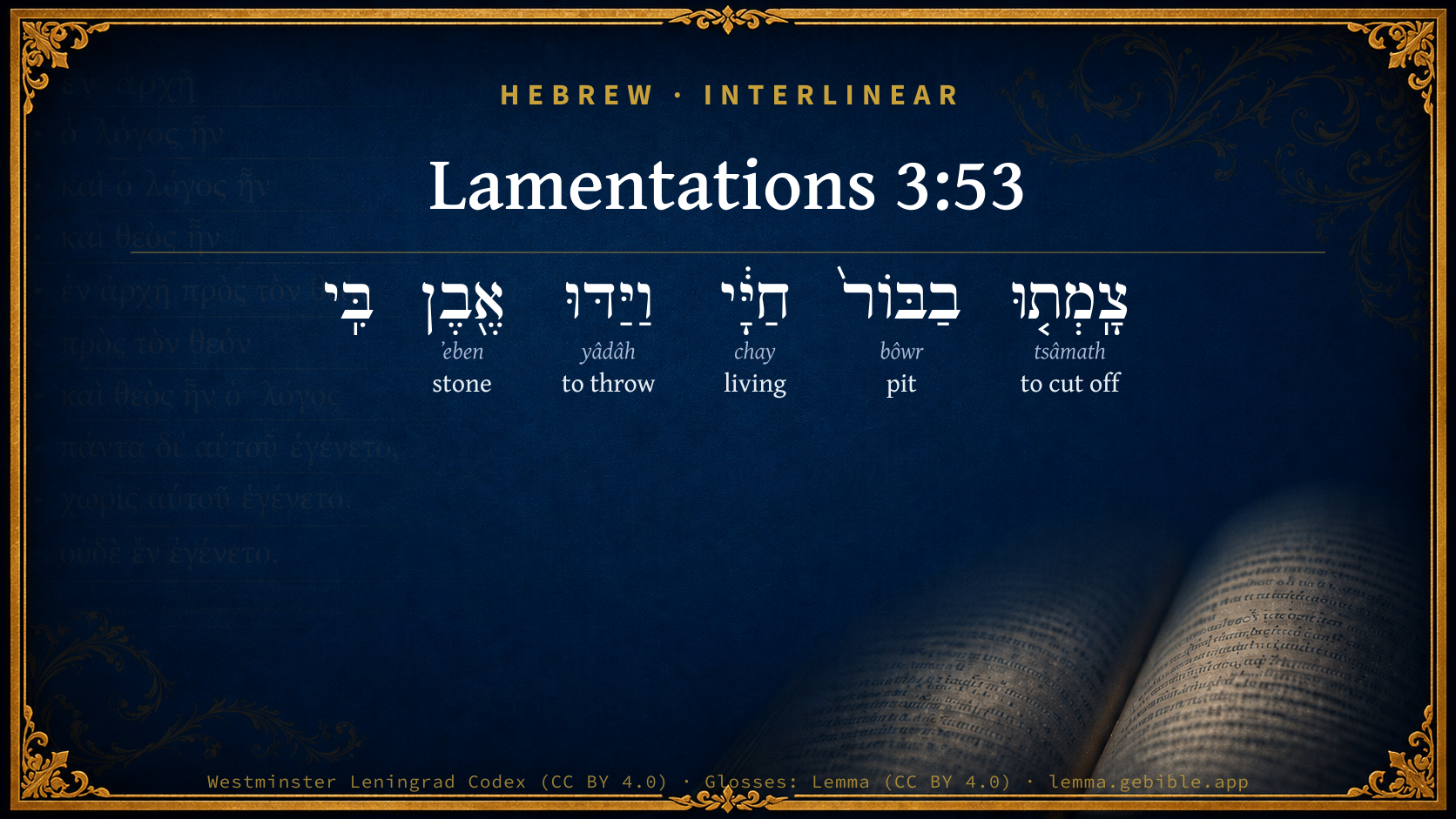
Hebrew (Westminster Leningrad Codex) Lamentations 3:53 appears in the Hebrew Old Testament. The text above is from the Westminster Leningrad Codex. Each word links to its Strong’s number, a concise gloss, and parsing drawn from the Open Scriptures Hebrew Bible morphology. Click any word for its full Brown-Driver-Briggs (BDB) entry.
Download image
Cite this verse

Lamentations 3:53 (World English Bible). Public Domain. Lemma interlinear Bible study tool, https://lemma.gebible.app/v/lamentations/3/53.

Show BibTeX & RIS
BibTeX
RIS
English Translation
They have cut off my life in the dungeon, and have cast a stone on me.
World English Bible · Public Domain
Download a study sheet

One document with this verse’s original text, its word-by-word gloss line, the meaning frame, cross-references with their text, attributed commentary, and full source and license credits — printable, and it pastes into notes with its structure intact.

This verse Autodidact and up

Study sheet (.html) Plain text (.txt)

A passage Seminary Student

Up to 50 verses in one chapter. A passage sheet keeps up to 6 commentary sources and 12 cross-references per verse, in the order this page ranks them, and says so on the sheet whenever that leaves anything out. Ask for a single verse and you get the Autodidact verse sheet above.

Everything on this page stays free to read, with no account — the sheet is a download of what is already on screen, not access to it.

Want to remove ads? Support Godless Engineer
Compare translations 3

The same verse in 3 English versions, stacked beneath the original-language interlinear above. Click any original word for its lexicon entry.

Each is an independent rendering of the whole verse — the interlinear is not word-aligned to these translations.

Highlighted words mark where these versions differ — a whole-verse word diff, not a word-by-word alignment.

  • World English Bible Public Domain
    They have cut off my life in the dungeon, and have cast a stone on me.
  • King James Version Public Domain
    They have cut off my life in the dungeon, and cast a stone upon me.
  • unfoldingWord Literal Text CC BY-SA 4.0
    They silenced my life in the pit and cast a stone against me.

unfoldingWord Literal Text — © unfoldingWord, licensed CC BY-SA 4.0. Word-aligned USFM3 via Door43 (git.door43.org/unfoldingWord/en_ult).

Versions to compare (up to 4)

3 of 4 selected

Show all 18 translations

Every available English version of this verse, each an independent rendering of the whole verse.

  • World English Bible Public Domain
    They have cut off my life in the dungeon, and have cast a stone on me.
  • Berean Standard Bible Public Domain
    They dropped me alive into a pit and cast stones upon me.
  • Majority Standard Bible Public Domain
    They dropped me alive into a pit and cast stones upon me.
  • King James Version Public Domain
    They have cut off my life in the dungeon, and cast a stone upon me.
  • American Standard Version (1901) Public Domain
    They have cut off my life in the dungeon, and have cast a stone upon me.
  • Revised Version (1885) Public Domain
    They have cut off my life in the dungeon, and have cast a stone upon me.
  • Geneva Bible (1599) Public Domain
    They haue shut vp my life in the dungeon, and cast a stone vpon me.
  • Douay-Rheims (1899) Public Domain
    Sade. My life is fallen into the pit, and they have laid a stone over me.
  • Young's Literal Translation Public Domain
    They have cut off in a pit my life, And they cast a stone against me.
  • Literal Standard Version CC BY-SA 4.0
    They have cut off my life in a pit, || And they cast a stone against me.
  • Unlocked Literal Bible CC BY-SA 4.0
    They cast me into a pit and they threw a stone on me,
  • unfoldingWord Literal Text CC BY-SA 4.0
    They silenced my life in the pit and cast a stone against me.
  • Darby Bible Public Domain
    They have cut off my life in a pit, and cast a stone upon me.
  • World Messianic Bible Public Domain
    They have cut off my life in the dungeon, and have cast a stone on me.
  • Webster's Bible Public Domain
    They have cut off my life in the dungeon, and cast a stone upon me.
  • Free Bible Version CC BY-SA 4.0
    They tried to kill me by tossing me into a pit and throwing stones at me.
  • Bible in Basic English Public Domain
    They have put an end to my life in the prison, stoning me with stones.
  • JPS Tanakh (1917) Public Domain
    They have cut off my life in the dungeon, and have cast stones upon me.

Literal Standard Version (2020), Covenant Press — licensed CC BY-SA 4.0. Text via the HelloAO Bible API (eBible.org). Unlocked Literal Bible (unfoldingWord) — licensed CC BY-SA 4.0. Text via the HelloAO Bible API (eBible.org). unfoldingWord Literal Text — © unfoldingWord, licensed CC BY-SA 4.0. Word-aligned USFM3 via Door43 (git.door43.org/unfoldingWord/en_ult). Free Bible Version, Dr. Jonathan Gallagher — licensed CC BY-SA 4.0. Text via the HelloAO Bible API (eBible.org).

Word by word

More ways to search: Search by grammar → Find every occurrence → Compare this word →

Practice this passage: Drill this verse → Learn its vocabulary →

צָֽמְת֤וּ
tsâmath
H6789
“to cut off”
Verb, Qal, Perfect, 3rd Person, Common, Plural
Part of Speech
Verb
Stem
Qal
Form
Perfect
Person
3rd Person
Gender
Common
Number
Plural
Full BDB Definition

Origin: a primitive root

TWOT: 1932

to put an end to, cut off, destroy, exterminate, extirpate - (Qal) to put an end to, terminate - (Niphal) to be ended, be annihilated, be exterminated - (Piel) to put an end to - (Pilel) to be exterminated, be annihilated - (Hiphil) to exterminate, annihilate
  1. בַבּוֹר֙ bôwr H953 “in/at the · pit” Preposition, Determined + Noun, Common, Masculine, Singular, Absolute
  2. חַיָּ֔י chay H2416 “living things · my” Noun, Common, Masculine, Plural, Construct + Suffix, Personal, 1st Person, Common, Singular
  3. וַיַּדּוּ yâdâh H3034 “and · to throw” Conjunction + Verb, Piel, Sequential Imperfect, 3rd Person, Masculine, Plural
  4. אֶ֖בֶן ʼeben H68 “stone” Noun, Common, Feminine, Singular, Absolute

About this verse

These counts appear in no published source. They are computed here, from the morphology-tagged text and Lemma’s own curated glosses. What Lemma adds →

6
words
5
distinct lemmas
Prophets
section

Notable vocabulary

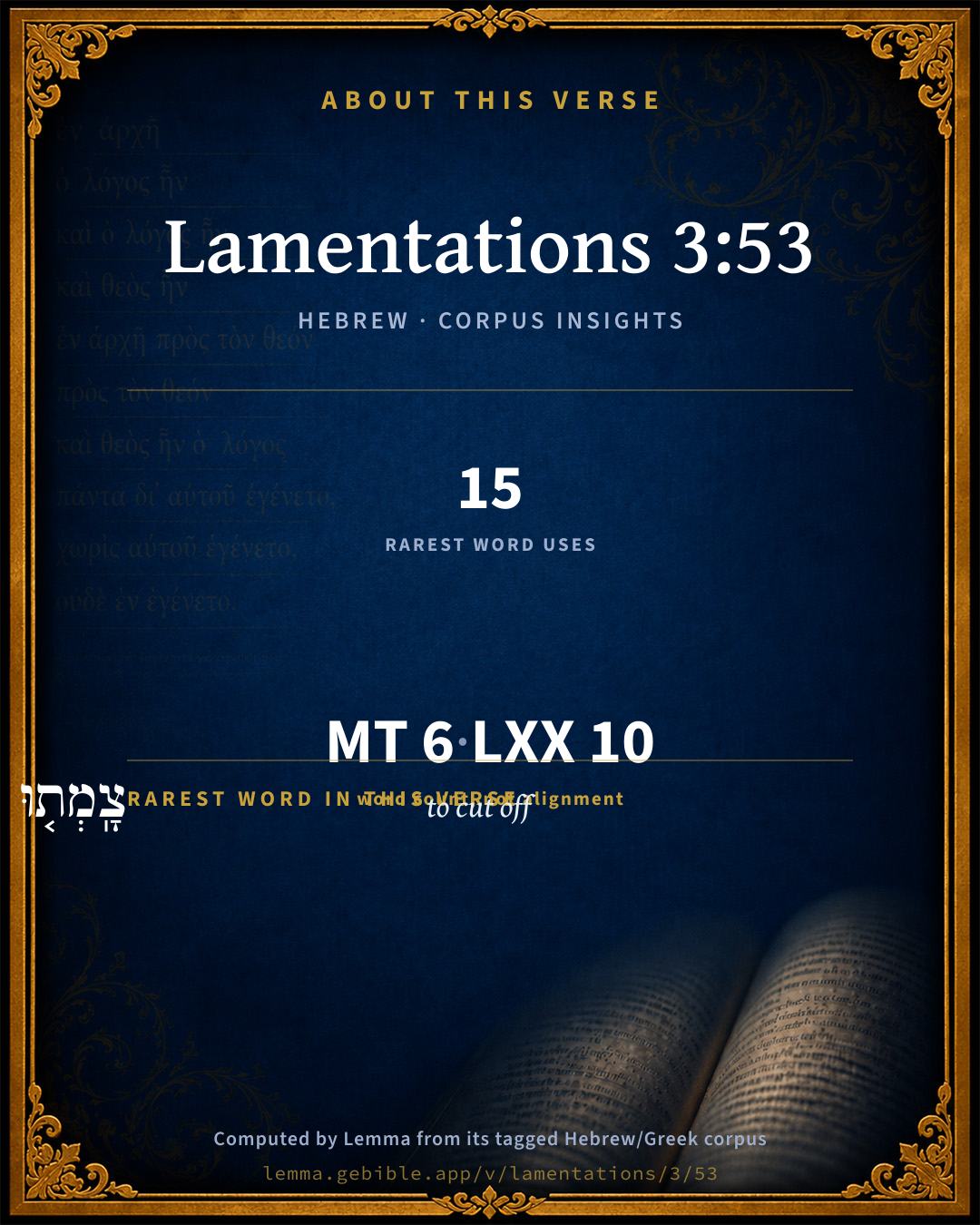
The rarest word here is צָֽמְת֤וּ to cut off H6789 — appearing just 15 times in the whole Hebrew Bible.

Shared distinctive vocabulary

צָֽמְת֤וּ to cut off H6789 occurs in 14 verses of the Hebrew Bible. Also found in:

Grammatical profile

  • 2 verbs
  • 3 nouns
  • 1 preposition

Verb forms

  • צָֽמְת֤וּ Qal · Perfect
  • וַיַּדּוּ Piel · Sequential Imperfect

Hebrew & Septuagint length

In English translation the verse runs 16 words from the Hebrew and 6 from the Septuagint (LXX English) — the Septuagint runs noticeably shorter here. See the side-by-side →

A rough comparison of the two English renderings, which tokenize alike — not a word-level alignment.

Word counts can differ between the Hebrew and the Greek without any difference in meaning — e.g. the Hebrew direct-object marker אֵת has no separate Greek word, and Greek often adds the article ὁ.

In the original languages it is 6 Hebrew tokens and 10 Greek tokens — but the two are counted differently (Hebrew bundles its prefixes and suffixes into one token; the Greek is in lemma form), so that isn’t a like-for-like length.

Cross-references

7

Topical passages linked to Lamentations 3:53 in the Treasury of Scripture Knowledge — connected by theme and wording, ordered by reader-vote popularity; previews shown in the World English Bible.

  • Jeremiah 38:6 Then took they Jeremiah, and cast him into the dungeon of Malchijah the king's son, that was in the court of the guard: and they let down Jeremiah with cords. In the dungeon there was no water, but mire; and Jeremiah sank in the mire.
  • Jeremiah 38:9 My lord the king, these men have done evil in all that they have done to Jeremiah the prophet, whom they have cast into the dungeon; and he is likely to die in the place where he is, because of the famine; for there is no more bread in the city.
  • Daniel 6:17 A stone was brought, and laid on the mouth of the den; and the king sealed it with his own signet, and with the signet of his lords; that nothing might be changed concerning Daniel.
  • Jeremiah 37:16 When Jeremiah was come into the dungeon-house, and into the cells, and Jeremiah had remained there many days;
  • Jeremiah 37:20 Now please hear, my lord the king: please let my supplication be presented before you, that you not cause me to return to the house of Jonathan the scribe, lest I die there.
  • Matthew 27:60 and laid it in his own new tomb, which he had hewn out in the rock, and he rolled a great stone to the door of the tomb, and departed.
  • Matthew 27:66 So they went with the guard and made the tomb secure, sealing the stone.

Cross-references courtesy of OpenBible.info (CC BY 4.0).

Hebrew and Greek witnesses Masoretic Hebrew ↔ Greek Septuagint

The same verse in the two great witnesses to the Old Testament, shown verse-for-verse.

Here the Septuagint runs noticeably shorter than the Hebrew — LXX2012 (modern English Septuagint) 6 words vs World English Bible 16. A rough length comparison of the two English translations, not a word-level alignment — read both below.

These are two independent witnesses, not word-aligned to each other, and the Septuagint is shown in lemma (dictionary) form.

Hebrew Lamentations 3:53 Masoretic · Westminster Leningrad Codex

צָֽמְת֤וּ בַבּוֹר֙ חַיָּ֔י וַיַּדּוּ אֶ֖בֶן בִּֽי

They have cut off my life in the dungeon, and have cast a stone on me.

World English Bible · Public Domain

Greek LXX Lamentations 3:53 Septuagint · lemma form

θανατόω ἐν λάκκος ζωή ἐγώ καί ἐπιτίθημι λίθος ἐπί ἐγώ

and laid a stone upon me.

LXX2012 (modern English Septuagint) · Public Domain

Hebrew: Westminster Leningrad Codex (CC BY 4.0). Greek: Septuagint (public domain); English from LXX2012 (modern English Septuagint) (Public Domain). How the Septuagint differs from the Hebrew →

Commentary

Notes on Lamentations 3:53 from classic Christian and Jewish commentators (each source and its license shown beneath its notes). The classic Christian expositions comment on the surrounding passage and are grouped to its opening verse, so a note may address several verses; the Jewish commentaries on the Tanakh (Rashi and others) are per-verse, so they appear only where the commentator wrote on this verse.

Lemma curates 59 commentaries, every one of them public domain or Creative Commons licensed, each selected and text-cleaned for this edition rather than reprinted as found. About our sources →

Trapp's Complete Commentary

John Trapp

Lam 3:53 They have cut off my life in the dungeon, and cast a stone upon me.

Ver. 53. They have cut off my life in the dungeon.] Where I led a lifeless life; such as did Roger, Bishop of Salisbury, in King Stephen’s time, who sustained such miseries in prison, ut vivere noluerit, mori nescierit, that live he would not, and yet die he could not.

And cast a stone upon me.] As they did upon the mouths of dens, dungeons, or sepulchres, to make sure work. The Chaldee hath it, They stoned me.

John Trapp, A Commentary or Exposition upon All the Books of the Old and New Testament (1647–1656) — public domain. Text from a community e-Sword module.

Keil & Delitzsch

C. F. Keil & F. Delitzsch

צמתוּ is here used transitively in Kal, as the Piel is elsewhere, Psa 119:139, and the Pilpel, Psa 88:17. צמתוּ בבּור, "they were destroying (cutting off) my life down into the pit," is a pregnant construction, and must be understood de conatu: "they sought to destroy my life when they hurled me down into the pit, and cast stones on me," i.e., not "they covered the pit with a stone" (Pareau, De Wette, Neumann). The verb ידה construed with בּ does not take this meaning, for ידה merely signifies to cast, e.g., lots (Jos 4:3, etc.), arrows (Jer 50:14), or to throw down = destroy, annihilate, Zac 2:4; and בּי does not mean "in the pit in which I was," but "upon (or against) me." The sing. אבן is to be understood in accordance with the expression רגם אבן, to cast stones = stone (Kg1 12:18; Lev 20:2, Lev 20:27). As to ויּדּוּ for ויידּוּ, see on ויּגּה in Lam 3:33. "Waters flowed over my head" is a figurative expression, denoting such misery and distress as endanger life; cf. Psa 59:2-3, Psa 59:15., Psa 124:4., Psa 42:8. 'I said (thought), I am cut off (from God's eyes or hand)," Psa 31:23; Psa 88:6, is a reminiscence from these Psalms, and does not essentially differ from "cut off out of the land of the living," Isa 43:8. For, that we must thereby think of death, or sinking down into Sheol, is shown by מבּור תּחתּיּות, Lam 3:55. The complaint in these verses (52-54) is regarded by some expositors as a description of the personal sufferings of Jeremiah; and the casting into the pit is referred to the incident mentioned in Jer 38:6. Such is the view, for instance, taken by Vaihinger and Ngelsbach, who point for proof to these considerations especially: (1) That the Chaldeans certainly could not, without good cause (Lam 3:53), be understood as the "enemies;" (2) that Jeremiah could not represent the people, speaking as if they were righteous and innocent; and (3) that the writer already speaks of his deliverance from their power, and contents himself with merely calling down on them the vengeance of God (Lam 3:55-66). But not one of these reasons is decisive. For, in the first place, the contents of Lam 3:52 do not harmonize with the known hostility which Jeremiah had to endure from his personal enemies. That is to say, there is nothing mentioned or known of his enemies having stoned him, or having covered him over with a stone, after they had cast him into the miry pit (Jer 38:6.), The figurative character of the whole account thus shows itself in the very fact that the separate portions of it are taken from reminiscences of passages in the Psalms, whose figurative character is universally acknowledged. Moreover, in the expression איבי חנּם, even when we understand thereby the Chaldeans, it is not at all implied that he who complains of these enemies considers himself righteous and innocent, but simply that he has not given them any good ground for their hostile conduct towards him. And the assertion, that the writer is already speaking of his deliverance from their power, rests on the erroneous notion that, in Lam 3:55-66, he is treating of past events; whereas, the interchange of the perfects with imperatives of itself shows that the deliverance of which he there speaks is not an accomplished or bygone fact, but rather the object of that assured faith which contemplates the non-existent as existent. Lastly, the contrast between personal suffering ad the suffering of the people, on which the whole reasoning rests, is quite beside the mark. Moreover, if we take the lamentations to be merely symbolical, then the sufferings and persecutions of which the prophet here complains are not those of the people generally, but of the godly Israelites, on whom they were inflicted when the kingdom was destroyed, not merely by the Chaldeans, but also by their godless fellow-countrymen. Hence we cannot, of course, say that Jeremiah here speaks from personal experience; however, he complains not merely of the persecutions that befall him personally, but also of the sufferings that had come on him and all godly ones. The same remark applies to the conclusion of this lamentation, - the prayer, Lam 3:55-66, in which he entreats the Lord for deliverance, and in the spirit of faith views this deliverance as already accomplished.

Keil & Delitzsch — Biblical Commentary on the Old Testament (1861–1891) — public domain (CC PDM 1.0). Text via the HelloAO Bible API. (Old Testament only.)

Geneva Bible (1599)

Geneva Bible translators

Read Jer. 37:16, how he was in the miry dungeon.

Geneva Bible (1599) marginal notes — public domain. Text via Bolls.life.

Jamieson, Fausset & Brown

Robert Jamieson, A. R. Fausset & David Brown

in . . . dungeon-- (Jer 37:16).

stone--usually put at the mouth of a dungeon to secure the prisoners (Jos 10:18; Dan 6:17; Mat 27:60).

Jamieson, Fausset & Brown — Commentary Critical and Explanatory on the Whole Bible (1871) — public domain (CC PDM 1.0). Text via the HelloAO Bible API.

John Calvin's Commentaries

He now employs other comparisons. Some improperly confine this to Jeremiah himself, as though he explained here before God the wrongs done to himself: but there is no doubt but that he undertakes the cause of the whole people; and his object was to encourage by his own example the faithful to lament their state so that they might obtain pardon from God.

He then compares himself to a man half-dead, cast into a pit, and there left for lost. Then some improperly interpret the words, “they cast stones;” for stoning was not in the mind of the Prophet; but having said that he was fast bound in a pit or dungeon, he adds that a stone was laid over him, that lie might not come forth, as we know was the case with Daniel. (Daniel 6:16, 17.) Daniel was cast into the den of lions, and then a stone was put on the mouth of the den. So also the Prophet says, that he was bound fast in the pit, and not only that, but that a stone was laid over him, that there might be no hope of coming out; and thus the pit was like a grave. Here, then, he means that lie was reduced to the last extremity, because he had not only been taken by his enemies, but had also been cast into a pit. And, as it is well known, it is a metaphorical expression or a similitude. He adds, —

John Calvin's Commentaries (1540-1563) — public domain. Text from the Calvin Translation Society English edition (1840s-50s) via the Christian Classics Ethereal Library (ccel.org). Calvin's coverage is partial (roughly two-thirds of the Bible); uncommented books and verses are honest gaps, never fabricated. The 19th-century editor's footnotes and remarks are omitted so the notes are faithfully Calvin's own voice.

Ellicott's Commentary for English Readers

(53) Cast a stone upon me.—The words admit of two meanings: (1) that they cast stones at him; (2) that they placed a stone over the opening of his dungeon so as to prevent escape.

A Bible Commentary for English Readers, edited by Charles John Ellicott (1878–1897) — public domain. Text from a community e-Sword module.

John Gill's Exposition

O Lord, thou hast pleaded the cause of my soul,.... Or, causes of "my soul", or "life" (u); such as concerned his soul and life: not one only, but many of them; and this respects not Jeremiah only, and the Lord's pleading his cause against Zedekiah and his nobles; but the people of the Jews in former times, when in Egypt, and in the times of the judges:

thou hast redeemed my life; by delivering out of the pit and dungeon, where it was in danger; and not only him, but the whole body of the people of old out of Egypt, and out of the hands of their enemies, the Philistines and others.

(u) "causas animaa meae", Junius & Tremellius, Piscator.

John Gill's Exposition of the Whole Bible (1746–1763) — public domain (CC PDM 1.0). Text via the HelloAO Bible API.

Albert Barnes' Notes on the Bible

They have cut off my life in the dungeon - Or, “They destroyed my life in the pit,” i. e. tried to destroy it by casting me into the cistern, and covering the month with a stone. See the margin reference.

Albert Barnes' Notes on the Bible (1834–1885) — public domain. Text from a community e-Sword/MySword module.

Haydock's Catholic Bible Commentary

Over me, as if I were buried. (Haydock) --- Jeremias was in prison (chap. xxxviii. 6.) when he prayed, ver. 54., and chap. xx. 7. (Calmet)

George Leo Haydock (1774–1849), Haydock's Catholic Family Bible and Commentary, 1859 edition — public domain. Excludes Psalms (Douay-Rheims chapter numbering differs from Protestant) and Deuterocanonical books (Catholic canon only).

Matthew Poole's English Annotations

Dungeon seemeth not to be here taken literally, for the lowest and nastiest place in prisons, which probably was the portion but of a few of the Jews; but metaphorically, for the lowest and saddest condition of misery. Their enemies had brought them into the deepest miseries, to the cutting off of their lives; and as men use to roll great stones upon the mouths of dens and pits, where they have shut up persons, to make them sure from escaping out, so their enemies had dealt with them, doing what lay in them to make their condition remediless and desperate.

Matthew Poole's English Annotations on the Holy Bible (1683–1685) — public domain. Text from a community e-Sword/MySword module.

Whedon's Commentary on the Bible

Daniel D. Whedon

53. Cast a stone, etc. — They covered the pit in which the prophet was confined with a stone, to make escape hopeless.

Daniel D. Whedon (gen. ed.), Commentary on the Old and New Testaments (1874–1909) — public domain. Text from a community e-Sword module.

John Wesley's Explanatory Notes

Dungeon - Dungeon seems here to be taken for the lowest condition of misery.

John Wesley, Explanatory Notes Upon the Whole Bible (1754–1765) — public domain. Text via the GEBible commentary corpus.

Rashi

Rabbi Shlomo Yitzchaki (Rashi)

They have confined my life in the dungeon Heb. בַּבּוֹר, in prison.

They have confined Heb. צָמְתוּ, they bound, like the junction (צֹמֶת) of the sinews (Hul. 76a); (Song 4:1): “from within your kerchief (לְצַמָתֵךְ),” estreyture in Old French, restriction, tightening.

and have cast a stone upon me on the mouth of the dungeon. That is what they did to Daniel, and Jeremiah foresaw it with the holy spirit.

They have confined my life in the dungeon And although they confined my life in the dungeon so that I cannot ascend from within it, they did not pay attention to this until they cast a stone upon me.

Rashi on the Tanakh — English translations: “The Judaica Press complete Tanach with Rashi, translated by A. J. Rosenberg” (CC BY 4.0); “Pentateuch with Rashi's commentary by M. Rosenbaum and A.M. Silbermann, 1929-1934” (public domain); “The Metsudah Tanach series, Lakewood, N.J” (CC BY 4.0); and “The Book of Joshua, Metsudah Publications, 1997” (CC BY 4.0). Text via Sefaria.

Lesson kit

Teaching starters — assembled from the data on this page, not authored interpretation. Every prompt links to the verse data it draws on. Edit before teaching.

Lamentations, in the Prophets, opens this verse with 6 words (5 distinct Hebrew lemmas). Its most distinctive word is tsâmath (“to cut off”). The Greek Septuagint runs shorter here. A historical commentator’s framing appears above. Read the whole chapter for the surrounding context.

Discussion questions

  1. What does “to cut off” (tsâmath) contribute to the verse as a whole?
  2. 2 Samuel 22:41 shares the word «to cut off» with this verse. How do the two illuminate each other?
  3. Compared with the Hebrew, the Septuagint runs shorter here. What questions does that raise?
  4. These translations render this verse differently. What is at stake in choosing one wording over another?
  5. The verb «צָֽמְת֤וּ» is Qal Perfect. How does its form color the action?
  6. Reading how Trapp's Complete Commentary and Keil & Delitzsch read this verse, where do the two commentators agree and where do they part?

Things to notice

Reading settings

Reading text

Shown beneath each verse's original-language words.

Old Testament
Old Testament edition

Read the OT as the Masoretic Hebrew (MT) or the Greek Septuagint (LXX).

English shown for the Greek Septuagint (in the Hebrew ↔ Greek comparison).

Comparing translations? Open the Compare panel on any verse page to stack up to four side by side.