
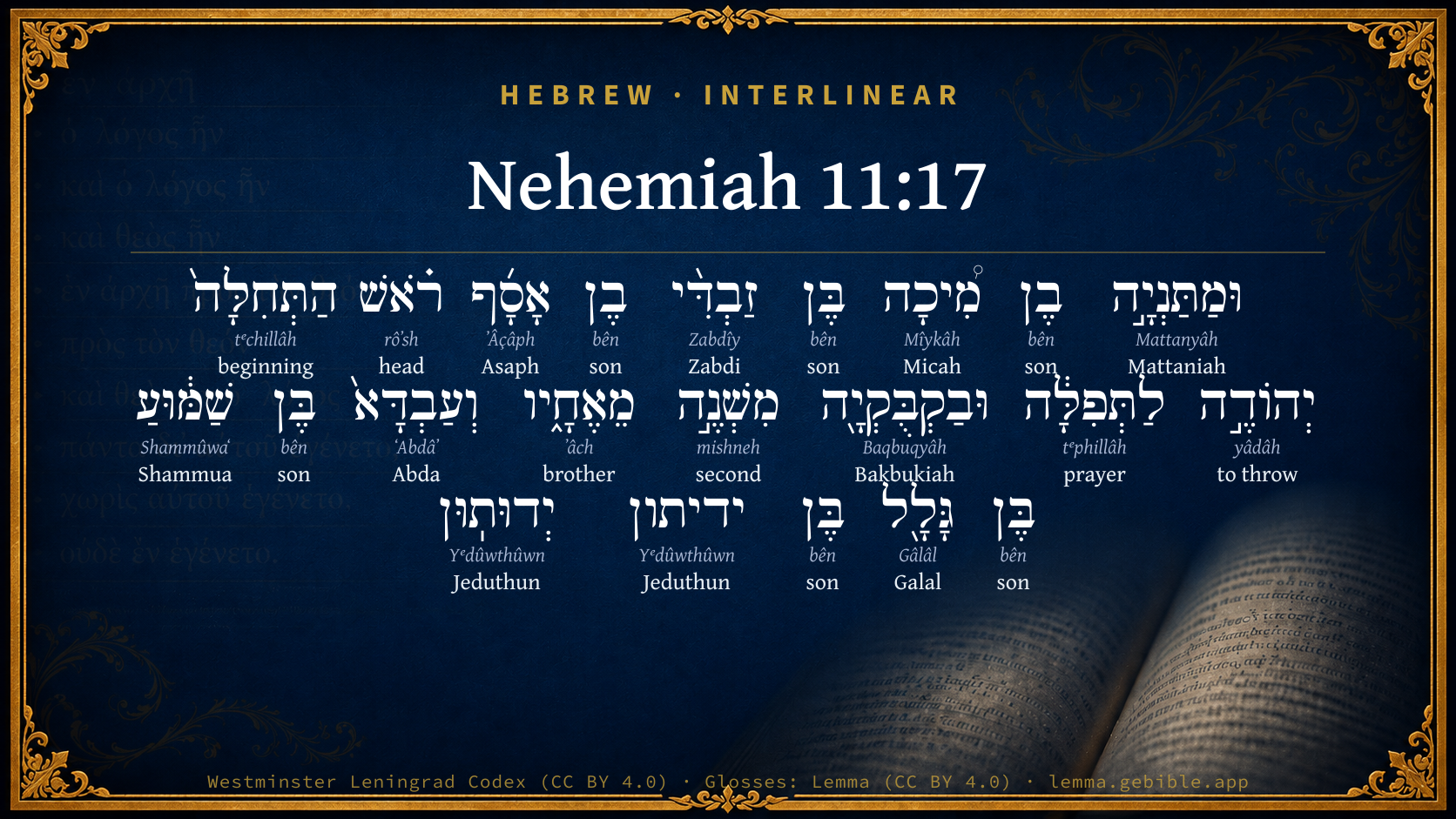
Nehemiah 11:17

Hebrew (Westminster Leningrad Codex) Nehemiah 11:17 appears in the Hebrew Old Testament. The text above is from the Westminster Leningrad Codex. Each word links to its Strong’s number, a concise gloss, and parsing drawn from the Open Scriptures Hebrew Bible morphology. Click any word for its full Brown-Driver-Briggs (BDB) entry.
Download image
Cite this verse

Nehemiah 11:17 (World English Bible). Public Domain. Lemma interlinear Bible study tool, https://lemma.gebible.app/v/nehemiah/11/17.

Show BibTeX & RIS
BibTeX
RIS
English Translation
and Mattaniah the son of Mica, the son of Zabdi, the son of Asaph, who was the chief to begin the thanksgiving in prayer, and Bakbukiah, the second among his brothers; and Abda the son of Shammua, the son of Galal, the son of Jeduthun.
World English Bible · Public Domain
Highlights
  • 1 first appearance in the Hebrew Bible
Full analysis ↓
Download a study sheet

One document with this verse’s original text, its word-by-word gloss line, the meaning frame, cross-references with their text, attributed commentary, and full source and license credits — printable, and it pastes into notes with its structure intact.

This verse Autodidact and up

Study sheet (.html) Plain text (.txt)

A passage Seminary Student

Up to 50 verses in one chapter. A passage sheet keeps up to 6 commentary sources and 12 cross-references per verse, in the order this page ranks them, and says so on the sheet whenever that leaves anything out. Ask for a single verse and you get the Autodidact verse sheet above.

Everything on this page stays free to read, with no account — the sheet is a download of what is already on screen, not access to it.

Want to remove ads? Support Godless Engineer
Compare translations 3

The same verse in 3 English versions, stacked beneath the original-language interlinear above. Click any original word for its lexicon entry.

Each is an independent rendering of the whole verse — the interlinear is not word-aligned to these translations.

Highlighted words mark where these versions differ — a whole-verse word diff, not a word-by-word alignment.

  • World English Bible Public Domain
    and Mattaniah the son of Mica, the son of Zabdi, the son of Asaph, who was the chief to begin the thanksgiving in prayer, and Bakbukiah, the second among his brothers; and Abda the son of Shammua, the son of Galal, the son of Jeduthun.
  • King James Version Public Domain
    And Mattaniah the son of Micha, the son of Zabdi, the son of Asaph, was the principal to begin the thanksgiving in prayer: and Bakbukiah the second among his brethren, and Abda the son of Shammua, the son of Galal, the son of Jeduthun.
  • unfoldingWord Literal Text CC BY-SA 4.0
    and Mattaniah, the son of Mika, the son of Zabdi, the son of Asaph, the head of the beginning who offered the thanksgiving prayer; and Bakbukiah, second from his brothers; and Abda, the son of Shammua, the son of Galal, the son of Jeduthun.

unfoldingWord Literal Text — © unfoldingWord, licensed CC BY-SA 4.0. Word-aligned USFM3 via Door43 (git.door43.org/unfoldingWord/en_ult).

Versions to compare (up to 4)

3 of 4 selected

Show all 18 translations

Every available English version of this verse, each an independent rendering of the whole verse.

  • World English Bible Public Domain
    and Mattaniah the son of Mica, the son of Zabdi, the son of Asaph, who was the chief to begin the thanksgiving in prayer, and Bakbukiah, the second among his brothers; and Abda the son of Shammua, the son of Galal, the son of Jeduthun.
  • Berean Standard Bible Public Domain
    Mattaniah son of Mica, the son of Zabdi, the son of Asaph, who led in thanksgiving and prayer; Bakbukiah, second among his associates; and Abda son of Shammua, the son of Galal, the son of Jeduthun.
  • Majority Standard Bible Public Domain
    Mattaniah son of Mica, the son of Zabdi, the son of Asaph, who led in thanksgiving and prayer; Bakbukiah, second among his associates; and Abda son of Shammua, the son of Galal, the son of Jeduthun.
  • King James Version Public Domain
    And Mattaniah the son of Micha, the son of Zabdi, the son of Asaph, was the principal to begin the thanksgiving in prayer: and Bakbukiah the second among his brethren, and Abda the son of Shammua, the son of Galal, the son of Jeduthun.
  • American Standard Version (1901) Public Domain
    and Mattaniah the son of Mica, the son of Zabdi, the son of Asaph, who was the chief to begin the thanksgiving in prayer, and Bakbukiah, the second among his brethren; and Abda the son of Shammua, the son of Galal, the son of Jeduthun.
  • Revised Version (1885) Public Domain
    and Mattaniah the son of Mica, the son of Zabdi, the son of Asaph, who was the chief to begin the thanksgiving in prayer, and Bakbukiah, the second among his brethren; and Abda the son of Shammua, the son of Galal, the son of Jeduthun.
  • Geneva Bible (1599) Public Domain
    And Mattaniah, the sonne of Micha, the sonne of Zabdi, the sonne of Asaph was the chiefe to begin the thankesgiuing and prayer: and Bakbukiah the second of his brethren, and Abda, the sonne of Shammua, the sonne of Galal, the sonne of Ieduthun.
  • Douay-Rheims (1899) Public Domain
    And Mathania the son of Micha, the son of Zebedei, the son of Asaph, was the principal man to praise, and to give glory in prayer, and Becbecia the second, one of his brethren, and Abda the son of Samua, the son of Galal, the son of Idithun.
  • Young's Literal Translation Public Domain
    and Mattaniah son of Micha, son of Zabdi, son of Asaph, `is' head -- at the commencement he giveth thanks in prayer; and Bakbukiah `is' second among his brethren, and Abda son of Shammua, son of Galal, son of Jeduthun.
  • Literal Standard Version CC BY-SA 4.0
    and Mattaniah son of Micha, son of Zabdi, son of Asaph, [is] head—at the commencement he gives thanks in prayer; and Bakbukiah [is] second among his brothers, and Abda son of Shammua, son of Galal, son of Jeduthun.
  • Unlocked Literal Bible CC BY-SA 4.0
    There was Mattaniah son of Mika son of Zabdi, a descendant of Asaph, who was the director who began the thanksgiving in prayer, and Bakbukiah, the second among his brothers, and Abda son of Shammua son of Galal son of Jeduthun.
  • unfoldingWord Literal Text CC BY-SA 4.0
    and Mattaniah, the son of Mika, the son of Zabdi, the son of Asaph, the head of the beginning who offered the thanksgiving prayer; and Bakbukiah, second from his brothers; and Abda, the son of Shammua, the son of Galal, the son of Jeduthun.
  • Darby Bible Public Domain
    and Mattaniah the son of Mica, the son of Zabdi, the son of Asaph, [who was] the principal to begin the thanksgiving in prayer; and Bakbukiah, the second among his brethren; and Abda the son of Shammua, the son of Galal, the son of Jeduthun:
  • World Messianic Bible Public Domain
    and Mattaniah the son of Mica, the son of Zabdi, the son of Asaph, who was the chief to begin the thanksgiving in prayer, and Bakbukiah, the second among his brothers; and Abda the son of Shammua, the son of Galal, the son of Jeduthun.
  • Webster's Bible Public Domain
    And Mattaniah the son of Micha, the son of Zabdi, the son of Asaph, was the principal to begin the thanksgiving in prayer: and Bakbukiah the second among his brethren, and Abda the son of Shammua, the son of Galal, the son of Jeduthun.
  • Free Bible Version CC BY-SA 4.0
    Mattaniah, son of Mica, son of Zabdi, son of Asaph, who led out in giving thanks and praise; and Bakbukiah, who was second; and Abda, son of Shammua, son of Galal, son of Jeduthun.
  • Bible in Basic English Public Domain
    And Mattaniah, the son of Mica, the son of Zabdi, the son of Asaph, who had to give the first note of the song of praise in prayer, and Bakbukiah, the second among his brothers, and Abda, the son of Shammua, the son of Galal, the son of Jeduthun.
  • JPS Tanakh (1917) Public Domain
    and Mattaniah the son of Mica, the son of Zabdi, the son of Asaph, who was the chief to begin the thanksgiving in prayer, and Bakbukiah, the second among his brethren; and Abda the son of Shammua, the son of Galal, the son of Jeduthun.

Literal Standard Version (2020), Covenant Press — licensed CC BY-SA 4.0. Text via the HelloAO Bible API (eBible.org). Unlocked Literal Bible (unfoldingWord) — licensed CC BY-SA 4.0. Text via the HelloAO Bible API (eBible.org). unfoldingWord Literal Text — © unfoldingWord, licensed CC BY-SA 4.0. Word-aligned USFM3 via Door43 (git.door43.org/unfoldingWord/en_ult). Free Bible Version, Dr. Jonathan Gallagher — licensed CC BY-SA 4.0. Text via the HelloAO Bible API (eBible.org).

Word by word

More ways to search: Search by grammar → Find every occurrence → Compare this word →

Practice this passage: Drill this verse → Learn its vocabulary →

וְעַבְדָּא֙
ʻAbdâʼ
H5653
“and · Abda”
Conjunction + Noun, Proper
Part of Speech
Conjunction + Noun
Type
Proper
Full BDB Definition

Origin: from H5647

TWOT: None

Abda = "servant of Jehovah" - father of Adoniram - a Levite, son of Shammua; also called 'Obadiah'
  1. וּמַתַּנְיָ֣ה Mattanyâh H4983 “and · Mattaniah” Conjunction + Noun, Proper
  2. בֶן bên H1121 “son of” Noun, Common, Masculine, Singular, Construct
  3. מִ֠יכָה Mîykâh H4318 “Micah” Noun, Proper
  4. בֶּן bên H1121 “son of” Noun, Common, Masculine, Singular, Construct
  5. זַבְדִּ֨י Zabdîy H2067 “Zabdi” Noun, Proper
  6. בֶן bên H1121 “son of” Noun, Common, Masculine, Singular, Construct
  7. אָסָ֜ף ʼÂçâph H623 “Asaph” Noun, Proper
  8. רֹ֗אשׁ rôʼsh H7218 “head of” Noun, Common, Masculine, Singular, Construct
  9. הַתְּחִלָּה֙ tᵉchillâh H8462 “the · beginning” Particle, Definite Article + Noun, Common, Feminine, Singular, Absolute
  10. יְהוֹדֶ֣ה yâdâh H3034 “to throw” Verb, Hiphil, Imperfect, 3rd Person, Masculine, Singular
  11. לַתְּפִלָּ֔ה tᵉphillâh H8605 “to/for the · prayer” Preposition, Determined + Noun, Common, Feminine, Singular, Absolute
  12. וּבַקְבֻּקְיָ֖ה Baqbuqyâh H1229 “and · Bakbukiah” Conjunction + Noun, Proper
  13. מִשְׁנֶ֣ה mishneh H4932 “second” Noun, Common, Masculine, Singular, Absolute
  14. מֵאֶחָ֑יו ʼâch H251 “from · brothers · his” Preposition + Noun, Common, Masculine, Plural, Construct + Suffix, Personal, 3rd Person, Masculine, Singular
  15. בֶּן bên H1121 “son of” Noun, Common, Masculine, Singular, Construct
  16. שַׁמּ֔וּעַ Shammûwaʻ H8051 “Shammua” Noun, Proper
  17. בֶּן bên H1121 “son of” Noun, Common, Masculine, Singular, Construct
  18. גָּלָ֖ל Gâlâl H1559 “Galal” Noun, Proper
  19. בֶּן bên H1121 “son of” Noun, Common, Masculine, Singular, Construct
  20. ידיתון Yᵉdûwthûwn H3038 “Jeduthun” Noun, Proper
  21. יְדוּתֽוּן Yᵉdûwthûwn H3038 “Jeduthun” Noun, Proper

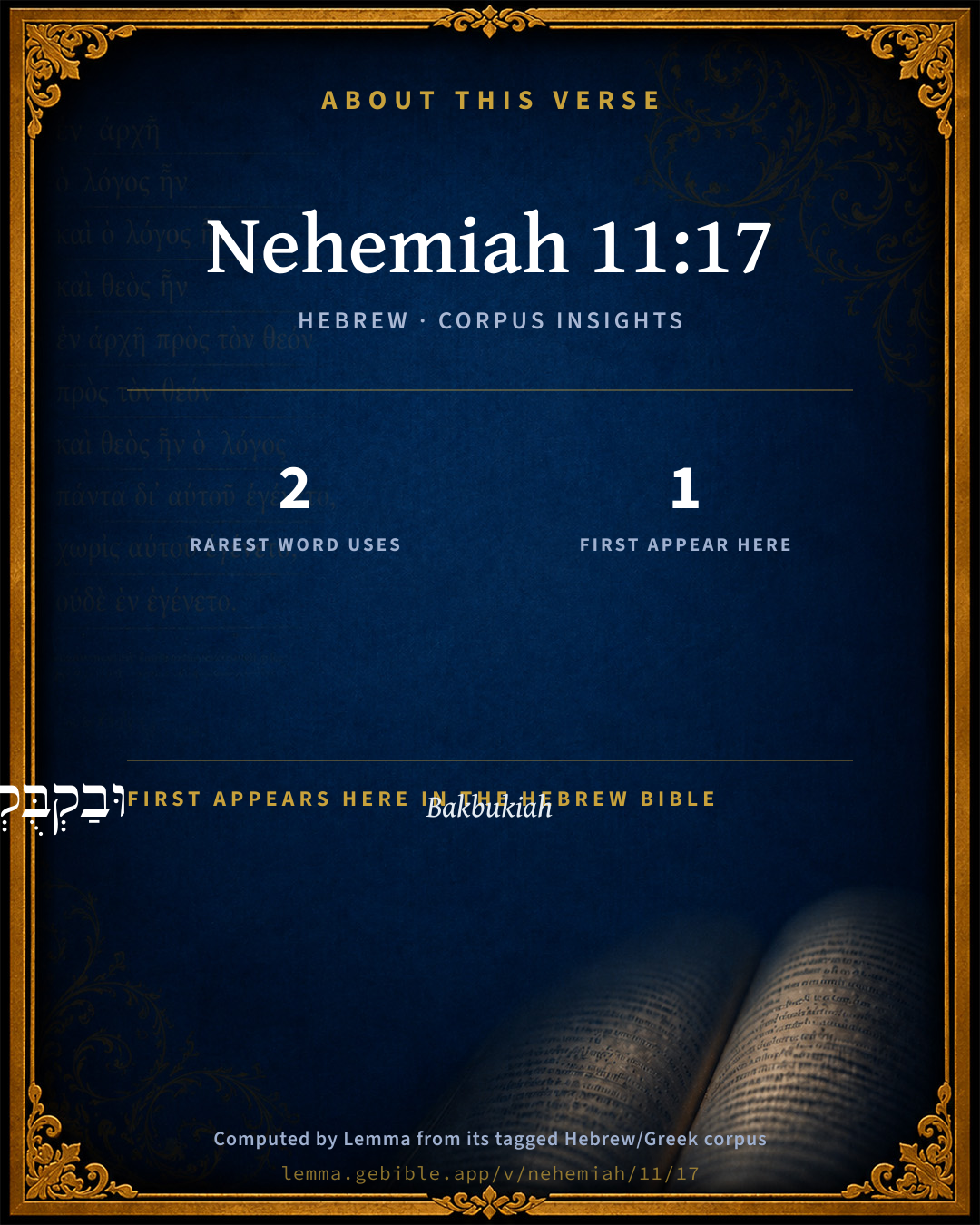
About this verse

These counts appear in no published source. They are computed here, from the morphology-tagged text and Lemma’s own curated glosses. What Lemma adds →

22
words
16
distinct lemmas
Historical
section

Notable vocabulary

The rarest word here is וְעַבְדָּא֙ Abda H5653 — appearing just 2 times in the whole Hebrew Bible.

First appearance in Scripture

This word makes its first canonical appearance in the Hebrew Bible here:

  • וּבַקְבֻּקְיָ֖ה Bakbukiah H1229

Shared distinctive vocabulary

וְעַבְדָּא֙ Abda H5653 occurs in 2 verses of the Hebrew Bible. Also found in:

Grammatical profile

  • 1 verb
  • 21 nouns

Verb forms

  • יְהוֹדֶ֣ה Hiphil · Imperfect

Repetition

Words recur within this verse — often emphatic in Hebrew:

  • בֶן son H1121 ×6
  • ידיתון Jeduthun H3038 ×2

Cross-references

10

Topical passages linked to Nehemiah 11:17 in the Treasury of Scripture Knowledge — connected by theme and wording, ordered by reader-vote popularity; previews shown in the World English Bible.

  • 1 Chronicles 9:15 and Bakbakkar, Heresh, and Galal, and Mattaniah the son of Mica, the son of Zichri, the son of Asaph,
  • 1 Chronicles 16:4 He appointed certain of the Levites to minister before the ark of Yahweh, and to celebrate and to thank and praise Yahweh, the God of Israel:
  • 1 Chronicles 16:41 and with them Heman and Jeduthun, and the rest who were chosen, who were mentioned by name, to give thanks to Yahweh, because his loving kindness endures forever;
  • 1 Chronicles 25:1–6 Moreover, David and the captains of the host set apart for the service certain of the sons of Asaph, and of Heman, and of Jeduthun, who should prophesy with harps, with psalteries, and with cymbals: and the number of those who did the work according to their service was:
  • Nehemiah 10:12 Zaccur, Sherebiah, Shebaniah,
  • Nehemiah 12:8–9 Moreover the Levites: Jeshua, Binnui, Kadmiel, Sherebiah, Judah, [and] Mattaniah, who was over the thanksgiving, he and his brothers.
  • Nehemiah 12:25 Mattaniah, and Bakbukiah, Obadiah, Meshullam, Talmon, Akkub, were porters keeping the watch at the store-houses of the gates.
  • Nehemiah 12:31 Then I brought up the princes of Judah on the wall, and appointed two great companies who gave thanks and went in procession. [One went] on the right hand on the wall toward the dung gate;

Cross-references courtesy of OpenBible.info (CC BY 4.0).

Hebrew and Greek witnesses Masoretic Hebrew ↔ Greek Septuagint

The same verse in the two great witnesses to the Old Testament, shown verse-for-verse.

These are two independent witnesses, not word-aligned to each other, and the Septuagint is shown in lemma (dictionary) form.

Hebrew Nehemiah 11:17 Masoretic · Westminster Leningrad Codex

וּמַתַּנְיָ֣ה בֶן מִ֠יכָה בֶּן זַבְדִּ֨י בֶן אָסָ֜ף רֹ֗אשׁ הַתְּחִלָּה֙ יְהוֹדֶ֣ה לַתְּפִלָּ֔ה וּבַקְבֻּקְיָ֖ה מִשְׁנֶ֣ה מֵאֶחָ֑יו וְעַבְדָּא֙ בֶּן שַׁמּ֔וּעַ בֶּן גָּלָ֖ל בֶּן ידיתון יְדוּתֽוּן

and Mattaniah the son of Mica, the son of Zabdi, the son of Asaph, who was the chief to begin the thanksgiving in prayer, and Bakbukiah, the second among his brothers; and Abda the son of Shammua, the son of Galal, the son of Jeduthun.

World English Bible · Public Domain

Greek LXX Structure differs

The Septuagint has no separate book of Nehemiah. Its Greek text is the second half of Esdras B (2 Esdras), chapters 11–23; Ezra is the first half (1–10).

A verse-for-verse comparison isn’t shown here because the chapters and verses don’t line up. Switch to the LXX edition with the MT / LXX toggle above to read the Greek directly.

On this verse, The Cambridge Bible for Schools and Colleges discusses the Septuagint’s reading. Read the note in Commentary ↓

Hebrew: Westminster Leningrad Codex (CC BY 4.0). Greek: Septuagint (public domain); English from a public-domain English Septuagint. How the Septuagint differs from the Hebrew →

Commentary

Notes on Nehemiah 11:17 from classic Christian and Jewish commentators (each source and its license shown beneath its notes). The classic Christian expositions comment on the surrounding passage and are grouped to its opening verse, so a note may address several verses; the Jewish commentaries on the Tanakh (Rashi and others) are per-verse, so they appear only where the commentator wrote on this verse.

Lemma curates 59 commentaries, every one of them public domain or Creative Commons licensed, each selected and text-cleaned for this edition rather than reprinted as found. About our sources →

John Gill's Exposition

The overseer also of the Levites at Jerusalem was Uzzi, the son of Bani,.... He was the supervisor of them, that looked after them that they did their work in ministering to the priests, as they had occasion for them; this man's genealogy is further traced through Hashabiah and Mattaniah, to Micha the son of Asaph, Neh 11:17,

of the sons of Asaph, the singers were over the business of the house of God; which, according to Jarchi, was to take care of the repairs of the temple and other things; but one would think rather that part of the service of the house which lay in singing the songs of it is respected.

John Gill's Exposition of the Whole Bible (1746–1763) — public domain (CC PDM 1.0). Text via the HelloAO Bible API.

Trapp's Complete Commentary

John Trapp

Neh 11:17 And Mattaniah the son of Micha, the son of Zabdi, the son of Asaph, [was] the principal to begin the thanksgiving in prayer: and Bakbukiah the second among his brethren, and Abda the son of Shammua, the son of Galal, the son of Jeduthun.

Ver. 17. To begin the thanksgiving in prayer] To set tunes to psalms of praise, and to begin those tunes, as precentor, chief chanter.

John Trapp, A Commentary or Exposition upon All the Books of the Old and New Testament (1647–1656) — public domain. Text from a community e-Sword module.

Joseph Benson's Commentary

Neh 11:17. To begin the thanksgiving in prayer — In the public and solemn prayers and praises, which were constantly joined with the morning and evening sacrifice, at which the singers were present, and praised God with a psalm or hymn, which this man began.

Joseph Benson's Commentary on the Old and New Testaments (1811–1818) — public domain. Text from a community e-Sword module.

Tyndale Open Study Notes

Tyndale Open Resources

11:17 a descendant of Asaph: David had chosen Asaph and his sons to provide music for the Temple worship (1 Chr 25:1-8). Asaph’s descendants took up this role again when the new Temple was built.

Tyndale Open Study Notes — © Tyndale Open Resources, licensed CC BY-SA 4.0. Text via the HelloAO Bible API.

Geneva Bible (1599)

Geneva Bible translators

That is, he began the Psalm, and was the chanter.

Geneva Bible (1599) marginal notes — public domain. Text via Bolls.life.

Jamieson, Fausset & Brown

Robert Jamieson, A. R. Fausset & David Brown

the principal to begin the thanksgiving in prayer--that is, the leader of the choir which chanted the public praise at the time of the morning and evening sacrifice. That service was always accompanied by some appropriate psalm, the sacred music being selected and guided by the person named.

Jamieson, Fausset & Brown — Commentary Critical and Explanatory on the Whole Bible (1871) — public domain (CC PDM 1.0). Text via the HelloAO Bible API.

Adam Clarke's Commentary

Verse 17. The principal to begin the thanksgiving] The precentor, pitcher of the tune, or master-singer.

Adam Clarke's Commentary on the Bible (1810–1826) — public domain. Text from a community e-Sword/MySword module.

The Cambridge Bible for Schools and Colleges

gen. ed. J. J. S. Perowne

17. Micha] R.V. Mica.

was the principal] R.V. who was the chief. The expression ‘the chief to begin the thanksgiving in prayer’ is not very intelligible. The Hebrew for ‘the chief to begin’ is literally ‘the head of the beginning (t’khillah) who used to give thanks to the prayer’ i.e. after it. The LXX. and Vulg. Vss. follow a text, which differs in one letter, ‘the head of the praise’ (t’hillah), and gives a good sense, viz. ‘the head or leader of praise, one who gave thanks in the time of prayer,’ (LXX. ἄρχων τοῦ αἴνου καὶ Ἰούδας τῆς προσευχῆς; Vulg. ‘princeps ad laudandum et ad confitendum in oratione.’) But the obscurity of the Hebrew phrase probably arises from its having been a technical title of the leader of the Temple choir, a choregus.

Bakbukiah the second among his brethren] i.e. second to Mattaniah. Bakbukiah probably corresponds to Bakbakkar in 1Ch_9:15, or to Berechiah in 1Ch_9:16.

Abda] This name appears with the same genealogy as Obadiah in 1Ch_9:16.

From the mention of ‘Asaph’ and ‘Jeduthun’ we evidently have in these verses (as in 1Ch_9:14-15) the class of Levites, who, e.g. in Ezr_2:41, stand before ‘the porters,’ i.e. ‘the singers.’

The Cambridge Bible for Schools and Colleges (gen. ed. J. J. S. Perowne; Cambridge University Press, 1878–1918) — public domain. Text from a community e-Sword module.

Haydock's Catholic Bible Commentary

Praise. Master of music. (Calmet) --- Hebrew, "chief to begin the thanksgiving in prayer." Syriac, "leader of the Jews in prayer." (Haydock)

George Leo Haydock (1774–1849), Haydock's Catholic Family Bible and Commentary, 1859 edition — public domain. Excludes Psalms (Douay-Rheims chapter numbering differs from Protestant) and Deuterocanonical books (Catholic canon only).

Matthew Poole's English Annotations

In prayer, i.e. in the public and solemn prayers and praises which were constantly joined with the morning and evening sacrifice, at which the singers were present, and praised God with a psalm or hymn, which this man began.

Matthew Poole's English Annotations on the Holy Bible (1683–1685) — public domain. Text from a community e-Sword/MySword module.

Whedon's Commentary on the Bible

Daniel D. Whedon

17. The principal to begin the thanksgiving — He was the precentor and chief musician, like Asaph, mentioned in 1Ch_16:5.

Bakbukiah the second — Second in rank; next in position and authority to Mattaniah.

Daniel D. Whedon (gen. ed.), Commentary on the Old and New Testaments (1874–1909) — public domain. Text from a community e-Sword module.

The Pulpit Commentary

Mattaniah ... was the principal to begin the thanksgiving in prayer. i.e. the "leader of the choir," or "precentor." Bakbukiah was second to him among his brethren; i.e. was his chief assistant. Abda (or "Obadiah," 1Ch_9:16) held the third place.

The Pulpit Commentary (1880–1919), ed. H.D.M. Spence-Jones & Joseph S. Exell — public domain. Text from a community e-Sword module.

John Wesley's Explanatory Notes

To begin - In the publick and solemn prayers and praises, which were constantly joined with the morning and evening sacrifice, at which the singers were present, and praised God with a psalm or hymn which, this man began.

John Wesley, Explanatory Notes Upon the Whole Bible (1754–1765) — public domain. Text via the GEBible commentary corpus.

unfoldingWord translationNotes

Door43 World Missions Community

Mattaniah ... Mika ... Zabdi ... Asaph ... Bakbukiah ... Abda ... Shammua ... Galal ... Jeduthun

These are the names of men. (See: How to Translate Names)

who began the thanksgiving in prayer

That is, who directed the singers.

Bakbukiah, the second among his brothers

Possible meanings are 1) Bakbukiah was Mattaniah's kinsman and second in authority to Mattaniah or 2) "Bakbukiah, who led a second group of singers."

brothers

Another possible meaning is "associates" or "fellow workers."

the holy city

This expression refers to the city of Jerusalem.

numbered 284

"numbered two hundred and eighty-four." There were 284 Levites in Jerusalem. (See: Numbers)

translationWords

son

descend

pray

holy

Levi

unfoldingWord translationNotes — © Distant Shores Media and the Door43 World Missions Community, licensed CC BY-SA 4.0. Source: git.door43.org/Door43/en_tn.

Rashi

Rabbi Shlomo Yitzchaki (Rashi)

the head to begin the thanksgiving in prayer He was the head and the appointed official, and the greatest one who was first to start and to thank in prayer and in singing the songs of the Levites. יְהוֹדֶה is like יוֹדֶה, and the “hey” enters the word unnecessarily, like יוֹסֵף and יְהוֹסֵף.

Rashi on the Tanakh — English translations: “The Judaica Press complete Tanach with Rashi, translated by A. J. Rosenberg” (CC BY 4.0); “Pentateuch with Rashi's commentary by M. Rosenbaum and A.M. Silbermann, 1929-1934” (public domain); “The Metsudah Tanach series, Lakewood, N.J” (CC BY 4.0); and “The Book of Joshua, Metsudah Publications, 1997” (CC BY 4.0). Text via Sefaria.

Lesson kit

Teaching starters — assembled from the data on this page, not authored interpretation. Every prompt links to the verse data it draws on. Edit before teaching.

Nehemiah, in the Historical, opens this verse with 22 words (16 distinct Hebrew lemmas). Its most distinctive word is ʻAbdâʼ (“Abda”). A historical commentator’s framing appears above. Read the whole chapter for the surrounding context.

Discussion questions

  1. The word ʻAbdâʼ carries the sense “Abda.” How does it shape the verse?
  2. This is the first place “Bakbukiah” appears in Scripture (first appears here). What does its debut here establish?
  3. How does 1 Kings 4:6, which shares the word «Abda», read alongside this verse?
  4. What does the repetition of “son” (6× in this one verse) do in this verse?
  5. These translations render this verse differently; the difference is in the English rendering, not the original. What questions does that raise?
  6. «יְהוֹדֶ֣ה» is a Hiphil Imperfect verb. How does that grammatical form shape the action described?
  7. Compare how John Gill's Exposition and Trapp's Complete Commentary read this verse. Where do they agree or differ?

Things to notice

  • 1 word makes its first canonical appearance in Scripture here.
  • These translations choose different wording for 13 words in this verse.
  • “son” occurs 6× in this single verse.
  • 16 distinct Hebrew lemmas span 22 words in this verse.

Reading settings

Reading text

Shown beneath each verse's original-language words.

Old Testament
Old Testament edition

Read the OT as the Masoretic Hebrew (MT) or the Greek Septuagint (LXX).

English shown for the Greek Septuagint (in the Hebrew ↔ Greek comparison).

Comparing translations? Open the Compare panel on any verse page to stack up to four side by side.