
Psalms 107:31

Hebrew (Westminster Leningrad Codex) Psalms 107:31 appears in the Hebrew Old Testament. The text above is from the Westminster Leningrad Codex. Each word links to its Strong’s number, a concise gloss, and parsing drawn from the Open Scriptures Hebrew Bible morphology. Click any word for its full Brown-Driver-Briggs (BDB) entry.
Download image
Cite this verse

Psalms 107:31 (World English Bible). Public Domain. Lemma interlinear Bible study tool, https://lemma.gebible.app/v/psalms/107/31.

Show BibTeX & RIS
BibTeX
RIS
English Translation
Let them praise Yahweh for his loving kindness, For his wonderful works for the children of men!
World English Bible · Public Domain
Download a study sheet

One document with this verse’s original text, its word-by-word gloss line, the meaning frame, cross-references with their text, attributed commentary, and full source and license credits — printable, and it pastes into notes with its structure intact.

This verse Autodidact and up

Study sheet (.html) Plain text (.txt)

A passage Seminary Student

Up to 50 verses in one chapter. A passage sheet keeps up to 6 commentary sources and 12 cross-references per verse, in the order this page ranks them, and says so on the sheet whenever that leaves anything out. Ask for a single verse and you get the Autodidact verse sheet above.

Everything on this page stays free to read, with no account — the sheet is a download of what is already on screen, not access to it.

Want to remove ads? Support Godless Engineer
Compare translations 3

The same verse in 3 English versions, stacked beneath the original-language interlinear above. Click any original word for its lexicon entry.

Each is an independent rendering of the whole verse — the interlinear is not word-aligned to these translations.

Highlighted words mark where these versions differ — a whole-verse word diff, not a word-by-word alignment.

  • World English Bible Public Domain
    Let them praise Yahweh for his loving kindness, For his wonderful works for the children of men!
  • King James Version Public Domain
    Oh that men would praise the LORD for his goodness, and for his wonderful works to the children of men!
  • unfoldingWord Literal Text CC BY-SA 4.0
    May they thank Yahweh his covenant faithfulness and his amazing deeds for the sons of man!

unfoldingWord Literal Text — © unfoldingWord, licensed CC BY-SA 4.0. Word-aligned USFM3 via Door43 (git.door43.org/unfoldingWord/en_ult).

Versions to compare (up to 4)

3 of 4 selected

Show all 18 translations

Every available English version of this verse, each an independent rendering of the whole verse.

  • World English Bible Public Domain
    Let them praise Yahweh for his loving kindness, For his wonderful works for the children of men!
  • Berean Standard Bible Public Domain
    Let them give thanks to the LORD for His loving devotion and His wonders to the sons of men.
  • Majority Standard Bible Public Domain
    Let them give thanks to the LORD for His loving devotion and His wonders to the sons of men.
  • King James Version Public Domain
    Oh that men would praise the LORD for his goodness, and for his wonderful works to the children of men!
  • American Standard Version (1901) Public Domain
    Oh that men would praise Jehovah for his lovingkindness, And for his wonderful works to the children of men!
  • Revised Version (1885) Public Domain
    Oh that men would praise the LORD for his goodness, and for his wonderful works to the children of men!
  • Geneva Bible (1599) Public Domain
    Let them therfore confesse before the Lord his louing kindnesse, and his wonderfull woorkes before the sonnes of men.
  • Douay-Rheims (1899) Public Domain
    Let the mercies of the Lord give glory to him, and his wonderful works to the children of men.
  • Young's Literal Translation Public Domain
    They confess to Jehovah His kindness, And His wonders to the sons of men,
  • Literal Standard Version CC BY-SA 4.0
    They confess to YHWH His kindness, || And His wonders to the sons of men,
  • Unlocked Literal Bible CC BY-SA 4.0
    Oh that people would praise Yahweh for his covenant faithfulness and for the amazing things he has done for humanity!
  • unfoldingWord Literal Text CC BY-SA 4.0
    May they thank Yahweh his covenant faithfulness and his amazing deeds for the sons of man!
  • Darby Bible Public Domain
    Let them give thanks unto Jehovah for his loving-kindness, and for his wondrous works to the children of men;
  • World Messianic Bible Public Domain
    Let them praise the LORD for his loving kindness, for his wonderful deeds for the children of men!
  • Webster's Bible Public Domain
    Oh that men would praise the LORD for his goodness, and for his wonderful works to the children of men!
  • Free Bible Version CC BY-SA 4.0
    Let them praise the Lord for his trustworthy love, and for all the wonderful things he does for people.
  • Bible in Basic English Public Domain
    Let men give praise to the Lord for his mercy, and for the wonders which he does for the children of men!
  • JPS Tanakh (1917) Public Domain
    Let them give thanks unto the LORD for His mercy, and for His wonderful works to the children of men!

Literal Standard Version (2020), Covenant Press — licensed CC BY-SA 4.0. Text via the HelloAO Bible API (eBible.org). Unlocked Literal Bible (unfoldingWord) — licensed CC BY-SA 4.0. Text via the HelloAO Bible API (eBible.org). unfoldingWord Literal Text — © unfoldingWord, licensed CC BY-SA 4.0. Word-aligned USFM3 via Door43 (git.door43.org/unfoldingWord/en_ult). Free Bible Version, Dr. Jonathan Gallagher — licensed CC BY-SA 4.0. Text via the HelloAO Bible API (eBible.org).

Word by word

More ways to search: Search by grammar → Find every occurrence → Compare this word →

Practice this passage: Drill this verse → Learn its vocabulary →

וְ֝נִפְלְאוֹתָ֗יו
pâlâʼ
H6381
“and · being wonderful · him”
Conjunction + Verb, Niphal, Participle Active, Feminine, Plural, Construct + Suffix, Personal, 3rd Person, Masculine, Singular
Part of Speech
Conjunction + Verb
Stem
Niphal
Form
Participle Active
Gender
Feminine
Number
Plural
State
Construct
Full BDB Definition

Origin: a primitive root

TWOT: 1768

to be marvellous, be wonderful, be surpassing, be extraordinary, separate by distinguishing action - (Niphal) - to be beyond one's power, be difficult to do - to be difficult to understand - to be wonderful, be extraordinary - marvellous (participle) - (Piel) to separate (an offering) - (Hiphil) - to do extraordinary or hard or difficult thing - to make wonderful, do wondrously - (Hithpael) to show oneself wonderful or marvellous
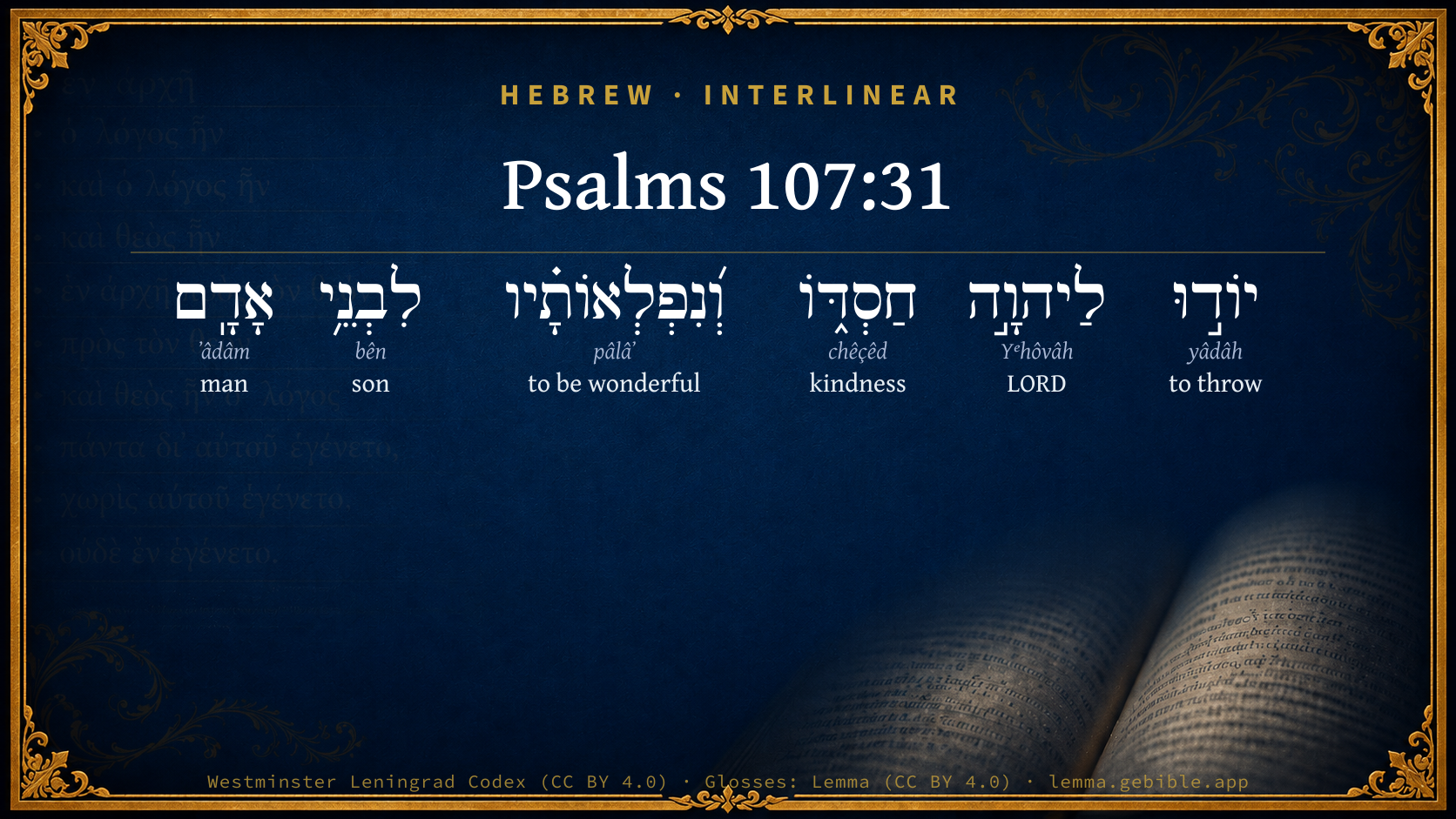
  1. יוֹד֣וּ yâdâh H3034 “to throw” Verb, Hiphil, Jussive, 3rd Person, Masculine, Plural
  2. לַיהוָ֣ה Yᵉhôvâh H3068 “to/for · LORD” Preposition + Noun, Proper
  3. חַסְדּ֑וֹ chêçêd H2617 “kindness · his” Noun, Common, Masculine, Singular, Construct + Suffix, Personal, 3rd Person, Masculine, Singular
  4. לִבְנֵ֥י bên H1121 “to/for · sons of” Preposition + Noun, Common, Masculine, Plural, Construct
  5. אָדָֽם ʼâdâm H120 “man” Noun, Common, Masculine, Singular, Absolute

About this verse

These counts appear in no published source. They are computed here, from the morphology-tagged text and Lemma’s own curated glosses. What Lemma adds →

6
words
6
distinct lemmas
Wisdom
section

Grammatical profile

  • 2 verbs
  • 4 nouns

Verb forms

  • יוֹד֣וּ Hiphil · Jussive
  • וְ֝נִפְלְאוֹתָ֗יו Niphal · Participle Active

Hebrew & Septuagint length

In English translation the verse runs 17 words from the Hebrew and 17 from the Septuagint (LXX English) — the same length.

A rough comparison of the two English renderings, which tokenize alike — not a word-level alignment.

Word counts can differ between the Hebrew and the Greek without any difference in meaning — e.g. the Hebrew direct-object marker אֵת has no separate Greek word, and Greek often adds the article ὁ.

Cross-references

17

Topical passages linked to Psalms 107:31 in the Treasury of Scripture Knowledge — connected by theme and wording, ordered by reader-vote popularity; previews shown in the World English Bible.

  • Psalms 107:8 Let them praise Yahweh for his loving kindness, For his wonderful works to the children of men!
  • Psalms 103:2 Praise Yahweh, my soul, And don't forget all his benefits;
  • Psalms 107:15 Let them praise Yahweh for his loving kindness, For his wonderful works to the children of men!
  • Psalms 107:21 Let them praise Yahweh for his loving kindness, For his wonderful works to the children of men!
  • Psalms 71:17 God, you have taught me from my youth. Until now, I have declared your wondrous works.
  • Psalms 72:18–19 Praise be to Yahweh God, the God of Israel, Who alone does marvelous deeds.
  • Psalms 77:11 I will remember Yah's deeds; For I will remember your wonders of old.
  • Psalms 77:14 You are the God who does wonders. You have made your strength known among the peoples.
  • Psalms 105:1–2 Give thanks to Yahweh! Call on his name! Make his doings known among the peoples.
  • Hosea 2:8 For she did not know that I gave her the grain, the new wine, and the oil, And multiplied to her silver and gold, which they used for Baal.
  • Jonah 1:16 Then the men feared Yahweh exceedingly; and they offered a sacrifice to Yahweh, and made vows.
  • Jonah 2:9 But I will sacrifice to you with the voice of thanksgiving. I will pay that which I have vowed. Salvation belongs to Yahweh."
  • Micah 6:4–5 For I brought you up out of the land of Egypt, And redeemed you out of the house of bondage. I sent before you Moses, Aaron, and Miriam.
  • Romans 1:20–21 For the invisible things of him since the creation of the world are clearly seen, being perceived through the things that are made, even his everlasting power and divinity; that they may be without excuse.
  • 2 Timothy 3:2 For men will be lovers of self, lovers of money, boastful, arrogant, blasphemers, disobedient to parents, unthankful, unholy,
  • Hebrews 13:15 Through him, then, let us offer up a sacrifice of praise to God continually, that is, the fruit of lips which make confession to his name.
  • Revelation 15:3 They sang the song of Moses, the servant of God, and the song of the Lamb, saying, "Great and marvelous are your works, Lord God, the Almighty; Righteous and true are your ways, you King of the nations.

Cross-references courtesy of OpenBible.info (CC BY 4.0).

Hebrew and Greek witnesses Masoretic Hebrew ↔ Greek Septuagint

The same verse in the two great witnesses to the Old Testament, shown verse-for-verse.

You’re reading Greek Psalm 106 (Hebrew Psalm 107). The Septuagint counts the superscription, so verse numbers can differ from the Hebrew — chapter-level alignment, not verse-by-verse. Numbering follows Rahlfs.

These are two independent witnesses, not word-aligned to each other, and the Septuagint is shown in lemma (dictionary) form.

Hebrew Psalms 107:31 Masoretic · Westminster Leningrad Codex

יוֹד֣וּ לַיהוָ֣ה חַסְדּ֑וֹ וְ֝נִפְלְאוֹתָ֗יו לִבְנֵ֥י אָדָֽם

Let them praise Yahweh for his loving kindness, For his wonderful works for the children of men!

World English Bible · Public Domain

Greek LXX Greek Psalm 106:31 Septuagint · lemma form

ἐκὁμολογέω ὁ κύριος ὁ ἔλεος αὐτός καί ὁ θαυμάσιος αὐτός ὁ υἱός ὁ ἄνθρωπος

Let them acknowledge to the Lord his mercies, and his wonderful works to the children of men.

LXX2012 (modern English Septuagint) · Public Domain

Hebrew: Westminster Leningrad Codex (CC BY 4.0). Greek: Septuagint (public domain); English from LXX2012 (modern English Septuagint) (Public Domain). How the Septuagint differs from the Hebrew →

Commentary

Notes on Psalms 107:31 from classic Christian and Jewish commentators (each source and its license shown beneath its notes). The classic Christian expositions comment on the surrounding passage and are grouped to its opening verse, so a note may address several verses; the Jewish commentaries on the Tanakh (Rashi and others) are per-verse, so they appear only where the commentator wrote on this verse.

Lemma curates 59 commentaries, every one of them public domain or Creative Commons licensed, each selected and text-cleaned for this edition rather than reprinted as found. About our sources →

Trapp's Complete Commentary

John Trapp

Psa 107:31 Oh that [men] would praise the LORD [for] his goodness, and [for] his wonderful works to the children of men!

Ver. 31. Oh that men would, &c.] See Psa 107:8.

John Trapp, A Commentary or Exposition upon All the Books of the Old and New Testament (1647–1656) — public domain. Text from a community e-Sword module.

J. A. Alexander on Psalms

Joseph Addison Alexander

31, 32. (Psa 107:31-32) Let (such) give thanks to Jehovah (for) his mercy, and his wonderful works to the sons of man ; and let them exalt him in the congregation of the people, and in the session of the elders praise him. Here again we have a striking instance of variety combined with uniformity. The burden or chorus, as in Psa 107:22, is followed by a solemn exhortation to connect the required thanksgiving with the forms of public worship. But instead of the temple with its sacrifices and its chants, the reference in this case, it should seem, is to the spiritual worship of the synagogue. The word translated congregation is one constantly applied to Israel, as actually gathered at the place of worship. See above, on Psa 22:22. The word session is employed in the translation of the last clause, not for the sake of a verbal coincidence with Presbyterian institutions, a coincidence, however, which is not to be denied, but because it adequately represents the Hebrew in its double acceptation, as denoting both the act and the place cf sitting, and especially of sitting together. See above, on Psa 107:4. The elders, here as elsewhere, are the heads of tribes and families, the hereditary chiefs and representatives of Israel.

Joseph Addison Alexander, The Psalms Translated and Explained (1850) — public domain. Text from a community e-Sword module.

Adam Clarke's Commentary

Verse 31. O that men] The intercalary verse, or burden, as before. See Ps 107:8.

Adam Clarke's Commentary on the Bible (1810–1826) — public domain. Text from a community e-Sword/MySword module.

The Cambridge Bible for Schools and Colleges

gen. ed. J. J. S. Perowne

31. Let them give thanks to Jehovah for his lovingkindness,

And for his wonderful works to the sons of men:

The Cambridge Bible for Schools and Colleges (gen. ed. J. J. S. Perowne; Cambridge University Press, 1878–1918) — public domain. Text from a community e-Sword module.

John Gill's Exposition

A fruitful land into barrenness,.... Or, "into saltness" (t); as Sodom and the land adjacent became a salt sea; and the land of Canaan was threatened to become brimstone, salt and burning, like Sodom; in which nothing was sown, and which bore no grass; see Gen 14:3 and so the Targum,

"the land of Israel, which brought forth fruit, he hath destroyed, as Sodom was overthrown.''

For the wickedness of them that dwell therein; this was the cause of the overthrow of Sodom, and of the destruction of that fine country, as also of Canaan afterwards; see Gen 13:13. The very Heathens had a notion that barrenness and unfruitfulness in countries were owing to the sins of men; hence the sterility and famine at Mycenas were attributed to the wickedness of Atreus (u). This may figuratively be understood of the present state and condition of the Jews; who were once a people well watered with the word and ordinances, and had the first preaching of the Gospel among them; but, rejecting and despising it, are now become like a desert, barren and unfruitful in the knowledge of divine things: and it might be illustrated by the case of several Christian churches; the seven churches of Asia, and others, once as well watered gardens, but now are no more; and the places where they stood are destitute of spiritual knowledge, and the means of it.

(t) "in salsuginem", Pagninus, Montanus, Musculus, Vatablus, Piscator, Gejerus, Michaelis; so Junius & Tremellius; "in salsam", Cocceius. (u) Hygin. Fab. 88.

John Gill's Exposition of the Whole Bible (1746–1763) — public domain (CC PDM 1.0). Text via the HelloAO Bible API.

Albert Barnes' Notes on the Bible

Oh that men... - See Psa 107:8, note; Psa 107:15, note; Psa 107:21, note. Assuredly they who are thus delivered from the dangers of the sea should praise the Lord; they who have seen the wonders of God on the great ocean should “never” forget God.

Albert Barnes' Notes on the Bible (1834–1885) — public domain. Text from a community e-Sword/MySword module.

The Treasury of David

Charles H. Spurgeon

Ver. 31. Oh that men would praise the Loud for his goodness, and for his wonderful works to the children of men! Let the sea sound forth Jehovah's praises because of his delivering grace. As the sailor touches the shore let him lift the solemn hymn to heaven, and let others who see him rescued from the jaws of death unite in his thanksgiving.

Ver. 31. Oh. This verse seems to include the ardent earnestness of the psalmist's spirit, that seamen would be much in thankfulness, and much and frequent in praising of the Lord their deliverer out of all their distresses. "Oh", seems he to say, that I could put men upon this duty, it would be more comfortable to me, seems the psalmist to say, to find such a principle in the hearts of those that are employed in the great waters, than any one thing in the world again whatsoever. "Oh" is but a little word consisting of two letters, but no word that ever man utters with his tongue comes with that force and affection from the heart as this doth. "Oh" is a word of the highest expression, a word when a man can say no more. This interjection oftentimes starts out of the heart upon a sudden from some unexpected conception, or admiration, or other. Daniel Pell.

Psalms 107:32*

Charles H. Spurgeon's The Treasury of David (1869–1885) — public domain. Psalms only. Text from a community e-Sword/MySword module.

The Pulpit Commentary

Oh that men, etc. Repeated from vers. 8, 15, and 21.

The Pulpit Commentary (1880–1919), ed. H.D.M. Spence-Jones & Joseph S. Exell — public domain. Text from a community e-Sword module.

unfoldingWord translationNotes

Door43 World Missions Community

Oh that people would praise Yahweh for his covenant faithfulness

Here the word "Oh" is used to convey a strong desire for people to praise Yahweh. The abstract noun "faithfulness" can be translated with an adjective. See how you translated this in Psalms 107:8. AT: "Let people praise Yahweh because he is faithful to his covenant" or "People should praise Yahweh because he is faithful to his covenant" (See: Exclamations and Abstract Nouns)

praise him in the council of the elders

"when the elders sit together." The elders sat together to discuss issues in the community and to make decisions for the community.

translationWords

exalt

assembly

people group

praise

council

elder

unfoldingWord translationNotes — © Distant Shores Media and the Door43 World Missions Community, licensed CC BY-SA 4.0. Source: git.door43.org/Door43/en_tn.

Lesson kit

Teaching starters — assembled from the data on this page, not authored interpretation. Every prompt links to the verse data it draws on. Edit before teaching.

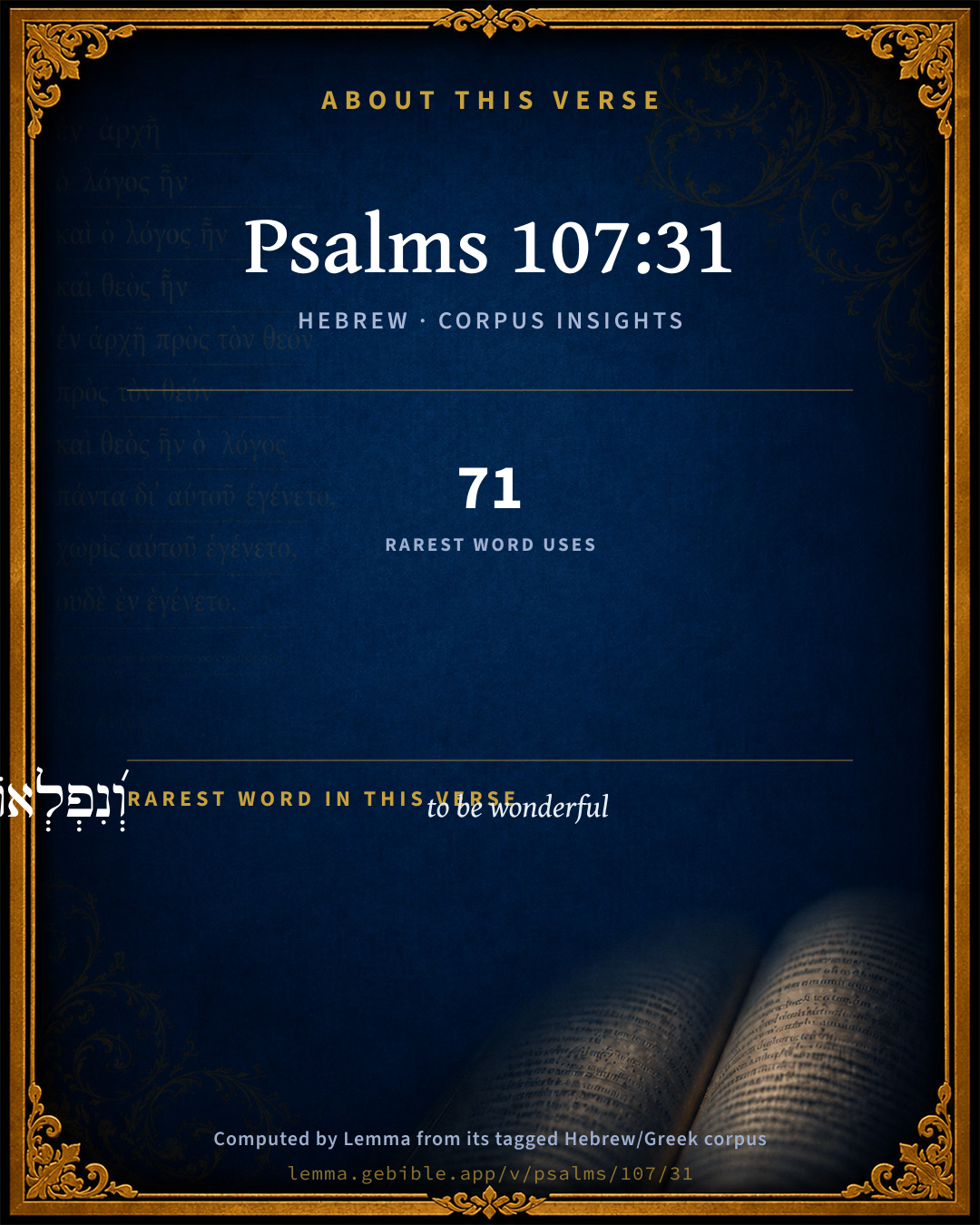
Psalms, in the Wisdom, opens this verse with 6 words (6 distinct Hebrew lemmas). Its most distinctive word is pâlâʼ (“to be wonderful”). A historical commentator’s framing appears above. Read the whole chapter for the surrounding context.

Discussion questions

  1. What does “to be wonderful” (pâlâʼ) contribute to the verse as a whole?
  2. Psalms 107:8 shares this passage’s theme. How do the two illuminate each other?
  3. These translations render this verse differently. What is at stake in choosing one wording over another?
  4. The verb «יוֹד֣וּ» is Hiphil Jussive. How does its form color the action?
  5. Reading how Trapp's Complete Commentary and J. A. Alexander on Psalms read this verse, where do the two commentators agree and where do they part?

Things to notice

Reading settings

Reading text

Shown beneath each verse's original-language words.

Old Testament
Old Testament edition

Read the OT as the Masoretic Hebrew (MT) or the Greek Septuagint (LXX).

English shown for the Greek Septuagint (in the Hebrew ↔ Greek comparison).

Comparing translations? Open the Compare panel on any verse page to stack up to four side by side.