
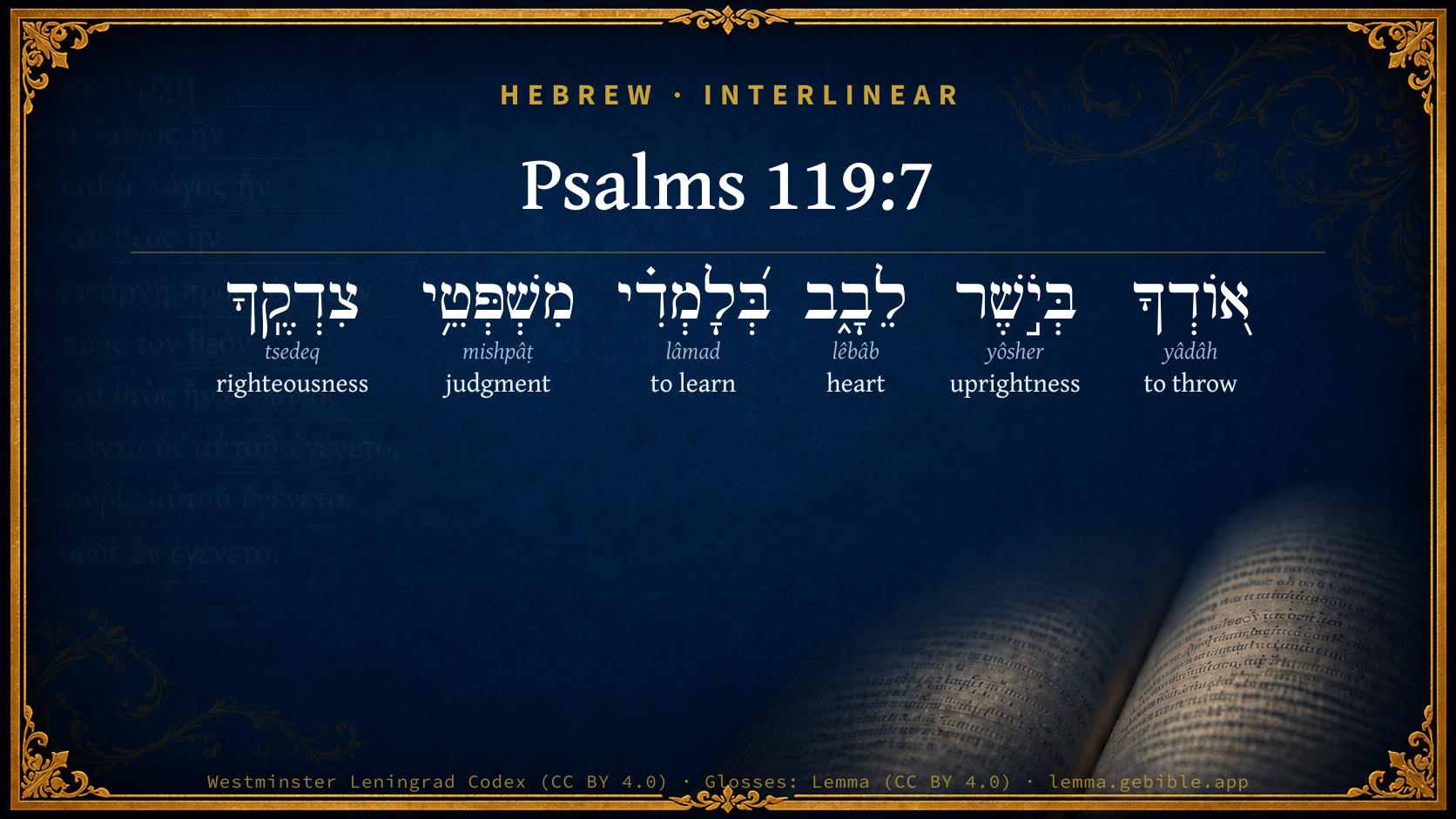
Psalms 119:7

Hebrew (Westminster Leningrad Codex) Psalms 119:7 appears in the Hebrew Old Testament. The text above is from the Westminster Leningrad Codex. Each word links to its Strong’s number, a concise gloss, and parsing drawn from the Open Scriptures Hebrew Bible morphology. Click any word for its full Brown-Driver-Briggs (BDB) entry.
Download image
Cite this verse

Psalms 119:7 (World English Bible). Public Domain. Lemma interlinear Bible study tool, https://lemma.gebible.app/v/psalms/119/7.

Show BibTeX & RIS
BibTeX
RIS
English Translation
I will give thanks to you with uprightness of heart, When I learn your righteous judgments.
World English Bible · Public Domain
Download a study sheet

One document with this verse’s original text, its word-by-word gloss line, the meaning frame, cross-references with their text, attributed commentary, and full source and license credits — printable, and it pastes into notes with its structure intact.

This verse Autodidact and up

Study sheet (.html) Plain text (.txt)

A passage Seminary Student

Up to 50 verses in one chapter. A passage sheet keeps up to 6 commentary sources and 12 cross-references per verse, in the order this page ranks them, and says so on the sheet whenever that leaves anything out. Ask for a single verse and you get the Autodidact verse sheet above.

Everything on this page stays free to read, with no account — the sheet is a download of what is already on screen, not access to it.

Want to remove ads? Support Godless Engineer
Compare translations 3

The same verse in 3 English versions, stacked beneath the original-language interlinear above. Click any original word for its lexicon entry.

Each is an independent rendering of the whole verse — the interlinear is not word-aligned to these translations.

Highlighted words mark where these versions differ — a whole-verse word diff, not a word-by-word alignment.

  • World English Bible Public Domain
    I will give thanks to you with uprightness of heart, When I learn your righteous judgments.
  • King James Version Public Domain
    I will praise thee with uprightness of heart, when I shall have learned thy righteous judgments.
  • unfoldingWord Literal Text CC BY-SA 4.0
    I will thank you with uprightness of heart when I learn the judgments of your righteousness.

unfoldingWord Literal Text — © unfoldingWord, licensed CC BY-SA 4.0. Word-aligned USFM3 via Door43 (git.door43.org/unfoldingWord/en_ult).

Versions to compare (up to 4)

3 of 4 selected

Show all 17 translations

Every available English version of this verse, each an independent rendering of the whole verse.

  • World English Bible Public Domain
    I will give thanks to you with uprightness of heart, When I learn your righteous judgments.
  • Berean Standard Bible Public Domain
    I will praise You with an upright heart when I learn Your righteous judgments.
  • Majority Standard Bible Public Domain
    I will praise You with an upright heart when I learn Your righteous judgments.
  • King James Version Public Domain
    I will praise thee with uprightness of heart, when I shall have learned thy righteous judgments.
  • American Standard Version (1901) Public Domain
    I will give thanks unto thee with uprightness of heart, When I learn thy righteous judgments.
  • Revised Version (1885) Public Domain
    I will give thanks unto thee with uprightness of heart, when I learn thy righteous judgments.
  • Geneva Bible (1599) Public Domain
    I will praise thee with an vpright heart, when I shall learne the iudgements of thy righteousnesse.
  • Young's Literal Translation Public Domain
    I confess Thee with uprightness of heart, In my learning the judgments of Thy righteousness.
  • Literal Standard Version CC BY-SA 4.0
    I confess You with uprightness of heart, || In my learning the judgments of Your righteousness.
  • Unlocked Literal Bible CC BY-SA 4.0
    I will give thanks to you with an upright heart when I learn your righteous decrees.
  • unfoldingWord Literal Text CC BY-SA 4.0
    I will thank you with uprightness of heart when I learn the judgments of your righteousness.
  • Darby Bible Public Domain
    I will give thee thanks with uprightness of heart, when I shall have learned thy righteous judgments.
  • World Messianic Bible Public Domain
    I will give thanks to you with uprightness of heart, when I learn your righteous judgments.
  • Webster's Bible Public Domain
    I will praise thee with uprightness of heart, when I shall have learned thy righteous judgments.
  • Free Bible Version CC BY-SA 4.0
    I will praise you sincerely as I learn from you the right way to live.
  • Bible in Basic English Public Domain
    I will give you praise with an upright heart in learning your right decisions.
  • JPS Tanakh (1917) Public Domain
    I will give thanks unto Thee with uprightness of heart, when I learn Thy righteous ordinances.

Literal Standard Version (2020), Covenant Press — licensed CC BY-SA 4.0. Text via the HelloAO Bible API (eBible.org). Unlocked Literal Bible (unfoldingWord) — licensed CC BY-SA 4.0. Text via the HelloAO Bible API (eBible.org). unfoldingWord Literal Text — © unfoldingWord, licensed CC BY-SA 4.0. Word-aligned USFM3 via Door43 (git.door43.org/unfoldingWord/en_ult). Free Bible Version, Dr. Jonathan Gallagher — licensed CC BY-SA 4.0. Text via the HelloAO Bible API (eBible.org).

Word by word

More ways to search: Search by grammar → Find every occurrence → Compare this word →

Practice this passage: Drill this verse → Learn its vocabulary →

About this verse

These counts appear in no published source. They are computed here, from the morphology-tagged text and Lemma’s own curated glosses. What Lemma adds →

6
words
6
distinct lemmas
Wisdom
section

Notable vocabulary

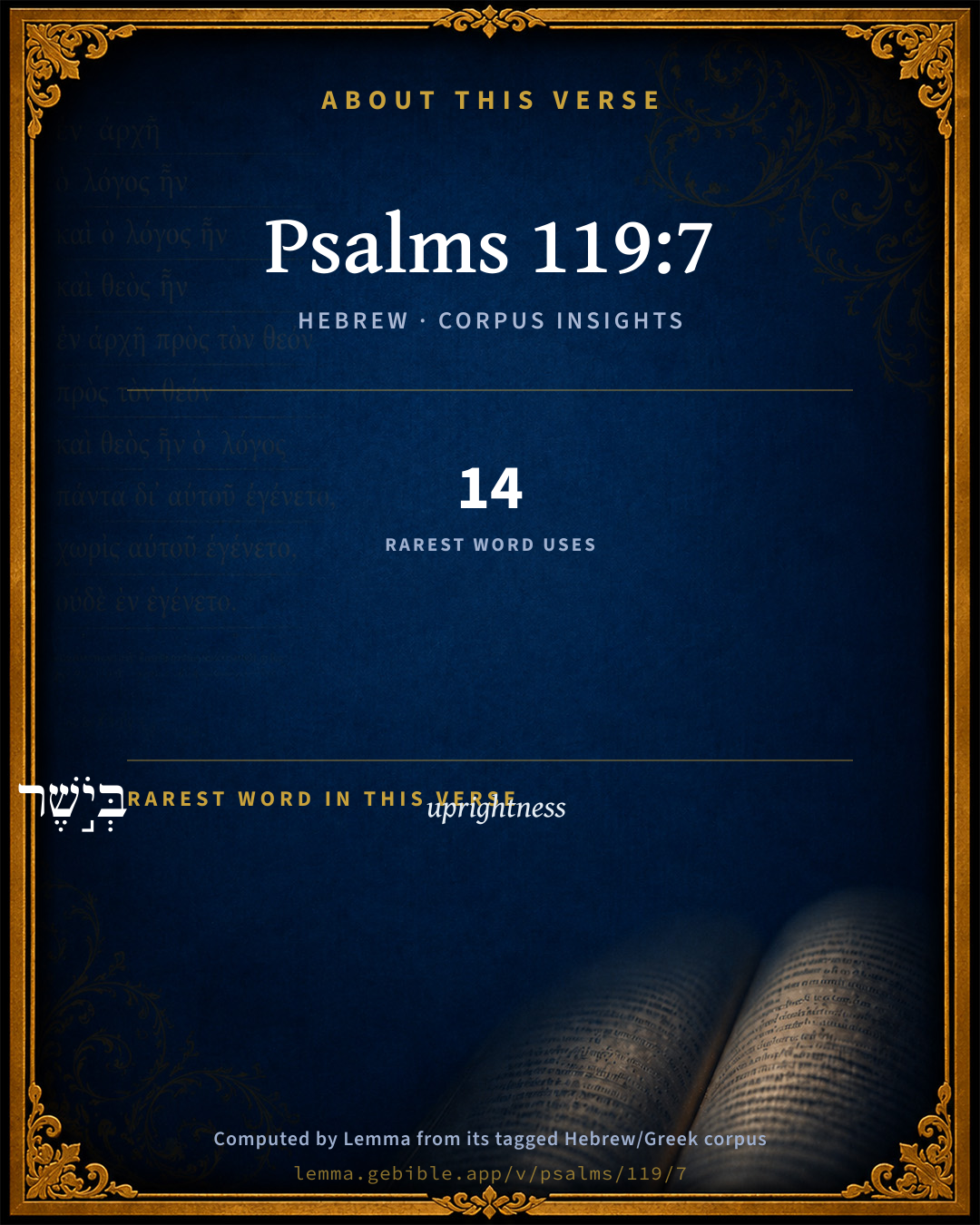
The rarest word here is בְּיֹ֣שֶׁר uprightness H3476 — appearing just 14 times in the whole Hebrew Bible.

Shared distinctive vocabulary

בְּיֹ֣שֶׁר uprightness H3476 occurs in 14 verses of the Hebrew Bible. Also found in:

Grammatical profile

  • 2 verbs
  • 4 nouns

Verb forms

  • א֭וֹדְךָ Hiphil · Imperfect
  • בְּ֝לָמְדִ֗י Qal · Infinitive Construct

Hebrew & Septuagint length

In English translation the verse runs 16 words from the Hebrew and 18 from the Septuagint (LXX English) — closely comparable.

A rough comparison of the two English renderings, which tokenize alike — not a word-level alignment.

Word counts can differ between the Hebrew and the Greek without any difference in meaning — e.g. the Hebrew direct-object marker אֵת has no separate Greek word, and Greek often adds the article ὁ.

Cross-references

16

Topical passages linked to Psalms 119:7 in the Treasury of Scripture Knowledge — connected by theme and wording, ordered by reader-vote popularity; previews shown in the World English Bible.

  • Psalms 119:171 Let my lips utter praise, For you teach me your statutes.
  • Psalms 25:4–5 Show me your ways, Yahweh. Teach me your paths.
  • Psalms 119:12 Blessed are you, Yahweh. Teach me your statutes.
  • John 6:45 It is written in the prophets, 'They will all be taught by God.' Therefore everyone who hears from the Father, and has learned, comes to me.
  • 1 Chronicles 29:13–17 Now therefore, our God, we thank you, and praise your glorious name.
  • Psalms 9:1 I will give thanks to Yahweh with my whole heart. I will tell of all your marvelous works.
  • Psalms 25:8–10 Good and upright is Yahweh, Therefore he will instruct sinners in the way.
  • Isaiah 48:17 Thus says Yahweh, your Redeemer, the Holy One of Israel: I am Yahweh your God, who teaches you to profit, who leads you by the way that you should go.
  • Psalms 119:33–34 Teach me, Yahweh, the way of your statutes. I will keep them to the end.
  • Psalms 119:27 Let me understand the teaching of your precepts! Then I will meditate on your wondrous works.
  • Psalms 119:73 Your hands have made me and formed me. Give me understanding, that I may learn your commandments.
  • Psalms 86:12–13 I will praise you, Lord my God, with my whole heart. I will glorify your name forevermore.
  • Psalms 119:64 The earth is full of your loving kindness, Yahweh. Teach me your statutes.
  • Psalms 143:10 Teach me to do your will, For you are my God. Your Spirit is good. Lead me in the land of uprightness.
  • Psalms 119:18–19 Open my eyes, That I may see wondrous things out of your law.
  • Psalms 119:124 Deal with your servant according to your loving kindness. Teach me your statutes.

Cross-references courtesy of OpenBible.info (CC BY 4.0).

Hebrew and Greek witnesses Masoretic Hebrew ↔ Greek Septuagint

The same verse in the two great witnesses to the Old Testament, shown verse-for-verse.

You’re reading Greek Psalm 118 (Hebrew Psalm 119). The Septuagint counts the superscription, so verse numbers can differ from the Hebrew — chapter-level alignment, not verse-by-verse. Numbering follows Rahlfs.

These are two independent witnesses, not word-aligned to each other, and the Septuagint is shown in lemma (dictionary) form.

Hebrew Psalms 119:7 Masoretic · Westminster Leningrad Codex

א֭וֹדְךָ בְּיֹ֣שֶׁר לֵבָ֑ב בְּ֝לָמְדִ֗י מִשְׁפְּטֵ֥י צִדְקֶֽךָ

I will give thanks to you with uprightness of heart, When I learn your righteous judgments.

World English Bible · Public Domain

Greek LXX Greek Psalm 118:7 Septuagint · lemma form

ἐκὁμολογέω σύ κύριος ἐν εὐθύτης καρδία ἐν ὁ μανθάνω ἐγώ ὁ κρίμα ὁ δικαιοσύνη σύ

I will give you thanks with uprightness of heart, when I have learned the judgments of your righteousness.

LXX2012 (modern English Septuagint) · Public Domain

On this verse, The Cambridge Bible for Schools and Colleges discusses the Septuagint’s reading. Read the note in Commentary ↓

Hebrew: Westminster Leningrad Codex (CC BY 4.0). Greek: Septuagint (public domain); English from LXX2012 (modern English Septuagint) (Public Domain). How the Septuagint differs from the Hebrew →

Commentary

Notes on Psalms 119:7 from classic Christian and Jewish commentators (each source and its license shown beneath its notes). The classic Christian expositions comment on the surrounding passage and are grouped to its opening verse, so a note may address several verses; the Jewish commentaries on the Tanakh (Rashi and others) are per-verse, so they appear only where the commentator wrote on this verse.

Lemma curates 59 commentaries, every one of them public domain or Creative Commons licensed, each selected and text-cleaned for this edition rather than reprinted as found. About our sources →

Trapp's Complete Commentary

John Trapp

Psa 119:7 I will praise thee with uprightness of heart, when I shall have learned thy righteous judgments.

Ver. 7. I will praise thee with uprightness] David was yet but a learner; and if God would teach him to profit in knowledge and holiness, he would lift up many a humble, joyful, and thankful heart to him.

John Trapp, A Commentary or Exposition upon All the Books of the Old and New Testament (1647–1656) — public domain. Text from a community e-Sword module.

The Biblical Illustrator

Joseph S. Exell

Psa_119:7

I will praise Thee with uprightness of heart.

The duty of thankfulness

Thankfulness is a duty wherein we are all obliged to the Lord. It is good in regard of the equity of it. Since the Lord gives us good things, shall not we give Him praises again? especially seeing the Lord is content so to part all His works between His majesty and us, that the good of them be ours, the glory of them be His own. It is good to praise the Lord in regard of Himself, who is the object of our praises. Since He is the treasure of all good, the Author of all blessings, it cannot be but a good thing to bless Him.

3. It is good in respect of our associates and companions in this exercise: the angels, cherubim and seraphim delight continually in His praises. Our elder brethren, that glorious congregation of the first-born, are described unto us falling down on their faces, casting their crowns at the feet of the Lord, to give Him the glory of their redemption. Now, seeing we pray that the will of God may be done in earth, as it is in heaven, why do we not delight in these exercises of praising God, by which we have fellowship with them who are glorified in Him?

4. It is good in respect of the great benefits we receive by it; nothing thereby accrues to the Lord, all the advantage is our own. (Bp. Cowper.)

The Biblical Illustrator, edited by Joseph S. Exell (c. 1880s–1900s) — public domain. Text from a community e-Sword module.

Joseph Benson's Commentary

Psa 119:7-8. I will praise thee — That is, worship and serve thee; with uprightness of heart — With a single eye to thy glory, and with a sincere desire to know and do thy will; when I shall have learned, &c. — When, by thy good Spirit, I shall be more fully instructed in the meaning of thy word. I will keep thy statutes — It is my full purpose so to do, whatsoever it may cost me. O forsake me not utterly — For then I should fall into the foulest sins. Not that he was contented to be forsaken in the least degree, but this he more especially deprecates, as he had great reason to do.

Joseph Benson's Commentary on the Old and New Testaments (1811–1818) — public domain. Text from a community e-Sword module.

J. A. Alexander on Psalms

Joseph Addison Alexander

7. (Psa 119:7) I will thank thee with rectitude of heart, in my learning the judgments of thy righteousness. It is only my experience of thy righteous judgments that enables me to praise thee as I ought; a sentiment peculiarly appropriate to the period of some great deliverance, for instance that of the return from exile, when the righteousness of God had been so signally dis- played in the destruction of his enemies, and in the fulfilment of his promise to his people. Here again, in my learning does not mean merely after I have learned, but in the very act and in consequence of learning.

Joseph Addison Alexander, The Psalms Translated and Explained (1850) — public domain. Text from a community e-Sword module.

Geneva Bible (1599)

Geneva Bible translators

For true religion standeth in serving God without hypocrisy.

That is, thy precepts, which contain perfect righteousness.

Geneva Bible (1599) marginal notes — public domain. Text via Bolls.life.

Matthew Henry's Commentary

Here is, I. David's endeavour to perfect himself in his religion, and to make himself (as we say) master of his business. He hopes to learn God's righteous judgments. He knew much, but he was still pressing forward and desired to know more, as knowing this, that he had not yet attained; but as far as perfection is attainable in this life he reached towards it, and would not take up short of it. As long as we live we must be scholars in Christ's school, and sit at his feet; but we should aim to be head-scholars, and to get into the highest form. God's judgments are all righteous, and therefore it is desirable not only to learn them, but to be learned in them, mighty in the scriptures.

II. The use he would make of his divine learning. He coveted to be learned in the laws of God, not that he might make himself a name and interest among men, or fill his own head with entertaining speculations, but, 1. That he might give God the glory of his learning: I will praise thee when I have learned thy judgments, intimating that he could not learn unless God taught him, and that divine instructions are special blessings, which we have reason to be thankful for. Though Christ keeps a free-school, and teaches without money and without price, yet he expects his scholars should give him thanks both for his word and for his Spirit; surely it is a mercy worth thanks to be taught so gainful a calling as religion is. Those have learned a good lesson who have learned to praise God, for that is the work of angels, the work of heaven. It is an easy thing to praise God in word and tongue; but those only are well learned in this mystery who have learned to praise him with uprightness of heart, that is, are inward with him in praising him, and sincerely aim at his glory in the course of their conversation as well as in the exercises of devotion. God accepts only the praises of the upright. 2. That he might himself come under the government of that learning: When I shall have learned thy righteous judgments I will keep thy statutes. We cannot keep them unless we learn them; but we learn them in vain if we do not keep them. Those have well learned God's statutes who have come up to a full resolution, in the strength of his grace, to keep them.

III. His prayer to God not to leave him: "O forsake me not! that is, leave me not to myself, withdraw not thy Spirit and grace from me, for then I shall not keep thy statutes." Good men see themselves undone if God forsakes them; for then the tempter will be too hard for them. "Though thou seem to forsake me, and threaten to forsake me, and dost, for a time, withdraw from me, yet let not the desertion be total and final; for that is hell. O forsake me not utterly! for woe unto me if God departs from me."

Matthew Henry's Commentary on the Whole Bible (1708–1710) — public domain (CC PDM 1.0). Text via the HelloAO Bible API.

John Calvin's Commentaries

7. I will praise thee He affirms it to be a singular instance of the loving-kindness of God, if a person has made considerable proficiency in his law. As a token and testimony of this, he here puts the giving of thanks to God; as if he should say, Lord, thou wilt confer upon me an inestimable blessing, if thou instruct me in thy law. It follows, therefore, that nothing in this life is more to be desired than this; and my fervent prayer is, that we may be fairly and fully convinced of the truth of it. For while searching carefully after such things as we deem advantageous to us, we do not overlook any earthly convenience, and yet we neglect that which is of most importance. The phrase, the judgments of thy righteousness, is the same with the commandments, in which perfect righteousness is comprehended; and thus the prophet commends God’s law on account of the thorough perfection of the doctrine contained in it. From this verse we learn, that none will praise God unfeignedly and cordially but he who has made such proficiency in his school as to mold his life into subjection to him. It is vain to make a pretense of praising God with the mouth and the tongue if we dishonor him by our life. Hence the prophet very justly here makes the fruit of genuine piety to consist in celebrating the praises of God without hypocrisy.

John Calvin's Commentaries (1540-1563) — public domain. Text from the Calvin Translation Society English edition (1840s-50s) via the Christian Classics Ethereal Library (ccel.org). Calvin's coverage is partial (roughly two-thirds of the Bible); uncommented books and verses are honest gaps, never fabricated. The 19th-century editor's footnotes and remarks are omitted so the notes are faithfully Calvin's own voice.

The Cambridge Bible for Schools and Colleges

gen. ed. J. J. S. Perowne

7. Piqqudîm, δικαιώματα (21 times), ‘precepts,’ ‘injunctions,’ LXX ἐντολαί, a poetical word found only in the Psalter (Psa_19:8; Psa_103:18; Psa_111:7).

7. I will give thanks unto thee … when I learn &c. (R.V.)] The Psalmist knows that he has not yet attained to a complete knowledge of God’s revealed Will; but he gives thanks for every advance. The will to obey (Psa_119:5-6) is the condition of progress (cp. Joh_7:17); and throughout the Psalm he prays repeatedly for teaching and direction.

The Cambridge Bible for Schools and Colleges (gen. ed. J. J. S. Perowne; Cambridge University Press, 1878–1918) — public domain. Text from a community e-Sword module.

John Gill's Exposition

I will keep thy statutes,.... This is a resolution taken up in the strength of divine grace, to answer the end of learning the judgments of God; which he did, not merely to have a notional knowledge of them, but to put them in practice; and not that he thought he could perfectly keep them, but was desirous of observing them in the best manner he could, as assisted by the grace of God; from love to God, in the faith and name of Christ, and with a view to the glory of God; without dependence upon them for life and salvation;

O forsake me not utterly; totally and finally, or not at all; otherwise as if he should say, I shall never be able to keep thy statutes; so sensible was he of the necessity of the divine Presence and grace, to assist him in the observance of them: or, "for ever", as Ben Balaam interprets it, and so the Ethiopic version; R. Moses reads the words, "O forsake me not", in a parenthesis, and joins the rest thus, "I will keep thy statutes vehemently"; or with all my strength and might; and so Kimchi reads them: but such an interpretation is very forced, and contrary to the accents.

John Gill's Exposition of the Whole Bible (1746–1763) — public domain (CC PDM 1.0). Text via the HelloAO Bible API.

Albert Barnes' Notes on the Bible

I will praise thee with uprightness of heart - With an upright and sincere heart.

When I shall have learned - Hebrew, “In my learning.” In the practice or act of learning them. His own experience of their nature, influence, and value would lead him to sincere praise. He had no doubt of finding that they were worthy of his praises, and of seeing in them more and more occasion to glorify and honor God. The more we know of God, the more shall we see in him to praise. The larger our acquaintance and experience, the more our hearts will be disposed to magnify his name. This remark must extend to all that there is in God to be learned; and as that is infinite, so there will be occasion for renewed and more elevated praise to all eternity.

Thy righteous judgments - Margin, as in Hebrew, “Judgments of thy righteousness.” The laws or statutes which God, as a righteous or just God, appoints to be the rule of conduct to his creatures.

Albert Barnes' Notes on the Bible (1834–1885) — public domain. Text from a community e-Sword/MySword module.

Matthew Poole's English Annotations

Praise thee, i.e. worship thee; one eminent duty of God’s worship being put for all, as is frequent in Scripture.

With uprightness of heart; or, with a right mind or heart; in a right manner, so as may be acceptable to thee, and beneficial to myself.

When I shall have learned thy righteous judgments; when by thy good Spirit I shall be more fully instructed in the meaning of thy word; which is the only rule of thy worship; for want of a sound knowledge whereof many persons run into superstitious or erroneous practices.

Matthew Poole's English Annotations on the Holy Bible (1683–1685) — public domain. Text from a community e-Sword/MySword module.

The Treasury of David

Charles H. Spurgeon

Ver. 7. I will praise thee. From prayer to praise is here, a long or a difficult journey. Be sure that he who prays for holiness will one day praise for happiness. Shame having vanished, silence is broken, and the formerly silent man declares, "I will praise thee." He cannot but promise praise while he seeks sanctification. Mark how well he knows upon what head to set the crown. "I will praise thee." He would himself be praiseworthy, but he counts God alone worthy of praise. By the sorrow and shame of sin he measures his obligations to the Lord who would teach him the art of living so that he should clean escape from his former misery.

With up righteous of heart. His heart would be upright if the Lord would teach him, and then it should praise its teacher. There is such a thing as false and feigned praise, and this the Lord abhors; but there is no music like that which comes from a pure soul which standeth in its integrity. Heart praise is required, uprightness in that heart, and teaching to make the heart upright. An upright heart is sure to bless the Lord, for grateful adoration is a part of its uprightness; no man can be right unless he is upright towards God, and this involves the rendering to him the praise which is his due.

When I shall have learned thy righteous judgments. We must learn to praise, learn that we may praise, and praise when we have learned. If we are ever to learn, the Lord must teach us, and especially upon such a subject as his judgments, for they are a great deep. While these are passing before our eyes, and we are learning from them, we ought to praise God, for the original is not, "when I have learned, "but, "in my learning." While yet I am a scholar I will be a chorister: my upright heart shall praise thine uprightness, my purified judgment shall admire thy judgments. God's providence is a book full of teaching, and to those whose hearts are right it is a music book, out of which they chant to Jehovah's praise. God's word is full of the record of his righteous providence, and as we read it we feel compelled to burst forth into expressions of holy delight and ardent praise. When we both read of God's judgments and become joyful partakers in them, we are doubly moved to song song in which there is neither formality, nor hypocrisy, nor lukewarmness, for the heart is upright in the presentation of its praise.

Ver. 7. I will praise thee... when I shall have learned, etc. There is no way to please God entirely and sincerely until we have learned both to know and do his will. Practical praise is the praise God looks after. Thomas Manton.

Ver. 7. I will praise thee. What is the matter for which he praises God? It is that he has been taught something of him and by him amongst men. To have learned any tongue, or science, from some school of philosophy, bindeth us to our alma mater. We praise those who can teach a dog, a horse, this or that; but for us ass colts to learn the will of God, how to walk pleasing before him, this should be acknowledged of us as a great mercy from God. Paul Bayne.

Ver. 7. Praise thee...when I shall have learned, etc. But when doth David say that he will be thankful? Even when God shall teach him. Both the matter and the grace of thankfulness are from God. As he did with Abraham, he commanded him to worship by sacrifice, and at the same time gave him the sacrifice: so doth he with all his children; for he gives not only good things, for which they should thank him, but in like manner grace by which they are able to thank him. William Cowper.

Ver. 7. When, I shall have learned. By learning he means his attaining not only to the knowledge of the word, but the practice of it. It is not a speculative light, or a bare notion of things: "Every man therefore that hath heard, and hath learned of the Father, cometh unto me" (Joh 6:45). It is such a learning as the effect will necessarily follow, such a light and illumination as doth convert the soul, and frame our hearts and ways according to the will of God. For otherwise, if we get understanding of the word, nay, if we get it imprinted in our memories, it will do us no good without practice. The best of God's servants are but scholars and students in the knowledge and obedience of his word. For saith David, "When I shall have learned." The professors of the Christian religion were primitively called disciples or learners: to plhyov twn mayhtwn; "the multitude of the disciples" (Ac 6:2.) Thomas Manton.

Ver. 7. Learned thy righteous judgments. We see here what David especially desired to learn, namely, the word and will of God: he would ever be a scholar in this school, and sought daily to ascend to the highest form; that learning to know, he might remember; remembering, might believe; believing, might delight; delighting might admire; admiring, might adore; adoring, might practise; and practising, might continue in the way of God's statutes. This learning is the old and true learning indeed, and he is best learned in this art, who turneth God's word into good works. Richard Greenham.

Ver. 7. Judgments of thy righteousness are the decisions concerning right and wrong which give expression to and put in execution the righteousness of God. Franz Delitzsch.

Ver. 7. The best of praise, the best of learning, the best of blendings, viz., praise and holiness.

Ver. 7.

1. The professor of sacred music: "I will praise."

2. The subject of his song: "Thee."

3. The instrument: "Heart."

4. The instrument tuned: "Uprightness of heart."

5. The musician's training academy: "Judgments." W.D.

Ver. 7. Learning and praising.

1. They are two spiritual exercises. It is possible for learners and singers to be carnal and sensual; but in this case they are employed about the righteous ends, works, and ways of the Lord.

2. They are two appropriate exercises. What can be more seemly than to learn of God and to praise him?

3. They are two profitable exercises. The expectations of the most utilitarian are surpassed. The pleasure and the profit yield abundant reward. Heart, head, life are all benefited.

4. They are two mutually assisting exercises. In the one we are receptive, and in the other communicative. By the one we are fitted to do the other. By the former we are stimulated to do the latter. How wonderfully the lesson is turned into a song, and the learner into a singer. W.J.

Ver. 7.

1. Deficiency confessed: "When I shall have learned." This is essential to growth. It is an admission all can truly make.

2. Progress anticipated. He gave his heart to the work of learning. He sought divine help.

3. Praise promised. He promised it to God alone. He vowed it should be sincere: "with upright heart." W. Williams, of Lambeth, 1882.

Psalms 119:8*

Charles H. Spurgeon's The Treasury of David (1869–1885) — public domain. Psalms only. Text from a community e-Sword/MySword module.

The Pulpit Commentary

I will praise thee with uprightness of heart, when I shall have learned thy righteous judgments. But, before the Law can be observed, it must be known and understood. This, then, is the first thing. Then obedience and acceptable praise will follow.

The Pulpit Commentary (1880–1919), ed. H.D.M. Spence-Jones & Joseph S. Exell — public domain. Text from a community e-Sword module.

John Wesley's Explanatory Notes

When - When by thy good spirit I shall he more fitly instructed in the meaning of thy word.

John Wesley, Explanatory Notes Upon the Whole Bible (1754–1765) — public domain. Text via the GEBible commentary corpus.

unfoldingWord translationNotes

Door43 World Missions Community

an upright heart

"a sincere heart." A person who is sincere will do what is right. The heart refers to the center of emotions in a person. See how you translated "uprightness" in Psalms 25:21. (See: Idiom and Metonymy)

your statutes

"Statutes" refers to God's laws or commands.

translationWords

heart

righteous

decree

unfoldingWord translationNotes — © Distant Shores Media and the Door43 World Missions Community, licensed CC BY-SA 4.0. Source: git.door43.org/Door43/en_tn.

Lesson kit

Teaching starters — assembled from the data on this page, not authored interpretation. Every prompt links to the verse data it draws on. Edit before teaching.

Psalms, in the Wisdom, opens this verse with 6 words (6 distinct Hebrew lemmas). Its most distinctive word is yôsher (“uprightness”). A historical commentator’s framing appears above. Read the whole chapter for the surrounding context.

Discussion questions

  1. How does “uprightness” (yôsher) shape what this verse is saying?
  2. Deuteronomy 9:5 shares the word «uprightness» with this verse. How do the two illuminate each other?
  3. These translations render this verse differently. What is at stake in choosing one wording over another?
  4. The verb «א֭וֹדְךָ» is Hiphil Imperfect. How does its form color the action?
  5. Reading how Trapp's Complete Commentary and The Biblical Illustrator read this verse, where do the two commentators agree and where do they part?

Things to notice

Reading settings

Reading text

Shown beneath each verse's original-language words.

Old Testament
Old Testament edition

Read the OT as the Masoretic Hebrew (MT) or the Greek Septuagint (LXX).

English shown for the Greek Septuagint (in the Hebrew ↔ Greek comparison).

Comparing translations? Open the Compare panel on any verse page to stack up to four side by side.