
Jeremiah 33:11

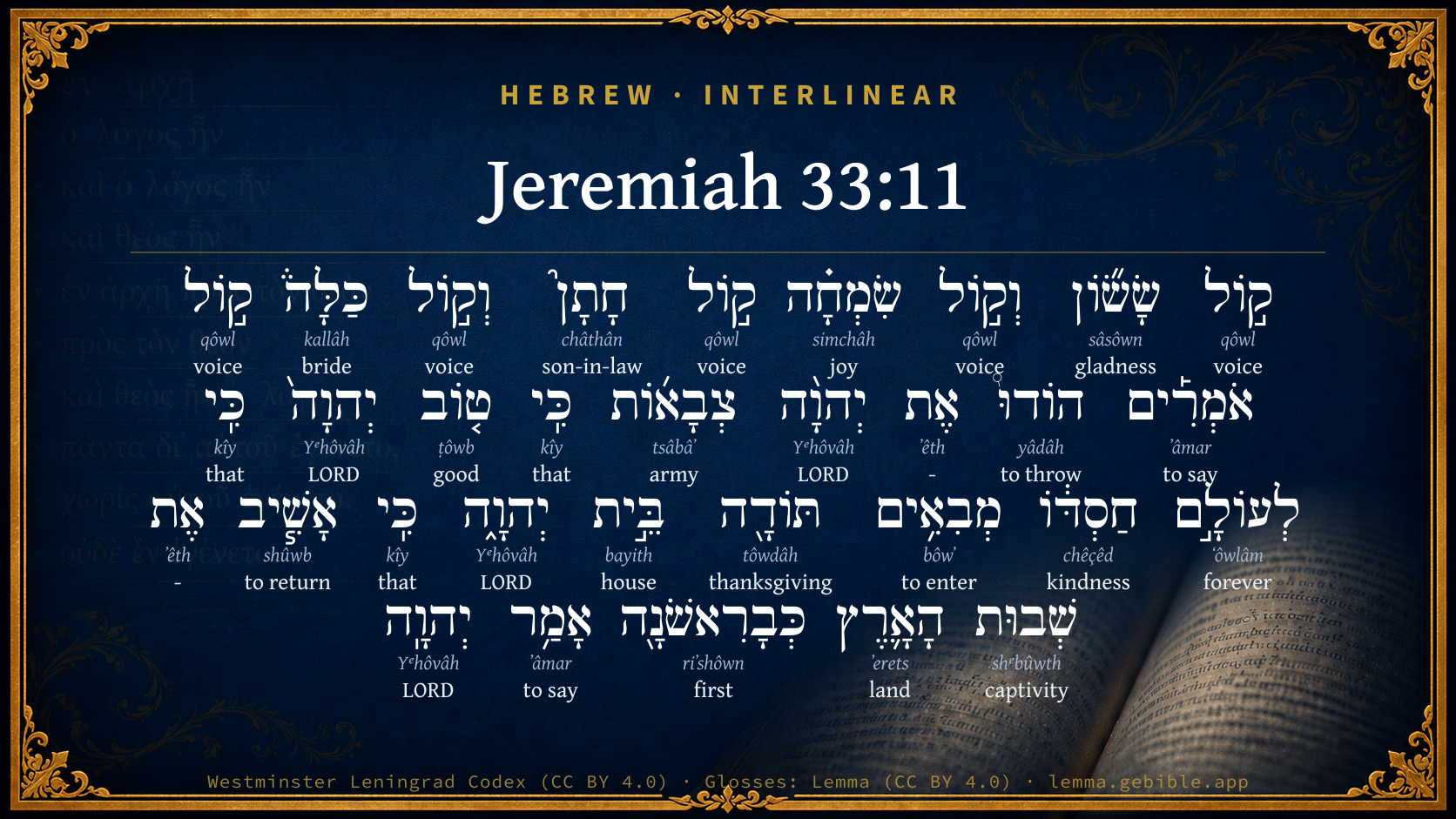
Hebrew (Westminster Leningrad Codex) Jeremiah 33:11 appears in the Hebrew Old Testament. The text above is from the Westminster Leningrad Codex. Each word links to its Strong’s number, a concise gloss, and parsing drawn from the Open Scriptures Hebrew Bible morphology. Click any word for its full Brown-Driver-Briggs (BDB) entry.
Download image
Cite this verse

Jeremiah 33:11 (World English Bible). Public Domain. Lemma interlinear Bible study tool, https://lemma.gebible.app/v/jeremiah/33/11.

Show BibTeX & RIS
BibTeX
RIS
English Translation
the voice of joy and the voice of gladness, the voice of the bridegroom and the voice of the bride, the voice of those who say, Give thanks to Yahweh of Hosts, for Yahweh is good, for his loving kindness endures forever; [and of them] who bring [sacrifices of] thanksgiving into the house of Yahweh. For I will cause the captivity of the land to return as at the first, says Yahweh.
World English Bible · Public Domain
Download a study sheet

One document with this verse’s original text, its word-by-word gloss line, the meaning frame, cross-references with their text, attributed commentary, and full source and license credits — printable, and it pastes into notes with its structure intact.

This verse Autodidact and up

Study sheet (.html) Plain text (.txt)

A passage Seminary Student

Up to 50 verses in one chapter. A passage sheet keeps up to 6 commentary sources and 12 cross-references per verse, in the order this page ranks them, and says so on the sheet whenever that leaves anything out. Ask for a single verse and you get the Autodidact verse sheet above.

Everything on this page stays free to read, with no account — the sheet is a download of what is already on screen, not access to it.

Want to remove ads? Support Godless Engineer
Compare translations 3

The same verse in 3 English versions, stacked beneath the original-language interlinear above. Click any original word for its lexicon entry.

Each is an independent rendering of the whole verse — the interlinear is not word-aligned to these translations.

Highlighted words mark where these versions differ — a whole-verse word diff, not a word-by-word alignment.

  • World English Bible Public Domain
    the voice of joy and the voice of gladness, the voice of the bridegroom and the voice of the bride, the voice of those who say, Give thanks to Yahweh of Hosts, for Yahweh is good, for his loving kindness endures forever; [and of them] who bring [sacrifices of] thanksgiving into the house of Yahweh. For I will cause the captivity of the land to return as at the first, says Yahweh.
  • King James Version Public Domain
    The voice of joy, and the voice of gladness, the voice of the bridegroom, and the voice of the bride, the voice of them that shall say, Praise the LORD of hosts: for the LORD is good; for his mercy endureth for ever: and of them that shall bring the sacrifice of praise into the house of the LORD. For I will cause to return the captivity of the land, as at the first, saith the LORD.
  • unfoldingWord Literal Text CC BY-SA 4.0
    the sound of joy and the sound of gladness, the sound of the groom and the sound of the bride, the sound of those who say, while they bring thank offerings to the house of Yahweh, “Give thanks to Yahweh of hosts, for Yahweh is good, and his unfailing love lasts forever!” For I will restore the fortunes of the land to what they were before,’ says Yahweh.

unfoldingWord Literal Text — © unfoldingWord, licensed CC BY-SA 4.0. Word-aligned USFM3 via Door43 (git.door43.org/unfoldingWord/en_ult).

Versions to compare (up to 4)

3 of 4 selected

Show all 18 translations

Every available English version of this verse, each an independent rendering of the whole verse.

  • World English Bible Public Domain
    the voice of joy and the voice of gladness, the voice of the bridegroom and the voice of the bride, the voice of those who say, Give thanks to Yahweh of Hosts, for Yahweh is good, for his loving kindness endures forever; [and of them] who bring [sacrifices of] thanksgiving into the house of Yahweh. For I will cause the captivity of the land to return as at the first, says Yahweh.
  • Berean Standard Bible Public Domain
    the sounds of joy and gladness, the voices of the bride and bridegroom, and the voices of those bringing thank offerings into the house of the LORD, saying: ‘Give thanks to the LORD of Hosts, for the LORD is good; His loving devotion endures forever.’ For I will restore the land from captivity as in former times, says the LORD.
  • Majority Standard Bible Public Domain
    the sounds of joy and gladness, the voices of the bride and bridegroom, and the voices of those bringing thank offerings into the house of the LORD, saying: ‘Give thanks to the LORD of Hosts, for the LORD is good; His loving devotion endures forever.’ For I will restore the land from captivity as in former times, says the LORD.
  • King James Version Public Domain
    The voice of joy, and the voice of gladness, the voice of the bridegroom, and the voice of the bride, the voice of them that shall say, Praise the LORD of hosts: for the LORD is good; for his mercy endureth for ever: and of them that shall bring the sacrifice of praise into the house of the LORD. For I will cause to return the captivity of the land, as at the first, saith the LORD.
  • American Standard Version (1901) Public Domain
    the voice of joy and the voice of gladness, the voice of the bridegroom and the voice of the bride, the voice of them that say, Give thanks to Jehovah of hosts, for Jehovah is good, for his lovingkindness `endureth' for ever; `and of them' that bring `sacrifices of' thanksgiving into the house of Jehovah. For I will cause the captivity of the land to return as at the first, saith Jehovah.
  • Revised Version (1885) Public Domain
    the voice of joy and the voice of gladness, the voice of the bridegroom and the voice of the bride, the voice of them that say, Give thanks to the LORD of hosts, for the LORD is good, for his mercy endureth for ever: and of them that bring sacrifices of thanksgiving into the house of the LORD. For I will cause the captivity of the land to return as at the first, saith the LORD.
  • Geneva Bible (1599) Public Domain
    The voyce of ioy and the voyce of gladnes, the voyce of the bridegrome, and the voyce of the bride, the voyce of them that shall say, Prayse the Lord of hostes, because the Lord is good: for his mercy endureth for euer, and of them that offer the sacrifice of prayse in the House of the Lord, for I will cause to returne the captiuitie of the land, as at the first, sayth the Lord.
  • Douay-Rheims (1899) Public Domain
    The voice of joy and the voice of gladness, the voice of the bridegroom and the voice of the bride, the voice of them that shall say: Give ye glory to the Lord of hosts, for the Lord is good, for his mercy endureth for ever: and of them that shall bring their vows into the house of the Lord: for I will bring back the captivity of the land as at the first, saith the Lord.
  • Young's Literal Translation Public Domain
    Is a voice of joy and a voice of gladness, Voice of bridegroom, and voice of bride, The voice of those saying, Thank Jehovah of Hosts, for Jehovah `is' good, For His kindness `is' to the age, Who are bringing in thanksgiving to the house of Jehovah, For I turn back the captivity of the land, As at the first, said Jehovah.
  • Literal Standard Version CC BY-SA 4.0
    A voice of joy and a voice of gladness, || Voice of bridegroom and voice of bride, || The voice of those saying, || Thank YHWH of Hosts, for YHWH [is] good, || For His kindness [is] for all time, || Who are bringing in thanksgiving to the house of YHWH, || For I return the captivity of the land, || As at the first,” said YHWH.
  • Unlocked Literal Bible CC BY-SA 4.0
    the sound of joy and the sound of gladness, the sound of the groom and the sound of the bride, the sound of those who say, while they bring thank offerings to the house of Yahweh, “Give thanks to Yahweh of hosts, for Yahweh is good, and his unfailing love lasts forever!” For I will restore the fortunes of the land to what they were before,' says Yahweh.
  • unfoldingWord Literal Text CC BY-SA 4.0
    the sound of joy and the sound of gladness, the sound of the groom and the sound of the bride, the sound of those who say, while they bring thank offerings to the house of Yahweh, “Give thanks to Yahweh of hosts, for Yahweh is good, and his unfailing love lasts forever!” For I will restore the fortunes of the land to what they were before,’ says Yahweh.
  • Darby Bible Public Domain
    there shall again be heard the voice of mirth and the voice of joy, the voice of the bridegroom and the voice of the bride, the voice of them that say, Give ye thanks unto Jehovah of hosts; for Jehovah is good, for his loving-kindness [endureth] for ever, -- of them that bring thanksgiving unto the house of Jehovah. For I will turn the captivity of the land as in the beginning, saith Jehovah.
  • World Messianic Bible Public Domain
    the voice of joy and the voice of gladness, the voice of the bridegroom and the voice of the bride, the voice of those who say, ‘Give thanks to the LORD of Hosts, for the LORD is good, for his loving kindness endures forever;’ who bring thanksgiving into the LORD’s house. For I will cause the captivity of the land to be reversed as at the first,” says the LORD.
  • Webster's Bible Public Domain
    The voice of joy, and the voice of gladness, the voice of the bridegroom, and the voice of the bride, the voice of them that shall say, Praise the LORD of hosts: for the LORD is good; for his mercy endureth for ever: and of them that shall bring the sacrifice of praise into the house of the LORD. For I will cause to return the captivity of the land, as at the first, saith the LORD.
  • Free Bible Version CC BY-SA 4.0
    the sounds of joy and celebration will be heard there again, the happy voices of bride and bridegroom, and the shouts of praise of those bringing thank offerings to the Lord's Temple, saying: “Thank the Lord Almighty! For the Lord is good; his trustworthy love lasts forever.” For I will bring the land back from its “captivity” too, says the Lord.
  • Bible in Basic English Public Domain
    Happy sounds, the voice of joy, the voice of the newly-married man and the voice of the bride, the voices of those who say, Give praise to the Lord of armies, for the Lord is good, for his mercy is unchanging for ever: the voices of those who go with praise into the house of the Lord. For I will let the land come back to its first condition, says the Lord.
  • JPS Tanakh (1917) Public Domain
    the voice of joy and the voice of gladness, the voice of the bridegroom and the voice of the bride, the voice of them that say: 'Give thanks to the LORD of hosts, for the LORD is good, for His mercy endureth for ever', even of them that bring offerings of thanksgiving into the house of the LORD. For I will cause the captivity of the land to return as at the first, saith the LORD.

Literal Standard Version (2020), Covenant Press — licensed CC BY-SA 4.0. Text via the HelloAO Bible API (eBible.org). Unlocked Literal Bible (unfoldingWord) — licensed CC BY-SA 4.0. Text via the HelloAO Bible API (eBible.org). unfoldingWord Literal Text — © unfoldingWord, licensed CC BY-SA 4.0. Word-aligned USFM3 via Door43 (git.door43.org/unfoldingWord/en_ult). Free Bible Version, Dr. Jonathan Gallagher — licensed CC BY-SA 4.0. Text via the HelloAO Bible API (eBible.org).

Word by word

More ways to search: Search by grammar → Find every occurrence → Compare this word →

Practice this passage: Drill this verse → Learn its vocabulary →

חָתָן֮
châthân
H2860
“son-in-law”
Noun, Common, Masculine, Singular, Absolute
Part of Speech
Noun
Type
Common
Gender
Masculine
Number
Singular
State
Absolute
Full BDB Definition

Origin: from H2859

TWOT: 781c

son-in-law, daughter's husband, bridegroom, husband
  1. ק֣וֹל qôwl H6963 “voice of” Noun, Common, Masculine, Singular, Construct
  2. שָׂשׂ֞וֹן sâsôwn H8342 “gladness” Noun, Common, Masculine, Singular, Absolute
  3. וְק֣וֹל qôwl H6963 “and · voice of” Conjunction + Noun, Common, Masculine, Singular, Construct
  4. שִׂמְחָ֗ה simchâh H8057 “joy” Noun, Common, Feminine, Singular, Absolute
  5. ק֣וֹל qôwl H6963 “voice of” Noun, Common, Masculine, Singular, Construct
  6. וְק֣וֹל qôwl H6963 “and · voice of” Conjunction + Noun, Common, Masculine, Singular, Construct
  7. כַּלָּה֒ kallâh H3618 “bride” Noun, Common, Feminine, Singular, Absolute
  8. ק֣וֹל qôwl H6963 “voice of” Noun, Common, Masculine, Singular, Construct
  9. אֹמְרִ֡ים ʼâmar H559 “saying” Verb, Qal, Participle Active, Masculine, Plural, Absolute
  10. הוֹדוּ֩ yâdâh H3034 “throw” Verb, Hiphil, Imperative, 2nd Person, Masculine, Plural
  11. אֶת ʼêth H853 “-” Particle, Direct Object
  12. יְהוָ֨ה Yᵉhôvâh H3068 “LORD” Noun, Proper
  13. צְבָא֜וֹת tsâbâʼ H6635 “armies” Noun, Common, Both, Plural, Absolute
  14. כִּֽי kîy H3588 “that” Conjunction
  15. ט֤וֹב ṭôwb H2896 “good” Adjective, Adjective, Masculine, Singular, Absolute
  16. יְהוָה֙ Yᵉhôvâh H3068 “LORD” Noun, Proper
  17. כִּֽי kîy H3588 “that” Conjunction
  18. לְעוֹלָ֣ם ʻôwlâm H5769 “to/for · forever” Preposition + Noun, Common, Masculine, Singular, Absolute
  19. חַסְדּ֔וֹ chêçêd H2617 “kindness · his” Noun, Common, Masculine, Singular, Construct + Suffix, Personal, 3rd Person, Masculine, Singular
  20. מְבִאִ֥ים bôwʼ H935 “entering” Verb, Hiphil, Participle Active, Masculine, Plural, Absolute
  21. תּוֹדָ֖ה tôwdâh H8426 “thanksgiving” Noun, Common, Feminine, Singular, Absolute
  22. בֵּ֣ית bayith H1004 “house of” Noun, Common, Masculine, Singular, Construct
  23. יְהוָ֑ה Yᵉhôvâh H3068 “LORD” Noun, Proper
  24. כִּֽי kîy H3588 “that” Conjunction
  25. אָשִׁ֧יב shûwb H7725 “to return” Verb, Hiphil, Imperfect, 1st Person, Common, Singular
  26. אֶת ʼêth H853 “-” Particle, Direct Object
  27. שְׁבוּת shᵉbûwth H7622 “captivity of” Noun, Common, Feminine, Singular, Construct
  28. הָאָ֛רֶץ ʼerets H776 “the · land” Particle, Definite Article + Noun, Common, Both, Singular, Absolute
  29. כְּבָרִאשֹׁנָ֖ה riʼshôwn H7223 “like/as · in/at the · first” Preposition + Preposition, Determined + Adjective, Adjective, Feminine, Singular, Absolute
  30. אָמַ֥ר ʼâmar H559 “to say” Verb, Qal, Perfect, 3rd Person, Masculine, Singular
  31. יְהוָֽה Yᵉhôvâh H3068 “LORD” Noun, Proper

About this verse

These counts appear in no published source. They are computed here, from the morphology-tagged text and Lemma’s own curated glosses. What Lemma adds →

32
words
21
distinct lemmas
Prophets
section

Notable vocabulary

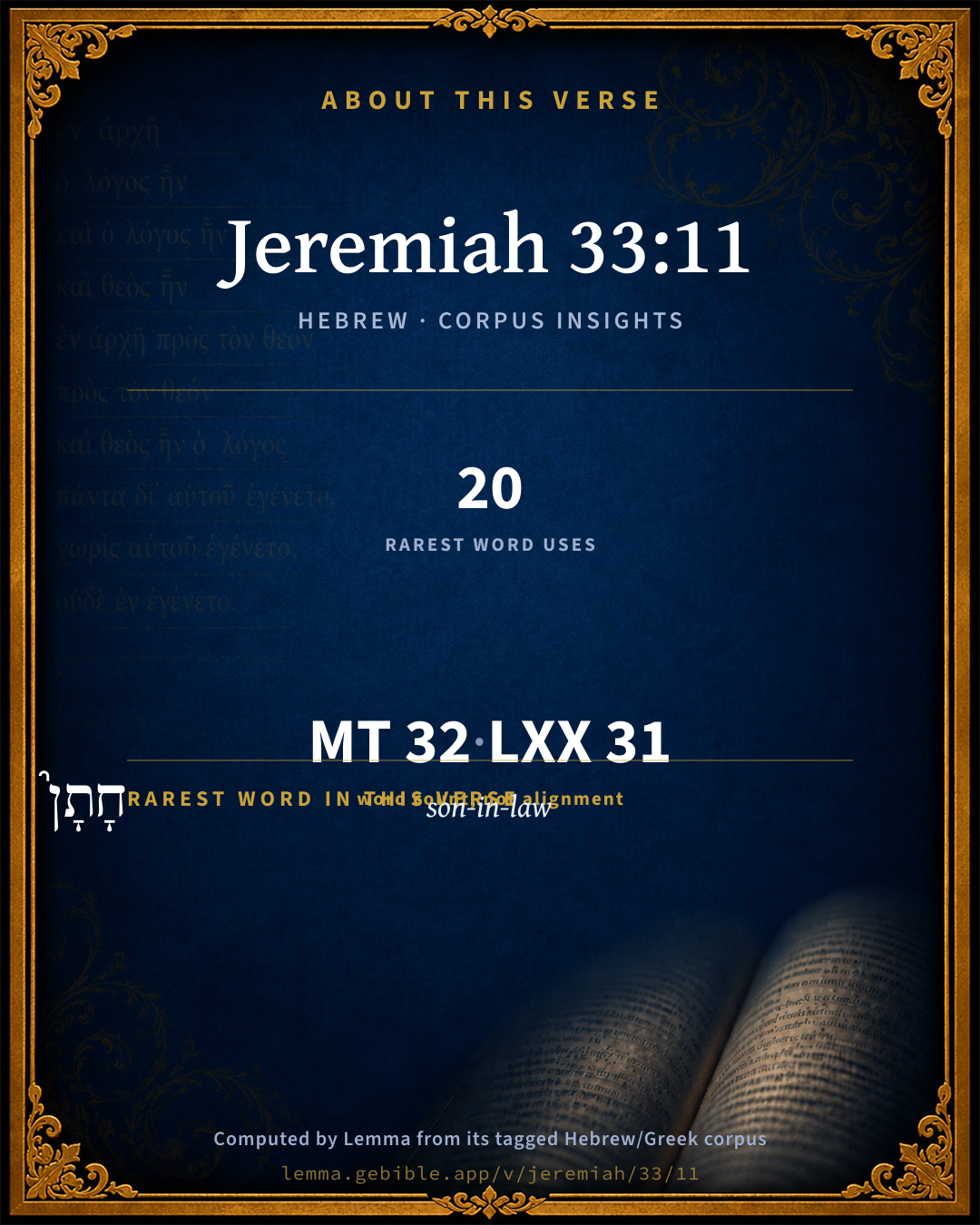
The rarest word here is חָתָן֮ son-in-law H2860 — appearing just 20 times in the whole Hebrew Bible.

Shared distinctive vocabulary

חָתָן֮ son-in-law H2860 occurs in 19 verses of the Hebrew Bible. Also found in:

Grammatical profile

  • 5 verbs
  • 20 nouns
  • 2 adjectives
  • 3 conjunctions
  • 2 particles

Verb forms

  • אֹמְרִ֡ים Qal · Participle Active
  • הוֹדוּ֩ Hiphil · Imperative
  • מְבִאִ֥ים Hiphil · Participle Active
  • אָשִׁ֧יב Hiphil · Imperfect
  • אָמַ֥ר Qal · Perfect

Repetition

Words recur within this verse — often emphatic in Hebrew:

  • ק֣וֹל voice H6963 ×5
  • יְהוָ֨ה LORD H3068 ×4
  • אֹמְרִ֡ים to say H559 ×2
  • כִּֽי that H3588 ×3

Hebrew & Septuagint length

In the original languages it is 32 Hebrew tokens and 31 Greek tokens — but the two are counted differently (Hebrew bundles its prefixes and suffixes into one token; the Greek is in lemma form), so that isn’t a like-for-like length.

Cross-references

36

Topical passages linked to Jeremiah 33:11 in the Treasury of Scripture Knowledge — connected by theme and wording, ordered by reader-vote popularity; previews shown in the World English Bible.

  • 1 Chronicles 16:34 Oh give thanks to Yahweh; for he is good; For his loving kindness endures forever.
  • Psalms 106:1 Praise Yahweh! Give thanks to Yahweh, for he is good, For his loving kindness endures forever.
  • Psalms 107:1 Give thanks to Yahweh, For he is good, For his loving kindness endures forever.
  • Psalms 107:22 Let them offer the sacrifices of thanksgiving, And declare his works with singing.
  • Hebrews 13:15 Through him, then, let us offer up a sacrifice of praise to God continually, that is, the fruit of lips which make confession to his name.
  • 2 Chronicles 5:13 it happened, when the trumpeters and singers were as one, to make one sound to be heard in praising and thanking Yahweh; and when they lifted up their voice with the trumpets and cymbals and instruments of music, and praised Yahweh, [saying], For he is good; for his loving kindness endures forever; that then the house was filled with a cloud, even the house of Yahweh,
  • 2 Chronicles 29:31 Then Hezekiah answered, Now you have consecrated yourselves to Yahweh; come near and bring sacrifices and thank-offerings into the house of Yahweh. The assembly brought in sacrifices and thank-offerings; and as many as were of a willing heart [brought] burnt offerings.
  • Isaiah 51:11 The ransomed of Yahweh shall return, and come with singing to Zion; and everlasting joy shall be on their heads: they shall obtain gladness and joy; [and] sorrow and sighing shall flee away.
  • 1 Chronicles 16:8 Oh give thanks to Yahweh, call on his name; Make known his doings among the peoples.
  • Psalms 136:1–26 Give thanks to Yahweh, for he is good; For his loving kindness endures forever.
  • John 3:29 He who has the bride is the bridegroom; but the friend of the bridegroom, who stands and hears him, rejoices greatly because of the bridegroom's voice. This, my joy, therefore is made full.
  • Revelation 18:23 The light of a lamp will shine no more at all in you. The voice of the bridegroom and of the bride will be heard no more at all in you; for your merchants were the princes of the earth; for with your sorcery all the nations were deceived.
  • Leviticus 7:12–13 If he offers it for a thanksgiving, then he shall offer with the sacrifice of thanksgiving unleavened cakes mixed with oil, and unleavened wafers anointed with oil, and cakes mixed with oil.
  • 2 Chronicles 7:3 All the children of Israel looked on, when the fire came down, and the glory of Yahweh was on the house; and they bowed themselves with their faces to the ground on the pavement, and worshiped, and gave thanks to Yahweh, [saying], For he is good; for his loving kindness endures for ever.
  • Psalms 116:17 I will offer to you the sacrifice of thanksgiving, And will call on the name of Yahweh.
  • Isaiah 52:9 Break forth into joy, sing together, you waste places of Jerusalem; for Yahweh has comforted his people, he has redeemed Jerusalem.
  • Jeremiah 7:34 Then will I cause to cease from the cities of Judah, and from the streets of Jerusalem, the voice of mirth and the voice of gladness, the voice of the bridegroom and the voice of the bride; for the land shall become a waste.
  • Jeremiah 33:7 I will cause the captivity of Judah and the captivity of Israel to return, and will build them, as at the first.
  • Zephaniah 3:14 Sing, daughter of Zion! Shout, Israel! Be glad and rejoice with all your heart, daughter of Jerusalem.
  • Zechariah 8:19 Thus says Yahweh of Hosts: "The fasts of the fourth fifth, seventh, and tenth months shall be for the house of Judah joy and gladness, and cheerful feasts. Therefore love truth and peace."
  • Ezra 3:11–13 They sang one to another in praising and giving thanks to Yahweh, [saying], For he is good, for his loving kindness endures forever toward Israel. All the people shouted with a great shout, when they praised Yahweh, because the foundation of the house of Yahweh was laid.
  • Ezra 6:22 and kept the feast of unleavened bread seven days with joy: for Yahweh had made them joyful, and had turned the heart of the king of Assyria to them, to strengthen their hands in the work of the house of God, the God of Israel.
  • Nehemiah 8:12 All the people went their way to eat, and to drink, and to send portions, and to make great mirth, because they had understood the words that were declared to them.
  • Nehemiah 12:43 They offered great sacrifices that day, and rejoiced; for God had made them rejoice with great joy; and the women also and the children rejoiced: so that the joy of Jerusalem was heard even afar off.
  • Psalms 100:4–5 Enter into his gates with thanksgiving, Into his courts with praise. Give thanks to him, and bless his name.
  • Psalms 118:1–4 Give thanks to Yahweh, for he is good, For his loving kindness endures forever.
  • Isaiah 12:1–6 In that day you will say, "I will give thanks to you, Yahweh; for though you were angry with me, your anger has turned away and you comfort me.
  • Jeremiah 16:9 For thus says Yahweh of Hosts, the God of Israel: Behold, I will cause to cease out of this place, before your eyes and in your days, the voice of mirth and the voice of gladness, the voice of the bridegroom and the voice of the bride.
  • Jeremiah 25:10 Moreover I will take from them the voice of mirth and the voice of gladness, the voice of the bridegroom and the voice of the bride, the sound of the millstones, and the light of the lamp.
  • Jeremiah 31:12–14 They shall come and sing in the height of Zion, and shall flow to the goodness of Yahweh, to the grain, and to the new wine, and to the oil, and to the young of the flock and of the herd: and their soul shall be as a watered garden; and they shall not sorrow any more at all.
  • Jeremiah 33:26 then will I also cast away the seed of Jacob, and of David my servant, so that I will not take of his seed to be rulers over the seed of Abraham, Isaac, and Jacob: for I will cause their captivity to return, and will have mercy on them.
  • Jonah 2:9 But I will sacrifice to you with the voice of thanksgiving. I will pay that which I have vowed. Salvation belongs to Yahweh."
  • Zechariah 9:17 For how great is his goodness, And how great is his beauty! Grain will make the young men flourish, And new wine the virgins.
  • Zechariah 10:7 Ephraim will be like a mighty man, And their heart will rejoice as through wine; Yes, their children will see it, and rejoice. Their heart will be glad in Yahweh.
  • 2 Chronicles 20:21 When he had taken counsel with the people, he appointed those who should sing to Yahweh, and give praise in holy array, as they went out before the army, and say, Give thanks to Yahweh; for his loving kindness endures forever.
  • Isaiah 51:3 For Yahweh has comforted Zion; he has comforted all her waste places, and has made her wilderness like Eden, and her desert like the garden of Yahweh; joy and gladness shall be found therein, thanksgiving, and the voice of melody.

Cross-references courtesy of OpenBible.info (CC BY 4.0).

Hebrew and Greek witnesses Masoretic Hebrew ↔ Greek Septuagint

The same verse in the two great witnesses to the Old Testament, shown verse-for-verse.

These are two independent witnesses, not word-aligned to each other, and the Septuagint is shown in lemma (dictionary) form.

Hebrew Jeremiah 33:11 Masoretic · Westminster Leningrad Codex

ק֣וֹל שָׂשׂ֞וֹן וְק֣וֹל שִׂמְחָ֗ה ק֣וֹל חָתָן֮ וְק֣וֹל כַּלָּה֒ ק֣וֹל אֹמְרִ֡ים הוֹדוּ֩ אֶת יְהוָ֨ה צְבָא֜וֹת כִּֽי ט֤וֹב יְהוָה֙ כִּֽי לְעוֹלָ֣ם חַסְדּ֔וֹ מְבִאִ֥ים תּוֹדָ֖ה בֵּ֣ית יְהוָ֑ה כִּֽי אָשִׁ֧יב אֶת שְׁבוּת הָאָ֛רֶץ כְּבָרִאשֹׁנָ֖ה אָמַ֥ר יְהוָֽה

the voice of joy and the voice of gladness, the voice of the bridegroom and the voice of the bride, the voice of those who say, Give thanks to Yahweh of Hosts, for Yahweh is good, for his loving kindness endures forever; [and of them] who bring [sacrifices of] thanksgiving into the house of Yahweh. For I will cause the captivity of the land to return as at the first, says Yahweh.

World English Bible · Public Domain

Greek LXX Structure differs

In the Septuagint, Jeremiah is about an eighth shorter than the Hebrew and arranges its material differently — the Oracles Against the Nations (Hebrew chapters 46–51) appear in the middle of the Greek book, after 25:13. Because the chapter and verse boundaries do not line up, a verse-for-verse comparison with the Hebrew is not shown.

A verse-for-verse comparison isn’t shown here because the chapters and verses don’t line up. Switch to the LXX edition with the MT / LXX toggle above to read the Greek directly.

Hebrew: Westminster Leningrad Codex (CC BY 4.0). Greek: Septuagint (public domain); English from a public-domain English Septuagint. How the Septuagint differs from the Hebrew →

Targum (Aramaic paraphrase)

1

The Targum is the ancient Jewish Aramaic paraphrase of the Hebrew Scriptures — an interpretive translation, not the Hebrew text itself. Onkelos (literal) and Pseudo-Jonathan (expansive) render the Torah, and Jonathan the Prophets. Coverage is partial: where no permissively-licensed English translation exists for a verse, only the Aramaic is shown. This is verse-level text, not a word-by-word alignment to the Hebrew.

  1. Targum Jonathan Prophets (Joshua–Malachi)
    קַל בִּיעַ וְקַל חֶדְוָה קַל חַתְנִין וְקַל כַּלָן קַל דְאָמְרִין אוֹדוּ קֳדָם יְיָ צְבָאוֹת אֲרֵי טַב יְיָ אֲרֵי לְעַלְמָא טִיבוּתֵיהּ מַעֲלֵי תוֹדְתָא לְבֵית מַקְדְשָׁא דַייָ אֲרֵי אָתֵיב יַת גָלוּת אַרְעָא כִּדְבְקַדְמֵתָא אֲמַר יְיָ:

    (no public-domain English translation for this verse)

    Targum Jonathan — Aramaic: “Mikraot Gedolot” (public domain). English: “Sefaria Community Translation” (CC0 1.0 (public-domain dedication)); “London "Chaldee Paraphrase," 1871” (public domain). Text via Sefaria.

Commentary

Notes on Jeremiah 33:11 from classic Christian and Jewish commentators (each source and its license shown beneath its notes). The classic Christian expositions comment on the surrounding passage and are grouped to its opening verse, so a note may address several verses; the Jewish commentaries on the Tanakh (Rashi and others) are per-verse, so they appear only where the commentator wrote on this verse.

Lemma curates 59 commentaries, every one of them public domain or Creative Commons licensed, each selected and text-cleaned for this edition rather than reprinted as found. About our sources →

Trapp's Complete Commentary

John Trapp

Jer 33:11 The voice of joy, and the voice of gladness, the voice of the bridegroom, and the voice of the bride, the voice of them that shall say, Praise the LORD of hosts: for the LORD [is] good; for his mercy [endureth] for ever: [and] of them that shall bring the sacrifice of praise into the house of the LORD. For I will cause to return the captivity of the land, as at the first, saith the LORD.

Ver. 11. The voice of joy.] See Jer 7:34; Jer 16:9.

The voice of them that shall say, Praise the Lord of hosts, for he is good.] This carmen intercalare the Jews sang joyfully at their return from Babylon, {Ezr 3:11} and the saints shall have cause to sing throughout all eternity.

And of them that shall bring the sacrifice of praise.] Even "the calves of their lips, giving thanks to his name," {Heb 13:15} together with other evangelical sacrifices, as contrition; {Psa 51:17} confidence; {Psa 4:4} alms deeds; {Heb 13:16} the obedience of faith; {Rom 15:16} self-denial, {Rom 12:1} &c. The Talmudists say that the sacrifice of praise here mentioned shall continue when all other sacrifices are abolished; and this we see verified in the Christian Church.

John Trapp, A Commentary or Exposition upon All the Books of the Old and New Testament (1647–1656) — public domain. Text from a community e-Sword module.

Tyndale Open Study Notes

Tyndale Open Resources

33:11 bridegrooms and brides: Contrast the earlier prophecies in 7:34 and 25:10.

Tyndale Open Study Notes — © Tyndale Open Resources, licensed CC BY-SA 4.0. Text via the HelloAO Bible API.

Geneva Bible (1599)

Geneva Bible translators

Which was a song appointed for the Levites to praise God by, 1 Chron. 16:8; Ps. 105:1; Isa. 12:4; Ps. 106:1; 107:1; 118:1; 136:1.

Geneva Bible (1599) marginal notes — public domain. Text via Bolls.life.

Jamieson, Fausset & Brown

Robert Jamieson, A. R. Fausset & David Brown

(Jer 7:34; Jer 16:9).

Praise the Lord, &c.--the words of Psa 136:1, which were actually used by the Jews at their restoration (Ezr 3:11).

sacrifice of praise-- (Psa 107:22; Psa 116:17). This shall continue when all other sacrifices shall be at an end.

Jamieson, Fausset & Brown — Commentary Critical and Explanatory on the Whole Bible (1871) — public domain (CC PDM 1.0). Text via the HelloAO Bible API.

Adam Clarke's Commentary

Verse 11. The voice of them that shall say, Praise the Lord of hosts] That is, the voice of the Levites in the sacred service: intimating that the temple should be rebuilt, and the public service restored.

Adam Clarke's Commentary on the Bible (1810–1826) — public domain. Text from a community e-Sword/MySword module.

John Calvin's Commentaries

Heard then shall be the voice of joy, and the voice of gladness; the voice of the bridegroom, and the voice of the bride; that is, marriages shall again be celebrated. And this way of speaking often occurs in the Prophets when they refer to the joyful condition of the city and of the people; for in seasons of mourning no one thinks of marrying a wife, so that marriage-feasts then cease as well as all festivals. Then the Prophet briefly shews that God would put an end to the calamities of the people, and give them reasons for rejoicing after he had for a time punished their sins.

But he shews also of what kind their joy would be, The voice of them who shall say, Praise ye Jehovah of hosts Here he distinguishes between the faithful and the ungodly, for joy is common to both, when prosperity happens to them; for God’s children may rejoice when the Lord shews himself to them as a bountiful Father. But the profane exult through intemperate joy, and at the same time they make no mention of God, for they live only on present things; but the faithful raise up their thoughts to God, and never rejoice without thanksgiving. Thus they consecrate and sanctify their joy, when the ungodly, by polluting God’s blessing, do also contaminate their joy. We ought then to take special notice of this difference which the Prophet here intimates, between godly and profane joy; for the children of this world do indeed exult, but as we have said, immoderately in their joy; and they are unthankful to God, and never duly reflect on his goodness; nay, they designedly turn away their eyes and their thoughts from God; but the faithful have always a regard to God whenever it succeeds well with them, for they know that everything flows to them from God’s goodness only.

Hence he says, Heard shall be the voice of them who shall say, Praise ye Jehovah, for he is good, etc. The Prophet here alludes to the customary practice of singing, which is spoken of in sacred history. For we know that when the Temple was dedicated, the praises of God were celebrated, and the Levites always sang, For his mercy is for ever They first exhorted others to praise God, and to every sentence this repetition was added, “For his mercy is for ever.” What then had formerly been in common use the Prophet refers to: Heard then shall be that usual song, Praise ye Jehovah, for his mercy is for ever

He then adds, Of them who shall bring praise to the house of Jehovah; for I will restore the captivity of the land He mentions sacrifices, for the service, according to the Law, required, that these should be added as evidences of gratitude. God indeed had no need of vetires, nor did he delight in external displays; but these exercises of religion were necessary for a rude people, and still learning the elements of truth. The Prophet then speaks here with reference to a particular time, when he connects sacrifices with praises and thanksgiving, he yet shews for what end God required sacrifices to be then offered to him, lest the Jews should think that God was pacified when a calf had been slain. He then shews that all this had been prescribed to them, and enjoined for this end — that they might shew themselves thankful.

This metonymical mode of speaking ought then to be carefully observed; for hence we conclude, that sacrifices of themselves were of no moment, but were only acceptable and of good odor to God on this account — because they were evidences of gratitude.

He then adds, To the house of Jehovah Now, this also ought in the last place to be noticed, — that it is not sufficient for one to be thankful to God, but that public thanksgiving is also required, so that we may mutually stimulate one another. And we also know that confession ought not to be separated from faith; as faith has its seat in the heart, so also outward confession proceeds from it; and therefore it cannot be but that the interior feeling must break out from the soul, and the tongue be connected with the heart. It hence follows, that all those are guilty of falsehood who say that they have faith within, but are at the same time mute, and, as far as they can, unworthily bury the benefits of God. And as I have said, this zeal is required of all the godly, in order that they may stimulate one another to praise God; for it was for this purpose and for this reason, that express mention is made of the Temple; that is, that the faithful might understand, that God is to be worshipped, not only privately and within closed doors, but that also a public profession ought to be made, so that they may together with common consent celebrate and acknowledge his benefits and blessings.

John Calvin's Commentaries (1540-1563) — public domain. Text from the Calvin Translation Society English edition (1840s-50s) via the Christian Classics Ethereal Library (ccel.org). Calvin's coverage is partial (roughly two-thirds of the Bible); uncommented books and verses are honest gaps, never fabricated. The 19th-century editor's footnotes and remarks are omitted so the notes are faithfully Calvin's own voice.

Ellicott's Commentary for English Readers

(11) The voice of joy, and the voice of gladness . . .—The words gain greater emphasis as being those which the prophet had himself used (Jer_7:34; Jer_16:9; Jer_25:10) in foretelling the desolation of the city. He points, as it were, by implication to the fulfilment of the one prediction, as a guarantee that the other also will, in due season, have its fulfilment.

Praise the Lord of hosts . . .—The words were used as the ever-recurring doxology of the Temple-services (Ezr_3:11; 2Ch_7:6; 2Ch_20:21; Psa_136:2-3; 1Ma_4:24). The Courts of the Temple, now hushed in silence, should once again re-echo with the Hallelujahs of the Priests and Levites. The “sacrifice of praise” (the same phrase as in Jer_17:26; Psa_56:12) may be either “the sacrifice which consists in praise,” or the “sacrifices of thanksgiving” of Lev_7:12, which were offered in acknowledgment of special blessings. The ground of the thanksgiving in either case would be that the Lord had “turned again the captivity” of Jacob. The phrase was a familiar one, as in Psa_14:7; Psa_53:6; Deu_30:3. The words “as at the first” (literally, as at the beginning) do not refer to any previous restoration, like that of the Exodus from Egypt, but to the state before the exile.

A Bible Commentary for English Readers, edited by Charles John Ellicott (1878–1897) — public domain. Text from a community e-Sword module.

The Cambridge Bible for Schools and Colleges

gen. ed. J. J. S. Perowne

11. Give thanks to the Lord of hosts, for the Lord is good, for his mercy endureth for ever] liturgical forms used in the Temple services. See 1Ch_16:34; 2Ch_5:13; 2Ch_7:3; 2Ch_7:6; Ezr_3:11; Psa_106:1.

sacrifices of thanksgiving] See on Jer_17:26.

I will cause the captivity of the land to return] See note on Jer_32:44.

The Cambridge Bible for Schools and Colleges (gen. ed. J. J. S. Perowne; Cambridge University Press, 1878–1918) — public domain. Text from a community e-Sword module.

John Gill's Exposition

The voice of joy, and the voice of gladness,.... Such is the voice of the Gospel to all sensible sinners; whose eyes are opened to see their lost estate; whose ears are opened to hear the joyful sound: whose hearts are opened to attend to the things spoken in it; who are humble and contrite, wounded and broken in spirit, and have a spiritual understanding of things given them: to these the Gospel preached is glad tidings of great joy; since it contains in it the doctrines of peace and pardon through the blood of Christ; of justification through his righteousness; of rest in him, and salvation by him. It is a voice of joy and gladness to all believers in Christ; since hereby they hear of Christ whom they love; they hear of the love of God in him, and of the love of him to them; it is food to their souls; and when found, under the hearing of it, it is the joy and rejoicing of their hearts; and whereas they are continually sinning in thought, word, or deed, the doctrine of pardon must be joyful to them. Moreover, this may be meant of the voice of those that come to the church of God, with songs of joy and gladness, for electing, redeeming, calling, pardoning, and justifying grace; the voice of young converts, and of all them that rejoice in Christ Jesus, and have no confidence in the flesh; see Isa 35:10; and why may not the ordinance of singing psalms, hymns, and spiritual songs, be included? since those are enjoined to be sung, and are sung in Gospel churches, Eph 5:19;

the voice of the bridegroom, and the voice of the bride; which, literally understood, is expressive of great joy and happiness; as the contrary signifies great calamity and distress; see Jer 7:34. It may be understood of such who are in such a natural relation to one another; and yet their voice may intend their joining together in spiritual praise to God. Moreover, by the "bridegroom" may be meant Christ, who has espoused his people to himself, and is their husband, and behaves as such towards them, in all tenderness, care, love, and affection; and his voice was heard in Judea's land as the bridegroom; John heard it, and rejoiced at it, and so did many others; see Mat 9:15, Joh 3:29; and the Gospel indeed is no other than his voice; and a soul quickening, soul comforting, and soul alluring, and charming voice it is. And by the "bride" may be meant the church, who is the bride, the Lamb's wife, being married to him; whose voice of prayer and praise to Christ, and of encouragement to sensible sinners, is heard in Zion, and is very desirable, Sol 2:14;

the voice of them that shall say, praise the Lord of hosts; the husband of his church, and Redeemer of his people, and who is the sovereign Lord of all; the voice of such is heard, who stir up others to this work and service, and enforce it by the reasons following:

for the Lord is good; originally and essentially in himself, and the fountain of goodness to others; the good Head and Husband of his church; the good Samaritan: the good Shepherd of his sheep, and Saviour of his people:

for his mercy endureth for ever; it is from everlasting to everlasting; in his love and pity he has redeemed his church; and this is seen in his tender care of her, and will endure to eternal life: these words seem to be taken out of Psa 106:1; and were used by the Jews at the laying of the foundation of the second temple, Ezr 3:11;

and of them that shall bring the sacrifice of praise into the house of the Lord; the church of the living God, the materials of which are lively stones, or true believers in Christ; into which none should enter without an offering; and this should be a spiritual one, the sacrifice of praise and thanksgiving; which God has enjoined as well pleasing to him, because it glorifies him. This shows that this prophecy belongs to Gospel times; since no other sacrifice is mentioned as brought into the house of God but the sacrifice of praise. And remarkable is the note of Kimchi on this passage;

"he does not say a sin offering, or a trespass offering, because at this time there will be no ungodly persons and sinners among them, for they shall all know the Lord. And so our Rabbins of blessed memory say, all offerings shall cease in time to come (the times of the Messiah) but the sacrifice of praise;''

for I will cause to return the captivity of the land as at the first,

saith the Lord: a release from spiritual captivity, or redemption by Christ; being the foundation of all solid joy, praise, and thanksgiving.

John Gill's Exposition of the Whole Bible (1746–1763) — public domain (CC PDM 1.0). Text via the HelloAO Bible API.

Albert Barnes' Notes on the Bible

Praise the Lord ... - The customary formula of thanksgiving in many of the later Psalms, and from its occurrence in 2Ch 5:13; 2Ch 7:3, 2Ch 7:6 ff probably a regular part of the liturgical service of the temple.

Shall say ... shall bring the sacrifice of praise - Or, say ... as they bring praise, i. e., a thank-offering (see the marginal reference) into the house of the Lord

At the first - Before the captivity, and when still unpolluted by the sins which have brought upon it so heavy a chastisement.

Albert Barnes' Notes on the Bible (1834–1885) — public domain. Text from a community e-Sword/MySword module.

Haydock's Catholic Bible Commentary

Vows. Promised victims of thanksgiving. (Calmet) --- First, when they were settled in it under Josue. (Haydock)

George Leo Haydock (1774–1849), Haydock's Catholic Family Bible and Commentary, 1859 edition — public domain. Excludes Psalms (Douay-Rheims chapter numbering differs from Protestant) and Deuterocanonical books (Catholic canon only).

Matthew Poole's English Annotations

The sum of this verse is, that those that should be carried into captivity should return, and upon their return they should be in their former states; both as to civil transactions, they should again marry and give in marriage; and as to civil and spiritual joy, they should publicly praise the Lord as they were wont to do in the words of David, Psa 106:1; 107:1; 118:1; 136:1, (we have a record in holy writ of the fulfilling of this prophecy upon the laying the foundations of the second temple, Ezr 3:11) and offer sacrifices of thanksgiving. See Neh 12:27.

Matthew Poole's English Annotations on the Holy Bible (1683–1685) — public domain. Text from a community e-Sword/MySword module.

Whedon's Commentary on the Bible

Daniel D. Whedon

11. The voice of joy, etc. — The fulness and emphasis of this promise is indicated by the wave after wave of parallelism which flows in upon us. Praise the Lord, etc. — This phraseology seems to be quoted here as liturgical; the regular and universal formula of praise and thanksgiving.

As at the first — I will restore the land to the condition it had before the captivity.

Daniel D. Whedon (gen. ed.), Commentary on the Old and New Testaments (1874–1909) — public domain. Text from a community e-Sword module.

The Pulpit Commentary

The sacrifice of praise. (see on Jer_17:26)

The prophet"s refrain.

"For I will cause to return the captivity of the land." This declaration is heard again and again. We have it in substance times without number in this and in previous chapters. We have a similar statement in Jer_32:37. But we have the exact words, the very same form of expression, in Jer_32:44, and in vers. 7 and 26 of this chapter. Hence we have called it the prophet"s refrain. And the like theme of God"s purposes of grace towards mankind generally should be the refrain of all the prophets of the Lord in these our days. For

I THE BLESSINGS ASSURED ARE SIMILAR. In connection with each several repetition of this promise, "I will cause their captivity to return," is named some specific blessing which that return shall bring along with it. In connection with its first mention (Jer_32:44) God"s purpose is given as the reason wherefore his now afflicted people should again possess their land. And there is a life eternal, a true, real, blessed life for humanity; a life compared with which this life is like the hard lot of the captive Israel compared with the glowing glad life promised in the days when their captivity should return. Then in connection with its second mention (ver. 7 of this chapter) there is the promise of "health and cure," moral and spiritual health, when their iniquity should be cleansed and their sin forgiven. And is not the promise of man"s redemption like to this? In the eternal life there shall be health and cure indeed. And with the third mention of this promise (ver. 11) there is associated gladness and joy. "There shall be... the voice of joy and the voice of gladness," etc. (ver. 11). And with the fourth there is (ver. 26 of this chapter) the promise of permanence for all that has been before, the permanency as of the covenant of day and night, and the perpetual sovereignty of their own royal house, the seed of David. And so we look for a new order of things, which shall not be as this, troubled and transient, but characterized by a rest and joy that shall be eternal. Thus analogous are the blessings promised to the return of Israel and the redemption of mankind.

II THE MOTIVES OF SUCH PROCLAMATION OF GOD"S PURPOSES OF GRACE ARE ALIKE. The reason of the prophet"s refrain were such as these.

1. He so delighted in the truth he had to tell. Often and often he had been charged with a message of a far less welcome kind; but this was blessed to his soul. And so, would we effectually speak of God"s purposes of grace, they must be the joy of our soul. We must ourselves delight in them.

2. He really believed it. The oft repetition of this word shows his confidence in it. He speaks with no bated breath. "I believed, therefore have I spoken." And this must ever be the spiritual force with which our gospel must be charged if it is to have any effect on those who hear it.

3. He knew it would so comfort the cast down. Many already were mourning along with the prophet over the desolations so surely coming on the land, and many more when away in exile would mourn. But the prophet knew that their hearts would be cheered and sustained by the earnest and confident assurance that "their captivity should return." For their sake, therefore, he reiterated this word. And in order to our now earnestly proclaiming the message of God"s love, we too must believe that it will do the people good, that it will be for their help and comfort. And we must have for them, as the prophet had for his people, a real love and concern. This has ever been an attendant of and is essential to a successful ministry.

4. He knew that it would so vindicate God. Questionings and perplexities not a few were being occasioned by the prophet"s solemn declarations of the coming destruction. They contrasted his terrible word with the oft repeated promises made by God" to David and to his seed forever" and to Zion, concerning which he had said, "There will I dwell, for I have delighted in it." These and the many more like promises seemed forever to forbid the possibility of that which the prophet, and now the actual course of events, declared to be close at hand. How were the two to be reconciled, and the truth and goodness of God to be vindicated? It was by the truth declared in this refrain of the prophet. That rendered both Divine words harmonious and true. Thus the enemies of the prophet would be silenced, and the company of them that feared God would be reassured. The house of God was dear to the prophet; and so must it be to us would we earnestly preach his Word. "The zeal of thine house hath eaten me up;" "Wist ye not that I must be about my Father"s business?" So was it spoken of or by the Lord Jesus Christ; and so in like manner in our measure and degree must it be true of us if we are to be true witnesses for him and for his grace. The gospel is the vindication of God today, as the return of the Captivity was in the days of the prophet. And being jealous for God, he proclaimed incessantly that return, as we must the redemption of mankind. C.

The Pulpit Commentary (1880–1919), ed. H.D.M. Spence-Jones & Joseph S. Exell — public domain. Text from a community e-Sword module.

Lesson kit

Teaching starters — assembled from the data on this page, not authored interpretation. Every prompt links to the verse data it draws on. Edit before teaching.

Jeremiah, in the Prophets, opens this verse with 32 words (21 distinct Hebrew lemmas). Its most distinctive word is châthân (“son-in-law”). A historical commentator’s framing appears above. Read the whole chapter for the surrounding context.

Discussion questions

  1. The word châthân carries the sense “son-in-law.” How does it shape the verse?
  2. How does Genesis 19:12, which shares the word «son-in-law», read alongside this verse?
  3. What does the repetition of “voice” (5× in this one verse) do in this verse?
  4. These translations render this verse differently. What is at stake in choosing one wording over another?
  5. «אֹמְרִ֡ים» is a Qal Participle Active verb. How does that grammatical form shape the action described?
  6. Compare how Trapp's Complete Commentary and Tyndale Open Study Notes read this verse. Where do they agree or differ?

Things to notice

Reading settings

Reading text

Shown beneath each verse's original-language words.

Old Testament
Old Testament edition

Read the OT as the Masoretic Hebrew (MT) or the Greek Septuagint (LXX).

English shown for the Greek Septuagint (in the Hebrew ↔ Greek comparison).

Comparing translations? Open the Compare panel on any verse page to stack up to four side by side.