
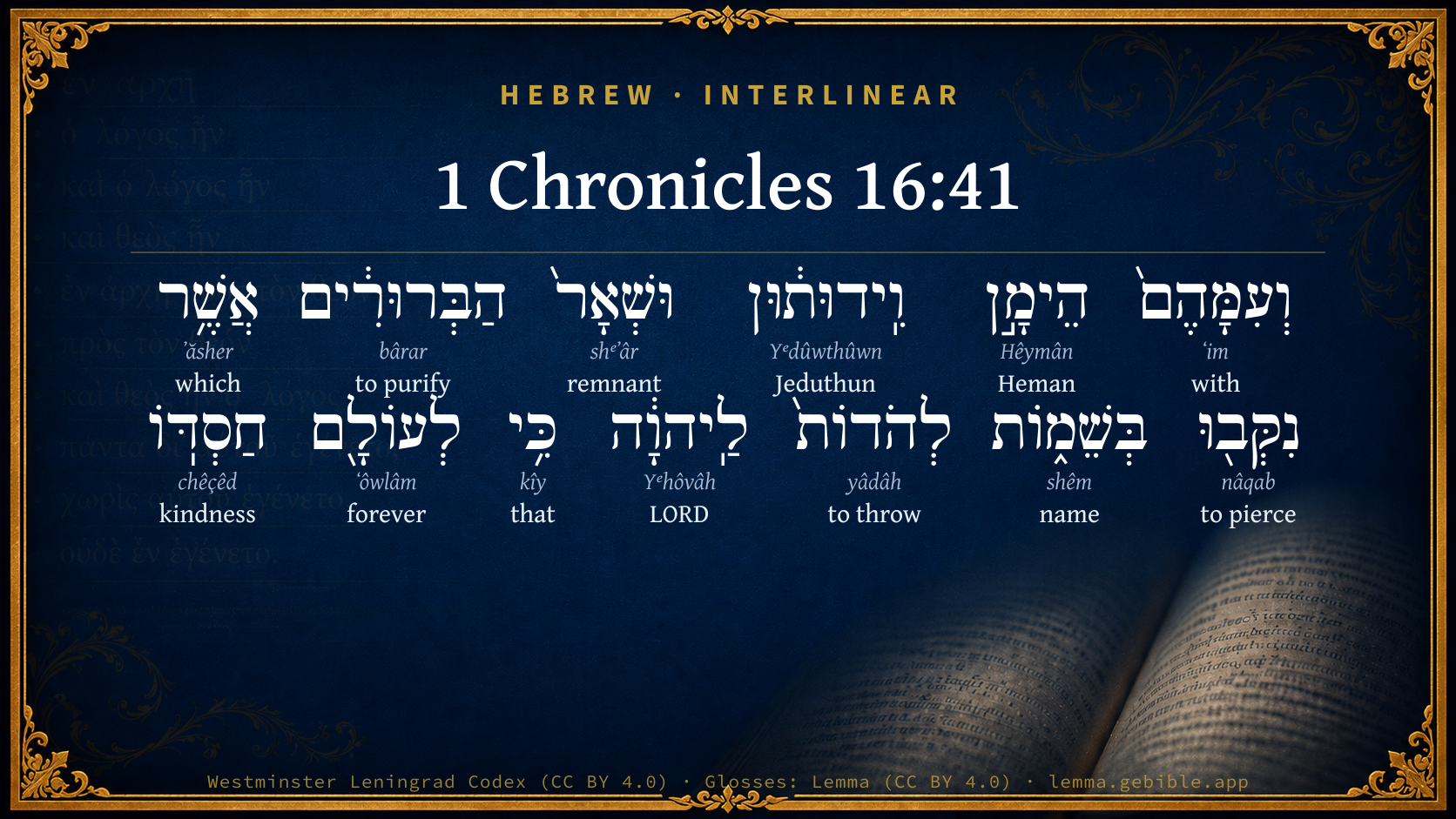
1 Chronicles 16:41

Hebrew (Westminster Leningrad Codex) 1 Chronicles 16:41 appears in the Hebrew Old Testament. The text above is from the Westminster Leningrad Codex. Each word links to its Strong’s number, a concise gloss, and parsing drawn from the Open Scriptures Hebrew Bible morphology. Click any word for its full Brown-Driver-Briggs (BDB) entry.
Download image
Cite this verse

1 Chronicles 16:41 (World English Bible). Public Domain. Lemma interlinear Bible study tool, https://lemma.gebible.app/v/1-chronicles/16/41.

Show BibTeX & RIS
BibTeX
RIS
English Translation
and with them Heman and Jeduthun, and the rest who were chosen, who were mentioned by name, to give thanks to Yahweh, because his loving kindness endures forever;
World English Bible · Public Domain
Download a study sheet

One document with this verse’s original text, its word-by-word gloss line, the meaning frame, cross-references with their text, attributed commentary, and full source and license credits — printable, and it pastes into notes with its structure intact.

This verse Autodidact and up

Study sheet (.html) Plain text (.txt)

A passage Seminary Student

Up to 50 verses in one chapter. A passage sheet keeps up to 6 commentary sources and 12 cross-references per verse, in the order this page ranks them, and says so on the sheet whenever that leaves anything out. Ask for a single verse and you get the Autodidact verse sheet above.

Everything on this page stays free to read, with no account — the sheet is a download of what is already on screen, not access to it.

Want to remove ads? Support Godless Engineer
Compare translations 3

The same verse in 3 English versions, stacked beneath the original-language interlinear above. Click any original word for its lexicon entry.

Each is an independent rendering of the whole verse — the interlinear is not word-aligned to these translations.

Highlighted words mark where these versions differ — a whole-verse word diff, not a word-by-word alignment.

  • World English Bible Public Domain
    and with them Heman and Jeduthun, and the rest who were chosen, who were mentioned by name, to give thanks to Yahweh, because his loving kindness endures forever;
  • King James Version Public Domain
    And with them Heman and Jeduthun, and the rest that were chosen, who were expressed by name, to give thanks to the LORD, because his mercy endureth for ever;
  • unfoldingWord Literal Text CC BY-SA 4.0
    And with them, Heman and Jeduthun and the rest of the chosen who were designated by names to give thanks to Yahweh, “for his covenant faithfulness to forever.”

unfoldingWord Literal Text — © unfoldingWord, licensed CC BY-SA 4.0. Word-aligned USFM3 via Door43 (git.door43.org/unfoldingWord/en_ult).

Versions to compare (up to 4)

3 of 4 selected

Show all 18 translations

Every available English version of this verse, each an independent rendering of the whole verse.

  • World English Bible Public Domain
    and with them Heman and Jeduthun, and the rest who were chosen, who were mentioned by name, to give thanks to Yahweh, because his loving kindness endures forever;
  • Berean Standard Bible Public Domain
    With them were Heman, Jeduthun, and the rest of those chosen and designated by name to give thanks to the LORD, for “His loving devotion endures forever.”
  • Majority Standard Bible Public Domain
    With them were Heman, Jeduthun, and the rest of those chosen and designated by name to give thanks to the LORD, for “His loving devotion endures forever.”
  • King James Version Public Domain
    And with them Heman and Jeduthun, and the rest that were chosen, who were expressed by name, to give thanks to the LORD, because his mercy endureth for ever;
  • American Standard Version (1901) Public Domain
    and with them Heman and Jeduthun, and the rest that were chosen, who were mentioned by name, to give thanks to Jehovah, because his lovingkindness `endureth' for ever;
  • Revised Version (1885) Public Domain
    and with them Heman and Jeduthun, and the rest that were chosen, who were expressed by name, to give thanks to the LORD, because his mercy endureth for ever;
  • Geneva Bible (1599) Public Domain
    And with them were Heman, and Ieduthun, and the rest that were chosen (which were appointed by names) to praise the Lord, because his mercie endureth for euer.
  • Douay-Rheims (1899) Public Domain
    And after him Heman, and Idithun, and the rest that were chosen, every one by his name to give praise to the Lord: because his mercy endureth for ever.
  • Young's Literal Translation Public Domain
    And with them `are' Heman and Jeduthun, and the rest of those chosen, who were defined by name, to give thanks to Jehovah, for to the age `is' His kindness,
  • Literal Standard Version CC BY-SA 4.0
    And with them [are] Heman and Jeduthun, and the rest of those chosen, who were defined by name, to give thanks to YHWH, for His kindness [is] for all time;
  • Unlocked Literal Bible CC BY-SA 4.0
    Heman and Jeduthun were with them, together with the rest who were chosen by name, to give thanks to Yahweh, because his covenant faithfulness endures forever.
  • unfoldingWord Literal Text CC BY-SA 4.0
    And with them, Heman and Jeduthun and the rest of the chosen who were designated by names to give thanks to Yahweh, “for his covenant faithfulness to forever.”
  • Darby Bible Public Domain
    and with them Heman and Jeduthun, and the rest that were chosen, who were expressed by name, to give thanks to Jehovah, because his loving-kindness [endureth] for ever;
  • World Messianic Bible Public Domain
    and with them Heman and Jeduthun and the rest who were chosen, who were mentioned by name, to give thanks to the LORD, because his loving kindness endures forever;
  • Webster's Bible Public Domain
    And with them Heman and Jeduthun, and the rest that were chosen, who were expressed by name, to give thanks to the LORD, because his mercy endureth for ever;
  • Free Bible Version CC BY-SA 4.0
    They were accompanied by Heman, Jeduthun, and the rest of those chosen and identified by name to give thanks to the Lord, for “His trustworthy love lasts forever.”
  • Bible in Basic English Public Domain
    And with them Heman and Jeduthun, and the rest who were marked out by name to give praise to the Lord, for his mercy is unchanging for ever;
  • JPS Tanakh (1917) Public Domain
    and with them Heman and Jeduthun, and the rest that were chosen, who were mentioned by name, to give thanks to the LORD, because His mercy endureth for ever;

Literal Standard Version (2020), Covenant Press — licensed CC BY-SA 4.0. Text via the HelloAO Bible API (eBible.org). Unlocked Literal Bible (unfoldingWord) — licensed CC BY-SA 4.0. Text via the HelloAO Bible API (eBible.org). unfoldingWord Literal Text — © unfoldingWord, licensed CC BY-SA 4.0. Word-aligned USFM3 via Door43 (git.door43.org/unfoldingWord/en_ult). Free Bible Version, Dr. Jonathan Gallagher — licensed CC BY-SA 4.0. Text via the HelloAO Bible API (eBible.org).

Word by word

More ways to search: Search by grammar → Find every occurrence → Compare this word →

Practice this passage: Drill this verse → Learn its vocabulary →

הֵימָ֣ן
Hêymân
H1968
“Heman”
Noun, Proper
Part of Speech
Noun
Type
Proper
Full BDB Definition

Origin: probably from H539

TWOT: None

Heman = "faithful" - a wise man to whom Solomon was compared - son of Joel, grandson of Samuel, and a Levitical singer and author of PS 88 - a seer
  1. וְעִמָּהֶם֙ ʻim H5973 “and · with · them” Conjunction + Preposition + Suffix, Personal, 3rd Person, Masculine, Plural
  2. וִֽידוּת֔וּן Yᵉdûwthûwn H3038 “and · Jeduthun” Conjunction + Noun, Proper
  3. וּשְׁאָר֙ shᵉʼâr H7605 “and · remnant of” Conjunction + Noun, Common, Masculine, Singular, Construct
  4. הַבְּרוּרִ֔ים bârar H1305 “the · purified” Particle, Definite Article + Verb, Qal, Participle Passive, Masculine, Plural, Absolute
  5. אֲשֶׁ֥ר ʼăsher H834 “which” Particle, Relative
  6. נִקְּב֖וּ nâqab H5344 “to pierce” Verb, Niphal, Perfect, 3rd Person, Common, Plural
  7. בְּשֵׁמ֑וֹת shêm H8034 “in/at · names” Preposition + Noun, Common, Masculine, Plural, Absolute
  8. לְהֹדוֹת֙ yâdâh H3034 “to throw” Preposition + Verb, Hiphil, Infinitive Construct
  9. לַֽיהוָ֔ה Yᵉhôvâh H3068 “to/for · LORD” Preposition + Noun, Proper
  10. כִּ֥י kîy H3588 “that” Conjunction
  11. לְעוֹלָ֖ם ʻôwlâm H5769 “to/for · forever” Preposition + Noun, Common, Masculine, Singular, Absolute
  12. חַסְדּֽוֹ chêçêd H2617 “kindness · his” Noun, Common, Masculine, Singular, Construct + Suffix, Personal, 3rd Person, Masculine, Singular

About this verse

These counts appear in no published source. They are computed here, from the morphology-tagged text and Lemma’s own curated glosses. What Lemma adds →

13
words
13
distinct lemmas
Historical
section

Notable vocabulary

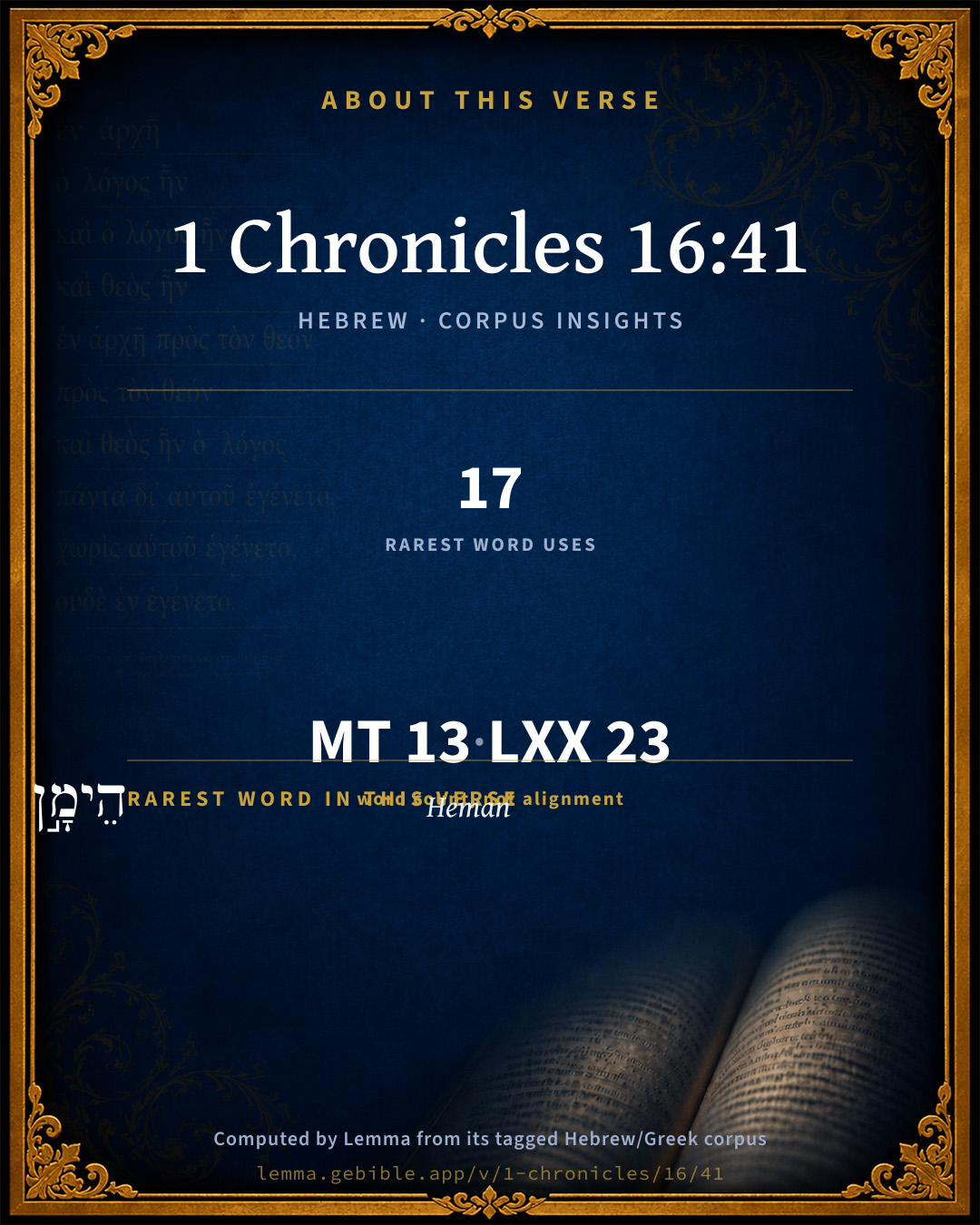
The rarest word here is הֵימָ֣ן Heman H1968 — appearing just 17 times in the whole Hebrew Bible.

Shared distinctive vocabulary

הֵימָ֣ן Heman H1968 occurs in 15 verses of the Hebrew Bible. Also found in:

Grammatical profile

  • 3 verbs
  • 7 nouns
  • 1 preposition
  • 1 conjunction
  • 1 particle

Verb forms

  • הַבְּרוּרִ֔ים Qal · Participle Passive
  • נִקְּב֖וּ Niphal · Perfect
  • לְהֹדוֹת֙ Hiphil · Infinitive Construct

Hebrew & Septuagint length

In English translation the verse runs 28 words from the Hebrew and 24 from the Septuagint (LXX English) — closely comparable.

A rough comparison of the two English renderings, which tokenize alike — not a word-level alignment.

Word counts can differ between the Hebrew and the Greek without any difference in meaning — e.g. the Hebrew direct-object marker אֵת has no separate Greek word, and Greek often adds the article ὁ.

In the original languages it is 13 Hebrew tokens and 23 Greek tokens — but the two are counted differently (Hebrew bundles its prefixes and suffixes into one token; the Greek is in lemma form), so that isn’t a like-for-like length.

Cross-references

15

Topical passages linked to 1 Chronicles 16:41 in the Treasury of Scripture Knowledge — connected by theme and wording, ordered by reader-vote popularity; previews shown in the World English Bible.

  • 2 Chronicles 5:13 it happened, when the trumpeters and singers were as one, to make one sound to be heard in praising and thanking Yahweh; and when they lifted up their voice with the trumpets and cymbals and instruments of music, and praised Yahweh, [saying], For he is good; for his loving kindness endures forever; that then the house was filled with a cloud, even the house of Yahweh,
  • 1 Chronicles 25:1–6 Moreover, David and the captains of the host set apart for the service certain of the sons of Asaph, and of Heman, and of Jeduthun, who should prophesy with harps, with psalteries, and with cymbals: and the number of those who did the work according to their service was:
  • Numbers 1:17 Moses and Aaron took these men who are mentioned by name.
  • 1 Chronicles 6:33 These are those who waited, and their sons. Of the sons of the Kohathites: Heman the singer, the son of Joel, the son of Samuel,
  • 1 Chronicles 16:34 Oh give thanks to Yahweh; for he is good; For his loving kindness endures forever.
  • 2 Chronicles 7:3 All the children of Israel looked on, when the fire came down, and the glory of Yahweh was on the house; and they bowed themselves with their faces to the ground on the pavement, and worshiped, and gave thanks to Yahweh, [saying], For he is good; for his loving kindness endures for ever.
  • 2 Chronicles 20:21 When he had taken counsel with the people, he appointed those who should sing to Yahweh, and give praise in holy array, as they went out before the army, and say, Give thanks to Yahweh; for his loving kindness endures forever.
  • Ezra 3:11 They sang one to another in praising and giving thanks to Yahweh, [saying], For he is good, for his loving kindness endures forever toward Israel. All the people shouted with a great shout, when they praised Yahweh, because the foundation of the house of Yahweh was laid.
  • Psalms 103:17 But Yahweh's loving kindness is from everlasting to everlasting with those who fear him, His righteousness to children's children;
  • 1 Chronicles 6:39–47 His brother Asaph, who stood on his right hand, even Asaph the son of Berechiah, the son of Shimea,
  • 1 Chronicles 16:37 So he left there, before the ark of the covenant of Yahweh, Asaph and his brothers, to minister before the ark continually, as every day's work required;
  • Ezra 8:20 and of the Nethinim, whom David and the princes had given for the service of the Levites, two hundred and twenty Nethinim: all of them were mentioned by name.
  • Jeremiah 33:11 the voice of joy and the voice of gladness, the voice of the bridegroom and the voice of the bride, the voice of those who say, Give thanks to Yahweh of Hosts, for Yahweh is good, for his loving kindness endures forever; [and of them] who bring [sacrifices of] thanksgiving into the house of Yahweh. For I will cause the captivity of the land to return as at the first, says Yahweh.
  • Luke 1:50 His mercy is for generations of generations on those who fear him.
  • 1 Chronicles 12:31 Of the half-tribe of Manasseh eighteen thousand, who were mentioned by name, to come and make David king.

Cross-references courtesy of OpenBible.info (CC BY 4.0).

Hebrew and Greek witnesses Masoretic Hebrew ↔ Greek Septuagint

The same verse in the two great witnesses to the Old Testament, shown verse-for-verse.

These are two independent witnesses, not word-aligned to each other, and the Septuagint is shown in lemma (dictionary) form.

Hebrew 1 Chronicles 16:41 Masoretic · Westminster Leningrad Codex

וְעִמָּהֶם֙ הֵימָ֣ן וִֽידוּת֔וּן וּשְׁאָר֙ הַבְּרוּרִ֔ים אֲשֶׁ֥ר נִקְּב֖וּ בְּשֵׁמ֑וֹת לְהֹדוֹת֙ לַֽיהוָ֔ה כִּ֥י לְעוֹלָ֖ם חַסְדּֽוֹ

and with them Heman and Jeduthun, and the rest who were chosen, who were mentioned by name, to give thanks to Yahweh, because his loving kindness endures forever;

World English Bible · Public Domain

Greek LXX 1 Chronicles 16:41 Septuagint · lemma form

καί μετά αὐτός αιμαν καί ιδιθων καί ὁ λοιπός ἐκλέγω ἐπί ὄνομα ὁ αἰνέω ὁ κύριος ὅτι εἰς ὁ αἰών ὁ ἔλεος αὐτός

And with him were Aeman and Idithun, and the rest chosen out by name to praise the Lord, for his mercy endures for ever.

LXX2012 (modern English Septuagint) · Public Domain

On this verse, The Pulpit Commentary discusses the Septuagint’s reading. Read the note in Commentary ↓

Hebrew: Westminster Leningrad Codex (CC BY 4.0). Greek: Septuagint (public domain); English from LXX2012 (modern English Septuagint) (Public Domain). How the Septuagint differs from the Hebrew →

Commentary

Notes on 1 Chronicles 16:41 from classic Christian and Jewish commentators (each source and its license shown beneath its notes). The classic Christian expositions comment on the surrounding passage and are grouped to its opening verse, so a note may address several verses; the Jewish commentaries on the Tanakh (Rashi and others) are per-verse, so they appear only where the commentator wrote on this verse.

Lemma curates 59 commentaries, every one of them public domain or Creative Commons licensed, each selected and text-cleaned for this edition rather than reprinted as found. About our sources →

The Cambridge Bible for Schools and Colleges

gen. ed. J. J. S. Perowne

41. Jeduthun] Psalms 39, 62, 77 (titles). In 1Ch_6:33-47; 1Ch_15:17; 1Ch_15:19 the names of the leading singers are given as Heman, Asaph and Ethan; in 1Ch_16:41; 1Ch_25:1 ff. however Jeduthun seems to take the place of Ethan. Probably there was a variation in the tradition as to the third name, two families competing each for the honour of its own ancestor.

to give thanks] Cp. 1Ch_16:34.

The Cambridge Bible for Schools and Colleges (gen. ed. J. J. S. Perowne; Cambridge University Press, 1878–1918) — public domain. Text from a community e-Sword module.

The Biblical Illustrator

Joseph S. Exell

1Ch_16:41

To give thanks to the Lord.

Praise in song

(for a Choir Service):--King David was the greatest innovator in worship of whom Scripture contains a record, for he introduced instrumental music to guide popular singing in worship, and he formed the whole tribe of Levi into a guild of various branches, one of which was employed in the musical services of religion. There had always been in Israel a tendency to song. At the digging of a well, at the winning of a victory, at the issue of a great deliverance the people sang, not men only, or priests only, but men and women. But music was not in the stated worship of God till David organised it. It was this organisation that Solomon found ready to his hand. The purpose of the music, the purport of the song, was praise for the mercy of the Lord: to give thanks unto the Lord, because His mercy endureth for ever. I am burdened with the sense of the mercies of God, said the dying Norman Macleod. That was the burden of Israel and Judah in the old time (2Ch_20:21; Ezr_3:11). That was the National Anthem of Israel. There is none like it yet, not even Luthers, though that comes next to it. It is a hymn we might sing in eternity. There is something to stir the heart in the mercy of God. There were many things that stirred the heart of Israel, but this one was always the chief. We know very little about the hymns or music of the early Church. Everything that was sung that was not a psalm seems to have been called a hymn. Paul enjoins psalms, hymns, and spiritual songs as a means of instruction and teaching. Thus it was at the German Reformation. Thus it was at the Scottish Reformation, when almost all the learning was of rhyme; psalms, beatitudes, creeds, and commandments--they rhymed and sang them all. The Gnostic heretics had, through their hymns, such hold on the heart, that he was the best champion of orthodoxy who could write a rival hymn. The Arians also swayed the mobs of the great cities of the East by their processions and their songs, and their catches sung at meal hours, so that Ambrose and Chrysostom had to counteract them with hymns that were charged with the very truth of God and Christ and the Holy Ghost. To you members of the choir I would say, You sing not as pagans sang; your music is not a refined amusement, or a toy, but a consecration to God of a great gift with which the Lord of the talents has entrusted you. It is given you that by its use you may lead us up to God. It is not congregational worship if some one sings in the presence of the congregation. The heart of the people must go with the singer. There is not much more worship in hearing some one sing than there would be in seeing some one paint. But there is a strange power in music--above all in the music of the human voice--to awaken emotion. Some of the grandest preaching I have ever heard was the singing of a hymn with a purpose. It was not worship, but it was wonderful teaching, and it led to worship--worship of the highest kind. Now triumph will be in the music that moves us to noble deeds. When one Greek orator spoke, men said, What a noble speech! but when the other spoke men looked on each other, grasped their swords and said, Let us march on Macedon. And if you use your gift to the highest purpose it will have for its result that we will arise and go to our Father. Basil said the Holy Ghost was the author of Christian music. This lifts up the central purpose beyond mere notation; the Holy Ghost takes of the things of Christ and shows them to us. (Prof. Charteris, D. D.)

The Biblical Illustrator, edited by Joseph S. Exell (c. 1880s–1900s) — public domain. Text from a community e-Sword module.

Geneva Bible (1599)

Geneva Bible translators

With Zadok and the rest of the Priests.

Geneva Bible (1599) marginal notes — public domain. Text via Bolls.life.

John Gill's Exposition

And all the people departed, every man to his house,.... Having accompanied the ark to its place, and having praised the Lord for it, and been refreshed with food, see Sa2 6:19.

and David returned to bless his house; his family; the Targum is,"to bless the people;''see Sa2 6:20.

Next: 1 Chronicles Chapter 17

John Gill's Exposition of the Whole Bible (1746–1763) — public domain (CC PDM 1.0). Text via the HelloAO Bible API.

Matthew Poole's English Annotations

Who were expressed by name; so exceeding careful was this good king of God’s worship, that he would have no person employed in it but such as he appointed to it, and were meant for it.

Matthew Poole's English Annotations on the Holy Bible (1683–1685) — public domain. Text from a community e-Sword/MySword module.

Whedon's Commentary on the Bible

Daniel D. Whedon

41. Jeduthun — The same as Ethan of 1Ch_6:44; 1Ch_15:17; 1Ch_15:19. Comp. 1Ch_25:1; 1Ch_25:6; 2Ch_5:12; 2Ch_29:14; 2Ch_35:15.

Daniel D. Whedon (gen. ed.), Commentary on the Old and New Testaments (1874–1909) — public domain. Text from a community e-Sword module.

The Pulpit Commentary

Vers. 41, 42. Comparing these verses with vers. 4-6 and 37-40, it may be supposed that we are intended to understand that of all who were set apart and who had been expressed by name (as e.g. , 1Ch_15:4-24) some were now formally appointed to serve before the ark, and some in the tabernacle at Gibeon. The confusion existing in these verses by the repetition of the preposition with, and the proper names Heman and Jeduthun, betrays some corruptness of text. The Septuagint does not show them in the latter verse. The sons of Jeduthun are found in 1Ch_25:3.

The Pulpit Commentary (1880–1919), ed. H.D.M. Spence-Jones & Joseph S. Exell — public domain. Text from a community e-Sword module.

Keil & Delitzsch

C. F. Keil & F. Delitzsch

And all the people departed, every man to his house,.... Having accompanied the ark to its place, and having praised the Lord for it, and been refreshed with food, see Sa2 6:19.

and David returned to bless his house; his family; the Targum is,"to bless the people;''see Sa2 6:20.

Next: 1 Chronicles Chapter 17

Keil & Delitzsch — Biblical Commentary on the Old Testament (1861–1891) — public domain (CC PDM 1.0). Text via the HelloAO Bible API. (Old Testament only.)

Rashi

Rabbi Shlomo Yitzchaki (Rashi)

and the rest of the chosen ones Heb. הַבְּרוּרִים, the chosen ones.

who were designated with names great men called by name to sing before the altar at the time of the offering of the sacrifices.

Rashi on the Tanakh — English translations: “The Judaica Press complete Tanach with Rashi, translated by A. J. Rosenberg” (CC BY 4.0); “Pentateuch with Rashi's commentary by M. Rosenbaum and A.M. Silbermann, 1929-1934” (public domain); “The Metsudah Tanach series, Lakewood, N.J” (CC BY 4.0); and “The Book of Joshua, Metsudah Publications, 1997” (CC BY 4.0). Text via Sefaria.

Lesson kit

Teaching starters — assembled from the data on this page, not authored interpretation. Every prompt links to the verse data it draws on. Edit before teaching.

1 Chronicles, in the Historical, opens this verse with 13 words (13 distinct Hebrew lemmas). Its most distinctive word is Hêymân (“Heman”). A historical commentator’s framing appears above. Read the whole chapter for the surrounding context.

Discussion questions

  1. The word Hêymân carries the sense “Heman.” How does it shape the verse?
  2. How does 1 Kings 4:31, which shares the word «Heman», read alongside this verse?
  3. These translations render this verse differently. What is at stake in choosing one wording over another?
  4. «הַבְּרוּרִ֔ים» is a Qal Participle Passive verb. How does that grammatical form shape the action described?
  5. Compare how The Cambridge Bible for Schools and Colleges and The Biblical Illustrator read this verse. Where do they agree or differ?

Things to notice

Reading settings

Reading text

Shown beneath each verse's original-language words.

Old Testament
Old Testament edition

Read the OT as the Masoretic Hebrew (MT) or the Greek Septuagint (LXX).

English shown for the Greek Septuagint (in the Hebrew ↔ Greek comparison).

Comparing translations? Open the Compare panel on any verse page to stack up to four side by side.