
Psalms 33:2

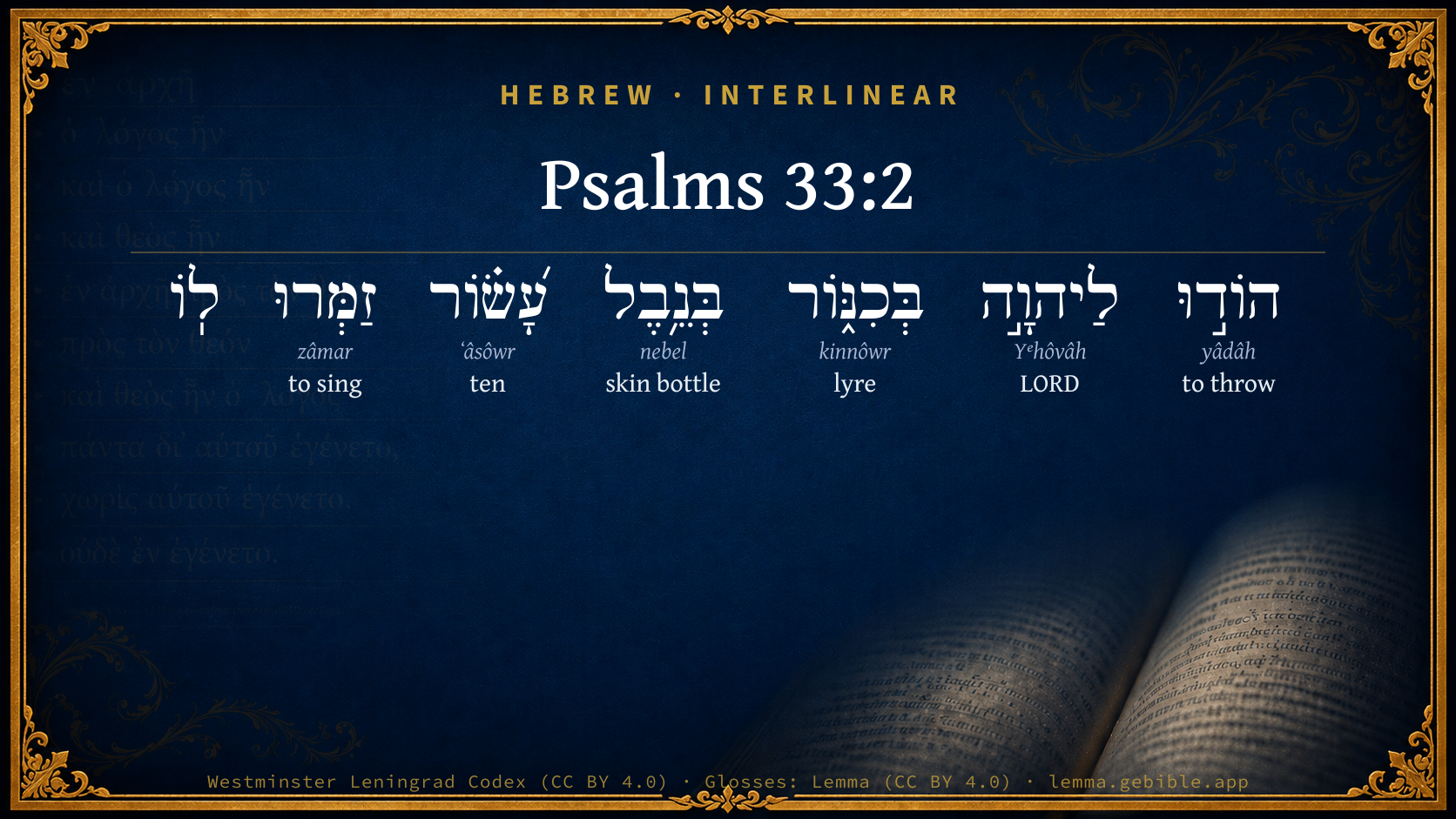
Hebrew (Westminster Leningrad Codex) Psalms 33:2 appears in the Hebrew Old Testament. The text above is from the Westminster Leningrad Codex. Each word links to its Strong’s number, a concise gloss, and parsing drawn from the Open Scriptures Hebrew Bible morphology. Click any word for its full Brown-Driver-Briggs (BDB) entry.
Download image
Cite this verse

Psalms 33:2 (World English Bible). Public Domain. Lemma interlinear Bible study tool, https://lemma.gebible.app/v/psalms/33/2.

Show BibTeX & RIS
BibTeX
RIS
English Translation
Give thanks to Yahweh with the lyre. Sing praises to him with the harp of ten strings.
World English Bible · Public Domain
Download a study sheet

One document with this verse’s original text, its word-by-word gloss line, the meaning frame, cross-references with their text, attributed commentary, and full source and license credits — printable, and it pastes into notes with its structure intact.

This verse Autodidact and up

Study sheet (.html) Plain text (.txt)

A passage Seminary Student

Up to 50 verses in one chapter. A passage sheet keeps up to 6 commentary sources and 12 cross-references per verse, in the order this page ranks them, and says so on the sheet whenever that leaves anything out. Ask for a single verse and you get the Autodidact verse sheet above.

Everything on this page stays free to read, with no account — the sheet is a download of what is already on screen, not access to it.

Want to remove ads? Support Godless Engineer
Compare translations 3

The same verse in 3 English versions, stacked beneath the original-language interlinear above. Click any original word for its lexicon entry.

Each is an independent rendering of the whole verse — the interlinear is not word-aligned to these translations.

Highlighted words mark where these versions differ — a whole-verse word diff, not a word-by-word alignment.

  • World English Bible Public Domain
    Give thanks to Yahweh with the lyre. Sing praises to him with the harp of ten strings.
  • King James Version Public Domain
    Praise the LORD with harp: sing unto him with the psaltery and an instrument of ten strings.
  • unfoldingWord Literal Text CC BY-SA 4.0
    Give thanks to Yahweh with the harp; with a lyre of ten make music to him.

unfoldingWord Literal Text — © unfoldingWord, licensed CC BY-SA 4.0. Word-aligned USFM3 via Door43 (git.door43.org/unfoldingWord/en_ult).

Versions to compare (up to 4)

3 of 4 selected

Show all 18 translations

Every available English version of this verse, each an independent rendering of the whole verse.

  • World English Bible Public Domain
    Give thanks to Yahweh with the lyre. Sing praises to him with the harp of ten strings.
  • Berean Standard Bible Public Domain
    Praise the LORD with the harp; make music to Him with ten strings.
  • Majority Standard Bible Public Domain
    Praise the LORD with the harp; make music to Him with ten strings.
  • King James Version Public Domain
    Praise the LORD with harp: sing unto him with the psaltery and an instrument of ten strings.
  • American Standard Version (1901) Public Domain
    Give thanks unto Jehovah with the harp: Sing praises unto him with the psaltery of ten strings.
  • Revised Version (1885) Public Domain
    Give thanks unto the LORD with harp: sing praises unto him with the psaltery of ten strings.
  • Geneva Bible (1599) Public Domain
    Prayse the Lord with harpe: sing vnto him with viole and instrument of ten strings.
  • Douay-Rheims (1899) Public Domain
    Give praise to the Lord on the harp; sing to him with the psaltery, the instrument of ten strings.
  • Young's Literal Translation Public Domain
    Give ye thanks to Jehovah with a harp, With psaltery of ten strings sing praise to Him,
  • Literal Standard Version CC BY-SA 4.0
    Give thanks to YHWH with a harp, || With stringed instrument of ten strings sing praise to Him,
  • Unlocked Literal Bible CC BY-SA 4.0
    Give thanks to Yahweh with the harp; sing praises to him with the harp of ten strings.
  • unfoldingWord Literal Text CC BY-SA 4.0
    Give thanks to Yahweh with the harp; with a lyre of ten make music to him.
  • Darby Bible Public Domain
    Give thanks unto Jehovah with the harp; sing psalms unto him with the ten-stringed lute.
  • World Messianic Bible Public Domain
    Give thanks to the LORD with the lyre. Sing praises to him with the harp of ten strings.
  • Webster's Bible Public Domain
    Praise the LORD with harp: sing to him with the psaltery and an instrument of ten strings.
  • Free Bible Version CC BY-SA 4.0
    Praise the Lord with the lyre, play music to him on the ten-stringed harp.
  • Bible in Basic English Public Domain
    Give praise to the Lord on the corded instrument; make melody to him with instruments of music.
  • JPS Tanakh (1917) Public Domain
    Give thanks unto the LORD with harp, sing praises unto Him with the psaltery of ten strings.

Literal Standard Version (2020), Covenant Press — licensed CC BY-SA 4.0. Text via the HelloAO Bible API (eBible.org). Unlocked Literal Bible (unfoldingWord) — licensed CC BY-SA 4.0. Text via the HelloAO Bible API (eBible.org). unfoldingWord Literal Text — © unfoldingWord, licensed CC BY-SA 4.0. Word-aligned USFM3 via Door43 (git.door43.org/unfoldingWord/en_ult). Free Bible Version, Dr. Jonathan Gallagher — licensed CC BY-SA 4.0. Text via the HelloAO Bible API (eBible.org).

Word by word

More ways to search: Search by grammar → Find every occurrence → Compare this word →

Practice this passage: Drill this verse → Learn its vocabulary →

About this verse

These counts appear in no published source. They are computed here, from the morphology-tagged text and Lemma’s own curated glosses. What Lemma adds →

7
words
6
distinct lemmas
Wisdom
section

Notable vocabulary

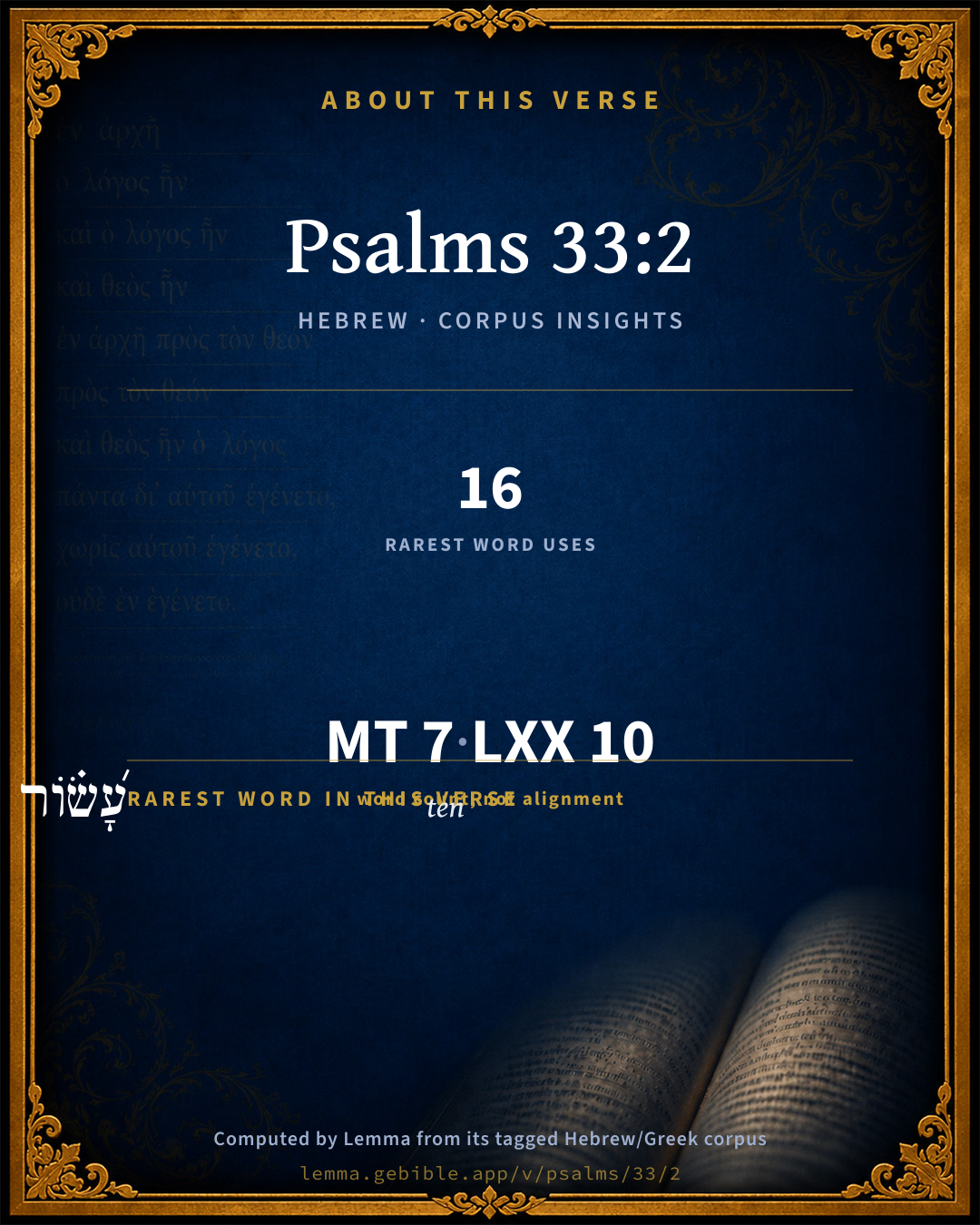
The rarest word here is עָ֝שׂ֗וֹר ten H6218 — appearing just 16 times in the whole Hebrew Bible.

Shared distinctive vocabulary

עָ֝שׂ֗וֹר ten H6218 occurs in 16 verses of the Hebrew Bible. Also found in:

Grammatical profile

  • 2 verbs
  • 4 nouns
  • 1 preposition

Verb forms

  • הוֹד֣וּ Hiphil · Imperative
  • זַמְּרוּ Piel · Imperative

Hebrew & Septuagint length

In English translation the verse runs 17 words from the Hebrew and 15 from the Septuagint (LXX English) — closely comparable.

A rough comparison of the two English renderings, which tokenize alike — not a word-level alignment.

Word counts can differ between the Hebrew and the Greek without any difference in meaning — e.g. the Hebrew direct-object marker אֵת has no separate Greek word, and Greek often adds the article ὁ.

In the original languages it is 7 Hebrew tokens and 10 Greek tokens — but the two are counted differently (Hebrew bundles its prefixes and suffixes into one token; the Greek is in lemma form), so that isn’t a like-for-like length.

Cross-references

15

Topical passages linked to Psalms 33:2 in the Treasury of Scripture Knowledge — connected by theme and wording, ordered by reader-vote popularity; previews shown in the World English Bible.

  • Psalms 150:3–6 Praise him with the sounding of the trumpet! Praise him with harp and lyre!
  • Psalms 98:4–5 Make a joyful noise to Yahweh, all the earth! Burst out and sing for joy, yes, sing praises!
  • Psalms 144:9 I will sing a new song to you, God. On a ten-stringed lyre, I will sing praises to you.
  • Exodus 15:20 Miriam the prophetess, the sister of Aaron, took a tambourine in her hand; and all the women went out after her with tambourines and with dances.
  • 2 Samuel 6:5 David and all the house of Israel played before Yahweh with all manner of [instruments made of] fir-wood, and with harps, and with psalteries, and with tambourines, and with castanets, and with cymbals.
  • 1 Chronicles 15:16 David spoke to the chief of the Levites to appoint their brothers the singers, with instruments of music, psalteries and harps and cymbals, sounding aloud and lifting up the voice with joy.
  • 1 Chronicles 15:28 Thus all Israel brought up the ark of the covenant of Yahweh with shouting, and with sound of the cornet, and with trumpets, and with cymbals, sounding aloud with psalteries and harps.
  • 1 Chronicles 25:3 Of Jeduthun; the sons of Jeduthun: Gedaliah, and Zeri, and Jeshaiah, Hashabiah, and Mattithiah, six, under the hands of their father Jeduthun with the harp, who prophesied in giving thanks and praising Yahweh.
  • 1 Chronicles 25:6 All these were under the hands of their father for song in the house of Yahweh, with cymbals, psalteries, and harps, for the service of the house of God; Asaph, Jeduthun, and Heman being under the order of the king.
  • Psalms 71:22 I will also praise you with the harp for your faithfulness, my God. I sing praises to you with the lyre, Holy One of Israel.
  • Psalms 81:2–3 Raise a song, and bring here the tambourine, The pleasant lyre with the harp.
  • Psalms 92:3 With the ten-stringed lute, with the harp, And with the melody of the lyre.
  • Revelation 5:8 Now when he had taken the book, the four living creatures and the twenty-four elders fell down before the Lamb, each one having a harp, and golden bowls full of incense, which are the prayers of the saints.
  • Revelation 14:2 I heard a sound from heaven, like the sound of many waters, and like the sound of a great thunder. The sound which I heard was like that of harpists playing on their harps.
  • Psalms 149:3 Let them praise his name in the dance! Let them sing praises to him with tambourine and harp!

Cross-references courtesy of OpenBible.info (CC BY 4.0).

Hebrew and Greek witnesses Masoretic Hebrew ↔ Greek Septuagint

The same verse in the two great witnesses to the Old Testament, shown verse-for-verse.

You’re reading Greek Psalm 32 (Hebrew Psalm 33). The Septuagint counts the superscription, so verse numbers can differ from the Hebrew — chapter-level alignment, not verse-by-verse. Numbering follows Rahlfs.

These are two independent witnesses, not word-aligned to each other, and the Septuagint is shown in lemma (dictionary) form.

Hebrew Psalms 33:2 Masoretic · Westminster Leningrad Codex

הוֹד֣וּ לַיהוָ֣ה בְּכִנּ֑וֹר בְּנֵ֥בֶל עָ֝שׂ֗וֹר זַמְּרוּ לֽוֹ

Give thanks to Yahweh with the lyre. Sing praises to him with the harp of ten strings.

World English Bible · Public Domain

Greek LXX Greek Psalm 32:2 Septuagint · lemma form

ἐκὁμολογέω ὁ κύριος ἐν κιθάρα ἐν ψαλτήριον δεκάχορδος ψάλλω αὐτός

Praise the Lord on the harp; platy to him on a lute of ten strings.

LXX2012 (modern English Septuagint) · Public Domain

On this verse, Ellicott's Commentary for English Readers discusses the Septuagint’s reading. Read the note in Commentary ↓

Hebrew: Westminster Leningrad Codex (CC BY 4.0). Greek: Septuagint (public domain); English from LXX2012 (modern English Septuagint) (Public Domain). How the Septuagint differs from the Hebrew →

Commentary

Notes on Psalms 33:2 from classic Christian and Jewish commentators (each source and its license shown beneath its notes). The classic Christian expositions comment on the surrounding passage and are grouped to its opening verse, so a note may address several verses; the Jewish commentaries on the Tanakh (Rashi and others) are per-verse, so they appear only where the commentator wrote on this verse.

Lemma curates 59 commentaries, every one of them public domain or Creative Commons licensed, each selected and text-cleaned for this edition rather than reprinted as found. About our sources →

Trapp's Complete Commentary

John Trapp

Psa 33:2 Praise the LORD with harp: sing unto him with the psaltery [and] an instrument of ten strings.

Ver. 2. Praise the Lord with harp] Or cittern, Jubal’s invention, Gen 4:21, much used by David and others of old under the Jewish pedagogy, as a help to devotion, as were also other musical instruments, here and elsewhere mentioned. Now it is otherwise; the best melody is to sing psalms with grace in our hearts; and for other music, when Aristotle was asked what he thought of it, he answered, Iovem nec canere, neque citharam pulsare, that Jupiter regarded it not.

John Trapp, A Commentary or Exposition upon All the Books of the Old and New Testament (1647–1656) — public domain. Text from a community e-Sword module.

The Biblical Illustrator

Joseph S. Exell

Psa_33:2

Sing unto Him with the psaltery and an instrument of ten strings.

A harp of ten strings

Most of us, if we praise the Lord at all, play upon one string, or two, or three, when we ought to take a harp full chorded and with glad fingers sweep all the strings. Instead of being grateful for here and there a blessing we happen to think of, we ought to rehearse all our blessings so far as we can recall them, and obey the injunction of my text to sing unto Him with an instrument of ten strings.

1. Have you appreciated the fact that on most of your tables are luxuries that do not come to all? Have you realized what varieties of flavour often touch your tongue, and how the saccharine and the acid have been afforded your palate? For the fine flavours and the luxurious viands you have enjoyed for a lifetime, perhaps you have never expressed to God a word of thanksgiving. That is one of the ten strings that you ought to have thrummed in praise to God, but you have never yet put it in vibration.

2. Have you thanked God for eyesight? Haw you realized the privation those suffer to whom the day is as black as the night, and who never see the face of father or mother or wife or child or friend? Through what painful surgery many have gone to get one glimpse of the light. The eyes--so delicate, and beautiful, and useful--that one of them is invaluable!

3. Notice how many pass through life in silence because the ear refuses to do its office. Have we devoutly thanked God for these two wonders of our hearing, with which we can now put ourselves under the charm of sweet sound, and also carry in our memories the infantile song with which our mothers put us to sleep?

4. There are many who never recognize how much God gives them when He gives them sleep. Oh, the felicities of slumber! Let all who have this real benefaction celebrate it. That is one of the sweetest strings in all the instrument of ten strings.

5. Acknowledge the power of physical locomotion. To be able to go where we wish, and all unaided--what a kindness! What multitudes have to call in the aid of crutch and invalids chair, and their whole life is a hinderment. How hard to get about with lack of strong and healthy and supple limbs.

6. Celebrate on the instrument of ten strings our illumined nights. They spread their tents over us, and some of us hardly go out to look at them. During the nights other worlds come in sight. Thank God for lunar and stellar illumination.

7. Celebrate the possession of our reason. Amid the increasing dementia of the world, let us appreciate the goodness of God to us if our mental faculties are in equipoise. Voyaging from New Zealand to Australia, a storm swooped upon us, and we saw all around us fragments of ships that had been caught in the same tempest; and how thankful we were, sailing into Sydney harbour, that we had escaped! So that man and that woman, whose intellect goes safely through the storms of this life, in which so many have foundered, ought every day and every night to employ one of the ten strings in gratitude for that particular mercy.

8. Another string of this instrument I now touch--friendships, deep and abiding. With one such friend you can defy the world.

9. Gospel advantages. That Gospel rocked our cradle, and it will epitaph our grave. It soothes our sorrows, brightens our hopes, inspires our courage, forgives our sins, and saves our souls. It takes a man who is all wrong and makes him all right. What that Gospel has done for you and me is a story that we can never fully tell. (T. De Witt Talmage.)

The Biblical Illustrator, edited by Joseph S. Exell (c. 1880s–1900s) — public domain. Text from a community e-Sword module.

Joseph Benson's Commentary

Psa 33:2-3. Praise the Lord with the harp, &c. — He mentions these instruments, because they were used in the public worship of God in the tabernacle. Sing unto him a new song — Either, 1st, A song newly composed: as if he had said, As God gives you fresh occasions to praise him, so do not content yourselves with the old songs or psalms made by former holy men of God, but make new ones suited to these occasions. Or, 2d, Songs renewed, or repeated and continued from day to day.

Joseph Benson's Commentary on the Old and New Testaments (1811–1818) — public domain. Text from a community e-Sword module.

J. A. Alexander on Psalms

Joseph Addison Alexander

2. (Psa 33:2) Give thanks to Jehovah with a harp; with a lyre of ten (strings) make music to him. The first verb means to acknowledge, either sins or favours; in the first case, it answers to confess, Psa 32:5, in the other to thank, Psa 7:17 (16). See also Psa 28:7; Psa 30:10 (9). The common version, praise, is too indefinite, though this idea is undoubtedly included. The mention of the instruments does not exclude vocal praise, but merely gives it an accompaniment and support, as if the voice were too weak by itself to utter the divine praise. The precise form of the instruments here named is now unknown and wholly unimportant. The ten strings of the second are mentioned, either to identify it by a similar circumstance, or, as some suppose, because the number had a mystical significance. The same combination reappears below in Psa 144:9, while in Psa 92:4 (3) the two words are separately used, as if denoting different instruments.

Joseph Addison Alexander, The Psalms Translated and Explained (1850) — public domain. Text from a community e-Sword module.

Geneva Bible (1599)

Geneva Bible translators

To sing on instruments, was a part of the ceremonial service of the Temple, which doth no more appertain unto us, than the sacrifices, censings, and lights.

Geneva Bible (1599) marginal notes — public domain. Text via Bolls.life.

Adam Clarke's Commentary

Verse 2. Praise the Lord with harp] כנור kinnor; probably something like our harp: but Calmet thinks it the ancient testudo, or lyre with three strings.

The psalter] נבל nebel. Our translation seems to make a third instrument in this place, by rendering עשור asor, an instrument of ten strings; whereas they should both be joined together, for נבל עשור nebel-asor signifies the nebal, or nabla, with ten strings, or holes. Calmet supposes this to have resembled our harp. In one of Kennicott's MSS., this Psalm begins with the second verse.

Adam Clarke's Commentary on the Bible (1810–1826) — public domain. Text from a community e-Sword/MySword module.

John Calvin's Commentaries

2. Praise Jehovah upon the harp. It is evident that the Psalmist here expresses the vehement and ardent affection which the faithful ought to have in praising God, when he enjoins musical instruments to be employed for this purpose. He would have nothing omitted by believers which tends to animate the minds and feelings of men in singing God’s praises. The name of God, no doubt, can, properly speaking, be celebrated only by the articulate voice; but it is not without reason that David adds to this those aids by which believers were wont to stimulate themselves the more to this exercise; especially considering that he was speaking to God’s ancient people. There is a distinction, however, to be observed here, that we may not indiscriminately consider as applicable to ourselves, every thing which was formerly enjoined upon the Jews. I have no doubt that playing upon cymbals, touching the harp and the viol, and all that kind of music, which is so frequently mentioned in the Psalms, was a part of the education; that is to say, the puerile instruction of the law: I speak of the stated service of the temple. For even now, if believers choose to cheer themselves with musical instruments, they should, I think, make it their object not to dissever their cheerfulness from the praises of God. But when they frequent their sacred assemblies, musical instruments in celebrating the praises of God would be no more suitable than the burning of incense, the lighting up of lamps, and the restoration of the other shadows of the law. The Papists, therefore, have foolishly borrowed this, as well as many other things, from the Jews. Men who are fond of outward pomp may delight in that noise; but the simplicity which God recommends to us by the apostle is far more pleasing to him. Paul allows us to bless God in the public assembly of the saints only in a known tongue, (1 Corinthians 14:16.) The voice of man, although not understood by the generality, assuredly excels all inanimate instruments of music; and yet we see what St Paul determines concerning speaking in an unknown tongue. “Et neant moins nous voyons ce que Sainct Paul en determine.” — Fr.

John Calvin's Commentaries (1540-1563) — public domain. Text from the Calvin Translation Society English edition (1840s-50s) via the Christian Classics Ethereal Library (ccel.org). Calvin's coverage is partial (roughly two-thirds of the Bible); uncommented books and verses are honest gaps, never fabricated. The 19th-century editor's footnotes and remarks are omitted so the notes are faithfully Calvin's own voice.

Ellicott's Commentary for English Readers

(2) Harp.—Heb., khinnôr (LXX. and Vulg., “cithara”), most probably a trigon or three-cornered harp, such as may be seen sculptured in Egyptian bas-reliefs. The number of strings probably varied, as different accounts are given. (See Bible Educator, 1:19.)

With the psaltery and an instrument of ten strings.—Properly, as LXX. and Vulg., “with the ten-stringed psaltery.” (See 1Sa_10:5.) Evidently a more elaborate instrument than the khinnôr, and with greater capacities. (See Bible Educator, 1:70, and art. “Psaltery” in Smith’s Biblical Dictionary.) From the Greek psalterion comes the title “psalter” for the Book of Psalms. By its derivation it meant an instrument played with the fingers. The word was in use in old English:

“And before hem went minstrels many one,

As harpes, pipes, lutes, and sautry.”

CHAUCER: The Flower and the Leaf, 237.

A Bible Commentary for English Readers, edited by Charles John Ellicott (1878–1897) — public domain. Text from a community e-Sword module.

The Cambridge Bible for Schools and Colleges

gen. ed. J. J. S. Perowne

2. Give thanks unto the Lord with harp:

Sing praises unto him with the psaltery of ten strings (R.V.).

The harp and psaltery were both stringed instruments, differing somewhat in form.

The Cambridge Bible for Schools and Colleges (gen. ed. J. J. S. Perowne; Cambridge University Press, 1878–1918) — public domain. Text from a community e-Sword module.

John Gill's Exposition

Praise the Lord with harp,.... An instrument David was well skilled in the use of, the inventor of which was Jubal, Gen 4:21;

sing unto, him with the psaltery; the name of this instrument is in the Hebrew language "nebel": the account which Josephus (w) gives of this, and of the former, is,

"the harp is extended with ten strings, and is plucked with a quill; the "nabla", or psaltery, has twelve sounds, and is played upon with the fingers;''

some make this and the next to be the same:

and an instrument of ten strings; and read them together thus, "with the psaltery of ten strings": and so the Targum, Septuagint, and other versions (x): but it seems from Josephus that it was not a stringed instrument, but had holes, and those twelve; and besides it is distinguished from the instrument of ten strings, Psa 92:3; it was in the form of a bottle, from whence it had its name.

(w) Antiqu. l. 7. c. 12. s. 3. (x) Vid. Jarchium in loc. & R. Mosem in Aben Ezra in loc.

John Gill's Exposition of the Whole Bible (1746–1763) — public domain (CC PDM 1.0). Text via the HelloAO Bible API.

Albert Barnes' Notes on the Bible

Praise the Lord with harp - For a description of the “harp,” see the notes at Isa 5:12.

Sing unto him with the psaltery - For the meaning of this word, also, see the notes at Isa 5:12, where the word is rendered “viol.”

And an instrument of ten strings - The word “and” is supplied here by the translators as if, in this place, a third instrument was referred to, distinct from the harp and the psaltery. The more correct rendering, however, would be, “a psaltery (or lyre) of ten strings.” The same construction occurs in Psa 144:9. In Psa 92:3, however, the two words are separately used as denoting different instruments. The “lyre” or psaltery was probably not always made with the same number of strings, and it would seem that the one that was made of “ten” strings had something special about it as an instrument of uncommon sweetness or power. Hence, it is particularly designated here; and the idea is that the instruments of especial power and sweetness should be on this occasion employed in the service of God.

Albert Barnes' Notes on the Bible (1834–1885) — public domain. Text from a community e-Sword/MySword module.

Matthew Poole's English Annotations

He mentions these instruments, because they were used in the public worship and praises of God in the tabernacle.

Matthew Poole's English Annotations on the Holy Bible (1683–1685) — public domain. Text from a community e-Sword/MySword module.

The Treasury of David

Charles H. Spurgeon

Ver. 2. Praise the Lord with harp. Men need all the help they can get to stir them up to praise. This is the lesson to be gathered from the use of musical instruments under the old dispensation. Israel was at school, and used childish things to help her to learn; but in these days, when Jesus gives us spiritual manhood, we can make melody without strings and pipes. We who do not believe these things to be expedient in worship, lest they should mar its simplicity, do not affirm them to be unlawful, and if any George Herbert or Martin Luther can worship God better by the aid of well tunes instruments, who shall gainsay their right? We do not need them, they would hinder than help our praise, but if others are otherwise minded, are they not living in gospel liberty? Sing unto him. This is the sweetest and best of music. No instrument like the human voice. As a help to singing the instrument is alone to be tolerated, for keys and strings do not praise the Lord. With the psaltery and an instrument of ten strings. The Lord must have a full octave, for all notes are his, and all music belongs to him. Where several pieces of music are mentioned, we are taught to praise God with all the powers which we possess.

Ver. 2. Praise the Lord with harp: sing unto him with the psaltery and an instrument of ten strings. Here we have the first mention of musical instruments in the Psalms. It is to be observed that the early fathers almost with one accord protest against their use in churches; as they are forbidden in the Eastern church to this day, where yet, by the consent of all, the singing is infinitely superior to anything that can be heard in the West. J. M. Neale.

Ver. 2. Harp; Psaltery, etc. Our church does not use musical instruments, as harps and psalteries, to praise God withal, that she may not seem to Judaise. Thomas Aquinas. It was only permitted to the Jews, as sacrifice was, for the heaviness and grossness of their souls. God condescended to their weakness, because they were lately drawn off from idols; but now instead of organs, we may use our own bodies to praise him withal. Chrysostom. The use of singing with instrumental music was not received in the Christian churches as it was among the Jews in their infant state, but only the use of plain song. Justin Martyr.

Ver. 2. (last clause). It is said that David praised God upon an instrument of ten strings; and he would never have told how many strings there were, but that without doubt he made use of them all. God hath given all of us bodies, as it were, instruments of many strings; and can we think it music good enough to strike but one string, to call upon him with our tongues only? No, no; when the still sound of the heart by holy thoughts, and the shrill sound of the tongue by holy words, and the loud sound of the hands by pious works, do all join together, that is God's concert, and the only music wherewith he is affected. Sir Richard Baker.

Ver. 2. Instrumental music. Is it lawful? Is it expedient? If so, its uses, limits, and laws. A sermon to improve congregational music.

Psalms 33:3*

Charles H. Spurgeon's The Treasury of David (1869–1885) — public domain. Psalms only. Text from a community e-Sword/MySword module.

Whedon's Commentary on the Bible

Daniel D. Whedon

2. Harp—The kinnor was an instrument ordinarily of ten strings, sometimes more, (see note on Psa_81:2,) shaped, probably, like a modern harp, or, as some suppose, like the letter delta (Δ) of the Greek alphabet. It was an Asiatic instrument of the earliest invention, (Gen_4:21,) used by the Hebrews on all occasions, either of joy or sorrow. See on Psa_92:3. But, though once so universally popular, it has now “disappeared from the entire East.”—Van Lennep.

Psaltery—Hebrew, nebel, another stringed instrument resembling the harp, probably a kind of guitar having six strings; Josephus says twelve, but Chappell says some were doubled, making virtually but six. In what respects it differed from the harp is not known. It was of Phoenician origin, much used by the Hebrews in worship. It is translated “viol,” Isa_5:12; Isa_44:11; Amo_5:23; Amo_6:5; and “lute” in the Prayer Book.

Instrument of ten strings—Hebrew, ‘asor. Whether this is a different instrument from the “psaltery” is doubtful. The full designation of “psaltery” is nebel ‘asor, the psaltery of ten strings, and here, and in Psa_92:4, it might be translated, “upon the psaltery of ten strings,” and, in Psa_92:3, “upon the ten stringed instrument, even the psaltery.” The word always occurs in connexion with psaltery.

New song—New displays of divine faithfulness call for a new song of praise.

Daniel D. Whedon (gen. ed.), Commentary on the Old and New Testaments (1874–1909) — public domain. Text from a community e-Sword module.

The Pulpit Commentary

Praise the Lord with harp. The harp obtains mention here for the first time in the Psalms. Reference, however, had been made to it previously in Genesis, Job, and the First Book of Samuel. There is reason to believe that the instrument, as known to the Hebrews, was a simple one, consisting of a nearly triangular framework of wood, crossed by seven strings. The Egyptians were acquainted from early times with a very much more elaborate instrument harps which stood six feet high upon a broad base of their own, and had as many as twenty-two strings (Rawlinson, "History of Ancient Egypt," vol. 1. p. 521). The harp was regarded by the Hebrews as peculiarly fitted for sacred music. (see 1Sa_10:5 2Sa_6:5 1Ch_15:16 1Ch_25:1, 1Ch_25:3, 6 2Ch_5:12 Neh_12:27, etc.) Sing unto him with the psaltery and an instrument of ten strings; rather, sing unto him with the lute of ten strings. One instrument only is here mentioned a lute or psaltery (nebel), having ten strings. (comp. Psa_92:3 Psa_144:9) The nebel was an instrument differing from the harp chiefly in the arrangement of the strings. It was used in the temple service, as appears from 1Ch_15:6, 28 25:1, 6 2Ch_5:12 2Ch_29:25, etc.

The Pulpit Commentary (1880–1919), ed. H.D.M. Spence-Jones & Joseph S. Exell — public domain. Text from a community e-Sword module.

John Wesley's Explanatory Notes

Harp, &c. - These instruments were used in the publick worship of God in the tabernacle.

John Wesley, Explanatory Notes Upon the Whole Bible (1754–1765) — public domain. Text via the GEBible commentary corpus.

Rashi

Rabbi Shlomo Yitzchaki (Rashi)

with a lyre of ten melodies Heb. בנבל עשור, of ten kinds of melody.

Rashi on the Tanakh — English translations: “The Judaica Press complete Tanach with Rashi, translated by A. J. Rosenberg” (CC BY 4.0); “Pentateuch with Rashi's commentary by M. Rosenbaum and A.M. Silbermann, 1929-1934” (public domain); “The Metsudah Tanach series, Lakewood, N.J” (CC BY 4.0); and “The Book of Joshua, Metsudah Publications, 1997” (CC BY 4.0). Text via Sefaria.

Lesson kit

Teaching starters — assembled from the data on this page, not authored interpretation. Every prompt links to the verse data it draws on. Edit before teaching.

Psalms, in the Wisdom, opens this verse with 7 words (6 distinct Hebrew lemmas). Its most distinctive word is ʻâsôwr (“ten”). A historical commentator’s framing appears above. Read the whole chapter for the surrounding context.

Discussion questions

  1. What does “ten” (ʻâsôwr) contribute to the verse as a whole?
  2. Genesis 24:55 shares the word «ten» with this verse. How do the two illuminate each other?
  3. The translations on this page render this verse differently — a whole-verse word diff, not a word-by-word alignment. What might account for the different wordings?
  4. The verb «הוֹד֣וּ» is Hiphil Imperative. How does its form color the action?
  5. Reading how Trapp's Complete Commentary and The Biblical Illustrator read this verse, where do the two commentators agree and where do they part?

Things to notice

Reading settings

Reading text

Shown beneath each verse's original-language words.

Old Testament
Old Testament edition

Read the OT as the Masoretic Hebrew (MT) or the Greek Septuagint (LXX).

English shown for the Greek Septuagint (in the Hebrew ↔ Greek comparison).

Comparing translations? Open the Compare panel on any verse page to stack up to four side by side.