
Psalms 99:3

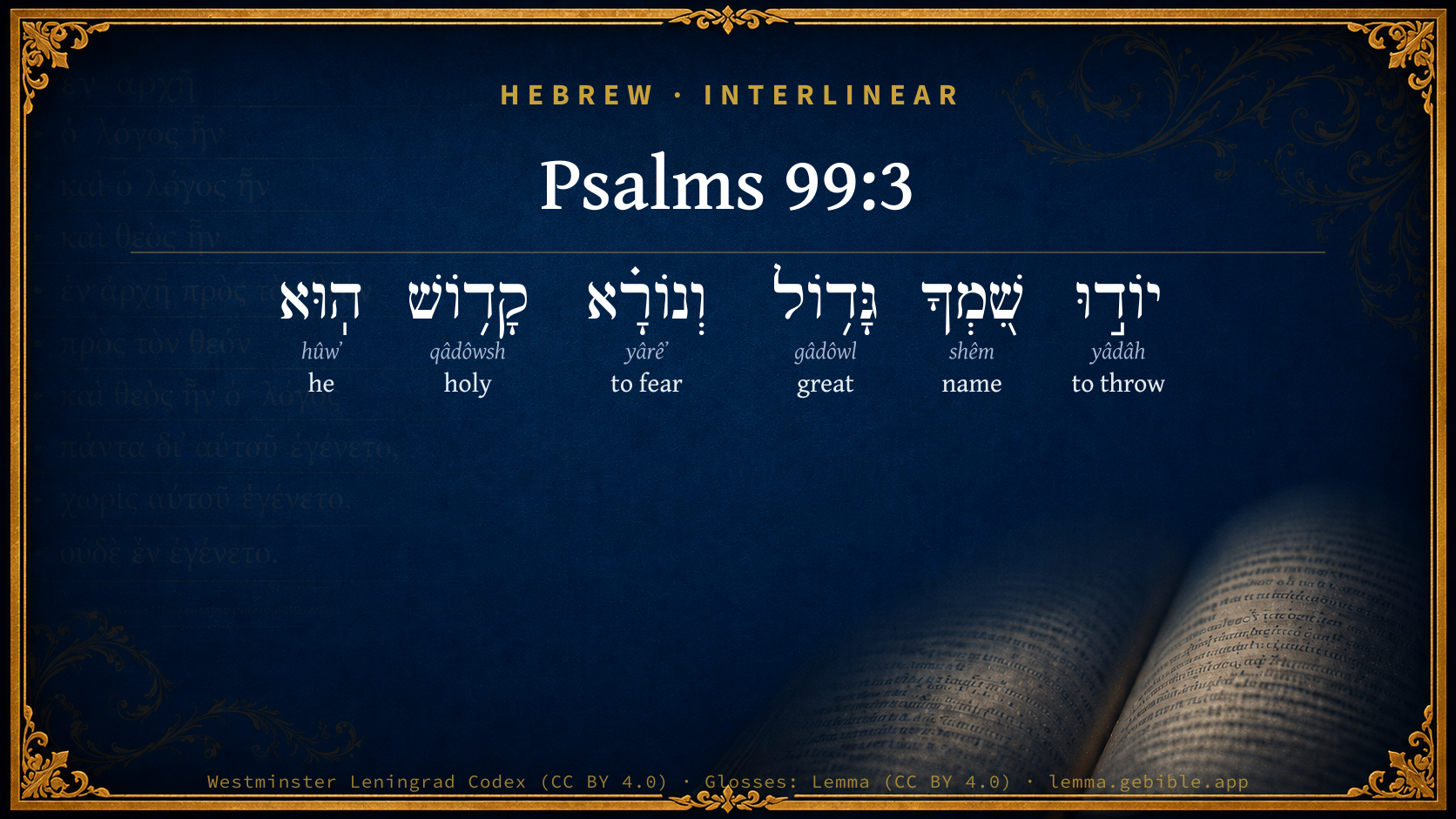
Hebrew (Westminster Leningrad Codex) Psalms 99:3 appears in the Hebrew Old Testament. The text above is from the Westminster Leningrad Codex. Each word links to its Strong’s number, a concise gloss, and parsing drawn from the Open Scriptures Hebrew Bible morphology. Click any word for its full Brown-Driver-Briggs (BDB) entry.
Download image
Cite this verse

Psalms 99:3 (World English Bible). Public Domain. Lemma interlinear Bible study tool, https://lemma.gebible.app/v/psalms/99/3.

Show BibTeX & RIS
BibTeX
RIS
English Translation
Let them praise your great and awesome name. He is Holy!
World English Bible · Public Domain
Download a study sheet

One document with this verse’s original text, its word-by-word gloss line, the meaning frame, cross-references with their text, attributed commentary, and full source and license credits — printable, and it pastes into notes with its structure intact.

This verse Autodidact and up

Study sheet (.html) Plain text (.txt)

A passage Seminary Student

Up to 50 verses in one chapter. A passage sheet keeps up to 6 commentary sources and 12 cross-references per verse, in the order this page ranks them, and says so on the sheet whenever that leaves anything out. Ask for a single verse and you get the Autodidact verse sheet above.

Everything on this page stays free to read, with no account — the sheet is a download of what is already on screen, not access to it.

Want to remove ads? Support Godless Engineer
Compare translations 3

The same verse in 3 English versions, stacked beneath the original-language interlinear above. Click any original word for its lexicon entry.

Each is an independent rendering of the whole verse — the interlinear is not word-aligned to these translations.

Highlighted words mark where these versions differ — a whole-verse word diff, not a word-by-word alignment.

  • World English Bible Public Domain
    Let them praise your great and awesome name. He is Holy!
  • King James Version Public Domain
    Let them praise thy great and terrible name; for it is holy.
  • unfoldingWord Literal Text CC BY-SA 4.0
    Let them praise your great and fearsome name; holy he.

unfoldingWord Literal Text — © unfoldingWord, licensed CC BY-SA 4.0. Word-aligned USFM3 via Door43 (git.door43.org/unfoldingWord/en_ult).

Versions to compare (up to 4)

3 of 4 selected

Show all 18 translations

Every available English version of this verse, each an independent rendering of the whole verse.

  • World English Bible Public Domain
    Let them praise your great and awesome name. He is Holy!
  • Berean Standard Bible Public Domain
    Let them praise Your great and awesome name—He is holy!
  • Majority Standard Bible Public Domain
    Let them praise Your great and awesome name—He is holy!
  • King James Version Public Domain
    Let them praise thy great and terrible name; for it is holy.
  • American Standard Version (1901) Public Domain
    Let them praise thy great and terrible name: Holy is he.
  • Revised Version (1885) Public Domain
    Let them praise thy great and terrible name: holy is he.
  • Geneva Bible (1599) Public Domain
    They shall prayse thy great and fearefull Name (for it is holy)
  • Douay-Rheims (1899) Public Domain
    Let them give praise to thy great name: for it is terrible and holy:
  • Young's Literal Translation Public Domain
    They praise Thy name, `Great, and fearful, holy `it' is.'
  • Literal Standard Version CC BY-SA 4.0
    They praise Your Name, “Great, and fearful, [it] is holy!”
  • Unlocked Literal Bible CC BY-SA 4.0
    Let them praise your great and awesome name; he is holy.
  • unfoldingWord Literal Text CC BY-SA 4.0
    Let them praise your great and fearsome name; holy he.
  • Darby Bible Public Domain
    They shall praise thy great and terrible name, -- it is holy! --
  • World Messianic Bible Public Domain
    Let them praise your great and awesome name. He is Holy!
  • Webster's Bible Public Domain
    Let them praise thy great and terrible name; for it is holy.
  • Free Bible Version CC BY-SA 4.0
    Let them praise his greatness, and respect him for who he is—for he is holy,
  • Bible in Basic English Public Domain
    Let them give praise to your name, for it is great and to be feared; holy is he.
  • JPS Tanakh (1917) Public Domain
    Let them praise Thy name as great and awful; Holy is He.

Literal Standard Version (2020), Covenant Press — licensed CC BY-SA 4.0. Text via the HelloAO Bible API (eBible.org). Unlocked Literal Bible (unfoldingWord) — licensed CC BY-SA 4.0. Text via the HelloAO Bible API (eBible.org). unfoldingWord Literal Text — © unfoldingWord, licensed CC BY-SA 4.0. Word-aligned USFM3 via Door43 (git.door43.org/unfoldingWord/en_ult). Free Bible Version, Dr. Jonathan Gallagher — licensed CC BY-SA 4.0. Text via the HelloAO Bible API (eBible.org).

Word by word

More ways to search: Search by grammar → Find every occurrence → Compare this word →

Practice this passage: Drill this verse → Learn its vocabulary →

About this verse

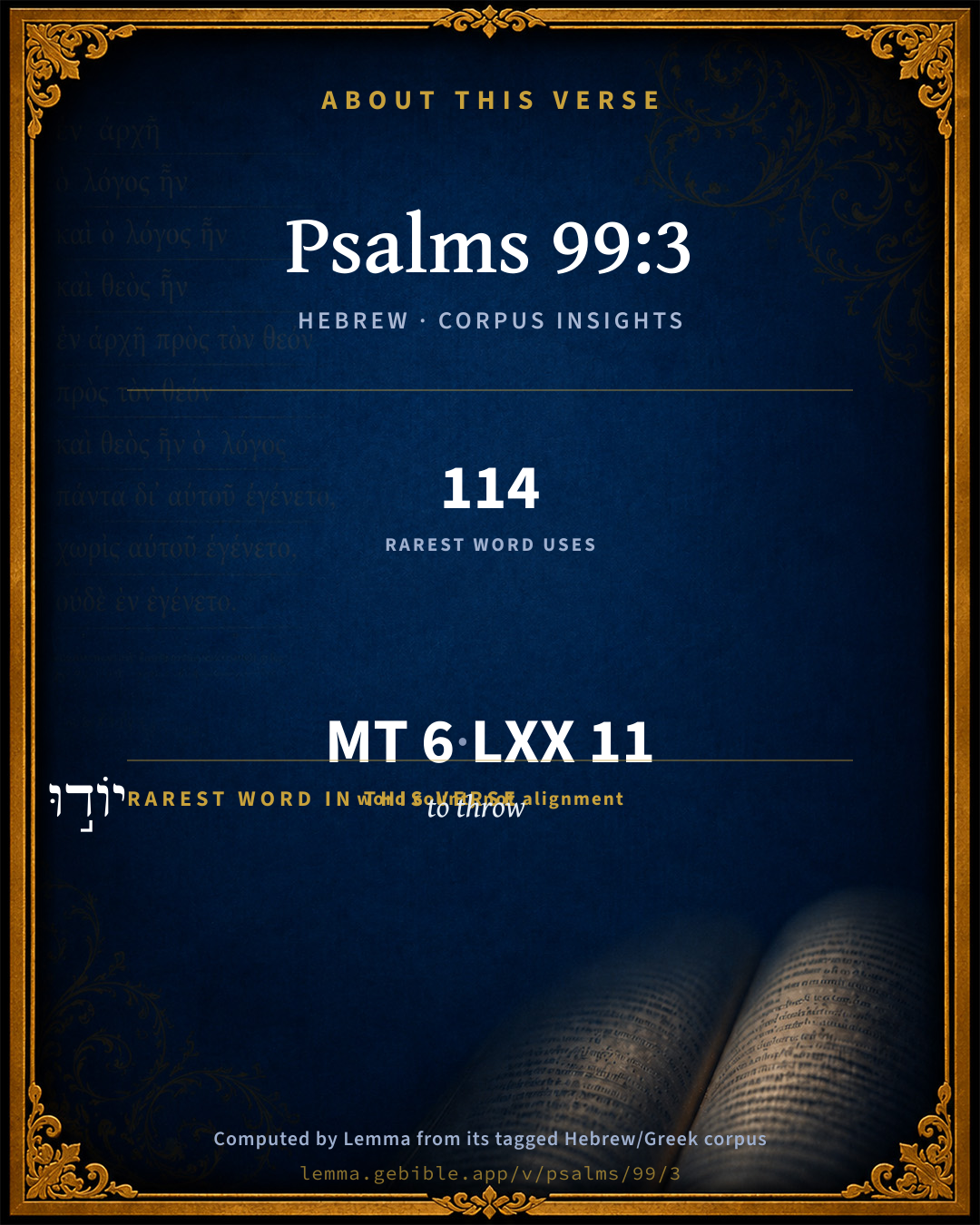
These counts appear in no published source. They are computed here, from the morphology-tagged text and Lemma’s own curated glosses. What Lemma adds →

6
words
6
distinct lemmas
Wisdom
section

Grammatical profile

  • 2 verbs
  • 1 noun
  • 2 adjectives
  • 1 pronoun

Verb forms

  • יוֹד֣וּ Hiphil · Imperfect
  • וְנוֹרָ֗א Niphal · Participle Active

Hebrew & Septuagint length

In English translation the verse runs 11 words from the Hebrew and 14 from the Septuagint (LXX English) — closely comparable.

A rough comparison of the two English renderings, which tokenize alike — not a word-level alignment.

Word counts can differ between the Hebrew and the Greek without any difference in meaning — e.g. the Hebrew direct-object marker אֵת has no separate Greek word, and Greek often adds the article ὁ.

In the original languages it is 6 Hebrew tokens and 11 Greek tokens — but the two are counted differently (Hebrew bundles its prefixes and suffixes into one token; the Greek is in lemma form), so that isn’t a like-for-like length.

Cross-references

17

Topical passages linked to Psalms 99:3 in the Treasury of Scripture Knowledge — connected by theme and wording, ordered by reader-vote popularity; previews shown in the World English Bible.

  • Isaiah 6:3 One called to another, and said, "Holy, holy, holy, is Yahweh of Hosts! The whole earth is full of his glory!"
  • Deuteronomy 28:58 If you will not observe to do all the words of this law that are written in this book, that you may fear this glorious and fearful name, YAHWEH YOUR GOD;
  • Psalms 111:9 He has sent redemption to his people. He has ordained his covenant forever. His name is holy and awesome!
  • Revelation 15:3–4 They sang the song of Moses, the servant of God, and the song of the Lamb, saying, "Great and marvelous are your works, Lord God, the Almighty; Righteous and true are your ways, you King of the nations.
  • Deuteronomy 7:21 You shall not be scared of them; for Yahweh your God is in the midst of you, a great and awesome God.
  • Nehemiah 1:5 and said, I beg you, Yahweh, the God of heaven, the great and awesome God, who keeps covenant and loving kindness with those who love him and keep his commandments:
  • Nehemiah 4:14 I looked, and rose up, and said to the nobles, and to the rulers, and to the rest of the people, Don't be you afraid of them: remember the Lord, who is great and awesome, and fight for your brothers, your sons, and your daughters, your wives, and your houses.
  • Psalms 66:3 Tell God, "How awesome are your deeds! Through the greatness of your power, your enemies submit themselves to you.
  • Psalms 145:17 Yahweh is righteous in all his ways, And gracious in all his works.
  • John 17:11 I am no more in the world, but these are in the world, and I am coming to you. Holy Father, keep them through your name which you have given me, that they may be one, even as we are.
  • Revelation 4:8 The four living creatures, each one of them having six wings, are full of eyes around about and within. They have no rest day and night, saying, "Holy, holy, holy, holy, holy, holy, holy, holy, holy is the Lord God, the Almighty, who was and who is and who is to come!"
  • Joshua 24:19 Joshua said to the people, You can't serve Yahweh; for he is a holy God; he is a jealous God; he will not forgive your disobedience nor your sins.
  • 1 Samuel 2:2 There is none holy as Yahweh; For there is none besides you, Neither is there any rock like our God.
  • Psalms 76:1 In Judah, God is known. His name is great in Israel.
  • Nehemiah 9:32 Now therefore, our God, the great, the mighty, and the awesome God, who keep covenant and loving kindness, don't let all the travail seem little before you, that has come on us, on our kings, on our princes, and on our priests, and on our prophets, and on our fathers, and on all your people, since the time of the kings of Assyria to this day.
  • Psalms 76:12 He will cut off the spirit of princes. He is feared by the kings of the earth.
  • Jeremiah 20:11 But Yahweh is with me as an awesome mighty one: therefore my persecutors shall stumble, and they shall not prevail; they shall be utterly disappointed, because they have not dealt wisely, even with an everlasting dishonor which shall never be forgotten.

Cross-references courtesy of OpenBible.info (CC BY 4.0).

Hebrew and Greek witnesses Masoretic Hebrew ↔ Greek Septuagint

The same verse in the two great witnesses to the Old Testament, shown verse-for-verse.

You’re reading Greek Psalm 98 (Hebrew Psalm 99). The Septuagint counts the superscription, so verse numbers can differ from the Hebrew — chapter-level alignment, not verse-by-verse. Numbering follows Rahlfs.

These are two independent witnesses, not word-aligned to each other, and the Septuagint is shown in lemma (dictionary) form.

Hebrew Psalms 99:3 Masoretic · Westminster Leningrad Codex

יוֹד֣וּ שִׁ֭מְךָ גָּד֥וֹל וְנוֹרָ֗א קָד֥וֹשׁ הֽוּא

Let them praise your great and awesome name. He is Holy!

World English Bible · Public Domain

Greek LXX Greek Psalm 98:3 Septuagint · lemma form

ἐκὁμολογέω ὁ ὄνομα σύ ὁ μέγας ὅτι φοβερός καί ἅγιος εἰμί

Let them give thanks to your great name; for it is terrible and holy.

LXX2012 (modern English Septuagint) · Public Domain

Hebrew: Westminster Leningrad Codex (CC BY 4.0). Greek: Septuagint (public domain); English from LXX2012 (modern English Septuagint) (Public Domain). How the Septuagint differs from the Hebrew →

Commentary

Notes on Psalms 99:3 from classic Christian and Jewish commentators (each source and its license shown beneath its notes). The classic Christian expositions comment on the surrounding passage and are grouped to its opening verse, so a note may address several verses; the Jewish commentaries on the Tanakh (Rashi and others) are per-verse, so they appear only where the commentator wrote on this verse.

Lemma curates 59 commentaries, every one of them public domain or Creative Commons licensed, each selected and text-cleaned for this edition rather than reprinted as found. About our sources →

Trapp's Complete Commentary

John Trapp

Psa 99:3 Let them praise thy great and terrible name; [for] it [is] holy.

Ver 3. Let them praise thy great and terrible name] Nomen illud maiestativum. Some hereby understand the name Jehovah, of which Jos 7:9, "What wilt thou do to thy great name?" And Jer 44:26, "I have sworn by my great name." But God’s name is usually put for God’s self.

For it is holy] And therefore to be sanctified in righteousness, Isa 5:16.

John Trapp, A Commentary or Exposition upon All the Books of the Old and New Testament (1647–1656) — public domain. Text from a community e-Sword module.

The Treasury of David

Charles H. Spurgeon

Ver. 3. Let them praise thy great and terrible name: let all the dwellers in Zion and all the nations upon the earth praise the Lord, or "acknowledge thankfully" the goodness of his divine nature, albeit that there is so much in it which must inspire their awe. Under the most terrible aspect the Lord is still to be praised. Many profess to admire the milder beams of the sun of righteousness, but burn with rebellion against its more flaming radiance: so it ought not to be: we are bound to praise a terrible, God and worship him who casts the wicked down to hell. Did not Israel praise him "who overthrew Pharaoh and his hosts in tile Red Sea, for his mercy endureth for ever." The terrible Avenger is to be praised, as well as the loving Redeemer. Against this the sympathy of man's evil heart with sin rebels; it cries out for an effeminate God in whom pity has strangled justice. The well-instructed servants of Jehovah praise him in all the aspects of his character, whether terrible or tender. Grace streaming from the mercy-seat can alone work in us this admirable frame of mind.

For it is holy, or He is holy. In him is no flaw or fault, excess or deficiency, error or iniquity. He is wholly excellent, and is therefore called holy. In his words, thoughts, acts, and revelations as well as in himself, he is perfection itself. O come let us worship and bow down before him.

Ver. 3. Let them praise thy great and terrible name, etc. Although the enemies of the Church of God are in a tumult, and the whole earth is moved, do you nevertheless with joyful spirit entrust your salvation to him, and acknowledge and diligently celebrate his power displayed in the defence of his people and the overthrow of his foes. Mollerus.

Ver. 3. Thy great and terrible name; for it is holy. The FATHER'S name is "great, "for he is the source, the Creator, the Lord of all; the SON'S name is "terrible, "for he is to be our judge; the name of the HOLY GHOST is "holy, "for he it is who bestows hallowing and sanctification. The Hebrew commentators see here the mystic Tetragrammaton hwhy, whose true pronunciation was kept a profound secret by the Rabbins, owing to a feeling of awful reverence; while the Greeks are precise in bidding us take it of that name, which is "terrible" to God's enemies, "holy" to his friends, and "great" to both, the name of JESUS. Hugo Cardinalis, Genebrardus, and Balthazar Corderius, in Neale's Commentary.

Ver. 3. Let them praise thy terrible name. What force the experience of a burdened conscience attaches to the expression, "Thy great and terrible name; for it is holy!" The misery of sin consists not merely in its consequences, but in its very nature, which is to separate between God and our souls, and to shut us out from God, and God from us. Yet the Spirit of God indicates, in the covenant of grace, a threefold practical influence of his holiness upon us, of which the issue is the opposite of despair. The various steps are marked as praise, exaltation, and worship (Ps 99:3, 5, 9). Of these the last seems by far the most difficult to realise. For it is in the nature of conscious sin to prevent even our approaches to God, to keep us from all comfortable fellowship with God, and to fill us with a heavy sense of our infinite and almost hopeless distance from him. Yet we will "praise thy great and terrible name; for it is holy." Great it is; most glorious and high; far above all human conceptions. Viewed in this light, even the fact otherwise so consoling, "The Lord reigneth, "leads only to the inference, "Let the people tremble; "and "He sitteth between the cherubim" (or manifesteth himself as the covenant God) to the conclusion, "Let the earth be moved, "or stagger. But his name is not only great and terrible in its manifestations, "it is holy, "and therefore we "praise" it. His greatness is all arrayed on the side of goodness, his power on that of righteousness and truth. Alfred Edersheim, in "The Golden Diary of Heart Converse with Jesus in the Book of Psalms, "1873.

Ver. 3. Thy terrible name... holy. In acts of man's vindictive justice, there is something of impurity, perturbation, passion, some mixture of cruelty; but none of these fall upon God in the several acts of wrath. When God appears to Ezekiel in the resemblance of fire, to signify his anger against the house of Judah for their idolatry, "from his loins downward there was the appearance of fire, but from the loins upward the appearance of brightness, as the colour of amber." Eze 8:2. His heart is clean in his most terrible acts of vengeance; it is a pure flame wherewith he scorcheth and burns his enemies. He is holy in the most fiery appearance. Stephen Charnock.

Ver. 3. It is holy. No attribute is sounded out so loftily, with such solenmity, and so frequently by angels that stand before his throne, as this. Where do you find any other attribute trebled in the praises of it as this? Isa 6:3: "Holy, holy, holy, is the LORD of hosts: the whole earth is full of his glory; "and Re 4:8: "The four living creatures rest not day and night saying, Holy, holy, holy, Lord God Almighty, "&c. His power of sovereignty as Lord of hosts is but once mentioned, but with a ternal repetition of his holiness. Do you hear in any evangelical song any other perfection of the divine nature thrice repeated? Where do we read of the crying out, Eternal, eternal, eternal; or Faithful, faithful, faithful, Lord God of hosts! Whatsoever other attribute is left out, this God would have to fill the mouths of angels and blessed spirits for ever in heaven... As it seems to challenge an excellence above all his other perfections, so it is the glory of all the rest; as it is the glory of the Godhead, so it is the glory of every perfection in the Godhead; as his power is the strength of them, so his holiness is the beauty of them; as all would be weak without almightiness to back them, so all would be uncomely without holiness to adorn them: should this be sullied all the rest would lose their honour and their comfortable efficacy; as at the same instant that the sun should lose its light, it would lose its heat, its strength, its generative and quickening virtue. As sincerity is the lustre of every grace in a Christian, so is purity the splendour of every attribute in the Godhead. His justice is a holy justice, his wisdom a holy wisdom, his arm of power a "holy arm, " Ps 98:1; his truth or promise a "holy promise, "Ps 105:42. Holy and true go hand and hand, Re 6:10. "His name, " which signifies all his attributes in conjunction, "is holy." Stephen Charnock.

Ver. 3. The terrors of the Lord, connected with holiness, and worthy of praise.

Psalms 99:4*

Charles H. Spurgeon's The Treasury of David (1869–1885) — public domain. Psalms only. Text from a community e-Sword/MySword module.

J. A. Alexander on Psalms

Joseph Addison Alexander

3. (Psa 99:3) They shall acknowledge thy name, great and terrible: Holy (is) He! The subject of the first verb is the nations mentioned in Psa 99:2. See above, Psa 96:9; Psa 97:7; Psa 98:1; Psa 98:4. The verb itself means to acknowledge thankfully, to thank, to .praise for benefits received. See above, on Psa 6:4. Thy name, the evidence already furnished of thine infinite perfection. Great and feared, or to be feared, epithets derived from Deu 10:17; Deu 28:58. In the last clause some would read, Holy (is) it, i.e. thy name. But the sense is determined by the analogy of Psa 99:5; Psa 99:9, and the obvious allusion to Isa 6:3. This allusion is by some supposed to be the reason of the sudden change of person, He instead of Thou. But this may be still more readily accounted for, by making these the very words in which God is acknowledged by the nations: (saying) Holy is he! Holy, in the wide sense which it has in the Old Testament, and more particularly in the Psalms. See above, on Psa 22:3.

Joseph Addison Alexander, The Psalms Translated and Explained (1850) — public domain. Text from a community e-Sword module.

Geneva Bible (1599)

Geneva Bible translators

Though the wicked rage against God, but the godly shall praise his Name and mighty power.

Geneva Bible (1599) marginal notes — public domain. Text via Bolls.life.

Adam Clarke's Commentary

Verse 3. Let them praise thy great and terrible name] Let them confess thee to be great and terrible: let them tremble before thee.

For it is holy.] קדוש הוא kadosh hu. As this not only ends this verse but the fifth also, and in effect the ninth, it seems to be a species of chorus which was sung in a very solemn manner at the conclusion of each of these parts. His holiness-the immaculate purity of his nature, was the reason why he should be exalted, praised, and worshipped.

Adam Clarke's Commentary on the Bible (1810–1826) — public domain. Text from a community e-Sword/MySword module.

Ellicott's Commentary for English Readers

(3) Great and terrible name.—The rabbins see here the mystic tetragrammaton, whose pronunciation was kept so secret.

For it is holy.—This is grammatically possible, but as Psa_99:5; Psa_99:9 repeat the expression, evidently as a refrain, and there it needs the masculine, it is better to read here, “Holy is He.”

In this way, too, we avoid an awkward construction in the next verse, which should be joined closely with this: Let them praise Thy great and terrible name (saying), “Holy is He, and mighty, a king that loveth justice.”

A Bible Commentary for English Readers, edited by Charles John Ellicott (1878–1897) — public domain. Text from a community e-Sword module.

The Cambridge Bible for Schools and Colleges

gen. ed. J. J. S. Perowne

3. thy great and terrible name] Cp. Psa_47:2; Psa_111:9; Deu_7:21.

for it is holy] A possible rendering; cp. Isa_57:15; but the parallels of Psa_99:5; Psa_99:9 point rather to the rendering of R.V., Holy is he. His highest claim to adoration is His absolute moral perfection. Cp. Psa_22:3 note.

The Cambridge Bible for Schools and Colleges (gen. ed. J. J. S. Perowne; Cambridge University Press, 1878–1918) — public domain. Text from a community e-Sword module.

John Gill's Exposition

Let them praise thy great and terrible name,.... All people, especially the Lord's people; those that dwell in Zion, where his name is great, in high esteem, venerable, and valued; as his name Jesus, or Saviour, is amiable and lovely to his saints; and his name, the Lion of the tribe of Judah, is terrible to his enemies:

for it is holy; his name is holy, as well as reverend and great; his nature is holy, both divine and human; holy in all his ways and works; and is holiness to his people, and therefore worthy of praise; holiness is the ground and foundation of his praise from the seraphim, Isa 6:3.

John Gill's Exposition of the Whole Bible (1746–1763) — public domain (CC PDM 1.0). Text via the HelloAO Bible API.

Albert Barnes' Notes on the Bible

Let them praise thy great and terrible name - The word rendered “terrible” means “to be feared or reverenced;” that is, his name - his being - he himself - is suited to inspire awe and reverence. The word “them” here refers to the nations over whom God reigns. It is a call on them to praise their king and their God.

For it is holy - See the notes at Isa 6:3; notes at Rev 4:8. The fact that God “is” holy - that he is pure and righteous - that he cannot look upon sin but with abhorrence - is a just foundation for universal praise. Who could worship or honor a God who was not pure and holy?

Albert Barnes' Notes on the Bible (1834–1885) — public domain. Text from a community e-Sword/MySword module.

Matthew Poole's English Annotations

Them, to wit, all people, last mentioned.

For it is holy; for it is not only great, but holy, and therefore most praise-worthy.

Matthew Poole's English Annotations on the Holy Bible (1683–1685) — public domain. Text from a community e-Sword/MySword module.

Whedon's Commentary on the Bible

Daniel D. Whedon

3. Let them praise—They shall praise; that is, the nations, or peoples, just mentioned. Psa_99:2. The prophetic character of the psalm and the form of the verb require that it be rendered in the declarative future.

Terrible name— “Terrible” only to his enemies, whom he will “break with a rod of iron,” (Psa_2:9,) and who, in conspiring against God’s people, “have played the madmen to their own destruction.”—Calvin. No less terrible is God against cherished sins in his own people. See Deu_10:17.

For it is holy—A solemn declaration, thrice made—once at the end of each strophe, (Psa_99:5; Psa_99:9,)—which strongly suggests that the occasion of this psalm was one which related to the public worship, and of solemn but joyful recognition and renewal of the national covenant with God.

Daniel D. Whedon (gen. ed.), Commentary on the Old and New Testaments (1874–1909) — public domain. Text from a community e-Sword module.

The Pulpit Commentary

Let them praise thy great and terrible Name. Even the Gentiles, after conversion, will praise the Lord, sing of him, and bless his Name. (On the "greatness" and "terribleness" of God, see Exo_15:11 Deu_7:21 Deu_10:17 Neh_1:5 Neh_4:14 Psa_68:35, etc.) For it is holy; rather, holy is he. This may be a suggestion to those about to praise God a putting of words into their mouth; or it may be an almost involuntary outburst of praise on the part of the psalmist.

The holiness of God.

Revised Version, "Holy is he." The refrain of the psalm is found in these words. Possibly it was given as a response by the congregation. What is prominent here, however, is not the purity that is in holiness, as the majesty that is in it, the severity that is in it. The psalmist is full of the "greatness" and the "terribleness" of the Divine Name, and this makes him say it is reverend, it is awe inspiring. It is one of the serious evils of our day, that the more august and solemnizing views of God seem to be lost. There is so little now of the "submission of holy awe." Even in acts of homage and worship we have to fear the encroachments of an undue familiarity. Hebrews may let reverence pass into superstition when they refuse to pronounce the Divine name, but it is to run to the opposite and even more dangerous extreme when we, at the lightest provocation, take the holy Name upon our lips. Today we need to put deeper and more searching and more awe inspiring meaning than ever into the "great and terrible Name" of the All-holy One. It is not "holiness" as a Divine attribute, but "holiness" as making a Divine claim, which we have here to consider.

I THE DIVINE HOLINESS AS A CLAIM FOR WORSHIP.

1. Take "holiness" as ideal, absolute perfection, the sublimest idea of being that man can possibly reach. Wherever man finds that, in whomsoever he finds that, he is bound to worship. Show that man can think a holiness which neither he nor any other has ever, or can ever, reach. God is presented as the perfect realization of that thought, so for God man has the highest reverence.

2. Take "holiness" as finding expression in righteousness and faithfulness. Then every review of the Divine dealings wakens in us the spirit of worship. There is so much to thank God for, to trust God for, to honour God for.

II THE DIVINE HOLINESS AS DECIDING THE CHARACTER OF WORSHIP. There is a tone of familiarity and lightness in much that is called "worship," which, though not wrong, is unbecoming and unworthy. We need say no evil of those who put noise and excitement in place of reverence, but we may urge that an atmosphere of quietness, solemnity, awe, are becoming to God"s house. Reverence, humility, self-restraints, submissive awe, are befitting his worship of whom it is said, "Holy is he. R.T.

The Pulpit Commentary (1880–1919), ed. H.D.M. Spence-Jones & Joseph S. Exell — public domain. Text from a community e-Sword module.

John Wesley's Explanatory Notes

Them - All people.

John Wesley, Explanatory Notes Upon the Whole Bible (1754–1765) — public domain. Text via the GEBible commentary corpus.

Rashi

Rabbi Shlomo Yitzchaki (Rashi)

They will acknowledge Your name They will acknowledge the might of the King Who loves judgment.

Rashi on the Tanakh — English translations: “The Judaica Press complete Tanach with Rashi, translated by A. J. Rosenberg” (CC BY 4.0); “Pentateuch with Rashi's commentary by M. Rosenbaum and A.M. Silbermann, 1929-1934” (public domain); “The Metsudah Tanach series, Lakewood, N.J” (CC BY 4.0); and “The Book of Joshua, Metsudah Publications, 1997” (CC BY 4.0). Text via Sefaria.

Lesson kit

Teaching starters — assembled from the data on this page, not authored interpretation. Every prompt links to the verse data it draws on. Edit before teaching.

Psalms, in the Wisdom, opens this verse with 6 words (6 distinct Hebrew lemmas). Its most distinctive word is yâdâh (“to throw”). A historical commentator’s framing appears above. Read the whole chapter for the surrounding context.

Discussion questions

  1. How does “to throw” (yâdâh) shape what this verse is saying?
  2. How does Isaiah 6:3, which shares this passage’s theme, read alongside this verse?
  3. The translations on this page render this verse differently — a whole-verse word diff, not a word-by-word alignment. What might account for the different wordings?
  4. «יוֹד֣וּ» is a Hiphil Imperfect verb. How does that grammatical form shape the action described?
  5. Compare how Trapp's Complete Commentary and The Treasury of David read this verse. Where do they agree or differ?

Things to notice

Reading settings

Reading text

Shown beneath each verse's original-language words.

Old Testament
Old Testament edition

Read the OT as the Masoretic Hebrew (MT) or the Greek Septuagint (LXX).

English shown for the Greek Septuagint (in the Hebrew ↔ Greek comparison).

Comparing translations? Open the Compare panel on any verse page to stack up to four side by side.