
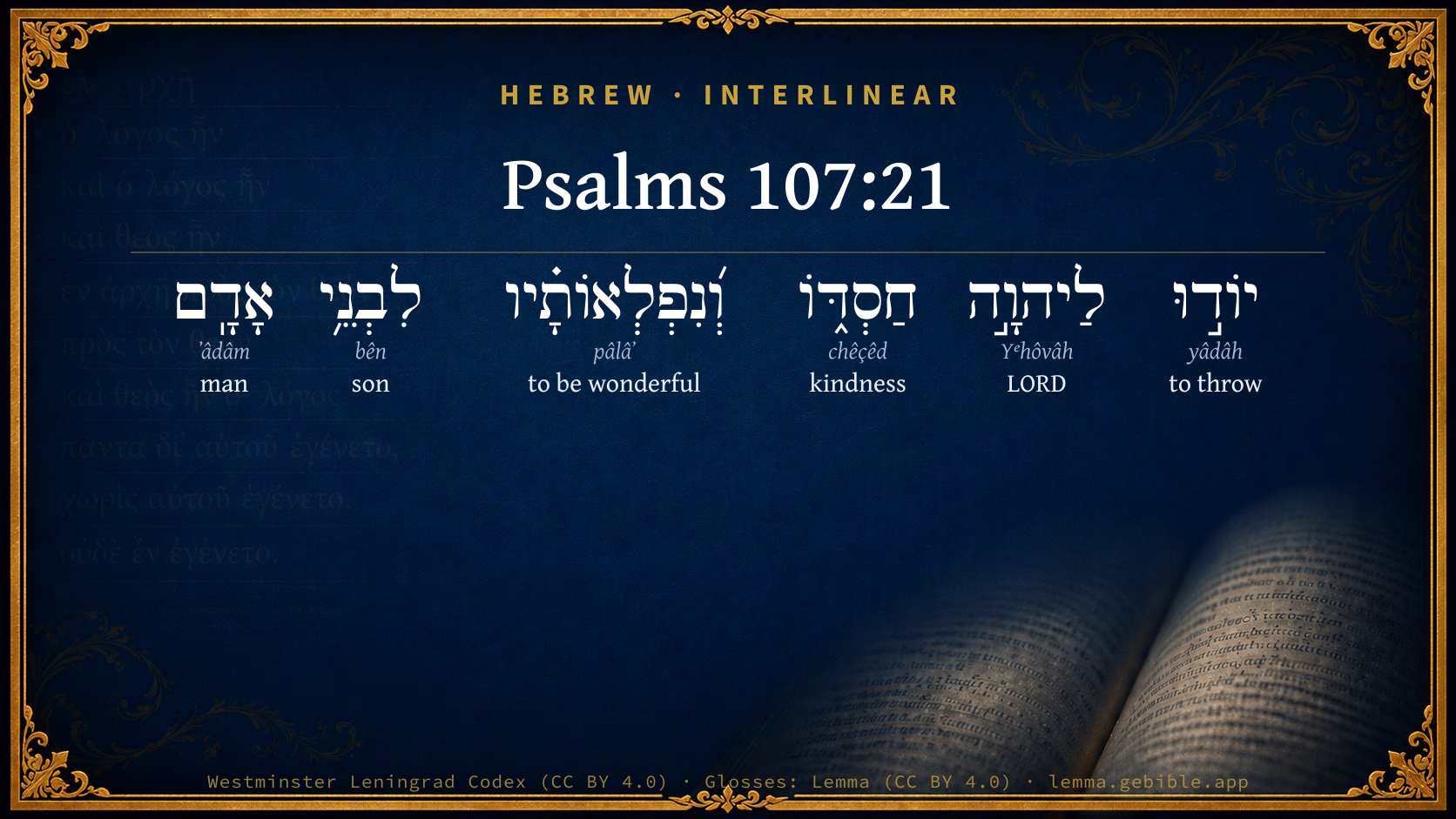
Psalms 107:21

Hebrew (Westminster Leningrad Codex) Psalms 107:21 appears in the Hebrew Old Testament. The text above is from the Westminster Leningrad Codex. Each word links to its Strong’s number, a concise gloss, and parsing drawn from the Open Scriptures Hebrew Bible morphology. Click any word for its full Brown-Driver-Briggs (BDB) entry.
Download image
Cite this verse

Psalms 107:21 (World English Bible). Public Domain. Lemma interlinear Bible study tool, https://lemma.gebible.app/v/psalms/107/21.

Show BibTeX & RIS
BibTeX
RIS
English Translation
Let them praise Yahweh for his loving kindness, For his wonderful works to the children of men!
World English Bible · Public Domain
Download a study sheet

One document with this verse’s original text, its word-by-word gloss line, the meaning frame, cross-references with their text, attributed commentary, and full source and license credits — printable, and it pastes into notes with its structure intact.

This verse Autodidact and up

Study sheet (.html) Plain text (.txt)

A passage Seminary Student

Up to 50 verses in one chapter. A passage sheet keeps up to 6 commentary sources and 12 cross-references per verse, in the order this page ranks them, and says so on the sheet whenever that leaves anything out. Ask for a single verse and you get the Autodidact verse sheet above.

Everything on this page stays free to read, with no account — the sheet is a download of what is already on screen, not access to it.

Want to remove ads? Support Godless Engineer
Compare translations 3

The same verse in 3 English versions, stacked beneath the original-language interlinear above. Click any original word for its lexicon entry.

Each is an independent rendering of the whole verse — the interlinear is not word-aligned to these translations.

Highlighted words mark where these versions differ — a whole-verse word diff, not a word-by-word alignment.

  • World English Bible Public Domain
    Let them praise Yahweh for his loving kindness, For his wonderful works to the children of men!
  • King James Version Public Domain
    Oh that men would praise the LORD for his goodness, and for his wonderful works to the children of men!
  • unfoldingWord Literal Text CC BY-SA 4.0
    May they thank Yahweh his covenant faithfulness and his amazing deeds for the sons of man!

unfoldingWord Literal Text — © unfoldingWord, licensed CC BY-SA 4.0. Word-aligned USFM3 via Door43 (git.door43.org/unfoldingWord/en_ult).

Versions to compare (up to 4)

3 of 4 selected

Show all 18 translations

Every available English version of this verse, each an independent rendering of the whole verse.

  • World English Bible Public Domain
    Let them praise Yahweh for his loving kindness, For his wonderful works to the children of men!
  • Berean Standard Bible Public Domain
    Let them give thanks to the LORD for His loving devotion and His wonders to the sons of men.
  • Majority Standard Bible Public Domain
    Let them give thanks to the LORD for His loving devotion and His wonders to the sons of men.
  • King James Version Public Domain
    Oh that men would praise the LORD for his goodness, and for his wonderful works to the children of men!
  • American Standard Version (1901) Public Domain
    Oh that men would praise Jehovah for his lovingkindness, And for his wonderful works to the children of men!
  • Revised Version (1885) Public Domain
    Oh that men would praise the LORD for his goodness, and for his wonderful works to the children of men!
  • Geneva Bible (1599) Public Domain
    Let them therefore cofesse before the Lord his louing kindnesse, and his wonderful workes before the sonnes of men,
  • Douay-Rheims (1899) Public Domain
    Let the mercies of the Lord give glory to him: and his wonderful works to the children of men.
  • Young's Literal Translation Public Domain
    They confess to Jehovah His kindness, And His wonders to the sons of men,
  • Literal Standard Version CC BY-SA 4.0
    They confess to YHWH His kindness, || And His wonders to the sons of men,
  • Unlocked Literal Bible CC BY-SA 4.0
    Oh that people would praise Yahweh for his covenant faithfulness and for the amazing things he has done for humanity!
  • unfoldingWord Literal Text CC BY-SA 4.0
    May they thank Yahweh his covenant faithfulness and his amazing deeds for the sons of man!
  • Darby Bible Public Domain
    Let them give thanks unto Jehovah for his loving-kindness, and for his wondrous works to the children of men,
  • World Messianic Bible Public Domain
    Let them praise the LORD for his loving kindness, for his wonderful deeds to the children of men!
  • Webster's Bible Public Domain
    Oh that men would praise the LORD for his goodness, and for his wonderful works to the children of men!
  • Free Bible Version CC BY-SA 4.0
    Let them praise the Lord for his trustworthy love, and for all the wonderful things he does for people.
  • Bible in Basic English Public Domain
    Let men give praise to the Lord for his mercy, and for the wonders which he does for the children of men!
  • JPS Tanakh (1917) Public Domain
    Let them give thanks unto the LORD for His mercy, and for His wonderful works to the children of men!

Literal Standard Version (2020), Covenant Press — licensed CC BY-SA 4.0. Text via the HelloAO Bible API (eBible.org). Unlocked Literal Bible (unfoldingWord) — licensed CC BY-SA 4.0. Text via the HelloAO Bible API (eBible.org). unfoldingWord Literal Text — © unfoldingWord, licensed CC BY-SA 4.0. Word-aligned USFM3 via Door43 (git.door43.org/unfoldingWord/en_ult). Free Bible Version, Dr. Jonathan Gallagher — licensed CC BY-SA 4.0. Text via the HelloAO Bible API (eBible.org).

Word by word

More ways to search: Search by grammar → Find every occurrence → Compare this word →

Practice this passage: Drill this verse → Learn its vocabulary →

וְ֝נִפְלְאוֹתָ֗יו
pâlâʼ
H6381
“and · being wonderful · him”
Conjunction + Verb, Niphal, Participle Active, Feminine, Plural, Construct + Suffix, Personal, 3rd Person, Masculine, Singular
Part of Speech
Conjunction + Verb
Stem
Niphal
Form
Participle Active
Gender
Feminine
Number
Plural
State
Construct
Full BDB Definition

Origin: a primitive root

TWOT: 1768

to be marvellous, be wonderful, be surpassing, be extraordinary, separate by distinguishing action - (Niphal) - to be beyond one's power, be difficult to do - to be difficult to understand - to be wonderful, be extraordinary - marvellous (participle) - (Piel) to separate (an offering) - (Hiphil) - to do extraordinary or hard or difficult thing - to make wonderful, do wondrously - (Hithpael) to show oneself wonderful or marvellous
  1. יוֹד֣וּ yâdâh H3034 “to throw” Verb, Hiphil, Jussive, 3rd Person, Masculine, Plural
  2. לַיהוָ֣ה Yᵉhôvâh H3068 “to/for · LORD” Preposition + Noun, Proper
  3. חַסְדּ֑וֹ chêçêd H2617 “kindness · his” Noun, Common, Masculine, Singular, Construct + Suffix, Personal, 3rd Person, Masculine, Singular
  4. לִבְנֵ֥י bên H1121 “to/for · sons of” Preposition + Noun, Common, Masculine, Plural, Construct
  5. אָדָֽם ʼâdâm H120 “man” Noun, Common, Masculine, Singular, Absolute

About this verse

These counts appear in no published source. They are computed here, from the morphology-tagged text and Lemma’s own curated glosses. What Lemma adds →

6
words
6
distinct lemmas
Wisdom
section

Grammatical profile

  • 2 verbs
  • 4 nouns

Verb forms

  • יוֹד֣וּ Hiphil · Jussive
  • וְ֝נִפְלְאוֹתָ֗יו Niphal · Participle Active

Hebrew & Septuagint length

In English translation the verse runs 17 words from the Hebrew and 17 from the Septuagint (LXX English) — the same length.

A rough comparison of the two English renderings, which tokenize alike — not a word-level alignment.

Word counts can differ between the Hebrew and the Greek without any difference in meaning — e.g. the Hebrew direct-object marker אֵת has no separate Greek word, and Greek often adds the article ὁ.

Cross-references

6

Topical passages linked to Psalms 107:21 in the Treasury of Scripture Knowledge — connected by theme and wording, ordered by reader-vote popularity; previews shown in the World English Bible.

  • Psalms 107:8 Let them praise Yahweh for his loving kindness, For his wonderful works to the children of men!
  • 2 Chronicles 32:25 But Hezekiah didn't render again according to the benefit done to him; for his heart was lifted up: therefore there was wrath on him, and on Judah and Jerusalem.
  • Psalms 66:5 Come, and see God's deeds-- Awesome work on behalf of the children of men.
  • Psalms 107:15 Let them praise Yahweh for his loving kindness, For his wonderful works to the children of men!
  • Psalms 107:31 Let them praise Yahweh for his loving kindness, For his wonderful works for the children of men!
  • Luke 17:18 Were there none found who returned to give glory to God, except this stranger?"

Cross-references courtesy of OpenBible.info (CC BY 4.0).

Hebrew and Greek witnesses Masoretic Hebrew ↔ Greek Septuagint

The same verse in the two great witnesses to the Old Testament, shown verse-for-verse.

You’re reading Greek Psalm 106 (Hebrew Psalm 107). The Septuagint counts the superscription, so verse numbers can differ from the Hebrew — chapter-level alignment, not verse-by-verse. Numbering follows Rahlfs.

These are two independent witnesses, not word-aligned to each other, and the Septuagint is shown in lemma (dictionary) form.

Hebrew Psalms 107:21 Masoretic · Westminster Leningrad Codex

יוֹד֣וּ לַיהוָ֣ה חַסְדּ֑וֹ וְ֝נִפְלְאוֹתָ֗יו לִבְנֵ֥י אָדָֽם

Let them praise Yahweh for his loving kindness, For his wonderful works to the children of men!

World English Bible · Public Domain

Greek LXX Greek Psalm 106:21 Septuagint · lemma form

ἐκὁμολογέω ὁ κύριος ὁ ἔλεος αὐτός καί ὁ θαυμάσιος αὐτός ὁ υἱός ὁ ἄνθρωπος

Let them acknowledge to the Lord his mercies, and his wonderful works to the children of men.

LXX2012 (modern English Septuagint) · Public Domain

Hebrew: Westminster Leningrad Codex (CC BY 4.0). Greek: Septuagint (public domain); English from LXX2012 (modern English Septuagint) (Public Domain). How the Septuagint differs from the Hebrew →

Commentary

Notes on Psalms 107:21 from classic Christian and Jewish commentators (each source and its license shown beneath its notes). The classic Christian expositions comment on the surrounding passage and are grouped to its opening verse, so a note may address several verses; the Jewish commentaries on the Tanakh (Rashi and others) are per-verse, so they appear only where the commentator wrote on this verse.

Lemma curates 59 commentaries, every one of them public domain or Creative Commons licensed, each selected and text-cleaned for this edition rather than reprinted as found. About our sources →

Trapp's Complete Commentary

John Trapp

Psa 107:21 Oh that [men] would praise the LORD [for] his goodness, and [for] his wonderful works to the children of men!

Ver. 21. Oh that men, &c.] See Psa 107:8.

And for his wonderful works] Men are misericordiis et miraculis obsesse, and it were no hard matter to find a miracle in most of our mercies.

John Trapp, A Commentary or Exposition upon All the Books of the Old and New Testament (1647–1656) — public domain. Text from a community e-Sword module.

J. A. Alexander on Psalms

Joseph Addison Alexander

21, 22. (Psa 107:21-22) Let (such) give thanks unto Jehovah, (for) his mercy and his wonderful works to tke sons of man; and let them sacrifice sacrifices of thanksgiving, and recount his deeds with (joyful) singing. The freedom from technical and artificial rules of rhetoric or versification, even in those parts of the composition which exhibit most of art and skill, is peculiarly observable in this verse, where, instead of adding to the uniform chorus or refrain some particular image from the scene just closing, as in Psa 107:9; Psa 107:16, the Psalmist continues and completes the sentence by repeating the exhortation to give thanks, in another but still figurative form, derived from the musical and sacrificial customs of the temple worship. They must not only utter thanks but offer them in sacrifice. They must not only offer them in sacrifice, but sing them. With the first clause compare Psa 50:14.

Joseph Addison Alexander, The Psalms Translated and Explained (1850) — public domain. Text from a community e-Sword module.

Adam Clarke's Commentary

Verse 21. O that men, &c.] The intercalary verse, or burden, as before.

Adam Clarke's Commentary on the Bible (1810–1826) — public domain. Text from a community e-Sword/MySword module.

The Cambridge Bible for Schools and Colleges

gen. ed. J. J. S. Perowne

21, 22. Let them give thanks to Jehovah for his lovingkindness,

And for his wonderful works to the sons of men:

And let them offer sacrifices of thanksgiving,

And tell of his works with glad singing.

Here and in Psa_107:32 the call to thanksgiving is amplified, instead of a reason for it being assigned as in Psa_107:9; Psa_107:16. Cp. Jer_33:11.

The Cambridge Bible for Schools and Colleges (gen. ed. J. J. S. Perowne; Cambridge University Press, 1878–1918) — public domain. Text from a community e-Sword module.

John Gill's Exposition

These see the works of the Lord,.... In creation, the sea itself, its flux and reflux; the creatures in it, fishes of various forms and sizes: and in providence, in preserving ships and men in the most imminent danger, and even to a miracle; sometimes causing the wind to change or to subside in a moment, whereby deliverance is wrought.

And his wonders in the deep; the strange and wonderful creatures that are in the deep waters of the sea, and to be seen nowhere else; and the amazing appearances of divine providence, in delivering when in the greatest distress, and none at hand to help, and all hope of salvation gone.

John Gill's Exposition of the Whole Bible (1746–1763) — public domain (CC PDM 1.0). Text via the HelloAO Bible API.

Albert Barnes' Notes on the Bible

Oh that men... - See the notes at Psa 107:8. Who can help joining in this wish, that those who have been restored from sickness, who have been raised up from the borders of the grave, “would” praise God for it! Who can help wishing that they had the feelings of Hezekiah when he was saved from the sickness which threatened his life - saved by the direct and manifest interposition of God - when he said Isa 38:20, “The Lord was ready to save me: therefore we will sing my songs to the stringed instruments, all the days of our life in the house of the Lord!” Who can help wishing that people everywhere would see in such interpositions the proof of the benevolence of God, and would thank him that he has not forgotten guilty and suffering people!

Albert Barnes' Notes on the Bible (1834–1885) — public domain. Text from a community e-Sword/MySword module.

The Treasury of David

Charles H. Spurgeon

Ver. 21. Oh that men would praise the Lord for his goodness, and for his wonderful works to the children of men. It is marvellous that men can be restored from sickness and yet refuse to bless the Lord. It would seem impossible that they should forget such great mercy, for we should expect to see both themselves and the friends to whom they are restored uniting in a lifelong act of thanksgiving. Yet when ten are healed it is seldom that more than one returns to give glory to God. Alas, where are the nine? When a spiritual cure is wrought by the great Physician, praise is one of the surest signs of renewed health. A mind rescued from the disease of sin and the weary pains of conviction, must and will adore Jehovah Rophi, the healing God: yet it were well if there were a thousand times as much even of this.

Psalms 107:22*

Charles H. Spurgeon's The Treasury of David (1869–1885) — public domain. Psalms only. Text from a community e-Sword/MySword module.

The Pulpit Commentary

Oh that men, etc.! A repetition of vers. 8 and 15.

The Pulpit Commentary (1880–1919), ed. H.D.M. Spence-Jones & Joseph S. Exell — public domain. Text from a community e-Sword module.

Lesson kit

Teaching starters — assembled from the data on this page, not authored interpretation. Every prompt links to the verse data it draws on. Edit before teaching.

Psalms, in the Wisdom, opens this verse with 6 words (6 distinct Hebrew lemmas). Its most distinctive word is pâlâʼ (“to be wonderful”). A historical commentator’s framing appears above. Read the whole chapter for the surrounding context.

Discussion questions

  1. The word pâlâʼ carries the sense “to be wonderful.” How does it shape the verse?
  2. How does Psalms 107:8, which shares this passage’s theme, read alongside this verse?
  3. These translations render this verse differently; the difference is in the English rendering, not the original. What questions does that raise?
  4. «יוֹד֣וּ» is a Hiphil Jussive verb. How does that grammatical form shape the action described?
  5. Compare how Trapp's Complete Commentary and J. A. Alexander on Psalms read this verse. Where do they agree or differ?

Things to notice

Reading settings

Reading text

Shown beneath each verse's original-language words.

Old Testament
Old Testament edition

Read the OT as the Masoretic Hebrew (MT) or the Greek Septuagint (LXX).

English shown for the Greek Septuagint (in the Hebrew ↔ Greek comparison).

Comparing translations? Open the Compare panel on any verse page to stack up to four side by side.