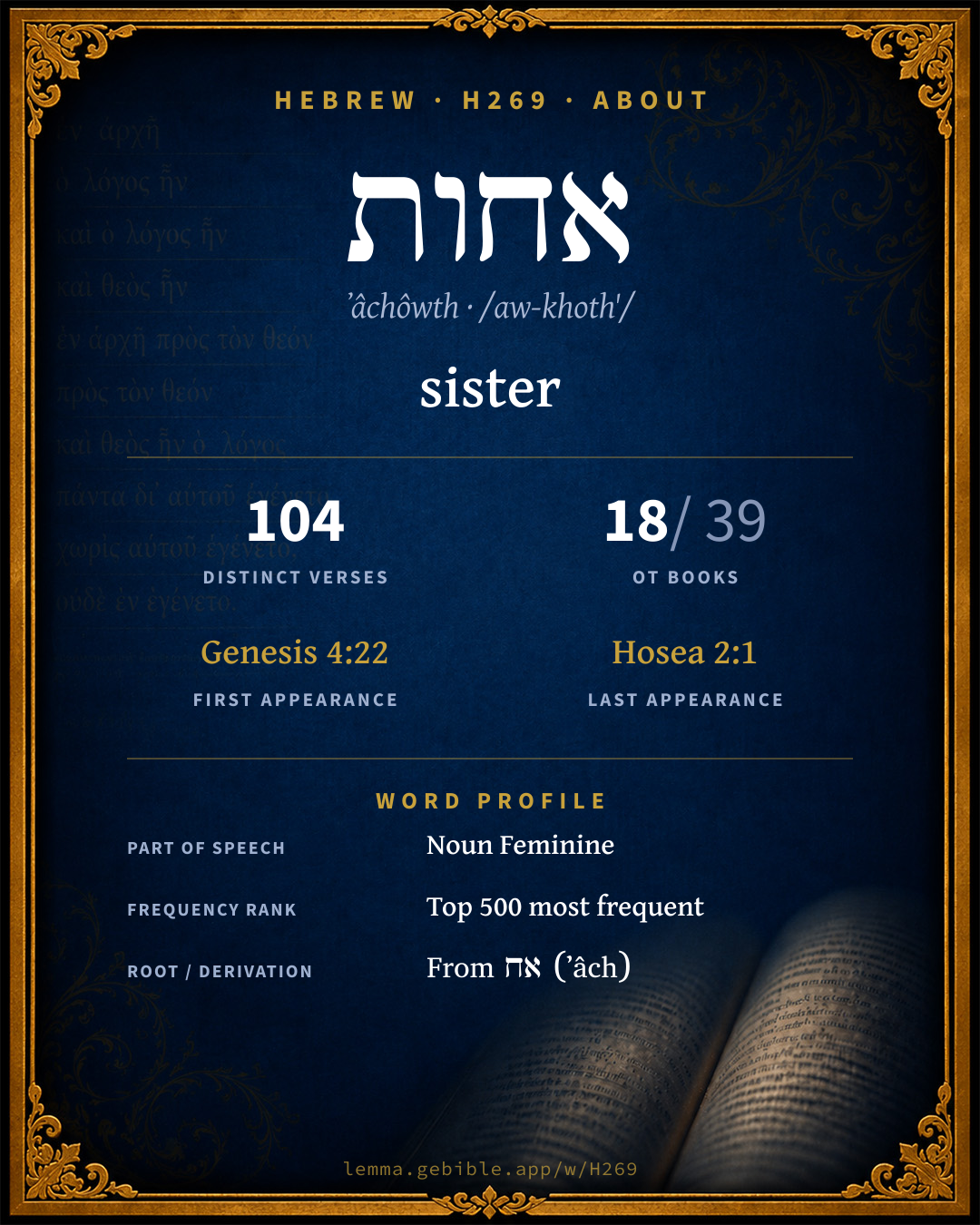
אָחוֹת
sister
‘sister’ is one of 7 main senses fuller range ↓
Full lexicon entry — Brown-Driver-Briggs (BDB)
From Brown-Driver-Briggs (BDB)
Where this word appears
See every Construct-state word in the Hebrew Bible →
Grammar key — what these labels mean
Part of speech
- Noun
- A naming word — a person, place, thing, or idea.
Noun type
- Common
- A common noun — a general class of person, place, or thing (“king,” “city,” “water”), not a specific name.
State
- Construct
- A noun bound to a following noun in a possessive / “of” relationship (the construct chain).
- Absolute
- The independent form of a noun, not bound to a following word.
Gender
- Feminine
- Grammatically feminine.
Number
- Singular
- One.
- Plural
- More than one (in Hebrew, generally three or more).
Grammatical forms
- Noun, Common, Feminine, Singular, Construct 103 times (87%)
- Noun, Common, Feminine, Plural, Construct 12 times (10%)
- Noun, Common, Feminine, Singular, Absolute 4 times (3%)
Parsed forms decoded from the imported morphology (morphhb / Westminster Leningrad Codex — WLC text public domain, morphhb tagging CC BY 4.0), counted across 119 parsed occurrences — not distinct verses.
Every verse where H269 appears — 104 distinct verses across 18 books. Click any verse to open its interlinear word-by-word view. Verse text shown in the World English Bible for context — . Each verse’s Hebrew form is shown with its reference; the English is not keyword-highlighted, since the data carries no word-level English alignment. Use “Compare translations” on any verse to read it across multiple English versions. This concordance covers the Hebrew Bible; Septuagint (Greek Old Testament) occurrences are not indexed here.
Genesis 23 verses
- Genesis 4:22 וַֽ/אֲח֥וֹת conj + n c fs cs Zillah also gave birth to Tubal Cain, the forger of every cutting instrument of brass and iron. Tubal Cain's sister was Naamah.
- Genesis 12:13 אֲחֹ֣תִ/י n c fs cs + sfx pers 1cs Please say that you are my sister, that it may be well with me for your sake, and that my soul may live because of you."
- Genesis 12:19 אֲחֹ֣תִ/י n c fs cs + sfx pers 1cs Why did you say, 'She is my sister,' so that I took her to be my wife? Now therefore, see your wife, take her, and go your way."
- Genesis 20:2 אֲחֹ֣תִ/י n c fs cs + sfx pers 1cs Abraham said about Sarah his wife, "She is my sister." Abimelech king of Gerar sent, and took Sarah.
- Genesis 20:5 אֲחֹ֣תִ/י n c fs cs + sfx pers 1cs Didn't he tell me, 'She is my sister?' She, even she herself said, 'He is my brother.' In the integrity of my heart and the innocence of my hands have I done this."
- Genesis 20:12 אֲחֹתִ֤/י n c fs cs + sfx pers 1cs Moreover she is indeed my sister, the daughter of my father, but not the daughter of my mother; and she became my wife.
- Genesis 24:30 אֲחֹת/וֹ֒ אֲחֹת/וֹ֙ n c fs cs + sfx pers 3ms n c fs cs + sfx pers 3ms It happened, when he saw the ring, and the bracelets on his sister's hands, and when he heard the words of Rebekah his sister, saying, "This is what the man said to me," that he came to the man. Behold, he was standing by the camels at the spring.
- Genesis 24:59 אֲחֹתָ֖/ם n c fs cs + sfx pers 3mp They sent away Rebekah, their sister, with her nurse, Abraham's servant, and his men.
- Genesis 24:60 אֲחֹתֵ֕/נוּ n c fs cs + sfx pers 1cp They blessed Rebekah, and said to her, "Our sister, may you be the mother of thousands of ten thousands, and let your seed possess the gate of those who hate them."
- Genesis 25:20 אֲח֛וֹת n c fs cs Isaac was forty years old when he took Rebekah, the daughter of Bethuel the Syrian of Paddan Aram, the sister of Laban the Syrian, to be his wife.
- Genesis 26:7 אֲחֹ֣תִ/י n c fs cs + sfx pers 1cs The men of the place asked him about his wife. He said, "She is my sister," for he was afraid to say, "My wife," lest, he thought, the men of the place might kill me for Rebekah, because she was beautiful to look on.
- Genesis 26:9 אֲחֹ֣תִ/י n c fs cs + sfx pers 1cs Abimelech called Isaac, and said, "Behold, surely she is your wife. Why did you say, 'She is my sister?'" Isaac said to him, "Because I said, 'Lest I die because of her.'"
- Genesis 28:9 אֲח֧וֹת n c fs cs Esau went to Ishmael, and took, besides the wives that he had, Mahalath the daughter of Ishmael, Abraham's son, the sister of Nebaioth, to be his wife.
- Genesis 29:13 אֲחֹת֗/וֹ n c fs cs + sfx pers 3ms It happened, when Laban heard the news of Jacob, his sister's son, that he ran to meet Jacob, and embraced him, and kissed him, and brought him to his house. Jacob told Laban all these things.
- Genesis 30:1 בַּ/אֲחֹתָ֑/הּ prep + n c fs cs + sfx pers 3fs When Rachel saw that she bore Jacob no children, Rachel envied her sister. She said to Jacob, "Give me children, or else I will die."
- Genesis 30:8 אֲחֹתִ֖/י n c fs cs + sfx pers 1cs Rachel said, "With mighty wrestlings have I wrestled with my sister, and have prevailed." She named him Naphtali.
- Genesis 34:13 אֲחֹתָֽ/ם n c fs cs + sfx pers 3mp The sons of Jacob answered Shechem and Hamor his father with deceit, and spoke, because he had defiled Dinah their sister,
- Genesis 34:14 אֲחֹתֵ֔/נוּ n c fs cs + sfx pers 1cp and said to them, "We can't do this thing, to give our sister to one who is uncircumcised; for that is a reproach to us.
- Genesis 34:27 אֲחוֹתָֽ/ם n c fs cs + sfx pers 3mp Jacob's sons came on the dead, and plundered the city, because they had defiled their sister.
- Genesis 34:31 אֲחוֹתֵֽ/נוּ n c fs cs + sfx pers 1cp They said, "Should he deal with our sister as with a prostitute?"
- Genesis 36:3 אֲח֥וֹת n c fs cs and Basemath, Ishmael's daughter, sister of Nebaioth.
- Genesis 36:22 וַ/אֲח֥וֹת conj + n c fs cs The children of Lotan were Hori and Heman. Lotan's sister was Timna.
- Genesis 46:17 אֲחֹתָ֑/ם n c fs cs + sfx pers 3mp The sons of Asher: Imnah, Ishvah, Ishvi, Beriah, and Serah their sister. The sons of Beriah: Heber and Malchiel.
Exodus 8 verses
- Exodus 2:4 אֲחֹת֖/וֹ n c fs cs + sfx pers 3ms His sister stood far off, to see what would be done to him.
- Exodus 2:7 אֲחֹת/וֹ֮ n c fs cs + sfx pers 3ms Then his sister said to Pharaoh's daughter, "Should I go and call a nurse for you from the Hebrew women, that she may nurse the child for you?"
- Exodus 6:23 אֲח֥וֹת n c fs cs Aaron took Elisheba, the daughter of Amminadab, the sister of Nahshon, as his wife; and she bore him Nadab and Abihu, Eleazar and Ithamar.
- Exodus 15:20 אֲח֧וֹת n c fs cs Miriam the prophetess, the sister of Aaron, took a tambourine in her hand; and all the women went out after her with tambourines and with dances.
- Exodus 26:3 אֲחֹתָ֑/הּ אֲחֹתָֽ/הּ n c fs cs + sfx pers 3fs n c fs cs + sfx pers 3fs Five curtains shall be coupled together one to another; and the other five curtains shall be coupled one to another.
- Exodus 26:5 אֲחֹתָֽ/הּ n c fs cs + sfx pers 3fs You shall make fifty loops in the one curtain, and you shall make fifty loops in the edge of the curtain that is in the second coupling. The loops shall be opposite one to another.
- Exodus 26:6 אֲחֹתָ/הּ֙ n c fs cs + sfx pers 3fs You shall make fifty clasps of gold, and couple the curtains one to another with the clasps: and the tent shall be a unit.
- Exodus 26:17 אֲחֹתָ֑/הּ n c fs cs + sfx pers 3fs There shall be two tenons in each board, joined to one another: thus shall you make for all the boards of the tent.
Leviticus 8 verses
- Leviticus 18:9 אֲחֽוֹתְ/ךָ֤ n c fs cs + sfx pers 2ms "'You shall not uncover the nakedness of your sister, the daughter of your father, or the daughter of your mother, whether born at home, or born abroad.
- Leviticus 18:11 אֲחוֹתְ/ךָ֖ n c fs cs + sfx pers 2ms "'You shall not uncover the nakedness of your father's wife's daughter, conceived by your father, since she is your sister. "'
- Leviticus 18:12 אֲחוֹת n c fs cs You shall not uncover the nakedness of your father's sister: she is your father's near kinswoman.
- Leviticus 18:13 אֲחֽוֹת n c fs cs "'You shall not uncover the nakedness of your mother's sister: for she is your mother's near kinswoman.
- Leviticus 18:18 אֲחֹתָ֖/הּ n c fs cs + sfx pers 3fs "'You shall not take a wife to her sister, to be a rival, to uncover her nakedness, while her sister is yet alive.
- Leviticus 20:17 אֲחֹת֡/וֹ אֲחֹת֛/וֹ n c fs cs + sfx pers 3ms n c fs cs + sfx pers 3ms "'If a man takes his sister, his father's daughter, or his mother's daughter, and sees her nakedness, and she sees his nakedness; it is a shameful thing; and they shall be cut off in the sight of the children of their people: he has uncovered his sister's nakedness; he shall bear his iniquity.
- Leviticus 20:19 אֲח֧וֹת וַ/אֲח֥וֹת n c fs cs conj + n c fs cs "'You shall not uncover the nakedness of your mother's sister, nor of your father's sister; for he has made naked his close relative: they shall bear their iniquity.
- Leviticus 21:3 וְ/לַ/אֲחֹת֤/וֹ conj + prep + n c fs cs + sfx pers 3ms and for his virgin sister who is near to him, who has had no husband; for her he may defile himself.
Numbers 3 verses
- Numbers 6:7 וּ/לְ/אַ֣חֹת֔/וֹ conj + prep + n c fs cs + sfx pers 3ms He shall not make himself unclean for his father, or for his mother, for his brother, or for his sister, when they die; because his separation to God is on his head.
- Numbers 25:18 אֲחֹתָ֔/ם n c fs cs + sfx pers 3mp for they vex you with their wiles, with which they have deceived you in the matter of Peor, and in the matter of Cozbi, the daughter of the prince of Midian, their sister, who was slain on the day of the plague in the matter of Peor.
- Numbers 26:59 אֲחֹתָֽ/ם n c fs cs + sfx pers 3mp The name of Amram's wife was Jochebed, the daughter of Levi, who was born to Levi in Egypt: and she bore to Amram Aaron and Moses, and Miriam their sister.
Deuteronomy 1 verse
Joshua 1 verse
Judges 1 verse
2 Samuel 10 verses
- 2 Samuel 13:1 אָח֥וֹת n c fs It happened after this, that Absalom the son of David had a beautiful sister, whose name was Tamar; and Amnon the son of David loved her.
- 2 Samuel 13:2 אֲחֹת֔/וֹ n c fs cs + sfx pers 3ms Amnon was so vexed that he fell sick because of his sister Tamar; for she was a virgin; and it seemed hard to Amnon to do anything to her.
- 2 Samuel 13:4 אֲח֛וֹת n c fs cs He said to him, Why, son of the king, are you thus lean from day to day? Won't you tell me? Amnon said to him, I love Tamar, my brother Absalom's sister.
- 2 Samuel 13:5 אֲחוֹתִ֜/י n c fs cs + sfx pers 1cs Jonadab said to him, Lay you down on your bed, and feign yourself sick: and when your father comes to see you, tell him, Please let my sister Tamar come and give me bread to eat, and dress the food in my sight, that I may see it, and eat it from her hand.
- 2 Samuel 13:6 אֲחֹתִ֗/י n c fs cs + sfx pers 1cs So Amnon lay down, and feigned himself sick: and when the king was come to see him, Amnon said to the king, Please let her sister Tamar come, and make me a couple of cakes in my sight, that I may eat from her hand.
- 2 Samuel 13:11 אֲחוֹתִֽ/י n c fs cs + sfx pers 1cs When she had brought them near to him to eat, he took hold of her, and said to her, Come, lie with me, my sister.
- 2 Samuel 13:20 אֲחוֹתִ֤/י n c fs cs + sfx pers 1cs Absalom her brother said to her, Has Amnon your brother been with you? but now hold your peace, my sister: he is your brother; don't take this thing to heart. So Tamar remained desolate in her brother Absalom's house.
- 2 Samuel 13:22 אֲחֹתֽ/וֹ n c fs cs + sfx pers 3ms Absalom spoke to Amnon neither good nor bad; for Absalom hated Amnon, because he had forced his sister Tamar.
- 2 Samuel 13:32 אֲחֹתֽ/וֹ n c fs cs + sfx pers 3ms Jonadab, the son of Shimeah, David's brother, answered, Don't let my lord suppose that they have killed all the young men the king's sons; for Amnon only is dead; for by the appointment of Absalom this has been determined from the day that he forced his sister Tamar.
- 2 Samuel 17:25 אֲח֥וֹת n c fs cs Absalom set Amasa over the host instead of Joab. Now Amasa was the son of a man, whose name was Ithra the Israelite, who went in to Abigail the daughter of Nahash, sister to Zeruiah, Joab's mother.
1 Kings 2 verses
- 1 Kings 11:19 אֲח֣וֹת אֲח֖וֹת n c fs cs n c fs cs Hadad found great favor in the sight of Pharaoh, so that he gave him as wife the sister of his own wife, the sister of Tahpenes the queen.
- 1 Kings 11:20 אֲח֣וֹת n c fs cs The sister of Tahpenes bore him Genubath his son, whom Tahpenes weaned in Pharaoh's house; and Genubath was in Pharaoh's house among the sons of Pharaoh.
2 Kings 1 verse
1 Chronicles 10 verses
- 1 Chronicles 1:39 וַ/אֲח֥וֹת conj + n c fs cs The sons of Lotan: Hori, and Homam; and Timna was Lotan's sister.
- 1 Chronicles 2:16 ו/אחיתי/הם וְ/אַחְיוֹתֵי/הֶ֖ם conj + n c fp cs + sfx pers 3mp conj + n c fp cs + sfx pers 3mp and their sisters were Zeruiah and Abigail. The sons of Zeruiah: Abishai, and Joab, and Asahel, three.
- 1 Chronicles 3:9 אֲחוֹתָֽ/ם n c fs cs + sfx pers 3mp All these were the sons of David, besides the sons of the concubines; and Tamar was their sister.
- 1 Chronicles 3:19 אֲחוֹתָֽ/ם n c fs cs + sfx pers 3mp The sons of Pedaiah: Zerubbabel, and Shimei. The sons of Zerubbabel: Meshullam, and Hananiah; and Shelomith was their sister;
- 1 Chronicles 4:3 אֲחוֹתָ֖/ם n c fs cs + sfx pers 3mp These were [the sons of] the father of Etam: Jezreel, and Ishma, and Idbash; and the name of their sister was Hazzelelponi;
- 1 Chronicles 4:19 אֲח֣וֹת n c fs cs The sons of the wife of Hodiah, the sister of Naham, were the father of Keilah the Garmite, and Eshtemoa the Maacathite.
- 1 Chronicles 7:15 אֲחֹת/וֹ֙ n c fs cs + sfx pers 3ms and Machir took a wife of Huppim and Shuppim, whose sister's name was Maacah; and the name of the second was Zelophehad: and Zelophehad had daughters.
- 1 Chronicles 7:18 וַ/אֲחֹת֖/וֹ conj + n c fs cs + sfx pers 3ms His sister Hammolecheth bore Ishhod, and Abiezer, and Mahlah.
- 1 Chronicles 7:30 אֲחוֹתָֽ/ם n c fs cs + sfx pers 3mp The sons of Asher: Imnah, and Ishvah, and Ishvi, and Beriah, and Serah their sister.
- 1 Chronicles 7:32 אֲחוֹתָֽ/ם n c fs cs + sfx pers 3mp Heber became the father of Japhlet, and Shomer, and Hotham, and Shua their sister.
2 Chronicles 1 verse
Job 3 verses
- Job 1:4 אחיתי/הם אַחְיֽוֹתֵי/הֶ֔ם n c fp cs + sfx pers 3mp n c fp cs + sfx pers 3mp His sons went and held a feast in the house of each one on his birthday; and they sent and called for their three sisters to eat and to drink with them.
- Job 17:14 וַ֝/אֲחֹתִ֗/י conj + n c fs cs + sfx pers 1cs If I have said to corruption, 'You are my father;' To the worm, 'My mother,' and 'my sister;'
- Job 42:11 אחיתי/ו אַחְיוֹתָ֜י/ו n c fp cs + sfx pers 3ms n c fp cs + sfx pers 3ms Then came there to him all his brothers, and all his sisters, and all those who had been of his acquaintance before, and ate bread with him in his house. They comforted him, and consoled him concerning all the evil that Yahweh had brought on him. Everyone also gave him a piece of money, and everyone a ring of gold.
Proverbs 1 verse
Song of Solomon 6 verses
- Song of Solomon 4:9 אֲחֹתִ֣/י n c fs cs + sfx pers 1cs You have ravished my heart, my sister, my bride. You have ravished my heart with one of your eyes, With one chain of your neck.
- Song of Solomon 4:10 אֲחֹתִ֣/י n c fs cs + sfx pers 1cs How beautiful is your love, my sister, my bride! How much better is your love than wine! The fragrance of your perfumes than all manner of spices!
- Song of Solomon 4:12 אֲחֹתִ֣/י n c fs cs + sfx pers 1cs A locked up garden is my sister, my bride; A locked up spring, A sealed fountain.
- Song of Solomon 5:1 אֲחֹתִ֣/י n c fs cs + sfx pers 1cs I have come into my garden, my sister, my bride. I have gathered my myrrh with my spice; I have eaten my honeycomb with my honey; I have drunk my wine with my milk. Friends Eat, friends! Drink, yes, drink abundantly, beloved. Beloved
- Song of Solomon 5:2 אֲחֹתִ֤/י n c fs cs + sfx pers 1cs I was asleep, but my heart was awake. It is the voice of my beloved who knocks: Open to me, my sister, my love, my dove, my undefiled; For my head is filled with dew, My hair with the dampness of the night.
- Song of Solomon 8:8 אָח֥וֹת לַ/אֲחֹתֵ֔/נוּ n c fs prep + n c fs cs + sfx pers 1cp We have a little sister. She has no breasts. What shall we do for our sister In the day when she is to be spoken for?
Jeremiah 4 verses
- Jeremiah 3:7 אֲחוֹתָ֖/הּ n c fs cs + sfx pers 3fs I said after she had done all these things, She will return to me; but she didn't return: and her treacherous sister Judah saw it.
- Jeremiah 3:8 אֲחוֹתָ֔/הּ n c fs cs + sfx pers 3fs I saw, when, for this very cause that backsliding Israel had committed adultery, I had put her away and given her a bill of divorce, yet treacherous Judah, her sister, didn't fear; but she also went and played the prostitute.
- Jeremiah 3:10 אֲחוֹתָ֛/הּ n c fs cs + sfx pers 3fs Yet for all this her treacherous sister Judah has not returned to me with her whole heart, but only in pretense, says Yahweh.
- Jeremiah 22:18 אָח֑וֹת n c fs Therefore thus says Yahweh concerning Jehoiakim the son of Josiah, king of Judah: they shall not lament for him, [saying], Ah my brother! or, Ah sister! They shall not lament for him, [saying] Ah lord! or, Ah his glory!
Ezekiel 20 verses
- Ezekiel 1:9 אֲחוֹתָ֖/הּ n c fs cs + sfx pers 3fs their wings were joined one to another; they didn't turn when they went; they went everyone straight forward.
- Ezekiel 1:23 אֲחוֹתָ֑/הּ n c fs cs + sfx pers 3fs Under the expanse were their wings straight, the one toward the other: everyone had two which covered on this side, and every one had two which covered on that side, their bodies.
- Ezekiel 3:13 אֲחוֹתָ֔/הּ n c fs cs + sfx pers 3fs [I heard] the noise of the wings of the living creatures as they touched one another, and the noise of the wheels beside them, even the noise of a great rushing.
- Ezekiel 16:45 וַ/אֲח֨וֹת אֲחוֹתֵ֜/ךְ conj + n c fs cs n c fs cs + sfx pers 2fs You are the daughter of your mother, who loathes her husband and her children; and you are the sister of your sisters, who loathed their husbands and their children: your mother was a Hittite, and your father an Amorite.
- Ezekiel 16:46 וַ/אֲחוֹתֵ֨/ךְ וַ/אֲחוֹתֵ֞/ךְ conj + n c fs cs + sfx pers 2fs conj + n c fs cs + sfx pers 2fs Your elder sister is Samaria, who dwells at your left hand, she and her daughters; and your younger sister, who dwells at your right hand, is Sodom and her daughters.
- Ezekiel 16:48 אֲחוֹתֵ֔/ךְ n c fs cs + sfx pers 2fs As I live, says the Lord Yahweh, Sodom your sister has not done, she nor her daughters, as you have done, you and your daughters.
- Ezekiel 16:49 אֲחוֹתֵ֑/ךְ n c fs cs + sfx pers 2fs Behold, this was the iniquity of your sister Sodom: pride, fullness of bread, and prosperous ease was in her and in her daughters; neither did she strengthen the hand of the poor and needy.
- Ezekiel 16:51 אחות/ך אֲחוֹתַ֔יִ/ךְ n c fs cs + sfx pers 2fs n c fp cs + sfx pers 2fs Neither has Samaria committed half of your sins; but you have multiplied your abominations more than they, and have justified your sisters by all your abominations which you have done.
- Ezekiel 16:52 לַֽ/אֲחוֹתֵ֔/ךְ אַחְיוֹתֵֽ/ךְ prep + n c fs cs + sfx pers 2fs n c fp cs + sfx pers 2fs You also, bear you your own shame, in that you have given judgment for your sisters; through your sins that you have committed more abominable than they, they are more righteous that you: yes, be also confounded, and bear your shame, in that you have justified your sisters.
- Ezekiel 16:55 וַ/אֲחוֹתַ֗יִ/ךְ conj + n c fp cs + sfx pers 2fs Your sisters, Sodom and her daughters, shall return to their former estate; and Samaria and her daughters shall return to their former estate; and you and your daughters shall return to your former estate.
- Ezekiel 16:56 אֲחוֹתֵ֔/ךְ n c fs cs + sfx pers 2fs For your sister Sodom was not mentioned by your mouth in the day of your pride,
- Ezekiel 16:61 אֲחוֹתַ֨יִ/ךְ֙ n c fp cs + sfx pers 2fs Then shall you remember your ways, and be ashamed, when you shall receive your sisters, your elder [sisters] and your younger; and I will give them to you for daughters, but not by your covenant.
- Ezekiel 22:11 אֲחֹת֥/וֹ n c fs cs + sfx pers 3ms One has committed abomination with his neighbor's wife; and another has lewdly defiled his daughter-in-law; and another in you has humbled his sister, his father's daughter.
- Ezekiel 23:4 אֲחוֹתָ֔/הּ n c fs cs + sfx pers 3fs The names of them were Oholah the elder, and Oholibah her sister: and they became mine, and they bore sons and daughters. As for their names, Samaria is Oholah, and Jerusalem Oholibah.
- Ezekiel 23:11 אֲחוֹתָ֣/הּ אֲחוֹתָֽ/הּ n c fs cs + sfx pers 3fs n c fs cs + sfx pers 3fs Her sister Oholibah saw this, yet was she more corrupt in her doting than she, and in her prostitution which were more than the prostitution of her sister.
- Ezekiel 23:18 אֲחוֹתָֽ/הּ n c fs cs + sfx pers 3fs So she uncovered her prostitution, and uncovered her nakedness: then my soul was alienated from her, like as my soul was alienated from her sister.
- Ezekiel 23:31 אֲחוֹתֵ֖/ךְ n c fs cs + sfx pers 2fs You have walked in the way of your sister; therefore will I give her cup into your hand.
- Ezekiel 23:32 אֲחוֹתֵ/ךְ֙ n c fs cs + sfx pers 2fs Thus says the Lord Yahweh: You shall drink of your sister's cup, which is deep and large; you shall ridiculed and had in derision; it contains much.
- Ezekiel 23:33 אֲחוֹתֵ֥/ךְ n c fs cs + sfx pers 2fs You shall be filled with drunkenness and sorrow, with the cup of astonishment and desolation, with the cup of your sister Samaria.
- Ezekiel 44:25 וּ/לְ/אָח֛וֹת conj + prep + n c fs They shall go in to no dead person to defile themselves; but for father, or for mother, or for son, or for daughter, for brother, or for sister who has had no husband, they may defile themselves.
Hosea 1 verse
About this entry
At a glance — auto-summarized from this page’s data, not written by a person. Every figure links to its source below. This summary describes the numbers; it doesn’t interpret them.
The Hebrew noun אחות centers on the idea of “sister.” Its meaning spans more than one sense — see its full sense range. It appears 104 verses across 18 books of the Hebrew Bible, among its common vocabulary. Its earliest occurrence is Genesis 4:22. It clusters with אח, אח and אחוה under a shared root. For the data behind this summary, explore the sense tree and the renderings breakdown below.
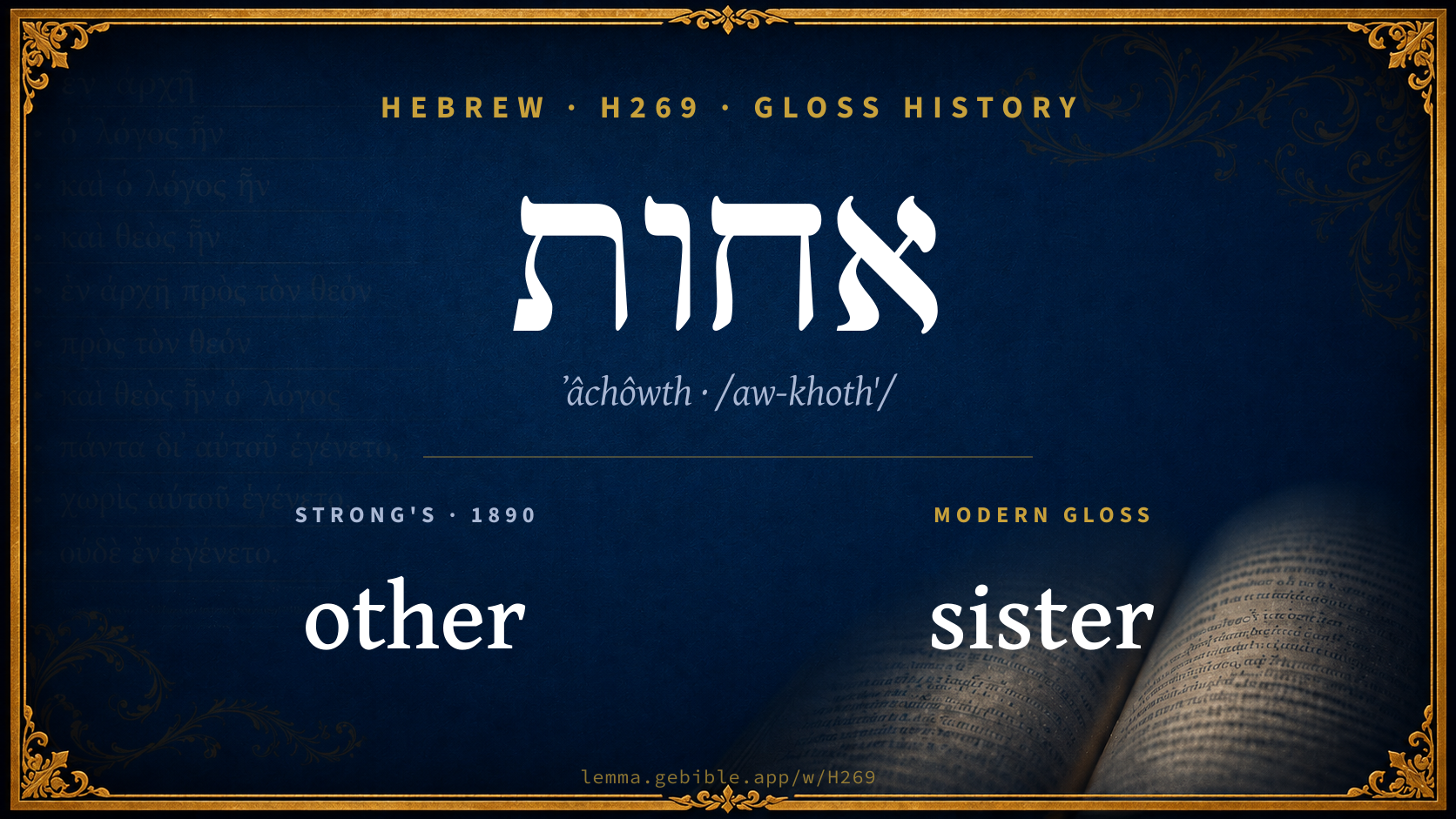
Gloss history
Strong's 1890 vs modern scholarship
About this word
Strong's H269 catalogs a Hebrew word from the Hebrew Old Testament.
These counts are not copied from any lexicon or concordance. They are computed here, from the morphology-tagged Hebrew Old Testament. What Lemma adds →
- 104
- distinct verses
- The word appears in 104 distinct verses.
- 18 / 39
- OT books
- The word appears in 18 of 39 Old Testament books.
- #363
- by frequency
- Top 500 most frequent Hebrew words (rank 363 of 8,640 Hebrew words by occurrence).
View all 104 occurrences in the concordance →
By section of the Old Testament
By traditional corpus
Conventional, traditional groupings — biblical authorship is debated, so this is a traditional corpus grouping, not an authorship claim. Each share is this word’s portion of its verses in that division of the Hebrew canon. Each figure is a share of the word’s 104 distinct verses.
- Torah (Pentateuch) 43 verses · 41%
- Prophets (Nevi'im) 40 verses · 38%
- Writings (Ketuvim) 21 verses · 20%
How translations render this word
Counts come from each version’s own published word-to-Strong’s tagging or interlinear alignment — an approximate guide to how each version renders this word, not a word-level alignment the data otherwise carries. Because each total is that version’s own tagged count, the per-version totals vary from one another and need not match the appearance or distinct-verse counts above. These counts may also differ from a printed concordance because Lemma counts each distinctly tagged rendering and does not collapse phrase taggings into a single head-word total. This is a fixed set of word-tagged versions (KJV, ASV, BSB, ULT) and does not change with the reading translation you choose elsewhere. Each version’s license is shown beside its name below (and on Sources).
- King James Version: Sister 73×, Sisters 10×, Another 5×
- American Standard Version: Sister 65×, Sisters 10×, 's sister 7×
- Berean Standard Bible: Sister 76×, Sisters 9×, Is my sister 5×
- unfoldingWord Literal Text: Sister 69×, Sister of 19×, Sisters 10×
King James Version Public Domain
Renders H269 across 113 tagged occurrences — most commonly:
Plus 12 renderings that appear only once — usually multi-word phrases or single function words the recovered tagging swept in, not distinct renderings. Not rendered by a distinct English word in 1 further occurrence.
American Standard Version Public Domain
Renders H269 across 113 tagged occurrences — most commonly:
Plus 17 renderings that appear only once — usually multi-word phrases or single function words the recovered tagging swept in, not distinct renderings.
Berean Standard Bible Public Domain
Renders H269 across 108 tagged occurrences — most commonly:
Plus 11 renderings that appear only once — usually multi-word phrases or single function words the recovered tagging swept in, not distinct renderings. Not rendered by a distinct English word in 6 further occurrences.
unfoldingWord Literal Text CC BY-SA 4.0
Renders H269 across 121 tagged occurrences — most commonly:
Plus 14 renderings that appear only once — usually multi-word phrases or single function words the recovered tagging swept in, not distinct renderings.
Senses in the full BDB
What do BDB’s symbols mean?
BDB uses these scholarly abbreviations:
| Symbol | Meaning |
|---|---|
| 𝔊 | the Septuagint (the ancient Greek translation, LXX) |
| 𝔙 | the Vulgate (the Latin translation) |
| 𝔖 | the Syriac version (the Peshitta) |
| 𝔗 | the Targum (the Aramaic translation) |
| ψ | the Psalms |
| √ | root (the underlying root or stem) |
| ‖ | parallel passage (a synonymous or contrasted parallel) |
| † | the dagger: every passage where the word occurs is cited |
The 5 senses and sub-senses the full Brown-Driver-Briggs lexicon distinguishes for this word, in lexicon order (not ranked by frequency), with BDB’s own verbatim wording and sub-sense lettering. Shown in Hebrew script with BDB’s own scholarly abbreviations. The condensed entry is in the Lexicon Entry tab. See also the Forms in the corpus table below.
- 1. sister Gn 4:22; 12:13, 19; 20:2, 5, 12 (same father, diff. mother) so Lv 18:11 cf. Ez 22:11; Gn 24:30(×2) +, Ex 2:4, 7; Lv 18:9 (either parent same) so Dt 27:22 Nu 6:7 2 S 13:1, 2, 4 +, Ct 8:8(×2); called upon, in mourning for dead Je 22:18; = near relative Gn 24:59, 60 (or because Laban prominent? so Di); woman of same nationality Nu 25:18 cf. Ho 2:3. e.g. Genesis 4:22
- 2. = beloved Ct 4:9, 10, 12; 5:1, 2 (4 times ‖ כַּלָּה bride; phr. orig. implying that marriage with half-sister—of same father—was allowed? cf. NöZMG 1886, 150, & Gn 20:12). e.g. Song of Solomon 4:9
- 3. symbol. of Judah, Samaria, Sodom & Jerusalem Je 3:7, 8, 10 Ez 16:45, 52,(×2) (del. Co) +, 23:4, 11 +. e.g. Jeremiah 3:7
- 4. fig. of intimate connection אִמִּי וַאֲחֹתִי לָרִמָּה … קָרָאתי Jb 17:14; אֱמֹר לַחָכְמָה אֲחֹתִי אַתְּ Pr 7:4. e.g. Job 17:14
- 5. another, אִשָּׁה אֶל־אֲחֹתָהּ, of curtains of tabern. Ex 26:3(×2), 6, loops v 5, tenons v 17; of wings of living creatures, Ezek.’s vision Ez 1:9, 23; 3:13; not of persons, but vid. רְעוּת. e.g. Exodus 26:3
Senses from the full Brown-Driver-Briggs lexicon (Brown, Driver, Briggs; Oxford 1906 — public domain), digitized via Sefaria, supplemented by the OpenScriptures HebrewLexicon (CC BY 4.0). Full attribution on Sources.
Word origin
n.f. sister (Ph. אחת, Aramaic אֲחָת, ܚܳܬܳܐ, Arabic أُخْتٌ, Assyrian aḫâtu, DlW Ethiopic እኅት Sab. in n.pr. אחֿתאמהו OsZMG 1865, 273)—abs. אָ׳ 2 S 13:1 + (never with art.); cstr. אֲחוֹת Gn 4:22 +; sf. אֲחֹתִי (אֲחוֹתִי) Gn 12:13 +, etc.; pl. sf. אַחְוֹתַי (Qr אַחְיוֹתַי) Jos 2:13; אֲחוֹתַיִךְ Ez 16:51 (Qr; Kt אחותך) + 2 times (Co all אחיו׳); אַחֲיוֹתֵךְ Ez 16:52 (Co ־תיך); אֲחוֹתֵךְ Ez 16:52 (must be pl., but del. Co); אַחְיֹתָיו Jb 42:11; אֲחוֹתֵיכֶם Ho 2:3; אַחְיֹתֵיהֶם 1 Ch 2:16 Jb 1:4—
— Brown-Driver-Briggs (Oxford 1906, public domain), digitized via Sefaria, supplemented by the OpenScriptures HebrewLexicon (CC BY 4.0). See Sources.
Derived from אח (ʼâch) (H251) — brother.
Jastrow Dictionary
A second Hebrew/Aramaic lexicon for comparison, covering Aramaic and post-biblical (Talmudic, Targumic, Midrashic) usage that the biblical-Hebrew BDB does not. Matched by lemma rather than by Strong’s number, so a lemma may carry more than one Jastrow headword (shown separately below), and the entries cover usage well beyond the Bible.
אָחוֹת
- , v. אָח I) sister. Yeb. I, 1; a. fr.—Ḥull. 114ᵃ (of animals).—Pl. אַחֲיוֹת. Yeb. III, 1; a. e.
A Dictionary of the Targumim, the Talmud Babli and Yerushalmi, and the Midrashic Literature (Marcus Jastrow; London, Luzac, 1903) — Public Domain. Digitized via Sefaria. Digitized via Sefaria. Full attribution on Sources.
Forms in the corpus
The 83 distinct written forms H269 takes in the Hebrew Bible, most frequent first — each parse links to that state’s occurrences in the concordance. Hebrew forms include their vowel points and cantillation, so a single lemma takes many written forms.
The 60 most common forms are shown; 23 rarer forms follow in the full concordance.
Same root — word family
Other BDB entries built from the same root as H269, grouped by Strong’s listed origin. These share a root / origin per the lexicon — not necessarily a shared meaning. Each links to that word’s own entry.
Derives from
Shares the same root
Proper names from this root
People and places named from this root — a name, not an additional meaning of the word.
- אחאב ʼAchʼâb H256 Ahab
- אחבן ʼAchbân H257 Ahban
- אחוח ʼĂchôwach H265 Ahoah
- אחומי ʼĂchûwmay H267 Ahumai
- אחי ʼĂchîy H277 Ahi
- אחיאם ʼĂchîyʼâm H279 Ahiam
- אחיה ʼĂchîyâh H281 Ahijah
- אחיהוד ʼĂchîyhûwd H282 Ahihud
- אחיו ʼAchyôw H283 Ahio
- אחיחד ʼĂchîychud H284 Ahihud
- אחיטוב ʼĂchîyṭûwb H285 Ahitub
- אחילוד ʼĂchîylûwd H286 Ahilud
- אחימות ʼĂchîymôwth H287 Ahimoth
- אחימלך ʼĂchîymelek H288 Ahimelech
- אחימן ʼĂchîyman H289 Ahiman
- אחימעץ ʼĂchîymaʻats H290 Ahimaaz
- אחין ʼAchyân H291 Ahian
- אחינדב ʼĂchîynâdâb H292 Ahinadab
- אחינעם ʼĂchîynôʻam H293 Ahinoam
- אחיסמך ʼĂchîyçâmâk H294 Ahisamach
- אחיעזר ʼĂchîyʻezer H295 Ahiezer
- אחיקם ʼĂchîyqâm H296 Ahikam
- אחירם ʼĂchîyrâm H297 Ahiram
- אחירע ʼĂchîyraʻ H299 Ahira
+3 more proper names from this root (not shown).
Compare all same-root words → Showing 4 of 31 — not the complete family. 27 of the same-root words are proper names (people or places). They share a root, not necessarily a meaning.
Septuagint verse parallels
This word appears in 104 verses that also exist in the Greek Old Testament (Septuagint), out of the 104 Hebrew verses it occurs in. You can read those verses in Greek by switching the Old Testament edition to the Septuagint.
Read these verses in the Septuagint
- Genesis 4:22
- Exodus 2:4
- Leviticus 18:9
- Numbers 6:7
- Deuteronomy 27:22
- Joshua 2:13
- Judges 15:2
- 2 Samuel 13:1
- 1 Kings 11:19
- 2 Kings 11:2
- 1 Chronicles 1:39
- 2 Chronicles 22:11
This is a verse-level parallel only — the same verses exist in both the Hebrew and Greek Old Testaments. No word-level Hebrew↔Greek correspondence is claimed: the data carries no such alignment, so no Greek word is shown as this Hebrew word’s translation. Coverage is not total — the Septuagint omits the deuterocanon and renumbers the Psalms, so some Hebrew verses have no direct Greek parallel.