Ezekiel 23:11

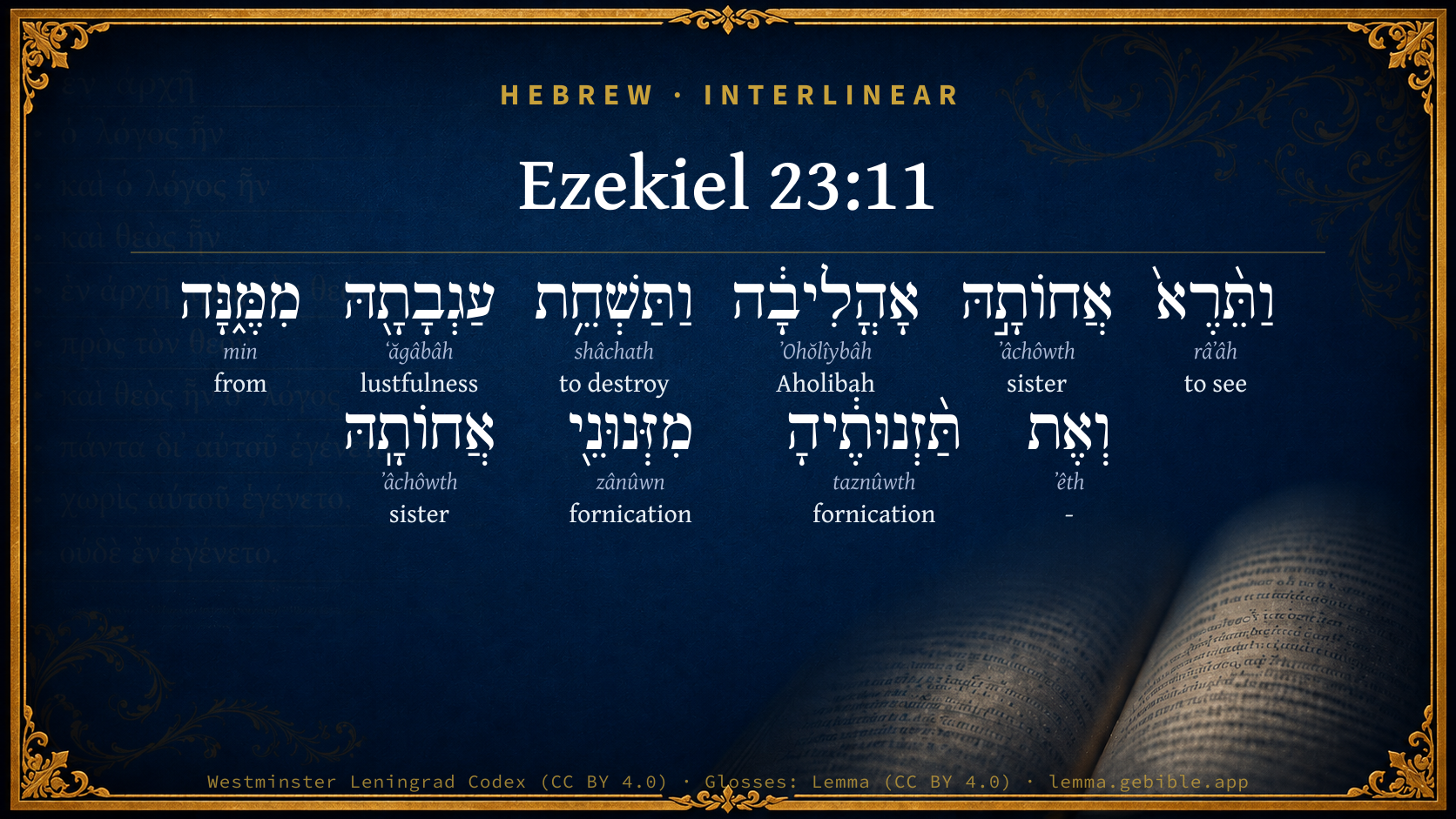
Hebrew (Westminster Leningrad Codex) Ezekiel 23:11 appears in the Hebrew Old Testament. The text above is from the Westminster Leningrad Codex. Each word links to its Strong’s number, a concise gloss, and parsing drawn from the Open Scriptures Hebrew Bible morphology. Click any word for its full Brown-Driver-Briggs (BDB) entry.
Download image
Cite this verse

Ezekiel 23:11 (World English Bible). Public Domain. Lemma interlinear Bible study tool, https://lemma.gebible.app/v/ezekiel/23/11.

Show BibTeX & RIS
BibTeX
RIS
English Translation
Her sister Oholibah saw this, yet was she more corrupt in her doting than she, and in her prostitution which were more than the prostitution of her sister.
World English Bible · Public Domain
Highlights
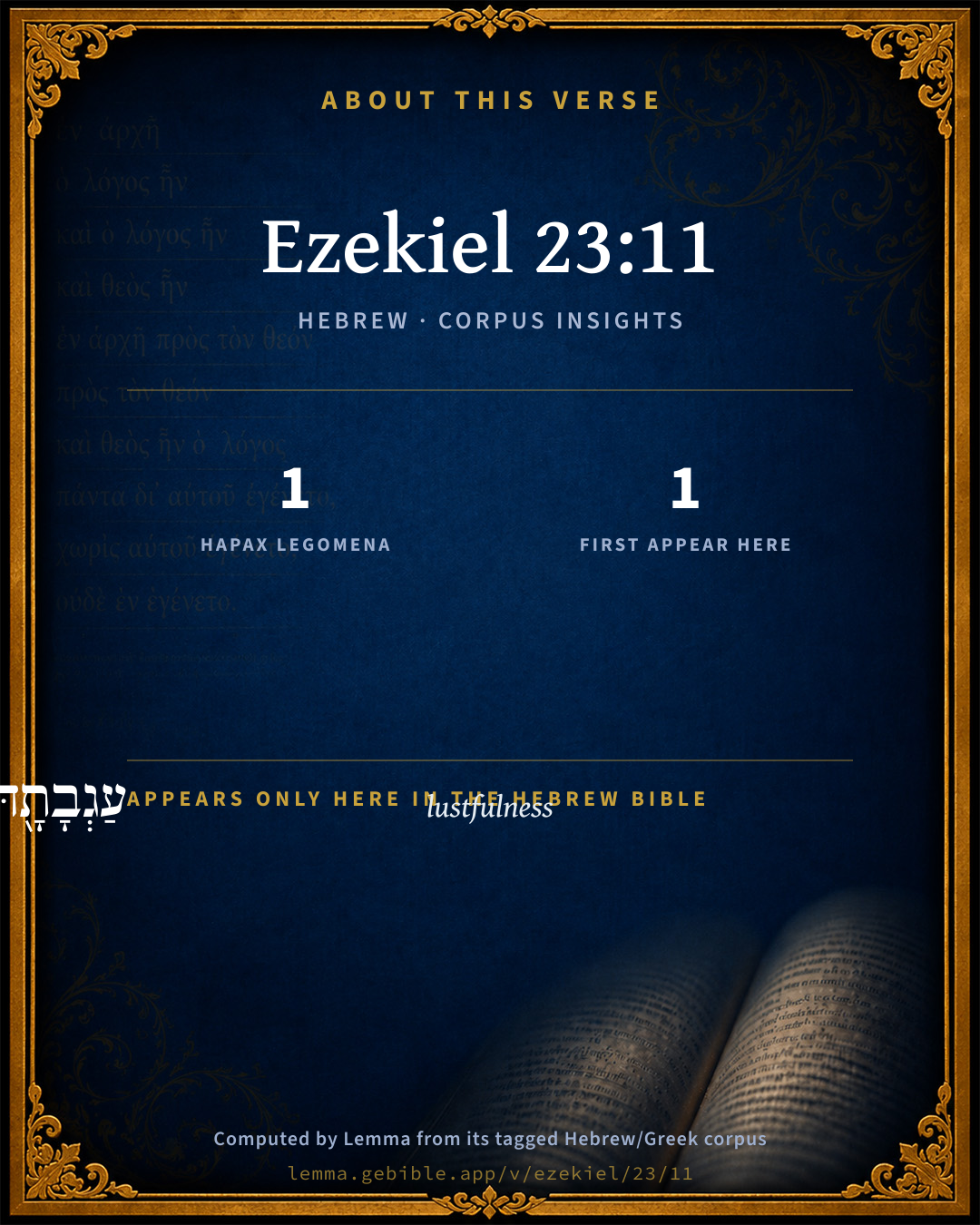
  • 1 hapax legomenon — only here in the Hebrew Bible
  • 1 first appearance in the Hebrew Bible
Full analysis ↓
Download a study sheet

One document with this verse’s original text, its word-by-word gloss line, the meaning frame, cross-references with their text, attributed commentary, and full source and license credits — printable, and it pastes into notes with its structure intact.

This verse Autodidact and up

Study sheet (.html) Plain text (.txt)

A passage Seminary Student

Up to 50 verses in one chapter. A passage sheet keeps up to 6 commentary sources and 12 cross-references per verse, in the order this page ranks them, and says so on the sheet whenever that leaves anything out. Ask for a single verse and you get the Autodidact verse sheet above.

Everything on this page stays free to read, with no account — the sheet is a download of what is already on screen, not access to it.

Want to remove ads? Support Godless Engineer
Compare translations 3

The same verse in 3 English versions, stacked beneath the original-language interlinear above. Click any original word for its lexicon entry.

Each is an independent rendering of the whole verse — the interlinear is not word-aligned to these translations.

Highlighted words mark where these versions differ — a whole-verse word diff, not a word-by-word alignment.

  • World English Bible Public Domain
    Her sister Oholibah saw this, yet was she more corrupt in her doting than she, and in her prostitution which were more than the prostitution of her sister.
  • King James Version Public Domain
    And when her sister Aholibah saw this, she was more corrupt in her inordinate love than she, and in her whoredoms more than her sister in her whoredoms.
  • unfoldingWord Literal Text CC BY-SA 4.0
    Her sister Oholibah saw this, but she lusted even more passionately and acted like a prostitute even more than her sister.

unfoldingWord Literal Text — © unfoldingWord, licensed CC BY-SA 4.0. Word-aligned USFM3 via Door43 (git.door43.org/unfoldingWord/en_ult).

Versions to compare (up to 4)

3 of 4 selected

Show all 18 translations

Every available English version of this verse, each an independent rendering of the whole verse.

  • World English Bible Public Domain
    Her sister Oholibah saw this, yet was she more corrupt in her doting than she, and in her prostitution which were more than the prostitution of her sister.
  • Berean Standard Bible Public Domain
    Her sister Oholibah saw this, yet in her lust and prostitution she was more depraved than her sister.
  • Majority Standard Bible Public Domain
    Her sister Oholibah saw this, yet in her lust and prostitution she was more depraved than her sister.
  • King James Version Public Domain
    And when her sister Aholibah saw this, she was more corrupt in her inordinate love than she, and in her whoredoms more than her sister in her whoredoms.
  • American Standard Version (1901) Public Domain
    And her sister Oholibah saw this, yet was she more corrupt in her doting than she, and in her whoredoms which were more than the whoredoms of her sister.
  • Revised Version (1885) Public Domain
    And her sister Oholibah saw this, yet was she more corrupt in her doting than she, and in her whoredoms which were more than the whoredoms of her sister.
  • Geneva Bible (1599) Public Domain
    And when her sister Aholibah sawe this, she marred her selfe with inordinate loue, more then she, and with her fornications more then her sister with her fornications.
  • Douay-Rheims (1899) Public Domain
    And when her sister Ooliba saw this, she was mad with lust more than she: and she carried her fornication beyond the fornication of her sister.
  • Young's Literal Translation Public Domain
    And see doth her sister Aholibah, And she maketh her doting love more corrupt than she, And her whoredoms than the whoredoms of her sister.
  • Literal Standard Version CC BY-SA 4.0
    And her sister Aholibah sees, || And she makes her unhealthy love more corrupt than she, || And her whoredoms than the whoredoms of her sister.
  • Unlocked Literal Bible CC BY-SA 4.0
    Her sister Oholibah saw this, but she lusted even more passionately and acted like a prostitute even more than her sister.
  • unfoldingWord Literal Text CC BY-SA 4.0
    Her sister Oholibah saw this, but she lusted even more passionately and acted like a prostitute even more than her sister.
  • Darby Bible Public Domain
    And her sister Oholibah saw [this], and was more corrupt in her passion than she, and in her fornications more than the whoredoms of her sister.
  • World Messianic Bible Public Domain
    “Her sister Oholibah saw this, yet she was more corrupt in her lusting than she, and in her prostitution which was more depraved than the prostitution of her sister.
  • Webster's Bible Public Domain
    And when her sister Aholibah saw this, she was more corrupt in her inordinate love than she, and in her prostitutions more than her sister in her prostitutions.
  • Free Bible Version CC BY-SA 4.0
    Oholibah saw what happened to her sister, but she became even worse than her in her wanting sex and practicing prostitution.
  • Bible in Basic English Public Domain
    And her sister Oholibah saw this, but her desire was even more unmeasured, and her loose behaviour was worse than that of her sister.
  • JPS Tanakh (1917) Public Domain
    And her sister Oholibah saw this, yet was she more corrupt in her doting than she, and in her harlotries more than her sister in her harlotries.

Literal Standard Version (2020), Covenant Press — licensed CC BY-SA 4.0. Text via the HelloAO Bible API (eBible.org). Unlocked Literal Bible (unfoldingWord) — licensed CC BY-SA 4.0. Text via the HelloAO Bible API (eBible.org). unfoldingWord Literal Text — © unfoldingWord, licensed CC BY-SA 4.0. Word-aligned USFM3 via Door43 (git.door43.org/unfoldingWord/en_ult). Free Bible Version, Dr. Jonathan Gallagher — licensed CC BY-SA 4.0. Text via the HelloAO Bible API (eBible.org).

Word by word

More ways to search: Search by grammar → Find every occurrence → Compare this word →

Practice this passage: Drill this verse → Learn its vocabulary →

עַגְבָתָ֖הּ
ʻăgâbâh
H5691
“lustfulness · her”
Noun, Common, Feminine, Singular, Construct + Suffix, Personal, 3rd Person, Feminine, Singular
Part of Speech
Noun
Type
Common
Gender
Feminine
Number
Singular
State
Construct
Full BDB Definition

Origin: from H5689

TWOT: 1559b

lustfulness
  1. וַתֵּ֨רֶא֙ râʼâh H7200 “and · to see” Conjunction + Verb, Qal, Sequential Imperfect, 3rd Person, Feminine, Singular
  2. אֲחוֹתָ֣הּ ʼâchôwth H269 “sister · her” Noun, Common, Feminine, Singular, Construct + Suffix, Personal, 3rd Person, Feminine, Singular
  3. אָהֳלִיבָ֔ה ʼOhŏlîybâh H172 “Aholibah” Noun, Proper
  4. וַתַּשְׁחֵ֥ת shâchath H7843 “and · to destroy” Conjunction + Verb, Hiphil, Sequential Imperfect, 3rd Person, Feminine, Singular
  5. מִמֶּ֑נָּה min H4480 “from · her” Preposition + Suffix, Personal, 3rd Person, Feminine, Singular
  6. וְאֶת ʼêth H853 “and · -” Conjunction + Particle, Direct Object
  7. תַּ֨זְנוּתֶ֔יהָ taznûwth H8457 “fornications · her” Noun, Common, Feminine, Plural, Construct + Suffix, Personal, 3rd Person, Feminine, Singular
  8. מִזְּנוּנֵ֖י zânûwn H2183 “from · fornication of” Preposition + Noun, Common, Masculine, Plural, Construct
  9. אֲחוֹתָֽהּ ʼâchôwth H269 “sister · her” Noun, Common, Feminine, Singular, Construct + Suffix, Personal, 3rd Person, Feminine, Singular

About this verse

These counts appear in no published source. They are computed here, from the morphology-tagged text and Lemma’s own curated glosses. What Lemma adds →

10
words
9
distinct lemmas
Prophets
section

Notable vocabulary

1 hapax legomenon — a word that appears only here in the entire Hebrew Bible:

  • עַגְבָתָ֖הּ lustfulness H5691

First appearance in Scripture

This word makes its first canonical appearance in the Hebrew Bible here:

  • עַגְבָתָ֖הּ lustfulness H5691

Shared distinctive vocabulary

אָהֳלִיבָ֔ה Aholibah H172 occurs in 5 verses of the Hebrew Bible. Also found in:

Grammatical profile

  • 2 verbs
  • 6 nouns
  • 1 preposition
  • 1 particle

Verb forms

  • וַתֵּ֨רֶא֙ Qal · Sequential Imperfect
  • וַתַּשְׁחֵ֥ת Hiphil · Sequential Imperfect

Repetition

A word recurs within this verse — often emphatic in Hebrew:

  • אֲחוֹתָ֣הּ sister H269 ×2

Hebrew & Septuagint length

In English translation the verse runs 28 words from the Hebrew and 27 from the Septuagint (LXX English) — closely comparable.

A rough comparison of the two English renderings, which tokenize alike — not a word-level alignment.

Word counts can differ between the Hebrew and the Greek without any difference in meaning — e.g. the Hebrew direct-object marker אֵת has no separate Greek word, and Greek often adds the article ὁ.

Cross-references

3

Topical passages linked to Ezekiel 23:11 in the Treasury of Scripture Knowledge — connected by theme and wording, ordered by reader-vote popularity; previews shown in the World English Bible.

  • Jeremiah 3:8–11 I saw, when, for this very cause that backsliding Israel had committed adultery, I had put her away and given her a bill of divorce, yet treacherous Judah, her sister, didn't fear; but she also went and played the prostitute.
  • Ezekiel 16:47–51 Yet have you not walked in their ways, nor done after their abominations; but, as [if that were] a very little [thing], you were more corrupt than they in all your ways.
  • Ezekiel 23:4 The names of them were Oholah the elder, and Oholibah her sister: and they became mine, and they bore sons and daughters. As for their names, Samaria is Oholah, and Jerusalem Oholibah.

Cross-references courtesy of OpenBible.info (CC BY 4.0).

Hebrew and Greek witnesses Masoretic Hebrew ↔ Greek Septuagint

The same verse in the two great witnesses to the Old Testament, shown verse-for-verse.

These are two independent witnesses, not word-aligned to each other, and the Septuagint is shown in lemma (dictionary) form.

Hebrew Ezekiel 23:11 Masoretic · Westminster Leningrad Codex

וַתֵּ֨רֶא֙ אֲחוֹתָ֣הּ אָהֳלִיבָ֔ה וַתַּשְׁחֵ֥ת עַגְבָתָ֖הּ מִמֶּ֑נָּה וְאֶת תַּ֨זְנוּתֶ֔יהָ מִזְּנוּנֵ֖י אֲחוֹתָֽהּ

Her sister Oholibah saw this, yet was she more corrupt in her doting than she, and in her prostitution which were more than the prostitution of her sister.

World English Bible · Public Domain

Greek LXX Ezekiel 23:11 Septuagint · lemma form

καί ὁράω ὁ ἀδελφή αὐτός οολιβα καί διαφθείρω ὁ ἐπίθεσις αὐτός ὑπέρ αὐτός καί ὁ πορνεία αὐτός ὑπέρ ὁ πορνεία ὁ ἀδελφή αὐτός

And her sister Ooliba saw it, and she indulged in her fondness more corruptly than she, and in her fornication more than the fornication of her sister.

LXX2012 (modern English Septuagint) · Public Domain

On this verse, Keil & Delitzsch discusses the Septuagint’s reading. Read the note in Commentary ↓

Hebrew: Westminster Leningrad Codex (CC BY 4.0). Greek: Septuagint (public domain); English from LXX2012 (modern English Septuagint) (Public Domain). How the Septuagint differs from the Hebrew →

Targum (Aramaic paraphrase)

1

The Targum is the ancient Jewish Aramaic paraphrase of the Hebrew Scriptures — an interpretive translation, not the Hebrew text itself. Onkelos (literal) and Pseudo-Jonathan (expansive) render the Torah, and Jonathan the Prophets. Coverage is partial: where no permissively-licensed English translation exists for a verse, only the Aramaic is shown. This is verse-level text, not a word-by-word alignment to the Hebrew.

  1. Targum Jonathan Prophets (Joshua–Malachi)
    וַחֲזַת אֲחָתָהּ אָהֳלִיבָה וְחַבִּילַת רְחִימְתָּא מִנָהּ וְיַת טַעֲוָתָהָא מִטַעֲוַת אֲחָתָהּ:

    (no public-domain English translation for this verse)

    Targum Jonathan — Aramaic: “Mikraot Gedolot” (public domain). English: “Sefaria Community Translation” (CC0 1.0 (public-domain dedication)); “London "Chaldee Paraphrase," 1871” (public domain). Text via Sefaria.

Commentary

Notes on Ezekiel 23:11 from classic Christian and Jewish commentators (each source and its license shown beneath its notes). The classic Christian expositions comment on the surrounding passage and are grouped to its opening verse, so a note may address several verses; the Jewish commentaries on the Tanakh (Rashi and others) are per-verse, so they appear only where the commentator wrote on this verse.

Lemma curates 59 commentaries, every one of them public domain or Creative Commons licensed, each selected and text-cleaned for this edition rather than reprinted as found. About our sources →

Matthew Henry's Commentary

The prophet Hosea, in his time, observed that the two tribes retained their integrity, in a great measure, when the ten tribes had apostatized (Hos 11:12, Ephraim indeed compasses me about with lies, but Judah yet rules with God and is faithful with the saints; and this was justly expected from them: Hos 4:15, Though thou Israel play the harlot, yet let not Judah offend); but this lasted not long. By some unhappy matches made between the house of David and the house of Ahab the worship of Baal had been brought into the kingdom of Judah, but had been by the reforming kings worked out again; and at the time of the captivity of the ten tribes, which was in the reign of Hezekiah, things were in a good posture: but it lasted not long. In the reign of Manasseh, soon after the kingdom of Judah had seen the destruction of the kingdom of Israel, they became more corrupt than Israel had been in their inordinate love of idols, Eze 23:11. Instead of being made better by the warning which that destruction gave them, they were made worse by it, as if they were displeased because the Lord had made that breach upon Israel, and for that reason became disaffected to him and to his service. Instead of being made to stand in awe of him as a jealous God, they therefore grew strange to him, and liked those gods better that would admit of partners with them. Note, Those may justly expect God's judgments upon themselves who do not take warning by his judgments upon others, who see in others what is the end of sin and yet continue to make a light matter of it. But it is bad indeed with those who are made worse by that which should make them better, and have their lusts irritated and exasperated by that which was designed to suppress and subdue them. Jerusalem grew worse in her whoredoms than her sister Samaria had been in her whoredoms. This was observed before (Eze 16:51), Neither has Samaria committed half of thy sins.

I. Jerusalem, that had been a faithful city, became a harlot, Isa 1:21. She also doted upon the Assyrians (Eze 23:12), joined in league with them, joined in worship with them, grew to be in love with their captains and rulers, and cried them up as finer and more accomplished gentlemen than any that ever the land of Israel produced. "See how richly, how neatly, they are dressed, clothed most gorgeously; how well they sit a horse; they are horsemen riding on horses; how charmingly they look, all of them desirable young men." And thus they grew to affect every thing that was foreign and to despise their own nation; and even the religion of it was mean and homely, and not to be compared with the curiosity and gaiety of the heathen temples. Thus she increased her whoredoms; she fell in love, fell in league, with the Chaldeans. Hezekiah himself was faulty this way when he was proud of the court which the king of Babylon made to him and complimented his ambassadors with the sight of all his treasures, Isa 39:2. And the humour increased (Eze 23:14); she doted upon the pictures of the Babylonian captains (Eze 23:15, Eze 23:16), joined in alliance with that kingdom, invited them to come and settle in Jerusalem, that they might refine the genius of the Jewish nation and make it more polite; nay, they sent for patterns of their images, altars, and temples, and made use of them in their worship. Thus was she polluted with her whoredoms (Eze 23:17), and thereby she discovered her own whoredom (Eze 23:18), her own strong inclination to idolatry. And when she had had enough of the Chaldeans, and grew tired of them and disposed to break her league with them, as Jehoiakim and Zedekiah did, her mind being alienated from them, she courted the Egyptians, doted upon their paramours (Eze 23:20), would come into an alliance with them, and, to strengthen the alliance, would join with them in their idolatries and then depend upon them to be their protectors from all other nations; for so wise, so rich, so strong, was the Egyptian nation, and came to such perfection in idolatry, that there was no nation now which they could take such satisfaction in as in Egypt. Thus they called to remembrance the days of their youth (Eze 23:19), the lewdness of their youth, Eze 23:21. 1. They pleased themselves with the remembrance of it. When they began to set their affections upon Egypt, they encouraged themselves to put a confidence in that kingdom, because of the old acquaintance they had with it, as if they still retained the gust and relish of the leeks and onions they ate there, or rather of the idolatrous worship they learned there, and brought up with them thence. When they began an acquaintance with Egypt they remembered how merrily their fathers worshipped the golden calf, what music and dancing they had at that sport, which they learned in Egypt; and they hoped they should now have a fair pretence to come to that again. Thus she multiplied her whoredoms, repeated her former whoredoms, and encouraged herself to close with present temptations, by calling to remembrance the days of her youth. Note, Those who, instead of reflecting upon their former sins with sorrow and shame, reflect upon them with pleasure and pride, contract new guilt thereby, strengthen their own corruptions, and in effect bid defiance to repentance. This is returning with the dog to his vomit. 2. They called it God's remembrance, and provoked him to remember it against them. God had said indeed that he would reckon with them for the golden calf, that idol of Egypt (Exo 32:34); but such was his patience that he seemed to have forgotten it till they, by their league now with the Egyptians against the Chaldeans, did, as it were, put him in mind of it; and in the day when he visits he will now, as he has said, visit for that. It is very observable how this adulteress changes her lovers: she dotes first on the Assyrians; then she thought the Chaldeans finer and courted them; after a while her mind was alienated from them, and she thought the Egyptians more powerful (Eze 23:20) and she must contract an intimacy with them. This shows the folly, (1.) Of fleshly lusts; when they are indulged they grow humoursome and fickle, are soon surfeited but never satisfied; they must have variety, and what is loved one day is loathed the next. Unius adulterium matrimonium vocant - One adultery is called marriage, as Seneca observes. (2.) Of idolatry. Those who think one God too little will not think a hundred sufficient, but will still be for trying more, as finding all insufficient. (3.) Of seeking to creatures for help; we go from one to another, but are disappointed in them all, and can never rest till we have made the God of Israel our help.

II. The faithful God justly gives a bill of divorce to this now faithless city, that has become a harlot. His jealousy soon discovered her lewdness (Eze 23:13): I saw that she was defiled, that she was debauched, and saw which way her inclination was, that the two sisters both took one way, and that Jerusalem grew worse than Samaria. For, if we stretch out our hand to a strange god, will not God search this out? No doubt he will; and when he has found it can he be pleased with it? No (Eze 23:18): Then my mind was alienated from her, as it was from her sister. How could the pure and holy God any longer take delight in such a lewd generation? Note, Sin alienates God's mind from the sinner, and justly, for it is the alienation of the sinner's mind from God; but woe, and a thousand woes, to those from whom God's mind is alienated; for whom he turns from he will turn against.

Matthew Henry's Commentary on the Whole Bible (1708–1710) — public domain (CC PDM 1.0). Text via the HelloAO Bible API.

Trapp's Complete Commentary

John Trapp

Eze 23:11 And when her sister Aholibah saw [this], she was more corrupt in her inordinate love than she, and in her whoredoms more than her sister in [her] whoredoms.

Ver. 11. And when her sister Aholibah saw this.] And yet would not be warned; which was a just both presage and desert of her utter destruction.

She was more corrupt.] She was therefore the worse, because she should have been better.

John Trapp, A Commentary or Exposition upon All the Books of the Old and New Testament (1647–1656) — public domain. Text from a community e-Sword module.

Joseph Benson's Commentary

Eze 23:11-12. When her sister Aholibah saw this, she was more corrupt — Jerusalem was so far from taking warning by the judgments inflicted on Samaria, that she advanced to greater degrees of idolatry. She doted upon the Assyrians her neighbours — Ahaz, king of Judah, entered into a confederacy with the king of Assyria, hoping for relief from his power and the bravery of his army, and worshipped the idols which the Assyrians worshipped, in order to ingratiate himself with them. See the margin.

Joseph Benson's Commentary on the Old and New Testaments (1811–1818) — public domain. Text from a community e-Sword module.

The Preacher's Complete Homiletical Commentary

Joseph S. Exell (gen. ed.)

(Eze_23:11-21.)

EXEGETICAL NOTES.—The spiritual adultery of Judah with Assyria, in which she surpasses Samaria in her iniquity.

Eze_23:11. “She was more corrupt in her inordinate love.” “Judah went much further than Samaria. It not only indulged in sinful intercourse with Assyria, which led on to idolatry as the latter had done, but it also allowed itself to be led astray by the splendour of Chaldea to form alliances with that imperial power, and to defile itself with her idolatry. And when it became tired of the Chaldeans it formed impure connections with the Egyptians as it had done once before during its sojourn in Egypt” (Keil).

Eze_23:12. “Doted upon the Assyrians, her neighbours.” “The reference here is to the application made by Ahaz to Tiglath-pileser for his assistance against the Syrians and Israelites (recorded 2Ki_16:7-9), which led to the idolatrous transaction at Damascus, and the introduction of the Syrian idolatry into Jerusalem (2Ch_28:16)” (Henderson). “Clothed most gorgeously.” The word means perfection, and the thought intended is, perfect beauty of clothing. “The costume of the Assyrian cavalry may be seen in the sculptures brought by Layard from Nineveh, which display all the magnificence of Oriental finery” (Henderson).

Eze_23:14. “She saw men portrayed upon the wall, the images of the Chaldeans portrayed with vermilion.” “In regard to the Chaldeans, the relation to them was brought about by means of likenesses, which Judah saw. The word means, something engraven or sketched, painted. These were, probably, coloured bas-reliefs, in vermilion, which would be all the more appropriate for warriors. The representation here may probably be the mere drapery of the thought, that the bare report of the military prowess of the Chaldeans had inflamed the imagination and the senses of Judah. Owing to the undeniable intercourse between nations in the Old World, which certainly obtained between Palestine and Babylon, it is not in itself unimaginable that such wall-pictures of representatives of foreign nations may have existed in the royal palaces of Judah.”—(Lange).

Eze_23:15. “Exceeding in dyed attire upon their heads.” The reference is to the lofty turbans, such as may be seen on the monuments of ancient Nineveh.

Eze_23:18. “My mind was alienated from her.” “The thought in these verses (Eze_23:16-18) is the following:—the acquaintance made by Israel (Judah) with the imperial splendour of the Chaldeans, as exhibited in the sculptures of their palaces, incited Judah to cultivate political and mercantile intercourse with this imperial power, which led to its becoming entangled in the heathen ways and idolatry of the Chaldeans. The Chaldeans themselves came and laid the foundation for an intercourse which led to the pollution of Judah with heathenism, and afterwards filled it with disgust, because it was brought thereby into dependence upon the Chaldeans. The consequence of all this was, that the Lord became tired of Judah. For instead of returning to the Lord, Judah turned to the other power of the world, namely, to Egypt; and in the time of Zedekiah renewed its ancient coquetry with that nation.” (Keil).

Eze_23:19. “In calling to remembrance the days of her youth.” She had grown disgusted with Babylon; yet she repented not, but turned back again to the old ways which she had learned in Egypt (2Ki_23:29-35).

Eze_23:20.“Whose flesh is as the flesh of asses, and whose issue is like the issue of horses.” “This representation is sufficiently explained by the particularly lecherous character of the animals mentioned, and describes the obscene character of the Egyptians (Eze_16:26).”—(Lange.)

Eze_23:21. “Calledst to remembrance the lewdness of thy youth” (Heb.). “And thou didst visit the lewdness of thy youth.” “The falling back into the old sin is, as it were, a visit which is paid to that which ought to be hated and avoided. The words, ‘When a man of Egypt handled,’ etc., refer to the attempt of the Egyptians to draw the people in their first beginnings into the Egyptian unity, and so to nationalize them—an attempt to which the youth of the people furnished the occasion.”—(Hengstenberg.)

HOMILETICS

THE SIN OF JUDAH

The sin of Judah was one of special aggravation. Her sin surpassed that of Samaria. “She was more corrupt in her inordinate love than she, and in her whoredoms more than her sister in her whoredoms.”

1. She had greater privileges. A purer knowledge of the true way of worship. Greater grace to resist temptation, and to keep in the right way.

2. She had the warning example of Samaria’s punishment. She saw how God punished them by the very instruments of their inordinate love, and yet took not warning. “They both took one way,” not reflecting that they who take the same way also reach the same end.

3. She used special devices to increase her sinful desires. “She increased her whoredoms.” She stimulated her lustful imagination by pictures and representations of forbidden objects. The sight of these would set her longing after the seductive idolatry of the nations, and draw her away from her lawful love and home. The lust of the eye is one of the great dangers of the world. She also suffered herself to be ensnared by the memory of her old sins (Eze_23:19; Eze_23:21). It is sad when nations and individuals go back again to the sins of their early life.

4. She brought sad judgment upon herself, yet repented not. When she had obtained her desire and embraced the idolatry of Babylon, she was still unsatisfied and even learned to loathe that which she once so eagerly sought. “Her mind was alienated from them.” Israel could not find rest in the idolatry of the nations, for she still retained some memory of better things. The people could not become as the heathen in all respects, for their glorious past was still a fact and could not be separated from their history. The idolatry of Babylon could not satisfy the sinful longings of the chosen people. All impure lust, when it has spent its passion, becomes hatred. For all such lust is selfish and will turn, at length, into aversion to its object. Fellowship with sin must only be of short duration. There is no true binding principle in it. But it was the shame and misery of Israel that the judgments of God, and her disgust of Babylon, failed to bring her to repentance.

1. When God executes severe judgments upon cities He looks that others should take warning thereby. God destroyed Samaria for her idolatry and confederating with heathenish nations. When Jerusalem saw this she reformed not, but was more corrupt. God expected that Jerusalem should hereupon have purged out all idolatry, and cleaved wholly to Him, so that she might have been spared, but she made no good use of His dealings with Samaria.

2. Progress in the same sins, after judgments executed upon others is a fearful aggravation of sin. “When she saw this she was more corrupt.” When God’s hand is lifted, judgment executed, men should fear and learn righteousness; but to go on in wickedness is a horrible slighting, yea, despising of God and His judgments.

3. Sinful cities usually grow worse whatever judgments they see executed upon others. Jerusalem was more corrupt than Samaria. So corrupt is the nature of man that it is not only worse after mercies but even after judgments.

4. The eyes are instruments and occasions of great evil. When she saw the images of the Chaldeans in their dresses, with their belts and aspects, she was taken with them. The images affected her eyes, and they conveyed corruption to her heart, or that which stirred the corruption pre-existent in her heart. Adultery and idolatry have their chief entrance by the eye, and many other sins likewise. What a sad thing was it, that Jerusalem’s eyes should be taken with the painted images of Babylonians! Some confess there is danger by gazing upon living objects, the beauties of men and women, but they fear none from dead objects; but Achan saw a wedge of gold and a Babylonish garment, and they snared him; Aholibah here saw Babylonish pictures, and they ensnared him.

5. For God’s people to admit any part of Babylonish worship is to defile the bed of love. God is a jealous God, His worship must be pure, and the heart must be pure. If the worship be mixed, or heart lean upon an arm of flesh, the bed of love is defiled. In His worship and ordinances God lets out His love to the soul. When they are pure, by the heart being pure and confiding in God, He lets out Himself and His love. Let us look to our hearts, that they may be disengaged from all creature confidences, and to our worship that it be according to God, and then we shall have communion with and comfort from our Beloved.

6. Wickedness is inconstant. “Her mind was alienated from them.” She was taken with the very images of the Babylonians; now she cares not for the men themselves, her soul is disjointed from them; but it was to fall in with some others, and they were the Egyptians (Eze_23:19). But she held not there long; which made the Lord to say, “Why gaddest thou about so much to change thy way? thou also shalt be ashamed of Egypt, as thou wert ashamed of Assyria” (Jer_2:36).

7. Impudence and open sinning cause God to disown and renounce them that do so. Aholibah discovered her whoredoms and nakedness; she talked openly what she had done with the Babylonians, she set up altars and idols in every street, was openly and impudently wicked, prostituting herself to all in the streets. Now it being so, saith the Lord, “then my mind was alienated from her,” seeing she is become so audaciously wicked, I can affect her no longer. Jerusalem’s wickedness alienated God’s heart from her, made Him renounce her for a harlot. It is sad when God renounces (Hos_1:9). If we would not have God’s heart alienated from us, and so be disowned, renounced by Him, let us take heed of all sins, especially of impudency in any sin.

8. Fresh sins bring to mind former old sins. Aholibah’s latter trucking with the Egyptians minded God of her primitive whoredoms and abominations, when she lived in Egypt, which was one thousand years before: there she had her lovers; there she defiled herself “with the idols of Egypt” (Exek. Eze_20:7); and her affection now to Egypt, and Egypt’s paramours, caused God to mind those sins of her youth. He had no pleasure in doing so, but Aholibah called them to remembrance, by acting the same or the like things again, she called them out of darkness, and presented them to the view of God. (Greenhill).

The Preacher's Complete Homiletical Commentary (gen. ed. Joseph S. Exell; Funk & Wagnalls, c. 1892) — public domain (pre-1929). A full-Bible homiletical/sermon-outline anthology covering 65 of 66 books (2 John is absent from the source module). Text from a community e-Sword module.

Keil & Delitzsch

C. F. Keil & F. Delitzsch

Whoredom of Judah

Eze 23:11. And her sister Oholibah saw it, and carried on her coquetry still more wantonly than she had done, and her whoredom more than the whoredom of her sister. Eze 23:12. She was inflamed with lust towards the sons of Asshur, governors and officers, standing near, clothed in perfect beauty, horsemen riding upon horses, choice men of good deportment. Eze 23:13. And I saw that she had defiled herself; they both went one way. Eze 23:14. And she carried her whoredom still further; she saw men engraved upon the wall, figures of Chaldeans engraved with red ochre, Eze 23:15. Girded about the hips with girdles, with overhanging caps upon their heads, all of them knights in appearance, resembling the sons of Babel, the land of whose birth is Chaldea: Eze 23:16. And she was inflamed with lust toward them, when her eyes saw them, and sent messengers to them to Chaldea. Eze 23:17. Then the sons of Babylon came to her to the bed of love, and defiled her with their whoredom; and when she had defiled herself with them, her soul tore itself away from them. Eze 23:18. And when she uncovered her whoredom, and uncovered her nakedness, my soul tore itself away from her, as my soul had torn itself away from her sister. Eze 23:19. And she increased her whoredom, so that she remembered the days of her youth, when she played the harlot in the land of Egypt. Eze 23:20. And she burned toward their paramours, who have members like asses and heat like horses. Eze 23:21. Thou lookest after the lewdness of thy youth, when they of Egypt handled thy bosom because of thy virgin breasts. - The train of thought in these verses is the following: - Judah went much further than Samaria. It not only indulged in sinful intercourse with Assyria, which led on to idolatry as the latter had done, but it also allowed itself to be led astray by the splendour of Chaldea, to form alliances with that imperial power, and to defile itself with her idolatry. And when it became tired of the Chaldeans, it formed impure connections with the Egyptians, as it had done once before during its sojourn in Egypt. The description of the Assyrians in Eze 23:12 coincides with that in Eze 23:5 and Eze 23:6, except that some of the predicates are placed in a different order, and לבשׁי is substituted for לבשׁי תכלת. The former expression, which occurs again in Eze 38:4, must really mean the same as תכלת 'לב. But it does not follow from this that מכלול signifies purple, as Hitzig maintains. The true meaning is perfection; and when used of the clothing, it signifies perfect beauty. The Septuagint rendering, εὺπάρυφα, with a beautiful border - more especially a variegated one - merely expresses the sense, but not the actual meaning of מכלול. The Chaldee rendering is לבשׁי גמר, perfecte induti. - There is great obscurity in the statement in Eze 23:14 as to the way in which Judah was seduced to cultivate intercourse with the Chaldeans. She saw men engraved or drawn upon the wall (מחקּה, a participle Pual of חקק, engraved work, or sculpture). These figures were pictures of Chaldeans, engraved (drawn) with שׁשׁר, red ochre, a bright-red colour. חגורי, an adjective form חגור, wearing a girdle. טבוּלים, coloured cloth, from טבל, to colour; here, according to the context, variegated head-bands or turbans. סרוּח, the overhanging, used here of the cap. The reference is to the tiarae tinctae (Vulgate), the lofty turbans or caps, as they are to be seen upon the monuments of ancient Nineveh. שׁלישׁים, not chariot-warriors, but knights: "tristatae, the name of the second grade after the regal dignity" (Jerome. See the comm. on Exo 14:7 and Sa2 23:8).

The description of these engravings answers perfectly to the sculptures upon the inner walls of the Assyrian palaces in the monuments of Nimrud, Khorsabad, and Kouyunjik (see Layard's Nineveh and its Remains, and Vaux, Nineveh and Persepolis). The pictures of the Chaldeans are not mythological figures (Hvernick), but sculptures depicting war-scenes, triumphal processions of Chaldean rulers and warriors, with which the Assyrian palaces were adorned. We have not to look for these sculptures in Jerusalem or Palestine. This cannot be inferred from Eze 8:10, as Hvernick supposes; nor established by Hitzig's argument, that the woman must have been in circumstances to see such pictures. The intercourse between Palestine and Nineveh, which was carried on even in Jonah's time, was quite sufficient to render it possible for the pictures to be seen. When Israelites travelled to Nineveh, and saw the palaces there, they could easily make the people acquainted with the glory of Nineveh by the accounts they would give on their return. It is no reply to this, to state that the woman does not send ambassadors till afterwards (Eze 23:16), as Hitzig argues; for Judah sent ambassadors to Chaldea not to view the glories of Assyria, but to form alliances with the Chaldeans, or to sue for their favour. Such an embassy, for example, was sent to Babylon by Zedekiah (Jer 29:3); and there is no doubt that in v. 16b Ezekiel has this in his mind. Others may have preceded this, concerning which the books of Kings and Chronicles are just as silent as they are concerning that of Zedekiah. The thought in these verses is therefore the following: - The acquaintance made by Israel (Judah) with the imperial splendour of the Chaldeans, as exhibited in the sculptures of their palaces, incited Judah to cultivate political and mercantile intercourse with this imperial power, which led to its becoming entangled in the heathen ways and idolatry of the Chaldeans. The Chaldeans themselves came and laid the foundation for an intercourse which led to the pollution of Judah with heathenism, and afterwards filled it with disgust, because it was brought thereby into dependence upon the Chaldeans. The consequence of all this was, that the Lord became tired of Judah (Eze 23:17, Eze 23:18). For instead of returning to the Lord, Judah turned to the other power of the world, namely, to Egypt; and in the time of Zedekiah renewed its ancient coquetry with that nation (Eze 23:19-21 compared with Eze 23:8). The form ותּעגּבה in Eze 23:20, which the Keri also gives in Eze 23:18, has taken ah as a feminine termination (not the cohortative ah), like תּרגּה in Pro 1:20; Pro 8:1 (vid., Delitzsch, Comm. on Job, en loc.). פּלּגשׁים are scorta mascula (here (Kimchi) - a drastically sarcastic epithet applied to the sârisim, the eunuchs, or courtiers. The figurative epithet answers to the licentious character of the Egyptian idolatry. The sexual heat both of horses and asses is referred to by Aristotle, Hist. anim. vi. 22, and Columella, de re rust. vi. 27; and that of the horse has already been applied to the idolatry of the people by Jeremiah (vid., Jer 5:8). בּשׂר, as in Eze 16:26. פּקד (Eze 23:21), to look about for anything, i.e., to search for it; not to miss it, as Hvernick imagines.

Keil & Delitzsch — Biblical Commentary on the Old Testament (1861–1891) — public domain (CC PDM 1.0). Text via the HelloAO Bible API. (Old Testament only.)

Tyndale Open Study Notes

Tyndale Open Resources

23:11-18 Samaria’s reputation and punishment were known to everyone in Ezekiel’s time. Her sister, Oholibah (Jerusalem), followed the same pattern of life and was even worse than her sister. What a succession of Judah’s kings regarded as wise political maneuvering—seeking alliances with Babylon as well as with Assyria—the prophet presents as a pattern of consistent, ever-deepening spiritual adultery.

Tyndale Open Study Notes — © Tyndale Open Resources, licensed CC BY-SA 4.0. Text via the HelloAO Bible API.

Jamieson, Fausset & Brown

Robert Jamieson, A. R. Fausset & David Brown

Judah, the southern kingdom, though having the "warning" (see on Eze 23:10) of the northern kingdom before her eyes, instead of profiting by it, went to even greater lengths in corruption than Israel. Her greater spiritual privileges made her guilt the greater (Eze 16:47, Eze 16:51; Jer 3:11).

Jamieson, Fausset & Brown — Commentary Critical and Explanatory on the Whole Bible (1871) — public domain (CC PDM 1.0). Text via the HelloAO Bible API.

Ellicott's Commentary for English Readers

(11) She was more corrupt.—Enough having been said of Aholah to form the basis for a comparison, the prophet now turns to Aholibah. The idolatries of Judah not only comparatively but actually exceeded those of her sister kingdom. See, e.g., the account of Manaseeh’s reign (2Ki_21:1-16; 2Ch_33:1-9). In addition to her connection with Assyria, Judah also formed alliances with Chaldæa, and intrigued with Egypt and other nations.

A Bible Commentary for English Readers, edited by Charles John Ellicott (1878–1897) — public domain. Text from a community e-Sword module.

The Cambridge Bible for Schools and Colleges

gen. ed. J. J. S. Perowne

11–21. The infidelities of Judah with Assyria, Babylon and Egypt

11. On the greater excesses of Judah cf. Eze_16:47; Eze_16:51; Jer_3:8; Jer_3:11.

The Cambridge Bible for Schools and Colleges (gen. ed. J. J. S. Perowne; Cambridge University Press, 1878–1918) — public domain. Text from a community e-Sword module.

John Gill's Exposition

And when her sister Aholibah saw this,.... The two tribes of Judah and Benjamin, when, they saw the idolatries the ten tribes fell into, and the destruction which came upon them for the same; instead of receiving instruction, and taking caution by all this,

she was more corrupt in her inordinate love than she; in courting the friendship, alliance, and help of their Heathen neighbours:

and in her whoredoms more than her sister in her whoredoms; guilty of more idolatries than the ten tribes, as in the times of Manasseh; see Jer 2:28.

John Gill's Exposition of the Whole Bible (1746–1763) — public domain (CC PDM 1.0). Text via the HelloAO Bible API.

Albert Barnes' Notes on the Bible

The idolatries of Manasseh’s reign exceeded all that had gone before either in Israel or in Judah 2 Kings 21:1-16; 2Ch 33:1-10.

Albert Barnes' Notes on the Bible (1834–1885) — public domain. Text from a community e-Sword/MySword module.

Haydock's Catholic Bible Commentary

This; not chastisement, but dissolution.

George Leo Haydock (1774–1849), Haydock's Catholic Family Bible and Commentary, 1859 edition — public domain. Excludes Psalms (Douay-Rheims chapter numbering differs from Protestant) and Deuterocanonical books (Catholic canon only).

Matthew Poole's English Annotations

Aholibah; Judah, yet two tribes.

Saw this; both the sins and punishments of the kingdom of Israel, which should have been her admonition.

She was more corrupt, ran more violently into both friendship, confederacies, and idolatries with the Assyrians,

than her sister, Samaria; Jerusalem had more idols in it, and more abominable idolatry, than any we read of in Samaria that, at present, I can remember.

Matthew Poole's English Annotations on the Holy Bible (1683–1685) — public domain. Text from a community e-Sword/MySword module.

Whedon's Commentary on the Bible

Daniel D. Whedon

11. Aholibah… was more corrupt — Judah, though with greater privileges, was even worse than her sister Samaria (Eze_16:47; Eze_16:51; Jer_3:8; Jer_3:11). She also doted upon the young Assyrian cavalrymen (Eze_23:12) and defiled herself with them (Eze_23:13), and as soon as she saw the wall pictures representing the Babylonian military officers, so passionate did she become that she could not even wait for them to come and offer their illicit affection, but hastened messengers to them calling them to her “bed of love” (Eze_23:14-17). The wall decorations mentioned are very common in the ruins of Chaldean palaces and temples. The pictures are often carved in brick and then enameled in bright colors. So naturalistic is the description in these verses (14-16) that Layard took them for the motto of his Nineveh and its Remains. The Assyrians and Babylonians much resembled each other in the gorgeousness of their dress and other decorations. The robes of the king were richly embroidered, covered often with exquisite designs of genii and symbolic animals set with precious stones. Among the spoils and tribute inscribed on the monuments colored garments of blue and purple are frequently mentioned. The very word used by Ezekiel — takiltu (Eze_23:6) — often occurs in these lists (Evetts).

Daniel D. Whedon (gen. ed.), Commentary on the Old and New Testaments (1874–1909) — public domain. Text from a community e-Sword module.

The Pulpit Commentary

Vers. 11, 12 The issue of the Assyrian alliance in the fall of Samaria might have served as a warning to the kings of Judah. But it did not. They also "courted the alliance of the kings of Assyria, as in the case of Ahaz (2Ki_16:7-10) and Tiglath-Pileser. Hezekiah followed in the same line, though he too trusted in Egypt, and afterwards rebelled. Manasseh too paid tribute, and made Jerusalem the scene of a confluent idolatry, which included that of Assyria. Even Josiah went forth against Pharaoh-Necho as the faithful vassal of either Assyria or Babylon. The splendor which had fascinated Samaria fascinated her also. Here clothed most gorgeously takes the place of "clothed in blue" in Ver. 6, describing, probably, the same fact.

The Pulpit Commentary (1880–1919), ed. H.D.M. Spence-Jones & Joseph S. Exell — public domain. Text from a community e-Sword module.

unfoldingWord translationNotes

Door43 World Missions Community

General Information:

Yahweh continues his metaphor in which he speaks of the cities of Jerusalem and Samaria as if they were two prostitutes. This metaphor continues through Ezekiel 23:34. (See: Metaphor)

Oholibah

This is the name of a woman that means "my tent is in her." See how you translated this name in Ezekiel 23:4. (See: How to Translate Names)

unclean

A person who God considers spiritually unacceptable or defiled is spoken of as if the person were physically unclean. See how you translated this in Ezekiel 23:7. (See: Metaphor)

It was the same for both sisters

This refers to how they had both made themselves unclean. AT: "Both sisters became unclean through their acts of prostitution" (See: Assumed Knowledge and Implicit Information)

translationWords

sister

unfoldingWord translationNotes — © Distant Shores Media and the Door43 World Missions Community, licensed CC BY-SA 4.0. Source: git.door43.org/Door43/en_tn.

Rashi

Rabbi Shlomo Yitzchaki (Rashi)

And her sister Oholibah saw all the evil that befell her sister because of her harlotries, but she was unafraid.

she became... corrupt in her lust [Heb. עַגְבָתָה,] her lust, wai(y)ter in Old French, unbridled passion.

Rashi on the Tanakh — English translations: “The Judaica Press complete Tanach with Rashi, translated by A. J. Rosenberg” (CC BY 4.0); “Pentateuch with Rashi's commentary by M. Rosenbaum and A.M. Silbermann, 1929-1934” (public domain); “The Metsudah Tanach series, Lakewood, N.J” (CC BY 4.0); and “The Book of Joshua, Metsudah Publications, 1997” (CC BY 4.0). Text via Sefaria.

Lesson kit

Teaching starters — assembled from the data on this page, not authored interpretation. Every prompt links to the verse data it draws on. Edit before teaching.

Ezekiel, in the Prophets, opens this verse with 10 words (9 distinct Hebrew lemmas). Its most distinctive word is ʻăgâbâh (“lustfulness”). A historical commentator’s framing appears above. Read the whole chapter for the surrounding context.

Discussion questions

  1. How does “lustfulness” (ʻăgâbâh) shape what this verse is saying?
  2. This verse holds 1 word here found nowhere else in the Hebrew Bible. What might the rare word draw attention to?
  3. The word “lustfulness” first appears here in Scripture. What is being introduced at this debut?
  4. Ezekiel 23:4 shares the word «Aholibah» with this verse. How do the two illuminate each other?
  5. “sister” occurs 2× in this one verse. What is the effect of the repetition?
  6. These translations render this verse differently; the difference is in the English rendering, not the original. What questions does that raise?
  7. The verb «וַתֵּ֨רֶא֙» is Qal Sequential Imperfect. How does its form color the action?
  8. Reading how Matthew Henry's Commentary and Trapp's Complete Commentary read this verse, where do the two commentators agree and where do they part?

Things to notice

  • 1 word in this verse appears nowhere else in the Hebrew Bible.
  • 1 word makes its first canonical appearance in Scripture here.
  • These translations choose different wording for 16 words in this verse.
  • “sister” occurs 2× in this single verse.
  • 9 distinct Hebrew lemmas span 10 words in this verse.

Reading settings

Reading text

Shown beneath each verse's original-language words.

Old Testament
Old Testament edition

Read the OT as the Masoretic Hebrew (MT) or the Greek Septuagint (LXX).

English shown for the Greek Septuagint (in the Hebrew ↔ Greek comparison).

Comparing translations? Open the Compare panel on any verse page to stack up to four side by side.