
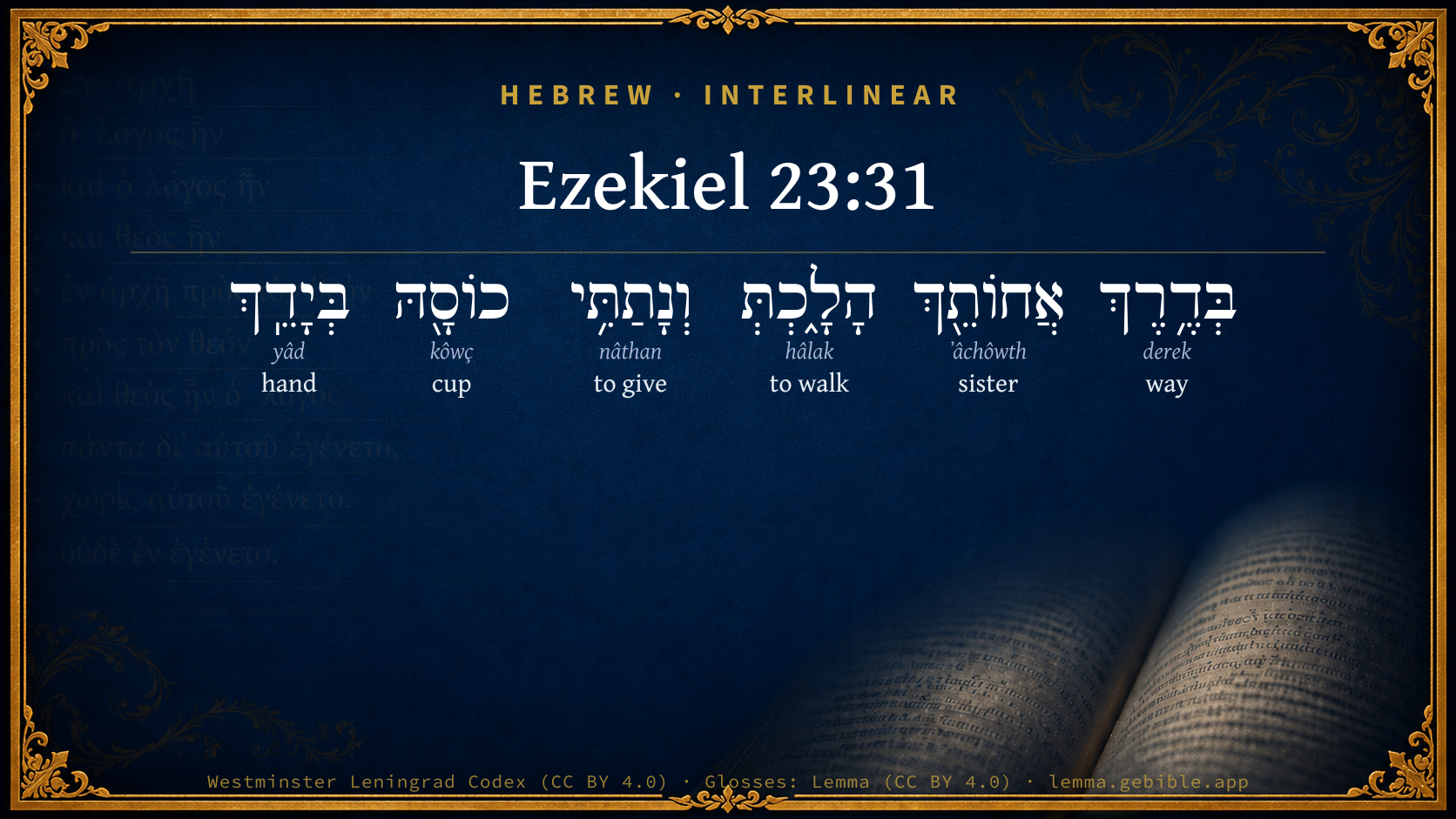
Ezekiel 23:31

Hebrew (Westminster Leningrad Codex) Ezekiel 23:31 appears in the Hebrew Old Testament. The text above is from the Westminster Leningrad Codex. Each word links to its Strong’s number, a concise gloss, and parsing drawn from the Open Scriptures Hebrew Bible morphology. Click any word for its full Brown-Driver-Briggs (BDB) entry.
Download image
Cite this verse

Ezekiel 23:31 (World English Bible). Public Domain. Lemma interlinear Bible study tool, https://lemma.gebible.app/v/ezekiel/23/31.

Show BibTeX & RIS
BibTeX
RIS
English Translation
You have walked in the way of your sister; therefore will I give her cup into your hand.
World English Bible · Public Domain
Download a study sheet

One document with this verse’s original text, its word-by-word gloss line, the meaning frame, cross-references with their text, attributed commentary, and full source and license credits — printable, and it pastes into notes with its structure intact.

This verse Autodidact and up

Study sheet (.html) Plain text (.txt)

A passage Seminary Student

Up to 50 verses in one chapter. A passage sheet keeps up to 6 commentary sources and 12 cross-references per verse, in the order this page ranks them, and says so on the sheet whenever that leaves anything out. Ask for a single verse and you get the Autodidact verse sheet above.

Everything on this page stays free to read, with no account — the sheet is a download of what is already on screen, not access to it.

Want to remove ads? Support Godless Engineer
Compare translations 3

The same verse in 3 English versions, stacked beneath the original-language interlinear above. Click any original word for its lexicon entry.

Each is an independent rendering of the whole verse — the interlinear is not word-aligned to these translations.

Highlighted words mark where these versions differ — a whole-verse word diff, not a word-by-word alignment.

  • World English Bible Public Domain
    You have walked in the way of your sister; therefore will I give her cup into your hand.
  • King James Version Public Domain
    Thou hast walked in the way of thy sister; therefore will I give her cup into thine hand.
  • unfoldingWord Literal Text CC BY-SA 4.0
    You have walked in the way of your sister, so I will put her cup of punishment into your hand.’

unfoldingWord Literal Text — © unfoldingWord, licensed CC BY-SA 4.0. Word-aligned USFM3 via Door43 (git.door43.org/unfoldingWord/en_ult).

Versions to compare (up to 4)

3 of 4 selected

Show all 18 translations

Every available English version of this verse, each an independent rendering of the whole verse.

  • World English Bible Public Domain
    You have walked in the way of your sister; therefore will I give her cup into your hand.
  • Berean Standard Bible Public Domain
    Because you have followed the path of your sister, I will put her cup into your hand.’
  • Majority Standard Bible Public Domain
    Because you have followed the path of your sister, I will put her cup into your hand.’
  • King James Version Public Domain
    Thou hast walked in the way of thy sister; therefore will I give her cup into thine hand.
  • American Standard Version (1901) Public Domain
    Thou hast walked in the way of thy sister; therefore will I give her cup into thy hand.
  • Revised Version (1885) Public Domain
    Thou hast walked in the way of thy sister; therefore will I give her cup into thine hand.
  • Geneva Bible (1599) Public Domain
    Thou hast walked in the way of thy sister: therefore wil I giue her cup into thine hand.
  • Douay-Rheims (1899) Public Domain
    Thou hast walked in the way of thy sister, and I will give her cup into thy hand.
  • Young's Literal Translation Public Domain
    In the way of thy sister thou hast walked, And I have given her cup into thy hand.
  • Literal Standard Version CC BY-SA 4.0
    You have walked in the way of your sister, || And I have given her cup into your hand.
  • Unlocked Literal Bible CC BY-SA 4.0
    You have walked in the way of your sister, so I will put her cup of punishment into your hand.'
  • unfoldingWord Literal Text CC BY-SA 4.0
    You have walked in the way of your sister, so I will put her cup of punishment into your hand.’
  • Darby Bible Public Domain
    Thou hast walked in the way of thy sister; and I have given her cup into thy hand.
  • World Messianic Bible Public Domain
    You have walked in the way of your sister; therefore I will give her cup into your hand.’
  • Webster's Bible Public Domain
    Thou hast walked in the way of thy sister; therefore will I give her cup into thy hand.
  • Free Bible Version CC BY-SA 4.0
    Because you did what your sister did, I will give you her cup to drink.
  • Bible in Basic English Public Domain
    You have gone in the way of your sister; and I will give her cup into your hand.
  • JPS Tanakh (1917) Public Domain
    In the way of thy sister hast thou walked; therefore will I give her cup into thy hand.

Literal Standard Version (2020), Covenant Press — licensed CC BY-SA 4.0. Text via the HelloAO Bible API (eBible.org). Unlocked Literal Bible (unfoldingWord) — licensed CC BY-SA 4.0. Text via the HelloAO Bible API (eBible.org). unfoldingWord Literal Text — © unfoldingWord, licensed CC BY-SA 4.0. Word-aligned USFM3 via Door43 (git.door43.org/unfoldingWord/en_ult). Free Bible Version, Dr. Jonathan Gallagher — licensed CC BY-SA 4.0. Text via the HelloAO Bible API (eBible.org).

Word by word

More ways to search: Search by grammar → Find every occurrence → Compare this word →

Practice this passage: Drill this verse → Learn its vocabulary →

About this verse

These counts appear in no published source. They are computed here, from the morphology-tagged text and Lemma’s own curated glosses. What Lemma adds →

6
words
6
distinct lemmas
Prophets
section

Shared distinctive vocabulary

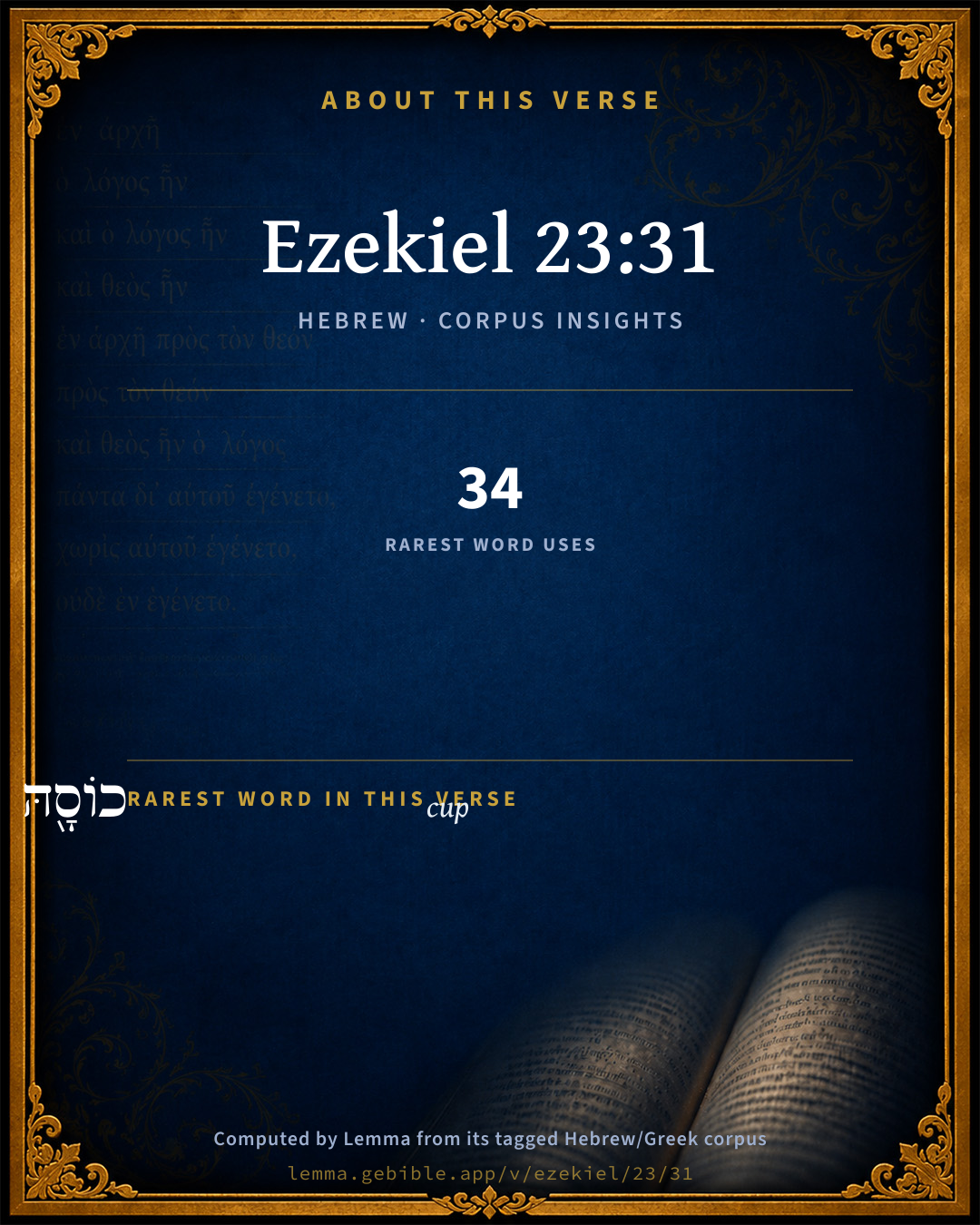
כוֹסָ֖הּ cup H3563 occurs in 29 verses of the Hebrew Bible. Also found in:

Grammatical profile

  • 2 verbs
  • 4 nouns

Verb forms

  • הָלָ֑כְתְּ Qal · Perfect
  • וְנָתַתִּ֥י Qal · Sequential Perfect

Hebrew & Septuagint length

In English translation the verse runs 18 words from the Hebrew and 18 from the Septuagint (LXX English) — the same length.

A rough comparison of the two English renderings, which tokenize alike — not a word-level alignment.

Word counts can differ between the Hebrew and the Greek without any difference in meaning — e.g. the Hebrew direct-object marker אֵת has no separate Greek word, and Greek often adds the article ὁ.

Cross-references

7

Topical passages linked to Ezekiel 23:31 in the Treasury of Scripture Knowledge — connected by theme and wording, ordered by reader-vote popularity; previews shown in the World English Bible.

  • 2 Kings 21:13 I will stretch over Jerusalem the line of Samaria, and the plummet of the house of Ahab; and I will wipe Jerusalem as a man wipes a dish, wiping it and turning it upside down.
  • Jeremiah 7:14–15 therefore will I do to the house which is called by my name, in which you trust, and to the place which I gave to you and to your fathers, as I did to Shiloh.
  • Jeremiah 3:8–11 I saw, when, for this very cause that backsliding Israel had committed adultery, I had put her away and given her a bill of divorce, yet treacherous Judah, her sister, didn't fear; but she also went and played the prostitute.
  • Jeremiah 25:15 For thus says Yahweh, the God of Israel, to me: take this cup of the wine of wrath at my hand, and cause all the nations, to whom I send you, to drink it.
  • Ezekiel 16:47–51 Yet have you not walked in their ways, nor done after their abominations; but, as [if that were] a very little [thing], you were more corrupt than they in all your ways.
  • Ezekiel 23:13 I saw that she was defiled; they both took one way.
  • Daniel 9:12 He has confirmed his words, which he spoke against us, and against our judges who judged us, by bringing on us a great evil; for under the whole sky has not been done as has been done on Jerusalem.

Cross-references courtesy of OpenBible.info (CC BY 4.0).

Hebrew and Greek witnesses Masoretic Hebrew ↔ Greek Septuagint

The same verse in the two great witnesses to the Old Testament, shown verse-for-verse.

These are two independent witnesses, not word-aligned to each other, and the Septuagint is shown in lemma (dictionary) form.

Hebrew Ezekiel 23:31 Masoretic · Westminster Leningrad Codex

בְּדֶ֥רֶךְ אֲחוֹתֵ֖ךְ הָלָ֑כְתְּ וְנָתַתִּ֥י כוֹסָ֖הּ בְּיָדֵֽךְ

You have walked in the way of your sister; therefore will I give her cup into your hand.

World English Bible · Public Domain

Greek LXX Ezekiel 23:31 Septuagint · lemma form

ἐν ὁ ὁδός ὁ ἀδελφή σύ πορεύομαι καί δίδωμι ὁ ποτήριον αὐτός εἰς χείρ σύ

You did walk in the way of your sister; and I will put her cup into your hands.

LXX2012 (modern English Septuagint) · Public Domain

Hebrew: Westminster Leningrad Codex (CC BY 4.0). Greek: Septuagint (public domain); English from LXX2012 (modern English Septuagint) (Public Domain). How the Septuagint differs from the Hebrew →

Targum (Aramaic paraphrase)

1

The Targum is the ancient Jewish Aramaic paraphrase of the Hebrew Scriptures — an interpretive translation, not the Hebrew text itself. Onkelos (literal) and Pseudo-Jonathan (expansive) render the Torah, and Jonathan the Prophets. Coverage is partial: where no permissively-licensed English translation exists for a verse, only the Aramaic is shown. This is verse-level text, not a word-by-word alignment to the Hebrew.

  1. Targum Jonathan Prophets (Joshua–Malachi)
    בְּאוֹרַח אֲחָתִיךְ הַלֵיכְתְּ וְאֶתֵּן כָּס פּוּרְעֲנוּתָהּ בִידִיךְ:

    (no public-domain English translation for this verse)

    Targum Jonathan — Aramaic: “Mikraot Gedolot” (public domain). English: “Sefaria Community Translation” (CC0 1.0 (public-domain dedication)); “London "Chaldee Paraphrase," 1871” (public domain). Text via Sefaria.

Commentary

Notes on Ezekiel 23:31 from classic Christian and Jewish commentators (each source and its license shown beneath its notes). The classic Christian expositions comment on the surrounding passage and are grouped to its opening verse, so a note may address several verses; the Jewish commentaries on the Tanakh (Rashi and others) are per-verse, so they appear only where the commentator wrote on this verse.

Lemma curates 59 commentaries, every one of them public domain or Creative Commons licensed, each selected and text-cleaned for this edition rather than reprinted as found. About our sources →

Trapp's Complete Commentary

John Trapp

Eze 23:31 Thou hast walked in the way of thy sister; therefore will I give her cup into thine hand.

Ver. 31. Therefore will I give her cup into thine hand.] An allusion to the manner of feasts, whereat the symposiarch or governor gave every guest his cup fitly tempered. God is the great Modimperator.

John Trapp, A Commentary or Exposition upon All the Books of the Old and New Testament (1647–1656) — public domain. Text from a community e-Sword module.

Joseph Benson's Commentary

Eze 23:31-35. Therefore will I give her cup, &c. — I will make thee drink the same bitter draught, or experience the same calamity that has fallen upon her. God’s judgments are often compared to a cup of intoxicating liquors, because they astonish men, and bereave them of common judgment and discretion, and likewise expose them to the scorn and contempt of their enemies. Thou shalt even drink it and suck it out — There shall be no punishment which thou shalt not partake of. Thou shalt drink of the cup of calamity even to the dregs; that which is the very worst and most bitter: see notes on Psa 75:8. and Isa 51:17. Thou shalt break the sherds thereof — People who are quite intoxicated, often in their drunken madness break the cups out of which they had drunk; therefore by this expression here is meant, that the Jewish people should be, as it were, driven to madness by the grievous judgments that should fall upon them. And pluck off thine own breasts — “Thou shalt tear away thy breasts with the sharp pieces of the broken cup, through grief and madness.” — Bishop Newcome. Or, Thou shalt be in a fury with thyself for having by thine own sins brought such grievous calamities upon thyself. Her breasts are mentioned as the parts which had a principal share in her guilt, according to the allegorical description here given of her idolatries. Because thou hast forgotten me — Because thou hast not only forsaken my worship, but hast showed the utmost contempt of and aversion from me. Therefore bear thou also thy lewdness — Therefore thou shalt suffer the punishment of thy wickedness and idolatry.

Joseph Benson's Commentary on the Old and New Testaments (1811–1818) — public domain. Text from a community e-Sword module.

Tyndale Open Study Notes

Tyndale Open Resources

23:31-34 your sister’s cup of terror: Jerusalem would have to drink from this bitter cup of judgment, as Samaria had. The pain of that judgment would cause her to beat (or tear at) her breast in anguish.

Tyndale Open Study Notes — © Tyndale Open Resources, licensed CC BY-SA 4.0. Text via the HelloAO Bible API.

Geneva Bible (1599)

Geneva Bible translators

I will execute the same judgments and vengeance against thee, and that with greater severity.

Geneva Bible (1599) marginal notes — public domain. Text via Bolls.life.

Jamieson, Fausset & Brown

Robert Jamieson, A. R. Fausset & David Brown

her cup--of punishment (Psa 11:6; Psa 75:8; Jer 25:15, &c.). Thy guilt and that of Israel being alike, your punishment shall be alike.

Jamieson, Fausset & Brown — Commentary Critical and Explanatory on the Whole Bible (1871) — public domain (CC PDM 1.0). Text via the HelloAO Bible API.

The Cambridge Bible for Schools and Colleges

gen. ed. J. J. S. Perowne

31. her cup] That which she drank, Isa_51:22-23; Jer_25:15-16.

The Cambridge Bible for Schools and Colleges (gen. ed. J. J. S. Perowne; Cambridge University Press, 1878–1918) — public domain. Text from a community e-Sword module.

John Gill's Exposition

Thou hast walked in the way of thy sister,.... Samaria, or the ten tribes of Israel; followed them in their idolatrous practices, were guilty of the same:

therefore will I give her cup into thine hand; the cup of her vengeance, as the Targum; inflict the same punishment on the two tribes as on the ten, and suffer them to be carried captive as they had been.

John Gill's Exposition of the Whole Bible (1746–1763) — public domain (CC PDM 1.0). Text via the HelloAO Bible API.

Haydock's Catholic Bible Commentary

Cup. Thou shalt be punished like Samaria, dreadfully, 4 Kings xvii. 4. (Calmet)

George Leo Haydock (1774–1849), Haydock's Catholic Family Bible and Commentary, 1859 edition — public domain. Excludes Psalms (Douay-Rheims chapter numbering differs from Protestant) and Deuterocanonical books (Catholic canon only).

Matthew Poole's English Annotations

Thou, O Jerusalem and Judah,

hast walked; hast run into the same sinful enormities.

Thy sister; Samaria and the ten tribes, both great idolatresses.

Her cup of judgments and sorrow, expressed frequently by a cup, Psa 75:8; Jer 25:15; I will punish thee with punishments like hers, since thou hast made thyself in sins like her.

Matthew Poole's English Annotations on the Holy Bible (1683–1685) — public domain. Text from a community e-Sword/MySword module.

Whedon's Commentary on the Bible

Daniel D. Whedon

31, 32. Her cup — See Jer_25:15; Mat_20:22; Mat_26:39. Every inhabitant of Jerusalem would admit that Samaria’s cup of sin and folly and punishment was deep and large (Eze_23:32).

It containeth much — Or, thou shalt be had in derision to the uttermost.

Daniel D. Whedon (gen. ed.), Commentary on the Old and New Testaments (1874–1909) — public domain. Text from a community e-Sword module.

The Pulpit Commentary

Vers. 31-33I will give her cup into thine hand. (For the image of the cup as the symbol of good or evil fortune, see Psa_23:5; Isa_51:17; Jer_25:15; Mat_20:22 Mat_26:39) The cup, in this case, was to be deep and large as that of Samaria. The adulteress was to be "drunk, but not with wine". (Isa_29:9) And that "cup," over and above the laughter and derision, would contain much of unknown calamities, the astonishment and desolation of Ver.

33.

A bad example.

Judah followed the bad example of her sister Israel; consequently, she was to share the fate of Israel We see here an instance of the evil influence of a bad example, and of its fatal consequences.

I THE EVIL INFLUENCE OF A BAD EXAMPLE. Consider how this fell power is exerted.

1. By the fascination of suggestion. The path is made by the pioneer, and the follower has only to walk in it. The sight of a predecessor indicates the road, calls attention to it, suggests the idea of walking in it. The publications of the details of a horrible crime in the newspaper exerts a most deleterious influence in this way by filling the minds of people with thoughts of a kindred character. Hence the common occurrence of an epidemic of similar crimes.

2. By the attraction of sympathy. Judah is drawn to follow her sister Israel When Israel goes wrong, Judah accompanies her and goes wrong in a similar manner. Affection is fatal when it induces us to copy the vices of those whom we love. Even sisters must part when one chooses an evil way, if the other would not also choose sin. But it is hard to resist the charms of affection.

3. By the delusion of a false excuse. Judah pleads the example of her sister as an excuse. What others are doing seems to be justified by their action. Instead of measuring our conduct by the Law of God, we are tempted to test it by the corresponding conduct of others.

II THE SIN OF FOLLOWING A BAD EXAMPLE. Judah is blamed for following the bad example of Israel. It is not for one moment supposed that the misconduct of her sister could be pleaded as a justification for her own repetition of it. We cannot be excused in our own sin on the ground that we are simply treading in the footsteps of predecessors. See how this sin is inexcusable.

1. Because the evil of the way is known. The foolish follower is not deceived. Judah knows that Israel has taken an evil course. Bad examples may ensnare the careless, but those who have minds to think for themselves cannot be blind to the wrong character of the example before them.

2. Because of the freedom of the will. A bad example is a temptation to evil; but it is not a force compelling men to follow. Its attraction can only work through the will, never contrary to it. Therefore one must consent voluntarily to follow the evil pattern before doing so, and this free consent destroys the excuse that the example is to blame rather than the man who imitates it.

3. Because of ones own advantages. Judah might plead that she was sorely tempted by her sister"s example. But then she possessed higher privileges than Israel. She was Aholibah, while her sister was only Aholah. She had the temple of God in her midst, while Israel was left to her own resources. Christians are doubly guilty in following the bad example of godless men. They sin in spite of higher influences which should suffice to keep them in the right path.

III THE FATAL CONSEQUENCES OF FOLLOWING A BAD EXAMPLE. Judah was walking in the way of her sister; therefore she must drink of her sister"s cup. Companions in guilt will be companions in doom. It is impossible to walk in the same path as another without going towards the same goal. Moreover, if higher religious privileges do not keep us from following the sinful practices of worldly men, most certainly they will not protect us from sharing their fate. He who treads the sinner"s flowery path will drink of the sinner"s bitter cup.

The Pulpit Commentary (1880–1919), ed. H.D.M. Spence-Jones & Joseph S. Exell — public domain. Text from a community e-Sword module.

Lesson kit

Teaching starters — assembled from the data on this page, not authored interpretation. Every prompt links to the verse data it draws on. Edit before teaching.

Ezekiel, in the Prophets, opens this verse with 6 words (6 distinct Hebrew lemmas). Its most distinctive word is kôwç (“cup”). A historical commentator’s framing appears above. Read the whole chapter for the surrounding context.

Discussion questions

  1. What does “cup” (kôwç) contribute to the verse as a whole?
  2. Genesis 40:11 shares the word «cup» with this verse. How do the two illuminate each other?
  3. These translations render this verse differently. What is at stake in choosing one wording over another?
  4. The verb «הָלָ֑כְתְּ» is Qal Perfect. How does its form color the action?
  5. Reading how Trapp's Complete Commentary and Joseph Benson's Commentary read this verse, where do the two commentators agree and where do they part?

Things to notice

Reading settings

Reading text

Shown beneath each verse's original-language words.

Old Testament
Old Testament edition

Read the OT as the Masoretic Hebrew (MT) or the Greek Septuagint (LXX).

English shown for the Greek Septuagint (in the Hebrew ↔ Greek comparison).

Comparing translations? Open the Compare panel on any verse page to stack up to four side by side.