
Proverbs 7:4

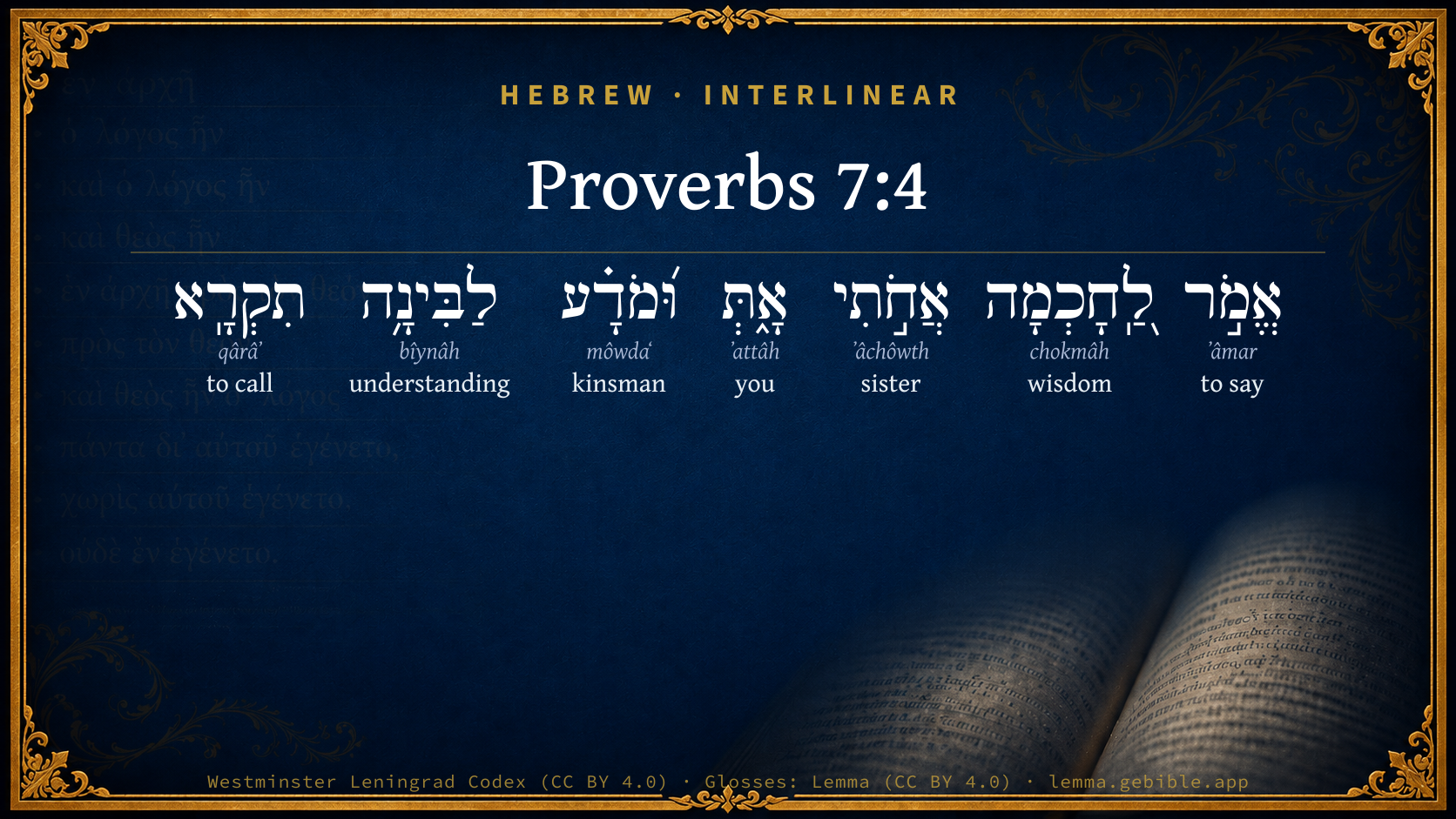
Hebrew (Westminster Leningrad Codex) Proverbs 7:4 appears in the Hebrew Old Testament. The text above is from the Westminster Leningrad Codex. Each word links to its Strong’s number, a concise gloss, and parsing drawn from the Open Scriptures Hebrew Bible morphology. Click any word for its full Brown-Driver-Briggs (BDB) entry.
Download image
Cite this verse

Proverbs 7:4 (World English Bible). Public Domain. Lemma interlinear Bible study tool, https://lemma.gebible.app/v/proverbs/7/4.

Show BibTeX & RIS
BibTeX
RIS
English Translation
Tell wisdom, "You are my sister." Call understanding your relative,
World English Bible · Public Domain
Download a study sheet

One document with this verse’s original text, its word-by-word gloss line, the meaning frame, cross-references with their text, attributed commentary, and full source and license credits — printable, and it pastes into notes with its structure intact.

This verse Autodidact and up

Study sheet (.html) Plain text (.txt)

A passage Seminary Student

Up to 50 verses in one chapter. A passage sheet keeps up to 6 commentary sources and 12 cross-references per verse, in the order this page ranks them, and says so on the sheet whenever that leaves anything out. Ask for a single verse and you get the Autodidact verse sheet above.

Everything on this page stays free to read, with no account — the sheet is a download of what is already on screen, not access to it.

Want to remove ads? Support Godless Engineer
Compare translations 3

The same verse in 3 English versions, stacked beneath the original-language interlinear above. Click any original word for its lexicon entry.

Each is an independent rendering of the whole verse — the interlinear is not word-aligned to these translations.

Highlighted words mark where these versions differ — a whole-verse word diff, not a word-by-word alignment.

  • World English Bible Public Domain
    Tell wisdom, "You are my sister." Call understanding your relative,
  • King James Version Public Domain
    Say unto wisdom, Thou art my sister; and call understanding thy kinswoman:
  • unfoldingWord Literal Text CC BY-SA 4.0
    Say to Wisdom, “You my sister,” and call to Understanding, “Kinsman,”

unfoldingWord Literal Text — © unfoldingWord, licensed CC BY-SA 4.0. Word-aligned USFM3 via Door43 (git.door43.org/unfoldingWord/en_ult).

Versions to compare (up to 4)

3 of 4 selected

Show all 18 translations

Every available English version of this verse, each an independent rendering of the whole verse.

  • World English Bible Public Domain
    Tell wisdom, "You are my sister." Call understanding your relative,
  • Berean Standard Bible Public Domain
    Say to wisdom, “You are my sister,” and call understanding your kinsman,
  • Majority Standard Bible Public Domain
    Say to wisdom, “You are my sister,” and call understanding your kinsman,
  • King James Version Public Domain
    Say unto wisdom, Thou art my sister; and call understanding thy kinswoman:
  • American Standard Version (1901) Public Domain
    Say unto wisdom, Thou art my sister; And call understanding `thy' kinswoman:
  • Revised Version (1885) Public Domain
    Say unto wisdom, Thou art my sister; and call understanding thy kinswoman:
  • Geneva Bible (1599) Public Domain
    Say vnto wisedome, Thou art my sister: and call vnderstanding thy kinswoman,
  • Douay-Rheims (1899) Public Domain
    Say to wisdom: Thou art my sister: and call prudence thy friend,
  • Young's Literal Translation Public Domain
    Say to wisdom, `My sister Thou `art'.' And cry to understanding, `Kinswoman!'
  • Literal Standard Version CC BY-SA 4.0
    Say to wisdom, “You [are] my sister.” And cry to understanding, “Relative!”
  • Unlocked Literal Bible CC BY-SA 4.0
    Say to wisdom, “You are my sister,” and call understanding your kinsman,
  • unfoldingWord Literal Text CC BY-SA 4.0
    Say to Wisdom, “You my sister,” and call to Understanding, “Kinsman,”
  • Darby Bible Public Domain
    Say unto wisdom, Thou art my sister, and call intelligence [thy] kinswoman:
  • World Messianic Bible Public Domain
    Tell wisdom, “You are my sister.” Call understanding your relative,
  • Webster's Bible Public Domain
    Say to wisdom, Thou art my sister; and call understanding thy kinswoman:
  • Free Bible Version CC BY-SA 4.0
    Tell wisdom, “You're my sister,” and call insight your best friend.
  • Bible in Basic English Public Domain
    Say to wisdom, You are my sister; let knowledge be named your special friend:
  • JPS Tanakh (1917) Public Domain
    Say unto wisdom: 'Thou art my sister', and call understanding thy kinswoman;

Literal Standard Version (2020), Covenant Press — licensed CC BY-SA 4.0. Text via the HelloAO Bible API (eBible.org). Unlocked Literal Bible (unfoldingWord) — licensed CC BY-SA 4.0. Text via the HelloAO Bible API (eBible.org). unfoldingWord Literal Text — © unfoldingWord, licensed CC BY-SA 4.0. Word-aligned USFM3 via Door43 (git.door43.org/unfoldingWord/en_ult). Free Bible Version, Dr. Jonathan Gallagher — licensed CC BY-SA 4.0. Text via the HelloAO Bible API (eBible.org).

Word by word

More ways to search: Search by grammar → Find every occurrence → Compare this word →

Practice this passage: Drill this verse → Learn its vocabulary →

About this verse

These counts appear in no published source. They are computed here, from the morphology-tagged text and Lemma’s own curated glosses. What Lemma adds →

7
words
7
distinct lemmas
Wisdom
section

Notable vocabulary

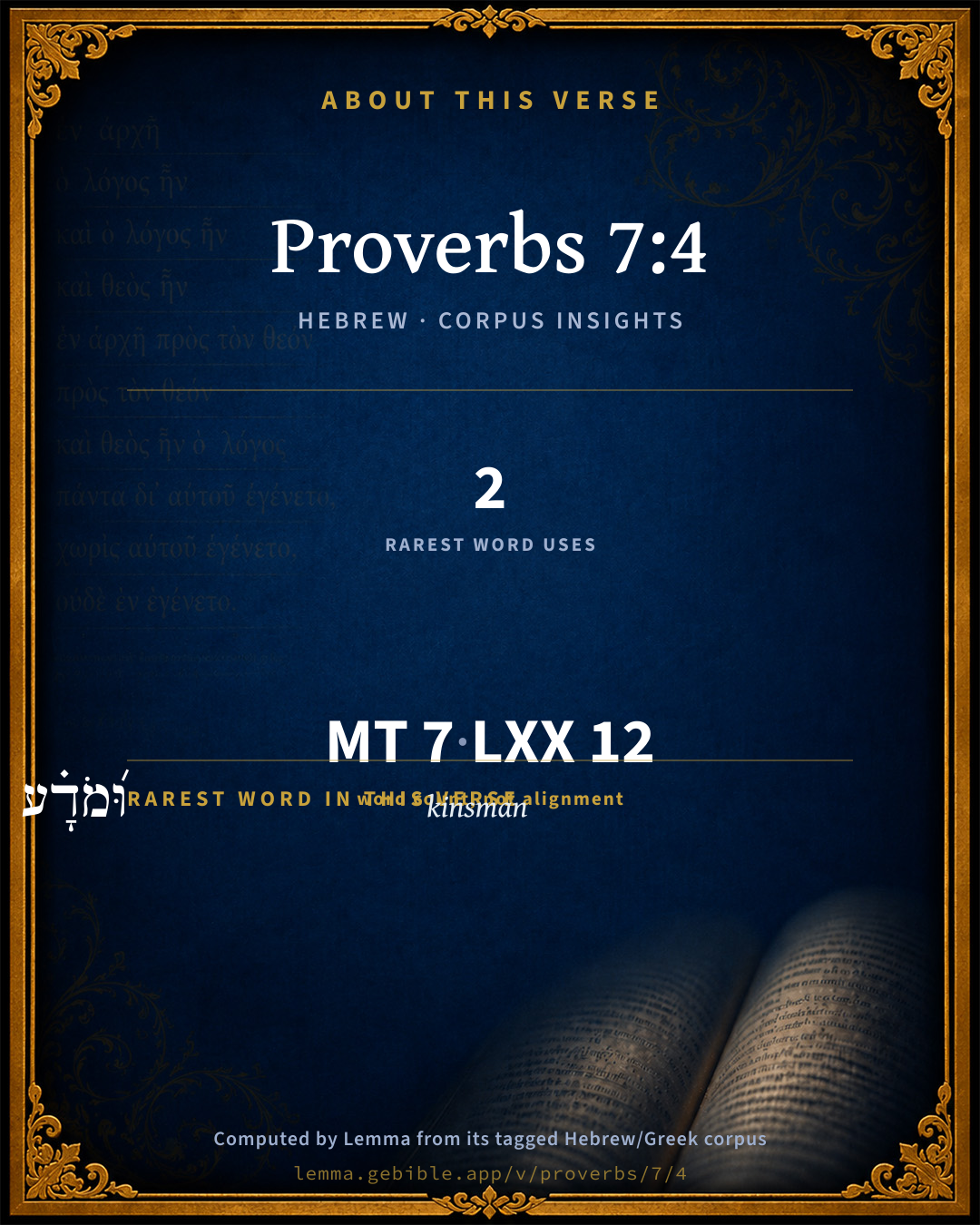
The rarest word here is וּ֝מֹדָ֗ע kinsman H4129 — appearing just 2 times in the whole Hebrew Bible.

Shared distinctive vocabulary

וּ֝מֹדָ֗ע kinsman H4129 occurs in 2 verses of the Hebrew Bible. Also found in:

Grammatical profile

  • 2 verbs
  • 4 nouns
  • 1 pronoun

Verb forms

  • אֱמֹ֣ר Qal · Imperative
  • תִקְרָֽא Qal · Imperfect

Hebrew & Septuagint length

In English translation the verse runs 10 words from the Hebrew and 14 from the Septuagint (LXX English) — the Septuagint runs noticeably longer here. See the side-by-side →

A rough comparison of the two English renderings, which tokenize alike — not a word-level alignment.

Word counts can differ between the Hebrew and the Greek without any difference in meaning — e.g. the Hebrew direct-object marker אֵת has no separate Greek word, and Greek often adds the article ὁ.

In the original languages it is 7 Hebrew tokens and 12 Greek tokens — but the two are counted differently (Hebrew bundles its prefixes and suffixes into one token; the Greek is in lemma form), so that isn’t a like-for-like length.

Cross-references

6

Topical passages linked to Proverbs 7:4 in the Treasury of Scripture Knowledge — connected by theme and wording, ordered by reader-vote popularity; previews shown in the World English Bible.

  • Proverbs 2:2–4 So as to turn your ear to wisdom, And apply your heart to understanding;
  • Proverbs 4:6–8 Don't forsake her, and she will preserve you. Love her, and she will keep you.
  • Job 17:14 If I have said to corruption, 'You are my father;' To the worm, 'My mother,' and 'my sister;'
  • Song of Solomon 8:1 Oh that you were like my brother, Who sucked the breasts of my mother! If I found you outside, I would kiss you; Yes, and no one would despise me.
  • Matthew 12:49–50 He stretched out his hand towards his disciples, and said, "Behold, my mother and my brothers!
  • Luke 11:27–28 It came to pass, as he said these things, a certain woman out of the multitude lifted up her voice, and said to him, "Blessed is the womb that bore you, and the breasts which nursed you!"

Cross-references courtesy of OpenBible.info (CC BY 4.0).

Hebrew and Greek witnesses Masoretic Hebrew ↔ Greek Septuagint

The same verse in the two great witnesses to the Old Testament, shown verse-for-verse.

Here the Septuagint runs noticeably longer than the Hebrew — LXX2012 (modern English Septuagint) 14 words vs World English Bible 10. A rough length comparison of the two English translations, not a word-level alignment — read both below.

These are two independent witnesses, not word-aligned to each other, and the Septuagint is shown in lemma (dictionary) form.

Hebrew Proverbs 7:4 Masoretic · Westminster Leningrad Codex

אֱמֹ֣ר לַֽ֭חָכְמָה אֲחֹ֣תִי אָ֑תְּ וּ֝מֹדָ֗ע לַבִּינָ֥ה תִקְרָֽא

Tell wisdom, "You are my sister." Call understanding your relative,

World English Bible · Public Domain

Greek LXX Proverbs 7:4 Septuagint · lemma form

εἶπον ὁ σοφία σός ἀδελφή εἰμί ὁ δέ φρόνησις γνώριμος περιποιέω σεαυτοῦ

Say that wisdom is your sister, and gain prudence as an acquaintance for yourself;

LXX2012 (modern English Septuagint) · Public Domain

On this verse, The Cambridge Bible for Schools and Colleges discusses the Septuagint’s reading. Read the note in Commentary ↓

Hebrew: Westminster Leningrad Codex (CC BY 4.0). Greek: Septuagint (public domain); English from LXX2012 (modern English Septuagint) (Public Domain). How the Septuagint differs from the Hebrew →

Commentary

Notes on Proverbs 7:4 from classic Christian and Jewish commentators (each source and its license shown beneath its notes). The classic Christian expositions comment on the surrounding passage and are grouped to its opening verse, so a note may address several verses; the Jewish commentaries on the Tanakh (Rashi and others) are per-verse, so they appear only where the commentator wrote on this verse.

Lemma curates 59 commentaries, every one of them public domain or Creative Commons licensed, each selected and text-cleaned for this edition rather than reprinted as found. About our sources →

Trapp's Complete Commentary

John Trapp

Pro 7:4 Say unto wisdom, Thou [art] my sister; and call understanding [thy] kinswoman:

Ver. 4. Say unto wisdom, Thou art my sister,] q.d., If thou must needs have a lady to set thy love upon, let me commend a mistress to thee more amiable and affable than any that thou canst meet with, and that is heavenly wisdom. Say unto her, Thou art my sister, &c. Christ oft woos his spouse by this title, "My sister, my spouse." As the nearest affinity is spouse, so the nearest consanguinity is sister. There are all bonds to knit us to Christ, there shall be all to knit Christ to us, if we fall in with wisdom; this is to become akin to Christ. {Mat 12:50} And that is the truest nobility where God himself is top of the kin, and religion the root, in regard whereof all the rest (riches, retinue, &c.) are but shadows and shapes of nobleness.

Call understanding thy kinswoman,] i.e., Be thoroughly and familiarly acquainted with her. Surely as in nature he is accounted a singular idiot that knows not his own sisters or near kinsfolk, so in religion he is strangely simple and stupid that is not acquainted with the grounds of behaviour and comfort, as they are contained in the word.

John Trapp, A Commentary or Exposition upon All the Books of the Old and New Testament (1647–1656) — public domain. Text from a community e-Sword module.

Keil & Delitzsch

C. F. Keil & F. Delitzsch

The subject-matter of this earnest warning are the admonitions of the teacher of wisdom, and through him of Wisdom herself, who in contrast to the world and its lust is the worthiest object of love, and deserves to be loved with the purest, sincerest love:

4 Say to wisdom: "Thou art my sister!"

And call understanding "Friend;"

5 That they may keep thee from the strange woman,

From the stranger who useth smooth words.

The childlike, sisterly, and friendly relationship serves also to picture forth and designate the intimate confidential relationship to natures and things which are not flesh and blood. If in Arabic the poor is called the brother of poverty, the trustworthy the brother of trustworthiness, and abu, um (אם), achu, ucht, are used in manifold ways as the expression for the interchangeable relation between two ideas; so (as also, notwithstanding Ewald, 273b, in many Hebr. proper names) that has there become national, which here, as at Job 17:14; Job 30:29, mediated by the connection of the thoughts, only first appears as a poetic venture. The figurative words of Pro 7:4 not merely lead us to think of wisdom as a personal existence of a higher order, but by this representation it is itself brought so near, that אם easily substitutes itself, Pro 2:3, in the place of אם. אחתי of Solomon's address to the bride brought home is in its connection compared with Book of Wisdom 8:2. While the ôth of אחות by no means arises from abstr. ûth, but achôth is derived from achajath, מודע (as Rut 2:1, cf. מודעת, Pro 3:2), here by Mugrash מודע, properly means acquaintance, and then the person known, but not in the superficial sense in which this word and the Arab. ma'arfat are used (e.g., in the Arabic phrase quoted by Fleischer, kanna aṣḥaab ṣarna m'aaraf - nous tions amis, nous en sommes plus que de simples connaissances), but in the sense of familiar, confidential alliance. The infin. לשׁמרך does not need for its explanation some intermediate thought to be introduced: quod eo conducet tibi ut (Mich.), but connects itself immediately as the purpose: bind wisdom to thyself and thyself to wisdom thus closely that thou mayest therewith guard thyself. As for the rest, vid., Pro 2:16; this verse repeats itself here with the variation of one word.

Keil & Delitzsch — Biblical Commentary on the Old Testament (1861–1891) — public domain (CC PDM 1.0). Text via the HelloAO Bible API. (Old Testament only.)

Tyndale Open Study Notes

Tyndale Open Resources

7:4 In Hebrew, sister is a term of endearment that expresses intimacy (see Song 4:9-10).

Tyndale Open Study Notes — © Tyndale Open Resources, licensed CC BY-SA 4.0. Text via the HelloAO Bible API.

Adam Clarke's Commentary

Verse 4. Thou art my sister] Thou art my dearest friend, and I will treat thee as such.

Adam Clarke's Commentary on the Bible (1810–1826) — public domain. Text from a community e-Sword/MySword module.

The Cambridge Bible for Schools and Colleges

gen. ed. J. J. S. Perowne

4. kinswoman] Lit. known, i.e. acquaintance, or intimate friend, γνώριμος, LXX.; amica, Vulg. In the only two other places, however, in which the word occurs (Rth_2:1; Rth_3:2) it is used in the sense of kinsman. Comp. Job_17:14.

The Cambridge Bible for Schools and Colleges (gen. ed. J. J. S. Perowne; Cambridge University Press, 1878–1918) — public domain. Text from a community e-Sword module.

John Gill's Exposition

Say unto wisdom, Thou art my sister,.... Intimately acquainted, greatly beloved, and highly delighted in: this may be understood both of the Gospel, the wisdom of God in a mystery, which men should be conversant with, be strongly affected to, and take delight and pleasure in; and of Christ, the essential Wisdom of God, and who stands in the relation of a brother to his people, and should be respected as such;

and call understanding thy kinswoman; or "kinsman" (a); such Christ is in our nature, our "goel", our near kinsman, partaker of the same flesh and blood, and therefore is not ashamed to call us brethren, nor should we be ashamed to call him kinsman: moreover, his Word and Gospel, and the understanding of it, should be familiar to us; it should be well "known" (b) by us, as the word used signifies, and dwell richly in us.

(a) "cognatum", Piscator. (b) "Notam", Montanus, Michaelis.

John Gill's Exposition of the Whole Bible (1746–1763) — public domain (CC PDM 1.0). Text via the HelloAO Bible API.

Matthew Poole's English Annotations

When other foolish young men seek wanton mistresses, whom they frequently call

sisters or

kinswomen, let wisdom be thy mistress; acquaint and delight thyself with her, and let her have the command of thy heart, and the conduct of thy life.

Matthew Poole's English Annotations on the Holy Bible (1683–1685) — public domain. Text from a community e-Sword/MySword module.

Whedon's Commentary on the Bible

Daniel D. Whedon

4. My sister… kinswoman — Or familiar acquaintance; that is, respect, love, and cherish her. Cp. Job_17:14; Job_30:29; also, Psa_55:13; Psa_88:8.

Daniel D. Whedon (gen. ed.), Commentary on the Old and New Testaments (1874–1909) — public domain. Text from a community e-Sword module.

The Pulpit Commentary

Vers. 4 and 5 contain earnest admonitions to the pursuit of Wisdom, which is worthy of the purest love.

Say unto Wisdom, Thou art my sister. Wisdom is personified, and the connection with her indicated by the relationship which best expresses love, purity, confidence. In the Book of Wisdom 8 she is represented as wife. Christ calls those who do God"s will his brother, and sister, and mother. (Mat_12:50) Call Understanding thy kinswoman; moda, "familiar friend." Let prudence and sound sense be as dear to thee as a close friend.

The Pulpit Commentary (1880–1919), ed. H.D.M. Spence-Jones & Joseph S. Exell — public domain. Text from a community e-Sword module.

John Wesley's Explanatory Notes

And call - Acquaint and delight thyself with her.

John Wesley, Explanatory Notes Upon the Whole Bible (1754–1765) — public domain. Text via the GEBible commentary corpus.

unfoldingWord translationNotes

Door43 World Missions Community

Say to wisdom, "You are my sister

Here wisdom is spoken of as if it were a person. AT: "Value wisdom as you would love your sister" (See: Personification)

call understanding your kinsman

Here the quality of understanding is spoken of as if it were a kinsman or relative. AT: "treat understanding as you would treat your kinsman" (See: Personification)

kinsman

"relative" or "family member"

the adulterous woman

This refers to any woman to whom a man is not married. AT: "the woman whom you should have nothing to do with"

the immoral woman

This refers to any woman who is not known to a man.

with her smooth words

Words intended to deceive are spoken of as if they were smooth objects. AT: "who says pleasant things, but wants to deceive you"

translationWords

wise

word

unfoldingWord translationNotes — © Distant Shores Media and the Door43 World Missions Community, licensed CC BY-SA 4.0. Source: git.door43.org/Door43/en_tn.

Rashi

Rabbi Shlomo Yitzchaki (Rashi)

“You are my sister” (Draw her near to you.)

a kinsman Heb. מדע, a kinsman, as in (Ruth 3: 2): “Boaz our kinsman (מדעתנו),” our close relative; i.e., draw her near to you always.

Rashi on the Tanakh — English translations: “The Judaica Press complete Tanach with Rashi, translated by A. J. Rosenberg” (CC BY 4.0); “Pentateuch with Rashi's commentary by M. Rosenbaum and A.M. Silbermann, 1929-1934” (public domain); “The Metsudah Tanach series, Lakewood, N.J” (CC BY 4.0); and “The Book of Joshua, Metsudah Publications, 1997” (CC BY 4.0). Text via Sefaria.

Lesson kit

Teaching starters — assembled from the data on this page, not authored interpretation. Every prompt links to the verse data it draws on. Edit before teaching.

Proverbs, in the Wisdom, opens this verse with 7 words (7 distinct Hebrew lemmas). Its most distinctive word is môwdaʻ (“kinsman”). The Greek Septuagint runs longer here. A historical commentator’s framing appears above. Read the whole chapter for the surrounding context.

Discussion questions

  1. How does “kinsman” (môwdaʻ) shape what this verse is saying?
  2. Ruth 2:1 shares the word «kinsman» with this verse. How do the two illuminate each other?
  3. Compared with the Hebrew, the Septuagint runs longer here. What questions does that raise?
  4. These translations render this verse differently; the difference is in the English rendering, not the original. What questions does that raise?
  5. The verb «אֱמֹ֣ר» is Qal Imperative. How does its form color the action?
  6. Reading how Trapp's Complete Commentary and Keil & Delitzsch read this verse, where do the two commentators agree and where do they part?

Things to notice

Reading settings

Reading text

Shown beneath each verse's original-language words.

Old Testament
Old Testament edition

Read the OT as the Masoretic Hebrew (MT) or the Greek Septuagint (LXX).

English shown for the Greek Septuagint (in the Hebrew ↔ Greek comparison).

Comparing translations? Open the Compare panel on any verse page to stack up to four side by side.