
Ezekiel 16:45

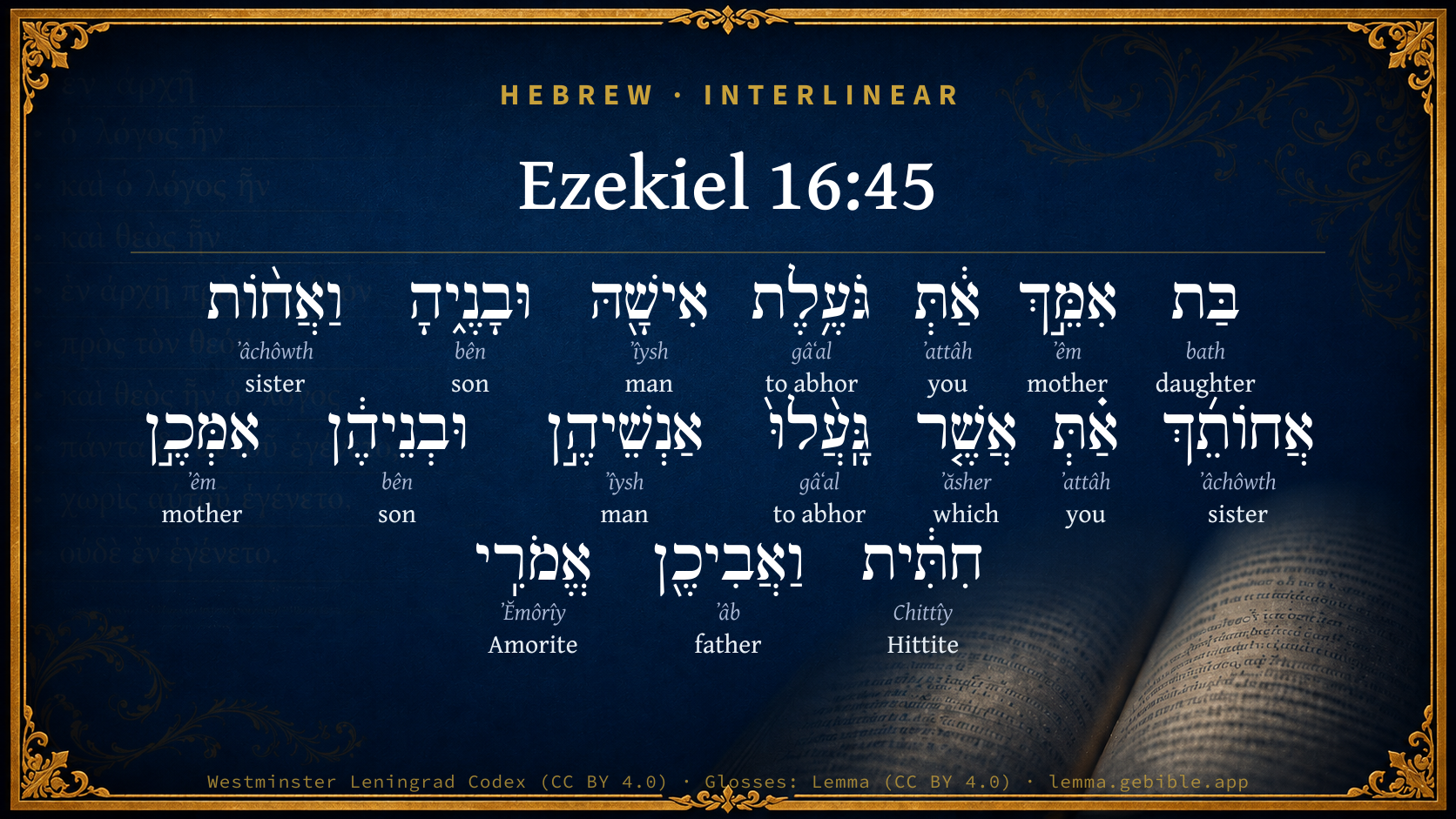
Hebrew (Westminster Leningrad Codex) Ezekiel 16:45 appears in the Hebrew Old Testament. The text above is from the Westminster Leningrad Codex. Each word links to its Strong’s number, a concise gloss, and parsing drawn from the Open Scriptures Hebrew Bible morphology. Click any word for its full Brown-Driver-Briggs (BDB) entry.
Download image
Cite this verse

Ezekiel 16:45 (World English Bible). Public Domain. Lemma interlinear Bible study tool, https://lemma.gebible.app/v/ezekiel/16/45.

Show BibTeX & RIS
BibTeX
RIS
English Translation
You are the daughter of your mother, who loathes her husband and her children; and you are the sister of your sisters, who loathed their husbands and their children: your mother was a Hittite, and your father an Amorite.
World English Bible · Public Domain
Download a study sheet

One document with this verse’s original text, its word-by-word gloss line, the meaning frame, cross-references with their text, attributed commentary, and full source and license credits — printable, and it pastes into notes with its structure intact.

This verse Autodidact and up

Study sheet (.html) Plain text (.txt)

A passage Seminary Student

Up to 50 verses in one chapter. A passage sheet keeps up to 6 commentary sources and 12 cross-references per verse, in the order this page ranks them, and says so on the sheet whenever that leaves anything out. Ask for a single verse and you get the Autodidact verse sheet above.

Everything on this page stays free to read, with no account — the sheet is a download of what is already on screen, not access to it.

Want to remove ads? Support Godless Engineer
Compare translations 3

The same verse in 3 English versions, stacked beneath the original-language interlinear above. Click any original word for its lexicon entry.

Each is an independent rendering of the whole verse — the interlinear is not word-aligned to these translations.

Highlighted words mark where these versions differ — a whole-verse word diff, not a word-by-word alignment.

  • World English Bible Public Domain
    You are the daughter of your mother, who loathes her husband and her children; and you are the sister of your sisters, who loathed their husbands and their children: your mother was a Hittite, and your father an Amorite.
  • King James Version Public Domain
    Thou art thy mother's daughter, that lotheth her husband and her children; and thou art the sister of thy sisters, which lothed their husbands and their children: your mother was an Hittite, and your father an Amorite.
  • unfoldingWord Literal Text CC BY-SA 4.0
    You are the daughter of your mother, who detested her husband and her children, and you are the sister of your sisters who detested their husbands and their children. Your mother was a Hittite, and your father was an Amorite.

unfoldingWord Literal Text — © unfoldingWord, licensed CC BY-SA 4.0. Word-aligned USFM3 via Door43 (git.door43.org/unfoldingWord/en_ult).

Versions to compare (up to 4)

3 of 4 selected

Show all 18 translations

Every available English version of this verse, each an independent rendering of the whole verse.

  • World English Bible Public Domain
    You are the daughter of your mother, who loathes her husband and her children; and you are the sister of your sisters, who loathed their husbands and their children: your mother was a Hittite, and your father an Amorite.
  • Berean Standard Bible Public Domain
    You are the daughter of your mother, who despised her husband and children. You are the sister of your sisters, who despised their husbands and children. Your mother was a Hittite and your father an Amorite.
  • Majority Standard Bible Public Domain
    You are the daughter of your mother, who despised her husband and children. You are the sister of your sisters, who despised their husbands and children. Your mother was a Hittite and your father an Amorite.
  • King James Version Public Domain
    Thou art thy mother's daughter, that lotheth her husband and her children; and thou art the sister of thy sisters, which lothed their husbands and their children: your mother was an Hittite, and your father an Amorite.
  • American Standard Version (1901) Public Domain
    Thou art the daughter of thy mother, that loatheth her husband and her children; and thou art the sister of thy sisters, who loathed their husbands and their children: your mother was a Hittite, and your father an Amorite.
  • Revised Version (1885) Public Domain
    Thou art thy mother’s daughter, that loatheth her husband and her children; and thou art the sister of thy sisters, which loathed their husbands and their children: your mother was an Hittite, and your father an Amorite.
  • Geneva Bible (1599) Public Domain
    Thou art thy mothers daughter, that hath cast off her husband and her children, and thou art the sister of thy sisters, which forsooke their husbands and their children: your mother is an Hittite, and your father an Amorite.
  • Douay-Rheims (1899) Public Domain
    Thou art thy mother's daughter, that cast off her husband, and her children: and thou art the sister of thy sisters, who cast off their husbands, and their children: your mother was a Cethite, and your father an Amorrhite.
  • Young's Literal Translation Public Domain
    Thy mother's daughter thou `art', Loathing her husband and her sons, And thy sisters' sister thou `art', Who loathed their husbands and their sons, Your mother `is' a Hittite, and your father an Amorite.
  • Literal Standard Version CC BY-SA 4.0
    You [are] your mother’s daughter, || Loathing her husband and her sons, || And you [are] your sisters’ sister, || Who loathed their husbands and their sons, || Your mother [is] a Hittite, and your father an Amorite.
  • Unlocked Literal Bible CC BY-SA 4.0
    You are the daughter of your mother, who detested her husband and her children, and you are the sister of your sisters who detested their husbands and their children. Your mother was a Hittite, and your father was an Amorite.
  • unfoldingWord Literal Text CC BY-SA 4.0
    You are the daughter of your mother, who detested her husband and her children, and you are the sister of your sisters who detested their husbands and their children. Your mother was a Hittite, and your father was an Amorite.
  • Darby Bible Public Domain
    Thou art the daughter of thy mother that loathed her husband and her children; and thou art the sister of thy sisters, who loathed their husbands and their children. Your mother was a Hittite, and your father an Amorite.
  • World Messianic Bible Public Domain
    You are the daughter of your mother, who loathes her husband and her children; and you are the sister of your sisters, who loathed their husbands and their children. Your mother was a Hittite, and your father an Amorite.
  • Webster's Bible Public Domain
    Thou art thy mother's daughter, that lotheth her husband and her children; and thou art the sister of thy sisters, who lothed their husbands and their children: your mother was a Hittite, and your father an Amorite.
  • Free Bible Version CC BY-SA 4.0
    You are the daughter of your mother who detested her husband and children. You are just like her! You are the sister of your sisters, just like them who detested their husbands and children. In fact your mother was a Hittite and your father was an Amorite.
  • Bible in Basic English Public Domain
    You are the daughter of your mother whose soul is turned in disgust from her husband and her children; and you are the sister of your sisters who were turned in disgust from their husbands and their children: your mother was a Hittite and your father an Amorite.
  • JPS Tanakh (1917) Public Domain
    Thou art thy mother's daughter, that loatheth her husband and her children; and thou art the sister of thy sisters, who loathed their husbands and their children; your mother was a Hittite, and your father an Amorite.

Literal Standard Version (2020), Covenant Press — licensed CC BY-SA 4.0. Text via the HelloAO Bible API (eBible.org). Unlocked Literal Bible (unfoldingWord) — licensed CC BY-SA 4.0. Text via the HelloAO Bible API (eBible.org). unfoldingWord Literal Text — © unfoldingWord, licensed CC BY-SA 4.0. Word-aligned USFM3 via Door43 (git.door43.org/unfoldingWord/en_ult). Free Bible Version, Dr. Jonathan Gallagher — licensed CC BY-SA 4.0. Text via the HelloAO Bible API (eBible.org).

Word by word

More ways to search: Search by grammar → Find every occurrence → Compare this word →

Practice this passage: Drill this verse → Learn its vocabulary →

גֹּעֶ֥לֶת
gâʻal
H1602
“abhoring”
Verb, Qal, Participle Active, Feminine, Singular, Absolute
Part of Speech
Verb
Stem
Qal
Form
Participle Active
Gender
Feminine
Number
Singular
State
Absolute
Full BDB Definition

Origin: a primitive root

TWOT: 369

to abhor, loathe, be vilely cast away, fall - (Qal) to abhor, loathe - (Niphal) to be defiled - (Hiphil) to reject as loathsome, show aversion
  1. בַּת bath H1323 “daughter of” Noun, Common, Feminine, Singular, Construct
  2. אִמֵּ֣ךְ ʼêm H517 “mother · your” Noun, Common, Feminine, Singular, Construct + Suffix, Personal, 2nd Person, Feminine, Singular
  3. אַ֔תְּ ʼattâh H859 “you” Pronoun, Personal, 2nd Person, Feminine, Singular
  4. אִישָׁ֖הּ ʼîysh H376 “man · her” Noun, Common, Masculine, Singular, Construct + Suffix, Personal, 3rd Person, Feminine, Singular
  5. וּבָנֶ֑יהָ bên H1121 “and · sons · her” Conjunction + Noun, Common, Masculine, Plural, Construct + Suffix, Personal, 3rd Person, Feminine, Singular
  6. וַאֲח֨וֹת ʼâchôwth H269 “and · sister of” Conjunction + Noun, Common, Feminine, Singular, Construct
  7. אֲחוֹתֵ֜ךְ ʼâchôwth H269 “sister · your” Noun, Common, Feminine, Singular, Construct + Suffix, Personal, 2nd Person, Feminine, Singular
  8. אַ֗תְּ ʼattâh H859 “you” Pronoun, Personal, 2nd Person, Feminine, Singular
  9. אֲשֶׁ֤ר ʼăsher H834 “which” Particle, Relative
  10. גָּֽעֲ֨לוּ֙ gâʻal H1602 “to abhor” Verb, Qal, Perfect, 3rd Person, Common, Plural
  11. אַנְשֵׁיהֶ֣ן ʼîysh H376 “men · their” Noun, Common, Masculine, Plural, Construct + Suffix, Personal, 3rd Person, Feminine, Plural
  12. וּבְנֵיהֶ֔ן bên H1121 “and · sons · their” Conjunction + Noun, Common, Masculine, Plural, Construct + Suffix, Personal, 3rd Person, Feminine, Plural
  13. אִמְּכֶ֣ן ʼêm H517 “mother · your” Noun, Common, Feminine, Singular, Construct + Suffix, Personal, 2nd Person, Feminine, Plural
  14. חִתִּ֔ית Chittîy H2850 “Hittite” Noun, Gentilic, Feminine, Singular, Absolute
  15. וַאֲבִיכֶ֖ן ʼâb H1 “and · father · your” Conjunction + Noun, Common, Masculine, Singular, Construct + Suffix, Personal, 2nd Person, Feminine, Plural
  16. אֱמֹרִֽי ʼĔmôrîy H567 “Amorite” Noun, Gentilic, Masculine, Singular, Absolute

About this verse

These counts appear in no published source. They are computed here, from the morphology-tagged text and Lemma’s own curated glosses. What Lemma adds →

17
words
11
distinct lemmas
Prophets
section

Notable vocabulary

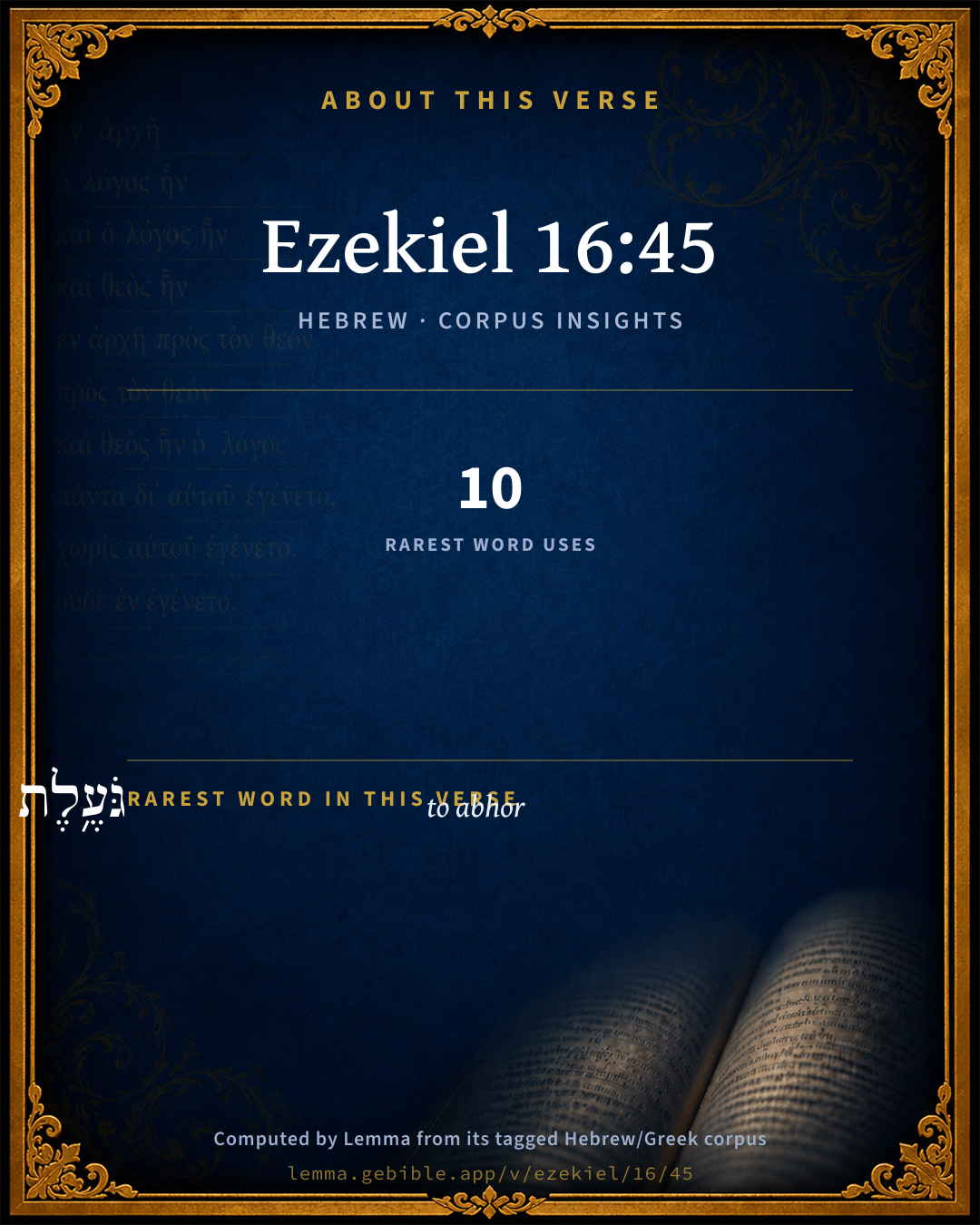
The rarest word here is גֹּעֶ֥לֶת to abhor H1602 — appearing just 10 times in the whole Hebrew Bible.

Shared distinctive vocabulary

גֹּעֶ֥לֶת to abhor H1602 occurs in 9 verses of the Hebrew Bible. Also found in:

Grammatical profile

  • 2 verbs
  • 12 nouns
  • 2 pronouns
  • 1 particle

Verb forms

  • גֹּעֶ֥לֶת Qal · Participle Active
  • גָּֽעֲ֨לוּ֙ Qal · Perfect

Repetition

Words recur within this verse — often emphatic in Hebrew:

  • אִמֵּ֣ךְ mother H517 ×2
  • גֹּעֶ֥לֶת to abhor H1602 ×2
  • אִישָׁ֖הּ man H376 ×2
  • וּבָנֶ֑יהָ son H1121 ×2
  • וַאֲח֨וֹת sister H269 ×2
  • אַ֔תְּ you H859 ×2

Hebrew & Septuagint length

In English translation the verse runs 39 words from the Hebrew and 43 from the Septuagint (LXX English) — closely comparable.

A rough comparison of the two English renderings, which tokenize alike — not a word-level alignment.

Word counts can differ between the Hebrew and the Greek without any difference in meaning — e.g. the Hebrew direct-object marker אֵת has no separate Greek word, and Greek often adds the article ὁ.

Cross-references

10

Topical passages linked to Ezekiel 16:45 in the Treasury of Scripture Knowledge — connected by theme and wording, ordered by reader-vote popularity; previews shown in the World English Bible.

  • Isaiah 1:4 Ah sinful nation, A people loaded with iniquity, A seed of evil-doers, Children who deal corruptly! They have forsaken Yahweh. They have despised the Holy One of Israel. They are estranged and backward.
  • Zechariah 11:8 I cut off the three shepherds in one month; for my soul was weary of them, and their soul also loathed me.
  • Deuteronomy 12:31 You shall not do so to Yahweh your God: for every abomination to Yahweh, which he hates, have they done to their gods; for even their sons and their daughters do they burn in the fire to their gods.
  • Ezekiel 16:8 Now when I passed by you, and looked at you, behold, your time was the time of love; and I spread my skirt over you, and covered your nakedness: yes, I swore to you, and entered into a covenant with you, says the Lord Yahweh, and you became mine.
  • Ezekiel 16:15 But you did trust in your beauty, and played the prostitute because of your renown, and poured out your prostitution on everyone who passed by; his it was.
  • Ezekiel 23:2 Son of man, there were two women, the daughters of one mother:
  • Ezekiel 23:37–39 For they have committed adultery, and blood is in their hands; and with their idols have they committed adultery; and they have also caused their sons, whom they bore to me, to pass through [the fire] to them to be devoured.
  • Romans 1:30–31 backbiters, hateful to God, insolent, haughty, boastful, inventors of evil things, disobedient to parents,
  • Deuteronomy 5:9 you shall not bow down yourself to them, nor serve them; for I, Yahweh, your God, am a jealous God, visiting the iniquity of the fathers on the children, and on the third and on the fourth generation of those who hate me;
  • Ezekiel 16:20–21 Moreover you have taken your sons and your daughters, whom you have borne to me, and these have you sacrificed to them to be devoured. Were your prostitution a small matter,

Cross-references courtesy of OpenBible.info (CC BY 4.0).

Hebrew and Greek witnesses Masoretic Hebrew ↔ Greek Septuagint

The same verse in the two great witnesses to the Old Testament, shown verse-for-verse.

These are two independent witnesses, not word-aligned to each other, and the Septuagint is shown in lemma (dictionary) form.

Hebrew Ezekiel 16:45 Masoretic · Westminster Leningrad Codex

בַּת אִמֵּ֣ךְ אַ֔תְּ גֹּעֶ֥לֶת אִישָׁ֖הּ וּבָנֶ֑יהָ וַאֲח֨וֹת אֲחוֹתֵ֜ךְ אַ֗תְּ אֲשֶׁ֤ר גָּֽעֲ֨לוּ֙ אַנְשֵׁיהֶ֣ן וּבְנֵיהֶ֔ן אִמְּכֶ֣ן חִתִּ֔ית וַאֲבִיכֶ֖ן אֱמֹרִֽי

You are the daughter of your mother, who loathes her husband and her children; and you are the sister of your sisters, who loathed their husbands and their children: your mother was a Hittite, and your father an Amorite.

World English Bible · Public Domain

Greek LXX Ezekiel 16:45 Septuagint · lemma form

θυγάτηρ ὁ μήτηρ σύ σύ εἰμί ὁ ἀποὠθέω ὁ ἀνήρ αὐτός καί ὁ τέκνον αὐτός καί ἀδελφή ὁ ἀδελφός σύ ὁ ἀποὠθέω ὁ ἀνήρ αὐτός καί ὁ τέκνον αὐτός ὁ μήτηρ σύ χετταία καί ὁ πατήρ σύ ἀμορραῖος

As is the mother, so is your mother's daughter: you are she that has rejected her husband and her children; and the sisters of your sisters have rejected their husbands and their children: your mother was a Chettite, and your father an Amorite.

LXX2012 (modern English Septuagint) · Public Domain

Hebrew: Westminster Leningrad Codex (CC BY 4.0). Greek: Septuagint (public domain); English from LXX2012 (modern English Septuagint) (Public Domain). How the Septuagint differs from the Hebrew →

Targum (Aramaic paraphrase)

1

The Targum is the ancient Jewish Aramaic paraphrase of the Hebrew Scriptures — an interpretive translation, not the Hebrew text itself. Onkelos (literal) and Pseudo-Jonathan (expansive) render the Torah, and Jonathan the Prophets. Coverage is partial: where no permissively-licensed English translation exists for a verse, only the Aramaic is shown. This is verse-level text, not a word-by-word alignment to the Hebrew.

  1. Targum Jonathan Prophets (Joshua–Malachi)
    לְמָה הֲוֵית בְּרַתָּא לְאַרְעָא דִכְנַעַן לְמֶעֱבַּד כְּעוֹבָדֵי עַמָא דְאִיתְרַבּוּ אֲבָהָן עִם בְּנִין וַאֲחָתָא לִסְדוֹם וַעֲמוֹרָה דְאִישְׁתֵּיצֵי עִמְהוֹן אַבָהָן עִם בְּנִין הֲלָא אִמְכוֹן שָׂרָה בֵּינֵי חִתָּאֵי הֲוַת וְלָא עַבְדַת כְּעוֹבָדֵיהוֹן וַאֲבוּכוֹן אַבְרָהָם בֵּינֵי אֱמוֹרָאֵי וְלָא הֲלֵיךְ בְּעֵיצַתְהוֹן:

    (no public-domain English translation for this verse)

    Targum Jonathan — Aramaic: “Mikraot Gedolot” (public domain). English: “Sefaria Community Translation” (CC0 1.0 (public-domain dedication)); “London "Chaldee Paraphrase," 1871” (public domain). Text via Sefaria.

Commentary

Notes on Ezekiel 16:45 from classic Christian and Jewish commentators (each source and its license shown beneath its notes). The classic Christian expositions comment on the surrounding passage and are grouped to its opening verse, so a note may address several verses; the Jewish commentaries on the Tanakh (Rashi and others) are per-verse, so they appear only where the commentator wrote on this verse.

Lemma curates 59 commentaries, every one of them public domain or Creative Commons licensed, each selected and text-cleaned for this edition rather than reprinted as found. About our sources →

Trapp's Complete Commentary

John Trapp

Eze 16:45 Thou [art] thy mother’s daughter, that lotheth her husband and her children; and thou [art] the sister of thy sisters, which lothed their husbands and their children: your mother [was] an Hittite, and your father an Amorite.

Ver. 45. Thou art thy mother’s daughter.] As like her as if spat out of her mouth; so like her, that thou art the worse again.

Your mother was an Hittite.] And doth therefore seek her daughter in the oven, because she had first been there herself. See Eze 16:3.

John Trapp, A Commentary or Exposition upon All the Books of the Old and New Testament (1647–1656) — public domain. Text from a community e-Sword module.

Geneva Bible (1599)

Geneva Bible translators

That is, of Samaria and Sodom.

Geneva Bible (1599) marginal notes — public domain. Text via Bolls.life.

Jamieson, Fausset & Brown

Robert Jamieson, A. R. Fausset & David Brown

mother's . . . that loatheth her husband--that is, God ("haters of God," Rom 1:30); therefore the knowledge of the true God had originally been in Canaan, handed down from Noah (hence we find Melchisedek, king of Salem, in Canaan, "priest of the most high God," Gen 14:18), but Canaan apostatized from it; this was what constituted the blackness of the Canaanites' guilt.

loathed . . . children--whom she put to death in honor of Saturn; a practice common among the Phœnicians.

sister of thy sisters--Thou art akin in guilt to Samaria and Sodom, to which thou art akin by birth. Moab and Ammon, the incestuous children of Lot, nephew of Abraham, Israel's progenitor, had their origin from Sodom; so Sodom might be called Judah's sister. Samaria, answering to the ten tribes of Israel, is, of course, sister to Judah.

Jamieson, Fausset & Brown — Commentary Critical and Explanatory on the Whole Bible (1871) — public domain (CC PDM 1.0). Text via the HelloAO Bible API.

Ellicott's Commentary for English Readers

(45) Which lothed their husbands.—Israel, like Samaria and Sodom, being spiritually of Amorite and Hittite descent, they are represented as her sisters. A certain difficulty arises from the statement that they, too, “lothed their husbands and their children,” and this is only removed by remembering that, notwithstanding their heathenism and long course of idolatry, they are still regarded as having gone astray from primeval revelation, and proved false to the only true God whom they once had known.

A Bible Commentary for English Readers, edited by Charles John Ellicott (1878–1897) — public domain. Text from a community e-Sword module.

The Cambridge Bible for Schools and Colleges

gen. ed. J. J. S. Perowne

45. that lotheth her husband] In the sense of the allegory “lothing her husband” should mean changing her god for another; and in the case of Jerusalem and Samaria the charge is intelligible, Jehovah being the husband (ch. 23). But such a charge could hardly be made against the Canaanites, the Hittite mother and Sodom (Jer_2:11). The prophet appears to desert the allegory, introducing real features into his description, and referring to actual adultery and unfaithfulness, which were characteristic of the Canaanite nations. Another interpretation, as old as Theodoret, considers Jehovah to be the “husband” even of the Hittite mother, heathen idolatries being infidelity to the true God. Such a reflexion is not natural to a prophet of this age, though a similar idea occurred to St Paul (Romans 1). At the same time this prophet predicts the restoration of Sodom and its union to the people of the Lord. Cornill, considering the difficulties of interpretation as insuperable, strikes out the words as a gloss.

sister of thy sisters] The sisters of Jerusalem were Samaria and Sodom, and she had a genuine family likeness to them.

your mother] Your (plur.) refers to the three sisters.

The Cambridge Bible for Schools and Colleges (gen. ed. J. J. S. Perowne; Cambridge University Press, 1878–1918) — public domain. Text from a community e-Sword module.

John Gill's Exposition

And thine elder sister is Samaria,.... The metropolis of the ten tribes; "sister" to the Jews, because of the same descent, having one and the same father; the "elder" or "greater" (x), because more in number and power; the kingdom of Israel consisted of ten tribes, and the kingdom of Judah but of two; and the ten tribes also were the first in the apostasy from the true worship of God:

she and her daughters that dwell at thy left hand; as Samaria the sister was the metropolis of the ten tribes, her daughters are the other cities and towns belonging thereunto; and so the Targum renders it, she and her villages; these were situated to the north of the land of Israel, as Judah was to the south, which with the Jews were left and right; as a man standing with his face to the east has the north on his left and the south on his right side:

and thy younger sister, that dwelleth at thy right hand, is Sodom and her daughters; where Lot the kinsman of Abraham lived, and from whom sprung the Ammonites and Moabites. Sodom was a lesser kingdom than that of Judah, and which lay to the south; that is, to the right of it; even that and the other cities, which perished with it, called her daughters, as Admah, Zeboim, &c.

(x) "major", V. L. Pagninus, Junius & Tremellius, Piscator, Cocceius.

John Gill's Exposition of the Whole Bible (1746–1763) — public domain (CC PDM 1.0). Text via the HelloAO Bible API.

Matthew Poole's English Annotations

Thou, the nation of the Jews,

art thy mother’s daughter; as much for her vicious inclinations, as for thy original derived from her, the most wicked daughter of as wicked a mother.

That loatheth; that was weary of the best Husband, that while she doted on abominable adulterers, did most contemptuously disregard her Husband, and forsake him. Other lewd women have had some love for their children, because born of them, bred by them, and resembling them; so much of the mother was in the children, that some adulteresses have loved themselves in the children; but here is a loose woman, an unnatural beast, that loathes her own flesh, persecuting such as are constant to the law of God their Father, and murdering others in sacrifice to devils.

The sister of thy sisters: it runs in the blood; as the mother, so the sisters, loved and doted on strange flesh, were as inordinate in their affections to others, as they were in their disaffection to their own husbands and children.

Your mother: see Eze 16:3. He speaks of them collectively, and as the greatest part were.

Matthew Poole's English Annotations on the Holy Bible (1683–1685) — public domain. Text from a community e-Sword/MySword module.

The Pulpit Commentary

Ezekiel returns to the thought of the spiritual parentage of Jerusalem and Judah, as in ver. 3. Reading between the lines, we find something like an anticipation of St. Paul"s thought that Jehovah was the God of the Gentiles as well as of the Jews. (Rom_3:29) The Hittites and Sodom and Samaria, to whom she is compared, had all alike been guilty of unfaithfulness to their husbands. Their idolatry was therefore, like hers, an act of apostasy. Jehovah was their husband also, their children were his children (ver. 21). He claimed them as his own, had entered with them also into a relation which, though less close than that with Israel, was as that of the husband to the wife. The thought expands, as we shall see, in the sequel of the chapter.

The Pulpit Commentary (1880–1919), ed. H.D.M. Spence-Jones & Joseph S. Exell — public domain. Text from a community e-Sword module.

John Wesley's Explanatory Notes

Thou - The nation of the Jews. Thy mother's daughter - As much in thy inclinations, as for thy original. Loatheth - That was weary of the best husband.

John Wesley, Explanatory Notes Upon the Whole Bible (1754–1765) — public domain. Text via the GEBible commentary corpus.

Rashi

Rabbi Shlomo Yitzchaki (Rashi)

your mother’s daughter The nation of Canaan, whose land you inherited.

spewing forth her husband and her children Who so increased their abominations that the land spewed forth its inhabitants, the fathers and the children together.

and you are your sister’s sister Sodom, which is next to the land of Israel.

your mother was a Hittite, etc. Jonathan renders: Is it not so that your mother Sarah was among the Hittites, yet did not do as their deeds, and your father Abraham was among the Amorites, yet did not follow their counsel!

Rashi on the Tanakh — English translations: “The Judaica Press complete Tanach with Rashi, translated by A. J. Rosenberg” (CC BY 4.0); “Pentateuch with Rashi's commentary by M. Rosenbaum and A.M. Silbermann, 1929-1934” (public domain); “The Metsudah Tanach series, Lakewood, N.J” (CC BY 4.0); and “The Book of Joshua, Metsudah Publications, 1997” (CC BY 4.0). Text via Sefaria.

Lesson kit

Teaching starters — assembled from the data on this page, not authored interpretation. Every prompt links to the verse data it draws on. Edit before teaching.

Ezekiel, in the Prophets, opens this verse with 17 words (11 distinct Hebrew lemmas). Its most distinctive word is gâʻal (“to abhor”). A historical commentator’s framing appears above. Read the whole chapter for the surrounding context.

Discussion questions

  1. The word gâʻal carries the sense “to abhor.” How does it shape the verse?
  2. How does Leviticus 26:11, which shares the word «to abhor», read alongside this verse?
  3. What does the repetition of “mother” (2× in this one verse) do in this verse?
  4. The translations on this page render this verse differently — a whole-verse word diff, not a word-by-word alignment. What might account for the different wordings?
  5. «גֹּעֶ֥לֶת» is a Qal Participle Active verb. How does that grammatical form shape the action described?
  6. Compare how Trapp's Complete Commentary and Geneva Bible (1599) read this verse. Where do they agree or differ?

Things to notice

Reading settings

Reading text

Shown beneath each verse's original-language words.

Old Testament
Old Testament edition

Read the OT as the Masoretic Hebrew (MT) or the Greek Septuagint (LXX).

English shown for the Greek Septuagint (in the Hebrew ↔ Greek comparison).

Comparing translations? Open the Compare panel on any verse page to stack up to four side by side.