1 Chronicles 4:3

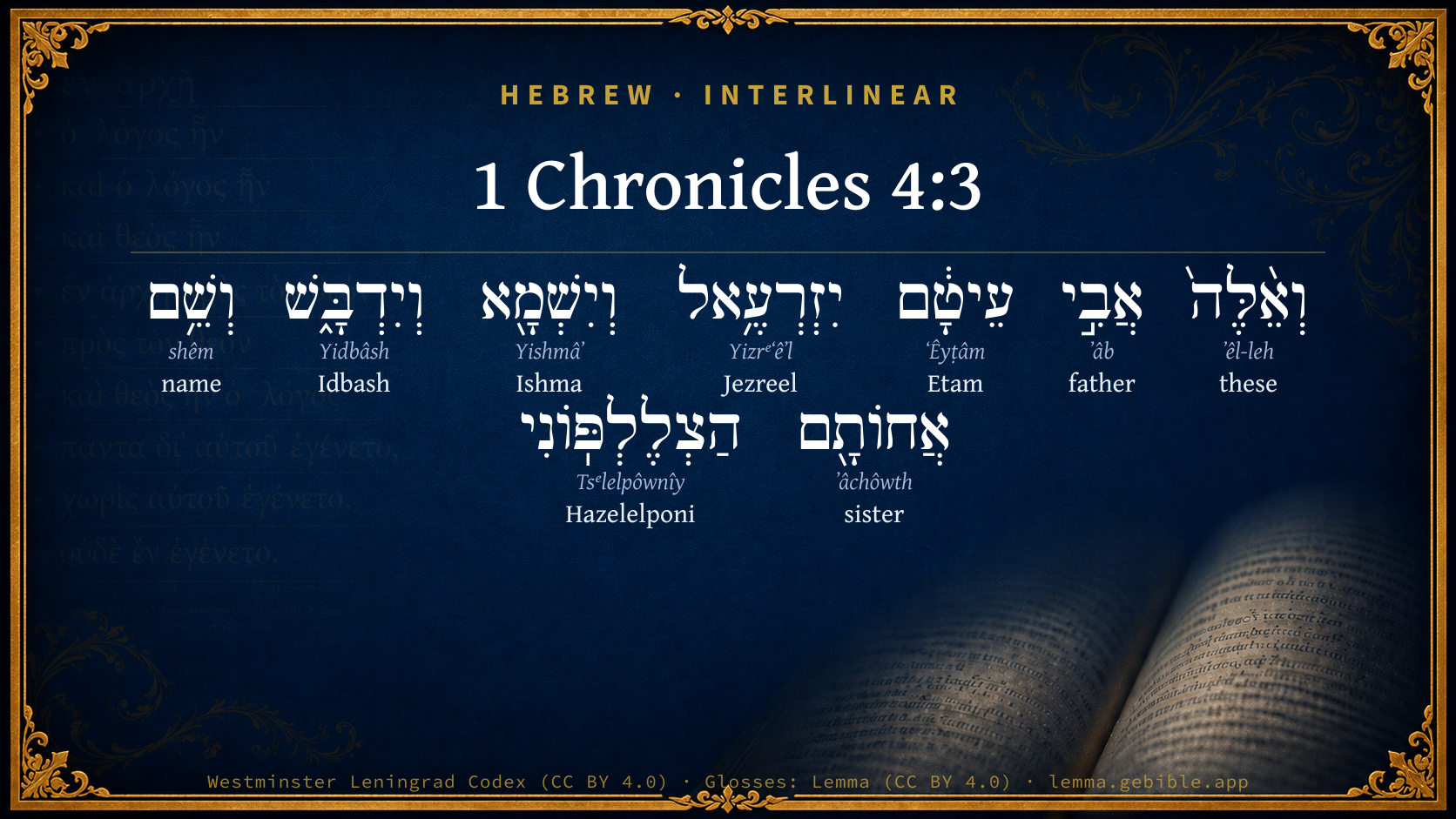
Hebrew (Westminster Leningrad Codex) 1 Chronicles 4:3 appears in the Hebrew Old Testament. The text above is from the Westminster Leningrad Codex. Each word links to its Strong’s number, a concise gloss, and parsing drawn from the Open Scriptures Hebrew Bible morphology. Click any word for its full Brown-Driver-Briggs (BDB) entry.
Download image
Cite this verse

1 Chronicles 4:3 (World English Bible). Public Domain. Lemma interlinear Bible study tool, https://lemma.gebible.app/v/1-chronicles/4/3.

Show BibTeX & RIS
BibTeX
RIS
English Translation
These were [the sons of] the father of Etam: Jezreel, and Ishma, and Idbash; and the name of their sister was Hazzelelponi;
World English Bible · Public Domain
Highlights
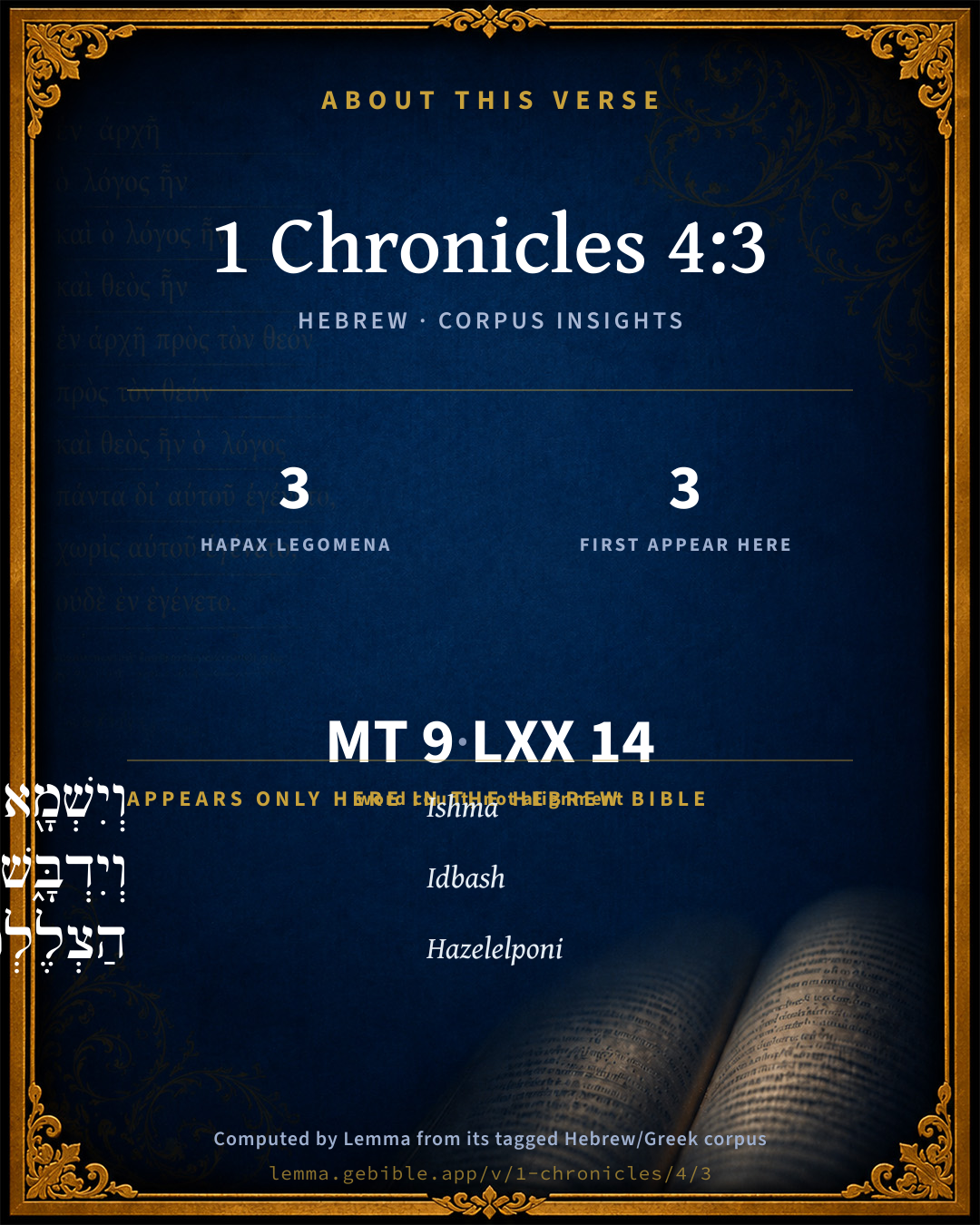
  • 3 hapax legomena — only here in the Hebrew Bible
  • 3 first appearances in the Hebrew Bible
Full analysis ↓
Download a study sheet

One document with this verse’s original text, its word-by-word gloss line, the meaning frame, cross-references with their text, attributed commentary, and full source and license credits — printable, and it pastes into notes with its structure intact.

This verse Autodidact and up

Study sheet (.html) Plain text (.txt)

A passage Seminary Student

Up to 50 verses in one chapter. A passage sheet keeps up to 6 commentary sources and 12 cross-references per verse, in the order this page ranks them, and says so on the sheet whenever that leaves anything out. Ask for a single verse and you get the Autodidact verse sheet above.

Everything on this page stays free to read, with no account — the sheet is a download of what is already on screen, not access to it.

Want to remove ads? Support Godless Engineer
Compare translations 3

The same verse in 3 English versions, stacked beneath the original-language interlinear above. Click any original word for its lexicon entry.

Each is an independent rendering of the whole verse — the interlinear is not word-aligned to these translations.

Highlighted words mark where these versions differ — a whole-verse word diff, not a word-by-word alignment.

  • World English Bible Public Domain
    These were [the sons of] the father of Etam: Jezreel, and Ishma, and Idbash; and the name of their sister was Hazzelelponi;
  • King James Version Public Domain
    And these were of the father of Etam; Jezreel, and Ishma, and Idbash: and the name of their sister was Hazelelponi:
  • unfoldingWord Literal Text CC BY-SA 4.0
    And these the father of Etam: Jezreel and Ishma and Idbash. And the name of their sister Hazzelelponi.

unfoldingWord Literal Text — © unfoldingWord, licensed CC BY-SA 4.0. Word-aligned USFM3 via Door43 (git.door43.org/unfoldingWord/en_ult).

Versions to compare (up to 4)

3 of 4 selected

Show all 18 translations

Every available English version of this verse, each an independent rendering of the whole verse.

  • World English Bible Public Domain
    These were [the sons of] the father of Etam: Jezreel, and Ishma, and Idbash; and the name of their sister was Hazzelelponi;
  • Berean Standard Bible Public Domain
    These were the sons of Etam: Jezreel, Ishma, and Idbash. And their sister was named Hazzelelponi.
  • Majority Standard Bible Public Domain
    These were the sons of Etam: Jezreel, Ishma, and Idbash. And their sister was named Hazzelelponi.
  • King James Version Public Domain
    And these were of the father of Etam; Jezreel, and Ishma, and Idbash: and the name of their sister was Hazelelponi:
  • American Standard Version (1901) Public Domain
    And these were `the sons of' the father of Etam: Jezreel, and Ishma, and Idbash; and the name of their sister was Hazzelelponi;
  • Revised Version (1885) Public Domain
    And these were the sons of the father of Etam; Jezreel, and Ishma, and Idbash: and the name of their sister was Hazzelelponi:
  • Geneva Bible (1599) Public Domain
    And these were of the father of Etam, Izreel, and Ishma and Idbash: and the name of their sister was Hazelelponi.
  • Douay-Rheims (1899) Public Domain
    And this is the posterity of Etam: Jezrahel, and Jesema, and Jedebos: and the name of their sister was Asalelphuni.
  • Young's Literal Translation Public Domain
    And these `are' of the father of Etam: Jezreel, and Ishma, and Idbash; and the name of their sister `is' Hazzelelponi,
  • Literal Standard Version CC BY-SA 4.0
    And these [are] of the father of Etam: Jezreel, and Ishma, and Idbash; and the name of their sister [is] Hazzelelponi;
  • Unlocked Literal Bible CC BY-SA 4.0
    These were the ancestors of the clans in the city of Etam: Jezreel, Ishma, and Idbash. Their sister's name was Hazzelelponi.
  • unfoldingWord Literal Text CC BY-SA 4.0
    And these the father of Etam: Jezreel and Ishma and Idbash. And the name of their sister Hazzelelponi.
  • Darby Bible Public Domain
    And these [were of] the father of Etam: Jizreel, and Jishma, and Jidbash; and the name of their sister was Hazlelponi;
  • World Messianic Bible Public Domain
    These were the sons of the father of Etam: Jezreel, Ishma, and Idbash. The name of their sister was Hazzelelponi.
  • Webster's Bible Public Domain
    And these were of the father of Etam; Jezreel, and Ishma, and Idbash: and the name of their sister was Hazelelponi:
  • Free Bible Version CC BY-SA 4.0
    These were the sons of Etam: Jezreel, Ishma, and Idbash. Their sister was called Hazzelelponi.
  • Bible in Basic English Public Domain
    And these were the sons of Hur, the father of Etam: Jezreel and Ishma and Idbash, and the name of their sister was Hazzelelponi;
  • JPS Tanakh (1917) Public Domain
    And these were the sons of the father of Etam: Jezreel, and Ishma, and Idbash; and the name of their sister was Hazlelponi;

Literal Standard Version (2020), Covenant Press — licensed CC BY-SA 4.0. Text via the HelloAO Bible API (eBible.org). Unlocked Literal Bible (unfoldingWord) — licensed CC BY-SA 4.0. Text via the HelloAO Bible API (eBible.org). unfoldingWord Literal Text — © unfoldingWord, licensed CC BY-SA 4.0. Word-aligned USFM3 via Door43 (git.door43.org/unfoldingWord/en_ult). Free Bible Version, Dr. Jonathan Gallagher — licensed CC BY-SA 4.0. Text via the HelloAO Bible API (eBible.org).

Word by word

More ways to search: Search by grammar → Find every occurrence → Compare this word →

Practice this passage: Drill this verse → Learn its vocabulary →

About this verse

These counts appear in no published source. They are computed here, from the morphology-tagged text and Lemma’s own curated glosses. What Lemma adds →

9
words
9
distinct lemmas
Historical
section

Notable vocabulary

3 hapax legomena — words that appear only here in the entire Hebrew Bible:

  • וְיִשְׁמָ֖א Ishma H3457
  • וְיִדְבָּ֑שׁ Idbash H3031
  • הַצְלֶלְפּֽוֹנִי Hazelelponi H6753

First appearance in Scripture

These words make their first canonical appearance in the Hebrew Bible here:

  • וְיִשְׁמָ֖א Ishma H3457
  • וְיִדְבָּ֑שׁ Idbash H3031
  • הַצְלֶלְפּֽוֹנִי Hazelelponi H6753

Shared distinctive vocabulary

עֵיטָ֔ם Etam H5862 occurs in 5 verses of the Hebrew Bible. Also found in:

Grammatical profile

  • 8 nouns
  • 1 pronoun

Hebrew & Septuagint length

In English translation the verse runs 22 words from the Hebrew and 18 from the Septuagint (LXX English) — closely comparable.

A rough comparison of the two English renderings, which tokenize alike — not a word-level alignment.

Word counts can differ between the Hebrew and the Greek without any difference in meaning — e.g. the Hebrew direct-object marker אֵת has no separate Greek word, and Greek often adds the article ὁ.

In the original languages it is 9 Hebrew tokens and 14 Greek tokens — but the two are counted differently (Hebrew bundles its prefixes and suffixes into one token; the Greek is in lemma form), so that isn’t a like-for-like length.

Cross-references

2

Topical passages linked to 1 Chronicles 4:3 in the Treasury of Scripture Knowledge — connected by theme and wording, ordered by reader-vote popularity; previews shown in the World English Bible.

  • 2 Chronicles 11:6 He built Bethlehem, and Etam, and Tekoa,
  • Judges 15:11 Then three thousand men of Judah went down to the cleft of the rock of Etam, and said to Samson, "Don't you know that the Philistines are rulers over us? What then is this that you have done to us?" He said to them, As they did to me, so have I done to them.

Cross-references courtesy of OpenBible.info (CC BY 4.0).

Hebrew and Greek witnesses Masoretic Hebrew ↔ Greek Septuagint

The same verse in the two great witnesses to the Old Testament, shown verse-for-verse.

These are two independent witnesses, not word-aligned to each other, and the Septuagint is shown in lemma (dictionary) form.

Hebrew 1 Chronicles 4:3 Masoretic · Westminster Leningrad Codex

וְאֵ֨לֶּה֙ אֲבִ֣י עֵיטָ֔ם יִזְרְעֶ֥אל וְיִשְׁמָ֖א וְיִדְבָּ֑שׁ וְשֵׁ֥ם אֲחוֹתָ֖ם הַצְלֶלְפּֽוֹנִי

These were [the sons of] the father of Etam: Jezreel, and Ishma, and Idbash; and the name of their sister was Hazzelelponi;

World English Bible · Public Domain

Greek LXX 1 Chronicles 4:3 Septuagint · lemma form

καί οὗτος υἱός αιταμ ιεζραηλ καί ραγμα καί ιαβας καί ὄνομα ἀδελφή αὐτός εσηλεββων

And these are the sons of Aetam; Jezrael and Jesman, and Jebdas: and their sister's name was Eselebbon.

LXX2012 (modern English Septuagint) · Public Domain

On this verse, Ellicott's Commentary for English Readers discusses the Septuagint’s reading. Read the note in Commentary ↓

Hebrew: Westminster Leningrad Codex (CC BY 4.0). Greek: Septuagint (public domain); English from LXX2012 (modern English Septuagint) (Public Domain). How the Septuagint differs from the Hebrew →

Commentary

Notes on 1 Chronicles 4:3 from classic Christian and Jewish commentators (each source and its license shown beneath its notes). The classic Christian expositions comment on the surrounding passage and are grouped to its opening verse, so a note may address several verses; the Jewish commentaries on the Tanakh (Rashi and others) are per-verse, so they appear only where the commentator wrote on this verse.

Lemma curates 59 commentaries, every one of them public domain or Creative Commons licensed, each selected and text-cleaned for this edition rather than reprinted as found. About our sources →

Adam Clarke's Commentary

Verse 3. These were of the father of Etam] "And these are the rabbins (doctors) living at Etam, Jezreel, Ishma, and Idbash." - T.

Adam Clarke's Commentary on the Bible (1810–1826) — public domain. Text from a community e-Sword/MySword module.

Ellicott's Commentary for English Readers

(3) And these were of the father of Etam.—Heb., And these (were) the father of Etam. Some MSS., the LXX., and the Vulg. read “and these (were) the sons of Etam;” other MSS., with the Syriac and Arabic versions, have “the sons of the father of Etam.” Both variants look like evasions of a difficulty. The unusual expression “and these—Abi-Etam” may be a brief way of stating that the clans whose names are given were the dominant houses of Etam (or Abi-etam; compare Abiezer, Jdg_7:11; Jdg_8:2). Etam is known from the history of Samson (Jdg_15:8, and 2Ch_11:6); Jezreel—not Ahab’s capital—from Jos_15:56, and as the city of Ahinoam, wife of David, from 1Ch_3:1. Both places were in the hill-country of Judah. The other three names are unknown.

Their sister.—Their sister-town (see 1Ch_1:39; 1Ch_1:52, and Notes).

Hazelelponi.—Means “make shadow, O thou that regardest me!”

A Bible Commentary for English Readers, edited by Charles John Ellicott (1878–1897) — public domain. Text from a community e-Sword module.

The Cambridge Bible for Schools and Colleges

gen. ed. J. J. S. Perowne

3. these were of the father of Etam] LXX. (“these were the sons of Etam”—Αἰτάν) yields better sense. Etam (1Ch_4:32) was a place; the “sons of Etam” would be families which derived their origin from the place.

The Cambridge Bible for Schools and Colleges (gen. ed. J. J. S. Perowne; Cambridge University Press, 1878–1918) — public domain. Text from a community e-Sword module.

John Gill's Exposition

And these were of the father of Etam,.... Or of the prince of Etam: or, as the Targum, these are princes that dwelt in Etam, a place not far from Zorah, Jdg 15:8 and is mentioned with Bethlehem and Tekoa in the tribe of Judah, Ch2 11:6, namely, which follow:

Jezreel, and Ishma, and Idbash; these were the sons of the governor of Etam:

and the name of their sister was Hazelelponi; who, perhaps, was a person of great note in those days, though now unknown; indeed, a Jewish chronologer (w) tells us, that the mother of Samson was Hazalelponith, of the tribe of Judah.

(w) Juchasin, fol. 10. 2.

John Gill's Exposition of the Whole Bible (1746–1763) — public domain (CC PDM 1.0). Text via the HelloAO Bible API.

Albert Barnes' Notes on the Bible

Read, “These are the sons of the father (i. e. chief) of Etam” 2Ch 11:6, a city of Judah, not far from Bethlehem.

Albert Barnes' Notes on the Bible (1834–1885) — public domain. Text from a community e-Sword/MySword module.

Haydock's Catholic Bible Commentary

Posterity. So all the ancient versions seem to have read boni, instead of the present Hebrew abi, which literally means, "and these are the father of Etam." If words ever wanted sense, they do so here. (Kennicott) --- Etham is perhaps the name of a town. (Malvenda)

George Leo Haydock (1774–1849), Haydock's Catholic Family Bible and Commentary, 1859 edition — public domain. Excludes Psalms (Douay-Rheims chapter numbering differs from Protestant) and Deuterocanonical books (Catholic canon only).

Matthew Poole's English Annotations

Etam is the name either of a man, or of a place; of which see below, 1Ch 4:32; 2Ch 11:6; whose inhabitants descended from him. The name of his father is not here expressed.

Matthew Poole's English Annotations on the Holy Bible (1683–1685) — public domain. Text from a community e-Sword/MySword module.

The Pulpit Commentary

Vers. 3, 4. Etam is, with little doubt, the name of a place (2Ch_11:6) in Judah, south of Jerusalem. It was near Tekoah (ver. 5, 1Ch_2:24) and Bethlehem (next verse). The hiatus in the first clause may possibly be supplied by "the families of" from the last verse, or, more fitly, by "the sons of," inasmuch as some manuscripts have it so. The Septuagint, however, and Vulgate displace "the father of" ( i.e. chief of), replacing it by "the sons of." The Syriac Version leaves out any notice of the sister, Hazelelponi, and gives the former part of the verse thus: "These are Amina-dab"s sons, Ahizareel, Nesma, and Dibas, Pheguel and Husia; These are the sons of Hur, the firstborn of Ephratha, who was the father," etc. With this the Arabic Version is partly in agreement, but closes the verse with the words, "These are the sons of Hur, son of Ephratha, the father of whom plural was of Bethlehem." The Chronicle Targum translates, "the rabbis dwelling at Etam." This variety indicates the difficulty felt by each in turn. The verse, however, purports to give the names of three brothers and one sister (Hazelel-poni, i.e. the shadow looking at me, Gesenius) connected with Etam, as in the following verse Penuel with Gedor (1Ch_2:51) and Ezer with Hushah. (1Ch_11:29 2Sa_23:27) Of no one of these, in all six other descendants of Hur, additional to those found at the close of ch. 2., is anything distinct known. It is to be noted that Hut himself is here called father of Bethlehem, while (1Ch_2:51) his son Salma is so called.

The Pulpit Commentary (1880–1919), ed. H.D.M. Spence-Jones & Joseph S. Exell — public domain. Text from a community e-Sword module.

Keil & Delitzsch

C. F. Keil & F. Delitzsch

And these were of the father of Etam,.... Or of the prince of Etam: or, as the Targum, these are princes that dwelt in Etam, a place not far from Zorah, Jdg 15:8 and is mentioned with Bethlehem and Tekoa in the tribe of Judah, Ch2 11:6, namely, which follow:

Jezreel, and Ishma, and Idbash; these were the sons of the governor of Etam:

and the name of their sister was Hazelelponi; who, perhaps, was a person of great note in those days, though now unknown; indeed, a Jewish chronologer (w) tells us, that the mother of Samson was Hazalelponith, of the tribe of Judah.

(w) Juchasin, fol. 10. 2.

Keil & Delitzsch — Biblical Commentary on the Old Testament (1861–1891) — public domain (CC PDM 1.0). Text via the HelloAO Bible API. (Old Testament only.)

unfoldingWord translationNotes

Door43 World Missions Community

Etam ... Gedor ... Hushah

These are names of cities. (See: How to Translate Names)

Jezreel ... Ishma ... Idbash ... Peniel ... Ezer ... Hur ... Ephrathah

These are the names of men. (See: How to Translate Names)

Hazzelelponi

This is the name of a woman. (See: How to Translate Names)

These were descendants of Hur

"Peniel and Ezer were descendants of Hur." This points forward to the list that will follow.

Ephrathah

This is the name of a woman. See how you translated this in 1 Chronicles 2:50.

translationWords

firstborn

Bethlehem

unfoldingWord translationNotes — © Distant Shores Media and the Door43 World Missions Community, licensed CC BY-SA 4.0. Source: git.door43.org/Door43/en_tn.

Lesson kit

Teaching starters — assembled from the data on this page, not authored interpretation. Every prompt links to the verse data it draws on. Edit before teaching.

1 Chronicles, in the Historical, opens this verse with 9 words (9 distinct Hebrew lemmas). Its most distinctive word is Yishmâʼ (“Ishma”). A historical commentator’s framing appears above. Read the whole chapter for the surrounding context.

Discussion questions

  1. What does “Ishma” (Yishmâʼ) contribute to the verse as a whole?
  2. This verse holds 3 words here found nowhere else in the Hebrew Bible. What might the rare words draw attention to?
  3. 3 words here appear for the first time in Scripture. What is being introduced at this debut?
  4. Judges 15:8 shares the word «Etam» with this verse. How do the two illuminate each other?
  5. The translations on this page render this verse differently — a whole-verse word diff, not a word-by-word alignment. What might account for the different wordings?
  6. Reading how Adam Clarke's Commentary and Ellicott's Commentary for English Readers read this verse, where do the two commentators agree and where do they part?

Things to notice

Reading settings

Reading text

Shown beneath each verse's original-language words.

Old Testament
Old Testament edition

Read the OT as the Masoretic Hebrew (MT) or the Greek Septuagint (LXX).

English shown for the Greek Septuagint (in the Hebrew ↔ Greek comparison).

Comparing translations? Open the Compare panel on any verse page to stack up to four side by side.