
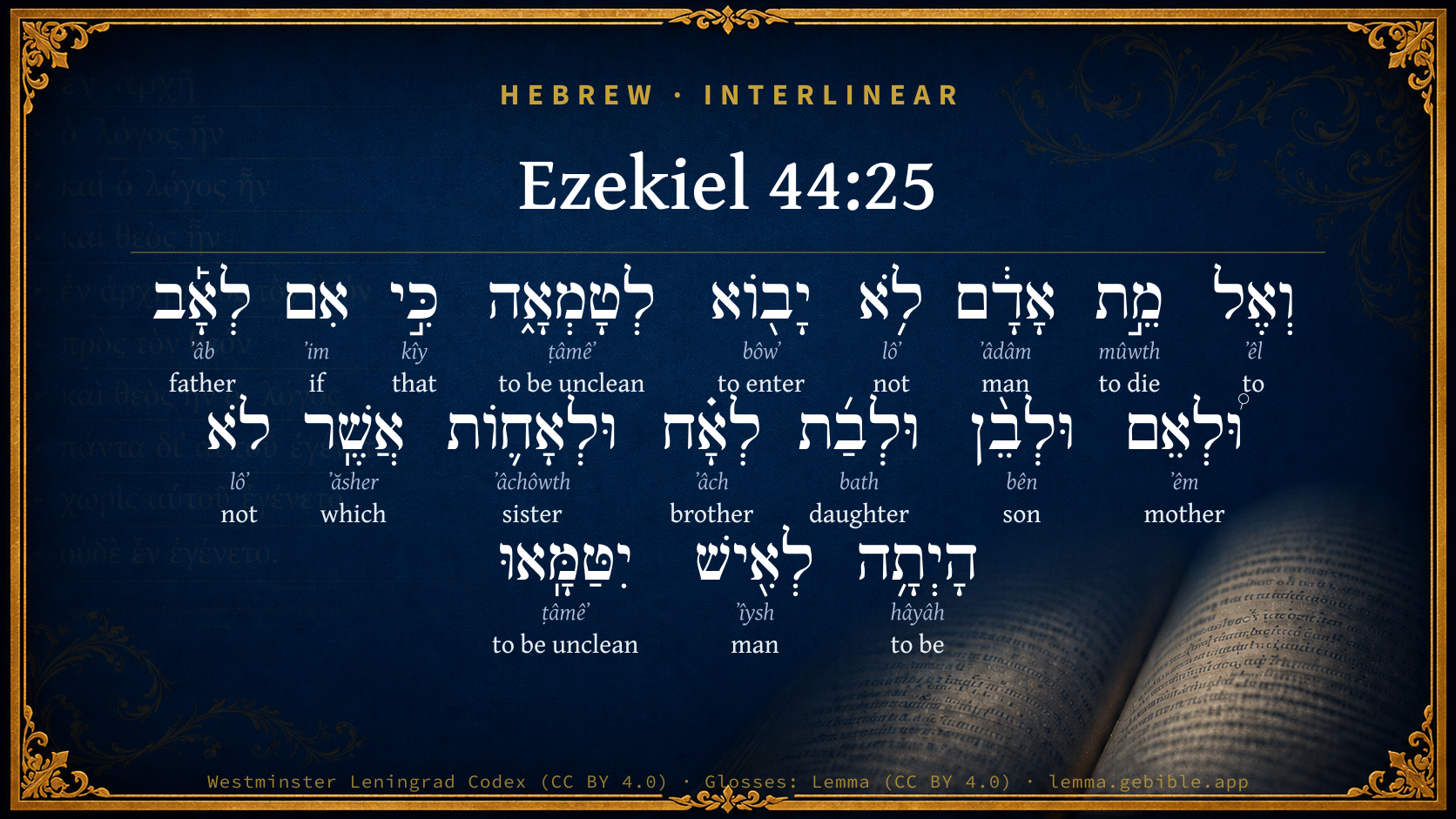
Ezekiel 44:25

Hebrew (Westminster Leningrad Codex) Ezekiel 44:25 appears in the Hebrew Old Testament. The text above is from the Westminster Leningrad Codex. Each word links to its Strong’s number, a concise gloss, and parsing drawn from the Open Scriptures Hebrew Bible morphology. Click any word for its full Brown-Driver-Briggs (BDB) entry.
Download image
Cite this verse

Ezekiel 44:25 (World English Bible). Public Domain. Lemma interlinear Bible study tool, https://lemma.gebible.app/v/ezekiel/44/25.

Show BibTeX & RIS
BibTeX
RIS
English Translation
They shall go in to no dead person to defile themselves; but for father, or for mother, or for son, or for daughter, for brother, or for sister who has had no husband, they may defile themselves.
World English Bible · Public Domain
Download a study sheet

One document with this verse’s original text, its word-by-word gloss line, the meaning frame, cross-references with their text, attributed commentary, and full source and license credits — printable, and it pastes into notes with its structure intact.

This verse Autodidact and up

Study sheet (.html) Plain text (.txt)

A passage Seminary Student

Up to 50 verses in one chapter. A passage sheet keeps up to 6 commentary sources and 12 cross-references per verse, in the order this page ranks them, and says so on the sheet whenever that leaves anything out. Ask for a single verse and you get the Autodidact verse sheet above.

Everything on this page stays free to read, with no account — the sheet is a download of what is already on screen, not access to it.

Want to remove ads? Support Godless Engineer
Compare translations 3

The same verse in 3 English versions, stacked beneath the original-language interlinear above. Click any original word for its lexicon entry.

Each is an independent rendering of the whole verse — the interlinear is not word-aligned to these translations.

Highlighted words mark where these versions differ — a whole-verse word diff, not a word-by-word alignment.

  • World English Bible Public Domain
    They shall go in to no dead person to defile themselves; but for father, or for mother, or for son, or for daughter, for brother, or for sister who has had no husband, they may defile themselves.
  • King James Version Public Domain
    And they shall come at no dead person to defile themselves: but for father, or for mother, or for son, or for daughter, for brother, or for sister that hath had no husband, they may defile themselves.
  • unfoldingWord Literal Text CC BY-SA 4.0
    They must not defile themselves by going near to a dead person; however, if the dead person was his father or mother, son or daughter, brother or unmarried sister, then they may defile themselves.

unfoldingWord Literal Text — © unfoldingWord, licensed CC BY-SA 4.0. Word-aligned USFM3 via Door43 (git.door43.org/unfoldingWord/en_ult).

Versions to compare (up to 4)

3 of 4 selected

Show all 18 translations

Every available English version of this verse, each an independent rendering of the whole verse.

  • World English Bible Public Domain
    They shall go in to no dead person to defile themselves; but for father, or for mother, or for son, or for daughter, for brother, or for sister who has had no husband, they may defile themselves.
  • Berean Standard Bible Public Domain
    A priest must not defile himself by going near a dead person. However, for a father, a mother, a son, a daughter, a brother, or an unmarried sister, he may do so,
  • Majority Standard Bible Public Domain
    A priest must not defile himself by going near a dead person. However, for a father, a mother, a son, a daughter, a brother, or an unmarried sister, he may do so,
  • King James Version Public Domain
    And they shall come at no dead person to defile themselves: but for father, or for mother, or for son, or for daughter, for brother, or for sister that hath had no husband, they may defile themselves.
  • American Standard Version (1901) Public Domain
    And they shall go in to no dead person to defile themselves; but for father, or for mother, or for son, or for daughter, for brother, or for sister that hath had no husband, they may defile themselves.
  • Revised Version (1885) Public Domain
    And they shall come at no dead person to defile themselves: but for father, or for mother, or for son, or for daughter, for brother, or for sister that hath had no husband, they may defile themselves.
  • Geneva Bible (1599) Public Domain
    And they shall come at no dead person to defile theselues, except at their father, or mother, or sone, or daughter, brother or sister, that hath had yet none husband: in these may they be defiled.
  • Douay-Rheims (1899) Public Domain
    And they shall come near no dead person, lest they be defiled, only their father and mother, and son and daughter, and brother and sister, that hath not had another husband: for whom they may become unclean.
  • Young's Literal Translation Public Domain
    And unto any dead man they come not for uncleanness, but for father, and for mother, and for son, and for daughter, for brother, for sister who hath not been to a man, they defile themselves.
  • Literal Standard Version CC BY-SA 4.0
    And he does not come near to any dead man to be defiled, but if for father, and for mother, and for son, and for daughter, for brother, for sister who has not been to a man, they may defile themselves.
  • Unlocked Literal Bible CC BY-SA 4.0
    They will not go to a dead person so as to become unclean, unless it is their father or mother, son or daughter, brother or a sister who has not slept with a man; otherwise, they will become unclean.
  • unfoldingWord Literal Text CC BY-SA 4.0
    They must not defile themselves by going near to a dead person; however, if the dead person was his father or mother, son or daughter, brother or unmarried sister, then they may defile themselves.
  • Darby Bible Public Domain
    And they shall come at no dead person to become unclean; but for father, or for mother, or for son, or for daughter, for brother, or for sister that hath had no husband, they may become unclean.
  • World Messianic Bible Public Domain
    “‘“They shall go in to no dead person to defile themselves; but for father, or for mother, or for son, or for daughter, for brother, or for sister who has had no husband, they may defile themselves.
  • Webster's Bible Public Domain
    And they shall come at no dead person to defile themselves: but for father, or for mother, or for son, or for daughter, for brother, or for sister that hath had no husband, they may defile themselves.
  • Free Bible Version CC BY-SA 4.0
    A priest must not make himself unclean by going near a dead body. However, if it's his father, mother, son, daughter, brother, or a sister that's not married, then he may do so.
  • Bible in Basic English Public Domain
    They are not to come near any dead person so as to become unclean: but for a father or mother or son or daughter or brother or for a sister who has no husband, they may make themselves unclean.
  • JPS Tanakh (1917) Public Domain
    And they shall come near no dead person to defile themselves; but for father, or for mother, or for son, or for daughter, for brother, or for sister that hath had no husband, they may defile themselves.

Literal Standard Version (2020), Covenant Press — licensed CC BY-SA 4.0. Text via the HelloAO Bible API (eBible.org). Unlocked Literal Bible (unfoldingWord) — licensed CC BY-SA 4.0. Text via the HelloAO Bible API (eBible.org). unfoldingWord Literal Text — © unfoldingWord, licensed CC BY-SA 4.0. Word-aligned USFM3 via Door43 (git.door43.org/unfoldingWord/en_ult). Free Bible Version, Dr. Jonathan Gallagher — licensed CC BY-SA 4.0. Text via the HelloAO Bible API (eBible.org).

Word by word

More ways to search: Search by grammar → Find every occurrence → Compare this word →

Practice this passage: Drill this verse → Learn its vocabulary →

וּלְאָח֛וֹת
ʼâchôwth
H269
“and · to/for · sister”
Conjunction + Preposition + Noun, Common, Feminine, Singular, Absolute
Part of Speech
Conjunction + Preposition + Noun
Type
Common
Gender
Feminine
Number
Singular
State
Absolute
Full BDB Definition

Origin: irregular f of H251

TWOT: 62c

sister - sister (same parents) - half-sister (same father) - relative - (metaphorically) of Israel's and Judah's relationship - beloved - bride - (figuratively) of intimate connection - another
  1. וְאֶל ʼêl H413 “and · to” Conjunction + Preposition
  2. מֵ֣ת mûwth H4191 “dying” Verb, Qal, Participle Active, Masculine, Singular, Construct
  3. אָדָ֔ם ʼâdâm H120 “man” Noun, Common, Masculine, Singular, Absolute
  4. לֹ֥א lôʼ H3808 “not” Particle, Negative
  5. יָב֖וֹא bôwʼ H935 “to enter” Verb, Qal, Imperfect, 3rd Person, Masculine, Singular
  6. לְטָמְאָ֑ה ṭâmêʼ H2930 “to be unclean” Preposition + Verb, Qal, Infinitive Construct
  7. כִּ֣י kîy H3588 “that” Conjunction
  8. אִם ʼim H518 “if” Conjunction
  9. לְאָ֡ב ʼâb H1 “to/for · father” Preposition + Noun, Common, Masculine, Singular, Absolute
  10. וּ֠לְאֵם ʼêm H517 “and · to/for · mother” Conjunction + Preposition + Noun, Common, Feminine, Singular, Absolute
  11. וּלְבֵ֨ן bên H1121 “and · to/for · son” Conjunction + Preposition + Noun, Common, Masculine, Singular, Absolute
  12. וּלְבַ֜ת bath H1323 “and · to/for · daughter” Conjunction + Preposition + Noun, Common, Feminine, Singular, Absolute
  13. לְאָ֗ח ʼâch H251 “to/for · brother” Preposition + Noun, Common, Masculine, Singular, Absolute
  14. אֲשֶֽׁר ʼăsher H834 “which” Particle, Relative
  15. לֹא lôʼ H3808 “not” Particle, Negative
  16. הָיְתָ֥ה hâyâh H1961 “to be” Verb, Qal, Perfect, 3rd Person, Feminine, Singular
  17. לְאִ֖ישׁ ʼîysh H376 “to/for · man” Preposition + Noun, Common, Masculine, Singular, Absolute
  18. יִטַּמָּֽאוּ ṭâmêʼ H2930 “to be unclean” Verb, Hithpael, Imperfect, 3rd Person, Masculine, Plural

About this verse

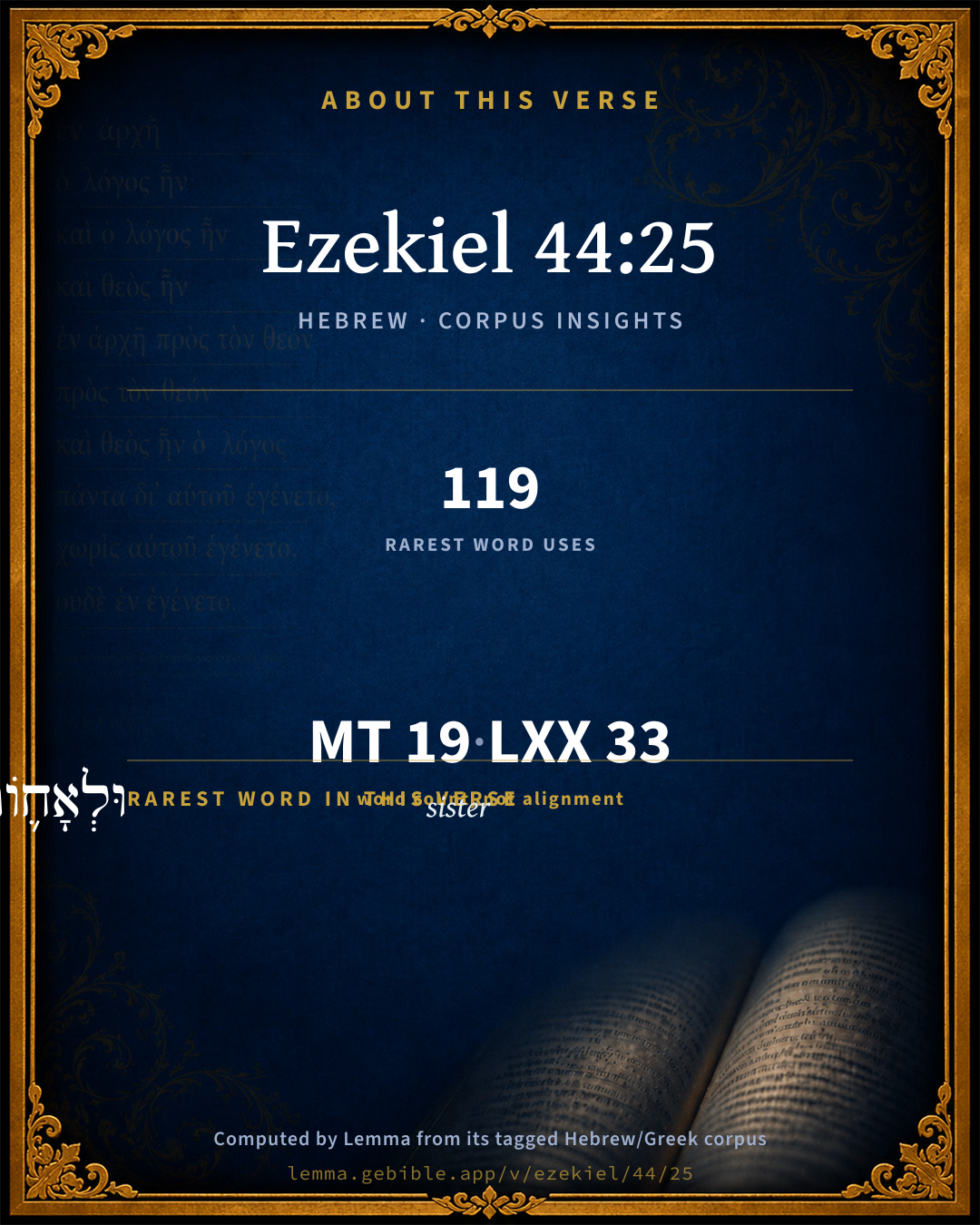
These counts appear in no published source. They are computed here, from the morphology-tagged text and Lemma’s own curated glosses. What Lemma adds →

19
words
17
distinct lemmas
Prophets
section

Grammatical profile

  • 5 verbs
  • 8 nouns
  • 1 preposition
  • 2 conjunctions
  • 3 particles

Verb forms

  • מֵ֣ת Qal · Participle Active
  • יָב֖וֹא Qal · Imperfect
  • לְטָמְאָ֑ה Qal · Infinitive Construct
  • הָיְתָ֥ה Qal · Perfect
  • יִטַּמָּֽאוּ Hithpael · Imperfect

Repetition

Words recur within this verse — often emphatic in Hebrew:

  • לְטָמְאָ֑ה to be unclean H2930 ×2
  • לֹ֥א not H3808 ×2

Hebrew & Septuagint length

In English translation the verse runs 37 words from the Hebrew and 50 from the Septuagint (LXX English) — closely comparable.

A rough comparison of the two English renderings, which tokenize alike — not a word-level alignment.

Word counts can differ between the Hebrew and the Greek without any difference in meaning — e.g. the Hebrew direct-object marker אֵת has no separate Greek word, and Greek often adds the article ὁ.

In the original languages it is 19 Hebrew tokens and 33 Greek tokens — but the two are counted differently (Hebrew bundles its prefixes and suffixes into one token; the Greek is in lemma form), so that isn’t a like-for-like length.

Cross-references

6

Topical passages linked to Ezekiel 44:25 in the Treasury of Scripture Knowledge — connected by theme and wording, ordered by reader-vote popularity; previews shown in the World English Bible.

  • Leviticus 22:4 "'Whoever of the seed of Aaron is a leper or has an issue; he shall not eat of the holy things, until he is clean. Whoever touches anything that is unclean by the dead, or a man whose seed goes from him;
  • Leviticus 21:1–6 Yahweh said to Moses, "Speak to the priests, the sons of Aaron, and say to them, 'A priest shall not defile himself for the dead among his people;
  • Matthew 8:21–22 Another of his disciples said to him, "Lord, allow me first to go and bury my father."
  • Luke 9:59–60 He said to another, "Follow me!" But he said, "Lord, allow me first to go and bury my father."
  • 2 Corinthians 5:16 Therefore we know no one after the flesh from now on. Even though we have known Christ after the flesh, yet now we know him so no more.
  • 1 Thessalonians 4:13–15 But we don't want you to be ignorant, brothers, concerning those who have fallen asleep, so that you don't grieve like the rest, who have no hope.

Cross-references courtesy of OpenBible.info (CC BY 4.0).

Hebrew and Greek witnesses Masoretic Hebrew ↔ Greek Septuagint

The same verse in the two great witnesses to the Old Testament, shown verse-for-verse.

These are two independent witnesses, not word-aligned to each other, and the Septuagint is shown in lemma (dictionary) form.

Hebrew Ezekiel 44:25 Masoretic · Westminster Leningrad Codex

וְאֶל מֵ֣ת אָדָ֔ם לֹ֥א יָב֖וֹא לְטָמְאָ֑ה כִּ֣י אִם לְאָ֡ב וּ֠לְאֵם וּלְבֵ֨ן וּלְבַ֜ת לְאָ֗ח וּלְאָח֛וֹת אֲשֶֽׁר לֹא הָיְתָ֥ה לְאִ֖ישׁ יִטַּמָּֽאוּ

They shall go in to no dead person to defile themselves; but for father, or for mother, or for son, or for daughter, for brother, or for sister who has had no husband, they may defile themselves.

World English Bible · Public Domain

Greek LXX Ezekiel 44:25 Septuagint · lemma form

καί ἐπί ψυχή ἄνθρωπος οὐ εἰςἔρχομαι ὁ μιαίνω ἀλλά ἤ ἐπί πατήρ καί ἐπί μήτηρ καί ἐπί υἱός καί ἐπί θυγάτηρ καί ἐπί ἀδελφός καί ἐπί ἀδελφή αὐτός ὅς οὐ γίγνομαι ἀνήρ μιαίνω

And they shall not go in to the dead body of a man to defile themselves: only a priest may defile himself for a father, or for a mother, or for a son, or for a daughter, or for a brother, or for his sister, who has not been married.

LXX2012 (modern English Septuagint) · Public Domain

Hebrew: Westminster Leningrad Codex (CC BY 4.0). Greek: Septuagint (public domain); English from LXX2012 (modern English Septuagint) (Public Domain). How the Septuagint differs from the Hebrew →

Targum (Aramaic paraphrase)

1

The Targum is the ancient Jewish Aramaic paraphrase of the Hebrew Scriptures — an interpretive translation, not the Hebrew text itself. Onkelos (literal) and Pseudo-Jonathan (expansive) render the Torah, and Jonathan the Prophets. Coverage is partial: where no permissively-licensed English translation exists for a verse, only the Aramaic is shown. This is verse-level text, not a word-by-word alignment to the Hebrew.

  1. Targum Jonathan Prophets (Joshua–Malachi)
    וְעַל מֵיתָא דֶאֱנָשָׁא לָא יֵעוֹל לְאִסְתָּאָבָא אֱלָהֵין לְאָב וּלְאֵם וּלְבָר וְלִבְרַת לְאָח וְלַאֲחָת דְלָא הֲוַת לִגְבַר יִסְתַּאֲבוּן:

    (no public-domain English translation for this verse)

    Targum Jonathan — Aramaic: “Mikraot Gedolot” (public domain). English: “Sefaria Community Translation” (CC0 1.0 (public-domain dedication)); “London "Chaldee Paraphrase," 1871” (public domain). Text via Sefaria.

Commentary

Notes on Ezekiel 44:25 from classic Christian and Jewish commentators (each source and its license shown beneath its notes). The classic Christian expositions comment on the surrounding passage and are grouped to its opening verse, so a note may address several verses; the Jewish commentaries on the Tanakh (Rashi and others) are per-verse, so they appear only where the commentator wrote on this verse.

Lemma curates 59 commentaries, every one of them public domain or Creative Commons licensed, each selected and text-cleaned for this edition rather than reprinted as found. About our sources →

Trapp's Complete Commentary

John Trapp

Eze 44:25 And they shall come at no dead person to defile themselves: but for father, or for mother, or for son, or for daughter, for brother, or for sister that hath had no husband, they may defile themselves.

Ver. 25. And they shall come at no dead person.] Not defile their consciences with dead works.

They may defile themselves.] So they keep a mean. Something they may yield to nature, nothing to impatience. Mens e luctu eluctetur, the mind surmounts difficulties from grief.

John Trapp, A Commentary or Exposition upon All the Books of the Old and New Testament (1647–1656) — public domain. Text from a community e-Sword module.

Joseph Benson's Commentary

Eze 44:25-26. They shall come at no dead person to defile themselves —

Whosoever touched a dead body became legally unclean, (Num 19:11,) and thereby was disqualified for attending upon God’s worship in the temple, Lev 22:3. Upon which account the priests were forbidden to contract such defilement, unless for their nearest relations, which prohibition is here renewed: see the margin. After he is cleansed they shall reckon unto him seven days — His uncleanness continued seven days, according to the forecited law, Num 19:11; and the priests were to reckon to him seven days more, before he could be admitted into the sanctuary.

Joseph Benson's Commentary on the Old and New Testaments (1811–1818) — public domain. Text from a community e-Sword module.

Geneva Bible (1599)

Geneva Bible translators

They may be at their burial, which was a defiling.

Geneva Bible (1599) marginal notes — public domain. Text via Bolls.life.

Adam Clarke's Commentary

Verse 25. And they shall come at no dead person to defile themselves] Touching the dead defiles a Hindoo now, as it formerly did a Jew; and they must bathe to become clean again.

Adam Clarke's Commentary on the Bible (1810–1826) — public domain. Text from a community e-Sword/MySword module.

The Cambridge Bible for Schools and Colleges

gen. ed. J. J. S. Perowne

25–27. Regulations for their necessary contact with the dead. They shall approach the dead bodies only of their nearest relatives, father, mother, son, daughter, brother and unmarried sister. From the defilement caused by this contact they must purify themselves before resuming their service in the inner court. It is curious that no reference is made to the priest’s wife among the relatives with whose dead bodies they may defile themselves. The same omission occurs Lev_21:1-3. In Eze_24:15 it is understood that he would naturally shew tokens of mourning for his wife. The two things, however, are not identical, and Ezek. was not an acting priest. According to Lev_21:11 the high-priest was not to defile himself by going near any dead body whatever. How defilement was contracted is explained Num_19:14.

The Cambridge Bible for Schools and Colleges (gen. ed. J. J. S. Perowne; Cambridge University Press, 1878–1918) — public domain. Text from a community e-Sword module.

John Gill's Exposition

And they shall come at no dead person to defile themselves,.... Shall not come into places where they are, nor touch them, nor attend their funerals, Lev 21:1, that their work might not be interrupted, or they through grief and sorrow be made unfit for it, Mat 8:22, this, in a spiritual sense, may signify, that they should have no conversation or fellowship with men dead in trespasses and sins; and should abstain from all dead works, as all sinful ones are:

but for father, or for mother, or for son, or for daughter, for brother, or for sister that hath had no husband, they may defile themselves; by coming near them, touching them, at least attending their funerals, because of their near relation to them, and that natural sympathy and affection that must be in them: all sorrow and mourning for dead relations is not forbidden saints, nor ministers of the word; provided it is in moderation, and not to excess, and is not for gracious persons, as those without hope; and should as little as possible break in upon the duties of their office, Th1 4:13.

John Gill's Exposition of the Whole Bible (1746–1763) — public domain (CC PDM 1.0). Text via the HelloAO Bible API.

Haydock's Catholic Bible Commentary

Unclean, attending the funeral, which inferior priests alone might do, Leviticus xxi. 10. (Menochius)

George Leo Haydock (1774–1849), Haydock's Catholic Family Bible and Commentary, 1859 edition — public domain. Excludes Psalms (Douay-Rheims chapter numbering differs from Protestant) and Deuterocanonical books (Catholic canon only).

Matthew Poole's English Annotations

They, the priests, who come near to minister before the Lord,

shall come at no dead person; neither touch, nor come into the room, nor attend the funeral of the dead; for this would be a legal and ceremonial defilement, and it is prohibited Lev 21:1. The Jews tell us that he who comes within four cubits of the dead is defiled; and the law, though it determine not at what distance such are defiled, it doth determine that they are unclean till evening by touch or coming near the carcass of any but man, and the defilement by coming near a dead man lasted seven days.

But for father, & c: the priest was indulged in the death of so near relations, as Lev 21:2,3, where they are reckoned up as ill this verse.

They may defile themselves mourn for them, touch them, be at their funerals, and show their natural affections to them.

Matthew Poole's English Annotations on the Holy Bible (1683–1685) — public domain. Text from a community e-Sword/MySword module.

Whedon's Commentary on the Bible

Daniel D. Whedon

25. The priest might touch no dead person nor enter the room where the dead lay (Num_19:14); for by this he would be ritually defiled and rendered unfit for duty. (Compare Lev_21:1-3; Lev_21:11.) Only for blood relatives was an exception made. Some have supposed the wife was not mentioned because it was self-evident that in such a case defilement “could not be avoided and was therefore tacitly allowed.” The priests were never supposed to be celibates. These restrictions contain a deep spiritual teaching. (See Eze_44:22.)

Daniel D. Whedon (gen. ed.), Commentary on the Old and New Testaments (1874–1909) — public domain. Text from a community e-Sword module.

The Pulpit Commentary

Vers. 25-27 Regulations are next given for preserving the priesthood from defilement through coming in contact with the dead, and for removing such defilement in case of its having been contracted. As under the Law, so in the ideal constitution of Ezekiel, the priests should not be at liberty to contract ceremonial impurity through touching a corpse except in the case of near relations. (comp. Lev_21:1-4) That neither in Leviticus nor in Ezekiel is the priest"s wife among the excepted is surprising, and hardly to be explained, with Knobel, on the ground that a wife is not a blood-relation, since according to the Divine conception of marriage husband and wife are one, (Gen_2:24) but either by holding, with Keil, that the wife, who stands nearer her husband than any of the relatives named, was viewed as included under the phrase, "and for his kin that is near unto him", (Lev_21:2) or by supposing it self-evident that such defilement could not be avoided in the case of a wife and was therefore tacitly allowed. Smend, as usual, finds signs of Ezekiel"s priority to the priest-code, first in the circumstance that Ezekiel regarded it as perfectly natural that a priest should sorrow for his wife, (Eze_24:15-18) which showed he had no acquaintance with Le 21; and secondly, in the fact that Lev_21:11 prohibits absolutely to the high priest all contact with a corpse, which, it is argued, betrays a greater strictness than existed in the days of Ezekiel. But as the prohibition in Lev_21:11 applies only to the high priest, who in Ezekiel"s temple has no place, an argument as to which of the books had priority of origin cannot properly be founded on so insecure a Basis. Knobel remarks on Lev_21:1-4 that "among the Greeks, priests and priestesses remained at a distance from funerals (Plato, "De Legg.," 12. p. 947); while among the Romans ought the Flamen dialis to touch no corpse (Gell., 10:15), the augur perform no funeral rites (Tacit., "Ann.," 1:31), and the pontifex accompany no funeral procession (Die Cass., 56:31); not at all should he behold a dead body (Serv., "Ad Aen.," 6:176), and in case he had occasion to pronounce a funeral oration, a curtain should hang between him and the corpse." As to the cleansing of a defiled priest, that should be conducted in accordance with the customary regulations,with (comp. Nu 19) this difference that on the termination of the ordinary rites, which extended over seven days, an additional seven days, according to Havernick and Keil (though Hengstenberg and Plumptre decide for only one heptade), should elapse, at the end of which, on the presentation of a sin offering, he should be restored to service in the inner sanctuary.

The Pulpit Commentary (1880–1919), ed. H.D.M. Spence-Jones & Joseph S. Exell — public domain. Text from a community e-Sword module.

unfoldingWord translationNotes

Door43 World Missions Community

General Information:

Yahweh continues giving Ezekiel his message to the house of Israel about the descendants of Zadok who serve as priests.

this is the Lord Yahweh's declaration

Yahweh speaks of himself by name to express the certainty of what he is declaring. See how you translated this in Ezekiel 5:11. AT: "this is what the Lord Yahweh has declared" or "this is what I, the Lord Yahweh, have declared" (See: First, Second, or Third Person)

translationWords

die

clean

holy place

sin offering

Lord Yahweh

unfoldingWord translationNotes — © Distant Shores Media and the Door43 World Missions Community, licensed CC BY-SA 4.0. Source: git.door43.org/Door43/en_tn.

Lesson kit

Teaching starters — assembled from the data on this page, not authored interpretation. Every prompt links to the verse data it draws on. Edit before teaching.

Ezekiel, in the Prophets, opens this verse with 19 words (17 distinct Hebrew lemmas). Its most distinctive word is ʼâchôwth (“sister”). A historical commentator’s framing appears above. Read the whole chapter for the surrounding context.

Discussion questions

  1. What does “sister” (ʼâchôwth) contribute to the verse as a whole?
  2. Leviticus 22:4 shares this passage’s theme. How do the two illuminate each other?
  3. “to be unclean” occurs 2× in this one verse. What is the effect of the repetition?
  4. These translations render this verse differently. What is at stake in choosing one wording over another?
  5. The verb «מֵ֣ת» is Qal Participle Active. How does its form color the action?
  6. Reading how Trapp's Complete Commentary and Joseph Benson's Commentary read this verse, where do the two commentators agree and where do they part?

Things to notice

Reading settings

Reading text

Shown beneath each verse's original-language words.

Old Testament
Old Testament edition

Read the OT as the Masoretic Hebrew (MT) or the Greek Septuagint (LXX).

English shown for the Greek Septuagint (in the Hebrew ↔ Greek comparison).

Comparing translations? Open the Compare panel on any verse page to stack up to four side by side.