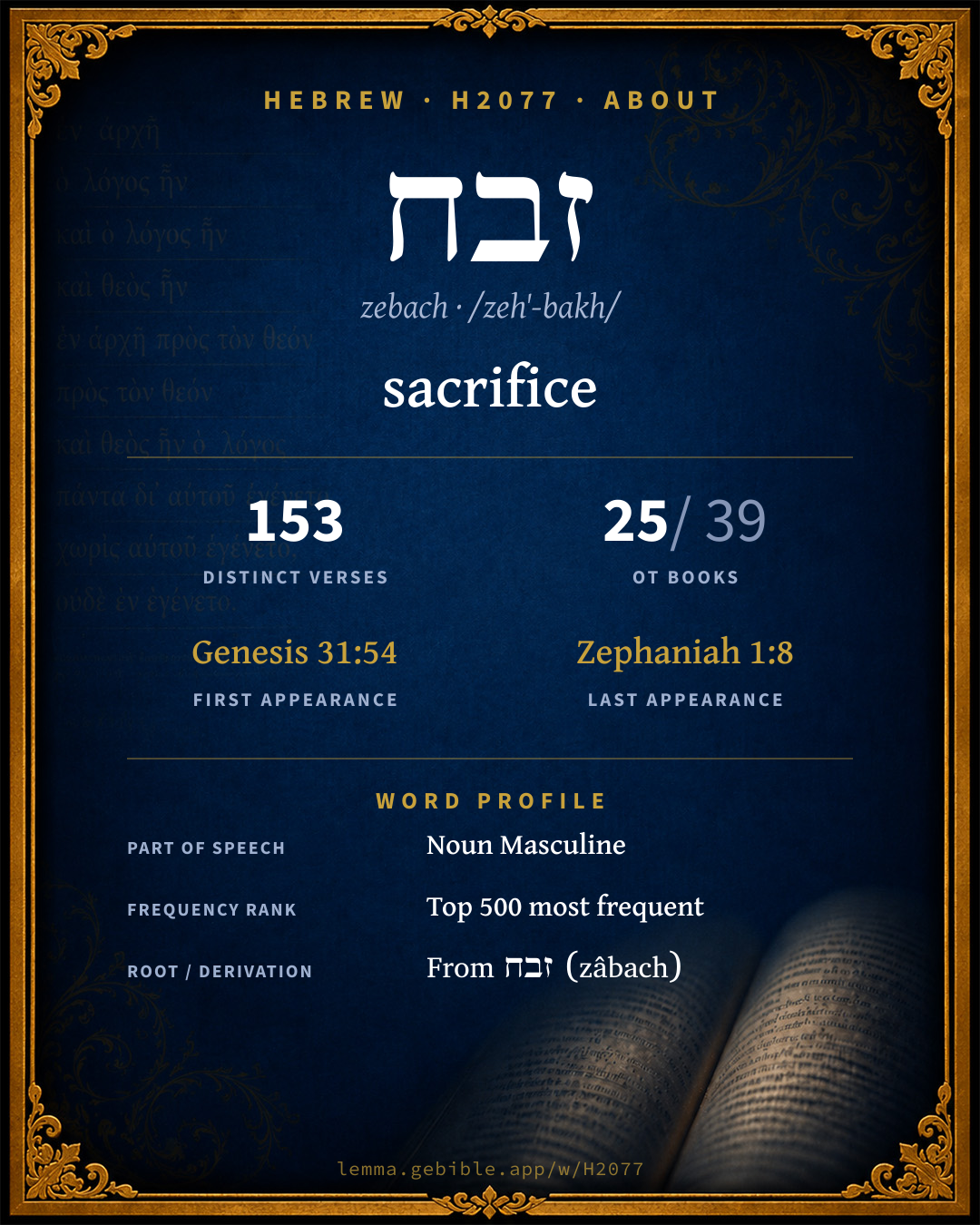
זֶ֫בַח
sacrifice
‘sacrifice’ is one of 8 main senses fuller range ↓
Full lexicon entry — Brown-Driver-Briggs (BDB)
From Brown-Driver-Briggs (BDB)
Where this word appears
See every Construct-state word in the Hebrew Bible →
Grammar key — what these labels mean
Part of speech
- Noun
- A naming word — a person, place, thing, or idea.
Noun type
- Common
- A common noun — a general class of person, place, or thing (“king,” “city,” “water”), not a specific name.
State
- Construct
- A noun bound to a following noun in a possessive / “of” relationship (the construct chain).
- Absolute
- The independent form of a noun, not bound to a following word.
Gender
- Masculine
- Grammatically masculine.
Number
- Singular
- One.
- Plural
- More than one (in Hebrew, generally three or more).
59 distinct verses where H2077 appears in the Absolute state, across 25 books. Filtered view — show all forms. Click any verse to open its interlinear word-by-word view. Verse text shown in the World English Bible for context — . Each verse’s Hebrew form is shown with its reference; the English is not keyword-highlighted, since the data carries no word-level English alignment. Use “Compare translations” on any verse to read it across multiple English versions. This concordance covers the Hebrew Bible; Septuagint (Greek Old Testament) occurrences are not indexed here.
Genesis 2 verses
- Genesis 31:54 זֶ֨בַח֙ n c ms Jacob offered a sacrifice in the mountain, and called his relatives to eat bread. They ate bread, and stayed all night in the mountain.
- Genesis 46:1 זְבָחִ֔ים n c mp Israel traveled with all that he had, and came to Beersheba, and offered sacrifices to the God of his father, Isaac.
Exodus 3 verses
- Exodus 10:25 זְבָחִ֣ים n c mp Moses said, "You must also give into our hand sacrifices and burnt-offerings, that we may sacrifice to Yahweh our God.
- Exodus 18:12 וּ/זְבָחִ֖ים conj + n c mp Jethro, Moses' father-in-law, took a burnt offering and sacrifices for God. Aaron came with all of the elders of Israel, to eat bread with Moses' father-in-law before God.
- Exodus 24:5 זְבָחִ֧ים n c mp He sent young men of the children of Israel, who offered burnt offerings and sacrificed peace-offerings of oxen to Yahweh.
Leviticus 4 verses
- Leviticus 7:13 זֶ֖בַח n c ms With cakes of leavened bread he shall offer his offering with the sacrifice of his peace offerings for thanksgiving.
- Leviticus 7:17 הַ/זָּ֑בַח ptcl def.art + n c ms but what remains of the flesh of the sacrifice on the third day shall be burned with fire.
- Leviticus 17:8 זָֽבַח n c ms "You shall say to them, 'Any man there is of the house of Israel, or of the strangers who live as foreigners among them, who offers a burnt offering or sacrifice,
- Leviticus 23:37 זֶ֥בַח n c ms "'These are the appointed feasts of Yahweh, which you shall proclaim to be holy convocations, to offer an offering made by fire to Yahweh, a burnt offering, and a meal offering, a sacrifice, and drink offerings, each on its own day;
Numbers 3 verses
- Numbers 15:3 זֶ֔בַח n c ms and will make an offering by fire to Yahweh, a burnt offering, or a sacrifice, to accomplish a vow, or as a freewill-offering, or in your set feasts, to make a sweet savor to Yahweh, of the herd, or of the flock;
- Numbers 15:5 לַ/זָּ֑בַח prep det + n c ms and wine for the drink-offering, the fourth part of a hin, shall you prepare with the burnt offering, or for the sacrifice, for each lamb.
- Numbers 15:8 זָ֑בַח n c ms When you prepare a bull for a burnt offering, or for a sacrifice, to accomplish a vow, or for peace-offerings to Yahweh;
Deuteronomy 1 verse
Joshua 3 verses
- Joshua 22:26 לְ/זָֽבַח prep + n c ms Therefore we said, Let us now prepare to build us an altar, not for burnt offering, nor for sacrifice:
- Joshua 22:28 לְ/זֶ֔בַח prep + n c ms Therefore said we, It shall be, when they so tell us or to our generations in time to come, that we shall say, Behold the pattern of the altar of Yahweh, which our fathers made, not for burnt offering, nor for sacrifice; but it is a witness between us and you.
- Joshua 22:29 וּ/לְ/זָ֑בַח conj + prep + n c ms Far be it from us that we should rebel against Yahweh, and turn away this day from following Yahweh, to build an altar for burnt-offering, for meal-offering, or for sacrifice, besides the altar of Yahweh our God that is before his tent.
Judges 1 verse
1 Samuel 8 verses
- 1 Samuel 2:13 זֶ֗בַח n c ms The custom of the priests with the people was that when any man offered sacrifice, the priest's servant came, while the flesh was boiling, with a flesh-hook of three teeth in his hand;
- 1 Samuel 3:14 בְּ/זֶ֥בַח prep + n c ms Therefore I have sworn to the house of Eli, that the iniquity of Eli's house shall not be expiated with sacrifice nor offering forever.
- 1 Samuel 6:15 זְבָחִ֛ים n c mp The Levites took down the ark of Yahweh, and the coffer that was with it, in which the jewels of gold were, and put them on the great stone: and the men of Beth-shemesh offered burnt offerings and sacrificed sacrifices the same day to Yahweh.
- 1 Samuel 9:13 הַ/זֶּ֔בַח ptcl def.art + n c ms as soon as you are come into the city, you shall immediately find him, before he goes up to the high place to eat; for the people will not eat until he come, because he does bless the sacrifice; [and] afterwards they eat who are invited. Now therefore get you up; for at this time you shall find him.
- 1 Samuel 11:15 זְבָחִ֥ים n c mp All the people went to Gilgal; and there they made Saul king before Yahweh in Gilgal; and there they offered sacrifices of peace-offerings before Yahweh; and there Saul and all the men of Israel rejoiced greatly.
- 1 Samuel 15:22 וּ/זְבָחִ֔ים מִ/זֶּ֣בַח conj + n c mp prep + n c ms Samuel said, Has Yahweh as great delight in burnt offerings and sacrifices, as in obeying the voice of Yahweh? Behold, to obey is better than sacrifice, and to listen than the fat of rams.
- 1 Samuel 16:3 בַּ/זָּ֑בַח prep det + n c ms Call Jesse to the sacrifice, and I will show you what you shall do: and you shall anoint to me him whom I name to you.
- 1 Samuel 16:5 בַּ/זָּ֑בַח לַ/זָּֽבַח prep det + n c ms prep det + n c ms He said, Peaceably; I am come to sacrifice to Yahweh: sanctify yourselves, and come with me to the sacrifice. He sanctified Jesse and his sons, and called them to the sacrifice.
2 Samuel 1 verse
1 Kings 2 verses
- 1 Kings 8:62 זֶ֖בַח n c ms The king, and all Israel with him, offered sacrifice before Yahweh.
- 1 Kings 12:27 זְבָחִ֤ים n c mp if this people go up to offer sacrifices in the house of Yahweh at Jerusalem, then will the heart of this people turn again to their lord, even to Rehoboam king of Judah; and they will kill me, and return to Rehoboam king of Judah.
2 Kings 4 verses
- 2 Kings 5:17 וָ/זֶ֨בַח֙ conj + n c ms Naaman said, If not, yet, please let there be given to your servant two mules' burden of earth; for your servant will henceforth offer neither burnt offering nor sacrifice to other gods, but to Yahweh.
- 2 Kings 10:19 זֶ֨בַח n c ms Now therefore call to me all the prophets of Baal, all his worshippers, and all his priests; let none be wanting: for I have a great sacrifice [to do] to Baal; whoever shall be wanting, he shall not live. But Jehu did it in subtlety, to the intent that he might destroy the worshippers of Baal.
- 2 Kings 10:24 זְבָחִ֣ים n c mp They went in to offer sacrifices and burnt offerings. Now Jehu had appointed him eighty men outside, and said, If any of the men whom I bring into your hands escape, [he who lets him go], his life shall be for the life of him.
- 2 Kings 16:15 זֶ֖בַח n c ms King Ahaz commanded Urijah the priest, saying, On the great altar burn the morning burnt offering, and the evening meal-offering, and the king's burnt offering, and his meal-offering, with the burnt offering of all the people of the land, and their meal-offering, and their drink-offerings; and sprinkle on it all the blood of the burnt offering, and all the blood of the sacrifice: but the brazen altar shall be for me to inquire by.
1 Chronicles 1 verse
2 Chronicles 4 verses
- 2 Chronicles 7:1 וְ/הַ/זְּבָחִ֑ים conj + ptcl def.art + n c mp Now when Solomon had made an end of praying, the fire came down from heaven, and consumed the burnt offering and the sacrifices; and the glory of Yahweh filled the house.
- 2 Chronicles 7:4 זֶ֖בַח n c ms Then the king and all the people offered sacrifice before Yahweh.
- 2 Chronicles 7:12 זָֽבַח n c ms Yahweh appeared to Solomon by night, and said to him, I have heard your prayer, and have chosen this place to myself for a house of sacrifice.
- 2 Chronicles 29:31 זְבָחִ֥ים זְבָחִ֣ים n c mp n c mp Then Hezekiah answered, Now you have consecrated yourselves to Yahweh; come near and bring sacrifices and thank-offerings into the house of Yahweh. The assembly brought in sacrifices and thank-offerings; and as many as were of a willing heart [brought] burnt offerings.
Nehemiah 1 verse
Psalms 3 verses
- Psalms 40:6 זֶ֤בַח n c ms Sacrifice and offering you didn't desire. You have opened my ears: Burnt offering and sin offering you have not required.
- Psalms 50:5 זָֽבַח n c ms "Gather my saints together to me, Those who have made a covenant with me by sacrifice."
- Psalms 51:16 זֶ֣בַח n c ms For you don't delight in sacrifice, or else I would give it. You have no pleasure in burnt offering.
Proverbs 1 verse
Ecclesiastes 1 verse
Isaiah 3 verses
- Isaiah 19:21 זֶ֣בַח n c ms Yahweh shall be known to Egypt, and the Egyptians shall know Yahweh in that day; yes, they shall worship with sacrifice and offering, and shall vow a vow to Yahweh, and shall perform it.
- Isaiah 34:6 זֶ֤בַח n c ms The sword of Yahweh is filled with blood, it is made fat with fatness, with the blood of lambs and goats, with the fat of the kidneys of rams; for Yahweh has a sacrifice in Bozrah, and a great slaughter in the land of Edom.
- Isaiah 57:7 זָֽבַח n c ms On a high and lofty mountain have you set your bed; there also you went up to offer sacrifice.
Jeremiah 4 verses
- Jeremiah 7:22 וָ/זָֽבַח conj + n c ms For I didn't speak to your fathers, nor command them in the day that I brought them out of the land of Egypt, concerning burnt offerings or sacrifices:
- Jeremiah 17:26 וְ/זֶ֖בַח conj + n c ms They shall come from the cities of Judah, and from the places round about Jerusalem, and from the land of Benjamin, and from the lowland, and from the hill-country, and from the South, bringing burnt offerings, and sacrifices, and meal-offerings, and frankincense, and bringing [sacrifices of] thanksgiving, to the house of Yahweh.
- Jeremiah 33:18 זֶּ֖בַח n c ms neither shall the priests the Levites want a man before me to offer burnt offerings, and to burn meal-offerings, and to do sacrifice continually.
- Jeremiah 46:10 זֶ֠בַח n c ms For that day is [a day] of the Lord, Yahweh of Hosts, a day of vengeance, that he may avenge him of his adversaries: and the sword shall devour and be satiate, and shall drink its fill of their blood; for the Lord, Yahweh of hosts, has a sacrifice in the north country by the river Euphrates.
Ezekiel 3 verses
- Ezekiel 39:17 זִבְחִ֗/י זֶ֣בַח n c ms cs + sfx pers 1cs n c ms You, son of man, thus says the Lord Yahweh: Speak to the birds of every sort, and to every animal of the field, Assemble yourselves, and come; gather yourselves on every side to my sacrifice that I do sacrifice for you, even a great sacrifice on the mountains of Israel, that you may eat flesh and drink blood.
- Ezekiel 40:42 וְ/הַ/זָּֽבַח conj + ptcl def.art + n c ms There were four tables for the burnt offering, of hewn stone, a cubit and a half long, and a cubit and a half broad, and one cubit high; whereupon they laid the instruments with which they killed the burnt offering and the sacrifice.
- Ezekiel 44:11 הַ/זֶּ֨בַח֙ ptcl def.art + n c ms Yet they shall be ministers in my sanctuary, having oversight at the gates of the house, and ministering in the house: they shall kill the burnt offering and the sacrifice for the people, and they shall stand before them to minister to them.
Daniel 1 verse
Hosea 2 verses
Amos 1 verse
Jonah 1 verse
Zephaniah 1 verse
About this entry
At a glance — auto-summarized from this page’s data, not written by a person. Every figure links to its source below. This summary describes the numbers; it doesn’t interpret them.
זבח (zebach) is a Hebrew noun most often rendered “sacrifice.” Not a single-sense word: explore its full sense range. With 153 verses in 25 books, it is a common word in the Hebrew Bible. It first appears in Genesis 31:54. It clusters with זבח, דבח and מזבח under a shared root. The sections below give every sense, occurrence, and version rendering.
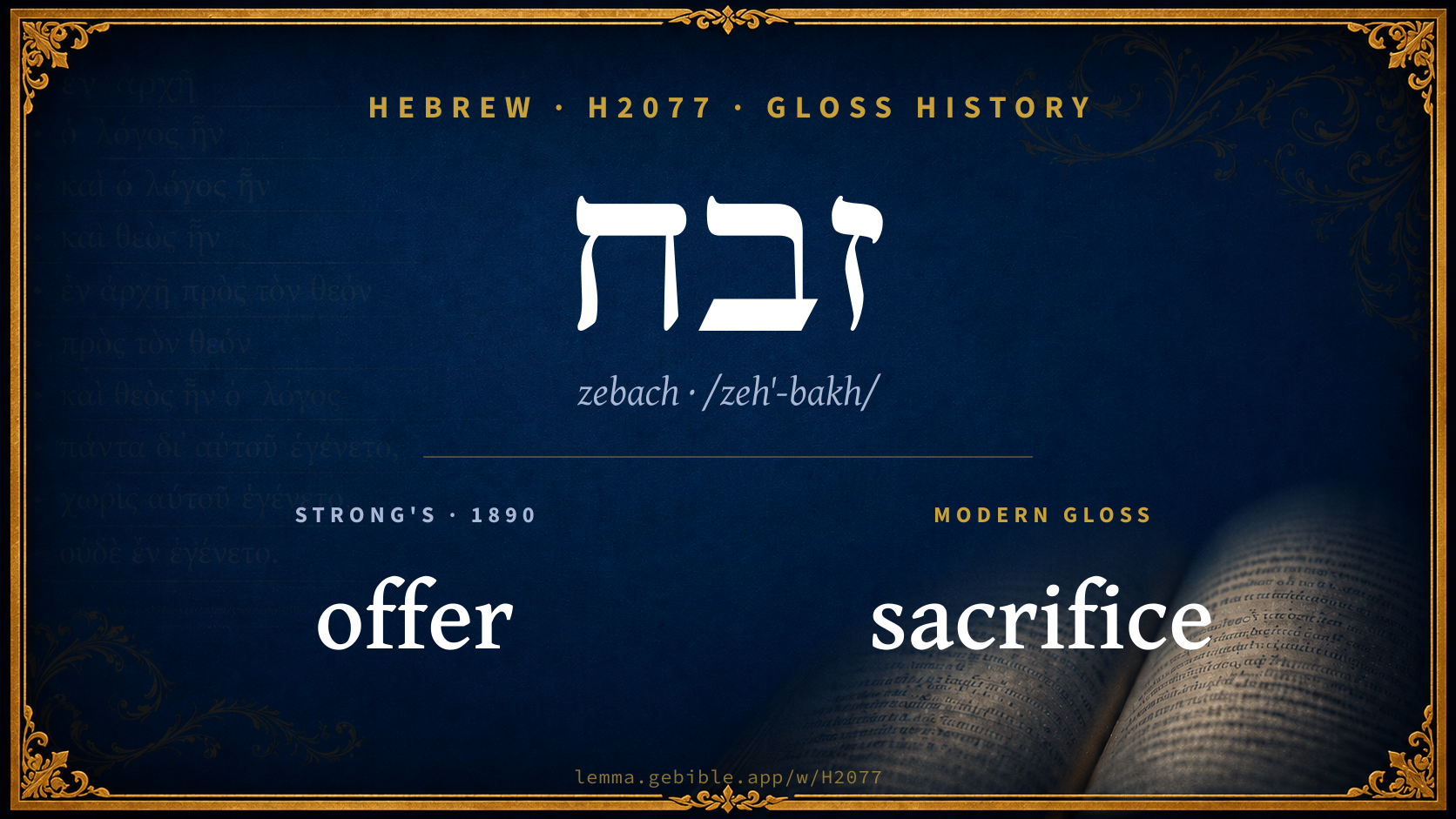
Gloss history
Strong's 1890 vs modern scholarship
About this word
Strong's H2077 catalogs a Hebrew word from the Hebrew Old Testament.
These counts are not copied from any lexicon or concordance. They are computed here, from the morphology-tagged Hebrew Old Testament. What Lemma adds →
- 153
- distinct verses
- The word appears in 153 distinct verses.
- 25 / 39
- OT books
- The word appears in 25 of 39 Old Testament books.
- #283
- by frequency
- Top 500 most frequent Hebrew words (rank 283 of 8,640 Hebrew words by occurrence).
View all 153 occurrences in the concordance →
By section of the Old Testament
By traditional corpus
Conventional, traditional groupings — biblical authorship is debated, so this is a traditional corpus grouping, not an authorship claim. Each share is this word’s portion of its verses in that division of the Hebrew canon. Each figure is a share of the word’s 153 distinct verses.
- Torah (Pentateuch) 68 verses · 44%
- Prophets (Nevi'im) 58 verses · 38%
- Writings (Ketuvim) 27 verses · 18%
How translations render this word
Counts come from each version’s own published word-to-Strong’s tagging or interlinear alignment — an approximate guide to how each version renders this word, not a word-level alignment the data otherwise carries. Because each total is that version’s own tagged count, the per-version totals vary from one another and need not match the appearance or distinct-verse counts above. These counts may also differ from a printed concordance because Lemma counts each distinctly tagged rendering and does not collapse phrase taggings into a single head-word total. This is a fixed set of word-tagged versions (KJV, ASV, BSB, ULT) and does not change with the reading translation you choose elsewhere. Each version’s license is shown beside its name below (and on Sources).
BDB lists this Strong’s number as 2 distinct words (homographs). Each count above pools all of them and is not split by sense — see the Senses section below. A low-frequency rendering may belong to a different one of those words, not the primary meaning.
- King James Version†: Sacrifice 83×, Sacrifices 48×, Offerings 6×
- American Standard Version†: Sacrifice 76×, Sacrifices 43×, Peace-offerings 11×
- Berean Standard Bible†: Sacrifices 52×, Sacrifice 42×, Offerings 6×
- unfoldingWord Literal Text†: Sacrifice 47×, Sacrifice of 46×, Sacrifices 40×
King James Version Public Domain
Renders H2077 across 162† tagged occurrences — most commonly:
Plus 18 renderings that appear only once — usually multi-word phrases or single function words the recovered tagging swept in, not distinct renderings.
American Standard Version Public Domain
Renders H2077 across 169† tagged occurrences — most commonly:
Plus 35 renderings that appear only once — usually multi-word phrases or single function words the recovered tagging swept in, not distinct renderings.
Berean Standard Bible Public Domain
Renders H2077 across 121† tagged occurrences — most commonly:
Plus 11 renderings that appear only once — usually multi-word phrases or single function words the recovered tagging swept in, not distinct renderings. Not rendered by a distinct English word in 18 further occurrences.
unfoldingWord Literal Text CC BY-SA 4.0
Renders H2077 across 166† tagged occurrences — most commonly:
Plus 12 renderings that appear only once — usually multi-word phrases or single function words the recovered tagging swept in, not distinct renderings.
11 senses and sub-senses in the full BDB
What do BDB’s symbols mean?
BDB uses these scholarly abbreviations:
| Symbol | Meaning |
|---|---|
| 𝔊 | the Septuagint (the ancient Greek translation, LXX) |
| 𝔙 | the Vulgate (the Latin translation) |
| 𝔖 | the Syriac version (the Peshitta) |
| 𝔗 | the Targum (the Aramaic translation) |
| ψ | the Psalms |
| √ | root (the underlying root or stem) |
| ‖ | parallel passage (a synonymous or contrasted parallel) |
| † | the dagger: every passage where the word occurs is cited |
The 11 senses and sub-senses the full Brown-Driver-Briggs lexicon distinguishes for this word, in lexicon order (not ranked by frequency), with BDB’s own verbatim wording and sub-sense lettering. Shown in Hebrew script with BDB’s own scholarly abbreviations. The condensed entry is in the Lexicon Entry tab. See also the Forms in the corpus table below.
זבח I
- I. general name for all sacrifices eaten at feasts:* Ph. זבח of an offering of bread and oil CIS i. 165. 12; 167. 8, cf. RSSem 205 (2nd ed. 222)—
- 1. of the God of Israel Gn 46:1 Ex 10:25; 18:12 (E) Ho 3:4; 6:6; 9:4 Am 5:25 Is 1:11; 19:21 Dt 12:27; 18:3 1 S 2:13, 29; 3:14; 6:15; 9:12, 13; 15:22(×2); 16:3, 5(×2) 2 S 15:12 1 K 8:62; 12:27 2 K 5:17; 16:15 ψ 40:7; 50:8; 51:18, 19 Pr 15:8; 21:3, 27 Is 43:23, 24; 56:7 Je 6:20; 7:21, 22; 17:26; 33:18 Ez 40:42; 44:11 1 Ch 29:21, 21 2 Ch 7:1, 4, 5, 12 Ne 12:43 Dn 9:27 Ec 4:17. They should be זִבְחֵי צֶדֶק sacrifices of righteousness (offered in righteousness by the righteous) Dt 33:19 ψ 4:6; 51:21; זִבְחֵי הַבְהָבַי sacrifices of gifts to me (י׳) Ho 8:13; the temple is בֵּית זָ֑בַח 2 Ch 7:12; they should not be ז׳ רִיב sacrifices of strife, where strife prevails Pr 17:1. e.g. Genesis 46:1
- 2. of other deities Ex 34:15 Nu 25:2 Dt 32:38 (JE) Ju 16:23 2 K 10:19, 24 Ho 4:19 Is 57:7 Ez 20:28; these are זִבְחֵי מֵתִים sacrifices to dead things (lifeless gods, opp. to י׳ as living) ψ 106:28. e.g. Exodus 34:15
- II. there are several kinds of זְבָחִים which are gradually distinguished:
- 1. the covenant sacrifice, between Jacob and Laban Gn 31:54 (E), with God ψ 50:5 (cf. Ex 24:5 1 S 11:5). e.g. Genesis 31:54
- 2. the passover זֶבַח חַג הַפֶּסַח Ex 34:25 (JE), זבח פסח Ex 12:27 (J); and prob. also זבחי Ex 23:18 (JE) = 34:25 (id.) e.g. Exodus 34:25
- 3. annual sacrifice זֶבַח הַיָּמִים 1 S 1:21; 2:19; 20:6, cf. ז׳ מִשְׁפָּחָה sacrifice of the clan 1 S 20:29. e.g. 1 Samuel 1:21
- 4. thank offering ז׳ (הַ)תּוֹדָה Lv 7:12; 22:29 ψ 107:22; 116:17, which is given as ז׳ קָרְבָּנוֹ, זִבְחוֹ, הַזָּבַח Lv 7:16, 17; and as a variety of שְׁלָמִים Lv 7:13, 15; it is implied in זִבְחֵי תְרוּעָה ψ 27:6; yet זֶבַח is generic with תּוֹדָה 2 Ch 29:31(×2). e.g. Leviticus 7:12
- 5. in ritual of H & P זבחים are defined by שׁלמים (q.v.) Lv 3:1 + 39 times Lv Nu, 1 S 10:8 1 K 8:63 2 Ch 30:22; 33:16 Pr 7:14, but sometimes (rarely) ז׳ alone is used in this sense, with or without suffix, where the meaning is plain from the context: Lv 17:5, 7, 8; 19:6; 23:37 (H) Nu 15:3, 5, 8 Jos 22:26, 29 (all P). These ritual offerings are of three varieties תּוֹדָה, נֶדֶר and נְדָבָה Lv 7:12, 16 (P); in the several lists זבחים are distinguished from תודות Am 4:4f. 2 Ch 29:31, from נדרים Nu 15:8 (P) Dt 12:6, 11 Jon 1:16, from נדבות Am 4:4 f. Dt 12:6 and from the more comprehensive שׁלמים Nu 15:8 Jos 22:27 (P). So also the sacrifice at the institution of the covenant at Horeb Ex 24:5 (JE) and the sacrifice at the installation of Saul 1 S 11:15 are defined as †זבחים שׁלמים. Thus ז׳ seems not only to be used for all these special forms but also to include other festal sacrifices not defined in the codes of law. The ritual was the same for the entire class. They were all sacrifices for feasts in which the flesh of the victim was eaten by the offerers, except so far as the officiating priests had certain choice pieces and the blood and fat pieces went to the altar for God. The sacrifice at the institution of the covenant at Horeb, the Passover victim, and the ram of consecration, were special, in that there was an application of a portion of the blood to the persons and things which were to be consecrated, Ex 12:22; 24:8 Lv 8:23. e.g. Leviticus 3:1
- 6. the slaughter of hostile nations is also a זֶבַח offered by God Himself, in which the vultures devour the flesh of the victims Is 34:6 Je 46:10 Ez 39:17(×2), 19 Zp 1:7, 8. e.g. Isaiah 34:6
- 7. the verb used with זֶבַח is ordinarily זָבַח but others also are found e.g. †עָשָׂה Nu 6:17; 15:3, 5, 8 Jos 22:23 (P) 1 K 12:27; 2 K 5:17; 10:24 Je 33:18 (cf. Sab. עסי דֿבח Hal 148 DHMZMG 1888, 374); †הֵבִיא Am 4:4 Dt 12:6, 11 Je 17:26, †הִגִּישׁ Am 5:25, †הִקְרִיב Lv 7:11, 16; 22:21 (all P), †עָבַד Is 19:21, †נָתַן Ec 4:17, יַעֲלָה עֹלָה אוֹ זֶבַח Lv 17:8 (H), בִּשֵּׁל ז׳ Ez 46:24, שָׁחַט אֶת־הָעוֹלָה וְהַזָּ֑בַח Ez 40:42 cf. 44:11. e.g. Numbers 6:17
זבח II m. a Midianite king Ju 8
Senses from the full Brown-Driver-Briggs lexicon (Brown, Driver, Briggs; Oxford 1906 — public domain), digitized via Sefaria, supplemented by the OpenScriptures HebrewLexicon (CC BY 4.0). Full attribution on Sources.
Word origin
I. n.m. Ju 16:23 sacrifice, ז׳ abs. Gn 31:54 +; cstr. Ex 34:25 +; זָ֑בַח Lv 17:8 + 16 times; sf. זִבְחוֹ Lv 7:16 Ez 34:15, זִבְחֲכֶם Lv 19:6; pl. זְבָחִים Gn 46:1 +; cstr. זִבְחֵי Lv 17:5 +; sf. 3 mpl. זִבְחֵיהֶם Lv 17:5, זְבָחֵימוֹ Dt 32:38, זִבְחוֹתָם †Ho 4:19 etc.;—the common and most ancient sacrifice, whose essential rite was eating the flesh of the victim at a feast in which the god of the clan shared by receiving the blood and fat pieces. In the older literature it is distinguished from מִנְחָה and עֹלָה, in the later literature from חַטָּאת and אָשָׁם.
II. n.pr.m. a Midianite king Ju 8:5, 6, 7, 10, 12(×2), 15(×2), 18, 21(×2) ψ 83:12, 𝔊 Ζεβεε.
— Brown-Driver-Briggs (Oxford 1906, public domain), digitized via Sefaria, supplemented by the OpenScriptures HebrewLexicon (CC BY 4.0). See Sources.
Derived from זבח (zâbach) (H2076) — to sacrifice.
Jastrow Dictionary
A second Hebrew/Aramaic lexicon for comparison, covering Aramaic and post-biblical (Talmudic, Targumic, Midrashic) usage that the biblical-Hebrew BDB does not. Matched by lemma rather than by Strong’s number, so a lemma may carry more than one Jastrow headword (shown separately below), and the entries cover usage well beyond the Bible.
זָבַח
- [to give a feast,] to slaughter, sacrifice. Ḥull. II, 3 (ref. to Deut. XXVII, 7) מה שאתה זוֹבֵחַ וכ׳ thou mayest eat what thou (a human hand) cuttest. Snh. 60ᵇ בזובח לעכו"ם of one sacrificing to an idol; a. fr.—Part. pass. זָבוּחַ. Lev. R. s. 10 (play on מזבח, Ex. XXXII, 5) מֵהַזָּ׳ לפניו וכ׳ he was afraid on account of him who lay killed before him (Hur); a. fr. e.g. Deuteronomy 27:7
- same. Snh. 62ᵃ ז׳ וקיטר וכ׳ if he slaughtered a sacrifice, and burnt &c. (to an idol). Ib. VII, 6 (60ᵇ) המְזַבֵּחַ Talm. ed. (Mish. הזובח) he who offers an animal (to an idol), a. fr.—V. זָבַל
- to be sacrificed, to be slaughtered; to die as a martyr. Zeb. I, 1 שנִזְבְּחוּ שלא לשמן which were offered not for the purpose for which they were dedicated. Y. Snh. X, 29ᶜ top (play on עלי זבח, Ps. L, 5) שעילו אותי ונזבחו על שמי who raised me and sacrificed themselves for my name’s sake; a. fr. e.g. Psalms 50:5
זֶבַח
- preced.) a slaughtering, sacrifice, esp. (festive) peace-offering (חֲגִיגָה). Pes. X, 9. Tosef. ib. X, 14. Tosef. Ber. V, 22; a. fr.—Pl. זְבָחִים, constr. זִבְחֵי. Ib. Zeb. I, 1 כל הז׳ all animalic offerings; a. fr.—Z’baḥim, name of a treatise of the Mishnah, Tosefta and Talmud Babli (also called שְׁחִיטַת קָדֳשִׁים).
A Dictionary of the Targumim, the Talmud Babli and Yerushalmi, and the Midrashic Literature (Marcus Jastrow; London, Luzac, 1903) — Public Domain. Digitized via Sefaria. Digitized via Sefaria. Full attribution on Sources.
Forms in the corpus
The 86 distinct written forms H2077 takes in the Hebrew Bible, most frequent first — each parse links to that state’s occurrences in the concordance. Hebrew forms include their vowel points and cantillation, so a single lemma takes many written forms.
The 60 most common forms are shown; 26 rarer forms follow in the full concordance.
Same root — word family
Other BDB entries built from the same root as H2077, grouped by Strong’s listed origin. These share a root / origin per the lexicon — not necessarily a shared meaning. Each links to that word’s own entry.
Derives from
Shares the same root
Proper names from this root
People and places named from this root — a name, not an additional meaning of the word.
Compare all same-root words → Showing 4 of 5 — not the complete family. 1 of the same-root words is a proper name (a person or place). They share a root, not necessarily a meaning.
Septuagint verse parallels
This word appears in 146 verses that also exist in the Greek Old Testament (Septuagint), out of the 153 Hebrew verses it occurs in. You can read those verses in Greek by switching the Old Testament edition to the Septuagint.
Read these verses in the Septuagint
- Genesis 31:54
- Exodus 10:25
- Leviticus 3:1
- Numbers 6:17
- Deuteronomy 12:6
- Joshua 22:23
- Judges 16:23
- 1 Samuel 1:21
- 2 Samuel 15:12
- 1 Kings 8:62
- 2 Kings 5:17
- 1 Chronicles 29:21
This is a verse-level parallel only — the same verses exist in both the Hebrew and Greek Old Testaments. No word-level Hebrew↔Greek correspondence is claimed: the data carries no such alignment, so no Greek word is shown as this Hebrew word’s translation. Coverage is not total — the Septuagint omits the deuterocanon and renumbers the Psalms, so some Hebrew verses have no direct Greek parallel.