Jonah 1:16

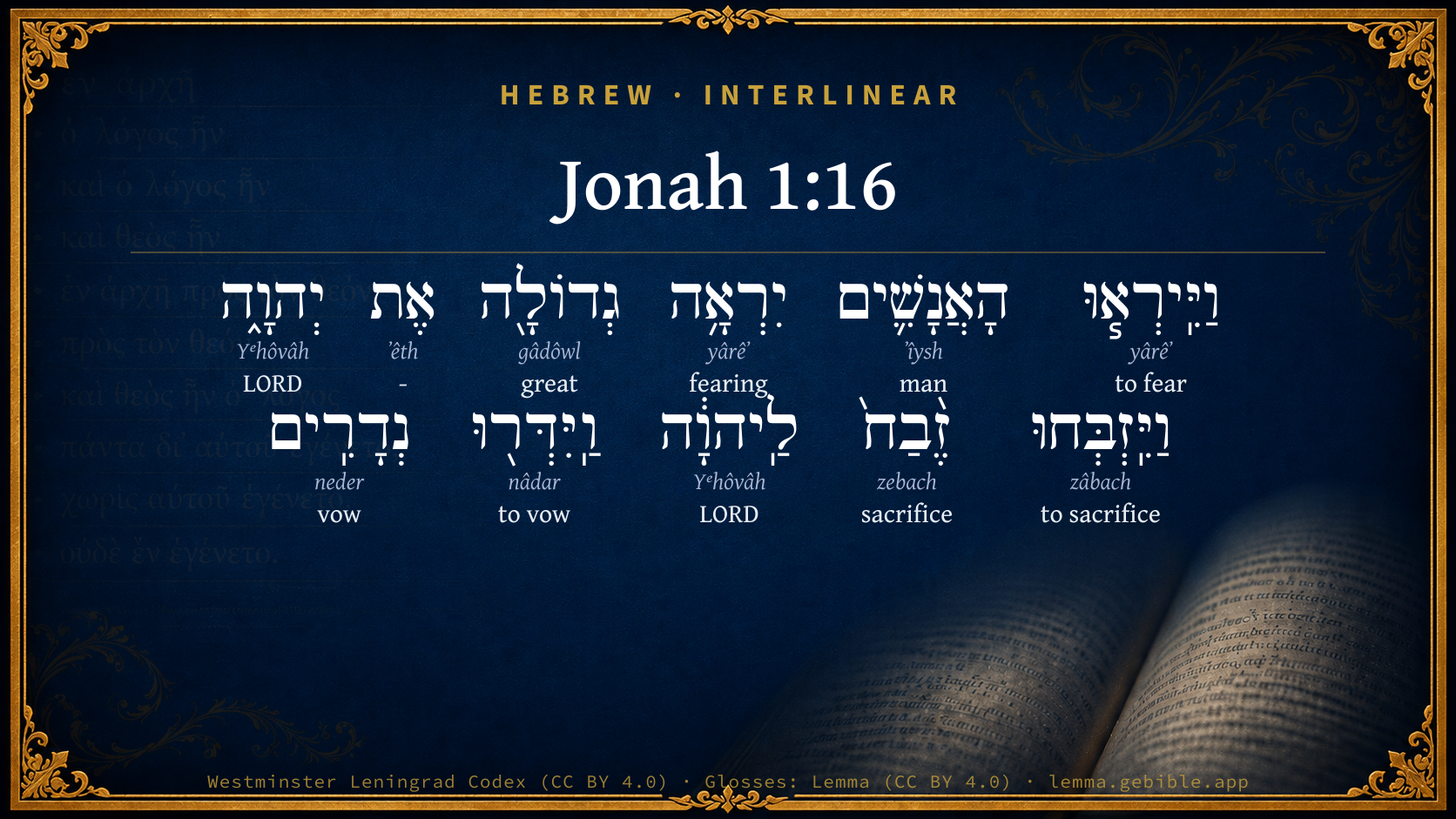
Hebrew (Westminster Leningrad Codex) Jonah 1:16 appears in the Hebrew Old Testament. The text above is from the Westminster Leningrad Codex. Each word links to its Strong’s number, a concise gloss, and parsing drawn from the Open Scriptures Hebrew Bible morphology. Click any word for its full Brown-Driver-Briggs (BDB) entry.
Download image
Cite this verse

Jonah 1:16 (World English Bible). Public Domain. Lemma interlinear Bible study tool, https://lemma.gebible.app/v/jonah/1/16.

Show BibTeX & RIS
BibTeX
RIS
English Translation
Then the men feared Yahweh exceedingly; and they offered a sacrifice to Yahweh, and made vows.
World English Bible · Public Domain
Download a study sheet

One document with this verse’s original text, its word-by-word gloss line, the meaning frame, cross-references with their text, attributed commentary, and full source and license credits — printable, and it pastes into notes with its structure intact.

This verse Autodidact and up

Study sheet (.html) Plain text (.txt)

A passage Seminary Student

Up to 50 verses in one chapter. A passage sheet keeps up to 6 commentary sources and 12 cross-references per verse, in the order this page ranks them, and says so on the sheet whenever that leaves anything out. Ask for a single verse and you get the Autodidact verse sheet above.

Everything on this page stays free to read, with no account — the sheet is a download of what is already on screen, not access to it.

Want to remove ads? Support Godless Engineer
Compare translations 3

The same verse in 3 English versions, stacked beneath the original-language interlinear above. Click any original word for its lexicon entry.

Each is an independent rendering of the whole verse — the interlinear is not word-aligned to these translations.

Highlighted words mark where these versions differ — a whole-verse word diff, not a word-by-word alignment.

  • World English Bible Public Domain
    Then the men feared Yahweh exceedingly; and they offered a sacrifice to Yahweh, and made vows.
  • King James Version Public Domain
    Then the men feared the LORD exceedingly, and offered a sacrifice unto the LORD, and made vows.
  • unfoldingWord Literal Text CC BY-SA 4.0
    Then the men feared Yahweh great fear, and they sacrificed a sacrifice to Yahweh and vowed vows. ts\*

unfoldingWord Literal Text — © unfoldingWord, licensed CC BY-SA 4.0. Word-aligned USFM3 via Door43 (git.door43.org/unfoldingWord/en_ult).

Versions to compare (up to 4)

3 of 4 selected

Show all 18 translations

Every available English version of this verse, each an independent rendering of the whole verse.

  • World English Bible Public Domain
    Then the men feared Yahweh exceedingly; and they offered a sacrifice to Yahweh, and made vows.
  • Berean Standard Bible Public Domain
    Then the men feared the LORD greatly, and they offered a sacrifice to the LORD and made vows to Him.
  • Majority Standard Bible Public Domain
    Then the men feared the LORD greatly, and they offered a sacrifice to the LORD and made vows to Him.
  • King James Version Public Domain
    Then the men feared the LORD exceedingly, and offered a sacrifice unto the LORD, and made vows.
  • American Standard Version (1901) Public Domain
    Then the men feared Jehovah exceedingly; and they offered a sacrifice unto Jehovah, and made vows.
  • Revised Version (1885) Public Domain
    Then the men feared the LORD exceedingly; and they offered a sacrifice unto the LORD, and made vows.
  • Geneva Bible (1599) Public Domain
    Then the men feared the Lord exceedingly, and offered a sacrifice vnto the Lord, and made vowes.
  • Douay-Rheims (1899) Public Domain
    And the men feared the Lord exceedingly, and sacrificed victims to the Lord, and made vows.
  • Young's Literal Translation Public Domain
    and the men fear Jehovah -- a great fear, and sacrifice a sacrifice to Jehovah, and vow vows.
  • Literal Standard Version CC BY-SA 4.0
    and the men fear YHWH [with] a great fear, and sacrifice a sacrifice to YHWH, and vow vows.
  • Unlocked Literal Bible CC BY-SA 4.0
    Then the men feared Yahweh very much. They offered sacrifices to Yahweh and made vows.
  • unfoldingWord Literal Text CC BY-SA 4.0
    Then the men feared Yahweh great fear, and they sacrificed a sacrifice to Yahweh and vowed vows. ts\*
  • Darby Bible Public Domain
    And the men feared Jehovah exceedingly, and offered a sacrifice unto Jehovah, and made vows.
  • World Messianic Bible Public Domain
    Then the men feared the LORD exceedingly; and they offered a sacrifice to the LORD and made vows.
  • Webster's Bible Public Domain
    Then the men feared the LORD exceedingly, and offered a sacrifice to the LORD, and made vows.
  • Free Bible Version CC BY-SA 4.0
    The sailors were overcome with fear. They offered a sacrifice to the Lord and made many promises to him.
  • Bible in Basic English Public Domain
    Then great was the men's fear of the Lord; and they made an offering to the Lord and took oaths to him.
  • JPS Tanakh (1917) Public Domain
    Then the men feared the LORD exceedingly; and they offered a sacrifice unto the LORD, and made vows.

Literal Standard Version (2020), Covenant Press — licensed CC BY-SA 4.0. Text via the HelloAO Bible API (eBible.org). Unlocked Literal Bible (unfoldingWord) — licensed CC BY-SA 4.0. Text via the HelloAO Bible API (eBible.org). unfoldingWord Literal Text — © unfoldingWord, licensed CC BY-SA 4.0. Word-aligned USFM3 via Door43 (git.door43.org/unfoldingWord/en_ult). Free Bible Version, Dr. Jonathan Gallagher — licensed CC BY-SA 4.0. Text via the HelloAO Bible API (eBible.org).

Word by word

More ways to search: Search by grammar → Find every occurrence → Compare this word →

Practice this passage: Drill this verse → Learn its vocabulary →

וַֽיִּדְּר֖וּ
nâdar
H5087
“and · to vow”
Conjunction + Verb, Qal, Sequential Imperfect, 3rd Person, Masculine, Plural
Part of Speech
Conjunction + Verb
Stem
Qal
Form
Sequential Imperfect
Person
3rd Person
Gender
Masculine
Number
Plural
Full BDB Definition

Origin: a primitive root

TWOT: 1308

to vow, make a vow - (Qal) to vow a vow
  1. וַיִּֽירְא֧וּ yârêʼ H3372 “and · to fear” Conjunction + Verb, Qal, Sequential Imperfect, 3rd Person, Masculine, Plural
  2. הָאֲנָשִׁ֛ים ʼîysh H376 “the · men” Particle, Definite Article + Noun, Common, Masculine, Plural, Absolute
  3. יִרְאָ֥ה yârêʼ H3373 “fearing” Noun, Common, Feminine, Singular, Absolute
  4. גְדוֹלָ֖ה gâdôwl H1419 “great” Adjective, Adjective, Feminine, Singular, Absolute
  5. אֶת ʼêth H853 “-” Particle, Direct Object
  6. יְהוָ֑ה Yᵉhôvâh H3068 “LORD” Noun, Proper
  7. וַיִּֽזְבְּחוּ zâbach H2076 “and · to sacrifice” Conjunction + Verb, Qal, Sequential Imperfect, 3rd Person, Masculine, Plural
  8. זֶ֨בַח֙ zebach H2077 “sacrifice” Noun, Common, Masculine, Singular, Absolute
  9. לַֽיהוָ֔ה Yᵉhôvâh H3068 “to/for · LORD” Preposition + Noun, Proper
  10. נְדָרִֽים neder H5088 “vows” Noun, Common, Masculine, Plural, Absolute

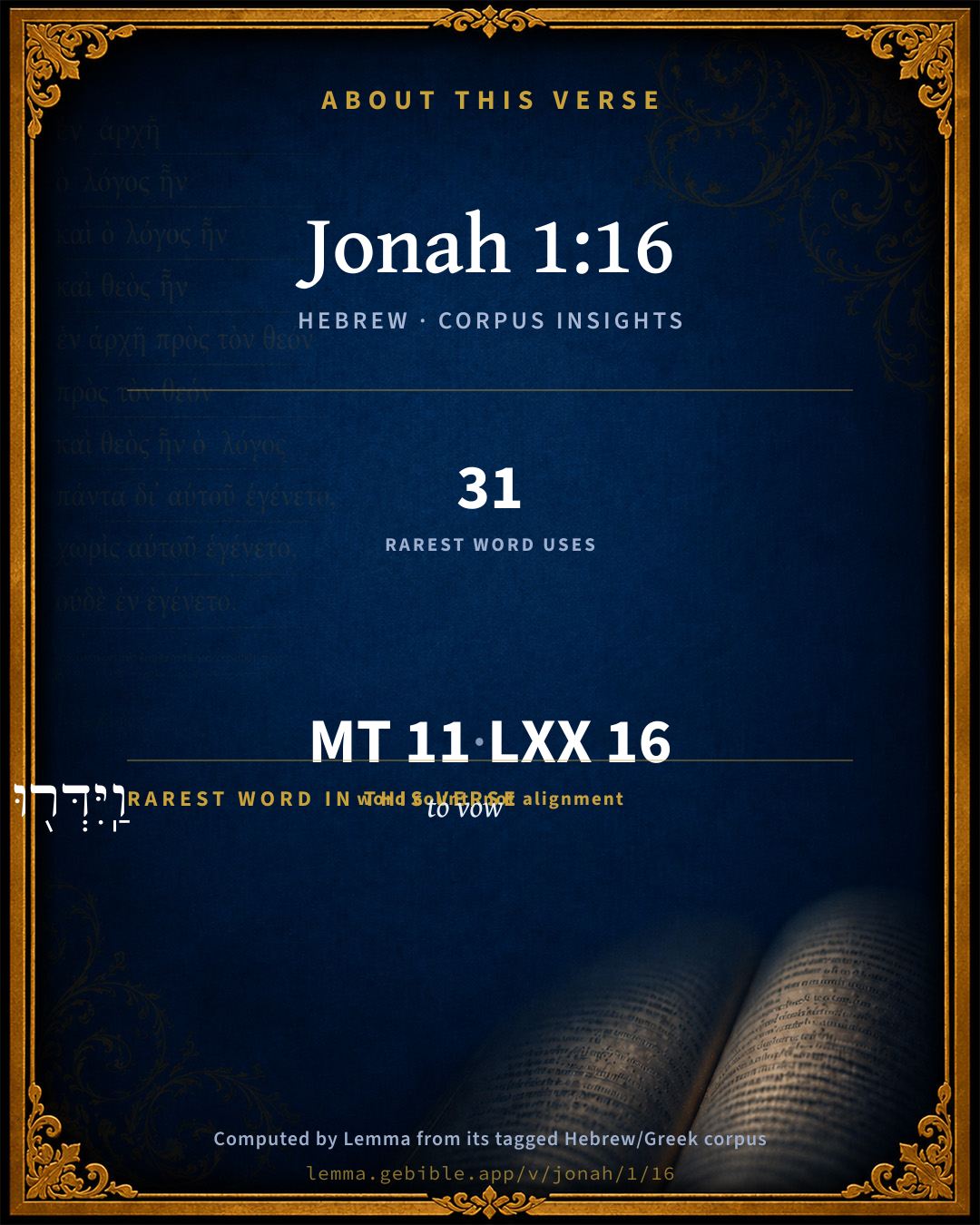
About this verse

These counts appear in no published source. They are computed here, from the morphology-tagged text and Lemma’s own curated glosses. What Lemma adds →

11
words
10
distinct lemmas
Prophets
section

Shared distinctive vocabulary

וַֽיִּדְּר֖וּ to vow H5087 occurs in 28 verses of the Hebrew Bible. Also found in:

Grammatical profile

  • 3 verbs
  • 6 nouns
  • 1 adjective
  • 1 particle

Verb forms

  • וַיִּֽירְא֧וּ Qal · Sequential Imperfect
  • וַיִּֽזְבְּחוּ Qal · Sequential Imperfect
  • וַֽיִּדְּר֖וּ Qal · Sequential Imperfect

Repetition

A word recurs within this verse — often emphatic in Hebrew:

  • יְהוָ֑ה LORD H3068 ×2

Hebrew & Septuagint length

In English translation the verse runs 16 words from the Hebrew and 18 from the Septuagint (LXX English) — closely comparable.

A rough comparison of the two English renderings, which tokenize alike — not a word-level alignment.

Word counts can differ between the Hebrew and the Greek without any difference in meaning — e.g. the Hebrew direct-object marker אֵת has no separate Greek word, and Greek often adds the article ὁ.

In the original languages it is 11 Hebrew tokens and 16 Greek tokens — but the two are counted differently (Hebrew bundles its prefixes and suffixes into one token; the Greek is in lemma form), so that isn’t a like-for-like length.

Cross-references

16

Topical passages linked to Jonah 1:16 in the Treasury of Scripture Knowledge — connected by theme and wording, ordered by reader-vote popularity; previews shown in the World English Bible.

  • Psalms 116:14 I will pay my vows to Yahweh, Yes, in the presence of all his people.
  • Daniel 6:26 I make a decree, that in all the dominion of my kingdom men tremble and fear before the God of Daniel; for he is the living God, and steadfast forever, His kingdom that which shall not be destroyed; and his dominion shall be even to the end.
  • Genesis 8:20 Noah built an altar to Yahweh, and took of every clean animal, and of every clean bird, and offered burnt offerings on the altar.
  • Psalms 50:14 Offer to God the sacrifice of thanksgiving. Pay your vows to the Most High.
  • Psalms 107:22 Let them offer the sacrifices of thanksgiving, And declare his works with singing.
  • Isaiah 26:9 With my soul have I desired you in the night; yes, with my spirit within me will I seek you earnestly: for when your judgments are in the earth, the inhabitants of the world learn righteousness.
  • Isaiah 60:5–7 Then you shall see and be radiant, and your heart shall thrill and be enlarged; because the abundance of the sea shall be turned to you, the wealth of the nations shall come to you.
  • Daniel 4:34–37 At the end of the days I, Nebuchadnezzar, lifted up my eyes to heaven, and my understanding returned to me, and I blessed the Most High, and I praised and honored him who lives forever; for his dominion is an everlasting dominion, and his kingdom from generation to generation.
  • Jonah 1:10 Then were the men exceedingly afraid, and said to him, "What is this that you have done?" For the men knew that he was fleeing from the presence of Yahweh, because he had told them.
  • Mark 4:31 It's like a grain of mustard seed, which, when it is sown in the earth, though it is less than all the seeds that are on the earth,
  • Acts 5:11 Great fear came on the whole assembly, and on all who heard these things.
  • Genesis 28:20 Jacob vowed a vow, saying, "If God will be with me, and will keep me in this way that I go, and will give me bread to eat, and clothing to put on,
  • 2 Kings 5:17 Naaman said, If not, yet, please let there be given to your servant two mules' burden of earth; for your servant will henceforth offer neither burnt offering nor sacrifice to other gods, but to Yahweh.
  • Psalms 66:13–16 I will come into your temple with burnt offerings. I will pay my vows to you,
  • Ecclesiastes 5:4 When you vow a vow to God, don't defer to pay it; for he has no pleasure in fools. Pay that which you vow.
  • Judges 13:16 The angel of Yahweh said to Manoah, Though you detain me, I won't eat of your bread; and if you will make ready a burnt offering, you must offer it to Yahweh. For Manoah didn't know that he was the angel of Yahweh.

Cross-references courtesy of OpenBible.info (CC BY 4.0).

Hebrew and Greek witnesses Masoretic Hebrew ↔ Greek Septuagint

The same verse in the two great witnesses to the Old Testament, shown verse-for-verse.

These are two independent witnesses, not word-aligned to each other, and the Septuagint is shown in lemma (dictionary) form.

Hebrew Jonah 1:16 Masoretic · Westminster Leningrad Codex

וַיִּֽירְא֧וּ הָאֲנָשִׁ֛ים יִרְאָ֥ה גְדוֹלָ֖ה אֶת יְהוָ֑ה וַיִּֽזְבְּחוּ זֶ֨בַח֙ לַֽיהוָ֔ה וַֽיִּדְּר֖וּ נְדָרִֽים

Then the men feared Yahweh exceedingly; and they offered a sacrifice to Yahweh, and made vows.

World English Bible · Public Domain

Greek LXX Jonah 1:16 Septuagint · lemma form

καί φοβέω ὁ ἀνήρ φόβος μέγας ὁ κύριος καί θύω θυσία ὁ κύριος καί εὔχομαι εὐχή

And the men feared the Lord very greatly, and offered a sacrifice to the Lord, and vowed vows.

LXX2012 (modern English Septuagint) · Public Domain

Hebrew: Westminster Leningrad Codex (CC BY 4.0). Greek: Septuagint (public domain); English from LXX2012 (modern English Septuagint) (Public Domain). How the Septuagint differs from the Hebrew →

Targum (Aramaic paraphrase)

1

The Targum is the ancient Jewish Aramaic paraphrase of the Hebrew Scriptures — an interpretive translation, not the Hebrew text itself. Onkelos (literal) and Pseudo-Jonathan (expansive) render the Torah, and Jonathan the Prophets. Coverage is partial: where no permissively-licensed English translation exists for a verse, only the Aramaic is shown. This is verse-level text, not a word-by-word alignment to the Hebrew.

  1. Targum Jonathan Prophets (Joshua–Malachi)
    וּדְחִילוּ גַבְרַיָא דְחִילָא רַבָּא מִן קֳדָם יְיָ וַאֲמַרוּ לְדַבָּחָא דְבַח קֳדָם יְיָ וּנְדָרוּ נִדְרִין:

    And the men revered with great reverence before the LORD, and they said they would sacrifice sacrifices before the LORD and pledge pledges.

    Targum Jonathan — Aramaic: “Mikraot Gedolot” (public domain). English: “Sefaria Community Translation” (CC0 1.0 (public-domain dedication)); “London "Chaldee Paraphrase," 1871” (public domain). Text via Sefaria.

Commentary

Notes on Jonah 1:16 from classic Christian and Jewish commentators (each source and its license shown beneath its notes). The classic Christian expositions comment on the surrounding passage and are grouped to its opening verse, so a note may address several verses; the Jewish commentaries on the Tanakh (Rashi and others) are per-verse, so they appear only where the commentator wrote on this verse.

Lemma curates 59 commentaries, every one of them public domain or Creative Commons licensed, each selected and text-cleaned for this edition rather than reprinted as found. About our sources →

Trapp's Complete Commentary

John Trapp

Jon 1:16 Then the men feared the LORD exceedingly, and offered a sacrifice unto the LORD, and made vows.

Ver. 16. Then the men feared the Lord exceedingly] Heb. with a great fear. They feared before, Jon 1:10, with a natural fear; but now they feared Jehovah. They began to bear all awful respect to the Divine majesty, of whose power and goodness they were by this miracle clearly convinced, and, as it may seem, to the true faith effectually converted.

For they offered a sacrifice to the Lord] They sacrificed spiritual sacrifices presently (that holocaust of themselves, Rom 12:1, that broken heart that lieth low and heareth all that God saith, giving thanks to his name, Heb 13:15), and resolved to cover God’s altar at Jerusalem upon their safe arrival, as the Chaldee here paraphraseth.

And made vows] That the true God should be their God (as Jacob, the father of vows, promised, Gen 28:21), and that they would bestow cost on the temple, on the poor saints, to feed and clothe them, as Isa 23:18.

John Trapp, A Commentary or Exposition upon All the Books of the Old and New Testament (1647–1656) — public domain. Text from a community e-Sword module.

Joseph Benson's Commentary

Jon 1:16. Then the men feared the Lord exceedingly — They were convinced of the power and greatness of that God whom Jonah worshipped: which appeared both in raising this storm, and in so suddenly laying it. And offered sacrifice unto the Lord — Or JEHOVAH; and made vows — As it is not probable that they offered a sacrifice on shipboard, this seems to be spoken of what they did when they came safe to the port for which they were bound; namely that they made a public acknowledgment, by sacrifice and other religious acts, of the mercy they had received of God, and of his wonderful power, the effects of which they had witnessed.

Joseph Benson's Commentary on the Old and New Testaments (1811–1818) — public domain. Text from a community e-Sword module.

Tyndale Open Study Notes

Tyndale Open Resources

1:16 awestruck: God’s display of power over the storm-tossed sea moved the sailors to worship. Although sacrifices and vows were aspects of Israelite worship (e.g., Ps 116:17-18), it is unlikely that the sailors were completely converted from the worship of false gods; they probably added Israel’s god to their list. It is ironic that pagan sailors honored the Lord while the Lord’s prophet, having dishonored him, apparently plunged to his death (cp. study note on Jon 2:8-9).

Tyndale Open Study Notes — © Tyndale Open Resources, licensed CC BY-SA 4.0. Text via the HelloAO Bible API.

Geneva Bible (1599)

Geneva Bible translators

They were touched with a certain repentance of their life past, and began to worship the true God by whom they saw themselves so wonderfully delivered: but this was done for fear, and not of a pure heart and affection, neither according to God’s word.

Geneva Bible (1599) marginal notes — public domain. Text via Bolls.life.

Jamieson, Fausset & Brown

Robert Jamieson, A. R. Fausset & David Brown

offered a sacrifice--They offered some sacrifice of thanksgiving at once, and vowed more when they should land. GLASSIUS thinks it means only, "They promised to offer a sacrifice."

Jamieson, Fausset & Brown — Commentary Critical and Explanatory on the Whole Bible (1871) — public domain (CC PDM 1.0). Text via the HelloAO Bible API.

Adam Clarke's Commentary

Verse 16. Offered a sacrifice] The first perhaps ever offered on board a vessel since the ark floated on the waters of the great deluge; and it is most probable that these heathens, witnessing what was done, became sincere converts to the true God.

Adam Clarke's Commentary on the Bible (1810–1826) — public domain. Text from a community e-Sword/MySword module.

John Calvin's Commentaries

Jonah now declares what fruit followed; and first, he says, that the sailors feared the true God. He uses here the proper name of God, Jehovah; for, as we have already seen, they were addicted to their own superstitions, as each of them cried to his own god: but it was a false notion; for they went astray after their own superstitions. The Prophet now points out the difference, — that they began to fear the true God. At the same time it may have been, that they afterwards relapsed into their own errors; yet it ought not to be overlooked that the Lord constrained them to entertain such a fear. The Hebrews, as it has been already said, sometimes take fear in a general sense, as meaning worship. It is said in 2 Kings 17:32,33, of the new inhabitants of the land of Canaan, who had been removed from Persia, that they “feared God,” that is, that they imitated the legal rite in sacrifices while worshipping God. But there is an addition in this place, which shows that the meaning is more restricted, for it is said to have been a great fear. Then Jonah means that the sailors and the passengers were not only touched with the fear of God, but that they also had the impression that the God of Israel was the supreme King of heaven and earth, that he held all things under his hand and government. This fear no doubt led them to true knowledge so as to know that they were previously deluded, and that whatever the world had invented was mere delusion, and that the gods devised by the fancies of men were nothing else but mere idols. We now then perceive what Jonah means.

But we must here say somewhat more at large of the fear of God. When the Scripture speaks of the fear of God, it sometimes means the outward worship, and sometimes true piety. When it designates the outward worship, it is no great thing; for hypocrites usually perform their ceremonies, and thus testify that they worship God: but yet, as they obey not God with sincerity of heart, nor bring faith and repentance, they do nothing but trifle. But the fear of God is often taken for true piety; and then it is called the beginning or the chief point of wisdom, or even wisdom itself, as it is in Job 28:28. The fear of God, then, or that pious regard (reventia) by which the faithful willingly submit themselves to God, is the chief part of wisdom.

But it also often happens that men are touched by servile fear, so as to have a desire to satisfy God, while, at the same time, they have even a wish to draw him down from his throne. This servile fear is full of perverseness; for they, at the same time, champ the bridle, as they cannot exempt themselves from his power and authority. Such was this fear of which Jonah speaks; for all those whom he mentions were not suddenly so changed as to devote themselves to the true God: they had not indeed made such a progress as this; it was not such real and thorough conversion of the soul as changed them into new men. How, then, is it said that they feared? even because the Lord extorted from them a confession at the time: it may have been that some of them afterwards made a greater progress; but I speak now generally of the whole. Because then it is said that they feared God, we are not hence to conclude that they really repented, so as to become wholly devoted to the God of Israel. But yet they were constrained to know and to confess that the God of Israel was the only and the true God. How so? because that dreadful judgment filled them with terror, so that they perceived that he alone was God who had heaven and earth under his command.

We now then see how that fear is to be viewed, of which Jonah speaks. If they afterwards made no farther progress, it only served to condemn them, that these sailors, having perceived by a sure evidence who the only true God was, mingled with the worship of him their wicked and ungodly superstitions, as many do even in our day. The Papists hold this truth in common with us, — that there is one true God, the framer of heaven and earth, yea, they come still nearer, and say that the only-begotten Son of God is our Redeemer; but yet we see how they contaminate the whole worship of God, and turn his truth to a lie; for they blend the worship of God with that of idols, so that there is nothing pure among them. But this main truth is however of great service, when the Lord stretches forth his hand to miserable men; for if there was no conviction of this under the Papacy that the word of God is to be believed, and that Christ the Son of God is the King and Head of the Church, we must have had to employ against them a long circuitous argument; but now an access to them is easy: when we bring against them the Law, and the Prophets, and the Gospel, they are restrained by some measure of reverence, and dare not to reject the authority of the Supreme God. We then see, that this fear is in itself of no great value, if men remain fixed in their own mire; but when it is the Lords purpose afterwards to call them, this fear opens for them the door to true godliness. So it may have been, as I have said, that some of these sailors and passengers had afterwards made better progress. But this fear of itself could have done nothing more than to convict them, so that no excuse could avail them before God’s tribunal; for a proof had been given them, by which they might know that there was no other God than He who was then worshipped by the chosen people.

He afterwards adds that they sacrificed a sacrifice to Jehovah They were accustomed before to offer sacrifices to their idols; but now they testified that they worshipped the God of Israel; for this is what sacrifices signify. But it must at the same time be observed that they thereby expressed this confession, that God confirmed the truth of his word. When, therefore, they perceived that this whole affair was ordered by the will of God, they were constrained to bear witness that he was the true God: this was the end and design of sacrifices.

It may, however, be inquired, whether that sacrifice pleased God. It is certain that whenever men bring forward their own devices, whatever is otherwise worthy of approbation in what they do, it cannot but be corrupted and vitiated by such a mixture; for God, as it is well known, allows of no associate. And we must remember that which is said in Ezekiel, ‘Go ye, sacrifice to the devil, and not to me!’ God there repudiates all the sacrifices which were wont to be offered by the people of Israel, because superstitions were blended with them. God then shows that such a mixture is so disapproved by him, that he chooses rather that the superstitious should wholly give themselves up to the devils than that his holy name should be thus profaned. Hence this sacrifice of itself was not lawful, nor could it have pleased God; but it was, so to speak, by accident and extrinsically that this sacrifice pleased God, — because he designed thus to make known his glory. Though, then, he repudiated the sailors themselves, yet it was his will that this act should bear a testimony to his glory: as, for instance, a deed is often vicious with regard to men, and yet in an accidental way it tends to set forth the glory of God.

And this ought to be carefully borne in mind: there is at this day a dispute, yea a fierce contest, about good works: and the Sophists ever deceive themselves by false reasoning; (παραλογισμῶ — sophistry) for they suppose that works morally good are either preparatory to the obtaining of grace, or meritorious towards attaining eternal life. When they speak of works morally good, they refer only to the outward deeds; they regard not the fountain or motive, nor even the end. When the heart of man is impure, unquestionably the work which thence flows is also ever impure, and is an abomination before God. When the end also is wrong, when it is not man’s purpose to worship God in sincerity of heart, the deed, however splendid it may appear, is filth in the presence of God. Hence the Sophists are greatly deceived, and are very childish, when they say, that works morally good please God, and are preparatory to grace and meritorious of salvation. But can this be, that a work does not please God, and yet avails to set forth his glory? I answer, that these two things are perfectly consistent, and are in no way so contrary that they cannot be easily reconciled. For God by accident, as I have said, accommodates to his own glory what is in itself vicious; I say, in itself, that is, with respect to men. Thus even under the Papacy the Christian name serves to the glory of God, for there ever remains some remnant. And how has it happened, that at this time the light of the Gospel has shone forth, and that true religion has been restored at least in many places? Even because the Lord has never suffered true religion to be extinguished, though it has been corrupted: for baptism under the Papacy, the very name of Christ as well as of the Church, and the very form of religion — all these have become wholly useless; but they have accidentally, as I have said, been of great service. When, therefore, we regard the priests (sacrificos — the sacrificers) as well as the people, we find nothing but a perverted worship of God; they presumptuously and indiscriminately add their own superstitions and devices to the word of God, and there is nothing pure among them. Since then they thus blend together heaven and earth, they do nothing but provoke God’s wrath against themselves.

We now then understand why Jonah says that the sailors and passengers offered sacrifices. We must, at the same time, remember what I have lately said, that sacrifice was, as it were, a symbol of Divine worship: for even from the beginning this notion prevailed among all, that sacrifices were to be offered to none but to God; and heathens in all ages had no other opinion of sacrifices, but that they thus manifested their piety towards their gods. Since then sacrifices have been from the beginning offered to God alone, it follows, that they at this day are wholly inexcusable who join associates to God, and offer their sacrifices to mortals or to angels. How can this be borne in Christians, since heathens have ever confessed that they regarded those as gods to whom they were wont to offer their sacrifices? Now then, since God declares that the chief sacrifice to him is invocations as we read in Psalm 1:1, the whole of religion under the Papacy must be perverted, as they pray not only to God but even to creatures: for they hesitate not to flee to Peter or to Paul, yea, to their own saints, real and fictitious, in the same manner as to the only true God. Inasmuch, then, as they rob God of this chief right, we see that they tread under foot the whole of religion by this sacrilege. Since, then, heathen men testified that they worshipped Jehovah, the God of Israel, by their external sacrifice, let us learn at this day not to transfer the rightful honor of God to creatures; but let this honor of being alone prayed to, be wholly and entirely reserved for him; for this, as we have said is the chief and the most valuable sacrifice which he demands and approves.

But Jonah also adds, that the sailors vowed vows to God This is a part of thanksgiving; for we know that the object, not only of the holy fathers, but also of the superstitious, in making vows, has ever been this — to bind themselves to God, and also to express their gratitude, and to make it evident, that they owed to him both their life and every favor bestowed on them. This then has in all ages been the reason for making, vows. When, therefore the sailors vowed a vow to God, they renounced their own idols. They cried before to their gods; but now they understand that they had cried in vain, and without any benefit, as they had to no purpose uttered their cries in the air. Now then they made their vows to the only true God; for they knew that their lives were in his hand.

And here we may easily learn how foolishly the Sophists of our day heap together all passages of Scripture which make any mention of vows; for they think that we are to be overwhelmed by that term alone, when we condemn their false vows. But no one of us has ever denied or does deny, that it is lawful to vows provided it be done according to what the Law and the Gospel prescribes. What we hold is, — that men are not thoughtlessly to obtrude on God what comes uppermost, but that they are to vow what he approves, and also, that they regard a right and just end in vowing, even to testify their gratitude to God. But in common vows which are made, there are the grossest errors, as also in the whole of the Papal worship; for they vow this and that to God indiscriminately, and regard not what the Lord requires or approves: one, on certain days, abstains from meat; another combs not his head: and a third trots away on some pilgrimage. All these things, we know, are rejected by God. And further, when they vow nothing but what God approves, it is yet done for a wrong purpose: for they seek in this way to bind God to themselves, and the diabolical conceit of merits ever possesses their minds. And, lastly, they consider not what they can do; they vow perpetual celibacy when at the same time incontinence burns them; and thus we see that, like the giants, they fight with God himself; and, in the meantime, they allow themselves an unbridled liberty as to whatever they vow.

Let us then know, that whenever the Scripture speaks of vows, we are to take for granted these two principles, — that vows as they appertain to the worship of God, ought not to be taken without any discretion, according to men’s fancy, but ought to be regulated and guided by God’s rule, so that men may bring nothing to God, except what they know to be approved by his word, — and then, that they are to keep in view the right end, even to show by this symbol their gratitude to God, to testify that they are preserved by his kindness, as was the case with these sailors, who made a vow because they thought that none but God was their deliverer; and so they testified, that when they came safe to shore, they would make it known that the God of Israel had showed mercy to them. It follows —

John Calvin's Commentaries (1540-1563) — public domain. Text from the Calvin Translation Society English edition (1840s-50s) via the Christian Classics Ethereal Library (ccel.org). Calvin's coverage is partial (roughly two-thirds of the Bible); uncommented books and verses are honest gaps, never fabricated. The 19th-century editor's footnotes and remarks are omitted so the notes are faithfully Calvin's own voice.

Ellicott's Commentary for English Readers

(16) Offered.—There may have been some live-stock on board suitable for sacrifice; but the offering could only be completed on landing, wherefore they made vows.

A Bible Commentary for English Readers, edited by Charles John Ellicott (1878–1897) — public domain. Text from a community e-Sword module.

The Cambridge Bible for Schools and Colleges

gen. ed. J. J. S. Perowne

16. feared the Lord exceedingly] They had feared exceedingly before (Jon_1:10, where the Heb. expression is the same as here), but their fear then was vague and indefinite, now it recognised as its object Jehovah, the God of Jonah.

offered a sacrifice] It would certainly seem to be implied, that immediately on the ceasing of the storm the sailors offered a sacrifice to Jonah’s God, in acknowledgment of what He had already done, and at the same time vowed that they would present to Him other gifts and offerings when He should have brought them safe to land. We know but little of the ships of the ancients, but some of them were of considerable size, and there is no difficulty in supposing that there may have been one or more live animals suitable for sacrifice on board Jonah’s ship.

Jon_1:17 to Jon_2:10. Jonah’s Prayer and Deliverance

Cast into the sea at his own request by the sailors, Jonah is swallowed alive by a large fish, and remains uninjured inside it for three days and three nights, Jon_1:17. While there, he offers a prayer of thanksgiving to Almighty God (Jon_2:1-9), at whose command the fish, at the end of the three days and three nights, vomits up Jonah on the dry land, Jon_2:10.

The Cambridge Bible for Schools and Colleges (gen. ed. J. J. S. Perowne; Cambridge University Press, 1878–1918) — public domain. Text from a community e-Sword module.

John Gill's Exposition

Then the men feared the Lord exceedingly,.... This was not a natural fear, as before, but a religious one; and not a servile fear, or a fear of punishment, but a reverential godly fear; for they feared him, not only because they saw his power in raising and stilling the tempest, but his goodness to them in saving them:

and offered a sacrifice unto the Lord; a spiritual sacrifice; the sacrifice of praise and thanksgiving for a safe deliverance from the storm; for other sort of sacrifice they seemed not to have materials for; since they had thrown overboard what they had in the ship to lighten it, unless there might be anything left fit for this purpose; but rather, if it is to be understood of a ceremonial sacrifice, it was offered when they went out of the ship, according to the gloss of Aben Ezra; or they solemnly declared they would, as soon as they came to land; to which sense is the Targum,

"and they said, they would offer a sacrifice:''

and agreeably to this the words may be rendered, with what follows, thus, "and offered a sacrifice unto the Lord", that is,

and made vows; they vowed that they would offer a sacrifice (n) when arrived in their own country, or should return to Judea, and come to Jerusalem. So the Hebrew "vau", is often used (o), as exegetical and explanative; though many interpreters understand the vows as distinct from the sacrifice; and that they vowed that the God of the Hebrews should be their God, and that they would for the future serve and worship him only; that they would become proselytes, as Jarchi; or give alms to the poor, as Kimchi; as an evidence of their sense of gratitude to God, the author of their mercies. If these men were truly converted, as it seems as if they were, they were great gainers by this providence; for though they lost their worldly goods, they found what was infinitely better, God to be their God and portion, and all spiritual good thing a with him; and it may be observed of the wise and wonderful providence of God, that though Jonah refused to go and preach to the Gentiles at Nineveh, for which he was corrected; yet God made this dispensation a means of converting other Gentiles.

(n) So Drusius. (o) Vid. Nold. Ebr. Part. Concord. p. 280.

John Gill's Exposition of the Whole Bible (1746–1763) — public domain (CC PDM 1.0). Text via the HelloAO Bible API.

Albert Barnes' Notes on the Bible

And the men feared the Lord with a great fear - because, from the tranquility of the sea and the ceasing of the tempest, they saw that the prophet’s words were true. This great miracle completed the conversion of the mariners. God had removed all human cause of fear; and yet, in the same words as before, he says, “they feared a great fear;” but he adds, “the Lord.” It was the great fear, with which even the disciples of Jesus feared, when they saw the miracles which He did, which made even Peter say, Luk 5:8. “Depart from me, for I am a sinful man, O Lord.” Events full of wonder had thronged upon them; things beyond nature, and contrary to nature; tidings which betokened His presence, Who had all things in His hands. They had seen “wind and storm fulfilling His word” Psa 148:8, and, forerunners of the fishermen of Galilee, knowing full well from their own experience that this was above nature, they felt a great awe of God. So He commanded His people, “Thou shalt fear the Lord thy God Deu 6:13, for thy good always” Deu 6:24.

And offered a sacrifice - Doubtless, as it was a large decked vessel and bound on a long voyage, they had live creatures on board, which they could offer in sacrifice. But this was not enough for their thankfulness; “they vowed vows.” They promised that they would do thereafter what they could not do then ; “that they would never depart from Him whom they had begun to worship.” This was true love, not to be content with aught which they could do, but to stretch forward in thought to an abiding and enlarged obedience, as God should enable them. And so they were doubtless enrolled among the people of God, firstfruits from among the pagan, won to God Who overrules all things, through the disobedience and repentance of His prophet. Perhaps, they were the first preachers among the pagan, and their account of their own wonderful deliverance prepared the way for Jonah’s mission to Nineveh.

Albert Barnes' Notes on the Bible (1834–1885) — public domain. Text from a community e-Sword/MySword module.

Haydock's Catholic Bible Commentary

Lord. They were converted by this prodigy, and offered sacrifice immediately, or (Calmet) when they came to port. (Menochius) --- All know by the light of reason that sacrifice and vows are acceptable to the Lord. (Worthington)

George Leo Haydock (1774–1849), Haydock's Catholic Family Bible and Commentary, 1859 edition — public domain. Excludes Psalms (Douay-Rheims chapter numbering differs from Protestant) and Deuterocanonical books (Catholic canon only).

Matthew Poole's English Annotations

Then, when they saw God approved the thing, and confirmed Jonah’s word, as of a true prophet, and had spared them, the men, the seamen, and all others, if any others were in the ship,

feared the Lord; with a deep reverence of his power, wisdom, and justice against Jonah, and of his mercy towards them. What was the final effect of this, and whether they were by it thoroughly turned to God, I inquire not now; it may best become our charity, that as Jonah’s casting overboard was type of Christ’s death, so the effect it had upon the mariners might be a type of the conversion of the heathen from idols to God.

Exceedingly; their fear before was exceeding great, but that was a fear of the danger, and for themselves a natural fear; but now they do fear the Lord and his majesty and mercy, it is a religious fear.

Offered a sacrifice; what they had in the ship to offer to God, or how they could offer there, appears not to us, but the Scripture affirms they did sacrifice, not to idols, but to the true God: some suppose the words are to be interpreted that they would sacrifice at Jerusalem, where they now know that the God of Jonah was worshipped.

Made vows: vows are a part of natural religion, and here these persons bind themselves by vows to recognize God’s goodness in their deliverance. It is not improbable that here is a trajection, as many times in Scripture, that placed last which in construction is to be first. They vowed vows and sacrificed, i.e. vowed they would do it, would be proselytes, and ever worship him Jonah preached to them, Creator of heaven and earth.

Matthew Poole's English Annotations on the Holy Bible (1683–1685) — public domain. Text from a community e-Sword/MySword module.

The Pulpit Commentary

Feared the Lord. They recognized the supernatural element in the transaction, and conceived an awe and fed, of Jehovah, who had wrought these wonders Offered a sacrifice unto the Lord. Many commentators think that they sacrificed on reaching shore, as they had thrown the cargo overboard, and would have had no animal to offer. The Chaldee renders accordingly, "They said that they would offer sacrifices." But the text implies that they sacrificed immediately on the cessation of the storm. They may naturally have had some animal on board fit for offering. And made vows. Vowed to make other offerings when it was in their power. Henderson compares Virgil, "AEneid," 3:403, etc. "Quin, ubi transmissae steterint trans aequora classes Et positis aris jam vota in litore solves." "And when thy fleet hath safely crossed the seas, And, raising altars on the shore, thy vows Thou shalt perform.

It has been supposed that these sailors embraced Judaism and became proselytes. At any rate, they showed themselves in the light of believers on this occasion.

Fear, sacrifice, and vows.

Times of danger are often times of devotion; but times of deliverance are not always times of thanksgiving. It is to the credit and honour of these seamen that when the storm ceased they acknowledged Jehovah as the Author of the calm, as the God of salvation. Three aspects of religious exercise are here presented to us.

I REVERENCE. We cannot say that there was no superstition in the feelings and the conduct of these mariners. Probably the piety of most good men has an element of superstition. In any case, they feared the Eternal, feeling themselves to be in the presence and at the disposal of him who holds the waters in the hollow of his hand.

II SACRIFICE. It was a thank offering, no doubt, which they presented. If they were sincere, this sacrifice was a symbol of the consecration of their whole nature, their whole life, unto God.

III Vows. Mercy experienced in the past should lead to the expectation of mercy in the future. The season of deliverance is a suitable season for resolutions and for vows. But be it remembered, "Better is it that thou shouldest not vow, than that thou shouldest vow and not pay."

The Pulpit Commentary (1880–1919), ed. H.D.M. Spence-Jones & Joseph S. Exell — public domain. Text from a community e-Sword module.

John Wesley's Explanatory Notes

Feared the Lord - Perhaps as Jonah's casting over-board was a type of Christ's death, so the effect it had upon the mariners might be a type of the conversion of the Heathen from idols unto God. Made vows - Probably they vowed, they would ever worship him whom Jonah preached, the Creator of heaven and earth.

John Wesley, Explanatory Notes Upon the Whole Bible (1754–1765) — public domain. Text via the GEBible commentary corpus.

Scofield Reference Notes

C. I. Scofield

feared

(See Scofield "Psa 19:9").

The Scofield Reference Bible (1917 edition), notes by C. I. Scofield — public domain. Text from a community e-Sword module.

Rashi

Rabbi Shlomo Yitzchaki (Rashi)

and they made vows—that they would proselytize.

Rashi on the Tanakh — English translations: “The Judaica Press complete Tanach with Rashi, translated by A. J. Rosenberg” (CC BY 4.0); “Pentateuch with Rashi's commentary by M. Rosenbaum and A.M. Silbermann, 1929-1934” (public domain); “The Metsudah Tanach series, Lakewood, N.J” (CC BY 4.0); and “The Book of Joshua, Metsudah Publications, 1997” (CC BY 4.0). Text via Sefaria.

Lesson kit

Teaching starters — assembled from the data on this page, not authored interpretation. Every prompt links to the verse data it draws on. Edit before teaching.

Jonah, in the Prophets, opens this verse with 11 words (10 distinct Hebrew lemmas). Its most distinctive word is nâdar (“to vow”). A historical commentator’s framing appears above. Read the whole chapter for the surrounding context.

Discussion questions

  1. How does “to vow” (nâdar) shape what this verse is saying?
  2. Genesis 28:20 shares the word «to vow» with this verse. How do the two illuminate each other?
  3. “LORD” occurs 2× in this one verse. What is the effect of the repetition?
  4. These translations render this verse differently; the difference is in the English rendering, not the original. What questions does that raise?
  5. The verb «וַיִּֽירְא֧וּ» is Qal Sequential Imperfect. How does its form color the action?
  6. Reading how Trapp's Complete Commentary and Joseph Benson's Commentary read this verse, where do the two commentators agree and where do they part?

Things to notice

Reading settings

Reading text

Shown beneath each verse's original-language words.

Old Testament
Old Testament edition

Read the OT as the Masoretic Hebrew (MT) or the Greek Septuagint (LXX).

English shown for the Greek Septuagint (in the Hebrew ↔ Greek comparison).

Comparing translations? Open the Compare panel on any verse page to stack up to four side by side.