

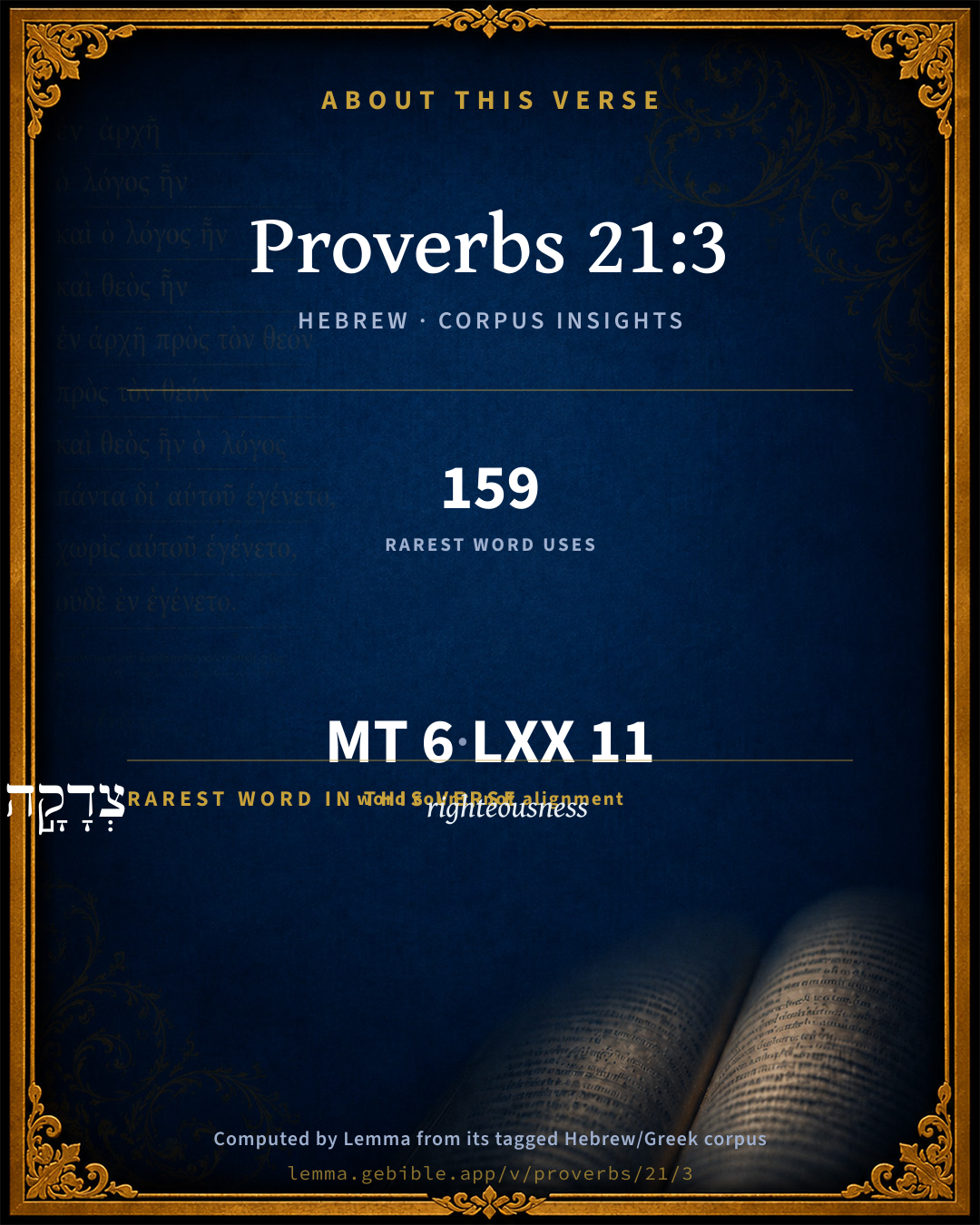
Proverbs 21:3

Hebrew (Westminster Leningrad Codex) Proverbs 21:3 appears in the Hebrew Old Testament. The text above is from the Westminster Leningrad Codex. Each word links to its Strong’s number, a concise gloss, and parsing drawn from the Open Scriptures Hebrew Bible morphology. Click any word for its full Brown-Driver-Briggs (BDB) entry.
Download image
Cite this verse

Proverbs 21:3 (World English Bible). Public Domain. Lemma interlinear Bible study tool, https://lemma.gebible.app/v/proverbs/21/3.

Show BibTeX & RIS
BibTeX
RIS
English Translation
To do righteousness and justice Is more acceptable to Yahweh than sacrifice.
World English Bible · Public Domain
Download a study sheet

One document with this verse’s original text, its word-by-word gloss line, the meaning frame, cross-references with their text, attributed commentary, and full source and license credits — printable, and it pastes into notes with its structure intact.

This verse Autodidact and up

Study sheet (.html) Plain text (.txt)

A passage Seminary Student

Up to 50 verses in one chapter. A passage sheet keeps up to 6 commentary sources and 12 cross-references per verse, in the order this page ranks them, and says so on the sheet whenever that leaves anything out. Ask for a single verse and you get the Autodidact verse sheet above.

Everything on this page stays free to read, with no account — the sheet is a download of what is already on screen, not access to it.

Want to remove ads? Support Godless Engineer
Compare translations 3

The same verse in 3 English versions, stacked beneath the original-language interlinear above. Click any original word for its lexicon entry.

Each is an independent rendering of the whole verse — the interlinear is not word-aligned to these translations.

Highlighted words mark where these versions differ — a whole-verse word diff, not a word-by-word alignment.

  • World English Bible Public Domain
    To do righteousness and justice Is more acceptable to Yahweh than sacrifice.
  • King James Version Public Domain
    To do justice and judgment is more acceptable to the LORD than sacrifice.
  • unfoldingWord Literal Text CC BY-SA 4.0
    To do righteousness and justice is preferred to Yahweh more than a sacrifice.

unfoldingWord Literal Text — © unfoldingWord, licensed CC BY-SA 4.0. Word-aligned USFM3 via Door43 (git.door43.org/unfoldingWord/en_ult).

Versions to compare (up to 4)

3 of 4 selected

Show all 18 translations

Every available English version of this verse, each an independent rendering of the whole verse.

  • World English Bible Public Domain
    To do righteousness and justice Is more acceptable to Yahweh than sacrifice.
  • Berean Standard Bible Public Domain
    To do righteousness and justice is more desirable to the LORD than sacrifice.
  • Majority Standard Bible Public Domain
    To do righteousness and justice is more desirable to the LORD than sacrifice.
  • King James Version Public Domain
    To do justice and judgment is more acceptable to the LORD than sacrifice.
  • American Standard Version (1901) Public Domain
    To do righteousness and justice Is more acceptable to Jehovah than sacrifice.
  • Revised Version (1885) Public Domain
    To do justice and judgment is more acceptable to the LORD than sacrifice.
  • Geneva Bible (1599) Public Domain
    To doe iustice and iudgement is more acceptable to the Lord then sacrifice.
  • Douay-Rheims (1899) Public Domain
    To do mercy and judgment, pleaseth the Lord more than victims.
  • Young's Literal Translation Public Domain
    To do righteousness and judgment, Is chosen of Jehovah rather than sacrifice.
  • Literal Standard Version CC BY-SA 4.0
    To do righteousness and judgment, || Is chosen of YHWH rather than sacrifice.
  • Unlocked Literal Bible CC BY-SA 4.0
    To do what is right and just is more acceptable to Yahweh than sacrifice.
  • unfoldingWord Literal Text CC BY-SA 4.0
    To do righteousness and justice is preferred to Yahweh more than a sacrifice.
  • Darby Bible Public Domain
    To exercise justice and judgment is more acceptable to Jehovah than sacrifice.
  • World Messianic Bible Public Domain
    To do righteousness and justice is more acceptable to the LORD than sacrifice.
  • Webster's Bible Public Domain
    To do justice and judgment is more acceptable to the LORD than sacrifice.
  • Free Bible Version CC BY-SA 4.0
    Doing what's right and fair pleases the Lord more than sacrifices.
  • Bible in Basic English Public Domain
    To do what is right and true is more pleasing to the Lord than an offering.
  • JPS Tanakh (1917) Public Domain
    To do righteousness and justice is more acceptable to the LORD than sacrifice.

Literal Standard Version (2020), Covenant Press — licensed CC BY-SA 4.0. Text via the HelloAO Bible API (eBible.org). Unlocked Literal Bible (unfoldingWord) — licensed CC BY-SA 4.0. Text via the HelloAO Bible API (eBible.org). unfoldingWord Literal Text — © unfoldingWord, licensed CC BY-SA 4.0. Word-aligned USFM3 via Door43 (git.door43.org/unfoldingWord/en_ult). Free Bible Version, Dr. Jonathan Gallagher — licensed CC BY-SA 4.0. Text via the HelloAO Bible API (eBible.org).

Word by word

More ways to search: Search by grammar → Find every occurrence → Compare this word →

Practice this passage: Drill this verse → Learn its vocabulary →

צְדָקָ֣ה
tsᵉdâqâh
H6666
“righteousness”
Noun, Common, Feminine, Singular, Absolute
Part of Speech
Noun
Type
Common
Gender
Feminine
Number
Singular
State
Absolute
Full BDB Definition

Origin: from H6663

TWOT: 1879b

justice, righteousness - righteousness (in government) - of judge, ruler, king - of law - of Davidic king Messiah - righteousness (of God's attribute) - righteousness (in a case or cause) - righteousness, truthfulness - righteousness (as ethically right) - righteousness (as vindicated), justification, salvation - of God - prosperity (of people) - righteous acts
  1. עֲ֭שֹׂה ʻâsâh H6213 “to do” Verb, Qal, Infinitive Construct
  2. וּמִשְׁפָּ֑ט mishpâṭ H4941 “and · judgment” Conjunction + Noun, Common, Masculine, Singular, Absolute
  3. נִבְחָ֖ר bâchar H977 “choosing” Verb, Niphal, Participle Active, Masculine, Singular, Absolute
  4. לַיהוָ֣ה Yᵉhôvâh H3068 “to/for · LORD” Preposition + Noun, Proper
  5. מִזָּֽבַח zebach H2077 “from · sacrifice” Preposition + Noun, Common, Masculine, Singular, Absolute

About this verse

These counts appear in no published source. They are computed here, from the morphology-tagged text and Lemma’s own curated glosses. What Lemma adds →

6
words
6
distinct lemmas
Wisdom
section

Grammatical profile

  • 2 verbs
  • 4 nouns

Verb forms

  • עֲ֭שֹׂה Qal · Infinitive Construct
  • נִבְחָ֖ר Niphal · Participle Active

Hebrew & Septuagint length

In English translation the verse runs 12 words from the Hebrew and 17 from the Septuagint (LXX English) — the Septuagint runs noticeably longer here. See the side-by-side →

A rough comparison of the two English renderings, which tokenize alike — not a word-level alignment.

Word counts can differ between the Hebrew and the Greek without any difference in meaning — e.g. the Hebrew direct-object marker אֵת has no separate Greek word, and Greek often adds the article ὁ.

In the original languages it is 6 Hebrew tokens and 11 Greek tokens — but the two are counted differently (Hebrew bundles its prefixes and suffixes into one token; the Greek is in lemma form), so that isn’t a like-for-like length.

Cross-references

8

Topical passages linked to Proverbs 21:3 in the Treasury of Scripture Knowledge — connected by theme and wording, ordered by reader-vote popularity; previews shown in the World English Bible.

  • 1 Samuel 15:22 Samuel said, Has Yahweh as great delight in burnt offerings and sacrifices, as in obeying the voice of Yahweh? Behold, to obey is better than sacrifice, and to listen than the fat of rams.
  • Hosea 6:6 For I desire mercy, and not sacrifice; And the knowledge of God more than burnt offerings.
  • Proverbs 15:8 The sacrifice made by the wicked is an abomination to Yahweh, But the prayer of the upright is his delight.
  • Micah 6:6–8 How shall I come before Yahweh, And bow myself before the exalted God? Shall I come before him with burnt offerings, With calves a year old?
  • Mark 12:33 and to love him with all the heart, and with all the understanding, with all the soul, and with all the strength, and to love his neighbor as himself, is more important than all whole burnt offerings and sacrifices."
  • Isaiah 1:11–17 "What are the multitude of your sacrifices to me?," says Yahweh. "I have had enough of the burnt offerings of rams, And the fat of fed animals. I don't delight in the blood of bulls, Or of lambs, Or of male goats.
  • Jeremiah 7:21–23 Thus says Yahweh of Hosts, the God of Israel: Add your burnt offerings to your sacrifices, and eat you flesh.
  • Psalms 50:8 I don't rebuke you for your sacrifices. Your burnt offerings are continually before me.

Cross-references courtesy of OpenBible.info (CC BY 4.0).

Hebrew and Greek witnesses Masoretic Hebrew ↔ Greek Septuagint

The same verse in the two great witnesses to the Old Testament, shown verse-for-verse.

Here the Septuagint runs noticeably longer than the Hebrew — LXX2012 (modern English Septuagint) 17 words vs World English Bible 12. A rough length comparison of the two English translations, not a word-level alignment — read both below.

These are two independent witnesses, not word-aligned to each other, and the Septuagint is shown in lemma (dictionary) form.

Hebrew Proverbs 21:3 Masoretic · Westminster Leningrad Codex

עֲ֭שֹׂה צְדָקָ֣ה וּמִשְׁפָּ֑ט נִבְחָ֖ר לַיהוָ֣ה מִזָּֽבַח

To do righteousness and justice Is more acceptable to Yahweh than sacrifice.

World English Bible · Public Domain

Greek LXX Proverbs 21:3 Septuagint · lemma form

ποιέω δίκαιος καί ἀληθεύω ἀρεστός παρά θεός μᾶλλον ἤ θυσία αἷμα

To do justly and to speak truth, are more pleasing to God than the blood of sacrifices.

LXX2012 (modern English Septuagint) · Public Domain

On this verse, Haydock's Catholic Bible Commentary discusses the Septuagint’s reading. Read the note in Commentary ↓

Hebrew: Westminster Leningrad Codex (CC BY 4.0). Greek: Septuagint (public domain); English from LXX2012 (modern English Septuagint) (Public Domain). How the Septuagint differs from the Hebrew →

Commentary

Notes on Proverbs 21:3 from classic Christian and Jewish commentators (each source and its license shown beneath its notes). The classic Christian expositions comment on the surrounding passage and are grouped to its opening verse, so a note may address several verses; the Jewish commentaries on the Tanakh (Rashi and others) are per-verse, so they appear only where the commentator wrote on this verse.

Lemma curates 59 commentaries, every one of them public domain or Creative Commons licensed, each selected and text-cleaned for this edition rather than reprinted as found. About our sources →

Trapp's Complete Commentary

John Trapp

Pro 21:3 To do justice and judgment [is] more acceptable to the LORD than sacrifice.

Ver. 3. Is more acceptable to the Lord.] Qui non vult ex rapina holocaustum, as heathens could see and say by the light of nature. The Jews thought to expiate their miscarriages toward men, and to set off with God by their ceremonies and sacrifices. {Isa 1:11-15 Jer 7:21-26 Mic 6:6-8} Some heathens also, as that Roman emperor, could say, Non sic deos coluimus ut ille nos vinceret, We have not been at so much charge with the gods that they should give us up into the enemy’s hands. But the Scripture gave the Jews to understand that "to obey was better than sacrifice," that God "would have mercy and not sacrifice," and that for a man to "love God above all, and his neighbour as himself, is more than all whole burntofferings and sacrifices." {Mar 12:33} The heathens also were told as much by their sages, as Plato in his book intituled περι προσευχης, where Socrates, reprehending the gilt horned bulls of the Greeks, and the sumptuous sacrifices of the Trojans at length infers - και γαρ αν δεινον εη, &c. It were a grievous thing if the gods should more respect men’s offerings and sacrifices than the holiness of their hearts, and the righteousness of their lives, &c. Aristotle in his Rhetorics, ‘Oυκ εικος Yεον χαιρεινταις δαπαναις, &c., saith he. It is not likely that God takes pleasure in the costliness of sacrifices, but rather in the good conversation of the sacrificers.

John Trapp, A Commentary or Exposition upon All the Books of the Old and New Testament (1647–1656) — public domain. Text from a community e-Sword module.

The Biblical Illustrator

Joseph S. Exell

Pro_21:3

To do Justice and Judgment is more acceptable to the Lord than sacrifice.

Ceremonial and moral duties

This text is a complete and independent sentence. Confirm the proposition deduced from the text--

I. From other places of Scripture. We find God rejecting and abhorring sacrifices if they were not accompanied with a real repentance and inward sincerity of mind, and the outward works of mercy and justice (Pro_21:27; Mic_6:6-7; Isa_1:11).

II. From the different nature of these two duties, and the different grounds from whence ariseth our obligation to them. Sacrifice was grounded upon a positive precept and institution, but justice has its foundation in the nature of God. If we consult merely natural light, we shall discover no necessary foundations in that for sacrifices. As the notion of God includes in it all possible and conceivable perfection, we discern justice to be one of His most essential attributes.

III. From the different ends of these two duties. Sacrifice was not enjoined for its own sake, but justice always was, and is, and ever will be. Sacrifices were ordained to be types of Christ, who was to be offered up in the fulness of time upon the Cross. Sacrifices were enjoined to be as a guard and security for other duties, to be as a hedge and a fence for the moral precepts, and especially to defend the Jews against idolatry. Evidently the goodness of this duty of sacrifice was not natural and intrinsical, but relative and external. But justice was, and is, and ever will be, enjoined for its own sake. It has a natural goodness and beauty in it which, at all times, and in all ages, recommends it to the practice of mankind. Justice is a duty that ariseth from the moral frame and constitution of our souls, and we must offer violence to ourselves, if we be not just to others.

IV. From the different effects of these two duties. The effect of sacrifices was the expiation of legal guilt. For deeper guilt no sacrifices were appointed. It is otherwise in the distribution of justice. An impartial execution of that in magistrates and judges does not only put a stop to the growth and increase of sin, but it also appeaseth the wrath and disarms the severity of God. (William Stainforth, M. A.)

The Biblical Illustrator, edited by Joseph S. Exell (c. 1880s–1900s) — public domain. Text from a community e-Sword module.

The Preacher's Complete Homiletical Commentary

Joseph S. Exell (gen. ed.)

MAIN HOMILETICS OF Pro_21:3

THE MORE ACCEPTABLE SACRIFICE

I. The sacrifices of the Mosaic law were acceptable to God as ceremonial signs. They were instituted by God, and therefore He expected them to be offered, and was displeased when His commands concerning them were disregarded. But they were but the means to an end, and if they did not lead to that end they were worthless in His sight. They were intended to awaken a sense of sin, and to be accompanied by observance of higher precepts and by obedience to more enduring laws. It availed nothing for a man to offer his bullock or his goat unless he laid his will upon the altar at the same time—no sin-offering could be acceptable to God unless the sin was put away, and no meat-offering could be regarded with favour if the heart of the offerer was without love to his neighbour and his life was marked by acts of injustice to him. It was of no avail to come before the Lord with “thousands of rams, or with ten thousand rivers of oil” unless the higher requirement was fulfilled—to do justly, and to love mercy, and to walk humbly with God (Mic_6:7-8).

II. The doing of justice and judgment is more acceptable to God because it is a moral reality. To love our neighbour as ourself is in itself good,—it is a moral attribute, an element of character, a part of the man himself. It is an expression of love to God and of obedience to His commands which can be made anywhere and at all times, for to do justice and judgment is the law of the moral universe, and belongs to heaven as much as to earth. It is to do what God has been doing from all eternity, for it is written that they “are the habitation of His throne” (Psa_89:14). All other offerings without these are “vain oblations” and even “an abomination” (Isa_1:13) unto Him who owns “every beast of the forest and the cattle upon a thousand hills” (Psa_50:10). To expect a holy and spiritual Being to accept anything less than a moral reality is to expect Him to be satisfied with less than would often content a fellow-creature.

OUTLINES AND SUGGESTIVE COMMENTS

Sacrifice; literally, slaughter. But with slender exceptions, the slaughter is a slaughter for sacrifice.… He did not love the slaughtering of His Son upon the cross. He did not love the slaughtering of beasts year by year continually. On the contrary, He does love righteousness, and, therefore, He does love, in the severities that men impugn, that very element of right which is the attribute that they would bring into the question. Doing righteousness Himself, He prefers the right-doing of His creatures to any form of sacrifice or possible service they can ever render.—Miller.

“Sacrifice” at best is only circumstantially good—rectitude is essentially so. Sacrifice, at best, is only the means and expression of good; rectitude is goodness itself. God accepts the moral without the ceremonial, but never the ceremonial without the moral. The universe can exist without of the ceremonial, but not without the moral.—David Thomas.

This maxim of the Proverbs was a bold saying then—it is a bold saying still; but it well unites the wisdom of Solomon with that of his father in the 51st Psalm, and with the inspiration the later prophets.—Stanley.

The Preacher's Complete Homiletical Commentary (gen. ed. Joseph S. Exell; Funk & Wagnalls, c. 1892) — public domain (pre-1929). A full-Bible homiletical/sermon-outline anthology covering 65 of 66 books (2 John is absent from the source module). Text from a community e-Sword module.

Tyndale Open Study Notes

Tyndale Open Resources

21:3 God is not pleased with worship unless godly actions flow from a godly heart (see Ps 40:6-8; Mic 6:6-8).

Tyndale Open Study Notes — © Tyndale Open Resources, licensed CC BY-SA 4.0. Text via the HelloAO Bible API.

Matthew Henry's Commentary

Here, 1. It is implied that many deceive themselves with a conceit that, if they offer sacrifice, that will excuse them from doing justice, and procure them a dispensation for their unrighteousness; and this makes their way seem right, Pro 21:2. We have fasted, Isa 58:3. I have peace-offerings with me, Pro 7:14. 2. It is plainly declared that living a good life (doing justly and loving mercy) is more pleasing to God than the most pompous and expensive instances of devotion. Sacrifices were of divine institution, and were acceptable to God if they were offered in faith and with repentance, otherwise not, Isa 1:11, etc. But even then moral duties were preferred before them (Sa1 15:22), which intimates that their excellency was not innate nor the obligation to them perpetual, Mic 6:6-8. Much of religion lies in doing judgment and justice from a principle of duty to God, contempt of the world, and love to our neighbour; and this is more pleasing to God than all burnt-offerings and sacrifices, Mar 12:33.

Matthew Henry's Commentary on the Whole Bible (1708–1710) — public domain (CC PDM 1.0). Text via the HelloAO Bible API.

Jamieson, Fausset & Brown

Robert Jamieson, A. R. Fausset & David Brown

(Compare Psa 50:7-15; Isa 1:11, Isa 1:17).

Jamieson, Fausset & Brown — Commentary Critical and Explanatory on the Whole Bible (1871) — public domain (CC PDM 1.0). Text via the HelloAO Bible API.

Adam Clarke's Commentary

Verse 3. To do justice and judgment] The words of Samuel to Saul. 1Sa 15:23.

Adam Clarke's Commentary on the Bible (1810–1826) — public domain. Text from a community e-Sword/MySword module.

Ellicott's Commentary for English Readers

(3) To do justice and judgment, &c—See above on Pro_10:2.

Is more acceptable than sacrifice.—See above on 15:8.

A Bible Commentary for English Readers, edited by Charles John Ellicott (1878–1897) — public domain. Text from a community e-Sword module.

The Cambridge Bible for Schools and Colleges

gen. ed. J. J. S. Perowne

3. Comp. 1Sa_15:22; Hos_6:6; Mic_6:6-8.

The Cambridge Bible for Schools and Colleges (gen. ed. J. J. S. Perowne; Cambridge University Press, 1878–1918) — public domain. Text from a community e-Sword module.

John Gill's Exposition

To do justice and judgment,.... The moral duties of religion, what is holy, just, and good, which the law requires; what is agreeably to both tables, piety towards God, and justice to men; that which is just and right between man and man; which, especially if done from right principles and with right views,

is more acceptable to the Lord than sacrifice; not than any sacrifice; than the sacrifice of a broken heart, or the sacrifice of praise and thanksgiving, or of acts of goodness and beneficence, or of a man's whole self to the Lord; but than ceremonial sacrifices; which, though of divine institution, and typical of Christ, and when offered up in the faith of him, were acceptable to God, while in force; yet not when done without faith and in hypocrisy, and especially when done to cover and countenance immoral actions; and, even when compared with moral duties, the latter were preferable to them; see Sa1 15:22.

John Gill's Exposition of the Whole Bible (1746–1763) — public domain (CC PDM 1.0). Text via the HelloAO Bible API.

Albert Barnes' Notes on the Bible

Compare the marginal reference. The words have a special significance as coming from the king who had built the temple, and had offered sacrifices that could not be numbered for multitude” 1Ki 8:5.

Albert Barnes' Notes on the Bible (1834–1885) — public domain. Text from a community e-Sword/MySword module.

Haydock's Catholic Bible Commentary

Mercy. Septuagint, "justice and truth." (Haydock) See Osee vi. 6. (Menochius)

George Leo Haydock (1774–1849), Haydock's Catholic Family Bible and Commentary, 1859 edition — public domain. Excludes Psalms (Douay-Rheims chapter numbering differs from Protestant) and Deuterocanonical books (Catholic canon only).

Matthew Poole's English Annotations

Justice and judgment; the conscientious performance of all our duties to men.

Than sacrifice; than the most costly outward services offered to God, joined with the neglect of our moral duties to God or men. The same thing is affirmed 1Sa 15:22; Hos 6:6; Mic 6:7.

Matthew Poole's English Annotations on the Holy Bible (1683–1685) — public domain. Text from a community e-Sword/MySword module.

Whedon's Commentary on the Bible

Daniel D. Whedon

3. More acceptable — Is chosen, is preferred. “This maxim was a bold saying then; it is a bold saying still; but it well unites the wisdom of Solomon with that of his father David, in the Fifty-first Psalm, and with the inspiration of the prophets.” — Dean Stanley. Compare Pro_15:8; 1Sa_15:22; Hos_6:6; Mic_4:7-8; Psa_51:16-17; Mat_9:13; Mat_12:7, etc.

Daniel D. Whedon (gen. ed.), Commentary on the Old and New Testaments (1874–1909) — public domain. Text from a community e-Sword module.

The Pulpit Commentary

To do justice and judgment is more acceptable to the Lord than sacrifice. The superiority of moral obedience to ceremonial worship is often inculcated. (see note on Pro_15:8, and below, ver. 27; and Mic_6:6-8 and comp. Mat_12:7) "Justice" and "judgment" (tsedakah and mishpat) are combined in Gen_18:19 Job_37:23 Isa_56:1, etc. They imply equity and justice proceeding, not from bare regard to law, but from the principle of love. Septuagint, "To do justify and to speak the truth are more pleasing to God than the blood of sacrifices.

Devotion and duty.

It is certainly noticeable that this truth should be expressed by Solomon. For the one great work of his life was the erection of the temple wherein sacrifice should be offered to the Lord. He might have been excused if his leaning had been toward the ceremonial rather than the moral. But he was not the first Hebrew thinker to give utterance to the idea. It is interesting to trace

I ITS HISTORY IN HEBREW THOUGHT. We find:

1. Samuel holding this view, and declaring it in firm and powerful language. (1Sa_15:22)

2. David filled with a deep sense of it as he humbled his soul before God. (Psa_51:10, Psa_51:15-19)

3. Asaph powerfully affected by it as he wrote his sacred song. (Psa_50:8-15)

4. Isaiah, Jeremiah, and Micah insisting upon this truth in strong and fervent words. (Isa_1:11-17 Jer_7:22, 23 Mic_6:6-8)

5. John the Baptist making nothing of ceremonial religion, and making everything of a true and genuine repentance.

6. Our Lord himself; by his teaching and his attitude, preferring the penitent publican and harlot to the much-sacrificing but hard-hearted Pharisee; while by his own sacrificial death he removed forever the need of any further offering on any altar whatsoever.

7. His inspired apostles declaring the needlessness of any sacrifice except those which are of a spiritual order. (Rom_12:1 Heb_9:28 Heb_10:12 Heb_13:15, Heb_13:16)

II ITS SIGNIFICANCE TO OURSELVES. We naturally ask What is the relation of devotion to duty or righteousness? and we answer:

1. No measure of devotion can make up for moral laxity. We might be worshipping in the house of the Lord day and night; but if we were false, or cruel, or dishonest, or impure in our daily practice, we should certainly incur his righteous anger.

2. Moral probity by itself will not take the place of the direct approach of our hearts to God. It is much that a man should be just in all his dealings, kind in his various relationships, blameless in his bearing and behaviourvery much. But it is not everything; it, leaves out one essential thing. God desires and demands of us that we ourselves come into close and living union and communion with himself, that we look to him and address him, and trust and love him as our Divine Father and Redeemer. And no propriety of behaviour, no excellency of life, will take the place of this.

3. Devotion and duty must coexist, and will sustain one another.

(1) We should so worship God that we shall be stronger to obey his commandments in the home and in the school and in the shop everywhere. We may safely conclude that our sacrifice on the sabbath is altogether imperfect and unsatisfactory if it does not lead to a worthier life in the week.

(2) And we should so act in all the various paths of life that" with clean hands and a pure heart" we can go up to the house of the Lord, and render acceptable service of prayer and praise as we bow before him in the sanctuary. They are complementary one to the other; and no wise man will disregard or disparage either. C.

The Pulpit Commentary (1880–1919), ed. H.D.M. Spence-Jones & Joseph S. Exell — public domain. Text from a community e-Sword module.

Keil & Delitzsch

C. F. Keil & F. Delitzsch

3 To practice justice and right

Hath with Jahve the pre-eminence above sacrifice.

We have already (vol. i. p. 42) shown how greatly this depreciation of the works of the ceremonial cultus, as compared with the duties of moral obedience, is in the spirit of the Chokma; cf. also at Pro 15:8. Prophecy also gives its testimony, e.g., Hos 6:7, according to which also here (cf. Pro 20:8 with Isa 9:8) the practising of צדקה וּמשׁפּט (sequence of words as at Gen 18:19; Psa 33:5, elsewhere צדק ומשׁפט, and yet more commonly משׁפט וצדקה) does not denote legal rigour, but the practising of the justum et aequum, or much rather the aequum et bonum, thus in its foundation conduct proceeding from the principle of love. The inf. עשׂה (like קנה, Pro 16:16) occurs three times (here and at Gen 50:20; Psa 101:3); once עשׂו is written (Gen 31:18), as also in the infin. absol. the form עשׂה mro and עשׂו interchange (vid., Norzi at Jer 22:4); once עשׂהוּ for עשׂותו (Exo 18:18) occurs in the status conjunctus.

Keil & Delitzsch — Biblical Commentary on the Old Testament (1861–1891) — public domain (CC PDM 1.0). Text via the HelloAO Bible API. (Old Testament only.)

Bridges on Proverbs

Charles Bridges

Did Solomon mean to undervalue sacrifice? Never did man more highly honor it. (1Ki 3:4 ; 1Ki 8:64 .) Perhaps the splendor of his sacrificial service may have given rise to the frequent national perverted trust in external forms. Sacrifice was appointed as a type of the Great Sacrifice for sin. (Heb 10:12 .) Buta never was it intended to take the place of that universal moral obedience, which the law of God had from the beginning indispensably required. Yet how soon did man mistake the intention of the ordinance! How easily did he substitute the offering of bulls and goats for the more self-denying service of the heart.†1 Israel abounded in the observance of their outward ceremonials, while indulging the sin of Sodom and Gomorrah.†2 The Corban sacrifice stood in the room of filial obligation. The lesser services of "anise and cummin" were scrupulously observed to the neglect of "the weightier matters of the law — judgment, mercy, and faith."†3 Justly therefore did our Lord commend the "discretion" of the scribe, who gave the due place and proportion to the ceremonial and moral service.†4 Both are his requirements; and a soundly-instructed conscience will aim at both. Yet plainly has he in some instances dispensed with the former;†5 never with the latter.†6 He has accepted the moral without the ceremonial; but never the ceremonial without the moral, observance. What would the world be without that justice and judgment, which at once "established the throne" (Pro 16:12 ), "exalt the nation" (Pro 14:34 ), and realize to their disciples a true interest in that richest of all possessions — the love of God! (Pro 15:9 . Compare Isa 64:5 .)

We indeed have no sacrifice to place in the stead of these invaluable principles. But the same preference, and indeed exaltation, of external service prevail among us. Whether under the proper form of Popery, or the more plausible cover of Tractarian delusion, it is the true religion of man’s heart — something to recommend us to the favor of God; something easier and less humbling than the "living sacrifice" (Rom 12:1 ) for his service. Christian professor! mark carefully the character of thy service. Let it be free and cheerful; else is it penance, not acceptable duty. Though it be in weakness, let it ever be in willingness, with the flower and strength of thy love. Look to it — art thou resting in the shell and surface, or art thou worshipping in the spirituality of service? Dost thou hear the voice calling thee from the dead forms, to seek the living power of godliness? Cain brought the sacrifice, not the heart. If thou speakest more, "what dost thou more than others?" (Mat 5:47 .) Remember those externals, that stand in the place of a consecrated heart, are the delusion of the great deceiver. Let thine heart be with God, walking with him in the sound exercise of Christian obligation; honoring the Divine stamp on every commandment; making conscience of every duty; and though we come short of every one, yet daring not to neglect any. (Psa 119:5-6, Psa 119:128 .)

Footnotes:

†1 1Sa 15:22 . Isa 1:13-14 .

†2 Isa 1:11. Jer 7:22 . Hos 6:6 . Amo 5:21 . Act 7:42 . Mic 6:6-8 .

†3 Mat 23:23.

†4 Mar 12:34.

†5 Mat 12:7. Act 10:34-35 .

†6 Mat 22:37-39.

Charles Bridges, An Exposition of the Book of Proverbs (1846) — public domain. Text from a community e-Sword module.

Kretzmann's Popular Commentary

Paul E. Kretzmann

v. 3. To do justice and judgment, to exercise the principles of righteousness and justice in all our dealings, is more acceptable to the Lord than sacrifice, for all outward acts of worship are hollow sham without true piety of the heart.

Paul E. Kretzmann, Popular Commentary of the Bible (1921–1924) — public domain. Text from a community e-Sword module.

unfoldingWord translationNotes

Door43 World Missions Community

To do what is right

"To do what Yahweh thinks is right"

To do what is ... just

"To treat people the way Yahweh wants people to treat other people"

just is more acceptable to Yahweh

"just—Yahweh wants this more"

Haughty eyes and a proud heart

The words "eyes" and "heart" are synecdoches for a person who considers himself better than other people and wants other people to know it. AT: "People who want others to think that they are better than other people" (See: Synecdoche and Doublet)

Haughty eyes

This is a synecdoche for a person who wants others to know that he thinks he is better than they are. (See: Synecdoche)

proud heart

This is a synecdoche for a person who thinks he is better than others. (See: Synecdoche)

the lamp of the wicked

The things that help the wicked are spoken of as a lamp. AT: "the things that help a wicked person like a lamp helps to see in the dark" (See: Metaphor)

translationWords

just

Yahweh

sacrifice

haughty

proud

heart

lamp

evil

sin

unfoldingWord translationNotes — © Distant Shores Media and the Door43 World Missions Community, licensed CC BY-SA 4.0. Source: git.door43.org/Door43/en_tn.

Lesson kit

Teaching starters — assembled from the data on this page, not authored interpretation. Every prompt links to the verse data it draws on. Edit before teaching.

Proverbs, in the Wisdom, opens this verse with 6 words (6 distinct Hebrew lemmas). Its most distinctive word is tsᵉdâqâh (“righteousness”). The Greek Septuagint runs longer here. A historical commentator’s framing appears above. Read the whole chapter for the surrounding context.

Discussion questions

  1. How does “righteousness” (tsᵉdâqâh) shape what this verse is saying?
  2. How does 1 Samuel 15:22, which shares this passage’s theme, read alongside this verse?
  3. The Septuagint runs longer here than the Hebrew. What might account for the difference?
  4. The translations on this page render this verse differently — a whole-verse word diff, not a word-by-word alignment. What might account for the different wordings?
  5. «עֲ֭שֹׂה» is a Qal Infinitive Construct verb. How does that grammatical form shape the action described?
  6. Compare how Trapp's Complete Commentary and The Biblical Illustrator read this verse. Where do they agree or differ?

Things to notice

Reading settings

Reading text

Shown beneath each verse's original-language words.

Old Testament
Old Testament edition

Read the OT as the Masoretic Hebrew (MT) or the Greek Septuagint (LXX).

English shown for the Greek Septuagint (in the Hebrew ↔ Greek comparison).

Comparing translations? Open the Compare panel on any verse page to stack up to four side by side.