
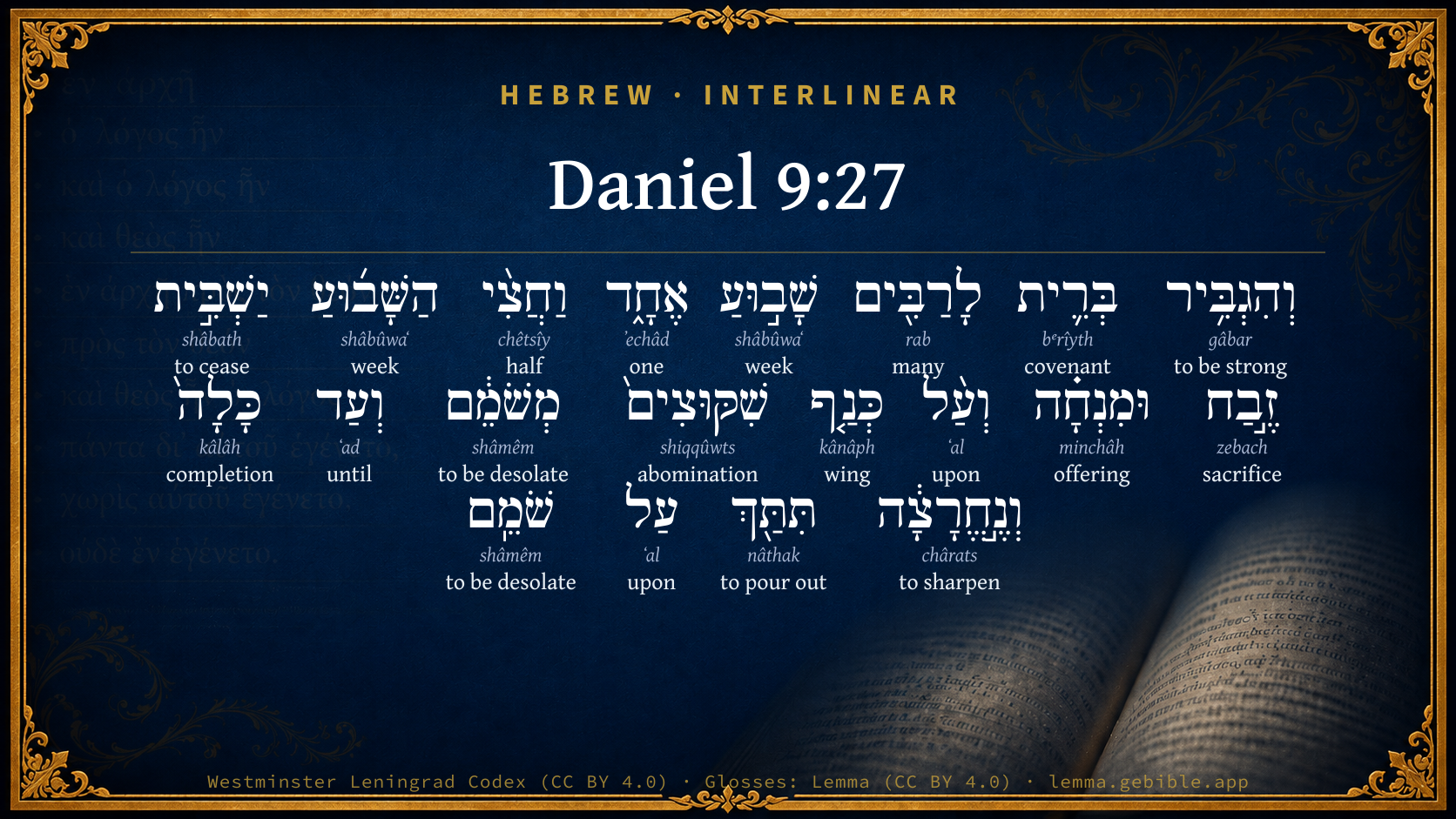
Daniel 9:27

Hebrew (Westminster Leningrad Codex) Daniel 9:27 appears in the Hebrew Old Testament. The text above is from the Westminster Leningrad Codex. Each word links to its Strong’s number, a concise gloss, and parsing drawn from the Open Scriptures Hebrew Bible morphology. Click any word for its full Brown-Driver-Briggs (BDB) entry.
Download image
Cite this verse

Daniel 9:27 (World English Bible). Public Domain. Lemma interlinear Bible study tool, https://lemma.gebible.app/v/daniel/9/27.

Show BibTeX & RIS
BibTeX
RIS
English Translation
He shall make a firm covenant with many for one week: and in the midst of the week he shall cause the sacrifice and the offering to cease; and on the wing of abominations [shall come] one who makes desolate; and even to the full end, and that determined, shall [wrath] be poured out on the desolate.
World English Bible · Public Domain
Download a study sheet

One document with this verse’s original text, its word-by-word gloss line, the meaning frame, cross-references with their text, attributed commentary, and full source and license credits — printable, and it pastes into notes with its structure intact.

This verse Autodidact and up

Study sheet (.html) Plain text (.txt)

A passage Seminary Student

Up to 50 verses in one chapter. A passage sheet keeps up to 6 commentary sources and 12 cross-references per verse, in the order this page ranks them, and says so on the sheet whenever that leaves anything out. Ask for a single verse and you get the Autodidact verse sheet above.

Everything on this page stays free to read, with no account — the sheet is a download of what is already on screen, not access to it.

Want to remove ads? Support Godless Engineer
Compare translations 3

The same verse in 3 English versions, stacked beneath the original-language interlinear above. Click any original word for its lexicon entry.

Each is an independent rendering of the whole verse — the interlinear is not word-aligned to these translations.

Highlighted words mark where these versions differ — a whole-verse word diff, not a word-by-word alignment.

  • World English Bible Public Domain
    He shall make a firm covenant with many for one week: and in the midst of the week he shall cause the sacrifice and the offering to cease; and on the wing of abominations [shall come] one who makes desolate; and even to the full end, and that determined, shall [wrath] be poured out on the desolate.
  • King James Version Public Domain
    And he shall confirm the covenant with many for one week: and in the midst of the week he shall cause the sacrifice and the oblation to cease, and for the overspreading of abominations he shall make it desolate, even until the consummation, and that determined shall be poured upon the desolate.
  • unfoldingWord Literal Text CC BY-SA 4.0
    He will make a strong covenant with the many for one seven. In the middle of the seven, he will put an end to sacrifice and offering. On the wing of abominations will come one who makes desolate, until the complete destruction that is decreed is poured out on the desolator.”

unfoldingWord Literal Text — © unfoldingWord, licensed CC BY-SA 4.0. Word-aligned USFM3 via Door43 (git.door43.org/unfoldingWord/en_ult).

Versions to compare (up to 4)

3 of 4 selected

Show all 18 translations

Every available English version of this verse, each an independent rendering of the whole verse.

  • World English Bible Public Domain
    He shall make a firm covenant with many for one week: and in the midst of the week he shall cause the sacrifice and the offering to cease; and on the wing of abominations [shall come] one who makes desolate; and even to the full end, and that determined, shall [wrath] be poured out on the desolate.
  • Berean Standard Bible Public Domain
    And he will confirm a covenant with many for one week, but in the middle of the week he will put an end to sacrifice and offering. And on the wing of the temple will come the abomination that causes desolation, until the decreed destruction is poured out upon him.”
  • Majority Standard Bible Public Domain
    And he will confirm a covenant with many for one week, but in the middle of the week he will put an end to sacrifice and offering. And on the wing of the temple will come the abomination that causes desolation, until the decreed destruction is poured out upon him.”
  • King James Version Public Domain
    And he shall confirm the covenant with many for one week: and in the midst of the week he shall cause the sacrifice and the oblation to cease, and for the overspreading of abominations he shall make it desolate, even until the consummation, and that determined shall be poured upon the desolate.
  • American Standard Version (1901) Public Domain
    And he shall make a firm covenant with many for one week: and in the midst of the week he shall cause the sacrifice and the oblation to cease; and upon the wing of abominations `shall come' one that maketh desolate; and even unto the full end, and that determined, shall `wrath' be poured out upon the desolate.
  • Revised Version (1885) Public Domain
    And he shall make a firm covenant with many for one week: and for the half of the week he shall cause the sacrifice and the oblation to cease; and upon the wing of abominations shall come one that maketh desolate; and even unto the consummation, and that determined, shall wrath be poured out upon the desolator.
  • Geneva Bible (1599) Public Domain
    And he shall confirme the couenant with many for one weeke: and in the middes of the weeke he shall cause the sacrifice and the oblation to cease, and for the ouerspreading of the abominations, he shall make it desolate, euen vntill the consummation determined shalbe powred vpon the desolate.
  • Douay-Rheims (1899) Public Domain
    And he shall confirm the covenant with many, in one week: and in the half of the week the victim and the sacrifice shall fall: and there shall be in the temple the abomination of desolation: and ihe desolation shall continue even to the consummation, and to the end.
  • Young's Literal Translation Public Domain
    And he hath strengthened a covenant with many -- one week, and `in' the midst of the week he causeth sacrifice and present to cease, and by the wing of abominations he is making desolate, even till the consummation, and that which is determined is poured on the desolate one.'
  • Literal Standard Version CC BY-SA 4.0
    And he has strengthened a covenant with many [for] one period of seven, and [in] the midst of the period of seven he causes sacrifice and present to cease, and by the wing of abominations he is making desolate, even until the consummation, and that which is determined is poured on the desolate one.”
  • Unlocked Literal Bible CC BY-SA 4.0
    He will confirm a covenant with many for one seven. In the middle of the seven he will put an end to the sacrifice and the offering. On the wing of abominations will come someone who makes desolate. A full end and destruction are decreed to be poured out on the one who has made the desolation.”
  • unfoldingWord Literal Text CC BY-SA 4.0
    He will make a strong covenant with the many for one seven. In the middle of the seven, he will put an end to sacrifice and offering. On the wing of abominations will come one who makes desolate, until the complete destruction that is decreed is poured out on the desolator.”
  • Darby Bible Public Domain
    And he shall confirm a covenant with the many [for] one week; and in the midst of the week he shall cause the sacrifice and the oblation to cease, and because of the protection of abominations [there shall be] a desolator, even until that the consumption and what is determined shall be poured out upon the desolate.
  • World Messianic Bible Public Domain
    He will make a firm covenant with many for one week. In the middle of the week he will cause the sacrifice and the offering to cease. On the wing of abominations will come one who makes desolate; and even to the decreed full end, wrath will be poured out on the desolate.”
  • Webster's Bible Public Domain
    And he shall confirm the covenant with many for one week: and in the midst of the week he shall cause the sacrifice and the oblation to cease, and for the overspreading of abominations, he shall make it desolate, even until the consummation, and that determined shall be poured upon the desolate.
  • Free Bible Version CC BY-SA 4.0
    He will confirm the agreement with many people for one week, but in the middle of the week he will put an end to sacrifices and offerings. The idolatry that causes devastation will be supported until the end when the same fate is poured out on the one who devastates.”
  • Bible in Basic English Public Domain
    And a strong order will be sent out against the great number for one week; and so for half of the week the offering and the meal offering will come to an end; and in its place will be an unclean thing causing fear; till the destruction which has been fixed is let loose on him who has made waste.
  • JPS Tanakh (1917) Public Domain
    And he shall make a firm covenant with many for one week; and for half of the week he shall cause the sacrifice and the offering to cease; and upon the wing of detestable things shall be that which causeth appalment; and that until the extermination wholly determined be poured out upon that which causeth appalment.'

Literal Standard Version (2020), Covenant Press — licensed CC BY-SA 4.0. Text via the HelloAO Bible API (eBible.org). Unlocked Literal Bible (unfoldingWord) — licensed CC BY-SA 4.0. Text via the HelloAO Bible API (eBible.org). unfoldingWord Literal Text — © unfoldingWord, licensed CC BY-SA 4.0. Word-aligned USFM3 via Door43 (git.door43.org/unfoldingWord/en_ult). Free Bible Version, Dr. Jonathan Gallagher — licensed CC BY-SA 4.0. Text via the HelloAO Bible API (eBible.org).

Word by word

More ways to search: Search by grammar → Find every occurrence → Compare this word →

Practice this passage: Drill this verse → Learn its vocabulary →

וְנֶ֣חֱרָצָ֔ה
chârats
H2782
“and · sharpening”
Conjunction + Verb, Niphal, Participle Active, Feminine, Singular, Absolute
Part of Speech
Conjunction + Verb
Stem
Niphal
Form
Participle Active
Gender
Feminine
Number
Singular
State
Absolute
Full BDB Definition

Origin: a primitive root

TWOT: 752

to cut, sharpen, decide, decree, determine, maim, move, be decisive, be mutilated - (Qal) - to cut, mutilate - to sharpen - to decide - (Niphal) to be decisive
  1. וְהִגְבִּ֥יר gâbar H1396 “and · to be strong” Conjunction + Verb, Hiphil, Sequential Perfect, 3rd Person, Masculine, Singular
  2. בְּרִ֛ית bᵉrîyth H1285 “covenant” Noun, Common, Feminine, Singular, Absolute
  3. לָרַבִּ֖ים rab H7227 “to/for the · many” Preposition, Determined + Adjective, Adjective, Masculine, Plural, Absolute
  4. שָׁב֣וּעַ shâbûwaʻ H7620 “week” Noun, Common, Masculine, Singular, Absolute
  5. אֶחָ֑ד ʼechâd H259 “one” Adjective, Cardinal number, Masculine, Singular, Absolute
  6. וַחֲצִ֨י chêtsîy H2677 “and · half of” Conjunction + Noun, Common, Masculine, Singular, Construct
  7. הַשָּׁב֜וּעַ shâbûwaʻ H7620 “the · week” Particle, Definite Article + Noun, Common, Masculine, Singular, Absolute
  8. יַשְׁבִּ֣ית shâbath H7673 “to cease” Verb, Hiphil, Imperfect, 3rd Person, Masculine, Singular
  9. זֶ֣בַח zebach H2077 “sacrifice” Noun, Common, Masculine, Singular, Absolute
  10. וּמִנְחָ֗ה minchâh H4503 “and · offering” Conjunction + Noun, Common, Feminine, Singular, Absolute
  11. וְעַ֨ל ʻal H5921 “and · upon” Conjunction + Preposition
  12. כְּנַ֤ף kânâph H3671 “wing of” Noun, Common, Feminine, Singular, Construct
  13. שִׁקּוּצִים֙ shiqqûwts H8251 “abominations” Noun, Common, Masculine, Plural, Absolute
  14. מְשֹׁמֵ֔ם shâmêm H8074 “being desolate” Verb, Poel, Participle Active, Masculine, Singular, Absolute
  15. וְעַד ʻad H5704 “and · until” Conjunction + Preposition
  16. כָּלָה֙ kâlâh H3617 “completion” Noun, Common, Feminine, Singular, Absolute
  17. תִּתַּ֖ךְ nâthak H5413 “to pour out” Verb, Qal, Imperfect, 3rd Person, Feminine, Singular
  18. עַל ʻal H5921 “upon” Preposition
  19. שֹׁמֵֽם shâmêm H8074 “being desolate” Verb, Qal, Participle Active, Masculine, Singular, Absolute

About this verse

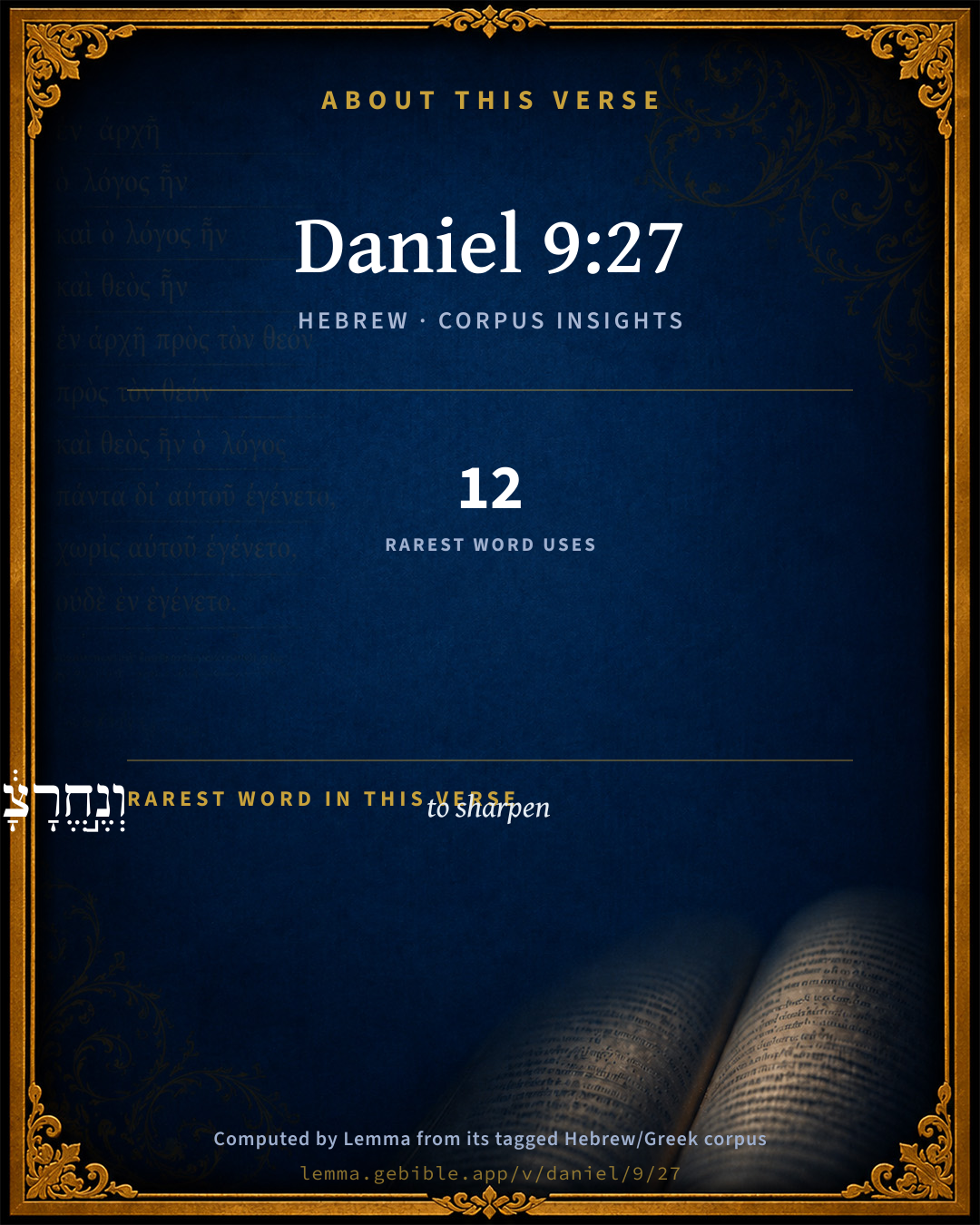
These counts appear in no published source. They are computed here, from the morphology-tagged text and Lemma’s own curated glosses. What Lemma adds →

20
words
17
distinct lemmas
Prophets
section

Notable vocabulary

The rarest word here is וְנֶ֣חֱרָצָ֔ה to sharpen H2782 — appearing just 12 times in the whole Hebrew Bible.

Shared distinctive vocabulary

וְנֶ֣חֱרָצָ֔ה to sharpen H2782 occurs in 12 verses of the Hebrew Bible. Also found in:

Grammatical profile

  • 6 verbs
  • 9 nouns
  • 2 adjectives
  • 3 prepositions

Verb forms

  • וְהִגְבִּ֥יר Hiphil · Sequential Perfect
  • יַשְׁבִּ֣ית Hiphil · Imperfect
  • מְשֹׁמֵ֔ם Poel · Participle Active
  • וְנֶ֣חֱרָצָ֔ה Niphal · Participle Active
  • תִּתַּ֖ךְ Qal · Imperfect
  • שֹׁמֵֽם Qal · Participle Active

Repetition

Words recur within this verse — often emphatic in Hebrew:

  • שָׁב֣וּעַ week H7620 ×2
  • וְעַ֨ל upon H5921 ×2
  • מְשֹׁמֵ֔ם to be desolate H8074 ×2

Hebrew & Septuagint length

In English translation the verse runs 57 words from the Hebrew and 48 from the Septuagint (LXX English) — closely comparable.

A rough comparison of the two English renderings, which tokenize alike — not a word-level alignment.

Word counts can differ between the Hebrew and the Greek without any difference in meaning — e.g. the Hebrew direct-object marker אֵת has no separate Greek word, and Greek often adds the article ὁ.

Cross-references

37

Topical passages linked to Daniel 9:27 in the Treasury of Scripture Knowledge — connected by theme and wording, ordered by reader-vote popularity; previews shown in the World English Bible.

  • Matthew 24:15 "When, therefore, you see the abomination of desolation, which was spoken of through Daniel the prophet, standing in the holy place (let the reader understand),
  • Daniel 12:11 From the time that the continual [burnt offering] shall be taken away, and the abomination that makes desolate set up, there shall be one thousand two hundred ninety days.
  • Mark 13:14 But when you see the abomination of desolation, spoken of by Daniel the prophet, standing where it ought not (let the reader understand), then let those who are in Judea flee to the mountains,
  • Luke 21:20 "But when you see Jerusalem surrounded by armies, then know that its desolation is at hand.
  • Daniel 11:36 The king shall do according to his will; and he shall exalt himself, and magnify himself above every god, and shall speak marvelous things against the God of gods; and he shall prosper until the indignation be accomplished; for that which is determined shall be done.
  • Daniel 8:13 Then I heard a holy one speaking; and another holy one said to that certain one who spoke, How long shall be the vision [concerning] the continual [burnt-offering], and the disobedience that makes desolate, to give both the sanctuary and the host to be trodden under foot?
  • Isaiah 10:22–23 For though your people, Israel, be as the sand of the sea, [only] a remnant of them shall return: a destruction [is] determined, overflowing with righteousness.
  • Jeremiah 32:40–42 and I will make an everlasting covenant with them, that I will not turn away from following them, to do them good; and I will put my fear in their hearts, that they may not depart from me.
  • Matthew 26:28 for this is my blood of the new covenant, which is poured out for many for the remission of sins.
  • Romans 5:15 But the free gift isn't like the trespass. For if by the trespass of the one the many died, much more did the grace of God, and the gift by the grace of the one man, Jesus Christ, abound to the many.
  • Leviticus 26:14–46 "'But if you will not listen to me, and will not do all these commandments;
  • Deuteronomy 4:26–28 I call heaven and earth to witness against you this day, that you shall soon utterly perish from off the land whereunto you go over the Jordan to possess it; you shall not prolong your days on it, but shall utterly be destroyed.
  • Deuteronomy 28:15–68 But it shall come to pass, if you will not listen to the voice of Yahweh your God, to observe to do all his commandments and his statutes which I command you this day, that all these curses shall come on you, and overtake you.
  • Deuteronomy 29:18–29 lest there should be among you man, or woman, or family, or tribe, whose heart turns away this day from Yahweh our God, to go to serve the gods of those nations; lest there should be among you a root that bears gall and wormwood;
  • Deuteronomy 31:28–29 Assemble to me all the elders of your tribes, and your officers, that I may speak these words in their ears, and call heaven and earth to witness against them.
  • Psalms 69:22–28 Let their table before them become a snare. May it become a retribution and a trap.
  • Isaiah 28:22 Now therefore don't you be scoffers, lest your bonds be made strong; for a decree of destruction have I heard from the Lord, Yahweh of Hosts, on the whole earth.
  • Isaiah 42:6 I, Yahweh, have called you in righteousness, and will hold your hand, and will keep you, and give you for a covenant of the people, for a light of the Gentiles;
  • Isaiah 53:11 He shall see of the travail of his soul, [and] shall be satisfied: by the knowledge of himself shall my righteous servant justify many; and he shall bear their iniquities.
  • Isaiah 55:3 Turn your ear, and come to me; hear, and your soul shall live: and I will make an everlasting covenant with you, even the sure mercies of David.
  • Jeremiah 31:31–34 Behold, the days come, says Yahweh, that I will make a new covenant with the house of Israel, and with the house of Judah:
  • Ezekiel 16:60–63 Nevertheless I will remember my covenant with you in the days of your youth, and I will establish to you an everlasting covenant.
  • Galatians 3:13–17 Christ redeemed us from the curse of the law, having become a curse for us. For it is written, "Cursed is everyone who hangs on a tree,"
  • 1 Thessalonians 2:15–16 who killed both the Lord Jesus and their own prophets, and drove us out, and didn't please God, and are contrary to all men;
  • Deuteronomy 30:17–18 But if your heart turn away, and you will not hear, but shall be drawn away, and worship other gods, and serve them;
  • Deuteronomy 32:19–44 Yahweh saw [it], and abhorred [them], Because of the provocation of his sons and his daughters.
  • Matthew 27:51 Behold, the veil of the temple was torn in two from the top to the bottom. The earth quaked and the rocks were split.
  • Luke 21:24 They will fall by the edge of the sword, and will be led captive into all the nations. Jerusalem will be trampled down by the Gentiles, until the times of the Gentiles are fulfilled.
  • Romans 5:19 For as through the one man's disobedience many were made sinners, even so through the obedience of the one will many be made righteous.
  • Romans 11:26 and so all Israel will be saved. Even as it is written, "There will come out of Zion the Deliverer, And he will turn away ungodliness from Jacob.
  • Romans 15:8–9 Now I say that Christ has been made a minister of the circumcision for the truth of God, that he might confirm the promises given to the fathers,
  • Hebrews 6:13–18 For when God made a promise to Abraham, since he could swear by none greater, he swore by himself,
  • Hebrews 8:8–13 For finding fault with them, he said, "Behold, the days come," says the Lord, "That I will make a new covenant with the house of Israel and with the house of Judah;
  • Hebrews 9:15–20 For this reason he is the mediator of a new covenant, since a death has occurred for the redemption of the transgressions that were under the first covenant, that those who have been called may receive the promise of the eternal inheritance.
  • Hebrews 9:28 so Christ also, having been once offered to bear the sins of many, will appear a second time, without sin, to those who are eagerly waiting for him for salvation.
  • Hebrews 10:4–22 For it is impossible that the blood of bulls and goats should take away sins.
  • Hebrews 13:20–21 Now may the God of peace, who brought again from the dead the great shepherd of the sheep with the blood of an eternal covenant, our Lord Jesus,

Cross-references courtesy of OpenBible.info (CC BY 4.0).

Hebrew and Greek witnesses Masoretic Hebrew ↔ Greek Septuagint

The same verse in the two great witnesses to the Old Testament, shown verse-for-verse.

These are two independent witnesses, not word-aligned to each other, and the Septuagint is shown in lemma (dictionary) form.

Hebrew Daniel 9:27 Masoretic · Westminster Leningrad Codex

וְהִגְבִּ֥יר בְּרִ֛ית לָרַבִּ֖ים שָׁב֣וּעַ אֶחָ֑ד וַחֲצִ֨י הַשָּׁב֜וּעַ יַשְׁבִּ֣ית זֶ֣בַח וּמִנְחָ֗ה וְעַ֨ל כְּנַ֤ף שִׁקּוּצִים֙ מְשֹׁמֵ֔ם וְעַד כָּלָה֙ וְנֶ֣חֱרָצָ֔ה תִּתַּ֖ךְ עַל שֹׁמֵֽם

He shall make a firm covenant with many for one week: and in the midst of the week he shall cause the sacrifice and the offering to cease; and on the wing of abominations [shall come] one who makes desolate; and even to the full end, and that determined, shall [wrath] be poured out on the desolate.

World English Bible · Public Domain

Greek LXX Daniel 9:27 Septuagint · lemma form

καί δυναστεύω ὁ διαθήκη εἰς πολύς καί πάλιν ἐπιστρέφω καί ἀναοἰκοδομέω εἰς πλάτος καί μῆκος καί κατά συντέλεια καιρός καί μετά ἑπτά καί ἑβδομήκοντα καιρός καί ἑξήκοντα δύο ἔτος ἕως καιρός συντέλεια πόλεμος καί ἀποαἱρέω ὁ ἐρήμωσις ἐν ὁ καταἰσχύω ὁ διαθήκη ἐπί πολύς ἑβδομάς καί ἐν ὁ τέλος ὁ ἑβδομάς αἴρω ὁ θυσία καί ὁ σπονδή καί ἐπί ὁ ἱερός βδέλυγμα ὁ ἐρήμωσις εἰμί ἕως συντέλεια καί συντέλεια δίδωμι ἐπί ὁ ἐρήμωσις

And one week shall establish the covenant with many: and in the midst of the week my sacrifice and drink-offering shall be taken away: and on the temple shall be the abomination of desolations; and at the end of time an end shall be put to the desolation.

LXX2012 (modern English Septuagint) · Public Domain

On this verse, Adam Clarke's Commentary discusses the Septuagint’s reading. Read the note in Commentary ↓

Hebrew: Westminster Leningrad Codex (CC BY 4.0). Greek: Septuagint (public domain); English from LXX2012 (modern English Septuagint) (Public Domain). How the Septuagint differs from the Hebrew →

Commentary

Notes on Daniel 9:27 from classic Christian and Jewish commentators (each source and its license shown beneath its notes). The classic Christian expositions comment on the surrounding passage and are grouped to its opening verse, so a note may address several verses; the Jewish commentaries on the Tanakh (Rashi and others) are per-verse, so they appear only where the commentator wrote on this verse.

Lemma curates 59 commentaries, every one of them public domain or Creative Commons licensed, each selected and text-cleaned for this edition rather than reprinted as found. About our sources →

Adam Clarke's Commentary

Verse 27. And for the overspreading of abominations he shall make it desolate] This clause is remarkably obscure. כנף שקוצים משמם kenaph shikkutsim meshomem, "And upon the wing of abominations causing amazement." This is a literal translation of the place; but still there is no determinate sense. A Hebrew MS., written in the thirteenth century, has preserved a very remarkable reading here, which frees the place from all embarrassment. Instead of the above reading, this valuable MS. has ובהיכל יהיה שיקוץ ubeheychal yihyey shikkuts; that is, "And in the temple (of the Lord) there shall be abomination." This makes the passage plain, and is strictly conformable to the facts themselves, for the temple was profaned; and it agrees with the prediction of our Lord, who said that the abomination that maketh desolate should stand in the holy place, Mt 24:15, and quotes the words as spoken δια Δανιηλ του φροφητου, by Daniel the prophet. That the above reading gives the true sense, there can be little doubt, because it is countenanced by the most eminent ancient versions.

The Vulgate reads, Et erit in templo abominatio, "And in the temple there shall be abomination."

The Septuagint, Και επι το ἱερον βδελυγμα των ερημωσεων, "And upon the temple there shall be the abomination of desolation."

The Arabic, "And upon the sanctuary there shall be the abomination of ruin."

The above reading is celebrated by J. D. Michaelis, Epist. De Ebdom. Dan., p. 120: Vix insignius exemplum reperiri posse autumem, ostensuro in codicibus Hebraeis latere lectiones dignissimas quae eruantur, c. "A more illustrious example can, I think, hardly be found, to show that various readings lie hid in Hebrew MSS., which are most worthy of being exhibited." Vid. Bib. Hebr. KENNICOTT, Dis. Gen.

I have only to add that this mode of reckoning years and periods by weeks is not solely Jewish. Macrobius, in his book on Scipio's dream, has these remarkable words: Sed a sexta usque ad septimam septimanam fit quidem diminutio, sed occulta, et quae detrimentum suum aperta defectione non prodat: ideo nonnullarum rerumpublicarum hic mos est, ut post sextam ad militiam nemo cogatur Somn. Scip., lib. i. c. vi., in fine. "From the sixth to the seventh week, there is a diminution of strength; but it is hidden, and does not manifest itself by any outward defect. Hence it was the custom in some republics not to oblige a man to go to the wars after the sixth week, i.e., after forty-two years of age."

Having now gone through the whole of this important prophecy, and given that interpretation which the original seemed best to warrant, I shall next proceed to notice the principal various readings found in the Collections of Kennicott and De Rossi, with those from my own MSS., which the reader may collate with the words of the common printed text.

Da 9:24

שבעים שבעים נחתך על עמך ועל עיר קדשך

לכלא הפשע ולחתם חטאות

ולכפר עו ולהביא צדק עלמים

ובצלחתם חזו ונביא ולמשח קדש קדשים׃

Da 9:25

ותדע ותשכל

מן מצא דבר להשיב ולבנות ירושלם

עד משיח נגיד שבעים שבעה

ושבעים ששים ושנים תשוב

ונבנתה רחוב וחרוץ ובצוק העתים׃

Da 9:26

ואחרי השבעים ששים ושנים

יכרת משיח ואין לו

והעיר והקדש ישחית עם נגיד הבא

וקצו בשטף

ועד קץ מלחמה נחרצת שממות׃

Da 9:27

והגביר ברית לרבים שבוע אחד

וחצי השבוע ישבית זבח ומנחה

ועל כנף שקוצים משמם

ועד כלה ונחרצה תתך על שומם׃

Of the whole passage Houbigant gives the following translation: -

Da 9:24. Seventy weeks are determined upon thy people, and the city of thy sanctuary:

That sin may be restrained, and transgressions have an end;

That iniquity may be expiated, and an everlasting righteousness brought in;

That visions and prophecies may be sealed up, and the Holy of holies anointed.

Da 9:25. Know therefore and understand: -

From the edict which shall be promulgated, to return and rebuild Jerusalem, there shall be seven weeks.

Then it shall be fully rebuilt, with anxiety, in difficult times.

Thence, to the Prince Messiah, there shall be sixty-two weeks.

Da 9:26. And after sixty-two weeks the Messiah shall be slain, and have no justice.

Afterwards he shall waste the city and the sanctuary, by the prince that is to come.

And his end shall be in straits; and to the end of the war desolation is appointed.

Da 9:27. And for one week he shall confirm a covenant with many;

And in the middle of the week he shall abrogate sacrifice and offering;

And in the temple there shall be the abomination of desolation,

Until the ruin which is decreed rush on after the desolation.

In this translation there are some peculiarities.

Instead of "the street shall be built again, and the wall," Da 9:25, he translates רחוב וחרוץ (with the prefix ב beth instead of ו vau in the latter word,) "it shall be fully (the city and all its walls) rebuilt with anxiety."

Instead of ואי לו "but not for himself," he translates, "Nor shall justice be done him; " supposing that די "justice" was originally in the verse.

Instead of "the people of the prince," Da 9:26, he translates "by the prince," using עם im as a preposition, instead of עם am, "the people."

Instead of "and for the overspreading," he translates ועל כנף "in the temple; " following the Septuagint, και επι το ιερον. This rendering is at least as good as ours: but see the marginal readings here, and the preceding notes.

Houbigant contends also that the arrangement of the several members in these passages is confused. He proposes one alteration, which is important, viz., From the promulgation of the decree to rebuild Jerusalem shall be seven weeks; and unto Messiah the prince, sixty-two weeks. All these alterations he vindicates in his notes at the end of this chapter. In the text I have inserted Houbigant's dots, or marks of distinction between the different members of the verses.

VARIOUS READINGS

Da 9:24. שבוים שבעים weeks written full, so to prevent mistakes, in thirteen of Kennicott's, four of De Rossi's, and one ancient of my own.

שבעים Seventy-one of Kennicott's, and one of De Rossi's, have שבועים "weeks, weeks, weeks;" that is, "many weeks:" but this is a mere mistake.

לכלא "to restrain." לכלח "to consume," is the reading of twenty-nine of Kennicott's, thirteen of De Rossi's, and one ancient of my own.

ולחתם "and to seal up." Forty-three of Kennicott's, twelve of De Rossi's, and one of my own, have ולחתם "to make an end." One reads ולחתום, more full.

חטאות "sins." חטאת "sin," in the singular, is the reading of twenty-six of De Rossi's; and so, in the second instance where this word occurs, two of my MSS.

עלמים "everlasting." Two of my oldest MSS. read שלמים, and so in the next instance.

ונביא "and the prophet." The conjunction is omitted by two of Kennicott's.

ותשכל "and understand." One of my MSS. has ותשכיל.

Da 9:25. מן מוצא "from the publication." One MS. of De Rossi's omits the מן "from," and instead of either, one of my oldest MSS. has למוצא "to the publication."

משיה "Messiah." Nine MSS. read the word with the point sheva, which makes it read, in regimine, "the anointed of the prince." But this is evidently the effect of carelessness, or rather design.

שבעה "seven." Two MSS. add the conjunction ו vau, "and."

ולבנות "and to build." One of mine omits the conjunction.

שבעים שבעה "seven weeks." One of Kennicott's has שבעים שבה "seventy years."

ושבעים "and weeks." One of Kennicott's has ושבוע and a week."

ששים "sixty." A few add the conjunction ו vau, "and sixty;" and another has ששה "six;" and another שבעים "seventy." Wherever this word signifies weeks, two of my oldest MSS. write it full שבועים. In one of my MSS. השבועים ששים are omitted in the text, but added by a later hand in the margin.

וחרוץ "and the ditch." One MS. has העיר "the city." And for רחב "street," one of mine has רחוב of the same meaning, but more full.

ובצוק "and in straits," or anxiety. One MS. without and, as the Vulgate and Septuagint.

Da 9:26. והקדש "and the holy place or sanctuary." But two of my most ancient MSS., and four of Kennicott's, leave out the ו vau, and read הקדש והעיר "and the holy city," or "city of holiness," instead of "the city and sanctuary." In one MS. ו is omitted in והעיר.

וקצו "and its end." One MS. omits the conjunction ו and; one omits the following קץ "the end;" reading thus: "and unto the war." But a more singular reading is that of one of my own MSS. written about A.D. 1136, which has וקיצו "and its summer."

ששים "sixty." But one of Kennicott's MSS. has ששים שבעים "sixty weeks;" and another adds the conjunction, AND sixty.

ישחית shall destroy." But one of De Rossi's has ישחת "shall be destroyed."

עם "the people." עם im, "with," is the reading of one of Kennicott's, with the Septuagint, Theodotion, Syriac, Hexapla, Vulgate, and Arabic.

בשטף "with a flood." One MS. has השטף "the flood."

ועל כנף "and upon the wing." Nearly twenty MSS. have ועד "and unto," c.

Da 9:27. ועד קץ "and unto the end." עד־ "to the end" and one has ועל "and upon."

קץ "the end." One has עת "the time; " and another both, עת קץ "the time of the end."

ועל כנף שקוצים "and upon the wing (or battlement) abomination." Instead of this, one of the Parisian MSS. numbered three hundred and thirteen in Kennicott's, has ובהיכל יהיה שיקוץ "and in the temple there shall be abomination." See the preceding notes. This is a similar reading to Theodotion, the Vulgate, Septuagint, Syriac, Hexapla, and the Arabic; and is countenanced by our Lord, Mt 24:15. After all that has been said on this reading, (which may be genuine, but is less liable to suspicion, as the MS. appears to be the work of some Christian; it is written from the left to the right hand, and is accompanied by the Vulgate Latin,) if this be an attempt to accommodate the Hebrew to the Vulgate, it should be stated that they who have examined this MS. closely, have asserted that there is no evidence that the writer has endeavoured to conform the Hebrew to the Latin text, unless this be accounted such. The ancient versions give this reading great credit.

שקוצים "abominations." One of mine has less fully שקצים.

משמם "desolation." One of mine has more fully משימם.

ועד "and unto," is wanting in one of mine; ועל "and upon" is the reading in one other.

על שומם "until the desolation." שומם "the desolation." One of mine has שמם without the ו vau. על is wanting; but is added in the margin, by a later hand, in another of these ancient MSS.

I have thus set down almost all the variations mentioned by Kennicott and De Rossi, and those furnished by three ancient MSS. of my own, that the learned reader may avail himself of every help to examine thoroughly this important prophecy. Upwards of thirty various readings in the compass of four verses, and several of them of great moment.

Adam Clarke's Commentary on the Bible (1810–1826) — public domain. Text from a community e-Sword/MySword module.

Trapp's Complete Commentary

John Trapp

Dan 9:27 And he shall confirm the covenant with many for one week: and in the midst of the week he shall cause the sacrifice and the oblation to cease, and for the overspreading of abominations he shall make [it] desolate, even until the consummation, and that determined shall be poured upon the desolate.

Ver. 27. And he (Messiah) shall confirm the covenant {see Dan 9:24} with many.] Heb., With his Rabbis, that is, with his elect. Compare Isa 53:11 Job 32:9 Jer 41:2.

For one week,] i.e., In the last seven years of the seventy.

And in the midst of the week,] i.e., In three years and a half he shall, by his passion, disannul the Jewish sacrifices and services.

And for the overspreading (or wing) of abominations,] i.e., For the abominable outrages committed by the seditious Jews, those zealots, as they called themselves, who filled the temple with dead bodies. Others, from Mat 24:15-16 cf. Luk 20:20-21, think the Romans to be meant, who set up their eagles (their ensigns) in the temple, together with the images, first of Caligula, and then of Titus, their emperors.

Even until the consummation.] Until the end, and to the utmost. The Jews have often attempted, but could never yet recover their country, nor are like to do. Perpetua et consummatissima consumptione urgentur.

Shall be poured.] As if the windows of heaven were opened, as once they were at the flood. See Dan 9:26.

John Trapp, A Commentary or Exposition upon All the Books of the Old and New Testament (1647–1656) — public domain. Text from a community e-Sword module.

Albert Barnes' Notes on the Bible

And he shall confirm the covenant - literally, “he shall make strong” - והגביר vehı̂gebı̂yr. The idea is that of giving strength, or stability; of making firm and sure. The Hebrew word here evidently refers to the “covenant” which God is said to establish with his people - so often referred to in the Scriptures as expressing the relation between Him and them, and hence used, in general, to denote the laws and institutions of the true religion - the laws which God has made for his church; his promises to be their protector, etc., and the institutions which grow out of that relation. The margin reads it, more in accordance with the Hebrew, “a,” meaning that he would confirm or establish “a covenant” with the many. According to this, it is not necessary to suppose that it was any existing covenant that it referred to, but that he would ratify what was understood by the word “covenant;” that is, that he would lead many to enter into a true and real covenant with God. This would be fulfilled if he should perform such a work as would bring the “many” into a relation to God corresponding to what was sustained to him by his ancient people; that is, bring them to be his true friends and worshippers.

The meaning of the expression here cannot be mistaken, that during the time specified, “he” (whoever may be referred to) would, for “one week” - pursue such a course as would tend to establish the true religion; to render it more stable and firm; to give it higher sanctions in the approbation of the “many,” and to bring it to bear more decidedly and powerfully on the heart. Whether this would be by some law enacted in its favor; or by protection extended over the nation; or by present example; or by instruction; or by some work of a new kind, and new influences which he would set forth, is not mentioned, and beforehand perhaps it could not have been well anticipated in what way this would be. There has been a difference of opinion, however, as to the proper nominative to the verb “confirm” - הגביר hı̂gebı̂yr - whether it is the Messiah, or the foreign prince, or the “one week.” Hengstenberg prefers the latter, and renders it, “And one week shall confirm the covenant; with many.”

So also Lengerke renders it. Bertholdt renders it “he,” that is, “he shall unite himself firmly with many for one week” - or, a period of seven years, ein Jahrsiebend lang. It seems to me that it is an unnatural construction to make the word “week” the nominative to the verb, and that the more obvious interpretation is to refer it to some person to whom the whole subject relates. It is not usual to represent time as an agent in accomplishing a work. In poetic and metaphorical language, indeed, we personate time as cutting down men, as a destroyer, &e., but this usage would not justify the expression that “time would confirm a covenant with many.” That is, evidently, the work of conscious, intelligent agent; and it is most natural, therefore, to understand this as of one of the two agents who are spoken of in the passage. These two agents are the “Messiah,” and the “prince that should come.”

But it is not reasonable to suppose that the latter is referred to, because it is said Dan 9:26 that the effect and the purpose of his coming would be to “destroy the city and the sanctuary.” He was to come “with a flood,” and the effect of his coming would be only desolation. The more correct interpretation, therefore, is to refer it to the Messiah, who is the principal subject of the prophecy; and the work which, according to this, he was to perform was, during that “one week,” to exert such an influence as would tend to establish a covenant between the people and God. The effect of his work during that one week would be to secure their adhesion to the “true religion;” to confirm to them the Divine promises, and to establish the principles of that religion which would lead them to God. Nothing is said of the mode by which that would be done; and anything, therefore, which would secure this would be a fulfillment of the prophecy. As a matter of fact, if it refers to the Lord Jesus, this was done by his personal instructions, his example, his sufferings and death, and the arrangements which he made to secure the proper effect of his work on the minds of the people - all designed to procure for them the friendship and favor of God, and to unite them to him in the bonds of an enduring covenant.

With many - לרבים lârabı̂ym. Or, for many; or, unto many. He would perform a work which would pertain to many, or which would bear on many, leading them to God. There is nothing in the word here which would indicate who they were, whether his own immediate followers, or those who already were in the covenant. The simple idea is, that this would pertain to “many” persons, and it would be fulfilled if the effect of his work were to confirm “many” who were already in the covenant, or if he should bring “many” others into a covenant relation with God. Nothing could be determined from the meaning of the word used here as to which of these things was designed, and consequently a fair fulfillment would be found if either of them occurred. If it refers to the Messiah, it would be fulfilled if in fact the effect of his coming should be either by statute or by instructions to confirm and establish those who already sustained this relation to God, or if he gathered other followers, and confirmed them in their allegiance to God.

For one week - The fair interpretation of this, according to the principles adopted throughout this exposition, is, that this includes the space of seven years. See the notes at Dan 9:24. This is the one week that makes up the seventy - seven of them, or forty-nine years, embracing the period from the command to rebuild the city and temple to its completion under Nehemiah; sixty-two, or four hundred and thirty-four years, to the public appearing of the Messiah, and this one week to complete the whole seventy, or four hundred and ninety years “to finish the transgression, and to make an end of sins, and to make reconciliation for iniquity, and to bring in everlasting righteousness,” etc., Dan 9:24. It is essential, therefore, to find something done, occupying these seven years, that would go to “confirm the covenant” in the sense above explained. In the consideration of this, the attention is arrested by the announcement of an important event which was to occur “in the midst of the week,” to wit, in causing the sacrifice and the oblation to cease, showing that there was to be an important change occurring during the “week,” or that while he would be, in fact, confirming the covenant through the week in some proper sense, the sacrifice and oblation would cease, and therefore the confirming of the many in the covenant must depend on something else than the continuation of the sacrifice and oblation. In regard to this language, as in respect to all the rest of the prophecy, there are, in fact, just two questions: one is, what is fairly to be understood by the words, or what is the proper interpretation, independent of anything in the result; the other is, whether anything occurred in what is regarded as the fulfillment which corresponds with the language so interpreted.

(1) The first inquiry then, is, What is the fair meaning of the language? Or what would one who had a correct knowledge of the proper principles of interpretation understand by this? Now, in regard to this, while it may be admitted, perhaps, that there would be some liability to a difference of view in interpreting it with no reference to the event, or no shaping of its meaning by the event, the following things seem to be clear:

(a) that the “one week,” would comprise seven years, immediately succeeding the appearance of the Messiah, or the sixty-two weeks, and that there was something which he would do in “confirming the covenant,” or in establishing the principles of religion, which would extend through that period of seven years, or that that would be, in some proper sense, “a period” of time, having a beginning - to wit, his appearing, and some proper close or termination at the end of the seven years: that is, that there would be some reason why that should be a marked period, or why the whole should terminate there, and not at some other time.

(b) That in the middle of that period of seven years, another important event would occur, serving to divide that time into two portions, and especially to be known as causing the sacrifice and oblation to cease; in some way affecting the public offering of sacrifice, so that from that time there would be in fact a cessation.

(c) And that this would be succeeded by the consummation of the whole matter expressed in the words, “and for the overspreading of abomination he shall make it desolate,” etc. It is not said, however, that this latter would immediately occur, but this would be one of the events that would pertain to the fulfillment of the prophecy. There is nothing, indeed, in the prediction to forbid the expectation that this would occur at once, nor is there anything in the words which makes it imperative that we should so understand it. It may be admitted that this would be the most natural interpretation, but it cannot be shown that that is required. It may be added, also, that this may not have pertained to the direct design of the prophecy - which was to foretell the coming of the Messiah, but that this was appended to show the end of the whole thing. When the Messiah should have come, and should have made an atonement for sin, the great design of rebuilding Jerusalem and the temple would have been accomplished, and both might pass away. Whether that would occur immediately or not might be in itself a matter of indifference; but it was important to state here that it would occur, for that was properly a completion of the design of rebuilding the city, and of the purpose for which it had ever been set apart as a holy city.

(2) The other inquiry is whether there was that in what is regarded as the fulfillment of this, which fairly corresponds with the prediction. I have attempted above (on Dan 9:25) to show that this refers to the Messiah properly so called - the Lord Jesus Christ. The inquiry now is, therefore, whether we can find in his life and death what is a fair fulfillment of these reasonable expectations. In order to see this, it is proper to review these points in their order:

(a) The period, then, which is embraced in the prophecy, is seven years, and it is necessary to find in his life and work something which would be accomplished during these seven years which could be properly referred to as “confirming the covenant with many.” The main difficulty in the case is on this point, and I acknowledge that this seems to me to be the most embarrassing portion of the prophecy, and that the solutions which can be given of this are less satisfactory than those that pertain to any other part. Were it not that the remarkable clause “in the midst of the week he shall cause the sacrifice and oblation to cease,” were added, I admit that the natural interpretation would be, that he would do this personally, and that we might look for something which he would himself accomplish during the whole period of seven years. That clause, however, looks as if some remarkable event were to occur in the middle of that period, for the fact that he would tense the sacrifice and oblation to cease - that is, would bring the rites of the temple to a close - shows that what is meant by “confirming the covenant” is different from the ordinary worship under the ancient economy. No Jew would think of expressing himself thus, or would see how it was practicable to “confirm the covenant” at the same time that all his sacrifices were to cease. The confirming of the covenant, therefore, during that “one week,” must be consistent with some work or event that would cause the sacrifice and oblation to cease in the middle of that period.

(b) The true fulfillment, it seems to me, is to be found in the bearing of the work of the Saviour on the Hebrew people - the ancient covenant people of God - for about the period of seven years after he entered on his work. Then the particular relation of his work to the Jewish people ceased. It may not be practicable to make out the exact time of “seven years” in reference to this, and it may be admitted that this would not be understood from the prophecy before the things occurred; but still there are a number of circumstances which will show that this interpretation is not only plausibIe, but that it has in its very nature strong probability in its favor. They are such as these:

(1) The ministry of the Saviour himself was wholly among the Jews, and his work was what would, in their common language, be spoken of as “confirming the covenant; “that is, it would be strengthening the principles of religion, bringing the Divine promises to bear on the mind, and leading men to God, etc.

(2) This same work was continued by the apostles as they labored among the Jews. They endeavored to do the same thing that their Lord and Master had done, with all the additional sanctions, now derived from his life and death. The whole tendency of their ministry would have been properly expressed in this language: that they endeavored to “confirm the covenant” with the Hebrew people; that is, to bring them to just views of the character of their natural covenant with God; to show them how it was confirmed in the Messiah; to establish the ancient promises; and to bring to bear upon them the sanctions of their law as it was now fulfilled, and ratified, and enlarged through the Messiah. Had the Saviour himself succeeded in this, or had his apostles, it would have been, in fact, only “confirming the ancient covenant” - the covenant made with Abraham, Isaac, and Jacob; the covenant established under Moses, and ratified by so many laws and customs among the people. The whole bearing of the Saviour’s instructions, and of his followers, was to carry out and fulfill the real design of that ancient institution - to show its true nature and meaning, and to impress it on the hearts of men

(3) This was continued for about the period here referred to; at least for a period so long that it could properly be represented in round numbers as “one week,” or seven years. The Saviour’s own ministry continued about half that time; and then the apostles prosecuted the same work, laboring with the Jews for about the other portion, before they turned their attention to the Gentiles, and before the purpose to endearour to bring in the Jewish people was abandoned. They remained in Jerusalem; they preached in the synagogues; they observed the rites of the temple service; they directed their first attention everywhere to the Hebrew people; they had not yet learned that they were to turn away from the “covenant people,” and to go to the Gentiles. It was a slow process by which they were led to this. It required a miracle to convince Peter of it, and to show him that it was right to go to Cornelius Acts 10, as a representative of the Gentile people, and it required another miracle to convert Saul of Tarsus, “the apostle of the Gentiles,” and to prepare him for the work of carrying the gospel to the pagan world, and a succession of severe persecutions was demanded to induce the apostles to leave Jerusalem, and to go abroad upon the face of the earth to convey the message of salvation.

Their first work was among the Jewish people, and they would have remained among them if they had not been driven away by these persecutions, and been thus constrained to go to other lands. It is true that it cannot be shown that this was a period of exactly “half a week,” or three years and a half after the ascension of the Saviour, but, in a prophecy of this nature, it was a period that might, in round numbers, be well expressed by that; or the whole might be properly described by “seventy weeks,” or four hundred and ninety years, and the last portion after the appearing of the Messiah as one of these weeks. There has been much needless anxiety to make out the exact time to a month or a day in regard to this prophecy - not remembering its general design, and not reflecting how uncertain are all the questions in ancient chronology. Compare the sensible remarks of Calvin on Dan 9:25.

(4) When this occurred; when the apostles turned away from the Hebrew people, and gave themselves to their labors among the Gentiles, the work of “confirming the covenant” with those to whom the promises had been made, and to whom the law was given, ceased. They were regarded as “broken off” and left, and the hope of success was in the Gentile world. See the reasoning of the apostle Paul in Rom. 11. Jerusalem was given up soon after to destruction, and the whole work, as contemplated in this prophecy, ceased. The object for which the city and temple were rebuilt was accomplished, and here was a proper termination of the “prophecy.” It was not necessary, indeed, that these should be at once destroyed, but they were henceforth regarded as having fulfilled the work designed, and as being now left to ruin. The ruin did not at once occur, but the sacrifices thenceforward offered were without meaning, and the train of events was constantly preparing that would sweep away city and temple together. I suppose, therefore, that this last “one week” embraced the period from the beginning of the ministry of the Saviour to that when the direct and exclusive efforts to bring the principles of his religion to bear on the Hebrew people, as carrying out the design of the covenant made by God with their fathers, and confirmed with so many promises, ceased, and the great effort was commenced to evangelize the pagan world. Then was the proper close of the seventy weeks; what is added is merely a statement of the winding up of the whole affair in the destruction of the city and temple. That occurred, indeed, some years after; but at this period all that was material in regard to that city had taken place, and consequently that was all that was necessary to specify as to the proper termination of the design of rebuilding the city and the temple.

And in the midst of the week - The word here rendered “in the midst” - חצי chētsı̂y - means, properly, half, the half part, Exo 24:6; Num 12:12; then the middle, or the midst, Jdg 16:3. The Vulgate renders it, in dimidio; the Greek, ἐν τῳ ἡμίσει en tō hēmisei. Hengstenberg, “the half.” So Lengerke, die Halfte; Luther, mitten. The natural and obvious interpretation is what is expressed in our translation, and that will convey the essential idea in the original. It refers to something which was to occur at about the middle portion of this time, or when about half of this period was elapsed, or to something which it would require half of the “one week,” or seven years, to accomplish. The meaning of the passage is fully met by the supposition that it refers to the Lord Jesus and his work, and that the exact thing that was intended by the prophecy was his death, or his being “cut off,” and thus causing the sacrifice and oblation to cease.

Whatever difficulties there may be about the “precise” time of our Lord’s ministry, and whether he celebrated three passovers or four after he entered on his public work, it is agreed on all hands that it lasted about three years and a half - the time referred to here. Though a few have supposed that a longer period was occupied, yet the general belief of the church has coincided in that, and there are few points in history better settled. On the supposition that this pertains to the death of the Lord Jesus, and that it was the design of the prophecy here to refer to the effects of that death, this is the very language which would have been used. If the period of “a week” were for any purpose mentioned, then it would be indispensable to suppose that there would be an allusion to the important event - in fact, the great event which was to occur in the middle of that period, when the ends of the types and ceremonies of the Hebrew people would be accomplished, and a sacrifice made for the sins of the whole world.

He shall cause the sacrifice and the oblation to cease - The word “he,” in this place, refers to the Messiah, if the interpretation of the former part of the verse is correct, for there can be no doubt that it is the same person who is mentioned in the phrase “he shall confirm the covenant with many.” The words “sacrifice” and “oblation” refer to the offerings made in the temple. The former word more properly denotes “bloody” offerings; the latter “offerings” of any kind - whether of flour, fruits, grain, etc. See these words explained in the notes at Isa 1:11, Isa 1:13. The word rendered “cease” (ישׁבית yashebı̂yt) means, properly, to rest (from the word Sabbath), and then in Hiphil, to cause to rest, or to cause to cease. It conveys the idea of “putting an end to” - as, for example, “war,” Psa 46:9; “contention,” Pro 18:18; “exultation,” Isa 16:10. - Gesenius. The literal signification here would be met by the supposition that an end would be made of these sacrifices, and this would occur either by their being made wholly to cease to be offered at that time, or by the fact that the object of their appointment was accomplished, and that henceforward they would be useless and would die away.

As a matter of fact, so far as the Divine intention in the appointment of these sacrifices and offerings was concerned, they “ceased” at the death of Christ - in the middle of the “week.” Then the great sacrifice which they had adumbrated was offered. Then they ceased to have any significancy, no reason existing for their longer continuance. Then, as they never had had any efficacy in themselves, they ceased also to have any propriety as types - for the thing which they had prefigured had been accomplished. Then, too, began a series of events and influences which led to their abolition, for soon they were interrupted by the Romans, and the temple and the altars were swept away to be rebuilt no more. The death of Christ was, in fact, the thing which made them to cease, and the fact that the great atonement has been made, and that there is now no further need of those offerings, is the only philosophical reason which can be given why the Jews have never been able again to rebuild the temple, and why for eighteen hundred years they have found no place where they could again offer a bloody sacrifice. The “sacrifice and the oblation” were made, as the result of the coming of the Messiah, to “cease” for ever, and no power of man will be able to restore them again in Jerusalem. Compare Gibbon’s account of the attempt of Julian to rebuild the temple at Jerusalem: Dec. and Fall, ii. 35-37.

And for the overspreading of abominations he shall make it desolate - The marginal reading here is very different, showing clearly the perplexity of the translators: “Upon the battlements shall be the idols of the desolator.” There is great variety, also, in the ancient versions in rendering this passage. The Latin Vulgate is, “And there shall be in the temple the abomination of desolation.” The Greek, “And upon the temple shall be an abomination of desolations.” The Syriac. “And upon the extremities of the abomination shall rest desolation.” The Arabic, “And over the sanctuary shall there be the abomination of ruin.” Luther renders it, “And upon the wings shall stand the abomination of desolation.” Lengerke and Hengstenberg render it, “And upon the summit of abomination comes the destroyer.” Prof. Stuart, “And the water shall be over a winged fowl of abominations.” These different translations show that there is great obscurity in the original, and perhaps exclude the hope of being able entirely to free the passage from all difficulties. An examination of the words, however, may perhaps enable us to form a judgment of its meaning. The “literal” and “obvious” sense of the original, as I understand it, is, “And upon the wing of the abominations one causing desolation” - משׁמם שׁקיצים כנף ועל ve‛al kenap shı̂qqytsı̂ym meshomēm. The word rendered “overspreading” (כנף kânâp) means, properly, a “wing;” so called as “covering,” or because it “covers” - from כנף kânap), to cover, to hide. Then it denotes anything having a resemblance to a wing, as an extremity, a corner, as

(a) of a garment, the skirt, or flap, 1Sa 24:4 (5), 11 (12); Num 15:38, and hence, as the outer garment was used by the Orientals to wrap themselves in at night, the word is used for the extremity or border of a bed-covering, Deu 22:30 Deu 23:1; Rth 3:9.

(b) It is applied to land, or to the earth - as the earth is compared with a garment spread out, Isa 24:16; Job 37:3; Job 38:13.

(c) It is used to denote the highest point, or a battlement, a pinnacle - as having a resemblance to a wing spread out.

So the word πτερύγιον pterugion is used in Mat 4:5. See the notes at that passage. It would seem most probable that the allusion by the word as applied to a building would not be, as supposed by Gesenius (Lexicon), and by Hengstenberg and Lengerke, to the “pinnacle or summit,” but to some roof, porch, or piazza that had a resemblance to the wings of a bird as spread out - a use of the word that would be very natural and obvious. The extended porch that Solomon built on the eastern side of the temple would, not improbably, have, to one standing on the opposite Mount of Olives, much the appearance of the wings of a bird spread out. Nothing certain can be determined about the allusion here from the use of this word, but the connection would lead us to suppose that the reference was to something pertaining to the city or temple, for the whole prophecy has a reference to the city and temple, and it is natural to suppose that in its close there would be an allusion to it.

The use of the word “wing” here would lead to the supposition that what is said would pertain to something in connection with the temple having a resemblance to the wings of a bird, and the word “upon” (על ‛al) would lead us to suppose that what was to occur would be somehow upon that. The word rendered “abominations” (שׁקוּצים shı̂qqûtsı̂ym) means “abominable” things, things to be held in detestation, as things unclean, filthy garments, etc., and then idols, as things that are to be held in abhorrence. The word שׁקוּץ shı̂qûts, is rendered abomination in Deu 29:17; 1Ki 11:5, 1Ki 11:7; 2Ki 23:13, 2Ki 23:24; Isa 66:3; Jer 4:1; Jer 7:30; Jer 13:27; Jer 32:34; Eze 5:11; Eze 7:20; Eze 20:7-8, Eze 20:30; Dan 9:27; Dan 11:31; Dan 12:11; Hos 9:10; Zec 9:7; abominable idols in 2Ch 15:8 (in the margin abominations); “detestable” in Jer 16:18; Eze 11:18, Eze 11:21; Eze 37:23; and “abominable filth” in Nah 3:6. It does not occur elsewhere.

In most of these places it is applied to “idols,” and the current usage would lead us so to apply it, if there were nothing in the connection to demand a different interpretation. It might refer to anything that was held in abomination, or that was detestable and offensive. The word is one that might be used of an idol god, or of anything that would pollute or defile, or that was from any cause offensive. It is not used in the Old Testament with reference to a “banner or military standard,” but there can be no doubt that it might be so applied as denoting the standard of a foe - of a pagan - planted on any part of the temple - a thing which would be particularly detestable and abominable in the sight of the Jews. The word rendered “he shall make IT desolate” - משׁמם meshomēm - is “he making desolate;” that is, “a desolator.” It is a Poel participle from שׁמם shâmēm - to be astonished, to be laid waste; and then, in an active sense, to lay waste, to make desolate. - Gesenius. The same word, and the same phrase, occur in Dan 11:31 : “And they shall place the abomination that maketh desolate,” or, as it is in the margin, “astonisheth.”

There, also, the expression is used in connection with “taking away the daily sacrifices.” The word would be more properly rendered in this place “desolator,” referring to some one who would produce desolation. There is great abruptness in the entire expression, and it is evident that it was not the intention to give so clear a prediction in this that it could be fully understood beforehand. The other portions of the prophecy respecting the building of the city, and the coming of the Messiah, and the work that he would accomplish, are much more clear, and their meaning could have been made out with much more certainty. But, in reference to this, it would seem, perhaps, that all that was designed was to throw out suggestions - fragments of thought, that would rather hint at the subject than give any continuous idea. Perhaps a much more “abrupt” method of translation than what attempts to express it in a continuous grammatical construction capable of being parsed easily, would better express the state of the mind of the speaker, and the language which he uses, than the ordinary versions.

The Masoretic pointing, also, may be disregarded, and then the real idea would be better expressed by some such translation as the following: “He shall cause the sacrifice and the offering to cease. And - upon the wing - the porch of the temple - abominations! And a desolator!” That is, after the ceasing of the sacrifice and the oblation, the mind is fixed upon the temple where they had been offered. The first thing that arrests the eye is some portion of the temple, here denoted by the word “wing.” The next is something abominable or detestable - an object to be hated and loathed in the very temple itself. The next is a desolator - one who had come to carry desolation to that very temple. Whether the “abomination” is connected with the “desolator” or not is not intimated by the language. It might or might not be. The angel uses language as these objects strike the eye, and he expresses himself in this abrupt manner as the eye rests on one or the other. The question then arises, What does this mean? Or what is to be regarded as the proper fulfillment? It seems to me that there can be no doubt that there is a reference to the Roman standard or banners planted on some part of the temple, or to the Roman army, or to some idols set up by the Romans - objects of abomination to the Jews - as attracting the eye of the angel in the distant future, and as indicating the close of the series of events here referred to in the prophecy. The reasons for this opinion are, summarily, the following:

(a) The “place or order” in which the passage stands in the prophecy. It is “after” the coming of the Messiah; “after” the proper cessation of the sacrifice and oblation, and at the close of the whole series of events - the termination of the whole design about rebuilding the city and the temple.

(b) The “language” is such as would properly represent that. Nothing could be more appropriate, in the common estimation of the Jews, than to speak of such an object as a Roman military standard planted in any part of the temple, as an “abomination,;” and no word would better denote the character of the Roman conqueror than the word “desolator” - for the effect of his coming, was to lay the whole city and temple in ruins.

(c) The language of the Saviour in his reference to this would seem to demand such an interpretation, Mat 24:15 : “When ye, therefore, shall see the abomination of desolation spoken of by Daniel the prophet stand in the holy place,” etc. There can be no reasonable doubt. that the Saviour refers to this passage in Daniel (see the notes at Mat 24:15), or that events occurred in the attack on Jerusalem and the temple that would fully correspond with the language used here. Josephus, for instance, says, that when the city was taken, the Romans brought their ensigns into the temple, and placed them over the eastern gate, and sacrificed to them there. “And now the Romans,” says he, “upon the flight of the seditious into the city, and upon the burning of the holy house itself, and all the buildings round about it, brought their ensigns into the temple, and set them over against its eastern gate; and there they did offer sacrifices to them, and there did they make Titus “Imperator” with the greatest acclamations of joy.” - “Jewish Wars,” b. vi. ch. vi. Section 1. This fact fully accords with the meaning of the language as above explained, and the reference to it was demanded in order that the purpose of the prophecy should be complete. Its proper termination is the destruction of the city and temple - as its beginning is the order to rebuild them.

Even until the consummation - Until the completion - ועד־כלה ye‛ad-kâlâh. That is, the series of events in the prophecy shall in fact reach to the completion of everything pertaining to the city and temple. The whole purpose in regard to that shall be completed. The design for which it is robe rebuilt shall be consummated; the sacrifices to be offered there shall be finished, and they shall be no longer efficacious or proper; the whole civil and religious polity connected with the city and temple shall pass away.

And that determined - ונחרצה venechĕrâtsâh. See this word explained in the notes at Dan 9:24, Dan 9:26. See also the notes at Isa 10:23. There seems to be an allusion in the word here to its former use, as denoting that this is the fulfillment of the determination in regard to the city and temple. The idea is, that what was determined, or decided on, to wit, with reference to the closing scenes of the city and temple, would be accomplished.

Shall be poured - תתך tı̂ttak. The word used here means to pour, to pour out, to overflow - as rain, water, curses, anger, etc. It may be properly applied to calamity or desolation, as these things may be represented as “poured down” upon a people, in the manner of a storm. Compare 2Sa 21:10; Exo 9:33; Psa 11:6; Eze 38:22; 2Ch 34:21; 2Ch 12:7; Jer 7:20; Jer 42:18; Jer 44:6.

Upon the desolate - Margin, desolator. The Hebrew word (שׁומם shômēm) is the same, though in another form (כל kal instead of פל pēl) which is used in the previous part of the verse, and rendered “he shall make it desolate,” but which is proposed above to be rendered “desolator.” The verb שׁמם shâmēm is an intransitive verb, and means, in “Kal,” the form used here, to be astonished or amazed; then “to be laid waste, to be made desolate” (Gesenius); and the meaning in this place, therefore, is that which is desolate or laid waste - the wasted, the perishing, the solitary. The reference is to Jerusalem viewed as desolate or reduced to ruins. The angel perhaps contemplates it, as he is speaking, in ruins or as desolate, and he sees this also as the termination of the entire series of predictions, and, in view of the whole, speaks of Jerusalem appropriately as “the desolate.”

Though it would be rebuilt, yet it would be again reduced to desolation, for the purpose of the rebuilding - the coming of the Messiah - would be accomplished. As the prophecy finds Jerusalem a scene of ruins, so it leaves it, and the last word in the prophecy, therefore, is appropriately the word “desolate.” The intermediate state indeed between the condition of the city as seen at first and at the close is glorious - for it embraces the whole work of the Messiah; but the beginning is a scene of ruins, and so is the close. The sum of the whole in the latter part of the verse may be expressed in a free paraphrase: “He, the Messiah, shall cause the sacrifice and oblation to cease,” by having fulfilled in his own dcath the design of the ancient offerings, thus rendering them now useless, and upon the outspreading - upon the temple regarded as spread out, or some wing or portico, there are seen abominable things - idolatrous ensigns, and the worship of foreigners. A desolator is there, also, come to spread destruction - a foreign army or leader. And this shall continue even to the end of the whole matter - the end of the events contemplated by the prophecy - the end of the city and the temple. And what is determined on - the destruction decreed - shall be poured out like a tempest on the city doomed to desolation - desolate as surveyed at the beginning of the prophecy - desolate at the close, and therefore appropriately called “the desolate.”

After this protracted examination of the meaning of this prophecy, all the remark which it seems proper to make is, that this prediction could have been the result only of inspiration. There is the clearest evidence that the prophecy was recorded long before the time of the Messiah, and it is manifest that it could not have been the result of any natural sagacity. There is not the slightest proof that it was uttered as late as the coming of Christ, and there is nothing better determined in relation to any ancient matter than that it was recorded long before the birth of the Lord Jesus. But it is equally clear that it could have been the result of no mere natural sagacity. How could such events have been foreseen except by Him who knows all things? How could the order have been determined? How could the time have been fixed? How could it have been anticipated that the Messiah, the Prince, would be cut off? How could it have been known that he would cause the sacrifice and oblation to cease? How could it have been ascertained that the period during which he would be engaged in this would be one week - or about seven years? How could it be predicted that a remarkable event would occur in the middle of that period that would in fact cause the sacrifice and oblation ultimately to cease? And how could it be conjectured that a foreign prince would come, and plant the standard of abomination in the holy city, and sweep all away - laying the city and the temple in ruins, and bringing the whole polity to an end? These things lie beyond the range of natural sagacity, and if they are fairly implied in this prophecy, they demonstrate that this portion of the book is from God.

Albert Barnes' Notes on the Bible (1834–1885) — public domain. Text from a community e-Sword/MySword module.

Joseph Benson's Commentary

Dan 9:27. And he shall confirm the covenant with many — “The covenant to be confirmed by the Messiah is not a civil, but a religious compact, as such, styled by Daniel himself, the holy covenant, Dan 11:28; Dan 11:30; Dan 11:32, the covenant of grace; which, after the infraction of the first divine law of strict obedience, was, of mere clemency, granted to all mankind by the mediation of Christ. He not only expiated the sins of the world by his death, which was the chief article of the federal system; but in person, by the energy of his miracles, by the efficacy of his doctrine, and, soon after his resurrection, by the gift of the Holy Spirit, he induced many myriads of the Jews to accede to this covenant, which the Prophet Jeremiah so admirably describes, Jer 31:33-34: compare Heb 8:6-13. He shall confirm this covenant with MANY, not with ALL, which marks the exclusion of the obstinate and impious Jews, whose fate is predicted in the preceding and following clause. By an obvious analogy, the Christian covenant, though offered to all, is still confirmed with many; namely, those only who, by a rational faith and moral subjection, having his law written in their hearts, attain to that exalted privilege.”

For one week — “Christ’s personal ministry continued to its fourth year. St. John (Joh 2:13; Joh 5:1; Joh 6:4; Joh 11:15;) distinctly reckons four passovers; the first, A.D. 30, Feb. 15, and the first year of his ministry; the second, A.D. 31; the third, A.D. 32; the fourth, A.D. 33. The half year precedes the first passover from his baptism. The first half week of Daniel is from the beginning of Christ’s first preaching, Mar 1:15, Repent ye, and believe the gospel, A. 30, to his death, April 3, A. 33; or rather, to the pentecost following, when all the Christian mysteries were completed. The duration of Christ’s ministry is so ascertained by St. John; and is so suitable to the great events of his life as well as to this prophecy, that, as it needs not to be protracted, so it cannot be shortened with any degree of probability. The second half week is from the feast of pentecost, (when St. Peter with so much energy converted three thousand of the Jews,) to the conversion of Cornelius, and the first-fruits of the Gentiles, by the same apostle. The best chronologers place the vision of St. Peter, and the conversion of Cornelius, in the fourth year after the passion; and in the same year we may place the foundation of the church of Antioch, where the disciples were first called CHRISTIANS, Act 11:26. Thus a prediction, which began with the happy event of rebuilding the earthly Jerusalem, sublimely terminates with the structure of the heavenly, built upon the foundation of the apostles and prophets, JESUS CHRIST himself being the chief corner-stone, Eph 2:20-22. The confirmation of the Christian covenant in one week, or seven years, includes its full effect, both in the conversion of many myriads of the Jews, and in the first-fruits of the Gentile Church.”

And in the MIDST of the week he shall cause the sacrifice and the oblation to cease — “The sacrifice here specified, with its attendant bread-offering, was eucharistical, as well as propitiatory, being a slain victim, on which the offerers feasted in token of amity and reconciliation with God. When Christ, in the MIDST of the week, offered his own body, that great sacrifice for the expiation of sin, to reconcile sinners to God; by that most holy and acceptable victim, he completed and abolished all the typical sacrifices of the law. The legal sacrifices, indeed, continued to be offered at the temple, for thirty-six years after Christ’s death; but, in effect, they ceased, at that instant their efficacy was no more, after that Christ had given himself for us an offering and a sacrifice to God for a sweet-smelling savour, Eph 5:2. Hence forward the Christian religion abrogated the Levitical sacrifices, as was accurately foretold by the psalmist, Psa 40:6, as commented by the inspired writer to the Heb 10:5-10.”

And for the overspreading of abominations he shall make it desolate —

Or, more literally, And he shall be a desolator by the wing of abominations. Or, And being a desolator, he shall command over a wing of abominations. The desolator is the Roman army of sixty thousand men: Jos., B. J. 3:4. 2. The wing, as well as the flood, is the Hebrew metaphor for great armies. Abominations, in the Jewish style, are idols. The word is so used by Dan 11:31, for the idol of the Olympian Jupiter, which Antiochus placed on God’s altar, 1Ma 1:57. In this prophecy, it denotes the standards of the Roman legions. To every legion was a golden eagle with expanded wings, grasping a thunder-bolt. The eagles, with the standards of the cohorts, ten in each legion, adorned with the image of the reigning Cesar, were deified, adored, and sworn by; each eagle was placed in a little temple, or shrine; and there was a chapel in the camp where all the eagles were adored. At Rome they were deposited in the temple of Mars. Such deified ensigns were an abomination to the Jews: see Jos 17:7; Jos 17:2; Jos 18:8. The prediction was minutely verified when the Romans, upon the flight of the seditious into the city, and upon the burning of the temple and adjacent buildings, brought the ensigns to the holy place, fixed them against the eastern gate, offered sacrifices to them, and hailed Titus Imperator, Jos 6:6. 1. The allusion to the Roman standards is observable in that prediction of Moses; The Lord shall bring a nation against thee from far, from the end of the earth, as the eagle flieth, a nation whose tongue thou shalt not understand, Deu 28:49 : see also Mat 24:15-16. The eagles, and the language, and the distance from Rome, discriminate the Romans from the Chaldeans, whose tongue was only a dialect of the Hebrew.”

“The concluding clause, Even until the consummation, and that determined, shall be poured upon the desolate, is elliptical. It may be thus literally translated, and the ellipses supplied; Even until the consummation and excision, the divine wrath shall be poured on the desolate city, temple and people; which expresses so complete a devastation, as cannot be described but in the emphatic words of Christ, when his disciples beheld with admiration the recent magnificence of Herod’s temple. See ye not all these things? Verily, I say unto you, there shall not be left one stone upon another, that shall not be thrown down. And, Dan 9:21, Then shall be great tribulation, such as was not since the beginning of the world to this time, no, nor ever shall be. Christ’s own prediction was memorably verified against the attempt of the apostate emperor, Julian, expressly to defeat it: an attempt which confirms the principle of prophecy, that the designs and counsels of God are independent of the projects of men, either to frustrate or fulfil them.” The war of Adrian, A.D. 133, may be also intended in this last clause of the prophecy; and the re-duplication of images and expressions, rising one above another, may relate to the two completions. “It is worthy of attention, that the ancient prophecies, prior to this of Daniel, have no such exact specification of the time of their completion. Chronology was not reducible to historic certainty prior to the Olympiads. When that era became the authentic measure of time, God was pleased to give this singular credential to the Christian religion; whose author and original could not be more precisely ascertained than by a measure of time, adapted to the ideas of the Jewish law, including ten jubilees, or seventy sabbatic years, nearly commencing with the war of Peloponnesus [between the Athenians and Lacedemonians;] in the recital of which, the unexampled accuracy of Thucydides led the example of the most exact notation of time to other historians. If chronology for six hundred years after Cyrus had been as perplexed as it was for six hundred years before, it would not have been possible to ascertain the completion of a prophecy, specifying so many particular dates.” — Dr. Apthorp. The reader will observe, that several false and evasive systems have been advanced on the subject of this prophecy; but it has not been judged proper to embarrass this exposition of the passage with a refutation of them.

Joseph Benson's Commentary on the Old and New Testaments (1811–1818) — public domain. Text from a community e-Sword module.

Whedon's Commentary on the Bible

Daniel D. Whedon

27. And he shall confirm — R.V. reads, “And he shall make a firm covenant with many for one week.” Expositors of the old school generally make the “Messiah” (Dan_9:26) the subject here. He shall make strong his new covenant of grace (Heb_9:13) during his life, in his death and resurrection, and for a short time afterward — this “week” being variously estimated as running to Pentecost, to the conversion of St. Paul, or farther still into the Christian era. But according to this method of interpretation it is not easy to find a period of seven years or thereabouts which could be naturally described as the week during which our Lord made firm his covenant. Some expositors make the “one week” refer to “the last period of the Jewish dispensation;” but is it consistent to make the sixty-ninth week end with the death (the “cutting off”) of the Messiah (Dan_9:26), and then to consider the week following as a part of the Jewish dispensation? It is one of the difficulties of this theory that the “cutting off” of Christ (Dan_9:26) should have occurred seemingly before the crisal week opens in which “he shall make a firm covenant with many” (Dan_9:27). For fuller discussion, see Introduction, II, 10. The newer interpretation is that Antiochus, by his many alliances with other princes and the covenant made with apostatizing Jews, was able to keep himself strong for one week (the first seven years of his reign, 175-168 B.C.), and during this period he was confirmed in his heartless persecutions of the Jews. Although the Hebrew word “covenant” usually refers to God’s covenant with Israel, this usage is not universal. (See Hos_12:1; Amo_1:9.) By a very slight change, however, the phrase may be rendered, “he shall cause many to transgress the covenant;” which was indeed sadly true of Antiochus, for we have independent Jewish testimony that “many Israelites” turned heathen at his command, consenting to profane the Sabbath, and even to set up altars to idols and sacrifice to them swine’s flesh and other unclean offerings (1Ma_1:10-15).

And in the midst of the week, etc. — R.V. reads, “and for the half of the week he shall cause the sacrifice and the oblation [meal offering] to cease.” The older school of expositors refer this to the cessation of the temple sacrifices, when Christ through the eternal Spirit offered himself as a Lamb without spot to bear the sins of the world (compare Hebrews 8-10). But was it only for half a week that these temple sacrifices were to cease? Or, if the A.V. is preferred, is it historical truth to say that in the middle of the week following the one in which the Christ was “cut off” (Dan_9:26) these sacrifices came to an end? Their typical virtue ended with the crucifixion, not half a week later; while beast sacrifices actually continued to be offered on the temple altar down to the destruction of Jerusalem, A.D. 70. Scholars who favor the new interpretation see in this half week a clearer allusion to the “time, times, and half a time” mentioned previously by Daniel, during which the saints were delivered into the hands of Antiochus Epiphanes (see note Dan_7:25) and the sacrifices (as all acknowledge) were abolished for some three and a half years; from perhaps June, 168 B.C., to December, 165 B.C.

And for the overspreading of abominations, etc. — The R.V. (which is accepted in substance by scholars of all schools) reads, “and upon the wing of abominations shall come one that maketh desolate.” R.V., margin, “upon the pinnacle of abominations.” The older commentators generally explain this as having reference to the idolatrous eagle standards of the Roman armies, which spread desolations wherever they came. The newer school explains it in harmony with the similar but clearer phrase found in Dan_11:31, Dan_12:11, where it evidently has an allusion to the heathen altar built by Antiochus Epiphanes on the temple altar of Jehovah, and where on Chislev (December) 25, B.C. 168, sacrifice was offered to the Olympic Zeus. This altar is actually called (1Ma_1:51; 1Ma_1:54; 1Ma_6:7) “the abomination of desolation.” This sacrilege certainly caused desolations and made even the most sacred altar of Jehovah an “abomination.” Although Farrar suggests that the heathen altar may have seemed to overshadow the great altar of burnt offering “like a wing,” it is not best to press any vivid pictorial meaning out of the word “wing,” as the exact thought of the Hebrew is uncertain. For the possible connection of this winged abomination with the Babylonian representations of evil genii see Speaker’s Commentary, in loco. The Greek version used by our Lord (Mat_24:15) seems to favor the modern view that this abomination specially referred to the desecration of the “holy place.”

Even until the consummation, etc. — The R.V. reads, “and even unto the consummation, and that determined, shall wrath be poured out upon the desolator (margin, ‘desolate’).” There are various readings of this very difficult phrase, but the general meaning certainly is that the desolations shall come to the divinely determined end and the desolator shall be punished. If we read “desolate,” with R.V., margin, instead of “desolator,” as the last word of the chapter, this would refer plainly to Jerusalem and would emphasize the statement that up to the very week of Messianic triumph desolations and afflictions should overwhelm the holy city. For this picture of Messianic triumph see Dan_12:1-3. We cannot think that there is here any direct prophecy of the second coming of Christ or the end of the world; neither can we think that the passage as a whole has direct and primary reference to the coming and crucifixion of our Saviour and the destruction of the temple by the Romans. We have given our reasons for doubting this, and might add the suggestive fact that “neither our Lord nor his apostles nor any of the earliest Christian writers once appealed to the evidence of this prophecy” (Farrar), which would be superlatively astonishing if this were a direct chronological proof that Jesus was indeed the Christ. On the other hand, we must never forget that in all prophecy the future is pictured in the present with an historic exit point in the background. It has been said that the seers of God were not “children of their time but were exalted above their time.” Whether that was true or not of the prophets as individuals, it certainly was true of their Messianic visions. They often spake better than they knew. Daniel’s vision does not stop with Antiochus; the picture which he paints fits upon him only as the forerunner of an enemy of the theocracy still more dreadful. As Professor Simcox has written in the Cambridge Bible, “If the Book of Daniel be accepted as a really inspired prophecy, the visions admit of but one explanation. The oppression of Antiochus is foretold in part for its own sake, as an important episode in the temporal and religious history of God’s people; in part also as a type of a greater and still more important oppression” (The Book of Revelation, p. 21).

Daniel D. Whedon (gen. ed.), Commentary on the Old and New Testaments (1874–1909) — public domain. Text from a community e-Sword module.

Keil & Delitzsch

C. F. Keil & F. Delitzsch

This verse contains four statements. - The first is: "He shall confirm the covenant to many for one week." Following the example of Theodotion, many (Hv., Hgstb., Aub., v. Leng., Hitzig, Hofm.) regard אחד שׁבוּע אח as the subject: one week shall confirm the covenant to many. But this poetic mode of expression is only admissible where the subject treated of in the statement of the speaker comes after the action, and therefore does not agree with בּרית הגבּיר, where the confirming of the covenant is not the work of time, but the deed of a definite person. To this is to be added the circumstance that the definitions of time in this verse are connected with those in Dan 9:25, and are analogous to them, and must therefore be alike interpreted in both passages. But if, notwithstanding these considerations, we make אחד שׁבוּע the subject, the question then presses itself upon us, Who effects the confirming of the covenant? Hvernick, Hengstenberg, and Auberlen regard the Messias as the subject, and understand by the confirming of the covenant, the confirming of the New Covenant by the death of Christ. Ewald, v. Lengerke, and others think of Antiochus and the many covenants which, according to 1 Macc. 1:12, he established between the apostate Jews and the heathen Greeks. Hitzig understands by the "covenant" the O.T. Covenant, and gives to הגבּיר the meaning to make grievous: The one week shall make the covenant grievous to many, for they shall have to bear oppression on account of their faith. On the other hand, Hofmann (Schriftbew.) renders it: The one week shall confirm many in their fidelity to the faith. But none of these interpretations can be justified. The reasons which Hengstenberg adduces in support of his view that the Messias is the subject, are destitute of validity. The assertion that the Messias is the chief person spoken of in the whole of this passage, rests on the supposition, already proved to be untenable, that the prince who was to come (Dan 9:26) was the instrument of the Anointed, and on the passages in Isa 53:11; Isa 42:6, which are not parallel to that under consideration. The connection much more indicates that Nagid is the subject to הגבּיר, since the prince who was to come is named last, and is also the subject in the suffix of קצּו (his end), the last clause of Dan 9:26 having only the significance of an explanatory subordinate clause. Also "the taking away of the daily sacrifice combines itself in a natural way with the destruction (Dan 9:26) of the city and the temple brought about by the הבּא נגיד;" - further, "he who here is represented as 'causing the sacrifice and oblation to cease' is obviously identical with him who changes (Dan 7:25) the times and usages of worship (more correctly: times and law)" (Kran.). "The reference of הגבּיר to the ungodly leader of an army, is therefore according to the context and the parallel passages of this book which have been mentioned, as well as in harmony with the natural grammatical arrangement of the passage," and it gives also a congruous sense, although by the Nagid Titus cannot naturally be understood. בּרית הגבּיר means to strengthen a covenant, i.e., to make a covenant strong (Hitzig has not established the rendering: to make grievous). "Covenant" does not necessarily mean the covenant of God (Old Testament or New Testament Covenant), since the assertion that this word occurs only in this book with reference to the covenant of God with Israel (Hgstb.) does not also prove that it must here have this meaning; and with expression בּרית הגבּיר with ל is analogous to בּרית כּרּת [icere faedus] with ל; and the construction with ל signifies that as in the forming of a covenant, so in the confirming of a covenant, the two contracting parties are not viewed as standing on an equality, but he who concludes or who confirms the covenant prevails, and imposes or forces the covenant on the other party. The reference to the covenant of God with man is thus indeed suggested, yet it is not rendered necessary, but only points to a relation analogous to the concluding of a covenant emanating from God. לרבּים with the article signifies the many, i.e., the great mass of the people in contrast with the few, who remain faithful to God; cf. Mat 24:12. Therefore the thought is this: That ungodly prince shall impose on the mass of the people a strong covenant that they should follow him and give themselves to him as their God.

While the first clause of this verse announces what shall happen during the whole of the last week, the second treats only of the half of this period. השׁבוּע חצי we cannot grammatically otherwise interpret than the definition of time mentioned immediately before, and thus, for reasons give above, cannot take it as the subject of the clause, but only as the accusative of the duration of time, consequently not in the sense of the ablative: in the midst of the week. The controversy whether חצי here means half, or midst, has no bearing on the matter, and acquires significance only if we interpret חצי, in opposition to the context, as synonymous with בּחצי, or with Klief., which is equally untenable and impossible in this context, regard השׁבוּע חצי as an absolute definition. חצי signifies only half, not midst. Only where the representation of an extent of space or period of time prevails can we render it, without a change of its meaning, by the word midst. In the half of the night is the same as in the middle of the night, at midnight, Exo 12:29; in the half of the firmament, Jos 10:13, is the same as in the middle of the space of the heavens across which the sun moves during day; in the half of the day of life is the same as in the middle of the period of life, Psa 102:25. But during the half of the week is not the same as: in the middle of the week. And the objection, that if we here take חצי in the sense of half, then the heptad or cycle of seven would be divided into two halves (Klief.), and yet of only one of them was anything said, is without significance, because it would touch also the explanation "and in the midst of the heptad," since in this case of the first, before the middle of the expiring half of the week, nothing also is said of what shall be done in it. If Kliefoth answers this objection by saying that we must conceive of this from the connection, namely, that which brings the power of Antichrist to its height, then we shall be able also, in the verbally correct interpretation of השׁבוּע חצי, to conceive from the connection what shall happen in the remaining period of the שׁבוּע. Yet weaker is the further objection: "that which is mentioned as coming to pass השׁבוּע חצי, the causing of the offering of sacrifice to cease, is something which takes place not during a period of time, but at a terminus" (Kliefoth); for since השׁבּית does not properly mean to remove, but to make to rest, to make quiet, it is thus not conceivable why we should not be able to say: The sacrifice shall be made to rest, or made still, during half a week.

In the verbally correct interpretation of השׁבוּע חצי, the supposition that the second half of the heptad is meant loses its support, for the terminus a quo of this half remains undefined if it cannot be determined from the subject itself. But this determination depends on whether the taking away of the sacrifice is to be regarded as the putting a complete termination to it, or only the causing of a temporary cessation to the service of sacrifice, which can be answered only by our first determining the question regarding the historical reference of this divine revelation. וּמנחה זבח, bloody and unbloody sacrifice, the two chief parts of the service of sacrifice, represent the whole of worship by sacrifice. The expression is more comprehensive than התּמיד, Dan 8:11, the continuance in worship, the daily morning and evening sacrifice, the cessation of which does not necessarily involve the putting an end to the service of sacrifice.

The third clause of this verse, משׁמם שׁקּוּצים כּנף ועל, is difficult, and its interpretation has been disputed. The lxx have rendered it: καὶ ἐπὶ τὸ ἱερὸν βδέλυγμα τῶν ἐρημώσεων ἔσται. Theodotion has given the same rendering, only omitting ἔσται. The Vulgate has: et erit in templo abominatio desolationis. The church interpreters have explained the words in accordance with these translations, understanding by שׁקּוּצים כּנף the abomination of idols in the temple, or the temple desecrated by the abomination of idols. Hvernick explains the words of the extreme height of abomination, i.e., of the highest place that can be reached where the abominations would be committed, i.e., the temple as the highest point in Jerusalem; Hengstenberg, on the contrary, regards the "wing of the abominations" as the pinnacle of the temple so desecrated by the abomination that it no longer deserved the name of a temple of the Lord, but the name of an idol-temple. Auberlen translates it "on account of the desolating summit of abominations," and understands by it the summit of the abominations committed by Israel, which draws down the desolation, because it is the desolation itself, and which reached its acme in the desecration of the temple by the Zealots shortly before the destruction of Jerusalem. But no one of these interpretations is justified by the language here used, because כּנף does not signify summit, highest point. This word, it is true, is often used figuratively of the extremity or skirt of the upper garment or cloak (Sa1 15:27; Sa1 24:5; Hag 2:12), of the uttermost part, end, of the earth, Isa 24:16, and frequently in the plur. of the borders of the earth, in the rabbin. also of the lobes of the lungs, but demonstrably never of the summit as the highest point or peak of an object; and thus can mean neither the temple as the highest point in Jerusalem, nor the pinnacle of the temple desecrated by the abomination, nor the summit of the abomination committed by Israel. "It is used indeed," as Bleek (Jahrbb. v. p. 93) also remarks, "of the extreme point of an object, but only of that which is extended horizontally (for end, or extremity), but never of that which is extended perpendicularly (for peak)." The use of it in the latter sense cannot also be proved from the πτερύγιον τοῦ ἱεροῦ, Mat 4:5; Luk 4:9. Here the genitive τοῦ ἱεροῦ, not τοῦ ναοῦ, shows that not the pinnacle, i.e., the summit of the temple itself, is meant, but a wing or adjoining building of the sanctuary; and if Suidas and Hesychius explain πτερύγιον by ἀκρωτήριον, this explanation is constructed only from the passages of the N.T. referred to, and is not confirmed by the Greek classics.

But though πτερύγιον may have the meaning of summit, yet this can by no means be proved to be the meaning of כּנף. Accordingly שׁקּוּצים כּנף cannot on verbal grounds be referred to the temple. This argument from the words used is not set aside by other arguments which Hengstenberg brings forward, neither by the remark that this explanation harmonizes well with the other parts of the prophecy, especially the removal of the sacrifice and the destruction of the temple, nor by the reference to the testimony of tradition and to the authority of the Lord. For, with reference to that remark, we have already shown in the explanation of the preceding verses that they do not refer to the destruction of Jerusalem by Titus, and thus are not reconcilable with this interpretation of שׁקּוּצים כּנף. But the testimony of tradition for this interpretation in Josephus, De bello Jud. iv. 6. 3, that by the desecration of the temple on the part of the Zealots an old prophecy regarding the destruction of the temple was fulfilled, itself demonstrates (under the supposition that no other passage occur in the book of Daniel in which Josephus would be able to find the announcement of bloody abomination in the temple which proceeded even from the members of the covenant people) nothing further than that Josephus, with many of his contemporaries, found such a prophecy in this verse in the Alexandrine translation, but it does not warrant the correctness of this interpretation of the passage. This warrant would certainly be afforded by the words of our Lord regarding "the abomination of desolation spoken of by Daniel the prophet standing in the holy place" (Mat 24:15.; Mar 13:14), if it were decided that the Lord had this passage (Dan 9:27) alone before His mind, and that He regarded the "abomination of desolation" as a sign announcing the destruction of Jerusalem by the Romans. But neither of these conditions is established. The expression βδέλυγμα τῆς ἐρημώσεως is found not only in Dan 9:27 (where the lxx and Theod. have the plur. ἐρημώσεων), but also in Dan 11:31 (βδ. ἐρημώσεως) and Dan 12:11 (τὸ βδ. τῆς ἐρημώσεως), and thus may refer to one of these passages. The possibility of this reference is not weakened by the objection, "that the prophecy Daniel 11 and Dan 12:1-13 was generally regarded as fulfilled in the Maccabean times, and that the fulfilling of Daniel 9 was placed forward into the future in the time of Christ" (Hgstb.), because the Lord can have a deeper and more correct apprehension of the prophecies of Daniel than the Jewish writers of His time; because,moreover, the first historical fulfilling of Daniel 11 in the Maccabean times does not exclude a further and a fuller accomplishment in the future, and the rage of Antiochus Epiphanes against the Jewish temple and the worship of God can be a type of the assault of Antichrist against the sanctuary and the church of God in the time of the end. Still less from the words, "whoso readeth, let him understand" (Mat 24:15), can it be proved that Christ had only Dan 9:27, and not also Dan 11:31 or Dan 12:11, before His view. The remark that these words refer to בּדּבר בּין (understand the matter), Dan 9:23, and to ותשׂכּל ותדע (know, and understand), does not avail for this purpose, because this reference is not certain, and בּין את־הדּבר dna ,n (and he understood the thing) is used (Dan 10:1) also of the prophecy in Daniel 10 and 11. But though it were beyond a doubt that Christ had, in the words quoted, only Dan 9:27 before His view, yet would the reference of this prophecy to the destruction of Jerusalem by the Romans not be thereby proved, because in His discourse Christ spake not only of this destruction of the ancient Jerusalem, but generally of His παρουσία and the συντέλεια τοῦ αἰῶνος (Mat 24:3), and referred the words of Daniel of the βδέλυγμα τῆς ἐρημώσεως to the παρουσία τοῦ υἱοῦ τοῦ ἀνθρώπου.

On these grounds we must affirm that the reference of the words under consideration to the desecration of the temple before the destruction of Jerusalem by the Romans is untenable.

But also the reference of these words, as maintained by other interpreters, to the desecration of the temple by the βδέλυγμα ἐρημώσεως (1 Macc. 1:54), built on the altar of burnt-offering by Antiochus Epiphanes, is disproved on the verbal ground that כּנף cannot designate the surface of the altar. In favour of this view the משׁמם השּׁקּוּץ, Dan 11:31 (the abomination that maketh desolate), is principally relied on, in order to establish the connection of משׁמם with שׁקּוּצים; but that passage is of a different character, and the difference of number between them opposes the connecting together of these two words. The singular משׁמם cannot be connected as an adjective with שׁקּוּצים. But the uniting of משׁמם with the noun כּנף gives no meaning, and besides has the parallels Dan 11:31 and Dan 12:11 against it. In this passage before us משׁמם can only be the subject; and the clause is neither to be connected with the preceding nor with the following, but is to be interpreted as containing an independent statement. Since in the preceding context mention is made of a Nagid who shall make desolate the city and the sanctuary, and shall take away the bloody and the unbloody sacrifice, it is natural to regard the משׁמם, desolater, as the Nagid, and to identify the two. The circumstance that it does not refer to it by the article (המּשׁמם) is no valid objection, because the article is in no way necessary, as משׁמם is a participle, and can be rendered as such: "on the wings of abomination he comes desolating." כּנף על can, without ingenuity, be rendered in no other way than on wings. שׁקּוּצים signifies not acts of abomination, but objects of abomination, things causing abomination, and is constantly used of the heathen gods, idol-images, sacrifices to the gods, and other heathen abominations. The connection of שׁקּוּצים permits us, however, with Reichel, Ebrard, Kliefoth, and Kranichfeld, to think on nothing else than that wings (כּנף) are attributed to the שׁקּוּצים. The sing. כּנף does not oppose this, since it is often used collectively in a peculiar and figurative meaning; cf. e.g., כּנף בּעל, Pro 1:17, with כּנפים בּעל, Ecc 10:20, the winged, the bird; and הארץ dna ;drib כּנף (from the uttermost part of the earth), Isa 24:16, is not different from הארץ כּנפות, Job 37:3; Job 38:13, just as אברה, wing, plumage, Psa 91:4; Deu 32:11, is found for אברות (wings), Psa 68:14. But from such passages as Deu 32:11; Exo 19:4, and Psa 18:11, we perceive the sense in which wings are attributed to the שׁקּוּצים, the idolatrous objects.

(Note: The interpretation of J. D. Michaelis, which has been revived by Hofmann, needs no serious refutation. They hold that שׁקּוּצים כּנף signifies an idol-bird, and denotes the eagle of Jupiter of Zeus. Hofm. repeats this interpretation in his Schriftbew. ii. 2, p. 592, after he had abandoned it.)

In the first of these passages (Deu 32:11), wings, the wings of an eagle, are attributed to God, because He is the power which raises up Israel, and lifting it up, and carrying it throughout its history, guides it over the earth. In P. 18 wings are attributed to the wind, because the wind is contemplated as the power which carries out the will of God throughout the kingdom of nature. "Thus in this passage wings are attributed to the שׁקּוּצים, idol-objects, and to idolatry with its abominations, because that shall be the power which lifts upwards the destroyer and desolater, carries him, and moves with him over the earth to lay waste" (Klief.).

(Note: Similarly, and independently of Kliefoth, Kranichfeld also explains the words: "The powerful heathen enemy of God is here conceived of as carried on (על) these wings of the idol-abomination, like as the God of the theocracy is borne on the wings of the clouds, and on cherubim, who are His servants; cf. Psa 18:11; Psa 104:3.")

The last clause, וגו ועד־כּלה, is differently construed, according as the subject to תּתּך, which is wanting, or appears to be wanting, is sought to be supplied from the context. Against the supposition of Hvernick and Ebrard, who take תּתּך as impersonal: "it pours down," it is rightly objected that this word is never so found, and can so much the less be so interpreted here, since in Dan 9:11 it is preceded by a definite subject. Others supply a subject, such as anger (Berth.), or curse and oath from Dan 9:11; the former is quite arbitrary, the latter is too far-fetched. Others, again (Hengstenberg, Maurer), take ונחרצה כלה (the consummation and that determined) as the subject. This is correct according to the matter. We cannot, however, so justify the regarding of ועד as a conjunction: till that; for, though עד is so used, ועד is not; nor, once more, can we justify the taking of ונחרצה כלה as a whole as the subject (Hofmann), or of ונחרצה alone as the subject (v. Leng., Hitzig, Kliefoth), since ועד is not repeated before ונחרצה on account of the ו(with v. Leng.), nor is ונחרצה alone supplied (with Hitz.), nor is the וbefore נחרצה to be regarded (with Klief.) as a sign of the conclusion. Where וintroduces the conclusion, as e.g., Dan 8:14, it is there united with the verb, and thus the expression here should in that case be נחרצה ותּתּך. The relative interpretation of תּתּך is the only one which is verbally admissible, whereby the words, "and till the consummation and that determined," are epexegetically connected to the foregoing clause: "and till the consummation and that determined which shall pour down upon the desolater." The words ונחרצה כלה remind us of Isa 10:23 and Isa 28:22, and signify that which is completed = altogether and irrevocably concluded, i.e., substantially the inflexibly decreed judgment of destruction. The words have here this meaning, as is clear from the circumstance that נחרצה points back to שׁממות נחרצת (Dan 9:26, desolations are determined), and כלה עד corresponds to קץ עד (Dan 9:26). In Dan 11:31 משׁמם is not in a similar manner to be identified with שׁמם, but has the active signification: "laying waste," while שׁמם has the passive: "laid waste." Both words refer to the Nagid, but with this difference, that this ungodly prince who comes as the desolater of the city and the sanctuary will on that account become desolate, that the destruction irrevocably decreed by God shall pour down upon him as a flood.

Let us now, after explaining the separate clauses, present briefly the substance of this divine revelation. We find that the Dan 9:25-27 contain the following announcement: From the going forth of the word to restore and build Jerusalem to the appearance of the Messias seven weeks shall pass away; after that, during threescore and two weeks the city shall be restored and built up amid the oppressions of the times; but after the sixty-two weeks the Messias shall be cut off, so that to Him nothing remains, and the city, together with the sanctuary, shall be destroyed by the people of a prince who shall come, who shall find his end in the flood; but the war shall continue to the end, since destruction is irrevocably decreed. That prince shall force a strong covenant for one week on the mass of the people, and during half a week shall take away the service of sacrifice, and, borne on the wings of idol-abominations, shall carry on a desolating rule, till the firmly decreed judgment shall pour itself upon him as one desolated. - According to this, the first seven weeks are determined merely according to their beginning and their end, and nothing further is said as to their contents than may be concluded from the definition of its terminus a quo, "to restore and to build Jerusalem," namely, that the restoring and the building of this city shall proceed during the period of time indicated. The sixty-two weeks which follow these seven weeks, ending with the coming of the Messias, have the same contents, only with the more special definition, that the restoration and the building in the broad open place and in the limited place shall be carried on in oppressive times. Hence it is clear that this restoration and building cannot denote the rebuilding of the city which was destroyed by the Chaldeans, but refers to the preservation and extension of Jerusalem to the measure and compass determined by God in the Messianic time, or under the dominion of the Messias, since He shall come at the end of the seven weeks, and after the expiry of the sixty-two weeks connected therewith shall be cut off, so that nothing remains to Him.

The statements of the angel (Dan 9:26, Dan 9:27) regarding the one week, which, because of the connection, can only be the seventieth, or the last of the seventy, are more ample. The cutting off of the Messias forms the beginning of this week; then follows the destruction of the city and of the sanctuary by the people of the coming prince, who shall find his end in the flood, not immediately after his coming, but at the end of this week; for the war shall continue to the end, and the prince shall take away the service of sacrifice during half a week, till the desolation determined as a flood shall pour down upon him, and make the desolater desolated. If we compare with this the contents of Dan 9:24, according to which seventy weeks are determined to restrain transgression, to make an end of sin and iniquity, partly by atonement and partly by shutting up, to bring in everlasting righteousness, to seal up the vision and prophecy, and to consecrate a new most holy, we shall find that the reciprocal statements are so related to each other, that Dan 9:25-27 present what shall be done in the course of the seventy weeks, which are divided into three periods, but Dan 9:24 what shall be the result of all these things. The seventieth week ends, according to Dan 9:27, with the judgment on the destroyer of the city and the sanctuary of God; but with this judgment shall be the conclusion of the divine counsel of salvation, or the kingdom of God shall be consummated. This was revealed to the prophet in Daniel 7, and thus does not need to be here expressly repeated. If that which, according to Dan 9:24, shall happen with the expiry of the seventy appointed weeks stood after Dan 9:27, then would the connection of the judgment on the last enemy of God with the consummation of the kingdom of God appear here also distinctly to view. But it was not necessary after Daniel 7 to give express prominence to this connection here; and Gabriel here first mentions the positive aim and end of the divine plan of salvation with Israel, because he gives to the prophet a comforting answer to remove his deep distress on account of his own sins, and the sin and guilt of his people, and therein cannot conceal the severe affliction which the future would bring, because he will announce to him that by the sins of the people the working out of the deliverance designed by God for them shall not be frustrated, but that in spite of the great guilt of Israel the kingdom of God shall be perfected in glory, sin and iniquity blotted out, everlasting righteousness restored, the prophecy of the judgment and of salvation completed, and the sanctuary where God shall in truth dwell among His people erected. In order to establish this promise, so rich in comfort, and firmly to ratify it to Daniel he unveils to him (Dan 9:25-27), in its great outlines, the progress of the development of the kingdom of God, first from the end of the Exile to the coming of the Messias; then from the appearance of Christ to the time far in the future, when Christ shall be cut off, so that nothing remains to Him; and finally, the time of the supremacy and of the victory of the destroyer of the church of God, the Antichrist, and the destruction of this enemy by the irrevocably determined final judgment. If, now, in this he says nothing particular regarding the first period of this development, regarding the time from the Exile to Christ, the reason is, that he had already said all that was necessary regarding the development of the world-kingdom, and its relation to the kingdom and people of God, in the preceding revelation in Daniel 8. It is the same angel Gabriel who (Daniel 8) comforted Daniel, and interpreted to him the vision of the second and third world-kingdom, and who here brings to him further revelations in answer to his prayer regarding the restoration of the holy city, which was lying in ruins, as is expressly remarked in Dan 9:21. - Also regarding the second long period which passes from the appearance of the Messias to His annihilation (Vernichtung), i.e., the destruction of His kingdom on the earth, little is apparently said, but in reality in the few words very much is said: that during this whole period the restoration and building shall proceed amid the oppressions of the times, namely, that the kingdom of God shall be built up to the extent determined by God in this long period, although amid severe persecution. this persecution shall during the last week mount up to the height of the cutting off of Christ and the destruction of His kingdom on the earth; but then with the extermination of the prince, the enemy of God, it shall reach its end.

But if, according to what has been said, this revelation presents the principal outlines of the development of the kingdom of God from the time of Daniel to its consummation at the end of this epoch of the world, the seventy שׁבעים which are appointed for it cannot be year-weeks, or cycles of seven years, but only symbolically defined periods of measured duration. This result of our exposition contradicts, however, the usual interpretations of this prophecy so completely, that in order to confirm our exposition, we must put thoroughly to the test the two classes of opposing interpretations - which, however, agree in this, that the definitions of time are to be understood chronologically, and that under the שׁבעים year - weeks are to be understood-and examine whether a chronological reckoning is in all respects tenable.

The first class of expositors who find the appearance of Christ in the flesh and His crucifixion, as well as the destruction of Jerusalem by the Romans, prophesied of in this passage, adduce in support of their view, partly the agreement of the chronological periods, partly the testimony of Christ, who referred Dan 9:27 to the destruction of Jerusalem by the Romans. How does it now stand with these two arguments?

The first Hengstenberg (Christol. iii. 1, p. 137) introduces with the remark, "The predominant view in the synagogue and in the church has always been, that the seventy weeks, as well as the shorter periods into which the whole period is divided, are closely fixed and limited. The opposite supposition becomes very suspicious by this, that it is maintained only by such as come into conflict with the chronology by their hypotheses, or take no interest in chronological investigations." He then seeks first to confute the arguments brought forward in favour of the supposition that the chronological definitions are only given in the lump (in Bausch und Bogen), and then to present the positive arguments for the definiteness of the chronological statements. But he has in this identified the definiteness of the prophecy in general with its chronological definiteness, while there is between these two ideas a noticeable difference. Of the positive arguments adduced, the first is, that the seventy weeks stand in closer relation to the seventy years of Jeremiah, in so far as regards chronological definiteness, when the seventy years of Jeremiah are understood as strictly chronological and as chronologically fulfilled. But the force of this argument is neutralized by the fact, that in Jeremiah a chronologically described period, "years," is in this prophecy, on the contrary, designated by a name the meaning of which is disputed, at all events is chronologically indefinite, since weeks, if seven-day periods are excluded by the contents off the prophecy, can as well signify Sabbath or jubilee periods, seven-year or seven times seven-years epochs. Still weaker is the second argument, that all the other designations of time with reference to the future in the book of Daniel are definite; for this is applicable only to the designations in Dan 8:14 and Dan 12:11-12, in which evening-mornings and days are named, but not to the passages Dan 7:25; Dan 12:7, and Dan 4:13 (16), where the chronologically indefinite expression, time, times, occurs, which are arbitrarily identified with years.

There remains thus, for the determination of the time spoken of in this prophecy, only the argument from its fulfilment, which should give the decision for the chronological definiteness. But, on the contrary, there arises a grave doubt, from the circumstance that among the advocates of the so-called "church Messianic interpretation" the terminus a quo of the prophecy is disputed; for some of these interpreters take the edict of Cyrus (b.c. 536) as such, while, on the other hand, others take the edict which Artaxerxes issued on the return of Ezra to Jerusalem for the restoration of the service of God according to the law, in the seventeenth year of his reign, i.e., in the year b.c. 457, and others, again, among whom is Hengstenberg, take the journey of Nehemiah to Jerusalem with the permission to rebuild the walls of Jerusalem, in the twentieth year of Artaxerxes, i.e., b.c. 445, or according to Hengstenberg, b.c. 455, as the terminus a quo of the seventy weeks - a difference of eighty-one years, which in chronological reckoning is very noticeable.

In our interpretation of Dan 9:25, we have given our decided opinion that the וגו להשׁיב דּבר, from the going forth of which seventy years are to be reckoned, refers to the edict of Cyrus permitting the Jews to return to their fatherland, and the arguments in favour of that opinion are given above. Against this reference to the edict of Cyrus, Hvernick, He

Keil & Delitzsch — Biblical Commentary on the Old Testament (1861–1891) — public domain (CC PDM 1.0). Text via the HelloAO Bible API. (Old Testament only.)

Scofield Reference Notes

C. I. Scofield

abominations

(Cf) Mat 24:15. The expression occurs three times in Daniel. In; Dan 9:27; Dan 12:11 the reference is to the "Beast," "man of sin"; 2Th 2:3; 2Th 2:4 and is identical with Mat 24:15. In Dan 11:31 the reference is to the act of Antiochus Epiphanes, the prototype of the man of sin, who sacrificed a sow upon the altar, and entered the holy of holies.

The Scofield Reference Bible (1917 edition), notes by C. I. Scofield — public domain. Text from a community e-Sword module.

Tyndale Open Study Notes

Tyndale Open Resources

9:27 The ruler (literally he): Most interpreters understand this pronoun as referring to the ruler of 9:26. Some think that it refers back to the anointed one of 9:25-26 and is thus a prophecy about Christ, meaning that Christ caused a covenant to prevail and removed the need for sacrifices and offerings by his death. However, the word behind make a treaty has the sense of imposing a covenant, evidently by the use of force or intimidation. Antiochus IV imposed a covenant with the people of Judea following the beginning of his rule in 175 BC (cp. 11:23; see 1 Maccabees 1:10-15). Other interpreters believe that this prophecy was fulfilled in the events of AD 66–70. For still others, it refers to a future ruler. • The phrase put an end refers to a destructive action, not an act of God’s salvation such as the Messiah would accomplish by his death. In 167 BC, Antiochus IV ordered the people of Judea to cease all practice of Jewish worship in the Temple and instead practice pagan worship, on pain of death (see 1 Maccabees 1:41-63). Similarly, the Roman general Titus put an end to the sacrifices and offerings in the Temple when he destroyed it in AD 70. • a sacrilegious object that causes desecration (literally an abomination of desolation): Cp. Dan 8:13; 11:31; 12:11. This expression (Hebrew shiqqutsim meshomem) is possibly a mocking play on the Semitic name for Zeus (Ba‘al Shamayim, “Lord of the Heavens”). Idol-gods are often referred to as shiqquts, “abomination,” “desolation,” elsewhere in the Bible (see Deut 29:17; 2 Chr 15:8; Isa 66:3; Jer 32:34; Ezek 20:7), and the similarity between the sounds of shomem, “devastation, destruction, desolation,” and shamayim is clear. In December 167 BC, Antiochus IV erected an image of Zeus atop the altar of burnt offering in the Temple court and sacrificed unclean animals there. The same phrase (abomination of desolation) is used in 1 Maccabees 1:54 to describe that altar and its sacrifices. Jesus and multiple New Testament authors anticipated a desolating sacrilege in the future (Matt 24:15; Mark 13:14; Luke 21:20; 2 Thes 2:3-4). After Titus destroyed the Temple in Jerusalem in AD 70, the Romans set up their idols in the Temple precinct and made sacrifices to their gods (see Josephus, War 6.6.1). The apostle John later observed that many antichrists had appeared (1 Jn 2:18-23) and that the spirit of the antichrist was at work in the world (1 Jn 4:3). • The time of destruction is under God’s control, and the fate decreed for this defiler is certain to come (cp. Dan 7:11; 8:25; 11:45). So it is with every ruler who exalts himself against God and seeks to destroy God’s people.

Tyndale Open Study Notes — © Tyndale Open Resources, licensed CC BY-SA 4.0. Text via the HelloAO Bible API.

Geneva Bible (1599)

Geneva Bible translators

Meaning, that Jerusalem and the Sanctuary should be utterly destroyed for their rebellion against God, and their idolatry: or as some read, that the plague shall be so great, that they shall be all astonied at them.

Christ accomplished this by his death and resurrection.

By the preaching of the Gospel he confirmed his promise, first to the Jews, and after to the Gentiles.

Geneva Bible (1599) marginal notes — public domain. Text via Bolls.life.

Jamieson, Fausset & Brown

Robert Jamieson, A. R. Fausset & David Brown

he shall confirm the covenant--Christ. The confirmation of the covenant is assigned to Him also elsewhere. Isa 42:6, "I will give thee for a covenant of the people" (that is, He in whom the covenant between Israel and God is personally expressed); compare Luk 22:20, "The new testament in My blood"; Mal 3:1, "the angel of the covenant"; Jer 31:31-34, describes the Messianic covenant in full. Contrast Dan 11:30, Dan 11:32, "forsake the covenant," "do wickedly against the covenant." The prophecy as to Messiah's confirming the covenant with many would comfort the faithful in Antiochus' times, who suffered partly from persecuting enemies, partly from false friends (Dan 11:33-35). Hence arises the similarity of the language here and in Dan 11:30, Dan 11:32, referring to Antiochus, the type of Antichrist.

with many-- (Isa 53:11; Mat 20:28; Mat 26:28; Rom 5:15, Rom 5:19; Heb 9:28).

in . . . midst of . . . week--The seventy weeks extend to A.D. 33. Israel was not actually destroyed till A.D. 79, but it was so virtually, A.D. 33, about three or four years after Christ's death, during which the Gospel was preached exclusively to the Jews. When the Jews persecuted the Church and stoned Stephen (Act 7:54-60), the respite of grace granted to them was at an end (Luk 13:7-9). Israel, having rejected Christ, was rejected by Christ, and henceforth is counted dead (compare Gen 2:17 with Gen 5:5; Hos 13:1-2), its actual destruction by Titus being the consummation of the removal of the kingdom of God from Israel to the Gentiles (Mat 21:43), which is not to be restored until Christ's second coming, when Israel shall be at the head of humanity (Mat 23:39; Act 1:6-7; Rom 11:25-31; Rom. 15:1-32). The interval forms for the covenant-people a great parenthesis.

he shall cause the sacrifice . . . oblation to cease--distinct from the temporary "taking away" of "the daily" (sacrifice) by Antiochus (Dan 8:11; Dan 11:31). Messiah was to cause all sacrifices and oblations in general to "cease" utterly. There is here an allusion only to Antiochus' act; to comfort God's people when sacrificial worship was to be trodden down, by pointing them to the Messianic time when salvation would fully come and yet temple sacrifices cease. This is the same consolation as Jeremiah and Ezekiel gave under like circumstances, when the destruction of Jerusalem by Nebuchadnezzar was impending (Jer 3:16; Jer 31:31; Eze 11:19). Jesus died in the middle of the last week, A.D. 30. His prophetic life lasted three and a half years; the very time in which "the saints are given into the hand" of Antichrist (Dan 7:25). Three and a half does not, like ten, designate the power of the world in its fulness, but (while opposed to the divine, expressed by seven) broken and defeated in its seeming triumph; for immediately after the three and a half times, judgment falls on the victorious world powers (Dan 7:25-26). So Jesus' death seemed the triumph of the world, but was really its defeat (Joh 12:31). The rending of the veil marked the cessation of sacrifices through Christ's death (Lev 4:6, Lev 4:17; Lev 16:2, Lev 16:15; Heb 10:14-18). There cannot be a covenant without sacrifice (Gen 8:20; Gen 9:17; Gen 15:9, &c.; Heb 9:15). Here the old covenant is to be confirmed, but in a way peculiar to the New Testament, namely, by the one sacrifice, which would terminate all sacrifices (Psa 40:6, Psa 40:11). Thus as the Levitical rites approached their end, Jeremiah, Ezekiel, and Daniel, with ever increasing clearness, oppose the spiritual new covenant to the transient earthly elements of the old.

for the overspreading of abominations--On account of the abominations committed by the unholy people against the Holy One, He shall not only destroy the city and sanctuary (Dan 9:25), but shall continue its desolation until the time of the consummation "determined" by God (the phrase is quoted from Isa 10:22-23), when at last the world power shall be judged and dominion be given to the saints of the Most High (Dan 7:26-27). AUBERLEN translates, "On account of the desolating summit of abominations (compare Dan 11:31; Dan 12:11; thus the repetition of the same thing as in Dan 9:26 is avoided), and till the consummation which is determined, it (the curse, Dan 9:11, foretold by Moses) will pour on the desolated." Israel reached the summit of abominations, which drew down desolation (Mat 24:28), nay, which is the desolation itself, when, after murdering Messiah, they offered sacrifices, Mosaic indeed in form, but heathenish in spirit (compare Isa 1:13; Eze 5:11). Christ refers to this passage (Mat 24:15), "When ye see the abomination of desolation, spoken of by Daniel the prophet, stand in the holy place" (the latter words being tacitly implied in "abominations" as being such as are committed against the sanctuary). TREGELLES translates, "upon the wing of abominations shall be that which causeth desolation"; namely, an idol set up on a wing or pinnacle of the temple (compare Mat 4:5) by Antichrist, who makes a covenant with the restored Jews for the last of the seventy weeks of years (fulfilling Jesus' words, "If another shall come in his own name, him ye will receive"), and for the first three and a half years keeps it, then in the midst of the week breaks it, causing the daily sacrifices to cease. TREGELLES thus identifies the last half week with the time, times, and a half of the persecuting little horn (Dan 7:25). But thus there is a gap of at least 1830 years put between the sixty-nine weeks and the seventieth week. SIR ISAAC NEWTON explains the wing ("overspreading") of abominations to be the Roman ensigns (eagles) brought to the east gate of the temple, and there sacrificed to by the soldiers; the war, ending in the destruction of Jerusalem, lasted from spring A.D. 67 to autumn A.D. 70, that is, just three and a half years, or the last half week of years [JOSEPHUS, Wars of the Jews, 6.6].

poured upon the desolate--TREGELLES translates, "the causer of desolation," namely, Antichrist. Compare "abomination that maketh desolate" (Dan 12:11). Perhaps both interpretations of the whole passage may be in part true; the Roman desolator, Titus, being a type of Antichrist, the final desolator of Jerusalem. BACON [The Advancement of Learning, 2.3] says, "Prophecies are of the nature of the Author, with whom a thousand years are as one day; and therefore are not fulfilled punctually at once, but have a springing and germinant accomplishment through many years, though the height and fulness of them may refer to one age."

The tenth through twelfth chapters more fully describe the vision in the eighth chapter by a second vision on the same subject, just as the vision in the seventh chapter explains more fully that in the second. The tenth chapter is the prologue; the eleventh, the prophecy itself; and the twelfth, the epilogue. The tenth chapter unfolds the spiritual worlds as the background of the historical world (Job 1:7; Job 2:1, &c.; Zac 3:1-2; Rev 12:7), and angels as the ministers of God's government of men. As in the world of nature (Joh 5:4; Rev 7:1-3), so in that of history here; Michael, the champion of Israel, and with him another angel, whose aim is to realize God's will in the heathen world, resist the God-opposed spirit of the world. These struggles are not merely symbolical, but real (Sa1 16:13-15; Kg1 22:22; Eph 6:12).

Next: Daniel Chapter 10

Jamieson, Fausset & Brown — Commentary Critical and Explanatory on the Whole Bible (1871) — public domain (CC PDM 1.0). Text via the HelloAO Bible API.

John Calvin's Commentaries

The angel now returns to Christ. We have explained why he made mention of the coming slaughter; first, to shew the faithful that they had no reason for remaining in the body of the nation in preference to being cut off from it; and next, to prevent the unbelievers from being satisfied with their obstinacy and their contempt of their inestimable blessings, by their rejecting the person of Christ. Thus this clause was interposed concerning the future devastation of the city and temple. The angel now continues his discourse concerning Christ by saying, he should confirm the treaty with many for one week This clause answers to the former, in which Christ is called a Leader. Christ took upon him the character of a leader, or assumed the kingly office, when he promulgated the grace of God. This is the confirmation of the covenant of which the angel now speaks. As we have already stated, the legal expiation of other ritual ceremonies which God designed to confer on the fathers is contrasted with the blessings derived from Christ; and we now gather the same idea from the phrase, the confirmation of the covenant. We know how sure and stable was God’s covenant under the law; he was from the beginning always truthful, and faithful, and consistent with himself. But as far as man was concerned, the covenant of the law was weak, as we learn from Jeremiah. (Jeremiah 31:31, 32.) I will enter into a new covenant with you, says he; not such as I made with your fathers, for they made it vain. We here observe the difference between the covenant which Christ sanctioned by his death and that of the Jewish law. Thus God’s covenant is established with us, because we have been once reconciled by the death of Christ; and at the same time the effect of the Holy Spirit is added, because God inscribes the law upon our hearts; and thus his covenant is not engraven in stones, but in our hearts of flesh, according to the teaching of the Prophet Ezekiel. (Ezekiel 11:19.) Now, therefore, we understand why the angel says, Christ should confirm the covenant for one week, and why that week was placed last in order. In this week will he confirm the covenant with many But I cannot finished this exposition just now.

John Calvin's Commentaries (1540-1563) — public domain. Text from the Calvin Translation Society English edition (1840s-50s) via the Christian Classics Ethereal Library (ccel.org). Calvin's coverage is partial (roughly two-thirds of the Bible); uncommented books and verses are honest gaps, never fabricated. The 19th-century editor's footnotes and remarks are omitted so the notes are faithfully Calvin's own voice.

Ellicott's Commentary for English Readers

(27) And he shall confirm.—The subject of the sentence is ambiguous. Theod. makes it to be “one week.” LXX. “the covenant;” others take it to be the Antichristian prince spoken of in the last verse, an opinion which derives some support from Dan_7:25. According to this interpretation, the covenant refers to the agreement which the prince makes with the large number of persons who become apostates. But (1) the word “covenant” does not apply to any such agreement, but rather to a covenant with God, and (2) in Dan_9:26 it is the people of the prince, and not the prince, which is the subject of the sentence. It is therefore more appropriate to take Messiah as the subject. During the last closing week of the long period mentioned, Messiah, though cut off, shall confirm God’s covenant (comp. Dan_11:22; Dan_11:28; Dan_11:30; Dan_11:32) with many, that is, with those who receive Him.

In the midst of the week.—Or, during half the week (the latter half of the week, according to the LXX.), he will cause to cease all the Mosaic sacrifices (possibly those mentioned in Dan_8:11), whether bloody or unbloody. The verb “cause to cease” is used here as in Jer_36:29.

And for the overspreading . . .—The Greek versions agree in translating this as follows, καὶ ἐπὶ τὸ ἱερὸν βδελυγμα τῶν ἐρημώσεων, which St. Jerome follows, “et erit in templo abominatio desolationis. However, it is not possible to obtain any such meaning from our present Hebrew text without omitting the last letter and altering the last vowel of the word translated “abominations.” As the text stands it can be literally translated only as follows, “and upon the wing of abominations is a desolator.” The desolator, of course, is the person who causes the desolations mentioned in Dan_9:26. But what is meant by the “wing of abominations?” The language is without parallel in the Old Testament, unless such passages as Psa_18:10; Psa_104:3 are adduced, where, however, the plural “wings,” and not the singular, is used. If the number is disregarded, the words before us are explained to mean that “the abomination” or idolatry is the power by which the desolator accomplishes his purposes. He comes riding on the wings of abominations, using them for his ministers as God does the winds or the cherubim. As it appears decisive against this interpretation that Daniel has written “wing,” and not “wings,” it is better to explain the words as referring to the “sanctuary” spoken of in the last verse. The sense is in that case, “and upon the wing—i.e., the pinnacle of the abominations (comp. the use of πτερύγιον, Mat_4:5) is a desolator. The Temple is thus called on account of the extent to which it had been desecrated by Israel.

Until the consummation.—These words refer back to Dan_9:26, and mean that these abominations will continue till the desolation which God has decreed shall be poured upon that which is desolated. Though the word “desolate” is active in Dan_8:13; Dan_12:11, it appears in this passage to be used in a passive sense, as also in Dan_9:18. That which is foretold by Daniel is the complete and final destruction of the same city and temple which evoked the prophet’s prayer. There is no prophecy that the desolator himself is destined to destruction. Of his doom nothing is here stated. The “prince” appears merely as the instrument pre-ordained by God, by whose people both city and sanctuary are to be destroyed.

A Bible Commentary for English Readers, edited by Charles John Ellicott (1878–1897) — public domain. Text from a community e-Sword module.

The Cambridge Bible for Schools and Colleges

gen. ed. J. J. S. Perowne

27. And he shall make a firm covenant with many for one week] Lit. make mighty a covenant. The expression is a peculiar one; but apparently (the Heb. being late) make mighty is used in the weakened sense of make strong or confirm; cf. Psa_103:11; Psa_117:2 (where ‘is great’ ought rather to be is mighty: the word is also sometimes rendered prevail, as Gen_49:26, Psa_65:3). The subject is naturally the ‘prince’ just named (Dan_9:26). If the text be sound, the allusion will be to the manner in which Antiochus found apostate Jews ready to cooperate with him in his efforts to extirpate their religion: see on Dan_11:30; and cf. 1Ma_1:11-15, where, conversely, the Hellenizing Jews say, ‘Let us go and make a covenant with the nations that are round about us.’

and for half of the week he shall cause sacrifice and meal-offering to cease] alluding to the suspension of the Temple services by Antiochus from the 15th of Chisleu, b.c. 168, to the 25th of Chisleu, b.c. 165 (1Ma_1:54; 1Ma_4:52 f.: see the note on ch. Dan_8:14). The ‘half-week’ does not seem to coincide exactly with the three and a half years of Dan_7:25 and Dan_12:7; for Dan_12:11 appears to shew that the suspension of the legitimate services did not precede the erection of the heathen altar on the 15th of Chisleu, b.c. 168; as the reckoning here is by weeks, the half-week is in all probability meant merely as a round fraction for what was strictly a little more than three-sevenths of a ‘week,’ three years and ten days. ‘Sacrifice’ and ‘meal-offering’ are mentioned as representing sacrifices generally: cf. 1Sa_2:29; 1Sa_3:14, Amo_5:25, Isa_19:21. The ‘meal-offering’ (minḥâh) was properly the accompaniment of the burnt-offering, and, as such, offered daily: see Exo_29:40-41. The word might, however, be used in its more general sense, and signify ‘offering’ or ‘oblation’ generally (1Sa_2:17; 1Sa_26:19).

and upon the wing of abominations (shall be) a desolator] or better (cf. on Dan_8:13 and Dan_11:31) one that causeth appalment: in contrast to Jehovah, who rides upon the cherub (Psa_18:10), the heathen foe will come against the sanctuary, riding upon a winged creature, which is the personification of the forces and practices of heathenism[340]. ‘Abomination’ (shiḳḳûẓ) is often used as a contemptuous designation of a heathen god or idol, or an object connected with idolatrous rites: see e.g. Deu_29:17; 1Ki_11:5; 1Ki_11:7; Jer_7:30. It would be better rendered—for the sake of distinction from tô‘çbâh, also ‘abomination’—detestation or detestable thing (as it is actually rendered in A.V. when it occurs by the side of tô‘çbâh, Eze_5:11; Eze_7:20; Eze_11:18; Eze_11:21); but ‘abomination’ is, through the N.T. (Mat_24:15; Mar_13:14), so inseparably connected with the Book of Daniel, that the time-honoured rendering may be left undisturbed.

[340] R.V. marg. ‘upon the pinnacle of abominations’; but though πτερύγιον (Mat_4:5) means a pinnacle, there is no evidence that the Heb. or Aram. כנף acquired this sense. A.V. ‘for (i.e. on account of) the overspreading,’ &c., follows David Kimchi, who takes ‘wing’ as a figure for spreading abroad, diffusion,—‘on account of the diffusion of abominations, men will be appalled.’ But such a metaphorical sense of the word is very improbable.

Whether, however, the rendering given above expresses the real meaning of the passage may be doubted. The figure of the ‘wing’ is not in harmony with the context; and in Dan_11:31 the same two words ‘abomination’ and ‘desolator (or appaller),’ differently construed, recur, with clear reference to Antiochus’s persecution, ‘And they shall profane the sanctuary, (even) the stronghold, and take away the continual (burnt-offering), and set up the abomination that maketh desolate (or appalleth)’ (cf. Dan_12:11 ‘from the time when the continual burnt-offering was taken away, and the abomination that maketh desolate (or appalleth) set up’; and above, Dan_8:13); and it is highly probable that, slightly changing the text, we should read here, similarly, ‘and in its place (כנו for כנף: so Van Lennep, Kuenen, Bevan, Kamphausen, Prince; cf. Dan_11:38) shall be the abomination that maketh desolate (or appalleth)’ (שׁקוץ משׁומם, as Dan_11:31, for שׁקוצים משׁומם,—a מ erroneously repeated, and then שׁקוצם written plene שׁקוצים), i.e. instead of the legitimate ‘sacrifice’ and ‘meal-offering’ on the altar of burnt-offering, there will be the detestable heathen altar (see on Dan_11:31), built upon it by Antiochus.

and that, until the consummation, and that which is determined (i.e. the determined doom), be poured upon the desolator (or appaller)] the heathen abomination will remain upon the altar until the destined judgement come down upon its author (Antiochus). The phrase, the consummation, &c., from Isa_10:23; Isa_28:22. Be poured is often used of anger or fury (Jer_42:18; Jer_44:6 al.).

The Cambridge Bible for Schools and Colleges (gen. ed. J. J. S. Perowne; Cambridge University Press, 1878–1918) — public domain. Text from a community e-Sword module.

John Gill's Exposition

And he shall confirm the covenant with many for one week,.... Sixty nine of the seventy weeks being accounted for, and the several events observed to be fulfilled in them; the angel proceeds to take notice of the remaining "one" week, or seven years, and what should be done within that space of time: a covenant should be confirmed with many; which is not to be understood of the Messiah's confirming the covenant of grace with many, or on account of all his people, by fulfilling the conditions of it, and by his blood and sacrifice, through which all the blessings of it come to them; for this is not for one week only, but for ever; but this is to be interpreted of the Roman people, spoken of in the latter part of the preceding verse; who, in order to accomplish their design to destroy the city and temple of Jerusalem, made peace with many nations, entered into covenant and alliance with them, particularly the Medes, Parthians, and Armenians, for the space of one week, or seven years; as it appears they did at the beginning of this week (l):

and in the midst of the week he shall cause the sacrifice and the oblation to cease; the daily sacrifice of the Jews, and all their other offerings; and which was literally fulfilled "in the half part" (m) of this week, as it may be rendered; towards the close of the latter half of it, when the city of Jerusalem, being closely besieged by Titus, what through the closeness of the siege, the divisions of the people, and the want both of time and men, and beasts to offer, the daily sacrifice ceased, as Josephus (n) says, to the great grief of the people; nor have the Jews, ever since the destruction of their city and temple, offered any sacrifice, esteeming it unlawful so to do in a strange land:

and at the same time, in the same half part of the week,

for the overspreading of abominations he shall make it desolate; that is, the Roman people shall make the land of Judea desolate, for the overspreading of their abominations or idolatries in it. The words may be rendered, as by some, "upon the wing", the battlements of the temple,

shall be the abominations, or "idols of the desolator", or "of him that makes desolate" (o); so Bishop Lloyd; meaning either the ensigns of the Roman army, which had upon them the images of their gods or emperors; and being set up in the holy place, and sacrificed to, nothing could be a greater abomination to the Jews; or else the blood of the zealots slain on these battlements, by which the holy place was polluted; see Mat 24:15,

even until the consummation, and that determined shall be poured upon the desolate; that is, either these abominations shall continue in the place where they are set until the utter destruction of the city and temple; or the desolation made there should continue until the consummation of God's wrath and vengeance upon them; until the whole he has determined is poured out on this desolate people; and which continues unto this day, and will till the times of the Gentiles be fulfilled, Luk 21:24. Some, as Bishop Lloyd, render it, "upon the desolator" (p); meaning the Romans; and the sense they take to be is, that this vengeance shall continue upon the Jews until it is turned upon the head of those who have made them desolate: now this "one week", according to the sense given, must begin in the sixty third year of the vulgar era of Christ, about thirty years after the expiration of the sixty nine weeks; since it ends in the seventieth year of the same era, in which was the destruction of Jerusalem, the grand event assigned to it in this famous prophecy; when it might have been expected it should have begun at the end of the sixty nine weeks, and run on in a direct line from them. The true reason of its being thus separated from them is the longsuffering and forbearance of God to the people of the Jews, who gave them, as to the old world, space to repent; but his grace and goodness being slighted, things began to work at the beginning of this week towards their final ruin, which, in the close of it, was fully accomplished: from the whole of this prophecy it clearly appears that the Messiah must be come many hundred years ago. The Jews are sensible of the force of this reasoning; so that, to terrify persons from considering this prophecy, they denounce the following curse, "let them burst, or their bones rot, that compute the times" (q). R. Nehemiah, who lived about fifty years before the coming of Christ, declared the time of the Messiah, as signified by Daniel, could not be protracted longer than those fifty years (r). The Jews also say the world is divided into six parts, and the last part is from Daniel to the Messiah (s).

(l) See Marshall's Chron. Treat. p. 271. (m) "et in dimidio hebdomadis", Montanus, Michaelis; "dimidio septimanae", Cocceius. (n) De Bello, Jud. l. 6. c. 2. (o) "desolator", Piscator, Gejerus; "desolans", Covveius; "stupefaciens", Montanus. (p) "super obstupescentem", Montanus; "in stupendem", Cocceius, (q) T. Bab. Sanhedrin. fol. 97. 2. (r) Apud Grotium de Ver. Rel. Christ l. 5. sect. 14. (s) Caphtor Uperah, fol 17. 2.

Next: Daniel Chapter 10

John Gill's Exposition of the Whole Bible (1746–1763) — public domain (CC PDM 1.0). Text via the HelloAO Bible API.

Haydock's Catholic Bible Commentary

CHAPTER IX.

Many. Christ seems to allude to this passage. (Matthew xxvi. 28.) He died for all; but several of the Jews particularly, would not receive the proffered grace. (Calmet) --- Of the week, or in the middle of the week, &c. Because Christ preached three years and a half: and then, by his sacrifice upon the cross, abolished all the sacrifices of the law. (Challoner) --- Temple. Hebrew: "the wing," (Calmet) or pinnacle, (Haydock) the highest part of the temple. (Calmet) --- Desolation. Some understand this of the profanation of the temple by the crimes of the Jews, and by the bloody faction of the zealots. Others, of the bringing in thither the ensigns and standard of the pagan Romans. Others, in fine, distinguish three different times of desolation: viz. that under Antiochus; that when the temple was destroyed by the Romans; and the last near the end of the world, under antichrist. To all which, as they suppose, this prophecy may have a relation. (Challoner) --- Protestant: "For the overspreading of abominations he shall make it desolate, even unto the consummation; and that determined, shall be poured upon the desolate." (Haydock) --- The ruin shall be entire. (Calmet)

George Leo Haydock (1774–1849), Haydock's Catholic Family Bible and Commentary, 1859 edition — public domain. Excludes Psalms (Douay-Rheims chapter numbering differs from Protestant) and Deuterocanonical books (Catholic canon only).

Matthew Poole's English Annotations

He: this

he is not Titus making truce with the Jews, which he did not, though he endeavoured to persuade them that he might spare them. I say then with Graser, Mede, and others, that this he is the Messiah, and the covenant he confirms is the new testament or covenant, called therefore the covenant of the people, Isa 42:6; 49:8; and the Angel of the covenant, Mal 3:1; and the Surety of the covenant, Heb 7:22; and the ancient rabbins called the Messias כרח a middle man, or middle man between two.

Quest. How did Christ confirm the covenant?

Answ. 1. By testimony,

(1.) Of angels, Luk 2:10; Mt 28;

(2.) John Baptist;

(3.) Of the wise men;

(4.) By the saints then living, Luk 1:2;

(5.) Moses and Elias, Mat 17:3;

(6.) Pharisees, as Nicodemus, Joh 3:2;

(7.) The devils that confessed him.

2. By his preaching.

3. By signs and wonders.

4. By his holy life.

5. By his resurrection and ascension.

6. By his death and blood shed.

Shall confirm the covenant; rybgh he shall corroborate it, as if it began before his coming to fail and be invalid.

With many; noting hereby the paucity of the Jewish church and nation, compared with the great increase and enlargement by believing Gentiles throughout all nations and ages of the world, Isa 11:9; 49:6; 53:11,12; 54:2,3; Mr 16:15; Act 13:46; q.d. With many Jews first and last, and with many more of the nations, yea, with the many whom the rabbins and Pharisees despise as the rabble, the common people, Isa 42:3; Mat 21:31; Joh 7:48,49; 1Co 1:26,27.

For one week; by a figure, take the greater part of the whole, he shall, though rejected by the chief and bulk of the Jewish nation, yet make the new testament prevail with many in that time, i.e. at the latter end of the seventy weeks.

The sacrifice and the oblation to cease; zebach and mincha, bloody and unbloody, to cease. i.e. all the Jewish rites, and Levitical ceremonious worship, i.e. by the burning of the temple before the city was taken, for they were only to offer sacrifice in the temple, nor had they wherewithal in the siege. Yet is there more in it than this, viz. that the Lord Jesus, by his death, and by the execution of his wrath, and abrogate and put an end to this laborious service, and made it to cease for ever.

For the overspreading of abominations he shall make it desolate; desolate

for the wing, for the manifold and great abominations stretching, and our text hath it well overspreading. This abomination was the Roman army with their eagles, and with their superstitious rites in approaching to besiege and subdue any place; and this is executed by Christ upon them, Mat 22:7, when he is called a King sending forth his armies, and destroying the murderers that destroyed him, and burning their city, and their coming is Christ’s coming, Mal 3:1,2; Joh 21:22; Jam 5:7; therefore it is said here,

he shall make it desolate. Even until the consummation, and that determined shall be poured upon the desolate: here all this is made the effect of God’s decree, and therefore irrevocable. This word shomen notes that this people were bewitched, sottishly superstitious, wanderers, banished, the astonishment and scorn of the world; all which did justly and dreadfully befall them, and they verify it to this day.

They that will curiously search further into the seventy weeks and other numbers in Daniel, and have leisure and skill, let them read Graserus, L’Empereur, Wasmuth, Mede, Willet, Wichmannus, Sanctius, Rainoldus, Pererius, Derorlon, Broughton, Liveleius, Helvicns, Calovius, Geierus. &c. Read also Joseph Med. p. 861, &c., and Bail. p. 180, &c. This scripture shows the coming of the Messiah so clearly, his sufferings, and the wrath of God so severely upon the Jews for it, that it thoroughly confutes their unbelief; and fully confirms our faith in Jesus Christ.

Matthew Poole's English Annotations on the Holy Bible (1683–1685) — public domain. Text from a community e-Sword/MySword module.

The Pulpit Commentary

And he shall confirm the covenant with many for one week: and in the midst of the week he shall cause the sacrifice and the oblation to cease, and for the overspreading of abominations he shall make it desolate, even until the consummation, and that determined shall be poured upon the desolate. The verse in the Septuagint corresponding to this is evidently mixed up with confluent readings and notes as to earlier verses, "And the covenant shall be strong upon many, and again he shall turn ("repent") ejpistreyei), and it shall be built in breadth and length, and according to the end of times until the end of the war, and after seven and seventy times and sixty-two years until the end of the war; and the desolation shall be taken away in confirming (or "when he shall confirm") the covenant to many weeks; and in the end of the week the sacrifice and the oblation shall be taken away, and upon the temple shall be the abomination of desolation until the end, and an end shall be given to the desolation." In this mass of confusion this much is clear the clause, "the covenant shall be strong (dunasteusei) upon many," is a doublet of the clause, "when he shall confirm the covenant to many weeks." The clause, "and after seven and seventy times and sixty-two years," is a doublet of the beginning of the twenty-sixth verse; "Till the end of the war, and the desolation shall be taken away," is an alternative version of the last clause of the twenty-sixth verse. When those extraneous elements are got rid of, we have left a rendering of the twenty-seventh verse, which may afford us light as to the text. "The covenant shall be strong upon many" is a possible rendering of the Hebrew. (see Psa_12:5) The alternative reading, "when he shall confirm (ejn tw katiscusai) the covenant during many weeks," implies the infinitive with the preposition b, and "weeks" in the plural, and one omitted the latter is omitted, indeed, by both. "And in the end of the week reading xqe (qaytz) instead of yxij) (hatzee) and offering shall be taken away, and upon the temple shall be the abomination of desolation reading vd,qo (qodesh), "holy," instead of jbz, (kenaph), "wing," "outspreading," or it may be tendered "wing of temple the end, and an end be given to desolation reading TTu (toottan), "is given," or "appointed," instead of (tittak), "poured out." Theodotion is closer to the Massoretic, "And one week shall confirm (dunamwsei) a covenant to many, and in the middle (hJmisei) of the week my sacrifice and offering shall be taken away reading yjibzi ( zebehee) instead of jbz, (zebah), and possibly min.hath, instead of minhah "and upon the temple (shall be) the abomination of desolations, and till (at) the end of the time an end is set (given) to the desolation." It will be observed that Theodotion agrees with the LXX in reading vd,qo (qodesh) instead of pnKe (kenaph), and TTu (toottan) instead of (tittak) The Peshitta is closer still to the Massoretic, but the last verb the translator seems to have read as tanah, "shall rest." Tertullian, in his quotation from the Vetus, shows that in this verse it follows Theodotion, or rather the version which he made his basis. He, however, connects "half a week" with "one week." The Vulgate rendering is, "One week also shall confirm the covenant to many, and in the middle of the week sacrifice and offering shall cease reading tbvyi: (yishbath) in the temple shall be the abomination of desolation therefore reading with the Greek versions and the Vetus, vd,q instead of pn; k; even to the consummation and end shall the desolation continue reading, therefore, bveTe instead of and omitting the preposition l ("al), "upon the latter is not a probable reading. From this examination of the versions one thing is clear we must accept, with all its difficulties, "confirms." Gratz would change one letter, and translate, "he shall cause many to transgress the covenant." The wilder supposition of Professor Bevan, which would change two letters, and translate, "the covenant shall be annulled for many," is equally out of court. The next point is kenaph, "expansion." Here the Greek and Latin versions, including that in Mat_24:15, but excluding the doublet mixed up in the text of the Vatican and Alexandrian Codices, have read vdqo. The Peshitta and the author of the reading intruded into the Alexandrian Codex have read pn) (kenaph). However, these two are not agreed as to the interpretation. The Peshitta renders "wings," the Vatican and Alexandrian scribes render pterugion, the word (Mat_4:5) for a pinnacle of the temple. There is, whichever is preferred, not the slightest justification for the suggestion of Kuenen that we should read wONK instead of pnK Professor Bevan thinks "this emendation is well-nigh certain." If that is so, any suggestion of any critic may be equally commended. We have practically four Greek versions here, two Syriae if we include Paulus Tellensis, two Latin, and not one of them gives the slightest hint that this "well-nigh certain" reading was in existence. The balance of evidence is decidedly in favour of vd,qo (qodesh), especially so in the light of our Lord"s words. Had the text with which his hearers were familiar contained the suggestive word pnKi, "wing," it was impossible, speaking as he did of the setting up of the Roman eagles in the temple, to have avoided remarking on the word used. Our Lord in this case must have had the Hebrew before him, as he does not render as the Greek versions do, ejpi ton, but ejn tolw aJgiw. We must thus hold vd,qo to have been the original text. And he shall confirm the covenant with many. What is the subject of the verb here? Hengstenberg, Hitzig, and yon Lengerke make the one week the nominative of the verb. Professor Bevan objects that to represent a week making a covenant, or making it burdensome, is without analogy. Both Hitzig and Hengstenberg appeal to Mal 3; Isa_22:5; Job_3:3, where a "day" is representedas acting. Theodotion translates thus. The natural meaning, according to the Hebrew, if we do not pass beyond the clause before us for the subject of the verb, is tyriB (bereeth), "covenant." Thus we ought naturally to render either taking the hiphil in its causative sense covenant," or "the covenant shall confirm;" i.e. secure "one week to many," or and this is better, as supported by Psa_12:5 (4), in the sense given to the hiphil of rbg; (gabar) covenant shall prevail for many during one week." This agrees with the first version we find in the Septuagint, The covenant God"s covenant with Israel, and this it must be here with many;" his covenant to send a Messiah, a part of the eternal covenant with Israel, would prevail with the hearts of many of Israel during one week. If we reckon our Lord"s ministry to have begun in the year A.D. 30, and the conversion of St. Paul A.D. 37, we have the interval required. After the conversion of St. Paul, the Gentiles more than the Jews were brought into the Church. Another theory is that it is the coming prince who is referred to. This is assumed by critics to be Antiochus; e.g. Ewald. Moses Stuart, who adopts this view, refers to the covenant made with Antiochus by many of the Jews. But bereeth thus absolute, is used not of alliances, but of the Divine covenant. The theory that the coming prince is Jason the brother of Onias does not suit with the idea of confirming the Divine covenant, so the interpreters that hold this viewe.g. Bevan do not make "the prince" the subject of the verb. If bereeth is the Divine covenant, as by usage it is, then the prince whose people were to lay waste the temple and city cannot be he that confirms the covenant. We might take the last clause of ver. 26 as in a parenthesis, and regard the subject of the verb confirm" as the Messiah who was cut off. It seems, however, preferable to take the construction as we have done above, and make bereeth the subject of the verb. And in the midst of the week he shall cause the sacrifice and the oblation to cease. In accordance with our interpretation of the previous clause, we would interpret this, "The covenant shall cause offering and oblation to cease." What covenant is this? The new Messianic covenant promised in Jer_31:31. The author of the Epistle to the Hebrews (Heb_8:8) quotes this passage as Messianic, and as proving that sacrifice and offering had ceased with Christ"s sacrifice of himself. Interpreters of the critical school are reduced to considerable difficulties in their endeavours to square this passage with their preconceived notions Bevan admits that the natural subject of the verb yashbeeth is the "prince who shall come;" but having come to the conclusion that this coming prince is Jason, he could not be said to make sacrifice and offering cease. Professor Bevan is constrained to change the reading from hiphil into the kal. He has certainly the justification that the Septuagint and Theodotion both make the word passive. Ewald regards the coming prince as Epiphanes. If so, then he must be the subject all through. In that case we are obliged to contradict usage and maintain that the covenant confirmed refers to an alliance made with apostate Jews; but this, as we have said, contradicts the usage in regard to "covenant" in this absolute position. Further, we have, in the end of ver. 26, the "end of the war" referred to. Yet, according to this interpretation, after the war is over the prince is making sacrifice and offering to cease. Ewald, recognizing the difficulties of his interpretation,declares, "As soon as the discourse touches upon the man and his projects, it is at once agitated with the profoundest disorder." The midst of the week. On the ordinary Christian interpretation, this applies to the crucifixion of our Lord, which took place, according to the received calculation, during the fourth year after his baptism by John, and the consequent opening of his ministry. Hitzig and many critical commentators see a reference in the half-week to the time, times, and half a time, and they identify that with the time during which Antiochus had set up the heathen altar in the temple. It is to be observed that this view has the support of RAPC 1Ma 1:54, which applies the next clause to Antiochus. If the traditional view is correct that the prophecy published in the days of Cyrus applied to the coming Romans then it was but natural that a writer in the clays of John Hyrcanus should be prone to interpret the prophecy of events in his own time. As we have already seen, the reference cannot be to Antiochus. The extreme popularity of Daniel by the time 1 Maccabees was written, probably about B.C. 100, is to be observed. For the overspreading of abominations, he shall make it desolate. This is rendered in the Revised Version, "And upon the wing of abominations shall come one that maketh desolate;" in the margin the rendering is, "upon the pinnacle of abominations." We have seen that the great balance of evidence was in favour of inserting vd,qo, "holy place," instead of pn; K; "wing.

Even if we take the Massoretic reading, and render it according either to the text or the margin, we have difficulties. We have no instance of a bird supporting itself by one wing. If pnK (konaph), "wing," is retained, the reference to the Roman eagles can scarcely be resisted. The word has several derivative meanings: "The edge" of the earth, asgion; (Isa_24:16; from this is derived the rendering in the Revised. In the present passage, Gesenius, Furst, and Wirier regard it as equivalent to pteru) but no such meaning is elsewhere found in Hebrew. He shall make it desolate." In Hebrew, this is only one word, meshomaym, the participle. The word occurs twice in Ezr_9:1, Ezr_9:4, and there means "astonished," "stupefied." It is imitated in Dan_11:31, but the preceding word, xWQvi (shiqqootz), is in the singular, and agrees with meshomaym. Here we have the noun shiqqootzeem in the plural while the participle is in the singular. Dan_12:11 we have another variation, xWqvi. The versions translate as if the word had been in the singular; hence we may doubt whether the noun was not originally singular, all the more that in the parallel passage (Dan_11:31) we have the singular used. An accidental reduplication of the m, which begins would explain the present reading. Professor Bevan suggests that we read mu, the hophal participle plural from "to sit;" but the evidence of the versions is decisive against this. The rendering of the clause would be thus, "and upon the temple the abomination of desolation." The usage of shiqqootz leads us to think of heathen idols, as 1Ki_11:1, Chemosh, the abomination of Moab; Molech, the abomination of the children of Ammon, 2Ki_23:13; As-toreth, the abomination of the Zidonians. More important is Ti Jer_32:34, "They set their abominations in the house that is called by my name, to defile it." We have here the combination suggested by Professor Bevan. From the fact that Daniel seems to have been saturated with Jeremiah, his suggestion might have had weight; but the utter want of any hint in the versions that the reading was even doubtful, compels us to be against this view. There is no case where shiqqootz means "altar," but many where it means" idol." So the setting up of a heathen altar is not what would naturally be thought of in this connection. The traditional opinion, that this refers to the Roman eagle standards, which were in a sense "idols," and were regarded especially as such by the Jews, is certainly at least plausible on grammatical grounds, and may be regarded as certain from other reasons; e.g. its suitability to the meaning of the other verses. Even until the consummation, and that determined shall be poured out upon the desolate. The Revised Version is very different here, "And even unto the consummation, and that determined, shall wrath be poured out upon the desolator." We have already seen that (tittak)," poured out," must be abandoned, as not present in any of the versions. Most of them have read TTu. We must, in the first instance, assume the nominative in the sentence to be the subject of the verb. In that case we should render in accordance with the rendering of the two Greek versions, "Until an end and a limit be set to the desolation." The reading of Jerome in the Vulgate, as we have seen, seems to have read bveT (tayshayb), "to dwell," "to remain," for he renders persecerabit; and must not have had the preposition l (al), "upon," for he makes desolation the nominative of the verb. Jerome"s interpretation points to the end of the world, and the reading we adopt points also to the same terminus ad quem, the more indefinitely. The end set to the desolation may be the end of time; but it may be some earlier period; but that is not revealed. The meaning of kalah is assumed to be "end," not "ruin," as asserted by many commentators. Where the word does mean "destruction," it is simply as an utter end of a person or nation it is that person"s or nation"s destruction; but it never does mean" destruction "apart from this. In connection with this question, two passages in Isaiah have to be considered, where (Isa_10:23 Isa_28:23) kalah and neheretzeth occur in connection. Our interpretation implies that we take d as a conjunction, and not as a preposition. Professor Bevan would make it absolute, that when d introduces a verbal clause, the verb takes the precedence of the subject, and would therefore point dO, not d; but in opposition to this dictum is 1Sa_2:15. The generality of the phenomenon is due to the normal structure of the Hebrew clause. An end shall be set some time to the desolation of Zion, although that end may coincide with "the end of all things.

The Pulpit Commentary (1880–1919), ed. H.D.M. Spence-Jones & Joseph S. Exell — public domain. Text from a community e-Sword module.

John Wesley's Explanatory Notes

He shall confirm - Christ confirmed the new covenant,

1. By the testimony of angels, of John baptist, of the wise men, of the saints then living, of Moses and Elias.

2. By his preaching.

3. By signs and wonders.

4. By his holy life.

5. By his resurrection and ascension.

6. By his death and blood shedding. Shall cause the sacrifice to cease - All the Jewish rites, and Levitical worship. By his death he abrogated, and put an end to this labourious service, forever. And that determined - That spirit of slumber, which God has determined to pour on the desolate nation, 'till the time draws near, when all Israel shall be saved.

John Wesley, Explanatory Notes Upon the Whole Bible (1754–1765) — public domain. Text via the GEBible commentary corpus.

unfoldingWord translationNotes

Door43 World Missions Community

He will ... he will

This refers to the coming ruler who will destroy the anointed one.

one seven ... In the middle of the seven

Here "seven" is used to refer to a period of seven years. AT: "seven years ... Halfway through the seven years"

put an end to

"stop" or "halt"

the sacrifice and the offering

These words basically mean the same thing. The repetition is to show that the ruler will prevent all types of sacrifices. AT: "all forms of sacrificing" or "every type of offering" (See: Doublet)

the wing of abominations

This may refer to the defensive structures on top of the walls of the temple, which are called "abominations" because they are full of idols. AT: "the walls of the temple that are full of abominations" (See: Metonymy)

someone who makes desolate

"a person who completely destroys"

A full end and destruction are decreed to be poured out

This can be stated in active form. AT: "God has decreed that he will pour out a full end and destruction" (See: Active or Passive and Idiom)

A full end and destruction

These two words or expressions are basically the same. They emphasize how serious and complete the destruction will be. AT: "Complete destruction" (See: Doublet)

the one who has made the desolation

"the person who caused the destruction"

translationWords

confirm

covenant

sacrifice

abomination

desolate

decree

unfoldingWord translationNotes — © Distant Shores Media and the Door43 World Missions Community, licensed CC BY-SA 4.0. Source: git.door43.org/Door43/en_tn.

Rashi

Rabbi Shlomo Yitzchaki (Rashi)

And he will strengthen a covenant for the princes for one week לָרַבִּים, for the princes, like “and all the officers of (רַבֵּי) the king,” in the Book of Jeremiah (39:13).

will strengthen Titus [will strengthen] a covenant with the princes of Israel.

for one week He will promise them the strengthening of a covenant and peace for seven years, but within the seven years, he will abrogate his covenant.

he will abolish sacrifice and meal-offering This is what he says in the first vision (8: 26): “and in tranquility he will destroy many.” Through a covenant of tranquility, he will destroy them.

and on high, among abominations will be the dumb one This is a pejorative for pagan deities. i.e., on a high place, among abominations and disgusting things, he will place the dumb one, the pagan deity, which is dumb like a silent stone.

high Heb. כְּנַף, lit. wing, an expression of height, like the wing of a flying bird.

and until destruction and extermination befall the dumb one and the ruling of the abomination will endure until the day that the destruction and extermination decreed upon it [will] befall it, in the days of the king Messiah.

befall the dumb one Heb. תִּתַּךְ, reach; and total destruction will descend upon the image of the pagan deity and upon its worshippers.

Rashi on the Tanakh — English translations: “The Judaica Press complete Tanach with Rashi, translated by A. J. Rosenberg” (CC BY 4.0); “Pentateuch with Rashi's commentary by M. Rosenbaum and A.M. Silbermann, 1929-1934” (public domain); “The Metsudah Tanach series, Lakewood, N.J” (CC BY 4.0); and “The Book of Joshua, Metsudah Publications, 1997” (CC BY 4.0). Text via Sefaria.

Lesson kit

Teaching starters — assembled from the data on this page, not authored interpretation. Every prompt links to the verse data it draws on. Edit before teaching.

Daniel, in the Prophets, opens this verse with 20 words (17 distinct Hebrew lemmas). Its most distinctive word is chârats (“to sharpen”). A historical commentator’s framing appears above. Read the whole chapter for the surrounding context.

Discussion questions

  1. What does “to sharpen” (chârats) contribute to the verse as a whole?
  2. How does Exodus 11:7, which shares the word «to sharpen», read alongside this verse?
  3. What does the repetition of “week” (2× in this one verse) do in this verse?
  4. These translations render this verse differently. What is at stake in choosing one wording over another?
  5. «וְהִגְבִּ֥יר» is a Hiphil Sequential Perfect verb. How does that grammatical form shape the action described?
  6. Compare how Adam Clarke's Commentary and Trapp's Complete Commentary read this verse. Where do they agree or differ?

Things to notice

Reading settings

Reading text

Shown beneath each verse's original-language words.

Old Testament
Old Testament edition

Read the OT as the Masoretic Hebrew (MT) or the Greek Septuagint (LXX).

English shown for the Greek Septuagint (in the Hebrew ↔ Greek comparison).

Comparing translations? Open the Compare panel on any verse page to stack up to four side by side.