
2 Chronicles 7:4

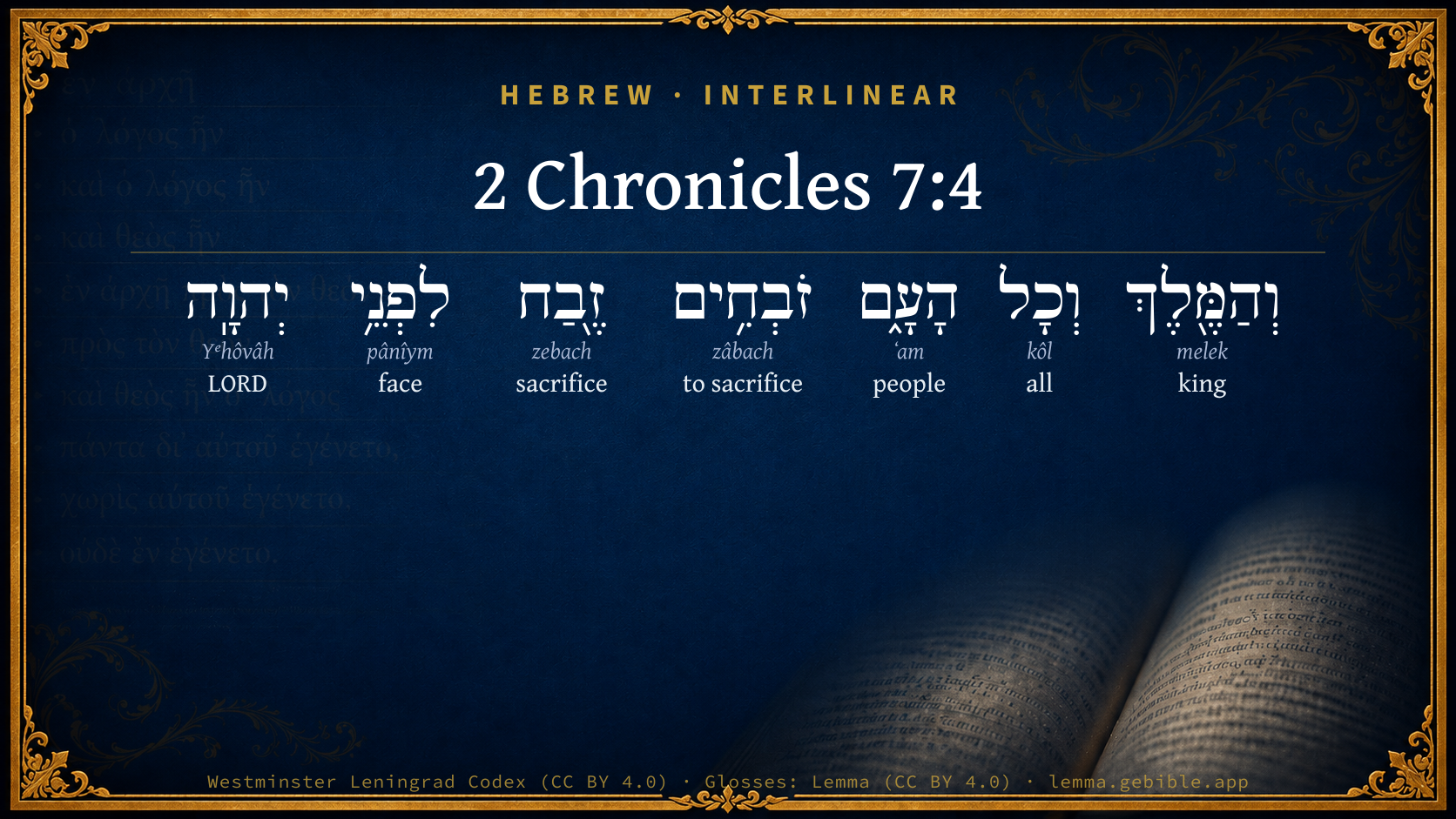
Hebrew (Westminster Leningrad Codex) 2 Chronicles 7:4 appears in the Hebrew Old Testament. The text above is from the Westminster Leningrad Codex. Each word links to its Strong’s number, a concise gloss, and parsing drawn from the Open Scriptures Hebrew Bible morphology. Click any word for its full Brown-Driver-Briggs (BDB) entry.
Download image
Cite this verse

2 Chronicles 7:4 (World English Bible). Public Domain. Lemma interlinear Bible study tool, https://lemma.gebible.app/v/2-chronicles/7/4.

Show BibTeX & RIS
BibTeX
RIS
English Translation
Then the king and all the people offered sacrifice before Yahweh.
World English Bible · Public Domain
Download a study sheet

One document with this verse’s original text, its word-by-word gloss line, the meaning frame, cross-references with their text, attributed commentary, and full source and license credits — printable, and it pastes into notes with its structure intact.

This verse Autodidact and up

Study sheet (.html) Plain text (.txt)

A passage Seminary Student

Up to 50 verses in one chapter. A passage sheet keeps up to 6 commentary sources and 12 cross-references per verse, in the order this page ranks them, and says so on the sheet whenever that leaves anything out. Ask for a single verse and you get the Autodidact verse sheet above.

Everything on this page stays free to read, with no account — the sheet is a download of what is already on screen, not access to it.

Want to remove ads? Support Godless Engineer
Compare translations 3

The same verse in 3 English versions, stacked beneath the original-language interlinear above. Click any original word for its lexicon entry.

Each is an independent rendering of the whole verse — the interlinear is not word-aligned to these translations.

Highlighted words mark where these versions differ — a whole-verse word diff, not a word-by-word alignment.

  • World English Bible Public Domain
    Then the king and all the people offered sacrifice before Yahweh.
  • King James Version Public Domain
    Then the king and all the people offered sacrifices before the LORD.
  • unfoldingWord Literal Text CC BY-SA 4.0
    And the king and all the people were offering sacrifice before Yahweh.

unfoldingWord Literal Text — © unfoldingWord, licensed CC BY-SA 4.0. Word-aligned USFM3 via Door43 (git.door43.org/unfoldingWord/en_ult).

Versions to compare (up to 4)

3 of 4 selected

Show all 18 translations

Every available English version of this verse, each an independent rendering of the whole verse.

  • World English Bible Public Domain
    Then the king and all the people offered sacrifice before Yahweh.
  • Berean Standard Bible Public Domain
    Then the king and all the people offered sacrifices before the LORD.
  • Majority Standard Bible Public Domain
    Then the king and all the people offered sacrifices before the LORD.
  • King James Version Public Domain
    Then the king and all the people offered sacrifices before the LORD.
  • American Standard Version (1901) Public Domain
    Then the king and all the people offered sacrifice before Jehovah.
  • Revised Version (1885) Public Domain
    Then the king and all the people offered sacrifice before the LORD.
  • Geneva Bible (1599) Public Domain
    Then the King and all the people offred sacrifices before the Lord.
  • Douay-Rheims (1899) Public Domain
    And the king and all the people sacrificed victims before the Lord.
  • Young's Literal Translation Public Domain
    And the king and all the people are sacrificing a sacrifice before Jehovah,
  • Literal Standard Version CC BY-SA 4.0
    And the king and all the people are sacrificing a sacrifice before YHWH,
  • Unlocked Literal Bible CC BY-SA 4.0
    So the king and all the people offered sacrifices to Yahweh.
  • unfoldingWord Literal Text CC BY-SA 4.0
    And the king and all the people were offering sacrifice before Yahweh.
  • Darby Bible Public Domain
    And the king and all the people offered sacrifices before Jehovah.
  • World Messianic Bible Public Domain
    Then the king and all the people offered sacrifices before the LORD.
  • Webster's Bible Public Domain
    Then the king and all the people offered sacrifices before the LORD.
  • Free Bible Version CC BY-SA 4.0
    Then the king and all the people offered sacrifices to the Lord.
  • Bible in Basic English Public Domain
    Then the king and all the people made offerings before the Lord.
  • JPS Tanakh (1917) Public Domain
    And the king and all the people offered sacrifice before the LORD.

Literal Standard Version (2020), Covenant Press — licensed CC BY-SA 4.0. Text via the HelloAO Bible API (eBible.org). Unlocked Literal Bible (unfoldingWord) — licensed CC BY-SA 4.0. Text via the HelloAO Bible API (eBible.org). unfoldingWord Literal Text — © unfoldingWord, licensed CC BY-SA 4.0. Word-aligned USFM3 via Door43 (git.door43.org/unfoldingWord/en_ult). Free Bible Version, Dr. Jonathan Gallagher — licensed CC BY-SA 4.0. Text via the HelloAO Bible API (eBible.org).

Word by word

More ways to search: Search by grammar → Find every occurrence → Compare this word →

Practice this passage: Drill this verse → Learn its vocabulary →

About this verse

These counts appear in no published source. They are computed here, from the morphology-tagged text and Lemma’s own curated glosses. What Lemma adds →

7
words
7
distinct lemmas
Historical
section

Grammatical profile

  • 1 verb
  • 6 nouns

Verb forms

  • זֹבְחִ֥ים Qal · Participle Active

Hebrew & Septuagint length

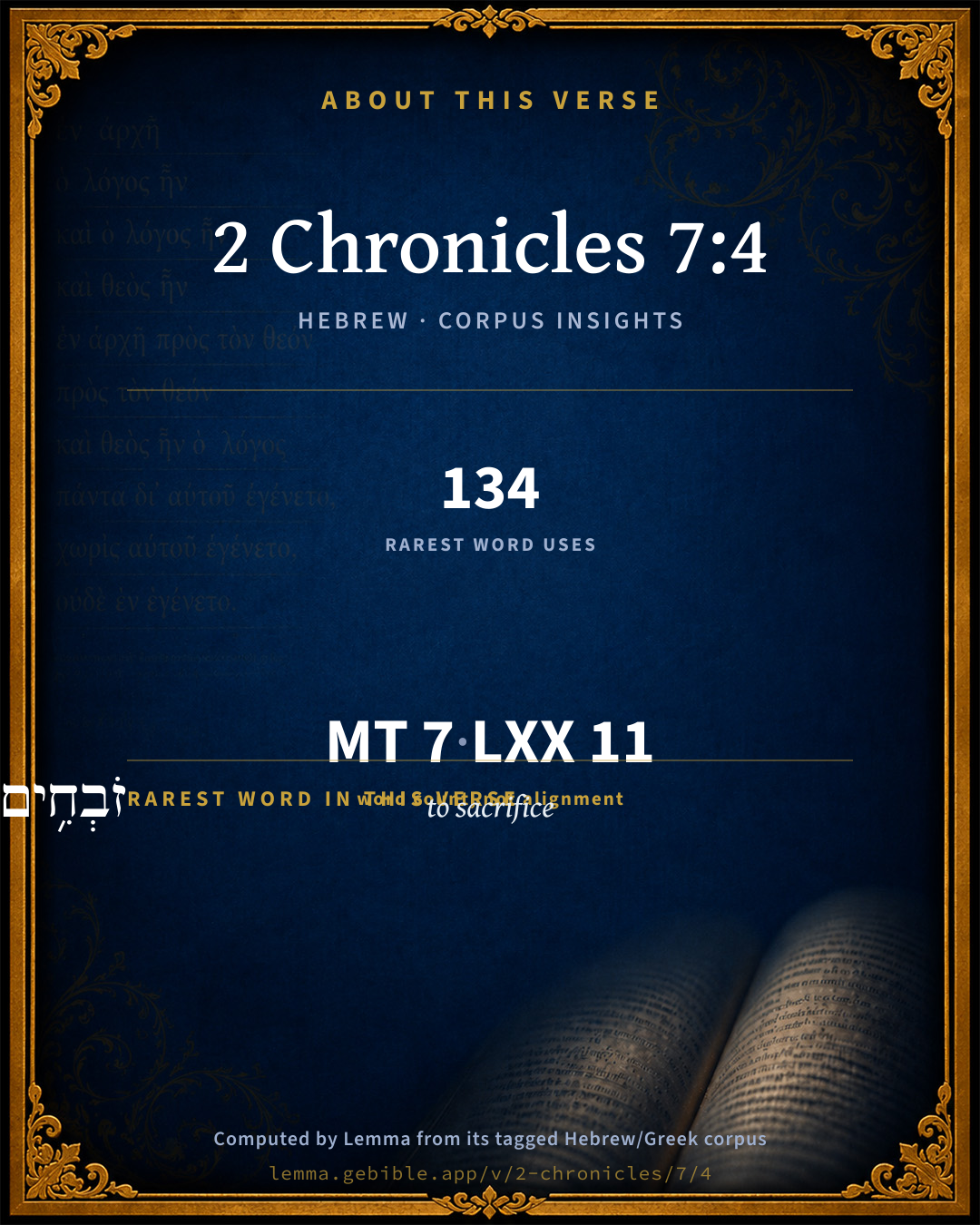
In English translation the verse runs 11 words from the Hebrew and 13 from the Septuagint (LXX English) — closely comparable.

A rough comparison of the two English renderings, which tokenize alike — not a word-level alignment.

Word counts can differ between the Hebrew and the Greek without any difference in meaning — e.g. the Hebrew direct-object marker אֵת has no separate Greek word, and Greek often adds the article ὁ.

In the original languages it is 7 Hebrew tokens and 11 Greek tokens — but the two are counted differently (Hebrew bundles its prefixes and suffixes into one token; the Greek is in lemma form), so that isn’t a like-for-like length.

Cross-references

1

Topical passages linked to 2 Chronicles 7:4 in the Treasury of Scripture Knowledge — connected by theme and wording, ordered by reader-vote popularity; previews shown in the World English Bible.

  • 1 Kings 8:62–63 The king, and all Israel with him, offered sacrifice before Yahweh.

Cross-references courtesy of OpenBible.info (CC BY 4.0).

Hebrew and Greek witnesses Masoretic Hebrew ↔ Greek Septuagint

The same verse in the two great witnesses to the Old Testament, shown verse-for-verse.

These are two independent witnesses, not word-aligned to each other, and the Septuagint is shown in lemma (dictionary) form.

Hebrew 2 Chronicles 7:4 Masoretic · Westminster Leningrad Codex

וְהַמֶּ֖לֶךְ וְכָל הָעָ֑ם זֹבְחִ֥ים זֶ֖בַח לִפְנֵ֥י יְהוָֽה

Then the king and all the people offered sacrifice before Yahweh.

World English Bible · Public Domain

Greek LXX 2 Chronicles 7:4 Septuagint · lemma form

καί ὁ βασιλεύς καί πᾶς ὁ λαός θύω θῦμα ἔναντι κύριος

And the king and all the people were offering sacrifices before the Lord.

LXX2012 (modern English Septuagint) · Public Domain

On this verse, Ellicott's Commentary for English Readers discusses the Septuagint’s reading. Read the note in Commentary ↓

Hebrew: Westminster Leningrad Codex (CC BY 4.0). Greek: Septuagint (public domain); English from LXX2012 (modern English Septuagint) (Public Domain). How the Septuagint differs from the Hebrew →

Commentary

Notes on 2 Chronicles 7:4 from classic Christian and Jewish commentators (each source and its license shown beneath its notes). The classic Christian expositions comment on the surrounding passage and are grouped to its opening verse, so a note may address several verses; the Jewish commentaries on the Tanakh (Rashi and others) are per-verse, so they appear only where the commentator wrote on this verse.

Lemma curates 59 commentaries, every one of them public domain or Creative Commons licensed, each selected and text-cleaned for this edition rather than reprinted as found. About our sources →

Jamieson, Fausset & Brown

Robert Jamieson, A. R. Fausset & David Brown

SOLOMON'S SACRIFICES. (Ch2 7:4-11)

Then the king and all the people offered sacrifices--Whether the individual worshippers slaughtered their own cattle, or a certain portion of the vast number of the Levitical order in attendance performed that work, as they sometimes did, in either case the offerings were made through the priests, who presented the blood and the fat upon the altar (see on Kg1 8:62).

Jamieson, Fausset & Brown — Commentary Critical and Explanatory on the Whole Bible (1871) — public domain (CC PDM 1.0). Text via the HelloAO Bible API.

Trapp's Complete Commentary

John Trapp

2Ch 7:4 Then the king and all the people offered sacrifices before the LORD.

Ver. 4. Then the king, &c.] See 1Ki 8:62.

John Trapp, A Commentary or Exposition upon All the Books of the Old and New Testament (1647–1656) — public domain. Text from a community e-Sword module.

Joseph Benson's Commentary

2Ch 7:4-5. Then the king and all the people offered sacrifices — They had offered sacrifices before; but now they renewed them, and offered more, in acknowledgment of these new assurances of God’s love to them. Twenty and two thousand oxen, and a hundred and twenty thousand sheep — It is probable that many of these sacrifices were burned in all the courts of the temple, and in different places upon the mount, as it was scarce possible that they should all be consumed upon one altar.

Joseph Benson's Commentary on the Old and New Testaments (1811–1818) — public domain. Text from a community e-Sword module.

Tyndale Open Study Notes

Tyndale Open Resources

7:4-6 The offering of sacrifices was essential to dedicate the dwelling of the Most High on earth; the sacrifices also provided food for the people during the fifteen days of celebration. The numbers of animals sacrificed match those found in 1 Kgs 8:63.

Tyndale Open Study Notes — © Tyndale Open Resources, licensed CC BY-SA 4.0. Text via the HelloAO Bible API.

Adam Clarke's Commentary

Verse 4. The king and all the people offered sacrifices] They presented the victims to the priests, and they and the Levites slew them, and sprinkled the blood: or perhaps the people themselves slew them; and, having caught the blood, collected the fat, &c., presented them to the priests to be offered as the law required.

Adam Clarke's Commentary on the Bible (1810–1826) — public domain. Text from a community e-Sword/MySword module.

Ellicott's Commentary for English Readers

(4) Then.—And.

Offered sacrifices.—Were sacrificing a sacrifice. LXX., θύοντες θύματα. Vulg., “immolabant.”

(4-10) THE SACRIFICES AND THE FESTIVAL. (Comp. 1Ki_8:62-66.) The two narratives are again mainly coincident.

A Bible Commentary for English Readers, edited by Charles John Ellicott (1878–1897) — public domain. Text from a community e-Sword module.

John Gill's Exposition

Then the king and all the people,.... Of these two verses; see Gill on Kg1 8:62; see Gill on Kg1 8:63.

.

2 Chronicles 7:6

ch2 7:6

ch2 7:6

ch2 7:6And the priests waited on their offices,.... Performed them, some in offering sacrifices, others in blowing trumpets, as it may be explained from the latter part of the verse:

the Levites also with instruments of music of the Lord, which David the king had made to praise the Lord; under a divine direction, on which the Levites played to the songs of praise offered to the Lord, and by which they made music sacred to him:

because his mercy endureth for ever; which, as it was the close of their songs of praise, was the cause of them:

when David praised by their ministry; the songs sung being composed by him, and the instruments they played upon being of his invention, and used by his order:

and the priests sounded trumpets before them; or rather over against them, that is, over against the Levites, as they were singing and playing on the instruments of music:

and all Israel stood; while this sacred and delightful service was performing, they both stood up, and stood by the priests and Levites, and joined with them in praising the Lord.

John Gill's Exposition of the Whole Bible (1746–1763) — public domain (CC PDM 1.0). Text via the HelloAO Bible API.

Haydock's Catholic Bible Commentary

Victims, by the hands of the priests: or they slew them themselves, and presented the blood and fat to be placed on the altar by the priests.

George Leo Haydock (1774–1849), Haydock's Catholic Family Bible and Commentary, 1859 edition — public domain. Excludes Psalms (Douay-Rheims chapter numbering differs from Protestant) and Deuterocanonical books (Catholic canon only).

The Pulpit Commentary

Vers. 4, 5. These two verses bring us again into company with the parallel in its vers. 62, 63. Let it be noticed that in both these verses the compiler of Chronicles avoids the words, "all Israel," and "all the children of Israel;" in favour of all the people. The parallel tells us that the sacrifices in part were peace offerings, eatable, therefore, by priests and people. Large as the numbers of the oxen and sheep sacrificed, yet indications in the narrative round about do something to sustain them, as e.g. the number of people who had come together; the fact that all the people are said to offer sacrifices; the fact that Solomon, Because of the press for room (ver. 7), hallowed the middle of the court, i.e. probably the court itself, in order to find place for the "burnt offerings, meat offerings, and fat" (ver. 7); further, the number of mouths of people that certainly would need filling, not only on one day, but on days more than one, while on the third day (Lev_19:6) any part of a peace offering still left was to be destroyed by fire. Nevertheless, the thought of the scene of butchery is, to our modern imagination, amazing to the last degree. An assemblage of people in Jerusalem, all making also for its temple, of a hundred and twenty thousand people, and a minimum of another twenty-two thousand people, is startling; but add to these a sheep apiece for the former number, and an ox apiece for the latter (a computation itself necessarily under the mark), and allow several days to be covered by the-killing and sacrificing, and one feels that the key and explanation of the present words of the Bible text in this very passage are scarcely in hand. The interesting note in the "Speaker"s Commentary" on 1Ki_8:63 scarcely assists us. Its instances of the "profusion" of the "sacrifices of antiquity" are altogether and immensely distanced by the narrative before us, not only in the number of victims, but in respect of the time in which the victims had to be despatched and disposed of, and the place and space within which, if not the slaughtering, yet certainly the offering, had to be done.

Vers. 4, 5.

Sacred overflow.

What meant this great slaughter of sheep and oxen? Why such a large, such a lavish expenditure of creature life? With our modem ideas of the sacredness of life, animal as well as human, we naturally inquire what purpose was served by sacrifices on such a scale as this. Clearly it was

I NOT IN OBEDIENCE TO A DIVINE COMMAND. There was no precept of the Law applicable to the case; the matter was entirely exceptional, and Solomon was cast on the resources of his own judgment and feeling. A very large part of our service must be spontaneous. We are continually placed in circumstances in which no biblical statute can be quoted. We need to be possessed of such broad and deep religions principles that these will serve us in any position in which we may be placed. It is not a vast array of precepts, but a few inclusive and suggestive principles, which prepare us for the eventualities of our life.

II NOT TO ENRICH ONE WHO KNOWS NO NECESSITY. Whatever idea the heathen nations around may have had of their sacrifices as an enrichment of their deities, the Israelites had no such vain thought. (see Psa_50:8-13) We cannot enrich by our material presentations One who claims and holds the entire earth as his possession. Yet is there that which we can give to God which will, in a true sense, add to his possessions our hearts and our lives; our own true selves; our trust, our love, our joy in him. May we not say that by the filial response of his children he is enriched?

III NOT TO APPEASE AN INEXORABLE ONE. It might be well enough that the priests of Baal should have recourse to all the arts and devices of a passionate importunity in order to secure his attention and enlist his aid. (1Ki_18:26-29) But the Divine Father whom we worship has not to be approached thus in order to be attentive to the voice of our prayer, or in order to grant us his merciful regard. He may, indeed, for a time withhold from us a sense of his favour in order to draw forth our prayer and to deepen our faith, and thus to enlarge and bless us. But as he did not require a vast multitude of beasts to be slain on his altar that his anger might be appeased, so does he not require any multiplied devotions, or incessant entreaties that his forgiving love may be extended to us. On the other hand, he waits to be gracious, and is prepared to go forth to meet the spirit that returns to him. It was, then

IV A DESIRE TO RENDER ADDED HONOUR TO THE HOLY AND THE GRACIOUS ONE.

1. Solomon and those who were about him may have been powerfullyaffected by the near presence of the Holy One of Israel; and they may consequently have been disposed to offer these sacrifices which purified them from all uncleanness and made them less unworthy to stand before him; thus regarded, these lavish offerings were the overflow of their humility. We are in no danger of going too far in this direction. We may, indeed, sometimes use language of shame and penitence which is in advance of our inward thought and actual spiritual condition. That is a great mistake. It is not acceptable to God, and it is misleading to ourselves. But we are never in danger of having too deep a sense of our own unworthiness; by all means let humility of spirit have free course, both in fact and in expression. "Blessed are the poor in spirit: for theirs is the kingdom of heaven.

2. Solomon and his attendants may have been keenly touched by a sense ofGod"s great and special goodness to them, and they may, therefore, have presented these offerings in gratitude and devotion. They were thus the overflow of their zeal. It is right that our zeal in the worship and service of God should be unbound by limits, should be free to utter itself in large and even lavish contributions. We are not to be tied to the tenth of our produce and our income; we may be free and eager to contribute a fifth, a half, two-thirds of all that we possess "for the furtherance of the gospel." We are not limited to one-seventh of our time for devotion, or to any prescribed times in the day for communion with God; we do well to let our hearts ascend in prayer and holy fellowship every day and at all hours of the day. If we have the consciousness of God"s abounding kindness, of our Saviour"s surpassing love, of the Holy Spirit"s grace and patience which we should have, to which we may all of us attain, we shall let there be a glad and generous overflow of offering unto God. We shall let our praise, our contribution, our endeavour, be multiplied. There will be no narrow regulation, but a broad and open spontaneity in our service of Jesus Christ. C.

The Pulpit Commentary (1880–1919), ed. H.D.M. Spence-Jones & Joseph S. Exell — public domain. Text from a community e-Sword module.

unfoldingWord translationNotes

Door43 World Missions Community

all the people

This generalization refers either 1) to the people whom Solomon called to Jerusalem and who are listed in 2 Chronicles 5:2, or 2) to those who traveled to Jerusalem for the feast, not necessarily to every person who lived in Israel. (See: Hyperbole and Generalization)

twenty-two thousand oxen

"22,000 oxen" (See: Numbers)

120,000 sheep and goats

"one hundred and twenty thousand sheep and goats" (See: Numbers)

each standing where they serve

"each standing in their appointed place"

the Levites also with instruments of music of Yahweh

The word "stood" is understood from the previous phrase. AT: the Levites also stood with instruments of music of Yahweh" (See: Ellipsis)

For his covenant faithfulness endures for ever

The abstract noun "faithfulness" can be stated as "faithfully" or "faithful." See how you translated "covenant faithfulness" in 2 Chronicles 7:3. AT: "God will always be faithful to his covenant with us" or "God will always faithfully love us" (See: Abstract Nouns)

all Israel

This generalization refers to those who were at the feast in Jerusalem, not necessarily to every person who lived in Israel. (See: Hyperbole and Generalization)

translationWords

king

ewe

goat

dedicate

servant

house of God

covenant faithfulness

eternity

trumpet

Israel

unfoldingWord translationNotes — © Distant Shores Media and the Door43 World Missions Community, licensed CC BY-SA 4.0. Source: git.door43.org/Door43/en_tn.

Lesson kit

Teaching starters — assembled from the data on this page, not authored interpretation. Every prompt links to the verse data it draws on. Edit before teaching.

2 Chronicles, in the Historical, opens this verse with 7 words (7 distinct Hebrew lemmas). Its most distinctive word is zâbach (“to sacrifice”). A historical commentator’s framing appears above. Read the whole chapter for the surrounding context.

Discussion questions

  1. The word zâbach carries the sense “to sacrifice.” How does it shape the verse?
  2. How does 1 Kings 8:62–63, which shares this passage’s theme, read alongside this verse?
  3. These translations render this verse differently; the difference is in the English rendering, not the original. What questions does that raise?
  4. «זֹבְחִ֥ים» is a Qal Participle Active verb. How does that grammatical form shape the action described?
  5. Compare how Jamieson, Fausset & Brown and Trapp's Complete Commentary read this verse. Where do they agree or differ?

Things to notice

Reading settings

Reading text

Shown beneath each verse's original-language words.

Old Testament
Old Testament edition

Read the OT as the Masoretic Hebrew (MT) or the Greek Septuagint (LXX).

English shown for the Greek Septuagint (in the Hebrew ↔ Greek comparison).

Comparing translations? Open the Compare panel on any verse page to stack up to four side by side.