2 Chronicles 7:12

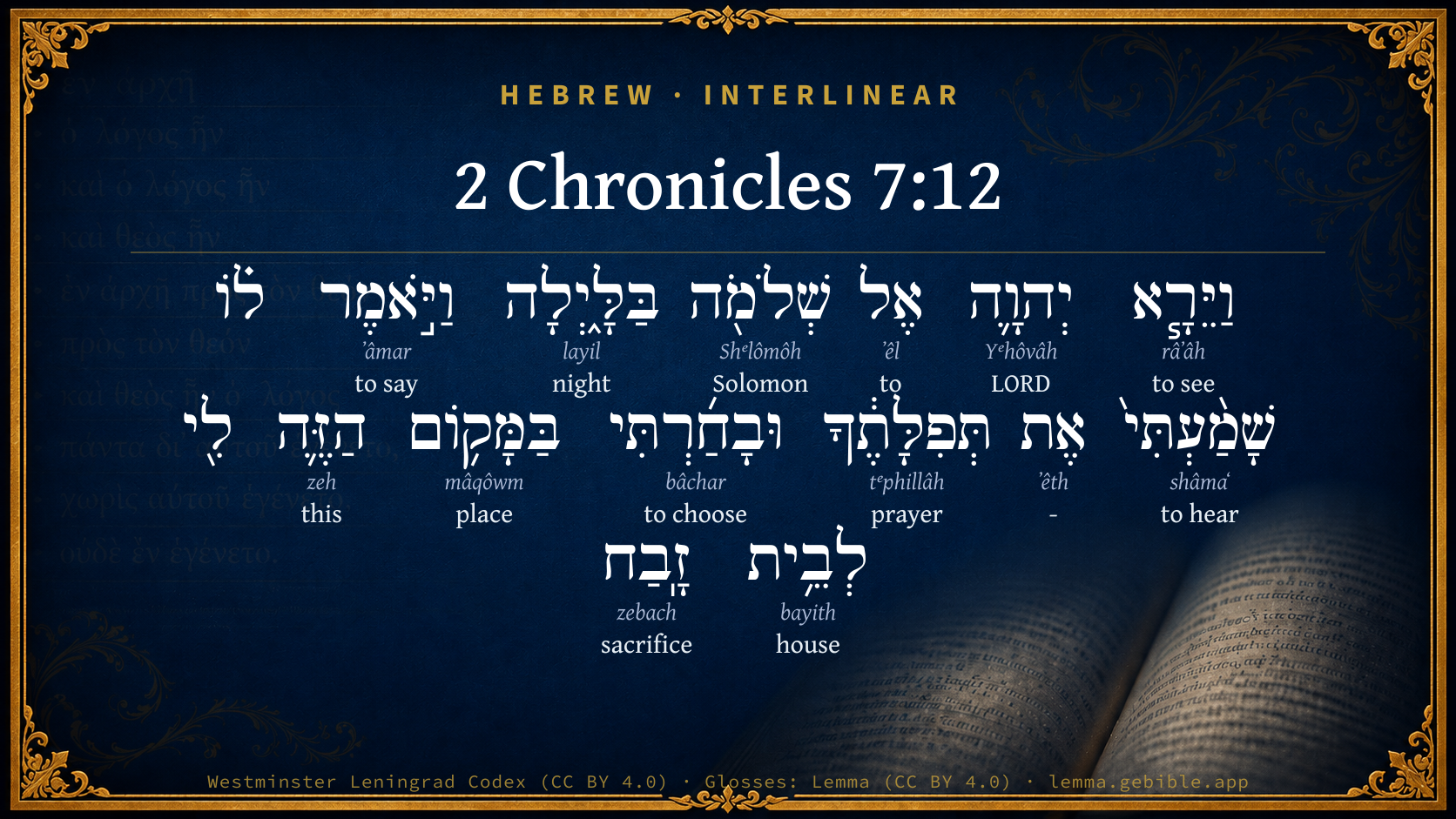
Hebrew (Westminster Leningrad Codex) 2 Chronicles 7:12 appears in the Hebrew Old Testament. The text above is from the Westminster Leningrad Codex. Each word links to its Strong’s number, a concise gloss, and parsing drawn from the Open Scriptures Hebrew Bible morphology. Click any word for its full Brown-Driver-Briggs (BDB) entry.
Download image
Cite this verse

2 Chronicles 7:12 (World English Bible). Public Domain. Lemma interlinear Bible study tool, https://lemma.gebible.app/v/2-chronicles/7/12.

Show BibTeX & RIS
BibTeX
RIS
English Translation
Yahweh appeared to Solomon by night, and said to him, I have heard your prayer, and have chosen this place to myself for a house of sacrifice.
World English Bible · Public Domain
Download a study sheet

One document with this verse’s original text, its word-by-word gloss line, the meaning frame, cross-references with their text, attributed commentary, and full source and license credits — printable, and it pastes into notes with its structure intact.

This verse Autodidact and up

Study sheet (.html) Plain text (.txt)

A passage Seminary Student

Up to 50 verses in one chapter. A passage sheet keeps up to 6 commentary sources and 12 cross-references per verse, in the order this page ranks them, and says so on the sheet whenever that leaves anything out. Ask for a single verse and you get the Autodidact verse sheet above.

Everything on this page stays free to read, with no account — the sheet is a download of what is already on screen, not access to it.

Want to remove ads? Support Godless Engineer
Compare translations 3

The same verse in 3 English versions, stacked beneath the original-language interlinear above. Click any original word for its lexicon entry.

Each is an independent rendering of the whole verse — the interlinear is not word-aligned to these translations.

Highlighted words mark where these versions differ — a whole-verse word diff, not a word-by-word alignment.

  • World English Bible Public Domain
    Yahweh appeared to Solomon by night, and said to him, I have heard your prayer, and have chosen this place to myself for a house of sacrifice.
  • King James Version Public Domain
    And the LORD appeared to Solomon by night, and said unto him, I have heard thy prayer, and have chosen this place to myself for an house of sacrifice.
  • unfoldingWord Literal Text CC BY-SA 4.0
    And Yahweh appeared to Solomon in the night, and he said to him, “I have heard your prayer, and I have chosen this place for myself for a house of sacrifice.

unfoldingWord Literal Text — © unfoldingWord, licensed CC BY-SA 4.0. Word-aligned USFM3 via Door43 (git.door43.org/unfoldingWord/en_ult).

Versions to compare (up to 4)

3 of 4 selected

Show all 18 translations

Every available English version of this verse, each an independent rendering of the whole verse.

  • World English Bible Public Domain
    Yahweh appeared to Solomon by night, and said to him, I have heard your prayer, and have chosen this place to myself for a house of sacrifice.
  • Berean Standard Bible Public Domain
    the LORD appeared to him at night and said to him: “I have heard your prayer and have chosen this place for Myself as a house of sacrifice.
  • Majority Standard Bible Public Domain
    the LORD appeared to him at night and said to him: “I have heard your prayer and have chosen this place for Myself as a house of sacrifice.
  • King James Version Public Domain
    And the LORD appeared to Solomon by night, and said unto him, I have heard thy prayer, and have chosen this place to myself for an house of sacrifice.
  • American Standard Version (1901) Public Domain
    And Jehovah appeared to Solomon by night, and said unto him, I have heard thy prayer, and have chosen this place to myself for a house of sacrifice.
  • Revised Version (1885) Public Domain
    And the LORD appeared to Solomon by night, and said unto him, I have heard thy prayer, and have chosen this place to myself for an house of sacrifice.
  • Geneva Bible (1599) Public Domain
    And the Lord appeared to Salomon by night and said to him, I haue heard thy prayer, and haue chosen this place for my selfe to be an house of sacrifice.
  • Douay-Rheims (1899) Public Domain
    And the Lord appeared to him by night, and said: I have heard thy prayer, and I have chosen this place to myself for a house of sacrifice.
  • Young's Literal Translation Public Domain
    And Jehovah appeareth unto Solomon by night, and saith to him, `I have heard thy prayer, and have fixed on this place to Me for a house of sacrifice.
  • Literal Standard Version CC BY-SA 4.0
    And YHWH appears to Solomon by night and says to him, “I have heard your prayer, and have fixed on this place for Myself for a house of sacrifice.
  • Unlocked Literal Bible CC BY-SA 4.0
    Yahweh appeared to Solomon by night and said to him, “I have heard your prayer, and I have chosen this place for myself as a house of sacrifice.
  • unfoldingWord Literal Text CC BY-SA 4.0
    And Yahweh appeared to Solomon in the night, and he said to him, “I have heard your prayer, and I have chosen this place for myself for a house of sacrifice.
  • Darby Bible Public Domain
    Then Jehovah appeared to Solomon by night, and said to him: I have heard thy prayer, and I have chosen for myself this place for a house of sacrifice.
  • World Messianic Bible Public Domain
    Then the LORD appeared to Solomon by night, and said to him, “I have heard your prayer, and have chosen this place for myself for a house of sacrifice.
  • Webster's Bible Public Domain
    And the LORD appeared to Solomon by night, and said to him, I have heard thy prayer, and have chosen this place to myself for a house of sacrifice.
  • Free Bible Version CC BY-SA 4.0
    the Lord appeared to him at night and told him: “I have heard your prayer and have chosen this place for myself as a Temple of sacrifice.
  • Bible in Basic English Public Domain
    Now the Lord came to Solomon in a vision by night, and said to him, I have given ear to your prayer, and have taken this place for myself as a house where offerings are to be made.
  • JPS Tanakh (1917) Public Domain
    And the LORD appeared to Solomon by night, and said unto him: 'I have heard thy prayer, and have chosen this place to Myself for a house of sacrifice.

Literal Standard Version (2020), Covenant Press — licensed CC BY-SA 4.0. Text via the HelloAO Bible API (eBible.org). Unlocked Literal Bible (unfoldingWord) — licensed CC BY-SA 4.0. Text via the HelloAO Bible API (eBible.org). unfoldingWord Literal Text — © unfoldingWord, licensed CC BY-SA 4.0. Word-aligned USFM3 via Door43 (git.door43.org/unfoldingWord/en_ult). Free Bible Version, Dr. Jonathan Gallagher — licensed CC BY-SA 4.0. Text via the HelloAO Bible API (eBible.org).

Word by word

More ways to search: Search by grammar → Find every occurrence → Compare this word →

Practice this passage: Drill this verse → Learn its vocabulary →

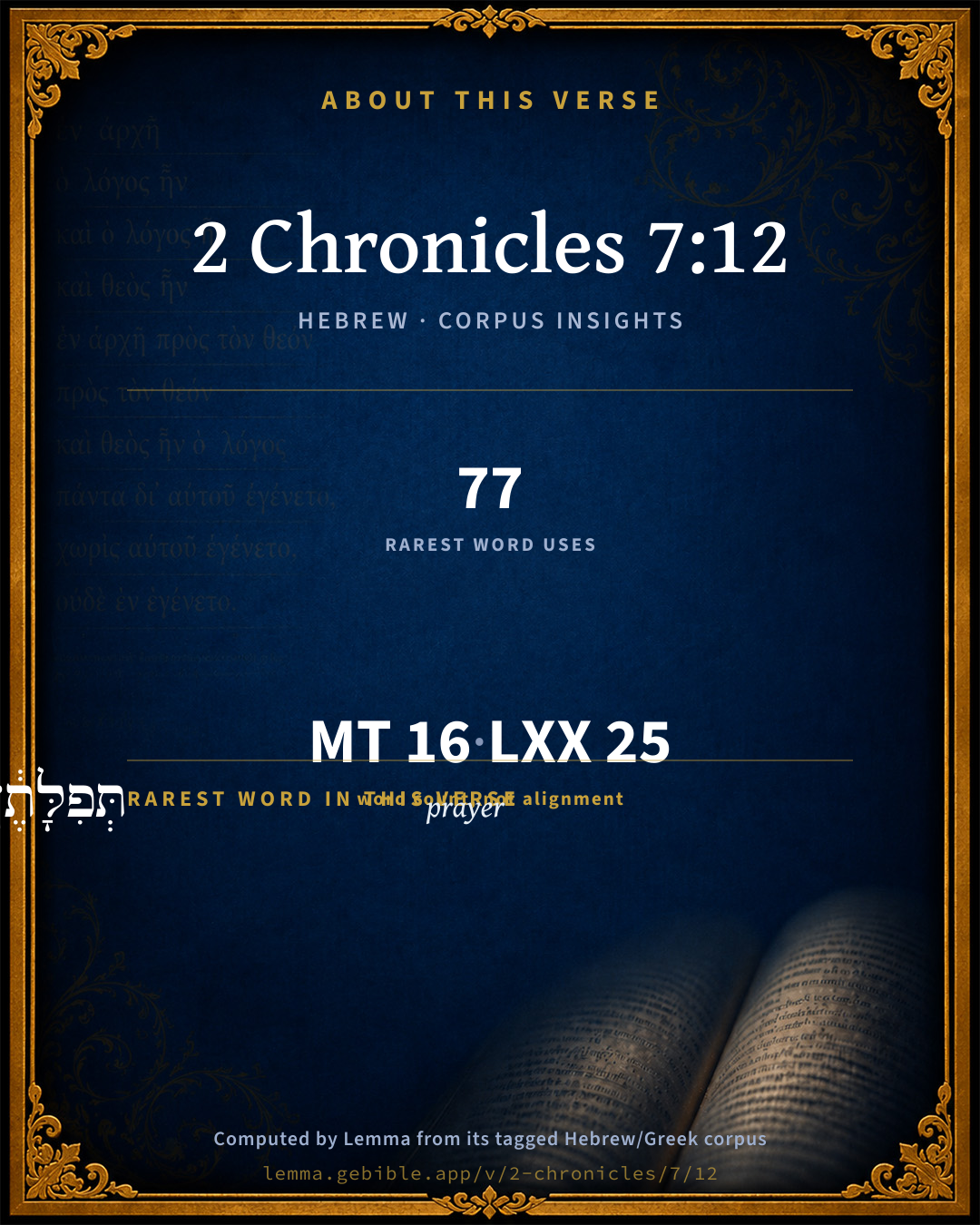
תְּפִלָּתֶ֔ךָ
tᵉphillâh
H8605
“prayer · your”
Noun, Common, Feminine, Singular, Construct + Suffix, Personal, 2nd Person, Masculine, Singular
Part of Speech
Noun
Type
Common
Gender
Feminine
Number
Singular
State
Construct
Full BDB Definition

Origin: from H6419

TWOT: 1776a

prayer - prayer - pray a prayer - house of prayer - hear prayer - in Psalm titles (of poetic or liturgical prayer)
  1. וַיֵּרָ֧א râʼâh H7200 “and · to see” Conjunction + Verb, Niphal, Sequential Imperfect, 3rd Person, Masculine, Singular
  2. יְהוָ֛ה Yᵉhôvâh H3068 “LORD” Noun, Proper
  3. אֶל ʼêl H413 “to” Preposition
  4. שְׁלֹמֹ֖ה Shᵉlômôh H8010 “Solomon” Noun, Proper
  5. בַּלָּ֑יְלָה layil H3915 “in/at the · night” Preposition, Determined + Noun, Common, Masculine, Singular, Absolute
  6. וַיֹּ֣אמֶר ʼâmar H559 “and · to say” Conjunction + Verb, Qal, Sequential Imperfect, 3rd Person, Masculine, Singular
  7. שָׁמַ֨עְתִּי֙ shâmaʻ H8085 “to hear” Verb, Qal, Perfect, 1st Person, Common, Singular
  8. אֶת ʼêth H853 “-” Particle, Direct Object
  9. וּבָחַ֜רְתִּי bâchar H977 “and · to choose” Conjunction + Verb, Qal, Perfect, 1st Person, Common, Singular
  10. בַּמָּק֥וֹם mâqôwm H4725 “in/at the · place” Preposition, Determined + Noun, Common, Masculine, Singular, Absolute
  11. הַזֶּ֛ה zeh H2088 “the · this” Particle, Definite Article + Pronoun, Demonstrative, Masculine, Singular
  12. לְבֵ֥ית bayith H1004 “to/for · house of” Preposition + Noun, Common, Masculine, Singular, Construct
  13. זָֽבַח zebach H2077 “sacrifice” Noun, Common, Masculine, Singular, Absolute

About this verse

These counts appear in no published source. They are computed here, from the morphology-tagged text and Lemma’s own curated glosses. What Lemma adds →

16
words
14
distinct lemmas
Historical
section

Grammatical profile

  • 4 verbs
  • 7 nouns
  • 1 pronoun
  • 3 prepositions
  • 1 particle

Verb forms

  • וַיֵּרָ֧א Niphal · Sequential Imperfect
  • וַיֹּ֣אמֶר Qal · Sequential Imperfect
  • שָׁמַ֨עְתִּי֙ Qal · Perfect
  • וּבָחַ֜רְתִּי Qal · Perfect

Hebrew & Septuagint length

In English translation the verse runs 27 words from the Hebrew and 30 from the Septuagint (LXX English) — closely comparable.

A rough comparison of the two English renderings, which tokenize alike — not a word-level alignment.

Word counts can differ between the Hebrew and the Greek without any difference in meaning — e.g. the Hebrew direct-object marker אֵת has no separate Greek word, and Greek often adds the article ὁ.

In the original languages it is 16 Hebrew tokens and 25 Greek tokens — but the two are counted differently (Hebrew bundles its prefixes and suffixes into one token; the Greek is in lemma form), so that isn’t a like-for-like length.

Cross-references

15

Topical passages linked to 2 Chronicles 7:12 in the Treasury of Scripture Knowledge — connected by theme and wording, ordered by reader-vote popularity; previews shown in the World English Bible.

  • Genesis 17:1 When Abram was ninety-nine years old, Yahweh appeared to Abram, and said to him, "I am God Almighty. Walk before me, and be blameless.
  • 1 Kings 9:2 that Yahweh appeared to Solomon the second time, as he had appeared to him at Gibeon.
  • 2 Chronicles 1:7 In that night did God appear to Solomon, and said to him, Ask what I shall give you.
  • 2 Chronicles 7:16 For now have I chosen and made this house holy, that my name may be there forever; and my eyes and my heart shall be there perpetually.
  • Deuteronomy 12:11 then it shall happen that to the place which Yahweh your God shall choose, to cause his name to dwell there, there shall you bring all that I command you: your burnt offerings, and your sacrifices, your tithes, and the heave-offering of your hand, and all your choice vows which you vow to Yahweh.
  • 2 Kings 20:5 Turn back, and tell Hezekiah the prince of my people, Thus says Yahweh, the God of David your father, I have heard your prayer, I have seen your tears: behold, I will heal you; on the third day you shall go up to the house of Yahweh.
  • Luke 1:13 But the angel said to him, "Don't be afraid, Zacharias, because your request has been heard, and your wife, Elizabeth, will bear you a son, and you shall call his name John.
  • Acts 10:31 and said, 'Cornelius, your prayer is heard, and your gifts to the needy are remembered in the sight of God.
  • 1 John 5:14–15 This is the boldness which we have toward him, that, if we ask anything according to his will, he listens to us.
  • Deuteronomy 12:5–6 But to the place which Yahweh your God shall choose out of all your tribes, to put his name there, even to his habitation shall you seek, and there you shall come;
  • 2 Kings 2:6 Elijah said to him, "Please wait here, for Yahweh has sent me to the Jordan." He said, "As Yahweh lives, and as your soul lives, I will not leave you." They two went on.
  • Psalms 10:17 Yahweh, you have heard the desire of the humble. You will prepare their heart. You will cause your ear to hear,
  • Psalms 66:19 But most assuredly, God has listened. He has heard the voice of my prayer.
  • Psalms 78:68–69 But chose the tribe of Judah, Mount Zion which he loved.
  • Psalms 132:13–14 For Yahweh has chosen Zion. He has desired it for his habitation.

Cross-references courtesy of OpenBible.info (CC BY 4.0).

Hebrew and Greek witnesses Masoretic Hebrew ↔ Greek Septuagint

The same verse in the two great witnesses to the Old Testament, shown verse-for-verse.

These are two independent witnesses, not word-aligned to each other, and the Septuagint is shown in lemma (dictionary) form.

Hebrew 2 Chronicles 7:12 Masoretic · Westminster Leningrad Codex

וַיֵּרָ֧א יְהוָ֛ה אֶל שְׁלֹמֹ֖ה בַּלָּ֑יְלָה וַיֹּ֣אמֶר ל֗וֹ שָׁמַ֨עְתִּי֙ אֶת תְּפִלָּתֶ֔ךָ וּבָחַ֜רְתִּי בַּמָּק֥וֹם הַזֶּ֛ה לִ֖י לְבֵ֥ית זָֽבַח

Yahweh appeared to Solomon by night, and said to him, I have heard your prayer, and have chosen this place to myself for a house of sacrifice.

World English Bible · Public Domain

Greek LXX 2 Chronicles 7:12 Septuagint · lemma form

καί ὁράω ὁ θεός ὁ σαλωμών ὁ νύξ καί εἶπον αὐτός ἀκούω ὁ προσευχή σύ καί ἐκλέγω ἐν ὁ τόπος οὗτος ἐμαυτοῦ εἰς οἶκος θυσία

And the Lord appeared to Solomon by night, and said to him, I have heard your prayer, and I have chosen this place to myself for a house of sacrifice.

LXX2012 (modern English Septuagint) · Public Domain

Hebrew: Westminster Leningrad Codex (CC BY 4.0). Greek: Septuagint (public domain); English from LXX2012 (modern English Septuagint) (Public Domain). How the Septuagint differs from the Hebrew →

Commentary

Notes on 2 Chronicles 7:12 from classic Christian and Jewish commentators (each source and its license shown beneath its notes). The classic Christian expositions comment on the surrounding passage and are grouped to its opening verse, so a note may address several verses; the Jewish commentaries on the Tanakh (Rashi and others) are per-verse, so they appear only where the commentator wrote on this verse.

Lemma curates 59 commentaries, every one of them public domain or Creative Commons licensed, each selected and text-cleaned for this edition rather than reprinted as found. About our sources →

Matthew Henry's Commentary

That God accepted Solomon's prayer appeared by the fire from heaven. But a prayer may be accepted and yet not answered in the letter of it; and therefore God appeared to him in the night, as he did once before (Ch2 1:7), and after a day of sacrifice too, as then, and gave him a peculiar answer to his prayer. We had the substance of it before, Kg1 9:2-9.

I. He promised to own this house for a house of sacrifice to Israel and a house of prayer for all people (Isa 56:7): My name shall be there for ever (Ch2 7:12, Ch2 7:16), that is, "There will I make myself known, and there will I be called upon."

II. He promised to answer the prayers of his people that should at any time be made in that place, Ch2 7:13-15. National judgments are here supposed (Ch2 7:13), famine, and pestilence, and perhaps war, for by the locusts devouring the land meant enemies as greedy as locusts, and laying all waste. 2. National repentance, prayer, and reformation, are required, Ch2 7:14. God expects that his people who are called by his name, if they have dishonoured his name by their iniquity, should honour it by accepting the punishment of their iniquity. They must be humble themselves under his hand, must pray for the removal of the judgment, must seek the face and favour of God; and yet all this will not do unless they turn from their wicked ways, and return to the God from whom they have revolted. 3. National mercy is then promised, that God will forgive their sin, which brought the judgment upon them, and then heal their land, redress all their grievances. Pardoning mercy makes ways for healing mercy, Psa 103:3; Mat 9:2.

III. He promised to perpetuate Solomon's kingdom, upon condition that he persevered in his duty, Ch2 7:17, Ch2 7:18. If he hoped for the benefit of God's covenant with David, he must imitate the example of David. But he set before him death as well as life, the curse as well as the blessing. 1. He supposed it possible that though they had this temple built to the honour of God, yet they might be drawn aside to worship other gods, Ch2 7:19. He knew their proneness to backslide into that sin. 2. He threatened it as certain that, if they did so, it would certainly be the ruin of both church and state. (1.) It would be the ruin of their state, Ch2 7:20. "Though they have taken deep root, and taken root long, in this good land, yet I will pluck them up by the roots, extirpate the whole nation, pluck them up as men pluck up weeds out of their garden, which are thrown to the dunghill." (2.) It would be the ruin of their church. This sanctuary would be no sanctuary to them, to protect them from the judgment of God, as they imagined, saying, The temple of the Lord are we, Jer 7:4. "This house which is high, not only for the magnificence of its structure, but for the designed ends and uses of it, shall be an astonishment, it shall come down wonderfully (Lam 1:9), to the amazement of all the neighbours."

Matthew Henry's Commentary on the Whole Bible (1708–1710) — public domain (CC PDM 1.0). Text via the HelloAO Bible API.

Jamieson, Fausset & Brown

Robert Jamieson, A. R. Fausset & David Brown

GOD APPEARS TO HIM. (Ch2 7:12-22)

the Lord appeared to Solomon by night--(See on Kg1 9:1-9). The dedication of the temple must have been an occasion of intense national interest to Solomon and his subjects. Nor was the interest merely temporary or local. The record of it is read and thought of with an interest that is undiminished by the lapse of time. The fact that this was the only temple of all nations in which the true God was worshipped imparts a moral grandeur to the scene and prepares the mind for the sublime prayer that was offered at the dedication. The pure theism of that prayer--its acknowledgment of the unity of God as well as of His moral perfections in providence and grace, came from the same divine source as the miraculous fire. They indicated sentiments and feelings of exalted and spiritual devotion, which sprang not from the unaided mind of man, but from the fountain of revelation. The reality of the divine presence was attested by the miracle, and that miracle stamped the seal of truth upon the theology of the temple-worship.

Next: 2 Chronicles Chapter 8

Jamieson, Fausset & Brown — Commentary Critical and Explanatory on the Whole Bible (1871) — public domain (CC PDM 1.0). Text via the HelloAO Bible API.

Trapp's Complete Commentary

John Trapp

2Ch 7:12 And the LORD appeared to Solomon by night, and said unto him, I have heard thy prayer, and have chosen this place to myself for an house of sacrifice.

Ver. 12. And the Lord appeared to Solomon by night.] Night and day God is doing good to his people. As a good householder, if he hear but a noise in the house by night, or smell but a smoke, starteth up, &c.; so here.

John Trapp, A Commentary or Exposition upon All the Books of the Old and New Testament (1647–1656) — public domain. Text from a community e-Sword module.

The Biblical Illustrator

Joseph S. Exell

2Ch_7:12-16

And the Lord appeared to Solomon by night, and said unto him, I have heard thy prayer.

The answer of God to the prayer of Solomon at the dedication of the temple

1. How strikingly does the answer meet the prayer. Solomon anticipated days of sorrow. He asked of God, If we call upon Thee, wilt Thou hear us? I will, says God, I will. Solomon asks that Gods eye and ear may be open to his house. God exceeds the prayer of the king. Not only shall Mine eyes and Mine ears be there, but My heart shall be there also.

2. God not only declares that He has heard the prayer of Solomon, He says something more encouraging: I have chosen this house for Myself, for a house of sacrifice.

3. God affirms national judgments to be the work of His own hand. If I shut up heaven, etc.

4. God supposes that always in national calamity the people will come running to Him.

5. God regards His house as pre-eminently a house of prayer. Mine ears shall be attent unto the prayer that is made in this place.

6. God gives a promise of His perpetual presence in His house.

Conclusion: What duty devolves upon us having such abundant mercies?

1. Personal religion.

2. Family religion.

3. Liberal offering to the Lord. (T. Mortimer, B.D.)

If I shut up heaven.--

Pestilence Gods retribution for sin

I. God claims to Himself the authorship of the calamity for whose removal we entreat.

II. The direct connection which is pointed out between the visitation of the pestilence and a peoples impiety as the provocation which has caused it.

III. Though pestilence be of gods sending, yet will he be entreated for its removal (Robert Bickersteth, M.A.)

The cessation of the cholera

I. There is no one truth that is more universal in its application, or which more commends itself to every mans conscience, than that guilt is followed by punishment, most certainly in the next world, and most probably in this.

II. That as true repentance will always be accepted, for Christs sake, for the putting away of sin, so will it often avail, in the mercy of God, to the removal of the temporal calamity which may have been the consequence and punishment of the sin. (F. O. Morris.)

The means and method of healing in the Church

I. The supposition of judgments.

1. Judgments light not on a people casually or by chance, but by the overruling command and commission of God (Job_5:6-7).

(1) Sometimes by way of dominion and absolute power.

(2) Sometimes as a preparation unto intended mercy, as men plough the ground which they mean to enrich with precious seed, and carve the stone which they mean to put in the top of the building. As men put forth longest into wind and sun that great timber which must bear the greatest burden and stress of the building.

(3) But most usually in a way of justice (Jer_30:15; Neh_9:33; Eze_14:23). Personal chastisements may be for trial and exercise of faith and patience, but general and public judgments are ever in wrath and displeasure. Let us therefore labour to find out our sins by our sufferings. Chastisements never mend us till they teach us (Psa_94:12; Mic_6:9).

2. The Lord hath variety of judgments whereby to reduce froward and stubborn sinners. Gods method in these various judgments usually is--

(1) He begins at the outward man, exercising a people many times with change of rods, which is ever a sign of anger in the father and stubbornness in the son.

(2) He proceeds to the soul, revealing His wrath, causing guilt and fear to gripe and seize on the conscience (Psa_51:8; Job_6:4; Pro_18:14).

(3) Towards obdurate sinners the Lord many times deals in a more fearful manner, sealing them up under hardness of heart, a spirit of slumber, a reprobate sense, a seared conscience, etc., till destruction unawares overtake them (Mat_24:39; Eze_24:14; Hos_4:17; Rev_22:11).

II. A direction unto duties. Consider--

1. The quality of the persons who are to perform them: My people that are called by My name. All men are His creatures, only a select and peculiar inheritance that bear His name and are in covenant with Him are called His people (Eze_16:8; Psa_4:3; Isa_43:21; Isa_63:18; Act_15:14). To be called by His name noteth to be His adopted children. We are Gods people--

(1) By visible profession or sacramental separation from the world, as the whole nation of the Jews are called His people (Exo_19:5; Deu_4:7).

(2) By spiritual sanctification and internal dispositions (Joh_17:6; Gal_6:16; Rom_2:29; Rom_9:8; Rom_11:5; Php_3:3).

2. The duties required for the removal of judgments.

(1) Humiliation.

(2) Prayer. Without this humiliation is but a sinking under God, not a seeking unto Him.

(a) By this we honour God in acknowledging Him the fountain of all our good, the inflicter of all evil. As a diamond is cut only by a diamond, so God is pacified only by Himself.

(b) By this we ease ourselves. Prayer lighteneth affliction where it doth not remove it. The heart is meekened to accept the punishment of sin, as wool or mud deadens the force of a bullet.

(3) Seeking the face of God. His favour to comfort us, and His counsel to direct us.

(4) Reformation of life.

III. A gracious promise of mercy.

1. A promise--

(1) Of gracious condescension: from heaven.

(2) Of gracious audience.

(3) Of forgiveness.

(4) Of healing:

2. Touching these promises, observe--

(1) That when God comes down to deliver, and looks from heaven, He doth it by no other way than by the Incarnation of His Son, the efficacy of His Spirit, the operation of His providence, or the ministry of angels.

(2) When He hears prayers, it is only by the intercession and mediation of Christ.

(3) When He forgives sins, it is only by the merits and righteousness of Christ.

(4) But when He heals a land, He often useth in that work the ministry of men. Magistrates are healers and repairers (Isa_3:7). Ministers are healers of the sick (Eze_34:4). (Edward Reynolds, D.D.)

Sin and judgments

1. The sins of Gods own people may provoke and procure judgments.

2. Their sins have some aggravations in them that other mens have not. They are sins against--

(1) Special light (1Ki_11:9).

(2) Special love and experiences of Divine favour (2Sa_12:7-9).

(3) Special relations (Isa_1:2).

(4) Special grace and assistance of the Holy Spirit (Eph_4:30).

(5) Special covenants and engagements, after avouching God for theirs (Psa_78:34).

(6) Special deliverances from greatest dangers (Ezr_9:13-14).

(7) Special hopes and more special promises which should have persuaded them to holiness (2Co_7:1; 1Jn_3:3).

(8) Special peace and glorious comforts, as David sinned against the joy of Gods salvation (Psa_51:12). Peter denied Christ after he had seen His transfiguration. (Edward Reynolds, D. D.)

If My people, which are called by My name, shall humble themselves.

Humiliation, its obligation and nature

I. It is a duty called for by prophets and apostles and specially respected by God (Mic_6:8; Jam_4:10; 1Pe_5:6; 2Ki_22:19; Lev_26:41-42).

1. It emptieth the heart of self-confidence and is the root of the fundamental duty of self-denial.

2. It fits for approach to God.

3. It disposeth to a confession of sin (Luk_15:17-19; Luk_18:13).

4. It prepares the heart for the entertainment of mercy.

5. It makes way for the forsaking of sin; the more a soul is humbled for it, the more it is fearful of it and watchful against it.

II. It is twofold in its nature.

1. Passive, when God breaks the heart by the hammer of His Word (Jer_23:29), or by some sore affliction.

2. Active, when the soul humbleth itself under sin and wrath. This may be--

(1) Legal, proceeding from a spirit of bondage, when the heart roars on a rack, or melts in a furnace, is filled with consternation and anguish under the weight of sin and wrath, as in the case of Pharaoh, Ahab, Belshazzar, Felix, the jailor, and the murderers of Christ.

(2) Evangelical. When the soul is not only broken and battered with the horror and dread of wrath (this it may be and remain hard, as every piece of a broken flint is hard still), but when it is kindly melted and softened with apprehensions of Gods goodness and free-grace. A compounded duty made up of love and sorrow; Hezekiah, Josiah (Jer_26:19; 2Ch_34:27).

III. This is a perpetual duty. As long as sin remains there must be a sense of it, and sorrow for it. But in some times and cases it is to be specially renewed. In times--

1. Of extraordinary sins and provocations.

2. Of public dangers and distresses.

3. Of great enterprises attempted.

4. Of successes and blessings desired (Ezr_8:21). (Edward Reynolds, D. D.)

Helps to the performance of the duty of humiliation

I. Take a view of God.

1. In Himself.

(1) His searching eye and mighty hand (Jam_4:10; 1Pe_5:6).

(2) His majesty and glory (Isa_6:2; Psa_89:6-7).

(3) His, holiness (Exo_15:11; Jos_24:19).

(4) His jealousy and justice (Nah_1:2).

(5) His mercy and goodness (Hos_3:5; Rom_2:4).

(6) His omniscience.

Such considerations have humbled the holiest of men. Moses (Exo_3:6); Job (Job_42:5); Elijah (1Ki_19:13); Isaiah (Isa_6:5); Ezra (Ezr_9:15); Peter (Luk_5:8).

2. In His relations to us. He is our Maker, King, Judge, Father, Master.

3. In His dealings with us.

(1) In His judgments and various providences.

(2) In His mercies which have shined upon us through all our clouds.

II. Take a view of yourselves, of your own hearts and lives. This is a duty of singular use and benefit. It enlargeth the heart in godly sorrow for sin past, upon the discoveries which this scrutiny maketh. (Edward Reynolds, D. D.)

Fruits and evidences of humiliation

1. A godly sorrow, so called because it sets the soul God-ward. Cain, Judas, Felix, all sorrowed, but they ran from God. As a ship in a tempest ventures not to any shore, but gets further into the sea, so the soul, when it is humbled by God, betakes not itself unto any carnal shore, but still runs closer unto Him.

2. A justifying of God, ascribing to Him the glory of His righteousness if He should condemn us; and of His mercy, that He absolves us (Psa_2:4; Dan_9:7-9).

3. A self-judging and subscribing to our condemnation (Deu_27:15). As St. Austin saith of the poor publican, He judged and accused himself, that God might deliver and defend him. Also Bernard, This is a good judgment indeed which withdraws and hides me from the severe judgment of God. (Edward Reynolds, D. D.)

The Divine philosophy of revivals

This is a revival text. It contains the germs of the whole Divine philosophy of revivals. A revival implies religious declension, and is itself such a waking up of the spiritual life of the Church as leads to the conversion of sinners.

I. An explicit description of the proper method for promoting a revival.

1. The first duty of a people seeking a revival is humiliation before God. This state of mind is produced by our contemplating the purity: and perfection and loving-kindness of the Lord, in contrast with our own sinfulness, unworthiness, and ingratitude.

2. Prayer is the next divinely prescribed means in promoting a revival of religion. Prayerfulness is one of the main characteristics of a godly life. But our prayers are sometimes prayerless. They are an unwritten liturgy, made up of hackneyed phrases in which there is hardly a spark of vitality. They lack the strong pinions of faith and ardent desire without which they cannot reach the third heaven. They lack the Divine electricity. When Gods people beseech Him, as John Knox did when he prayed, Lord, give me Scotland, or I die, then their prayers are effective.

3. We must seek Gods face. He never intended that His people should pray to Him as strangers. He wants us to draw near to Him as children go to a loving father or mother.

4. There must be a forsaking of sin.

II. Some definite and good reasons which we have for expecting a revival.

1. Gods intimate relation to the Church.

(1) He claims a special and unrivalled property in its members. He calls them His people.

(2) He puts a special honour upon them. He calls them by His name.

2. Gods explicit promise.

(1) He will hear from heaven.

(2) And will forgive their sins.

(3) And will heal their land. (David Winters.)

The duty of a people under Divine chastisements

I. There are three modes in which it has pleased Almighty God at different periods of the world to inflict His righteous judgments on national delinquency: by the sword without, the famine and pestilence within.

II. The duties enjoined upon a people under the afflictive visitation of a pestilence..

1. Humiliation.

2. Prayer.

3. Reformation.

III. The encouraging assurance of the God of mercy to a humbled, praying, and converted people. (James Williams, M.A.)

National chastisements

It seems to have been after an interval of thirteen years that the Lord signified in detail that He had listened to the solemn prayer that Solomon offered at the dedication of the temple. God notifies the possibility of His punishments falling on the land in the event of their sinning against Him, and then adds, If the people shall humble themselves, etc.

I. This passage is only one of many which point out how entirely nature is ruled by God. Take such examples as these: the flood; the destruction of Sodom; Elijah fed by ravens; the destiny of Jonah, etc. They all proclaim that the whole world is under the immediate control of a personal God who regulates it in reference to man.

II. National trouble should cause a people to consider their ways, and to seriously reflect upon their national sins.

III. A proper consciousness of national sins ought to bring a people to their knees in humble submission, and lead them to acknowledge that national chastisements are of His appointment. In reply to the objection that might be urged against this teaching, Why ascribe to God what may easily be traced to natural causes? I observe, the more science the better. Trace out the causes as best you can: discover the laws of rain and sunshine, of temperature and weather. But, after all, these are not the first cause. They are only second in order. There is still the sphere in which God rules supreme. It is only too obvious in a case of personal sickness. A man may be laid upon a bed of affliction: the illness may upset his plans--deepen his reflections--bring him to a true repentance--and, in fact, alter his whole career for the better; in this the first cause is God, in His mercy and love to a wayward soul; the second cause is, perhaps, that one day he caught a chill But then that chill does not exclude God. It is worthy of special remark, moreover, that our Lords teachings and miracles were pointedly in this direction. He did not deny that the tower of Siloam was a judgment, though He repressed self-righteous inferences on the part of others. He adduced the flood and the destruction of Sodom as warnings to His own generation.

IV. It may be objected that better days will come whether a people will humble themselves and pray or not. It may be so. Just as a sick man may refuse to repent, and yet will in due time get well again. But the moral loss is well-nigh beyond recovery. It involves the blunting of the moral sense, the deadening of conscience, and the loss of the higher benefit which God willed to bestow. A nation which cannot recognise the correcting hand of God must be indeed estranged from Him. Conclusion: Our personal duty.

1. Repentance.

2. Intercession.

God sets His mark of love and protection upon them who sigh and cry for all the abominations. No one can tell how much he may do by himself returning to God. (C. A. Raymond, M.A.)

Biblical anthropomorphism

In anthropomorphic language eyes are ascribed to God; thus we read that the eye of the Lord is on them that fear Him (Psa_38:18). Thus again, I will guide thee with Mine eye (Psa_32:8). He is said to be of purer eyes than to behold evil (Heb_1:13). A similar form of speech ascribes ears to God. Thus we have these words--In Mine ears, saith the Lord of hosts (Isa_5:9); The cries of them which have reaped are entered into the cars of the Lord of Sabaoth (Jam_5:4.) What does this language mean? Why are eyes and cars ascribed to a Spirit that has no limits and no form? The language is used for two purposes.

I. To express His cognizance of man. Through the eye and the ear we derive our knowledge of all outside of us.

1. He knows us directly.

2. He knows us thoroughly.

(1) He knows what we are.

(2) He knows what we have been.

(3) He knows all that we ever shall be.

To him there is nothing old appears, to Him there is nothing new. A sense of His knowledge of us should make us frank, solemn, circumspect, devout.

II. To express His interest in man. Gods interest in us is shown--

1. In the various capacities of enjoyment with which He has endowed us, and the provisions He has made for them. We have capacity for every species of enjoyment--sensuous, intellectual, social, religious. We can drink of all the rivers from the eternal ocean of joy. For the sensuous there is matter, for the intellectual there is truth, for the social there is society, for the religious there is Himself.

2. In the preservation of our existence, notwithstanding our sinfulness. We have transgressed His precepts, warred against His arrangements, yet He preserves us year after year. The patience of an Infinite Love is here.

3. In our redemption by Jesus Christ. God so loved the world, etc. He spared not His own Son, but delivered Him up, etc.

Conclusion: Thou God seest me, we unite with the blessed fact, Thou God lovest us. It is His interest in us that prompts Him to watch our movements and listen to our words. (Homilist.)

.

The Biblical Illustrator, edited by Joseph S. Exell (c. 1880s–1900s) — public domain. Text from a community e-Sword module.

Joseph Benson's Commentary

2Ch 7:12. The Lord appeared to Solomon, and said, I have heard thy prayer — That God had accepted his prayer was shown by his sending fire from heaven. But a prayer may be accepted, and yet not answered in the letter of it. God therefore appeared to him in the night, as he had done once before, (1Ch 1:7,) and gave him a particular answer to his prayer. See notes on 1Ki 9:2-9.

Joseph Benson's Commentary on the Old and New Testaments (1811–1818) — public domain. Text from a community e-Sword module.

Adam Clarke's Commentary

Verse 12. The Lord appeared to Solomon] This was a second manifestation; see 1Kg 9:2-9, and the notes there. The Targum says, "The WORD of the Lord appeared to Solomon."

Adam Clarke's Commentary on the Bible (1810–1826) — public domain. Text from a community e-Sword/MySword module.

Ellicott's Commentary for English Readers

(12) By night.—This is implied in Kings, which has, “as He had appeared unto him in Gibeon.”

I have heard thy prayer.—From this point begins the chronicler’s addition to the prayer as extant in the older text. Judging by the style, the added section must have formed an integral part of the original text, from which both the editor of Kings and the chronicler drew their narratives.

An house of sacrifice (bêth zâbah).—A phrase occurring nowhere else in the Old Testament.

A Bible Commentary for English Readers, edited by Charles John Ellicott (1878–1897) — public domain. Text from a community e-Sword module.

The Cambridge Bible for Schools and Colleges

gen. ed. J. J. S. Perowne

11–22 (= 1Ki_9:1-9). The Night vision in answer to Solomon’s Prayer

12. appeared … by night] Cp. 2Ch_1:7.

a house of sacrifice] Cp. 2Ch_2:6.

The Cambridge Bible for Schools and Colleges (gen. ed. J. J. S. Perowne; Cambridge University Press, 1878–1918) — public domain. Text from a community e-Sword module.

Albert Barnes' Notes on the Bible

An house of sacrifice - This expression does not elsewhere occur. Its meaning, however, is clear. God declares that Solomon’s Temple is the place whereunto all Israelites were commanded to bring their burnt-offerings and sacrifices (see Deu 12:5-6).

Albert Barnes' Notes on the Bible (1834–1885) — public domain. Text from a community e-Sword/MySword module.

The Pulpit Commentary

See 1Ki_3:5 1Ki_9:2; Deu_12:2, Deu_12:3, Deu_12:5-7, Deu_12:11, Deu_12:14; and, by turning to the last of these sets of references, the emphasis laid here upon the house as the house of sacrifice will be amply accounted for without supposing a rather premature aside as regards synagogues. Meantime, what a feature, manifestly, the sacrifices were!

Vers. 12-22.

A covenant concerning the Church of God.

I THE PARTIES.

1. TheLord. Jehovah, the supreme and self-existent Deity, (Exo_3:14) the God of nature, who can "shut up heaven," "command the locusts," "send pestilence" (ver. 13), as well as the God of grace, who can hear prayer, forgive sin, and heal not only land, but souls (ver. 14); the God of providence, who can pluck up nations by the roots, and scatter

2. them abroad upon the face of the earth (ver. 20); the God of law and order, who issues statutes and commandments (ver. 19); the God of faithfulness and truth, who both maketh and keepeth covenant with his people (ver. 18); the God of believing families, who, as "the Lord God of their fathers," remembereth them the children for good (ver. 22); the God of justice, who is able to fulfil his threatenings as well as promises (ver. 20); the one living and true God, who will not tolerate the rivalry of such as are no gods (ver. 22).

3. Solomon the King of Israel. The prince of peace, the head and representative of his people, their intercessor and mediator, who by sacrifices and supplications interposed between them and the all-glorious Jehovah who dwelt between the cherubim; in this respect a type of Jesus Christ, the heavenly Solomon, the true Prince of Peace, (Isa_9:6) theKing of Israel par excellence, (Joh_1:49) the Head and Representative of the Church of God, (Eph_1:22) the Advocate and Intercessor for his believing people (Heb_7:25; 1Jn_2:1)

II THE BASIS. Two acts of grace on the part of Jehovah towards Solomon.

1. The acceptance of his prayer on behalf of Israel. "I have heard thy prayer" (ver. 12). On a similar basis Jehovah grounds his covenant with Christ concerning the Church of the New Testament, via. his acceptance of Christ"s mediation and intercession art or, "this is" my beloved Son, in whom I am well pleased" (Mat_3:17; Mar_1:11; Luk_3:22) "Father, I know that thou hearest me always" ( (Joh_11:42).

2. The choice of his temple as a place of sacrifice. (Ver. 12.) There can be no covenant except on a sacrificial basis. (Heb_9:16-20) For this reason emphasis was laid upon the choice of the temple as a house of sacrifice. The "house of sacrifice" in the new covenant was the temple of Christ"s body (Joh_2:21; Heb_10:19, Heb_10:20)

III THE PROMISES.

1. For the people. That penitential prayer, accompanied with an earnest seeking of the Divine favour, and a genuine work of reformation among them, should be followed by forgiveness and its attendant signs (ver. 14).

1. For the temple. That God"s heart should be there perpetually (ver. 16), that his eyes should be open towards it, and his ears attest unto whatever

2. prayer should in future years be made in it (ver. 15). So God still engages to observe every suppliant and hear every prayer made to him in Christ"s Name, or with an eye to his atoning sacrifice; because his eyes and his heart are ever on the Son.

3. For the king. That God would establish his throne according to the covenant made with David, that the throne of Israel should never want a ruler (ver. 18); always provided that he, the king, followed in the footsteps of David, doing all God commanded him, and observing God"s statutes and judgments.

IV THE THREATENINGS. All covenants have penalties attached to them to be inflicted as alternatives in case the covenanting party or parties fail to implement the condition on which alone the promise or promises can be bestowed. (see Gen_2:17) Here the penalties for disobedience were explicit, if severe.

1. For the king. Failure of the royal line, which would terminate with himself or with a near descendant. This a clear deduction from the terms of the Davidic covenant.

2. For the people. Plucking up by the roots from the land of their inheritance, and dispersion among the nations of the earth as a proverb and a byword (ver. 20).

3. For the temple. Destruction and desolation, which should make of its lofty wails an astonishment to every one that passeth by.

Learn:

1. That God"s promises of grace and salvation are all conditioned by thefaith and obedience of those who receive them.

2. That God"s threatenings are as certain of fulfilment as his promises.

3. That God"s judgments can always vindicate themselves to those whoreverently inquire concerning them. W.

The Pulpit Commentary (1880–1919), ed. H.D.M. Spence-Jones & Joseph S. Exell — public domain. Text from a community e-Sword module.

Kretzmann's Popular Commentary

Paul E. Kretzmann

The Lord’s Answer to Solomon’s Prayer

v. 12. And the Lord appeared to Solomon by night and said unto him, I have heard thy prayer, the prayer made at the dedication of the Temple, and have chosen this place to Myself for an house of sacrifice.

v. 13. If I shut up heaven that there be no rain, or if I command the locusts to devour the land, or if I send pestilence among My people, all these being special punishments of the Lord upon the disobedience of His people at all times;

v. 14. if My people, which are called by My name, shall humble themselves, in true repentance, and pray, and seek My face, and turn from their wicked ways, then will I hear from heaven, and will forgive their sin, and will heal their land, as the body of a person afflicted with severe ulcers.

v. 15. Now, Mine eyes shall be open and Mine ears [be] attent unto the prayer that is made in this place.

v. 16. For now have I chosen and sanctified this house, that My name may be there forever, to be proclaimed by sacrifices, by prayers, and by the singing of the glorious psalms; and Mine eyes and Mine heart shall be there perpetually, His eyes to watch over this Sanctuary, and His heart to be united in love with all true believers.

v. 17. And as for thee, if thou wilt walk before Me, as David, thy father, walked, ordering his whole life according to the divine will, and do according to all that I have commanded thee, and shalt observe My statutes and My judgments, both the precepts of the covenant relation and those of the general relation toward God and men,

v. 18. then will I stablish the throne of thy kingdom, according as I have covenanted with David, thy father, saying, There shall not fail thee a man to be ruler in Israel, 2Ch 6:16.

v. 19. But if ye turn away and forsake My statutes and My commandments which I have set before you, and shall go and serve other gods and worship them, in any form of idolatry,

v. 20. then will I pluck them up by the roots, eradicate them completely, like noxious weeds, out of My land which I have given them, and which they possess merely as stewards or tenants, as all men do in reality; and this house, which I have sanctified for My name, will I cast out of My sight, and will make it to be a proverb and a byword among all nations, Deu 28:37; Jer 24:9.

v. 21. And this house, which is high, both by reason of its location and its distinction, shall be an astonishment to every one that passeth by it, so that he shall say, Why hath the Lord done thus unto this land and unto this house?

v. 22. And it shall be answered, Because they forsook the Lord God of their fathers, which brought them forth out of the land of Egypt, and laid hold on other gods, and worshiped them, and served them; therefore hath He brought all this evil upon them. Cf 1Ki 9:3-9. The same holds true today. A mere dead orthodoxy, without true piety of the heart, will not uphold the Church. Luther’s warning regarding the swiftness with which God’s pure Word is taken from the people that forsake Him in their hearts may well be heeded even at this time. Believers should never become self-reliant, for let him that standeth take heed lest he fall.

Paul E. Kretzmann, Popular Commentary of the Bible (1921–1924) — public domain. Text from a community e-Sword module.

Rashi

Rabbi Shlomo Yitzchaki (Rashi)

And the Lord appeared to Solomon at night in a vision of the night.

I have heard your prayer With the wording that Solomon used, “And You shall hear.” The Holy One, blessed be He, answered him: “I have heard your prayer.” He prayed, (above 6:26): “When heaven is closed up.” And the Holy One, blessed be He, answered him, “If I close up.” He prayed concerning famine and locusts, and the Holy One, blessed be He, answered him, “if I command locusts.” He prayed concerning pestilence, and the Holy One, blessed be He, answered him, “or if I send pestilence upon My people.

and My people... humble themselves” by praying and seeking My presence and repenting of their evil ways. Hence we have three [responses] corresponding to three [entreaties].

Rashi on the Tanakh — English translations: “The Judaica Press complete Tanach with Rashi, translated by A. J. Rosenberg” (CC BY 4.0); “Pentateuch with Rashi's commentary by M. Rosenbaum and A.M. Silbermann, 1929-1934” (public domain); “The Metsudah Tanach series, Lakewood, N.J” (CC BY 4.0); and “The Book of Joshua, Metsudah Publications, 1997” (CC BY 4.0). Text via Sefaria.

Lesson kit

Teaching starters — assembled from the data on this page, not authored interpretation. Every prompt links to the verse data it draws on. Edit before teaching.

2 Chronicles, in the Historical, opens this verse with 16 words (14 distinct Hebrew lemmas). Its most distinctive word is tᵉphillâh (“prayer”). A historical commentator’s framing appears above. Read the whole chapter for the surrounding context.

Discussion questions

  1. The word tᵉphillâh carries the sense “prayer.” How does it shape the verse?
  2. Genesis 17:1 shares this passage’s theme. How do the two illuminate each other?
  3. These translations render this verse differently. What is at stake in choosing one wording over another?
  4. The verb «וַיֵּרָ֧א» is Niphal Sequential Imperfect. How does its form color the action?
  5. Reading how Matthew Henry's Commentary and Jamieson, Fausset & Brown read this verse, where do the two commentators agree and where do they part?

Things to notice

Reading settings

Reading text

Shown beneath each verse's original-language words.

Old Testament
Old Testament edition

Read the OT as the Masoretic Hebrew (MT) or the Greek Septuagint (LXX).

English shown for the Greek Septuagint (in the Hebrew ↔ Greek comparison).

Comparing translations? Open the Compare panel on any verse page to stack up to four side by side.