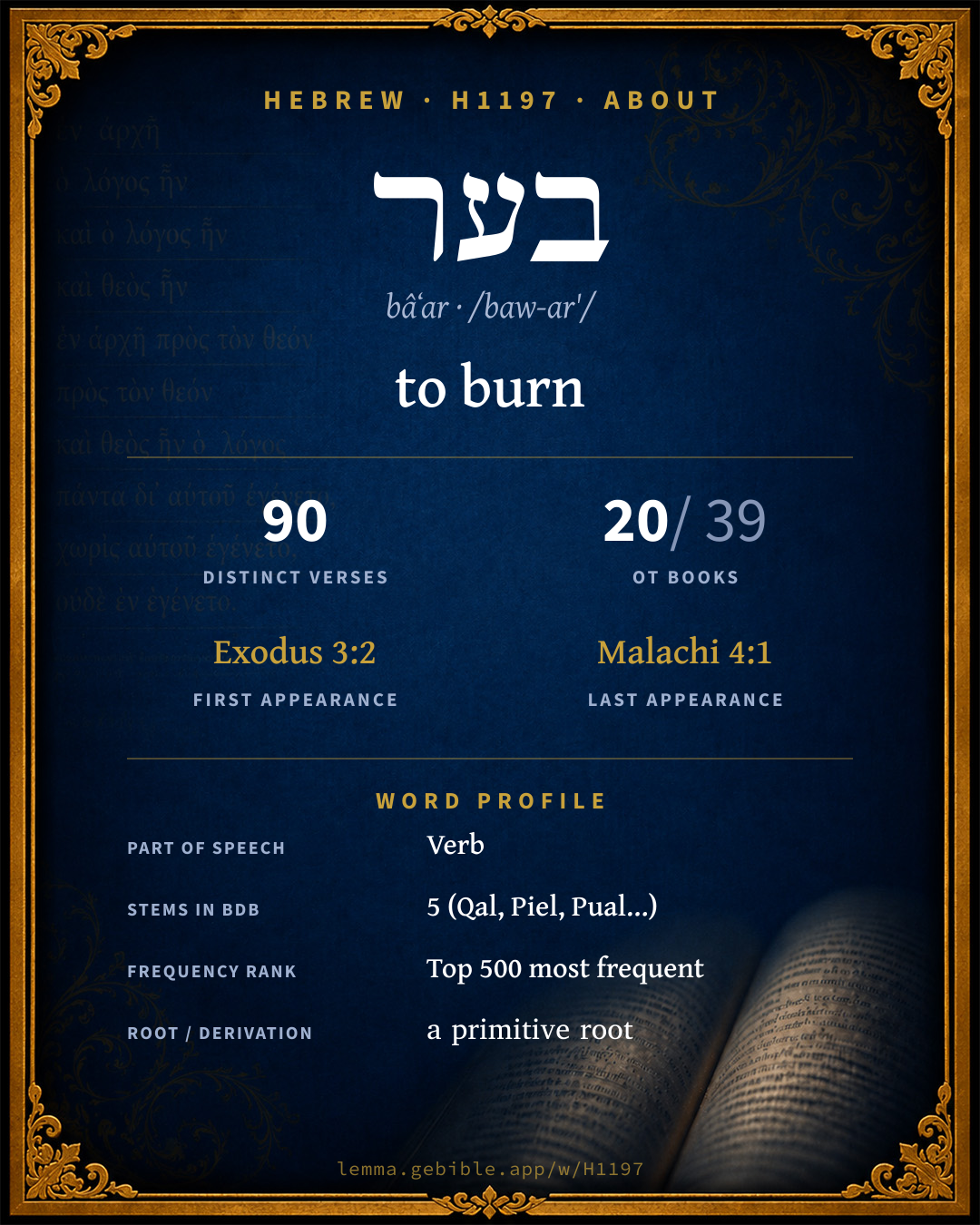
בָּעַר
to burn
also: consume, kindle, be kindled fuller range ↓
Full lexicon entry — Brown-Driver-Briggs (BDB)
From Brown-Driver-Briggs (BDB)
Where this word appears
See every Qal verb in the Hebrew Bible →
Grammar key — what these labels mean
Part of speech
- Verb
- An action or state-of-being word.
Stem
- Piel
- An intensive or resultative active stem. Here: ‘kindle’
- Qal
- The basic, simple active stem — the plain form of the verb (“he wrote”). Here: ‘be burning’
- Hiphil
- The causative active stem (“he caused / brought about”). Here: ‘kindle’
- Niphal
- Usually the simple passive or reflexive of the Qal (“he was written”).
- Pual
- The passive counterpart of the Piel.
Form
- Sequential Perfect
- A perfect with prefixed waw continuing a preceding imperfect or command (waw-consecutive perfect).
- Participle Active
- A verbal adjective expressing ongoing or characteristic action (“writing / one who writes”).
- Infinitive Construct
- A bound verbal noun, frequently with prepositions (“to write / in writing”).
- Sequential Imperfect
- An imperfect with prefixed waw — the standard past-narrative form (waw-consecutive imperfect).
- Imperfect
- An incomplete, ongoing, or future action (“he will / would write”).
- Perfect
- A completed action or state — Hebrew marks aspect (completeness) more than strict tense (“he wrote”).
- Cohortative
- A first-person volitional form expressing wish or resolve (“let me / let us write”).
- Participle Passive
- A verbal adjective expressing action received (“written”).
- Infinitive Absolute
- An unbound verbal noun, often intensifying or standing in for a finite verb.
State
- Absolute
- The independent form of a noun, not bound to a following word.
Person
- 2nd Person
- The one addressed (“you”).
- 3rd Person
- The one spoken about (“he / she / it / they”).
- 1st Person
- The speaker (“I / we”).
Gender
- Masculine
- Grammatically masculine.
- Feminine
- Grammatically feminine.
- Common
- Either gender — not distinguished for this form.
Number
- Singular
- One.
- Plural
- More than one (in Hebrew, generally three or more).
Grammatical forms 38 distinct
- Verb, Piel, Sequential Perfect, 2nd Person, Masculine, Singular 10 times (11%)
- Verb, Piel, Infinitive Construct 8 times (9%)
- Verb, Qal, Participle Active, Masculine, Singular, Absolute 7 times (7%)
- Verb, Qal, Sequential Imperfect, 3rd Person, Feminine, Singular 5 times (5%)
- Verb, Qal, Imperfect, 3rd Person, Feminine, Singular 5 times (5%)
- Verb, Qal, Sequential Perfect, 3rd Person, Feminine, Singular 4 times (4%)
- Verb, Qal, Perfect, 3rd Person, Common, Plural 4 times (4%)
- Verb, Qal, Participle Active, Feminine, Singular, Absolute 4 times (4%)
+30 more forms (47 occurrences)
Parsed forms decoded from the imported morphology (morphhb / Westminster Leningrad Codex — WLC text public domain, morphhb tagging CC BY 4.0), counted across 94 parsed occurrences — not distinct verses.
Every verse where H1197 appears — 90 distinct verses across 20 books. Click any verse to open its interlinear word-by-word view. Verse text shown in the World English Bible for context — . Each verse’s Hebrew form is shown with its reference; the English is not keyword-highlighted, since the data carries no word-level English alignment. Use “Compare translations” on any verse to read it across multiple English versions. This concordance covers the Hebrew Bible; Septuagint (Greek Old Testament) occurrences are not indexed here.
Exodus 5 verses
- Exodus 3:2 בֹּעֵ֣ר Qal ptcp.act ms The angel of Yahweh appeared to him in a flame of fire out of the midst of a bush. He looked, and behold, the bush burned with fire, and the bush was not consumed.
- Exodus 3:3 יִבְעַ֥ר Qal impf 3ms Moses said, I will turn aside now, and see this great sight, why the bush is not burnt.
- Exodus 22:5 יַבְעֶר וּ/בִעֵ֖ר Hiphil impf 3ms conj + Piel wpf 3ms "If a man causes a field or vineyard to be eaten, and lets his animal loose, and it grazes in another man's field, he shall make restitution from the best of his own field, and from the best of his own vineyard.
- Exodus 22:6 הַ/מַּבְעִ֖ר ptcl def.art + Hiphil ptcp.act ms "If fire breaks out, and catches in thorns so that the shocks of grain, or the standing grain, or the field are consumed; he who kindled the fire shall surely make restitution.
- Exodus 35:3 תְבַעֲר֣וּ Piel impf 2mp You shall kindle no fire throughout your habitations on the Sabbath day.'"
Leviticus 1 verse
Numbers 3 verses
- Numbers 11:1 וַ/תִּבְעַר conj + Qal wimpf 3fs The people were as murmurers, [speaking] evil in the ears of Yahweh: and when Yahweh heard it, his anger was kindled; and the fire of Yahweh burnt among them, and devoured in the uttermost part of the camp.
- Numbers 11:3 בָעֲרָ֥ה Qal pf 3fs The name of that place was called Taberah, because the fire of Yahweh burnt among them.
- Numbers 24:22 לְ/בָ֣עֵֽר prep + Piel inf.cs Nevertheless Kain shall be wasted, Until Asshur shall carry you away captive.
Deuteronomy 16 verses
- Deuteronomy 4:11 בֹּעֵ֤ר Qal ptcp.act ms You came near and stood under the mountain; and the mountain burned with fire to the heart of the sky, with darkness, cloud, and thick darkness.
- Deuteronomy 5:23 בֹּעֵ֣ר Qal ptcp.act ms It happened, when you heard the voice out of the midst of the darkness, while the mountain was burning with fire, that you came near to me, even all the heads of your tribes, and your elders;
- Deuteronomy 9:15 בֹּעֵ֣ר Qal ptcp.act ms So I turned and came down from the mountain, and the mountain was burning with fire: and the two tables of the covenant were in my two hands.
- Deuteronomy 13:5 וּ/בִֽעַרְתָּ֥ conj + Piel wpf 2ms That prophet, or that dreamer of dreams, shall be put to death, because he has spoken rebellion against Yahweh your God, who brought you out of the land of Egypt, and redeemed you out of the house of bondage, to draw you aside out of the way which Yahweh your God commanded you to walk in. So shall you put away the evil from the midst of you.
- Deuteronomy 17:7 וּ/בִֽעַרְתָּ֥ conj + Piel wpf 2ms The hand of the witnesses shall be first on him to put him to death, and afterward the hand of all the people. So you shall put away the evil from the midst of you.
- Deuteronomy 17:12 וּ/בִֽעַרְתָּ֥ conj + Piel wpf 2ms The man who does presumptuously, in not listening to the priest who stands to minister there before Yahweh your God, or to the judge, even that man shall die: and you shall put away the evil from Israel.
- Deuteronomy 19:13 וּ/בִֽעַרְתָּ֧ conj + Piel wpf 2ms Your eye shall not pity him, but you shall put away the innocent blood from Israel, that it may go well with you.
- Deuteronomy 19:19 וּ/בִֽעַרְתָּ֥ conj + Piel wpf 2ms then shall you do to him, as he had thought to do to his brother: so shall you put away the evil from the midst of you.
- Deuteronomy 21:9 תְּבַעֵ֛ר Piel impf 2ms So shall you put away the innocent blood from the midst of you, when you shall do that which is right in the eyes of Yahweh.
- Deuteronomy 21:21 וּ/בִֽעַרְתָּ֥ conj + Piel wpf 2ms All the men of his city shall stone him to death with stones: so shall you put away the evil from the midst of you; and all Israel shall hear, and fear.
- Deuteronomy 22:21 וּ/בִֽעַרְתָּ֥ conj + Piel wpf 2ms then they shall bring out the young lady to the door of her father's house, and the men of her city shall stone her to death with stones, because she has done folly in Israel, to play the prostitute in her father's house: so shall you put away the evil from the midst of you.
- Deuteronomy 22:22 וּ/בִֽעַרְתָּ֥ conj + Piel wpf 2ms If a man be found lying with a woman married to a husband, then they shall both of them die, the man who lay with the woman, and the woman: so shall you put away the evil from Israel.
- Deuteronomy 22:24 וּ/בִֽעַרְתָּ֥ conj + Piel wpf 2ms then you shall bring them both out to the gate of that city, and you shall stone them to death with stones; the lady, because she didn't cry, being in the city; and the man, because he has humbled his neighbor's wife: so you shall put away the evil from the midst of you.
- Deuteronomy 24:7 וּ/בִֽעַרְתָּ֥ conj + Piel wpf 2ms If a man be found stealing any of his brothers of the children of Israel, and he deal with him as a slave, or sell him; then that thief shall die: so shall you put away the evil from the midst of you.
- Deuteronomy 26:13 בִּעַ֧רְתִּי Piel pf 1cs You shall say before Yahweh your God, I have put away the holy things out of my house, and also have given them to the Levite, and to the foreigner, to the fatherless, and to the widow, according to all your commandment which you have commanded me: I have not transgressed any of your commandments, neither have I forgotten them:
- Deuteronomy 26:14 בִעַ֤רְתִּי Piel pf 1cs I have not eaten of it in my mourning, neither have I put away of it, being unclean, nor given of it for the dead: I have listened to the voice of Yahweh my God; I have done according to all that you have commanded me.
Judges 3 verses
- Judges 15:5 וַ/יַּבְעֶר וַ/יַּבְעֵ֛ר conj + Hiphil wimpf 3ms conj + Hiphil wimpf 3ms When he had set the brands on fire, he let them go into the standing grain of the Philistines, and burnt up both the shocks and the standing grain, and also the olive groves.
- Judges 15:14 בָּעֲר֣וּ Qal pf 3cp When he came to Lehi, the Philistines shouted as they met him: and the Spirit of Yahweh came mightily on him, and the ropes that were on his arms became as flax that was burnt with fire, and his bands dropped from off his hands.
- Judges 20:13 וּ/נְבַעֲרָ֥ה conj + Piel coh 1cp Now therefore deliver up the men, the base fellows, who are in Gibeah, that we may put them to death, and put away evil from Israel. But Benjamin would not listen to the voice of their brothers the children of Israel.
2 Samuel 3 verses
- 2 Samuel 4:11 וּ/בִעַרְתִּ֥י conj + Piel wpf 1cs How much more, when wicked men have slain a righteous person in his own house on his bed, shall I not now require his blood of your hand, and take you away from the earth?
- 2 Samuel 22:9 בָּעֲר֥וּ Qal pf 3cp There went up a smoke out of his nostrils, Fire out of his mouth devoured: Coals were kindled by it.
- 2 Samuel 22:13 בָּעֲר֖וּ Qal pf 3cp At the brightness before him Coals of fire were kindled.
1 Kings 4 verses
- 1 Kings 14:10 וּ/בִֽעַרְתִּי֙ יְבַעֵ֥ר conj + Piel wpf 1cs Piel impf 3ms therefore, behold, I will bring evil on the house of Jeroboam, and will cut off from Jeroboam every man-child, him who is shut up and him who is left at large in Israel, and will utterly sweep away the house of Jeroboam, as a man sweeps away dung, until it be all gone.
- 1 Kings 16:3 מַבְעִ֛יר Hiphil ptcp.act ms behold, I will utterly sweep away Baasha and his house; and I will make your house like the house of Jeroboam the son of Nebat.
- 1 Kings 21:21 וּ/בִעַרְתִּ֖י conj + Piel wpf 1cs Behold, I will bring evil on you, and will utterly sweep you away and will cut off from Ahab every man-child, and him who is shut up and him who is left at large in Israel:
- 1 Kings 22:46 בִּעֵ֖ר Piel pf 3ms The remnant of the sodomites, that remained in the days of his father Asa, he put away out of the land.
2 Kings 1 verse
2 Chronicles 4 verses
- 2 Chronicles 4:20 לְ/בַעֲרָ֧/ם prep + Piel inf.cs + sfx pers 3mp and the lampstands with their lamps, to burn according to the ordinance before the oracle, of pure gold;
- 2 Chronicles 13:11 לְ/בָעֵר֙ prep + Piel inf.cs and they burn to Yahweh every morning and every evening burnt offerings and sweet incense: the show bread also [set they] in order on the pure table; and the lampstand of gold with the lamps of it, to burn every evening: for we keep the charge of Yahweh our God; but you have forsaken him.
- 2 Chronicles 19:3 בִעַ֤רְתָּ Piel pf 2ms Nevertheless there are good things found in you, in that you have put away the Asheroth out of the land, and have set your heart to seek God.
- 2 Chronicles 28:3 וַ/יַּבְעֵ֤ר conj + Hiphil wimpf 3ms Moreover he burnt incense in the valley of the son of Hinnom, and burnt his children in the fire, according to the abominations of the nations whom Yahweh cast out before the children of Israel.
Nehemiah 1 verse
Esther 1 verse
Job 1 verse
Psalms 8 verses
- Psalms 2:12 יִבְעַ֣ר Qal impf 3ms Kiss the son, lest he be angry, and you perish in the way, For his wrath will soon be kindled. Blessed are all those who take refuge in him.
- Psalms 18:8 בָּעֲר֥וּ Qal pf 3cp Smoke went out of his nostrils. Consuming fire came out of his mouth. Coals were kindled by it.
- Psalms 39:3 תִבְעַר Qal impf 3fs My heart was hot within me. While I meditated, the fire burned: I spoke with my tongue:
- Psalms 79:5 תִּבְעַ֥ר Qal impf 3fs How long, Yahweh? Will you be angry forever? Will your jealousy burn like fire?
- Psalms 83:14 תִּבְעַר Qal impf 3fs As the fire that burns the forest, As the flame that sets the mountains on fire,
- Psalms 89:46 תִּבְעַ֖ר Qal impf 3fs How long, Yahweh? Will you hide yourself forever? Will your wrath burn like fire?
- Psalms 94:8 בֹּעֲרִ֣ים Qal ptcp.act mp Consider, you senseless among the people; You fools, when will you be wise?
- Psalms 106:18 וַ/תִּבְעַר conj + Qal wimpf 3fs A fire was kindled in their company. The flame burned up the wicked.
Isaiah 17 verses
- Isaiah 1:31 וּ/בָעֲר֧וּ conj + Qal wpf 3cp The strong will be like tinder, And his work like a spark. They will both burn together, And no one will quench them."
- Isaiah 3:14 בִּֽעַרְתֶּ֣ם Piel pf 2mp Yahweh will enter into judgment with the elders of his people, And their leaders: "It is you who have eaten up the vineyard. The spoil of the poor is in your houses.
- Isaiah 4:4 בָּעֵֽר Piel inf.abs when the Lord shall have washed away the filth of the daughters of Zion, and shall have purged the blood of Jerusalem from its midst, by the spirit of justice, and by the spirit of burning.
- Isaiah 5:5 לְ/בָעֵ֔ר prep + Piel inf.cs Now I will tell you what I will do to my vineyard. I will take away its hedge, and it will be eaten up. I will break down its wall of it, and it will be trampled down.
- Isaiah 6:13 לְ/בָעֵ֑ר prep + Piel inf.cs If there are yet a tenth in it, It also shall in turn be eaten up: As a terebinth, and as an oak, whose stock remains, when they are felled; So the holy seed is its stock."
- Isaiah 9:18 בָעֲרָ֤ה Qal pf 3fs For wickedness burns as the fire; it devours the briers and thorns; yes, it kindles in the thickets of the forest, and they roll upward in a column of smoke.
- Isaiah 10:17 וּ/בָעֲרָ֗ה conj + Qal wpf 3fs The light of Israel will be for a fire, and his Holy One for a flame; and it will burn and devour his thorns and his briers in one day.
- Isaiah 19:11 נִבְעָרָ֑ה Niphal ptcp.act fs The princes of Zoan are utterly foolish; the counsel of the wisest counselors of Pharaoh is become brutish: how do you say to Pharaoh, I am the son of the wise, the son of ancient kings?
- Isaiah 30:27 בֹּעֵ֣ר Qal ptcp.act ms Behold, the name of Yahweh comes from far, burning with his anger, and in thick rising smoke: his lips are full of indignation, and his tongue is as a devouring fire;
- Isaiah 30:33 בֹּעֲרָ֖ה Qal ptcp.act fs For a Topheth is prepared of old; yes, for the king it is made ready; he has made it deep and large; the pile of it is fire and much wood; the breath of Yahweh, like a stream of sulfur, does kindle it.
- Isaiah 34:9 בֹּעֵרָֽה Qal ptcp.act fs The streams of [Edom] shall be turned into pitch, and the dust of it into sulfur, and the land of it shall become burning pitch.
- Isaiah 40:16 בָּעֵ֑ר Piel inf.cs Lebanon is not sufficient to burn, nor the animals of it sufficient for a burnt offering.
- Isaiah 42:25 וַ/תִּבְעַר conj + Qal wimpf 3fs Therefore he poured on him the fierceness of his anger, and the strength of battle; and it set him on fire round about, yet he didn't know; and it burned him, yet he didn't lay it to heart.
- Isaiah 43:2 תִבְעַר Qal impf 3fs When you pass through the waters, I will be with you; and through the rivers, they shall not overflow you: when you walk through the fire, you shall not be burned, neither shall the flame kindle on you.
- Isaiah 44:15 לְ/בָעֵ֔ר prep + Piel inf.cs Then shall it be for a man to burn; and he takes of it, and warms himself; yes, he kindles it, and bakes bread: yes, he makes a god, and worships it; he makes it an engraved image, and falls down to it.
- Isaiah 50:11 בִּֽעַרְתֶּ֔ם Piel pf 2mp Behold, all you who kindle a fire, who gird yourselves about with firebrands; walk you in the flame of your fire, and among the brands that you have kindled. This shall you have of my hand; you shall lie down in sorrow.
- Isaiah 62:1 יִבְעָֽר Qal impf 3ms For Zion's sake will I not hold my peace, and for Jerusalem's sake I will not rest, until her righteousness go forth as brightness, and her salvation as a lamp that burns.
Jeremiah 11 verses
- Jeremiah 4:4 וּ/בָעֲרָה֙ conj + Qal wpf 3fs Circumcise yourselves to Yahweh, and take away the foreskins of your heart, you men of Judah and inhabitants of Jerusalem; lest my wrath go forth like fire, and burn so that none can quench it, because of the evil of your doings.
- Jeremiah 7:18 מְבַעֲרִ֣ים Piel ptcp.act mp The children gather wood, and the fathers kindle the fire, and the women knead the dough, to make cakes to the queen of the sky, and to pour out drink-offerings to other gods, that they may provoke me to anger.
- Jeremiah 7:20 וּ/בָעֲרָ֖ה conj + Qal wpf 3fs Therefore thus says the Lord Yahweh: Behold, my anger and my wrath shall be poured out on this place, on man, and on animal, and on the trees of the field, and on the fruit of the ground; and it shall burn, and shall not be quenched.
- Jeremiah 10:8 יִבְעֲר֣וּ Qal impf 3mp But they are together brutish and foolish: the instruction of idols! it is but a stock.
- Jeremiah 10:14 נִבְעַ֤ר Niphal pf 3ms Every man is become brutish [and is] without knowledge; every goldsmith is disappointed by his engraved image; for his molten image is falsehood, and there is no breath in them.
- Jeremiah 10:21 נִבְעֲרוּ֙ Niphal pf 3cp For the shepherds are become brutish, and have not inquired of Yahweh: therefore they have not prospered, and all their flocks are scattered.
- Jeremiah 20:9 בֹּעֶ֔רֶת Qal ptcp.act fs If I say, I will not make mention of him, nor speak any more in his name, then there is in my heart as it were a burning fire shut up in my bones, and I am weary with forbearing, and I can't [contain].
- Jeremiah 21:12 וּ/בָעֲרָה֙ conj + Qal wpf 3fs House of David, thus says Yahweh, Execute justice in the morning, and deliver him who is robbed out of the hand of the oppressor, lest my wrath go forth like fire, and burn so that none can quench it, because of the evil of your doings.
- Jeremiah 36:22 מְבֹעָֽרֶת Pual ptcp.pass fs Now the king was sitting in the winter-house in the ninth month: and [there was a fire in] the brazier burning before him.
- Jeremiah 44:6 וַ/תִּבְעַר֙ conj + Qal wimpf 3fs Therefore my wrath and my anger was poured forth, and was kindled in the cities of Judah and in the streets of Jerusalem; and they are wasted and desolate, as it is this day.
- Jeremiah 51:17 נִבְעַ֤ר Niphal pf 3ms Every man is become brutish [and is] without knowledge; every goldsmith is disappointed by his image; for his molten image is falsehood, and there is no breath in them.
Lamentations 1 verse
Ezekiel 6 verses
- Ezekiel 1:13 בֹּֽעֲרוֹת֙ Qal ptcp.act fp As for the likeness of the living creatures, their appearance was like burning coals of fire, like the appearance of torches: [the fire] went up and down among the living creatures; and the fire was bright, and out of the fire went forth lightning.
- Ezekiel 5:2 תַּבְעִיר֙ Hiphil impf 2ms A third part shall you burn in the fire in the midst of the city, when the days of the siege are fulfilled; and you shall take a third part, and strike with the sword round about it; and a third part you shall scatter to the wind, and I will draw out a sword after them.
- Ezekiel 20:48 בִּֽעַרְתִּ֑י/הָ Piel pf 1cs + sfx pers 3fs All flesh shall see that I, Yahweh, have kindled it; it shall not be quenched.
- Ezekiel 21:31 בֹּֽעֲרִ֔ים Qal ptcp.act mp I will pour out my indignation on you; I will blow on you with the fire of my wrath; and I will deliver you into the hand of brutish men, skillful to destroy.
- Ezekiel 39:9 וּ/בִעֲר֡וּ וּ/בִעֲר֥וּ conj + Piel wpf 3cp conj + Piel wpf 3cp Those who dwell in the cities of Israel shall go forth, and shall make fires of the weapons and burn them, both the shields and the bucklers, the bows and the arrows, and the war clubs, and the spears, and they shall make fires of them seven years;
- Ezekiel 39:10 יְבַֽעֲרוּ Piel impf 3mp so that they shall take no wood out of the field, neither cut down any out of the forests; for they shall make fires of the weapons; and they shall plunder those who plundered them, and rob those who robbed them, says the Lord Yahweh.
Hosea 2 verses
- Hosea 7:4 בֹּעֵ֖רָה Qal ptcp.act fs They are all adulterers. They are burning like an oven that the baker stops stirring, From the kneading of the dough, until it is leavened.
- Hosea 7:6 בֹעֵ֖ר Qal ptcp.act ms For they have made ready their heart like an oven, While they lie in wait. Their baker sleeps all the night. In the morning it burns as a flaming fire.
Nahum 1 verse
Malachi 1 verse
About this entry
At a glance — auto-summarized from this page’s data, not written by a person. Every figure links to its source below. This summary describes the numbers; it doesn’t interpret them.
בער (bâʻar) is a Hebrew verb most often rendered “to burn.” Where the King James Version says “burn,” newer translations reach for “you must purge” (Berean Standard Bible) and “burning” (unfoldingWord Literal Text); the renderings breakdown has the detail. The Hebrew Bible uses it across 90 verses — moderately common. Debuting at Exodus 3:2, it then recurs through the corpus. Across 5 stems, its meaning turns on the binyan (Qal, Piel). For the data behind this summary, explore the sense tree and the renderings breakdown below.
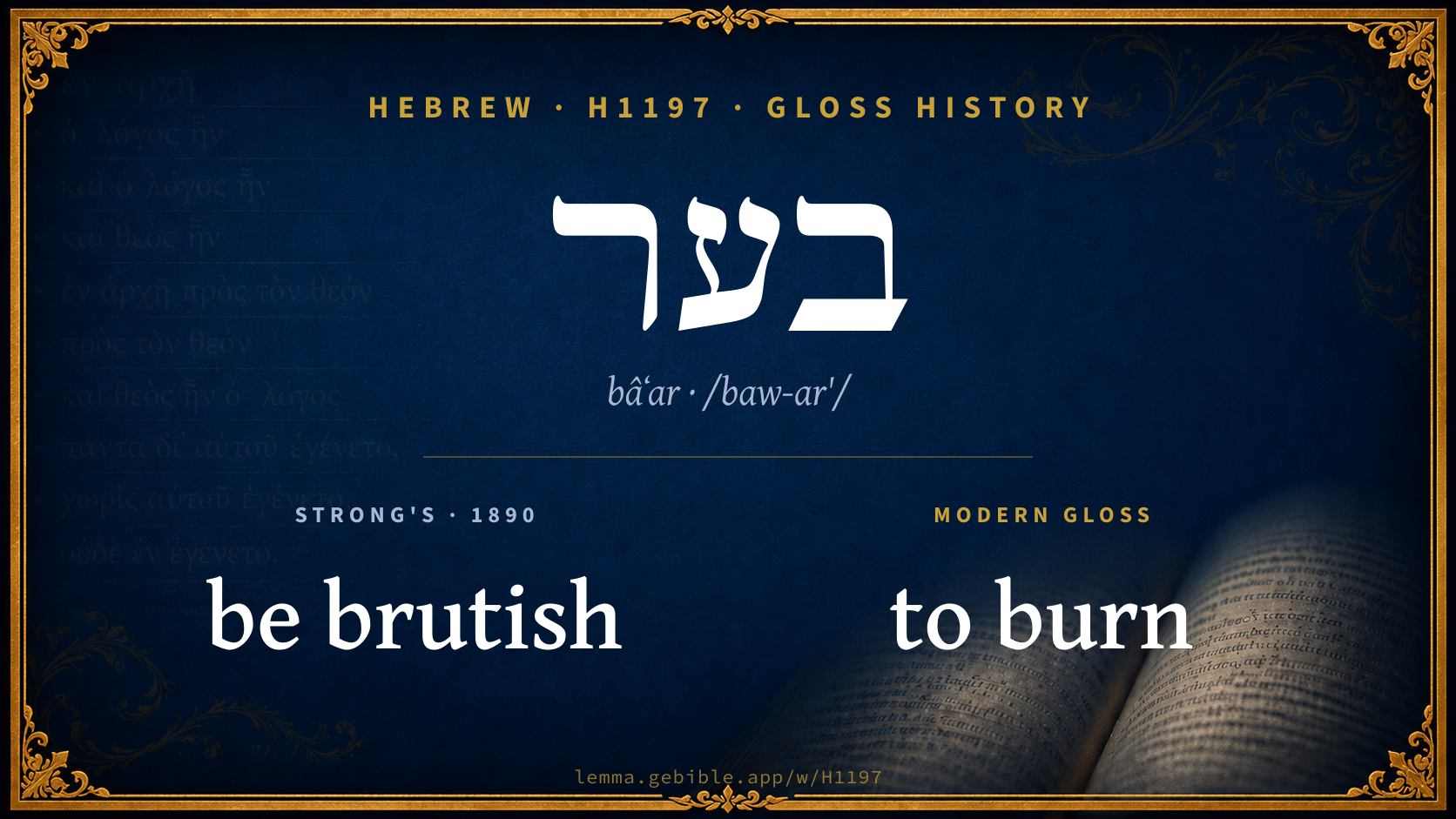
Gloss history
Strong's 1890 vs modern scholarship
About this word
Strong's H1197 catalogs a Hebrew word from the Hebrew Old Testament.
These counts are not copied from any lexicon or concordance. They are computed here, from the morphology-tagged Hebrew Old Testament. What Lemma adds →
- 90
- distinct verses
- The word appears in 90 distinct verses.
- 20 / 39
- OT books
- The word appears in 20 of 39 Old Testament books.
- #440
- by frequency
- Top 500 most frequent Hebrew words (rank 440 of 8,640 Hebrew words by occurrence).
View all 90 occurrences in the concordance →
Most concentrated in
- Isaiah 17 verses 19%
- Deuteronomy 16 verses 18%
- Jeremiah 11 verses 12%
By section of the Old Testament
By traditional corpus
Conventional, traditional groupings — biblical authorship is debated, so this is a traditional corpus grouping, not an authorship claim. Each share is this word’s portion of its verses in that division of the Hebrew canon. Each figure is a share of the word’s 90 distinct verses.
- Prophets (Nevi'im) 49 verses · 54%
- Torah (Pentateuch) 25 verses · 28%
- Writings (Ketuvim) 16 verses · 18%
How translations render this word
Counts come from each version’s own published word-to-Strong’s tagging or interlinear alignment — an approximate guide to how each version renders this word, not a word-level alignment the data otherwise carries. Because each total is that version’s own tagged count, the per-version totals vary from one another and need not match the appearance or distinct-verse counts above. These counts may also differ from a printed concordance because Lemma counts each distinctly tagged rendering and does not collapse phrase taggings into a single head-word total. This is a fixed set of word-tagged versions (KJV, ASV, BSB, ULT) and does not change with the reading translation you choose elsewhere. Each version’s license is shown beside its name below (and on Sources).
BDB lists this Strong’s number as 2 distinct words (homographs). Each count above pools all of them and is not split by sense — see the Senses section below. A low-frequency rendering may belong to a different one of those words, not the primary meaning.
- King James Version†: Burn 8×, Away 6×, Burned 6×
- American Standard Version†: Burn 9×, Away 6×, Burneth 5×
- Berean Standard Bible†: You must purge 9×, Burn 5×, Burned 5×
- unfoldingWord Literal Text†: Burning 11×, Burn 10×, You shall remove 10×
King James Version Public Domain
Renders H1197 across 100† tagged occurrences — most commonly:
Plus other, less common renderings. Plus 40 renderings that appear only once — usually multi-word phrases or single function words the recovered tagging swept in, not distinct renderings.
American Standard Version Public Domain
Renders H1197 across 100† tagged occurrences — most commonly:
Plus other, less common renderings. Plus 45 renderings that appear only once — usually multi-word phrases or single function words the recovered tagging swept in, not distinct renderings.
Berean Standard Bible Public Domain
Renders H1197 across 93† tagged occurrences — most commonly:
Plus other, less common renderings. Plus 45 renderings that appear only once — usually multi-word phrases or single function words the recovered tagging swept in, not distinct renderings.
unfoldingWord Literal Text CC BY-SA 4.0
Renders H1197 across 104† tagged occurrences — most commonly:
Plus other, less common renderings. Plus 36 renderings that appear only once — usually multi-word phrases or single function words the recovered tagging swept in, not distinct renderings.
18 senses and sub-senses in the full BDB
Hebrew verbs can shift meaning by stem (binyan): Qal is the basic action, Niphal is often passive or reflexive, Piel often intensifies or makes it factitive, and Hiphil is typically causative. The senses below are grouped under the stem BDB assigns to each. This entry also uses Pual (the passive of Piel).
What do BDB’s symbols mean?
BDB uses these scholarly abbreviations:
| Symbol | Meaning |
|---|---|
| 𝔊 | the Septuagint (the ancient Greek translation, LXX) |
| 𝔙 | the Vulgate (the Latin translation) |
| 𝔖 | the Syriac version (the Peshitta) |
| 𝔗 | the Targum (the Aramaic translation) |
| ψ | the Psalms |
| √ | root (the underlying root or stem) |
| ‖ | parallel passage (a synonymous or contrasted parallel) |
| † | the dagger: every passage where the word occurs is cited |
The 18 senses and sub-senses the full Brown-Driver-Briggs lexicon distinguishes for this word, in lexicon order (not ranked by frequency), with BDB’s own verbatim wording and sub-sense lettering. Shown in Hebrew script with BDB’s own scholarly abbreviations. The condensed entry is in the Lexicon Entry tab. See also the Forms in the corpus table below.
בער I burn, consume (𝔗 בְּעַר burn
Qal
- Pf. 3 fs. בָּֽעֲרָה Nu 11:3 + 2 times, וּבָֽעֲרָה consec. Is 10:17 + 3 times, בָּֽעֲרוּ Ju 15:14 + 2 times + 2 S 22:13 (but cf. De on ψ 18), וּבָֽעֲרוּ consec. Is 1:31; Impf. יִבְעַר Ex 3:3 ψ 2:12, etc.; Pt. בֹּעֵר Ex 3:2 + 6 times, בֹּעֵרָ֑ה Is 34:9, בּוֹעֵרָה Ho 7:4, בֹּעֲרָ֫ה Is 30:33, בֹּעֶ֫רֶת Je 20:9, בֹּעֲרוֹת Ez 1:13;—burn, e.g. Numbers 11:3
- 1. (intr.) specif. begin to burn, be kindled ψ 18:9 sq. מִן (subj. גֶּחָלִים) = 2 S 22:9 (in v 13 textual error cf. supr.), ψ 106:18 (subj. אֵשׁ); fig. ψ 2:12 (subj. אַפּוֹ); cf. Je 44:6 (subj. חֵמָה); Is 30:33 (c. בְּ, subj. נִשְׁמַת י׳), ψ 39:4 (subj. אֵשׁ fig. of grief, distress) cf. Je 20:9. e.g. Psalms 18:9
- 2. be burning, burn, Ju 15:14 (subj. פִּשְׁתִּים, c. בָּאֵשׁ), Ex 3:2 (הסנה, c. בָּאֵשׁ), v 3 (subj. id.); Dt 4:11; 5:25; 9:15 (all subj. הר, c. בָּאֵשׁ), cf. Is 34:9 (זֶפֶת בערה), fig. of destruction Is 1:31 (subj. חָסֹן & פֹּעֲלוֹ); of torch לַפִּיד Is 62:1; of oven תַּנּוּר Ho 7:4, 6 (i.e. heated by fire within it). e.g. Judges 15:14
- 3. trans. burn, consume (subj. אשׁ, להבה etc., sq. בְּ) Nu 11:1, 3 (אשׁ י׳). Jb 1:16 (אשׁ אלהים); in simile Ez 1:13 (גחלי אשׁ י׳), ψ 83:15 (only here trans. c.acc.; should תבער be pointed as Pi.?); fig. (subj. wrath of י׳) Is 42:25 cf. La 2:3 (subj. fire = fiery trial) Is 43:2. e.g. Numbers 11:1
- 4. act. but abs., fig. subj. wrath of י׳ Je 4:4; 7:20; 21:12 ψ 89:47 cf. Is 10:17 ψ 79:5 Is 30:27 (שֵׁם י׳ … בֹּעֵר אַפּוֹ) Mal 3:19 (היום בא); of human anger Est 1:12; subj. wickedness Is 9:17. e.g. Jeremiah 4:4
Piel
- Pf. בִּעֵר 1 K 22:47 2 K 23:24, וּבִעֵר consec. Lv 6:5, בִּעַ֫רְתָּ 2 Ch 19:3, וּבִעַרְתָּ֫ Dt 13:6 + 9 times in Dt; וּבִעֲרוּ cons. Ez 39:9(×2) (9a del. Co after Vrss), etc.; Impf. יְבַעֵר 1 K 14:10; 2 ms. תְּבַעֵר Dt 21:9, יְבַעֲרוּ Ez 39:10; 2 mpl. תְּבַעֲרוּ Ex 35:3, וּנְבַעֲרָה Ju 20:13 Inf. בָּעֵר Is 40:16; Pt. מְבַעֲרִים Je 7:18;— e.g. 1 Kings 22:47
- 1. kindle, lit. c. acc. אשׁ Ex 35:3 Je 7:18 cf. Ez 39:9 (v. supr.) v 10; fig. of י׳ sending destruction Ez 21:4 cf. of human schemes Is 50:11; light, obj. lamps in temple 2 Ch 4:20 cf. 13:11. e.g. Exodus 35:3
- 2. burn, lit. c. acc. עֵצִים Lv 6:5, גָּלָל dung 1 K 14:10; abs. Is 44:15 cf. 40:16 Ne 10:35. e.g. Leviticus 6:5
- 3. fig. consume, utterly remove, partic. of evil and guilt, c. acc., especially in Deuteronomic phrase (מישׂראל) ובערת הרע מקרבך Dt 13:6; 17:7, 12; 19:13, 19; 21:21 cf. v 9 22:21, 22, 24; 24:7, v. also Ju 20:13; further, 1 K 22:47 2 K 23:24 2 Ch 19:3; also of devoted (tabooed) things Dt 26:13, 14; of persons (exterminate) 2 S 4:11; sq. אחרי pregn. 1 K 14:10; 16:3; 21:21; = devour, devastate, greedily enjoy the fruits of, Is 3:14; abs. היה לְבָעֵר be for destruction, be destroyed Nu 24:22 Is 5:5; 6:13; cf. רוּחַ בָּעֵר Is 4:4. e.g. Deuteronomy 13:6
Pual
- Pt. מְבֹעָ֑רֶת Je 36:22;—burn (i.e. be supplied with fire), of fire-jar, הָאָח. e.g. Jeremiah 36:22
Hiphil
- Pf. וְהִבְעַרְתִּ֫י Na 2:14; Impf. וַיַּבְעֵר Ju 15:5 2 Ch 28:3, וַיַּבְעֶר־ Ju 15:5; תַּבְעִיר Ez 5:2; Pt. מַבְעִיר 1 K 16:3, מַבְעִר Ex 22:5;— e.g. Nahum 2:14
- 1. kindle (c. acc. cogn.) Ex 22:5, cf. Ju 15:5 ויב׳ אשׁ בלפידים caused fire to burn among the brands. e.g. Exodus 22:5
- 2. burn up, c. acc. Ju 15:5 2 Ch 28:3 (sacrifice of children) בָּאֵשׁ) Ez 5:2 (בָּאוּר but cf. Co) Na 2:14 (בעשׁן). e.g. Judges 15:5
- 3. consume = destroy (cf. Pi.) 1 K 16:3 (sq. אַחֲרֵי). e.g. 1 Kings 16:3
בער II denom. be brutish
Qal
- Impf. יִבְעֲרוּ Je 10:8 (‖ יכסלו) be stupid, dull-hearted, unreceptive; cf. Pt. pl. בֹּעֲרִים ψ 94:8 (‖ כסילים); of inhuman, cruel, barbarous men Ez 21:36. e.g. Jeremiah 10:8
Niphal
- Pf. נִבְעַר Je 10:14 = 51:17, נִבְעֲרוּ Je 10:21; Pt. נִבְעָרָ֑ה Is 19:11;—brutish, stupid Is 19:11 (עצה, ‖ אויל); dull-hearted, ignorant of God Je 10:14, 21; 51:17. Niph. Je 10:14 = 51:17 rather stupefied (by spectacle 10:13 = 51:16). e.g. Jeremiah 10:14
Piel
- Pf. וּבִעֵר consec. Ex 22:4 feed, graze (בשׂדה אחר). e.g. Exodus 22:4
Hiphil
- Impf. יַבְעֶר־ Ex 22:4 cause to be grazed over, sq. שׂדה. e.g. Exodus 22:4
Senses from the full Brown-Driver-Briggs lexicon (Brown, Driver, Briggs; Oxford 1906 — public domain), digitized via Sefaria, supplemented by the OpenScriptures HebrewLexicon (CC BY 4.0). Full attribution on Sources.
Word origin
I. vb. burn, consume (𝔗 בְּעַר burn; ܒܥܰܪ seek out, collect, glean; this apparently earlier meaning)—
II. vb.denom. be brutish—
— Brown-Driver-Briggs (Oxford 1906, public domain), digitized via Sefaria, supplemented by the OpenScriptures HebrewLexicon (CC BY 4.0). See Sources.
Origin: a primitive root
Jastrow Dictionary
A second Hebrew/Aramaic lexicon for comparison, covering Aramaic and post-biblical (Talmudic, Targumic, Midrashic) usage that the biblical-Hebrew BDB does not. Matched by lemma rather than by Strong’s number, so a lemma may carry more than one Jastrow headword (shown separately below), and the entries cover usage well beyond the Bible.
בָּעַר
- , v. בָּעָה; cmp. בָּאֵר) [to clear,]
- 1. to burn (act. a. neut.). Ex. R. s. 2 אש בּוֹעֶרֶת burning fire. Ib. כשם שהסנה בּוֹעֵר וכ׳ as the bush is burning &c. [Num. R. s. 9, end לבוערים בע"ז, read לבוסרים, v. בָּסַר I, Var. לכיפרים.]
- 2. to be empty. Denom. בַּעַר.
- 3. to eat up. Denom. בְּעִיר.
- 1. to clear, remove (out of existence or out of possession). Pes. 6ᵃ זקוק לבָעֵר is bound to remove (the leaven by burning or otherwise); a. fr.—Shebi. VII, 7 חייב לב׳ is bound to remove (dispose of the fruits of the Sabbath year in due time). [Num. R. s. 9 (p. 230ᵇ ed. Amst.) מבערים את העון, read with Yalk. Num. 708, Sifré Num. 11 מערערין; oth. vers. מבררין, v. בָּרַר.]
- 2. to clear, eat up. B. Kam. 2ᵇ וּבִעֵר זו השן ‘and it clears’ (Ex. XXII, 4) this refers to injury by the tooth (animal’s eating). [ e.g. Exodus 22:4
- 3. (b. h.) to start a fire, enkindle. V. בְּעֵרָה.]
- to start or entertain a fire, to clear a field. Sabb. 20ᵃ (ref. to לא תבערו וכ׳ Ex. XXXV, 3) בכל … אי אתה מַבְעִיר ‘in all your dwellings’ thou art not permitted to start a fire; v. הַבְעָרָה. B. Kam. 60ᵇ הַבְּעֵרָה שהִבְעַרְתִּי the fire which I set (to Zion). Ib. 55ᵇ (ref. to Ex. l. c. 5) עד דעביד כעין מבעיר only when he acts like the one setting fire (to clear the field, i.e. criminal negligence); a. e. e.g. Exodus 35:3
- to be rekindled, to burn again. Sabb. 37ᵃ; 37ᵇ
בְּעַר I
- 1. to burn. Targ. O. Ex. III, 2 בָּעַר ed. Berl. (oth. ed. בָּעֵר, Part). Targ. Is. LXII, 1. Targ. Ps. XVIII, 9; a. fr.
- 2. to remove; to dispose of. Pes. 5ᵇ בְּעִירוּ חמירא וכ׳ dispose ye of the leavened bread of the (gentile) soldiers (deposited with you).
- to enkindle, ignite. Targ. Ex. XXXV, 3. Targ. O. Lev. VI, 5 (Mss. a. some ed. יַבְעֵר Af.).
- same. Targ. O. Lev. VI, 5 (v. supra). *Targ. Y. I Gen. XV, 17 מַבְעִיר שביבין.
*בְּעַר II
- (cmp. בְּעֵי II) to open the mouth wide, to low (of oxen; cmp. פער). Targ. II Eth. I, 2 בוערין (some edit. געיין).
A Dictionary of the Targumim, the Talmud Babli and Yerushalmi, and the Midrashic Literature (Marcus Jastrow; London, Luzac, 1903) — Public Domain. Digitized via Sefaria. Digitized via Sefaria. Full attribution on Sources.
Forms in the corpus
The 75 distinct written forms H1197 takes in the Hebrew Bible, most frequent first — each parse links to that stem’s occurrences in the concordance. Hebrew forms include their vowel points and cantillation, so a single lemma takes many written forms.
The 60 most common forms are shown; 15 rarer forms follow in the full concordance.
Same root — word family
Other BDB entries built from the same root as H1197, grouped by Strong’s listed origin. These share a root / origin per the lexicon — not necessarily a shared meaning. Each links to that word’s own entry.
Derived from this word
Proper names from this root
People and places named from this root — a name, not an additional meaning of the word.
Compare all same-root words → Showing 4 of 6 — not the complete family. 2 of the same-root words are proper names (people or places). They share a root, not necessarily a meaning.
Septuagint verse parallels
This word appears in 84 verses that also exist in the Greek Old Testament (Septuagint), out of the 90 Hebrew verses it occurs in. You can read those verses in Greek by switching the Old Testament edition to the Septuagint.
Read these verses in the Septuagint
- Exodus 3:2
- Leviticus 6:12
- Numbers 11:1
- Deuteronomy 4:11
- Judges 15:5
- 2 Samuel 4:11
- 1 Kings 14:10
- 2 Kings 23:24
- 2 Chronicles 4:20
- Esther 1:12
- Job 1:16
- Psalms 2:12
This is a verse-level parallel only — the same verses exist in both the Hebrew and Greek Old Testaments. No word-level Hebrew↔Greek correspondence is claimed: the data carries no such alignment, so no Greek word is shown as this Hebrew word’s translation. Coverage is not total — the Septuagint omits the deuterocanon and renumbers the Psalms, so some Hebrew verses have no direct Greek parallel.