
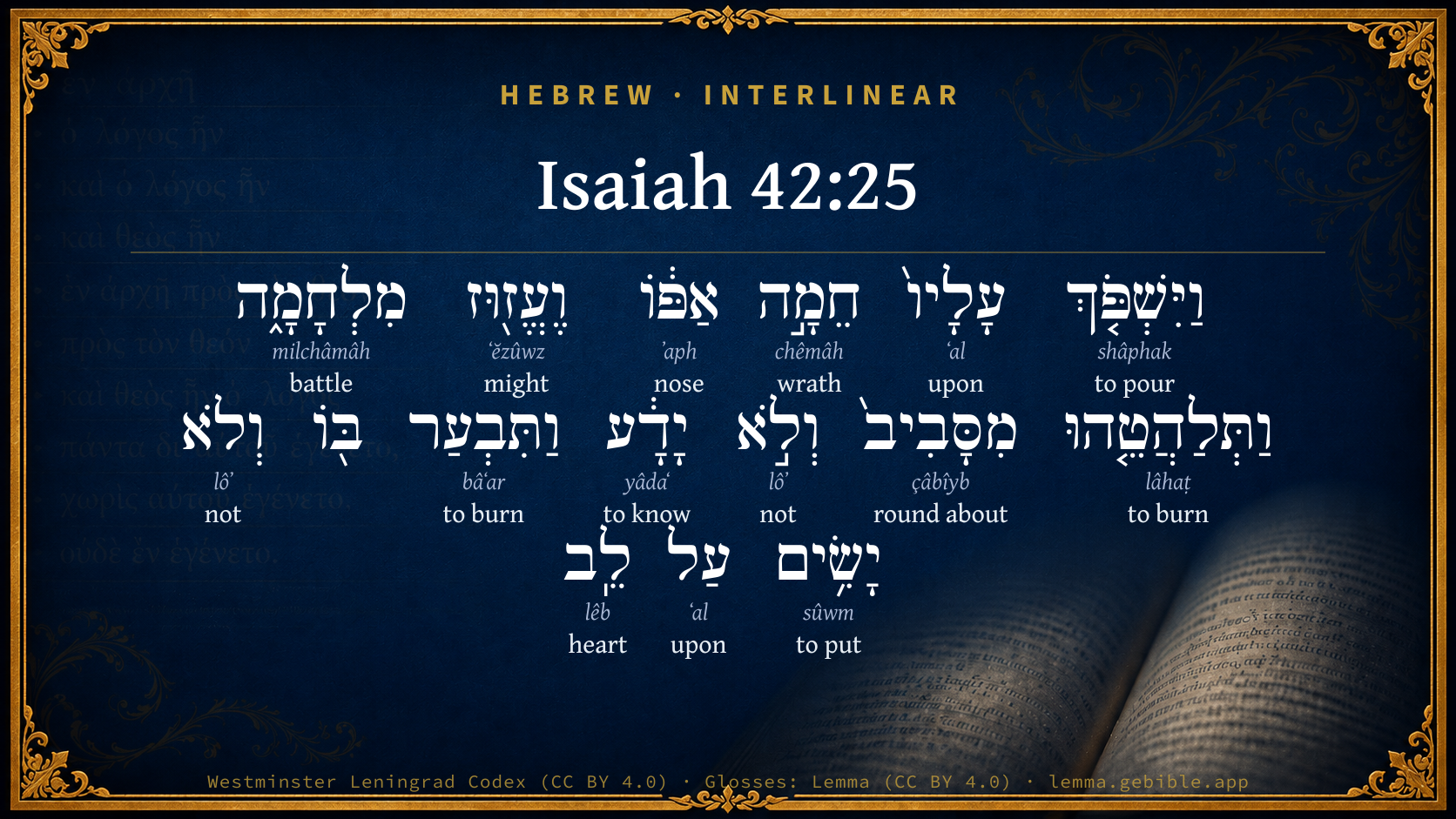
Isaiah 42:25

Hebrew (Westminster Leningrad Codex) Isaiah 42:25 appears in the Hebrew Old Testament. The text above is from the Westminster Leningrad Codex. Each word links to its Strong’s number, a concise gloss, and parsing drawn from the Open Scriptures Hebrew Bible morphology. Click any word for its full Brown-Driver-Briggs (BDB) entry.
Download image
Cite this verse

Isaiah 42:25 (World English Bible). Public Domain. Lemma interlinear Bible study tool, https://lemma.gebible.app/v/isaiah/42/25.

Show BibTeX & RIS
BibTeX
RIS
English Translation
Therefore he poured on him the fierceness of his anger, and the strength of battle; and it set him on fire round about, yet he didn't know; and it burned him, yet he didn't lay it to heart.
World English Bible · Public Domain
Download a study sheet

One document with this verse’s original text, its word-by-word gloss line, the meaning frame, cross-references with their text, attributed commentary, and full source and license credits — printable, and it pastes into notes with its structure intact.

This verse Autodidact and up

Study sheet (.html) Plain text (.txt)

A passage Seminary Student

Up to 50 verses in one chapter. A passage sheet keeps up to 6 commentary sources and 12 cross-references per verse, in the order this page ranks them, and says so on the sheet whenever that leaves anything out. Ask for a single verse and you get the Autodidact verse sheet above.

Everything on this page stays free to read, with no account — the sheet is a download of what is already on screen, not access to it.

Want to remove ads? Support Godless Engineer
Compare translations 3

The same verse in 3 English versions, stacked beneath the original-language interlinear above. Click any original word for its lexicon entry.

Each is an independent rendering of the whole verse — the interlinear is not word-aligned to these translations.

Highlighted words mark where these versions differ — a whole-verse word diff, not a word-by-word alignment.

  • World English Bible Public Domain
    Therefore he poured on him the fierceness of his anger, and the strength of battle; and it set him on fire round about, yet he didn't know; and it burned him, yet he didn't lay it to heart.
  • King James Version Public Domain
    Therefore he hath poured upon him the fury of his anger, and the strength of battle: and it hath set him on fire round about, yet he knew not; and it burned him, yet he laid it not to heart.
  • unfoldingWord Literal Text CC BY-SA 4.0
    So he poured out on him the heat of his nose and the strength of battle, and it kindled him from around, but he did not know, and it burned him up, but he did not set to heart.

unfoldingWord Literal Text — © unfoldingWord, licensed CC BY-SA 4.0. Word-aligned USFM3 via Door43 (git.door43.org/unfoldingWord/en_ult).

Versions to compare (up to 4)

3 of 4 selected

Show all 18 translations

Every available English version of this verse, each an independent rendering of the whole verse.

  • World English Bible Public Domain
    Therefore he poured on him the fierceness of his anger, and the strength of battle; and it set him on fire round about, yet he didn't know; and it burned him, yet he didn't lay it to heart.
  • Berean Standard Bible Public Domain
    So He poured out on them His furious anger and the fierceness of battle. It enveloped them in flames, but they did not understand; it consumed them, but they did not take it to heart.
  • Majority Standard Bible Public Domain
    So He poured out on them His furious anger and the fierceness of battle. It enveloped them in flames, but they did not understand; it consumed them, but they did not take it to heart.
  • King James Version Public Domain
    Therefore he hath poured upon him the fury of his anger, and the strength of battle: and it hath set him on fire round about, yet he knew not; and it burned him, yet he laid it not to heart.
  • American Standard Version (1901) Public Domain
    Therefore he poured upon him the fierceness of his anger, and the strength of battle; and it set him on fire round about, yet he knew not; and it burned him, yet he laid it not to heart.
  • Revised Version (1885) Public Domain
    Therefore he poured upon him the fury of his anger, and the strength of battle; and it set him on fire round about, yet he knew not; and it burned him, yet he laid it not to heart.
  • Geneva Bible (1599) Public Domain
    Therefore hee hath powred vpon him his fierce wrath, and the strength of battell: and it set him on fire round about, and he knewe not, and it burned him vp, yet he considered not.
  • Douay-Rheims (1899) Public Domain
    And he hath poured out upon him the indignation of his fury, and a strong battle, and hath burnt him round about, and he knew not: and set him on fire, and he understood not.
  • Young's Literal Translation Public Domain
    And He poureth on him fury, His anger, and the strength of battle, And it setteth him on fire round about, And he hath not known, And it burneth against him, and he layeth it not to heart!
  • Literal Standard Version CC BY-SA 4.0
    And He pours fury on him, || His anger, and the strength of battle, || And it sets him on fire all around, || And he has not known, || And it burns against him, and he does not lay it to heart!
  • Unlocked Literal Bible CC BY-SA 4.0
    Therefore he poured out on them his fierce anger and the violence of war, Its flames encircled them, yet they did not understand; it consumed them, but they did not take it to heart.
  • unfoldingWord Literal Text CC BY-SA 4.0
    So he poured out on him the heat of his nose and the strength of battle, and it kindled him from around, but he did not know, and it burned him up, but he did not set to heart.
  • Darby Bible Public Domain
    And he hath poured upon him the fury of his anger, and the strength of battle: and it set him on fire round about, yet he knew not; and it burned him, yet he took it not to heart.
  • World Messianic Bible Public Domain
    Therefore he poured the fierceness of his anger on him, and the strength of battle. It set him on fire all around, but he didn’t know. It burned him, but he didn’t take it to heart.”
  • Webster's Bible Public Domain
    Therefore he hath poured upon him the fury of his anger, and the strength of battle: and it hath set him on fire around, yet he knew not; and it burned him, yet he laid it not to heart.
  • Free Bible Version CC BY-SA 4.0
    So he poured out his furious anger on them, and the violence of war. Even though they were surrounded by flames, but they still didn't understand. The fire burned them up, but they still did not take the situation seriously.
  • Bible in Basic English Public Domain
    For this reason he let loose on him the heat of his wrath, and his strength was like a flame; and it put fire round about him, but he did not see it; he was burned, but did not take it to heart.
  • JPS Tanakh (1917) Public Domain
    Therefore He poured upon him the fury of His anger, and the strength of battle; and it set him on fire round about, yet he knew not, and it burned him, yet he laid it not to heart.

Literal Standard Version (2020), Covenant Press — licensed CC BY-SA 4.0. Text via the HelloAO Bible API (eBible.org). Unlocked Literal Bible (unfoldingWord) — licensed CC BY-SA 4.0. Text via the HelloAO Bible API (eBible.org). unfoldingWord Literal Text — © unfoldingWord, licensed CC BY-SA 4.0. Word-aligned USFM3 via Door43 (git.door43.org/unfoldingWord/en_ult). Free Bible Version, Dr. Jonathan Gallagher — licensed CC BY-SA 4.0. Text via the HelloAO Bible API (eBible.org).

Word by word

More ways to search: Search by grammar → Find every occurrence → Compare this word →

Practice this passage: Drill this verse → Learn its vocabulary →

וֶעֱז֖וּז
ʻĕzûwz
H5807
“and · might of”
Conjunction + Noun, Common, Masculine, Singular, Construct
Part of Speech
Conjunction + Noun
Type
Common
Gender
Masculine
Number
Singular
State
Construct
Full BDB Definition

Origin: from H5810

TWOT: 1596c

strength, fierceness, might
  1. וַיִּשְׁפֹּ֤ךְ shâphak H8210 “and · to pour” Conjunction + Verb, Qal, Sequential Imperfect, 3rd Person, Masculine, Singular
  2. עָלָיו֙ ʻal H5921 “upon · him” Preposition + Suffix, Personal, 3rd Person, Masculine, Singular
  3. חֵמָ֣ה chêmâh H2534 “wrath” Noun, Common, Feminine, Singular, Absolute
  4. אַפּ֔וֹ ʼaph H639 “nose · his” Noun, Common, Masculine, Singular, Construct + Suffix, Personal, 3rd Person, Masculine, Singular
  5. מִלְחָמָ֑ה milchâmâh H4421 “battle” Noun, Common, Feminine, Singular, Absolute
  6. וַתְּלַהֲטֵ֤הוּ lâhaṭ H3857 “and · to burn · him” Conjunction + Verb, Piel, Sequential Imperfect, 3rd Person, Feminine, Singular + Suffix, Personal, 3rd Person, Masculine, Singular
  7. מִסָּבִיב֙ çâbîyb H5439 “from · round about” Preposition + Noun, Common, Both, Singular, Absolute
  8. וְלֹ֣א lôʼ H3808 “and · not” Conjunction + Particle, Negative
  9. יָדָ֔ע yâdaʻ H3045 “to know” Verb, Qal, Perfect, 3rd Person, Masculine, Singular
  10. וַתִּבְעַר bâʻar H1197 “and · to burn” Conjunction + Verb, Qal, Sequential Imperfect, 3rd Person, Feminine, Singular
  11. וְלֹא lôʼ H3808 “and · not” Conjunction + Particle, Negative
  12. יָשִׂ֥ים sûwm H7760 “to put” Verb, Qal, Imperfect, 3rd Person, Masculine, Singular
  13. עַל ʻal H5921 “upon” Preposition
  14. לֵֽב lêb H3820 “heart” Noun, Common, Masculine, Singular, Absolute

About this verse

These counts appear in no published source. They are computed here, from the morphology-tagged text and Lemma’s own curated glosses. What Lemma adds →

16
words
13
distinct lemmas
Prophets
section

Notable vocabulary

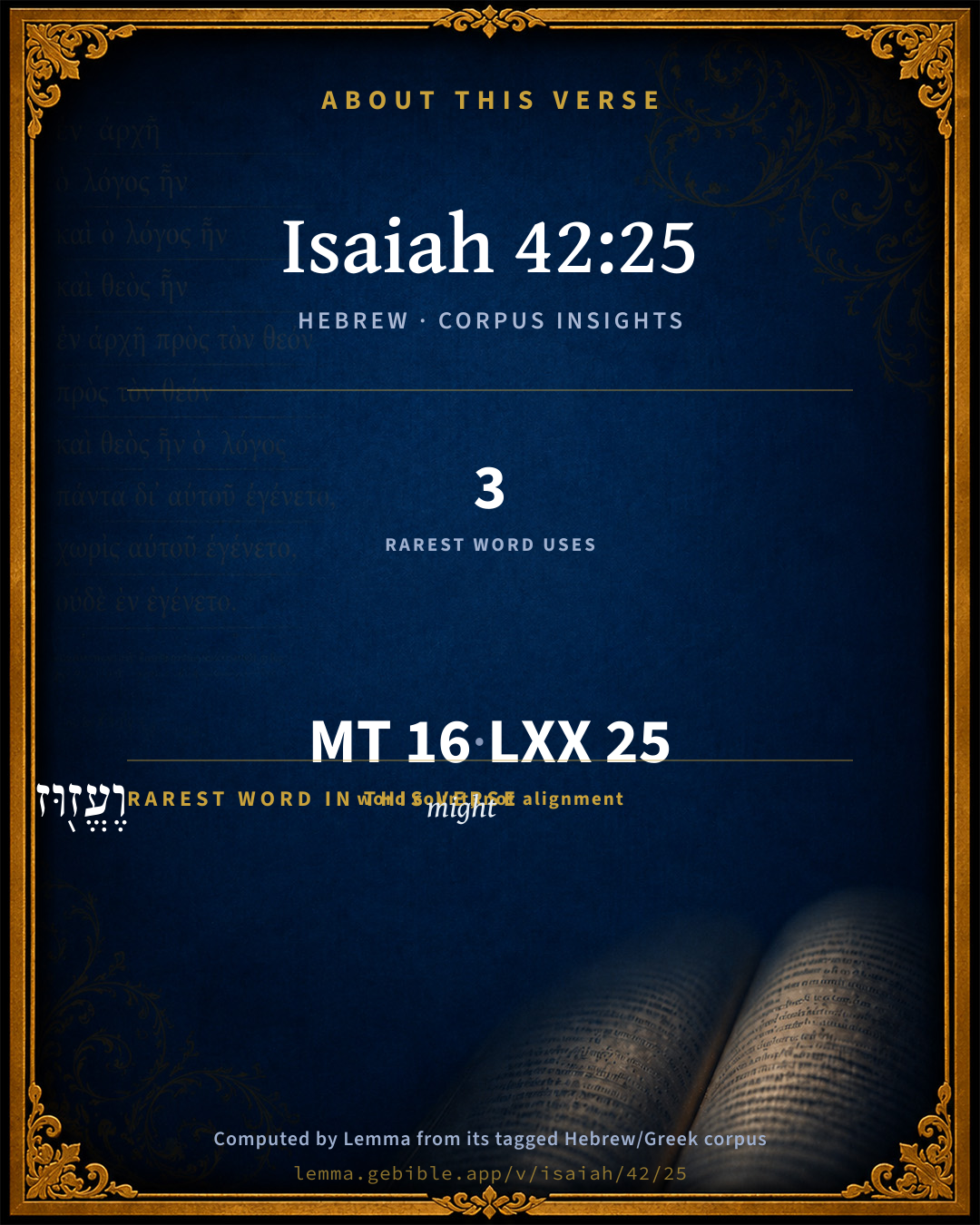
The rarest word here is וֶעֱז֖וּז might H5807 — appearing just 3 times in the whole Hebrew Bible.

Shared distinctive vocabulary

וֶעֱז֖וּז might H5807 occurs in 3 verses of the Hebrew Bible. Also found in:

Grammatical profile

  • 5 verbs
  • 6 nouns
  • 3 prepositions
  • 2 particles

Verb forms

  • וַיִּשְׁפֹּ֤ךְ Qal · Sequential Imperfect
  • וַתְּלַהֲטֵ֤הוּ Piel · Sequential Imperfect
  • יָדָ֔ע Qal · Perfect
  • וַתִּבְעַר Qal · Sequential Imperfect
  • יָשִׂ֥ים Qal · Imperfect

Repetition

Words recur within this verse — often emphatic in Hebrew:

  • עָלָיו֙ upon H5921 ×2
  • וְלֹ֣א not H3808 ×2

Hebrew & Septuagint length

In English translation the verse runs 38 words from the Hebrew and 37 from the Septuagint (LXX English) — closely comparable.

A rough comparison of the two English renderings, which tokenize alike — not a word-level alignment.

Word counts can differ between the Hebrew and the Greek without any difference in meaning — e.g. the Hebrew direct-object marker אֵת has no separate Greek word, and Greek often adds the article ὁ.

In the original languages it is 16 Hebrew tokens and 25 Greek tokens — but the two are counted differently (Hebrew bundles its prefixes and suffixes into one token; the Greek is in lemma form), so that isn’t a like-for-like length.

Cross-references

18

Topical passages linked to Isaiah 42:25 in the Treasury of Scripture Knowledge — connected by theme and wording, ordered by reader-vote popularity; previews shown in the World English Bible.

  • Isaiah 57:11 Of whom have you been afraid and in fear, that you lie, and have not remembered me, nor laid it to your heart? Haven't I held my peace even of long time, and you don't fear me?
  • Hosea 7:9 Strangers have devoured his strength, And he doesn't realize it. Indeed, gray hairs are here and there on him, And he doesn't realize it.
  • Ezekiel 7:8–9 Now will I shortly pour out my wrath on you, and accomplish my anger against you, and will judge you according to your ways; and I will bring on you all your abominations.
  • Malachi 2:2 If you will not listen, and if you will not lay it to heart, to give glory to my name," says Yahweh of Hosts, "then will I send the curse on you, and I will curse your blessings. Indeed, I have cursed them already, because you do not lay it to heart.
  • Leviticus 26:15–46 and if you shall reject my statutes, and if your soul abhors my ordinances, so that you will not do all my commandments, but break my covenant;
  • Deuteronomy 32:22 For a fire is kindled in my anger, Burns to the lowest Sheol, Devours the earth with its increase, Sets on fire the foundations of the mountains.
  • Psalms 79:5–6 How long, Yahweh? Will you be angry forever? Will your jealousy burn like fire?
  • Isaiah 9:13 Yet the people have not turned to him who struck them, neither have they sought Yahweh of Hosts.
  • Jeremiah 5:3 O Yahweh, don't your eyes look on truth? you have stricken them, but they were not grieved; you have consumed them, but they have refused to receive correction: they have made their faces harder than a rock; they have refused to return.
  • Ezekiel 20:34 and I will bring you out from the peoples, and will gather you out of the countries in which you are scattered, with a mighty hand, and with an outstretched arm, and with wrath poured out;
  • Nahum 1:6 Who can stand before his indignation? Who can endure the fierceness of his anger? His wrath is poured out like fire, and the rocks are broken apart by him.
  • Revelation 9:18–21 By these three plagues were one third of mankind killed: by the fire, the smoke, and the sulfur, which proceeded out of their mouths.
  • Revelation 16:1–21 I heard a loud voice out of the temple, saying to the seven angels, "Go and pour out the seven bowls of the wrath of God on the earth!"
  • 2 Kings 25:9 He burnt the house of Yahweh, and the king's house; and all the houses of Jerusalem, even every great house, burnt he with fire.
  • Isaiah 29:13 The Lord said, Because this people draw near [to me], and with their mouth and with their lips to honor me, but have removed their heart far from me, and their fear of me is a commandment of men which has been taught [them];
  • Isaiah 47:7 You said, I shall be mistress forever; so that you did not lay these things to your heart, neither did remember the latter end of it.
  • Isaiah 57:1 The righteous perishes, and no man lays it to heart; and merciful men are taken away, none considering that the righteous is taken away from the evil [to come].
  • Ezekiel 22:21–22 Yes, I will gather you, and blow on you with the fire of my wrath, and you shall be melted in the midst of it.

Cross-references courtesy of OpenBible.info (CC BY 4.0).

Hebrew and Greek witnesses Masoretic Hebrew ↔ Greek Septuagint

The same verse in the two great witnesses to the Old Testament, shown verse-for-verse.

These are two independent witnesses, not word-aligned to each other, and the Septuagint is shown in lemma (dictionary) form.

Hebrew Isaiah 42:25 Masoretic · Westminster Leningrad Codex

וַיִּשְׁפֹּ֤ךְ עָלָיו֙ חֵמָ֣ה אַפּ֔וֹ וֶעֱז֖וּז מִלְחָמָ֑ה וַתְּלַהֲטֵ֤הוּ מִסָּבִיב֙ וְלֹ֣א יָדָ֔ע וַתִּבְעַר בּ֖וֹ וְלֹא יָשִׂ֥ים עַל לֵֽב

Therefore he poured on him the fierceness of his anger, and the strength of battle; and it set him on fire round about, yet he didn't know; and it burned him, yet he didn't lay it to heart.

World English Bible · Public Domain

Greek LXX Isaiah 42:25 Septuagint · lemma form

καί ἐπιἄγω ἐπί αὐτός ὀργή θυμός αὐτός καί καταἰσχύω αὐτός πόλεμος καί ὁ συνφλέγω αὐτός κύκλος καί οὐ γιγνώσκω ἕκαστος αὐτός οὐδέ τίθημι ἐπί ψυχή

So he brought upon them the fury of his wrath; and the war, and those that burnt round about them, prevailed against them; yet no one of them knew it, neither did they lay it to heart.

LXX2012 (modern English Septuagint) · Public Domain

Hebrew: Westminster Leningrad Codex (CC BY 4.0). Greek: Septuagint (public domain); English from LXX2012 (modern English Septuagint) (Public Domain). How the Septuagint differs from the Hebrew →

Targum (Aramaic paraphrase)

1

The Targum is the ancient Jewish Aramaic paraphrase of the Hebrew Scriptures — an interpretive translation, not the Hebrew text itself. Onkelos (literal) and Pseudo-Jonathan (expansive) render the Torah, and Jonathan the Prophets. Coverage is partial: where no permissively-licensed English translation exists for a verse, only the Aramaic is shown. This is verse-level text, not a word-by-word alignment to the Hebrew.

  1. Targum Jonathan Prophets (Joshua–Malachi)
    וּשְׁפַךְ עֲלֵיהוֹן חֵימַת רוּגְזֵהּ וּתְקוֹף עָבְדֵי קְרָבֵהּ אַיְתִי עֲלֵיהוֹן וּקְטָלוּ בְהוֹן מִסְחוֹר סְחוֹר וְלָא יְדַעוּ וְשַׁלִיטוּ בְהוֹן וְלָא שַׁוִיאוּ דְחַלְתֵּהּ עַל לִבָּא:

    Therefore He hath poured upon them the fury of His anger, and hath brought upon them the strength of His warriors, and hath slain them round about, and they knew it not; and they ruled over them, and they did not lay His fear to heart.

    Targum Jonathan — Aramaic: “Mikraot Gedolot” (public domain). English: “Sefaria Community Translation” (CC0 1.0 (public-domain dedication)); “London "Chaldee Paraphrase," 1871” (public domain). Text via Sefaria.

Commentary

Notes on Isaiah 42:25 from classic Christian and Jewish commentators (each source and its license shown beneath its notes). The classic Christian expositions comment on the surrounding passage and are grouped to its opening verse, so a note may address several verses; the Jewish commentaries on the Tanakh (Rashi and others) are per-verse, so they appear only where the commentator wrote on this verse.

Lemma curates 59 commentaries, every one of them public domain or Creative Commons licensed, each selected and text-cleaned for this edition rather than reprinted as found. About our sources →

Trapp's Complete Commentary

John Trapp

Isa 42:25 Therefore he hath poured upon him the fury of his anger, and the strength of battle: and it hath set him on fire round about, yet he knew not; and it burned him, yet he laid [it] not to heart.

Ver. 25. And it hath set him on fire.] When the country was wasted, the city and temple burnt and ruined. Read Josephus, Lege, inquam, et luge. I say read and weep.

And he laid it not to heart.] This was worse than all the rest. Like a sleepy man (fire burning in his bed straw) he crieth not out, when others haply lament his case, that see afar off, but cannot help him.

John Trapp, A Commentary or Exposition upon All the Books of the Old and New Testament (1647–1656) — public domain. Text from a community e-Sword module.

The Biblical Illustrator

Joseph S. Exell

Isa_42:25

It hath set him on fire round about

Playing with fire

Because of their unfaithfulness, God gave up His people to divers judgments, and yet the prophet has to deplore that Israel failed to recognise the hand of God in their tribulation; they would not understand and repent; although they were burned, yet they laid it not to heart.

Consider--

I. THE DESTRUCTIVENESS OF SIN. It hath set him on fire round about. It was the purpose of God that Israel should dwell in safety in a rich and pleasant land. But the chosen people sinned against God, so He gave Jacob for a spoil and Israel to the robbers. Sometimes the plague wasted the land, sometimes the great army of locusts and caterpillars, at other times the land was devastated by fire and sword. In the text we behold invading armies overrunning the country, leaving it a smoking ruin. So sin has spoiled the world. Our nation, that might be so entirely rich and happy, is plagued with miseries; houses which might be paradises are hells; hearts which might be watered gardens are full of blackness. And there is nothing arbitrary in this retribution (Isa_1:31). The idolater is as tow, and his work is the spark which ignites the blaze of destruction. Oh, hesitate l you cannot break the law but it is as fire among the dry stubble, bringing with it an inevitable train of disasters and miseries.

II. THE INFATUATION OF SINNERS. Yet he knew it not. Yet he laid it not to heart. The proverb says, The burnt child dreads the fire. This is equally true of men in their business life. Let a man speculate in some concern or other that turns out badly, people say, Ah! he has burnt his fingers. Now, when a man has done that, beware how you approach him with your rosy prospectuses. He will show you his blisters, and send you away with scant courtesy. As the Orientals say, He who has suffered from a firebrand is afraid of a firefly. A victim is afraid of anything that bears the most distant likeness to that from which he suffered. This is rational. But men are not thus cautious in regard to the moral life. There they blind themselves, harden themselves, and when Gods judgments are let loose upon them they will not see, when they are burned they will not lay it to heart. What a striking illustration of this we have in Pharaoh! The history of Israel is an illustration, on a larger scale, of the same blindness and insensibility. How many times did their idolatry bring them into trouble! And yet they would not hear, they would not see, until wrath came upon them to the uttermost in the captivity of Babylon, in their overthrow by the Romans. How often do we ourselves fail to take to heart Gods sharp yet gracious warnings! How is it that, whilst we dread the fire which burns the skin, we do not fear the fire which sears the soul?

1. The fire which burns sears. The action of sin destroys sensibility, so do neglected judgments (Jer_6:15). Let us lay to heart the first sense of shame, the first warning, the first rebuke! When a choice ornament is unhappily slightly fractured there is great and sincere distress; but the next accident is taken lightly, and only provokes the merry rejoinder, Oh, it was cracked! When a thing is stained or fractured, a spot or crack more or less after that seems of no great consequence.

2. The fire which burns seduces. If men once begin to lack sincerity, to disregard the still, small whisper of conscience, to trifle with the fine health of the pure and faithful soul, sin, despite all its implied agony, soon acquires an indescribable fascination--we suffer through it, and yet we cling to it. Illustration, the moth and the flame. So men are fascinated by the flame which consumes them. In the whole mystery of iniquity is nothing more mysterious than the way in which sin seems to master the reason of men, and to allure and charm them to ruin. So Israel was fascinated by idolatry; dreadfully plagued as they were for their lapses, they could not resist the glamour. So it is with men once committed to the hypnotic power of evil--they linger on the verge of death.

3. The fire which burns spares. Strange reason this, but it is a reason. There was an element of mercy in the judgments of Israel, and very mercy was misconstrued and turned into lasciviousness (Isa_1:5; Isa_1:7). Children playing with fire are sometimes only slightly injured, and then they make light of it, and repeat their trifling; and perhaps in the end they pay very dearly indeed. So it was with the Jews. They lost a bit of territory; they were compelled to pay tribute; some of them fell by the sword, or were carried into captivity; they were afflicted in measure, and they presumed. So it is still (Ecc_8:11). The law of retribution is ever working in human life; ever and anon it drops blazing warnings at our feet; and be sure the day of the Lord will come, when He will arise and judge the earth in righteousness, when wrath to the uttermost will come upon the obstinately disobedient. Gods sparing mercies appeal to you to sin no more. (W. L. Watkinson.)

.

The Biblical Illustrator, edited by Joseph S. Exell (c. 1880s–1900s) — public domain. Text from a community e-Sword module.

Joseph Benson's Commentary

Isa 42:25. Therefore he hath poured upon him the fury, &c. — Most grievous judgments. It hath set him on fire round about — This was literally fulfilled when the Chaldean army took their city, and burned both it and their temple. Yet he knew it not — Considered it not: they were secure and stupid under God’s judgments; neither fearing them when threatened, nor truly sensible of God’s hand in them, of the causes of God’s displeasure, or of the means of cure. The reader will easily observe, that “the force and elegance of the metaphor in this verse are very great. Of all natural evils which affect the human mind, which arouse and awaken it, none do so with greater quickness than fire, than a mighty flame encompassing a man on every side. No sleep, no lethargy is so great, which this will not shake off; and yet the stupor and insensibility of the Jews are here represented to be so great, that in the midst of the fire and flame, which they might and ought to think kindled by God, they inquired not into the causes of this judgment. They knew them not, nor considered them; but, persisting in their impenitence and stupidity, applied not to God in faith and repentance, nor humbled themselves before him.” See Vitringa.

Joseph Benson's Commentary on the Old and New Testaments (1811–1818) — public domain. Text from a community e-Sword module.

Tyndale Open Study Notes

Tyndale Open Resources

42:25 Generation after generation of Israelites did not learn their lesson, even when God disciplined them through military defeat.

Tyndale Open Study Notes — © Tyndale Open Resources, licensed CC BY-SA 4.0. Text via the HelloAO Bible API.

Jamieson, Fausset & Brown

Robert Jamieson, A. R. Fausset & David Brown

him--Israel (Isa 42:24).

strength of battle--violence of war.

it--the battle or war (compare Isa 10:16).

knew not--knew not the lesson of repentance which the judgment was intended to teach (Isa 5:13; Isa 9:13; Jer 5:3).

Next: Isaiah Chapter 43

Jamieson, Fausset & Brown — Commentary Critical and Explanatory on the Whole Bible (1871) — public domain (CC PDM 1.0). Text via the HelloAO Bible API.

Adam Clarke's Commentary

Verse 25. The fury of his anger - "The heat of his wrath"] For חמה chammah, the Bodl. MS. has חמת chammath, in regimine, more regularly.

It hath set him on fire round about] So thoroughly hardened are the Jewish people, that they are represented as being in a house on fire, and even scorched with the flames, without perceiving their danger, or feeling that they are hurt! What a picture of mental induration! and this is their state to the present day. But by whom shall Jacob arise? for in this sense he is small indeed. Many efforts have been made to Christianize them, but without effect; and is this to be wondered at, while we tell them how great they are, how learned, how wise, how much we owe to them, that they are still the peculiar people of God, &c., &c.? If all this be true, what can they gain by becoming Christians? Whereas a more stupid, proud, hardened, ignorant people can scarcely be found in the civilized world, and they are most grossly ignorant of their own Scriptures.

Adam Clarke's Commentary on the Bible (1810–1826) — public domain. Text from a community e-Sword/MySword module.

Ellicott's Commentary for English Readers

(25) The fury of his anger.—Better, the burning heat of His wrath, and the violence of war. Historically, the words seem to find a better fulfiment in the “wars and rumours of wars” (Mat_24:6) than in the long equable continuance of the exile.

A Bible Commentary for English Readers, edited by Charles John Ellicott (1878–1897) — public domain. Text from a community e-Sword module.

The Cambridge Bible for Schools and Colleges

gen. ed. J. J. S. Perowne

25. Therefore should be simply and. the strength of battle] the violence of war, which (as in ch. Isa_9:18 ff. etc.) is compared to a fire. he knew not] i.e. “understood it not;” hardly, “heeded it not.” Israel felt its calamities keenly enough, but did not comprehend their significance, as a visitation from Jehovah. Note the contrast in ch. Isa_43:2.

The Cambridge Bible for Schools and Colleges (gen. ed. J. J. S. Perowne; Cambridge University Press, 1878–1918) — public domain. Text from a community e-Sword module.

Albert Barnes' Notes on the Bible

Therefore he hath poured upon him the fury of his anger - His righteous indignation in the overturning of their nation, the destruction of their temple and city, and in carrying them captive into a distant land.

And it hath set him on fire - That is, the fury of Yahweh kindled the flame of war all around the Jewish nation, and spread desolation everywhere.

Yet he knew not - They refused to attend to it, and lay it to heart. They pursued their ways of wickedness, regardless of the threatening judgments, and the impending wrath of God. They did not consider that these evils were inflicted for their crimes, nor did they turn from their sins when they were thus threatened with the wrath of God.

Albert Barnes' Notes on the Bible (1834–1885) — public domain. Text from a community e-Sword/MySword module.

Matthew Poole's English Annotations

The fury of his anger, and the strength of battle; most grievous judgments.

Yet he knew not; they were secure and stupid under God’s judgments, neither fearing them when threatened, nor truly sensible of God’s hand in them, and of the causes of God’s displeasure against them, and of the means of cure.

Matthew Poole's English Annotations on the Holy Bible (1683–1685) — public domain. Text from a community e-Sword/MySword module.

The Pulpit Commentary

Therefore he hath poured upon him... the strength of battle; i.e. for this cause, on account of their iniquities, did God bring upon his people the scourge of foreign war, and allow the Babylonians to waste Judaea, to destroy Jerusalem, and to lead into captivity the entire nation. (2Ch_36:14-17) It hath set him on fire; rather, it (i.e. the war) set him on fire. The reference is, perhaps, especially to the burning of Jerusalem by Nebuzar-adan; (2Ki_25:9) but the phrase will cover also the general devastation of the land both before and after this event (Jeremiah 39-42), He knew not; rather, he took no notice; he did not change his ways on account of the chastisement. The prophet"s view is that Israel, as a whole, was not greatly bettered by the Captivity, at any rate up to the time which he takes for his standpoint, and at which he supposes him. self to be addressing them.

The Pulpit Commentary (1880–1919), ed. H.D.M. Spence-Jones & Joseph S. Exell — public domain. Text from a community e-Sword module.

John Wesley's Explanatory Notes

Fury - Most grievous judgments. Yet - They were secure and stupid under God's judgments.

John Wesley, Explanatory Notes Upon the Whole Bible (1754–1765) — public domain. Text via the GEBible commentary corpus.

J. A. Alexander on Isaiah

Joseph Addison Alexander

“And He (Jehovah) poured upon him (Israel) fury, (even) His wrath and the strength (or violence) of war: and it set him on fire sound about, and he knew (it) not; and it burned him, and he will not lay it to heart.” This continues and concludes the description of God’s judgments and of Israel’s insensibility. ‘He knew not’ does not here mean unawares, without his knowledge, but, as the parallel clause shows, implies extreme insensibility. The translation of the last verb as a preterite is ungrammatical, and the assimilation of the two as presents quite gratuitous. That a preterite precedes, instead of showing that the future must refer to past time, shows the contrary, by leaving us unable to account for the difference of form if none of meaning was intended. However necessary such assimilations may be elsewhere, they are inadmissible in cases like the present, where the change of tense admits of an easy explanation, to wit, that the writer intended to describe the people, not only as having been insensible before, but as likely to continue so in time to come. On the usage of the phrase to put or lay upon the heart.

Joseph Addison Alexander, The Prophecies of Isaiah (1846–1847; New York: Scribner, 1870–1878) — public domain. Text from a community e-Sword module.

unfoldingWord translationNotes

Door43 World Missions Community

General Information:

Isaiah continues speaking.

Therefore he

"Therefore Yahweh"

he poured out on them his fierce anger

Isaiah speaks of Yahweh's anger as if it were a liquid that could be poured out. AT: "he showed them just how angry he was" (See: Metaphor)

on them

"against us." Here "them" refers to the people of Israel, but Isaiah still included himself as part of the people.

and the violence of war

The word "devastation" can be translated with a verb. AT: "by devastating them with war" (See: Abstract Nouns)

Its flames encircled them ... it consumed them

Isaiah speaks of Yahweh's fierce anger as if it were a fire that burned the people. (See: Metaphor)

they did not take it to heart

Paying attention to something and learning from it is spoken of as if it were placing that thing on one's heart. AT: "they did not pay attention" or "they did not learn from it" (See: Metaphor)

translationWords

anger

devastate

heart

unfoldingWord translationNotes — © Distant Shores Media and the Door43 World Missions Community, licensed CC BY-SA 4.0. Source: git.door43.org/Door43/en_tn.

Rashi

Rabbi Shlomo Yitzchaki (Rashi)

and it blazed upon them all around I brought retribution upon the heathens ([Ms.] nations) all around so that they see and learn their lesson, like the matter stated (Zeph. 3:6f.): “I cut off nations, their towers were desolate...I said, You shall but fear Me, you shall learn a lesson...” ([This appears in certain manuscripts and in printed editions. In Nach Lublin, the reading is:] So that Israel see and learn a lesson.)

and they did not know They actually did know, but they trod with their heels. They did not care to understand this and to repent of their wickedness.

and it burned among them After the retribution of the heathens ([ms.] nations) around, it burned upon them themselves.

Rashi on the Tanakh — English translations: “The Judaica Press complete Tanach with Rashi, translated by A. J. Rosenberg” (CC BY 4.0); “Pentateuch with Rashi's commentary by M. Rosenbaum and A.M. Silbermann, 1929-1934” (public domain); “The Metsudah Tanach series, Lakewood, N.J” (CC BY 4.0); and “The Book of Joshua, Metsudah Publications, 1997” (CC BY 4.0). Text via Sefaria.

Ibn Ezra

Rabbi Abraham ibn Ezra

Upon him. Comp. Gen. 49:22. עליו upon him, after the plural לא שמעו,לא אבו they would not, they were not obedient, and צעדה she runs after בנות branches. (Gen. 49:22.) Comp. c. ii. Note 18. Upon every one of our forefathers.

חמה חמת אפו═חמה אפו The fury, the fury of His anger, Comp. האהלה אהל שרה ══ האהלה שרה into the tent, the tent of Sarah (Gen. 24:67).

ותלהטהו And it burned him. Comp. להט flame (Gen. 3:24).—They will confess that their forefathers were blind with regard to their hearts, and had no understanding.

Ibn Ezra on the Tanakh — English translations: “Sefaria Community Translation” (CC0 1.0 (public-domain dedication)); “Yalkut, Sifsei Chachomim Chumash, Metsudah Publications, 2009” (CC BY 4.0); and “Commentary of Ibn Ezra on Isaiah - trans. by M. Friedlander, 1873” (public domain). Text via Sefaria.

Lesson kit

Teaching starters — assembled from the data on this page, not authored interpretation. Every prompt links to the verse data it draws on. Edit before teaching.

Isaiah, in the Prophets, opens this verse with 16 words (13 distinct Hebrew lemmas). Its most distinctive word is ʻĕzûwz (“might”). A historical commentator’s framing appears above. Read the whole chapter for the surrounding context.

Discussion questions

  1. The word ʻĕzûwz carries the sense “might.” How does it shape the verse?
  2. Psalms 78:4 shares the word «might» with this verse. How do the two illuminate each other?
  3. “upon” occurs 2× in this one verse. What is the effect of the repetition?
  4. The translations on this page render this verse differently — a whole-verse word diff, not a word-by-word alignment. What might account for the different wordings?
  5. The verb «וַיִּשְׁפֹּ֤ךְ» is Qal Sequential Imperfect. How does its form color the action?
  6. Reading how Trapp's Complete Commentary and The Biblical Illustrator read this verse, where do the two commentators agree and where do they part?

Things to notice

Reading settings

Reading text

Shown beneath each verse's original-language words.

Old Testament
Old Testament edition

Read the OT as the Masoretic Hebrew (MT) or the Greek Septuagint (LXX).

English shown for the Greek Septuagint (in the Hebrew ↔ Greek comparison).

Comparing translations? Open the Compare panel on any verse page to stack up to four side by side.