
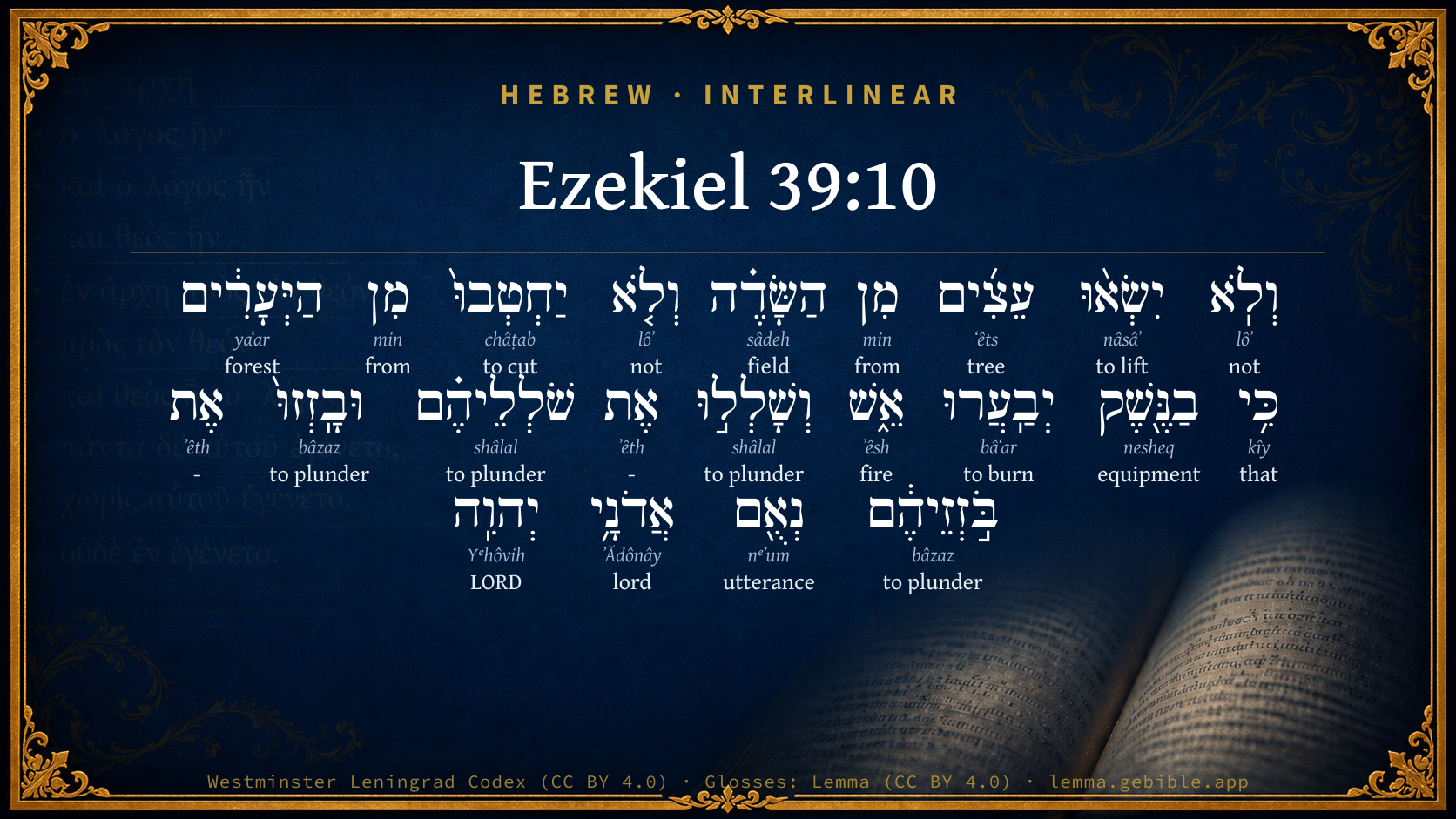
Ezekiel 39:10

Hebrew (Westminster Leningrad Codex) Ezekiel 39:10 appears in the Hebrew Old Testament. The text above is from the Westminster Leningrad Codex. Each word links to its Strong’s number, a concise gloss, and parsing drawn from the Open Scriptures Hebrew Bible morphology. Click any word for its full Brown-Driver-Briggs (BDB) entry.
Download image
Cite this verse

Ezekiel 39:10 (World English Bible). Public Domain. Lemma interlinear Bible study tool, https://lemma.gebible.app/v/ezekiel/39/10.

Show BibTeX & RIS
BibTeX
RIS
English Translation
so that they shall take no wood out of the field, neither cut down any out of the forests; for they shall make fires of the weapons; and they shall plunder those who plundered them, and rob those who robbed them, says the Lord Yahweh.
World English Bible · Public Domain
Download a study sheet

One document with this verse’s original text, its word-by-word gloss line, the meaning frame, cross-references with their text, attributed commentary, and full source and license credits — printable, and it pastes into notes with its structure intact.

This verse Autodidact and up

Study sheet (.html) Plain text (.txt)

A passage Seminary Student

Up to 50 verses in one chapter. A passage sheet keeps up to 6 commentary sources and 12 cross-references per verse, in the order this page ranks them, and says so on the sheet whenever that leaves anything out. Ask for a single verse and you get the Autodidact verse sheet above.

Everything on this page stays free to read, with no account — the sheet is a download of what is already on screen, not access to it.

Want to remove ads? Support Godless Engineer
Compare translations 3

The same verse in 3 English versions, stacked beneath the original-language interlinear above. Click any original word for its lexicon entry.

Each is an independent rendering of the whole verse — the interlinear is not word-aligned to these translations.

Highlighted words mark where these versions differ — a whole-verse word diff, not a word-by-word alignment.

  • World English Bible Public Domain
    so that they shall take no wood out of the field, neither cut down any out of the forests; for they shall make fires of the weapons; and they shall plunder those who plundered them, and rob those who robbed them, says the Lord Yahweh.
  • King James Version Public Domain
    So that they shall take no wood out of the field, neither cut down any out of the forests; for they shall burn the weapons with fire: and they shall spoil those that spoiled them, and rob those that robbed them, saith the Lord GOD.
  • unfoldingWord Literal Text CC BY-SA 4.0
    They will not gather wood from the fields or cut down trees from the forests, since they will burn the weapons; they will take from those who wanted to take from them; they will plunder those who wanted to plunder them—this is the Lord Yahweh’s declaration.”

unfoldingWord Literal Text — © unfoldingWord, licensed CC BY-SA 4.0. Word-aligned USFM3 via Door43 (git.door43.org/unfoldingWord/en_ult).

Versions to compare (up to 4)

3 of 4 selected

Show all 18 translations

Every available English version of this verse, each an independent rendering of the whole verse.

  • World English Bible Public Domain
    so that they shall take no wood out of the field, neither cut down any out of the forests; for they shall make fires of the weapons; and they shall plunder those who plundered them, and rob those who robbed them, says the Lord Yahweh.
  • Berean Standard Bible Public Domain
    They will not gather wood from the countryside or cut it from the forests, for they will use the weapons for fuel. They will loot those who looted them and plunder those who plundered them, declares the Lord GOD.
  • Majority Standard Bible Public Domain
    They will not gather wood from the countryside or cut it from the forests, for they will use the weapons for fuel. They will loot those who looted them and plunder those who plundered them, declares the Lord GOD.
  • King James Version Public Domain
    So that they shall take no wood out of the field, neither cut down any out of the forests; for they shall burn the weapons with fire: and they shall spoil those that spoiled them, and rob those that robbed them, saith the Lord GOD.
  • American Standard Version (1901) Public Domain
    so that they shall take no wood out of the field, neither cut down any out of the forests; for they shall make fires of the weapons; and they shall plunder those that plundered them, and rob those that robbed them, saith the Lord Jehovah.
  • Revised Version (1885) Public Domain
    so that they shall take no wood out of the field, neither cut down any out of the forests; for they shall make fires of the weapons: and they shall spoil those that spoiled them, and rob those that robbed them, saith the Lord GOD.
  • Geneva Bible (1599) Public Domain
    So that they shall bring no wood out of the fielde, neither cut downe any out of the forestes: for they shall burne the weapons with fire, and they shall robbe those that robbed them, and spoyle those that spoyled them, sayeth the Lord God.
  • Douay-Rheims (1899) Public Domain
    And they shall not bring wood out of the countries, nor cut down out of the forests: for they shall burn the weapons with fire, and shall make a prey of them to whom they had been a prey, and they shall rob those that robbed them, saith the Lord God.
  • Young's Literal Translation Public Domain
    And they do not take wood out of the field, Nor do they hew out of the forests, For with armour they cause the fire to burn, And they have spoiled their spoilers, And they have plundered their plunderers, An affirmation of the Lord Jehovah.
  • Literal Standard Version CC BY-SA 4.0
    And they do not take wood out of the field, || Nor do they hew out of the forests, || For they cause the fire to burn with armor, || And they have spoiled their spoilers, || And they have plundered their plunderers, || A declaration of Lord YHWH.
  • Unlocked Literal Bible CC BY-SA 4.0
    They will not gather wood from the fields or cut down trees from the forests, since they will burn the weapons; they will take from those who wanted to take from them; they will plunder those who wanted to plunder them—this is the Lord Yahweh's declaration.”
  • unfoldingWord Literal Text CC BY-SA 4.0
    They will not gather wood from the fields or cut down trees from the forests, since they will burn the weapons; they will take from those who wanted to take from them; they will plunder those who wanted to plunder them—this is the Lord Yahweh’s declaration.”
  • Darby Bible Public Domain
    And no wood shall be taken out of the field, neither cut down out of the forests; for they shall make fire with the weapons; and they shall spoil those that spoiled them, and plunder those that plundered them, saith the Lord Jehovah.
  • World Messianic Bible Public Domain
    so that they will take no wood out of the field, and not cut down any out of the forests; for they will make fires with the weapons. They will plunder those who plundered them, and rob those who robbed them,” says the Lord GOD.
  • Webster's Bible Public Domain
    So that they shall take no wood out of the field, neither cut down any out of the forests; for they shall burn the weapons with fire: and they shall lay waste those that wasted them, and rob those that robbed them, saith the Lord GOD.
  • Free Bible Version CC BY-SA 4.0
    They won't need to go and gather firewood from the countryside or cut it from the forests, because they'll use the weapons to make fires. They will loot and plunder those who looted and plundered them, declares the Lord God.
  • Bible in Basic English Public Domain
    And they will take no wood out of the field or have any cut down in the woods; for they will make their fires of the instruments of war: and they will take by force the property of those who took their property, and go off with the goods of those who took their goods, says the Lord.
  • JPS Tanakh (1917) Public Domain
    so that they shall take no wood out of the field, neither cut down any out of the forests, for they shall make fires of the weapons; and they shall spoil those that spoiled them, and rob those that robbed them, saith the Lord GOD.

Literal Standard Version (2020), Covenant Press — licensed CC BY-SA 4.0. Text via the HelloAO Bible API (eBible.org). Unlocked Literal Bible (unfoldingWord) — licensed CC BY-SA 4.0. Text via the HelloAO Bible API (eBible.org). unfoldingWord Literal Text — © unfoldingWord, licensed CC BY-SA 4.0. Word-aligned USFM3 via Door43 (git.door43.org/unfoldingWord/en_ult). Free Bible Version, Dr. Jonathan Gallagher — licensed CC BY-SA 4.0. Text via the HelloAO Bible API (eBible.org).

Word by word

More ways to search: Search by grammar → Find every occurrence → Compare this word →

Practice this passage: Drill this verse → Learn its vocabulary →

יַחְטְבוּ֙
châṭab
H2404
“to cut”
Verb, Qal, Imperfect, 3rd Person, Masculine, Plural
Part of Speech
Verb
Stem
Qal
Form
Imperfect
Person
3rd Person
Gender
Masculine
Number
Plural
Full BDB Definition

Origin: a primitive root

TWOT: 639

to cut, gather - (Qal) to cut, gather (wood) - (Pual) to cut, carve
  1. וְלֹֽא lôʼ H3808 “and · not” Conjunction + Particle, Negative
  2. יִשְׂא֨וּ nâsâʼ H5375 “to lift” Verb, Qal, Imperfect, 3rd Person, Masculine, Plural
  3. עֵצִ֜ים ʻêts H6086 “trees” Noun, Common, Masculine, Plural, Absolute
  4. מִן min H4480 “from” Preposition
  5. הַשָּׂדֶ֗ה sâdeh H7704 “the · field” Particle, Definite Article + Noun, Common, Masculine, Singular, Absolute
  6. וְלֹ֤א lôʼ H3808 “and · not” Conjunction + Particle, Negative
  7. מִן min H4480 “from” Preposition
  8. הַיְּעָרִ֔ים yaʻar H3293 “the · forests” Particle, Definite Article + Noun, Common, Masculine, Plural, Absolute
  9. כִּ֥י kîy H3588 “that” Conjunction
  10. בַנֶּ֖שֶׁק nesheq H5402 “in/at the · equipment” Preposition, Determined + Noun, Common, Masculine, Singular, Absolute
  11. יְבַֽעֲרוּ bâʻar H1197 “to burn” Verb, Piel, Imperfect, 3rd Person, Masculine, Plural
  12. אֵ֑שׁ ʼêsh H784 “fire” Noun, Common, Both, Singular, Absolute
  13. וְשָׁלְל֣וּ shâlal H7997 “and · to plunder” Conjunction + Verb, Qal, Sequential Perfect, 3rd Person, Common, Plural
  14. אֶת ʼêth H853 “-” Particle, Direct Object
  15. שֹׁלְלֵיהֶ֗ם shâlal H7997 “plundering · them” Verb, Qal, Participle Active, Masculine, Plural, Construct + Suffix, Personal, 3rd Person, Masculine, Plural
  16. וּבָֽזְזוּ֙ bâzaz H962 “and · to plunder” Conjunction + Verb, Qal, Sequential Perfect, 3rd Person, Common, Plural
  17. אֶת ʼêth H853 “-” Particle, Direct Object
  18. בֹּ֣זְזֵיהֶ֔ם bâzaz H962 “plundering · them” Verb, Qal, Participle Active, Masculine, Plural, Construct + Suffix, Personal, 3rd Person, Masculine, Plural
  19. נְאֻ֖ם nᵉʼum H5002 “utterance of” Noun, Common, Masculine, Singular, Construct
  20. אֲדֹנָ֥י ʼĂdônây H136 “Lord · my” Noun, Common, Masculine, Plural, Construct + Suffix, Personal, 1st Person, Common, Singular
  21. יְהוִֽה Yᵉhôvih H3069 “LORD” Noun, Proper

About this verse

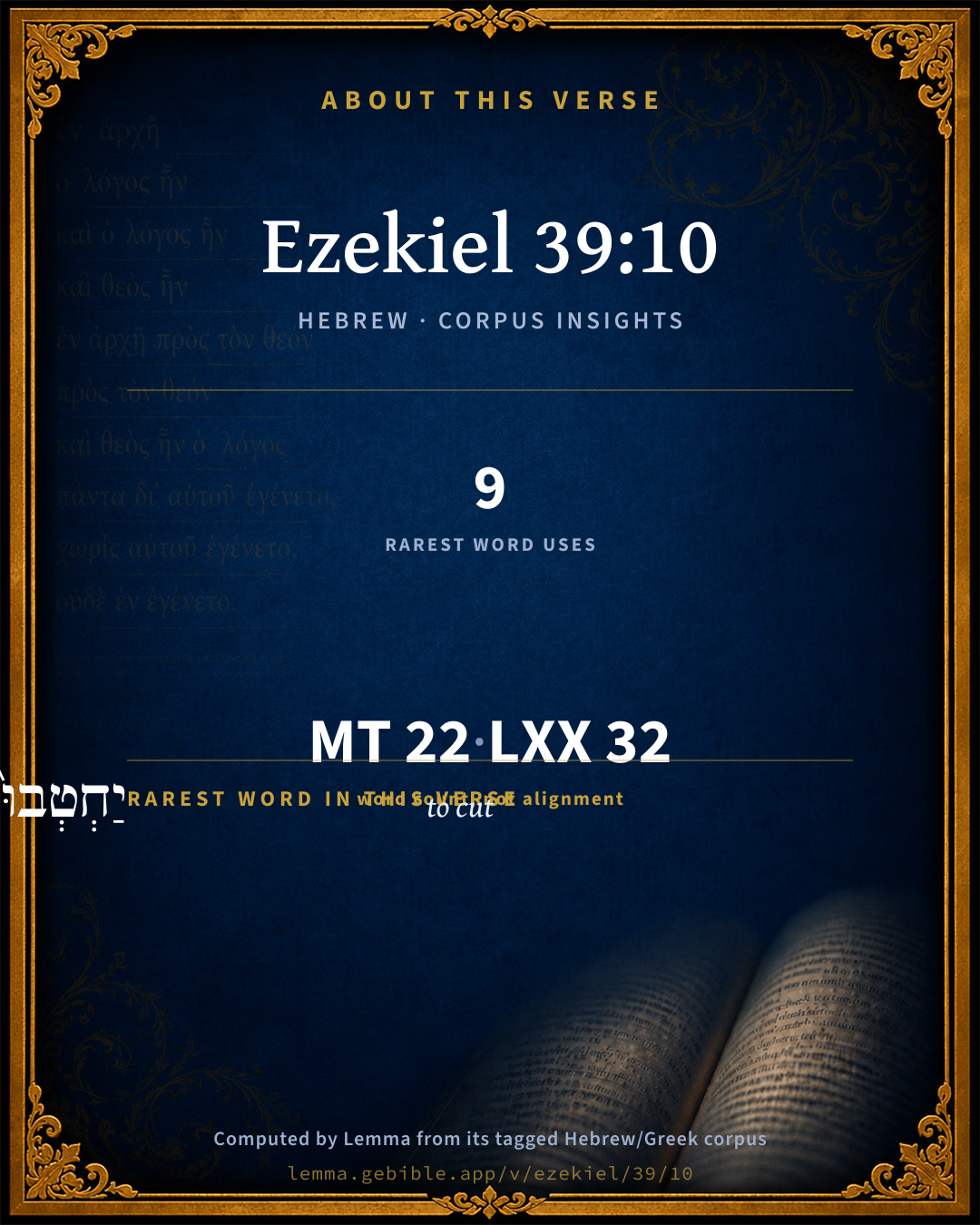
These counts appear in no published source. They are computed here, from the morphology-tagged text and Lemma’s own curated glosses. What Lemma adds →

22
words
17
distinct lemmas
Prophets
section

Notable vocabulary

The rarest word here is יַחְטְבוּ֙ to cut H2404 — appearing just 9 times in the whole Hebrew Bible.

Shared distinctive vocabulary

יַחְטְבוּ֙ to cut H2404 occurs in 9 verses of the Hebrew Bible. Also found in:

Grammatical profile

  • 7 verbs
  • 8 nouns
  • 2 prepositions
  • 1 conjunction
  • 4 particles

Verb forms

  • יִשְׂא֨וּ Qal · Imperfect
  • יַחְטְבוּ֙ Qal · Imperfect
  • יְבַֽעֲרוּ Piel · Imperfect
  • וְשָׁלְל֣וּ Qal · Sequential Perfect
  • שֹׁלְלֵיהֶ֗ם Qal · Participle Active
  • וּבָֽזְזוּ֙ Qal · Sequential Perfect
  • בֹּ֣זְזֵיהֶ֔ם Qal · Participle Active

Repetition

Words recur within this verse — often emphatic in Hebrew:

  • וְשָׁלְל֣וּ to plunder H7997 ×2
  • וּבָֽזְזוּ֙ to plunder H962 ×2
  • וְלֹֽא not H3808 ×2
  • מִן from H4480 ×2

Hebrew & Septuagint length

In English translation the verse runs 45 words from the Hebrew and 45 from the Septuagint (LXX English) — the same length.

A rough comparison of the two English renderings, which tokenize alike — not a word-level alignment.

Word counts can differ between the Hebrew and the Greek without any difference in meaning — e.g. the Hebrew direct-object marker אֵת has no separate Greek word, and Greek often adds the article ὁ.

In the original languages it is 22 Hebrew tokens and 32 Greek tokens — but the two are counted differently (Hebrew bundles its prefixes and suffixes into one token; the Greek is in lemma form), so that isn’t a like-for-like length.

Cross-references

11

Topical passages linked to Ezekiel 39:10 in the Treasury of Scripture Knowledge — connected by theme and wording, ordered by reader-vote popularity; previews shown in the World English Bible.

  • Isaiah 33:1 Woe to you who destroy, and you weren't destroyed; and deal treacherously, and they didn't deal treacherously with you! When you have ceased to destroy, you shall be destroyed; and when you have made an end of dealing treacherously, they shall deal treacherously with you.
  • Isaiah 14:2 The peoples shall take them, and bring them to their place; and the house of Israel shall possess them in the land of Yahweh for servants and for handmaids: and they shall take them captive whose captives they were; and they shall rule over their oppressors.
  • Micah 5:8 The remnant of Jacob will be among the nations, In the midst of many peoples, Like a lion among the animals of the forest, Like a young lion among the flocks of sheep; Who, if he goes through, treads down and tears in pieces, And there is no one to deliver.
  • Exodus 3:22 But every woman shall ask of her neighbor, and of her who visits her house, jewels of silver, jewels of gold, and clothing; and you shall put them on your sons, and on your daughters. You shall despoil the Egyptians.
  • Exodus 12:36 Yahweh gave the people favor in the sight of the Egyptians, so that they let them have what they asked. They despoiled the Egyptians.
  • Habakkuk 2:8 Because you have plundered many nations, all the remnant of the peoples will plunder you, because of men's blood, and for the violence done to the land, to the city and to all who dwell in it.
  • Habakkuk 3:8 Was Yahweh displeased with the rivers? Was your anger against the rivers, Or your wrath against the sea, That you rode on your horses, On your chariots of salvation?
  • Zephaniah 2:9–10 Therefore as I live, says Yahweh of Hosts, the God of Israel, surely Moab will be as Sodom, and the children of Ammon as Gomorrah, a possession of nettles, and salt pits, and a perpetual desolation. The remnant of my people will plunder them, and the survivors of my nation will inherit them.
  • Matthew 7:2 For with whatever judgment you judge, you will be judged; and with whatever measure you measure, it will be measured to you.
  • Revelation 13:10 If anyone has captivity, he will go. If anyone is with the sword, he must be killed. Here is the endurance and the faith of the saints.
  • Revelation 18:6 Return to her just as she returned, and repay her double as she did, and according to her works. In the cup which she mixed, mix to her double.

Cross-references courtesy of OpenBible.info (CC BY 4.0).

Hebrew and Greek witnesses Masoretic Hebrew ↔ Greek Septuagint

The same verse in the two great witnesses to the Old Testament, shown verse-for-verse.

These are two independent witnesses, not word-aligned to each other, and the Septuagint is shown in lemma (dictionary) form.

Hebrew Ezekiel 39:10 Masoretic · Westminster Leningrad Codex

וְלֹֽא יִשְׂא֨וּ עֵצִ֜ים מִן הַשָּׂדֶ֗ה וְלֹ֤א יַחְטְבוּ֙ מִן הַיְּעָרִ֔ים כִּ֥י בַנֶּ֖שֶׁק יְבַֽעֲרוּ אֵ֑שׁ וְשָׁלְל֣וּ אֶת שֹׁלְלֵיהֶ֗ם וּבָֽזְזוּ֙ אֶת בֹּ֣זְזֵיהֶ֔ם נְאֻ֖ם אֲדֹנָ֥י יְהוִֽה

so that they shall take no wood out of the field, neither cut down any out of the forests; for they shall make fires of the weapons; and they shall plunder those who plundered them, and rob those who robbed them, says the Lord Yahweh.

World English Bible · Public Domain

Greek LXX Ezekiel 39:10 Septuagint · lemma form

καί οὐ μή λαμβάνω ξύλον ἐκ ὁ πεδίον οὐδέ μή κόπτω ἐκ ὁ δρυμός ἀλλά ἤ ὁ ὅπλον κατακαίω πῦρ καί προνομεύω ὁ προνομεύω αὐτός καί σκυλεύω ὁ σκυλεύω αὐτός λέγω κύριος

and they shall not take any wood out of the field, neither shall they cut any out of the forests, but they shall burn the weapons with fire: and they shall plunder those that plundered them, and spoil those that spoiled them, says the Lord.

LXX2012 (modern English Septuagint) · Public Domain

Hebrew: Westminster Leningrad Codex (CC BY 4.0). Greek: Septuagint (public domain); English from LXX2012 (modern English Septuagint) (Public Domain). How the Septuagint differs from the Hebrew →

Targum (Aramaic paraphrase)

1

The Targum is the ancient Jewish Aramaic paraphrase of the Hebrew Scriptures — an interpretive translation, not the Hebrew text itself. Onkelos (literal) and Pseudo-Jonathan (expansive) render the Torah, and Jonathan the Prophets. Coverage is partial: where no permissively-licensed English translation exists for a verse, only the Aramaic is shown. This is verse-level text, not a word-by-word alignment to the Hebrew.

  1. Targum Jonathan Prophets (Joshua–Malachi)
    וְלָא יִסְבוּן אָעִין מִן חַקְלָא וְלָא יְקַצוּן מִן חוּרְשָׁא אֲרֵי בְמִנֵי זְיָנָא יִדְלְקוּן נוּרָא וְיִבְזוּן יַת בְּזָזֵיהוֹן וְיַעְדוּ יַת עֲדֵיהוֹן אֲמַר יְיָ אֱלֹהִים:

    (no public-domain English translation for this verse)

    Targum Jonathan — Aramaic: “Mikraot Gedolot” (public domain). English: “Sefaria Community Translation” (CC0 1.0 (public-domain dedication)); “London "Chaldee Paraphrase," 1871” (public domain). Text via Sefaria.

Commentary

Notes on Ezekiel 39:10 from classic Christian and Jewish commentators (each source and its license shown beneath its notes). The classic Christian expositions comment on the surrounding passage and are grouped to its opening verse, so a note may address several verses; the Jewish commentaries on the Tanakh (Rashi and others) are per-verse, so they appear only where the commentator wrote on this verse.

Lemma curates 59 commentaries, every one of them public domain or Creative Commons licensed, each selected and text-cleaned for this edition rather than reprinted as found. About our sources →

Trapp's Complete Commentary

John Trapp

Eze 39:10 So that they shall take no wood out of the field, neither cut down [any] out of the forests; for they shall burn the weapons with fire: and they shall spoil those that spoiled them, and rob those that robbed them, saith the Lord GOD.

Ver. 10. So that they shall take no wood.] This must needs be hyperbolic, as are also sundry other passages in Holy Scripture. When Luther burnt the Pope’s decrees and decretals at Wittemberg, it was a fair fire doubtless, as Solon once said of the fire he caused to be made at Athens of the bills and bonds of the Athenian usurers.

John Trapp, A Commentary or Exposition upon All the Books of the Old and New Testament (1647–1656) — public domain. Text from a community e-Sword module.

The Cambridge Bible for Schools and Colleges

gen. ed. J. J. S. Perowne

10. burn the weapons] make fire with the weapons. Such abundance of fuel shall the weapons supply, that firewood shall neither be gathered in the field nor cut down out of the forests.

The Cambridge Bible for Schools and Colleges (gen. ed. J. J. S. Perowne; Cambridge University Press, 1878–1918) — public domain. Text from a community e-Sword module.

John Gill's Exposition

So that they shall take no wood out of the field,.... During that seven years; or they shall have no need to do so, as the Syriac version; having a sufficiency of armour:

neither cut down any out of the forest: out of the forest of Lebanon, or any other, where they used to fetch wood for their necessary uses; but so great a quantity of armour shall now be brought home by them to their houses, that they should have no need to be at the trouble and expense of fetching wood from the forests:

for they shall burn the weapons with fire; the reason of which will be, because they will have no occasion for them hereafter; for when this battle is over, which seems to be the same with that at Armageddon, there will be an entire destruction of all the enemies of Christ and his church; the world will be cleared of them, and there will be war no more, and so no more use of weapons; this will be the last battle that will be fought; see Isa 2:4,

and they shall spoil those that spoil them, and rob those that robbed them, saith the Lord God: not only take their weapons and burn them, but strip them of their garments, and take away their gold, and silver, and jewels, and everything of value they shall find about them.

John Gill's Exposition of the Whole Bible (1746–1763) — public domain (CC PDM 1.0). Text via the HelloAO Bible API.

Haydock's Catholic Bible Commentary

Prey. The Jews relate that Zorobabel went out to oppose these nations, and took so much plunder as to be able to begin the temple. (Theodoret)

George Leo Haydock (1774–1849), Haydock's Catholic Family Bible and Commentary, 1859 edition — public domain. Excludes Psalms (Douay-Rheims chapter numbering differs from Protestant) and Deuterocanonical books (Catholic canon only).

Matthew Poole's English Annotations

So, Heb. And, they shall not, &c.

They shall take: this, as noted before, taken potentially, or speaking what they might, not what they eventually should do; such store of fuel from the weapons and utensils of war left by these Gogites, that the Jews will not need to go to the forests to cut down wood. Or else comparatively, as some will; what they shall need to fetch from the forests shall be nothing in comparison to what they were wont to fetch.

They shall burn; they may if they will: it is not preceptive, to make it duty, nor doth it necessarily determine that they must, but there were and would be for all that time who would be burning these weapons, and save the labour and cost of buying and fetching wood; and these who should do this I would look for among the poorer sort.

They shall spoil; strip the dead, rifle their waggons and tents, searching what they may find of value and use, in which it is likely the poor among the Jews would be earliest and most diligent.

Those that spoiled them; the army of Gog, and his followers.

And rob: it was not theft or robbery in the Jews to do this, though it was robbery in Gog and his company to spoil the Jews; but for decorum of the phrase, the prophet useth the same word in both cases.

Matthew Poole's English Annotations on the Holy Bible (1683–1685) — public domain. Text from a community e-Sword/MySword module.

The Pulpit Commentary

The spoiler spoiled.

There is something very picturesque and impressive in this prediction. The foes of Israel, under the leadership of Gog, are represented as defeated, scattered, and slain. Their bodies are strewn over the soil which they came in their haughty self-confidence to conquer and to possess. The dwellers in the cities of Israel are depicted as going out upon the plains to gather the weapons of war the shields, the bows, and the spears which lie upon the ground where the mighty have fallen, and as collecting them that they may use them as fuel. The Israelites spare their own forests, and use the weapons of their enemies in place of the firewood they have been accustomed to cut. Thus for seven years their necessities in this respect are supplied! The spoiler is spoiled, and those who robbed them are robbed in turn. This poetical hyperbole sets forth the utter confusion of the enemies of God"s people, and the signal and complete character of Jehovah"s interposition and delivering power and mercy. It is impossible to confine such statements as these to any event which has ever happened or ever will happen in any particular time or place. They enunciate a principle of worldwide and lasting application. Sin is the great spoiler that has entered into the world with the view of robbing and mining mankind, and Christ is the great Deliverer, who spoils the spoiler, leads captivity captive, and rescues from the threatened destruction.

I THIS FACT IS ENTIRELY CONTRARY TO HUMAN UNDERSTANDING AND EXPECTATION.

II THIS FACT IS AN EXEMPLIFICATION OF A DIVINE PRINCIPLE THAT THE BATTLE. IS NOT TO THE STRONG,

III THIS FACT IS A PROOF OF GOD"S CARE AND SOLICITUDE FOR HIS OWN.

IV AND OF GOD"S UNIVERSAL GOVERNMENT AND CONTROL.

V THIS FACT IS AN EARNEST OF FINAL AND EVERLASTING SECURITY AND VICTORY FOR THOSE WHOM GOD DELIVERS AND REDEEMS.

APPLICATION. In preaching the gospel of Christ, stress should be laid upon the Lord"s power, as well as upon his love. Christ, in his resurrection, was proved to be "the Son of God with power." The same might which was then manifested is ever exercised for the protection and preservation of all sincere Christians. They who adhere faithfully to the Savior need to be encouraged by the assurance that Omnipotence is upon their side. Enemies and opposition they may have to encounter; but the Lord will deliver their foes into their hands. They shall be more than conquerors through him that loved them. There is therefore no ground for fear or for depression. The Lord shall fight for them, and they shall hold their peace. In returning and in rest they shall be saved. They shall pass through victory to rest. T.

The Pulpit Commentary (1880–1919), ed. H.D.M. Spence-Jones & Joseph S. Exell — public domain. Text from a community e-Sword module.

Lesson kit

Teaching starters — assembled from the data on this page, not authored interpretation. Every prompt links to the verse data it draws on. Edit before teaching.

Ezekiel, in the Prophets, opens this verse with 22 words (17 distinct Hebrew lemmas). Its most distinctive word is châṭab (“to cut”). A historical commentator’s framing appears above. Read the whole chapter for the surrounding context.

Discussion questions

  1. The word châṭab carries the sense “to cut.” How does it shape the verse?
  2. Deuteronomy 19:5 shares the word «to cut» with this verse. How do the two illuminate each other?
  3. “to plunder” occurs 2× in this one verse. What is the effect of the repetition?
  4. These translations render this verse differently. What is at stake in choosing one wording over another?
  5. The verb «יִשְׂא֨וּ» is Qal Imperfect. How does its form color the action?
  6. Reading how Trapp's Complete Commentary and The Cambridge Bible for Schools and Colleges read this verse, where do the two commentators agree and where do they part?

Things to notice

Reading settings

Reading text

Shown beneath each verse's original-language words.

Old Testament
Old Testament edition

Read the OT as the Masoretic Hebrew (MT) or the Greek Septuagint (LXX).

English shown for the Greek Septuagint (in the Hebrew ↔ Greek comparison).

Comparing translations? Open the Compare panel on any verse page to stack up to four side by side.