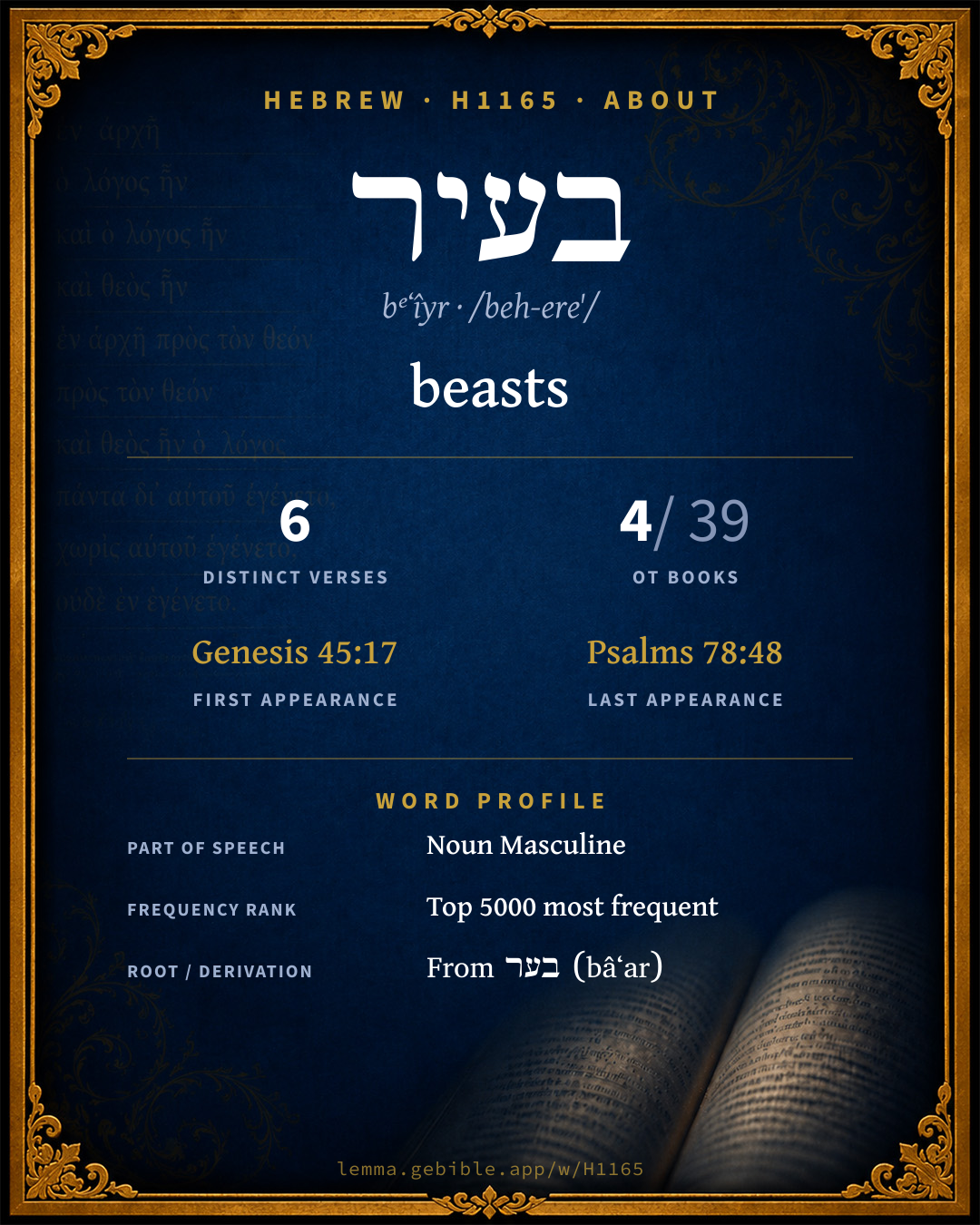
בְּעִיר
beasts
Full lexicon entry — Brown-Driver-Briggs (BDB)
From Brown-Driver-Briggs (BDB)
Where this word appears
Grammar key — what these labels mean
Part of speech
- Noun
- A naming word — a person, place, thing, or idea.
Noun type
- Common
- A common noun — a general class of person, place, or thing (“king,” “city,” “water”), not a specific name.
State
- Construct
- A noun bound to a following noun in a possessive / “of” relationship (the construct chain).
Gender
- Masculine
- Grammatically masculine.
Number
- Singular
- One.
Every verse where H1165 appears — 6 distinct verses across 4 books. Click any verse to open its interlinear word-by-word view. Verse text shown in the World English Bible for context — . Each verse’s Hebrew form is shown with its reference; the English is not keyword-highlighted, since the data carries no word-level English alignment. Use “Compare translations” on any verse to read it across multiple English versions. This concordance covers the Hebrew Bible; Septuagint (Greek Old Testament) occurrences are not indexed here.
Genesis 1 verse
Exodus 1 verse
Numbers 3 verses
- Numbers 20:4 וּ/בְעִירֵֽ/נוּ conj + n c ms cs + sfx pers 1cp Why have you brought the assembly of Yahweh into this wilderness, that we should die there, we and our animals?
- Numbers 20:8 בְּעִירָֽ/ם n c ms cs + sfx pers 3mp Take the rod, and assemble the congregation, you, and Aaron your brother, and speak you to the rock before their eyes, that it give forth its water; and you shall bring forth to them water out of the rock; so you shall give the congregation and their cattle drink.
- Numbers 20:11 וּ/בְעִירָֽ/ם conj + n c ms cs + sfx pers 3mp Moses lifted up his hand, and struck the rock with his rod twice: and water came forth abundantly, and the congregation drank, and their cattle.
Psalms 1 verse
About this entry
At a glance — auto-summarized from this page’s data, not written by a person. Every figure links to its source below. This summary describes the numbers; it doesn’t interpret them.
At its core, בעיר (bᵉʻîyr) means “beasts.” The word gravitates to Numbers (50%), then Genesis and Exodus. It appears 6 verses across 4 books of the Hebrew Bible, among its uncommon vocabulary. Scripture first uses it in Genesis 45:17. It clusters with בער, בער and בערה under a shared root. Dig into 6-verse concordance and the renderings breakdown below.
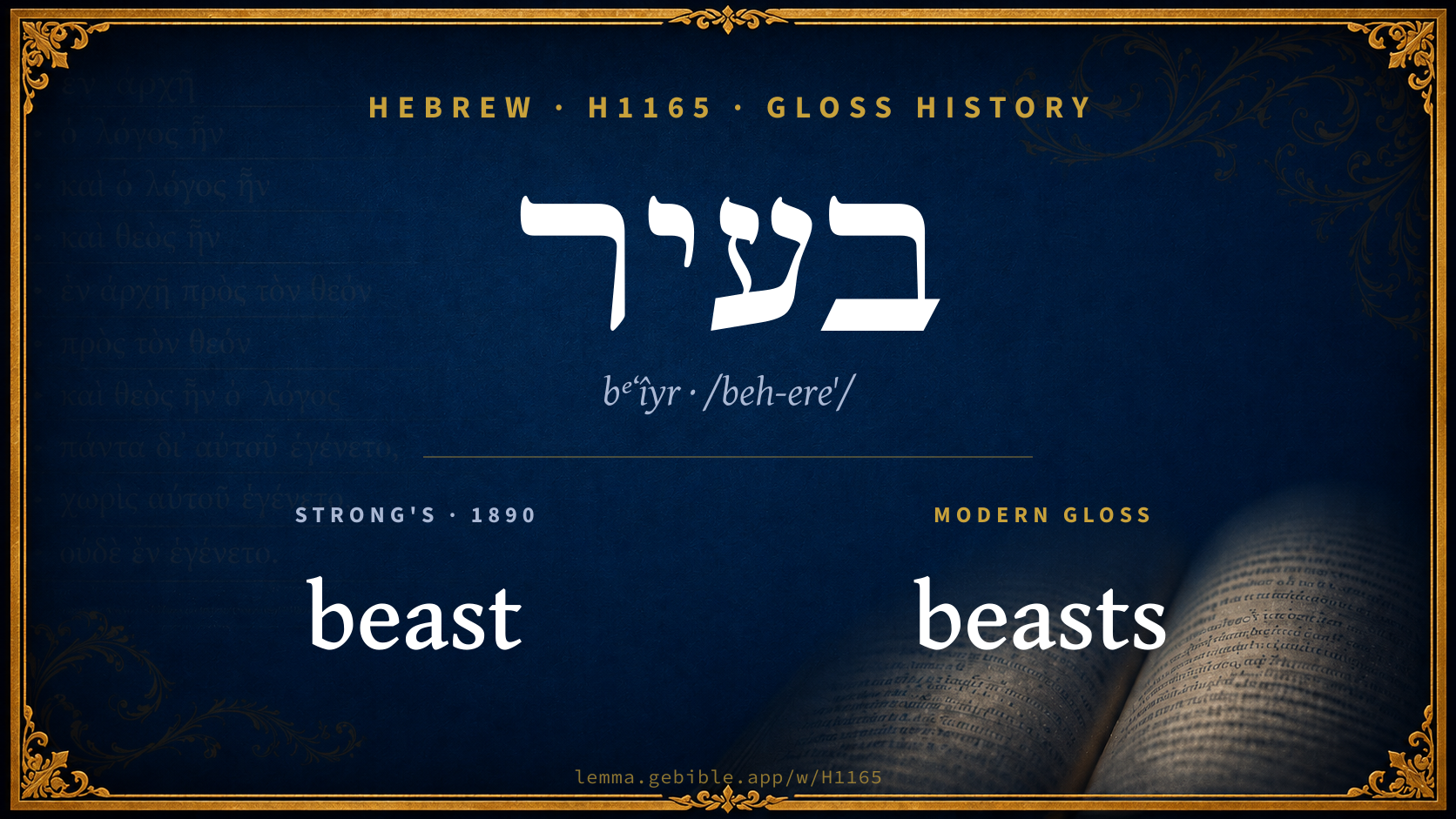
Gloss history
Strong's 1890 vs modern scholarship
About this word
Strong's H1165 catalogs a Hebrew word from the Hebrew Old Testament.
These counts are not copied from any lexicon or concordance. They are computed here, from the morphology-tagged Hebrew Old Testament. What Lemma adds →
- 6
- distinct verses
- The word appears in 6 distinct verses.
- 4 / 39
- OT books
- The word appears in 4 of 39 Old Testament books.
- #2,835
- by frequency
- Top 5000 most frequent Hebrew words (rank 2,835 of 8,640 Hebrew words by occurrence).
View all 6 occurrences in the concordance →
By section of the Old Testament
By traditional corpus
Conventional, traditional groupings — biblical authorship is debated, so this is a traditional corpus grouping, not an authorship claim. Each share is this word’s portion of its verses in that division of the Hebrew canon. Each figure is a share of the word’s 6 distinct verses.
- Torah (Pentateuch) 5 verses · 83%
- Writings (Ketuvim) 1 verse · 17%
How translations render this word
Counts come from each version’s own published word-to-Strong’s tagging or interlinear alignment — an approximate guide to how each version renders this word, not a word-level alignment the data otherwise carries. Because each total is that version’s own tagged count, the per-version totals vary from one another and need not match the appearance or distinct-verse counts above. These counts may also differ from a printed concordance because Lemma counts each distinctly tagged rendering and does not collapse phrase taggings into a single head-word total. This is a fixed set of word-tagged versions (KJV, ASV, BSB, ULT) and does not change with the reading translation you choose elsewhere. Each version’s license is shown beside its name below (and on Sources).
- King James Version: Beasts 3×
- American Standard Version: Cattle 2×
- Berean Standard Bible: Livestock 3×
- unfoldingWord Literal Text: Livestock 4×
King James Version Public Domain
Renders H1165 across 6 tagged occurrences — most commonly:
Plus 3 renderings that appear only once — usually multi-word phrases or single function words the recovered tagging swept in, not distinct renderings.
American Standard Version Public Domain
Renders H1165 across 5 tagged occurrences — most commonly:
Plus 3 renderings that appear only once — usually multi-word phrases or single function words the recovered tagging swept in, not distinct renderings.
Berean Standard Bible Public Domain
Renders H1165 across 6 tagged occurrences — most commonly:
Plus 3 renderings that appear only once — usually multi-word phrases or single function words the recovered tagging swept in, not distinct renderings.
unfoldingWord Literal Text CC BY-SA 4.0
Renders H1165 across 7 tagged occurrences — most commonly:
Plus 3 renderings that appear only once — usually multi-word phrases or single function words the recovered tagging swept in, not distinct renderings.
Senses in BDB
The 1 sense BDB distinguishes for this word, in lexicon order (not ranked by frequency or importance). The full entry — with sub-senses — is in the Lexicon Entry tab.
- beasts, cattle
Word origin
[ בְּעִיר ] n.m. beasts, cattle coll.
— Brown-Driver-Briggs (Oxford 1906, public domain), digitized via Sefaria, supplemented by the OpenScriptures HebrewLexicon (CC BY 4.0). See Sources.
Derived from בער (bâʻar) (H1197) — to burn.
Jastrow Dictionary
A second Hebrew/Aramaic lexicon for comparison, covering Aramaic and post-biblical (Talmudic, Targumic, Midrashic) usage that the biblical-Hebrew BDB does not. Matched by lemma rather than by Strong’s number, so a lemma may carry more than one Jastrow headword (shown separately below), and the entries cover usage well beyond the Bible.
בְּעֵיר
- , v. בְּעַר
בְּעִיר
- c. (b. h. בְּעִיר; בער; cmp. also בָּעָה) grazing animal, cattle. Targ. Gen. I, 24 sq.; a. fr.—Y. B. Mets. II, 8ᶜ bot.; Lev. R. s. 27, a. e. ב׳ דקיקא small cattle; v. בְּהֵמָה.—Pesik. B’shall. p. 93ᵃ אתקן לי ב׳ get an animal ready for me (for travel). Snh. 105ᵃ (in Hebr. dict., play on בְּעוֹר).
בְּעַר I
- 1. to burn. Targ. O. Ex. III, 2 בָּעַר ed. Berl. (oth. ed. בָּעֵר, Part). Targ. Is. LXII, 1. Targ. Ps. XVIII, 9; a. fr.
- 2. to remove; to dispose of. Pes. 5ᵇ בְּעִירוּ חמירא וכ׳ dispose ye of the leavened bread of the (gentile) soldiers (deposited with you).
- to enkindle, ignite. Targ. Ex. XXXV, 3. Targ. O. Lev. VI, 5 (Mss. a. some ed. יַבְעֵר Af.).
- same. Targ. O. Lev. VI, 5 (v. supra). *Targ. Y. I Gen. XV, 17 מַבְעִיר שביבין.
עֲיָירוֹת
- , pl. of עִיר.
*עַיִר
- (= h. עַיִר; v. עוּר; cmp. נַעַר) foal. Targ. Zech. IX, 9.—Pl. עַיְרִין. Targ. Jud. X, 4; v. עִיל.
עִיר I
- (עוּר) guardian, angel. Midr. Till. to Ps. CXVIII, 8 ולא ירד עמו לא ע׳ ולא שרף וכ׳ ed. Bub. (oth. ed. לא ע׳ ולא קדיש, borrowed from Dan. IV, 10) nor went down with him (Abraham) a guardian, or Seraph, or angel. Ib. to Ps. 1 (play on עיר, Gen. XI, 4) ואין ע׳ אלא אלוה ʿir means a deity (ref. to Dan. l. c.).—Pl. עִירִין. Pes. 33ᵃ (quot. fr. Dan. IV, 14) בגזירת ע׳ וכ׳ by the decree of the guardians (scholars) the word (is established) &c., i.e. they have so decided at college.—[עִיר awake, v. עוּר ch.] e.g. Daniel 4:10
עִיר II
- [watch-tower, fort,] town, city. B. Kam. 80ᵇ הלוקח ע׳ בארץ וכ׳ he who buys a township in Palestine, is bound by law to buy also the accesses to it on four sides. Snh. 17ᵇ כל ע׳ שאין בה עשרה וכ׳ in a town in which there are not the following ten things (institutions), a scholar is not permitted to live. Snh. I, 6 וכמה יהא בע׳ וכ׳ and how large must the population of a town be, to be fit as a seat for a Sanhedrin? Yoma 20ᵇ הָעִ׳ (Ms. M. רומי) the City of Rome; Pes. 119ᵃ בָּעִ׳ (Ms. M. ברומי) in Rome; a. v. fr.—Pl. עָרִים, עֲיָירוֹת. Tosef. Macc. III (II), 1; Macc. 9ᵇ שלש ע׳ הבדיל וכ׳ Moses set apart three towns (of refuge). Ib. II, 4, a. fr. עָרֵי מקלט, v. מִקְלָט. Meg. I, 1, sq.; a. fr.
A Dictionary of the Targumim, the Talmud Babli and Yerushalmi, and the Midrashic Literature (Marcus Jastrow; London, Luzac, 1903) — Public Domain. Digitized via Sefaria. Digitized via Sefaria. Full attribution on Sources.
Forms in the corpus
The 7 distinct written forms H1165 takes in the Hebrew Bible, most frequent first — each parse links to that state’s occurrences in the concordance. Hebrew forms include their vowel points and cantillation, so a single lemma takes many written forms.
| Form | Parsing | Example | Uses |
|---|---|---|---|
| בְּעִ֣ירְ/כֶ֔ם | Noun, Common, Masculine, Singular, Construct | Genesis 45:17 | 1 |
| בְּעִיר֔/וֹ | Noun, Common, Masculine, Singular, Construct | Exodus 22:5 | 1 |
| בְּעִירָ֑/ם | Noun, Common, Masculine, Singular, Construct | Psalms 78:48 | 1 |
| בְּעִירָֽ/ם | Noun, Common, Masculine, Singular, Construct | Numbers 20:8 | 1 |
| בעיר/ה | Noun, Common, Masculine, Singular, Construct | Exodus 22:5 | 1 |
| וּ/בְעִירֵֽ/נוּ | Noun, Common, Masculine, Singular, Construct | Numbers 20:4 | 1 |
| וּ/בְעִירָֽ/ם | Noun, Common, Masculine, Singular, Construct | Numbers 20:11 | 1 |
Same root — word family
Other BDB entries built from the same root as H1165, grouped by Strong’s listed origin. These share a root / origin per the lexicon — not necessarily a shared meaning. Each links to that word’s own entry.
Derives from
Shares the same root
Proper names from this root
People and places named from this root — a name, not an additional meaning of the word.
Compare all same-root words → Showing 4 of 6 — not the complete family. 2 of the same-root words are proper names (people or places). They share a root, not necessarily a meaning.
Septuagint verse parallels
This word appears in 5 verses that also exist in the Greek Old Testament (Septuagint), out of the 6 Hebrew verses it occurs in. You can read those verses in Greek by switching the Old Testament edition to the Septuagint.
Read these verses in the Septuagint
This is a verse-level parallel only — the same verses exist in both the Hebrew and Greek Old Testaments. No word-level Hebrew↔Greek correspondence is claimed: the data carries no such alignment, so no Greek word is shown as this Hebrew word’s translation. Coverage is not total — the Septuagint omits the deuterocanon and renumbers the Psalms, so some Hebrew verses have no direct Greek parallel.