Isaiah 1:31

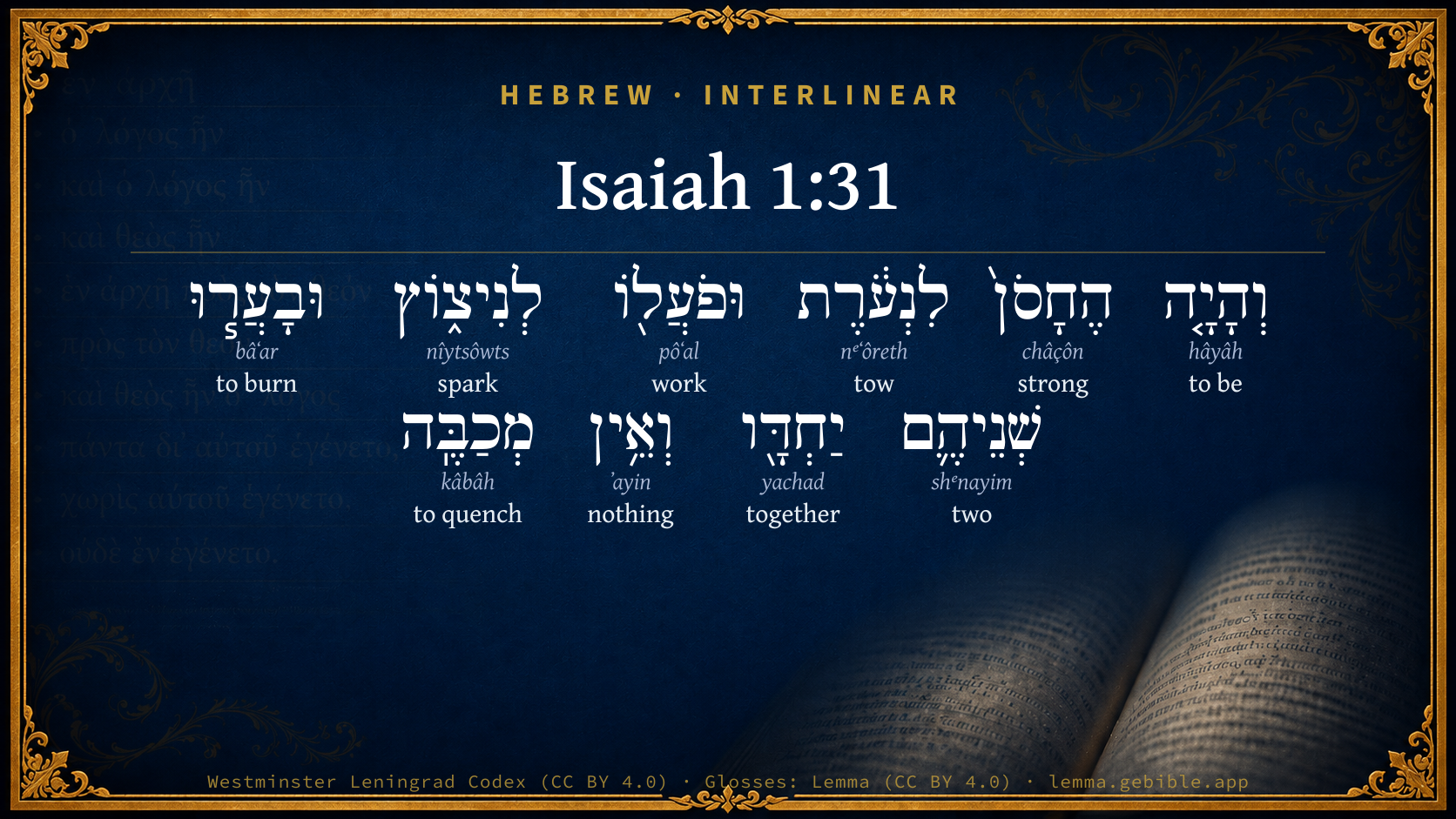
Hebrew (Westminster Leningrad Codex) Isaiah 1:31 appears in the Hebrew Old Testament. The text above is from the Westminster Leningrad Codex. Each word links to its Strong’s number, a concise gloss, and parsing drawn from the Open Scriptures Hebrew Bible morphology. Click any word for its full Brown-Driver-Briggs (BDB) entry.
Download image
Cite this verse

Isaiah 1:31 (World English Bible). Public Domain. Lemma interlinear Bible study tool, https://lemma.gebible.app/v/isaiah/1/31.

Show BibTeX & RIS
BibTeX
RIS
English Translation
The strong will be like tinder, And his work like a spark. They will both burn together, And no one will quench them."
World English Bible · Public Domain
Highlights Full analysis ↓
Download a study sheet

One document with this verse’s original text, its word-by-word gloss line, the meaning frame, cross-references with their text, attributed commentary, and full source and license credits — printable, and it pastes into notes with its structure intact.

This verse Autodidact and up

Study sheet (.html) Plain text (.txt)

A passage Seminary Student

Up to 50 verses in one chapter. A passage sheet keeps up to 6 commentary sources and 12 cross-references per verse, in the order this page ranks them, and says so on the sheet whenever that leaves anything out. Ask for a single verse and you get the Autodidact verse sheet above.

Everything on this page stays free to read, with no account — the sheet is a download of what is already on screen, not access to it.

Want to remove ads? Support Godless Engineer
Compare translations 3

The same verse in 3 English versions, stacked beneath the original-language interlinear above. Click any original word for its lexicon entry.

Each is an independent rendering of the whole verse — the interlinear is not word-aligned to these translations.

Highlighted words mark where these versions differ — a whole-verse word diff, not a word-by-word alignment.

  • World English Bible Public Domain
    The strong will be like tinder, And his work like a spark. They will both burn together, And no one will quench them."
  • King James Version Public Domain
    And the strong shall be as tow, and the maker of it as a spark, and they shall both burn together, and none shall quench them.
  • unfoldingWord Literal Text CC BY-SA 4.0
    And the strong will become tow, and his work, a spark, and the two of them will burn together, and there will be none extinguishing.

unfoldingWord Literal Text — © unfoldingWord, licensed CC BY-SA 4.0. Word-aligned USFM3 via Door43 (git.door43.org/unfoldingWord/en_ult).

Versions to compare (up to 4)

3 of 4 selected

Show all 18 translations

Every available English version of this verse, each an independent rendering of the whole verse.

  • World English Bible Public Domain
    The strong will be like tinder, And his work like a spark. They will both burn together, And no one will quench them."
  • Berean Standard Bible Public Domain
    The strong man will become tinder and his work will be a spark; both will burn together, with no one to quench the flames.
  • Majority Standard Bible Public Domain
    The strong man will become tinder and his work will be a spark; both will burn together, with no one to quench the flames.
  • King James Version Public Domain
    And the strong shall be as tow, and the maker of it as a spark, and they shall both burn together, and none shall quench them.
  • American Standard Version (1901) Public Domain
    And the strong shall be as tow, and his work as a spark; and they shall both burn together, and none shall quench them.
  • Revised Version (1885) Public Domain
    And the strong shall be as tow, and his work as a spark; and they shall both burn together, and none shall quench them.
  • Geneva Bible (1599) Public Domain
    And the strong shall be as towe, and the maker thereof, as a sparke: and they shall both burne together, and none shall quench them.
  • Douay-Rheims (1899) Public Domain
    And your strength shall be as the ashes of tow, and your work as a spark: and both shall burn together, and there shall be none to quench it.
  • Young's Literal Translation Public Domain
    And the strong hath been for tow, And his work for a spark, And burned have both of them together, And there is none quenching!
  • Literal Standard Version CC BY-SA 4.0
    And the strong has been for tow, || And his work for a spark, || And both of them have burned together, || And there is none quenching!
  • Unlocked Literal Bible CC BY-SA 4.0
    The strong man will be like tinder, and his work like a spark; they will both burn together, and no one will quench them.”
  • unfoldingWord Literal Text CC BY-SA 4.0
    And the strong will become tow, and his work, a spark, and the two of them will burn together, and there will be none extinguishing.
  • Darby Bible Public Domain
    And the strong shall be for tow, and his work a spark; and they shall both burn together, and there shall be none to quench [them].
  • World Messianic Bible Public Domain
    The strong will be like tinder, and his work like a spark. They will both burn together, and no one will quench them.”
  • Webster's Bible Public Domain
    And the strong shall be as tow, and the maker of it as a spark, and they shall both burn together, and none shall quench them.
  • Free Bible Version CC BY-SA 4.0
    Your strong people will become like tinder, and their work will become like a spark. They will burn together, and nobody will be able to put out the flames.
  • Bible in Basic English Public Domain
    And the strong will be as food for the fire, and his work as a flame; and they will be burned together, with no one to put out the fire.
  • JPS Tanakh (1917) Public Domain
    And the strong shall be as tow, and his work as a spark; and they shall both burn together, and none shall quench them.

Literal Standard Version (2020), Covenant Press — licensed CC BY-SA 4.0. Text via the HelloAO Bible API (eBible.org). Unlocked Literal Bible (unfoldingWord) — licensed CC BY-SA 4.0. Text via the HelloAO Bible API (eBible.org). unfoldingWord Literal Text — © unfoldingWord, licensed CC BY-SA 4.0. Word-aligned USFM3 via Door43 (git.door43.org/unfoldingWord/en_ult). Free Bible Version, Dr. Jonathan Gallagher — licensed CC BY-SA 4.0. Text via the HelloAO Bible API (eBible.org).

Word by word

More ways to search: Search by grammar → Find every occurrence → Compare this word →

Practice this passage: Drill this verse → Learn its vocabulary →

לְנִיצ֑וֹץ
nîytsôwts
H5213
“to/for · spark”
Preposition + Noun, Common, Masculine, Singular, Absolute
Part of Speech
Preposition + Noun
Type
Common
Gender
Masculine
Number
Singular
State
Absolute
Full BDB Definition

Origin: from H5340

TWOT: 1405a

spark
  1. וְהָיָ֤ה hâyâh H1961 “and · to be” Conjunction + Verb, Qal, Sequential Perfect, 3rd Person, Masculine, Singular
  2. הֶחָסֹן֙ châçôn H2634 “the · strong” Particle, Definite Article + Adjective, Adjective, Masculine, Singular, Absolute
  3. לִנְעֹ֔רֶת nᵉʻôreth H5296 “to/for · tow” Preposition + Noun, Common, Feminine, Singular, Absolute
  4. וּפֹעֲל֖וֹ pôʻal H6467 “and · work · his” Conjunction + Noun, Common, Masculine, Singular, Construct + Suffix, Personal, 3rd Person, Masculine, Singular
  5. וּבָעֲר֧וּ bâʻar H1197 “and · to burn” Conjunction + Verb, Qal, Sequential Perfect, 3rd Person, Common, Plural
  6. שְׁנֵיהֶ֛ם shᵉnayim H8147 “two · their” Adjective, Cardinal number, Masculine, Dual, Construct + Suffix, Personal, 3rd Person, Masculine, Plural
  7. יַחְדָּ֖ו yachad H3162 “together” Adverb
  8. וְאֵ֥ין ʼayin H369 “and · nothing” Conjunction + Particle, Negative
  9. מְכַבֶּֽה kâbâh H3518 “quenching” Verb, Piel, Participle Active, Masculine, Singular, Absolute

About this verse

These counts appear in no published source. They are computed here, from the morphology-tagged text and Lemma’s own curated glosses. What Lemma adds →

10
words
10
distinct lemmas
Prophets
section

Notable vocabulary

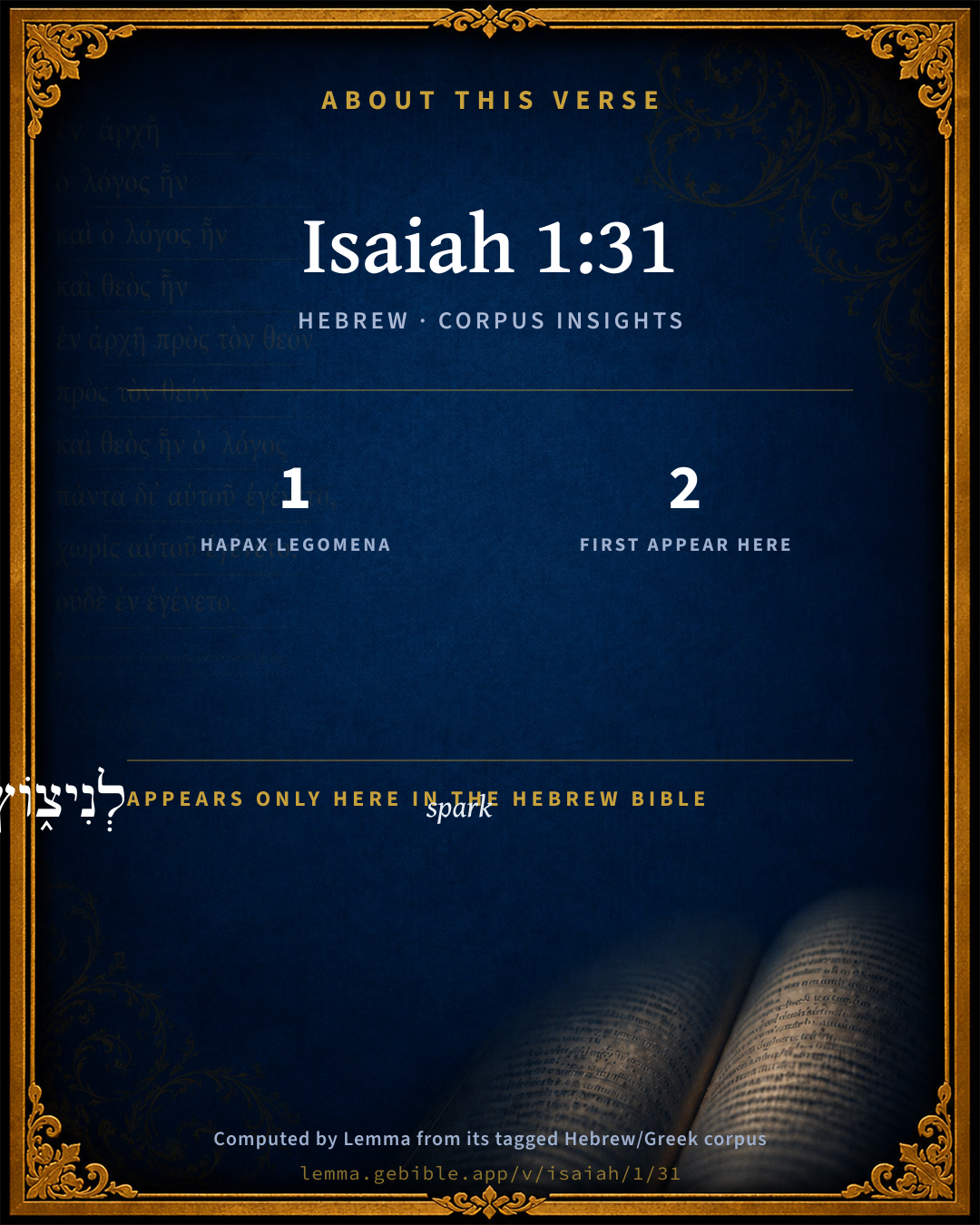
1 hapax legomenon — a word that appears only here in the entire Hebrew Bible:

  • לְנִיצ֑וֹץ spark H5213

First appearance in Scripture

These words make their first canonical appearance in the Hebrew Bible here:

  • הֶחָסֹן֙ strong H2634
  • לְנִיצ֑וֹץ spark H5213

Shared distinctive vocabulary

הֶחָסֹן֙ strong H2634 occurs in 2 verses of the Hebrew Bible. Also found in:

Grammatical profile

  • 3 verbs
  • 3 nouns
  • 2 adjectives
  • 1 adverb
  • 1 particle

Verb forms

  • וְהָיָ֤ה Qal · Sequential Perfect
  • וּבָעֲר֧וּ Qal · Sequential Perfect
  • מְכַבֶּֽה Piel · Participle Active

Hebrew & Septuagint length

In English translation the verse runs 23 words from the Hebrew and 34 from the Septuagint (LXX English) — the Septuagint runs noticeably longer here. See the side-by-side →

A rough comparison of the two English renderings, which tokenize alike — not a word-level alignment.

Word counts can differ between the Hebrew and the Greek without any difference in meaning — e.g. the Hebrew direct-object marker אֵת has no separate Greek word, and Greek often adds the article ὁ.

Cross-references

19

Topical passages linked to Isaiah 1:31 in the Treasury of Scripture Knowledge — connected by theme and wording, ordered by reader-vote popularity; previews shown in the World English Bible.

  • Isaiah 66:24 They shall go forth, and look on the dead bodies of the men who have transgressed against me: for their worm shall not die, neither shall their fire be quenched; and they shall be an abhorring to all flesh.
  • Ezekiel 32:21 The strong among the mighty shall speak to him out of the midst of Sheol with those who help him: they are gone down, they lie still, even the uncircumcised, slain by the sword.
  • Malachi 4:1 "For, behold, the day comes, it burns as a furnace; and all the proud, and all who work wickedness, will be stubble; and the day that comes will burn them up," says Yahweh of Hosts, "that it shall leave them neither root nor branch.
  • Judges 15:14 When he came to Lehi, the Philistines shouted as they met him: and the Spirit of Yahweh came mightily on him, and the ropes that were on his arms became as flax that was burnt with fire, and his bands dropped from off his hands.
  • Isaiah 5:24 Therefore as the tongue of fire devours the stubble, And as the dry grass sinks down in the flame, So their root shall be as rottenness, And their blossom shall go up as dust; Because they have rejected the law of Yahweh of Hosts, And despised the word of the Holy One of Israel.
  • Isaiah 9:19 Through the wrath of Yahweh of hosts is the land burnt up; and the people are as the fuel of fire: no man spares his brother.
  • Isaiah 26:11 Yahweh, your hand is lifted up, yet they don't see: but they shall see [your] zeal for the people, and be disappointed; yes, fire shall devour your adversaries.
  • Isaiah 27:4 Wrath is not in me: would that the briers and thorns were against me in battle! I would march on them, I would burn them together.
  • Isaiah 33:14 The sinners in Zion are afraid; trembling has seized the godless ones: Who among us can dwell with the devouring fire? who among us can dwell with everlasting burning?
  • Isaiah 34:9–10 The streams of [Edom] shall be turned into pitch, and the dust of it into sulfur, and the land of it shall become burning pitch.
  • Isaiah 43:17 who brings forth the chariot and horse, the army and the mighty man (they lie down together, they shall not rise; they are extinct, they are quenched as a wick):
  • Isaiah 50:11 Behold, all you who kindle a fire, who gird yourselves about with firebrands; walk you in the flame of your fire, and among the brands that you have kindled. This shall you have of my hand; you shall lie down in sorrow.
  • Ezekiel 20:47–48 and tell the forest of the South, Hear the word of Yahweh: Thus says the Lord Yahweh, Behold, I will kindle a fire in you, and it shall devour every green tree in you, and every dry tree: the flaming flame shall not be quenched, and all faces from the south to the north shall be burnt thereby.
  • Matthew 3:10 "Even now the axe lies at the root of the trees. Therefore, every tree that doesn't bring forth good fruit is cut down, and cast into the fire.
  • Mark 9:43–49 If your hand causes you to stumble, cut it off. It is better for you to enter into life maimed, rather than having your two hands to go into Gehenna, into the unquenchable fire,
  • Revelation 6:14–17 The sky was removed like a scroll when it is rolled up. Every mountain and island were moved out of their places.
  • Revelation 14:10–11 he also will drink of the wine of the wrath of God, which is prepared unmixed in the cup of his anger. He will be tormented with fire and sulfur in the presence of the holy angels, and in the presence of the Lamb.
  • Revelation 19:20 The beast was taken, and with him the false prophet who worked the signs in his sight, with which he deceived those who had received the mark of the beast and those who worshiped his image. These two were thrown alive into the lake of fire that burns with sulfur.
  • Revelation 20:10 The devil who deceived them was thrown into the lake of fire and sulfur, where the beast and the false prophet are also. They will be tormented day and night forever and ever.

Cross-references courtesy of OpenBible.info (CC BY 4.0).

Hebrew and Greek witnesses Masoretic Hebrew ↔ Greek Septuagint

The same verse in the two great witnesses to the Old Testament, shown verse-for-verse.

Here the Septuagint runs noticeably longer than the Hebrew — LXX2012 (modern English Septuagint) 34 words vs World English Bible 23. A rough length comparison of the two English translations, not a word-level alignment — read both below.

These are two independent witnesses, not word-aligned to each other, and the Septuagint is shown in lemma (dictionary) form.

Hebrew Isaiah 1:31 Masoretic · Westminster Leningrad Codex

וְהָיָ֤ה הֶחָסֹן֙ לִנְעֹ֔רֶת וּפֹעֲל֖וֹ לְנִיצ֑וֹץ וּבָעֲר֧וּ שְׁנֵיהֶ֛ם יַחְדָּ֖ו וְאֵ֥ין מְכַבֶּֽה

The strong will be like tinder, And his work like a spark. They will both burn together, And no one will quench them."

World English Bible · Public Domain

Greek LXX Isaiah 1:31 Septuagint · lemma form

καί εἰμί ὁ ἰσχύς αὐτός ὡς καλάμη στιππύον καί ὁ ἐργασία αὐτός ὡς σπινθήρ πῦρ καί κατακαίω ὁ ἄνομος καί ὁ ἁμαρτωλός ἅμα καί οὐ εἰμί ὁ σβέννυμι

And their strength shall be as a thread of tow, and their works as sparks, and the transgressors and the sinners shall be burnt up together, and there shall be none to quench them.

LXX2012 (modern English Septuagint) · Public Domain

On this verse, Keil & Delitzsch discusses the Septuagint’s reading. Read the note in Commentary ↓

Hebrew: Westminster Leningrad Codex (CC BY 4.0). Greek: Septuagint (public domain); English from LXX2012 (modern English Septuagint) (Public Domain). How the Septuagint differs from the Hebrew →

Targum (Aramaic paraphrase)

1

The Targum is the ancient Jewish Aramaic paraphrase of the Hebrew Scriptures — an interpretive translation, not the Hebrew text itself. Onkelos (literal) and Pseudo-Jonathan (expansive) render the Torah, and Jonathan the Prophets. Coverage is partial: where no permissively-licensed English translation exists for a verse, only the Aramaic is shown. This is verse-level text, not a word-by-word alignment to the Hebrew.

  1. Targum Jonathan Prophets (Joshua–Malachi)
    וִיהֵי תוּקְפֵיהוֹן דְרַשִׁיעַיָא כִּנְעוֹרֶת כִּתָּנָא וְעוֹבַד יֶדְהוֹן כְּנִיצוֹץ נוּרָא כְּמָא דִמְקָרְבִין דֵין לִסְטַר דֵין וְדָלְקִין תַּרְוֵיהוֹן כַּחֲדָא כֵּן יְסוּפוּן רַשִׁיעַיָא אִינוּן וְעוֹבָדֵיהוֹן בִּישַׁיָא וְלָא יְהֵא עֲלֵיהוֹן חַיָס:

    The strength of the wicked shall be as tow of flax, and the work of their hand as a spark of fire, when one approaches to the side of the other, both are burning together: thus the wicked shall be consumed, they and their evil works, and none shall have pity upon them.

    Targum Jonathan — Aramaic: “Mikraot Gedolot” (public domain). English: “Sefaria Community Translation” (CC0 1.0 (public-domain dedication)); “London "Chaldee Paraphrase," 1871” (public domain). Text via Sefaria.

Commentary

Notes on Isaiah 1:31 from classic Christian and Jewish commentators (each source and its license shown beneath its notes). The classic Christian expositions comment on the surrounding passage and are grouped to its opening verse, so a note may address several verses; the Jewish commentaries on the Tanakh (Rashi and others) are per-verse, so they appear only where the commentator wrote on this verse.

Lemma curates 59 commentaries, every one of them public domain or Creative Commons licensed, each selected and text-cleaned for this edition rather than reprinted as found. About our sources →

Trapp's Complete Commentary

John Trapp

Isa 1:31 And the strong shall be as tow, and the maker of it as a spark, and they shall both burn together, and none shall quench [them].

Ver. 31. And the strong shall be as tow.] The idol is here called the strong one, either by an irony, sicut siquis scelestum bonum virum dicat, as if one should say to a knave, You are a right honest man: or else according to the idolater’s false opinion of it, and vain expectation of it: like as in 2Ch 28:23, the gods of Damascus are said to have "smitten" or "plagued" Ahaz: not that they did so indeed (for an idol is "nothing in the world," and this strong in the text is weak as water, Jer 10:5 2Co 8:4), but he thought they did so like as the silly Papists also think of their male saints and female saints, whereof they have not a few, but are shamefully foiled and frustrated; besides that they are here and elsewhere threatened with unquenchable fire. Jerome, following Symmachus, for "tow," hath the "refuse of tow," which is quickly kindled.

And the maker of it.] Or, And his work - that is, all your pains taken to no purpose in worshipping your idols, and bringing your memories, as they are called, and presents to them.

And they shall both burn together.] As one saith of Aretine’s obscene book, that it is opus dignum quod cremetur cum authore, {a} fit for nothing but to make a bonfire to burn the author of it in. The beast and his complices shall be cast alive into the burning lake. {Rev 19:20}

And none shall quench them.] Hell fire is unquenchable. {Isa 30:33 Mat 3:12} This Origen denied, and is therefore justly condemned by all sound divines.

{a} Boissard. Biblioth.

John Trapp, A Commentary or Exposition upon All the Books of the Old and New Testament (1647–1656) — public domain. Text from a community e-Sword module.

The Biblical Illustrator

Joseph S. Exell

Isa_1:31

And the strong shall be as tow

The tinder, and the spark

The strong shall become tow, and his work a spark, and both shall burn together--a vivid picture of the doom of transgressors, since the mighty man is made combustible, and his own act is that which kindles the flame.

(T. W. Chambers, D. D.)

The fire of judgment

The fire of judgment that consumes sinners does not need to come from without; sin carries within itself the fire of wrath. (F. Delitzsch.)

The tow and the spark

These terrible words of warning are not levelled--

1. Against low and vile people (Isa_1:23-26). Nor--

2. Against the avowedly irreligious. The people addressed performed a multitude of sacrifices (Isa_1:11), were punctilious in their attendance on the house of God (Isa_1:12-14), were full of apparent devotion (Isa_1:15). Nor--

3. Do they refer to the grosser forms of sin. These would, of course, come under the same condemnation. But spiritual sins, though more refined to our perception, are more fatal even than sensual sins. It is preeminently a spiritualism in root, however sensual in fruit, that is here arrived at. It is all summed up in the one evil, forsaking the Lord (Isa_1:28). Consider--

I. THE RADICAL CHARGE SIN WORKS IN THE CONSTITUTION OF THE SINNER. Sin, the prophet says in effect, has a disintegrating, deteriorating, degrading influence upon the mans nature who yields to it. Tow is the coarse, broken part of flax or hemp--waste, refuse--It is used here in contrast to that which is strong--also as a pattern of what is inflammable.

1. Sin lowers the tone and tenor of our nature.

2. Sin, depraving and degrading the type and tenor of our nature, enfeebles our powers of resistance to the assaults of external evil. Sin is weakness as well as wickedness; weakness as the result of wickedness.

3. Sin imparts to us an increased susceptibility to evil--makes us more inflammable.

II. THE WAY IN WHICH THE SINNER AND HIS SIN COOPERATE FOR THEIR COMMON DESTRUCTION. Sin is ever multiplying itself between the sinner and his sinful deed. And the issue is irremediable ruin. They shall both burn together, and none shall quench them. The moral is, that if we would keep out of hell, we must keep out of sin. (W. Roberts, B. A.)

Sin weakens the strong

The Earl of Breadalbane planned the massacre of Glencoe, and carried it out in the most cruel and dastardly manner. Macaulay, speaking of the effects produced upon the mind of the perpetrator of this atrocious deed, says that Breadalbane, hardened as he was, felt the stings of conscience, or the dread of retribution. He did his best to assume an air of unconcern. He made his appearance in the most fashionable coffee house at Edinburgh, and talked loudly and self-complacently about the important services in which he had been engaged among the mountains. Some of his soldiers, however, who observed him closely, whispered that all this bravery was put on. He was not the man that he had been before that night. The form of his countenance was changed. In all places, at all hours, whether he waked or slept, Glencoe was ever before him. (Tools for Teachers.)

.

The Biblical Illustrator, edited by Joseph S. Exell (c. 1880s–1900s) — public domain. Text from a community e-Sword module.

Joseph Benson's Commentary

Isa 1:31. And the strong — The wisest, strongest, or richest persons among you, who think to secure themselves against the threatened danger by their wisdom, wealth, or power, and much more they that are weak and helpless; shall be as tow — Shall be as suddenly and easily consumed by God’s judgments as tow is by the fire. And the maker of it — The maker of the idol, who can neither save himself nor his workmanship; as a spark — To set it on fire: by his sin he shall bring himself to ruin. Or, as פעלו לניצוצ, may be rendered, his work shall become a spark, shall be the cause of his destruction. “The words are elegant, and the meaning of them is, that the rich, the powerful, the great, (meant by the word החסן, which we render strong,) who seemed like a lofty and well-rooted oak, shall perish with their works: for their works, their great and wicked undertakings, by which they had sought safety, like sparks, shall set them on fire and consume them like tow. They shall perish, like fools, by their own devices. The very works themselves, which they had raised for the glory and preservation of themselves and their republic, shall be turned into the very cause of their destruction. Vitringa thinks the prophet alludes to the destruction of their state and temple by the Romans.” — Dodd.

Joseph Benson's Commentary on the Old and New Testaments (1811–1818) — public domain. Text from a community e-Sword module.

The Preacher's Complete Homiletical Commentary

Joseph S. Exell (gen. ed.)

THE TOW AND THE SPARK

Isa_1:31. And the strong shall be as tow, and the maker of it as a spark, and they shall both burn together, and none shall quench them.

For the phrases “and the maker of it,” the margin reads, “and his work.” So Alexander and Henderson. This reading renders the passage intelligible in meaning and terrible in import. It then in simple, vivid manner sets forth the reciprocal influence of the sinner and his sin. The man in committing sin degrades and enfeebles himself, and then the sin he has committed reacts upon his degraded and enfeebled nature to kindle in it the fire of its corruption. It is worth observing that these terrible words of warning are not levelled

(1) against low and vile people. The term “strong” precludes that opinion. They are spoken against those who have been, or are still, esteemed, exalted, and powerful,—presumably against the princes, the judges, the counsellors of the nation (Isa_1:23-26). Nor are they spoken

(2) against the avowedly irreligious. The people addressed performed a multitude of sacrifices (Isa_1:11), were punctilious in their attendance on the house of God, &c. (Isa_1:12-14), were full of apparent devotion (Isa_1:15). Nor

(3) do they refer to the grosser forms of sin. These would of course come under the same condemnation. But spiritual sins, though more refined to our perception, are more fatal even than sensual sins. It is pre-eminently a spiritual sin in root, however sensual in fruit, that is here arrived at. It is all summed up in the one evil, “forsaking the Lord” (Isa_1:28). It is important to bear these considerations in mind if we would obtain personal and profitable application of these words. Consider—

I. The radical change sin works in the constitution of the sinner. Sin is lawlessness, an outbreak of self-will (1Jn_3:4). It is conscious wrongdoing (Jas_4:17). And sin, the prophet says in effect, has a disintegrating, deteriorating, degrading influence upon the man’s nature who yields to it. “The strong shall be as tow.” Tow is the coarse, broken part of flax or hemp—waste, refuse. Used here in contrast to that which is strong. Used also as pattern of what is inflammable.

1. Sin lowers the tone and tenor of our nature. Man’s nature is originally a very high nature. “A little lower than the angels” (Psa_8:5); a little lower than Divinity (see Alexander and Thrupp in loc.) Originally a king with all highest forms of existence grouped around his throne (Psa_8:6-8). He falls by sin. How low? To level of beasts that perish? (Psa_49:20). Lower than that (Isa_1:3). To level of trees and shrubs? Lower than that. See, that heap of coarse and tangled refuse was a plant once, a living thing. Now it is cut down, dried, dead; choicest parts gone, wasted! “Tow”—that is the symbol of the sinful man. The height from which he has fallen measures the degradation incurred. To that which is by nature “tow,” it is no degradation to be as “tow.” But for that which is “strong” to become as “tow”—for the highest of God’s creations to become as the lowest—this is disgraceful, dreadful.

2. Sin, depraving and degrading the type and tenor of our nature, enfeebles our powers of resistance to the assaults of external evil. Sin is weakness as well as wickedness; weakness as the result of wickedness. The “strong” becomes as “tow,” becomes weak. Hard to tell which is the worse to bear, the paroxysms of remorse, or the paralysis of power which the habit of sin engenders [487] To feel that when some “temptation comes and calmly states itself before us” we are helplessly a prey to it, is terrible indeed. The first sin of any kind greatly facilitates a second commission of the same [490] and every repetition increases that facility till the ease of doing it almost amounts to a practical inability to abstain from doing it [493] Sin gets dominion over us. Men are “sold under sin.”

3. Sin imparts to us an increased susceptibility to evil—makes us more inflammable. And Satan’s “fiery darts” striking, inflame us [496] Some counsellors advise young people to indulge in a certain measure of sin as a remedy for its enkindling impulses; they call it “sowing their wild oats.” A figure is sometimes the best vail for a fact. One would think that “sowing” would of itself suggest reproduction and multiplied reproduction (Gal_6:7-8). If you wish your nature to become hopelessly inflammable, utterly uncontrollable, give way to the indulgence of its hot impulses while you are young.

[487] One of the affecting features in a life of vice is the longing, wistful outlooks given, by the wretches who struggle with unbridled passions towards virtues which are no longer within their reach. Men in the tide of vice are sometimes like the poor creatures swept down the stream of mighty rivers, who see people safe on shore, and trees and flowers, as they go quickly past, and all things that are desirable gleam upon them a moment to heighten their trouble, and to aggravate their swift-coming destruction.—Beecher.

[490] A brand that has been once in the fire easily catches the second time.—Flavel, 1630–1696.

[493] Sin is like the descent of a hill, where every step we take increases the difficulty of our return. Sin, in its habits, becomes stronger every day—the heart grows harder, the conscience grows duller, the distance between God and the soul grows greater, and like a rock hurled from a mountain’s top, the further we descend we go down, and down, and down, with greater and greater rapidity.—Guthrie.

[496] It is in our own bosom that the power of temptation is found. Temptation is but a spark; and if a spark fall upon ice, if it fall upon snow, if it fall upon water, what is the harm of a spark? But if it fall upon powder—the powder is yours, the spark only is the devil’s.—Beecher.

The power of temptation is in proportion to the nature of the soul tempted. A thoughtless miner takes an uncovered light into the mine: where there is but little gas, there is but a wavering and flickering of a transient flame,—hardly flame, indeed; but where there is an accumulation of gas, the uncovered light occasions an explosion which shivers the rocks and brings swift destruction upon all who are in the mine. In both cases it was the same mine, the same miner, but the condition of the air was different. So is it with the fiery darts of the wicked one; they are shot into all human hearts, and just in proportion to the materials, so to speak, which are to be found there, will be the success or failure of the enemy.—Dr Parker.

Every commission of sin imprints upon the soul further disposition and proneness to sin; as the second, third, and fourth degrees of heat are more easily introduced than the first. Every one is both a preparative and a step to the next. Drinking both quenches the present thirst and provokes it for the future. When the soul is beaten from its first station, and the mounds and earthworks of virtue are once broken down, it becomes quite another thing from what it was before. In one single eating of the forbidden fruit, when the act is gone, yet the relish remains; and the remembrance of the first is an easy allurement to the second. One visit is enough to begin an acquaintance; and this point is gained by it, that when the visitant comes again, he is no more a stranger.—South, 1633–1716.

II. The way in which the sinner and his sin co-operate for their common destruction. We all know the influence of coming into contact with the instruments, the companions, the locality even, of a former sin. They stir up in us the memories, the emotions, the impulse to the same transgression. So the sinner goes about the world setting new snares for his feet at every turn as he sins. The relation of sin to the sinner and to his sinful deed is like that of a lamp placed between two mirrors, which reflect and re-reflect the light, till both the mirrors seem full of lamps. Sin is ever multiplying itself between the sinner and his sinful deed. And the issue is irremediable ruin. “They shall both burn together, and none shall quench them.” And the moral is, that if we would keep out of hell, we must keep out of sin.—W. Roberts, B.A.

The Preacher's Complete Homiletical Commentary (gen. ed. Joseph S. Exell; Funk & Wagnalls, c. 1892) — public domain (pre-1929). A full-Bible homiletical/sermon-outline anthology covering 65 of 66 books (2 John is absent from the source module). Text from a community e-Sword module.

Keil & Delitzsch

C. F. Keil & F. Delitzsch

Isa 1:31 shows in a third figure where this spark was to come from: "And the rich man becomes tow, and his work the spark; and they will both burn together, and no one extinguishes them." The form poalo suggests at first a participial meaning (its maker), but החסון would be a very unusual epithet to apply to an idol. Moreover, the figure itself would be a distorted one, since the natural order would be, that the idol would be the thing that kindled the fire, and the man the object to be set on fire, and not the reverse. We therefore follow the lxx, Targ., and Vulg., with Gesenius and other more recent grammarians, and adopt the rendering "his work" (opus ejus). The forms פּעלו and פּעלו (cf., Isa 52:14 and Jer 22:13) are two equally admissible changes of the ground-form פעלו (פּעלו). As Isa 1:29 refers to idolatrous worship, poalo (his work) is an idol, a god made by human hands (cf., Isa 2:8; Isa 37:19, etc.). The prosperous idolater, who could give gold and silver for idolatrous images out of the abundance of his possessions (Châson is to be interpreted in accordance with Isa 33:6), becomes tow (talm. "the refuse of flax:" the radical meaning is to shake out, viz., in combing), and the idol the spark which sets this mass of fibre in flames, so that they are both irretrievably consumed. For the fire of judgment, by which sinners are devoured, need not come from without. Sin carries the fire of indignation within itself. And an idol is, as it were, an idolater's sin embodied and exposed to the light of day.

The date of the composition of this first prophecy is a puzzle. Caspari thoroughly investigated every imaginary possibility, and at last adopted the conclusion that it dates from the time of Uzziah, inasmuch as Isa 1:7-9 do not relate to an actual, but merely to an ideal, present. But notwithstanding all the acuteness with which Caspari has worked out his view, it still remains a very forced one. The oftener we return to the reading of this prophetic address, the stronger is our impression that Isa 1:7-9 contain a description of the state of things which really existed at the time when the words were spoken. There were actually two devastations of the land of Judah which occurred during the ministry of Isaiah, and in which Jerusalem was only spared by the miraculous interposition of Jehovah: one under Ahaz in the year of the Syro-Ephraimitish war; the other under Hezekiah, when the Assyrian forces laid the land waste but were scattered at last in their attack upon Jerusalem. The year of the Syro-Ephraimitish war is supported by Gesenius, Rosenmller (who expresses a different opinion in every one of the three editions of his Scholia), Maurer, Movers, Knobel, Hvernick, and others; the time of the Assyrian oppression by Hitzig, Umbreit, Drechsler, and Luzzatto. Now, whichever of these views we may adopt, there will still remain, as a test of its admissiblity, the difficult question, How did this prophecy come to stand at the head of the book, if it belonged to the time of Uzziah-Jotham? This question, upon which the solution of the difficulty depends, can only be settled when we come to Isa 6:1-13. Till then, the date of the composition of chapter 1 must be left undecided. It is enough for the present to know, that, according to the accounts given in the books of Kings and Chronicles, there were two occasions when the situation of Jerusalem resembled the one described in the present chapter.

Keil & Delitzsch — Biblical Commentary on the Old Testament (1861–1891) — public domain (CC PDM 1.0). Text via the HelloAO Bible API. (Old Testament only.)

Geneva Bible (1599)

Geneva Bible translators

The false god, wherein ye put your confidence, shall be consumed as easily as a piece of tow.

Geneva Bible (1599) marginal notes — public domain. Text via Bolls.life.

Jamieson, Fausset & Brown

Robert Jamieson, A. R. Fausset & David Brown

strong--powerful rulers (Amo 2:9).

maker of it--rather, his work. He shall be at once the fuel, "tow," and the cause of the fire, by kindling the first "spark."

both--the wicked ruler, and "his work," which "is as a spark."

Next: Isaiah Chapter 2

Jamieson, Fausset & Brown — Commentary Critical and Explanatory on the Whole Bible (1871) — public domain (CC PDM 1.0). Text via the HelloAO Bible API.

Ellicott's Commentary for English Readers

(31) The maker of it as a spark.—Better, his work as a spark. The sin itself becomes the instrument of destruction. The mighty and the proud, who were foremost in the work of idolatry, and who did not repent, should perish with their work—i.e., with the idol which their hands had made. The tow and the spark are chosen as representing the most rapid form of combustion.

A Bible Commentary for English Readers, edited by Charles John Ellicott (1878–1897) — public domain. Text from a community e-Sword module.

John Gill's Exposition

And the strong shall be as tow,.... "that strong one", who is eminently so; the little horn, whose look is more stout than his fellows, Dan 7:20 the beast who had great power and authority given by the dragon, Rev 13:2 who shall be cast alive into the lake of fire; when he will be like tow in those devouring flames, easily, quickly, and irrecoverably consumed, Dan 7:11, Rev 19:20.

and the maker of it as a spark, or "his work"; so the Targum,

"and the work of their hands shall be as a spark of fire;''

or like the embers and ashes of a coal, which are blown away and lost at once: so antichrist, and all his evil works, as well as all his evil workers under him, will be entirely consumed: or, as it may be rendered, "he that wrought him": that is, Satan, for his coming is after the working of Satan; he has his seat, power, and authority, from the dragon, the old serpent, and the devil, and may be truly called a creature of his, Th2 2:9.

and they shall both burn together; both the pope and the devil in the lake of fire and brimstone, into which they will both be cast, Rev 20:10.

and none shall quench them; that fire will be unquenchable and everlasting; they will be tormented for ever and ever, and so will all the worshippers of the beast, Mat 25:41. The Chaldee paraphrase is,

"so the wicked shall be consumed, and their evil works, and there shall be no mercy upon them.''

Next: Isaiah Chapter 2

John Gill's Exposition of the Whole Bible (1746–1763) — public domain (CC PDM 1.0). Text via the HelloAO Bible API.

Albert Barnes' Notes on the Bible

And the strong - Those who have been thought to be strong, on whom the people relied for protection and defense - their rulers, princes, and the commanders of their armies.

As tow - The coarse or broken part of flax, or hemp. It means here that which shall be easily and quickly kindled and rapidly consumed. As tow burns and is destroyed at the touch of fire, so shall the rulers of the people be consumed by the approaching calamities.

And the maker of it - This is an unhappy translation. The word פעלו po‛ălô may be indeed a participle, and be rendered ‘its maker,’ but it is more commonly a noun, and means his work, or his action. This is its plain meaning here. So the Latin Vulgate, the Septuagint, and the Chaldee. It means, that as a spark enkindles tow, so the works or deeds of a wicked nation shall be the occasion or cause of their destruction. The ambition of one man is the cause of his ruin; the sensuality of a second is the cause of his; the avarice of a third is the cause of his. These passions, insatiable and ungratified, shall be the occasion of the deep and eternal sorrows of hell. So it means here, that the crimes and hypocrisy of the nation would be the real cause of all the calamities that would come upon them as a people.

Shall both burn together - The spark and the flame from the kindled flax mingle, and make one fire. So the people and their works would be enkindled and destroyed together. They would burn so rapidly, that nothing could extinguish them. The meaning is, that the nation would be punished; and that all their works of idolatry and monuments of sin would be the occasion of their punishment, and would perish at the same time. The “principle” involved in this passage teaches us the following things:

(1) That the wicked, however mighty, shall be destroyed.

(2) That their works will be the “cause” of their ruin - a cause necessarily leading to it.

(3) That the works of the wicked - all that they do and all on which they depend - shall be destroyed.

(4) That this destruction shall be final. Nothing shall stay the flame. No tears of penitence, no power of men or devils, shall “put out” the fires which the works of the wicked shall enkindle.

Albert Barnes' Notes on the Bible (1834–1885) — public domain. Text from a community e-Sword/MySword module.

Haydock's Catholic Bible Commentary

It. The efforts of Achan and Ezechias against the enemy proved in vain. (Calmet)

George Leo Haydock (1774–1849), Haydock's Catholic Family Bible and Commentary, 1859 edition — public domain. Excludes Psalms (Douay-Rheims chapter numbering differs from Protestant) and Deuterocanonical books (Catholic canon only).

Matthew Poole's English Annotations

The strong; either,

1. Your idols, which you think to be strong, and able to defend you, as appears by your confidence in them. Or,

2. The strongest persons among you, who think to secure themselves against the threatened danger by their wealth, or power, or wisdom; and much more they that are weak and helpless.

Shall be as tow; shall be as suddenly and easily consumed by my judgments as tow is by fire.

The maker of it; the maker of the idol, who can neither save himself nor his workmanship. Or,

his work; either all that he doth or can do, or that which he hath done, his wicked course of life, shall bring him to ruin.

Matthew Poole's English Annotations on the Holy Bible (1683–1685) — public domain. Text from a community e-Sword/MySword module.

Whedon's Commentary on the Bible

Daniel D. Whedon

31. And the strong — The “strong” men — “strong” rulers of the nation, of which the present rulers are the fit representatives.

As tow — Beaten flax. A symbol of weakness.

And the maker of it — Better, his work, as in the marginal reading. All that his skill has laboriously produced — whether his idols or worldly schemes.

A spark — As the “spark” which ignites the “tow.” No longer than this shall they endure — they shall go up in a flash and in smoke, and that shall be the end of them.

Such is the appropriate warning of the close of this preface to the body of prophecies following. “The hand of the Lord shall be known toward his servants, and his indignation toward his enemies.” Isa_66:14.

Daniel D. Whedon (gen. ed.), Commentary on the Old and New Testaments (1874–1909) — public domain. Text from a community e-Sword module.

The Pulpit Commentary

The strong (literally, the strong one) shall be as tow; i.e. weak and powerless, (comp. Jud_1:16:9) utterly unable to resist the Divinefiat when it goes forth. The maker of it. An extraordinary mistranslation, since poal never means anything but "work." His own acts would light the fire by which the "strong one" would be consumed and perish. "Nec lex justior ulla est, Quam necis artifices arts perire sua.

The Pulpit Commentary (1880–1919), ed. H.D.M. Spence-Jones & Joseph S. Exell — public domain. Text from a community e-Sword module.

John Wesley's Explanatory Notes

The strong - Your idols, which you think to be strong and able to defend you. As tow - Shall be as suddenly and easily, consumed by my judgments, as tow is by fire. The maker - Of the idol, who can neither save himself nor his workmanship.

John Wesley, Explanatory Notes Upon the Whole Bible (1754–1765) — public domain. Text via the GEBible commentary corpus.

J. A. Alexander on Isaiah

Joseph Addison Alexander

This verse contains a closing threat of sudden, total, instantaneous destruction to the Jewish idolaters, to be occasioned by the very things which they preferred to God, and in which they confided. “And the strong,” the mighty man, alluding no doubt to the unjust rulers of the previous context, “shall become tow,” an exceedingly inflammable substance, “and his work,” his idols, often spoken of in Scripture as the work of men’s hands, “shall become a spark,” the means and occasion of destruction to their worshippers, “and they shall burn both of them together, and there shall be no one quenching” or to quench them. The frequent mention of idols as the work of men’s hands, and the prominence given to idolatry in the immediately preceding context, seem to justify us in understanding the whole verse as a prediction that the very gods, in whom the strong men of Jerusalem now trusted, should involve their worshippers and makers with themselves in total, instantaneous, irrecoverable ruin.

Joseph Addison Alexander, The Prophecies of Isaiah (1846–1847; New York: Scribner, 1870–1878) — public domain. Text from a community e-Sword module.

unfoldingWord translationNotes

Door43 World Missions Community

General Information:

Isaiah speaks Yahweh's words to the people of Judah in the form of a poem. (See: Parallelism)

The strong man

"The strong person" or "Whoever is powerful." This may refer to people who are important and who influence other people.

tinder

dry material that burns easily

his work like a spark

This compares the person's deeds or evil works to a spark that falls on tinder and sets it on fire. AT: "his work will be like a spark that starts a fire" (See: Simile)

translationWords

quench

unfoldingWord translationNotes — © Distant Shores Media and the Door43 World Missions Community, licensed CC BY-SA 4.0. Source: git.door43.org/Door43/en_tn.

Rashi

Rabbi Shlomo Yitzchaki (Rashi)

the[ir] strength with which they take from the poor by force and rob them and strengthen themselves with the money. That money will become as tow, which is shaken out of the flax, which is light and easily ignited.

and its perpetrator The one who amasses this power will become as a spark of fire, and they will burn, one with the other. as a spark Heb. וּפֹעֲלוֹ לְנִיצוֹץ, estencele in O.F. [etincelle in modern French], a spark. Jonathan renders וְעוֹבַד יְדֵיהוֹן, and the work of their hands. This does not follow the Hebrew, however, for, were it so, it would have to be voweled וּפָעֳלוּ with a ‘kamatz- chatuf,’ a hurried ‘kamatz,’ and it would be explained as an expression of work. Now, that it is voweled with a ‘cholam,’ it is an expression of a worker, or perpetrator.

with no one to extinguish Jonathan renders: And no one will pity them.

Rashi on the Tanakh — English translations: “The Judaica Press complete Tanach with Rashi, translated by A. J. Rosenberg” (CC BY 4.0); “Pentateuch with Rashi's commentary by M. Rosenbaum and A.M. Silbermann, 1929-1934” (public domain); “The Metsudah Tanach series, Lakewood, N.J” (CC BY 4.0); and “The Book of Joshua, Metsudah Publications, 1997” (CC BY 4.0). Text via Sefaria.

Ibn Ezra

Rabbi Abraham ibn Ezra

החסון. The strong. Adjective; the substantive is חוסן strength.

נעורת Tow. That which is shaken off (נער to shake) from the flax.

לניצוץ As a spark (comp. Ez. 1:7). This verse refers to the idols, which are made strong, that they should not shake, but which those who formed them will burn in time of trouble, because they helped not; but the workmen themselves will likewise be burnt;..

this is meant by and they will both burn. (Comp. Exod. 3:3.)

And none shall quench. And none shall help.

Ibn Ezra on the Tanakh — English translations: “Sefaria Community Translation” (CC0 1.0 (public-domain dedication)); “Yalkut, Sifsei Chachomim Chumash, Metsudah Publications, 2009” (CC BY 4.0); and “Commentary of Ibn Ezra on Isaiah - trans. by M. Friedlander, 1873” (public domain). Text via Sefaria.

Lesson kit

Teaching starters — assembled from the data on this page, not authored interpretation. Every prompt links to the verse data it draws on. Edit before teaching.

Isaiah, in the Prophets, opens this verse with 10 words (10 distinct Hebrew lemmas). Its most distinctive word is nîytsôwts (“spark”). The Greek Septuagint runs longer here. A historical commentator’s framing appears above. Read the whole chapter for the surrounding context.

Discussion questions

  1. How does “spark” (nîytsôwts) shape what this verse is saying?
  2. This verse holds 1 word here found nowhere else in the Hebrew Bible. What might the rare word draw attention to?
  3. 2 words here appear for the first time in Scripture. What is being introduced at this debut?
  4. Amos 2:9 shares the word «strong» with this verse. How do the two illuminate each other?
  5. Compared with the Hebrew, the Septuagint runs longer here. What questions does that raise?
  6. These translations render this verse differently. What is at stake in choosing one wording over another?
  7. The verb «וְהָיָ֤ה» is Qal Sequential Perfect. How does its form color the action?
  8. Reading how Trapp's Complete Commentary and The Biblical Illustrator read this verse, where do the two commentators agree and where do they part?

Things to notice

  • 1 word in this verse appears nowhere else in the Hebrew Bible.
  • 2 words make their first canonical appearance in Scripture here.
  • These translations choose different wording for 15 words in this verse.
  • 10 distinct Hebrew lemmas span 10 words in this verse.

Reading settings

Reading text

Shown beneath each verse's original-language words.

Old Testament
Old Testament edition

Read the OT as the Masoretic Hebrew (MT) or the Greek Septuagint (LXX).

English shown for the Greek Septuagint (in the Hebrew ↔ Greek comparison).

Comparing translations? Open the Compare panel on any verse page to stack up to four side by side.