
Isaiah 6:13

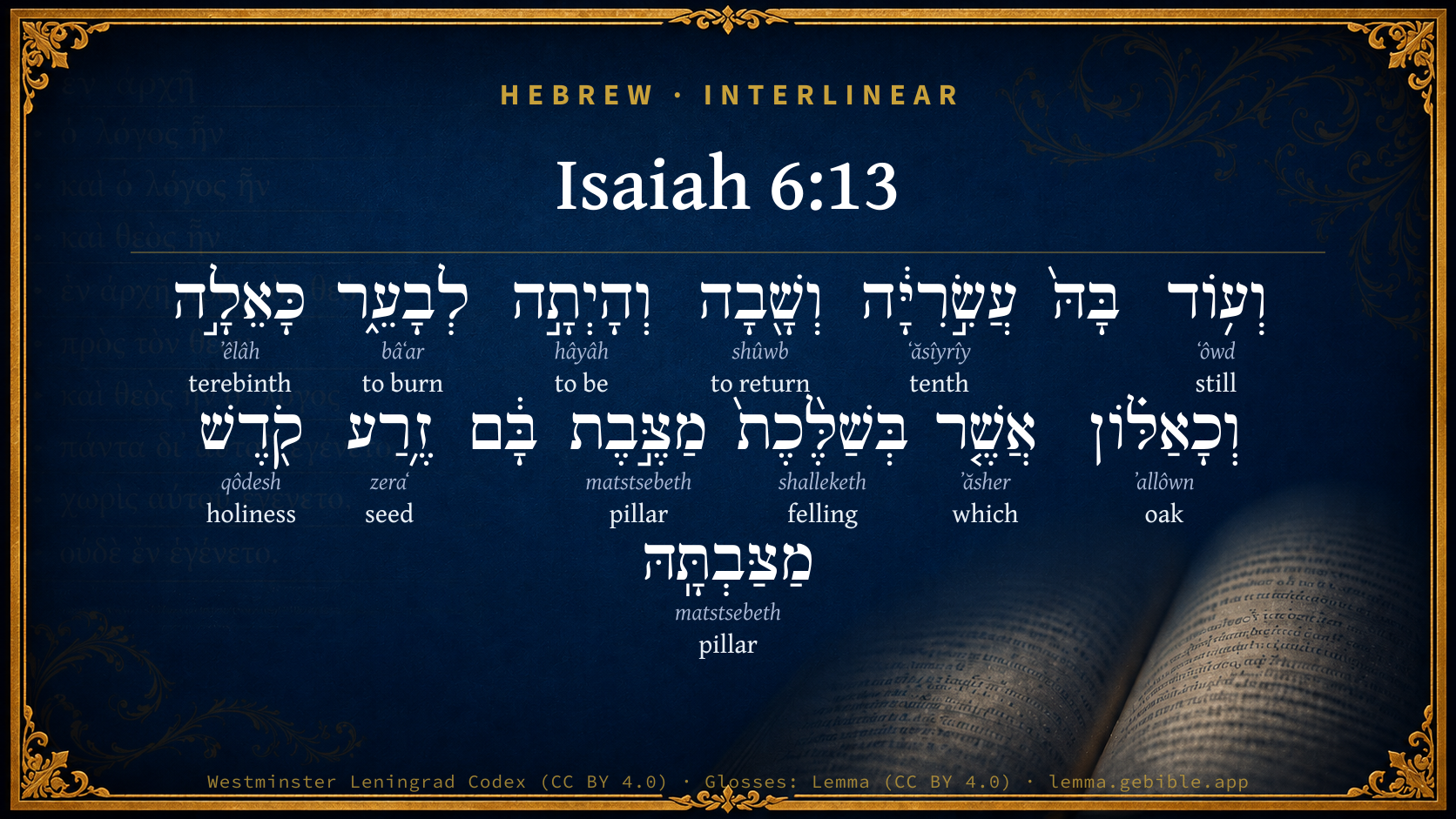
Hebrew (Westminster Leningrad Codex) Isaiah 6:13 appears in the Hebrew Old Testament. The text above is from the Westminster Leningrad Codex. Each word links to its Strong’s number, a concise gloss, and parsing drawn from the Open Scriptures Hebrew Bible morphology. Click any word for its full Brown-Driver-Briggs (BDB) entry.
Download image
Cite this verse

Isaiah 6:13 (World English Bible). Public Domain. Lemma interlinear Bible study tool, https://lemma.gebible.app/v/isaiah/6/13.

Show BibTeX & RIS
BibTeX
RIS
English Translation
If there are yet a tenth in it, It also shall in turn be eaten up: As a terebinth, and as an oak, whose stock remains, when they are felled; So the holy seed is its stock."
World English Bible · Public Domain
Highlights
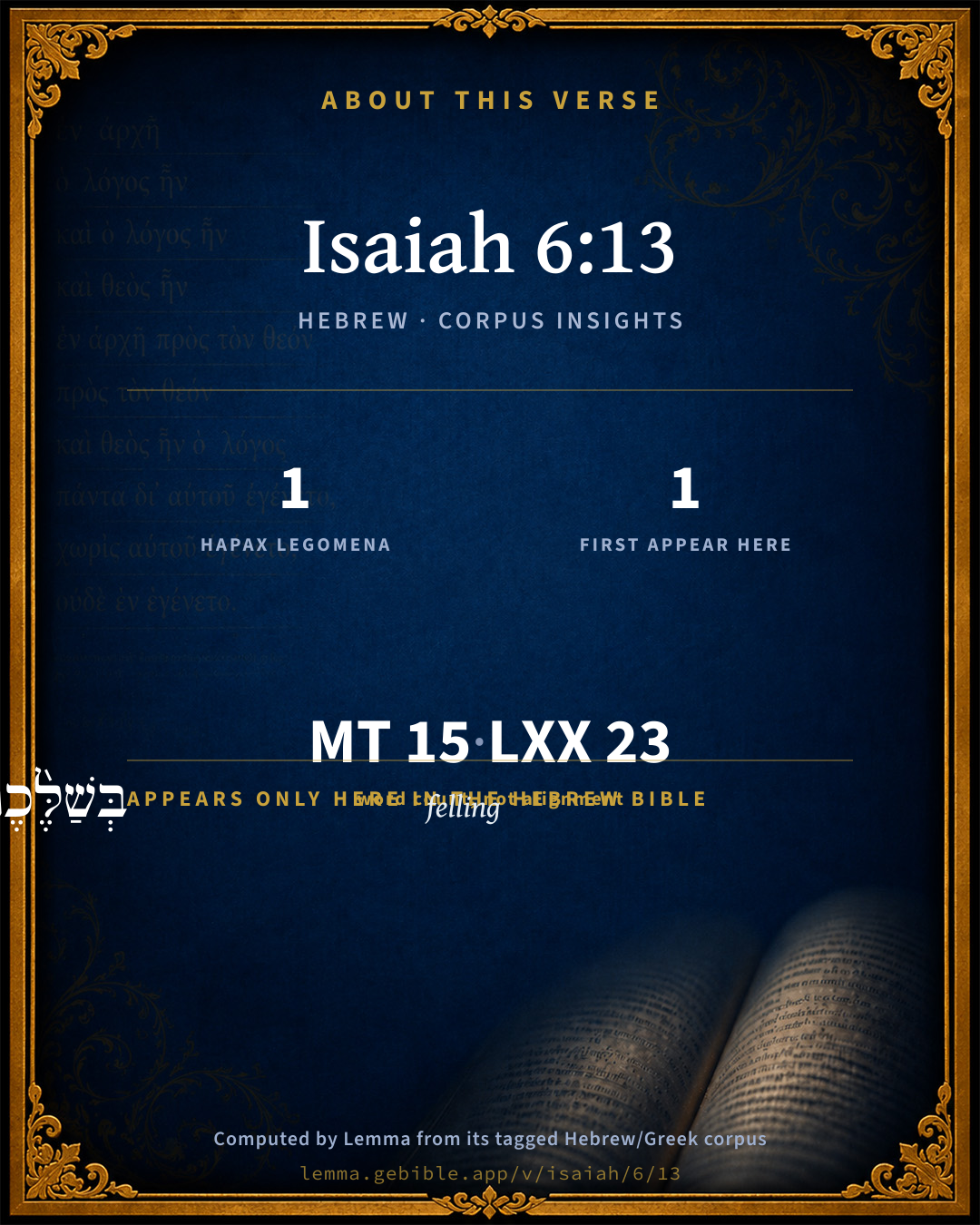
  • 1 hapax legomenon — only here in the Hebrew Bible
  • 1 first appearance in the Hebrew Bible
Full analysis ↓
Download a study sheet

One document with this verse’s original text, its word-by-word gloss line, the meaning frame, cross-references with their text, attributed commentary, and full source and license credits — printable, and it pastes into notes with its structure intact.

This verse Autodidact and up

Study sheet (.html) Plain text (.txt)

A passage Seminary Student

Up to 50 verses in one chapter. A passage sheet keeps up to 6 commentary sources and 12 cross-references per verse, in the order this page ranks them, and says so on the sheet whenever that leaves anything out. Ask for a single verse and you get the Autodidact verse sheet above.

Everything on this page stays free to read, with no account — the sheet is a download of what is already on screen, not access to it.

Want to remove ads? Support Godless Engineer
Compare translations 3

The same verse in 3 English versions, stacked beneath the original-language interlinear above. Click any original word for its lexicon entry.

Each is an independent rendering of the whole verse — the interlinear is not word-aligned to these translations.

Highlighted words mark where these versions differ — a whole-verse word diff, not a word-by-word alignment.

  • World English Bible Public Domain
    If there are yet a tenth in it, It also shall in turn be eaten up: As a terebinth, and as an oak, whose stock remains, when they are felled; So the holy seed is its stock."
  • King James Version Public Domain
    But yet in it shall be a tenth, and it shall return, and shall be eaten: as a teil tree, and as an oak, whose substance is in them, when they cast their leaves: so the holy seed shall be the substance thereof.
  • unfoldingWord Literal Text CC BY-SA 4.0
    If yet a tenth in it, then it will return and be for burning, like a terebinth and like an oak, which, in felling, a stump for them. The seed of holiness its stump.”

unfoldingWord Literal Text — © unfoldingWord, licensed CC BY-SA 4.0. Word-aligned USFM3 via Door43 (git.door43.org/unfoldingWord/en_ult).

Versions to compare (up to 4)

3 of 4 selected

Show all 18 translations

Every available English version of this verse, each an independent rendering of the whole verse.

  • World English Bible Public Domain
    If there are yet a tenth in it, It also shall in turn be eaten up: As a terebinth, and as an oak, whose stock remains, when they are felled; So the holy seed is its stock."
  • Berean Standard Bible Public Domain
    And though a tenth remains in the land, it will be burned again. As the terebinth and oak leave stumps when felled, so the holy seed will be a stump in the land.”
  • Majority Standard Bible Public Domain
    And though a tenth remains in the land, it will be burned again. As the terebinth and oak leave stumps when felled, so the holy seed will be a stump in the land.”
  • King James Version Public Domain
    But yet in it shall be a tenth, and it shall return, and shall be eaten: as a teil tree, and as an oak, whose substance is in them, when they cast their leaves: so the holy seed shall be the substance thereof.
  • American Standard Version (1901) Public Domain
    And if there be yet a tenth in it, it also shall in turn be eaten up: as a terebinth, and as an oak, whose stock remaineth, when they are felled; so the holy seed is the stock thereof.
  • Revised Version (1885) Public Domain
    And if there be yet a tenth in it, it shall again be eaten up: as a terebinth, and as an oak, whose stock remaineth, when they are felled; so the holy seed is the stock thereof.
  • Geneva Bible (1599) Public Domain
    But yet in it shalbe a tenth, and shall returne, and shalbe eaten vp as an elme or an oke, which haue a substance in them, when they cast their leaues: so the holy seede shall be the substance thereof.
  • Douay-Rheims (1899) Public Domain
    And there shall be still a tithing therein, and she shall turn, and shall be made a show as a turpentine tree, and as an oak that spreadeth its branches: that which shall stand therein, shall be a holy seed.
  • Young's Literal Translation Public Domain
    And yet in it a tenth, and it hath turned, And hath been for a burning, As a teil-tree, and as an oak, that in falling, Have substance in them, The holy seed `is' its substance!'
  • Literal Standard Version CC BY-SA 4.0
    And yet a tenth in it, and it has turned, || And has been for a burning, || As a teil-tree, and as an oak, that in falling, || Has substance in them, || The holy seed [is] its substance!”
  • Unlocked Literal Bible CC BY-SA 4.0
    Even if a tenth of the people remain in it, it will again be destroyed; as a terebinth or an oak is cut down and whose trunk remains, the holy seed is in its stump.”
  • unfoldingWord Literal Text CC BY-SA 4.0
    If yet a tenth in it, then it will return and be for burning, like a terebinth and like an oak, which, in felling, a stump for them. The seed of holiness its stump.”
  • Darby Bible Public Domain
    But a tenth part shall still be therein, and it shall return and be eaten; as the terebinth and as the oak whose trunk [remaineth] after the felling: the holy seed shall be the trunk thereof.
  • World Messianic Bible Public Domain
    If there is a tenth left in it, that also will in turn be consumed, as a terebinth, and as an oak whose stump remains when they are cut down, so the holy seed is its stump.”
  • Webster's Bible Public Domain
    But yet in it shall be a tenth, and it shall return, and shall be eaten: as a teil-tree, and as an oak whose substance is in them, when they cast their leaves: so the holy seed shall be the substance of it.
  • Free Bible Version CC BY-SA 4.0
    Even though a tenth of the population remains in the land, it will be destroyed again. But in the same way as the terebinth and oak trees leave stumps when they're cut down, so the holy seed will remain as a stump.”
  • Bible in Basic English Public Domain
    And even if there is still a tenth part in it, it will again be burned, like a tree of the woods whose broken end is still in the earth after the tree has been cut down (the holy seed is the broken end).
  • JPS Tanakh (1917) Public Domain
    And if there be yet a tenth in it, it shall again be eaten up; as a terebinth, and as an oak, whose stock remaineth, when they cast their leaves, so the holy seed shall be the stock thereof.'

Literal Standard Version (2020), Covenant Press — licensed CC BY-SA 4.0. Text via the HelloAO Bible API (eBible.org). Unlocked Literal Bible (unfoldingWord) — licensed CC BY-SA 4.0. Text via the HelloAO Bible API (eBible.org). unfoldingWord Literal Text — © unfoldingWord, licensed CC BY-SA 4.0. Word-aligned USFM3 via Door43 (git.door43.org/unfoldingWord/en_ult). Free Bible Version, Dr. Jonathan Gallagher — licensed CC BY-SA 4.0. Text via the HelloAO Bible API (eBible.org).

Word by word

More ways to search: Search by grammar → Find every occurrence → Compare this word →

Practice this passage: Drill this verse → Learn its vocabulary →

בְּשַׁלֶּ֨כֶת֙
shalleketh
H7995
“in/at · felling”
Preposition + Noun, Common, Feminine, Singular, Absolute
Part of Speech
Preposition + Noun
Type
Common
Gender
Feminine
Number
Singular
State
Absolute
Full BDB Definition

Origin: from H7993

TWOT: 2398b

felling (of tree)
  1. וְע֥וֹד ʻôwd H5750 “and · still” Conjunction + Adverb
  2. עֲשִׂ֣רִיָּ֔ה ʻăsîyrîy H6224 “tenth” Adjective, Ordinal number, Feminine, Singular, Absolute
  3. וְשָׁ֖בָה shûwb H7725 “and · to return” Conjunction + Verb, Qal, Sequential Perfect, 3rd Person, Feminine, Singular
  4. וְהָיְתָ֣ה hâyâh H1961 “and · to be” Conjunction + Verb, Qal, Sequential Perfect, 3rd Person, Feminine, Singular
  5. לְבָעֵ֑ר bâʻar H1197 “to burn” Preposition + Verb, Piel, Infinitive Construct
  6. כָּאֵלָ֣ה ʼêlâh H424 “like/as the · terebinth” Preposition, Determined + Noun, Common, Feminine, Singular, Absolute
  7. וְכָאַלּ֗וֹן ʼallôwn H437 “and · like/as the · oak” Conjunction + Preposition, Determined + Noun, Common, Masculine, Singular, Absolute
  8. אֲשֶׁ֤ר ʼăsher H834 “which” Particle, Relative
  9. מַצֶּ֣בֶת matstsebeth H4678 “pillar” Noun, Common, Feminine, Singular, Absolute
  10. זֶ֥רַע zeraʻ H2233 “seed of” Noun, Common, Masculine, Singular, Construct
  11. קֹ֖דֶשׁ qôdesh H6944 “holiness” Noun, Common, Masculine, Singular, Absolute
  12. מַצַּבְתָּֽהּ matstsebeth H4678 “pillar · her” Noun, Common, Feminine, Singular, Construct + Suffix, Personal, 3rd Person, Feminine, Singular

About this verse

These counts appear in no published source. They are computed here, from the morphology-tagged text and Lemma’s own curated glosses. What Lemma adds →

15
words
12
distinct lemmas
Prophets
section

Notable vocabulary

1 hapax legomenon — a word that appears only here in the entire Hebrew Bible:

  • בְּשַׁלֶּ֨כֶת֙ felling H7995

First appearance in Scripture

This word makes its first canonical appearance in the Hebrew Bible here:

  • בְּשַׁלֶּ֨כֶת֙ felling H7995

Shared distinctive vocabulary

מַצֶּ֣בֶת pillar H4678 occurs in 4 verses of the Hebrew Bible. Also found in:

Grammatical profile

  • 3 verbs
  • 7 nouns
  • 1 adjective
  • 2 prepositions
  • 1 adverb
  • 1 particle

Verb forms

  • וְשָׁ֖בָה Qal · Sequential Perfect
  • וְהָיְתָ֣ה Qal · Sequential Perfect
  • לְבָעֵ֑ר Piel · Infinitive Construct

Repetition

A word recurs within this verse — often emphatic in Hebrew:

  • מַצֶּ֣בֶת pillar H4678 ×2

Hebrew & Septuagint length

In English translation the verse runs 37 words from the Hebrew and 32 from the Septuagint (LXX English) — closely comparable.

A rough comparison of the two English renderings, which tokenize alike — not a word-level alignment.

Word counts can differ between the Hebrew and the Greek without any difference in meaning — e.g. the Hebrew direct-object marker אֵת has no separate Greek word, and Greek often adds the article ὁ.

In the original languages it is 15 Hebrew tokens and 23 Greek tokens — but the two are counted differently (Hebrew bundles its prefixes and suffixes into one token; the Greek is in lemma form), so that isn’t a like-for-like length.

Cross-references

16

Topical passages linked to Isaiah 6:13 in the Treasury of Scripture Knowledge — connected by theme and wording, ordered by reader-vote popularity; previews shown in the World English Bible.

  • Job 14:7–9 "For there is hope for a tree, If it is cut down, that it will sprout again, That the tender branch of it will not cease.
  • Romans 11:5–6 Even so then at this present time also there is a remnant according to the election of grace.
  • Genesis 22:18 In your seed will all the nations of the earth be blessed, because you have obeyed my voice."
  • Isaiah 65:8–9 Thus says Yahweh, As the new wine is found in the cluster, and one says, Don't destroy it, for a blessing is in it: so will I do for my servants' sake, that I may not destroy them all.
  • Romans 11:16–29 If the first fruit is holy, so is the lump. If the root is holy, so are the branches.
  • Ezra 9:2 For they have taken of their daughters for themselves and for their sons, so that the holy seed have mixed themselves with the peoples of the lands: yes, the hand of the princes and rulers has been chief in this trespass.
  • Isaiah 1:9 Unless Yahweh of hosts had left to us a very small remnant, We would have been as Sodom; We would have been like Gomorrah.
  • Galatians 3:16–19 Now the promises were spoken to Abraham and to his seed. He doesn't say, "To seeds," as of many, but as of one, "To your seed," which is Christ.
  • Galatians 3:28–29 There is neither Jew nor Greek, there is neither slave nor free man, there is neither male nor female; for you are all one in Christ Jesus.
  • Mark 13:20 Unless the Lord had shortened the days, no flesh would have been saved; but for the sake of the chosen ones, whom he picked out, he shortened the days.
  • Isaiah 4:3 It will happen, that he who is left in Zion, and he who remains in Jerusalem, shall be called holy, even everyone who is written among the living in Jerusalem;
  • Isaiah 10:20–22 It shall come to pass in that day, that the remnant of Israel, and those who are escaped of the house of Jacob, shall no more again lean on him who struck them, but shall lean on Yahweh, the Holy One of Israel, in truth.
  • Malachi 2:15 Did he not make one, although he had the residue of the Spirit? Why one? He sought a godly seed. Therefore take heed to your spirit, and let none deal treacherously against the wife of his youth.
  • Romans 9:5 of whom are the fathers, and from whom is Christ as concerning the flesh, who is over all, God, blessed forever. Amen.
  • John 15:1–3 "I am the true vine, and my Father is the farmer.
  • Matthew 24:22 Unless those days had been shortened, no flesh would have been saved. But for the sake of the chosen ones, those days will be shortened.

Cross-references courtesy of OpenBible.info (CC BY 4.0).

Hebrew and Greek witnesses Masoretic Hebrew ↔ Greek Septuagint

The same verse in the two great witnesses to the Old Testament, shown verse-for-verse.

These are two independent witnesses, not word-aligned to each other, and the Septuagint is shown in lemma (dictionary) form.

Hebrew Isaiah 6:13 Masoretic · Westminster Leningrad Codex

וְע֥וֹד בָּהּ֙ עֲשִׂ֣רִיָּ֔ה וְשָׁ֖בָה וְהָיְתָ֣ה לְבָעֵ֑ר כָּאֵלָ֣ה וְכָאַלּ֗וֹן אֲשֶׁ֤ר בְּשַׁלֶּ֨כֶת֙ מַצֶּ֣בֶת בָּ֔ם זֶ֥רַע קֹ֖דֶשׁ מַצַּבְתָּֽהּ

If there are yet a tenth in it, It also shall in turn be eaten up: As a terebinth, and as an oak, whose stock remains, when they are felled; So the holy seed is its stock."

World English Bible · Public Domain

Greek LXX Isaiah 6:13 Septuagint · lemma form

καί ἔτι ἐπί αὐτός εἰμί ὁ ἐπιδέκατος καί πάλιν εἰμί εἰς προνομή ὡς τερέβινθος καί ὡς βάλανος ὅταν ἐκπίπτω ἀπό ὁ θήκη αὐτός

And yet there shall be a tenth upon it, and again it shall be for a spoil, as a turpentine tree, and as an acorn when it falls out of its husk.

LXX2012 (modern English Septuagint) · Public Domain

On this verse, Adam Clarke's Commentary discusses the Septuagint’s reading. Read the note in Commentary ↓

Hebrew: Westminster Leningrad Codex (CC BY 4.0). Greek: Septuagint (public domain); English from LXX2012 (modern English Septuagint) (Public Domain). How the Septuagint differs from the Hebrew →

Targum (Aramaic paraphrase)

1

The Targum is the ancient Jewish Aramaic paraphrase of the Hebrew Scriptures — an interpretive translation, not the Hebrew text itself. Onkelos (literal) and Pseudo-Jonathan (expansive) render the Torah, and Jonathan the Prophets. Coverage is partial: where no permissively-licensed English translation exists for a verse, only the Aramaic is shown. This is verse-level text, not a word-by-word alignment to the Hebrew.

  1. Targum Jonathan Prophets (Joshua–Malachi)
    וְיִשְׁתַּאֲרוּן בָּהּ חַד מִן עַסְרָא צַדִיקַיָא וִיתוּבוּן וִיהוֹן לִצְרָבָא כְּבוּטְמָא וְכִבְלוֹטָא דִבְמִתַר טַרְפּוֹהִי דָמִין לְיַבְשִׁין וְעַד כְּעַן אִינוּן רַטִיבָן לְקַיָמָא מִנְהוֹן זַרְעָא כֵּן גָלוּתָא דְיִשְׂרָאֵל יִתְכַּנְשׁוּן וִיתוּבוּן לְאַרְעֲהוֹן אֲרֵי זַרְעָא דְקוּדְשָׁא נִצְבַתְהוֹן:

    And there shall be left in it righteous men, one out of ten: they shall return, and they shall be for poverty, as the terebynth and the oak when their leaves fall, they are like to dry trees, nevertheless, they are moist to raise up seed from them; thus the captivity of Israel shall be gathered, and shall return to their land, for the seed which is holy is their plantation.

    Targum Jonathan — Aramaic: “Mikraot Gedolot” (public domain). English: “Sefaria Community Translation” (CC0 1.0 (public-domain dedication)); “London "Chaldee Paraphrase," 1871” (public domain). Text via Sefaria.

Commentary

Notes on Isaiah 6:13 from classic Christian and Jewish commentators (each source and its license shown beneath its notes). The classic Christian expositions comment on the surrounding passage and are grouped to its opening verse, so a note may address several verses; the Jewish commentaries on the Tanakh (Rashi and others) are per-verse, so they appear only where the commentator wrote on this verse.

Lemma curates 59 commentaries, every one of them public domain or Creative Commons licensed, each selected and text-cleaned for this edition rather than reprinted as found. About our sources →

Trapp's Complete Commentary

John Trapp

Isa 6:13 But yet in it [shall be] a tenth, and [it] shall return, and shall be eaten: as a teil tree, and as an oak, whose substance [is] in them, when they cast [their leaves: so] the holy seed [shall be] the substance thereof.

Ver. 13. But yet in it shall be a tenth,] {a} i.e., Some elect left in the land for a reserve. And these are called a tenth - (1.) Because, as the tenths, they are consecrated to God; {Lev 27:30-32} (2.) Because but a few. So that God may say, as once of the cured lepers, "Where are the other nine?" Such were those that looked for the consolation of Israel when Christ came in the flesh, Zacharias, Simeon, Anna, the Marys, Joseph of Arimathea, the apostles, Peter’s converts, &c.

And it shall return and shall be eaten.] Or, It shall, after its return again, be burnt up or removed; so they were to some purpose by the Romans. See on Isa 6:12.

As a teil tree, or as an oak.] Trees that are durae ac durabiles, hard and long lasting; and although they lose their fruit and leaves, or be cut down, yet

Their substance is in them.] The substance of the matter, the sap remaineth in the trunk and root. {b} Some think there is an allusion in this text to a bank or causeway that went from the king’s house to the temple, and was borne up with trees planted on either side of it; which trees, as they kept up the causeway, so do the godly the state. {1Ch 26:16; 1Ch 26:18 1Ki 10:12 2Ch 9:11} Semen sanctum statumen terrae.

{a} It may be rendered God’s tenth. But what meant Lyra to argue from hence that tithes are due to the Church?

{b} In radice et caudice. - Junius, Piscator.

John Trapp, A Commentary or Exposition upon All the Books of the Old and New Testament (1647–1656) — public domain. Text from a community e-Sword module.

The Biblical Illustrator

Joseph S. Exell

Isa_6:13

But yet in it shall be a tenth, and it shall return

The remnant

In the worst of times God has a little remnant that kept their garments clean, and in the midst of the most sweeping and desolating calamities He will take special notice of it for good.

1. The remnant will be but small. A tenth. A certain number put for an uncertain. The tenth was Gods proportion under the law, consecrated for His use.

2. They shall return; i.e., from their sins and backslidings and the common defections of the Church of Israel. They shall return also from their captivity in Babylon to their native land.

3. It is asserted of this remnant that it shall be eaten; that is, say some, after they return they shall be devoured a second time by the kings of Assyria. Gods remnant, when they are delivered out of one trouble, must lay their account with another. Or, as some understand it, shall be accepted of God as the tithe was which was meat in Gods house. The saving of this remnant shall be meat to the faith and hope of them that wish well to Gods kingdom and interest.

4. It is said of this remnant, that it shall be as a teil, and as an oak whose substance is in them, even when they east their leaves. As if He had said, Though they may be stripped of their outward prosperity, and share in the common calamity; yet they shall recover like a tree in the spring, and sprout and flourish again: although they fall, they shall not be utterly cast down.

5. This distinguished remnant shall be the stay and support of the public interest. The holy seed shall be the substance thereof. (E. Erskine.)

How the religious of a nation are the strength of it

I. WHAT ARE WE TO UNDERSTAND BY THE RELIGIOUS OF A NATION?

1. Those who, as to the doctrine of Christianity, hold the Head.

2. Those who, as to the practice of Christianity, fear God and work righteousness.

II. HOW, AND IN WHAT RESPECTS, THEY MAY BE SAID TO BE ITS STRENGTH. The holy seed is here called the substance, or stock, of a people; so that in what respects the strength of a tree is in its stock, in those, or several of them, the strength of a people is in the religion of them.

1. The stock of a tree is the most firm and durable part of it.

2. The stock is that which propagates its kind. Cut off all the boughs, and yet the stem will shoot forth again, send out new leaves and fruit and seed, from which other trees will come. So here the righteous propagate their righteousness, communicate to others, beget children to God.

3. The stock of the tree is that for the sake of which the tree is dressed and watered and looked after. Men take care of the tree so long as there is life in the stock; they not only do not grub it up, but prune it, and bestow upon it what cost and labour is fit for it.

III. ON WHAT ACCOUNT THE RELIGIOUS OF A NATION MAY BE SAID TO BE ITS STRENGTH, or what influence they have on the welfare and security of a people.

1. As they are Gods favourites.

2. As they improve their interest with God for a people.

3. As they are a means many times to stop the current of wickedness, which is ready to overflow a land with judgments, and to bring swift destruction on it.

4. As they not only check the progress of sin, but propagate goodness to others, as well as promote it in themselves. This they do by their counsels, admonitions, example.

5. Sometimes the religious of a nation may have an influence upon its public welfare, by doing some eminent service, wherewith God is much pleased, and to which He hath a special respect. Phinehas stood up, and executed judgment: and so the plague was stayed (Psa_106:30).

6. God may sometimes spare a people for the sake of His children among them, that they may be useful and helpful to them in His work. This end God had in sparing the Gibeonites; He intended they should be hewers of wood and drawers of water for His sanctuary, and so assistant to the priests and Levites in their service (Jos_9:27). So, Isa_62:5,

7. God can make even Moab hide His outcasts (Isa_16:3-4); the earth help the woman (Rev_12:16); Ahab favour a good Obadiah, that he may hide the Lords prophets (1Ki_18:3-4); a heathen Cyrus let go His captives and build His city (Isa_14:13); a Darius, an Artaxerxes, an Ahasuerus, countenance and prefer a Daniel, a Nehemiah, a Mordecai, public instruments of good to His people. Sometimes God may so twist and combine the interest of worldly men with the interest of His children, that they cannot promote their own, without helping on the others.

IV. APPLICATION.

1. If the religious of a nation are the strength and defence of it, then the same may be said of the religious of the world,--they are the substance of it, the support, the strength of it. The world itself is preserved chiefly for the sake of the godly in it, the holy seed.

2. The religious of a nation are not its enemies.

3. The sinners of a nation are really the weakness of it.

4. It is the interest of any people where God hath a seed of righteous ones to favour them and make much of them.

5. It is folly in any people to persecute them that are truly religious. For by this means they lose--

(1) the benefit of the saints prayers;

(2) the help of the saints. (J. Collins, M. A.)

The doctrine of the remnant an antidote to discouragement

Though it belongs to the very essence of Biblical revelation, we find, we moderns, a strange difficulty in laying hold of it. In spite of the pathetic beauty of its exposition in Isaiah it never lays hold of us in our reasonable thinking, in our habitual imagination, as the truth of all truths in estimating and justifying the ways of Providence. We read these great and beautiful passages which tell of the remnant which shall return, to come again to Zion with joy and singing, and yet it does not fasten on us as the exhibition of a principle which should govern our conduct, and determine our growth, and solve our practical perplexities, and disperse depression and feed hope. Yet this is what it did to the prophets, and this is what it did to St. Paul. In every darkest hour, under every bewilderment, at every blow that smote the spirit of faith or wounded the heart of love, back they turned to this one prevailing theme--Never fear! Never give up! The remnant shall return; the remnant shall be saved. God has not forgotten His remnant, and in the safety of the remnant all is once more possible. The whole jeopardised salvation of Israel and the Church may yet be recovered. (H. Scott-Holland, D. D.)

Practical application of the idea of the remnant

Practically, in conduct, in handling your own lives, in dealing with your neighbours, surely this method of Gods should be yours also.

1. You are inclined to denounce the wickedness of the world, to despair of human nature, to abandon someone as hopeless, to see nothing in him that you can like or respect. Look again, consider it once more. Is there no place in that mans heart where you may touch him, no point at which he will reveal a good side? It is strange how men we thought to be the very worst surprise us here; constantly we come upon something generous that they do, some touch of loyalty, some sign of tenderness and devotion. There it is; that is the one hope! God need not despair of the man so long as he has one spot left on which to work. One saith: Destroy it not, for its blessing is in it--the blessed words of mercy said over the dead trunk of a tree, bare and wasted and burned with fire, a stump charred to the naked ground, yet destroy it not; its seed, its substance is in it! So long as that can be said over a man, strive for him, pray for him, work for him at that spot to rescue it, to enlarge it, to save it.

2. And do the same with yourself when you are despairing, when you review your life and condemn it at every point, when you can see no use whatever in renewing resolutions which you are sure to break, and efforts which already foretell their own disaster. Nevertheless, go back on the holy substance--Christ is in you, the eternal hope of honour. Yes, you will say, all else would have been lost but for that; verily, if God had not left me that seed, I should have been even as Sodom and Gomorrah, but, thanks be to God, it is not so; it never can be so if only I will believe it. (H. Scott-Holland, D. D.)

The leafless tree

The application--

I. TO THE JEWS. What a chequered history has been the history of the Jewish nation! Why is it that the Jewish race is preserved? We have our answer in the text: The holy seed is the substance thereof. There is something within a tree mysterious, hidden and unknown, which preserves life in it when everything outward tends to kill it. So in the Jewish race there is a secret element which keeps it alive. We know what it is; it is the remnant according to the election of grace.

II. TO THE CHURCH OF CHRIST, whereof the Jewish people are but a dim shadow and an emblem. The Church has had its trials; trials from without and trials within. Why is it that the Church is still preserved, when she looks so dead? For this reason: that there is in the midst of her--though many are hypocrites and impostors--a chosen seed, who are the substance thereof. Let me draw your attention, as a Church connected with this place, to this point--that the holy seed is the substance of the Church. A great many of you might be compared to the bark of the tree; some of you are like the big limbs; others are like pieces of the trunk. Well, we should be very sorry to lose any of you; but we could afford to do so without any serious damage to the life of the tree. Yet there are some here--God knoweth who they are--who are the substance of the tree. By theword substance it meant the life, the inward principle. The inward principle is in the tree, when it has lost its leaves. Now, God discerns some men in this Church, I doubt not, who are towards us like the inward principle of the oak: they are the substance of the Church. Note here, that the life of a tree is not determined by the shape of the branches, nor by the way it grows, but it is the substance. The shape of a Church is not its life. In one place I see a Church formed in an Episcopalian shape; in another place I see one formed in a Presbyterian shape; then, again, I see one formed on an Independent principle. Here I see one with sixteen ounces to the pound of doctrine; there I see one with eight, and some with very little clear doctrine at all. And yet I find life in all the Churches, in some degree--some good men in all of them. How do I account for this? Why, just inthis way--that the oak may be alive, whatever its shape, if it has got the substance. Observe, again, that the substance of the oak is a hidden thing; you cannot see it. Thou art a Church member. Let me ask thee--art thou one of the holy seed? Some will say, How is it that good men are the means of preserving the visible Church? I answer, the holy seed doth this, because it derives its life from Christ.

III. This is true of EVERY INDIVIDUAL BELIEVER: his substance is in him when he has lost his leaves.

1. Christian men lose their leaves when they lose their comforts. The faith of the Christian, when shrouded by doubts and fears, is just as much there as when he rejoiceth devoutly in the display of it.

2. Some Christians lose their leaves not by doubts, but by sin. Many a child of God has gone far away from his Master, but His substance is in him. (C. H.Spurgeon.)

Life in the root

A gentleman had a beautiful shrub in his garden. He set great store by it as the pride of his place. At the time of the great blizzard it was blasted and withered. The life of it seemed wholly gone. He did not give up hope, though there was nothing that gave him encouragement. But he loved that shrub, and longed to save it if he could. So what did he do? Tended it more than ever. Opened its roots to the genial sun, pruned it patiently and with care, cherished it all he possibly could. A year or two passed away. It was a slow and cheerless business, and he came near losing hope. But, one day, what was his joy to see signs of life returning. The sap began to rise, the stems to recover their spring, it put on fresh leaves, bloomed anew, and filled his heart with thankfulness. Be patient. God sees deeper than we do. (Sunday School Chronicle.)

A tall tree . . . an oak

The terebinth and the oak

The two most common forest trees of Palestine were the terebinth and oak. They were strong hardy trees. It was a matter of difficulty to kill them, so to cut and maim them as to take the substance or vitality out of them. So long as the trunk or stem was allowed to remain in the soil, they were sure, in course of time, to grow and flourish anew; and Isaiah was taught by God Himself that His people would be equally tenacious of life. The red rough hand of war might shake off the leaves and lop off the branches; It might also reduce the stem to the slenderest proportions; but the tree of Judah, at times a large fair tree, would not fall into a state of utter decay, and vanish away. Period after period there would be a tenth--a remnant, however diminutive, as many as would, by the blessing of Heaven, once more develop into a prosperous nation. Sooner or later, the judgments of God would have the desired effect, and the tree that had been hurt and peeled would give indications that it had not been deprived of all its substance or vitality. (G. Cron, M. A.)

The terebinth,

The terebinth, a beautiful tree, the Pistacia terebinthus, growing to a large size in the countries around the east end of the Mediterranean, and in countries further to the east, especially in Syria, Palestine, Arabia, and Persia. It is also called the turpentine tree, and a transparent, pleasant-smelling resin of high value is procured in small quantities from slits made in the bark of branches and stems. Its blossoms bloom in April, and its fruit is a small bluish nut with an edible kernel, much used and relished especially by the Persians. In Palestine it wag found in valleys, not in woods, but generally isolated. The name does not occur in the A.V., but the Hebrews elah, rendered in Isa_6:13 teil, and in Hos_4:13 elm, is most probably the terebinth. (J. Macpherson, M. A.)

So the holy seed shall be the substance thereof

The substance of a nation

The holy seed is the substance, the body, the life, the worth of any nation, any community, or any church.

I. First, therefore, we must contemplate THE HOLY SEED that we may know who they are.

1. This seed of God are they whom He has created anew by His Spirit, whom He has adopted into His family.

2. But this seed are evidenced and demonstrated by their holiness; they are the holy seed. Holiness signifies separation, seclusion, setting apart.

II. Our main point is to prove that THIS HOLY SEED IS, IN ANY COMMUNITY OR CHURCH, THE SUBSTANCE OF IT. The holy seed is the substance of a nation--

1. Because God regards all beside in a nation but as dross and foliage--dross without gold, foliage without fruit.

2. Because the holy seed alone diffuses a sanctifying, a saving and a savouring efficacy upon the land in which it is found.

3. Because for their sakes God spares a guilty land when otherwise His whole displeasure would be allowed to rise against it (ch. 1:9; Gen_18:23, etc.).

4. Because the holy seed are the spiritual warders of a nation, who watch with prayer, and stand in the breach and implore God that He should not destroy it. (H. Stowell, M. A.)

The holy seed

I. GIVE A DESCRIPTION OF THE REMNANT spoken of in the text.

1. A remnant is a small piece taken from a greater. The Church of Christ is a remnant separated from the rest of mankind.

2. This remnant is different from the rest of mankind in their character.

3. They are also under a different government.

4. They also stand on a different foundation.

5. They are under the influence of another spirit.

6. They are travelling quite a different road.

7. They come to a different end.

II. SHOW WHY THEY ARE CALLED A SEED. Because--

1. They owe their spiritual origin to God.

2. They bear His likeness. As every tree bringeth forth its natural fruit, he that is born of God will be like God.

3. They are in respect to their dependence on God. God grafts us into Jesus Christ, and we are therefore dependent upon Him for nourishment and strength, as the branch depends on the stock of the tree for support and sap to grow thereby.

4. Because they are of the family of God.

5. Because they are heirs of His estate.

III. SHOW WHY THEY ARE CALLED A HOLY SEED.

1. They are holy by sanctification. They are set apart.

2. Because of their purification.

3. Because the Spirit of God dwells in them.

IV. WHAT IS MEANT BY THIS SEED BEING DENOMINATED THE SUBSTANCE OF A LAND OR CHURCH?

1. By the word substance I think the prophet means treasure, or the chief part, or that which constitutes the welfare of a land--that in which the chief excellency or support or wealth of a nation consists. This is true of the people of God.

2. Further, it implies that they are Gods only inheritance in the world.

3. This seed is called a substance because it is the support and stay of a land or a church.

V. SHOW IN WHAT RESPECT THIS SEED MAY BE SAID TO BE THE STAY AND SUPPORT OF A LAND OR OF A CHURCH. For their sakes ruining calamities are withheld from those nations which deserve to be visited with the judgments of God (Gen_19:22; 2Sa_5:12; Gen_30:27; Gen_39:3; Mal_3:11). This remnant shall be the strength of the land by their prayers (Jer_29:7; 1Sa_7:9). (T. Bagnall-Baker, M. A.)

The present obligations of pious men

I. WHAT IS THE CONDUCT WHICH IT NOW BECOMES PIOUS MEN TO CULTIVATE AND DISPLAY. In order that they may sustain the honourable station which is assigned to them, they are to cultivate and display certain habits of thought and character appropriate to the season in which it is their lot to live.

1. Pious men should cultivate and display uncompromising separation from the practical wickedness which is around them.

2. Pious men ought to cultivate and display firm and unwavering attachment to the cardinal doctrines of the Christian faith.

3. Pious men ought to cultivate and display cordial, fraternal attachment towards each other.

4. Pious men ought to cultivate and display zealous exertion for the promotion of Christian truth and influence throughout the land.

II. WHAT ARE THE RESULTS WHICH, FROM THE CULTIVATION AND DISPLAY OF THIS CONDUCT, MAY BE PROPERLY ANTICIPATED. The holy seed shall be the substance thereof. Pious men are to be the safeguards of the national interests; and when the time of calamity has passed, those interests are to be maintained in security and in honour. God preserves nations for the sake of the pious men who are in them, and who duly display and vindicate their character.

1. Observe the anticipated results as they bear upon what is temporal and civil. There has not been a dynasty holding the reins of empire since genuine Christianity took its root amongst us, and there has not been a single reign of any one of those dynasties, but what might be summoned, as affording living testimony to the truth, that the temporal interests of the nation have been bound up with the piety of its people. Pious men will preserve--

(1) The order of our land.

(2) The freedom of our land.

(3) The peace of our land.

(4) The prosperity and honour of our land.

2. Notice the anticipated results as they bear upon matters spiritual and religious. Here the promise is more distinct and the consequences are more palpable.

(1) The defeat and destruction of erroneous opinions will be secured.

(2) The salvation of multitudes of immortal souls will be secured.

(3) Vastly increased facilities for the promotion of the Saviours kingdom throughout the earth will be secured. Conclusion--

1. The vast importance of being numbered amongst the holy seed yourselves.

2. Let us endeavour to arise to the performance of our obligations. (J. Parsons.)

The holy seed

1. The seed, like the tithe, is but little in respect of the rest of the field. Yet--

2. It is a numerous seed, absolutely considered in itself Rev_7:9).

3. It is an honourable seed.

4. A costly seed unto our glorious Redeemer.

5. A flourishing and fruitful seed.

6. A troubled and persecuted seed in this world.

7. Yet a very durable seed (Psa_89:28-29).

8. In this world a scattered seed.

9. A holy seed. (E. Erskine.)

The holy seed the substance

This imports--

1. That the wicked of a land are but a heap of lumber in Gods reckoning, whatever be their station, quality, or estate.

2. That the saints, the truly godly, in a land are excellent and valuable persons (Psa_16:3; Pro_12:26; Rev_3:4; Heb_11:38).

3. That the saints of are His inheritance and portion in a land. He has a peculiar right and property in them beyond the rest of mankind; they are so much His that they are not their own, and therefore have not power to dispose of themselves, but for His glory.

4. That as they are His portion and property, so He has a great deal of pleasure in them, even as a man takes delight and pleasure in that which is his substance.

5. That there is something in and about the godly that is not to be found among other men. The wicked, when laid in Gods balance, are found wanting solidity; but the holy seed are the substance, they bear weight.

6. That the remnant of truly godly in a land are the riches thereof, for a mans riches is his substance.

7. That the truly godly are the stay and support of the land where they live. (E. Erskine.)

The judgments threatened

We do not suppose that the prophet means to say that all the wicked men will be removed from captivity and the good men only left. (See on the contrary Jer_24:5-7.) He is dealing with the nation as representing the kingdom of God, and means to say that the coming judgments will weed out the worldliness and carelessness that prevail at present, will deepen true spiritual religion in Israel, and fit her to be the centre from which the truth and grace of God shall go forth to all the world. (P. Thompson, M. A.)

.

The Biblical Illustrator, edited by Joseph S. Exell (c. 1880s–1900s) — public domain. Text from a community e-Sword module.

Joseph Benson's Commentary

Isa 6:13. But yet in it shall be a tenth — A small remnant reserved, that number being put indefinitely. And it shall return — Out of the Babylonish captivity, into their own land. And shall be eaten — Or, shall be for a prey, as Dr. Waterland translates it: that is, that remnant shall be devoured a second time by the kings of Syria, and afterward by the Romans. Yet as a teil-tree, and as an oak, &c. — Yet there shall be another remnant, not such a one as that which came out of Babylon, but a holy seed, who shall afterward look upon him whom they have pierced, and mourn over him. Whose substance is in them when they cast their leaves, &c. — Who, when their leaves are cast in winter, have a substance within themselves, a vital principle, which preserves life in the root of the tree, and in due time sends it forth into all the branches. So the holy seed shall be the substance, or, rather, the support thereof — Of the people, who, were it not for the sake of these, should be finally rooted out and destroyed.

Joseph Benson's Commentary on the Old and New Testaments (1811–1818) — public domain. Text from a community e-Sword module.

Tyndale Open Study Notes

Tyndale Open Resources

6:13 Even if a tenth—a remnant—survive, the judgment would continue until nearly all were destroyed. The prophet often spoke of near extermination or decimation (9:18-21; 10:20; 22:4; 48:19; 51:18) but maintained the hope of a remnant who would make a new beginning (7:21-22; 29:23; 37:31; 44:26; 49:19; 54:1). • Israel’s stump will be a holy seed: The stump represents a remnant of holy people (see 4:2-3) whose new leader would be pleasing to the Lord (11:1).

Tyndale Open Study Notes — © Tyndale Open Resources, licensed CC BY-SA 4.0. Text via the HelloAO Bible API.

Geneva Bible (1599)

Geneva Bible translators

Meaning, the tenth part: or as some write, it was revealed to Isaiah for the confirmation of his prophecy, that ten Kings should come before their captivity, as were from Uzziah to Zedekiah.

For the fewness they shall seem to be eaten up: yet they shall after flourish as a tree, which in winter loseth leaves, and seemeth to be dead, yet in Summer is fresh and green.

Geneva Bible (1599) marginal notes — public domain. Text via Bolls.life.

Jamieson, Fausset & Brown

Robert Jamieson, A. R. Fausset & David Brown

and it shall return, and . . . be eaten--Rather, "but it shall be again given over to be consumed": if even a tenth survive the first destruction, it shall be destroyed by a second (Isa 5:25; Eze 5:1-5, Eze 5:12), [MAURER and HORSLEY]. In English Version, "return" refers to the poor remnant left in the land at the Babylonish captivity (Kg2 24:14; Kg2 25:12), which afterwards fled to Egypt in fear (Kg2 25:26), and subsequently returned thence along with others who had fled to Moab and Edom (Jer 40:11-12), and suffered under further divine judgments.

tell--rather, "terebinth" or "turpentine tree" (Isa 1:29).

substance . . . when . . . cast . . . leaves--rather, "As a terebinth or oak in which, when they are cast down (not 'cast their leaves,' Job 14:7), the trunk or stock remains, so the holy seed (Ezr 9:2) shall be the stock of that land." The seeds of vitality still exist in both the land and the scattered people of Judea, waiting for the returning spring of God's favor (Rom 11:5, Rom 11:23-29). According to Isaiah, not all Israel, but the elect remnant alone, is destined to salvation. God shows unchangeable severity towards sin, but covenant faithfulness in preserving a remnant, and to it Isaiah bequeaths the prophetic legacy of the second part of his book (the fortieth through sixty-sixth chapters).

In the Assyrian inscriptions the name of Rezin, king of Damascus, is found among the tributaries of Tiglath-pileser, of whose reign the annals of seventeen years have been deciphered. For the historical facts in this chapter, compare 2Ki. 15:37-16:9. Rezin of Syria and Pekah of Israel, as confederates, advanced against Jerusalem. In the first campaign they "smote Ahaz with a great slaughter" (Ch2 28:5). Their object was probably to unite the three kingdoms against Assyria. Egypt seems to have favored the plan, so as to interpose these confederate kingdoms between her own frontier and Assyria (compare Isa 7:18, "Egypt"; and Kg2 17:4, Hoshea's league with Egypt). Rezin and Pekah may have perceived Ahaz' inclination towards Assyria rather than towards their own confederacy; this and the old feud between Israel and Judah (Kg1 12:16) occasioned their invasion of Judah. Ahaz, at the second inroad of his enemies (compare 2Ch. 28:1-26 and Kg2 15:37, with Isa 16:5), smarting under his former defeat, applied to Tiglath-pileser, in spite of Isaiah's warning in this chapter, that he should rather rely on God; that king accordingly attacked Damascus, and slew Rezin (Kg2 16:9); and probably it was at the same time that he carried away part of Israel captive (Kg2 15:29), unless there were two assaults on Pekah--that in Kg2 15:29, the earlier, and that in which Tiglath helped Ahaz subsequently [G. V. SMITH]. Ahaz was saved at the sacrifice of Judah's independence and the payment of a large tribute, which continued till the overthrow of Sennacherib under Hezekiah (Isa 37:37; Kg2 16:8, Kg2 16:17-18; Ch2 28:20). Ahaz' reign began about 741 B.C., and Pekah was slain in 738 [WINER].

Next: Isaiah Chapter 7

Jamieson, Fausset & Brown — Commentary Critical and Explanatory on the Whole Bible (1871) — public domain (CC PDM 1.0). Text via the HelloAO Bible API.

Adam Clarke's Commentary

Verse 13. A tenth] This passage, though somewhat obscure, and variously explained by various interpreters, has, I think, been made so clear by the accomplishment of the prophecy, that there remains little room to doubt of the sense of it. When Nebuchadnezzar had carried away the greater and better part of the people into captivity, there was yet a tenth remaining in the land, the poorer sort left to be vine-dressers and husbandmen, under Gedaliah, 2Kg 25:12; 2Kg 25:22, and the dispersed Jews gathered themselves together, and returned to him, Jer 40:12; yet even these, fleeing into Egypt after the death of Gedaliah, contrary to the warning of God given by the prophet Jeremiah, miserably perished there. Again, in the subsequent and more remarkable completion of the prophecy in the destruction of Jerusalem, and the dissolution of the commonwealth by the Romans, when the Jews, after the loss of above a million of men, had increased from the scanty residue that was left of them, and had become very numerous again in their country; Hadrian, provoked by their rebellious behaviour, slew above half a million more of them, and a second time almost extirpated the nation. Yet after these signal and almost universal destructions of that nation, and after so many other repeated exterminations and massacres of them in different times and on various occasions since, we yet see, with astonishment, that the stock still remains, from which God, according to his promise frequently given by his prophets, will cause his people to shoot forth again, and to flourish. - L.

A tenth, עשיריה asiriyah. The meaning, says Kimchi, of this word is, there shall yet be in the land ten kings from the time of declaring this prophecy. The names of the ten kings are Jotham, Ahaz, Hezekiah, Manasseh, Amon, Josiah, Jehoahaz, Jehoiachin, Jehoiakim, and Zedekiah; then there shall be a general consumption, the people shall be carried into captivity, and Jerusalem shall be destroyed.

For בם bam, in them, above seventy MSS., eleven of Kennicott's, and thirty-four of De Rossi's, read בה bah, in it; and so the Septuagint.

Adam Clarke's Commentary on the Bible (1810–1826) — public domain. Text from a community e-Sword/MySword module.

Ellicott's Commentary for English Readers

(13) But yet in it shall be a tenth . . .—Better, And though there should be a tenth in it, yet this shall be again devoured (with fire). What the prophet is led to expect is a series of successive chastisements sifting the people, till the remnant of the chosen ones alone is left. (Comp. the same thought under a different imagery in Eze_5:12 : Zec_13:8-9.) The “tenth” is taken, as in Lev_27:30, for an ideally consecrated portion.

As a teil tree.—Better, terebinth; and for “when they cast their leaves” read, when they are cut down. The “teil tree” of the Authorised Version is probably meant for the “lime” (tilier, tilleul). The thought of this verse is that embodied in the name of his son Shear-jashub (see Note on Isa_7:3), and constantly reappears (Isa_1:27; Isa_4:2-3; Isa_10:20; Isa_29:17; Isa_30:15, &c). The tree might be stripped of its leaves, and its branches lopped off, and nothing but the stump left; but from that seemingly dead and decayed stock, pruned by the chastisements of God (Joh_15:2), a young shoot should spring, holy, as consecrated to Jehovah, and carry on the continuity of the nation’s life. The same thought is dominant in St. Paul’s hope for his people. At first the “remnant,” and then “all Israel,” should be saved (Rom_11:5; Rom_11:26). In Isa_10:33 to Isa_11:1 the same image is specially applied to the house of David, and becomes, therefore, essentially Messianic.

A Bible Commentary for English Readers, edited by Charles John Ellicott (1878–1897) — public domain. Text from a community e-Sword module.

The Cambridge Bible for Schools and Colleges

gen. ed. J. J. S. Perowne

13. The verse reads:

And should there still be in it a tenth,

It must again pass through the fire,

Like the terebinth and like the oak,

To which a stump (remains) when they are felled;

A holy seed is the stump thereof.

The last clause is wanting in the LXX., and with its omission it undoubtedly becomes possible to understand the figure of the verse as a sentence of final rejection; not only will the tree be cut down, but its stump will be destroyed by fire. The usual interpretation (which there is no reason to abandon) is: As the terebinth and oak when cut down retain the principle of vitality in their roots, which will again spring up into a great tree (cf. Job_14:7 ff.), so the ruined Israel contains the indestructible germ of the future kingdom of God, the “holy seed” is wrapped up in it. The difference is not material, since in any view Isaiah speaks of an extermination of the actually existing people: but the first explanation excludes Isaiah’s characteristic doctrine of the Remnant, which we should certainly expect to find in his inaugural vision. It must have been shortly after this time that he gave a significant expression to that doctrine in the name of his son Shear-jashub (see on next chapter).

a tenth] Perhaps an allusion to Amo_5:3.

A symbolical representation of the idea of this verse is given in Eze_5:1-4. Cf. also Zec_13:8.

The Cambridge Bible for Schools and Colleges (gen. ed. J. J. S. Perowne; Cambridge University Press, 1878–1918) — public domain. Text from a community e-Sword module.

John Gill's Exposition

But yet in it shall be a tenth,.... Which some understand of ten kings that should reign over Judah from this time, the death of Uzziah, unto the captivity, as Jarchi and Aben Ezra observe; and which are, as Kimchi reckons them, as follows, Jotham, Ahaz, Hezekiah, Manasseh, Amon, Josiah, Jehoahaz, Jehoiakim, Jehoiachin, Zedekiah; but the prophecy, as we have seen, respects not the captivity of the Jews in Babylon, but their present one; wherefore the words are to be understood of a few persons, a remnant, according to the election of grace, that should be called, and saved amidst all the blindness, darkness, and destruction that should come upon that people; and may be illustrated by the words of the apostle in Rom 11:5 and these chosen, called, and saved ones, are the "tenth", that is, the Lord's tenth, as the words may be rendered (r). To this sense the Targum agrees,

"and there shall be left in it righteous persons, one out of ten;''

though indeed the Christians were not left in Jerusalem when it was destroyed, but were called out of it just before, and were preserved from that ruin.

And it shall return, and shall be eaten; or "be for burning". I should choose to render it, "it shall return, and be burnt" (s); that is, it shall be burnt again; it was burnt a first time by Nebuchadnezzar king of Babylon, and his army, Jer 52:13 and a second time by Titus Vespasian, to which this prophecy refers:

as a teil tree, and as an oak, whose substance is in them, when they cast their leaves; the word "Beshallecheth", which we render, "when they cast their leaves", is by some, as Jarchi, Aben Ezra, and Kimchi observe, thought to be the name of a gate in Jerusalem, called "Shallecheth", from which a causeway went towards the king's palace, from whence it had its name, Ch1 26:16 and along which causeway, as is supposed, were planted teil trees and oaks, which are here referred to. But the Targum, Jarchi, and Kimchi, interpret the word as we do, of casting their leaves: and the sense seems to be this; that as the teil tree and oak, when they cast their leaves in autumn, and look as if they were dry, withered, and dead, yet have a substance in them, and in spring appear alive and green, and flourishing again; so the Jews, notwithstanding their miserable destruction by the Romans, when they were stripped of all their riches and glory, yet were not utterly consumed as a people, but remained an entire distinct people, and do so to this day, among the nations of the world; though, like a dry withered trunk of a tree, without verdure or beauty; the reason of this follows:

so, or "because",

the holy seed shall be the substance thereof; that is, they shall subsist, or continue a distinct people, though in this miserable condition; because there is a "holy seed", or a certain number, whom God has chosen to be holy, that is to arise from them, and will be called and converted in the latter day; hence they have a substance, a subsistence, and shall remain till that comes, and that chosen remnant is called and saved, Rom 11:25. The Targum is,

"as the elm and oak, when their leaves fall, and are like to dry "trees", and yet are moist to raise up seed from them; so the captivities of Israel shall be gathered, and shall return to their land; for the seed which is holy is their plantation.''

Some, interpreting the passage of the Babylonish captivity, by the "holy seed" understand the Messiah. See Luk 1:35 (t).

(r) "decima ejus", i.e. Dei. (s) "et convertatur sitque in incendium", Syr.; "ad conflagrandum", Montanus; "ad urendum", De Dieu. (t) Ericus Phaletranus de ablat. Sceptr. Jud. in Graev. Syntag. p. 437.

Next: Isaiah Chapter 7

John Gill's Exposition of the Whole Bible (1746–1763) — public domain (CC PDM 1.0). Text via the HelloAO Bible API.

Albert Barnes' Notes on the Bible

But yet ... - The main idea in this verse is plain, though there is much difficulty in the explanation of the particular phrases. The leading thought is, that the land should not be “utterly” and finally abandoned. There would be the remains of life - as in an oak or terebinth tree when the tree has fallen; compare the notes at Isa 11:1.

A tenth - That is, a tenth of the inhabitants, or a very small part. Amidst the general desolation, a small part should be preserved. This was accomplished in the time of the captivity of the Jews by Nebuchadnezzar. We are not to suppose that “literally” a tenth part of the nation would remain; but a part that should bear somewhat the same proportion to the entire nation, in strength and resources, that a tenth does to the whole. Accordingly, in the captivity by the Babylonians we are told 2Ki 25:12, that ‘the captain of the guard left the poor of the land to be vinedressers and farmers;’ compare 2Ki 24:14, where it is said, that ‘Nebuchadnezzar carried away all Jerusalem, and all the princes, and all the mighty men of valor, even ten thousand captives, and all the craftsmen and smiths, none remained save the poorer sort of the people of the land.’ Over this remnant, Nebuchadnezzar made Gedaliah king; 2Ki 25:22.

And it shall return - This expression can be explained by the history. The prophet mentions the “return,” but he has omitted the fact that this remnant should go away; and hence, all the difficulty which has been experienced in explaining this. The history informs us, 2Ki 25:26, that this remnant, this tenth part, ‘arose and came to Egypt, for they were afraid of the Chaldees.’ A part also of the nation was scattered in Moab and Edom, and among the Ammonites; Jer 40:2. By connecting this idea with the prophecy, there is no difficulty in explaining it. It was of the return from Egypt that the prophet here speaks; compare Jer 42:4-7. After this flight to Egypt they returned again to Judea, together with those who were scattered in Moab, and the neighboring regions; Jer 40:11-12. This renmant thus collected was what the prophet referred to as “returning” after it had been scattered in Egypt, and Moab, and Edom, and among the Ammonites.

And shall be eaten - This is an unhappy translation. It has arisen from the difficulty of making sense of the passage, by not taking into consideration the circumstances just adverted to. The word translated ‘eaten’ means to feed, to graze, to consume by grazing to consume by fire, to consume or destroy in any way, to remove. “Gesenius” on the word בער bâ‛ar. Here it means that this remnant shall be for “destruction;” that judgments and punishments shall follow them after their return front Egypt and Moab. Even this remnant shall be the object of divine displeasure, and shall feel the weight of his indignation; see Jer 43:1-13; 44.

As a teil-tree - The word “teil” means the “linden,” though there is no evidence that the linden is denoted here. The word used here - אלה 'êlâh - is translated “elm” in Hos 4:13, but generally “oak:” Gen 35:4; Jdg 6:11, Jdg 6:19; 2Sa 18:9, 2Sa 18:14. It is here distinguished from the אלון 'allôn “oak.” It probably denotes the “terebinth,” or turpentine tree, for a description of which, see the notes at Isa 1:29.

Whose substance - Margin, ‘Stock’ or ‘Stem.’ The margin is the more correct translation. The word usually denotes the upright shaft, stem, or stock of a tree. It means here, whose “vitality” shall remain; that is, they do not entirely die.

When they cast their leaves - The words ‘their leaves’ are not in the original, and should not be in the translation. The Hebrew means, ‘in their falling’ - or when they fall. As the evergreen did “not” cast its leaves, the reference is to the falling of the “body” of the tree. The idea is, that when the tree should fall and decay, still the life of the tree would remain. In the root there would be life. It would send up new “shoots,” and thus a new tree would be produced; see the notes at Isa 4:2; Isa 11:1. This was particularly the case with the terebinth, as it is with the fir, the chestnut, the oak, the willow, etc.; see Job 14:7. The idea is, that it would be so with the Jews. Though desolate, and though one judgment would follow another, and though even the renmant would be punished, yet the race would not be extinguished. It would spring up again, and survive. This was the case in the captivity of Babylon; and again the case in the destruction of Jerusalem; and in all their persecutions and trials since, the same has always occurred. They survive; and though scattered in all nations, they still live as demonstrative of the truth of the divine predictions; Deut 28.

The holy seed - The few remaining Jews. They shall not be utterly destroyed, but shall be like the life remaining in the root of the tree. No prophecy, perhaps, has been more remarkably fulfilled than that in this verse. Though the cities be waste and the land be desolate, it is not from the poverty of the soil that the fields are abandoned by the plow, nor from any diminution of its ancient and natural fertility, that the land has rested for so many generations. Judea was not forced only by artificial means, or from local and temporary causes, into a luxuriant cultivation, such as a barren country might have been, concerning which it would not have needed a prophet to tell that, if once devastated and abandoned it would ultimately revert to its original sterility. Phenicia at all times held a far different rank among the richest countries of the world; and it was not a bleak and sterile portion of the earth, nor a land which even many ages of desolation and neglect could impoverish, that God gave in possession and by covenant to the seed of Abraham. No longer cultivated as a garden, but left like a wilderness, Judea is indeed greatly changed from what it was; all that human ingenuity and labor did devise, erect, or cultivate, people have laid waste and desolate; all the “plenteous goods” with which it was enriched, adorned, and blessed, have fallen like seared and withered leaves when their greenness is gone; and stripped of its “ancient splendor,” it is left “as an oak whose leaf fadeth,” but its inherent sources of fertility are not dried up; the natural richness of the soil is unblighted; “the substance is in it,” strong as that of the tell tree or the solid oak, which retain their substance when they east their leaves.

And as the leafless oak waits throughout winter for the genial warmth of returning spring, to be clothed with renewed foilage, so the once glorious land of Judea is yet full of latent vigor, or of vegetative power, strong as ever, ready to shoot forth, even “better than at the beginning,” whenever the sun of heaven shall shine on it again, and “the holy seed” be prepared for being finally” the substance thereof.” “The substance that is in it” - which alone has here to be proved - is, in few words, thus described by an enemy: “The land in the plains is fat and loamy, and exhibits every sign of the greatest fecundity. Were nature assisted by art, the fruits of the most distant countries might be produced within the distance of twenty leagues.” “Galilee,” says Malte Brun, “would be a paradise, were it inhabited by an industrious people, under an enlightened government.”’

Albert Barnes' Notes on the Bible (1834–1885) — public domain. Text from a community e-Sword/MySword module.

Haydock's Catholic Bible Commentary

Tithing. The land shall produce its fruits, and people shall bring their tithes, Ezechiel xx. 40. There shall be some left; (chap. i. 9., and iv. 3.; Calmet) though only a tenth part will embrace Christianity. (St. Basil) --- Made. Septuagint, "ravaged." They shall be exposed to many persecutions under Epiphanes, and few shall escape the arms of the Romans, (Calmet) those particularly (Haydock) who shall be a holy seed. (Calmet) --- The apostles were of Jewish extraction, (Haydock) and spread the gospel throughout the world. (Menochius)

George Leo Haydock (1774–1849), Haydock's Catholic Family Bible and Commentary, 1859 edition — public domain. Excludes Psalms (Douay-Rheims chapter numbering differs from Protestant) and Deuterocanonical books (Catholic canon only).

Matthew Poole's English Annotations

A tenth; a small remnant reserved, that number being put indefinitely, as is very usual.

Shall return, to wit, on, of the Babylonish captivity, into their own land.

Shall be eaten; that remnant shall be devoured and destroyed a second time by the kings of Syria, and afterwards more effectually by the Romans.

As a teil tree, and as an oak, or, yet as, &c.; or, nevertheless as, &c.; such particles being frequently understood in the Hebrew, as hath been noted again and again. So the sense of the following words of the verse seems to be this, Although the Jewish nation shall undergo a second and a greater desolation by the Romans, yet there shall be another remnant, not such a one as that which came out of Babylon, which for the most part were corrupt and degenerate, as appears by the sacred histories and prophecies relating to that time; but a holy seed, a number of elect and godly Israelites, who shall afterwards look upon him whom they pierced, and mourn over him, as is said, Zec 12:10, and by me be received to mercy. Whose substance is in them, when they east their leaves; who, when their leaves are withered and east, as it is in winter, have a substance, or subsistence, or support within themselves, to wit, a vital principle, which preserves life in the root and body of the tree, and in due time sends it forth into all the branches. But others take the Hebrew word shallecheth for the proper name of a place, to wit, a causeway which led from the palace to the temple, 1Ch 26:16; and so the place is and may be rendered thus, as a teil tree, (or, an elm,) and as an oak, (the singular number for the plural, as is very frequent,) as the elms and the oaks which are at or by Shallecheth (on both sides of which way such trees were planted, to beautify and to support that causeway, as some have observed) have subsistence or support in them; either,

1. For themselves; they stand fast and firm, when other trees are blown down: or,

2. For the way which they uphold.

The substance thereof; or rather, the support (as the same word seems to be taken in the next foregoing; clause) thereof, to wit, of the land or people, which, were it not for the sake of these elect persons, should be totally and finally rooted out; or, of that tenth part, which shall be delivered and preserved for the sake of that holy seed, those true-hearted Israelites which are among them.

Matthew Poole's English Annotations on the Holy Bible (1683–1685) — public domain. Text from a community e-Sword/MySword module.

Whedon's Commentary on the Bible

Daniel D. Whedon

13. A tenth — A remnant of some one in ten shall be left in Judah by the captor. Thus, in 2Ki_25:12, it is said “the captain of the guard left the poor of the land to be vine-dressers and husbandmen.” It was the great land monopolists that were taken from the land. So, 2Ki_24:14, it is said, “Nebuchadnezzar carried away all Jerusalem, and all the princes, and all the mighty men of valour, even ten thousand captives, and all the craftsmen and smiths; none remained save the poorer sort of the people of the land.” Over these he made Gedaliah king. 2 Kings 24:22.

It shall return — The prophecy omits to say that this “tenth” emigrated at first to Egypt, and that it was from Egypt that it returned. The omission is supplied by 2Ki_25:26, where it is said that the remnant “arose and came to Egypt, for they were afraid of the Chaldees,” or Babylonians. They afterwards, however, returned to Judea, (Jer_40:11-12,) and resumed residence under the rule of Gedaliah.

Be eaten — Literally, be grazed, or consumed as grass is by grazing cattle. They would be worn out with poverty and hardship,

Teil tree — The terebinth or turpentine tree. A large tree, less than the oak, with lancet-shaped leaves of a dark reddish hue, and a trunk producing a fine resin. It is not an evergreen.

Cast their leaves — In autumn these noble deciduous trees shed their “leaves;” but their sap retires to the trunk, and the concentrated vitality will put on new glory in the spring. So shall the holy seed — the offspring of Abraham — be the stock thereof, that is, of the Hebrew race. The remnant, reinforced by the restoration from the captivity, will constitute a trunk surviving the downfal, as a tree survives its cast-off foliage. Wonderfully truly, from the prophet’s time to the present hour, has this prophecy of the persistent vitality of the Jewish race been verified.]

Daniel D. Whedon (gen. ed.), Commentary on the Old and New Testaments (1874–1909) — public domain. Text from a community e-Sword module.

The Pulpit Commentary

But yet in it shall be a tenth, etc.; rather, and should there still be in it a tenth; i.e. should there still remain, after the great deportation, a tenth part of the inhabitants, "this again shall be burned up," i.e. shall be destined to further judgment and destruction. The trials of the Jewish nation under the Persian, Egyptian, and Syrian monarchies may be intended. As a teil tree, and as an oak, etc.; rather, as the terebinth tree and as the oak trees which shoot up again from the stock after being cut down; or, as the prophet expresses it, "have a stem in their destruction." So to Judah shall remain, after all, a "holy seed," which shall be its "stem" or "stock, "and from which it shall once more "take root downward, and bear fruit upward". (Isa_37:31)

The Pulpit Commentary (1880–1919), ed. H.D.M. Spence-Jones & Joseph S. Exell — public domain. Text from a community e-Sword module.

John Wesley's Explanatory Notes

A tenth - A small remnant reserved, that number being put indefinitely. Return - Out of the Babylonish captivity, into their own land. Eaten - That remnant shall be devoured a second time, by the kings of Syria, and afterwards by the Romans. Yet - Yet there shall be another remnant, not such an one as that which came out of Babylon, but an holy seed, who shall afterwards look upon him whom they have pierced, and mourn over him. When - Who when their leaves are cast in winter, have a substance within themselves, a vital principle, which preserves life in the root of the tree, and in due time sends it forth into all the branches. The support - Of the land or people, which, were it not for the sake of these, should be finally rooted out.

John Wesley, Explanatory Notes Upon the Whole Bible (1754–1765) — public domain. Text via the GEBible commentary corpus.

J. A. Alexander on Isaiah

Joseph Addison Alexander

The chapter closes with a repetition and extension of the threatening, but in such a form as to involve a promise of the highest import. While it is threatened that the stroke shall be repeated on the remnant that survives its first infliction, it is promised that there shall be such a remnant after every repetition to the last. “And yet (even after the entire desolation which had first been mentioned) in it (the desolated land) (there shall remain) a tenth or tithe (here put indefinitely for a small proportion) and (even this tenth) shall return and be for a consuming (i.e., shall again be consumed, but still not utterly, for) like the terebinth and like the oak (the two most common forest-trees of Palestine) which in falling (in their fallen state, when felled) have substance (or vitality) in them (so) a holy seed (shall be or is) the substance (vital principle) of it (the tenth or remnant which appeared to be destroyed).” However frequently the people may seem to be destroyed, there shall still be a surviving remnant, and however frequently that very remnant may appear to perish, there shall still be a remnant of the remnant left, and this indestructible residuum shall be the holy seed, the true, church (Rom 11:5). This prediction was fulfilled, not once for all, but again and again; not only in the vine-dressers and husbandmen left by Nebuchadnezzar and afterwards destroyed in Egypt; not only in the remnant that survived the destruction of the city by the Romans, and increased until again destroyed by Adrian; but in the present existence of the Jews as a peculiar people, notwithstanding the temptations to amalgamate with others, notwithstanding persecutions and apparent extirpations; a fact which can only be explained by the prediction that "all Israel shall be saved" (Rom 11:26). As in many former instances, throughout the history of the chosen people, under both dispensations, "even so, at this present time also, there is a remnant according to the election of grace."

Joseph Addison Alexander, The Prophecies of Isaiah (1846–1847; New York: Scribner, 1870–1878) — public domain. Text from a community e-Sword module.

Scofield Reference Notes

C. I. Scofield

tenth

See "Remnant," (See Scofield "Rom 11:5").

return

(See Scofield "Isa 8:18")

The Scofield Reference Bible (1917 edition), notes by C. I. Scofield — public domain. Text from a community e-Sword module.

unfoldingWord translationNotes

Door43 World Missions Community

it will again be destroyed

This can be stated in active form. AT: "armies will again destroy the land of Israel" (See: Active or Passive)

as a terebinth or an oak is cut down and whose trunk remains, the holy seed is in its stump

This simile means that even after Yahweh destroys Israel, he will still set apart people from among the Israelites to serve him. (See: Simile)

terebinth

a kind of oak tree (See: Translate Unknowns)

trunk ... stump

A trunk is the thick main stem of a tree. A stump is the part of a tree that remains in the ground after the tree is cut down.

the holy seed

The people who will serve Yahweh after armies destroy Israel are spoken of as if they were set apart as a holy seed. (See: Metaphor)

translationWords

tenth

people group

oak

holy

seed

unfoldingWord translationNotes — © Distant Shores Media and the Door43 World Missions Community, licensed CC BY-SA 4.0. Source: git.door43.org/Door43/en_tn.

Rashi

Rabbi Shlomo Yitzchaki (Rashi)

And when there is yet a tenth [And when they are diminished to one out of ten (Rashi ms.)] even upon this remnant will I return My hand as a purge after a purge, and it will be purged until only completely righteous men will remain, who will repent wholeheartedly.

like the terebinth and like the oak which, at the time of their casting, when they cast off their leaves during the fall, one casting after another casting, until nothing is left in it except the trunk, they too, the holy seed found in its midst, adhering to their holiness, they will be to Me as the trunk; another explanation of מַצַּבְתָּהּ is: its planting. Therefore, I will not destroy them, for I planted them as holy seed. Some explain that there was a Shallecheth Gate in Jerusalem, as it is stated in Ezra (I Chron. 26:16, written by Ezra), and there, terebinths and oaks were planted.

Rashi on the Tanakh — English translations: “The Judaica Press complete Tanach with Rashi, translated by A. J. Rosenberg” (CC BY 4.0); “Pentateuch with Rashi's commentary by M. Rosenbaum and A.M. Silbermann, 1929-1934” (public domain); “The Metsudah Tanach series, Lakewood, N.J” (CC BY 4.0); and “The Book of Joshua, Metsudah Publications, 1997” (CC BY 4.0). Text via Sefaria.

Ibn Ezra

Rabbi Abraham ibn Ezra

ועוד בה וגו׳ And yet in it shall be, etc. According to some: Ten more kings will rule over Judah before the exile, and then ושבה והיתה לבער it shall again be removed: comp. ובערת And thou shalt put away (Deuter. 21:21); others compare לבער with תבערו You shall kindle (Exod. 35:3)—and the number of kings from that time, Uzziah included, was really ten. Some explain, the tenth part will be left in the land. Grammatically, עשיריה is an adjective, the tenth; but different from עשירית the tenth part; comp. שלישיה (19:24) the third. It is, therefore, clear that עשיריה refers to the number of kings.

אשר בשלכת Which were in Shalecheth. Two trees were in the gate Shalecheth, which were exceedingly strong. Those that take לשכת ═ שלכת are wrong, as well as those that derive it from השליך he cast; for whoever is able to say such things has no knowledge of grammar.

מצבת בם Substance is in them. They will still remain and stand firmly for ever; the comparison of the people with a tree is by no means uncommon; comp. for as the days of a tree, etc. (65:22).

Holy seed will be the substance thereof. Holy seed will they be that will remain after that. Those that would come back from the Babylonian exile are here hinted at.

Ibn Ezra on the Tanakh — English translations: “Sefaria Community Translation” (CC0 1.0 (public-domain dedication)); “Yalkut, Sifsei Chachomim Chumash, Metsudah Publications, 2009” (CC BY 4.0); and “Commentary of Ibn Ezra on Isaiah - trans. by M. Friedlander, 1873” (public domain). Text via Sefaria.

Lesson kit

Teaching starters — assembled from the data on this page, not authored interpretation. Every prompt links to the verse data it draws on. Edit before teaching.

Isaiah, in the Prophets, opens this verse with 15 words (12 distinct Hebrew lemmas). Its most distinctive word is shalleketh (“felling”). A historical commentator’s framing appears above. Read the whole chapter for the surrounding context.

Discussion questions

  1. What does “felling” (shalleketh) contribute to the verse as a whole?
  2. 1 word here appears nowhere else in the Hebrew Bible. Why might the author reach for such rare wording?
  3. This is the first place “felling” appears in Scripture (first appears here). What does its debut here establish?
  4. How does Genesis 35:14, which shares the word «pillar», read alongside this verse?
  5. What does the repetition of “pillar” (2× in this one verse) do in this verse?
  6. These translations render this verse differently; the difference is in the English rendering, not the original. What questions does that raise?
  7. «וְשָׁ֖בָה» is a Qal Sequential Perfect verb. How does that grammatical form shape the action described?
  8. Compare how Trapp's Complete Commentary and The Biblical Illustrator read this verse. Where do they agree or differ?

Things to notice

  • 1 word in this verse appears nowhere else in the Hebrew Bible.
  • 1 word makes its first canonical appearance in Scripture here.
  • This verse counts 15 Hebrew ↔ 23 Greek words.
  • These translations choose different wording for 27 words in this verse.
  • “pillar” occurs 2× in this single verse.

Reading settings

Reading text

Shown beneath each verse's original-language words.

Old Testament
Old Testament edition

Read the OT as the Masoretic Hebrew (MT) or the Greek Septuagint (LXX).

English shown for the Greek Septuagint (in the Hebrew ↔ Greek comparison).

Comparing translations? Open the Compare panel on any verse page to stack up to four side by side.