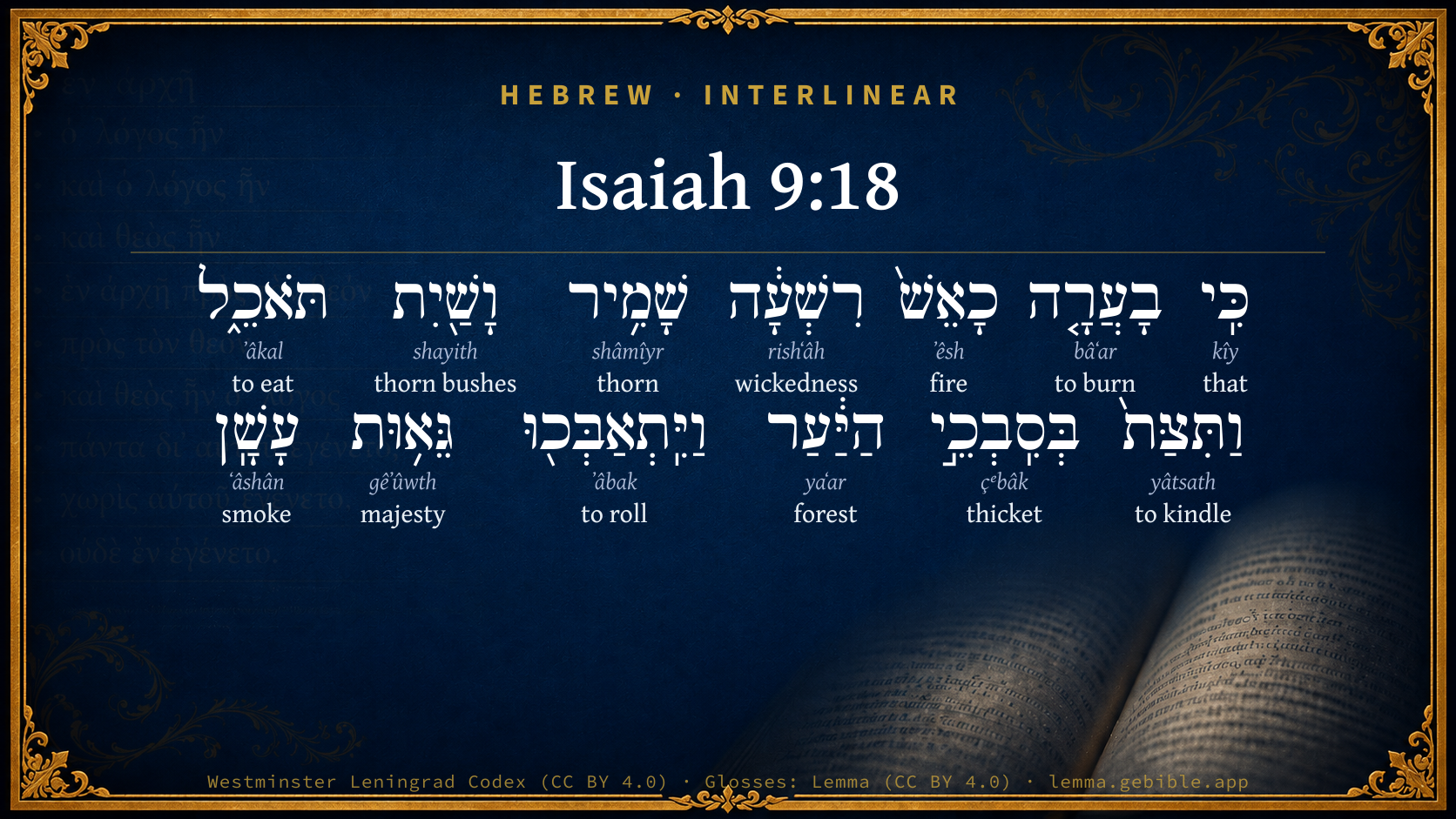
Isaiah 9:18

Hebrew (Westminster Leningrad Codex) Isaiah 9:18 appears in the Hebrew Old Testament. The text above is from the Westminster Leningrad Codex. Each word links to its Strong’s number, a concise gloss, and parsing drawn from the Open Scriptures Hebrew Bible morphology. Click any word for its full Brown-Driver-Briggs (BDB) entry.
Download image
Cite this verse

Isaiah 9:18 (World English Bible). Public Domain. Lemma interlinear Bible study tool, https://lemma.gebible.app/v/isaiah/9/18.

Show BibTeX & RIS
BibTeX
RIS
English Translation
For wickedness burns as the fire; it devours the briers and thorns; yes, it kindles in the thickets of the forest, and they roll upward in a column of smoke.
World English Bible · Public Domain
Highlights
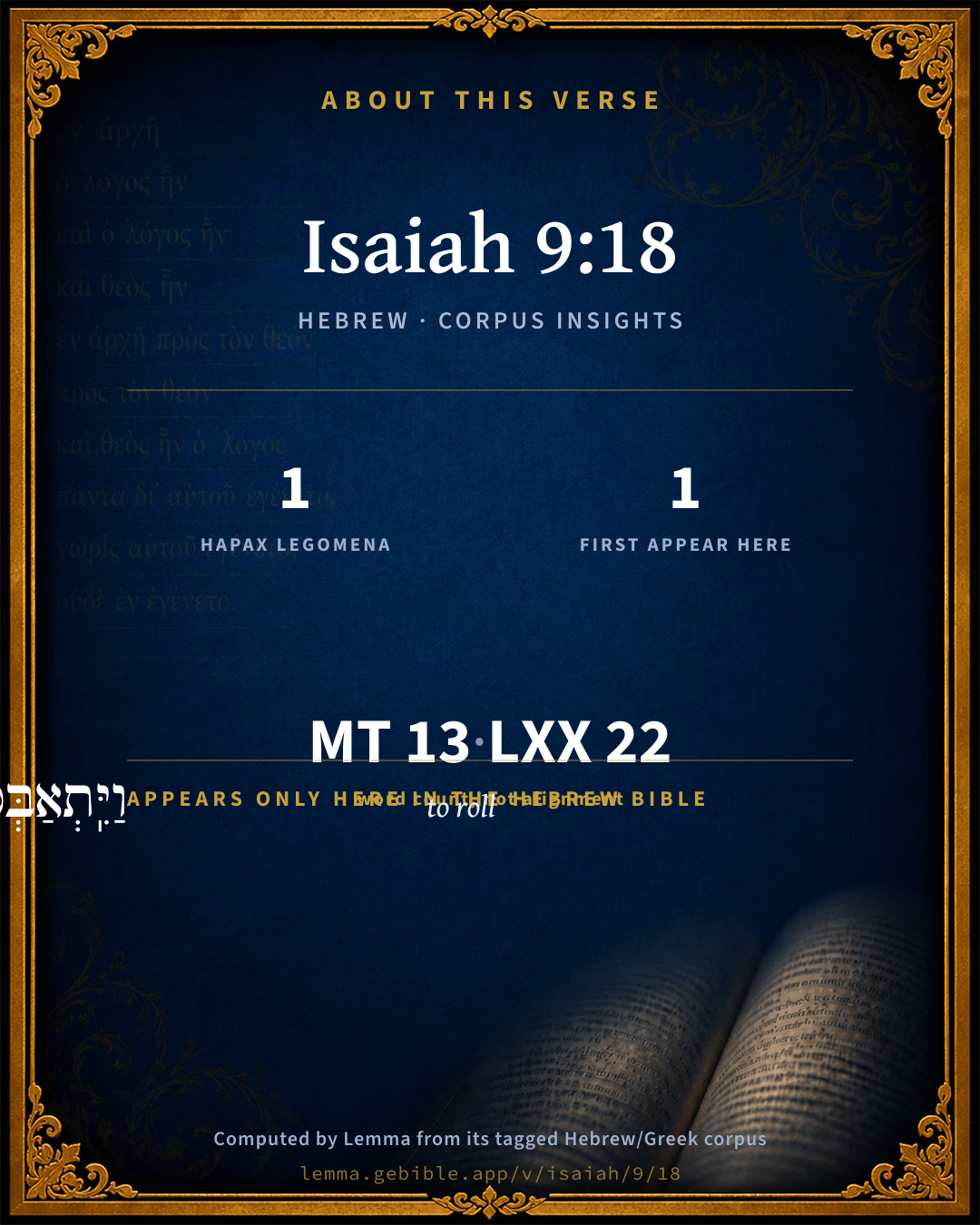
  • 1 hapax legomenon — only here in the Hebrew Bible
  • 1 first appearance in the Hebrew Bible
Full analysis ↓
Download a study sheet

One document with this verse’s original text, its word-by-word gloss line, the meaning frame, cross-references with their text, attributed commentary, and full source and license credits — printable, and it pastes into notes with its structure intact.

This verse Autodidact and up

Study sheet (.html) Plain text (.txt)

A passage Seminary Student

Up to 50 verses in one chapter. A passage sheet keeps up to 6 commentary sources and 12 cross-references per verse, in the order this page ranks them, and says so on the sheet whenever that leaves anything out. Ask for a single verse and you get the Autodidact verse sheet above.

Everything on this page stays free to read, with no account — the sheet is a download of what is already on screen, not access to it.

Want to remove ads? Support Godless Engineer
Compare translations 3

The same verse in 3 English versions, stacked beneath the original-language interlinear above. Click any original word for its lexicon entry.

Each is an independent rendering of the whole verse — the interlinear is not word-aligned to these translations.

Highlighted words mark where these versions differ — a whole-verse word diff, not a word-by-word alignment.

  • World English Bible Public Domain
    For wickedness burns as the fire; it devours the briers and thorns; yes, it kindles in the thickets of the forest, and they roll upward in a column of smoke.
  • King James Version Public Domain
    For wickedness burneth as the fire: it shall devour the briers and thorns, and shall kindle in the thickets of the forest, and they shall mount up like the lifting up of smoke.
  • unfoldingWord Literal Text CC BY-SA 4.0
    For wickedness burns like fire; it devours the briar and the thorn. And it kindles in the thickets of the forest, and they roll upward a rising of smoke.

unfoldingWord Literal Text — © unfoldingWord, licensed CC BY-SA 4.0. Word-aligned USFM3 via Door43 (git.door43.org/unfoldingWord/en_ult).

Versions to compare (up to 4)

3 of 4 selected

Show all 18 translations

Every available English version of this verse, each an independent rendering of the whole verse.

  • World English Bible Public Domain
    For wickedness burns as the fire; it devours the briers and thorns; yes, it kindles in the thickets of the forest, and they roll upward in a column of smoke.
  • Berean Standard Bible Public Domain
    For wickedness burns like a fire that consumes the thorns and briers and kindles the forest thickets which roll upward in billows of smoke.
  • Majority Standard Bible Public Domain
    For wickedness burns like a fire that consumes the thorns and briers and kindles the forest thickets, which roll upward in billows of smoke.
  • King James Version Public Domain
    For wickedness burneth as the fire: it shall devour the briers and thorns, and shall kindle in the thickets of the forest, and they shall mount up like the lifting up of smoke.
  • American Standard Version (1901) Public Domain
    For wickedness burneth as the fire; it devoureth the briers and thorns; yea, it kindleth in the thickets of the forest, and they roll upward in a column of smoke.
  • Revised Version (1885) Public Domain
    For wickedness burneth as the fire; it devoureth the briers and thorns: yea, it kindleth in the thickets of the forest, and they roll upward in thick clouds of smoke.
  • Geneva Bible (1599) Public Domain
    For wickednesse burneth as a fire: it deuoureth the briers and the thornes and will kindle in the thicke places of the forest: and they shall mount vp like the lifting vp of smoke.
  • Douay-Rheims (1899) Public Domain
    For wickedness is kindled as a fire, it shall devour the brier and the thorn: and shall kindle in the thicket of the forest, and it shall be wrapped up in smoke ascending on high.
  • Young's Literal Translation Public Domain
    For burned as a fire hath wickedness, Brier and thorn it devoureth, And it kindleth in thickets of the forest, And they lift themselves up, an exaltation of smoke!
  • Literal Standard Version CC BY-SA 4.0
    For wickedness has burned as a fire, || It devours brier and thorn, || And it kindles in thickets of the forest, || And they lift themselves up, an exaltation of smoke!
  • Unlocked Literal Bible CC BY-SA 4.0
    Wickedness burns like a fire; it devours the briers and thorns; it even burns the thickets of the forest, which rise in a column of smoke.
  • unfoldingWord Literal Text CC BY-SA 4.0
    For wickedness burns like fire; it devours the briar and the thorn. And it kindles in the thickets of the forest, and they roll upward a rising of smoke.
  • Darby Bible Public Domain
    For wickedness burneth as a fire: it devoureth briars and thorns, and kindleth in the thickets of the forest, and they go rolling up like a pillar of smoke.
  • World Messianic Bible Public Domain
    For wickedness burns like a fire. It devours the briers and thorns; yes, it kindles in the thickets of the forest, and they roll upward in a column of smoke.
  • Webster's Bible Public Domain
    For wickedness burneth as the fire: it shall devour the briers and thorns, and shall kindle in the thickets of the forest, and they shall mount up like the rising of smoke.
  • Free Bible Version CC BY-SA 4.0
    For wickedness blazes like a fire, burning up brambles and thorns, setting the forest on fire, sending a column of smoke swirling upwards.
  • Bible in Basic English Public Domain
    For evil was burning like a fire; the blackberries and thorns were burned up; the thick woods took fire, rolling up in dark clouds of smoke.
  • JPS Tanakh (1917) Public Domain
    (9-17) For wickedness burneth as the fire; it devoureth the briers and thorns; yea, it kindleth in the thickets of the forest, and they roll upward in thick clouds of smoke.

Literal Standard Version (2020), Covenant Press — licensed CC BY-SA 4.0. Text via the HelloAO Bible API (eBible.org). Unlocked Literal Bible (unfoldingWord) — licensed CC BY-SA 4.0. Text via the HelloAO Bible API (eBible.org). unfoldingWord Literal Text — © unfoldingWord, licensed CC BY-SA 4.0. Word-aligned USFM3 via Door43 (git.door43.org/unfoldingWord/en_ult). Free Bible Version, Dr. Jonathan Gallagher — licensed CC BY-SA 4.0. Text via the HelloAO Bible API (eBible.org).

Word by word

More ways to search: Search by grammar → Find every occurrence → Compare this word →

Practice this passage: Drill this verse → Learn its vocabulary →

וַיִּֽתְאַבְּכ֖וּ
ʼâbak
H55
“and · to roll”
Conjunction + Verb, Hithpael, Sequential Imperfect, 3rd Person, Masculine, Plural
Part of Speech
Conjunction + Verb
Stem
Hithpael
Form
Sequential Imperfect
Person
3rd Person
Gender
Masculine
Number
Plural
Full BDB Definition

Origin: a primitive root

TWOT: 5

to roll, turn - (Hithpael) to roll, roll up, billow
  1. כִּֽי kîy H3588 “that” Conjunction
  2. בָעֲרָ֤ה bâʻar H1197 “to burn” Verb, Qal, Perfect, 3rd Person, Feminine, Singular
  3. כָאֵשׁ֙ ʼêsh H784 “like/as the · fire” Preposition, Determined + Noun, Common, Both, Singular, Absolute
  4. רִשְׁעָ֔ה rishʻâh H7564 “wickedness” Noun, Common, Feminine, Singular, Absolute
  5. שָׁמִ֥יר shâmîyr H8068 “thorn” Noun, Common, Masculine, Singular, Absolute
  6. וָשַׁ֖יִת shayith H7898 “and · thorn bushes” Conjunction + Noun, Common, Masculine, Singular, Absolute
  7. תֹּאכֵ֑ל ʼâkal H398 “to eat” Verb, Qal, Imperfect, 3rd Person, Feminine, Singular
  8. וַתִּצַּת֙ yâtsath H3341 “and · to kindle” Conjunction + Verb, Qal, Sequential Imperfect, 3rd Person, Feminine, Singular
  9. בְּסִֽבְכֵ֣י çᵉbâk H5442 “in/at · thickets of” Preposition + Noun, Common, Masculine, Plural, Construct
  10. הַיַּ֔עַר yaʻar H3293 “the · forest” Particle, Definite Article + Noun, Common, Masculine, Singular, Absolute
  11. גֵּא֥וּת gêʼûwth H1348 “majesty of” Noun, Common, Feminine, Singular, Construct
  12. עָשָֽׁן ʻâshân H6227 “smoke” Noun, Common, Masculine, Singular, Absolute

About this verse

These counts appear in no published source. They are computed here, from the morphology-tagged text and Lemma’s own curated glosses. What Lemma adds →

13
words
13
distinct lemmas
Prophets
section

Notable vocabulary

1 hapax legomenon — a word that appears only here in the entire Hebrew Bible:

  • וַיִּֽתְאַבְּכ֖וּ to roll H55

First appearance in Scripture

This word makes its first canonical appearance in the Hebrew Bible here:

  • וַיִּֽתְאַבְּכ֖וּ to roll H55

Shared distinctive vocabulary

בְּסִֽבְכֵ֣י thicket H5442 occurs in 4 verses of the Hebrew Bible. Also found in:

Grammatical profile

  • 4 verbs
  • 8 nouns
  • 1 conjunction

Verb forms

  • בָעֲרָ֤ה Qal · Perfect
  • תֹּאכֵ֑ל Qal · Imperfect
  • וַתִּצַּת֙ Qal · Sequential Imperfect
  • וַיִּֽתְאַבְּכ֖וּ Hithpael · Sequential Imperfect

Hebrew & Septuagint length

In English translation the verse runs 30 words from the Hebrew and 35 from the Septuagint (LXX English) — closely comparable.

A rough comparison of the two English renderings, which tokenize alike — not a word-level alignment.

Word counts can differ between the Hebrew and the Greek without any difference in meaning — e.g. the Hebrew direct-object marker אֵת has no separate Greek word, and Greek often adds the article ὁ.

In the original languages it is 13 Hebrew tokens and 22 Greek tokens — but the two are counted differently (Hebrew bundles its prefixes and suffixes into one token; the Greek is in lemma form), so that isn’t a like-for-like length.

Cross-references

26

Topical passages linked to Isaiah 9:18 in the Treasury of Scripture Knowledge — connected by theme and wording, ordered by reader-vote popularity; previews shown in the World English Bible.

  • Psalms 83:14 As the fire that burns the forest, As the flame that sets the mountains on fire,
  • Malachi 4:1 "For, behold, the day comes, it burns as a furnace; and all the proud, and all who work wickedness, will be stubble; and the day that comes will burn them up," says Yahweh of Hosts, "that it shall leave them neither root nor branch.
  • Isaiah 5:24 Therefore as the tongue of fire devours the stubble, And as the dry grass sinks down in the flame, So their root shall be as rottenness, And their blossom shall go up as dust; Because they have rejected the law of Yahweh of Hosts, And despised the word of the Holy One of Israel.
  • Isaiah 34:8–10 For Yahweh has a day of vengeance, a year of recompense for the cause of Zion.
  • Nahum 1:10 For entangled like thorns, and drunken as with their drink, they are consumed utterly like dry stubble.
  • Numbers 11:1–3 The people were as murmurers, [speaking] evil in the ears of Yahweh: and when Yahweh heard it, his anger was kindled; and the fire of Yahweh burnt among them, and devoured in the uttermost part of the camp.
  • Deuteronomy 32:22 For a fire is kindled in my anger, Burns to the lowest Sheol, Devours the earth with its increase, Sets on fire the foundations of the mountains.
  • Job 31:11–12 For that would be a heinous crime; Yes, it would be an iniquity to be punished by the judges:
  • Psalms 37:20 But the wicked shall perish. The enemies of Yahweh shall be like the beauty of the fields. They will vanish-- Vanish like smoke.
  • Isaiah 1:31 The strong will be like tinder, And his work like a spark. They will both burn together, And no one will quench them."
  • Isaiah 10:16–18 Therefore will the Lord, Yahweh of Hosts, send among his fat ones leanness; and under his glory there shall be kindled a burning like the burning of fire.
  • Isaiah 27:4 Wrath is not in me: would that the briers and thorns were against me in battle! I would march on them, I would burn them together.
  • Isaiah 30:30 Yahweh will cause his glorious voice to be heard, and will show the lighting down of his arm, with the indignation of [his] anger, and the flame of a devouring fire, with a blast, and tempest, and hailstones.
  • Isaiah 30:33 For a Topheth is prepared of old; yes, for the king it is made ready; he has made it deep and large; the pile of it is fire and much wood; the breath of Yahweh, like a stream of sulfur, does kindle it.
  • Isaiah 33:12 The peoples shall be as the burning of lime, as thorns cut down, that are burned in the fire.
  • Isaiah 66:16–17 For by fire will Yahweh execute judgment, and by his sword, on all flesh; and the slain of Yahweh shall be many.
  • Ezekiel 20:47–48 and tell the forest of the South, Hear the word of Yahweh: Thus says the Lord Yahweh, Behold, I will kindle a fire in you, and it shall devour every green tree in you, and every dry tree: the flaming flame shall not be quenched, and all faces from the south to the north shall be burnt thereby.
  • Hosea 13:3 Therefore they will be like the morning cloud, And like the dew that passes away early, Like the chaff that is driven with the whirlwind out of the threshing floor, And like the smoke out of the chimney.
  • Joel 2:20 But I will remove the northern army far away from you, And will drive it into a barren and desolate land, Its front into the eastern sea, And its back into the western sea; And its stench will come up, And its bad smell will rise." Surely he has done great things.
  • Amos 7:4 Thus the Lord Yahweh showed me and, behold, the Lord Yahweh called for judgment by fire; and it dried up the great deep, and would have devoured the land.
  • Nahum 1:6 Who can stand before his indignation? Who can endure the fierceness of his anger? His wrath is poured out like fire, and the rocks are broken apart by him.
  • Matthew 13:49–50 So will it be in the end of the world. The angels will come forth, and separate the wicked from among the righteous,
  • Matthew 25:41 Then he will say also to those on the left hand, 'Depart from me, you cursed, into the eternal fire which is prepared for the devil and his angels;
  • Mark 9:43–50 If your hand causes you to stumble, cut it off. It is better for you to enter into life maimed, rather than having your two hands to go into Gehenna, into the unquenchable fire,
  • Hebrews 6:8 but if it bears thorns and thistles, it is rejected and near being cursed, whose end is to be burned.
  • Revelation 14:11 The smoke of their torment goes up forever and ever. They have no rest day and night, those who worship the beast and his image, and whoever receives the mark of his name.

Cross-references courtesy of OpenBible.info (CC BY 4.0).

Hebrew and Greek witnesses Masoretic Hebrew ↔ Greek Septuagint

The same verse in the two great witnesses to the Old Testament, shown verse-for-verse.

These are two independent witnesses, not word-aligned to each other, and the Septuagint is shown in lemma (dictionary) form.

Hebrew Isaiah 9:18 Masoretic · Westminster Leningrad Codex

כִּֽי בָעֲרָ֤ה כָאֵשׁ֙ רִשְׁעָ֔ה שָׁמִ֥יר וָשַׁ֖יִת תֹּאכֵ֑ל וַתִּצַּת֙ בְּסִֽבְכֵ֣י הַיַּ֔עַר וַיִּֽתְאַבְּכ֖וּ גֵּא֥וּת עָשָֽׁן

For wickedness burns as the fire; it devours the briers and thorns; yes, it kindles in the thickets of the forest, and they roll upward in a column of smoke.

World English Bible · Public Domain

Greek LXX Isaiah 9:18 Septuagint · lemma form

διά θυμός ὀργή κύριος συνκαίω ὁ γῆ ὅλος καί εἰμί ὁ λαός ὡς ὑπό πῦρ κατακαίω ἄνθρωπος ὁ ἀδελφός αὐτός οὐ ἐλεέω

And iniquity shall burn as fire, and shall be devoured by fire as dry grass: and it shall burn in the thickets of the wood, and shall devour all that is round about the hills.

LXX2012 (modern English Septuagint) · Public Domain

On this verse, Keil & Delitzsch discusses the Septuagint’s reading. Read the note in Commentary ↓

Hebrew: Westminster Leningrad Codex (CC BY 4.0). Greek: Septuagint (public domain); English from LXX2012 (modern English Septuagint) (Public Domain). How the Septuagint differs from the Hebrew →

Targum (Aramaic paraphrase)

1

The Targum is the ancient Jewish Aramaic paraphrase of the Hebrew Scriptures — an interpretive translation, not the Hebrew text itself. Onkelos (literal) and Pseudo-Jonathan (expansive) render the Torah, and Jonathan the Prophets. Coverage is partial: where no permissively-licensed English translation exists for a verse, only the Aramaic is shown. This is verse-level text, not a word-by-word alignment to the Hebrew.

  1. Targum Jonathan Prophets (Joshua–Malachi)
    בְּתַבְעוֹר מִן קֳדָם יְיָ צְבָאוֹת חֲרוֹכַת אַרְעָא וַהֲוָה עַמָא כִּיקֵידַת נוּר גְבַר עַל אֲחוּהִי לָא חָיְסִין:

    Through the wrath from before the presence of the Lord of hosts the earth shall be burnt up, and the people shall be like the burning fuel of fire: no man shall spare his brother.

    Targum Jonathan — Aramaic: “Mikraot Gedolot” (public domain). English: “Sefaria Community Translation” (CC0 1.0 (public-domain dedication)); “London "Chaldee Paraphrase," 1871” (public domain). Text via Sefaria.

Commentary

Notes on Isaiah 9:18 from classic Christian and Jewish commentators (each source and its license shown beneath its notes). The classic Christian expositions comment on the surrounding passage and are grouped to its opening verse, so a note may address several verses; the Jewish commentaries on the Tanakh (Rashi and others) are per-verse, so they appear only where the commentator wrote on this verse.

Lemma curates 59 commentaries, every one of them public domain or Creative Commons licensed, each selected and text-cleaned for this edition rather than reprinted as found. About our sources →

Trapp's Complete Commentary

John Trapp

Isa 9:18 For wickedness burneth as the fire: it shall devour the briers and thorns, and shall kindle in the thickets of the forest, and they shall mount up [like] the lifting up of smoke.

Ver. 18. For wickedness burneth as a fire.] God will burn up these wicked Israelites, as once he did those sinful Sodomites; for unregenerate Israel is to him as Ethiopia, {Amo 9:7} when once scelera abierunt in mores, and there is a general defection of all sorts and states, God will make an utter riddance of them; he will fire the whole forest.

John Trapp, A Commentary or Exposition upon All the Books of the Old and New Testament (1647–1656) — public domain. Text from a community e-Sword module.

The Biblical Illustrator

Joseph S. Exell

Isa_9:18-21

For wickedness burneth as the fire

Wickedness as fire

Wickedness, i.., the constant willing of evil, is a fire which man kindles in himself. And when the grace of God, which stifles and checks this fire, is at an end, it breaks forth The fire of wickedness is nothing else but Gods עֶבְדָה for so wrath is called as breaking forth from within and spreading itself inwardly more and more, and then passing outwards into word and deed; it is Gods own wrath; for all sin carries this within itself as its own punishment. (F. Delitzsch.)

Sin compared to a great fire

The prophet affirms that there are resemblances between a fire and sin. It is not a common fire to which he refers, such as is employed for domestic or public purposes. It is a great conflagration which burns the humble shrubbery, the gigantic forest, extends over the land, and sends a mighty column of smoke and flame up to heaven

I. THE ORIGIN OF A GREAT FIRE. Recently we read an account of a great fire, and the paragraph closed with these words: the origin of the fire is unknown The same with the origin of sin. We know it had a beginning, for God only is from everlasting. We know it had a beginning before Eve and Adam felt its power, since they were tempted: We know it began with him who is called Satan and the father of lies. Still, there are three questions about it which we cannot answer.

(1) Where did it begin?

(2) When did it begin!

(3) How did it begin?

II. THE PROGRESS OF A GREAT FIRE. Place one spark amid combustible material in London. Let it alone. It will leap from point to point, house to house, street to street, until the whole city is in flames. Sin has spread in as exactly similar way. One sin, to the individual; one wrong action, to the family; one immoral look, to thousands; one crime, to a kingdom.

III. THE TRANSFORMING POWER OF A GREAT FIRE. Wood, coal, etc., it transforms into its own essence, because it makes fire of these. It is even so with sin. It turns everything, over which it gains the slightest control, into its own nature--that is into a curse. The desire to possess, sin has turned in a different direction, and made it an autocratic passion. Take the principle of ambition in the same Way. Take commerce in the same way. Thus the richest blessings, yea, all the which God has given to us, sin can so transform that they shall become curses.

IV. THE DESTRUCTIVE ENERGY OF A GREAT FIRE. Who can calculate the amount of property in London alone, which has been destroyed by fire! But the destruction which sin has caused in London is infinitely greater and more momentous. Some have bodies, once beautiful, now bloated and withered by sin. Some have feelings, once tender, now petrified by sin. Some whose intellectual powers were once strong, now feeble by sin. Some, who were once full of hope, now hopeless by sin. The destruction Which sin has caused is awful.

V. THE TERMINATION OF A GREAT FIRE. It terminates when an the material is reduced to ashes. Can the fire of sin ever he put out in this way? The body in the grave is scorched by it no more; but what of the soul? Look at the rich man. He is tormented, in pain, not by a literal flame, but by the fire of sin. He will be so forever, because the soul is immortal. A great fire has been terminated by a superior quenching power. There is also an element which can completely remove sin from the soul. What is it? Ask those in heaven, and those on earth, who have been saved. They all say that they have washed their robes and made them white in the blood of the Lamb. (A. MAuslane, D. D.)

Sin mirrored as fire

The Bible is full of the figurative and analogic.

I. SIN IS LIKE FIRE IN THE FORMS IN WHICH IT EXISTS. Fire is found to exist in two states--the insensibly latent, and the sensibly active.

1. In an insensible state, heat is everywhere. Even in solid masses of ice it is to be found. Sir Humphrey Davy, it is said, quickly melted pieces of ice by rubbing them together in a room cooled below the freezing point. It is so with sin. It is found in every part of the human world; it sleeps, perhaps, even in the most innocent of our kind. All it wants is the contact of some tempting circumstance to bring it out into an active flame. The virtue of some men is but vice sleeping. As savages light their fire by rubbing two pieces of wood together, so men stir up the latent of depravity by mutual contact. There is sufficient latent fire around us to burn up the globe, and there is sufficient latent sin in humanity to turn earth into hell

2. But fire is active as well as latent. In its active state you see it flaming on your hearths, illuminating your cities, working your manufactures, propelling your fleets, drawing your carriages, flashing in the lightning and thundering in the earthquake. Sin is terribly active in our world, active in every department of life:--in commerce, in politics, and religion To use the language of the text, It mounts up like the lifting up of smoke: the smoke of this fire of sin pollutes and darkens every sphere of life.

II. SIN IS LIKE FIRE IN ITS TENDENCY TO SPREAD ITSELF. What a great fire a little spark will kindle! Fire is essentially diffusive; so is sin. How true it is that one sinner destroyeth much good.

III. SIN IS LIKE FIRE IN ITS POWER OF CHANGING EVERYTHING TO ITS OWN NATURE. It has turned alcohol into intemperance, merchandise into fraud, government into tyranny, aggression into the demon of war. When Archimedes, to gratify his vengeance on the Romans, brought down the genial rays of heaven by magic glass to burn up their ships, he only dramatised the universal fact that sin ever strives to turn the greatest blessing to the greatest curse.

IV. SIN IS LIKE FIRE IN ITS REPELLING ENERGY. Philosophers tell us that fire is that principle in nature which counteracts attraction, and keeps the various particles of matter at their proper distance. It is that repulsive force which prevents atoms from coming into close contact, and sometimes drives them far apart. It turns the solid bodies into liquids and liquids into vapours. Apply fire to the compact tree, and it will break it into a million atoms, and send these atoms abroad on the wide fields of air. Were it not for heat, all parts of the universe would rush together into one solid mass, whose parts would press together in closer contact than the heaviest stone. Sin is a repulsive principle. It separates man from man, family from family, nation from nation--all from God!

V. SIN IS LIKE FIRE IN ITS DEVOURING CAPABILITY. It consumes something far more valuable than the most beautiful forms of material nature, or the most exquisite productions of human art--it consumes man. You cannot walk the streets of any great city, without meeting men whose bodies are being consumed by sin. Sin devours the soul. It dries up its fountain of Divine feeling, it sears its conscience, it withers its intellect, it blasts its prospects and its hopes.

VI. SIN IS LIKE FIRE IN ITS POWER TO INFLICT PAIN. There is no element in nature capable of inflicting more suffering on the body than fire. But sin can inflict greater suffering: the fires of remorse are a thousand times more painful than the flames that enwrapped the martyrs. A wounded spirit who can bear? The fire of sin in the soul will burn to the lowest hell. Ask Cain, Belshazzar, Judas, concerning the intensity of moral suffering.

VII. SIN IS LIKE FIRE IN ITS SUSCEPTIBILITY OF BEING EXTINGUISHED. You have seen a raging fire go out from one of two causes; either because it has consumed the body on which it fed and reduced it to ashes, or because of the application of some quenching force. The fire of sin will never go out for the former reason--the object on which it feeds is indestructible: if it is ever to be destroyed, it must be extinguished by some outward force. Thank God! there is a moral element on earth to put out sin; the river of mediatorial influences that rolls from the throne of God has quenched the fire of sin in the case of millions, and is as efficacious to do so now as ever. (Homilist.)

Wickedness as fire

I. WICKEDNESS. Of this wickedness there are divers sorts, each of which may be distinguished by the objects on which it terminates.

1. When immediately directed against God, it is discovered by an absurd contempt of His providences and ordinances, His commandments, promises, and threatenings, and a virulent opposition to the interests of His kingdom and glory.

2. When its operations are aimed against men, it is perpetrated by harassing, oppressing and persecuting those who are entitled to acts of justice, beneficence, and charity, and by disturbing the peace and good order of human society.

3. When it chiefly respects the persons themselves by whom it is acted, the most daring iniquities are committed, forbidden by the law of nature, the law of nations, and the law of God, in order to gratify their ungovernable desires, and to promote their interest, honour, or pleasure.

II. WICKEDNESS BURNETH AS FIRE. The amiable endowments of the person in whom it burns, the good dispositions and laudable desires with which his mind is furnished, will fall a sacrifice to its rage. It will enfeeble the understanding, harden the conscience, deprave the heart, hurt the memory, weaken the senses, debilitate the whole frame; it will entirely eat away peace of mind, and lead on to contention, confusion, and every evil work. It will devour the strength and vigour of the body, bring on untimely old age, and shorten the now short life of man. It will consume his honour and reputation, and leave behind it indelible marks of disgrace and reproach, that shall not be wiped away. It will burn up his riches and possessions; for by means of it a man is often brought to a piece of bread, and a nation involved in irremediable destruction. (R. Macculloch.)

Wickedness is destruction

There is to be internecine war: Manasseh shall fly at Ephraim, and Ephraim at Manasseh, and they who could agree upon nothing between themselves always agree in flying together against Judah. This is what wickedness will bring the world to--to murder, to mutual hatred and distrust, to perdition. We do not understand the power of wickedness, because at present, owing to religious thinking and action and moral civilisation, mere are so ninny mitigating circumstances, so many relieving lights; but wickedness in itself let loose upon the earth, and the earth is no longer the abode of green thing of fair flower, or singing bird, of mutual trust and love: it becomes a pandemonium. If we could consider this deeply, it would make us solemn. We do not consider it; we are prepared to allow it as a theory or a conjecture, but the realisation of it is kept far from us. The wicked man kills himself; puts his teeth into the flesh of his own arm, and gnaws it with the hunger of a wild beast. That is what wickedness comes to! It is not an intellectual error, not a slight and passing mistake, not a lapse of judgment, or a momentarily lamentable act of misconduct which can easily be repaired: the essence of wickedness is destruction. Wickedness would no sooner hesitate to kill a little child than to snap a flower. The thing that keeps the world from suicide is the providence of God. Were God to take away the restraining influences which are keeping society together, society would gall into mutual enmity, and the controversy could only end in mutual death. For all this His anger is not turned away, but His hand is stretched out still. Do not blame the judgment, blame the sin; do not say, How harsh is God, say, How corrupt, how blasphemous is man! (J. Parker, D. D.)

Injury inflicted on the body politic

A nation is sometimes spoken of as a person constituted of a soul, and the various parts of a human body. In this political body there are those who act the part of the arms, by whom its strength is exerted, and its safety preserved. On this principle I explain this prediction, they shall eat every man the flesh of his own arm. Every one almost was to be employed in cruelly harassing and devouring those whose business it was to support and defend the interests of the nation. Unmindful of the laws of nature, the ties of friendship and gratitude, they would vex and destroy those useful members of the community with whom they were nearly connected, and to whom they were obliged for their efforts in their behalf. (R. Macculloch.)

.

The Biblical Illustrator, edited by Joseph S. Exell (c. 1880s–1900s) — public domain. Text from a community e-Sword module.

Joseph Benson's Commentary

Isa 9:18. For wickedness burneth as fire, &c. — Rageth like a fire, destroying and laying waste the nation. We have here the third great evil, on account of which divine vengeance was about to come upon them; namely, the power of reigning and barefaced impiety; the punishment whereof, denounced in the subsequent verses, is, as usual, assimilated to the vice, namely, destructive factions, which should overthrow their republic. Having rendered themselves hateful to God by their crimes, they shall be destroyed by those crimes, by their dissensions, animosities, divisions, tumults, insurrections, and civil broils, arising from the wickedness of their own dispositions, and issuing in their mutual destruction. Inflamed by envy, avarice, and impurity, they shall perish in this very fire let loose among them by the wrath of God, and permitted to rage uncontrolled, like fire among briers and thorns, Isa 9:19. The latter state of the Israelitish government abundantly proves the exactness of this prophet’s prediction, 2Ki 15:10; 2Ki 15:30; 2Ki 17:1; 2Ki 17:18-24.

Joseph Benson's Commentary on the Old and New Testaments (1811–1818) — public domain. Text from a community e-Sword module.

The Preacher's Complete Homiletical Commentary

Joseph S. Exell (gen. ed.)

THE DESTRUCTIVENESS OF SIN

Isa_9:18-19. For wickedness burneth as the fire, &c.

One of the grandest and most fearful scenes in nature is a forest on fire. This is the figure Isaiah employs to describe the destruction that was coming upon sinful and stubborn Israel [952] That destruction would be all-comprehending and irresistible. Even the poorest would not be spared, and the wealthiest could not escape. And all this woe, at which it behoved the people to tremble, is attributed to the wickedness in which they delighted. “Wickedness burneth as the fire”—a comprehensive statement eternally true.

[952] Civil war and foreign invasion shall rage through this reprobate people like the fire with which the husbandman clears the ground of briers and thorns. The wickedness of the land becomes its own punishment, and burns with a fury which is indeed the wrath of God, while its fuel is the people themselves.—Strachey.

Wickedness, i.e., the constant thirst of evil is a fire which a man kindles in himself. And when the grace of God which damps and restrains this fire is all over, it is sure to burst forth.… The fire, into which this wickedness bursts forth, seizes individuals first of all; and then, like a forest fire, it seizes upon the nation at large in all its ranks and members, who roll up in the form of ascending smoke.… In its historical manifestation, this judgment consisted in the most inhuman self-destruction during an anarchial civil war.—Delitzsch.

The picture of guilt grows darker still. It is like destroying fire in the jungle of a forest. The confusion and misery thus caused are like the volumes of smoke that mount up in whirling eddies from such a conflagration.—Birks.

I. Consider how true it is in regard to individuals. The forest-fire—what a trivial thing it may seem in its commencement! It was but a little heap of dried leaves and sticks which a thoughtless traveller kindled, that by means of the little fire thus produced he might cook his evening meal. He had no conception how that fire would spread. So the wickedness that ultimately consumes and utterly destroys, often commences in what seems a little transgression, e.g., the few glasses of wine taken at a wedding-breakfast by one who has been a total abstainer; the little act of dishonesty that is undetected, &c. (Jas_3:5). Many of the passions by which millions are consumed—avarice, lust, intemperance, &c.—seem little things in their commencement (H. E. I. 4497, 4498, 4513–4518).

2. It makes progress according to its own laws, utterly regardless of the desires of the onlookers. It will not stop at any line which they may prescribe. No man can accomplish a desire to burn down just one acre of a forest. If he kindles a fire in the forest at all, it will advance as far and as long as there is fuel for it. So no man can determine beforehand the measure of the power which permitted wickedness shall acquire over him; the fire which a man kindles in the forest of his own passions will go burning on long after he may wish it to stop.

3. Its power grows continually. It acquires a marvellous intensity and fervour as it proceeds (H. E. I. 409, 4500, 4501, 4534–4537).

4. Consequently it proceeds with ever-accelerating rapidity. Here again the moral analogy is frightfully accurate.

5. Consequently, too, its range continually widens. That which began as a little point becomes a vast circle constantly expanding. Things that seemed so far off as to be absolutely safe are speedily included in the ring of flame. So the fire of ungodliness which was kindled in one passion hastens through the whole nature, and destroys every vestige of virtue and nobility; it seizes every faculty of mind and heart [955]

6. It is remorselessly undistinguishing in its effects. The fair flowers and the poisonous weeds, the stately cedars and the misshapen brambles, it consumes alike. So again with the sinner: the wickedness that consumes him spares nothing. In workhouses, lunatic asylums, prisons, how many most terrible proofs there are of the truth of this declaration! Once the owners of many choice possessions, and with prospects as fair as those of any of us, they are now like the forest region after the fire—blackened and desolate.

[955] Oftentimes a ruling sin will have power little by little to colour the whole life with its own tints; to assimilate everything there to itself, as in ever-widening circles to absorb all into its own vortex, being as it were a gulf, a maelstrom, into which all that was better and nobler in the man is irresistibly attracted and drawn, and is there swallowed up, and for ever disappears.—Trench.

See also the Outline: THE TOW AND THE SPARK, pp. 69–71.

II. Consider how true this is of nations. Wickedness consumes the nation’s prosperity, happiness, strength, and ultimately its existence [958]

[958] See Outline: INIQUITY A BURDEN, p. 13.

From all this there are many lessons to be learned.

1. He is a fool who makes a sport of sin (Pro_10:23). He is infinitely more foolish than the child who plays with fire.

2. He is a fool who does not stamp out the fires of unholy passion the instant that he perceives them beginning to kindle upon him. In dealing with sin, or in dealing with fire, our only safety lies in the promptest and most energetic action [961] H. E. I. 4733, 4734).

3. Those nations are guilty of suicidal folly who legalise vice in any form.

4. Those who pander to a nation’s vices are traitors of the worst kind [964]R. A. B.

[961] When the heart begins once to be kindled, it is easy to smother the smoke of passion, which else will fume up into the head and gather into so thick a cloud that we shall lose the very sight of ourselves, and what is best to be done.—Sibbes.

[964] See Outline: INIQUITY A BURDEN, p. 13.

When a fire is first broken out in a chimney, it may with much less labour be quenched than when it has seized the timber of the house. What small beginnings had those fires which have conquered stately palaces, and turned famous cities into ruinous heaps!—Suinnock.

In this message the prophet affirms that there are resemblances between a fire and sin. It is not a common fire to which he refers, such as is employed for domestic or public purposes. It is a great conflagration which burns the humble shrubbery, the gigantic forest, extends over the land, and sends a mighty column of smoke and flame up to heaven. By attending to this comparison some of the characteristics of sin will vividly appear.

I. The origin of a great fire. Recently we read an account of a great fire, and the paragraph closed with these words: “The origin of the fire is unknown.” Suppositions were made, conjectures were offered, still a deep mystery which may never be unravelled. The same with the origin of sin. We know it had a beginning, for God only is from everlasting. We know it had a beginning before Eve and Adam felt its power, since they were tempted. We know it began with him who is called Satan and the father of lies. Still, there are three questions about it which we cannot answer.

(1) Where did it begin?

(2) When did it begin?

(3) How did it begin. These questions might have been answered; they have not, because such information is not required by us in this stage of our unending history.

II. The progress of a great fire. Place one spark amid combustible material in London. Let it alone. What will be the result? It will leap from point to point, house to house, street to street, until the whole city is in flames. Sin has spread in an exactly similar way. One sin, to the individual; one wrong action, to the family; one immoral look, to thousands; one crime, to a kingdom. The sin of one woman away in the East, some sixty centuries ago, has spread itself amongst the whole race; and there is not one who has not felt, to some extent, its scorching power.

III. The transforming power of a great fire. Wood, coal, &c., it transforms into its own essence, because it makes fire of these. It is even so with sin. It turns everything, over which it gains the slightest control, into its own nature—that is, into a curse. The desire to possess, sin has turned it in a different direction, and made it an autocratic passion. Take the principle of ambition in the same way. Take commerce in the same way. Thus the richest blessings, yea, all the blessings which God has given to us, sin can so transform that they shall become curses.

IV. The destructive energy of a great fire. Who can calculate the amount of property in London alone which has been destroyed by fire? But the destruction which sin has caused in London is infinitely greater and more momentous. Some have bodies, once beautiful, now bloated and withered by sin. Some have feelings, once tender, now petrified by sin. Some whose intellectual powers were once strong, now feeble by sin. Some, who were once full of hope, now hopeless by sin. The destruction which sin has caused is awful. And this it must ever do to all who touch it. Avoid it, therefore, more than anything else. Herein only is safety.

V. The termination of a great fire. It terminates when all the material is consumed and reduced to ashes. Can the fire of sin ever be put out in this way? The body in the grave is scorched by it no more; but what of the soul? Look at the rich man. He is tormented, in pain, not by a literal flame, but by the fire of sin. He will be so for ever, because the soul is immortal.

A great fire has been terminated by a superior quenching power. There is also an element which can completely remove sin from the soul. What is it? Nothing can be more important than the true answer to this question. Health must depart, trade must be left, money not required. Our souls must live for ever. With sin, no heaven, but hell. How delivered? Ask those in heaven, and those on earth, who have been saved. They all say that the fires of unholy passion have been quenched in them, and their guilt removed, by the blood of the Lamb. Apply at once to the same source.—A. M‘Auslane, D.D.

The Preacher's Complete Homiletical Commentary (gen. ed. Joseph S. Exell; Funk & Wagnalls, c. 1892) — public domain (pre-1929). A full-Bible homiletical/sermon-outline anthology covering 65 of 66 books (2 John is absent from the source module). Text from a community e-Sword module.

Lange's Commentary on the Holy Scriptures

3. ISRAEL DEVOURING ITSELF BY THE FLAMES OF DISCORD

CHAPTER Isa_9:18-21 (Isa_9:17-20)

18 (17) FOR wickedness burneth as the fire:

It shall devour the briers and thorns,

And shall kindle in the thickets of the forest,

And they shall mount up like the lifting up of smoke.

19 (18) Through the wrath of the LORD of hosts is the land darkened,

And the people shall be as the fuel of the fire:

No man shall spare his brother.

20 (19) And he shall snatch on the right hand, and be hungry;

And he shall eat on the left hand, and they shall not be satisfied:

They shall eat every man the flesh of his own arm:

21 (20) Manasseh, Ephraim; and Ephraim, Manasseh;

And they together shall be against Judah.

For all this his anger is not turned away,

But his hand is stretched out still.

TEXTUAL AND GRAMMATICAL

On Isa_9:17. רִשׁעָה, in the older writings found only in Deu_9:4-5; Deu_25:2; in Isaiah only here; beside this only in post Isaiah writings; so that the expression seems to be a reminiscence of Deuteronomy.—בערה כאשׁ perhaps a reminiscence of Num_11:3.—The form יצת occurs only once more in Isa_33:12, and there it is undoubtedly passive. Consider in addition that here the preposition בְּ occasions surprise if thereby the object of the kindling is expressed (GESEN. would take this בְּ in a partitive sense, Thes., p. 172, sub. A. 2), whereas הִצִּת אֵשׁ בְּ occurs often (Amo_1:14; Jer_17:27; Jer_21:14; Jer_43:13, etc.) thus it seems to me more probable that תִּצַּת is to be taken as passive of הִצִּית אֵשׁ. As to the form, see EWALD, § 197, a.—התאבדּ is ἄπ. λεγ. The root אבד seems related to חפד whereby the meaning is approximated “to turn one’s-self, to roll, whirl” (comp. Jdg_7:13): “they whirled up in height of the smoke.” The construction is analogous to עָלָה שָׁמִיר וָשַׁיִת Isa_5:6;Isa_34:13; Pro_24:31.—נאות must be regarded as accusative, and of that species that follows verbs of fulness. The expression נאות עשׁו recalls נֵאוּת הַיָם Psa_89:10.

On Isa_9:18. נעתם ἅπ. λεγ. “burnt up, charred.” חמל often with עַל; Exo_2:6; 1Sa_15:3; 1Sa_15:9; 1Sa_15:15; 1Sa_23:21, etc. Here עַל stands for אֶל as Jer_50:14; Jer_51:3.

On Isa_9:19. נָּזַר means secuit, and is used of cutting through the middle a living body (1Ki_3:25 sq.) or a dead one (2Ki_6:4), comp. מַנְזֵרָה “a cutting implement,” 2Sa_12:31. It is better then to translate it, “to hew,” than “to bite.”

On Isa_9:20. The accusatives את־מנשׁה ,את־אפרים depend on יאכלו, whereas על־יהודה depends on the notion of the hostile onslaught that lies in Isa_9:19 a.

EXEGETICAL AND CRITICAL

1. This strophe plainly divides into two parts. In the first (Isa_9:17-18 a.), the dissension is described figuratively. In the following, the Prophet himself explains the figure.

2. For wickedness——fuel of the fire.

Isa_9:18-19 (Isa_9:17-18). The כִּי “for” appears to introduce the proof not only for ver. (16b), but also for (16a). For the impregnation with badness, that is declared of the whole people, ver. (16), displays itself as real, if its condition may be compared to an all-devouring conflagration. The badness burns like fire; not as a fire that devours only thorns and thistles (comp., on Isa_9:6) the lowlier products of the open field, but also the thickets (the standing timber, Isa_10:34), of the forests, consequently seizes on the entire vegetation of the land, high and low. The fire of Isa_9:17 is the fire of sin, consequently a fire hateful to God, and which therefore bears no blessing in it, but a curse. The Prophet therefore can say that the effect of this fire is at the same time an effect of divine wrath. This effect is that the land looks burnt up, charred, while the people dwelling in it are become food of the fire. So far the figure.

4. No man shall spare——stretched out still.

Isa_9:19-21 (Isa_9:18-20). With these words the Prophet explains the figure. It is plain that he means the fire of dissension. This he first characterizes negatively by saying, that one behaves himself pitilessly, unsparingly against the other; then positively by describing how the rough, selfish men direct their attacks now on the right, now on the left. But these attacks do no good: for those attacking get no blessing thereby; they remain hungry after as well as before. They do harm in fact. For it appears that those men of violence have raged against themselves, and (comp. Jer_19:9) have, so to speak, devoured their own flesh. In what sense he means this, the Prophet explains Isa_9:20 (21) a: The tribes of the northern kingdom were divided among themselves, but united for hostility against Judah. It is to be noticed that he does not say; Israel and Judah were mutually hostile; but names only Ephraim and Manasseh as embroiled in mutual strife. Judah, however, appears outside of their communion and the object of their common hatred, while, moreover, there is no reference to a hostility of Judah against Israel. Thus it appears that the Prophet represents the flames of discord as raging only in the bounds of the Ten Tribes. This is another proof that the entire passage, Isa_9:7 to Isa_10:4 is directed only against the northern kingdom. Manasseh and Ephraim are mentioned because these two tribes were descendants of uterine brothers, the sons of Joseph. From of old there was jealousy between these tribes (comp. 1Sa_10:27; 2Sa_20:1; 1Ki_12:16; 1Ki_15:27 sqq.; 1Ki_16:21 sqq.; 2Ki_9:14, etc.). From the first the Ten Tribes were little inclined to David’s dynasty (2Sa_2:8 sqq.); but their own history is a continued alternation of conspiracy and murder. It may be said that the Israelites did themselves more harm than all foreign foes could ever have done. Thus dissension was the destruction of Israel. And still even this is not the last stage of the divine judgment.

DOCTRINAL AND ETHICAL

1. On Isa_7:1. “Hierosolyma oppugnatur, etc. Jerusalem is assaulted but not conquered. The church is pressed but not oppressed.”—Foerster.

2. On Isa_7:2. “Quando ecclesia, etc. When the Church is assaulted and Christ crucified over again in His elect, Rezin and Pekah, Herod and Pilate are wont to form alliance and enter into friendly relations. There are, so to speak, the foxes of Samson, joined indeed by the tails, but their heads are disconnected.”—Foerster.—“He that believes flees not (Isa_28:16). ‘The righteous is bold as a lion’ (Pro_28:1). Hypocrites and those that trust in works (work-saints) have neither reason nor faith. Therefore they cannot by any means quiet their heart. In prosperity they are, indeed, overweening, but in adversity they fall away (Jer_17:9).” Cramer.

3. On Isa_7:9. (“If ye will not believe, surely ye shall not be established.”) “Insignis sententia, etc. A striking sentiment that may be adapted generally to all temptation, because all earnest endeavor after anything, as you know, beguiles us in temptation. But only faith in the word of promise makes us abide and makes sure whatever we would execute. He warns Ahaz, therefore, as if he said: I now promise you by the word, it shall be that those two kings shall not hurt you. Believe this word! For if you do not, whatever you afterwards devise will deceive you: because all confidence is vain which is not supported by the word of God.”—Luther.

4. On Isa_7:10-12. “Wicked Ahaz pretends to great sanctity in abstaining from asking a sign through fear of God. Thus hypocrites are most conscientious where there is no need for it: on the other hand, when they ought to be humble, they are the most insolent. But where God commands to be bold, one must be bold. For to be obedient to the word is not tempting God. That is rather tempting God when one proposes something without having the word for it. It is, indeed, the greatest virtue to rest only in the word, and desire nothing more. But where God would add something more than the word, then it must not be thought a virtue to reject it as superfluous. We must therefore exercise such a faith in the word of God that we will not despise the helps that are given in addition to it as aids to faith. For example the Lord offers us in the gospel all that is necessary to salvation. Why then Baptism and the Lord’s Supper? Are they to be treated as superfluous? By no means. For if one believes the word he will at the same time exhibit an entire obedience toward God. We ought therefore to learn to join the sign with the word, for no man has the power to sever the two.

But do you ask: is it permitted to ask God for a sign? We have an example of this in Gideon. Answer: Although Gideon was not told of God to ask a sign, yet he did it by the impulse of the Holy Spirit, and not according to his own fancy. We must not therefore abuse his example, and must be content with the sign that is offered by the Lord. But there are extraordinary signs or miracles, like that of the text, and ordinary ones like Baptism and the Lord’s Supper. Yet both have the same object and use. For as Gideon was strengthened by that miraculous event, so, too, are we strengthened by Baptism and the Lord’s Supper, although no miracle appears before our eyes.” Heim and Hoffmann after Luther. Eliezer, the servant of Abraham, also asked the Lord to show him the right wife for Isaac by means of a sign of His own choosing, (Gen_24:14).

It ought to be said that this asking a sign (opening the Bible at a venture, or any other book) does not suit Christian perfection (Heb_6:1). A Christian ought to be inwardly sensible of the divine will. He ought to content himself with the guarantees that God Himself offers. Only one must have open eyes and ears for them. This thing of demanding a sign, if it is not directly an effect of superstition (Mat_12:39; Mat_16:4; 1Co_1:22), is certainly childish, and, because it easily leads to superstitious abuses, it is dangerous.

5. On Isa_7:13. “Non caret, etc. That the Prophet calls God his God is not without a peculiar emphasis. In Zec_2:12 it is said, that whoever touches the servants of God touches the pupil of God’s eye. Whoever opposes teacher and preacher will have to deal with God in heaven or with the Lord who has put them into office.”—Foerster.

6. On Isa_7:14. “The name Immanuel is one of the most beautiful and richest in contents of all the Holy Scripture. ‘God with us’ comprises God’s entire plan of salvation with sinful humanity. In a narrower sense it means ‘God-man’ (Mat_1:23), and points to the personal union of divinity and humanity, in the double nature of the Son of God become man. Jesus Christ was a God-with-us, however, in this, that for about 33 years He dwelt among us sinners (Joh_1:11; Joh_1:14). In a deeper and wider sense still He was such by the Immanuel’s work of the atonement (2Co_5:19; 1Ti_2:3). He will also be such to every one that believes on Him by the work of regeneration and sanctification and the daily renewal of His holy and divine communion of the Spirit (Joh_17:23; Joh_17:26; Joh_14:19-21; Joh_14:23). He is such now by His high-priestly and royal administration and government for His whole Church (Mat_28:20; Heb_7:25). He will be snch in the present time of the Church in a still more glorious fashion (Joh_10:16). The entire and complete meaning of the name Immanuel, however, will only come to light in the new earth, and in the heavenly Jerusalem (Rev_21:3; Rev_21:23; Rev_22:5).”—Wilh. Fried. Roos.

Isa_8:7. On Isa_8:5 sqq. “Like boastful swimmers despise small and quiet waters, and on the other hand, for the better display of their skill, boast of the great sea and master it, but often are lost in it,—thus, too, did the hypocrites that despised the small kingdom of Judah, and bragged much and great things of the power and splendor of the kingdom of Israel and of the Syrians; such hypocrites are still to be found now-a-days—such that bear in their eye the admiranda Romae, the splendor, riches, power, ceremonies and pomp of the Romish church, and thereupon ‘set their bushel by the bigger-heap.’ It is but the devil’s temptation over again: ‘I will give all this to thee.’ ”—Cramer.—“Fons Siloa,” etc. “The fountain of Siloam, near the temple, daily reminded the Jews that Christ was coming.”—Calvin on Joh_9:7.

8. On Isa_8:10. “When the great Superlatives sit in their council chambers and have determined everything, how it ought to be, and especially how they will extinguish the gospel, then God sends the angel Gabriel to them, who must look through the window and say: nothing will come of it.”—Luther.—“Christ, who is our Immanuel, is with us by His becoming man, for us by His office of Mediator, in us by the work of His sanctification, by us by His personal, gracious presence.”—Cramer.

9. On Isa_8:14-15. Christ alone is set by God to be a stone by which we are raised up. That He is, however, an occasion of offence to many is because of their purpose, petulance and contempt (1Pe_2:8). Therefore we ought to fear lest we take offence at Him. For whoever falls on this stone will shatter to pieces (Mat_21:44).” Cramer.

10. On Isa_8:16 sqq. He warns His disciples against heathenish superstition, and exhorts them to show respect themselves always to law and testimony. “They must not think that God must answer them by visions and signs, therefore He refers them to the written word, that they may not become altogether too spiritual, like those now-a-days who cry: spirit! spirit! … Christ says, Luke 16 : They have Moses and the prophets, and again Joh_5:39 : Search the Scriptures. So Paul says, 2Ti_3:16 : The Scripture is profitable for doctrine. So says Peter, 2Pe_1:9 : We have a sure word of prophecy. It is the word that changes hearts and moves them. But revelations puff people up and make them insolent.” Heim and Hoffmann after Luther.

Chap. 9–11. On Isa_9:1 sqq. (2). “Postrema pars, etc. The latter part of chap. 8 was νομικὴ καὶ ἀπειλητική (legal and threatening) so, on the other hand, the first and best part of chap. 9 is εὐαγγελικὴ καὶ παραμυθητική, (evangelical and comforting). Thus must ever law and gospel, preaching wrath and grace, words of reproof and words of comfort, a voice of alarm and a voice of peace follow one another in the church.” Foerster.

12. On Isa_9:1 (2). Both in the Old Testament and New Testament Christ is often called light. Thus Isaiah calls Him “a light to the gentiles,” Isa_42:6; Isa_49:6. The same Prophet says: “Arise, shine (make thyself light), for thy light is come,” Isa_60:1. And again Isa_9:19 : “The Lord shall be unto thee an everlasting light.” In the New Testament it is principally John that makes use of this expression: “The life was the light of men,” Joh_1:4, “and the light shined in the darkness,” Joh_9:5. John was not that light, but bore testimony to the light, Joh_9:8. “That was the true light that lighteth every man that cometh into the world,” Joh_9:9. And further: “And this is the condemnation that light is come into the world, and men loved darkness rather than light,” Joh_3:19. “I am the light of the world,” (Joh_8:12; Joh_9:5; comp. Joh_12:35).

13. On Isa_9:1 (2). The people that sit in darkness may be understood to comprise three grades. First, the inhabitants of Zebulon and Naphtali are called so (Isaiah 8:23), for the Prophet’s gaze is fixed first on that region lying in the extreme end of Palestine, which was neighbor to the heathen and mixed with them, and on this account was held in low esteem by the dwellers in Judah. The night that spreads over Israel in general is darkest there. But all Israel partakes of this night, therefore all Israel, too, may be understood, as among the people sitting in darkness. Finally, no one can deny that this night extends over the borders of Israel to the whole human race. For far as men dwell extends the night which Christ, as light of the world, came to dispel, Luk_1:76 sqq.

14. On Isa_9:5 (6). Many lay stress on the notion “child,” inasmuch as they see in that the reason for the reign of peace spoken of afterwards. It is not said a man, a king, a giant is given to us. But this is erroneous. For the child does not remain a child. He becomes a man: and the six names that are ascribed to Him and also the things predicted of His kingdom apply to Him, not as a child, but as a man. That His birth as a child is made prominent, has its reason in this, that thereby His relation to human kind should be designated as an organic one. He does not enter into humanity as a man, i.e. as one whose origin was outside of it, but He was born from it, and especially from the race of David. He is Son of man and Son of David. He is a natural offshoot, but also the crowning bloom of both. Precisely because He was to be conceived, carried and born of a human mother, and indeed of a virgin, this prophecy belongs here as the completion and definition of the two prophetic pictures Isa_7:10 sqq.; Isa_8:1 sqq.—“He came down from heaven for the sake of us men, and for our bliss (1Ti_1:15; Luk_2:7). For our advantage: for He undertook not for the seed of angels, but for the seed of Abraham (Heb_2:16). Not sold to us by God out of great love, but given (Rom_5:15; Joh_3:16). Therefore every one ought to make an application of the word ‘to us’ to himself, and to learn to say: this child was given to me, conceived for me, born to me.”—Cramer.—“Cur oportuit, etc. Why did it become the Redeemer of human kind to be not merely man nor merely God, but God and man conjoined or θεάνθρωπον? Anselm replies briefly, indeed, but pithily: Deum qui posset, hominem, qui deberet.” Foerster.

15. On Isa_9:5 (6). “You must not suppose here that He is to be named and called according to His person, as one usually calls another by his name; but these are names that one must preach, praise and celebrate on account of His act, works and office.” Luther.

16. On Isa_9:6. “Verba pauca, etc. A few words, but to be esteemed great, not for their number but for their weight.” Augustine. “Admirabilis in, etc. Wonderful in birth, counsellor in what He preaches, God in working, strong in suffering, father of the world to come in resurrection, Prince of peace in bliss perpetual.” Bernard of Clairvaux. In reference to “a child is born,” and “a son is given,” Joh. Cocceius remarks in his Heb. Lex. s. v. יֶלֶד: “respectu, etc., in respect to His human nature He is said to be born, and in respect to His divine nature and eternal generation not indeed born, but given, as, Joh_3:16, it reads God gave His only begotten Son.”

“In the application of this language all depends on the words is born to us, is given to us.” The angels are, in this matter, far from being as blessed as we are. They do not say: To us a Saviour is born this day, but; to you. As long as we do not regard Christ as ours, so long we shall have little joy in Him. But when we know Him as our wisdom, righteousness, sanctification and redemption, as a gift that our heavenly Father designed for us, we will appropriate Him to ourselves in humble faith, and take possession of all His redeeming effects that He has acquired. For giving and taking go together. The Son is given to us; we must in faith receive Him.” J. J. Rambach, Betracht. über das Ev. Esaj., Halle, 1724.

On Isa_9:6 (7). “The government is on His shoulders.” “It is further shown how Christ differs in this respect from worldly kings. They remove from themselves the burden of government and lay it on the shoulders of the privy counsellors. But He does not lay His dominion as a burden on any other; He needs no prime minister and vicegerent to help Him bear the burden of administration, but He bears all by the word of His power as He to whom all things are given of the Father. Therefore He says to the house of Jacob (Isa_46:3 sq.): Hearken unto me ye who were laid on my shoulders from your mothers’ womb. I will carry you to old age. I will do it, I will lift, and carry and deliver,—on the contrary the heathen must bear and lift up their idols, (Isa_46:1; Isa_46:7).”—Rambach. “In the first place we must keep in mind His first name: He is called Wonderful. This name affects all the following.” “All is wonderful that belongs to this king: wonderfully does He counsel and comfort; wonderfully He helps to acquire and conquer, and all this in suffering and want of strength. (Luther, Jen. germ. Tom. III. Fol. 184 b.). ” “He uses weakness as a means of subduing all things to Himself. A wretched reed, a crown of thorns and an infamous cross, are the weapons of this almighty God, by means of which He achieves such great things. In the second place, He was a hero and conqueror in that just by death, He robbed him of his might who had the power of death, i.e., the devil (Heb_2:14); in that He, like Samson, buried His enemies with Himself, yea, became poison to death itself, and a plague to hell (Hos_13:14) and more gloriously resumed His life so freely laid down, which none of the greatest heroes can emulate.”—Rambach.

17. On Isa_9:18 (19) sqq. True friendship can never exist among the wicked. For every one loves only himself. Therefore they are enemies one of another; and they are in any case friends to each other, only as long as it concerns making war on a third party.

Isaiah 10-18. On Isa_10:4. (Comp. the same expression in chap. 10). God’s quiver is well filled. If one arrow does not attain His object, He takes another, and so on, until the rights of God, and justice have conquered.

19. On Isa_10:5-7. “God works through men in a threefold way. First, we all live, move and have our being in Him, in that all activity is an outflow of His power. Then, He uses the services of the wicked so that they mutually destroy each other, or He chastises His people by their hand. Of this sort the Prophet speaks here. In the third place, by governing His people by the Spirit of sanctification: and this takes place only in the elect.”—Heim and Hoffmann.

20. On Isa_10:5 sqq. “Ad hunc, etc. Such places are to be turned to uses of comfort. Although the objects of temptation vary and enemies differ, yet the effects are the same, and the same spirit works in the pious. We are therefore to learn not to regard the power of the enemy nor our own weakness, but to look steadily and simply into the word, that will assuredly establish our minds that they despair not, but expect help of God. For God will not subdue our enemies, either spiritual or corporal, by might and power, but by weakness, as says the text: my strength is made perfect in weakness.” (2Co_12:9).—Luther.

21. On Isa_10:15. “Efficacia agendi penes Deum est, homines ministerium tantum praebent. Quare nunc sibilo suo se illos evocaturum minabatur (cap. Isa_5:26; Isa_7:18); nunc instar sagenae sibi fore ad irretiendos, nunc mallei instar ad feriendos Israelitas. Sed praecipue tum declaravit, quod non sit otiosus in illis, dum Sennacherib securim vocat, quae ad secandum manu sua et destinata fuit et impacta. Non male alicubi Augustinus ita definit, quod ipsi peccant, eorum esse; quod peccando hoc vel illud agant, ex virtute Dei esse, tenebras prout visum est dividentis (De praedest Sanctt.).”—Calvin Inst. II. 4, 4.

22. On Isa_10:20-27. “In time of need one ought to look back to the earlier great deliverances of the children of God, as to the deliverance of Israel out of Egypt, or later, from the hand of the Midianites. Israel shall again grow out of the yoke.”—Diedrich.

Isaiah 11-23. On Isa_11:4. “The staff of His mouth.” “Evidence that the kingdom of Christ will not be like an earthly kingdom, but consist in the power of the word and of the sacraments; not in leathern, golden or silver girdles, but in girdles of righteousness and faith.”—Cramer.

24. On Isa_11:10 sqq. If the Prophet honors the heathen in saying that they will come to Christ before Israel, he may be the more readily believed, when Isa_11:11 sqq., he gives the assurance that the return out of the first, the Egyptian exile, shall be succeeded by a return out of the second, the Assyrian exile, (taking this word in the wider sense of Isaiah). It is manifest that the return that took place under Zerubbabel and Ezra was only an imperfect beginning of that promised return. For according to our passage this second return can only take place after the Messiah has appeared. Farthermore, all Israelites that belong to “the remnant of Israel,” in whatever land they may dwell, shall take part in it. It will be, therefore, a universal, not a partial return. If now the Prophet paints this return too with the colors of the present (Isa_11:13 sqq.), still that is no reason for questioning the reality of the matter. Israel will certainly not disappear, but arise to view in the church of the new covenant. But if the nation is to be known among the nations as a whole, though no more as a hostile contrast, but in fraternal harmony, why then shall not the land, too, assume a like position among the lands? But the nation can neither assume its place among nations, nor the land its place among lands, if they are not both united: the people Israel in the land of their fathers.

25. On Isaiah 11 “We may here recall briefly the older, so-called spiritual interpretation. Isa_11:1-5 were understood of Christ’s prophetic office that He exercised in the days of His flesh, then of the overthrow of the Roman Empire and of Antichrist, who was taken to be the Pope. But the most thorough-going of those old expositors must acknowledge, at Isa_11:4, that the Antichrist is not yet enough overthrown, and must be yet more overthrown. If such is the state of the case, then this interpretation is certainly false, for Isa_11:4 describes not a gradual judgment, but one accomplished at once. There have been many Antichrists, and among the Popes too, but the genuine Antichrist described 2 Thessalonians 2, is yet to be expected, and also the fulfillment of Isa_11:4 of our chapter. Thereby is proved at the same time that the peaceful state of things in the brute world and the return of the Jews to their native land are still things of the future, for they must happen in that period when the Antichristian world, and its head shall be judged by Christ. But then, too, the dwelling together of tame and wild beasts is not the entrance of the heathen into the church, to which they were heretofore hostile, and the return of the Jews is not the conversion of a small part of Israel that took place at Pentecost and after. The miracles and signs too, contained in Isa_11:15-16 did not take place then. We see just here how one must do violence to the word if he will not take it as it stands. But if we take it as we have done, then the whole chapter belongs to the doctrine of hope (Hoffnungslehre) of the Scripture, and constitutes an important member of it. The Lord procures right and room for His church. He overthrows the world-kingdom, together with Antichrist. He makes of the remnant of Israel a congregation of believers filled with the Spirit, to whom He is near in an unusual way, and from it causes His knowledge to go out into all the world. He creates peace in the restless creatures, and shows us here in advance what more glorious things we may look for in the new earth. He presents to the world a church which, united in itself, unmolested by neighbors, stands under God’s mighty protection. All these facts are parts of a chain of hope that must be valuable and dear to our hearts. The light of this future illumines the obscurity of the present; the comfort of that day makes the heart fresh.” Weber, der Prophet Jesaja, 1875.

Chap. 12–26. On Isa_12:4 sq. “These will not be the works of the New Testament: sacrificing and slaying, and make pilgrimage to Jerusalem and to the Holy Sepulchre, but praising God and giving thanks, preaching and hearing, believing with the heart and confessing with the mouth. For to praise our God is good; such praise is pleasant and lovely” (Psa_147:1). Cramer.

27. On Chap. 12 “With these words conclude the prophetic discourses on Immanuel. Through what obscurity of history have we not had to go, until we came to the bright light of the kingdom of Christ! How Israel and the nations had to pass through the fire of judgment before the sun arises in Israel and the entire gentile world is illumined! It is the, same way that every Christian has to travel. In and through the fire we become blessed. Much must be burnt up in us, before we press to the full knowledge of God and of His Son, before we become entirely one with Him, entirely glad and joyful in Him. Israel was brought up and is still brought up for glory, and we too. O that our end too were such a psalm of praise as this psalm!” Weber, Der Pr. Jes. 1875.

Lange's Commentary on the Holy Scriptures (Critical, Doctrinal, and Homiletical), ed. John Peter Lange, English translation edited by Philip Schaff (1864–1880) — public domain. Text from a community e-Sword module.

Tyndale Open Study Notes

Tyndale Open Resources

9:18-21 Following the decimation of leadership, civil war would destroy the nation like an out-of-control brushfire.

Tyndale Open Study Notes — © Tyndale Open Resources, licensed CC BY-SA 4.0. Text via the HelloAO Bible API.

Geneva Bible (1599)

Geneva Bible translators

Wickedness as a bellows kindleth the fire of God’s wrath, which consumeth all his obstinate enemies.

Geneva Bible (1599) marginal notes — public domain. Text via Bolls.life.

Jamieson, Fausset & Brown

Robert Jamieson, A. R. Fausset & David Brown

Third strophe.

burneth--maketh consumption, not only spreading rapidly, but also consuming like fire: sin is its own punishment.

briers . . . thorns--emblem of the wicked; especially those of low rank (Isa 27:4; Sa2 23:6).

forest--from the humble shrubbery the flame spreads to the vast forest; it reaches the high, as well as the low.

mount up like . . . smoke--rather. "They (the thickets of the forest) shall lift themselves proudly aloft [the Hebrew is from a Syriac root, a cock, expressing stateliness of motion, from his strutting gait, HORSLEY], in (in passing into) volumes of ascending smoke" [MAURER].

Jamieson, Fausset & Brown — Commentary Critical and Explanatory on the Whole Bible (1871) — public domain (CC PDM 1.0). Text via the HelloAO Bible API.

Adam Clarke's Commentary

Verse 18. For wickedness] Wickedness rageth like a fire, destroying and laying waste the nation: but it shall be its own destruction, by bringing down the fire of God's wrath, which shall burn up the briers and the thorns; that is, the wicked themselves. Briers and thorns are an image frequently applied in Scripture, when set on fire, to the rage of the wicked; violent, yet impotent, and of no long continuance. "They are extinct as the fire of thorns," Ps 118:12. To the wicked themselves, as useless and unprofitable, proper objects of God's wrath, to be burned up, or driven away by the wind. "As thorns cut up they shall be consumed in the fire," Isa 33:12. Both these ideas seem to be joined in Ps 58:9: -

"Before your pots shall feel the thorn,

As well the green as the dry, the tempest shall

bear them away."

The green and the dry is a proverbial expression, meaning all sorts of them, good and bad, great and small, &c. So Ezekiel: "Behold, I will kindle a fire, and it shall devour every green tree, and every dry tree," Eze 20:47. D'Herbelot quotes a Persian poet describing a pestilence under the image of a conflagration: "This was a lightning that, falling upon a forest, consumed there the green wood with the dry." See Harmer's Observations, Vol. II., p. 187.

Adam Clarke's Commentary on the Bible (1810–1826) — public domain. Text from a community e-Sword/MySword module.

Ellicott's Commentary for English Readers

(18) It shall devour the briers and thorns . . .—The words are obviously figurative for men who were base and vile, as in 2Sa_23:6; but the figure may have been suggested by Isa_7:23-24. The outward desolation, with its rank growth of underwood, was to the prophet’s eye a type of the moral condition of his people. And for such a people sin becomes the punishment of sin, and burns like a fire in a forest thicket, leaving the land clear for fresh culture and a better growth. (Comp. Isa_33:11-12; Jas_3:5; Heb_6:8.)

A Bible Commentary for English Readers, edited by Charles John Ellicott (1878–1897) — public domain. Text from a community e-Sword module.

The Cambridge Bible for Schools and Colleges

gen. ed. J. J. S. Perowne

18. The smouldering embers of wickedness burst out in a raging fire: see Hosea’s image of the oven, Isa_7:4; Isa_7:6.

For wickedness … thickets] Render, For wickedness burned like a fire that consumes thorns and thistles, and it set fire to the thickets, &c., cf. Isa_10:17-18. Both wickedness and the punishment of it are likened to an unquenchable fire; Job_31:12; Deu_32:22. First the thorns and thistles are kindled, then the fire catches the trees.

they shall mount … smoke] and they roll upward in a pillar of smoke; lit. “a lifting up of smoke.” The word for “roll upward” does not occur again; it contains an alliteration with that for “thickets.”

18–21. Third strophe. As in ch. Isa_3:1-7, the removal of the pillars of the state is followed by wild confusion and civil war. The state of things alluded to can be partly realised from passages in the book of Hosea, e.g. Isa_4:2, Isa_5:11 f., Isa_6:8 f., Isa_7:7, Isa_10:3; Isa_10:13; and cf. 2Ki_15:23-25.

The Cambridge Bible for Schools and Colleges (gen. ed. J. J. S. Perowne; Cambridge University Press, 1878–1918) — public domain. Text from a community e-Sword module.

John Gill's Exposition

For wickedness burneth as the fire,.... That is, the punishment of their sins, as the Targum interprets it; the wrath of God for sin, which is poured out like fire, and consumes as that does; unless wicked men are meant, who are consumed with the fire of divine vengeance; the sense is the same:

it shall devour the briers and thorns; sinners and ungodly, so the Targum paraphrases it; and Aben Ezra observes, they are the wicked; who are compared to briers and thorns, for their unfruitfulness in themselves, harmfulness to others, and for their weakness to stand against the fury of incensed Deity, see Sa2 23:6,

and shall kindle in the thickets of the forest. Kimchi thinks there is a gradation in these words, that as fire first begins to burn the thorns, and smaller wood, and then the greater; so wickedness consumes first the little ones, who are the thorns, and after that it kindles in the thickets of the forest, who are the great ones; so the commonwealth of Israel is compared to a forest; and the thorns, briers, and thickets, may denote the common people and their governors, who all being guilty of wickedness, should not escape the vengeance of God:

and they shall mount up like the lifting up of smoke: or lift up themselves, or be lifted up; so Aben Ezra and Kimchi interpret the word; but Jarchi thinks it has the signification of "to be perplexed": and gives the sense of it thus; they are perplexed, and shut up with the strength of smoke that burns: others take it to be a word of the same meaning with and render it, "they shall pulverize", or "go into dust in the lifting up of smoke" (d); and denotes the dissolution of the commonwealth; but perhaps it may be better rendered, "though they shall walk proudly" (or behave haughtily), their "pride" shall be as "smoke", which soon vanishes away; since the word, which is only here used, in the Syriac language signifies to walk proudly, as a cock with two crests (e).

(d) "et epulverabitur erectione fumi", Cocceius; "adeo ut in minutissimum pulverem abeant elato fumo, vel elatione fumi", Junius & Tremellius, Piscator. (e) "Et superbient, (fastuose se gerent,) at superbia (vel quorum superbia) fumus, h. e. fumi instar, evanescit, interibit, quod etiam Armenis indigiat, isfud vacobulum `Abac', Syr. galus, gallinaceus, superbo gradu incedens et bicristatus", Castel. Lexicon Polyglott. col. 12.

John Gill's Exposition of the Whole Bible (1746–1763) — public domain (CC PDM 1.0). Text via the HelloAO Bible API.

Albert Barnes' Notes on the Bible

For wickedness - This commences the third part of the prophecy, which continues to the end of the chapter. It is a description of prevailing impiety. The effects and prevalence of it are described by the image of a raging, burning flame, that spreads everywhere: first among the humble shrubbery - the briers and thorns, then in the vast forests, until it spreads over the land, and sends a mighty column of flame and smoke up to heaven.

Burneth as the fire - Spreads, rages. extends as fire does in thorns and in forests. In what respects it burns like the fire, the prophet immediately specifies. It spreads rapidly everywhere, and involves all in the effects. Wickedness is not unfrequently in the Scriptures compared to a fire that is shut up long, and then bursts forth with raging violence. Thus Hos 7:6 :

Truly, in the inmost part of it, their heart is like an oven,

While they lie in wait;

All the night their baker sleepeth;

In the morning it burneth like a blazing star.

‘As an oven conceals the lighted fire all night, while the baker takes his rest, and in the morning vomits forth its blazing flame; so all manner of concupiscence is brooding mischief in their hearts, while the ruling faculties of reason and conscience are lulled asleep, and their wicked designs wait only for a fair occasion to break forth.’ - Horsely on Hosea; see also Isa 50:2; Isa 65:5.

It shall devour - Hebrew, ‘It shall eat.’ The idea of devouring or eating, is one which is often given to fire in the Scriptures.

The briers and thorns - By the briers and thorns are meant, doubtless, the lower part of the population; the most degraded ranks of society. The idea here seems to be, first, that of impiety spreading like fire over all classes of people; but there is also joined with it, in the mind of the prophet, the idea of punishment. Wickedness would rage like spreading fire; but like fire, also, it would sweep over the nation accomplishing desolation and calamity, and consuming everything in the fire oft God’s vengeance. The wicked are often compared to thorns and briers - fit objects to be burned up; Isa 33:12 :

And the people shall be as the burnings of lime;

As thorns cut up shall they be burned in the fire.

And shall kindle - Shall burn, or extend, as sweeping fire extends to the mighty forest.

In the thickets of the forests - The dense, close forest or grove. The idea is, that it extends to all classes of people - high as well as low.

And they shall mount up - The Hebrew word used here - יתאבכוּ yit'abekû from אבך 'âbak - occurs nowhere else. The image is that of a far-spreading, raging fire, sending columns of smoke to heaven. So, says the prophet, is the rolling, raging, consuming fire of the sins of the nation spreading over all classes of people in the land, and involving all in widespread desolation.

Albert Barnes' Notes on the Bible (1834–1885) — public domain. Text from a community e-Sword/MySword module.

Haydock's Catholic Bible Commentary

High. All shall witness the fall of Israel, (Calmet) like a forest on fire. (Haydock)

George Leo Haydock (1774–1849), Haydock's Catholic Family Bible and Commentary, 1859 edition — public domain. Excludes Psalms (Douay-Rheims chapter numbering differs from Protestant) and Deuterocanonical books (Catholic canon only).

Matthew Poole's English Annotations

Wickedness burneth, i.e. shall burn you, as it follows, shall devour. Your

iniquity shall be your ruin, as God threatens, Eze 18:30.

The briers and thorns; either,

1. The wicked, who are oft compared to briers and thorns, as 2Sa 23:6; Isa 27:4; or rather,

2. The low and mean persons; for these are opposed to

the thickets of the forest, in the next clause. In the thickets of the forest; in the wood, where the trees are tall, and stand thick, having their boughs entangled together, which makes them more ready both to catch and to spread the fire.

Like the lifting up of smoke; sending up smoke like a vast furnace. Heb. with height or pride of smoke, i.e. with aspiring smoke, which in that case riseth high, and spreadeth far, and filleth all the neighbouring air.

Matthew Poole's English Annotations on the Holy Bible (1683–1685) — public domain. Text from a community e-Sword/MySword module.

Whedon's Commentary on the Bible

Daniel D. Whedon

18. We have passed two strophes, and here enter on the third, which closes the chapter. They are apparently artificial and antiphonic. Possibly the prophet pronounced the grave causes of judgment upon judgment, and his disciple-adherents added the gloomy refrain. The scene may have occurred in the temple court, where were gathered, as by appointment, the king, nobles, false prophets and leaders, and the people. More gladly did they this time listen than if themselves were the immediate objects of the denounced judgments. They were, however, familiar enough with them as of their own deserving; and, probably, in their minds were likely to be yet more. There can be little doubt of Isaiah’s large indirect influence on the affairs of state. But Ahaz was so committed to an Assyrian policy, and so entangled by it, that the prophet’s statesmanship was less apparent in his reign; but obviously more in that of Hezekiah, his son and successor.

For wickedness — Prevailing impiety and blasphemy.

Burneth as the fire — Extends as fire does among thorns and thickets. Or, it smoulders, when long pent up, then bursts forth irresistibly. See Hos_7:6. Wickedness produces its own punishment.

Briers and thorns — An image, probably, of the lower grades of the population, where the fires of corruption and punishment are first seen.

Thickets of the forest — Among ranks grading upward, till high and low receive the conflagration together.

Mount up like… smoke — The “smoke” of their destruction ascendeth to heaven.

Daniel D. Whedon (gen. ed.), Commentary on the Old and New Testaments (1874–1909) — public domain. Text from a community e-Sword module.

The Pulpit Commentary

Wickedness burneth as the fire; i.e. the contagion of wickedness overspreads a whole nation in the same rapid way that fire spreads over a field of stubble or a forest. They shall mount up like the lifting up of smoke ; rather, they i.e. , the forest thickets shall be whirled upward with the uplifting of smoke. The burning thickets shall mount up with the volumes of smoke into the air, and hang there as a murky but lurid pall. The flames of wickedness give no light to a land, but lunge it in heavy, hopeless gloom.

Vers. 18-21. Sin suicidal.

From this declaration of judgment against a guilty nation we may gather some principles which are applicable to men as well as nations elsewhere, and indeed everywhere. We learn

I THAT SIN IS A WASTING POWER. "Wickedness burneth as a fire" (ver. 18):, Where sin abounds there desolation abounds. The longer a man (or nation) has lived under its dominion the more has power withered and possession decreased, the more has heritage been wasted and lost.

1. Sin first destroys the less valuable. "The brier and the thorn it shall consume the visible, the temporal, the pecuniary, the material, the fleshly.

2. Then the more valuable. "It shall kindle in the thickets of the grove." The reputation, the intelligence, the character, the influence for good, these disappear under the consuming fires of sin.

3. Then it amounts to a conspicuous disaster. "They shall mount up in volumes of rising smoke." The ruin is so striking that attention is commanded; all surrounding nations must observe it; all neighbors must remark it.

II THAT IT TURNS ITS HAND UPON ITSELF. Of the fire of human sin humanity itself is the fuel (ver. 19). This is palpably and painfully true:

1. Of the individual. He that sins against God wrongs his own soul, first and most. (Pro_8:36) It is not only the drunkard and the debauchee who injure themselves by their iniquities. Look on far enough, or look down deep enough, and you will find that every transgressor is putting his own most precious interests, as fuel, into the devouring flame; every such man "eats the flesh of his own arm" (ver. 20).

2. Of the community. It is sin, the departure from the Divine will, which brings about

1. faction in the state;

2. contention in the Church;

3. discord in the family.

Often, in its ultimate outworkings, it becomes remorseless and insatiable. "No man will spare his brother;" he "eats and is not satisfied". (ver. 19; see Gal_5:15)

III THAT THE WASTE OF SIN IS ITS DIVINELY APPOINTED PENALTY. "Through the wrath of the Lord of hosts is the land darkened." It seems to be in the very nature of things that sin, whether in the individual or the community, should consume and destroy; but so much has the Lord of hosts to do with the nature of things that those who thus suffer the consequences of their guilt may well feel that the punitive hand of God is laid upon them. And they will also do well to feel

IV THAT GOD HAS SOMETHING MORE TO SAY THAN HE HAS YET SPOKEN. "For all this," etc. C.

The Pulpit Commentary (1880–1919), ed. H.D.M. Spence-Jones & Joseph S. Exell — public domain. Text from a community e-Sword module.

John Wesley's Explanatory Notes

Burneth - Shall burn you, as it follows, shall devour. Thorns - The low and mean persons; for these are opposed to the thickets of the forest, in the next clause. Forest - In the wood, where the trees are tall, and stand thick, having their bows entangled together, which makes them more ready both to catch and to spread the fire. Smoak - Sending up smoak like a vast furnace.

John Wesley, Explanatory Notes Upon the Whole Bible (1754–1765) — public domain. Text via the GEBible commentary corpus.

Keil & Delitzsch

C. F. Keil & F. Delitzsch

Strophe 3. "For the wickedness burneth up like fire: it devours thorns and thistles, and burns in the thickets of the wood; and they smoke upwards in a lofty volume of smoke. Through the wrath of Jehovah of hosts the land is turned into coal, and the nation has become like the food of fire: not one spares his brother. They hew on the right, and are hungry; and devour on the left, and are not satisfied: they devour the flesh of their own arm: Manasseh, Ephraim; and Ephraim, Manasseh: these together over Judah. With all this His anger is not turned away, and His hand is stretched out still." The standpoint of the prophet is at the extreme end of the course of judgment, and from that he looks back. Consequently this link of the chain is also past in his view, and hence the future conversives. The curse, which the apostasy of Israel carries within itself, now breaks fully out. Wickedness, i.e., the constant thirst of evil, is a fire which a man kindles in himself. And when the grace of God, which damps and restrains this fire, is all over, it is sure to burst forth: the wickedness bursts forth like fire (the verb is used here, as in Isa 30:27, with reference to the wrath of God). And this is the case with the wickedness of Israel, which now consumes first of all thorns and thistles, i.e., individual sinners who are the most ripe for judgment, upon whom the judgment commences, and then the thicket of the wood (sib-che,

(Note: The metheg (gaya) in סבכי (to be pronounced sib-che) has simply the caphonic effect of securing a distinct enunciation to the sibilant letter (in other instances to the guttural, vid., ‛arboth, Num 31:12), in cases where the second syllable of the word commences with a guttural or labial letter, or with an aspirate.)

as in Isa 10:34, from sebac, Gen 22:13 = sobec), that is to say, the great mass of the people, which is woven together by bands of iniquity (vattizzath is not a reflective niphal, as in Kg2 22:13, but kal, to kindle into anything, i.e., to set it on fire). The contrast intended in the two figures is consequently not the high and low (Ewald), nor the useless and useful (Drechsler), but individuals and the whole (Vitringa). The fire, into which the wickedness bursts out, seizes individuals first of all; and then, like a forest fire, it seizes upon the nation at large in all its ranks and members, who "whirl up (roll up) ascending of smoke," i.e., who roll up in the form of ascending smoke (hith'abbek, a synonym of hithhappēk, Jdg 7:13, to curl or roll). This fire of wickedness was no other than the wrath (ebrâh) of God: it is God's own wrath, for all sin carries this within itself as its own self-punishment. By this fire of wrath the soil of the land is gradually but thoroughly burnt out, and the people of the land utterly consumed: עתם ἁπ λεγ to be red-hot (lxx συγκέκαυται, also the Targum), and to be dark or black (Arabic ‛atame, late at night), for what is burnt out becomes black. Fire and darkness are therefore correlative terms throughout the whole of the Scriptures. So far do the figures extend, in which the prophet presents the inmost essence of this stage of judgment. In its historical manifestation it consisted in the most inhuman self-destruction during an anarchical civil war. Destitute of any tender emotions, they devoured one another without being satisfied: gâzar, to cut, to hew (hence the Arabic for a butcher): zero'o, his arm, according to Jer 19:9, equivalent to the member of his own family and tribe, who was figuratively called his arm (Arabic ‛adud: see Ges. Thes. p. 433), as being the natural protector and support. This interminable self-immolation, and the regicide associated with the jealousy of the different tribes, shook the northern kingdom again and again to its utter destruction. And the readiness with which the unbrotherly feelings of the northern tribes towards one another could turn into combined hostility towards Judah, was evident enough from the Syro-Ephraimitish war, the consequences of which had not passed away at the time when these prophecies were uttered. This hostility on the part of the brother kingdoms would still further increase. And the end of the judgments of wrath had not come yet.

Keil & Delitzsch — Biblical Commentary on the Old Testament (1861–1891) — public domain (CC PDM 1.0). Text via the HelloAO Bible API. (Old Testament only.)

J. A. Alexander on Isaiah

Joseph Addison Alexander

This verse assigns a reason why God’s hand is still stretched out for the destruction of His people, by describing that destruction as the natural effect of their own wickedness, here likened to a fire beginning near the ground among the thorns and briers, then extending to the undergrowth or brushwood of the forest, which, as it consumes away, ascends in a volume of smoke. “For wickedness burneth as the fire, thorns and briers it consumes, then kindles in the thickets of the forest, and they roll themselves upwards, a column (literally, an ascent) of smoke.” Thorns and briers are often used as emblems of the wicked (Mic 7:4; Nah 1:10; 2Sa 23:6), and their burning as a figure for the punishment of sinners (Isa 33:12; Psa 118:12; 2Sa 23:7), especially by means of foreign enemies (Isa 10:17; Isa 32:13).

Joseph Addison Alexander, The Prophecies of Isaiah (1846–1847; New York: Scribner, 1870–1878) — public domain. Text from a community e-Sword module.

unfoldingWord translationNotes

Door43 World Missions Community

Wickedness burns like a fire; it devours the briers and thorns; it even burns the thickets of the forest

The people's evil deeds are spoken of as if they were a very destructive fire. This fire burns even the briers and thorns, plants that grow in places where people no longer live, and "the thickets of the forest" where no one has ever lived, because it has already destroyed the places where people were living. (See: Metaphor)

briers ... thorns

The words "briers" and "thorns" both refer to useless, thorny plants; they can be translated using one word. See how you translated these words in Isaiah 7:23. AT: "thorn bushes" (See: Doublet)

Through the fury of Yahweh of hosts the land is scorched

Translate "Yahweh of hosts" as in Isaiah 1:9. This can be stated in active form. AT: "Like fire that scorches the land, the Lord's intense anger will destroy the people of Israel" (See: Active or Passive and Metaphor)

No man spares his brother

To "spare" someone means to save them from harm. AT: "No one does anything to help his own brother escape" (See: Idiom)

translationWords

evil

fire

devour

wrath

Yahweh of hosts

people group

brother

unfoldingWord translationNotes — © Distant Shores Media and the Door43 World Missions Community, licensed CC BY-SA 4.0. Source: git.door43.org/Door43/en_tn.

Rashi

Rabbi Shlomo Yitzchaki (Rashi)

the smoke has reached Heb. נֶעְתַּם. Jonathan translates: The earth has become scorched. But I find it difficult to explain it in that manner, for it should state נֶעֶתְמָה [since אֶרֶץ is a feminine noun,] and since it is hapax legomenon in Scripture, appearing neither in the sense of the Targum nor any other sense, I explain it according to its context: By the wrath of the Holy One, blessed be He, this smoke reached the earth, and it is an expression that it was ‘decreed’ upon the earth or an expression of ‘reaching’ the earth.

Rashi on the Tanakh — English translations: “The Judaica Press complete Tanach with Rashi, translated by A. J. Rosenberg” (CC BY 4.0); “Pentateuch with Rashi's commentary by M. Rosenbaum and A.M. Silbermann, 1929-1934” (public domain); “The Metsudah Tanach series, Lakewood, N.J” (CC BY 4.0); and “The Book of Joshua, Metsudah Publications, 1997” (CC BY 4.0). Text via Sefaria.

Ibn Ezra

Rabbi Abraham ibn Ezra

נעתם Is darkened. In Arabic the word signifies dark. This verse is closely connected with the preceding, where the smoke is described. R. Moses Hakkohen compares נעתם with יועם is become dim (Lam. 4:1), and explains the ת to be the characteristic of the Hithpael; but this is a blunder.

Ibn Ezra on the Tanakh — English translations: “Sefaria Community Translation” (CC0 1.0 (public-domain dedication)); “Yalkut, Sifsei Chachomim Chumash, Metsudah Publications, 2009” (CC BY 4.0); and “Commentary of Ibn Ezra on Isaiah - trans. by M. Friedlander, 1873” (public domain). Text via Sefaria.

Lesson kit

Teaching starters — assembled from the data on this page, not authored interpretation. Every prompt links to the verse data it draws on. Edit before teaching.

Isaiah, in the Prophets, opens this verse with 13 words (13 distinct Hebrew lemmas). Its most distinctive word is ʼâbak (“to roll”). A historical commentator’s framing appears above. Read the whole chapter for the surrounding context.

Discussion questions

  1. The word ʼâbak carries the sense “to roll.” How does it shape the verse?
  2. 1 word here appears nowhere else in the Hebrew Bible. Why might the author reach for such rare wording?
  3. This is the first place “to roll” appears in Scripture (first appears here). What does its debut here establish?
  4. How does Genesis 22:13, which shares the word «thicket», read alongside this verse?
  5. The translations on this page render this verse differently — a whole-verse word diff, not a word-by-word alignment. What might account for the different wordings?
  6. «בָעֲרָ֤ה» is a Qal Perfect verb. How does that grammatical form shape the action described?
  7. Compare how Trapp's Complete Commentary and The Biblical Illustrator read this verse. Where do they agree or differ?

Things to notice

Reading settings

Reading text

Shown beneath each verse's original-language words.

Old Testament
Old Testament edition

Read the OT as the Masoretic Hebrew (MT) or the Greek Septuagint (LXX).

English shown for the Greek Septuagint (in the Hebrew ↔ Greek comparison).

Comparing translations? Open the Compare panel on any verse page to stack up to four side by side.