
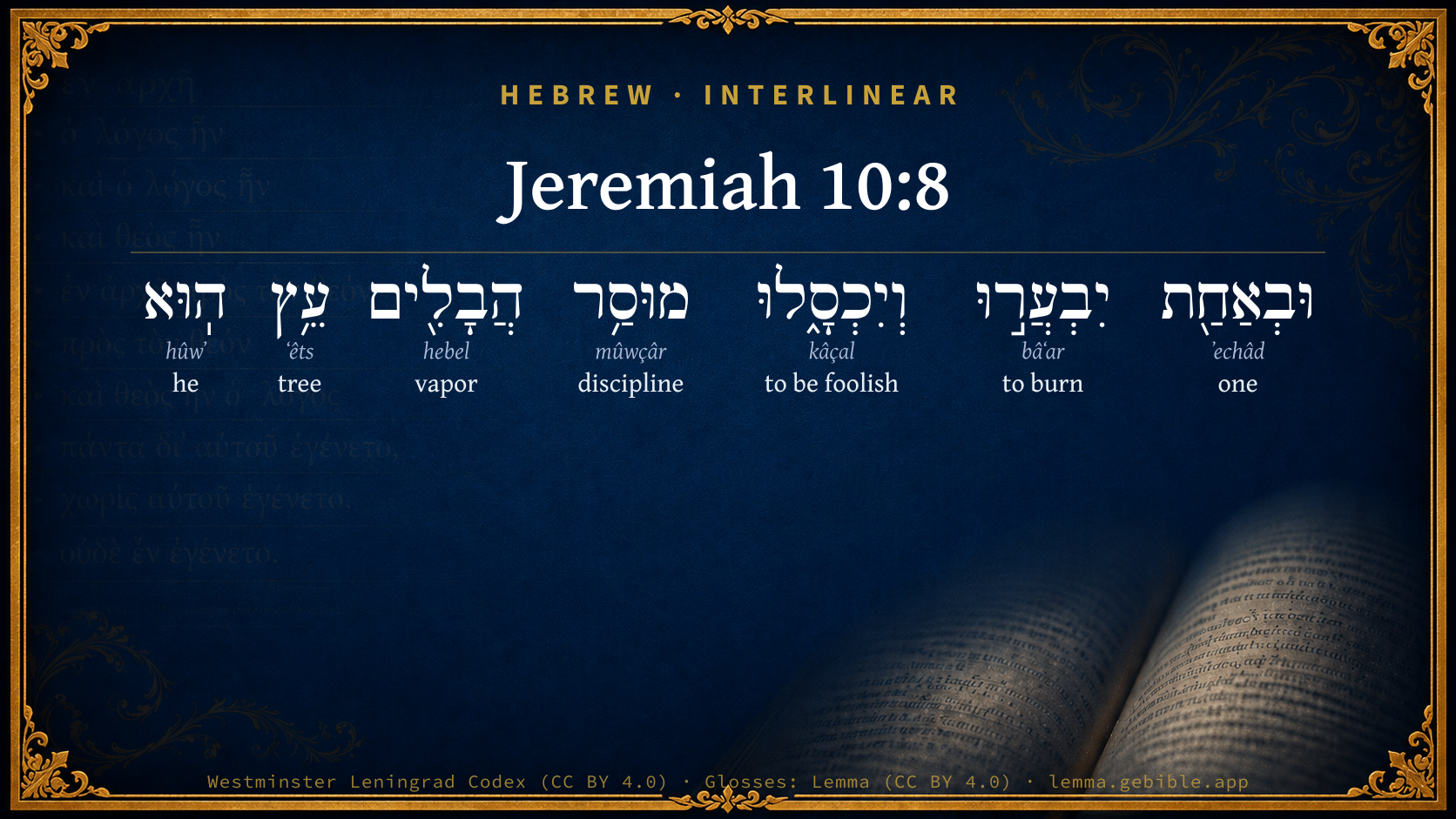
Jeremiah 10:8

Hebrew (Westminster Leningrad Codex) Jeremiah 10:8 appears in the Hebrew Old Testament. The text above is from the Westminster Leningrad Codex. Each word links to its Strong’s number, a concise gloss, and parsing drawn from the Open Scriptures Hebrew Bible morphology. Click any word for its full Brown-Driver-Briggs (BDB) entry.
Download image
Cite this verse

Jeremiah 10:8 (World English Bible). Public Domain. Lemma interlinear Bible study tool, https://lemma.gebible.app/v/jeremiah/10/8.

Show BibTeX & RIS
BibTeX
RIS
English Translation
But they are together brutish and foolish: the instruction of idols! it is but a stock.
World English Bible · Public Domain
Highlights
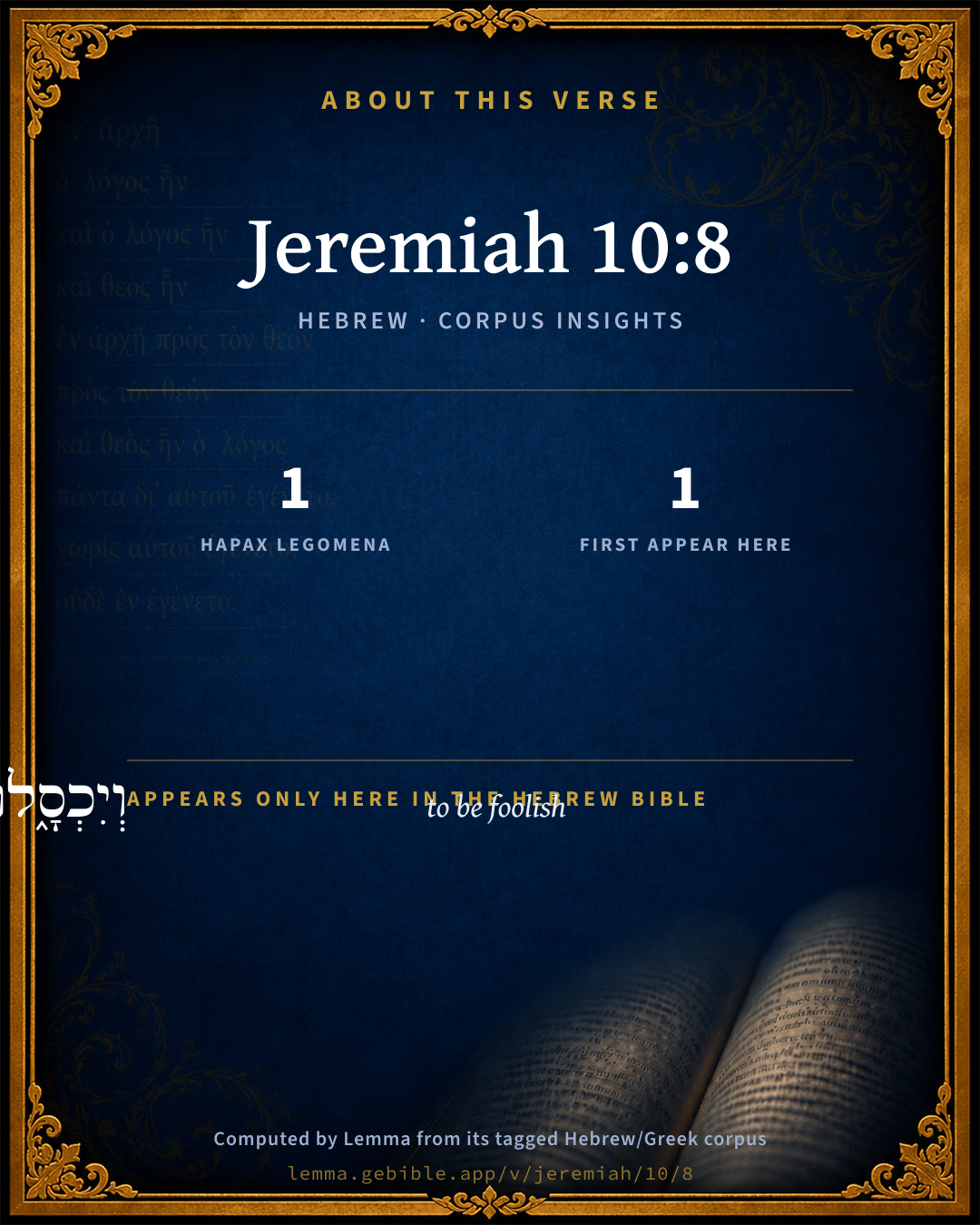
  • 1 hapax legomenon — only here in the Hebrew Bible
  • 1 first appearance in the Hebrew Bible
Full analysis ↓
Download a study sheet

One document with this verse’s original text, its word-by-word gloss line, the meaning frame, cross-references with their text, attributed commentary, and full source and license credits — printable, and it pastes into notes with its structure intact.

This verse Autodidact and up

Study sheet (.html) Plain text (.txt)

A passage Seminary Student

Up to 50 verses in one chapter. A passage sheet keeps up to 6 commentary sources and 12 cross-references per verse, in the order this page ranks them, and says so on the sheet whenever that leaves anything out. Ask for a single verse and you get the Autodidact verse sheet above.

Everything on this page stays free to read, with no account — the sheet is a download of what is already on screen, not access to it.

Want to remove ads? Support Godless Engineer
Compare translations 3

The same verse in 3 English versions, stacked beneath the original-language interlinear above. Click any original word for its lexicon entry.

Each is an independent rendering of the whole verse — the interlinear is not word-aligned to these translations.

Highlighted words mark where these versions differ — a whole-verse word diff, not a word-by-word alignment.

  • World English Bible Public Domain
    But they are together brutish and foolish: the instruction of idols! it is but a stock.
  • King James Version Public Domain
    But they are altogether brutish and foolish: the stock is a doctrine of vanities.
  • unfoldingWord Literal Text CC BY-SA 4.0
    And in one they are stupid and foolish, the instruction of vain things wood.

unfoldingWord Literal Text — © unfoldingWord, licensed CC BY-SA 4.0. Word-aligned USFM3 via Door43 (git.door43.org/unfoldingWord/en_ult).

Versions to compare (up to 4)

3 of 4 selected

Show all 18 translations

Every available English version of this verse, each an independent rendering of the whole verse.

  • World English Bible Public Domain
    But they are together brutish and foolish: the instruction of idols! it is but a stock.
  • Berean Standard Bible Public Domain
    But they are altogether senseless and foolish, instructed by worthless idols made of wood!
  • Majority Standard Bible Public Domain
    But they are altogether senseless and foolish, instructed by worthless idols made of wood!
  • King James Version Public Domain
    But they are altogether brutish and foolish: the stock is a doctrine of vanities.
  • American Standard Version (1901) Public Domain
    But they are together brutish and foolish: the instruction of idols! it is but a stock.
  • Revised Version (1885) Public Domain
    But they are together brutish and foolish: the instruction of idols, it is but a stock.
  • Geneva Bible (1599) Public Domain
    But, altogether they dote, and are foolish: for the stocke is a doctrine of vanitie.
  • Douay-Rheims (1899) Public Domain
    They shall all proved together to be senseless and foolish: the doctrine of their vanity is wood.
  • Young's Literal Translation Public Domain
    And in one they are brutish and foolish, An instruction of vanities `is' the tree itself.
  • Literal Standard Version CC BY-SA 4.0
    And as one they are brutish and foolish, || An instruction of vanities [is] the tree itself.
  • Unlocked Literal Bible CC BY-SA 4.0
    They are all the same, they are brutish and stupid, disciples of idols that are nothing but wood.
  • unfoldingWord Literal Text CC BY-SA 4.0
    And in one they are stupid and foolish, the instruction of vain things wood.
  • Darby Bible Public Domain
    But they are one and all senseless and foolish; the teaching of vanities is a stock.
  • World Messianic Bible Public Domain
    But they are together brutish and foolish, instructed by idols! It is just wood.
  • Webster's Bible Public Domain
    But they are altogether brutish and foolish: the stock is a doctrine of vanities.
  • Free Bible Version CC BY-SA 4.0
    Yet these “wise men” are completely foolish and stupid, because they think they can be taught by useless idols made of wood!
  • Bible in Basic English Public Domain
    But they are together like beasts and foolish: the teaching of false gods is wood.
  • JPS Tanakh (1917) Public Domain
    But they are altogether brutish and foolish: the vanities by which they are instructed are but a stock;

Literal Standard Version (2020), Covenant Press — licensed CC BY-SA 4.0. Text via the HelloAO Bible API (eBible.org). Unlocked Literal Bible (unfoldingWord) — licensed CC BY-SA 4.0. Text via the HelloAO Bible API (eBible.org). unfoldingWord Literal Text — © unfoldingWord, licensed CC BY-SA 4.0. Word-aligned USFM3 via Door43 (git.door43.org/unfoldingWord/en_ult). Free Bible Version, Dr. Jonathan Gallagher — licensed CC BY-SA 4.0. Text via the HelloAO Bible API (eBible.org).

Word by word

More ways to search: Search by grammar → Find every occurrence → Compare this word →

Practice this passage: Drill this verse → Learn its vocabulary →

About this verse

These counts appear in no published source. They are computed here, from the morphology-tagged text and Lemma’s own curated glosses. What Lemma adds →

7
words
7
distinct lemmas
Prophets
section

Notable vocabulary

1 hapax legomenon — a word that appears only here in the entire Hebrew Bible:

  • וְיִכְסָ֑לוּ to be foolish H3688

First appearance in Scripture

This word makes its first canonical appearance in the Hebrew Bible here:

  • וְיִכְסָ֑לוּ to be foolish H3688

Shared distinctive vocabulary

מוּסַ֥ר discipline H4148 occurs in 50 verses of the Hebrew Bible. Also found in:

Grammatical profile

  • 2 verbs
  • 3 nouns
  • 1 adjective
  • 1 pronoun

Verb forms

  • יִבְעֲר֣וּ Qal · Imperfect
  • וְיִכְסָ֑לוּ Qal · Imperfect

Cross-references

12

Topical passages linked to Jeremiah 10:8 in the Treasury of Scripture Knowledge — connected by theme and wording, ordered by reader-vote popularity; previews shown in the World English Bible.

  • Jeremiah 10:14 Every man is become brutish [and is] without knowledge; every goldsmith is disappointed by his engraved image; for his molten image is falsehood, and there is no breath in them.
  • Zechariah 10:2 For the teraphim have spoken vanity, and the diviners have seen a lie; And they have told false dreams. They comfort in vain. Therefore they go their way like sheep. They are oppressed, because there is no shepherd.
  • Psalms 115:8 Those who make them will be like them; Yes, everyone who trusts in them.
  • Psalms 135:18 Those who make them will be like them; Yes, everyone who trusts in them.
  • Isaiah 41:29 Behold, all of them, their works are vanity [and] nothing; their molten images are wind and confusion.
  • Jeremiah 51:17–18 Every man is become brutish [and is] without knowledge; every goldsmith is disappointed by his image; for his molten image is falsehood, and there is no breath in them.
  • Habakkuk 2:18 "What value does the engraved image have, that its maker has engraved it; the molten image, even the teacher of lies, that he who fashions its form trusts in it, to make mute idols?
  • Romans 1:21–22 Because, knowing God, they didn't glorify him as God, neither gave thanks, but became vain in their reasoning, and their senseless heart was darkened.
  • Isaiah 44:19 None calls to mind, neither is there knowledge nor understanding to say, I have burned part of it in the fire; yes, also I have baked bread on the coals of it; I have roasted flesh and eaten it: and shall I make the residue of it an abomination? shall I fall down to the stock of a tree?
  • Jeremiah 2:27 who tell a stock, You are my father; and to a stone, You have brought me forth: for they have turned their back to me, and not their face; but in the time of their trouble they will say, Arise, and save us.
  • Jeremiah 4:22 For my people are foolish, they don't know me; they are foolish children, and they have no understanding; they are wise to do evil, but to do good they have no knowledge.
  • Hosea 4:12 My people consult with their wooded idol, And answer to a stick of wood. Indeed the spirit of prostitution has led them astray, And they have been unfaithful to their God.

Cross-references courtesy of OpenBible.info (CC BY 4.0).

Hebrew and Greek witnesses Masoretic Hebrew ↔ Greek Septuagint

The same verse in the two great witnesses to the Old Testament, shown verse-for-verse.

These are two independent witnesses, not word-aligned to each other, and the Septuagint is shown in lemma (dictionary) form.

Hebrew Jeremiah 10:8 Masoretic · Westminster Leningrad Codex

וּבְאַחַ֖ת יִבְעֲר֣וּ וְיִכְסָ֑לוּ מוּסַ֥ר הֲבָלִ֖ים עֵ֥ץ הֽוּא

But they are together brutish and foolish: the instruction of idols! it is but a stock.

World English Bible · Public Domain

Greek LXX Structure differs

In the Septuagint, Jeremiah is about an eighth shorter than the Hebrew and arranges its material differently — the Oracles Against the Nations (Hebrew chapters 46–51) appear in the middle of the Greek book, after 25:13. Because the chapter and verse boundaries do not line up, a verse-for-verse comparison with the Hebrew is not shown.

A verse-for-verse comparison isn’t shown here because the chapters and verses don’t line up. Switch to the LXX edition with the MT / LXX toggle above to read the Greek directly.

Hebrew: Westminster Leningrad Codex (CC BY 4.0). Greek: Septuagint (public domain); English from a public-domain English Septuagint. How the Septuagint differs from the Hebrew →

Targum (Aramaic paraphrase)

1

The Targum is the ancient Jewish Aramaic paraphrase of the Hebrew Scriptures — an interpretive translation, not the Hebrew text itself. Onkelos (literal) and Pseudo-Jonathan (expansive) render the Torah, and Jonathan the Prophets. Coverage is partial: where no permissively-licensed English translation exists for a verse, only the Aramaic is shown. This is verse-level text, not a word-by-word alignment to the Hebrew.

  1. Targum Jonathan Prophets (Joshua–Malachi)
    וּבַחֲדָא יְחוֹבוּן עַמְמַיָא פַּלְחֵי כּוֹכְבַיָא עַל דְאִטַפָּשׁוּ עַל דִפְלָחוּ לְטַעֲוָתָא דִלְמָא אִינוּן:

    (no public-domain English translation for this verse)

    Targum Jonathan — Aramaic: “Mikraot Gedolot” (public domain). English: “Sefaria Community Translation” (CC0 1.0 (public-domain dedication)); “London "Chaldee Paraphrase," 1871” (public domain). Text via Sefaria.

Commentary

Notes on Jeremiah 10:8 from classic Christian and Jewish commentators (each source and its license shown beneath its notes). The classic Christian expositions comment on the surrounding passage and are grouped to its opening verse, so a note may address several verses; the Jewish commentaries on the Tanakh (Rashi and others) are per-verse, so they appear only where the commentator wrote on this verse.

Lemma curates 59 commentaries, every one of them public domain or Creative Commons licensed, each selected and text-cleaned for this edition rather than reprinted as found. About our sources →

Trapp's Complete Commentary

John Trapp

Jer 10:8 But they are altogether brutish and foolish: the stock [is] a doctrine of vanities.

Ver. 8. But they are altogether brutish and foolish.] The wise men are, for that, when they knew there was but one only true God - as did Pythagoras, Socrates, Plato, Seneca, &c. - they "detained the truth in unrighteousness," and taught the people to worship stocks and stones. {Rom 1:21-23} The nations are, because they yield to be taught devotion by images under what pretext soever. Considerentur hic subterfugia Papistarum. Let them regard this strategm of Popery. Pope Gregory first taught that images in churches were laymen’s books, a doctrine of devils.

John Trapp, A Commentary or Exposition upon All the Books of the Old and New Testament (1647–1656) — public domain. Text from a community e-Sword module.

Joseph Benson's Commentary

Jer 10:8. But they are altogether brutish — Or, all alike brutish. They that make images, saith the psalmist, Psa 115:8, are like unto them, equally stupid and insensible. The stock is a doctrine of vanities — Or lies. The use of images in worship is grounded on a false and foolish opinion, that God is like the work of men’s hands, and that images have some divine power lodged within them, and in this opinion it has a direct tendency to confirm the ignorant. Hence an image is called by Habakkuk, A teacher of lies. Instead of the stock, &c., Dr. Waterland reads, Vain institutions! very wood! Blaney, in consistency with his interpretation of the 7th verse, given above, renders this, But they, when they approach, (namely, to worship,) are stupid and sottish, the very wood itself being a rebuker of vanities. On which he observes, “The contrast is thus strongly marked between the true God, and the objects of heathen superstition. The servants of the former, when they approached him in their devotions, could not but be impressed with a reverential awe of a being so transcendently glorious. But those who drew near to worship the latter, manifested the greatest stupidity, in not discovering what was so obvious to common apprehension, the gross unworthiness of the objects to which their adorations were addressed.” On the latter clause, The very wood itself, &c., he remarks, “The true meaning and force of this passage seem to have escaped the notice of all the commentators. מוסר, (which our translators render doctrine,) properly signifies rectifying, or correcting, a false notion by just reproof; and by vanities are meant idols, so called from their being of no real use or advantage to those who had recourse to their assistance. And this unprofitableness of the idol, the very dull and senseless matter, says the prophet, out of which it was formed, is capable of demonstrating. But the rebuke, strictly speaking, is not directed to the idol, but to those who had not sense to perceive, that all the efforts of human art could never change an inanimate log of wood into an animated being, possessed of power and intelligence far surpassing those of the person from whom its origin was derived. There are, therefore, an energy and pointedness in this short sentence, at least equal to whatever has been said on the same subject by the most spirited writer, whether sacred or profane. Not even the keen raillery of the Roman satirist in those celebrated lines, olim truncus eram, &c., cuts with greater severity.” See note on Isa 44:12, &c.

Joseph Benson's Commentary on the Old and New Testaments (1811–1818) — public domain. Text from a community e-Sword module.

Geneva Bible (1599)

Geneva Bible translators

Because the people thought that to have images, was a means to serve God, and to bring them to the knowledge of him, he showeth that nothing more displeaseth God, nor bringeth man into greater errors and ignorance of God: and therefore he calleth them the doctrine of vanity, the work of errors, verse 15, and Hab. 2:18 calleth them the teachers of lies: contrary to that wicked opinion, that they are the books of the lay people.

Geneva Bible (1599) marginal notes — public domain. Text via Bolls.life.

Jamieson, Fausset & Brown

Robert Jamieson, A. R. Fausset & David Brown

altogether--rather, "all alike" [MAURER]. Even the so-called "wise" men (Jer 10:7) of the Gentiles are on a level with the brutes and "foolish," namely, because they connive at the popular idolatry (compare Rom 1:21-28). Therefore, in Daniel and Revelation, the world power is represented under a bestial form. Man divests himself of his true humanity, and sinks to the level of the brute, when he severs his connection with God (Psa 115:8; Jon 2:8).

stock is a doctrine of vanities--The stock (put for the worship of all idols whatever, made out of a stock) speaks for itself that the whole theory of idolatry is vanity (Isa 44:9-11). CASTALIO translates, "the very wood itself confuting the vanity" (of the idol).

Jamieson, Fausset & Brown — Commentary Critical and Explanatory on the Whole Bible (1871) — public domain (CC PDM 1.0). Text via the HelloAO Bible API.

Adam Clarke's Commentary

Verse 8. The stock is a doctrine of vanities.] Dr. Blayney translates,-"The wood itself is a rebuker of vanities." The very tree out of which the god is hewn demonstrates the vanity and folly of the idolaters; for, can all the art of man make out of a log of wood an animate and intelligent being?

Adam Clarke's Commentary on the Bible (1810–1826) — public domain. Text from a community e-Sword/MySword module.

John Calvin's Commentaries

The Prophet shews here, in one sentence, that the wisest in the whole world could be proved guilty of the greatest madness, or of a twofold folly, because they willingly worshipped the trunks of trees, and they worshipped stones; for Under one kind he includes the other. There is no one, he says, however intelligent, who does not approve of the superstitions of the people, who does not bend the knee before a wood or a stone. There have been, indeed, a few in the world who ridiculed such sottishhess, but no one dared openly to condemn it, and no one introduced anything better. And even the Platonics hold that the Greeks had not without reason invented gods like men; and they say that there was not so much judgment among the barbarians as to form such ideas of the gods as were suitable to their nature. However this may have been, it is evident that the grossest superstitions of the nations were ever approved by all their wise men.

The Prophet then shews that there was no need of a long discussion to discover the vanity of the wise; In one, in one thing, he says; and there is emphasis in this word, when he says, In one thing they are foolish and fatuitous; for there is to be understood a contrast, as though he had said, “I will not here join together many heads of accusation against them to expose their folly, one thing is sufficient; this one sentence is enough to condemn them, — that wood is the teaching of vanities.” We have stated what the Prophet means, even that all the wise, who together with the vulgar worshipped gods made of wood and stone, were very foolish: but we must notice the import of the expression, The teaching of vanities is the wood. It is, as we have said, an instance of a part being put for the whole; for under “wood” Jeremiah includes statues of stone, and others made of different materials; as though he had said, “Every form or effigy, representing a god, is the teaching of vanities.” He takes this as granted; and yet there had been, as we have lately stated, a great and fierce contention among the wise men on this subject; but the Prophet deigned not to contend or seriously to dispute with them, for the thing itself was sufficiently evident, that is, that nothing can be more absurd than to worship the trunk of a tree or a stone.

Now we may from this passage draw a general truth, — that when men seek to represent God under any visible form, they give way to the delusions and impostures of Satan. Well known is that sentence of Gregory to Serenus, the Bishop of Marseilles, when that good man cast down the images which he saw led to ungodly worship, and purged the churches of Marseilles from such pollutions: Gregory, though a pious man, yet wrote very foolishly — that Serenus acted rightly and wisely in forbidding images to be worshipped, but that he yet acted inconsiderately by emptying the churches of them; for “they are,” he said, “the books of the simple:” this is the conclusion of his epistle. And it is ever in the mouth of Papists — that images are the books of the simple. At the same time I would they retained this truth avowed by Gregory, that they ought not to be worshipped. They worship and adore them, as it is well known, in the place of God. But as I have already said, that answer of Gregory was puerile and foolish: for we hear what the Prophet says, — that in wood and stone and in every outward representation there is vanity, as Habakkuk also in the second chapter, where He speaks of idols, calls an idol the teacher of vanity. Every statue, every image, by which foolish men seek to represent God, is a teacher of falsehood. So our Prophet says, — that the teaching of vanities is found in all statues, because God is thus misrepresented; for what can be in a wood or stone that is like the infinite power of God, or his incomprehensible essence and majesty? Men, therefore, offer a serious affront to God when they thus deform him, as Paul also in Romans 1:25, says, — that the truth was thus changed into falsehood, that is, when he is supposed to have anything like to what external and dead figures have; as the same Paul further reasons in Acts 17:29, when he says, Do ye think that God is like to wood or stone, to silver or gold? And his argument was at that time suitable; for he had to do with heafilens: he did not refer to the law, though he might have quoted a passage in Deuteronomy, where God reminded the people that he so appeared to them that they saw no similitude; and he might have referred to the testimonies of Isaiah, Jeremiah, and of the other Prophets; but as he addressed heathens, even the Athenians, he says, “One of your poets has said, that we are the offspring of God:” if we are then, He says, the offspring of God, do ye not draw God down from his celestial throne, when ye seek to delineate him according to your fancies, and suppose that he lies hid in wood or stone, in silver and gold? For some life appears at least in men, they are endued with mind and intelligence, and so far they bear some likeness to God: but a dead wood and stone, which are void of sense, — gold also and silver, which are metals without reason, which have no life, — what affinity, He says, can these have to God? This subject might be more copiously handled; but I merely explain what the Prophet means, and also shew the import of his doctrine, and how it may be applied for general instruction. It now follows —

John Calvin's Commentaries (1540-1563) — public domain. Text from the Calvin Translation Society English edition (1840s-50s) via the Christian Classics Ethereal Library (ccel.org). Calvin's coverage is partial (roughly two-thirds of the Bible); uncommented books and verses are honest gaps, never fabricated. The 19th-century editor's footnotes and remarks are omitted so the notes are faithfully Calvin's own voice.

Ellicott's Commentary for English Readers

(8) Altogether.—Literally, in one, probably in the sense in one word, in one fact, sc., that which follows in the next clause.

The stock is a doctrine of vanities.—Better, inverting the subject and predicate, the teaching of vanities (i.e., of idols) is a word, or is a log. That is all it comes to; that one word is its condemnation.

A Bible Commentary for English Readers, edited by Charles John Ellicott (1878–1897) — public domain. Text from a community e-Sword module.

The Cambridge Bible for Schools and Colleges

gen. ed. J. J. S. Perowne

8. together] rather, all together, one and all.

the instruction … a stock] lit. the instruction of idols is wood, i.e. “is no better than the idol itself: idolatry is destitute of moral or spiritual force,” Dr. Possibly MT. needs emendation, as the expression is a strange one.

The Cambridge Bible for Schools and Colleges (gen. ed. J. J. S. Perowne; Cambridge University Press, 1878–1918) — public domain. Text from a community e-Sword module.

John Gill's Exposition

But they are altogether brutish and foolish,.... In comparison of the Lord, there is no knowledge and wisdom in them, this is a certain fact; they are verily brutish and foolish; or they are one and all so, there is not a wise man among them: or, "in one thing they are brutish" (r), &c.; namely, in their idolatry; however wise they may be in other respects, in this they are foolish: or, to give no more instances of their brutishness (s) and folly, this one is sufficient, even what follows,

the stock is a doctrine of vanities; or what they teach persons, as to worship the trunk of a tree, or any idol of metal, or of wood, is a most vain and foolish thing, and argues gross stupidity and folly, and proves them to be brutish, and without understanding.

(r) "in hoc uno Munster", Tigurine version; "et certe in una quadem re obbrutescunt", Piscator. So Jarchi and Abarbinel. (s) The Talmudists seem to take the word to have the signification of burning; for the sense of these words being asked, it is replied, there is one thing that burns the wicked in hell; what is it? idolatry; as it is here written, "a doctrine of vanities is the stock."

John Gill's Exposition of the Whole Bible (1746–1763) — public domain (CC PDM 1.0). Text via the HelloAO Bible API.

Albert Barnes' Notes on the Bible

Brutish - Jer 10:21 and foolish Theirs was the brutishness of men in a savage state, little better than mere animals: their folly that of stupidity.

The stock ... - Rather, the instruction of idols is a piece of wood. That is what they are themselves, and “ex nihilo nihil fit” (from nothingness, nothing is made).

Albert Barnes' Notes on the Bible (1834–1885) — public domain. Text from a community e-Sword/MySword module.

Haydock's Catholic Bible Commentary

Vanity, and shews them clearly to be foolish (Calmet) and wicked. (Haydock)

George Leo Haydock (1774–1849), Haydock's Catholic Family Bible and Commentary, 1859 edition — public domain. Excludes Psalms (Douay-Rheims chapter numbering differs from Protestant) and Deuterocanonical books (Catholic canon only).

Matthew Poole's English Annotations

They are altogether brutish: the awe that the idol doth impress upon carnal men’s minds, and thereby taking them off from a due apprehension of the essence of God, doth keep them between such hope and fear, that they become as senseless and as inapprehensive of any true worship as brutes.

And foolish; not only some of them, but even all, both Jews and Gentiles: q.d. I need not stand to particularize, but take them altogether, they are become stupid idolaters, and have drank in the most gross superstitions of the Gentiles, as Rom 1:19,21.

The stock; a synecdoche put for all sorts of idols, of what materials soever; and a metonymy of the matter, to render them contemptible, either as deluding the ignorant, or in themselves considered; they are mere vain, foolish, helpless things.

Is a doctrine of vanities; the Hebrew word musar is taken for bad instruction, Pro 16:22; q. d. It is an easy matter to prove them very fools and brutish, when they look upon a stock, a piece of wood, to be their god, which hath neither knowledge nor providence, and therefore must needs be a doctrine of vanity, when they think to be taught devotion by images, which is a teacher of lies; that saith to the dumb stone, It shall teach, Hab 2:18,19; like that doctrine of devils first broached by Pope Gregory, who first commended Serenus bishop of Massilia for not permitting images to be worshipped, but reproved him for throwing them out of the church, because they serve for ornaments and laymen’s books, which since hath been received as a catholic doctrine, that images are laymen’s books.

Matthew Poole's English Annotations on the Holy Bible (1683–1685) — public domain. Text from a community e-Sword/MySword module.

Whedon's Commentary on the Bible

Daniel D. Whedon

8. The stock, etc. — Rather, the teaching of idols is wood. They themselves are wood, and nothing can proceed from them better than what is in them. The special point of this sentence, at once so keenly satirical and so truly philosophical, is this: Their shaping, polishing, decking, and plating would seem to be for the purpose of getting something more precious than wood. As they look upon their finished god, decked out with his trappings of gold and silver, they forget his genesis, and think of him as something else than he really is. And so the prophet condenses all the possibilities of the case into a single sentence; and then, as if in the way of individual justification, he hastily runs over the process of the manufacture of idols.

Daniel D. Whedon (gen. ed.), Commentary on the Old and New Testaments (1874–1909) — public domain. Text from a community e-Sword module.

unfoldingWord translationNotes

Door43 World Missions Community

They are all the same, they are brutish and stupid, disciples

The words "brutish" and "stupid" mean basically the same thing and emphasize how foolish the people are for worshiping idols. AT: "They are all very stupid, they are disciples" (See: Doublet)

disciples of idols that are nothing but wood

"they try to learn from an idol which is only a piece of wood"

Tarshish ... Uphaz

places where silver and gold are mined (See: How to Translate Names)

gold from Uphaz made by artificers, the hands of refiners

This can be stated in active form. Also, the refiners are represented here by their "hands" because they do their work with their hands. AT: "gold from Uphaz that skilled craftsmen and refiners have made" (See: Active or Passive and Metonymy)

artificers

"skilled craftsmen"

refiners

people who heat gold to remove from it anything that is not gold

Their clothes are blue and purple cloth

"The people dress the idols in blue and purple cloth"

The earth quakes at his anger

This speaks of the earth shaking as an emotional response to Yahweh's anger, when actually Yahweh causes the earth to quake. AT: "The earth quakes when he is angry" (See: Personification)

quakes

"shakes"

translationWords

disciple

Tarshish

hand

true

God

life

eternity

anger

endure

unfoldingWord translationNotes — © Distant Shores Media and the Door43 World Missions Community, licensed CC BY-SA 4.0. Source: git.door43.org/Door43/en_tn.

Rashi

Rabbi Shlomo Yitzchaki (Rashi)

But with one thing they are brutish i.e., the heathens, and what is that one thing? Their vanities of wood for which they will be punished, and they will be punished for it. יבערו is an expression of foolishness, so is ויכסלו.

Rashi on the Tanakh — English translations: “The Judaica Press complete Tanach with Rashi, translated by A. J. Rosenberg” (CC BY 4.0); “Pentateuch with Rashi's commentary by M. Rosenbaum and A.M. Silbermann, 1929-1934” (public domain); “The Metsudah Tanach series, Lakewood, N.J” (CC BY 4.0); and “The Book of Joshua, Metsudah Publications, 1997” (CC BY 4.0). Text via Sefaria.

Lesson kit

Teaching starters — assembled from the data on this page, not authored interpretation. Every prompt links to the verse data it draws on. Edit before teaching.

Jeremiah, in the Prophets, opens this verse with 7 words (7 distinct Hebrew lemmas). Its most distinctive word is kâçal (“to be foolish”). A historical commentator’s framing appears above. Read the whole chapter for the surrounding context.

Discussion questions

  1. The word kâçal carries the sense “to be foolish.” How does it shape the verse?
  2. This verse holds 1 word here found nowhere else in the Hebrew Bible. What might the rare word draw attention to?
  3. The word “to be foolish” first appears here in Scripture. What is being introduced at this debut?
  4. Deuteronomy 11:2 shares the word «discipline» with this verse. How do the two illuminate each other?
  5. The translations on this page render this verse differently — a whole-verse word diff, not a word-by-word alignment. What might account for the different wordings?
  6. The verb «יִבְעֲר֣וּ» is Qal Imperfect. How does its form color the action?
  7. Reading how Trapp's Complete Commentary and Joseph Benson's Commentary read this verse, where do the two commentators agree and where do they part?

Things to notice

  • 1 word in this verse appears nowhere else in the Hebrew Bible.
  • 1 word makes its first canonical appearance in Scripture here.
  • These translations choose different wording for 13 words in this verse.
  • 7 distinct Hebrew lemmas span 7 words in this verse.

Reading settings

Reading text

Shown beneath each verse's original-language words.

Old Testament
Old Testament edition

Read the OT as the Masoretic Hebrew (MT) or the Greek Septuagint (LXX).

English shown for the Greek Septuagint (in the Hebrew ↔ Greek comparison).

Comparing translations? Open the Compare panel on any verse page to stack up to four side by side.