Hebrews 3:14

Greek (Tischendorf 8th ed.) Hebrews 3:14 appears in the Greek New Testament. The text above is from the Tischendorf 8th edition. Each word links to its Strong’s number and a concise gloss. Click any word for its full Thayer’s Greek Lexicon entry.
Download image
Cite this verse

Hebrews 3:14 (World English Bible). Public Domain. Lemma interlinear Bible study tool, https://lemma.gebible.app/v/hebrews/3/14.

Show BibTeX & RIS
BibTeX
RIS
English Translation
For we have become partakers of Christ, if we hold fast the beginning of our confidence firm to the end:
World English Bible · Public Domain
Download a study sheet

One document with this verse’s original text, its word-by-word gloss line, the meaning frame, cross-references with their text, attributed commentary, and full source and license credits — printable, and it pastes into notes with its structure intact.

This verse Autodidact and up

Study sheet (.html) Plain text (.txt)

A passage Seminary Student

Up to 50 verses in one chapter. A passage sheet keeps up to 6 commentary sources and 12 cross-references per verse, in the order this page ranks them, and says so on the sheet whenever that leaves anything out. Ask for a single verse and you get the Autodidact verse sheet above.

Everything on this page stays free to read, with no account — the sheet is a download of what is already on screen, not access to it.

Want to remove ads? Support Godless Engineer
Compare translations 3

The same verse in 3 English versions, stacked beneath the original-language interlinear above. Click any original word for its lexicon entry.

Each is an independent rendering of the whole verse — the interlinear is not word-aligned to these translations.

Highlighted words mark where these versions differ — a whole-verse word diff, not a word-by-word alignment.

  • World English Bible Public Domain
    For we have become partakers of Christ, if we hold fast the beginning of our confidence firm to the end:
  • King James Version Public Domain
    For we are made partakers of Christ, if we hold the beginning of our confidence stedfast unto the end;
  • unfoldingWord Literal Text CC BY-SA 4.0
    For we have become sharers of Christ, if indeed we hold firm the beginning of our confidence until the end,

unfoldingWord Literal Text — © unfoldingWord, licensed CC BY-SA 4.0. Word-aligned USFM3 via Door43 (git.door43.org/unfoldingWord/en_ult).

Versions to compare (up to 4)

3 of 4 selected

Show all 19 translations

Every available English version of this verse, each an independent rendering of the whole verse.

  • World English Bible Public Domain
    For we have become partakers of Christ, if we hold fast the beginning of our confidence firm to the end:
  • Berean Standard Bible Public Domain
    We have come to share in Christ if we hold firmly to the end the assurance we had at first.
  • Majority Standard Bible Public Domain
    We have come to share in Christ if we hold firmly to the end the assurance we had at first.
  • King James Version Public Domain
    For we are made partakers of Christ, if we hold the beginning of our confidence stedfast unto the end;
  • American Standard Version (1901) Public Domain
    for we are become partakers of Christ, if we hold fast the beginning of our confidence firm unto the end:
  • Revised Version (1885) Public Domain
    for we are become partakers of Christ, if we hold fast the beginning of our confidence firm unto the end:
  • Geneva Bible (1599) Public Domain
    For we are made partakers of Christ, if we keepe sure vnto the ende that beginning, wherewith we are vpholden,
  • Douay-Rheims (1899) Public Domain
    For we are made partakers of Christ: yet so, if we hold the beginning of his substance firm unto the end.
  • Young's Literal Translation Public Domain
    for partakers we have become of the Christ, if the beginning of the confidence unto the end we may hold fast,
  • Literal Standard Version CC BY-SA 4.0
    for we have become partakers of the Christ, if we may hold fast the confidence [we had] at the beginning to the end,
  • Unlocked Literal Bible CC BY-SA 4.0
    For we have become partners of Christ if we firmly hold to our confidence in him from the beginning to the end.
  • unfoldingWord Literal Text CC BY-SA 4.0
    For we have become sharers of Christ, if indeed we hold firm the beginning of our confidence until the end,
  • Darby Bible Public Domain
    For we are become companions of the Christ if indeed we hold the beginning of the assurance firm to the end;
  • World Messianic Bible Public Domain
    For we have become partakers of Messiah, if we hold the beginning of our confidence firm to the end,
  • Webster's Bible Public Domain
    For we are made partakers of Christ, if we hold the beginning of our confidence steadfast to the end;
  • Free Bible Version CC BY-SA 4.0
    For we are partners with Christ as long as we hold on to our confidence in God from beginning to end.
  • Bible in Basic English Public Domain
    For if we keep the substance of the faith which we had at the start, even till the end, we have a part with Christ;
  • Text-Critical English NT CC BY 4.0
    For we have come to share in Christ, but only if we hold our original confidence firm to the end.
  • Tyndale New Testament (1534) Public Domain
    We are partetakers of Christ yf we kepe sure vnto the ende the fyrst substance

Literal Standard Version (2020), Covenant Press — licensed CC BY-SA 4.0. Text via the HelloAO Bible API (eBible.org). Unlocked Literal Bible (unfoldingWord) — licensed CC BY-SA 4.0. Text via the HelloAO Bible API (eBible.org). unfoldingWord Literal Text — © unfoldingWord, licensed CC BY-SA 4.0. Word-aligned USFM3 via Door43 (git.door43.org/unfoldingWord/en_ult). Free Bible Version, Dr. Jonathan Gallagher — licensed CC BY-SA 4.0. Text via the HelloAO Bible API (eBible.org).

Word by word

More ways to search: Search by grammar → Find every occurrence → Compare this word →

Practice this passage: Drill this verse → Learn its vocabulary →

ὑποστάσεως
hypóstasis
G5287
“confidence”
Noun, Genitive, Singular, Feminine
Part of Speech
Noun
Case
Genitive
Number
Singular
Gender
Feminine
Full Thayer's Definition

Origin: from a compound of G5259 and G2476

TDNT: 17:32,1

1. a setting or placing under a. thing put under, substructure, foundation 2. that which has foundation, is firm a. that which has actual existence 1. a substance, real being b. the substantial quality, nature, of a person or thing c. the steadfastness of mind, firmness, courage, resolution 1. confidence, firm trust, assurance
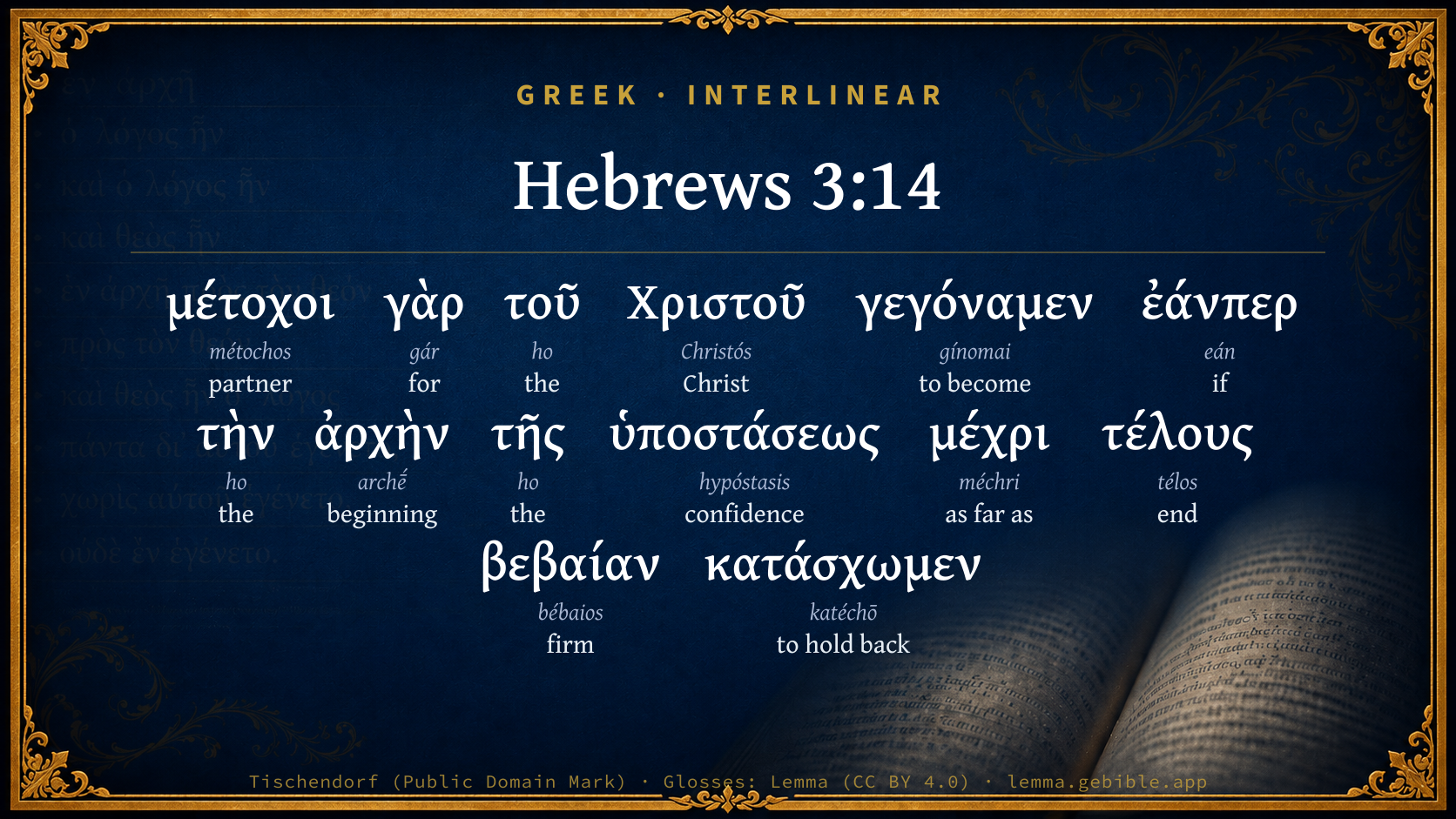
  1. μέτοχοι métochos G3353 “partner” Adjective, Nominative, Plural, Masculine
  2. γὰρ gár G1063 “for” Conjunction
  3. τοῦ ho G3588 “the” Article, Genitive, Singular, Masculine
  4. Χριστοῦ Christós G5547 “Christ” Noun, Genitive, Singular, Masculine
  5. γεγόναμεν gínomai G1096 “to become” Verb, Perfect, Active, Indicative, 1st person, Plural
  6. ἐάνπερ eán G1437 “if” Conditional
  7. τὴν ho G3588 “the” Article, Accusative, Singular, Feminine
  8. ἀρχὴν archḗ G746 “beginning” Noun, Accusative, Singular, Feminine
  9. τῆς ho G3588 “the” Article, Genitive, Singular, Feminine
  10. μέχρι méchri G3360 “as far as” Adverb
  11. τέλους télos G5056 “end” Noun, Genitive, Singular, Neuter
  12. βεβαίαν bébaios G949 “firm” Adjective, Accusative, Singular, Feminine
  13. κατάσχωμεν katéchō G2722 “to hold back” Verb, Aorist, Active, Subjunctive, 1st person, Plural

About this verse

These counts appear in no published source. They are computed here, from the morphology-tagged text and Lemma’s own curated glosses. What Lemma adds →

14
words
12
distinct lemmas
General Epistles
section

Notable vocabulary

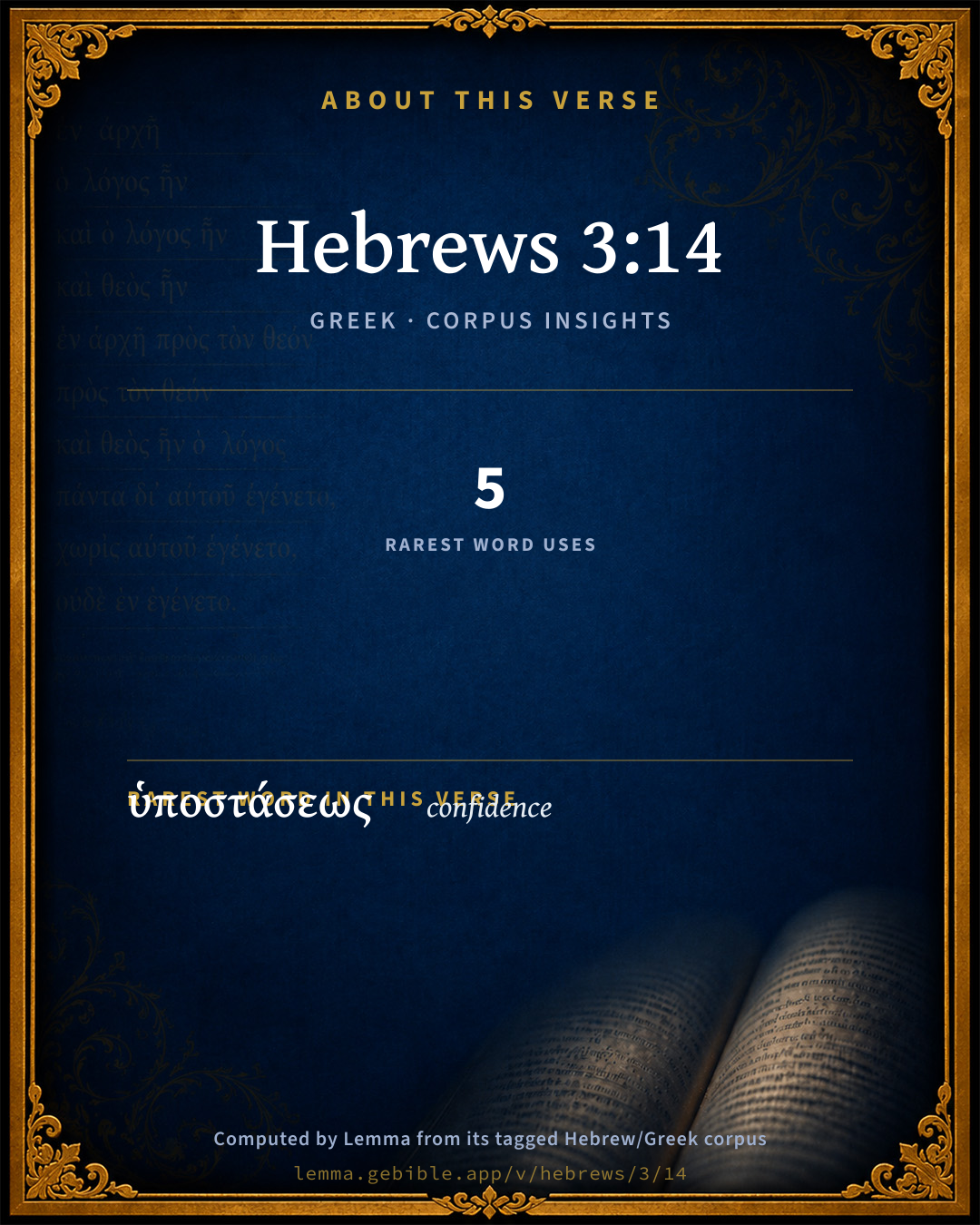
The rarest word here is ὑποστάσεως confidence G5287 — appearing just 5 times in the whole Greek New Testament.

Shared distinctive vocabulary

ὑποστάσεως confidence G5287 occurs in 5 verses of the Greek New Testament. Also found in:

Repetition

A word recurs within this verse:

Cross-references

11

Topical passages linked to Hebrews 3:14 in the Treasury of Scripture Knowledge — connected by theme and wording, ordered by reader-vote popularity; previews shown in the World English Bible.

  • Hebrews 3:6 but Christ is faithful as a Son over his house; whose house we are, if we hold fast our confidence and the glorying of our hope firm to the end.
  • Hebrews 6:11 We desire that each one of you may show the same diligence to the fullness of hope even to the end,
  • Hebrews 12:10 For they indeed, for a few days, punished us as seemed good to them; but he for our profit, that we may be partakers of his holiness.
  • 1 Peter 4:13 But because you are partakers of Christ's sufferings, rejoice; that at the revelation of his glory also you may rejoice with exceeding joy.
  • Ephesians 3:6 that the Gentiles are fellow heirs, and fellow members of the body, and fellow partakers of his promise in Christ Jesus through the Gospel,
  • Hebrews 6:4 For concerning those who were once enlightened and tasted of the heavenly gift, and were made partakers of the Holy Spirit,
  • Romans 11:17 But if some of the branches were broken off, and you, being a wild olive, were grafted in among them, and became partaker with them of the root and of the richness of the olive tree;
  • Hebrews 3:1 Therefore, holy brothers, partakers of a heavenly calling, consider the Apostle and High Priest of our confession, Jesus;
  • 1 Corinthians 10:17 Because we, who are many, are one bread, one body; for we all partake of the one bread.
  • 1 Corinthians 1:30 But of him, you are in Christ Jesus, who was made to us wisdom from God, and righteousness and sanctification, and redemption:
  • 1 John 1:3 that which we have seen and heard we declare to you, that you also may have fellowship with us. Yes, and our fellowship is with the Father, and with his Son, Jesus Christ.

Cross-references courtesy of OpenBible.info (CC BY 4.0).

Commentary

Notes on Hebrews 3:14 from classic Christian and Jewish commentators (each source and its license shown beneath its notes). The classic Christian expositions comment on the surrounding passage and are grouped to its opening verse, so a note may address several verses; the Jewish commentaries on the Tanakh (Rashi and others) are per-verse, so they appear only where the commentator wrote on this verse.

Lemma curates 59 commentaries, every one of them public domain or Creative Commons licensed, each selected and text-cleaned for this edition rather than reprinted as found. About our sources →

The Biblical Illustrator

Joseph S. Exell

Heb_3:14

We are made partakers of Christ

Partners of Christ

There is nothing that Christ hath, but we have part of it.

His wisdom, holiness, His righteousness is ours; yea, His kingdom is ours. We are heirs, yea, co-heirs with Him of His kingdom. As the man at the day of marriage says to his wife, With all ray worldly goods I thee endow, so the Lord Jesus endoweth us with all His goods; by reason whereof, being poor and worth nothing, we become exceeding rich. Christ is ours, death, life, the world is ours. Oh, unspeakable prerogative vouchsafed to dust and ashes! Let us walk worthy of this honour whereunto we are advanced: being Christs partners, let us not be the devils partners. Let us be holy as He is holy, humble as He is humble; let us contemn this world with all the vain pleasures that be in it as He did. What fellowship is there between Christ and Belial? (W. Jones, D. D.)

Fellows of Christ

What does this mean? The first idea that suggests itself is that Christ stands as a synonym and compendium of salvation, just as Moses in the above-quoted words of Paul is a synonym for the redemption he was Gods instrument in achieving. An alternative course is open to the interpreter: to render, partakers with Christ, and to find in the words the thought that only such as persevere in faith share in the glory and the joy conferred on Him at the close of His earthly career as Gods faithful apostle. This view, however, though true in itself, attains to its full heights only when we adopt a bolder course, and take μέτοχι as meaning here, as in Heb_1:9, companions or fellows. We then get the striking thought that by persistent loyalty to the Christian vocation we become fellows of Jesus. It is intrinsically likely that the passage about the Messiah quoted from the forty-fifth Psalm in the first chapter was present to the writers mind at this point. It speaks of the Messiah as anointed with the oil of gladness above His fellows, implying that they too, in their measure, have a cup full of joy. In the present connection of thought mention is made of a boasting of hope, a hope rising into exultation, implying a still higher measure of triumphant joy when hope reaches its consummation. The idea, the faithful the fellows of Christ, is also in full sympathy with the thought expressed in Heb_1:6, whose house are we. The faithful are Gods house, at the head of which is Christ, Gods Son. They are Gods house not as Moses was, as servants, but as sons, therefore the brethren of Christ. But brotherhood is a thing of degrees. There is an initial brotherhood, in which, as Paul says, a son differs nothing from a servant; and there is a brotherhood, the result of a normal moral development, in which a younger son, at length arrived at maturity, becomes the companion of the elder brother. We are brethren to begin with, but if we are faithful we shall end in becoming fellows. And so our author, having already said of those who persevere that they are the house of God, now takes a step in advance, and in renewing his exhortation to steadfastness says, The faithful are not only the house of God and the brethren of Christ, they are His fellows, sharing His joy and having perfect communion with Him in spirit. (A. B. Bruce, D. D.)

A persuasive to steadfastness

I. First, then, here is A VERY HIGH PRIVILEGE. We are made partakers of Christ. Observe that the text does not say we are made partakers of rich spiritual benefits. There is more than that here. To be partakers of pardoning mercy, of renewing grace, of the adoption, of sanctification, preservation, and of all the other covenant blessings, is to possess an endowment of unspeakable value: but to be made partakers of Christ, is to have all in one. You have all the flowers in one posy, all the gems in one necklace, all the sweet spices in one delicious compound. We are made partakers of Christ--of Himself. It pleased the Father that in Him should all fulness dwell, and we are made partakers with Him of all that He is ordained to be of God unto us wisdom, righteousness, sanctification, and redemption. We are made partakers of Christ, when first of all by faith in Him we procure a share in His merits. Moreover, we are partakers of Christ, inasmuch as His righteousness also becomes ours by imputation. We further become partakers of Christ by living and feeding on Him. The sacramental table represents our fellowship. Partakers of Christ! Yes, and therefore with Him partakers in destiny. The language of the text reminds us that none of us have any title to this privilege by nature. We are made partakers of Christ. From our first parentage we derived a very different entail. We are made partakers of Christ. This is the Holy Ghosts work in us, to rend us away from the old wild olive, and to graft us into the good olive; to dissolve the union between us and sin, and to cement a union between our souls and Christ. This is work as grand and godlike as to create a world.

II. The privilege of which we have spoken suggests A SOLEMN, SEARCHING QUESTION. Are we made partakers of Christ? There is nothing more to be dreaded than a counterfeit justification, a spurious hope.

III. Now we come to THE UNERRING TEST. Patience comes to the aid of faith here. Evidences accumulate till the issue is conclusive. We are made partakers of Christ if we hold the beginning of our confidence steadfast unto the end. This passage may be read in two ways, neither of which violates the literal meaning of the original as we have it in our version, the beginning of our confidence, or, as I would rather translate it, the foundation of our confidence, the basis on which our confidence rests. Take your choice. We will expound both. That man is a partaker of Christ who holds fast the faith he had at first, having received it, not as an education, but as an intuition of his spiritual life; not as an argument, but as an axiom he could not challenge, or rather as an oracle he received joyfully and bowed to submissively. The confidence which is based upon the true foundation, even Christ Jesus, is simple and clear as ones own consciousness. It asks no proof because it admits no doubt. Now what was the beginning of our confidence? Well, the beginning of my confidence was, I am a sinner, Christ is a Saviour; and I rest on Him to save me. We were nothing at all, and Jesus Christ was all in all. We are not made partakers of Christ unless we hold this fast to the end. (C. H. Spurgeon.)

The Biblical Illustrator, edited by Joseph S. Exell (c. 1880s–1900s) — public domain. Text from a community e-Sword module.

Joseph Benson's Commentary

Heb 3:14. For we are made partakers of Christ — Of all the blessings procured by his death, and offered in his gospel, even of pardon, holiness, and eternal life; if we hold — If we retain with constancy and perseverance; the beginning of our confidence — That is, the confidence or trust we have begun to place in him; steadfast — Βεβαιαν, firm; unto the end — Of our lives, whatever difficulties or oppositions may arise. Dr. Owen (who, by being partakers of Christ, understands our having an interest in his nature, by the communication of his Spirit, as Christ had in ours by the assumption of our flesh) interprets the word υποστασις, here rendered confidence, of that union which we are bound to preserve and maintain with Christ, or of our subsistence in him, our abiding in him as the branches in the vine, observing, “So the word very properly signifies, and so it is here emphatically used.” He adds, “the beginning of our subsistence in Christ, and of our engagements to him, is, for the most part, accompanied with much love and other choice affections, resolution, and courage; which, without great care and watchfulness, we are very ready to decay in and fall from.”

Joseph Benson's Commentary on the Old and New Testaments (1811–1818) — public domain. Text from a community e-Sword module.

Tyndale Open Study Notes

Tyndale Open Resources

3:14 For if we are faithful: Those who persevere in the faith have assurance that they are indeed part of God’s family (see 3:6; Rom 8:9, 17; 11:22; 2 Cor 13:5; Col 1:22-23).

Tyndale Open Study Notes — © Tyndale Open Resources, licensed CC BY-SA 4.0. Text via the HelloAO Bible API.

Bengel's Gnomon

Johann Albrecht Bengel

Heb 3:14. Μέτοχοι Χριστοῦ, partakers of Christ) Heb 3:1; Heb 3:6. So μέτοχοι, “partakers of the Holy Ghost,” ch. Heb 6:4.—ἀρχὴν—μέχρι τέλους, the beginning—to the end) comp. ch. Heb 6:11, Heb 12:2. A Christian, so long as he is not made perfect, considers himself as a beginner.—τῆς ὑποστάσεως, of our solid confidence) [lit. substance], Heb 11:1; 2Co 9:4, note.—βεβαίαν, stedfast) A word of frequent occurrence in this epistle, with its synonyms, ἀκλινὴς, ἀμετάθετος, ἀσφαλὴς, ἰσχυρός.

Bengel's Gnomon of the New Testament — English translation (T&T Clark, Edinburgh, 1860) — public domain. Text from a community e-Sword module.

Meyer's Critical & Exegetical Commentary

Heinrich August Wilhelm Meyer

Heb_3:14. Warning justification of ἵνα μὴ σκληρυνθῇ ἐξ ὑμῶν τις κ.τ.λ., Heb_3:13, inasmuch as the fulfilling of a condition is necessary to the attainment of salvation.

μέτοχοι τοῦ Χριστοῦ] Participators in (Heb_3:1, Heb_6:4, Heb_12:8) Christ, i.e. in His treasures of blessing and in His glory. Schulz, Delitzsch, Ewald, Hofmann, and others explain: Associates of Christ (Heb_1:9), i.e. His brethren (Heb_2:11 ff.), or His συγκληρονόμοι (Rom_8:17), inasmuch as the δόξα, into which Christ, the Anointed One existing in kingly glory, has entered as our ἀρχηγός, is, by virtue of the κλῆσις ἐπουράνιος, not only His, but also ours, although as to its revelation and consummation in hope (Delitzsch); against which, however, the fact is decisive that ἐάνπερ κ.τ.λ. points to a relation not of equality, but of dependence, and μετόχους τοῦ Χριστοῦ εἶναι corresponds to the notion of εἰσέρχεσθαι εἰς τὴν κατάπαυσιν, Heb_3:11; Heb_3:18. Compare, moreover, against Delitzsch, Riehm, Lehrbegr. des Hebräerbr. p. 719, note.

γεγόναμεν] we have become. The author does not write ἐσμέν, as Heb_3:6, in order to dismiss at once the thought of claim existing from the first, and, on the contrary, to represent the said prerogative as one only acquired (by faith, comp. ἐάνπερ κ.τ.λ.).

ἐάνπερ τὴν ἀρχὴν τῆς ὑποστάσεως κ.τ.λ.] if so be that (provided) we preserve the beginning of the confidence firm to the end, comp. Heb_3:6, fin. ὑπόστασις does not here denote fundamentum (Erasmus, Paraphr.; Seyffarth, p. 67: prima religionis fundamenta; Schulz: the first [anfänglichen] firm foundation; Stein and others), nor substantia, whether this be taken as reality [Wesen], as Luther (the reality begun), or as that of which a thing consists [Bestand], which constitutes it (Vatablus: illud, per quod primum subsistimus, i.e. fidem firmam; Estius: fidem, per quam in vita hac spirituali subsistimus; Bisping: the beginning of the subsistence [of Christ in us], i.e. faith; Ewald, al.). The expression stands, on the contrary, in the well-ascertained signification: confidence, which notion is here naturally defined by the connection as confidence of faith (not hope, as Whitby and Delitzsch think). Comp. Heb_11:1; 2Co_9:4; 2Co_11:17; LXX. Psa_39:8; Eze_19:5; Rth_1:12. Compare also Polybius, iv. 50. 10 : Οἱ δὲ Ῥόδιοι, θεωροῦντες τὴν τῶν Βυζαντίων ὑπόστασιν, πραγματικῶς διενοήθησαν πρὸς τὸ καθικέσθαι τῆς προθέσεως; vi. 55. 2 : οὐχ οὕτω τὴν δύναμιν, ὡς τὴν ὑπόστασιν αὐτοῦ καὶ τόλμαν καταπεπληγμένων τῶν ἐναντίων; Diodorus Siculus, Excerpta de Virt. et vit. (Opp. ed. Wesselingius, t. ii., Amstelod. 1745, fol.) p. 557: ἡ ἐν ταῖς βασάνοις ὑπόστασις τῆς ψυχῆς καὶ τὸ καρτερικὸν τῆς τῶν δεινῶν ὑπομονῆς περὶ μόνον ἐγενήθη τὸν Ἀριστογείτονα; Josephus, Antiq. xviii. 1. 6 : τὸ ἀμετάλλακτον αὐτῶν τῆς ὑπὸ τοιούτοις ὑποστάσεως.

τὴν ἀρχὴν τῆς ἱποστάσεως] the beginning of the confidence, i.e. not: the first confidence, which now begins to diminish (τὴν ὑπόστασιν, ἣν ἤρξασθε ἔχειν vel ἣν εἴχετε ἐν ἀρχῇ, Cameron; τὴν ὑπόστασιν τὴν ἐξ ἀρχῆς, Grotius, Wolf, Bloomfield; τὴν πρώτην ὑπόστασιν as τὴν πρώτην πίστιν, 1Ti_5:12, and as τὴν ἀγάπην τὴν πρώτην, Rev_2:4; Abresch, Tholuck, Stuart, Delitzsch, Riehm, Lehrbegr. des Hebräerbr. p. 754; Maier, Kurtz, Hofmann), but the confidence with which we have made a beginning, in such wise that τὴν ἀρχήν corresponds to the following μέχρι τέλους βεβαίαν. Thus, rightly, Bleek, de Wette, Alford.

Meyer — Critical and Exegetical Commentary on the New Testament — English translation by Peter Christie, edited by Frederick Crombie (T&T Clark, 1880) — public domain. Text from a community e-Sword module.

Expositor's Greek Testament

ed. W. Robertson Nicoll

Heb 3:14 . μέτοχοι γὰρ .… In Heb 3:6 the writer had adduced as the reason of his warning ( βλέπετε ) that participation in the salvation of Christ depended on continuance in the confident expectation that their heavenly calling would be fulfilled; and so impressed is he with the difficulty of thus continuing that he now returns to the same thought, and once again assigns the same reason for his warning: “For we are become partakers of Christ, if we hold the beginning of our confidence firm to the end”. Delitzsch, Rendall, Bruce and others understand by μέτοχοι , “partners” or “fellows” of Christ, as if the faithful were not only the house of Christ (Heb 3:6 ) but shared His joy in the house. It may be objected that μέτοχοι in this Epistle (Heb 2:14 , Heb 3:1 , Heb 5:13 , Heb 6:4 , Heb 7:13 , Heb 12:8 ) is regularly used of participators in something, not of participators with someone. In Heb 1:9 , however, it is not so used. The idea of participating with Christ finds frequent expression in Scripture. See Mat 25:21 ; Rev 3:21 . τοῦ Χριστοῦ , the article may link this mention of Christ’s name with that in Heb 3:6 ; and, if so, μέτοχοι will naturally refer to companionship with Christ in His house. This companionship we have entered into and continue to enjoy [ γεγόναμεν ] on the same condition as above (Heb 3:6 ) ἐάνπερ τὴν ἀρχὴν … “if at least we maintain the beginning of our confidence firm to the end”. ὑποστάσεως is used by LXX twenty times and represents twelve different Hebrew words [Hatch in Essays in Bibl. Greek says eighteen times representing fifteen different words, but cf. Concordance ]. In Rth 1:12 , Psa 39:8 , Eze 19:5 it means “ground of hope” [its primary meaning being that on which anything is based], hence it takes the sense, “hope” or “confidence”. Bleek gives examples of its use in later Greek, Polyb., iv. 50, οἱ δὲ Ῥόδιοι θεωροῦντες τὴν τῶν Βυζαντίων ὑπόστασιν , so vi. 55 of Horatius guarding the bridge. It also occurs in the sense of “fortitude,” bearing up against pain, υ . Diod. Sic., De Virt. , p. 557, and Josephus, Ant. , xviii. 1. Confidence the Hebrews already possessed [ ἀρχὴν ]; their test was its maintenance to the end [ τέλους ], i.e. , till it was beyond trial, finally triumphant, in Christ’s presence.

The Expositor's Greek Testament, edited by W. Robertson Nicoll (1897–1910) — public domain. Text from a community e-Sword module.

Geneva Bible (1599)

Geneva Bible translators

Now he considereth these words, If you hear his voice, etc., showing that they are spoken and meant of the hearing of faith, against which he setteth hardening through unbelief.

That beginning of trust and confidence: and after the manner of the Hebrews, he calleth that beginning, which is chiefest.

Geneva Bible (1599) marginal notes — public domain. Text via Bolls.life.

Jamieson, Fausset & Brown

Robert Jamieson, A. R. Fausset & David Brown

For, &c.--enforcing the warning, Heb 3:12.

partakers of Christ--(Compare Heb 3:1, Heb 3:6). So "partakers of the Holy Ghost" (Heb 6:4).

hold--Greek, "hold fast."

the beginning of our confidence--that is, the confidence (literally, substantial, solid confidence) of faith which we have begun (Heb 6:11; Heb 12:2). A Christian so long as he is not made perfect, considers himself as a beginner [BENGEL].

unto the end--unto the coming of Christ (Heb 12:2).

Jamieson, Fausset & Brown — Commentary Critical and Explanatory on the Whole Bible (1871) — public domain (CC PDM 1.0). Text via the HelloAO Bible API.

Adam Clarke's Commentary

Verse 14. For we are made partakers of Christ] Having believed in Christ as the promised Messiah, and embraced the whole Christian system, they were consequently made partakers of all its benefits in this life, and entitled to the fulfilment of all its exceeding great and precious promises relative to the glories of the eternal world. The former they actually possessed, the latter they could have only in case of their perseverance; therefore the apostle says, If we hold fast the beginning of our confidence steadfast unto the end, i.e. of our life. For our participation of glory depends on our continuing steadfast in the faith, to the end of our Christian race.

The word υποστασις, which we here translate confidence, from υπο, under, and ιστημι, to place or stand, signifies properly a basis or foundation; that on which something else is builded, and by which it is supported. Their faith in Christ Jesus was this hypostasis or foundation; on that all their peace, comfort, and salvation were builded. If this were not held fast to the end, Christ, in his saving influences, could not be held fast; and no Christ, no heaven. He who has Christ in him, has the well-founded hope of glory; and he who is found in the great day with Christ in his heart, will have an abundant entrance into eternal glory.

Adam Clarke's Commentary on the Bible (1810–1826) — public domain. Text from a community e-Sword/MySword module.

John Calvin's Commentaries

14. For we are made partakers, etc. He commends them for having begun well; but lest, under the pretext of the grace which they had obtained, they should indulge themselves in carnal security, he says that there was need of perseverance; for many having only tasted the Gospel, do not think of any progress as though they had reached the summit. Thus it is that they not only stop in the middle of their race, yea, nigh the starting-posts, but turn another way. Plausible indeed is this objection, “What can we wish more after having found Christ?” But if he is possessed by faith, we must persevere in it, so that he may be our perpetual possession. Christ then has given himself to be enjoyed by us on this condition, that by the same faith by which we have been admitted into a participation of him, we are to preserve so great a blessing even to death.

Hence he says beginning, intimating that their faith was only begun. As hypostasis sometimes means confidence, it may be so taken here; yet the term substance, as some have rendered it, I do not dislike, though I explain it in a way somewhat different. They think that faith is thus called, because the whole of what man may have without it is nothing but vanity; but I so regard it, because we recumb on it alone, as there is no other support on which we can rely. And suitable to this view is the word steadfast or firm; for we shall be firmly fixed and beyond the danger of vacillating, provided faith be our foundation. The sum of the whole then is, that faith whose beginnings only appear in us, is to make constant and steady progress to the end.

John Calvin's Commentaries (1540-1563) — public domain. Text from the Calvin Translation Society English edition (1840s-50s) via the Christian Classics Ethereal Library (ccel.org). Calvin's coverage is partial (roughly two-thirds of the Bible); uncommented books and verses are honest gaps, never fabricated. The 19th-century editor's footnotes and remarks are omitted so the notes are faithfully Calvin's own voice.

Ellicott's Commentary for English Readers

(14) For.—Take heed (Heb_3:12) lest there be anything that may lead astray, for we have become partakers of the Christ if (and only if) we hold the beginning of our confidence firm unto the end. In Heb_3:6, since Israel had been spoken of as God’s house, the Christian hope finds expression in “whose house are we,” Here the comparison with Israel journeying to the land of promise suggests another figure, and all blessing is summed up in becoming “partakers of the Christ,” foretold and expected as the Fulfiller of all promises. Two different words in the two verses are rendered “confidence” in the Authorised version. The former, as we have seen (Heb_3:6), is “boldness;” the latter (here used) is applied to men who make a firm stand when attacked, who stand firmly under pressure. In the first energy of the new life such firm constancy had been shown by them (Heb_10:32-34); but would it be maintained “unto the end”?

A Bible Commentary for English Readers, edited by Charles John Ellicott (1878–1897) — public domain. Text from a community e-Sword module.

The Cambridge Bible for Schools and Colleges

gen. ed. J. J. S. Perowne

14. we are made] Rather, “we are become.”

partakers of Christ] Rather, “partakers with Christ,” for the thought of mystical union with Christ extending into spiritual unity and identity, which makes the words “in Christ” the “monogram” of St Paul, is scarcely alluded to by this writer. His thoughts are rather of “Christ for us” than of “Christ in us.” “To him that overcometh will I grant to sit with me in my throne,” Rev_3:21.

the beginning of our confidence] The word hypostasis is here rendered confidence, as in Psa_39:7 (“sure hope”). This meaning of the word (elsewhere rendered “substance,” to which it etymologically corresponds, Heb_1:3, Heb_11:1), is found only in later Greek. The expression “beginning” does not here imply anything inchoate or imperfect, but is merely in contrast with “end.”

stedfast unto the end] See note on Heb_3:6.

The Cambridge Bible for Schools and Colleges (gen. ed. J. J. S. Perowne; Cambridge University Press, 1878–1918) — public domain. Text from a community e-Sword module.

John Gill's Exposition

For we are made partakers of Christ,.... Being loved by him, given to him, and chosen in him before the foundation of the world; and so participate of all spiritual blessings in him; for this respects something past, and may be rendered, "we have been made". The phrase is expressive of union to Christ, which is not by faith on man's part, and by the Spirit on Christ's part, but by his everlasting love, taking his people into an oneness with himself; thereby becoming their head, surety, and representative, which is the ground and foundation of all the blessings of grace being imparted to them: hence arises communion; as this is a conjugal union, there is communion of names, of persons, of goods, of honour and dignity, and of everlasting glory; as it is a federal or representative union, hence a non-imputation of sin, justification, and freedom from condemnation; and as it is an union of head and members; hence a communication of life, and the security of it, and of all grace and strength; hence holiness, fruitfulness, and perseverance, and everlasting happiness both of soul and body:

if we hold fast the beginning of our confidence steadfast unto the end; by "confidence" is meant faith, which is an hypostasis, or subsistence, which is the word here used; and is so called, because it gives a kind of subsistence, substance, or being, to things it is concerned with, Heb 11:1 and because it is a great support to believers, under their various exercises; and is that by which they have an open, spiritual, and comfortable subsistence, and abiding in Christ: the "beginning" of it, which is to be held fast, is either Christ himself, who is the "the beginning", the author, and finisher of faith; and so this shows from whom, and in what way, this grace is distributed; and is expressive of communion with Christ, and is an evidence of the participation of him: or else the Gospel, which is the means of implanting faith, and directs to that which is the ground and foundation of it; and this is to be held fast, and never to be departed from: or else the grace of faith itself, which is a grace but begun, not yet finished, but shall continue, and is to be held fast, and constantly exercised; and perseverance in believing on Christ is an evidence of union to him.

John Gill's Exposition of the Whole Bible (1746–1763) — public domain (CC PDM 1.0). Text via the HelloAO Bible API.

Trapp's Complete Commentary

John Trapp

14 For we are made partakers of Christ, if we hold the beginning of our confidence stedfast unto the end;

Ver. 14: For we are made partakers] Christ’s consorts, co-heirs with him, Rom 8:17. This we are in present, if we persevere to the end.

The beginning of our confidence] Gr. υποστασεως, of our subsistence, or substance, that is, of our faith, Heb 11:1, whereby we subsist, and become sons of God, as Ambrose expounds it. The Greek signifieth the very first act of faith, whereby we began to subsist in Christ.

John Trapp, A Commentary or Exposition upon All the Books of the Old and New Testament (1647–1656) — public domain. Text from a community e-Sword module.

Albert Barnes' Notes on the Bible

For we are made partakers of Christ - We are spiritually united to the Saviour. We become one with him. We partake of his spirit and his allotments. The sacred writers are accustomed to describe the Christian as being closely united to the Saviour, and as being one with him see the Joh 15:1-7; Joh 17:21, Joh 17:23 notes; Eph 5:30 note; 1Co 12:27 note. The idea is, that we participate in all that pertains to him. It is a union of feeling and affection; a union of principle and of congeniality; a union of dependence as well as love; a union where nothing is to be imparted by us, but everything gained; and a union, therefore, on the part of the Redeemer of great condescension. It is the union of the branch to the vine, where the branch is supported and nourished by the vine, and not the union of the ivy and the oak, where the ivy has its own roots, and merely clings around the oak and climbs up upon it. What else can be said so honorable of man as that he is a “partaker of Christ;” that he shares his feelings here, and that he is to share his honors in a brighter world? Compared with this, what is it to participate with the rich and the frivolous in their pleasures; what would it be to share in the honors of conquerors and kings?

μετοχοι του Χριστου metochoi tou Christou cannot signify, as some explain, participation merely in the blessings of Christ’s death, but must be referred, as our author here affirms, to the spiritual union which subsists between Christ and his people. That union doubtless involves, as necessary consequents, “a union of feeling and affection, a union of principle and congeniality, a union of dependence and love.” Yet, we think, it is something more. It is a “real” and vital union, formed by the one Spirit of Christ, pervading the head and the members of the mystical body. And this is the “foundation” of all union of affection, etc. For a condensed view of the subject, see the supplementary note on Rom 8:10.)

If we hold the beginning of our confidence steadfast - see the note at Heb 3:6. If we continue to maintain the same confidence which we had in the beginning, or which we showed at the commencement of our Christian life. At first, they had been firm in the Christian hope. They evinced true and strong attachment to the Redeemer. They were ardent and devoted to his cause. If they continued to maintain that to the end, that is, the end of life; if in the midst of all temptations and trials they adhered inflexibly to the cause of the Saviour, they would show that they were true Christians, and would partake of the blessedness of the heavenly world with the Redeemer. The idea is, that it is only perseverance in the ways of religion that constitutes certain evidence of piety. Where piety is manifested through life, or where there is an untiring devotion to the cause of God, there the evidence is clear and undoubted.

But where there is at first great ardor, zeal, and confidence, which soon dies away, then it is clear that they never had any real attachment to him and his cause. It may be remarked here, that the “beginning of the confidence” of those who are deceived, and who know nothing about religion at heart, is often as bold as where there is true piety. The hypocrite makes up in ardor what he lacks in sincerity; and he who is really deceived, is usually deceived under the influence of some strong and vivid emotion, which he mistakes for true religion. Often the sincere convert is calm, though decided, and sometimes is even timorous and doubting; while the self-deceiver is noisy in profession, and clamorous in his zeal, and much disposed to blame the lukewarmness of others. Evidence of piety, therefore, should not be built on that early zeal; nor should it be concluded that because there is ardor, there is of necessity genuine religion. Ardor is valuable, and true religion is ardent; but there is other ardor than what the gospel inspires. The evidence of genuine piety is to be found in what will bear us up under trials, and endure amidst persecution and opposition. The doctrine here is, that it is necessary to persevere if we would have the evidence of true piety. This doctrine is taught everywhere in the Scriptures. Persevere in what? I answer, not:

(1)Merely in a profession of religion. A man may do that and have no piety.

(2)Not in zeal for party, or sect. The Pharisees had that to the end of their lives.

(3)Not in mere honesty, and correctness of external deportment. A man may do that in the church, as well as out of it, and yet have no religion.

But we should persevere:

(1)In the love of God and of Christ - in conscious, ardent, steady attachment to Him to whom our lives are professedly devoted.

(2)In the secret duties of religion. In that watchfulness over the heart; that communion with God; that careful study of the Bible; that guardianship over the temper; and in that habitual contact with God in secret prayer which is appropriate to a Christian, and which marks the Christian character.

(3)In the performance of the public duties of religion; in leading a “Christian” life - as distinguished from a life of worldliness and vanity; a life of mere morality, and honesty; a life such as thousands lead who are out of the church.

There is something which distinguishes a Christian from one who is not a Christian; a religious from an irreligious man. There is “something” in religion; “something” which serves to characterize a Christian, and unless that something is manifested, there can be no evidence of true piety. The Christian is to be distinguished in temper, feeling, deportment, aims, plans, from the people of this world - and unless those characteristics are shown in the life and deportment, there can be no well-founded evidence of religion.

Learn:

(1)That it is not mere “feeling” that furnishes evidence of religion.

(2)That it is not mere “excitement” that constitutes religion.

(3)That it is not mere ardor.

(4)That it is not mere zeal.

All these may be temporary. Religion is something that lasts throughout life. It goes with a person everywhere. It is with him in trial. It forms his plans; regulates his temper; suggests his words; prompts to his actions. It lives with him in all his external changes, and goes with him through the dark valley of death, and accompanies him up to the bar of God, and is with him forever.

Albert Barnes' Notes on the Bible (1834–1885) — public domain. Text from a community e-Sword/MySword module.

Haydock's Catholic Bible Commentary

You have already been made partakers of the benefits of Christ, at your conversion and baptism, to the beginning of his substance,[2] by which seems to be understood the faith of Christ. (Witham) --- If to subsist in Jesus Christ, to be washed in his blood, to be animated with his spirit, to be nourished with his flesh, is but a sketch, a seed of that union with him which on a future day is to be effected, how comes it that we are so attached to this earth, how can we hazard for such a mere trifle such immense felicity?

===============================

[BIBLIOGRAPHY]

Initium substantiæ ejus, Greek: ten archen tes upostaseos. See Chap. xi. 1. Est fides sperandarum substantia rerum, Greek: elpizomenon upostasis.

====================

George Leo Haydock (1774–1849), Haydock's Catholic Family Bible and Commentary, 1859 edition — public domain. Excludes Psalms (Douay-Rheims chapter numbering differs from Protestant) and Deuterocanonical books (Catholic canon only).

Whedon's Commentary on the Bible

Daniel D. Whedon

14. Are made—Both in the English and the Greek the verb assumes a standpoint beyond the end; that is, at the judgment day, and is, therefore, expressively indicative of the future.

The beginning of our confidence— Our commencement of Christian life. To begin, do well, and then fail, is to lose all the reward of our previous righteousness.

The end—Of our day of probation.

Daniel D. Whedon (gen. ed.), Commentary on the Old and New Testaments (1874–1909) — public domain. Text from a community e-Sword module.

The Pulpit Commentary

For we are become partakers (or, patterers) of Christ, if only we hold fast the beginning of our confidence firm unto the end. This is a repetition in another form of the assertion of our position as Christians, with the appended condition, in ver. 6. It is a question whether metocoi Cristou means that we partake of Christ as being in communion with him, or that we are partakers with him of the glory he has won for us. (cf. sugklhronomoi Cristou , Rom_8:17) The first is undoubtedly the ordinary sense of metocov with a genitive in classical Greek, and generally in the New Testament (cf. e.g. infra, Heb_6:4, Metocouv Pneumatov agiou), and is on this ground maintained by Bleek, Alford, and others; but in the LXX metocov , followed by a genitive, is as undoubtedly used for" partner" or "companion;" of Psa_119:63, Metocov egw eimi pantwn twn foboumenwn se : Hos_4:17, Metocov eidwlwn : and especially Psa_45:7, Metocouv sou , which has been already cited, (Heb_1:9) and justifies, as it may prove suggested, the expression in this sense here. Cf. also in the New Testament, Luk_5:7, where metocov , though without an expressed genitive following, occurs in the sense of "partner." Further, the second sense accords better than the first with the view of our relation to Christ so far set forth in the Epistle.

a. On the word upostasiv (translated "confidence"), see what was said Heb_1:3. All the ancient interpreters understood it here in the same general sense as in the former passage that of substance or subsistence, either as denoting our subsistence as members of Christ, or our faith regarded as the substance of our Christian life, or with other modifications of the general meaning. Modern commentators agree in understanding merely the sense in which the word is found to be commonly used by the Alexandrian writers that of confidence, derived from the physical conception of a firm foundation. It thus corresponds with the parrhsian of ver. 6.

b. "The beginning" (thn) of this confidence refers to the earlier stage of the experiences of the Hebrew Christians, before their faith had shown any signs of wavering. There is no sufficient ground for Ebrard"s inference from this expression, that the Epistle was not addressed to the Hebrew Church at large, which was the oldest of all Churches, but to "a circle of catechumens and neophytes." The phrase does not imply that the "beginning" was recent. All it need mean is, "Go on as you began." Further, we find, in Heb_5:12, a distinct intimation that the Church addressed is one of old standing.

c. "Unto the end "may have an individual reference to the end of life, or (the Church being addressed as a community expecting the second advent) a general one to the close of the period of grace during which it is called Today."

The Pulpit Commentary (1880–1919), ed. H.D.M. Spence-Jones & Joseph S. Exell — public domain. Text from a community e-Sword module.

John Wesley's Explanatory Notes

For we are made partakers of Christ - And we shall still partake of him and all his benefits, if we hold fast our faith unto the end. If - But not else; and a supposition made by the Holy Ghost is equal to the, strongest assertion. Both the sentiment and the manner of expression are the same as ver. 6.

John Wesley, Explanatory Notes Upon the Whole Bible (1754–1765) — public domain. Text via the GEBible commentary corpus.

Scofield Reference Notes

C. I. Scofield

partakers

companions; the same word trans. "fellows" in Heb 1:9.

The Scofield Reference Bible (1917 edition), notes by C. I. Scofield — public domain. Text from a community e-Sword module.

Burkitt's Expository Notes on the New Testament

William Burkitt

That is, hereby we shall declare ourselves to be made partakers of Christ and his saving benefit, if we persevere in the faith of the gospel, of which we have begun to make a profession of Christianity, either through fear or flattery, were never made partakers of Christ, nor savingly united to him: No better evidence of our interest in Christ, than what perseverance gives.

William Burkitt's Expository Notes on the New Testament (1700–1703) — public domain. Text from a community e-Sword module.

The People's New Testament

B. W. Johnson

14. Partakers of Christ. In fellowship with Christ, partakers of his benefits and glory. If we hold, etc. If we persevere to the end. The Israelites started well, but did not persevere. The only final perseverance of the saints is to persevere until the work of life is over.

B. W. Johnson's The People's New Testament with Notes (1889–1891) — public domain. Electronic text from the Christian Classics Ethereal Library (CCEL) ThML edition.

unfoldingWord translationNotes

Door43 World Missions Community

General Information:

This continues the quotation from the same psalm that was also quoted in Hebrews 3:7.

For we have become

Here "we" refers to both the writer and the readers. (See: Inclusive "We")

if we firmly hold to our confidence in him

"if we continue to confidently trust in him"

from the beginning

"from when we first begin to believe in him"

to the end

This is a polite way of referring to when a person dies. AT: "until we die" (See: Euphemism)

it has been said

This can be stated in active form. AT: "the writer wrote" (See: Active or Passive)

if you hear his voice

God's "voice" represents him speaking. See how you translated this in Hebrews 3:7. AT: "when you hear God speak" (See: Metonymy)

as in the rebellion

Here "rebellion" can be stated as a verb. See how you translated this in Hebrews 3:8. AT: "as when your ancestors rebelled against God" (See: Abstract Nouns)

translationWords

Christ

confidence

voice

rebel

unfoldingWord translationNotes — © Distant Shores Media and the Door43 World Missions Community, licensed CC BY-SA 4.0. Source: git.door43.org/Door43/en_tn.

Cambridge Greek Testament for Schools and Colleges

14. μέτοχοι τοῦ Χριστοῦ. Lit., “partakers of Christ,” but the meaning may rather be “partakers with Christ”; for the thought of mystical union with Christ extending into spiritual unity and identity, which makes the words “in Christ” the “monogram” of St Paul, is scarcely alluded to by this writer. His thoughts are rather of “Christ for us” than of “Christ in us.” “To him that overcometh will I grant to sit with me in my throne,” Rev 3:21.

γεγόναμεν, “we are become.”

ἐάνπερ. The περ emphasizes the condition. “If—not otherwise.” It strikes the same note of distrust—of anxiety respecting their steadfastness—which marks the whole tone of the Epistle.

τὴν ἀρχὴν τῆς ὑποστάσεως. The word ὑπόστασις is here rendered “confidence,” as in Psa 39:7 (“sure hope”). This meaning of the word (elsewhere rendered “substance,” to which it etymologically corresponds, Heb 1:3, Heb 11:1), is found only in later Greek (Polybius, Josephus, Diod. Sic). The expression ἀρχὴν does not here imply anything inchoate or imperfect, but is merely in contrast with “end.”

μέχρι τέλους βεβαίαν. See note on Heb 3:6.

Cambridge Greek Testament for Schools and Colleges (Cambridge University Press, 1896; 21 vols, various authors incl. Carr, Maclear, Plummer, Farrar, Lumby, Moule, M. R. James, Simcox) — public domain. Text from a community e-Sword module.

Alford’s Greek Testament

Henry Alford

14.] A reason given for βλέπετε κ.τ.λ., enforcing the caution; since it is only by endurance that we can become partakers of Christ.

For we have become (Bleek remarks, “Our Writer loves the use of this word γέγονα, where he designates a state to which any one has attained, even where it would have been sufficient to have expressed by εἶναι simply the being (das sich befinden) in that state.” See reff. But here it is rather perhaps proleptic, looking on to the fulfilment of the condition to be stated) partakers of Christ (some, e. g. Michaelis, Paulus, Bretschn., De Wette, take these words as τοὺς μετόχους σου ch. 1:9, to signify “fellow-partakers with Christ;” but as Bleek remarks, in all the places where our Writer himself uses μέτοχος with a gen. (ch. 1:9 being a citation), it ever signifies partaker ‘of,’ and not ‘with,’ that genitive noun. So μετόχους γενηθέντας πνεύματος ἁγίου, ch. 6:4; also ch. 3:1; 12:8;—and μετέχειν τινός, ch. 2:14; 5:13; 7:13. So Chrys. (μετέχομεν αὐτοῦ φησιν κ.τ.λ.), Thl. (μετέχομεν αὐτοῦ ὡς σῶμα κεφαλῆς), Œc., Primas., Luther, Bengel, Bleek, Lünemann, &c.), if, that is (περ is originally the same as περί, and is found as an enclitic in Latin as well as in Greek, in ‘paulisper,’ ‘parumper,’ ‘semper,’—bearing the sense of ‘omnino,’ or the German prefixed all, in allda, allwo, also, &c., and in our ‘although.’ See an interesting chapter in Hartung ii. 327-344, and Donaldson’s New Cratylus, p. 231 ff. ἐάνπερ does not occur in St. Paul, nor his usual εἴπερ in this Epistle. We have it in Herod. vi. 57, πατρούχου τε παρθένου πέρι, ἐς τὸν ἱκνέεται ἔχειν, ἢν μή περ ὁ πατὴρ αὐτὴν ἐγγυήση, if, that is … ‘si omnino’ …), we hold fast (see on ver. 6) the beginning of our confidence (the earlier Commentators, down to Calvin, do not seem to have been aware that ὑπόστασις has in Hellenistic Greek the signification of ‘confidence.’ That it has, is now proved beyond a doubt. Thus Polyb. iv. 54. 10, οἱ δὲ Ῥόδιοι, θεωροῦντες τὴν τῶν Βὐζαντίων ὑπόστασιν, πραγματικῶς διενοήθησαν πρὸς τὸ καθικέσθαι τῆς προθέσεως: ib. vi. 55. 2, οὐχ οὕτω τὴν δύναμιν, ὡς τὴν ὑπόστασιν αὐτοῦ καὶ τόλμαν καταπεπληγμένων τῶν ἐναντίων: Diodor. Sic. Excerpta de Virt. et Vit. p. 557, ἡ ἐν τοῖς βασάνοις ὑπόστασις τῆς ψυχῆς καὶ τὸ καρτερικὸν τῆς τῶν δεινῶν ὑπομονῆς περὶ μόνον ἐγενήθη τὸν Ἀριστογείτονα. See more examples in Bleek and Lünemann. Diod. Sic. also uses ὑποστατικός of one who is of a confident nature (xx. 78), and Polyb. v. 16. 4, ὑποστατικῶς. See also notes on reff. 2 Cor.: and our ch. 11:1, and the reff. in the LXX.

The Greek Fathers mostly give ἀρχὴν τῆς ὑποστάσεως the sense of “our faith:” and Chrys. and Thl. explain how they came by this meaning: τὴν πίστιν λέγει διʼ ἧς ὑπέστημεν. The Latins also, as vulg., “initium substantiæ ejus,” or as Primasius, “fidem Christi per quam subsistimus et renati sumus, quia ipse est fundamentum omnium virtutum.” And thus, or similarly, many of the moderns, even recently Bisping, “the beginning of the subsistence of Christ in us.” Calvin himself gives it “fiduciæ vel subsistentiæ.”

It is somewhat doubtful, whether τὴν ἀρχὴν τῆς ὑποστ. is to be understood ‘the beginning of our confidence,’ i. e. our incipient confidence, which has not yet reached its perfection,—or, ‘our former confidence,’ τὴν ὑπόστασιν τὴν ἐξ ἀρχῆς, as 1Ti 5:12, τὴν πρώτην πίστιν ἠθέτησαν [cf. also Rev 2:4]. This latter is taken by very many, as Grot., Wolf, Tholuck, Delitzsch, al.: but the other is far better, inasmuch as it keeps the contrast between ἀρχή and τέλος; ‘if we hold fast this beginning of our confidence firm until the end.’ Otherwise, by making ἀρχὴν τῆς = ἀρχαίαν, the contrast vanishes) firm unto the end (see reff. The end thought of is, not the death of each individual, but the coming of the Lord, which is constantly called by this name),—

Henry Alford, The Greek Testament (1849–1861) — public domain. Text from a community e-Sword module.

Vincent's Word Studies in the New Testament

Marvin R. Vincent

We are made partakers of Christ [μετοχοι γαρ του χριστου γεγοναμεν] . Rend. we are become fellows with Christ. For fellows see Luk 5:7; Heb 1:9. It marks even a closer relation than "brethren." See Luk 22:30; Rom 8:17; Rev 3:21.

Beginning of our confidence [την αρχην της υποστασεως] . The believing confidence with which we began our Christian life. For uJpostasiv confidence see on ch. Heb 1:3. The Greek fathers render substance; that in virtue of which we are believers.

Unto the end [μεχρι τελους] . Better, the consummation. It is more than mere termination. It is the point into which the whole life of faith finally gathers itself up. See Rom 6:21; 2Co 11:15; Phi 3:19; Heb 6:8; 1Pe 1:9.

Marvin R. Vincent, Word Studies in the New Testament (1887–1900) — public domain. Text from a community e-Sword/MySword module.

Westcott on Hebrews & the Epistles of John

Brooke Foss Westcott

14. μέτοχοι γάρ...) Such an exhortation has a solid ground to rest upon, for we are become partakers in

Christ, or, more strictly, in the Christ, the hope of our fathers. We have been united with Him and so we have been made now to partake in the falness of His life (Vulg. participes Christi affecté sumus). The old promises have found for us a complete fulfilment, though unbelief destroys it or hides it from us. The phrase can also be rendered with Christ, i.o. Christ’s fellows (c. i. 9; Luko νυ. 7); but this sense is far lees natural here, and, as far as it is applicable, it is included in the more comprehensive idea.

In either case the thought is of a blessing conferred (γεγόναμεν), and not simply of a bicesing enjoyed (<opev) For the form per. γεγόναμεν as contrasted with μετεσχήκαμεν (vii. 13), 800 6. ti, 2 note.

The form ὁ χριστός occurs again v. 5; vi 1; ix. 14, 28; xi. 26. See

Brooke Foss Westcott (1825–1901), The Epistle to the Hebrews (1889) and The Epistles of St John (1883) — public domain (pre-1929). Text recovered from Internet Archive / Google Books OCR scans. Westcott’s Gospel of John commentary is not included (its OCR lost the chapter running-heads required for reliable verse-keying). Some Greek quoted in the Hebrews volume is imperfectly rendered by the OCR.

Lesson kit

Teaching starters — assembled from the data on this page, not authored interpretation. Every prompt links to the verse data it draws on. Edit before teaching.

Hebrews, in the General Epistles, opens this verse with 14 words (12 distinct Greek lemmas). Its most distinctive word is hypóstasis (“confidence”). A historical commentator’s framing appears above. Read the whole chapter for the surrounding context.

Discussion questions

  1. The word hypóstasis carries the sense “confidence.” How does it shape the verse?
  2. 2 Corinthians 9:4 shares the word «confidence» with this verse. How do the two illuminate each other?
  3. “the” occurs 3× in this one verse. What is the effect of the repetition?
  4. These translations render this verse differently. What is at stake in choosing one wording over another?
  5. Reading how The Biblical Illustrator and Joseph Benson's Commentary read this verse, where do the two commentators agree and where do they part?

Things to notice

Reading settings

Reading text

Shown beneath each verse's original-language words.

Old Testament
Old Testament edition

Read the OT as the Masoretic Hebrew (MT) or the Greek Septuagint (LXX).

English shown for the Greek Septuagint (in the Hebrew ↔ Greek comparison).

Comparing translations? Open the Compare panel on any verse page to stack up to four side by side.